Fire Agate: Where the "Fire" Inside the Stone Comes From
Old French traders called it "feu emprisonné", trapped fire. The name fits. Turn a polished fire agate in the light and you see layers of red, orange and gold that seem to smoulder from somewhere deep inside the stone. Yet there is no glow and no luminescence here. The stone does not shine in the dark and it is not radioactive. The whole effect is pure optics: light bounces off hundreds of wafer-thin layers of iron oxide and recombines into a rainbow sheen, the same trick an oil film plays on a puddle.
Fire agate rarely makes it into jewellery, and not because it is hard to dig out of the ground. The problem is yield: barely a fifth of the rough is good enough for a finished stone, because the layers have to lie parallel to the cut surface or the fire simply dies. The rest ends up on the spoil heap or in a mineral cabinet. That is where this stone gets its reputation as a gem for people who know the difference between merely pretty and genuinely rare.
So, to the point: what it is made of, how it forms inside volcanic rock, where it is mined, how to tell it from look-alikes and fakes, and how to care for it so it does not go dull in a couple of years.
What Fire Agate Is: The Chemistry and Physics of the Stone
Composition and Structure
Fire agate is a variety of chalcedony, a cryptocrystalline form of quartz. Its backbone is the same as rock crystal and ordinary agate: silicon dioxide, SiO2. The crystal system is trigonal, like all quartz, but the crystals are so tiny that the eye cannot pick them out, so the stone looks solid and continuous.
The colour and the "fire" itself come from thin layers of iron oxides and hydroxides, goethite and limonite. These settle as films a fraction of a micron thick, right inside the chalcedony mass. It is these iron-rich films that give the reds and oranges.
Agate belongs to a large family of chalcedonies, each with its own character and history. A full breakdown of all the varieties lives in our piece on the types of agate and their properties.
Wear the symbol, don't just read about it. These are in stock:


Hardness, Density, Optics
- Mohs hardness: 6.5 to 7. That is quartz territory. The stone takes everyday wear in its stride, dust will not scratch it (airborne quartz dust sits around 7 too) and neither will most household surfaces. Topaz, corundum and of course diamond will scratch it.
- Density: roughly 2.58 to 2.64 g/cm3. A touch heavier than opal, lighter than beryl or topaz. A pendant set with fire agate feels moderate on the chain.
- Refractive index: around 1.53 to 1.54, typical for chalcedony.
- Fracture: conchoidal, like glass and quartz. A sharp knock on the side can chip the stone rather than just scratch it.
Pleochroism does not apply to fire agate: chalcedony is not optically uniaxial in the usual sense, and it shows no obvious colour shift as you turn it. The rainbow play is iridescence on those thin iron films, the same phenomenon you get on a soap bubble. Light reflected off neighbouring layers reinforces and cancels at different wavelengths, and the eye reads it as shifting red, orange and, more rarely, green.
Why the "Fire" Only Shows at the Right Angle
The effect works when the iron layers sit almost parallel to the polished surface. Then the reflected light travels back to your eye and the layers "catch fire". If the cutter gets the angle wrong and the layers run down into the stone, that same piece looks plain brown and dead. So the value of the rough depends not only on how much iron is present but on the geometry of how those films lie.
Thin-Film Interference in Plain Words
To understand where the fire in the stone comes from, it helps to remember a puddle with a patch of petrol on it. The film shimmers with rainbow colour not because petrol is coloured but because light reflects off two boundaries at once: the top surface of the film and the bottom. Those two reflected waves overlap. Where they line up in phase, a colour is reinforced; where they cancel, it drops out. The result depends on the thickness of the film: a fraction thicker or thinner, and the colour shifts to its neighbour on the spectrum.
In fire agate the role of that film is played by layers of goethite and limonite inside the chalcedony. Nature stacked them film upon film, and each one reflects a share of the light. Because their thicknesses vary and are measured in fractions of a micron, the reflected light adds up to red, orange and gold. The phenomenon is called thin-film interference, and it is the same family of effect as a soap bubble, the wing of a morpho butterfly or the nacre of a shell. There is no pigment inside the stone that burns: the colour is born out of the geometry of the layers themselves.
Two things follow from this for a buyer. First, the fire has a physical address inside the stone, a specific depth at which the working stack of films sits, and that depth cannot be moved. Second, no treatment can add fire that the geology did not put there, which is a comfort in a market where most warm-coloured stones can be dyed or heated into looking better than they are.
How Iridescence Differs From Luminescence
These two words get confused constantly, and the difference matters. Luminescence is when a substance emits light of its own: the phosphor on the dial of an old watch, a firefly, a mineral that glows green under ultraviolet. Such material is visible in complete darkness. Iridescence emits nothing at all: it merely reflects incoming light in a particular way. Switch the lamp off and an iridescent stone becomes as invisible as any other.
Fire agate belongs strictly to the second group. It is not luminescent, it does not phosphoresce, it does not shine by itself. All of its fire is the play of reflected light on iron films. The practical consequence is direct: the better and the more directional the lighting, the brighter the stone. In the half-light of a restaurant it goes quiet; under a desk lamp or in sunlight it flares.
This is worth testing in the shop before you buy. Ask to see the stone away from the display cabinet, whose spotlights are chosen to flatter everything under them, and take it to a window or under an ordinary ceiling light. A stone with real depth of fire will still move and change; a weak one shows its colour only under the shop's own beam and goes brown the moment you step away from it.
Why Iron Gives Red and Orange Specifically
The base colour of fire agate, the background under everything else, comes from the same iron that colours rust, ochre and red clay. Goethite and limonite are iron hydroxides, and in bulk they produce warm browns, russets and reddish tones. So even without any iridescence, fire agate has a warm foundation rather than a grey or a blue one.
On top of that background sits the interference rainbow from the same films. Because the ground is warm, the shifting colours lean towards the warm end of the spectrum too: red, orange and gold read most often, green less frequently, blue very rarely indeed. This is what separates fire agate from opal, where the background is usually neutral and the play is free to wander the whole spectrum, cool blues and violets included.
How Fire Agate Forms: The Geology
Fire agate is born in the cavities of volcanic rock, in the gas bubbles of cooled lava, in basalts and andesites. The process is slow and runs in stages.
First, groundwater rich in dissolved silica seeps into the cavity. When the temperature or acidity of that solution shifts, the silica begins to settle on the walls of the void as layers of chalcedony. At the same time the water carries dissolved iron. In the moments when conditions tip, the iron drops out as thin goethite films between the quartz layers. That is the future fire.
Every cycle leaves a fresh microlayer. To build up a piece worth working takes a very long time, hundreds of thousands of years and more. Fire agate deposits cluster in volcanic regions that are young by geological standards.
Sometimes the chalcedony grows not in flat sheets but radially, outward from a central seed point. In cross-section those patches look like concentric rings, often called "eyes". Radial growth makes a lovely pattern, but the fire is harder to catch: to make the layers play, the cut has to follow a precise angle.
The Main Deposits
- Mexico, Chihuahua state is the world's leading source of gem-grade fire agate. Its deposits yield stones with bright orange-red layers and good clarity. Most of the jewellery on the market comes from this region.
- United States, Arizona and California are the historically famous finds of the American southwest. Mining there is modest now, and the material tends to stay with local collectors.
- Brazil turns up fire agate in the southern states alongside other agates. The crystals can run larger, but the fire is less consistent.
Fire agate is a fairly local stone: outside North and South America there is almost no gem-quality material to speak of.
Why the Deposits Sit in the Americas
The stone's narrow geography is no accident. Fire agate needs three conditions to coincide: young volcanism that left cavities in the lava; a long presence of iron-rich groundwater; and a dry climate that slowed the later breakdown of the rock and preserved the delicate films. The southwest of North America and the north of Mexico happen to have had all three for millions of years, with young volcanic fields, iron-bearing sediments and desert conditions holding steady. In Europe and across most of Asia the volcanism is either far older or the rocks have long since been buried and reworked, and iridescent agates of this character are essentially never found there.
For a British buyer that geography has a practical edge. The agates of the Scottish Midland Valley, the ones collectors have hunted along the Ayrshire and Angus coasts for two centuries, come from volcanic rocks of roughly the same origin, but they are hundreds of millions of years old and have been through repeated burial and weathering. They give superb banding and no fire whatsoever. Anything sold at a British fair as a locally found fire agate deserves a careful question about where the rough actually came from.
How the Stone Is Taken From the Rock
Fire agate does not lie in beds but in nodules and pockets within hard volcanic rock. Mechanised extraction in the usual sense barely exists: the material is picked out by hand or by small teams, knocking nodules out of outcrops and inspecting each one closely. From the outside a future gem looks like nothing at all, a brown knobbly crust, and an experienced eye is needed at that stage already, judging by shape and weight whether good fire might be hiding inside. Hence the uneven supply on the market: finds come irregularly, and the share of genuinely bright stones is small.
The "Window" Into the Stone: Why Cutters Work Blind
The central difficulty is that the fire cannot be seen before working begins. The brown crust hides the layers, and the cutter starts carefully grinding the surface away, testing at what level the colour will ignite. It is work done almost blind: take off too little and the fire stays buried, take off too much and you pass through the working layer and kill the play for good. Because of that risk a great deal of rough is spent for nothing, and every successful stone is in some sense half the achievement of nature and half the instinct of the person at the wheel.
This also explains the shapes on offer. A cutter chasing a layer follows its contour, so the finished stone comes out as a rolling landscape of hollows and ridges rather than a smooth dome. Collectors read those undulations as evidence of honest work, and a fire agate ground flat into a tidy calibrated oval usually means the cutter had little fire to chase and settled for a neat shape instead.
One fire agate on a bare collarbone against black silk. Add a second bright stone and you have made a crowd. Don't.
What to Wear Fire Agate With
Over years on set fire agate has passed through dozens of my looks, and it is a temperamental stone: loud on its own, so it wants quiet around it. Here is what actually works, by occasion. From the same warm "fiery" family it is worth comparing demantoid garnet with its inner ray and sphene (titanite), the stone of fire and rainbow.
What do you wear fire agate with day to day? For every day I recommend a 15 to 20 mm pendant on a fine chain over a plain T-shirt or a roll-neck. A black, grey, sand or olive backdrop makes the orange layers come alive and the look pulls together with no effort. A bare collarbone helps: the stone settles on the skin and draws the eye exactly where you want it.
Can it go to the office? I read the tone of the company. In a formal setting I suggest tucking the stone under a blouse or choosing a small ring on the ring finger. In a creative team I do the opposite and bring the pendant out on a medium-length chain, where the warm stone reads as a sign of taste rather than a shout.
How do I build an evening look? In the evening fire agate comes into its own. I choose a larger pendant, 25 to 35 mm, against a black or navy dress: under warm light the layers start to smoulder. I add a copper or gold mount, smooth silk or suede, and keep the rest of the jewellery restrained.
Which stones and metals does it pair with? I keep the rule of one hero. Warm neighbours work beautifully: fire agate with carnelian or amber gathers into an autumn palette, while a contrast with deep blue lapis lazuli gives a bold evening story. I choose metal by mood: silver cools and modernises, gold and copper add warmth.
What chain length should I take? I suggest a length that sets the stone roughly at the level of the solar plexus, where it looks natural. And I never wear two bright gems at once: fire agate likes the stage to itself, so if the pendant is large I keep the earrings minimal, studs or thin hoops.

Turn on your camera, pick earrings, a pendant or a ring, and see the piece on yourself in real time.
Switch items in one tap.
Everything runs in your browser: no photo or video is ever uploaded.
History: Agate in Culture
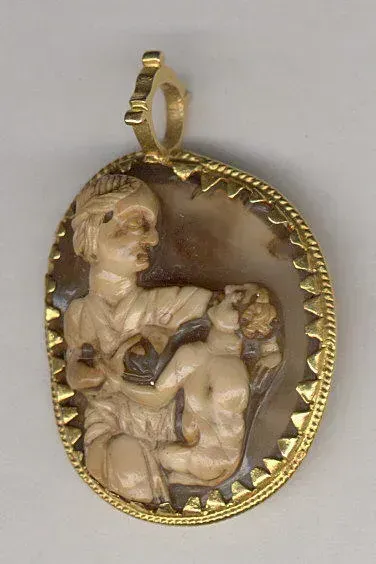
Agate is one of the oldest ornamental stones we know. It was worked in Mesopotamia and ancient Egypt, cut into beads, seals and amulets. The Greeks and Romans carved gems, cameos and intaglios from it and set them in signet rings. Classical writers tied the very word "agate" to a river in Sicily where the stone was found in abundance.
The layered structure of agate is perfect for carving: a master cuts through the top coloured layer to reveal another shade beneath, producing a raised image against a contrasting ground. The technique reached its peak in the Renaissance, when cameos of layered agate and sardonyx adorned the rings and pendants of the nobility.
Fire agate itself is a relatively new chapter. Antiquity and the Middle Ages worked with ordinary layered agates; the iridescent variety with its iron "fire" only became known and sought after once the American deposits were opened up. By gemmological standards this is a stone of the last century and a half, one that took hold in the jewellery and collecting world only in the twentieth century.
Varieties and Shades
Classic Mexican Fire Agate
This is the benchmark against which everything else is judged. The layers run red, from deep cherry to scarlet, set against orange and gold. The films are narrow and crisp, the clarity good: hold it to the light and you see several layers deep. The fire reads even under ordinary room light, not only in direct sun.
Brazilian and Other American Material
Here the layers are often thinner, the clarity variable, and you find specimens with a milky haze that smothers the play. Sometimes there are foreign inclusions, little quartz crystals or specks of pyrite. They lower the "purity" of the effect but make each stone's pattern its own.
Sagenitic Agate
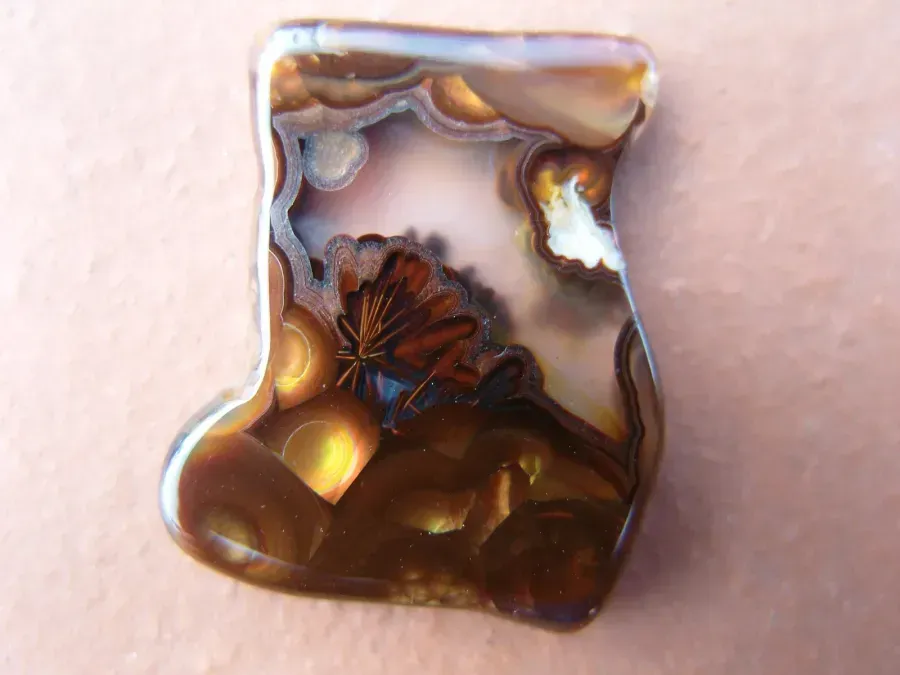
A variety with needle-like inclusions (hence "sagenitic", from the fine mineral needles inside). The specimen above is exactly this case: needles thread through the body of the stone while fire plays between the layers. A collector's piece, and a striking one.
How Lighting Changes It
Fire agate depends heavily on light. In direct sun it burns at its brightest. Under warm domestic light the effect stays strong. But under cold fluorescent tubes (offices, many shops) the stone looks more modest, just a reddish brown. Worth keeping in mind when buying from photographs: sellers often shoot the stone under perfect raking light, and in the hand it can turn out more restrained.
Customer reviews
Zevira is a real jewellery shop. Genuine payments, deliveries and customer thank-yous.
🥰🥰🥰 gracias

Ok, ¡gracias! 🙂

Why Fire Agate Is Cut "However It Falls", Not in a Perfect Oval
Ordinary gems are cut to calibrated sizes: a 7x5 mm oval, a 6 mm round, so the stone drops into a ready-made mount. With fire agate that does not work. The fire lies inside the stone in waves, folds and separate pockets, and the cutter follows those folds rather than a drawing. He grinds the dull brown chalcedony down to exactly the layer where the colour ignites, then stops. So almost every stone comes out free-form: baroque, asymmetric, with "waves" on the surface that echo how the films lie.
A few practical consequences follow for the buyer. First, every stone is unique in outline, no two alike, and matching "the same one for the second earring" is nearly impossible, which is why matched fire agate earrings are rare and command a premium. Second, the surface of a good cabochon is not always a smooth dome: that rolling relief is not a flaw, it is how the cutter kept the maximum fire. A stone polished into a perfect smooth oval often loses some of its play, because the cutter had to grind away the working layer. Third, carat weight tells you little here: a large dull stone is worth less than a small bright one. You pay for the area of living fire, not for the grams.
Upload a photo of your pet, someone you love, or an object. We'll build a 3D model and hand-cast it in pewter.




How to Judge Quality Before You Buy
Fire agate has no certified grading scale like the "4Cs" of a diamond, but experienced buyers look at five things. Check them on the stone itself, or at the very least on a video where the stone is turned under light.
- Depth and movement of the fire. Turn the stone. In a good piece the colour "flows" and flares in different places as you tilt it, as though something is burning inside. If the flash is static and does not move, you are looking at either a surface film or weak material.
- Coverage of the area. Estimate how much of the stone actually plays. In a strong stone the fire runs across most of the surface; in a weak one only a speck in the corner lights up while the rest is brown and dead.
- Range of colour. The basic red-orange is in almost all of them. The premium is justified by the extra tones: gold, green, occasionally blue-green. The wider the palette in a single stone, the rarer it is.
- Cleanliness of the background. Milky haze, whitish streaks and large foreign inclusions smother the play. A light "mist" is acceptable, solid cloudiness eats the effect.
- Quality of the polish. Run your eye over the surface under raking light. Matte patches, scratches from coarse grinding, under-polished pits all lower the brilliance. A lapidary can fix this, but in a finished piece you pay for the finish.
The sum of these traits is the "price of the fire". Size affects it last of all.
Treatment: Honest About What Is Inside
Here fire agate has an advantage rare in the agate trade. Most coloured agates on the shelf (bright blue, magenta, acid-green geode slices) are dyed: colourless chalcedony is soaked in pigment, or sugar-treated with acid and tinted. That is normal for ornamental agate, but it has nothing to do with natural colour.
Gem fire agate, by contrast, is prized precisely because its colour and play are natural and there is no reason to change them. The fire is the physics of iron films inside the stone; you cannot "paint it on" from outside. So honest fire agate is never heated, dyed or enhanced: the whole of the craftsman's work is to cut and polish it correctly, nothing more.
What does turn up on the market as genuine deception is covered below: coloured films over cheap agate, oil soaking for a temporary shine, tinting to fake the "fire". They all give themselves away because the effect sits on the surface and does not move as you tilt the stone. If the seller honestly says "natural, untreated" and the stone backs that up with play in its depths, you are holding the right material.





How to Tell It From Look-Alikes and Fakes
Fire agate gets confused with a few stones and is faked in a few ways. Here is what to watch for.
Fire agate or opal. The key difference is hardness. Opal is soft, 5.5 to 6.5 on Mohs, agate is harder, 6.5 to 7. Opal's play of light is rainbow and "jumps" across the whole spectrum (blue, green, violet), while in fire agate the shimmer stays in the warm range: red, orange, gold. Opal is also more brittle. If it is the rainbow play you are really after, there is a separate read on fire opal and its properties.
Agate with a coloured coating. Cheap pale agate is sometimes covered with a thin coloured film or tinted to mimic fire. The giveaways are runs and an unnaturally even colour at the edges, plus the fact that the "fire" does not change as you turn the stone. In genuine material the play lives and moves with the light.
Oiled stone. Cheap agate is soaked in oil or wax so it looks brighter and clearer for a while. Over time the soak evaporates and the stone dulls. An indirect sign is a greasy surface; the oil can leave a mark on a soft cloth.
Dyed agate. Dyed material more often gives itself away with an overly uniform, "chemical" orange and tinted cracks where the pigment pools more intensely.
The universal test is hardness and the character of the play. Real fire agate will not scratch under a steel knife (opal and glass will), and its fire lies deep within the layers and moves as you tilt it, rather than sitting as a flat film on the surface. For expensive specimens it is worth asking for a gemmologist's report: it confirms natural origin, nothing more.
Leave your email, we'll send your discount code. No spam, unsubscribe anytime.
The code arrives by email, valid on your first order.
Fire Agate and Fire Opal: Why They Are Forever Confused
Of all the mix-ups, the commonest is fire agate against fire opal. The names are to blame: both are "fire", both sit in warm tones, both come largely out of Mexico. They are two different minerals with different sources of colour, different durability and different fates in a piece of jewellery. Worth going through point by point, because both the price and the care depend on it.
Different Sources of the "Fire"
In fire agate the fire is iridescence on iron films, reflected light adding up to a red and orange rainbow. In fire opal everything works differently. Classic Mexican fire opal is prized above all for its own saturated body colour, from honey yellow through flame orange to something close to red. That colour belongs to the material itself rather than to interference. Some opals additionally show play-of-colour, flashes of shifting hue, but the mechanism there is different again: ordered microspheres of silica diffracting light, not metallic films reflecting it.
Different Durability and Care
Here the difference is the most practical of all. Fire agate is chalcedony with a hardness of 6.5 to 7 and a dense, anhydrous structure. Fire opal is softer, around 5.5 to 6.5 on the Mohs scale, and it holds water inside its structure. Because of that water, opal fears dry air, heat and abrupt changes: it can craze into a net of fine cracks, and that damage is permanent. Agate has no such temperament. For a ring worn every day fire agate is markedly more reliable than opal, which is why opal more often goes into a pendant or earrings, where life is calmer.
British conditions sharpen the point in an unexpected direction. A house that swings between damp autumn air and a dry, heated interior all winter is exactly the cycle that crazes opal, and a jewellery box on a shelf above a radiator is the worst place in the building. Fire agate is indifferent to all of it and only asks not to be knocked.
How to Tell Them Apart in a Minute
The quickest everyday test is the character of the light as you turn the stone. In fire agate you see a metallic shimmer that seems to come from a depth below the surface, flowing across it and staying within a warm range. In an opal with play the flashes are more mosaic, scattered in patches across the whole spectrum, greens and blues included. A plain fire opal without play simply looks like an evenly coloured honey or orange stone, transparent or translucent, with no reflective layers at all. If it is that second stone you are drawn to, there is a detailed piece on fire opal, its geology, history and how to choose it.
Fire Agate Beside the Other Agates
To place fire agate properly, it helps to set it next to its relatives in the chalcedony family. All of these stones are kin, and each has a character of its own.
How It Differs From Moss and Landscape Agates
Moss and landscape agates are valued for the picture inside a translucent mass: twigs and trees formed by inclusions of manganese and iron oxides build up into something like scenery. The colour there is calm and there is no play of light at all. Fire agate is the opposite: the pattern of its layers is secondary, and what counts is the moving glint. One stone is a frozen picture, the other is live light.
How It Differs From Banded and Ribbon Agate
Classic banded agate, the kind cameos are carved from, is layered too, but its layers are simply alternating shades of chalcedony. They are beautiful in section and they do not iridesce. In fire agate the layers are orders of magnitude thinner and work as an optical filter rather than a decorative stripe. It is in essence the same principle of layering, carried by nature down to the micron scale at which interference begins. A general survey of the whole family is gathered in the piece on the types of agate and their properties.
Banded agate also carries the deeper history of the two. It has been cut in Europe since antiquity, worked in Idar-Oberstein since the Middle Ages, and set in mourning jewellery through the Victorian decades, so British antique shops are full of it. Fire agate has none of that past, which is precisely why it turns up in contemporary pieces and almost never in inherited ones.
CAPAORA mini knife pendant
The 18th-century Spanish navaja in miniature: 40 mm of stainless steel, a real folding mechanism and a Palanquilla lock that clicks. An affordable gift to remember.
Authentic · Ships from Spain · 14-day returns
Care and Storage
A hardness of 6.5 to 7 makes fire agate a thoroughly wearable stone: it resists scratching in ordinary life. The weak point is not hardness but the conchoidal fracture: a hard knock or a fall onto a hard floor can chip the stone, especially along the edge of the cabochon. So in a ring it is best worn in a mount that shields the girdle, and the piece should come off for sport, cleaning and handwork.
A few simple rules:
- Cleaning. Wipe with a soft dry cloth after wear. When dirty, use warm water with a drop of neutral soap and a soft brush, then dry thoroughly. No alcohol, acetone, abrasive pastes or ultrasonic baths: the stone often holds microcracks, and aggressive treatment opens them up.
- Store it separately. Keep the stone in a soft pouch or its own compartment in a box, away from harder stones (topaz, corundum, garnet) that can leave scratches.
- No overheating or sudden swings. Conchoidal quartz handles thermal shock badly. Do not leave the piece on a radiator or carry it abruptly from the cold into a warm room.
- Less direct sun in storage. Prolonged ultraviolet exposure can, in theory, mute the iron colour over time. For long-term storage a darkened place is better.
If the surface loses its shine over the years, the cause is usually the polish, not the stone itself, and a lapidary can re-polish the cabochon and bring the gloss back.
Which Piece Lets Fire Agate Live Longest
The hardness of 6.5 to 7 is the same in every setting, but the risk of chipping depends on where the stone sits. The logic is simple: the fewer knocks the stone takes and the better its edge is shielded, the longer it looks new.
- Pendant and necklace are the safest choice. The stone hangs free, takes almost no knocks, and a large stone is exactly what opens the fire up to the light. Even big free forms of 25 to 35 mm work here, the sort that would be vulnerable in a ring.
- Earrings are another gentle format, but remember the matching problem: two stones with the same play are hard to pair, so good matched earrings cost more than a single pendant of the same weight. Heavy drop earrings are best on a sturdy hook, as a conchoidal fracture dislikes a stone that swings and knocks.
- Ring is the most demanding scenario. Hands hit things more than anything else, and the edge of the cabochon suffers first. Choose a mount that shields the girdle all round (a bezel, a rim), avoid a high open setting, and take the ring off for sport, cleaning and handwork.
- Bracelet is a compromise: fewer knocks than a ring, more than a pendant. A protected setting suits it, worn on the non-dominant hand.
The general principle: the closer the piece is to the hands, the more enclosed the setting should be.
Symbolism: Briefly and Honestly
Across various traditions fire agate is linked to the energy of action, to courage and to protection of the home; in the chakra system it is assigned to the solar plexus. All of this is a cultural layer, not the physics of the stone. There is no proven effect on health, sleep, blood pressure or "energy", and science recognises no healing properties in the mineral.
What is real is the warm, expressive colour and the rarity, which is why the stone has historically read as a marker of status and character. If a piece pleases its owner and means something to them, that is a question of personal meaning, not of the mineral's properties. Buy fire agate for how it looks and how rare it is, not for promised effects.
Send a friend a discount code, they save on their first order.
Fire Agate Among Collectors and Carvers
Fire agate has had an unusual career. It barely reached the great historical treasuries or any royal regalia, for the simple reason that it was recognised late. Instead it became the favourite of a different public: lapidary artists and mineral collectors, who value rarity and difficulty of work above a loud name.
Why It Is Called a Lapidary's Stone
Most gems are cut to a table of angles: the geometry is set, the shape is set, the outcome is predictable. Fire agate does not work that way. Every stone dictates its own form, and the cutter follows the fire rather than a drawing. That turned fire agate into something of an examination in skill: how much living fire a person managed to bring to the surface without taking off too much is read as a verdict on their hand. For many American lapidaries of the middle of the twentieth century, work with the local fire agate became their calling card.
The consequence for a buyer is that a fire agate carries far more of a specific person's judgement than a calibrated gem does. Two cutters given halves of the same nodule will produce stones that look nothing alike, and one of them may have a fraction of the other's fire. This is also why fire agate is rarely sold in the standard millimetre sizes that mass settings expect, and why so much of it ends up in one-off mounts.
A Stone of Local Pride in the Southwest
In Arizona and the neighbouring states fire agate has long been woven into the culture of prospecting and the rockhound trade, on much the same footing as turquoise. Amateurs with a hammer and a rucksack went looking for it in the desert, traded it at mineral fairs, passed it hand to hand. That folk history gave the stone a particular warmth: it belongs not to palaces but to a dusty road, a campfire and the thrill of a find.
Britain has its own version of that culture, built around the agates of the Scottish coast and the fairs where they change hands, so the impulse translates easily. What does not translate is the material: the fire is an American accident of geology, and a British collector meets it through a dealer rather than through a day out with a hammer.
Facts That Surprise
Fire agate is a quiet stone in a display case and a rich one in unexpected detail. A few of these change how you look at it.
It Is Not Coloured, It Is Optical
In the ordinary sense of the word, fire agate holds no red or orange colourant that burns. The warm ground comes from iron, and the rainbow itself is born from the geometry of the layers and the play of light across them. A large part of its beauty, in other words, is physics rather than substance. Grind that layer away and the colour vanishes, because the working stack of films has gone with it.
A Stone of One Hemisphere
Almost all the gem-grade fire agate on the planet comes from a narrow band of North and Central America. Most gemstones have alternative sources on different continents; fire agate essentially has none. That makes it one of the most geographically tied of the popular stones, and it is the reason a good piece can be absent from the European market for a season at a time.
Grams of Gem From a Tonne of Rough
Whether the layers lie parallel to the cut surface is a lottery. Out of a large volume of extracted material, only a small fraction yields a decent gem, and the rest is either dull or has its films lying at an unhelpful angle. So a large, bright stone is far rarer than the mineral's modest fame suggests.
The Fire Is Thinner Than a Wavelength of Light
The iron films that produce the interference are measured in fractions of a micron, which is to say they are thinner than the wavelength of visible light. That is exactly why they act as an optical filter: a layer on that scale can reinforce some colours and cancel others. In effect nature has assembled inside the stone what physicists build by vapour-depositing coatings onto lenses and mirrors.
A Relative of the Soap Bubble and the Butterfly Wing
The same mechanism that colours fire agate colours a soap film, a patch of petrol on wet tarmac, the nacre of a shell and the wing of a tropical morpho butterfly. All of these are structural colours: they arise from the architecture of a surface rather than from any pigment. Fire agate is a rare case in which such structural colour was created neither by living tissue nor by a film of liquid, but by rock.
Carat Weight Says Almost Nothing About Value
With most gems, larger means dearer. With fire agate the rule breaks: a dull heavy stone is worth less than a small one with saturated, moving fire. What is paid for is the area and the depth of living light, and the grams are secondary. This confuses buyers who are used to reasoning carat by carat, and it is the single most useful thing to know before walking into a negotiation.
Matched Earrings Cost More, and Fairly So
Since no two stones are ever alike, matching a pair with a similar pattern and comparable strength of fire is genuinely hard. Good matched fire agate earrings therefore cost noticeably more than a single stone of the same weight. That gap is not a seller's mark-up but the real scarcity of a lucky coincidence.
Frequently Asked Questions
Does fire agate glow in the dark?
No. This is a common misconception. The stone is neither luminescent nor radioactive. The "fire" effect is the reflection and iridescence of light on the iron layers; in complete darkness you see nothing.
How does fire agate differ from opal?
In hardness and the character of the play. Opal is softer (5.5 to 6.5 against agate's 6.5 to 7) and more brittle, and its play is rainbow across the whole spectrum. In fire agate the shimmer stays in the warm red-orange range, and the stone itself is tougher and better at everyday wear.
Can you wear fire agate every day?
Yes, if the stone is protected. A ring with a cabochon in a closed setting, or a pendant on a chain, will last for years. The key is to protect the stone from knocks and to take it off for sport and physical work: the hardness is high, but the conchoidal fracture leaves it open to chipping.
Where is fire agate mined?
The main source is Chihuahua state in Mexico. It also turns up in the American southwest (Arizona, California) and in Brazil. This is a stone almost exclusively of American deposits.
Does fire agate occur naturally green?
The iridescence occasionally gives green and blue-green flashes, but the base of the colour is iron-based, that is, red-orange. Richly green specimens are rare and not often seen in jewellery.
How do you tell a natural stone from a dyed or oiled one?
Check the hardness (agate will not scratch under steel), look at the play as you tilt it (in a genuine stone it lives in the depths rather than sitting as a flat film), inspect the edges for runs and unnaturally even colour. An oiled stone can leave a greasy mark on cloth. For expensive specimens a gemmologist's report makes sense.
Can fire agate irritate the skin?
Chalcedony itself is inert and causes no allergy. If your skin reacts, the cause is almost always the metal of the mount (nickel in a cheap alloy, say) or the adhesive. A hypoallergenic mount solves it.
Is fire agate a man's or a woman's stone?
The mineral has no gender conventions. The warm, expressive colour suits anyone; the choice comes down to taste and style, not to any "belonging" of the stone.
Buying it as a gift? Each one arrives ready to give.
 A branded Zevira box and a little card come with every order.













About Zevira
Fire agate is a rare stone: of all the rough mined, only a small part is fit for a jewellery stone, where the layers lie correctly and the fire reads at a glance. In the Zevira collection we select exactly those stones, with crisp orange-red layers, good clarity and play that holds beyond direct sun alone.
Every stone we check for natural origin and soundness, and we choose the setting to shield the stone's edge without muting its play. A piece with fire agate from our collection is built for long wear and for staying in the family.
Find a piece with fire agate
The Zevira collection holds rare stones with pronounced play of fire. Every fire agate is unique in the pattern of its layers.
Go to the catalogue