Nuumite: the black stone with golden sparks, three billion years old
Most of the stones in your jewellery are younger than the dinosaurs. Nuumite is older than life itself. Its crystals formed roughly three billion years ago, when the Earth had no fish, no plants and nowhere near the oxygen we breathe today. That black surface scattered with golden, blue and copper sparks, the ones that catch fire when you tilt the stone, is no optical trick. It is the trace of processes that ran for longer than every living thing has existed.
You rarely see this stone sitting in a shop window next to the familiar agates and amethysts. It comes from a single district in Greenland, mining there is brutal, and the stone is temperamental to cut. So it has earned a particular reputation: a stone for people who look for depth rather than dazzle.
Let us go through it honestly: where it comes from, why it sparkles, what in the legends is true and what was invented by sellers, and how to pick a genuine mineral rather than a dyed fake.
What nuumite is and why it looks like a night sky
Nuumite (sometimes spelled nuummite) is not a single mineral but a rock. More precisely, it is a dense intergrowth of two minerals from the amphibole group: anthophyllite and gedrite. They form thin elongated crystals lying almost parallel to one another. When light strikes the polished surface, it reflects off these crystals at different angles and scatters into coloured flashes. Geologists call this effect iridescence; in plain speech we just say the stone plays.
The colour of the sparks depends on the thickness of the crystal plates and the angle from which you view them. Gold and bronze flash most often. Blue, violet, green and copper-red are rarer. In the best specimens you can see almost the whole rainbow if you turn the stone slowly under a lamp. The background stays deeply black throughout, sometimes with a grey sheen.
Wear the symbol, don't just read about it. These are in stock:




Nuumite plays differently from labradorite or spectrolite, the stones it is often confused with. Labradorite shows iridescence in broad sheets of flame that seem to float across the surface. Nuumite's sparks are small, scattered, point-like. It looks like embers in which golden coals are smouldering, or a night sky where the stars flare and fade as you move your head. That very granularity is what made the stone recognisable.
On hardness it sits around 5.5 to 6 on the Mohs scale. That is a middling figure: harder than glass, softer than quartz. In practice this means the stone will survive careful wear for years, but it dislikes knocks against hard surfaces and the company of tougher stones in the same box. Its relative softness, incidentally, is one reason cutting it counts as delicate work: polish it wrongly and the sparks dim, while the layered structure can split.
Where the name came from
The stone's name comes from the Greenlandic settlement of Nuuk, more precisely from a spot called Nuummiut near the fjord where the mineral was first described and began to be mined systematically. The name stuck in the 1980s, when nuumite started reaching the jewellery market as a material in its own right.
Before that, specimens went mostly to mineralogists and museum collections. The stone was known to science but not to the wider public. The word nuumite itself points literally to the land near Nuuk, to the Greenlandic coast.
You sometimes see trade names like "storm stone" or "magic stone of the north" on sale. Curiously, the nickname "storm stone" rightly belongs to a quite different mineral, pietersite with its swirling pattern, and it gets pinned to nuumite only for the sake of mystery. These are marketing labels, not geological terms. There is one geologically correct word: nuumite.
What the stone is made of
Nuumite is mostly anthophyllite and gedrite, two amphiboles close in nature. Both are silicates of complex composition, rich in magnesium and iron. It is the iron, in large part, that gives the rock its dark, almost black colour.
The thin needle-like crystals of these minerals grew in an orderly way, in layers. Between the layers, light refracts and interferes, and that is where the coloured flashes come from. In essence, nuumite is a natural example of the same physics that makes a butterfly's wing or a film of petrol on a puddle shimmer. Only here the effect is locked inside a stone billions of years old.
History: from the Inuit to European laboratories
The mineral's history splits into two very different parts. The first lasts millennia and is barely documented. The second began less than half a century ago and is logged by date.
The stone the Inuit knew
Greenland is home to the Inuit, descendants of cultures that reached the Arctic thousands of years ago. The Palaeo-Eskimo Saqqaq culture existed on the island's west coast from roughly 2500 BCE. Later it gave way to the Dorset and Thule cultures. All of them lived quite literally on the lands where nuumite lies, and they could hardly have failed to notice the unusual black stone with sparks in the cliffs of the fjord.
No direct written evidence survives: these cultures had no writing, and archaeological finds made of this particular stone are extremely scarce. So the honest statement is this: we know that people lived beside the deposit for thousands of years and saw this stone, but to claim the Inuit wore it widely as an amulet would be guesswork. More likely the stone belonged to a broader stratum of northern beliefs about the powers of earth, ice and darkness. A good story should not stand in for the facts.
The polar night, which lasts for weeks at Greenland's latitude, made darkness and light the central images of local mythology. A stone that hides light inside the dark fitted that worldview perfectly. So it is no surprise that the mineral gradually gathered a reputation as the stone of darkness and hidden fire.
Arrival in science
The systematic description of the rock is tied to the geological surveys of Greenland in the twentieth century. The region around Nuuk, known for the Isua belt and the neighbouring complexes, had long drawn geologists: some of the oldest rocks on the planet are preserved here. Studying these complexes, researchers recorded the characteristic iridescent amphibole rock. For geologists it was interesting first of all as part of the most ancient crust, not as a jewellery material.
Nuumite entered the mineralogical literature in the second half of the century. For a long time it remained a narrowly specialist material, of interest to collectors and scientists but not to the general public. Jewellery was hardly on the agenda: the stone was reckoned too rare and too tricky to work. Only a few cutters took it on, and their pieces circulated within a small circle of connoisseurs.
Reaching the jewellery market
The turning point came in the 1980s. The Greenlandic authorities and individual entrepreneurs began limited mining of the stone to sell as an ornamental and jewellery material. The first cabochons, pendants and silver settings appeared. Its rarity and striking play made the stone coveted by collectors, and the earliest pieces went to a narrow but devoted band of admirers.
From the 1990s, and especially through the 2000s, nuumite acquired a settled reputation as a rare protective stone, largely thanks to books and articles about crystal properties. Let us say plainly at once: those descriptions belong to the realm of belief, not proven fact. But they are what shaped the stone's modern image. Marketing and esoterica layered themselves over the real geological antiquity, and out came a recognisable myth in which truth and invention are tangled together.
Knowing the history helps you separate fact from advertising. When a seller says ancient shamans wore nuumite, he stretches thin data into a pretty legend. When he says the stone formed three billion years ago, he reports a geological fact. Once you grasp the difference, you stop overpaying for a fairy tale and start valuing the stone for what it really is: rarity, antiquity and a unique play of light.
Nuumite earns its keep under a warm lamp, mid-turn. Sit rigid under office strip-lighting and you are wearing a lump of coal, don't blame the stone.
What to wear nuumite with
Years on shoots taught me one thing about nuumite: it does not shout, it smoulders, and the whole trick is getting that smoulder into the light. Here is what actually works, sorted by occasion.
What do I wear nuumite with every day? For everyday I recommend a pendant on a medium or long chain over a plain, unpatterned top: knit, cotton, linen. Against graphite, wine or dark green the golden sparks read clearly, while a busy print smothers them. An open neckline, a boat or a V, drops the pendant onto skin, where it catches light with every step.
Does it work at the office? It does, as long as you keep it to a minimum. I suggest one pair of plain cabochon earrings or a slender pendant, with nothing piled on top. Under a strict blouse or blazer nuumite acts as a quiet accent with character, not a loud one. It never breaks the businesslike tone.
How do I build an evening look? For the evening I open the stone up fully. Warm lamplight kindles the gold and copper, so a large pendant or teardrop earrings turn dramatic. On a black, navy or emerald dress nuumite smoulders like a coal, and that reads nobler than any glitter.
Silver or gold under it? I choose by the look I am after. Silver 925 gives strict, graphic lines and deepens the black. A golden tone runs warmer and echoes the sparks in the stone. Mixing both in one look is fine, as long as one metal leads and the other only supports.
And layers or stacked rings? Layers are welcome, but keep them restrained. To a nuumite pendant I add a fine plain chain with no charm, not a second loud stone, since a crowded field kills its subtle play. In a stack of rings I make the nuumite one the soloist and keep the rest narrow and calm.

Turn on your camera, pick earrings, a pendant or a ring, and see the piece on yourself in real time.
Switch items in one tap.
Everything runs in your browser: no photo or video is ever uploaded.
Geology and deposits: why nuumite comes almost entirely from one place
The mineral's defining feature, more important than the sparks and the legends, is its geography. The genuine, classic stone comes from a single district on the west coast of Greenland, near the town of Nuuk. That makes it one of the most geographically restricted jewellery materials in the world.
Age: three billion years
The rocks of the Nuuk region belong to the Archean eon, the oldest stretch of Earth's history. The parent complexes are dated to roughly 2.8 to 3 billion years, and some neighbouring formations are older still.
For comparison: the dinosaurs died out around 66 million years ago, so nuumite is tens of times older than they were. When the mineral already existed, life on Earth amounted to nothing more than the simplest microbes in the ocean.
When people say nuumite is one of the oldest stones on Earth, that is not an exaggeration but an accurate phrasing. The planet does hold older mineral grains (individual zircon crystals over four billion years old), but as a whole iridescent rock fit for cutting, nuumite holds its place among the most ancient. You do not need to believe in magic to appreciate that you are holding a witness to a time when the planet was only forming its crust.
How it formed
Nuumite was born deep underground, under enormous pressure and at high temperature. The original ultramafic rocks underwent metamorphism: their mineral makeup was rebuilt, and from it crystallised the thin needles of anthophyllite and gedrite. These needles grew in an orderly fashion, layer upon layer. It is their parallel arrangement that gives the very iridescence the stone is prized for. Without that strict order you would simply have a black stone with no play.
The process took a colossal span of time and ran under conditions that have long since stopped recurring at the Earth's surface. The Archean crust formed in an environment strikingly unlike today's: a different atmospheric makeup, a different thermal regime for the planet. So no one tries to reproduce the stone artificially at industrial scale: it is easier to find lookalikes than to synthesise the genuine rock.
The Greenland deposit
The main mining is concentrated in the fjord district near Nuuk. Conditions there are harsh: an Arctic climate, a short working season, difficult access. Mining is limited and controlled, so output volumes are small. That directly explains why good nuumite is rarely found in mass-market shops. Logistics from the Arctic do not help either: every kilogram of raw material makes a long journey to the cutter.
The Greenlandic mineral is regarded as the benchmark. It has a deep black background and a bright, varied play of colour. The best specimens deliver, beyond gold and bronze, blue, violet and green flashes. Pieces like that are valued most highly by collectors. The stone has become a kind of calling card for the island in the world of minerals, a recognisable symbol of Greenlandic geology.
Similar rocks from other places
Sometimes similar iridescent amphibole rocks from other regions are sold under the name of nuumite. In Canada and a few other places, for instance, you find stones with a comparable effect that go by trade names such as larvikite or spectrolite. These are different materials. They too are beautiful, but they are not Greenlandic nuumite, and their history and composition differ. Their play is often of another kind, and their origin is quite separate.
The key thing here is not to confuse an honest alternative with a fake. A seller who calls a stone spectrolite or iridescent labradorite outright is hiding nothing. The trouble begins when a lookalike is passed off as Greenlandic nuumite and priced accordingly.
Reserves and the future
Because nuumite is tied to a specific Arctic deposit with limited mining, there will never be more of it. Unlike the common stones mined the world over, nuumite is finite by the very nature of its geography. That gives it the status of a stone for people who value rarity, and at the same time explains why genuinely high-quality specimens only grow dearer over time. In this nuumite resembles charoite, mined at the only deposit on the planet: such narrow geography alone makes a stone special.
Customer reviews
Zevira is a real jewellery shop. Genuine payments, deliveries and customer thank-yous.
🥰🥰🥰 gracias

Ok, ¡gracias! 🙂

Types and shades: how nuumite specimens differ
Although the mineral comes from almost a single district, specimens differ noticeably from one another. The differences concern the colour of the background, the brightness and palette of the sparks, the pattern and the overall character of the stone.
By background colour
Classic nuumite is coal-black. But the background varies: from a saturated pitch-black to a dark grey with a graphite sheen. The deeper and more even the black, the more striking the sparks look against it. Grey specimens look softer and quieter; the golden flashes on them are less contrasting.
By spark colour
This is the main parameter by which nuumite is valued. The most common palette is golden-bronze: warm sparks recalling the glint of copper or old gold. That is the classic, recognisable look of the stone.
Rarer and therefore more valuable specimens add blue, violet, green and copper-red flashes. A stone in which several colours flare at once as you turn it is reckoned outstanding. Interestingly, the same stone can show different colours depending on the lighting. Under the warm light of an incandescent lamp, gold and copper play more brightly; under cool daylight, blue and green tones tend to emerge.
By pattern
The crystal needles inside the stone are not always arranged perfectly parallel. Because of this the spark pattern varies. In some specimens the flashes run in even bands, in others they curl in waves, in still others they scatter chaotically like stardust.
When cutting the raw material, the lapidary chooses the direction so as to reveal the most expressive play. This is hand work, almost jeweller's work: one and the same lump of rock can be turned into either a dull cabochon or a glowing one. That is exactly why two pendants made from neighbouring pieces of one block can look completely different.
Cutting and shape
Nuumite is almost always worked into a cabochon, that is, a smooth domed stone without facets. The reason is simple: iridescence is best revealed on a rounded polished surface, where light glides and lights the sparks one after another. Faceting with sharp edges does not suit nuumite: it fragments the play and loses depth. A black opaque stone with facets would look flat and dull.
The rock is made into cabochons of various shapes: oval, round, teardrop, rectangular with rounded corners. Large even pieces without cracks are valued more highly: they yield striking inserts for pendants and signet rings. Small fragments go into beads and modest earrings.
Quality grades in plain words
Basic stone: a dark background, modest golden play, small sparks, visible cracks. Such a stone is still beautiful, but without much effect.
Mid level: an even black background, expressive gold-bronze iridescence, a clean surface. This is a sound, pleasant stone for everyday jewellery.
Top level: a deep black, multicoloured play with blue and violet flashes, a large clean cabochon free of defects. The higher the level, the rarer the stone and the dearer it costs.
Upload a photo of your pet, someone you love, or an object. We'll build a 3D model and hand-cast it in pewter.




The meaning and reputation of the stone
People do not buy nuumite for its looks alone. A symbolic reputation has built up around it, and it is worth working out what rests on fact and what on a pretty tradition.
The most honest meaning: age
The strongest and at the same time the truest symbolic meaning of nuumite is its age. To wear a piece of rock older than all life on Earth is a tangible reminder of the scale of time. The stone becomes a quiet philosophical object: it outlived the appearance and disappearance of countless forms of life and will outlive us. This meaning requires no faith in the esoteric; it is simply true. Therein lies nuumite's strength as a symbol: its chief meaning rests on fact, not on legend.
The stone of darkness and hidden light
Because of the black background and the sparks hidden inside, the stone is often called the stone of inner work. The image is telling: darkness on the outside, a light hidden within that shows itself in movement. In crystal books this image is read as a metaphor for self-knowledge. That is poetry, not a property of the rock, but the image is a fine one and did not arise out of nothing.
In lithotherapy, the tradition of belief in the healing properties of stones, nuumite ranks among the chief protective stones. The logic is simple: black has long been linked with protection, and antiquity is read as a symbol of steadiness. Dark stones in various cultures traditionally played the role of a shield, and nuumite fell into that line. The boundary here is straightforward: this is a system of belief, not a proven fact. The stone does not heal or protect in the physical sense, and there is no scientific support for it. We describe the tradition because many buyers find it interesting, but we do not pass it off as fact.
Whom nuumite suits by character
The mineral draws people who feel an affinity for restraint, depth, understated strength. It is not a stone for show: its beauty unfolds up close, in movement, for the one who looks carefully. So it often becomes the choice of those who have tired of bright sparkle and want something more personal and quiet.





Jewellery with nuumite: rings, pendants, earrings, bracelets
Now to the most practical part: how this stone lives in jewellery, which metals suit it and what to watch for when choosing a setting.
Pendants
The pendant is the most frequent format for the mineral, and there are reasons for that. On the chest the stone gets the most light and plays constantly as you move. What is more, a pendant is hardly ever knocked, unlike a ring, so nuumite's relative softness is no danger. A large cabochon in a simple setting looks deep and dignified: a black background in which golden sparks flare with every step. The plainer the setting, the harder the stone works.
Nuumite reveals itself best in silver. The cool gleam of 925 silver underlines the black background and does not quarrel with the stone's golden sparks. You can read more about the metal in the piece on 925 sterling silver.
Rings
A ring with nuumite is at once a man's and a woman's option: the dark stone looks restrained and suits both. But there is an important caveat here. A ring meets surfaces every day, and nuumite is softer than many stones. So a ring with nuumite is best worn carefully: take it off for physical work, do not knock it against tables, keep it from falls.
A good ring setting protects the stone with a rim around the edge of the cabochon. Such a bezel setting covers the vulnerable edges and lowers the risk of chips. Massive signet rings with the stone in silver are popular with those who like large, characterful jewellery: a dark stone in a heavy silver setting looks solid.
Earrings
Earrings with nuumite are flattering because the stone ends up in motion: as you turn your head the sparks flare and fade, creating a living play near the face. For earrings people usually take small or medium cabochons so they are not heavy. The teardrop shape is especially good: it draws out the line and catches the light beautifully. Since earrings are hardly subject to mechanical strain, the stone's softness is no problem at all here. This is one of the safest formats for nuumite in terms of preservation.
Bracelets
A bracelet with this stone comes in two types. The first: a single large cabochon in a setting, a kind of centre stone on the wrist. The second: nuumite beads strung in a row. A bead bracelet gives a special effect: dozens of small black spheres shimmer with gold as the hand moves, like a handful of smouldering coals.
The bracelet has a quirk: the wrist often brushes surfaces, so the stone here is at more risk than in a pendant or earrings. Beads, though, are more robust than a single cabochon: even if one gets scratched, the overall look of the bracelet does not suffer. If you want to wear the stone every day and actively, a bead bracelet will be a sensible choice.
Which metal to choose
925 sterling silver is the classic for the rock: the cool tone of silver sets off the black background perfectly. Those who prefer warm metals will like a gold-coloured setting: a golden frame echoes the stone's golden sparks and creates a whole, warm look. The main thing is to avoid overly busy, glittering settings packed with small stones; they distract from nuumite's own play. The stone likes a restrained frame that works for it, not against it.
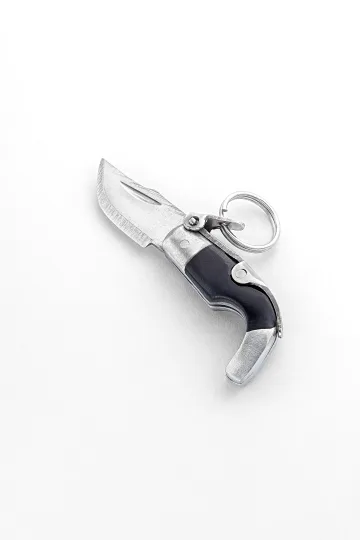
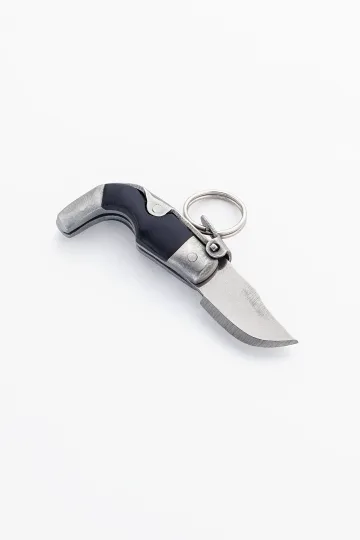
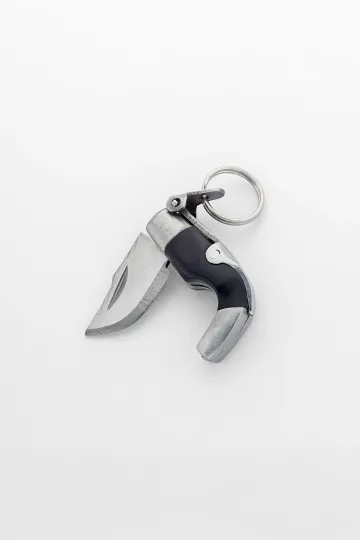
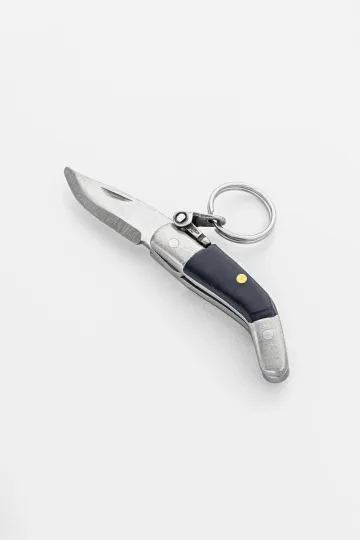
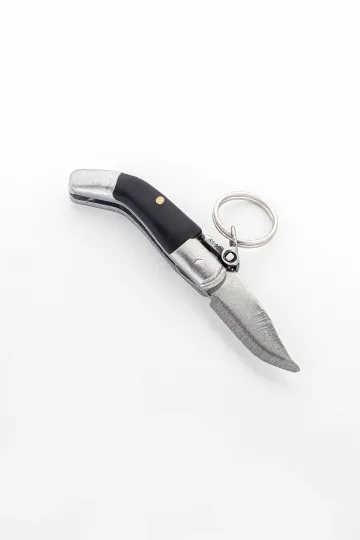
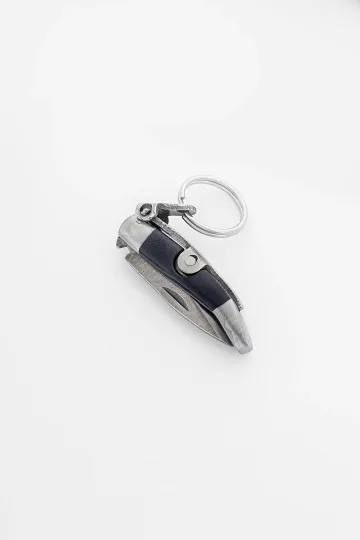
CAPAORA mini knife pendant
The 18th-century Spanish navaja in miniature: 40 mm of stainless steel, a real folding mechanism and a Palanquilla lock that clicks. An affordable gift to remember.
Authentic · Ships from Spain · 14-day returns
How to wear and care for nuumite
The mineral needs a little more attention than hard stones, but there is nothing complicated in its care. A few simple rules will preserve its play for years.
Careful handling
Because of its hardness of around 5.5 to 6, this stone is afraid of knocks and scratches from harder objects. Do not keep it in the same box as hard stones such as quartz, topaz or corundum: they will easily leave marks on it. Store nuumite separately, in a soft pouch or in a compartment with a fabric lining.
Take jewellery with the mineral off before sport, cleaning, manual work or a trip to the pool. The stone dislikes sharp knocks against hard surfaces and contact with aggressive chemistry. This applies especially to rings and bracelets, which more often come under strain.
Cleaning
Clean nuumite gently: warm water, a drop of mild soap, a soft cloth or brush. Afterwards wipe the stone dry. Avoid ultrasonic and steam cleaning: vibration and sharp temperature swings can harm the iridescent structure. No aggressive solvents, bleaches or abrasive pastes: they can damage the polish and mute the play.
Do not leave nuumite for long in direct sun or near sources of strong heat. The rock itself is stable, but sharp temperature swings are the worst enemy of any stone with a layered structure.
How often to wear it
The stone is easily worn daily if you choose a safe format (a pendant, earrings) and handle it carefully. For active everyday wear a pendant on a long chain or earrings will do better, while a ring and a bracelet are best saved for occasions when the hands are free. With sensible handling the stone will serve for decades, keeping its play.
Which stones nuumite pairs with
The mineral is self-sufficient; its deep black background looks good on its own. But in combinations it is expressive too, if you pick partners by contrast.
Light stones beside black nuumite give a strong contrast. Moonstone with its milky glow, white or smoky quartz, pearl, all of these underline nuumite's darkness and its sparks. Such a union looks like night and moon: a dark background and a soft light accent.
Warm stones such as amber, carnelian and citrine echo the stone's golden sparks and create a cosy warm range. This is a less contrasting but harmonious combination for those who like soft transitions.
If you want to stay in the dark palette, nuumite chimes beautifully with Tahitian black pearl: both are dark, but one plays with sparks, the other with a soft pearly sheen.
What to avoid: do not combine nuumite with a profusion of bright multicoloured stones; a busy surrounding drowns its subtle play. Also do not wear nuumite hard against harder stones in one bracelet, so they do not scratch each other. The best principle: give this stone room, one or two quiet partners in colour, no more.
Leave your email, we'll send your discount code. No spam, unsubscribe anytime.
The code arrives by email, valid on your first order.
Nuumite compared with other dark stones
There are many dark stones, and buyers often waver between them. Let us work out how nuumite differs from its lookalikes by colour and when it is worth choosing precisely this one.
Nuumite and onyx
Black onyx is a variety of chalcedony: an even, matte-deep black stone with no play. It is cheaper, more widespread and harder than the rock. People choose onyx for a clean, calm black with no effects, and nuumite for antiquity and a hidden play of sparks. In essence, it is a choice between strict plainness and dark depth with a spark.
Nuumite and haematite
Haematite is a metallically shiny grey-black stone with a mirror surface. It is heavy, dense, with a characteristic steely sheen. Haematite shines with an even metallic light, while nuumite shines with scattered coloured sparks. If you want a cool metallic gleam, that is haematite; if a warm shimmering play, that is nuumite.
Nuumite and obsidian
Obsidian is volcanic glass, smooth and uniformly black, sometimes with a rainbow or silvery sheen in certain varieties. It formed as lava cooled and is geologically young compared with nuumite. The chief difference lies in age and nature: obsidian is frozen glass, nuumite an ancient crystalline rock with ordered needles.
Nuumite and black tourmaline
Black tourmaline (schorl) is simply black, with no play, whereas nuumite flares with sparks. In composition they differ: tourmaline is a borosilicate, nuumite an amphibole rock. Tourmaline is cheaper and more widespread, mined in many countries. If the play of light matters to you, the choice is obvious.
When to choose nuumite specifically
It is worth choosing nuumite when you want three things at once: a deep black colour, a hidden colour play and a sense of antiquity. None of the stones listed combines all of that simultaneously. But if only the black colour or only the budget matters, take a closer look at onyx or tourmaline.
How to choose nuumite and tell a fake
Since the genuine stone is rare, the market holds substitutes and outright fakes. Let us work out what to look for.
What to pay attention to
The play of light is the chief sign of quality. Turn the stone under a lamp: genuine nuumite lights up with small scattered sparks that travel as you move. The brighter, the more varied in colour and the more even that play, the better the specimen. A dull stone with no living iridescence is most likely low-grade or not nuumite at all.
Look at the background: it should be deeply black or dark grey, even, with no unnatural sheen of paint. Check the surface for cracks and chips, especially along the edges of the cabochon. Small natural inclusions are acceptable, but large cracks reduce both beauty and strength.
Common substitutions
What most often gets passed off as nuumite are other iridescent stones: labradorite, spectrolite, larvikite. They are similar in effect, but their play is of another kind, in broader sheets rather than small sparks. This is not a fake in the strict sense if the seller has named the material honestly. But if such a stone is sold as Greenlandic nuumite at the matching price, that is deceit.
There are also crude fakes: dyed glass or pressed crumb with glitter. They give themselves away by the unnaturally even, metallic gleam of the sparks, the lack of depth and a suspiciously low price. Genuine nuumite plays softly and shimmering, it does not sparkle like Christmas tinsel.
A short checklist before buying
First: turn the stone under directed light. Genuine nuumite responds with small running sparks.
Second: assess the background. It should be deep and even, with no traces of paint or unnatural gloss.
Third: inspect the edges of the cabochon. Cracks and chips along the edge are a weak point, especially for a ring.
Fourth: clarify the origin. Greenlandic nuumite and related stones from other regions are not the same thing, and an honest description of the material saves you from confusion.
Fifth: weigh the price against common sense. Too cheap for a rare Arctic stone is almost always a warning sign.
The geological scale: where nuumite sits on the ribbon of time
Nuumite's age is easier to grasp if you lay out a simple ribbon of time.
Nuumite formed around 2.8 to 3 billion years ago, in the Archean eon. At that time the Earth already had a solid crust and oceans, but the atmosphere held almost no free oxygen. Life existed only as the simplest single-celled microbes.
The Great Oxidation Event, the saturation of the atmosphere with oxygen, happened roughly 2.4 billion years ago, that is, already after nuumite formed. The first complex multicellular organisms appeared around 600 million years ago, when the mineral had already existed for more than two billion years. The dinosaurs ruled the planet from roughly 230 to 66 million years ago, and nuumite was tens of times older than they were.
Modern humans as a species have existed for about 300,000 years, writing for only a few thousand. When you hold a pendant with nuumite, you hold an object whose age exceeds the whole history of humankind by tens of thousands of times. That is its chief, entirely honest meaning. Most stones in jewellery are geologically young, while nuumite is a rare case where antiquity is not a metaphor but a measurable fact.
Send a friend a discount code, they save on their first order.
Cutting and working: the path from block to cabochon
To turn a lump of dark rock into a piece of jewellery, nuumite goes through several stages. Understanding the process helps you judge what you are paying for.
First the block is sawn into slabs. This is the key moment: how the iridescence reveals itself depends on the direction of the cut. The crystal needles inside lie at a certain angle. Cut the rock the wrong way and the sparks will barely show; the stone will come out dull. An experienced master studies the lump, looks for the direction in which the play is greatest, and only then cuts.
From the slab a cabochon blank of the required shape is cut, then ground down, giving it a smooth dome. Grinding goes from coarse abrasive to ever finer. Care matters at this stage: nuumite is softer than many stones, and too aggressive a treatment can split the structure.
The final polish is the most responsible step. It is what reveals the play: a smooth mirror surface lets light glide and kindle the sparks. A poor polish mutes the iridescence, and even a good stone looks faded. So the quality of the cut is valued almost on a par with the quality of the raw material itself.
Unlike transparent stones, where cutting is largely standardised, nuumite demands an individual approach to each piece. No two blanks are alike. So good nuumite is always the result of hand work, of thoughtful labour, and that is one reason the stone never became mass-market: it cannot be run off a conveyor without losing quality.
Nuumite as an object for collecting
Beyond jewellery use, this stone is prized by mineral collectors. They look at beauty, purity of origin, the size of the piece, the strength and the many colours of the play. A specimen with confirmed Greenlandic origin and bright blue or violet iridescence is valued especially highly. Both effective rough material with a striking pattern and masterfully cut cabochons are prized.
For geologists nuumite is valuable as part of the planet's most ancient crust. The rocks of the Nuuk region help us understand how the early Earth formed, and the study of such complexes sheds light on the conditions in which the planet existed billions of years ago. So nuumite is interesting both as jewellery and as a piece of scientific history.
Although quality specimens grow dearer over time, you should not buy nuumite purely as an investment: its market is narrow and liquidity low. The chief value of nuumite for most people is emotional and philosophical. You hold a witness to a time when life was only beginning.
Buying it as a gift? Each one arrives ready to give.
 A branded Zevira box and a little card come with every order.








Frequently asked questions
Is nuumite a precious or an ornamental stone?
Formally, nuumite is classed among ornamental, or gem-ornamental, stones rather than the precious ones in the classic sense. The precious stones are traditionally the transparent hard ones such as diamond, ruby, sapphire and emerald. Nuumite is opaque and comparatively soft, so it does not fall into that group. But that does not make it second-rate: its rarity and antiquity are highly valued, and the best specimens cost more than many semi-precious stones.
How old is nuumite really?
The parent rocks from the Nuuk region of Greenland formed roughly 2.8 to 3 billion years ago, in the Archean eon. That makes the stone one of the oldest iridescent stones used in jewellery. To picture it: the dinosaurs lived tens of millions of years ago, and nuumite is tens of times older than they were. Individual mineral grains on Earth can be older still, but as a whole rock fit for cutting, nuumite really is one of the most ancient.
Why does nuumite shine and shimmer?
The effect is called iridescence. Inside the stone lie the finest needle-like crystals of two minerals, anthophyllite and gedrite, arranged in almost parallel layers. When light passes through these layers and reflects off them at different angles, it scatters into coloured flashes: golden, blue, copper, green. As the stone turns, the angle changes, and the sparks flare and fade. It is a purely physical phenomenon, kin to the play on a butterfly's wing or a soap bubble.
How does nuumite differ from labradorite?
Both stones are iridescent, but differently. Labradorite plays in broad floating sheets, usually blue, green or golden, that cover large patches of the surface (this effect is called labradorescence). Nuumite's sparks are small, point-like, scattered, like stars in a black sky. In addition, labradorite's background is more often grey-blue, while nuumite's is deeply black. The origin differs too: labradorite is widespread in many regions, while classic nuumite is almost exclusively Greenlandic.
Are nuumite and spectrolite the same thing?
No. Spectrolite is a trade name for an especially bright iridescent labradorite, mainly from Finland. It is close to labradorite in nature and gives a multicoloured play in broad sheets. Nuumite is a different rock (amphibole, not feldspar) with a different, fine-sparked play and a Greenlandic origin. Sometimes sellers use the word spectrolite as a marketing label for bright nuumite too, which creates confusion.
Can nuumite be worn every day?
Yes, given a sensible format and care. The pendant and earrings are best suited to daily wear: they are hardly ever knocked, and the stone's relative softness does not matter there. A ring and a bracelet can be worn too, but more carefully: take them off for manual work, sport and cleaning, and protect them from knocks. The main thing is to remember that nuumite is softer than many stones, and to store it away from hard minerals so that scratches do not appear.
How do you care for nuumite?
The care is simple and gentle. Clean the stone with warm water and a drop of mild soap, using a soft cloth or brush, then wipe it dry. Avoid ultrasonic and steam cleaning, aggressive chemistry, abrasive pastes. Do not leave nuumite in direct sun or near heat sources for long: sharp temperature swings harm the layered structure. Store it apart from hard stones in a soft pouch or a compartment of a box.
Is nuumite a rare stone?
Yes, and that is its key feature. The genuine stone comes almost exclusively from one Arctic district of Greenland, near Nuuk, where mining is limited by the harsh climate and difficult access. That makes it one of the most geographically restricted jewellery materials. The reserves are tied to a specific locality and will not grow, so quality specimens only grow dearer over time, and good nuumite is rare on mass-market shelves.
What colours does nuumite come in?
Nuumite's background runs from deep coal-black to dark grey with a graphite sheen. The main palette, though, lies in the sparks. Most often it is gold and bronze, warm copper flashes. Rarer and more valuable specimens add blue, violet, green and copper-red sheets. Lighting matters too: warm light brings out gold, cool light the blueness.
Where does the name nuumite come from?
The name comes from a Greenlandic place name. The stone was named after a spot called Nuummiut near the town of Nuuk on the west coast of Greenland, where the mineral was first described and began to be mined systematically. The name stuck in the 1980s, when the stone reached the jewellery market as a material in its own right. Names found on sale such as "storm stone" are marketing labels, not geological terms.
How does nuumite differ from black tourmaline?
These are quite different stones, united only by their dark colour. Black tourmaline (schorl) is an opaque matte or faintly shiny stone with no iridescence: it is simply black, with no play of sparks. Nuumite, by contrast, flares with golden and coloured flashes when turned. In composition they also differ: tourmaline is a borosilicate, nuumite an amphibole rock. If the stone does not play with sparks, it is not nuumite.
Does nuumite suit men?
Yes, nuumite is one of the most gender-universal stones. Its restrained black background looks strict and dignified, without any fussiness, so massive signet rings and large pendants with nuumite are popular with men. At the same time the fine golden play adds depth and character to the stone, which women appreciate too. It is not a stone for show; its play unfolds up close and in movement.
Is there an artificial nuumite?
There is essentially no industrial synthetic stone grown in a laboratory the way artificial emeralds or alexandrites are. To reproduce a metamorphic rock that formed over billions of years under enormous pressure is technically not worthwhile. So what you meet on the market is not synthetic nuumite but imitations: other iridescent stones (labradorite, spectrolite) or crude fakes of dyed glass and pressed crumb with glitter. A fake gives itself away by an unnaturally even metallic gleam, a lack of depth and too low a price.
Which star sign does nuumite suit?
In the astrological tradition nuumite is most often linked with Scorpio, Capricorn and Sagittarius. This is the realm of belief, not proven fact: the stone does not choose its owner by date of birth. From a practical point of view nuumite suits anyone who likes its appearance and its symbolism of antiquity. You should not turn down a stone you like merely because of a horoscope; aesthetics and personal response matter more than any astrological table.
Can nuumite get wet?
Brief contact with water does nuumite no harm: it is calmly washed with warm water during cleaning. But prolonged soaking, hot water, a chlorinated pool and salty sea water are undesirable. Aggressive chemistry and sharp temperature swings can in time harm the iridescent layered structure and the setting. So take jewellery off before a shower, a bath, the pool and washing dishes. If the stone gets wet, simply wipe it dry.
Where is nuumite mined besides Greenland?
Classic, benchmark nuumite is almost exclusively Greenlandic, from the district near Nuuk. Similar iridescent amphibole rocks occur in other places too, for instance in Canada, but strictly speaking these are no longer Greenlandic stone but related minerals, sometimes sold under the same or a different trade name. They too can be beautiful, but they differ in composition, history and, as a rule, are valued below the benchmark Greenlandic material.
Is nuumite a heavy stone?
By density nuumite is a middling stone, heavier than quartz but not extremely dense. In practice this means a small pendant or earrings with nuumite are comfortable to wear and do not drag. A large massive signet ring or a big cabochon in a pendant, though, will be noticeable in weight. For earrings it is especially important not to take stones that are too large, so the lobes do not tire.
Can nuumite be given as a gift?
Yes, and it is a thoughtful gift. The stone suits those who value rarity, depth and meaning above bright sparkle. Its chief message is antiquity: you give a person a piece of rock older than all life on Earth. This works as a gift for significant dates or for someone who loves things with a history. The stone is gender-universal, so it suits a man and a woman alike. If you want to strengthen the meaning, choose a format the person will wear often: a pendant or earrings for an active life, a ring for special occasions.
How does nuumite look in light and in shade?
In shade or diffuse light nuumite looks almost uniformly black, calm, the sparks barely visible. But let it meet direct directed light (sun, lamp, torch) and turn the stone, and from the blackness flare golden, copper and blue flashes. That is exactly why nuumite is so flattering in movement. From afar a strict blackness, up close a hidden radiance noticed only by the attentive.
Can nuumite fade or dull over time?
The stone itself does not fade: its colour and play are the result of a natural structure, not a coating or dye. The black background will stay black, and the crystal layers will keep scattering light into sparks. Over time the surface polish can suffer: scratches and scuffs from careless wear mute the shine. The good news is that the polish can be restored by a master if needed.
How does nuumite differ from larvikite?
Larvikite is a feldspar rock from Norway, with a grey-blue sheen and a broad shimmering play. It is often used as a cladding and ornamental stone. Nuumite is an amphibole rock with a deeply black background and small scattered sparks. Its play is granular and multicoloured, not broad and bluish like larvikite's. If the background is rather grey-blue and the flashes broad, you are most likely looking at larvikite.
Is nuumite suitable for an engagement or wedding ring?
Technically nuumite can be set in a ring, and a dark stone with golden sparks looks unusual. But there is an important caveat on durability. Nuumite is softer than many stones, so for a ring worn without taking it off for years it is not the most practical choice: a wedding ring is subject to daily strain, and the stone can get scratched. If you do want nuumite in a ring, choose a closed protective setting and wear the piece with care.
Can nuumite be worn with gold and silver at the same time?
Yes, and this is a matter of taste, not rules. 925 sterling silver with its cool gleam underlines the stone's black background, while a golden metal echoes its warm sparks. Combining silver and gold in one look has long been normal practice. The main thing is for the metals to look deliberate: let one set the tone and the other support it.
Nuumite in the Zevira collection
We choose stones that have character and an honest history. Nuumite is one of them: ancient, rare, with a light hidden inside. Look through the jewellery with iridescent and dark stones in our collection and find the one that resonates with you.
See the Zevira collectionWear the symbol, don't just read about it. These are in stock:


About Zevira
Zevira is jewellery for those who choose meaning over noise. We do not chase loud shop windows and seasonal fashion. We are more interested in stones and symbols with a real history: ancient, rare, with a character of their own.
Nuumite fits this logic perfectly, a stone older than life on Earth that hides golden sparks beneath a black surface and reveals itself only to the one who looks closely. It is jewellery for the attentive, for those who value depth above shine.
We talk about stones honestly: where the truth lies and where the pretty legend invented by sellers begins. We believe a piece becomes truly yours when you understand what you are holding.
If the idea of understated depth, quiet strength and things with a history is close to you, take a look at the collection. And if you want to learn more about other stones and symbols, our blog has detailed pieces on rare and unusual minerals.