Pietersite: the storm trapped in stone, and why it is so hard to fake
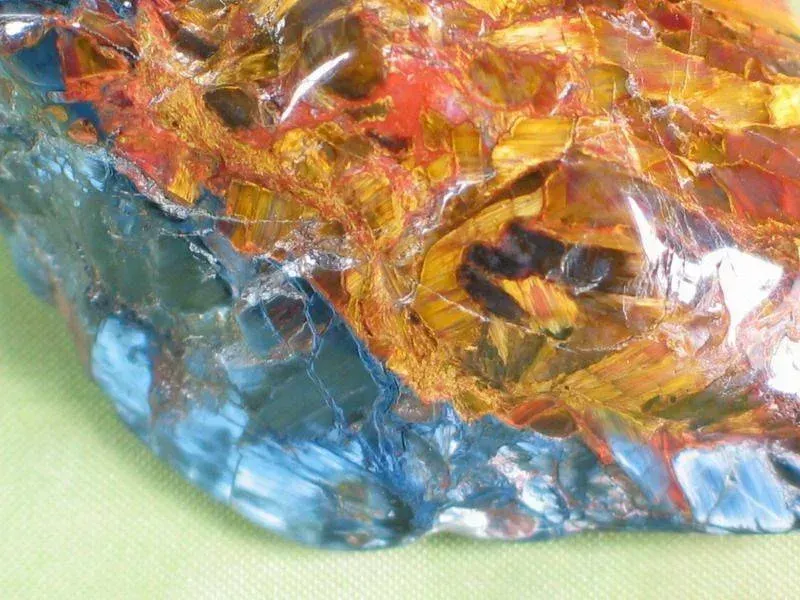
Pietersite was discovered in Namibia in 1962, and geologists nicknamed it "the tempest stone" almost at once. Inside a polished slab, the fibres change direction so that blue and gold currents twist into vortices, as if someone caught a thundery sky and froze it. The mineral itself is roughly 2.8 billion years old, older than the planet's oxygen atmosphere.
The cat's-eye effect in pietersite does not run in neat bands the way it does in ordinary tiger's eye. It comes in tangled strands, because tectonics wrenched and twisted the fibres. Tilt a slab under a lamp and the light flows across it like wind over a field of barley. No two stones can be physically identical, and that is exactly what makes pietersite rare for its price bracket.
Here we will take the stone apart on its own terms: what it is made of, how it forms in nature, how the blue Namibian material differs from the red-gold Chinese, how to tell a real pietersite from a dyed fake, and how to care for it. No mysticism, and no promises that the stone will "do" something for you.
What pietersite actually is: composition, hardness, optics
Pietersite is a variety of quartz with inclusions of fibrous minerals from the amphibole group and crocidolite, partly or wholly replaced by silica. Nature took thin mineral needles, twisted them under the pressure of the earth's crust, then flooded the mass with quartz (silicon dioxide, SiO2). When that mass is cut and polished, the needles reflect light in moving bands, producing the shimmer that mineralogists call silky lustre or the cat's-eye effect.
Chemistry and physics
The dry facts worth leaning on when you buy:
- Chemistry: a quartz base (SiO2), plus silica-replaced fibres of crocidolite (a sodium-iron amphibole) and other amphiboles.
- Crystal system: the quartz base is trigonal, but because of the fibrous inclusions and brecciation the stone behaves like an aggregate rather than a single crystal.
- Hardness: about 6.5 to 7 on the Mohs scale, harder than glass and comparable to ordinary quartz.
- Density: roughly 2.6 to 2.7 g/cm3, so about 2.6 to 2.7 times heavier than water.
- Refractive index: around 1.53 to 1.55, like quartz. Pietersite has no dispersion (the coloured fire you see in a diamond); its beauty lives in flowing light, not in faceting.
- Lustre: silky thanks to the fibres, almost glassy on a good polish.
- Optical effect: chatoyancy (cat's-eye) with a swirled, "stormy" pattern instead of a single straight line.
Colour rests on iron and on how far the original fibres have oxidised. Blue and grey-blue tones come from unoxidised crocidolite inclusions, while gold, honey and red-brown come from oxidised ones. In a single piece these zones sit side by side, which is why good pietersite looks like the sky before a storm: a dark blue cloud slashed through with golden light.
Wear the symbol, don't just read about it. These are in stock:





To the touch, polished pietersite is cool and smooth. A hardness of 6.5 to 7 is enough for rings, pendants, earrings and bracelets, but a sharp knock against tile or ceramic can chip the edge of a cabochon. Harder stones (diamond, corundum, topaz) will scratch the polish, so pietersite should be stored on its own.
The quartz cat's-eye family
Pietersite belongs to the "cat's-eye" quartzes. The family includes tiger's eye, falcon's eye and hawk's eye. The difference lies in the structure of the fibres:
- Tiger's eye, golden brown, fibres lying parallel, a crisp straight band of light.
- Falcon's eye, bluish grey, the same parallel structure but cooler in colour.
- Hawk's eye, another name for the bluish-grey variety.
- Pietersite, fibres pointing every which way, crushed and rotated as the rock layers moved, so the light runs in twisted vortices and the palette is wider.
Pietersite is the only one of the group whose fibres are disordered. That very chaos is what makes the stone special: a perfectly ordered pietersite would simply be tiger's eye.
An honest word about symbolism
Pietersite is credited with qualities of character: will, resolve, clarity of intuition. That is part of the culture of stones and the crystal-healing currents of recent decades, not a property of the mineral. There is no proven effect on mind or body. More on the symbolism below, in a short section of its own, without making a fuss of it.
Geology: how a storm is born
To understand pietersite, picture a catastrophe in slow motion. Ordinary tiger's eye forms when fibrous crocidolite is gradually replaced by quartz while keeping its parallel structure. Pietersite is the same process, interrupted by tectonic chaos.
Brecciation: a stone shattered and glued back together
The key word in pietersite geology is breccia. Brecciation is when rock fractures into angular fragments and those fragments are then cemented together again. That is exactly what happened to pietersite: the primary fibrous layers split apart under the pressure of moving plates, the fragments turned to all sorts of angles, and silica filled the spaces between them.
Because of this, the fibre directions in pietersite are jumbled. Within a single square centimetre, light can reflect in three or four different directions. As you rotate the stone under a light source, different zones flare up in turn, giving the impression that something inside is churning and shifting.
What happened to the rock, step by step:
- First, thin parallel fibres of crocidolite grew.
- Silica-rich solutions began replacing them with quartz, giving birth to the shimmer.
- Tectonics intervened: the rock was shattered into angular fragments.
- The fragments turned to random angles.
- Silica filled the gaps between them, gluing everything together again.
- In parallel, iron oxidised, producing the multicoloured zones.
The result is an irreproducible mosaic of differently oriented shimmering patches. Every stone carries the imprint of its own geological history.
Namibia: the homeland and the benchmark
The Namibian deposit near Outjo (a district north of Windhoek) yields the most prized material. Here you find the deep blues and blue-greys that barely exist in any other source. The finest Namibian pieces combine that thundery blue with golden veins and hold a strong optical effect, the light flowing across them in long, soft waves.
Mining there is artisanal and irregular. The stone comes out in small batches, the veins are thin, and the yield of quality material is low. That is why deeply blue Namibian pietersite has always been relatively scarce.
The Namibian host rocks belong to some of the oldest formations in the earth's crust, dated at roughly 2.8 billion years. The fibres that tectonics later crushed were forming in an age when the planet held only water and the first bacteria. Hold a polished slab and you hold a piece of a very early Earth. In this, pietersite is close to nuummite, the black stone with golden sparks, whose rocks are also among the oldest on the planet.
China: the red-gold branch
In the early 1990s a shimmering stone of a similar type was found in China, in Henan province. The Chinese material has a different character: warm tones dominate, gold, honey, red-brown, sometimes with greenish and grey zones. Blue is rarer and usually softer than the Namibian. In exchange, the Chinese material is often denser, with a finer pattern and a good polish, which suits cabochon cutting. For a long time collectors argued over whether the Chinese stone counted as true pietersite. The prevailing view today is that it is pietersite, simply with a different mineral makeup in the inclusions and a different balance of oxidation. For the buyer the difference is simple: if you want thundery blue, look to Namibia; if you love warm gold and red flame, look to China. The Chinese material is sometimes sold under the trade name "tetterelite".
Other finds and a finite supply
Shimmering material of the pietersite type has occasionally been reported elsewhere, but in commercial quantities the world market rests on two sources, Namibian and Chinese. If someone offers you pietersite "from ten different countries", treat it as a warning sign: most likely dyed tiger's eye or glass is being passed off as pietersite.
Pietersite does not form anew on any timescale we can see; it is the product of ancient tectonic events. The veins are limited and mining is difficult, so good blue pietersite will become scarcer over time. A similar story belongs to charoite, mined at the single deposit on Earth where it occurs: a limited source makes the stone scarce by nature, not by the whim of the market.
From vein to jewellery
- Mining. The vein-bearing rock is taken by hand, often in hard-to-reach places. The yield of quality material is low.
- Sorting. The rough is graded by colour and by the strength of the optical effect. Most of it is set aside as minor lapidary stock.
- Sawing. Blocks are cut to catch the maximum flow of light. The same piece, cut at a different orientation, gives a completely different play.
- Shaping. Cabochons, smooth domed forms without facets, are worked from the slabs.
- Polishing. The surface is brought to a mirror finish, or the optical effect never opens up.
- Matching and setting. The stone is mounted in metal; for earrings a pair of closely matched cabochons is chosen.
Material is lost at every step, so a large pietersite with a single coherent storm pattern is always the result of heavy culling.
Customer reviews
Zevira is a real jewellery shop. Genuine payments, deliveries and customer thank-yous.
🥰🥰🥰 gracias
Ok, ¡gracias! 🙂
Storm blue wants silver and a bare neck. You do not bury a thunderstorm under a tie.
What to wear pietersite with
I have turned pietersite over in my hands on more shoots than I can count, and one thing is settled: this stone is its own leading act, and my job is to stay out of its thunder. Here is how I build a look around it, occasion by occasion.
How do I wear blue pietersite every day? For daytime I recommend a thundery-blue cabochon in silver over a plain base: grey marl, dark denim, a white shirt. The cool metal deepens the blue and a quiet backdrop lets the light run. Keep busy prints away, they argue with the stone's pattern.
Where does the warm gold and red belong? Honey and red-brown pietersite I set in yellow or rose gold and take onto an earthy range: beige, ochre, tweed, suede. Warm on warm reads as one piece. I choose knitted textures for it, never gloss.
What works for the office? For work I suggest a restrained format: a small cabochon in a ring or earrings, silver for the blue tone. Pietersite sits well at the neckline of a roll-neck or under a shirt collar, a quiet expensive detail that does not shout.
How do I put an evening look together? In the evening the logic flips. I choose a large cabochon pendant on a bare neck with a simply cut piece in a deep colour: ink, graphite, wine. The stone becomes the single accent, and that is enough, I add nothing else that glitters.
Can pietersite work in a man's look? Absolutely. I recommend cufflinks, a signet or a massive ring with a sharp suit or a chunky-knit jumper. And the rule that never fails: the larger the stone, the longer the chain and the simpler the rest. Never wear two shimmering stones at once, they cancel each other out.

Turn on your camera, pick earrings, a pendant or a ring, and see the piece on yourself in real time.
Switch items in one tap.
Everything runs in your browser: no photo or video is ever uploaded.
History: a stone only sixty years old
Most famous gemstones have a history stretching back millennia. Pietersite's is short and well documented. It is a rare case where we know almost everything from day one.
1962: Sid Pieters and the Namibian find
Pietersite was found by Sid Pieters, a mineralogist and stone dealer of Dutch origin working in what was then South West Africa (today's Namibia). In 1962 he came across an unusual shimmering material near a farm in the Outjo district. The stone, with its swirled inner glow, resembled neither tiger's eye nor anything else familiar.
Pieters described the find, and in 1964 it was officially registered. The mineral was named after his surname, latinised to "pietersite". A rare thing: a gemstone carries the name of a specific twentieth-century person, not a legendary king or saint.
The 1990s: a second deposit
For a long time Namibian pietersite was the only one in the world. With the arrival of the Chinese source in the early 1990s, the stone grew more visible on the market. In the 2000s it caught on with studio jewellers and lovers of unusual gems. It found its way into catalogues and onto the major mineral shows in Tucson and Munich.
Why pietersite has no ancient legends
A great deal of invention circulates online: texts about "ancient shamans with pietersite" or a "stone of the pharaohs". None of it is true. Before 1962 humanity did not know pietersite, and any "thousand-year tradition" around it is a late invention by sellers.
But the absence of ancient myths is no weakness. Pietersite is a rare example of a gem whose reputation we can watch forming in real time. Over sixty years a symbolism of change and will has gathered around it, and it gathered quickly because the stone's appearance suggests those themes by itself. The storm pattern, the twisted currents of light, the contrast of blue and gold read as movement and tempest. People read the symbolism straight off the surface of the stone.
A timeline in dates
- about 2.8 billion years ago: the host rocks form in what will become Namibia.
- 1962: Sid Pieters finds an unusual shimmering stone near Outjo.
- 1964: the find is officially registered and named pietersite.
- 1970s to 1980s: the stone enters the world of collectors and craftspeople.
- early 1990s: a second deposit opens in Henan province, China.
- 2000s: pietersite appears at the major mineral shows and demand rises.
- today: blue Namibian material is scarce, and the value of fine pieces is climbing.
Upload a photo of your pet, someone you love, or an object. We'll build a 3D model and hand-cast it in pewter.



Types and shades: from thundery blue to golden flame
No two pietersites are alike, but by colour and the character of the pattern you can mark out several recognisable types.
Blue and blue-grey (the Namibian type)
The most coveted and most expensive variant. A deep, slightly smoky blue, slashed through with gold and honey flashes. It is this type that earned pietersite the nickname "the tempest stone": the dark blue ground looks like a storm cloud, the golden currents like flashes of light through it. The cleaner and deeper the blue, and the stronger the contrast with the gold, the higher the value. Grey-blue tones are softer and calmer, loved for their restrained elegance.
Gold and honey
A warm, sunny variant, closer to classic tiger's eye but with a swirled pattern instead of straight bands. It occurs in both Namibian and Chinese material. Under light it rolls in amber waves. A good choice for those who find blue too cold, and usually more affordable.
Red-brown and "fiery" (the Chinese type)
Red and maroon-brown tones, sometimes with a flame effect when the light runs across the stone in tongues. A very dramatic variant, loved for its depth and warmth. The red here is the result of iron oxidising in the original fibres, that is to say a natural rather than an induced colour (unless the stone is a fake).
Multicoloured and cool tones
The most interesting specimens combine everything at once: blue, gold, red and greenish zones in a single piece. Collectors prize such pietersite, because in it you can see the whole spectrum of oxidation and the maximum movement of light. Greenish and grey zones appear with a particular inclusion makeup and a weaker shimmer; on their own they are more modest, but in combination with blue or gold they add depth to the stone.
The pietersite palette in descending order of rarity:
- Deep blue, the rarest and dearest, usually Namibian.
- Multicoloured "kaleidoscope", a collector's favourite.
- Blue-grey, restrained and elegant.
- Gold and honey, warm and sunny.
- Red-brown "fiery", dramatic, more often Chinese.
- Greenish and grey, more modest, good as an accent.
What matters more than colour: the strength of the optical effect
The value of pietersite is set by both colour and the strength of the light flowing across the surface. A stone may be pale in tone, but if light runs across it in a bright, mobile stream, it will be worth more than a dull but saturated specimen. When choosing, always rotate the stone under a lamp: the real value reveals itself in movement, not in a static photograph.
What to ask the seller:
- The origin, Namibia or China.
- How deep the blue is and whether there are contrasting golden zones.
- How strongly the stone "flows" when turned under a lamp.
- Whether the pattern is coherent or has cloudy, broken patches.
- Whether there are any traces of dye and any chips along the edge.




How to tell pietersite from similar stones and from fakes
Pietersite is faked often, because the natural blue material is scarce. And it is easy to confuse with its shelf-mates. Let us sort out the differences.
The main sign of authenticity: the "flow" of light
Real pietersite shows a living, tangled flow of light when turned under a lamp. That is hard to imitate with glass or plastic: in imitations the glint is either dead or painted on in even bands. Always ask to turn the stone. If the light flows in chaotic strands, that is a good sign.
Pietersite and its lookalikes
- Tiger's eye: even parallel bands of light, golden brown. If the band is straight, it is tiger's eye, not pietersite.
- Labradorite: a flash of blue-green sheen at one angle, going dark at another. Labradorite "blinks", pietersite "flows".
- Sodalite and lapis lazuli: a dense matte blue with no shimmer, often with white or golden patches. No flow of light means a different blue stone.
- Dyed quartz or agate: an even "candy" blue, dye in the cracks, fading in sunlight. Blue that is too even is grounds to suspect dyeing.
Signs of a dyed fake
The most common substitution is dyed tiger's eye or agate passed off as blue pietersite. Natural pietersite is almost never evenly blue; there are always zones of different tone.
- A too-even, "candy" blue, the same across the whole stone.
- Bands of light running parallel, with no swirls.
- Dye concentrated in cracks and along the girdle.
- An unnaturally bright, "chemical" colour.
- A tone that fades or shifts in sunlight over time.
- A suspiciously low price for "blue pietersite".
Glass and plastic
Cheap imitations are made from glass with a fibrous coating or from plastic. They give themselves away by air bubbles inside, warmth to the touch (glass and plastic warm up in the hand faster than stone), and a suspiciously light weight. Natural quartz is cool and heavier than plastic.
Documents and price as a signal
For an expensive blue Namibian stone it makes sense to ask for a statement of origin, and for large investments, a report from a gemmological laboratory. For a bead bracelet that is overkill: it is enough to check the flow of light in person and to buy from a seller with a reputation.
A good blue Namibian pietersite cannot cost the same as a handful of glass beads. If a large "blue pietersite with a storm pattern" is offered at the price of a cup of coffee, it is almost certainly a dyed imitation. Warm Chinese material is cheaper than blue Namibian, and that is normal.
Buyer's checklist
- Turned the stone under a lamp; the light flows in swirls, not in bands.
- The colour is uneven, with zones of different tone.
- No dye build-up on the girdle or in the cracks.
- The stone is cool and a little heavy for its size.
- The price matches the type: blue costs more than gold.
- For an expensive stone there is a statement of origin or a laboratory report.
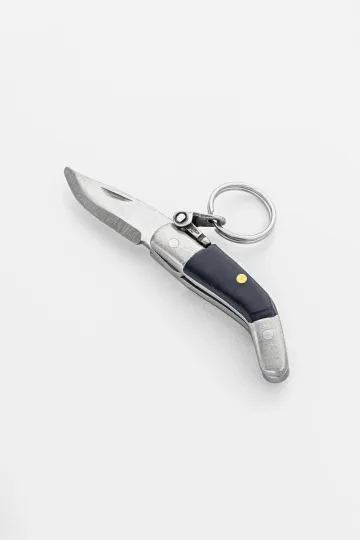
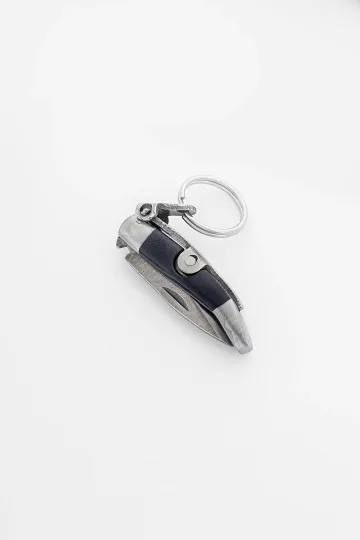
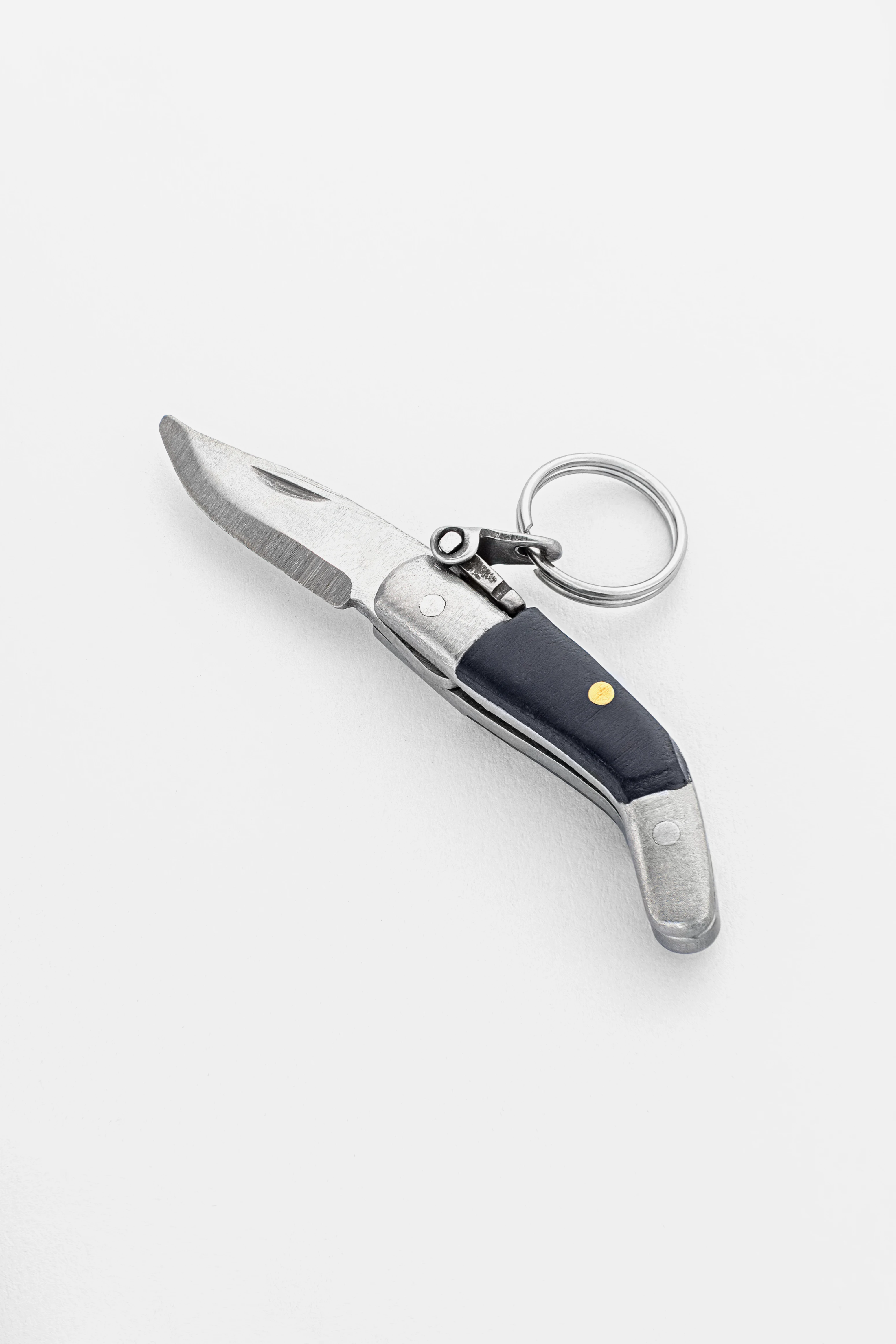
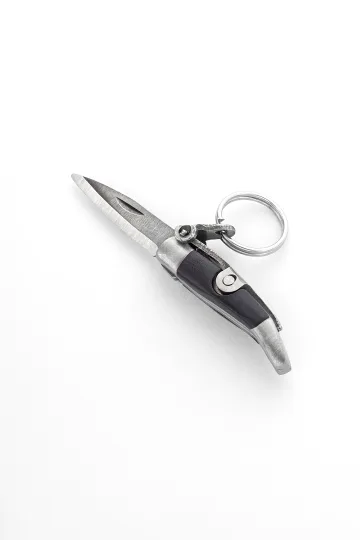
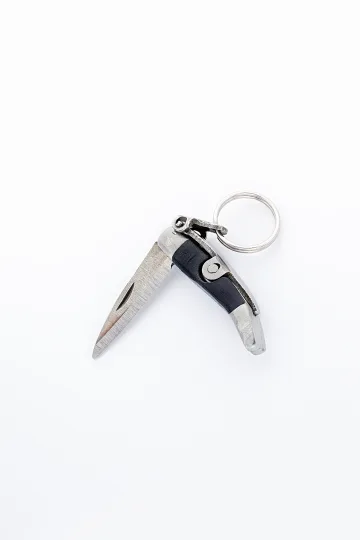
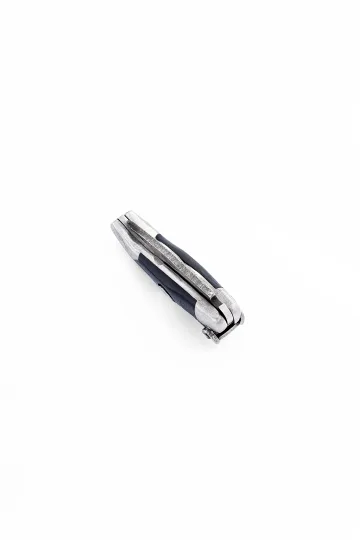
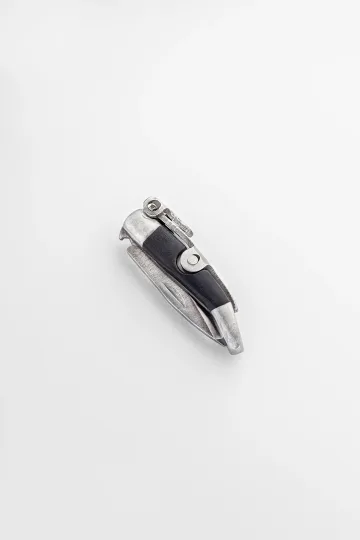
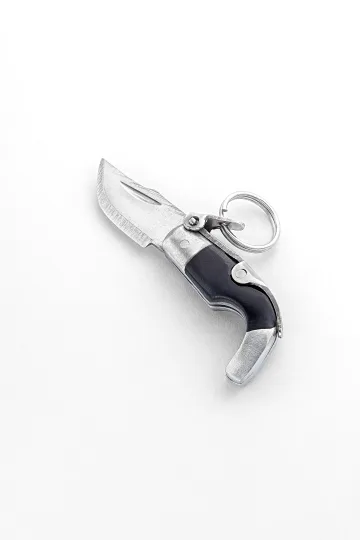
CAPAORA mini knife pendant
The 18th-century Spanish navaja in miniature: 40 mm of stainless steel, a real folding mechanism and a Palanquilla lock that clicks. An affordable gift to remember.
Authentic · Ships from Spain · 14-day returns
Care and storage
A hardness of 6.5 to 7 makes pietersite fit for everyday wear, but it is not indestructible. The main risk is a chip along the edge of a cabochon from a knock against a hard surface. A few simple habits add years to the stone's life.
What to do and what to avoid
You can:
- Wipe it with a soft dry or slightly damp cloth.
- Store it in its own soft pouch or in a fabric-lined compartment of a box.
- Occasionally rinse it under cool water and dry it at once.
You should not:
- Soak it for long, especially in hot water.
- Clean it with ultrasound or steam: vibration and sudden heat are dangerous for the fibrous structure.
- Use abrasives, baking soda, salt or harsh household chemicals.
- Drop it onto tile or stone, as the cabochon edge can chip.
- Store it loose with hard stones (diamond, corundum, topaz, ordinary quartz), which scratch the polish.
- Leave it under direct scorching sun for hours, since overheating is undesirable.
Take pietersite off before sport, cleaning with chemicals, the shower and sleep. Keep perfume and cosmetics from landing directly on the stone.
How hardness affects wearability
In a ring, choose a setting that shields the girdle (edge) of the stone, so the pietersite is protected from knocks. A bead bracelet survives active wear better than a fragile cabochon in a ring. Tiny internal cracks in natural pietersite are a normal feature of its brecciated nature: the stone is quite literally assembled from shattered and re-cemented pieces. Small internal cracks are not dangerous in themselves, but a sharp change of temperature or a heavy blow can "open them up".
If the polish goes dull
Over time, from rubbing against fabric and skin, the gloss may wear slightly. That is normal and fixable. Do not polish the stone at home with pastes: it is easy to spoil the geometry of the cabochon. Take the piece to a jeweller or a lapidary; a re-polish takes only minutes and brings the glow back. It is a rare procedure, usually once every few years with active wear.
Leave your email, we'll send your discount code. No spam, unsubscribe anytime.
The code arrives by email, valid on your first order.
Symbolism: what tradition says
Everything below is cultural symbolism and the tradition of crystal healing, not a medical or physical fact. The mineral has no proven effect. We describe what people believe, not what "will happen".
Tradition assigns pietersite three themes, and all three grew out of the stone's appearance:
- Transformation. The storm pattern reads as a passage, the moment when one state gives way to another. So the stone is linked to phases of change.
- Will. The same pattern reads as a strength that cannot be broken, hence the reputation of a "stone of resolve".
- Intuition and clarity. Blue is traditionally tied to clarity and honest speech. The same theme of inner sight is given by tradition to iolite, the Vikings' stone, by which, legend says, seafarers checked their course.
The stone "does" nothing on its own. If it supports a person at all, it does so the way any meaningful keepsake does, through attention and habit, not through mystical radiation. There is nothing shameful in that, and nothing to exaggerate either.
Pietersite jewellery: rings, pendants, earrings, bracelets
Since the pattern is unique, every piece of pietersite jewellery is one of a kind. Let us go through it by type of jewellery and by setting metal.
Rings
A ring is the best way to show off pietersite: the stone is always in motion with the hand, and the light flows across it with every gesture. A cabochon is used, a smooth domed form without facets, because that is what opens up the optical effect. A faceted cut does not suit pietersite: the facets break up the flow of light.
Cool sterling silver underlines the blue of the Namibian stone. Warm gold (yellow or rose) works better with the golden and red Chinese pieces. A massive cabochon in a plain setting looks restrained and masculine.
What to look for:
- The setting shields the edge of the stone, protecting the girdle from chips.
- The cabochon sits firmly and does not wobble.
- The flow of light is visible when you turn your wrist.
- The size is in proportion to the hand: a large cabochon is striking but catches on clothing.
Pendants
A pendant is the format for a large stone. A big polished slab in a pendant lets you see the whole storm pattern at once. It is worn on a chain or a leather cord. Free, natural shapes are especially lovely, where the maker keeps the natural outline of the piece rather than forcing it into a strict oval; then the pietersite looks like a shard of sky.
Earrings
In earrings pietersite calls for a matched pair: two cabochons should at least roughly agree in tone and in the direction of the light's flow. A perfect match never happens, the pattern is always different, but a good maker chooses stones close in character. Light, small cabochons in silver make a good everyday option, large slabs are for an occasion and an accent. The clasp must be secure: the stone is irreplaceable.
Bracelets
A bead bracelet is the most affordable way into the stone. Beads of 8 to 10 mm on an elastic cord show several fragments of the pattern at once. The format is sturdier than a fragile cabochon in a ring and survives active wear. A bracelet is easy to combine with other stones.
Cufflinks, brooches, men's accessories
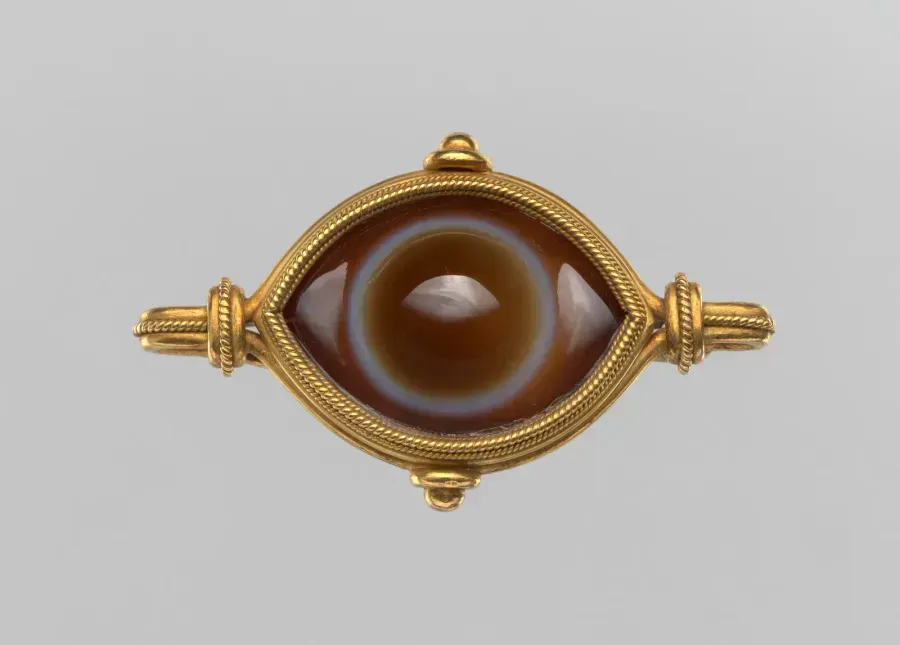
Because of its restrained drama, pietersite often goes into men's accessories: cufflinks, tie clips, signet rings. A dark blue or red-gold cabochon in silver or steel looks strict and expensive, without fuss.
Metal colour to match the stone
- Storm blue, sterling silver, white gold, rhodium. Cool metal strengthens the blue.
- Blue-grey, silver, platinum. A restrained pairing.
- Gold and honey, yellow gold, brass. Warm to warm.
- Red-brown "fiery", rose and yellow gold. The metal supports the flame of the stone.
- Multicoloured, neutral silver or white gold, so as not to argue with the busy pattern.
- Men's pieces, steel, titanium, blackened silver.
Steel and titanium also suit those allergic to silver. The main thing in a setting is not the metal itself but the protection of the cabochon edge from knocks.
Frequently asked questions
What is pietersite in simple terms?
It is an ornamental stone, a variety of quartz with twisted fibrous inclusions that reflect light in vortices. Because of this, light seems to flow and churn inside the polished stone, which is why pietersite is nicknamed "the tempest stone". It was discovered in Namibia in 1962 and later found in China. The colours run from storm blue and gold to red-brown. The stone belongs to the "cat's-eye" family along with tiger's eye and falcon's eye, but it is set apart by its chaotic, swirled pattern of light instead of straight bands.
How old is pietersite as a stone?
There is a double answer here. As a mineralogical type, pietersite is young: it was discovered and described in 1962 to 1964. It is one of the few gems whose biography we know in full, right down to the surname of its discoverer. But as a rock, pietersite is ancient: the Namibian host formations are counted among the oldest parts of the earth's crust, on the order of 2.8 billion years old.
Why is pietersite called "the tempest stone"?
Because of its inner pattern. The fibrous inclusions were twisted by tectonics: they were crushed and rotated as the rock layers moved. When such a stone is polished, light reflects not in one even band, as in tiger's eye, but in twisted, tangled streams. Add the contrast of dark blue and golden zones, the blue reading like a cloud, the gold like flashes of light, and you get the feeling of a sky before a storm.
How does pietersite differ from tiger's eye?
They are relatives from the same quartz family, but built differently. In tiger's eye the fibres lie parallel, so the band of light runs in a crisp straight line. In pietersite the fibres are jumbled and turned to different angles because of the rock's brecciation, so the light flows in vortices. By colour, tiger's eye is usually golden brown, while pietersite gives a wider palette, including the rare storm blue. Pietersite is noticeably rarer and dearer, especially in the blue Namibian variant.
Where is pietersite mined?
There are two main sources. The first and the benchmark is Namibia, the Outjo district north of Windhoek, where the stone was discovered in 1962. Namibian pietersite is prized for its deep storm blue. The second source is China, Henan province, found in the early 1990s; the Chinese material is warmer in tone: gold, honey, red-brown. Shimmering material of the pietersite type is sometimes reported elsewhere, but the market rests on these two sources.
Which pietersite is more expensive, blue or gold?
Blue and blue-grey are dearer, as a rule the Namibian ones. Deep storm blue is rare and mined in small batches. The warm tones (gold, honey, red-brown) are more often Chinese and more affordable. But much depends on the strength of the optical effect: a pale stone with bright, mobile light can cost more than a saturated but dull one. Always view the stone in motion under a lamp.
Is pietersite from China genuine?
Yes, Chinese pietersite is genuine pietersite, although collectors argued about it for a long time. The difference lies in the mineral makeup of the inclusions and in the balance of iron oxidation: the Chinese material gives more warm red-gold tones and rarely the deep blue. It is not a fake but a different variety of the same stone from a different deposit. A fake is when dyed tiger's eye or glass is passed off as pietersite.
Can pietersite be worn every day?
Yes. The Mohs hardness is about 6.5 to 7, harder than glass and enough for everyday wear. But the stone dislikes sharp knocks against hard surfaces: a chip can form along the cabochon edge, so in a ring choose a setting that shields the girdle. Take the piece off before sport, cleaning with chemicals and sleep, and keep it away from perfume and hot water. Handled with care, pietersite lasts for decades.
Can pietersite get wet?
Brief contact with cool water does no harm: the stone can be rinsed and wiped with a soft cloth. But prolonged soaking is undesirable. Pietersite is quartz with fibrous inclusions and microcracks, and a long stay in water, especially hot or with sharp swings of temperature, can affect the stone over time. Salt and saline solutions are best avoided: salt is abrasive. Take pietersite off before the shower, the sauna and swimming.
What is tetterelite and is it the same thing?
Tetterelite is one of the trade names under which pietersite appears on the market, more often the Chinese material from Henan province. In essence it is the same shimmering quartz, simply sold under a different name; sometimes the term refers specifically to the red-gold varieties. There is no single strict standard for gemstone trade names, so "tetterelite" should be judged by the same signs as pietersite.
Is pietersite a precious or a semi-precious stone?
By the old classification, pietersite is counted among ornamental and lapidary-grade stones. It is a variety of quartz, and quartz is a common mineral, so pietersite does not belong to the "precious" stones in the classic sense (like diamond, corundum, emerald). But that classification is arbitrary: value is set not by a label but by the rarity, beauty and quality of the particular specimen. A good blue Namibian pietersite is rare and worth more than many formally "precious" small stones of low quality.
How do you tell a real pietersite from a fake?
The main sign is the flow of light. Turn the stone under a lamp: in a real pietersite the light moves in living, tangled vortices, not in even bands. The second sign is colour: natural pietersite is almost never evenly blue, so a "candy" uniform blue is a worry. The third is temperature and weight: glass and plastic warm up in the hand faster and are lighter than stone. The fourth is price: a large "blue pietersite" at the price of glass beads is almost certainly a fake.
Can you identify pietersite at home without instruments?
To a large degree yes, by how the light behaves. Turn the stone under a directed lamp: in a real pietersite the light flows in living, tangled strands, flaring up in different zones in turn. Check the colour for uniformity, since a natural stone is almost always uneven. Hold it in your palm: quartz is cool and warms more slowly than glass and plastic. Examine the cracks and the edge for build-ups of dye. That is enough to weed out crude fakes; precise confirmation of an expensive purchase is best left to a gemmologist.
Does pietersite fade in the sun?
Natural pietersite, whose colour comes from iron in the fibrous inclusions, is stable and does not fade in brief sun. Dyed imitations, on the other hand, can fade and shift in tone under direct rays, which is an indirect way to suspect a fake. But even the natural stone should not be kept for hours under scorching sun: the issue is heat and temperature swings, undesirable for quartz with a fibrous structure. Diffuse light is fine, prolonged direct scorching sun is not.
Which metal should I choose for pietersite?
It depends on the colour of the stone. Sterling silver is the universal choice; its cool sheen underlines the storm blue of the Namibian material. Warm gold (yellow or rose) works better with the golden and red-brown Chinese pieces. Steel and titanium suit men's pieces and those allergic to silver. The main point of a setting is to protect the stone: for a ring, choose one that shields the cabochon edge.
Does pietersite crack or chip?
Pietersite is sturdy enough for everyday wear (hardness 6.5 to 7), but not indestructible. The main risk is a chip along the cabochon edge from a knock against a hard surface. That is why rings use a setting that shields the girdle. Internal cracks are a normal feature of the stone's brecciated nature; small in themselves, they are not dangerous, but a sharp change of temperature or a heavy blow can open them up. Wear it with care, take it off before sport and dirty work.
How does blue pietersite differ from lapis lazuli or sodalite?
The stones are simply different. Lapis lazuli and sodalite give a dense matte blue with no shimmer, often with white or golden flecks. Pietersite gives a blue with a mobile silky sheen, the light flowing across it in vortices. Telling them apart is easy: turn the stone under a lamp, and on pietersite the light will run, while the surface of lapis stays matte and still. By rarity and price, a quality blue pietersite is usually above lapis.
Why do two pietersites have a different pattern?
Because the pattern is frozen chance. The stone is born from shattered and re-cemented fibres, turned to random angles by tectonics. The direction of each fibre, the degree of iron oxidation, the geometry of the fracture are unique to each part of the vein. Even two cabochons from neighbouring pieces of one block will differ. Matching a strictly identical pair for earrings is impossible; the maker only brings stones close in character.
Can pietersite be worn with other stones?
It can. There is one aesthetic rule: do not overload the piece. Pietersite is very "loud" in pattern, and five different stones beside it will turn a bracelet into mush. One or two calm companions (smooth silver, a matte stone), and the storm design stays the hero. This is advice about aesthetics, not about "energy compatibility".
Does pietersite darken over time?
Natural pietersite does not darken or lighten by itself: its colour is set by iron inside the structure, not by an unstable coating. Stones mined decades ago look as good as new. What can change is the surface gloss: from rubbing against skin and fabric the polish wears slightly. That is fixable with a re-polish by a craftsperson. If a "pietersite" has noticeably changed tone or faded, you are most likely looking at a dyed imitation.
Is there artificial or treated pietersite?
Fully synthetic pietersite is practically absent from the market; there is little economic sense in growing it. Imitations, on the other hand, are widespread (dyed tiger's eye, dyed agate, glass with a fibrous coating), as is the treatment of natural stone (dyeing to strengthen the colour, impregnation to mask cracks). So the buyer's main question is not "natural or synthetic" but "natural or dyed". It is checked by the behaviour of light, the uniformity of colour and the reasonableness of the price.
Send a friend a discount code, they save on their first order.
Quick takeaways
- Pietersite is a shimmering variety of quartz with a swirled, "stormy" pattern of light; the base is SiO2, hardness 6.5 to 7 on Mohs, density 2.6 to 2.7 g/cm3.
- Discovered in 1962 in Namibia by Sid Pieters, with a second deposit in China.
- Blue Namibian is the rarest and dearest, warm Chinese is more affordable.
- The chief value is the strength of the light's flow; check the stone in motion under a lamp.
- Fakes are dyed tiger's eye and glass; they give themselves away by even colour and dye in the cracks.
- The symbolism (change, will, intuition) grew out of the stone's appearance; it is a cultural tradition, not a proven fact.
- It is cut into cabochons and worn in rings, pendants, earrings and bracelets, fitting for women and men alike.
- Keep it from knocks, hot water, chemicals and scratches, and it will last for decades.
Buying it as a gift? Each one arrives ready to give.
 A branded Zevira box and a little card come with every order.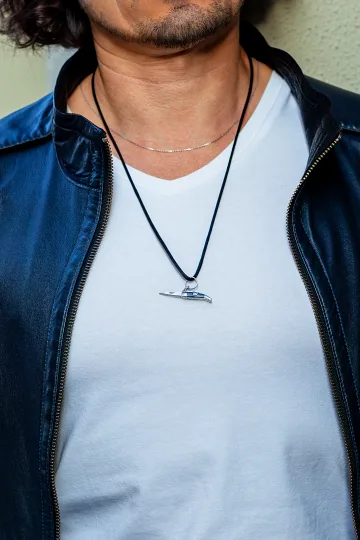







About Zevira
At Zevira we love stones with character, and pietersite is exactly that: no two specimens repeat, because each one holds its own frozen storm. We choose the material by the strength of the light's flow, by the purity of the storm blue and the warm gold, and we set the cabochons so the stone is always in motion with you: in sterling silver for the cool blue tones, in warm metal for the gold and red ones. Every piece is one of a kind, because nature never makes two identical pietersites.
We talk about stones honestly: where the history is, and where the pretty legend is; where the fact is, and where the tradition is. Pietersite is not obliged to "do" anything for you, but if you want to wear a rare stone with a clear origin and living light inside it, it is hard to picture a more interesting choice.
Find your storm in stone
Rings, pendants and bracelets with natural pietersite, blue Namibian and gold Chinese. Every stone is one of a kind, with its own pattern of light. We will match a piece to your shade and your occasion.
See pietersite jewelleryWant to go deeper into the world of shimmering, "moving" stones? Read our pieces on alexandrite, the stone of transformation and on black tourmaline and its protective symbolism. And if you are curious about how stones come into jewellery at all, and why some are prized and others are not, look into the history of the jeweller's craft.
Wear the symbol, don't just read about it. These are in stock: