The Peace Sign and the Dove in Jewellery: From Aldermaston to Everyday Wear
Two distinct symbols of peace have lived side by side in jewellery culture for decades, and they rarely get confused once you know what you are looking at. The first was drawn on the 21st of February 1958, in London: a graphic designer named Gerald Holtom produced a circle containing three lines for the Campaign for Nuclear Disarmament's inaugural march from London to Aldermaston, where Britain's Atomic Weapons Establishment was housed. That badge became the most recognised emblem of civilian pacifism in the modern world. The second symbol is older by millennia: a dove carrying an olive branch, returning to Noah's ark after the flood. Between these two images lies a vast cultural distance, but both work in jewellery, and both have their devoted wearers.
This article is written honestly. It will not turn either symbol into political agitation or into a meditation on the energies of peace. The peace sign and the dove with a branch are cultural and historical emblems. They carry political weight in certain eras and humanitarian weight beyond any specific political context. Wearing such a piece means accepting that weight consciously, not borrowing someone else's gesture without understanding it.
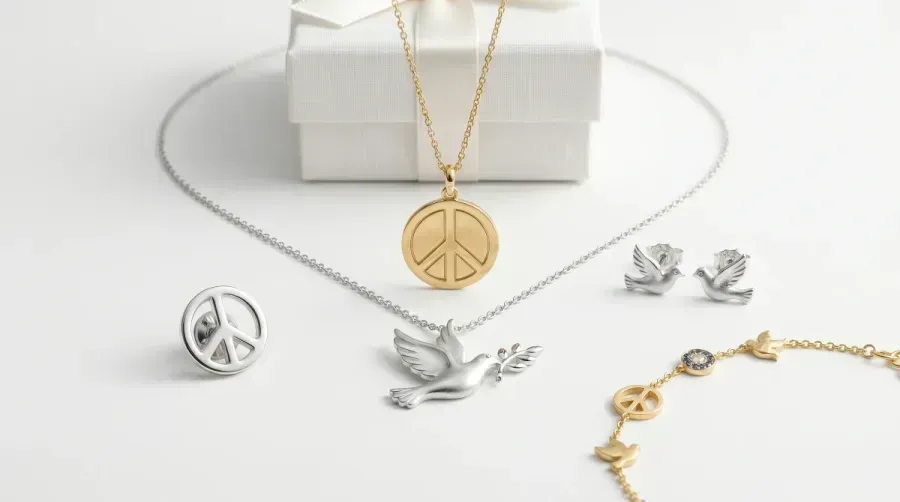
The Zevira collection includes both symbols, made as serious jewellery rather than festival-stall souvenirs. The peace sign appears in the retro register of the 1960s, with bright enamel, and in a strict minimalist version without decorative excess. The dove with an olive branch follows classical iconography closer to Picasso and to ancient coins than to modern cartoon simplification.
The political context is addressed once, in the history sections below, and then left there. The rest of the article concerns how these symbols work as jewellery: which formats succeed, which materials suit them, how to wear them, and who they actually belong to. If the jewellery side is your main interest, the history sections can be skipped, though wearing a piece this loaded without knowing its background is a strange choice.
Both symbols belong to the same cultural family as the Venus female symbol in jewellery: twentieth-century emblems with a long graphic biography, not decorative ornament. Wearing them means joining a conversation. It helps to know which conversation you are joining.
Wear the symbol, don't just read about it. These are in stock:

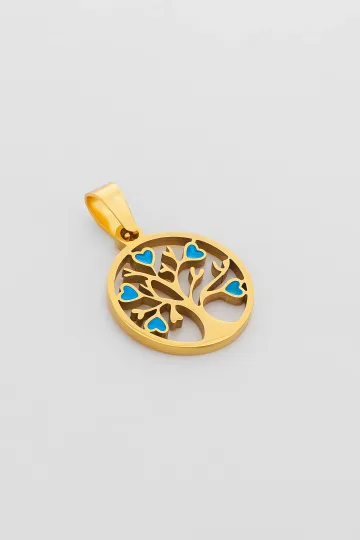
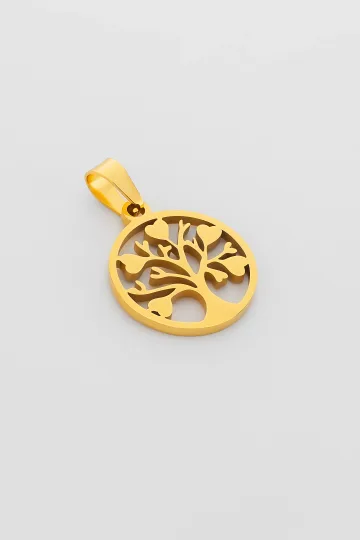
Peace sign jewellery: what to choose

The most recognisable format is the medallion pendant with the emblem set inside a circle. Diameter typically runs from fifteen to thirty millimetres. A small pendant, around fifteen millimetres, reads as a neat detail on a chain worn under a shirt or jumper. A medium piece, around twenty-five millimetres, holds its own as a visible accent at the open collar. A large piece, thirty millimetres and above, enters the territory of retro statement and needs the right surroundings: a plain white T-shirt or a jacket with no competing jewellery.
Stud earrings with the peace sign are a practical everyday format. The stud rarely exceeds eight to ten millimetres, the emblem reads at close range but does not demand attention from across a room. They work well paired with a slender chain in the same design, or worn entirely alone. For more visual presence, drop earrings with the peace sign on a chain two to three centimetres long give the emblem gentle movement as the wearer moves.
A ring with the peace sign in relief is a rarer format. The sign usually sits on a round platform of five to seven millimetres, or on a rectangular signet-style top. The relief can be raised or engraved and filled with black enamel. Such rings read as a standalone statement and are generally worn on the index or middle finger rather than the ring finger.
Brooches with the peace sign were especially popular from the late 1960s through the early 1970s. A large enamel brooch, four to five centimetres in diameter, is a direct citation of that period. It can be pinned to a lapel, on the shoulder of a jumper, on a bag, or on a scarf. In a contemporary wardrobe, such a brooch works best on a single-colour plain ground where nothing competes with it.
Peace sign bracelets exist in two forms. The first is a chain or leather cord with a single peace sign pendant. The second, more decorative, features small repeating peace signs along the full length, sometimes alternating with beads or small links. The second version is closer to a bohemian aesthetic and reads best in summer, against tanned skin, with simple linen or cotton clothing.
Men's peace sign formats most commonly use a leather or waxed cord with a larger, heavier metal sign. The silver here tends to be oxidised, dark, with a matte surface, no gilding, no enamel. Such a pendant is worn over a T-shirt or shirt, in full view, and reads as a biographical gesture: it generally belongs to someone who grew up on particular music and a particular literature.
On the matter of surface treatments, the peace sign accommodates a wide range. Sterling silver 925 with coloured enamel filling the fields between the lines of the emblem gives the most recognisable 1960s retro register. Enamel colours vary: rainbow, solid bright red, bright blue, orange, yellow. Minimalist silver without enamel gives a clean contemporary version that suits a professional wardrobe. Gold plating over silver warms the emblem and removes the association with a protest placard. Oxidising deepens the vintage sensation, as though the piece has spent years in someone's drawer.
The dove with an olive branch in jewellery

The dove appears in jewellery in several iconographic variants, each with its own history. The most canonical is the dove in flight with an olive branch in its beak, profile silhouette, wings open. Pablo Picasso's 1949 poster fixed this composition, and since then it has been reproduced in countless variations. In jewellery the piece is typically a pendant from two to four centimetres in length, with finely worked feathers and a clearly readable branch.
A single dove in flight can be executed in flat relief, where the silhouette is cut from sheet silver and slightly raised, or in full sculptural treatment with dimensional wings. The first option is simpler to produce and better suited to daily wear. The second costs more in labour, weighs more, and becomes an accent piece requiring a plain background.
A paired dove motif works in the format of matching jewellery for two. This might be two pendants, one dove flying right, one flying left, with a symmetrical branch on each. Or a pair of rings each carrying a miniature dove. This format sits near the tradition of paired jewellery, heart halves, key and lock, but carries a different semantic weight: it is not directly about romantic attachment but about a shared value, a pair who together choose a certain tone in their relationship.
A large dove brooch is its own genre. Four to six centimetres, often a silver base with details in mother-of-pearl, enamel, or small stones. Such brooches look old-fashioned in the best sense; they reference mid-twentieth-century jewellery culture and require the corresponding clothing: a jacket, a coat, a formally cut dress.
A stylised minimalist dove silhouette is the contemporary reading. A thin outline, no feather detail, no volume, maximum abstraction. Such a pendant sits alongside graphic symbols like the Venus sign or an initial, and it suits those who prefer jewellery without excess decoration. The silhouette reads immediately but does not shout.
Carved bas-relief with a dove is a classical genre derived from antique and Renaissance tradition. The dove is carved on a round or oval medallion, sometimes in the technique of a cameo with a light silhouette standing against a dark ground, sometimes reversed. Such medallions are worn on a chain and read as a family heirloom even if made yesterday.
A locket-style pendant with an engraved dove, opening to hold a miniature portrait or a lock of hair, is a nostalgic nineteenth-century format. In that form the dove appears in mourning and memorial jewellery connected to themes of loss and hope, related to pieces such as memorial jewellery with a dog paw.
A dove ring is a rarer but expressive format. Usually substantial, with the dove on a flat oval or rectangular platform, sometimes with a branch curving around the edge. Such a ring works as a personal sign and is frequently made to order with a date or initials engraved on the inside.
A peace sign wants bare skin and denim, never lurex. The dove keeps to silk and hush. Mix them up and the whole thing reads like fancy dress.
How to wear the peace sign and the dove
I have been building both symbols into looks for years, and each follows its own logic. Here is what actually works, sorted by occasion.
How do I wear the peace sign every day? For everyday I recommend a graphic sign in silver on a fine chain or a leather cord over a white tee, a denim shirt, or grey marl. A plain light top lifts the emblem; on a busy print it disappears. Under an open neck I suggest a longer chain, under a closed collar a shorter one, so the sign does not hide inside.
Does the dove call for a different mood? It does. I choose the dove for a more composed, adult look: a blouse, silk, fine wool, a quiet dress. A pendant three to four centimetres with well-worked feathers sits best on soft fabric. With sportswear it looks out of place, so there I leave it at home.
What works at the office? For work I recommend the quiet register: a tiny sign stud or a small dove on a slim chain under a shirt. The metal is matte or polished silver, no bright enamel. A large coloured brooch falls out of key in a meeting room, while a restrained detail reads as personal without announcing itself.
How do I build an evening look? For going out I choose one strong piece and a calm ground around it: an enamel sign as the single accent on a smooth dress without a print, or a larger sculptural dove. If you want layers, I suggest two or three fine chains of different lengths in one metal, with the symbol on the shortest, closest to the face. I do not mix gold and silver in that set.
Can I wear both symbols at once? You can, but carefully. One symbol leads, the other supports: a small sign in the ears with a modest dove at the neck works, while two large pieces together overload the look. And the rule that never fails: one item leads, the rest stays quiet.

Turn on your camera, pick earrings, a pendant or a ring, and see the piece on yourself in real time.
Switch items in one tap.
Everything runs in your browser: no photo or video is ever uploaded.
Customer reviews
Zevira is a real jewellery shop. Genuine payments, deliveries and customer thank-yous.
🥰🥰🥰 gracias
Ok, ¡gracias! 🙂
The history of the peace sign
The peace sign as we know it was completed on 21 February 1958. Gerald Holtom, a British graphic designer and member of the Campaign for Nuclear Disarmament, finished the emblem for the march from London to Aldermaston, where Britain's Atomic Weapons Establishment was located. The march took place on Easter weekend, 4 April 1958, and drew several thousand participants. Bertrand Russell, then in his mid-eighties, was among the public supporters of CND at the time.
The composition has a rational explanation. The circle contains two superimposed semaphore letters: N and D, where N is signalled by two flags held diagonally downward and D by one flag straight down and one straight up. N and D stand for Nuclear Disarmament. That was the Campaign's immediate objective, and the sign was designed as its logo.
Holtom himself, in later interviews and letters, mentioned a second source of inspiration. The shape reminded him of a figure with arms dropped and extended outward, a gesture of despair, which he associated with the peasant in the foreground of Francisco Goya's painting "The Third of May 1808," where a firing squad levels rifles at a group of Spanish civilians. Goya's painting became one of the most recognised anti-war works in European art, and the reference was not accidental. Holtom later wrote that he had at one point considered inverting the sign to have the arms pointing upward in a gesture of joy, but by then the emblem had already spread and could not be turned back.
The sign was deliberately left unpatented and received no legal protection. Holtom wanted the emblem to spread freely and to belong to the movement rather than to its creator. This decision had enormous consequences: by the end of 1958 the sign appeared on posters, T-shirts, and bags, and by the mid-1960s it was being worn by participants at anti-war demonstrations in the United States.
In the US the sign travels into the 1960s with the protests against the Vietnam War. It appears on badges, on the bodywork of vans, on soldiers' helmets, on album covers. American culture of 1967 to 1969, the hippie movement, Woodstock, the California scene, transformed the sign from the logo of one campaign into a universal emblem of counterculture and pacifism. By the early 1970s the sign no longer belonged to any specific movement; it had become international.
After 1970 the sign went through several waves of fashion and several waves of political activism. In the 1980s it reappeared on anti-nuclear demonstrations across Europe during the debate over medium-range missiles. In the 1990s it entered pop culture as a nostalgic sign without acute political charge. In the 2000s it returned to anti-war marches against the Iraq war. Today it reads broadly: from a considered civil statement to a purely decorative element, and that depends not on the symbol itself but on who wears it and how.
Upload a photo of your pet, someone you love, or an object. We'll build a 3D model and hand-cast it in pewter.

The dove as a symbol of peace

The dove's history is longer still. The most familiar biblical source is the account of Noah in Genesis. After the flood subsides, Noah releases birds from the ark to test whether the water has retreated. The dove returns with an olive leaf in its beak, and this becomes the sign that the earth is habitable once more. Genesis 8:11. From that moment the dove with the olive branch is fixed in Jewish and Christian tradition as a symbol of renewed peace between God and humankind.
In Hellenistic and Roman iconography the olive branch was already an attribute of peace long before Christianity. The Greek goddess Eirene and the Roman Pax were depicted holding olive branches. Coins bearing the image of Pax with a branch were issued under the Emperor Augustus, and the combination of dove and olive branch existed in parallel within Graeco-Roman and Judaeo-Christian cultures, gradually merging into a shared image.
Christian tradition added a further layer of meaning to the dove. In the scene of Christ's baptism in the Gospels, the Holy Spirit descends on Jesus in the form of a dove. This dove is iconographically distinct from the peace dove of Noah, but in popular imagination the two images frequently merge. In jewellery, the dove as Holy Spirit is typically shown with a halo and rays; the peace dove carries the branch. The visual difference is unambiguous.
In 1949 an event occurred that redefined the dove's iconography for the entire twentieth century. Pablo Picasso drew a lithograph of a dove for the poster of the First World Peace Congress held in Paris in April 1949. The poster was reproduced in mass print runs and the image spread worldwide. The actual bird was drawn from life: Picasso kept doves, and the drawing was based on a live Milanese breed given to him by Henri Matisse.
Picasso's poster became the point after which any depiction of a dove in the context of peace inevitably refers back to it, even when the artist had no such intention. In later variations Picasso drew the dove repeatedly, in different postures and with different degrees of stylisation. Some of those variations became nearly as recognisable as the original 1949 image.
The dove entered the official symbolism of international organisations. The UN emblem, adopted in 1945, includes olive branches on either side of the globe, though the dove itself is absent. The dove with an olive branch appears in the symbolism of many humanitarian organisations, from religious communities to secular refugee-aid foundations. In contemporary diplomatic visual culture the dove remains one of the most universal and politically neutral symbols of peace, not belonging to any specific programme.
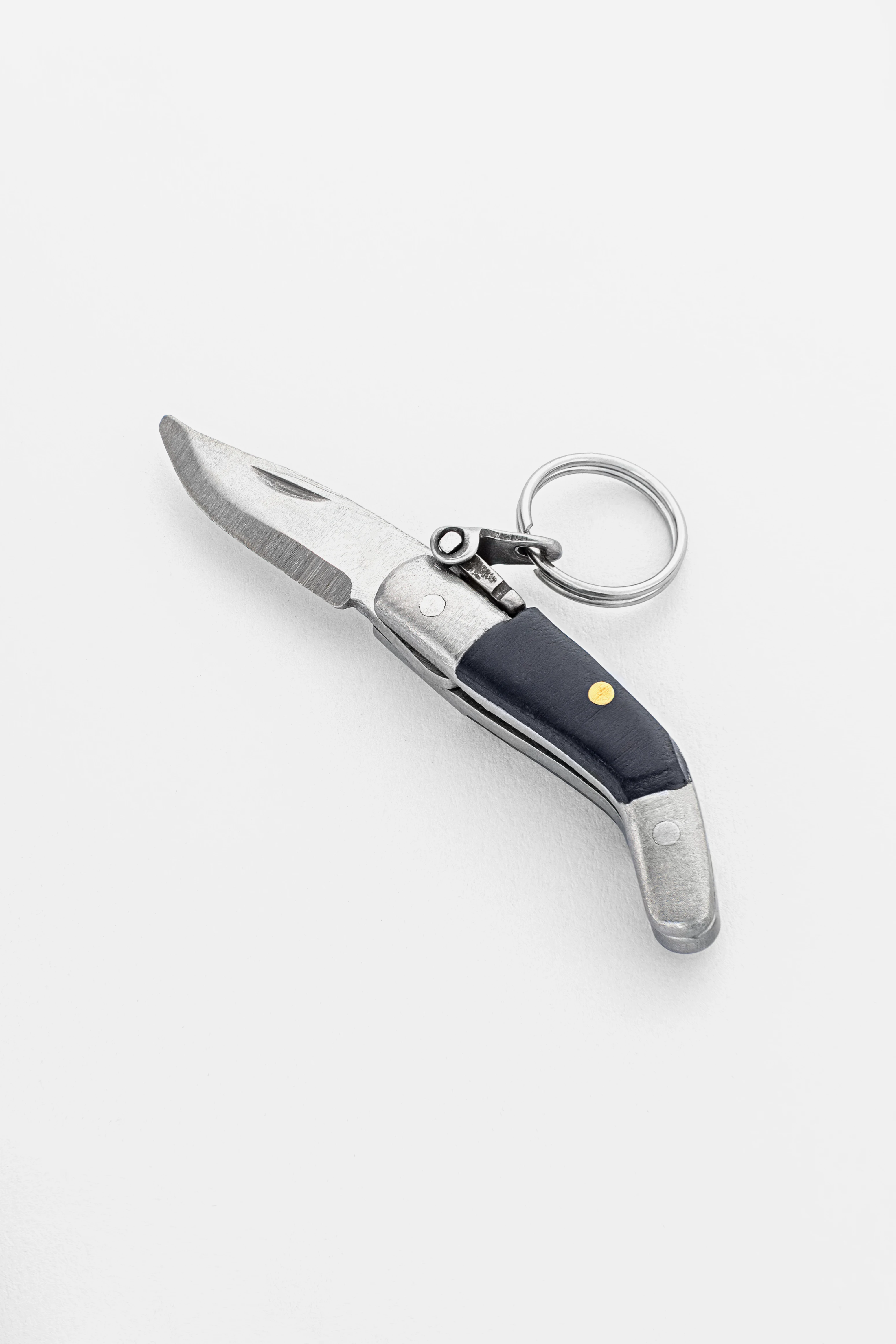
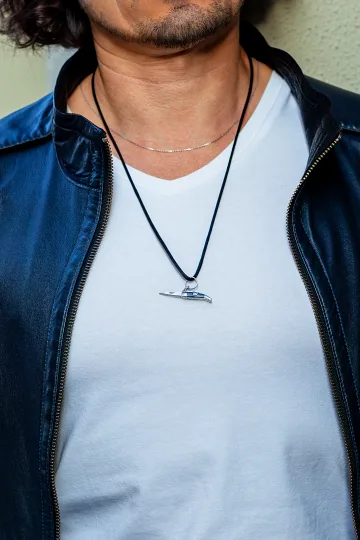
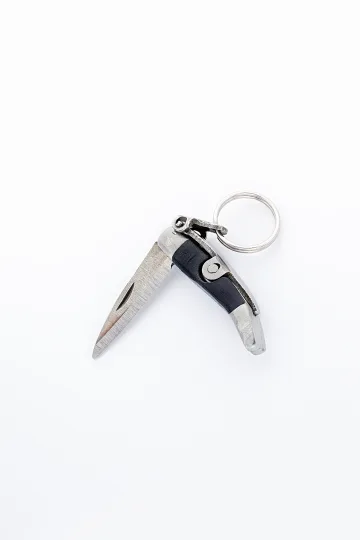
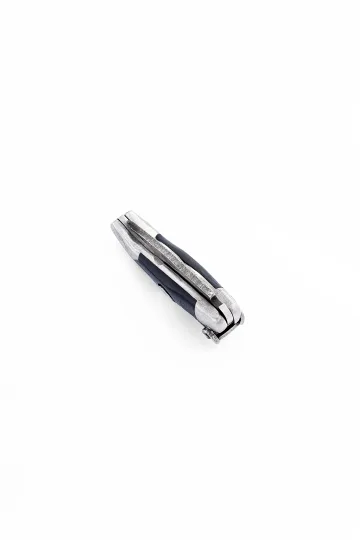
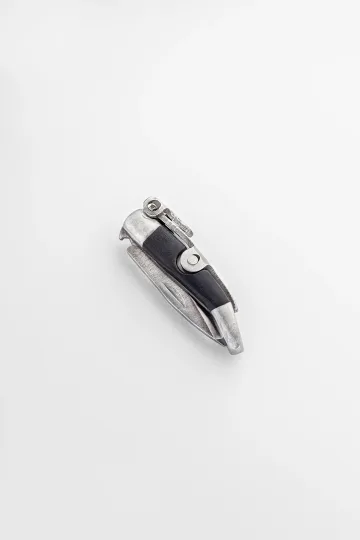
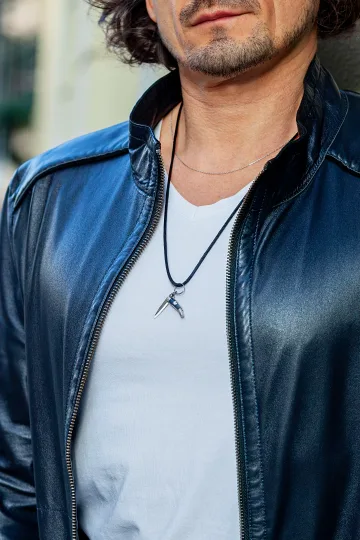
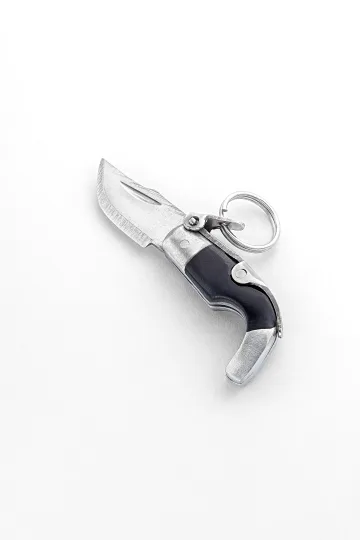
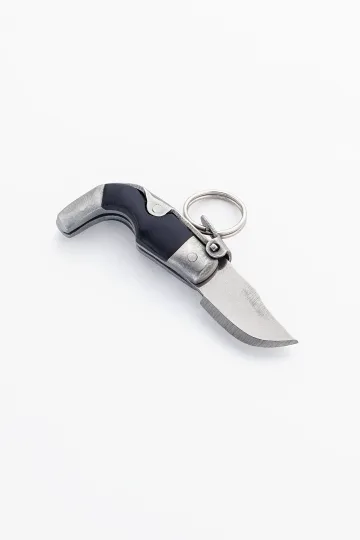
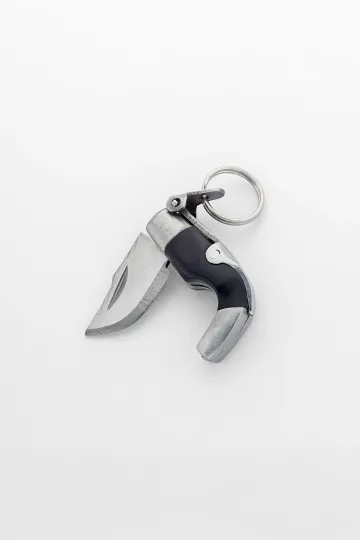
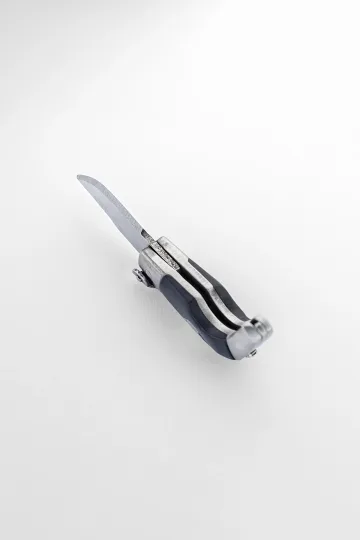
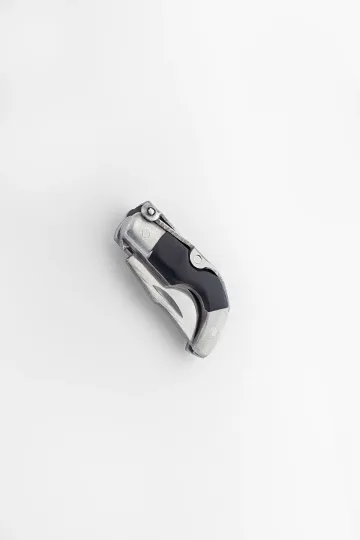
CAPAORA mini knife pendant
The 18th-century Spanish navaja in miniature: 40 mm of stainless steel, a real folding mechanism and a Palanquilla lock that clicks. An affordable gift to remember.
Authentic · Ships from Spain · 14-day returns
What the pair of symbols means

The peace sign and the dove with an olive branch together make up the pacifist vocabulary of the twentieth century, but they operate in different registers. The peace sign is sharper; it is clearly linked to specific historical campaigns, to the anti-war movement, to a particular era. Wearing it means making a more personal and more politically tinted statement, even if the wearer does not think in political terms. The symbol is read quickly, and it is read as a civic position: a refusal of violence, a critical stance on war as a way of resolving conflict, scepticism toward militarist rhetoric.
The dove is softer. It works in the register of hope, the calm after the storm, the possibility of dialogue. It is a more lyrical symbol, and it is less frequently read as a political statement. The dove may be worn simply because the wearer finds the image of a messenger bird appealing, without endorsing any specific programme. The dove admits more interpretations; its tone is gentler.
An honest qualification: neither the peace sign nor the dove is a party symbol and neither should be read as support for any side in any current conflict. The wearer is someone for whom the idea of civil peace matters more than immediate geopolitics. This is not a political emblem at the level of a party badge; it is an emblem of humanitarian intuition. The distinction is material.
There is also a formal difference between the two symbols. The peace sign is graphically simple and abstract: a circle with lines. The dove is figurative, a living bird, a natural form. This difference is reflected in the jewellery. The peace sign welcomes sharp stylisation, bright enamel, design experiments. The dove requires more delicate workmanship: feather detail, beak, sometimes miniature sculpture. They are, in essence, two different craft problems.
Both symbols can be worn together, but with restraint. A peace sign pendant with dove earrings, for example. Or a dove ring and a slender peace sign bracelet. The combination works if the proportions are right and one symbol takes the lead while the other supports. If both are worn large and boldly, the look becomes overloaded and tips into performance, which rarely convinces.
Materials and techniques

Sterling silver 925 is the base material for both symbols. It gives a good white surface, holds enamel, takes engraving and oxidising well. For the peace sign in its 1960s retro register, silver is often combined with bright enamel: the fields between the lines of the emblem are filled with coloured vitreous enamel. Standard colours are scarlet, bright blue, yellow, orange, and sometimes a rainbow gradient. Enamel is fired in a kiln where powdered enamel fuses and sets as a glass surface. The work is time-consuming but the result lasts for decades.
Minimalist silver without enamel is a different approach. The peace sign here works through silhouette alone: deep cuts in the circle, a polished or matte surface, no added colour. This version is cleaner and better suited to a professional wardrobe. Matte silver, achieved through sandblasting, produces a velvety surface that does not catch light or compete with clothing detail.
Gold plating over silver is a galvanic process that deposits a thin layer of gold. It shifts the piece from white to warm yellow and moves it visually away from the protest placard and toward more classical jewellery aesthetics. For the peace sign, gold plating can work paradoxically: the sharp political symbol of the 1960s softens under the material and acquires a vintage, almost antique quality. This approach suits those who want to wear the peace sign within a more formal or mature wardrobe.
Oxidising works in the opposite direction, amplifying the vintage effect. Silver is treated with potassium sulphide or liver of sulphur; the surface darkens; polishing then lifts the raised areas back to bright silver while leaving the recesses dark. The result suggests a piece that has been worn for many years. For a peace sign on a leather cord, oxidising is almost obligatory; without it the metal looks too new.
Mother-of-pearl as a circular insert behind the peace sign is an uncommon but effective technique. A round mother-of-pearl disc serves as the background, and the sign sits over it or is cut through the layer. Mother-of-pearl gives a soft, near-phosphorescent glow and makes the piece more feminine in tone. This variant is closer to mid-twentieth-century jewellery tradition and is rarely found at the mass-market level.
For the dove, the technical range is wider. Precise laser engraving of feathers yields very fine detail on a flat silhouette. Filigree wings are hand-built from fine silver wire, twisted into an open lace pattern and soldered to the base. Filigree work carries value and reads as a small made object, not a stamped component.
Semi-precious stone inserts work well on the dove. A small lapis lazuli or agate cabochon as the bird's eye gives life to the silhouette. The olive branch is sometimes inlaid with small pieces of green onyx or malachite to separate it in colour from the white of the silver. Mother-of-pearl appears here too, but on the dove it suggests a pearlescent wing rather than a background glow.
Leave your email, we'll send your discount code. No spam, unsubscribe anytime.
The code arrives by email, valid on your first order.
How to wear the peace sign and the dove day to day
The peace sign is worn differently depending on format and on the age of the wearer. For teenagers and students it is often a decorative element pinned to a denim jacket or to the strap of a rucksack, close in spirit to a badge collected at a gig. For older wearers, especially those who remember the Aldermaston marches and the CND meetings of the sixties from life rather than from a textbook, the same shape carries a biographical weight. Both approaches are legitimate. They are simply two different conversations with one piece of graphic design.
In everyday clothing the peace sign works best against calm grounds: a white T-shirt, a black jumper, a denim shirt, a light summer dress without a print. On busy patterned fabric the symbol disappears, because the eye reads the pattern first and the circle a moment later, and by then the meaning has been lost. A large enamel brooch in the seventies manner works as a standalone accent on a plain jacket or a wool coat, and in that case almost no other jewellery is needed. A pair of small silver studs with the sign is the universal everyday solution: quiet, legible at conversational distance, and easy to forget you are wearing at all.
In a British office the rule is narrower. Only a small sign in matte or lightly polished silver works, or a miniature stud that reads as a shape before it reads as a symbol. Bright coloured enamel belongs to a different register and looks out of place in a meeting room, where anything loud invites comment and steals attention from the work. A fine chain with a small sign worn under a shirt collar behaves better: present, personal, visible only when the wearer chooses to let it show. The same logic applies to interviews and to client work, where the safest version of any symbol is the smallest one.
At a concert, at a summer festival in a muddy field, on a weekend walking in the Peak District or along the coast, the peace sign works at its most natural. Here any size and any enamel are appropriate, up to the brightest options, because the setting carries them. Combined with loose clothing, natural fabrics, leather and woven accessories, the result reads as a whole rather than as a costume assembled for the occasion. This is the context in which the symbol behaves exactly as it did when it first left the drawing board in 1958, worn by people standing outdoors in bad weather for something they believed in.
The dove asks for a different approach and sits better in a more grown-up register. A dove pendant of three to four centimetres on a fine chain looks right with a blouse, a shirt, or a quiet dress. It does not belong with sportswear, where the delicacy of the modelling looks accidental. A large dove brooch is a separate matter again: it needs a jacket, a coat, cloth dense enough to carry the weight without sagging at the pin. Tweed, heavy wool, a structured collar. On a fine jersey the same brooch drags the fabric into a pucker that no amount of adjustment will settle.
Wearing both symbols in one look is possible but wants restraint. One symbol leads and the other supports. A small sign in the ears with a modest dove at the neck is a working combination, as is the reverse. If both are large the look becomes declarative, and a declaration made in two symbols at once tends to read as costume rather than conviction.
Both symbols sit well with natural fabrics: linen, cotton, wool, cashmere. Synthetics and loud prints weigh them down and flatten the metal. The colour range that suits them is neutral, pastel, or the deep natural shades that British wardrobes are built on anyway: navy, charcoal, moss, oatmeal, grey. Against bright pink or neon green the peace sign loses its seriousness and becomes part of a fancy dress outfit.
A few practical notes for a damp climate. Fine chains catch in the wool of scarves and in the fastenings of raincoats, so a slightly heavier link survives a British winter better than the finest cable chain. Enamel chips at the edges if a brooch is pinned and unpinned daily, so a piece that lives on one coat lasts longer than one that travels between five. Brooch pins leave visible holes in fine knit, and a small backing disc behind the fabric spreads the load and prevents that. Silver darkens faster in coastal air and in cities with soft, sulphurous damp, which is normal and reverses with a cloth in a minute.
Pendants, earrings and brooches with the peace sign, the dove with an olive branch, and matching sets.
Who these pieces suit

The first obvious group is the generation that grew up on rock music and the mythology of the sixties. For someone whose youth was scored by the beat groups, the folk revival singers and the protest songwriters of that decade, played off vinyl in a bedroom or heard live at an outdoor rally, the peace sign is not an abstract emblem but part of a personal history. Such people often wear the sign for decades, returning to it after long gaps. They usually already own one and are looking for a second or third piece.
The second group is activists in humanitarian and environmental causes. Not necessarily radical ones; more often people working quietly in foundations, voluntary organisations, and ecological initiatives. For them the peace sign and the dove are a working emblem, a marker of belonging to a particular humanitarian circle. They wear these pieces calmly, without underlining.
A third category is people for whom political quietness matters more than a loud position on either side. These are not indifferent people; they simply believe that the idea of civil peace matters more than participating in current political conflicts. For them the dove is especially close; it is softer, more lyrical, and less firmly tied to any specific movement.
Workers in humanitarian organisations, refugee aid, medics taking part in missions in conflict zones, often choose these pieces as a quiet sign of their profession. Here the dove works even better than the peace sign, because it reads as a general humanitarian symbol rather than the emblem of a particular campaign.
Both symbols make a good gift for someone for whom peace is a personal value rather than rhetoric. But such a gift requires understanding: if the recipient holds strong views in an opposing direction, the gift will be read as a provocation. The symbol should go to someone for whom it is genuinely close.
For young people discovering twentieth-century history through images, such a piece can become an entry point into a larger subject. A peace sign on a rucksack raises the question "where does that actually come from?" and then begins a conversation about Vietnam, about Holtom, about Picasso, about everything standing behind these two graphic forms. That is considerably better than blindly copying festival fashion.
These pieces are not right for those seeking jewellery purely as a visual accessory, with no semantic content. There will always be a layer of meaning here, and it cannot be shed. Someone wanting a beautiful pendant without content will more likely choose a piece with an initial or monogram, or a geometric ethnic symbol like the lauburu. The peace sign and the dove work only when the meaning is read and accepted.
Send a friend a discount code, they save on their first order.
Frequently asked questions
Is the peace sign a Christian symbol? No. The peace sign is a secular symbol, created in February 1958 by the British graphic designer Gerald Holtom for the Campaign for Nuclear Disarmament. It has no religious foundation. The composition is based on the semaphore letters N and D, standing for Nuclear Disarmament. Confusion with religious symbolism arises because the sign is graphically similar to an inverted cross with additional elements, but that is a visual coincidence, not a historical connection.
Is the peace sign associated with occultism? This is a widespread myth that originated in certain conservative circles in the 1970s. It has no historical basis. Holtom was an anti-war artist and a member of the British Campaign for Nuclear Disarmament, and his motivation was entirely civic and political. The shape of the emblem comes from the semaphore alphabet with an additional reference to Goya's "The Third of May 1808." There is no occult significance in the designer's intention or in the symbol's history.
Is Picasso's peace dove the same as the biblical dove? They are different sources that have visually converged. The biblical dove returns to Noah's ark with an olive branch; that image has existed for millennia. Picasso in 1949 drew his lithograph of a dove for the World Peace Congress. Picasso's composition became canonical for the twentieth century, but it inherits from the ancient biblical iconography, from the Hellenistic tradition with Eirene and Pax, and from Picasso's direct observation of his own live doves. After 1949 these threads merged in popular imagination into the single image of the dove with the olive branch.
Can I wear a peace sign to business meetings? Yes, but choose a small format in matte or polished silver, without bright enamel. A miniature stud or a small pendant under a shirt will read as a personal detail rather than a political manifesto. A large 1970s enamel brooch at a business meeting looks demonstrative and can distract from the conversation. The register is chosen to fit the situation: the more formal the context, the quieter the format.
Is this symbol political? In the 1960s, 1970s, and 1980s during anti-nuclear demonstrations the sign was clearly political, belonging to specific civic campaigns. Today it is more humanitarian: it signals a general pacifist sensibility without attachment to a party programme. That does not mean it has become neutral decoration; it retains its semantic weight, but that weight is broader and less tied to any single movement. The dove in this sense is even less political; it works as a universal human symbol of hope and dialogue.
What is the difference between a dove with an olive branch and a dove without one? A dove with an olive branch in its beak is specifically a symbol of peace, inheriting both the biblical story of Noah and the Picasso poster of 1949. The reading is unambiguous. A dove without a branch can carry different meanings depending on context: the Holy Spirit in Christian iconography, a sign of love in the romantic tradition, simply a bird. If the aim is to convey the idea of peace, the branch in the beak is essential; it fixes the meaning.
About Zevira
Zevira is a Spanish jewellery brand from Albacete. The peace sign and dove line is one of the catalogue categories. See the catalogue for current pieces and details.
Buying it as a gift? Each one arrives ready to give.
 A branded Zevira box and a little card come with every order.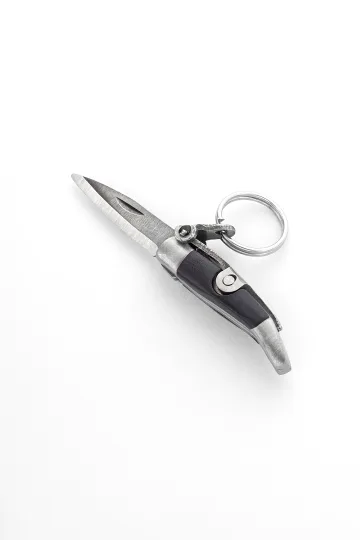




Final thoughts
In a world where the idea of peace can seem naive, wearing a peace sign or a dove with an olive branch is not naive. It is a considered position that quietly marks which cultural tradition the wearer wishes to belong to. No one is required to declare their values through jewellery, but those who do have the right to serious, well-made pieces rather than souvenir trinkets.
The peace sign and the dove work better the calmer the era surrounding the wearer. They do not shout; they indicate. In a loud political context they can easily become the flag of one side, which is not what they were intended for. In quiet everyday life they remain what they were designed to be: a reminder of a civic choice in favour of dialogue, the calm after the storm, and the possibility of understanding one another.