Red Spinel: The Gem Mistaken for Ruby for Six Centuries
The largest red gem in the British crown is called the Black Prince's Ruby. It weighs roughly 170 carats, has crowned helmets and royal regalia for six hundred years, and has a name that turns out to be a lie. In the twentieth century gemmologists finally settled the question: it is not a ruby at all. It is spinel. And it was not the only one. Tucked away in Europe's treasuries are dozens of famous "rubies" that proved to be spinel under proper analysis. Whole dynasties of kings wore red spinel believing they owned the rarest red stone on earth.
The confusion makes sense. Spinel and ruby form in the same rocks, share almost the same colour, and carry the same glassy shine. Until the late eighteenth century nobody had a reliable way to tell them apart. What follows is the practical story: how spinel differs from ruby in chemistry and physics, where it comes out of the ground, how it forms, how to spot a real stone from glass, and how to look after one once it is on your hand.
What red spinel actually is: chemistry and physics
Composition and formula
Spinel is a magnesium aluminium oxide with the formula MgAl₂O₄. In its pure form the mineral is colourless. The red comes from traces of chromium that slot into the crystal lattice in place of aluminium. The more chromium, the deeper and cleaner the red. Iron pushes the colour towards brown and orange, so stones high in iron look darker and muddier.
There is a neat coincidence here: chromium is exactly what colours a ruby red too. Two completely different minerals turn red for the same reason, which is half the explanation for how easily they were mixed up.
Crystal structure
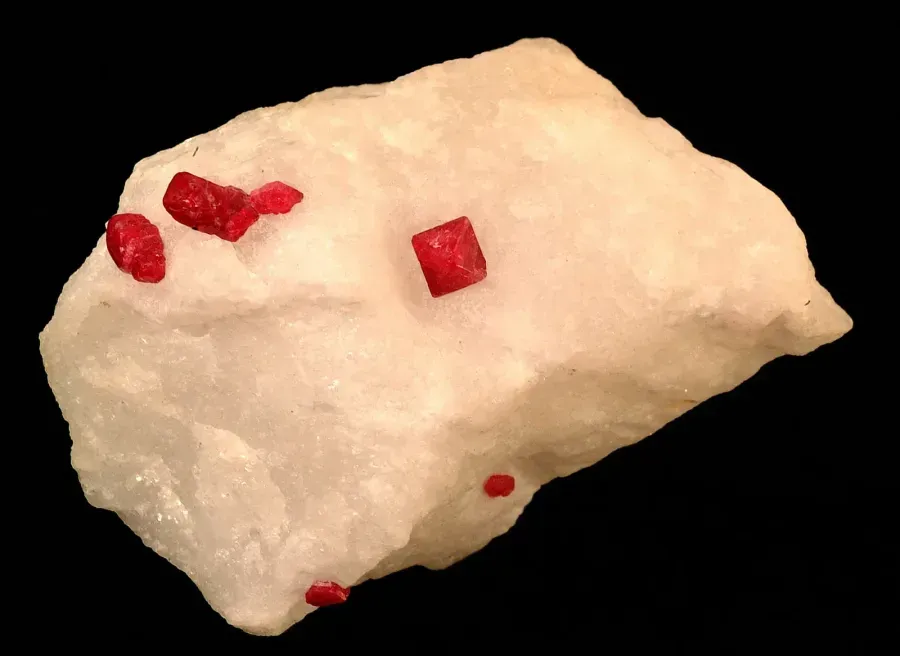
Spinel crystallises in the cubic, or isometric, system. In nature its crystals often grow as octahedra, regular eight-sided shapes that look like two pyramids joined base to base. On a good mineral specimen you can see this with the naked eye.
Wear the symbol, don't just read about it. These are in stock:




That cubic structure is the key physical difference from ruby, which belongs to the trigonal system of corundum. Because of it, spinel is optically isotropic: light passes through it the same way in every direction, so the stone has no double refraction and no pleochroism. Ruby is doubly refractive and pleochroic, meaning the same colour shifts in tone as you turn it. This is why spinel glows in a steady, soft way while a ruby gives a sharper, more sparkling play of light.
Hardness, density, optics
Spinel sits at 8.0 on the Mohs scale. That is softer than sapphire and ruby (9.0) but noticeably harder than most coloured stones such as garnet, tourmaline and amethyst. For everyday wear 8.0 is excellent: the stone shrugs off fabric, paper and dust and survives years in a ring without losing its polish.
The density of red spinel is around 3.5 to 3.6 g/cm³. The refractive index is single, somewhere around 1.71 to 1.73. Dispersion (the splitting of light into a spectrum, the so-called "fire") is moderate, lower than diamond, so spinel sparkles in a calmer register. Many stones show a red or orange fluorescence under ultraviolet light, again thanks to that chromium.
How spinel forms in nature
Red spinel is born in metamorphic rock at high temperature and pressure, where limestone and dolomite meet hot intrusions and recrystallise into marble. In an environment rich in magnesium and aluminium but short on silica, spinel crystals grow. The right conditions sit a few kilometres down.
Then surface geology takes over. Tectonic movement lifts the rock, and water and erosion break down the soft marble. The tough spinel crystals wash out and gather in river gravels and alluvial deposits. That is why, historically, most stones were not mined from shafts but recovered by washing gravel in mountain streams, much like panning for gold.
Geography: where red spinel comes from
The historic source of the finest red spinel is the Mogok region of Myanmar (Burma). Burmese stones are prized for a clean, saturated red with no brown drift: the local rock carries plenty of chromium and little iron. Mogok also produces rubies, which is precisely why the two were confused for so long.
Sri Lanka is the second great source. Ceylon spinel is often lighter than Burmese, sometimes with a pink or orange cast. It comes up from the same gravel beds that yield sapphires.
Another historic name is Badakhshan, a mountain region straddling what is now Tajikistan and Afghanistan. For centuries it sent out large red stones that medieval inventories called "balas rubies" or "lals". Today spinel is also mined in Thailand, Vietnam and Tanzania. The Tanzanian finds of recent decades have given the market vivid neon pink-reds that collectors took to quickly.
In Britain and across Europe gem-quality red spinel does not occur in any meaningful quantity, which is part of why the royal stones had to be imported along the old Asian trade routes in the first place.
Mogok: the valley of rubies where spinel also lives
Gemmologists call the Mogok district of northern Myanmar the valley of rubies, yet for centuries it has also produced the finest red spinel in the world. The host rock here is marble formed when continental plates collided, rich in chromium and almost free of iron. That chemistry gives Burmese spinel the clean red that seems to glow from inside, with no brown undertone at all. Mining is artisanal and very old: stones are washed out of river gravels in baskets and dug by hand from soft weathered rock. Large clean crystals turn up rarely, and each one is an event on the local market.
Kuh-i-Lal: the Pamir seam in Tajikistan
The Kuh-i-Lal deposit in Gorno-Badakhshan, in what is now Tajikistan, is the historic heart of the balas ruby. The Persian and Turkic word "lal", used for red stones across centuries of inventories, is bound up with these mountains. Kuh-i-Lal sits high in the Pamirs, and working it is hard because of the altitude and the climate. Many of the giant historic stones in Asian and European regalia probably came from here, because this seam produced the rare large crystals in a deep even tone. Mining today is limited, and Tajik spinel is prized by collectors for the direct line it draws back to the Badakhshan of the old accounts.
Sri Lanka, Tanzania and the newer sources
The Ceylon gravels yield spinel as a by-catch alongside sapphire: the stones have been washed out of their host rock and gathered in the gravel layers of river valleys. Ceylon spinel is often lighter and softer in tone than Burmese, drifting towards pink and orange. Tanzania arrived later but made an entrance: deposits around Mahenge gave the world vivid pink-reds and near-neon stones that collectors wanted immediately. Vietnam, around Luc Yen, supplies both red spinel and the rare blue kind, and occasional finds come out of Thailand, Afghanistan and Madagascar. The map is wider than most people assume, and top-grade material is scarce everywhere on it.
Why good spinel is so rare
Nature hands out gem-grade red spinel sparingly. It needs an unusual set of conditions to line up: magnesium and aluminium in abundance, very little silica, enough chromium for the red, and almost no iron, because iron drags the colour towards brown. Those chemical windows do not open often in the rock, and crystals free of fractures and cloudy zones are rarer still. Even at the famous deposits the bulk of what comes out is cheap material, and only a small fraction reaches a clean saturated red. That scarcity is what holds the value of good spinel up, despite the mineral having far less fame behind it than ruby.
Customer reviews
Zevira is a real jewellery shop. Genuine payments, deliveries and customer thank-yous.
🥰🥰🥰 gracias
Ok, ¡gracias! 🙂
Keep the red stone alone. Crowd it with a second and you are wearing a traffic light, not a look. Do spare me.
What to wear red spinel with
I always let the red spinel lead the look and fit everything else around it. Here are the questions I hear most at fittings.
What should I wear spinel with day to day? For everyday I recommend a slim ring or studs with a one to two carat stone. That is enough to lift jeans with a white shirt or a grey knit, and it never argues with the rest. For the setting I suggest something quiet: silver or white gold reads as a detail of taste rather than a claim to luxury.
Which metal should I pick for the stone? Warm red gets on with both white and yellow gold. White gold and silver sharpen the cool purity of the tone, yellow gives the stone a faintly antique character. For a cool skin undertone I choose a white metal, for a warm one I happily go with yellow gold.
How do I build an evening look? For the evening I suggest an open neckline and a plain fabric in a deep colour: black, navy, wine, emerald. Against that the red sinks into depth. A pendant with a large spinel or drop earrings against bare skin at the collarbone read best of all.
Can I combine spinel with other stones? You can, as long as you keep a hierarchy. One bright red accent plus a couple of quiet pieces: a fine chain, a plain ring, small studs. It looks handsome next to a calm blue sapphire or a white pearl. The one rule: a single strong red accent at a time.
Which chain length should I choose? For a pendant I recommend starting from the neckline. A 45 centimetre chain sits at the collarbone and suits an open neckline, 60 centimetres drops the accent lower and works over a plain dress. A short length keeps the stone on show, a long one tucks it closer to the body.

Turn on your camera, pick earrings, a pendant or a ring, and see the piece on yourself in real time.
Switch items in one tap.
Everything runs in your browser: no photo or video is ever uploaded.
History: a stone in crowns and treasuries

A deception six centuries long
Red stones from Badakhshan travelled the trade routes of Asia to the courts of Persia, India and Europe. They moved alongside rubies pulled from the same ground, and nobody separated them: to a merchant or a king it was simply "a red stone of noble kind". Most of the famous "rubies" in old regalia turn out, on inspection, to be spinel.
The best-known case is the Black Prince's Ruby in the Imperial State Crown. By tradition it reached the English court in the fourteenth century and passed from monarch to monarch ever after. Modern analysis showed it to be a large uncut red spinel. The same treasury holds the Timur Ruby, also a spinel, engraved with the names of the rulers through whose hands it passed.
The Black Prince's Ruby: Britain's greatest impostor
The stone sits directly above the large diamond at the front of the Imperial State Crown, and anyone who has looked at the crown in the Jewel House at the Tower has looked straight at it. It is roughly the size of a hen's egg, a deep crimson red, and barely cut at all: the surface has only been polished along its natural form. According to the chronicles it belonged to a Muslim ruler of Granada, passed to King Pedro of Castile, and from him in the fourteenth century to the English prince Edward, known as the Black Prince, in return for military help. That is where the name comes from.
From there the stone ran through the central episodes of English history. Legend has Henry V wearing it on his helmet at Agincourt, where a blow to the helmet could have killed the king outright and the stone came through unharmed. In the seventeenth century, after the execution of Charles I, most of the crown regalia were sold off and melted down, yet the red stone survived even that and returned to the collection at the Restoration. For six centuries it was called a ruby, and only gemmological analysis in the twentieth century settled its true nature: a large uncut red spinel. One detail gives its history away at a glance. There is a drilled hole through the side, left from an older way of wearing it on a cord, and the hole was later plugged with a small genuine ruby.
The Timur Ruby: a stone signed by its owners
The second famous impostor in the same collection weighs around 350 carats and is likewise a spinel rather than a ruby. Its interest lies in more than the size. Engraved across the surface are the names and titles of rulers through whose hands it passed over several centuries: Central Asian, Persian and Indian sovereigns each added an inscription, treating the stone as a chronicle in mineral form. The connection to Timur was attached later, and there is no direct evidence that the conqueror ever owned it, but the engravings themselves are genuine and old.
Those inscriptions turn the stone into a rare historical document. They show how a jewel migrated between courts as war booty, diplomatic gift, or part of a dowry, and how each new owner felt entitled to add a line. When the stone entered the British collection in the nineteenth century it was filed among the rubies out of habit, and its real identity was established only with modern instruments. Read in order, the engraved names give a route across Asia that no written archive records quite so compactly.
Other crown spinels of Europe and Asia
The Black Prince's and the Timur stones are far from alone. Large red spinel sits in the imperial crown of Russia among its other gems, and big red stones in the Czech and Iranian regalia have repeatedly proved to be spinel when tested. The pattern behind this is simple. While colour was the only measure available, any large red stone of noble clarity was automatically entered in the books as a ruby, and the very largest historic "rubies" almost always turn out to be spinel, because nature produces spinel in big flawless crystals more readily than it produces ruby. A giant clean ruby of many tens or hundreds of carats is close to impossible; spinel at that size is uncommon but real.
The favourite of Asian courts
The Mughal rulers of India had a particular love for large red spinel. They often had the owner's name and titles engraved on their stones, which turned a jewel into a kind of inherited passport. Court miniatures show emperors wearing massive red stones, and many of those were spinel rather than ruby.
Recognition as a separate mineral
By the end of the eighteenth century mineralogy had learned to measure stones: hardness, density, the angle at which light bends. That is when a large share of the "rubies" in royal collections were revealed to be a different mineral. Spinel was given the status of a gemstone in its own right, but outside specialist circles the knowledge spread slowly. Only in the twentieth century did museums rewrite their labels and gem laboratories pin down clear criteria. The story of how ruby is valued in jewellery and why it was confused with spinel for so long is one we cover separately.
Upload a photo of your pet, someone you love, or an object. We'll build a 3D model and hand-cast it in pewter.


Types and shades
Grades of colour
Colour is the headline parameter for red spinel. The most prized tone is a deep, saturated red with neither excess darkness nor a brown undertone; it is sometimes called pigeon's blood by analogy with the finest rubies. A step below sits a clean bright red. Then come the pinkish-reds and orange-reds: more common and cheaper, though plenty of people love pink spinel for its softness.
The main visual test is simple: a good stone glows from within rather than looking dull. Stones that are too dark lose their play of light and can look almost black in low light.
Worth knowing: star spinel
If a stone holds parallel needles of rutile inside it, cutting it as a cabochon brings out a star of light on the surface (asterism), usually with four or six rays. Such star spinels are rare and prized in their own right. A close cousin is the cat's eye effect, where the inclusions give one moving band of light.



Telling spinel from ruby and from fakes
Spinel versus ruby
By eye, the most reliable guide is the character of the glow. Ruby bends light more sharply, throws bright pinpoint flashes, and through double refraction and pleochroism shifts its tone slightly as you turn it. Spinel is optically uniform: it glows evenly and softly throughout, with no change of tone. Spinel's colour is often a touch warmer, sometimes with a grape-like depth, where a ruby can carry a faint bluish cast.
Proper certainty comes from instruments. Ruby is doubly refractive, spinel singly so, and that shows up at once on a refractometer. Density and absorption-spectrum lines differ too. For any expensive purchase, take a report from a gem laboratory.
Spinel and other red stones
Garnet is softer (about 6.5 to 7.5 Mohs) with a lower refractive index, and a good red garnet can be mistaken for spinel by eye while being less durable. Red tourmaline (rubellite) is also softer (around 7 to 7.5) and usually clearer in the character of its shine; we go into it in our piece on rubellite tourmaline as a red stone. Red zircon can be hard but is more brittle and chips more easily along its edges.
Fakes and treatment
The commonest imitation is coloured glass. It is softer, it scratches, and against the light it gives an even, lifeless colour with no natural inclusions; often you can see round gas bubbles inside. Natural spinel under a loupe shows tiny crystalline inclusions and traces of natural dissolution.
A separate matter is synthetic spinel. It is grown in a laboratory; by composition and structure it is genuine spinel, simply man-made. Synthetics look suspiciously clean and uniform, with none of nature's "flaws", but only a gemmologist with a microscope and refractometer can reliably separate them from a natural stone. So for anything over a few carats it makes sense to take a laboratory certificate and to ask the seller to let you examine the stone under magnification. An honest jeweller will always allow it.
A stone almost never treated
This is a rare and important property of spinel. Most red stones on the counter have been treated: rubies are almost universally heated to clear a bluish cast and dissolve inclusions, fancy sapphires are baked, beryls are soaked in oil and resin. Red spinel falls outside that pattern: its colour comes from chromium at birth and does not improve with heat, so the overwhelming majority of spinels on the market have never seen heat or impregnation. What you see in the stone is its natural tone and natural clarity, with no cosmetics.
The practical conclusion is simple. When buying a ruby you have to establish the degree and kind of treatment, because it bears directly on price and durability. With spinel that question nearly always answers itself: an untreated natural stone is the norm, not a stroke of luck. If a seller does claim some treatment, that is a reason to pause and ask for a laboratory report.
Cut, clarity and the "window"
Spinel is most often cut in classic open-table shapes: oval, cushion, round, and less often the stepped emerald cut. The cubic structure imposes no cleavage directions, so the cutter is free to choose proportions and works only to draw the maximum colour and brilliance out of the stone.
The main cutting flaw is the "window": if a stone is sawn too flat, a pale transparent patch appears in the centre through which you can read your finger or the setting, and the red seems to drain away there. A stone with correct proportions glows evenly across the whole table. The test is easy: lay the stone on printed text and look down. If the letters show through the middle, the cut has lost some of the colour.
For clarity, spinel has its own benchmarks. Small inclusions are natural for it and no death sentence in themselves: they confirm a natural origin and are barely visible without a loupe. What matters is something else: cracks that reach the surface, and large cloudy zones. The first reduce strength and interfere with ultrasonic cleaning, the second smother the glow. A stone that is clean to the eye with light internal inclusions is more practical and more honestly priced than a "perfectly empty" one, which is more often synthetic or glass.
Synthetic spinel: the man-made twin
How and why it is grown
Synthetic spinel has been made in the laboratory for more than a century, and at the start it was made more or less by accident. Chemists trying to grow blue sapphire by melting powder in a flame added magnesium oxide to the mix and produced a crystal of a different composition altogether, which turned out to be spinel. The method, named after the chemist who developed it, is flame fusion: oxide powder is dropped through a hydrogen and oxygen flame, the molten droplets settle on a rotating rod, and a carrot-shaped crystal known as a boule builds up. Growth from a molten flux was mastered later and gives crystals that look more natural. Chemically and structurally this is the same MgAl₂O₄, simply produced by people in a matter of days rather than by geology over millions of years.
Where it turns up and where the catch is
Colourless and blue synthetic spinel spent decades in inexpensive jewellery standing in for other gems: it has imitated aquamarine, zircon, and, thanks to how easily its colour can be tuned, even diamond and sapphire. Red synthetic material is less common, because getting a clean chromium red through flame fusion is technically awkward, but it exists. The problem is not that laboratory stones are somehow bad, since the material is genuine spinel by composition. The problem is that they are sometimes sold at the price of a natural crystal, and the gap between the two is enormous. An honest seller states the origin without being asked.
How to tell the synthetic from the natural
By eye there is not much to go on, though a laboratory stone does give itself away in places. Flame fusion often leaves curved growth lines inside the crystal and small rounded gas bubbles, whereas natural spinel shows angular mineral inclusions and traces where crystal faces have been partly dissolved. Synthetics frequently look too clean and too uniform, without a single internal vein. Under ultraviolet light some artificial material fluoresces differently from natural stones. Full certainty comes from a laboratory: the absorption spectrum, the character of the inclusions under a microscope, and precise optical measurements separate the two beyond argument. For anything above a couple of carats sold as natural, a report is a sensible insurance policy rather than a luxury.
Leave your email, we'll send your discount code. No spam, unsubscribe anytime.
The code arrives by email, valid on your first order.
Care and wearability
Hardness and everyday wear
Hardness of 8.0 makes spinel one of the most practical coloured stones. In a ring, earrings or a bracelet it takes daily wear in its stride: ordinary contact does not scratch it. Earrings and bracelets are safer still than rings, because they meet hard surfaces less often. A sharp knock against an edge could in theory chip any stone, so it is best to take a ring off before sport, DIY, cleaning with harsh chemicals, and handling heavy objects.
Cleaning
Care is simple. Every couple of weeks wash the stone in warm water with a drop of mild soap, run a soft toothbrush over the facets and under the setting where grease and dust collect, rinse in clean water and dry with a lint-free cloth. Avoid abrasive powders, solvents, acetone and concentrated acids, which can harm both stone and metal. An ultrasonic bath at the workshop is fine for a deep clean, provided the stone has no large cracks.
Storage
Store the piece apart from others, so that harder stones (sapphires, diamonds) do not leave scratches on the facets. A soft pouch or a separate compartment in a box does the job. Spinel itself does not fade: the red comes from chromium in the crystal lattice, and that colouring is stable and indifferent to time, sun and household temperatures. If a stone looks dull over time, the cause is a film of dirt and cosmetics, not the mineral; a normal clean brings the shine back.
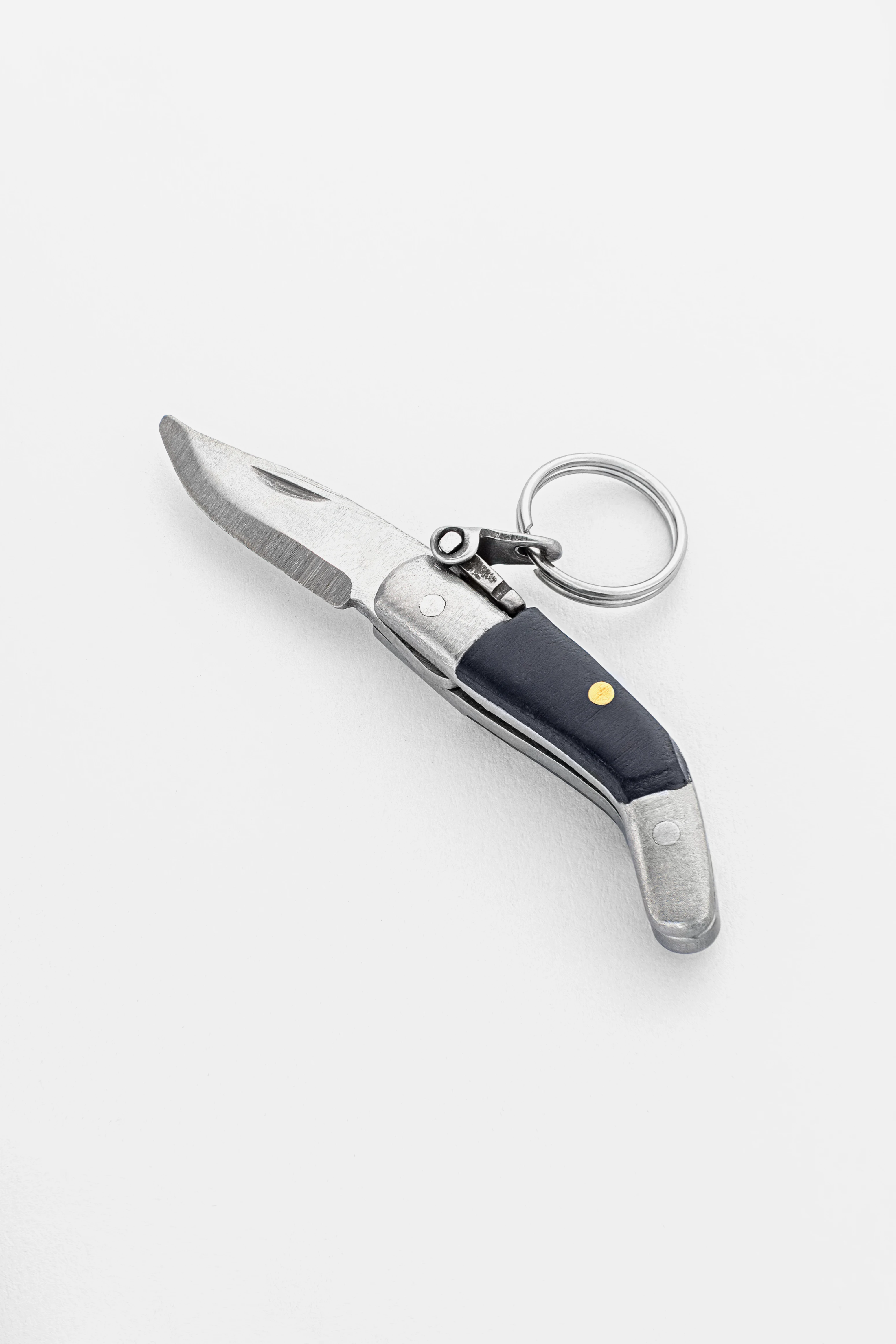
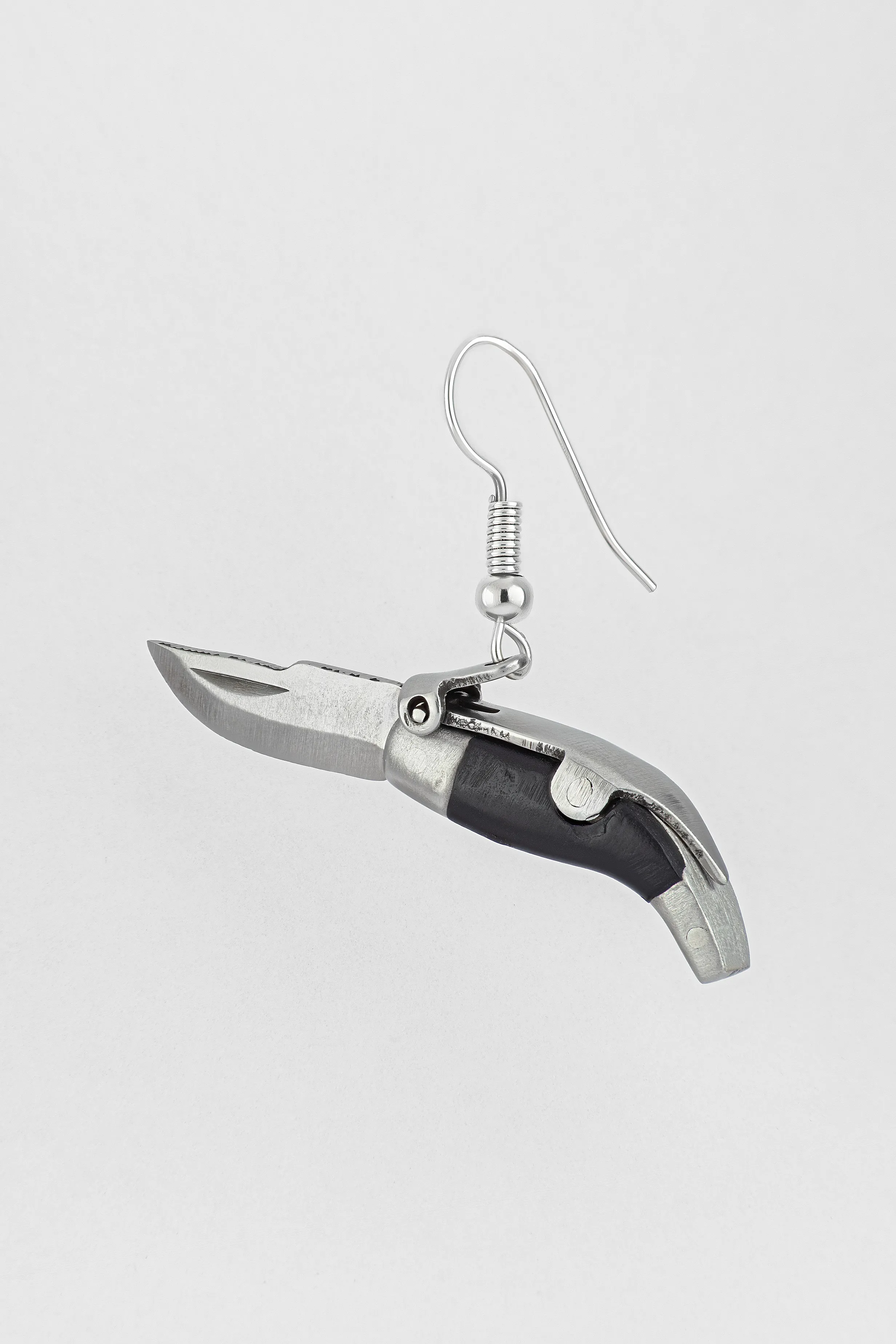
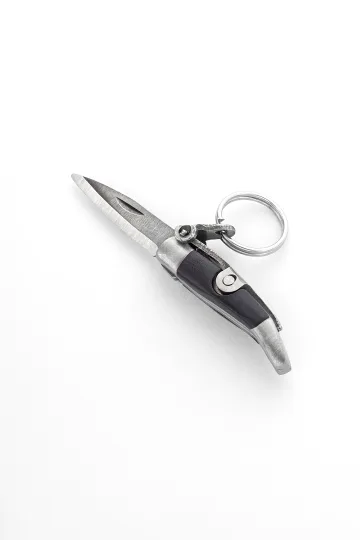
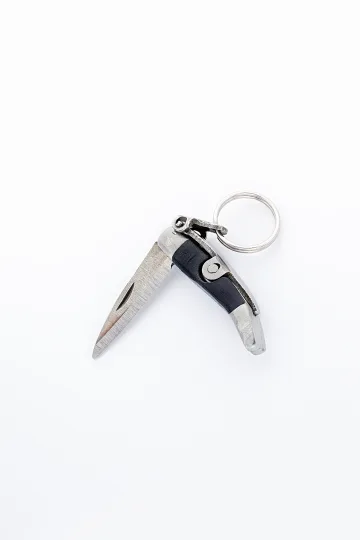
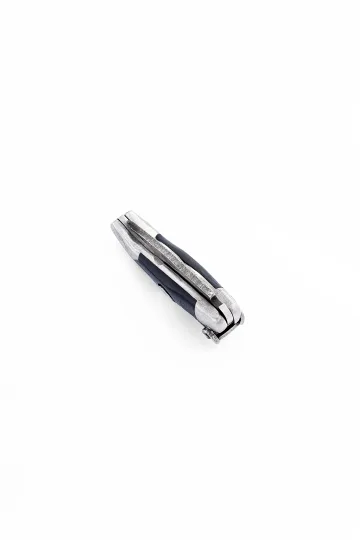
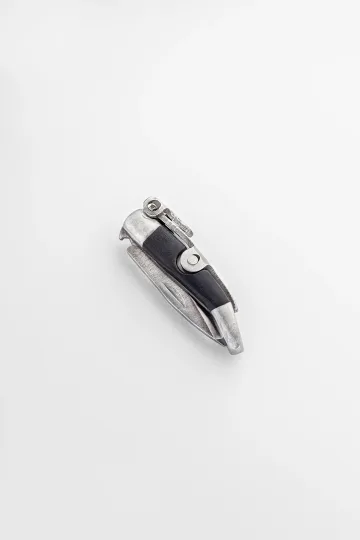
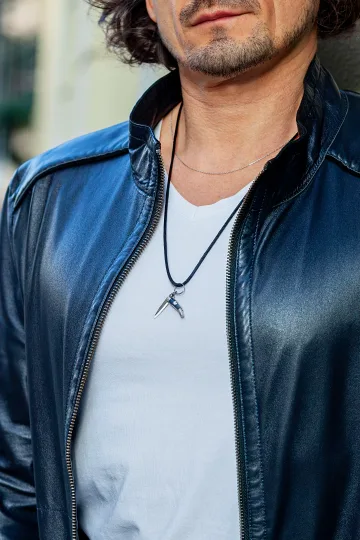
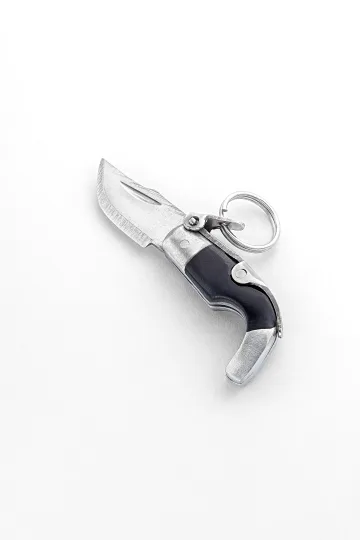
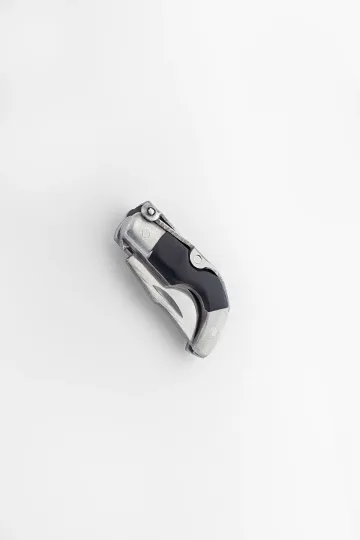
CAPAORA mini knife pendant
The 18th-century Spanish navaja in miniature: 40 mm of stainless steel, a real folding mechanism and a Palanquilla lock that clicks. An affordable gift to remember.
Authentic · Ships from Spain · 14-day returns
Symbolism: briefly and honestly
Across many traditions red was tied to life force, passion and courage, and red stones were worn as a mark of status and resolve, which is part of the history of jewellery. In Indian tradition spinel was counted among stones of a "fiery" nature. Treat this as cultural heritage rather than instruction: there is no proven effect of the stone on character, health, sleep or luck. Spinel is valued first of all for being a beautiful, durable and rare mineral with an interesting past.
What to check when buying
Light decides the most. Look at the stone under different lighting: daylight by a window, a warm incandescent lamp, a cool white LED. A good stone holds a saturated red in all three and never slides into a dull brown. If it comes alive under the lamp but dies by the window, the colour has been propped up by the shop's artificial light.
Turn the stone table-up to the light and tilt it. Clean spinel stays uniform in tone, because it has no double refraction and no pleochroism. If the red noticeably shifts as you turn it, you are more likely looking at a ruby or another stone, and that changes the price. Air bubbles inside, visible even without a loupe, give away glass.
Ask for a ten-power loupe; any conscientious seller will hand one over. Natural crystalline inclusions and traces of dissolved facets are a good sign of authenticity. Suspiciously sterile clarity, on the other hand, is more typical of a synthetic. Inspect the girdle and the table separately for chips and scratches: a stone of hardness 8.0 should not have them, and if it does, it has been dropped or poorly stored.
For a stone over two or three carats, take a laboratory report. In it look at two points: the nature of the stone (natural spinel, not synthetic) and the treatment note. For spinel the treatment line almost always reads "none detected", and that is its honest advantage. If the document records an enhancement, ask what it is and how it bears on the price.
Send a friend a discount code, they save on their first order.
Facts that take people by surprise
Britain's most famous ruby is not a ruby
For six centuries the Black Prince's Ruby was counted among the most valuable rubies in the world and sat at the front of the crown worn by British monarchs. When gemmology learned to measure stones precisely, it turned out to be red spinel. The most celebrated red stone in the country belongs to an entirely different mineral species, and nobody has bothered to rename it, because after six hundred years the name is part of the history.
In old inventories the word "ruby" often means spinel
Jewellery historians have learned not to take old catalogues at face value. If a medieval or Renaissance inventory lists a large ruby of impressive size, the odds are good that the stone was spinel. The bigger and cleaner the described stone, the higher those odds climb, because nature yields spinel in large flawless crystals considerably more readily than it yields ruby.
One mineral, two species, the same reason for the colour
Ruby and red spinel are coloured red by exactly the same element: chromium, sitting in the lattice where aluminium would otherwise be. Two entirely different minerals arrive at red through an identical chemical mechanism. That coincidence is precisely what made them indistinguishable by eye and set off six centuries of confusion in the treasuries of Europe and Asia.
Spinel is almost never treated
In a trade where rubies are heated almost as a matter of routine, sapphires are baked, and emeralds are oiled, red spinel stands apart. Its colour comes from chromium at birth and does not improve with heat. The overwhelming majority of spinel on the market is exactly what it appears to be, with no cosmetic work behind it, which is a rare and rather honest quality in a coloured gemstone.
The synthesis of spinel was discovered by mistake
The first artificial spinel was not made deliberately. Chemists working on blue sapphire in a flame furnace added magnesium oxide to their charge and grew spinel instead of corundum. That accidental result became an entire industry of imitation material, which spent decades standing in for other stones in inexpensive jewellery.
Spinel comes in colours other than red
The mineral is famous for red, but in nature it also occurs blue, violet, pink, orange and nearly black. Different impurities set the tone: chromium gives red, iron and cobalt pull it towards blue. The rare vivid blue cobalt spinel is prized among collectors on a level with the best red material, and good specimens of it are every bit as difficult to find.
The mineral occurs in meteorites and in lunar soil
Spinel is refractory and stable enough to form in space. Its grains have been identified in stony meteorites and in samples of lunar soil brought back to Earth. The mineral crystallises at temperatures high enough to survive conditions in which many other gem species would never have formed in the first place.
There is a star inside some of them
Given the right rutile inclusions and a cabochon cut, red spinel shows a moving band of light across the dome, usually as a four-rayed star. Star red spinel is genuinely rare and a particular pleasure for a collector, because a single stone combines saturated colour with a cross of light that shifts as the piece is turned in the hand.
Frequently asked questions
How does red spinel differ from ruby by eye?
The main difference is the character of the glow. Ruby bends light more sharply and throws bright pinpoint flashes that seem to reach toward the light source, and through double refraction it shifts tone slightly as you turn it. Spinel is optically uniform: it glows softer and more evenly, scattering light throughout, with no change of tone. Spinel's tone is often a touch warmer, sometimes with a grape-like depth; ruby can carry a faint bluish undertone. Without an instrument it is hard to be a hundred per cent sure, so for an expensive purchase take a laboratory certificate.
Can I wear a red spinel ring every day?
Yes. Its Mohs hardness is 8.0, just one step softer than sapphire and well above most coloured stones. Fabric, paper and a bag's leather will not scratch it. Even so, take the ring off before sport, DIY, cleaning with harsh chemicals and handling heavy objects: a sharp knock against an edge could in theory chip any stone. Bracelets and earrings are safer than rings in this respect.
Which colour of red spinel is the most prized?
The highest value goes to a deep, saturated red without excess darkness and without a brown drift in tone, sometimes called blood red or pigeon's blood. That shade comes from deposits high in chromium and low in iron. A step below sits a clean bright red with no off undertones. Pinkish-reds and orange-reds are more common and cheaper. The main guide: the stone should glow from within rather than look dull or cloudy.
Why is red spinel more affordable than ruby when they look alike?
At comparable quality spinel usually costs appreciably less than ruby. The reason is rarity and reputation: fine rubies are markedly scarcer, and they carry centuries of fame as the stone of kings. Spinel is a sensible choice for anyone who wants a red stone with history and a character of its own without paying the premium for a famous name. That said, top large spinel can fetch very high prices at auction, so "a cheap stone" is not really the truth of it.
How do I care for red spinel jewellery?
Every couple of weeks wash the stone in warm water with a drop of mild soap, gently working a soft toothbrush over the facets and under the setting. Rinse in clean water and dry with a soft lint-free cloth. Avoid abrasive powders, solvents, acetone and concentrated acids. Store the piece apart from others so harder stones do not leave scratches. For a deep clean an ultrasonic bath at the workshop will do.
Does red spinel fade over time?
Spinel itself does not fade or darken. Its red is a consequence of chromium in the crystal lattice, and that colouring is stable and indifferent to time, sunlight or household temperatures. There are pieces several centuries old that have kept their original tone. A loss of shine is down not to the stone but to a film of dirt and cosmetics on the surface, which a normal clean removes. If the shine does not return, the cause is microscratches on the facets, and then a polish at the jeweller helps.
Is red spinel suitable for an engagement ring?
Yes, both for beauty and for practicality. Hardness 8.0 allows daily wear, and the saturated red looks expressive and warm. The classic setting is a central spinel in white gold flanked by a pair of small diamonds, but a minimalist ring in sterling silver with a single stone looks just as stylish. If you want something less obvious than a traditional colourless stone, spinel offers character without giving up durability.
How do I tell natural spinel from synthetic or fake?
The crudest fakes are coloured glass: softer, prone to scratching, and against the light an even, lifeless colour with no natural inclusions, sometimes with round gas bubbles. Natural spinel under a loupe shows tiny inclusions and traces of natural dissolution, whereas a synthetic looks suspiciously perfect and uniform. Only a gemmologist with a refractometer and microscope can reliably separate good synthetic from a natural stone, so for anything over a few carats take a laboratory certificate.
What size of spinel should I choose for a ring?
For a woman's ring a balanced size is roughly two to four carats: the stone shows well but does not get in the way. Too small and it is lost on the finger, too large and it can feel heavy. For a man's signet three to seven carats is the norm, since settings are heftier. In earrings about one carat per stone is plenty. Price rises non-linearly: one large stone costs more than two small ones of the same total weight, because large crystals are rarer.
Can red spinel be passed down as an heirloom?
Yes, spinel is well suited to family heirlooms. The stone is chemically and physically stable, does not break down with time and keeps its colour over centuries. If you like, an old setting can be swapped for a new one, moving the same stone into a modern piece, and that will not harm the spinel with careful work. Many historic stones have come down to us precisely because they passed from generation to generation.
Buying it as a gift? Each one arrives ready to give.
 A branded Zevira box and a little card come with every order.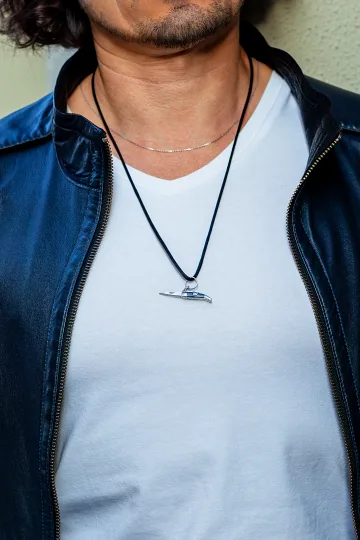







About Zevira: jewellery with red spinel
The Zevira collection includes pieces with red spinel: rings, earrings, bracelets and pendants in which a classic form meets a modern setting. We work with natural spinel, choosing stones with a clean red tone and good clarity.
We make our settings in sterling silver and gold. Silver and white gold underline the cool purity of the red, while yellow gold lends the stone a warm, slightly antique character. Each piece comes with information about the stone and care guidance.
Spinel jewellery is equally at home in an everyday look and on a special occasion. Thanks to its hardness of 8.0, a ring with this stone takes daily wear calmly, while the saturated colour makes it a clear accent without any shouting.
Red spinel in the Zevira catalogue
A stone with the history of crown regalia, the toughness for daily wear and a saturated red colour. Choose a ring, earrings or a pendant with spinel in the Zevira catalogue.
Open the Zevira catalogue Zevira home