The Scarab: How a Dung Beetle Became the Most Powerful Symbol in Ancient Egypt
Introduction
Here is a sentence that sounds absurd until you think about it: for over 3,000 years, the most revered creature in one of the most advanced civilisations in human history was a beetle that rolls balls of dung across the desert floor.
Not the falcon. Not the cobra. Not the lion or the crocodile. A dung beetle. The Egyptians carved it into amulets, pressed it into seals, placed it over the hearts of their dead, and gave it a god's name. Pharaohs issued scarabs the way modern governments issue commemorative coins. Cleopatra's court was still producing them when Rome was already an empire.
The scarab is one of those symbols that makes you reconsider how symbols work. We tend to assume that beautiful things inspire beautiful meanings. But the scarab flips that logic. The Egyptians did not look at this beetle despite its habits. They looked at it because of them. The ball of dung was not disgusting. It was the sun. The larvae emerging from the earth were not gross. They were resurrection. The beetle creating life from waste was not random biology. It was the most profound act in the universe: creation from nothing.
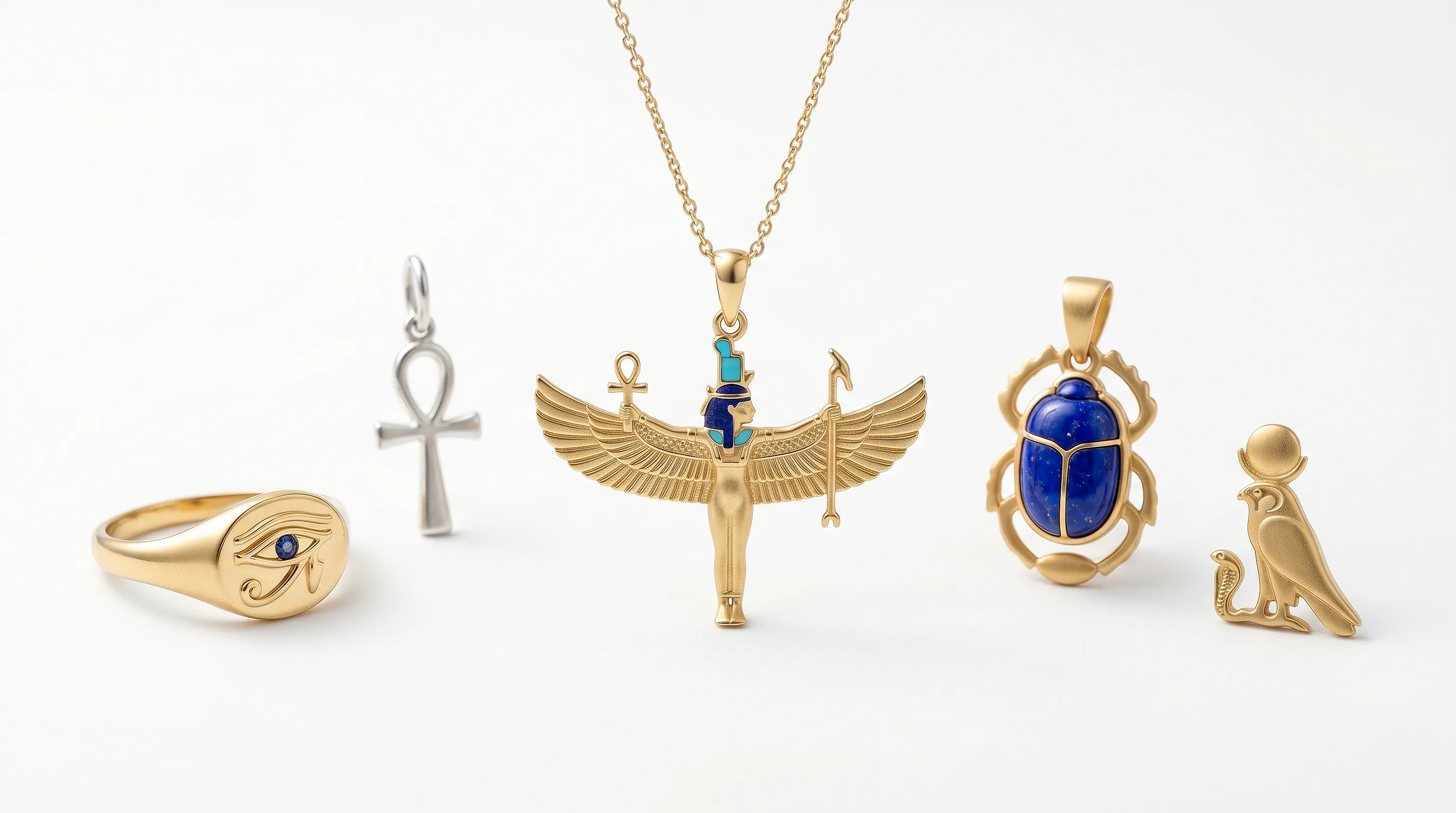
Wear the symbol, don't just read about it. These are in stock:




That idea of transformation, rebirth, and self-creation turned a common insect into perhaps the single most produced amulet in ancient history. And it has not stopped resonating. You will find scarabs in the Louvre, in the archives of classic American jewellers, on tattoo parlour walls, and hanging from the necks of people who may not know the full story but feel its pull anyway.
This is the full story.
Khepri: the god with a beetle for a face
The sun, the dung ball, and the logic behind it
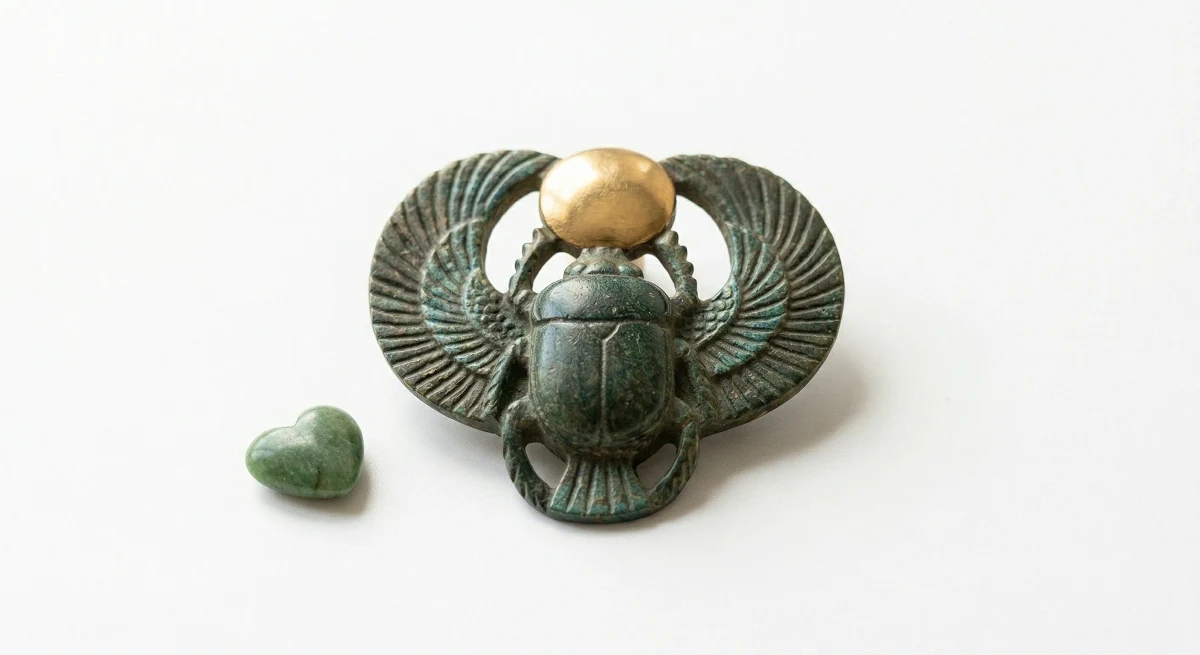
The Egyptian god Khepri is depicted as a man with a scarab beetle where his head should be. Or sometimes just as the beetle itself, wings spread, pushing a golden disc. That disc is the sun.
The connection was observational, not arbitrary. Egyptians watched the scarab beetle (Scarabaeus sacer) roll a near-perfect sphere of dung across the sand, orienting itself by the Milky Way, though they did not know that last part. What they saw was a small creature pushing a round object across the earth from east to west, the same path the sun takes across the sky.
The logic clicked. If a beetle pushes a ball across the ground, then surely a cosmic beetle pushes the sun across the heavens. Khepri was that beetle. Every morning, he rolled the newborn sun above the horizon. Every evening, he delivered it to the underworld, where it would travel through darkness and emerge again at dawn.
This was not a marginal belief. Khepri was one of the three solar aspects of Ra: Khepri at dawn, Ra at noon, Atum at sunset. The sunrise, the most important daily event in Egyptian cosmology, belonged to the dung beetle.
Sunrise as daily rebirth
For the Egyptians, the sun did not simply "rise." It was reborn. Every single morning was a repetition of the first creation. The world had emerged from darkness and chaos once, and it did so again every dawn. Khepri was the agent of that daily miracle.
This is why scarab amulets were so ubiquitous. Wearing a scarab was not decorative. It was aligning yourself with the most fundamental force in the universe: the daily renewal of existence. Every scarab pendant was a tiny sunrise you carried with you.
The Coffin Texts and the Book of the Dead are full of references to Khepri. The deceased hoped to join Khepri's journey, to be reborn with the sun each morning. Chapter 83 of the Book of the Dead is literally titled "Spell for being transformed into a sacred beetle." The dead wanted to become the scarab. Not metaphorically. Literally.
Self-creation: born from nothing
The Egyptian word "kheper" means "to come into being" or "to transform." It shares a root with Khepri's name, and with the word for the scarab itself. Language, god, and insect were all tangled together in a single concept: self-creation.
The Egyptians believed that the scarab beetle spontaneously generated from the dung ball. They did not understand insect reproduction in the way we do. What they observed was this: a beetle rolls a ball of dung, buries it, and weeks later, new beetles emerge from the earth. No parent visible. No mating observed. Life appearing from lifeless matter.
In Egyptian theology, this was the defining act of creation. Atum, the creator god, was said to have brought himself into being. Khepri embodied the same principle at a smaller scale. The scarab was self-created, self-renewing, self-sustaining. It was the closest thing in the natural world to the divine act of making something from nothing.
That is why the scarab outlasted every other Egyptian amulet in popularity. It was no mere charm. It was a theology compressed into a shape you could hold in your hand.
A winged scarab is for bare collarbones after dark, never over a turtleneck. Bury it under wool and the beetle stops respecting you.
How to wear scarab jewellery
I have styled the scarab through dozens of looks, from daytime knitwear to evening silk. Here is what actually holds up, sorted by occasion rather than by what sounds good on paper.
How do I wear a scarab every day? For everyday I recommend a smaller folded-wing beetle on a fine chain over plain knitwear, a white shirt or a basic tee. The calmer the outfit, the more the wing detail reads. Under a V-neck I suggest a slightly longer chain so the beetle sits on the chest; under a high neckline I go shorter so the scarab stays on the collarbone instead of hiding under fabric.
Does it work at the office? It does, and it behaves better than you would think. I choose a mid-size silver or gold-plated beetle over a shirt or a tailored dress, around 45 to 50 cm. Under a blazer it reads as a considered detail rather than jewellery for its own sake. A scarab brooch on the lapel follows the same logic: a quiet, confident statement.
How do I build an evening look? For evening I suggest a dark, smooth fabric in a deep colour, black, wine or emerald, with a larger winged scarab at the centre. After dark it opens up and pulls the look toward itself, so I keep everything else restrained: one striking beetle plus understated earrings. Gold or turquoise catches the light best.
How do I combine it with other pieces? The scarab likes the company of Egyptian motifs. I recommend layering it with an Eye of Horus, an ankh or a thin crescent; they share the same clean-line language. I stay in one metal per layer, gold with gold, silver with silver, or the beetle's detail gets lost. A turquoise or green scarab I back with calm, neutral clothing so the colour carries.
Who does it actually suit? Anyone who likes pieces with meaning and is not afraid of texture, rather than smooth minimalism. Two rules that never fail me. First, I match the size to the wearer: a small beetle on a short chain for every day, a large winged one saved for looks where it can lead. Second, the scarab needs room; one clear beetle always beats one crushed between five other pendants.
Turn on your camera, pick earrings, a pendant or a ring, and see the piece on yourself in real time.
Switch items in one tap.
Everything runs in your browser: no photo or video is ever uploaded.
Scarabs in Egyptian daily life
Amulets for the living
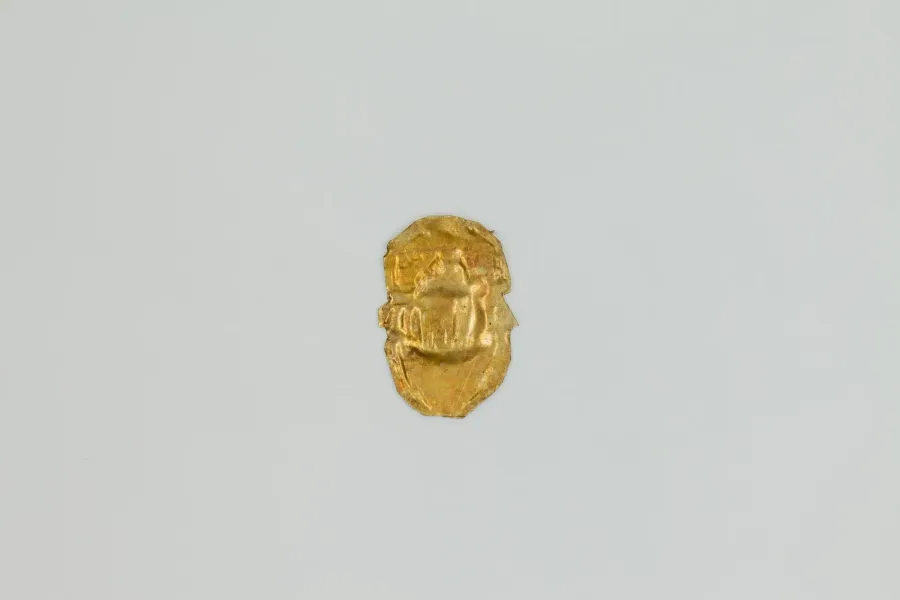
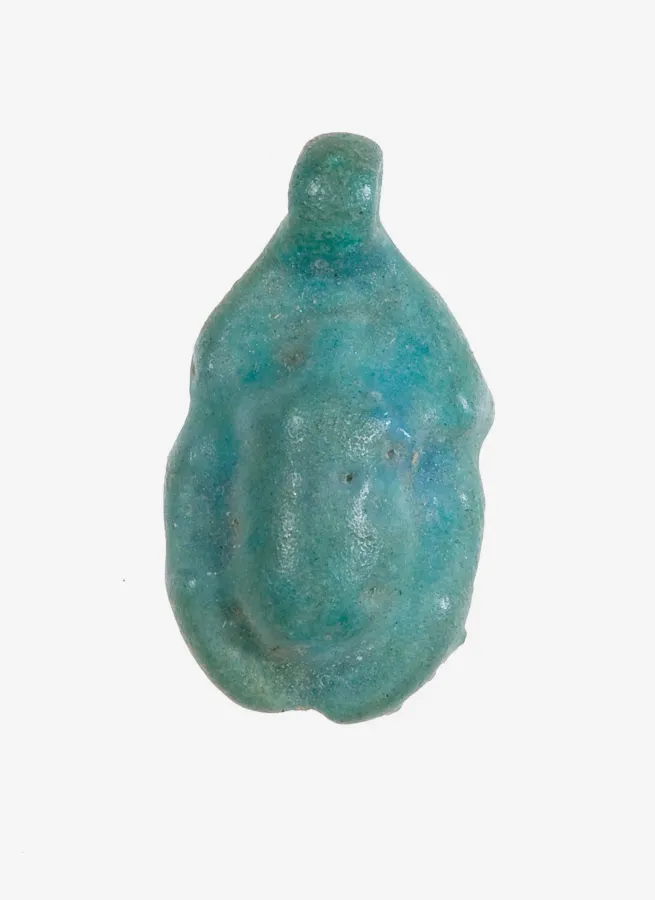
Scarab amulets were everywhere in ancient Egypt. Not just in tombs. Not just for the wealthy. Archaeologists have found them in homes, in workshops, in market stalls, on children. They were carved from steatite, glazed in blue or green faience, cut from carnelian, lapis lazuli, amethyst, and jasper. The finest were gold. The simplest were clay.
People wore them as pendants, rings, and bracelets. They sewed them into clothing. They placed them in foundation deposits when building a house. A scarab was insurance, not in the financial sense, but in the cosmic sense. It connected you to the daily rebirth of the sun. It said: I will endure. I will be renewed.
The sheer number of surviving scarabs is staggering. Museums around the world hold hundreds of thousands of them. The British Museum alone has over 3,000. They were produced for roughly 2,500 years without interruption, from the late Old Kingdom through the Ptolemaic period. No other amulet form in any culture comes close to that production run.
Heart scarabs and the judgement of the dead
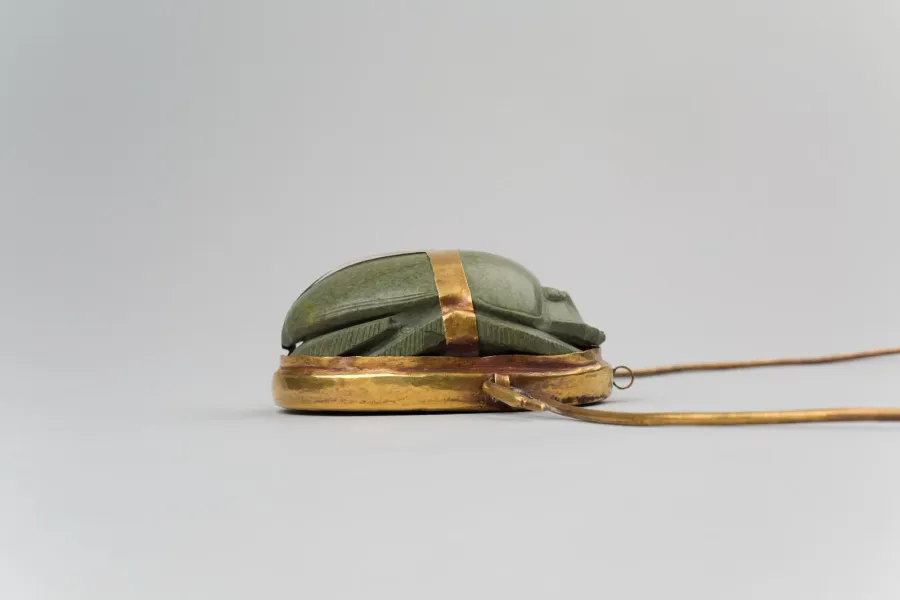
The most sacred scarab was the heart scarab. This was a large scarab, typically carved from dark green or black stone, placed directly on the chest of the mummified dead, over the heart.
Its purpose was specific and urgent. In Egyptian afterlife belief, the deceased faced a trial in the Hall of Ma'at. Their heart was weighed against the feather of truth. If the heart was heavier than the feather, weighed down by sin, the soul was devoured by Ammit, a demon with the head of a crocodile, the body of a lion, and the hindquarters of a hippopotamus.
The heart scarab was there to prevent disaster. On its flat underside, Chapter 30B of the Book of the Dead was inscribed: "O my heart of my mother, O my heart of my transformations, do not stand up against me as a witness, do not oppose me in the tribunal." The scarab was literally telling the heart to keep quiet, to not betray its owner's sins during judgement.
This is one of the most human things in all of ancient religion. The Egyptians believed in moral accountability after death. But they also hedged their bets. The heart scarab was the backup plan.
Scarab seals: signatures carved in stone
Beyond their religious function, scarabs served a completely practical purpose. The flat bottom of a scarab amulet was ideal for carving designs, names, titles, and hieroglyphs. Pressed into wet clay or wax, these became personal seals, the ancient equivalent of a signature or a stamp.
Scarab seals were used by everyone from pharaohs to mid-level bureaucrats. They sealed letters, authenticated documents, marked property, and identified goods in trade. A scarab seal was both a piece of jewellery and a tool of administration. You wore your identity on your finger.
The designs on scarab seals evolved over centuries and became a detailed chronological record. Egyptologists can date scarabs by their style, their hieroglyphs, and the types of designs carved on them. Some show royal names. Others show protective symbols such as the Eye of Horus, the ankh, the djed pillar. Others show geometric patterns, animals, or scenes of daily life.
Commemorative scarabs: the pharaoh's press release
Pharaoh Amenhotep III (ruled approximately 1391-1353 BCE) took the scarab to a new level. He issued large commemorative scarabs, sometimes over 10 centimetres long, to announce important events. These were not religious objects. They were propaganda.
Five types of Amenhotep III commemorative scarabs survive. The "marriage scarab" announces his union with Queen Tiye and lists her parents' names. The "lion hunt scarab" claims 102 lions killed in the first ten years of his reign. The "wild bull hunt scarab" records a single impressive hunt. The "lake scarab" describes an artificial lake he built for Tiye. The "Gilukhepa scarab" announces the arrival of a Mitanni princess and her 317 attendants.
These scarabs were distributed to officials and foreign courts. They were diplomatic gifts and political statements. Think of them as the pharaoh's press releases, cast in stone and shaped like a beetle.
Over 200 of these commemorative scarabs survive today, scattered across museums worldwide. They are some of the most important historical documents from the New Kingdom, and they are all shaped like dung beetles. History has a sense of humour.
Why this beetle: the biology that inspired a religion
The dung ball and the sun
The species at the centre of all this is Scarabaeus sacer, a large black dung beetle found across the Mediterranean and North Africa. The male beetle locates a pile of animal dung, carves out a portion, and shapes it into a near-perfect sphere using its hind legs. It then rolls this ball, sometimes many times its own body weight, across the ground to a suitable burial site.
Recent research has shown that the scarab beetle navigates by polarised light patterns and, at night, by the Milky Way. It is the first known animal to use the galactic plane for orientation. The Egyptians did not know this, but they were not wrong about the beetle's relationship with the sky. It is literally guided by the stars.
The ball itself serves as a food source and, in some cases, a brood chamber. The female lays an egg inside a specially prepared "brood ball," buries it, and the larva develops inside, feeding on the dung. When it matures, the new beetle digs its way out of the earth.
Watch this process without modern entomological knowledge, and the Egyptian interpretation makes perfect sense. A creature pushes a golden-brown sphere across the ground (the sun crossing the sky). It buries the sphere (the sun entering the underworld). New life emerges from the buried sphere (the sun reborn at dawn). The entire solar cycle, enacted by an insect.
Larvae emerging from the earth
The emergence of the new beetle from the ground was perhaps the most theologically important part. To the Egyptians, it looked like spontaneous generation: life from non-life, being from non-being. The ball went into the earth as dead matter. A living creature came out.
This mapped directly onto their understanding of death and resurrection. The mummy goes into the earth. The spirit (the ba and the ka) emerge renewed. The scarab was living proof that this was possible. Not a metaphor. Not a hope. Observable, repeatable fact, at least as they understood it.
Scarabaeus sacer: the sacred species
Not all dung beetles were sacred. The Egyptians were specific. Scarabaeus sacer, with its distinctive smooth black carapace and its habit of rolling spherical balls, was the one. Other dung beetles that did not roll balls, the tunnellers and the dwellers, did not receive the same veneration.
The beetle is about 25-35 millimetres long. It has powerful forelegs adapted for digging and shaping. Its head has a distinctive fan-shaped plate used for cutting and moulding dung. When it flies, its wing cases open to reveal translucent amber-brown wings underneath. In certain light, the black carapace shows a faint iridescent blue-green sheen.
There is something fitting about that hidden beauty. You have to look closely to see it, just as you have to look closely at a dung beetle's behaviour to see the sun.
Customer reviews
Zevira is a real jewellery shop. Genuine payments, deliveries and customer thank-yous.
🥰🥰🥰 gracias
Ok, ¡gracias! 🙂
The scarab beyond Egypt
Phoenician traders and the scarab highway
The Phoenicians were the great cultural transmitters of the ancient Mediterranean. They traded everything, and they adopted the scarab enthusiastically. Phoenician workshops in Tharros (Sardinia), Carthage, and along the Levantine coast produced enormous quantities of scarabs from the 8th century BCE onward.
Phoenician scarabs differ from Egyptian originals. The carving is often coarser. The designs mix Egyptian motifs with local elements: Phoenician script, Mesopotamian imagery, Greek mythological scenes. But the basic form is the same: a beetle on top, a flat seal surface on the bottom.
Through Phoenician trade networks, scarabs reached every corner of the Mediterranean. They have been found in Spain, Sicily, Sardinia, Malta, Tunisia, Greece, and Turkey. The scarab became genuinely international centuries before Alexander the Great.
Greek and Etruscan adaptations
The Greeks encountered scarabs through trade with Egypt and Phoenicia, and they adapted the form to their own tastes. Greek scarabs, particularly from the 6th and 5th centuries BCE, are often masterpieces of miniature gem-cutting. The beetle form is maintained on the back, but the seal surface carries Greek subjects: warriors, athletes, gods, and mythological scenes.
The island of Rhodes was a major production centre. Naukratis, the Greek trading colony in Egypt, was another. Greek scarabs tend to be smaller and more delicately carved than Egyptian ones, with a focus on artistic quality rather than magical function.
The Etruscans in central Italy took the scarab and made it their own. Etruscan scarabs from the 5th and 4th centuries BCE are among the finest carved gems in the ancient world. They favoured carnelian, agate, and banded jasper. The beetle form on the back became increasingly stylised, sometimes barely recognisable, while the intaglio scenes on the seal face show extraordinary detail and skill.
Etruscan scarab subjects include heroes from Greek mythology (Heracles was especially popular), scenes of combat, animals, and mythological creatures. These were worn as signet rings and used as personal seals. Hundreds survive in museums across Italy and beyond.
Roman gemstone scarabs
By the Roman period, the scarab form had evolved into something more decorative than functional. Roman gem-cutters produced scarab-shaped gems, usually in carnelian, jasper, or garnet, but the seal function was fading. The beetle back became flatter, more abstract. The emphasis shifted to the carved image on the base.
Roman scarabs turn up in jewellery hoards, in graves, and in the ruins of villas across the empire. They are part of the broader Roman fascination with Egyptian religion and culture. After Augustus conquered Egypt in 30 BCE, Egyptian motifs flooded Roman decorative arts. Scarabs, alongside obelisks and images of Isis, became part of Rome's cultural vocabulary.
Upload a photo of your pet, someone you love, or an object. We'll build a 3D model and hand-cast it in pewter.
Victorian Egyptomania and the scarab craze
Napoleon, the Nile, and a new obsession
Modern scarab jewellery begins, in a sense, with Napoleon Bonaparte. His Egyptian campaign of 1798-1801 was a military failure but a cultural earthquake. The 167 scholars and artists he brought along, the Commission des Sciences et des Arts, documented Egyptian monuments, tombs, and artefacts in extraordinary detail. Their publication, the Description de l'Egypte (1809-1829), introduced Egyptian aesthetics to European audiences who had never seen anything like it.
Suddenly, Egyptian motifs were fashionable. Sphinxes appeared on furniture. Obelisks appeared in city squares. And scarabs appeared in jewellery.
Egyptian Revival jewellery
The Egyptian Revival movement in jewellery had two main peaks. The first was in the early 19th century, driven by Napoleon's campaign and the subsequent work of scholars like Champollion, who deciphered hieroglyphs in 1822. The second was in the 1920s, triggered by the discovery of Tutankhamun's tomb.
During the first wave, jewellers worked with Egyptian motifs but in European styles. Scarabs were rendered in gold, enamel, and coloured stones. They appeared on brooches, bracelets, necklaces, and rings. The designs were often somewhat fanciful, more "European idea of Egypt" than historically accurate Egypt. But the scarab form was unmistakable.
Archaeological scarabs also entered the jewellery market directly. Wealthy European travellers to Egypt bought ancient scarabs and had them set into modern rings, brooches, and pendants. An authentic Egyptian scarab in a Victorian gold setting was a prestige item of the highest order. It said: I have been to Egypt. I understand antiquity. I am cultured.
Place Vendome haute joaillerie: luxury goes pharaonic
The great French and British jewellery houses embraced Egyptian motifs with enthusiasm. The leading Paris maisons created some of the most famous Egyptian Revival pieces in history. Their scarab brooches and pendants from the 1920s and 1930s combine platinum, diamonds, emeralds, rubies, and enamel in designs that reference ancient forms while being unmistakably Art Deco.
The Place Vendome heritage houses produced similarly spectacular Egyptian-inspired parures, matching sets of jewellery featuring scarabs alongside lotuses, cobras, and hieroglyphic motifs. These were made for royalty and the ultra-wealthy, and they remain some of the most sought-after pieces in auction history.
The luxury house connection gave the scarab an additional layer of meaning. It was no longer just ancient and mystical. It was also chic, expensive, and aspirational. The scarab moved from the archaeologist's catalogue to the jeweller's window, and it never left.
The great collections: how museums shaped what we think a scarab looks like
Most people who wear a scarab today are wearing a shape filtered through a handful of museum cases. The British Museum holds tens of thousands of Egyptian amulets, and its scarab holdings alone run into five figures. The Petrie Museum of Egyptian Archaeology at University College London holds a further collection built by excavation rather than purchase, which matters more than it sounds: Flinders Petrie recorded where each object came from, so his scarabs can be dated by context rather than by guesswork. The Ashmolean in Oxford, the Fitzwilliam in Cambridge and the National Museums Scotland in Edinburgh all hold substantial groups.
The consequence for jewellery is direct. When Victorian and Edwardian designers drew a scarab, they were usually drawing from a museum vitrine, a published excavation plate, or a plaster cast sold in a museum shop. That is why the revival scarab has a particular look: symmetrical, clean-backed, with a clearly divided elytra line and a broad flat base. Real ancient scarabs vary enormously, from crude thumb-sized faience lumps to precision hardstone carving. The revival flattened that variety into one idealised beetle, and that idealised beetle is what the market still sells.
Cataloguing scarabs is one of the harder jobs in Egyptology precisely because there are so many of them and so few come from recorded digs. Specialists date them by the shape of the head plate, the treatment of the legs, the style of the back divisions, and the palaeography of the inscription. It is painstaking work, and it produces the reference typologies that let a curator say a given beetle is Middle Kingdom rather than Ptolemaic. None of this reaches the shop counter, which is exactly why the next section matters.
Fakes, tourist scarabs and the reproduction trade
Here is the blunt truth that dealers rarely volunteer: the overwhelming majority of "ancient" scarabs offered for sale are not ancient. They are modern reproductions, and they have been made in enormous quantities for well over a century.
The trade began with Egyptomania itself. From the 1820s onward, European travellers arrived in Egypt wanting an antiquity to take home, and local workshops in Luxor, Qurna and Cairo obliged. Steatite is soft, carves quickly, and takes a glaze; a competent carver could produce a convincing scarab in an afternoon and age it with heat, ash, and burial in damp soil. By the late 19th century the forgery workshops were sophisticated enough that Petrie complained about them in print, and museum curators of the period bought fakes in quantity. Some of those fakes are still sitting in study collections, quietly mislabelled.
The 1922 Tutankhamun wave produced a second flood, and mass tourism from the 1960s onward produced a third that has never really stopped. Today a bazaar scarab costs about what a postcard costs, and it is honestly sold as a souvenir. The problem arises further up the chain, when the same object is relabelled "Late Period, ex private collection" and sold online at a hundred times the price.
A few practical signals. Genuine ancient steatite scarabs almost always show wear consistent with the whole object, not selectively on the high points; artificial ageing tends to sit in the crevices where a brush pushed it. Suspension holes drilled through the long axis by bow drill are slightly irregular and often taper from both ends; modern holes are straight, uniform, and cylindrical. Hieroglyphic inscriptions on fakes frequently read as nonsense to an Egyptologist, because the carver copied shapes without understanding them. Faience glaze on a genuine piece is usually uneven, thin over raised areas, pooled in the incisions. And provenance beats every physical test: an object with a documented collection history before 1970 sits on the right side of the UNESCO convention on cultural property, and an object without one does not.
There is a legal and ethical dimension here, not only a financial one. The UK implemented the 1970 UNESCO convention through the Dealing in Cultural Objects (Offences) Act 2003, and reputable dealers in London will refuse material without documented history. The illicit antiquities trade damages archaeological sites permanently, because an object ripped from its context loses the information that made it useful.
The sane conclusion for anyone who simply wants to wear the symbol: buy a piece made now, made openly as a piece of jewellery, in a metal or stone chosen because it wears well. A modern scarab is not a lesser object than a looted one. It is a better one, because it carries the meaning without carrying the damage.
The Tutankhamun effect: 1922 and beyond
Howard Carter opens the tomb
On 26 November 1922, Howard Carter peered through a small hole in the sealed doorway of a tomb in the Valley of the Kings and saw "wonderful things." The tomb of Tutankhamun was the most intact royal tomb ever discovered in Egypt, and its contents ignited a worldwide obsession.
Among the treasures was a pectoral ornament featuring a large scarab carved from Libyan desert glass, a rare, naturally occurring glass formed by a meteorite impact millions of years ago. The scarab sits at the centre of a winged composition, holding a solar barque and flanked by cobras. It is one of the most reproduced objects in Egyptology.
Other scarabs in the tomb included heart scarabs, amulet scarabs, and decorative scarabs set into rings and pendants. The sheer quantity confirmed what Egyptologists already knew: the scarab was the most important amulet in the Egyptian repertoire.
Art Deco Egyptian revival
The Tutankhamun discovery hit at exactly the right cultural moment. Art Deco was already embracing geometric forms, bold colours, and exotic influences. Egyptian motifs, with their clean lines, symmetrical compositions, and vivid palette, were a perfect match.
Scarab brooches, rings, and pendants appeared in every price range, from haute joaillerie diamonds to Woolworth's costume jewellery. Egyptian Revival became one of the defining themes of 1920s and 1930s fashion. Cinema amplified the effect. Films set in Egypt (many of them terrible) kept the imagery in front of mass audiences.
The scarab was suddenly everywhere: on powder compacts, on cigarette cases, on belt buckles, on handbag clasps. It crossed from high jewellery to popular culture and back again, accumulating new associations with each crossing.
The curse narrative and popular culture
The death of Lord Carnarvon, Howard Carter's patron, from an infected mosquito bite in April 1923, just months after the tomb was opened, sparked one of the most durable myths of the 20th century: the curse of Tutankhamun. Newspapers ran wild with the story. Every subsequent death of anyone remotely connected to the excavation was attributed to the curse.
The curse was nonsense. Howard Carter himself lived until 1939, seventeen years after opening the tomb, and died of lymphoma at 64. But the narrative gave the scarab and other Egyptian symbols an aura of mystery and danger that made them even more appealing.
Horror films, adventure novels, and later video games all drew on this imagery. The scarab became a fixture of popular culture: sometimes sacred, sometimes sinister, always powerful. From Universal's Mummy franchise to Brendan Fraser's 1999 version (where flesh-eating scarabs swarm through corridors), the beetle kept its hold on the imagination.



The scarab today
Tattoo culture and transformation
The scarab is one of the most requested designs in tattoo culture. Its appeal is obvious: it is visually striking, rich in meaning, and adaptable to almost any size or style. A scarab works as a tiny minimalist outline on a wrist or as a full-colour chest piece with wings spread.
The meanings people attach to their scarab tattoos cluster around transformation and rebirth. People get them after surviving illness, leaving toxic relationships, changing careers, or simply deciding to become a different version of themselves. The scarab says: I was one thing. Now I am another. I created myself.
There is also an aesthetic dimension. The scarab's symmetrical form, its spread wings, and the potential for ornate detail make it one of the most visually satisfying tattoo subjects. It sits beautifully on the sternum, across the upper back, or centred on the forearm.
Scarab in fashion and streetwear
Beyond tattoos and fine jewellery, the scarab has entered mainstream fashion. Streetwear brands use it on graphic tees and hoodies. Alexander McQueen incorporated scarab motifs into runway collections. Versace and Dolce & Gabbana have both used Egyptian beetle imagery.
The scarab works in fashion for the same reason it worked for the Egyptians: it is a symbol of power that does not need explanation. You do not need to know the myth of Khepri to feel the beetle's visual authority. The spread wings, the symmetrical form, the ancient association: it communicates immediately.
Why it resonates: rebirth, self-creation, persistence
Strip away the mythology, the archaeology, the luxury branding, and the pop culture, and the scarab's appeal comes down to three ideas.
Rebirth. Every ending contains a beginning. The sun goes down and comes up again. You can emerge from darkness.
Self-creation. You are not defined by your origins. A beetle born in dung becomes a god. You can make yourself into something new.
Persistence. The beetle pushes its ball uphill, across sand, against wind. It does not stop. You do not have to stop either.
These are not abstract philosophical concepts. They are lived experiences. Everyone has faced a moment where they needed to believe that things would get better, that they could change, that the effort was worth it. The scarab says: yes. Keep pushing.
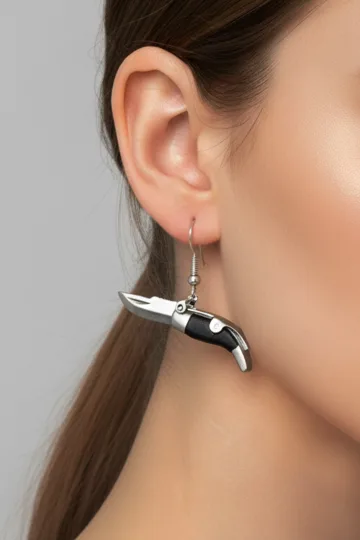
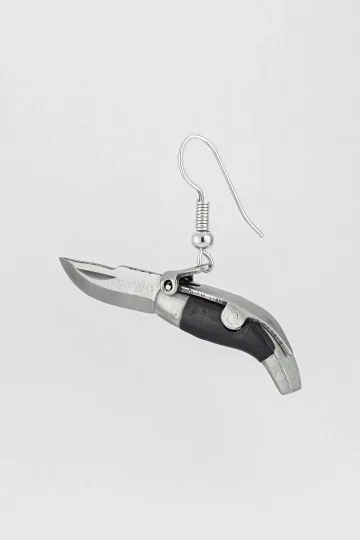
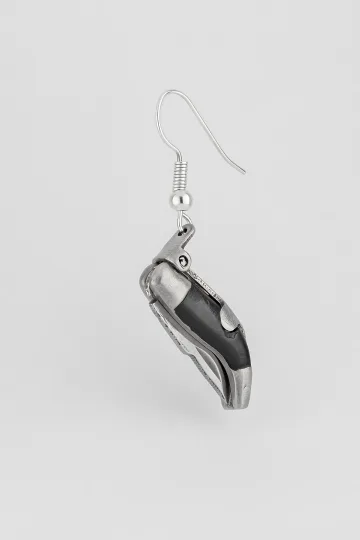
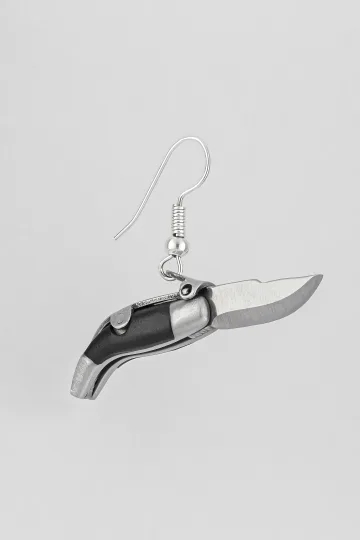
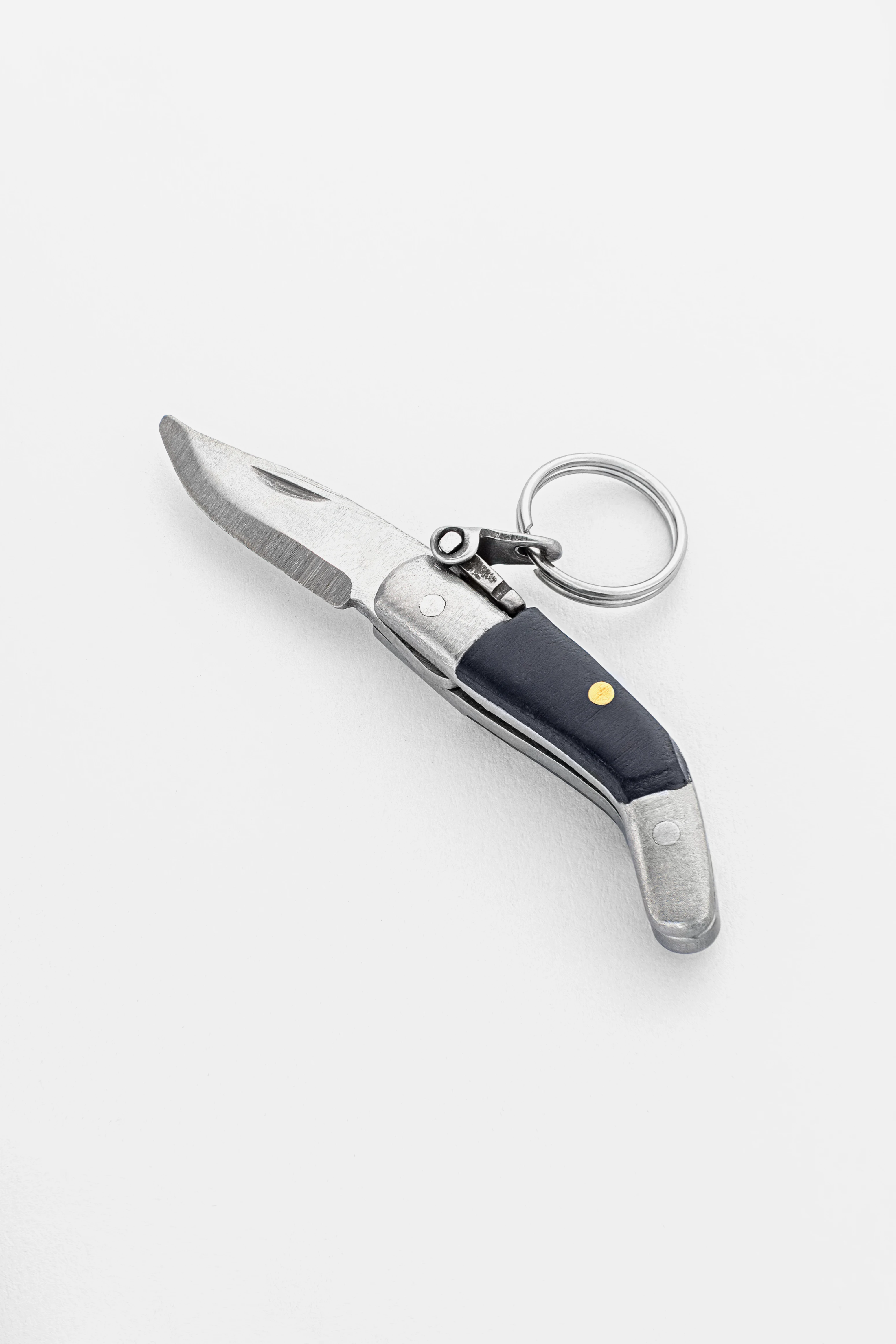
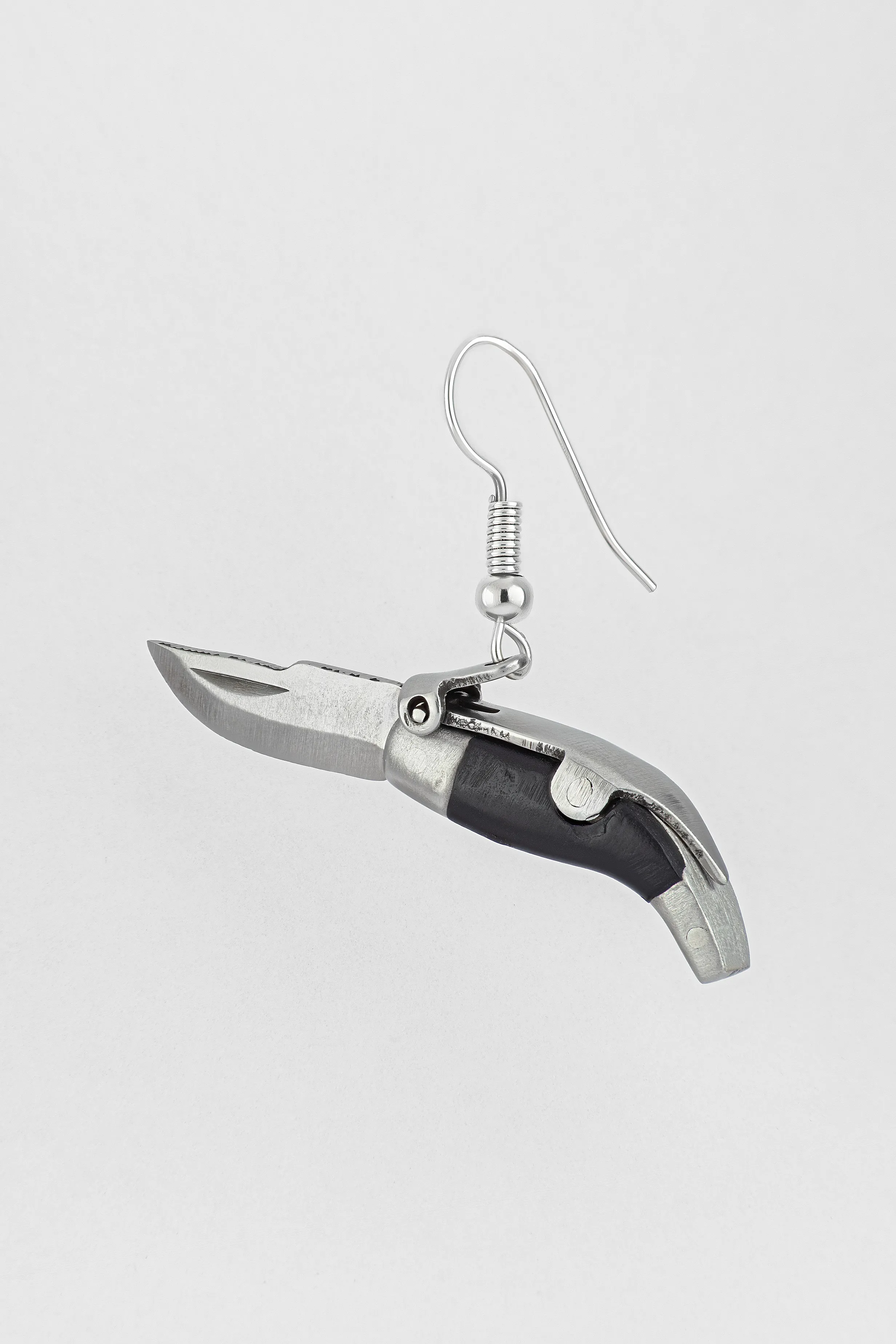
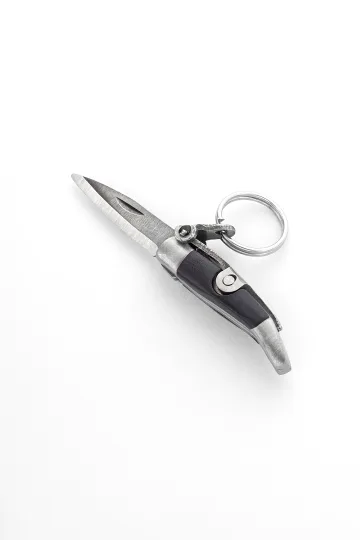
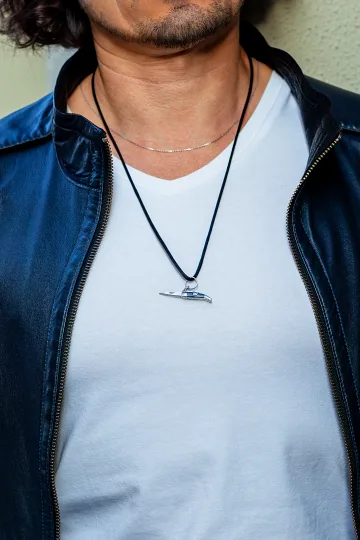
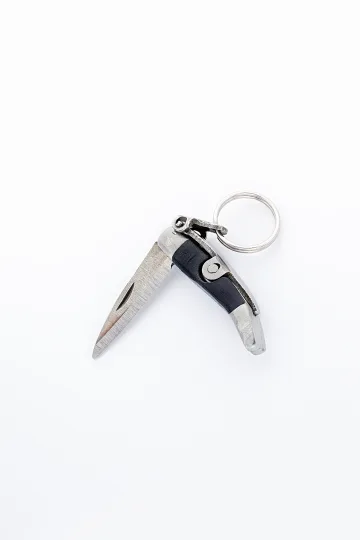
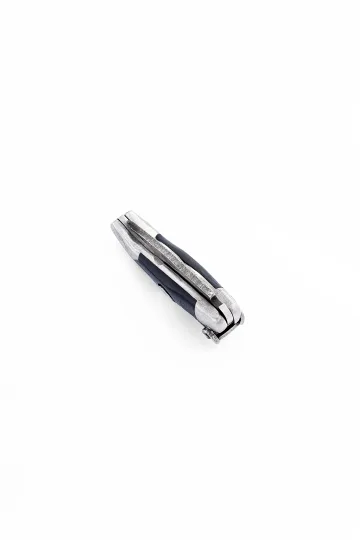
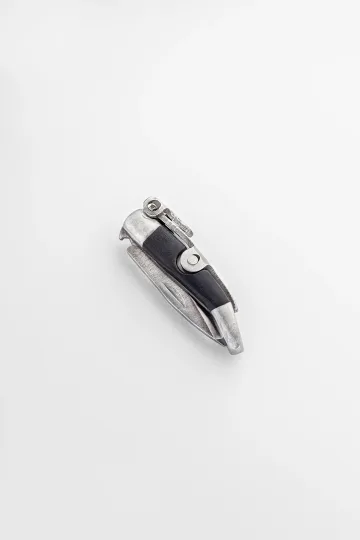
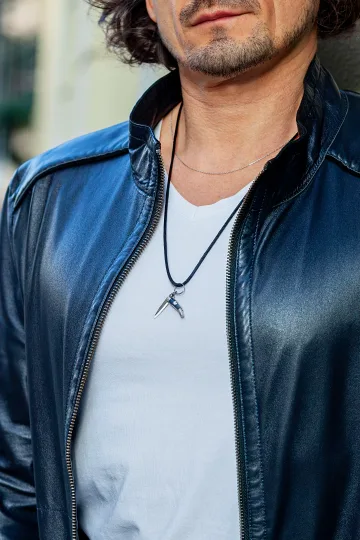
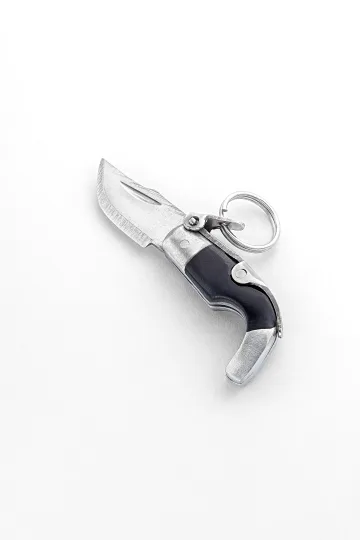
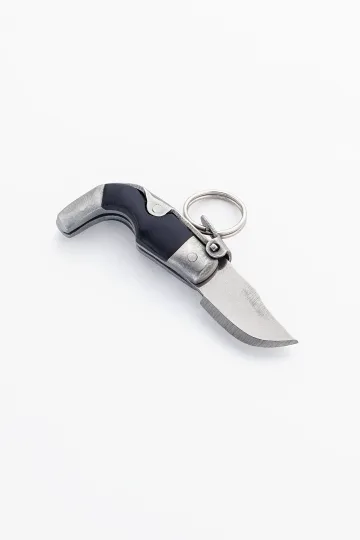
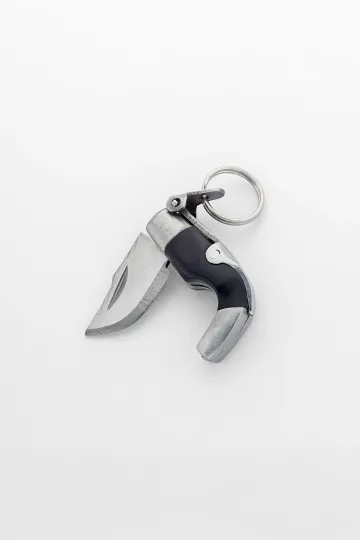
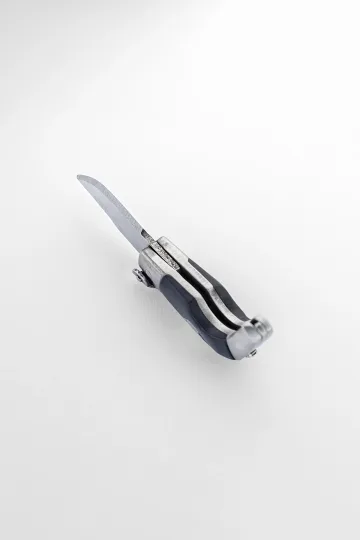
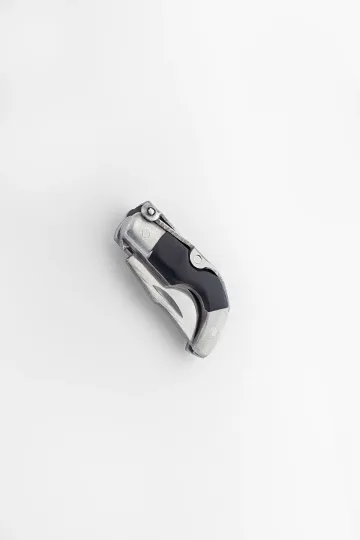
CAPAORA mini knife pendant
The 18th-century Spanish navaja in miniature: 40 mm of stainless steel, a real folding mechanism and a Palanquilla lock that clicks. An affordable gift to remember.
Authentic · Ships from Spain · 14-day returns
The winged scarab: a symbol within a symbol
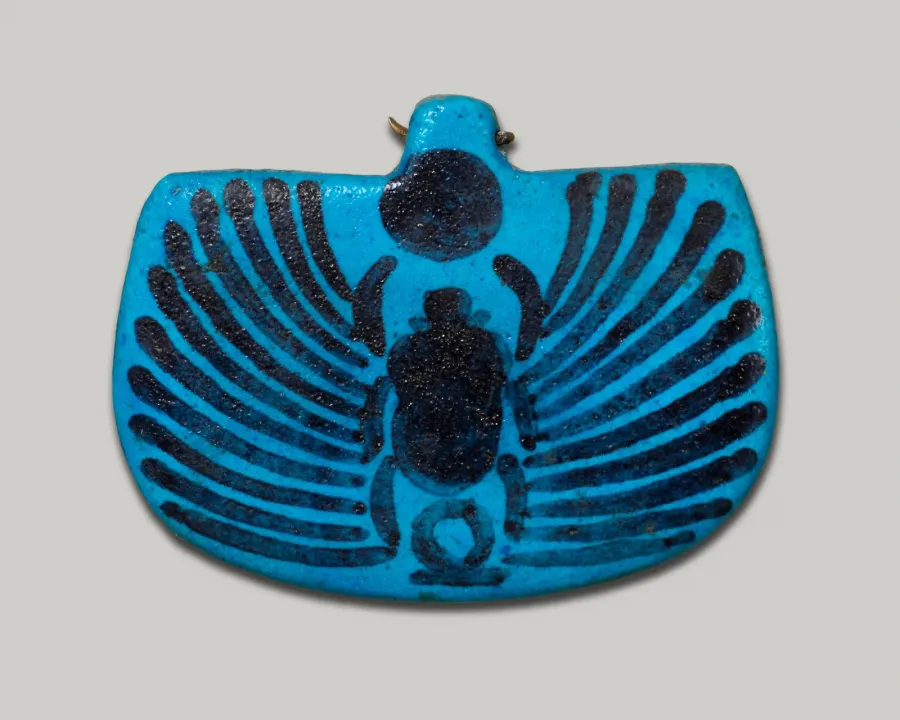
The scarab without wings is an amulet. The scarab with wings is a cosmological statement.
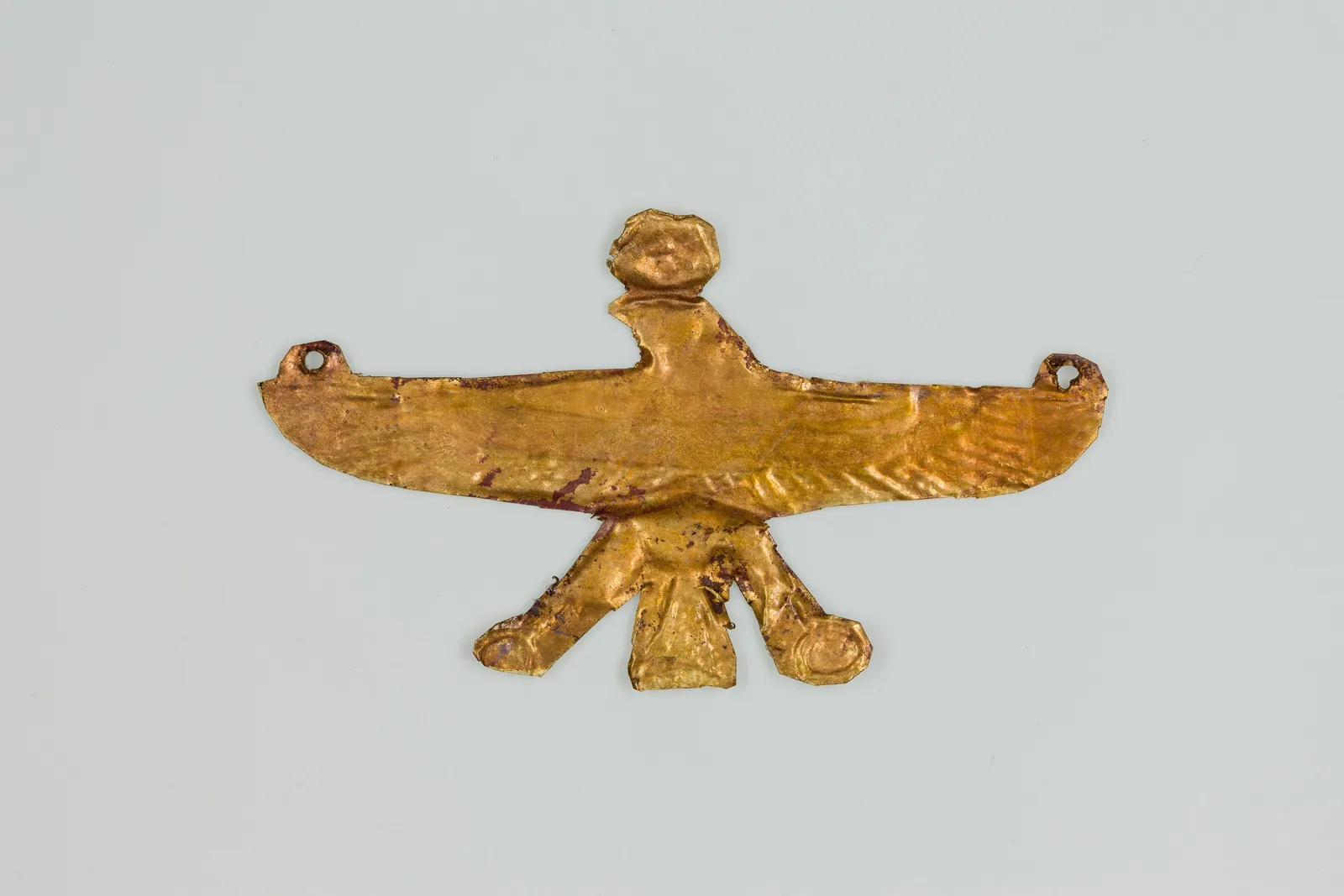
When Egyptian artists spread the beetle's wings horizontally, they were depicting Khepri at the moment of greatest power: the sun at the instant of rising, when the cosmos is most vulnerable and the god's effort is most visible. Winged scarab images appear on the walls of royal tombs, on pectoral ornaments placed on the chests of the dead, and on the lintels of temple doorways. They mark thresholds: between night and day, between death and life, between the underworld and the world above.
The mechanics of the composition were specific. The scarab occupies the centre, often holding the solar disc between its front legs, or carrying a cartouche with the name of the pharaoh. The wings extend outward, sometimes held by human-armed figures, sometimes simply floating. Below, cobra goddesses flank the beetle. Above, the solar disc radiates light. It is one of the most architecturally coherent symbols in Egyptian art: everything in the image is doing something, and everything connects to everything else.
The most famous winged scarab ever made is the pectoral from Tutankhamun's tomb. Its central beetle is carved from Libyan desert glass in a deep golden-green. The wings are inlaid with turquoise, lapis lazuli, and carnelian in the quintessential Egyptian triad of colours. The piece is not just jewellery. It is a model of the cosmos: the beetle at the centre, the solar cycle implied by the disc it carries, the protective cobras on either side, the whole composition framed in gold. Every element is precise. Nothing is decoration.
In jewellery today, the winged scarab functions differently from the simple beetle form. A compact scarab pendant is intimate, a personal talisman that travels with you. A winged scarab is theatrical: it declares its symbolism openly, it takes up more visual space, and it reads as a statement rather than a private reminder. Both are legitimate. Which form suits you depends on what you want the symbol to do.
One practical consideration: winged scarab pieces require more structural integrity than simple pendants. The wings are inherently fragile at the tips, particularly in cast metal. Quality pieces reinforce the wing joints and keep the wing tips thick enough to resist bending. Look for even metal thickness across the wings and solid attachment at the central body. A well-made winged scarab lasts decades. A poorly made one bends the first time it catches on a sweater.
How scarab amulets were made: manufacturing across 2,500 years
The production scale of Egyptian scarabs is one of the most extraordinary manufacturing achievements in the ancient world. Over roughly 2,500 years, workshops across Egypt produced hundreds of millions of these objects. Understanding how they were made explains both their ubiquity and their range in quality.
Faience scarabs were the standard product, made by two main methods. The first was hand-forming: a craftsman kneaded a paste of ground quartz, binding agent, and mineral colorant into the shape of a beetle, then pressed details in by hand or with a tool. The second was press-moulding: separate top and bottom halves were pressed into prepared stone or ceramic moulds, joined, and fired. The moulding method allowed identical pieces to be produced rapidly. A single experienced craftsman with a good set of moulds could produce dozens of faience scarabs in a day.
Steatite scarabs were hand-carved. Steatite, also called soapstone, has the useful property of cutting easily before firing and hardening afterward. A craftsman could carve the beetle form, incise the hieroglyphs or design on the flat base, and fire the piece in a kiln. After firing, the surface was typically coated with a faience glaze, most often blue or green. Most inscribed scarabs from the New Kingdom are steatite with faience glaze.
Hardstone scarabs required entirely different skills. Carnelian, amethyst, lapis lazuli, and jasper are hard minerals that cannot be carved with standard blades. They required a bow-drill and abrasive powder, typically quartz sand or emery, applied in patient, incremental passes. The work was slow. A single hardstone scarab of moderate size represented days or weeks of skilled labour. These pieces were expensive and commissioned by wealthy individuals.
Gold scarabs were cast or hammered in temple and palace workshops. Some were solid cast. Others were hollow, formed over a core of resin or plaster. The finest combined gold bodies with inlaid stones: a gold setting for a carved carnelian or lapis lazuli surface. These were the apex of scarab production, made for pharaohs, high priests, and the most powerful officials.
This range meant that the scarab was simultaneously the most common amulet in Egyptian society and one of the most prestigious luxury objects. Faience scarabs were affordable for artisans and farmers. Gold scarabs were reserved for royalty. Both were the same symbol. This is unusual. Most luxury symbols are not also popular symbols. The scarab managed to be both, and that is part of why it was produced for so long without losing cultural currency.
Leave your email, we'll send your discount code. No spam, unsubscribe anytime.
The code arrives by email, valid on your first order.
Colours and materials in scarab jewellery
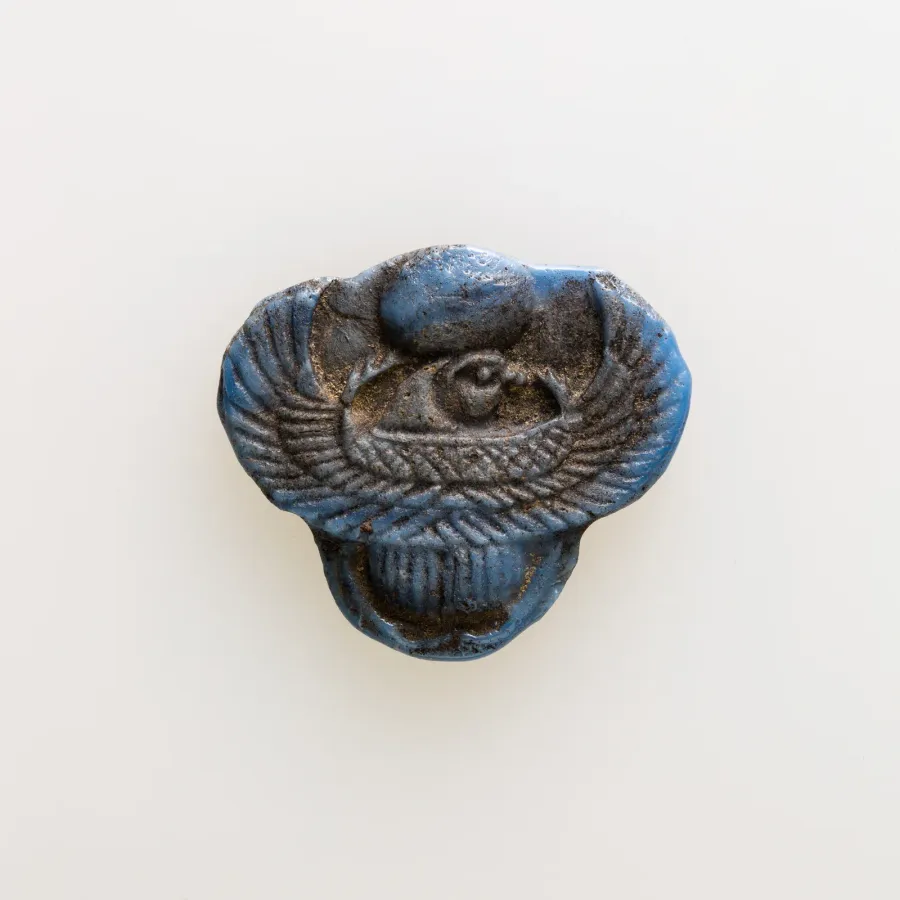
Colour in Egyptian amulets was never decorative in the modern sense. It was functional. Each colour carried specific meaning, and the choice of stone or glaze reflected the amulet's intended purpose.
Blue and green were the most common colours for scarab amulets, and for good reason. The Egyptian word for blue-green, "wadj," also meant "flourishing" or "healthy." Faience scarabs glazed in turquoise blue or green were associated with rebirth, the fertility of the Nile flood, and the regenerative power of Khepri. A blue-green scarab was no mere ornament. It was a concentrated statement about renewal.
Green specifically connected to Osiris, god of the dead and resurrection. Heart scarabs were typically cut from dark green stone (schist, basalt, or serpentinite) which linked them directly to the regenerative powers of Osiris. The green of new plant growth after the Nile flood was the green of life returning after death.
Gold was reserved for the highest-status pieces. Royal scarabs were often cast or hammered in gold, reflecting the solar connection: gold was the flesh of the gods in Egyptian theology, the material that did not decay, the colour of the sun itself. A gold scarab was a direct visual claim to divine protection.
Red and orange carnelian produced scarabs associated with vitality and blood, the warmth of living flesh. Lapis lazuli, a deep midnight blue imported from Afghanistan at considerable expense, was among the most prestigious materials and appeared in high-status amulets and jewellery pieces. Amethyst, jasper, and obsidian were all used for specific symbolic purposes.
In contemporary scarab jewellery, the colour logic still holds relevance even when modern makers are not consciously following it. A turquoise or malachite scarab reaches back to the most ancient associations. A gold-plated piece connects to the solar mythology. A dark stone version reads as funerary and serious in a way that a bright green enamel piece does not.
When choosing a scarab, think about what the colour is saying. It is part of the meaning.
Formats of scarab jewellery: pendant, ring, brooch, cufflink
Scarab jewellery comes in more shapes than most people expect, and the format changes how the symbol behaves on the body.
The pendant is the classic. A beetle on a chain, wings folded or spread, is the most direct way to carry the symbol, and it sits comfortably under almost any neckline. The folded-wing version is compact and behaves like a private token. The spread-wing version occupies the upper chest and reads across a room. Both are correct; they simply do different jobs.
Rings have the longest pedigree of any scarab format, because the Egyptians themselves wore swivel-mounted scarabs on finger rings so the inscribed base could be turned down to seal a document and turned up to be admired. Victorian jewellers revived exactly that mechanism, setting a beetle in a gold bezel that pivots on a wire axis. A modern scarab ring sits in that tradition without needing to explain itself: distinctive, but not loud. Practically, a scarab ring wants a slightly domed, smoothly finished back to the beetle, because a sharply carved elytra line catches on gloves and pockets.
Brooches are the scarab's other natural home. The beetle's symmetry mounts well, and the flat underside gives a natural bearing surface for a pin assembly. A scarab brooch on a lapel, a coat collar or a scarf is a quiet, confident statement, and it is one of the few pieces of jewellery that reads equally well on tailoring of any cut. Look for a solid joint and a proper safety catch; the wing tips of a spread-wing brooch are the first thing to bend if the pin sits loose.
Cufflinks and tie pins carry the scarab into formalwear, and they suit it unusually well because the beetle's oval fits the small circular field of a cufflink face almost exactly. The Egyptian originals had no such format, but the proportions transfer cleanly.
Bracelets and charms are the most casual entry point. A single small beetle on a link bracelet moves as you move and catches light from changing angles, which suits the sun symbolism better than a static setting does.
A practical note across all formats: scarab pieces carry more detail than most symbolic jewellery, so quality shows immediately. Look for crisp lines in the wing structure, defined body segmentation, and a finish that holds light in the incisions rather than filling them. On enamel work, the colour should be bright and evenly laid, without pooling or pinholes. The best scarabs have a sense of weight and presence even when they are small, and that comes from metal thickness rather than size.
Caring for scarab jewellery
The care routine for a scarab piece depends entirely on its materials. Silver scarabs with enamel inlay need the most attention: enamel is glass, and sharp impacts can chip it. Wipe enamel pieces with a soft cloth rather than submerging them. Avoid ultrasonic cleaners entirely for anything with stones or enamel.
Gold and silver scarabs without inlay are straightforward. A warm water rinse, a soft brush for crevices between the wing segments, and a dry cloth. The winged versions have more surface area and therefore more places for residue to collect. A soft toothbrush and mild soap once a month keeps the detail visible.
Stone scarabs vary by material. Lapis lazuli is porous and should not soak in water. Carnelian and jasper are harder and more water-tolerant. Faience replicas are durable but the glaze can be abraded by rough handling over time.
For storage, a pouch or compartmented box prevents pieces from scratching each other. Scarab pendants with spread wings have protruding edges that can catch on other jewellery and bend if stored loosely.
The scarab and its parallels in other cultures
Dung beetles live almost everywhere, including Central and South America, and the story takes an unexpected turn there.
The Maya knew the dung beetle well. Maya iconography includes insect figures that researchers identify as scarabaeids, often in solar contexts. The Maya sun god Kinich Ahau shares with Khepri the same fundamental association between a celestial disc and its movement across the sky. Among the Aztecs, Piltzintecuhtli, linked to the young sun and to dawn, shows conceptual parallels with Khepri: both represent the youthful, regenerating aspect of the sun, both attach to the moment of sunrise, both tie the solar cycle to ideas of rebirth.
There is no question of borrowing here. These civilisations had no contact. The point is more interesting than transmission would be: the behaviour of the dung beetle is so visually persuasive, so obviously solar, that entirely independent cultures reached comparable conclusions from it.
The pattern extends further. Ancient Greek writers describe the beetle as self-generating, an idea they took from Egypt and repeated for centuries. Minoan and Mycenaean workshops copied the scarab form for seal stones without necessarily importing the theology. In parts of West Africa, beetles appear in proverbs about persistence and about work that looks undignified but sustains life, which is remarkably close to the Egyptian reading. Nordic and Celtic material has nothing comparable, for the straightforward reason that the large ball-rolling species are not native there; where the beetle is absent, the symbol is absent too.
That absence is the strongest evidence for how the symbol formed. This is not a myth that spread along trade routes. It is an observation that anyone in the right latitude could make for themselves. A beetle pushes a sphere across the ground; the sun is a sphere pushed across the sky. Once you have seen the first, the second is impossible to unsee, whether you are standing in the Nile valley or in the forests of the Peten.
Send a friend a discount code, they save on their first order.
Scarab vs ankh vs Eye of Horus: Egyptian symbols compared
All three are popular in jewellery, but they say different things.
The ankh is about life: pure, simple, eternal. It is the most widely recognised Egyptian symbol and the most general in meaning. If you want to say "I value life" or "I believe in something beyond death," the ankh is your symbol.
The Eye of Horus (the Wedjat) is about protection. It wards off evil, heals the sick, and guards the wearer. Its appeal is defensive: it keeps bad things away. People who wear the Eye of Horus often describe a sense of safety.
The scarab is about transformation. It does not just affirm life or ward off evil. It actively changes things. It turns death into life, darkness into dawn, dung into divinity. If the ankh is a noun and the Eye of Horus is a shield, the scarab is a verb. It does something.
You can wear all three together. They complement rather than compete. But if you are drawn to one above the others, that preference usually tells you something about where you are in life.
Who wears the scarab and why
Three thousand years of continuous wear have left the scarab with several distinct constituencies, people drawn to quite different things in the same beetle.
Some wear it because of a personal experience of transformation. Illness survived, an addiction left behind, a career abandoned and rebuilt, a destructive relationship ended. This has nothing to do with fashion or exotica. It is a private record. The scarab says: I went through something hard and came out different. The beetle's persistence is not a metaphor for these wearers, it is a description of how the thing felt from the inside.
Others wear it because they are interested in history. Egyptology is one of the most popular historical fields at amateur level anywhere in Britain and Europe: people read about the Middle Kingdom for pleasure, queue for touring exhibitions, and keep shelves of excavation reports. A scarab on a chain or a wrist is a way of keeping a serious interest present in ordinary life. Men wear it particularly readily, because the historical framing removes the sense that jewellery is not for them. Officials, generals and pharaohs wore this exact object for two and a half millennia, which settles the question.
A third group wears it purely as an object. The symmetry, the wings, the way the back divides into clean fields that can carry ornament, all make the scarab one of the most visually satisfying symbolic forms available. People who could not name Khepri still feel that the shape is finished in a way that simpler symbols are not.
There is a fourth group worth naming: people who inherited one. Egyptian Revival brooches and Victorian swivel rings circulate through families, and a scarab is often the piece that survives when the rest of a grandmother's jewellery has been broken up. That inheritance changes the meaning again. The beetle about rebirth becomes a piece about continuity.
And then there are those who wear it for all of these reasons simultaneously. That is probably the most accurate description of the average wearer.
Buying it as a gift? Each one arrives ready to give.
 A branded Zevira box and a little card come with every order.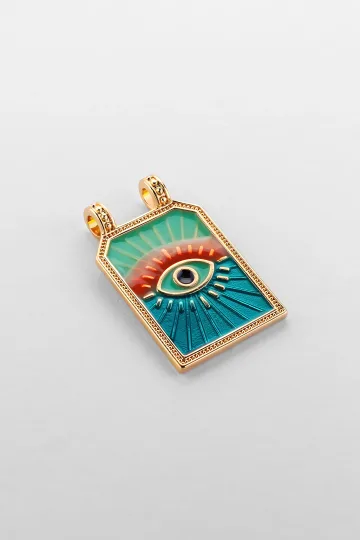



Frequently asked questions about scarab jewellery
Is the scarab only an Egyptian symbol?
No. While it originated in Egypt, the scarab was adopted by Phoenicians, Greeks, Etruscans, and Romans. It spread across the entire Mediterranean and has been continuously used in jewellery for over 4,000 years. Today it is a global symbol, not limited to any one culture.
Does wearing a scarab bring good luck?
In Egyptian tradition, the scarab was not really about luck. It was about renewal and protection, ensuring that the wearer would endure and be reborn. Modern wearers often associate it with transformation and resilience rather than luck per se. Whether you believe in its power or simply appreciate the history, the symbol carries weight either way.
What is the difference between a scarab and a beetle in jewellery?
A scarab specifically refers to the sacred dung beetle (Scarabaeus sacer) and its associated symbolism of rebirth and self-creation. A generic "beetle" in jewellery might reference any species and carries different connotations. Victorian beetle brooches, for instance, were often about natural beauty rather than Egyptian theology. If the piece has spread wings and an Egyptian feel, it is a scarab.
What stone is the scarab in Tutankhamun's pectoral?
Libyan desert glass, a naturally occurring silica glass formed by a meteorite impact approximately 29 million years ago. It has a distinctive yellow-green colour and is found only in the Libyan Desert. Its use in the pectoral suggests the Egyptians valued it as a rare and significant material.
Can men wear scarab jewellery?
The scarab was worn by men for the vast majority of its history. Pharaohs, priests, soldiers, and bureaucrats all wore scarab rings and amulets. A scarab signet ring or a pendant worn under a shirt collar is entirely in keeping with thousands of years of tradition. The symbol is genuinely unisex.
Is it culturally appropriate to wear a scarab?
The scarab has been worn by people of many cultures for millennia: Egyptians, Phoenicians, Greeks, Romans, Victorians, and everyone in between. It is not a restricted symbol belonging to a single living cultural group. Modern Egyptians themselves use scarab imagery widely, including in tourism and decorative arts. Wearing a scarab as jewellery is well within the bounds of respectful appreciation.
What colours are traditional for scarab jewellery?
Blue and green are the most historically significant. Egyptian faience scarabs were typically glazed in turquoise blue or green, colours associated with rebirth, fertility, and the Nile. Gold is also traditional, especially for royal and funerary scarabs. Modern scarab jewellery uses a wider palette, but blue-green and gold remain the most symbolically resonant.
What does a winged scarab mean?
A scarab with spread wings is a representation of Khepri in his full solar aspect, the beetle carrying the sun across the sky. It emphasises the cosmic, transcendent dimension of the symbol. A scarab without wings is closer to the amulet tradition of personal protection and renewal. Both are valid, but the winged version tends to make a bolder visual statement.
How do I know if an antique scarab is genuine?
Genuine ancient Egyptian scarabs are widely available on the antiquities market, but fakes are common. Look for signs of age: wear patterns consistent with centuries of handling, authentic materials (steatite, faience, semi-precious stones), and carving styles consistent with known periods. If in doubt, consult a specialist. Reputable auction houses authenticate their pieces. Street vendors in tourist areas rarely sell genuine articles.
Can I wear a scarab with other symbolic jewellery?
Absolutely. The scarab predates most other symbolic traditions and conflicts with none of them. It pairs naturally with other Egyptian symbols (ankh, Eye of Horus, lotus), with general spiritual symbols (crescent moon, sun), and even with religious symbols from other traditions. Build your own symbolic vocabulary. There are no rules except your own taste.
What is faience and why were so many scarabs made from it?
Faience is a silica-based material with a glazed surface, produced by heating ground quartz or sand mixed with mineral colourants. The Egyptians called it "tjehenet," meaning "brilliant" or "scintillating." It was not a cheap substitute for stone. It was deliberately chosen for its colour, specifically the blue-green that meant rebirth, and for the way it caught light. Faience was also practical: the material could be moulded rather than carved, which allowed mass production at a scale that stone could not match. A faience scarab was the standard amulet. A stone or gold scarab was the luxury upgrade.
Do scarabs appear in any other ancient Near Eastern cultures?
Yes, though not always with the same meaning. Phoenician workshops produced scarabs in enormous quantities from the 8th century BCE onward, adapting the form for their own religious and commercial purposes. Scarabs have been found as far afield as Iberia, Sardinia, and Turkey. The Hyksos, a people who ruled northern Egypt during the Second Intermediate Period, used scarabs extensively and spread the form into the Levant. In Mesopotamia, cylinder seals served a similar administrative function, but the scarab as a specific form remained primarily Mediterranean rather than broadly Near Eastern.
Did the scarab beetle actually navigate by the Milky Way?
Yes. A 2013 study published in Current Biology by Marcus Byrne and colleagues demonstrated that Scarabaeus sacer uses the band of the Milky Way for orientation when rolling its dung ball at night. It is the first animal confirmed to use the galactic plane as a compass. The Egyptians could not have known this mechanism, but their intuition that the scarab had a relationship with the heavens was correct in a way they could not have anticipated. The beetle is literally guided by the stars.
Why did the Hyksos use scarabs so extensively?
The Hyksos were a West Asian people who ruled northern Egypt (the Nile Delta and parts of Middle Egypt) during the Second Intermediate Period, roughly 1650-1550 BCE. They adopted Egyptian administrative and cultural practices extensively, including the scarab. Hyksos scarabs are distinctive: many bear royal names or titles in a style that blends Egyptian hieroglyphs with foreign name forms. Some Hyksos scarabs show non-Egyptian decorative motifs alongside Egyptian ones. They used scarabs as political legitimation. Adopting the most visible marker of Egyptian royal authority signalled that their rule fit within Egyptian tradition, even if their origin did not. After the Hyksos were expelled by Ahmose I, their scarabs continued to circulate in the Levant, spreading the form further into the Near East.
Silver and gold jewellery, wedding bands, symbolic pendants, paired sets.
Wear the symbol, don't just read about it. These are in stock:




Conclusion
A dung beetle rolls a ball of waste across the sand. New life emerges from the buried sphere. The sun rises. The dead are reborn. A civilisation lasting three thousand years puts this insect at the centre of its spiritual life, and four thousand years after the first scarab amulet was carved, people still reach for the same shape when they want to say something about transformation, endurance, and the stubborn refusal to stay down.
The scarab is not elegant in the way a butterfly is elegant. It is not fierce in the way a lion is fierce. Its power comes from a stranger, deeper place, from the observation that creation and beauty and divinity can emerge from the most unlikely raw material. Including dung. Including darkness. Including you.
About Zevira
Zevira makes jewellery in the artisan tradition of Albacete, Spain. The scarab is exactly the kind of piece we love: a form that carries meaning, a symbol of transformation and persistence that a person chooses on purpose, and that we bring to life in metal and stone.
Here is what you will find with us on the Egyptian theme:
- Scarab pendants, with folded and with spread wings
- Rings and brooches with Egyptian motifs
- Eye of Horus, ankh, and other protective symbols
- Pieces in the blue-green and dark palettes that echo the ancient colour logic
- Paired and layered sets where the scarab sits alongside other symbols
- Options in 925 silver and gold to suit different budgets
Every piece is handcrafted, with the option of personal engraving. Sterling 925 silver and 14-18K gold.