Carnelian: the stone, its chemistry, history and care
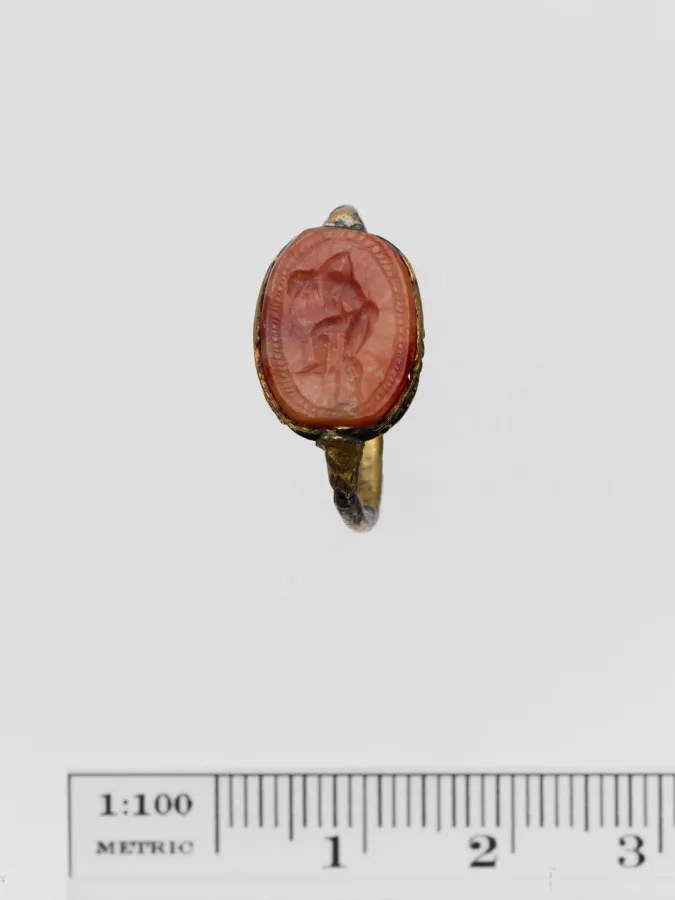
A carnelian seal lay in an Egyptian tomb for three and a half thousand years and came out with its engraving intact: crisp, no chips, no fading. That is not magic, it is geology. Microcrystalline quartz with a hardness of 7 on the Mohs scale resists abrasion and holds fine relief beautifully. That is exactly why ancient carvers cut signet seals from it, and why the impression pressed into wax came out sharp and impossible to forge. From here, an honest look at the stone itself: what it is made of, where it comes from, how it differs from look-alikes, and how to care for it.
What carnelian is: composition, structure, physics
Carnelian is a variety of chalcedony, which means it is cryptocrystalline quartz. Its chemical formula is silicon dioxide, SiO2. Unlike rock crystal or amethyst, where you see large transparent crystals, chalcedony is built from tiny quartz fibres a fraction of a micron across. They grow tightly together, so the stone turns out uniform, dense and takes a high polish, which makes it easy to carve into cabochons.
The orange-red colour comes from iron. More precisely, from finely dispersed iron oxides and hydroxides: hematite (Fe2O3) pulls the colour towards brownish-red, goethite (FeO·OH) towards a more yellow-orange. The more iron there is, and the more strongly oxidised it is, the deeper the tone, from pale peach to almost brick.
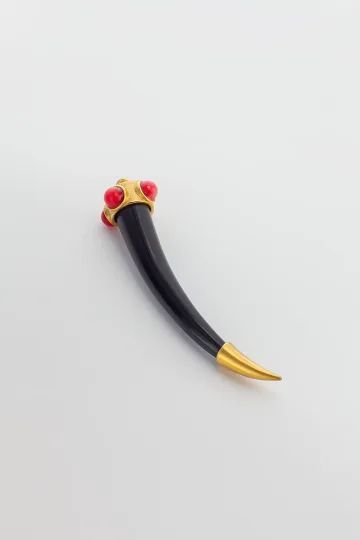
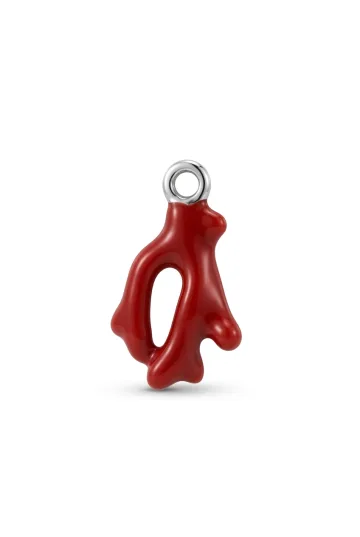
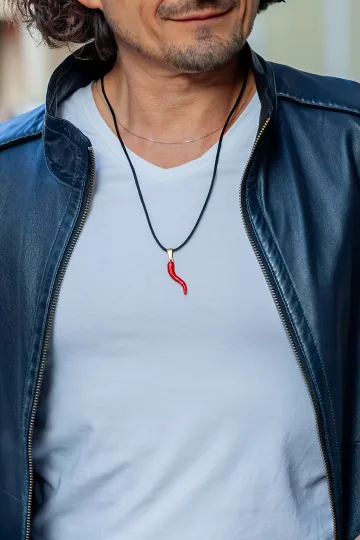
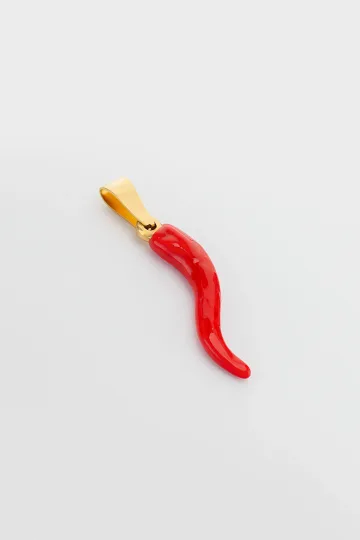
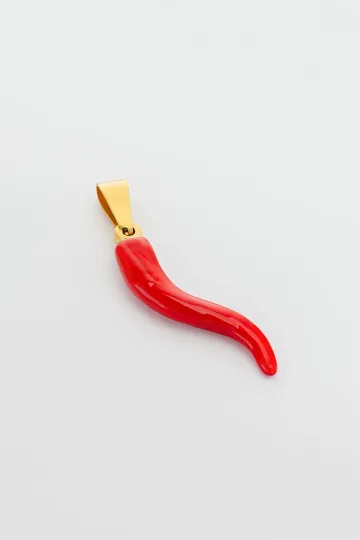
Wear the symbol, don't just read about it. These are in stock:




Key properties of carnelian:
- Class: chalcedony, a cryptocrystalline variety of quartz.
- Formula: SiO2 with traces of iron oxides and hydroxides.
- Crystal system: trigonal (like quartz); fibrous aggregate.
- Hardness: 6.5 to 7 on the Mohs scale.
- Density: roughly 2.58 to 2.64 g/cm3.
- Cleavage: none; conchoidal fracture.
- Lustre: waxy, rising to vitreous when polished.
- Transparency: translucent to semi-translucent.
- Optics: uniaxial, refractive index around 1.53 to 1.54, weak birefringence. Chalcedony shows almost no pleochroism, the colour reads the same in every direction.
That translucency is a handy everyday test. Hold a thin edge of good carnelian to a lamp and it glows a warm orange. The line between carnelian and sard (the darker brownish-red variety) and sardonyx (the banded one with white stripes) is loose: it is all the same iron-bearing chalcedony, separated only by tone and by the presence of bands.
How carnelian forms in nature
Chalcedony precipitates from silica-rich solutions in cavities within rock at fairly low temperatures. The classic scenario plays out in volcanic rock. Lava cools and leaves behind gas pockets (amygdales and geodes). Later, groundwater loaded with silica and dissolved iron circulates through the rock. Layer by layer, the silica settles on the cavity walls, building up in concentric crusts. That is how agates form, and the single-coloured zones tinted by iron are carnelian.
The banding of the stone is a record of successive batches of solution with different compositions. Where more oxidised iron settled between the chalcedony layers, the band is redder; where the chalcedony stayed clean, it is whiter. That is also where sardonyx and its contrasting layers come from.
Natural carnelian is rarely a perfectly even colour. Swirls, lighter zones, thin whitish veins: that is normal and a sign of authenticity. A flat, perfectly uniform, screaming-orange stone is more often dyed agate or coloured glass.
Carnelian wants an open collar and sun-warmed skin. Buried under a turtleneck it just dies, so do not.
What to wear carnelian with
I always put an orange stone at the centre of a look, never in its shadow. Over years on shoots carnelian has passed through dozens of my outfits, and here is what actually works, by occasion.
How do I wear carnelian every day? For daytime I suggest a 20 to 25 mm pendant on a fine silver chain over a white shirt, beige knitwear or a linen blouse. Cool clothing tones (milky white, grey-blue, emerald) push the orange forward by contrast, while warm ones (terracotta, mustard, chocolate) pull the look into an earthy register. On a round neckline or a V-neck the stone settles right into the hollow between the collarbones, its best spot.
Does carnelian work at the office? It does, as long as you keep it restrained. I recommend a small pendant or a plain silver ring with a smooth stone, no carving or extra shine. Under a jacket the warm stone reads as a quiet detail of character rather than a loud accent, and it never argues with a businesslike palette.
How do I build an evening look? For evening I choose a larger piece or a faceted carnelian that catches the light on its edges, and I wear it solo, with no other chains. Warm orange on dark smooth fabric (wine, graphite, black) looks expensive and seems to glow from within by candlelight. An open neckline and a bare throat serve it best here.
Which metal, and for which skin? By metal, carnelian gets on with warm tones: yellow gold, brass and copper underline its sunniness, while silver gives a cool, graphic contrast. For tanned and olive skin I suggest deep red-brown tones closer to sard; for fair skin, peach and classic oranges. From the same warm family, for a shade nearer yellow people reach for heliodor, golden beryl, and in a bolder red for rubellite, red tourmaline.
One piece or layered? I pick one form per look, a pendant, or earrings, or a ring, otherwise the orange starts arguing with itself. On the wrist a carnelian bead bracelet sits calmly beside wooden beads, dark agates and slim metal bangles. I keep the chain length around 42 to 45 cm so the stone rests at the base of the neck.

Turn on your camera, pick earrings, a pendant or a ring, and see the piece on yourself in real time.
Switch items in one tap.
Everything runs in your browser: no photo or video is ever uploaded.
Geology and deposits
The largest sources of carnelian are tied to ancient volcanic provinces in South America.
- Brazil is the main supplier. The deposits in Rio Grande do Sul state sit within basalt lava flows, where chalcedony fills geodes. Material is mined in large volumes, with colour ranging from pale to deep.
- Uruguay shares the same geological belt across the border, in the Artigas region. Uruguayan material is prized for its deeper, redder tone.
- India (Gujarat) gave the world both deposits and, more importantly, an ancient centre of cutting and carving. Chalcedony has been worked here for thousands of years; much of the rough is brought in and cut locally.
- Madagascar, Botswana, Namibia, the United States (the west of the country), and Germany (the Idar-Oberstein district, the historic centre of agate working). Volumes vary, and so does quality.
The ancient Egyptian sources near the Red Sea and Sinai are of historical rather than industrial importance today.
Natural colour and heat
A noticeable share of the bright carnelian on the market is heated material. Much of the rough comes out of the ground pale yellow or greyish. Heated to roughly 300 to 450 °C, the iron hydroxides convert to hematite and the stone reddens permanently. The process is irreversible, the colour is stable, and the strength is not affected.
Heating is a long-accepted, legitimate treatment for chalcedony, on a par with polishing. In essence it speeds up what underground heat does over millions of years. Telling a heated stone from one tinted by iron deep in the earth is nearly impossible without a lab, and it makes no difference to how the stone wears. Dyeing with colourants is a different matter: that is imitation, not heating, and it is far less durable.
Carnelian, cornelian, sard and sarder: where the line falls
The naming here is genuinely loose, and anyone who tells you there is a precise boundary is selling something. All four words describe the same mineral, a cryptocrystalline quartz coloured by iron, and the differences between them are matters of tone and translucency judged by eye.
Carnelian covers the bright end: orange, orange-red, peach, translucent enough that a thin edge glows against a lamp. Cornelian is the older British spelling of exactly the same thing, still used in museum catalogues and in the antique trade, and it is the form you will meet in nineteenth-century writing. Sard is the darker, browner end, running from russet into a deep liver colour, usually a little less translucent. Sarder turns up occasionally as a variant of sard in older texts.
Where does one become the other? The traditional working rule among lapidaries is that if you can read print through a two-millimetre slice, it is carnelian, and if you cannot, it is sard. That is a rule of thumb rather than a definition, and a single nodule frequently produces both, since the iron is not evenly distributed through the rock.
There is a practical reason to care. Sard was historically preferred for intaglios, seals with the design cut into the stone, because a darker ground shows a wax impression more clearly. Carnelian was preferred for beads and cabochons, where the light coming through the stone is the whole point. Buy according to what the piece has to do rather than according to which word is printed on the ticket.
Why iron colours the stone this way
Silicon dioxide is colourless. Pure chalcedony is a milky white or pale grey, and everything warm in a carnelian is contamination in the strict sense: iron compounds sitting between the silica fibres in quantities so small they would barely register on a chemical analysis, often well under one percent by weight.
The specific compound decides the specific colour. Iron oxide hydroxides, goethite and limonite, produce yellows, tans and dull ochres. Anhydrous iron oxide, hematite, produces reds and oranges. That is the whole mechanism, and it is the same one that colours a rusting gate, a brick and the soil of Devon.
Heating drives water out of the hydroxides and converts them to hematite, which is why a dull yellowish nodule turns bright orange in a kiln and stays that way. Underground the same conversion happens slowly, through geological warmth and time, which is why some material comes out of the ground already red. The two products are chemically identical at the end of the process, and this is precisely why laboratories struggle to separate natural from heated carnelian.
Two other details follow from the chemistry. First, the colour is inside the crystal structure rather than on it, so it does not rub off, wash out or migrate. Second, extremely long ultraviolet exposure can very slightly dull the tone by shifting the iron chemistry at the surface, which is why serious collections keep chalcedony out of direct sunlight and why a stone in a window display looks tired after a few years.
How carnelian differs from agate and onyx within one rock family
All three are chalcedony. They are separated by pattern rather than by chemistry, which is why a single nodule from a Uruguayan basalt can legitimately be cut into all three.
Agate is banded chalcedony with curved, concentric or irregular banding, formed as successive layers of silica gel lined a cavity. If you can see the layers as wavy or looping lines, it is an agate.
Onyx is banded chalcedony where the bands are straight and parallel. That distinction matters commercially, because parallel bands can be cut into a flat plate with a clean stripe, which is what a cameo carver needs. Confusingly, most black onyx in shops is dyed grey agate, a trade practice going back at least to Roman times.
Carnelian is chalcedony that is essentially one colour throughout, with the iron distributed evenly enough that no banding shows. If banding does show and one of the bands is orange, the correct name is sardonyx.
The practical consequence is that these labels describe the piece in front of you, not its source. A cutter takes a nodule, looks at where the colour is even and where it is banded, and saws accordingly. One rock, several names, one mineral.
Customer reviews
Zevira is a real jewellery shop. Genuine payments, deliveries and customer thank-yous.
🥰🥰🥰 gracias

Ok, ¡gracias! 🙂

History: seals, regalia, cultures
Carnelian is one of the earliest ornamental stones in human history. Beads and amulets made from it turn up at Bronze Age sites; in the Indus Valley, carnelian beads were made several thousand years ago, some of them etched with white patterns.
The Indus Valley and the etched bead
The oldest technically remarkable carnelian work in the world comes from the cities of the Indus Valley, roughly between 2600 and 1900 BCE. Craftsmen there produced long barrel beads, some of them over ten centimetres, drilled end to end with a bore narrow enough to take a thread. Drilling a straight hole that length through a stone of hardness 7 is an achievement that modern experimental archaeologists have only reproduced with difficulty, using specially hardened drill points and days of patient work per bead.
More striking still is the etched bead. The technique involved painting a pattern onto the finished stone with an alkaline paste, probably derived from a local plant, and then heating it. Where the paste touched the surface, the stone bleached permanently white to a depth of a fraction of a millimetre, so the bead emerged with crisp white lines, circles and zigzags standing against the orange ground. The whiteness is a chemical change in the stone itself rather than a coating, which is why beads made this way still carry their patterns four thousand years later.
These beads travelled. Indus carnelian has been excavated in Mesopotamian graves more than two thousand kilometres away, which makes them one of the earliest pieces of hard evidence for long-distance luxury trade anywhere. A bead is small, durable, valuable by weight and instantly recognisable, which is very nearly the definition of an ideal trade good.
Mesopotamia and the cylinder seal
In Mesopotamia carnelian became an instrument of administration. The cylinder seal, a small stone barrel carved with a scene in reverse and rolled across wet clay to leave a continuous frieze, was the signature of the ancient world, and carnelian was among the favoured materials for it.
The reasons were practical. The stone was hard enough that the carving did not wear away through thousands of impressions. It was tough enough not to shatter when dropped. And it was fine-grained enough to hold detail measured in fractions of a millimetre, which mattered when the seal had to be distinguishable from every other seal in a city.
A seal was a personal object worn on a cord at the wrist or the neck, and it was buried with its owner, since it had no meaning once he was gone. That habit has been extremely good to archaeology: the seals survive in their thousands, and because the scenes carved on them are dateable by style, they give a chronology for a great deal else.
There is a detail worth pausing on. Carnelian arriving in Mesopotamia largely came from the east, from Gujarat and the Indus cities, so the stone that authenticated Sumerian and Akkadian contracts had travelled the width of a continent before it did so. Imported material, local authority.
Ancient Egypt
In Egypt, carnelian appeared in jewellery, funerary goods and amulets. Scarabs and pendants were carved from it, often combined with gold, lapis lazuli and turquoise. The warm orange colour was linked to the sun and to life force, so the stone was readily placed in burial sets. Pieces with carnelian have been found in New Kingdom tombs; it is precisely the durability of the material that let the engraving survive to our day.
The tyet amulet: the knot of Isis
One Egyptian object deserves separate treatment, because it explains why carnelian in particular was chosen so often rather than any other red stone.
The tyet is a looped sign resembling an ankh with its arms folded downward, and it is associated with the goddess Isis. Funerary texts specify that the amulet should be made of red jasper or of carnelian, dipped in water infused with sycamore flowers, and placed at the throat of the deceased. The colour is doing the work: red was the colour of blood, and the amulet was understood to carry the protective power of Isis to the person wearing it.
That instruction is one of the earliest surviving examples of a specification for jewellery material, and it is unusually explicit. Not any stone, not any red stone in general, but this stone or that one, prepared this way, worn in this place. It tells us that the Egyptians distinguished carefully between materials that a modern eye might lump together as simply red.
Carnelian met the brief well for reasons beyond colour. It takes a high polish, which mattered because a polished surface was understood as a bright and living one. It survives burial without degrading, unlike organic materials. And Egypt had access to it through the Eastern Desert and through trade, in quantities that made it available below the very top of society.
The tyet appears in gold-mounted carnelian in high-status burials and in plain carved carnelian in modest ones, and the same shape persists across roughly two thousand years, which is a longer continuous life than almost any jewellery motif in use today.
Antiquity: Greece and Rome
Around the Mediterranean, carnelian became the leading stone for intaglios, seals with an image cut into them. The impression in wax or soft metal came out crisp and contrasting, and the seal itself served as a signature and a guarantee of a document's authenticity. The Greek scholar Theophrastus and the Roman writer Pliny the Elder described carnelian and sard in their works on stones, placing it among the chalcedonies and noting its value to carvers. Pliny passed on beliefs about the stone's "calming" powers, though he himself treated them with caution.
Byzantium and early Christianity
When the Roman world became Christian, the seal did not disappear. It changed its imagery. Carnelian intaglios continue without a break from the third century into the sixth and beyond, and what happens on their faces is one of the clearest records we have of a culture changing its mind about what it believed.
Early Christian gems carry a small vocabulary of signs: a fish, an anchor, a dove with an olive branch, a shepherd carrying a lamb, two fishermen at a boat. Many were cut by the same workshops that had been supplying classical subjects a generation earlier, in the same material, at the same scale, using the same tools, and occasionally an older stone was simply recut.
Carnelian remained the practical choice for the same reasons as before. A bishop, a merchant or an imperial official needed a seal that produced a legible impression and survived daily handling, and the stone did both. The devotional element was an addition rather than a replacement: the object was still, first, a working instrument of authentication.
Byzantine practice also carried carnelian into reliquaries, book covers and cross-shaped pendants, where the warm orange sat against gold and against the deep blue of lapis. That colour pairing runs from the Egyptian New Kingdom through Rome and Byzantium into medieval Europe with remarkable persistence, and it remains a good pairing in a jewellery case today.
Islam: the signet ring and its traditions
In the Islamic world the carnelian signet ring, the khatam, became one of the most widely worn objects in the whole history of jewellery, worn across ranks and across centuries.
The stone is engraved with a name, a phrase, a short line of scripture or a personal motto, cut in reverse so that it reads correctly when pressed into wax or ink. Because the engraving is functional, these rings were used constantly: to seal letters, to authenticate documents, to mark ownership. Fine calligraphy in a space the size of a thumbnail is the demanding part, and the best carvers of Isfahan, Delhi and Cairo were celebrated by name.
Carnelian, aqiq in Arabic, holds a particularly honoured place, and in Shia tradition especially it is associated with the Prophet's family and carries strong devotional weight. It should be said plainly that this is living religious practice rather than folklore, and it is treated with the respect it is due here. A stone worn for that reason is worn for reasons that have nothing to do with jewellery fashion.
For anyone buying an antique carnelian seal ring, one practical note: the engraving is the object. A worn or partly recut inscription greatly reduces both interest and value, and re-polishing the face to freshen the stone destroys it entirely. Leave the surface alone.
The East and the Middle Ages
In Islamic culture, carnelian signet rings were widely worn; in the Shia tradition the stone is especially honoured. In the East, inscriptions were engraved on carnelian and it was worn as a personal signet ring. Medieval Europe leaned towards bright transparent stones, but interest in carving carnelian never disappeared.
The Caucasus, Central Asia and Mughal India
Across a broad belt from the Caucasus through Central Asia to northern India, carnelian settled into the everyday jewellery of ordinary households rather than remaining a court material, and that is unusual for a stone with such a grand ancient pedigree.
In the Caucasus and in Central Asian silverwork, flat discs and cabochons of carnelian are set into heavy silver: pectoral ornaments, temple pendants, amulet cases, belt fittings. The visual logic is consistent. Bright warm orange against white metal, often with turquoise nearby for a cool counterpoint. Because these pieces were made in quantity for wearing rather than for display, they survive in good numbers and remain among the most collectable ethnographic jewellery available.
In India after the Mughal period, carnelian took two roads. One was inlay work in stone, where thin shaped pieces were bedded into white marble alongside jasper and lapis to make floral patterns, a technique carried out at architectural scale. The other was carving: beads, small vessels, hilt fittings and pendant plaques, with Cambay in Gujarat operating as a cutting centre so dominant that it still supplies a large share of the world's worked carnelian today.
That continuity is the point worth remembering. The Gujarati bead-drilling tradition that produced the Indus beads four thousand years ago never fully stopped. The tools changed, the drills are diamond-tipped now and the wheels are powered, but the material, the region and the trade are the same ones.
The 18th and 19th centuries
The taste for classical gems brought carnelian back into European jewellery. Cameos and intaglios were cut from it and from sardonyx and set into rings, brooches and signets. In the 19th century, carnelian was a routine stone for monogram signet rings. Across Europe, lapidaries from London to Idar-Oberstein worked it for the rising middle class, who wanted a seal of their own to stamp letters and documents.
Britain: pebble jewellery and the Victorian seal
Britain has its own carnelian story, and it runs through two quite different fashions.
The first is the seal itself. Through the Georgian and early Victorian decades, a gentleman's watch chain carried a fob seal, a lump of gold or gilt metal holding an engraved stone that hung at the waist and was used several times a day to close letters. Carnelian and sard were the standard stones for it, engraved with a crest, a monogram or a motto by workshops in London, Birmingham and Edinburgh. When the adhesive envelope arrived in the middle of the century the seal lost its function almost overnight, and thousands of them survive precisely because they stopped being used before they wore out. They are among the most affordable genuinely antique carved stones anyone can buy.
The second is Scottish pebble jewellery, which reached the height of its popularity after the royal enthusiasm for the Highlands made everything Scottish fashionable. Brooches, bracelets and dirk pins were made by setting flat plates of native agate, jasper, bloodstone and carnelian into silver, fitted edge to edge like marquetry so that the whole surface became a mosaic of stone. Much of the material was genuinely gathered from Scottish river gravels and the Ayrshire coast, though as demand outran supply a great deal of German-cut agate quietly entered the trade.
Both fashions collapsed and both left large quantities of good carnelian in circulation, which is why an antique fair in Britain will usually have more of it than a jeweller's window. If you want a real carved carnelian rather than a modern cabochon, that is where to look.
Famous gems and where they ended up
A handful of carnelians are individually famous, and they are worth knowing about because they show what the material can do in the right hands.
Museum collections across Europe hold Greek and Etruscan carnelian scarabs of the sixth and fifth centuries BCE, swivel-mounted in gold so that the carved underside could be turned down and used as a seal. The scale of the work is the shock: complete figures, correctly proportioned, cut into a stone the size of a fingernail, using a bow-driven drill and abrasive powder, without magnification as we would understand it.
From Rome there survive portrait intaglios of extraordinary quality, some signed by their carvers, which is rare in ancient art of any kind. A signed gem was a luxury object commissioned by someone who knew exactly whose hand he was buying, and the practice tells you these carvers held a status closer to that of a painter than a craftsman.
The Islamic world produced inscribed carnelian seals and amulets, several attributed to named calligraphers, in which entire verses are cut legibly into a surface a couple of centimetres across. Mughal workshops added carved carnelian dagger fittings and inlaid plaques, some now in national collections in Britain and India.
Two general lessons come out of all of this. First, carnelian's place in history rests on carving rather than on colour, because it is the only widely available stone hard enough to hold fine detail and fine-grained enough not to chip while taking it. Second, almost every famous carnelian is a working object that happened to survive, rather than a treasure made to be admired. It was hardware.
Upload a photo of your pet, someone you love, or an object. We'll build a 3D model and hand-cast it in pewter.




Types and varieties
- Carnelian: orange and orange-red translucent chalcedony.
- Sard: the same material in a darker, brownish-red tone. The boundary with carnelian is loose.
- Sardonyx: a layered stone alternating red-orange and white (grey, black) bands. Thanks to those contrasting layers it is prized for cameos: the relief is carved into the red layer and the background left white.
- Cornelian: simply an alternative spelling of the same stone. In English, "carnelian" and "cornelian" mean the same thing.
How to tell carnelian from look-alikes and fakes
Among warm red-orange stones, confusion is common. A few reliable markers.
Red jasper
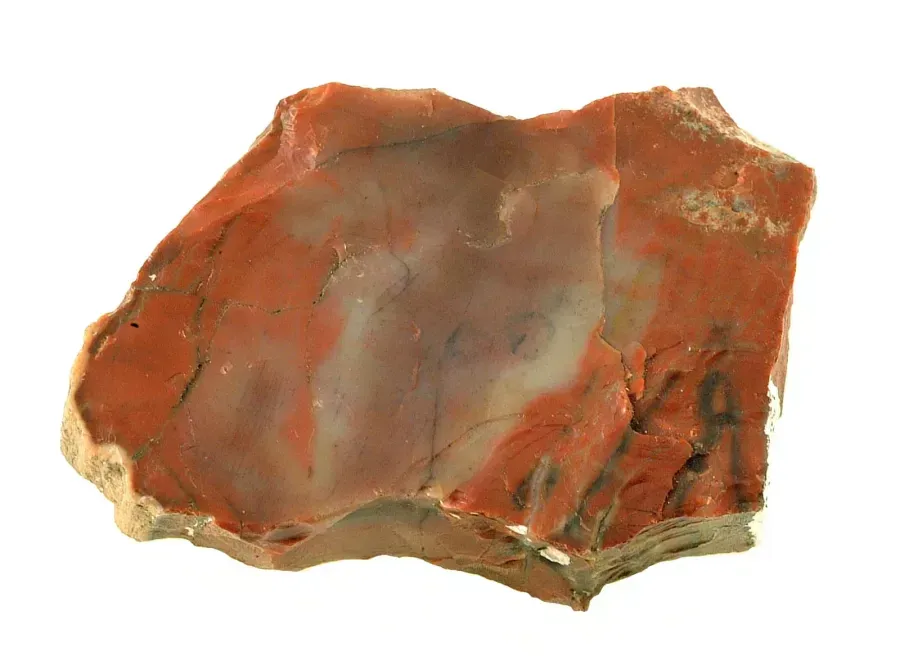
Jasper is also iron-bearing, but it is opaque and more granular. The main test is the light test: a thin edge of carnelian lets a warm orange glow through, while jasper stays dead even against a bright lamp. The hardness is similar, but jasper's structure is looser and it crumbles more under the carver's tool.
Sardonyx
This is not a different mineral but carnelian with white (grey, black) bands. If the stone is single-coloured, it is carnelian; if it has contrasting layers, it is sardonyx.
Coral
Orange coral is organic, the skeleton of a sea polyp rather than a mineral. It is noticeably softer (hardness 3 to 4), scratches easily, reacts to acid and feels lighter in the hand. Carnelian is harder, heavier and inert to weak acids.
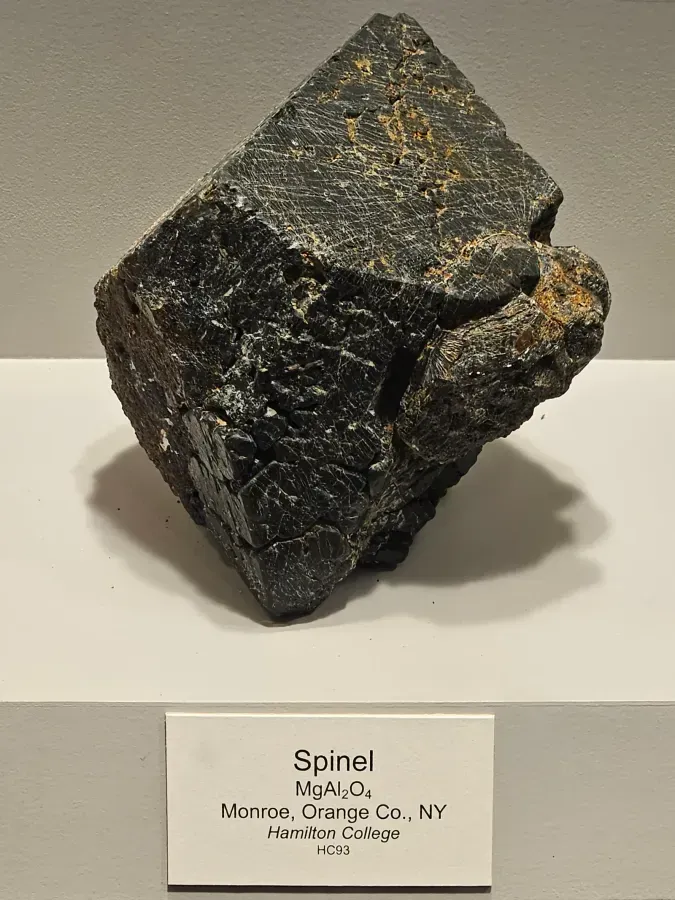
Red spinel
In deep red tones, carnelian is sometimes taken for the more expensive red spinel, which was mistaken for ruby for centuries. Spinel is more transparent, has more fire and is markedly harder (8 on the Mohs scale).
Dyed agate and glass
The most common imitation is dyed grey agate. The tells: a colour that is too even and aggressively bright, with dye concentrated along cracks and the boundaries of layers, visible under a loupe. Glass gives itself away with air bubbles inside and the glossy look typical of casting; glass is also lighter and warms up faster in the hand.
Practical checks: look at the light through a lamp, hunt for natural unevenness under a 10x loupe, weigh it (the stone is noticeably denser than plastic), and remember the hardness of 7: carnelian is not scratched by a household steel knife, which only leaves a smear of metal.
How dye gives itself away under a loupe
A ten-power loupe costs very little and settles most arguments about dyed agate in under a minute. There are four things to look for, and you need only find one of them.
Colour concentrated in cracks. Dye enters a stone through whatever passages exist: hairline fractures, porous zones, the boundaries between growth layers. Under magnification those passages show as darker lines of intense colour running through a paler ground, like ink drawn along a scratch. Natural iron colouring does the opposite, sitting evenly in the body of the stone and often being palest at the edges of the nodule.
Colour that stops at a layer boundary. Chalcedony is built in layers of differing porosity, and dye takes strongly in some and weakly in others. The result is an abrupt stripe of screaming orange against a stripe of dull grey, with a sharp edge between them. Natural colour changes gradually.
A drill hole that is the wrong colour. On a bead, look inside the hole. If the stone was dyed before drilling, the bore will be paler than the surface. If dyed after, the bore will be darker where the dye pooled. Either mismatch is conclusive.
Uniformity that is too good. This is the least technical and the most reliable. Natural carnelian is never perfectly even. There will be a faint cloudiness, a lighter zone, a whisper of banding somewhere. A cabochon of flawless, identical, saturated orange across its whole face, sold cheaply, is dyed.
Two further checks need no loupe at all. Rub the stone hard with a cotton bud dampened with acetone, on the back where it will not matter: some cheap dyes transfer. And put the piece under a bright light for a moment and look at the shadow it casts through a thin edge, since dyed material often throws a flat, muddy orange where natural material throws a warm glow.
What a laboratory can and cannot show
Send a stone to a gemmological laboratory and you will get a clear answer to one question and an unsatisfying answer to another.
The clear answer concerns dye. Spectroscopy separates an organic or inorganic colourant from iron oxide without difficulty, because the dye has its own absorption signature that has nothing to do with the stone. Magnification at higher powers than a loupe allows makes the concentration in fractures obvious. A laboratory will tell you confidently whether a carnelian has been dyed.
The unsatisfying answer concerns heating. Natural and heated carnelian end up chemically identical, both coloured by hematite, because heating simply performs in hours the dehydration that geology performs over ages. There is no residue and no by-product to find. Laboratories can sometimes infer heating from subtle structural clues, but in most cases the honest report reads that heat treatment cannot be excluded, which is a polite way of saying nobody knows.
This is why the trade has long treated heating as a normal part of preparing chalcedony rather than as a disclosed treatment in the way that, say, fracture-filling a ruby is. The colour is permanent, the stone is not weakened, and the alternative would be to certify something that cannot be certified.
Practically, this means testing a carnelian is worth doing only in specific cases: a stone sold as an important antique, a large cabochon at a serious price, or a bead strand where the seller has made explicit claims about origin. For an ordinary pendant the loupe and the lamp are enough.
Why imitations have existed for thousands of years
Fakes are not a modern degradation of a once-honest trade. Faience beads made to imitate carnelian appear in Egyptian burials, glass imitations of carved gems circulated widely in the Roman world, and the practice of dyeing pale chalcedony to a rich red is described in surviving ancient technical writing.
The reason is structural. Carnelian sits in a peculiar commercial position: famous enough that people want it, cheap enough that nobody expects to have it tested, and simple enough in appearance that a passable copy needs neither transparency nor fire nor precise cutting. A red-orange translucent object is easy to fake and rarely challenged. Faking a fine emerald is difficult and instantly scrutinised, which is exactly why fewer people bother.
There is also a genuine grey area. Dyed agate is a real stone that has been coloured, and when it is sold honestly as dyed agate there is nothing wrong with it at all: it wears well, it holds a good polish and it costs less. The dishonesty begins only with the label. A great deal of what is sold as carnelian in tourist markets, at mineral fairs and on the cheaper end of the internet is dyed agate under an aspirational name, and the sellers frequently do not know it themselves, having bought it that way further up the chain.
The historical footnote worth keeping in mind is that an ancient imitation is now an antiquity in its own right. Roman glass gems are collected, catalogued and studied, and some are more valuable than the carnelian intaglios they were made to copy. Time is generous to forgers eventually.





How to choose carnelian: what to look for
Carnelian is judged not by the clarity of its inclusions, like transparent gemstones, but by the evenness of its tone and the quality of its glow. A useful set of markers when choosing.
- Colour and its depth. The best stones have an even, saturated orange or red-orange with no grey or muddy zones. Pale peach is cheaper; a deep brick-red (closer to sard) is valued more highly. A screaming-bright, traffic-cone tone that reads flat usually betrays dyed agate.
- Glow. Quality carnelian is translucent: along the thin edge of a cabochon you can see a warm orange light coming through. A dead, fully opaque mass is closer to jasper and worth less.
- Uniformity. Natural swirls and gentle zoning are normal, but large whitish patches and grey clouds in the centre of the stone spoil the look. For a ring or earrings, choose a stone with as few such zones as possible in the face.
- Polish. The waxy lustre should be even, with no orange-peel texture and no matte bald spots. A good polish shows the cutter did not rush.
- Cracks. Turn the stone under a lamp: flashes betray internal hairlines. For a pendant a small crack near the edge is not critical; for a ring, choose a stone without them.
Cabochon or faceted
Carnelian is usually cut as a cabochon (a smooth dome) or a flat insert: translucent material does not play across facets the way a diamond does, so even colour and a calm lustre matter more. Faceted carnelian is less common and is chosen for a light play of light in the evening, but it costs more because of the more labour-intensive work. For intaglios and cameos, flat or layered material is used: the design is cut in or left in relief rather than polished into a dome.
What affects the value
Carnelian is an affordable stone, and there is no need to overpay for a "carat" here. Still, there is some difference in price within the category, and it comes together like this.
- Tone and saturation. A deep, even red-orange is worth more than a pale, muddy one. The most prized tone historically is sard, a dark brownish-red with a good glow.
- Size and cleanliness of the rough. A large piece of even colour with no cracks is rarer than a small one, so a large insert costs more per unit.
- Carving. The main added value is the work. An intaglio, a cameo or an engraved seal is valued for the hand of the master, not for the stone itself. An antique gem is worth incomparably more than the same carnelian without carving.
- Treatment, honestly. A heated stone is the market norm and barely affects the price. Dyed agate, on the other hand, should cost noticeably less than natural carnelian, and selling it as "natural carnelian" is not honest.
In a piece of jewellery, the cost is more often set by the metal of the setting and the maker's work than by the stone itself. That means a silver pendant with a good carnelian stays affordable, with the meaning invested in the craft, not in the rarity of the mineral.
Leave your email, we'll send your discount code. No spam, unsubscribe anytime.
The code arrives by email, valid on your first order.
Who it suits and how to give it
Carnelian is one of the easiest coloured stones to give, for a reason that has nothing to do with fashion: warm orange sits close to the colour of skin, so it flatters a far wider range of people than a stone at the cool end of the spectrum does. Very few complexions are actively fought by it.
Matching it to skin and eye colour
Start with undertone rather than with how light or dark the skin is, since the two are independent and the undertone is what does the work.
Warm undertones, where the veins at the wrist look greenish and gold jewellery looks natural, take carnelian effortlessly across its whole range. Bright orange, peach and deep russet all read as harmonious. The one risk is that a mid-orange stone can blend in rather than stand out, so either go bright, go dark, or set it in silver for contrast.
Cool undertones, where the wrist veins look blue and silver looks natural, benefit from the opposite approach: the contrast between warm stone and cool skin is the effect. Choose the clearer, brighter oranges rather than the muddy russets, which can look drab against a cool complexion, and set them in white metal to sharpen the contrast further.
Neutral undertones can take anything and should choose on other grounds.
Deeper skin tones are flattered particularly well by carnelian, because the stone is translucent and glows rather than merely sitting on the surface. The deeper reds and sards, set in yellow gold, are especially good here.
Eye colour gives a smaller but real steer. Green and hazel eyes are lifted by orange, which is directly opposite green on the colour wheel and intensifies it. Brown eyes are echoed by the warmer sards. Blue and grey eyes take the strongest contrast of all, though the effect is dramatic rather than subtle, so scale the piece accordingly.
Hair matters as much as either. Red and auburn hair against orange carnelian is a tonal look that either works beautifully or reads as too much of one idea, and the deciding factor is usually whether the metal is warm or cool. Silver saves it. Dark hair takes bright orange without difficulty.
The occasion and the meaning of the gift
Carnelian is traditionally associated with courage, drive and creative work, and that cluster of ideas points fairly clearly at the moments it suits.
A new job, a promotion, a first day. The most natural occasion for it. The stone reads as forward motion, and a small pendant or a plain ring is a gift that can be worn to the office on the first morning without announcing itself.
Finishing something difficult. A degree, a qualification, a recovery, a long project. Something warm and solid is the right register here, and carnelian carries the association without any of the weight of a precious stone.
A creative milestone. The long-standing link between carnelian and the work of makers, speakers and writers gives it a specific meaning for anyone who has just published, exhibited or performed. It is a considered gift rather than a generic one.
A seventeenth wedding anniversary, for which carnelian is the traditional stone in the common English lists. Worth knowing, since seventeen is one of the years that stumps people.
A first proper piece of jewellery for a young person. Hardness of 7, an affordable stone, no anxiety attached, and a colour that is cheerful without being childish.
Two things to avoid. Do not present it with health claims attached, because there are none and the gift does not need them. And keep the piece modest in scale unless you know the person's taste well: a large orange cabochon is a strong statement and needs someone who wants to make one.
On presentation, carnelian looks best in daylight, where the translucency shows. Handing it over in a dim restaurant sells it short. If you can, include a note about where the stone was cut, since the Gujarati cutting tradition behind most carnelian is genuinely four thousand years old and that is a better story than any leaflet about crystal properties.
CAPAORA mini knife pendant
The 18th-century Spanish navaja in miniature: 40 mm of stainless steel, a real folding mechanism and a Palanquilla lock that clicks. An affordable gift to remember.
Authentic · Ships from Spain · 14-day returns
Caring for jewellery with carnelian
A hardness of 7 means a working ornamental stone: not fussy, but not a diamond either. It has no cleavage, so it will not split along a plane, but a sharp knock against a hard surface can chip or crack it. The wearing rules follow from that.
Cleaning
- Wipe it day to day with a soft dry cloth (microfibre, flannel).
- Once every month or two, wash it in warm water with a drop of mild soap, gently going over the setting and the seams with a soft brush. Rinse well and dry at once.
- Avoid harsh chemistry: acids, bleaches, silver-cleaning solutions and acetone are all unnecessary. They damage the setting and can harm dyed imitations, and they do natural stone no good either.
- Carnelian generally tolerates ultrasound, but if there are hidden cracks the vibration can open them. With a stone of unknown make-up it is better not to risk it.
Storage
- Keep it apart from harder stones (quartz, topaz, sapphire, diamond), which scratch carnelian when they rub against it.
- A fabric pouch or a compartment in a box is better than a shared drawer.
- Long, direct ultraviolet over the years can dull the colour slightly, especially in dyed specimens. The stone is not kept in a window under the sun.
Wearability
A hardness of 7 is plenty for an everyday pendant, earrings and bracelet. A ring wears the fastest: a stone on the finger knocks into things more often. Take the jewellery off before cleaning, sport, hand work and contact with household chemicals. A chip on a cabochon can usually be fixed, with the cutter re-polishing the edge.
Symbolism: what the stone is credited with
Across various traditions, carnelian has been credited with courage, vigour and creative energy, linking its warm orange colour to the sun and to fire. In crystal lore it is grouped among the "stones of action". It is fair to say plainly: the stone has no proven physical or healing effect. This is cultural symbolism and a pleasant warm colour, not medicine. If an orange stone lifts your mood, that is a perfectly good reason to wear it, with no promises of "healing" or "energy".
What follows describes what people have believed and why, which is a genuinely interesting subject in its own right, without any suggestion that the beliefs are true.
Carnelian and the sacral chakra
In the chakra system as it is presented in modern Western crystal practice, carnelian is assigned to the second or sacral centre, located below the navel and associated with creativity, appetite and vitality. The assignment is made on colour: the sacral centre is conventionally orange, and carnelian is the most available orange stone there is.
It is worth being precise about the history here, because it is frequently misrepresented. The chakra system originates in Indian tantric traditions of considerable age and sophistication, but the specific colour scheme in circulation today, with a fixed spectrum running from red at the base to violet at the crown, was formalised in the twentieth century as those ideas were transmitted westward. The pairing of particular stones with particular centres is more recent still, largely a product of the crystal literature of the last fifty years.
So carnelian's place in the scheme is a modern arrangement built on an older framework, and it rests on colour matching rather than on any traditional Indian text specifying this stone. People who find the framework useful are welcome to it. People who want the historical record should know which parts are ancient and which are not.
The stone of makers and speakers
A more durable association, and one with better documentation behind it, links carnelian to craftsmen, orators and anyone whose work is done in public.
The connection is easy enough to trace. Carnelian was the stone of the seal, and the seal was the instrument by which a person's word became binding. A merchant's contract, an official's order, a letter's authenticity, all of them rested on an impression made in this material. Over centuries the stone accumulated an association with speaking with authority and being believed, which is a fairly logical thing to happen to a signature.
The craft association runs alongside it. Carnelian was the carver's material of choice, the stone on which the finest miniature work of the ancient world was done, and workshops from Mesopotamia to Mughal Delhi built reputations on it. A stone that skilled hands worked for four millennia acquires a link to skilled hands.
Renaissance and later lapidaries, the books cataloguing stones and their supposed virtues, repeat that carnelian steadies the voice and helps the timid speak. Those books are unreliable as science and valuable as cultural history, since they record what educated people thought worth writing down about the material world. The modern version, that carnelian is a stone for confidence and creative work, is a direct descendant of them.
Wedding and protective amulets
The third strand is protection, and it is the oldest of the three. The Egyptian tyet amulet placed at the throat of the dead is a protective object; the amulet cases of Central Asia set with carnelian discs are protective objects; the inscribed rings of the Islamic world combine devotion with the same impulse.
The common thread across all of them is red. Red is the colour of blood and therefore of life, and stones in that range have been treated as protective across an extraordinary range of unconnected cultures, from Bronze Age Europe to South Asia. Carnelian's advantage over other red stones was availability: it could be had, worked and worn by people well below the level of society that could afford garnet or ruby.
The wedding association appears in several traditions and generally concerns the same idea of protection extended to a household. Carnelian turns up in bridal ornaments in Central Asian and Caucasian silverwork, in North African jewellery and in various European folk contexts, usually alongside coral, which carries similar meanings and a similar colour.
There is one honest observation to make here. These traditions are not the same tradition, and stringing them together into a single "meaning of carnelian" flattens some genuinely distinct cultural histories into marketing copy. They are worth knowing separately. What they share is a stone that was warm, red, cheap enough to be common and hard enough to last, which turns out to be all that is needed for a material to become meaningful.
The psychology of a warm colour
Set aside the crystal claims and there remains something real to say about orange, because colour does measurably affect how people perceive objects and one another, and the effects are studied.
Why orange reads as energetic
Three things are going on, and none of them requires anything mystical.
Wavelength and attention. Long-wavelength colours, reds and oranges, advance visually against most backgrounds. In practical terms an orange object appears slightly closer and slightly larger than a blue object of the same size at the same distance. This is why warning signage, high-visibility clothing and emergency equipment settled on that end of the spectrum, and it is why a small carnelian pendant is more visible across a room than a considerably larger dark stone.
Learned association. Orange is the colour of fire, of embers, of low sun and of ripe fruit, and human beings have spent their entire existence around all four. Warmth, food and light are useful things, and the association between the colour and them is about as deeply learned as an association can be. It is not innate in any strict sense, but it is close to universal because the experiences behind it are.
Contrast with the wearer. This is the one most people miss. Skin occupies a narrow band of warm tones, and an orange stone sits near that band without matching it. The result is a colour that harmonises rather than clashes, which is exactly why carnelian looks comfortable on so many people while a bright green stone of the same size can look surgically attached.
There is a fourth point that is less about optics and more about behaviour. Wearing a colour that is noticeable changes how the wearer holds themselves, in small ways that they may not register. The research literature on enclothed cognition suggests that what we put on affects how we act while wearing it. That is not the stone doing anything. It is the wearer doing something because of the stone, which is a different claim and a defensible one.
The practical takeaway for choosing jewellery: if you want a piece to be seen, warm and translucent beats cool and dark at every size. If you want a piece that is present but quiet, a small carnelian in a plain setting achieves that better than almost anything, because the colour carries the visibility so the scale does not have to.
Send a friend a discount code, they save on their first order.
Carnelian in art and carving
Carnelian's importance in art rests on a single technical fact. It is hard enough to hold detail, at 7 on the Mohs scale, and fine-grained enough to take that detail without chipping, because it has no cleavage and no visible crystal boundaries to break along. Very few materials manage both.
Working it is slow. Because the stone is harder than steel, a carver cannot cut it directly; instead the tool carries an abrasive harder than the stone, historically emery or crushed corundum in a paste, now diamond, and the tool spins while the abrasive does the cutting. The carver holds the stone against a rotating point and grinds away hundredths of a millimetre at a time, working the image in reverse if it is an intaglio, checking progress with impressions in wax.
An ancient carver had a bow drill or a treadle-driven wheel, no magnification worth the name, and a piece of stone the width of a fingernail. On that he produced a recognisable portrait with individual strands of hair. Modern carvers with binocular microscopes and diamond tools consider this work difficult to match, which is a rare and honest admission in any craft.
Cameos in sardonyx
The cameo is carnelian's family speciality, and it depends on the banded variety.
A sardonyx cameo exploits the layers directly. The carver selects a piece with a clean boundary between an orange-red layer and a white one, orients it so the boundary runs parallel to the surface, and then carves down from the top. The relief emerges in the pale layer while the darker layer beneath is revealed as the background. The image is not painted or applied; it is the stone's own structure, exposed by the removal of everything around it.
That process makes the material selection at least as skilled as the carving. The carver has to read a rough nodule, judge how deep each layer runs and how flat the boundary is, and commit to a plan before making the first cut. A boundary that turns out to slope means the background will be pale on one side and dark on the other, and the piece is ruined. Ancient and Renaissance cameo carvers sawed test slices for exactly this reason.
Sardonyx cameos survive from the Hellenistic period onward, and the very large ones, palm-sized state pieces cut with multiple figures across three or four layers, are among the most technically ambitious objects the ancient world produced. The Renaissance revived the form deliberately, and the neoclassical taste of the late eighteenth and early nineteenth centuries turned it into an industry, at which point shell largely replaced stone because it was faster and cheaper to carve.
For a buyer today, that distinction is the one that matters. Most antique cameos on the market are shell, which is soft, warm-toned and translucent, and they are perfectly good things. A genuine hardstone cameo in sardonyx is a different order of object: heavier, cooler to the touch, sharper in its detail, and considerably rarer. Hold one against a light. Shell glows through; sardonyx does not, except at the very thinnest edge.
Facts that surprise
A few things about carnelian that catch people out, collected in one place.
The stone is famous for a colour it often did not start with. A large share of the world's carnelian comes out of the ground pale yellow or grey and is turned orange by heat. The practice is ancient. Sun-baking pale chalcedony for weeks before firing it was described in antiquity, and it worked.
One region has been cutting it continuously for four thousand years. The bead workshops of Gujarat that supplied the Indus cities never entirely stopped, and Cambay remains a centre of the trade. Very few industries anywhere can claim that kind of unbroken line.
Carnelian beads were an early long-distance luxury export. Indus carnelian appears in Mesopotamian royal graves, having crossed thousands of kilometres by land and sea. The bead was small, hard, valuable and unmistakable, which made it close to an ideal trade good.
The white patterns on ancient beads are not painted on. They are a chemical bleach driven into the stone by heat, which is why they survive intact after four millennia while paint would have gone in a century.
Carnelian's greatest use was bureaucratic. For most of its history the stone was not primarily decorative at all. It was the material of seals, which is to say the material of contracts, signatures and legal authority. Jewellery was the secondary application.
The envelope killed it. The Victorian fob seal industry, which consumed enormous quantities of carnelian and sard, collapsed within a generation of the adhesive envelope becoming common. A whole craft ended because of stationery.
It cannot be reliably tested for heating. Natural and heated carnelian are chemically identical at the finish, so even a well-equipped laboratory usually cannot say which it has. This is unusual among coloured stones and it is the reason heating is treated as normal rather than as a disclosed treatment.
Most "black onyx" is dyed agate, and the practice is Roman. The same layered chalcedony that gives sardonyx its bands has been colour-adjusted by craftsmen for two thousand years, which puts modern dyed agate in surprisingly respectable company as long as it is sold honestly.
It is one of the few genuinely ancient stones still cheap. Lapis, turquoise and emerald all carried prestige into modern prices. Carnelian, equally old and equally storied, remains affordable, largely because there is a great deal of it and it is easy to work.
Common questions about carnelian
Are carnelian and cornelian the same thing?
Yes. Carnelian and cornelian are two spellings of the same stone, orange chalcedony. The darker brownish-red variety is usually called sard, and the banded one sardonyx.
Is carnelian natural or is it dyed?
Most of the bright carnelian on the market is natural stone that has been heated: heating oxidises the iron and the colour reddens permanently. That is a legitimate treatment and the colour does not fade. Separately there is dye-coloured agate, which is imitation, given away by a too-even, screaming tone and dye along the cracks.
How do I check it is genuine?
Look at the stone against the light: real carnelian lets a warm orange through along its thin edge, while an opaque, dead mass is more likely jasper. Under a loupe, look for natural unevenness; an even, artificial colour and bubbles inside are signs of glass or dyed material. Carnelian, at a hardness of 7, is not scratched by an ordinary steel knife.
How hard is carnelian and is it afraid of water?
6.5 to 7 on the Mohs scale, a sturdy ornamental stone. It is not afraid of water, washing in warm water is fine. It is worth protecting from knocks, abrasives and harsh chemicals.
How does carnelian differ from red jasper?
Jasper is opaque and more granular; carnelian is translucent. That is the main test: hold a thin edge up to a bright lamp.
Is carnelian expensive?
No, it is an affordable semi-precious stone. The cost of a piece of jewellery is set mainly by the metal of the setting and the maker's work, not by the stone itself.
Can carnelian be worn every day?
Yes. For a pendant, earrings and bracelet the hardness is more than enough. A ring wears faster, so it is best taken off during cleaning, sport and hand work.
Can carnelian fade?
As a mineral it is stable. Very long, direct ultraviolet over the years can dull the tone slightly, especially in dyed specimens, but with normal wear and storage in the shade this goes unnoticed.
Where is carnelian mined?
The main sources are Brazil and Uruguay (volcanic basalts), with India as the major cutting centre. It is also found in Madagascar, Namibia, Botswana, the United States and Germany.
Buying it as a gift? Each one arrives ready to give.
 A branded Zevira box and a little card come with every order.













Quick reference
| Property | Value |
|---|---|
| Class | Chalcedony (cryptocrystalline quartz) |
| Formula | SiO2 with traces of iron oxides and hydroxides |
| Crystal system | Trigonal, fibrous aggregate |
| Hardness | 6.5 to 7 on the Mohs scale |
| Density | 2.58 to 2.64 g/cm3 |
| Refractive index | around 1.53 to 1.54 |
| Cleavage | None, conchoidal fracture |
| Transparency | Translucent to semi-translucent |
| Colour | From pale peach to brownish-red |
| Deposits | Brazil, Uruguay, India, Madagascar, Germany |
| Care | Warm water and a soft cloth, no acids or abrasives |
About Zevira
The Zevira collection includes jewellery set with natural stones, carnelian among them. Each piece is the result of a maker's work, choosing the stone, seeing its potential and bringing it to life in silver or gold. If you want jewellery that carries meaning, take a look at the catalogue.