Lepidolite: The Lilac Lithium Stone, Its History, Calm, and Jewellery
There is a metal on the periodic table that 19th-century chemists first pulled out of a rock rather than from a plant or an animal. That metal is lithium. And there is one common gemstone that carries it in a noticeable amount: lepidolite, a lilac mica that geologists once crushed for the metal and that jewellers now cut into smooth cabochons for the colour.
Lepidolite rarely sits in a shop window next to diamonds. It is soft, opaque, mauve with a rosy cast. Nobody facets it into sharp edges; it is far too fragile for that. Yet it owns a biography rare for any gem: from this unassuming rock chemists discovered a brand-new element, rubidium, and for decades they mined it for lithium.
What follows is an honest breakdown: what lepidolite is made of, how and where it forms, how it differs from look-alike violet stones, how to tell it from a fake, and how to care for it so the colour holds for years.
What lepidolite is: composition and physics
Lepidolite is a mica, a mineral from the family of layered silicates. Chemically it is a complex fluorosilicate of potassium, lithium, and aluminium. The simplified formula reads K(Li,Al)₃(Al,Si)₄O₁₀(F,OH)₂. The key part is the lithium: the presence of that light metal is what separates lepidolite from ordinary mica and gives the stone its colour.
Lithium on its own is colourless. The lilac and pink tones come from traces of manganese sitting in the crystal lattice. The more lithium and manganese a vein holds, the deeper and warmer the rose-violet colour. That is why lepidolite from different veins varies: in one place the mica is nearly grey with a mauve wash, in another it is a rich saturated lilac. By the depth of the tone, geologists can roughly judge how rich a rock is in lithium.
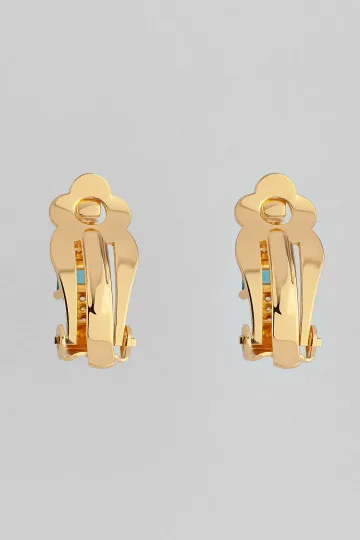
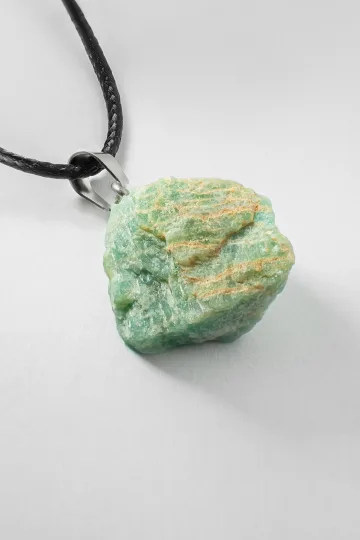
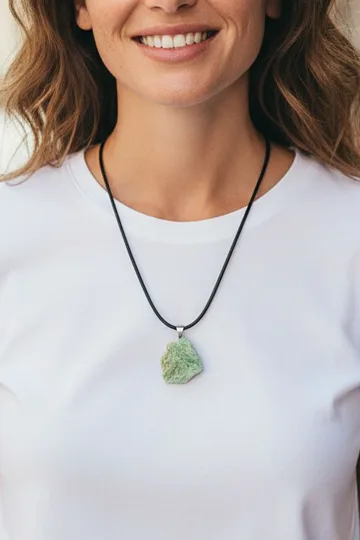
Wear the symbol, don't just read about it. These are in stock:






Hardness, structure, optics
Lepidolite crystallises in the monoclinic system and inherits the layered build of all micas. Inside each ultra-thin sheet the atoms are bound tightly, while the sheets themselves cling to one another only weakly. That is why mica can be split into leaves thinner than paper. Lepidolite is made of many such lilac flakes stacked one on another, which is exactly where the name comes from: in Greek lepidos means "scale" and lithos means "stone".
Every working property of the stone flows from that structure:
- Mohs hardness: 2.5 to 3.5. This is a soft stone. For comparison, window glass sits near 5.5 and quartz at 7. Lepidolite is easily scratched by a steel point, and it dislikes knocks and friction.
- Density: roughly 2.8 to 2.9 g/cm³. The stone feels light, not heavy like glass of the same size.
- Cleavage perfect in one direction, a direct consequence of the layering. Along the mica planes the stone splits almost perfectly flat.
- Pearly, silky lustre. The mica flakes catch the light and give a soft silvery shimmer that flows across the surface as you turn the stone. This is not the bright fire of a diamond but the quiet glow of silk.
- Transparency: usually opaque, more rarely translucent in thin sheets. Refractive indices are low (around 1.52 to 1.59), and since the stone is opaque and never faceted, it shows no optical play.
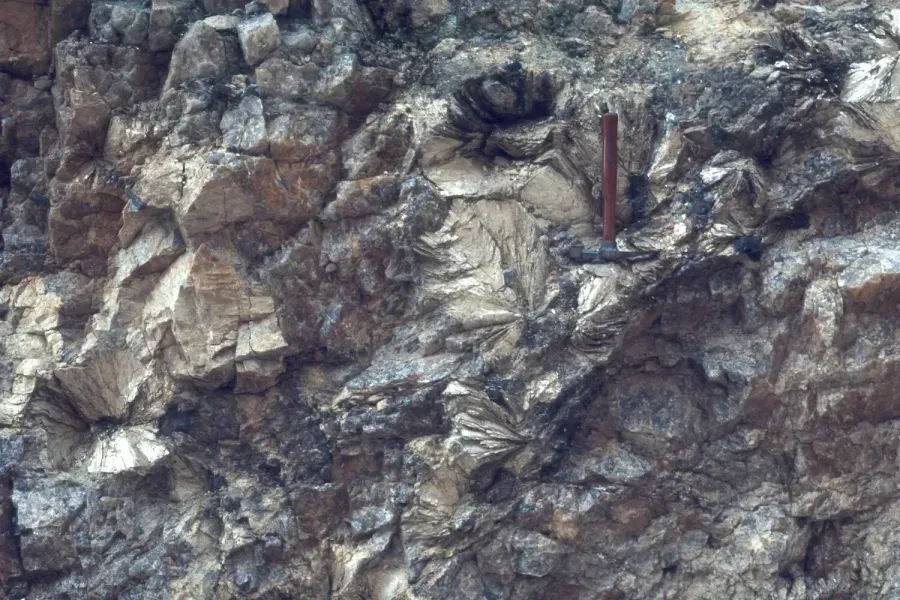
Lepidolite rarely forms large single crystals. More often it grows as dense scaly masses, like compressed lilac crumb, or as rosettes of thin glittering plates. Cabochons are cut from these solid blocks.
How and where lepidolite forms
Lepidolite is not born just anywhere; it forms in special pockets of the Earth's crust, in pegmatites. A pegmatite is the final act of cooling magma. When a huge body of melt slowly sets deep underground, the ordinary minerals crystallise first. What remains is a hot liquid oversaturated with rare light elements that found no room in the common crystals: lithium, rubidium, caesium, sometimes beryllium and tantalum.
That residual liquid fills cracks and cavities, and over tens of thousands of years large crystals of rare minerals grow there, lepidolite among them. So lilac mica almost always keeps company with other lithium and rare-metal minerals: pink and green tourmaline, clear spodumene, beryl, quartz, feldspar. A geologist who spots lilac mica nests in a rock knows there are gems worth hunting here. The lilac colour serves as a natural pointer to a rich vein.
The main world deposits
Lepidolite turns up on every continent, but only a handful of regions yield quality jewellery-grade material.
Brazil, the state of Minas Gerais. One of the chief sources of beautiful lepidolite. The local pegmatites are enormous and rich in lithium. Here you find deeply lilac scaly masses and striking intergrowths of lepidolite with pink tourmaline. Brazilian material often goes into the brightest cabochons.
The United States. San Diego County in California and the deposits of Maine in particular. The Californian pegmatites became famous back in the early 20th century for their pink tourmalines, and the lilac mica travelled with them along the vein.
Madagascar. Supplies lepidolite of a juicy violet tone, frequently alongside other rare-metal minerals. The island pegmatites are young by geological standards and generous with colour.
The Czech Republic (Moravia). A historic site: this is exactly where, at the end of the 18th century, the specimens were found that launched the scientific study of the mineral.
Afghanistan, Zimbabwe, Namibia. These fill in the map. Lepidolite is recovered there as a by-product while lithium and tourmaline veins are worked.
Geography shapes what you buy: the colour, the cleanness of the flakes, the size of the solid blocks fit for polishing. Brazilian and Madagascan material tends to give the bright lilac cabochon, while material with a long mining history is prized for its calm tone and back-story.
How lepidolite is worked
Working lepidolite calls for caution because of its softness. A hard stone can be sawn and polished aggressively; lepidolite cannot. Under coarse grinding the flakes chip away and the surface goes cloudy. Cutters use a fine abrasive, low speeds, water cooling, and finish the surface with a long hand polish.
Lepidolite is turned mostly into cabochons, smooth rounded inserts with no facets. Facets are pointless here: a soft opaque stone plays no light, and its beauty lives in colour and the silky sheen. Besides cabochons, cutters turn beads for bracelets, slice flat plates for pendants, and make tumbled pebbles.
You will often see stabilised lepidolite for sale, where the loose micaceous mass is soaked in a colourless resin to bind the flakes and add strength. This is an honest method when it is disclosed: it helps a soft stone last longer. A separate story is lepidolite in matrix, where the lilac mica sits beside pink tourmaline, smoky quartz, and feldspar. Such landscape stones are prized: a single cabochon reads like the whole geological company of the pegmatite.
Lepidolite wants silver and a plain sweater. Pile on gold and it sulks.
What to wear lepidolite with
Over years on shoots I have put lepidolite through dozens of looks. Here is what actually works, by occasion.
What do you wear lepidolite with every day? For every day I recommend a thin silver pendant under a shirt collar or a light jumper, small studs, an understated bracelet. I suggest a calm cool palette: grey, white, dusty blue, soft denim, dusty pink. Lilac reads best on plain, patternless fabric, so the colour does not get lost in the busyness.
Does it work at the office? It does; lepidolite is near ideal for the office, calm and never loud. I choose a medium-length pendant just below the collarbones or restrained silver drop earrings. For a V-neck shirt I suggest a pendant on a fine chain; for a high collar, earrings, so the stone sits by the face.
How do you build an evening look? For the evening I recommend a large cabochon ring or long earrings with lepidolite beads interlaced with silver. Against a plain dress in a cool palette (navy, graphite, lilac) the lilac stone works as a considered accent. For a special occasion I suggest the rarest variant: an intergrowth of lepidolite with pink tourmaline, which looks dearer than its price thanks to its living pattern.
Which metals and stones pair with it? On metals the rule is simple: lepidolite gets on with white metals, so keep to silver and do not mix in warm gold, or the cool and warm tones will quarrel. Among stones it takes well to amethyst (separate it with silver beads, it is harder and will wear away the soft mica), rose quartz, smoky quartz, and moonstone. Into the same cool palette falls celestine, the heavenly stone of calm and clarity. I avoid sharp contrasts with hot stones: red, orange, and saturated yellow quarrel with the lilac.
Who does lepidolite actually suit? Anyone with a cool skin undertone and a love of quiet pieces with character. One rule that never fails: a single striking piece per look beats five at once. Lepidolite is expressive on its own, and overload smothers its calm beauty.

Turn on your camera, pick earrings, a pendant or a ring, and see the piece on yourself in real time.
Switch items in one tap.
Everything runs in your browser: no photo or video is ever uploaded.
The history of lepidolite
The history of lepidolite is shorter than that of emerald or pearl, and that is its peculiarity. Most famous gems were known in antiquity: people found them on the surface, admired the colour, and invented legends. Lepidolite, for nearly all of its human history, stayed not an ornament but a raw material. There is no thousand-year mythology behind it; there is real rock and real chemistry.
Discovery and name
The mineral was first described scientifically at the end of the 18th century, from specimens of lilac mica out of Moravia. The name was given in 1792 by the German chemist Martin Heinrich Klaproth, who joined the Greek lepidos (scale) and lithos (stone). The name is accurate: under a loupe you see a multitude of thin plates layered one over another, like the pages of a book once soaked and then dried out. In old 19th-century mining handbooks the mineral was also called lilac mica and lithium mica.
The stone that revealed rubidium
Lepidolite played a part rare for a gemstone in the birth of chemistry. In the late 18th and early 19th centuries chemists were only learning to break minerals down into their parts. Lilac mica drew attention because in a flame it dyed the fire red, something ordinary mica did not do. That red flash was a clue: something unusual lived inside.
In 1817 the Swedish chemist Johan August Arfwedson, studying the related mineral petalite, discovered a new alkali metal and named it lithium, from the Greek lithos, because he had found it in a stone rather than in plants or animal tissue, where sodium and potassium had been found before. It soon became clear that lepidolite was saturated with the same lithium, and the lilac mica became one of the chief natural sources of the new element.
The story did not end there. The German chemists Robert Bunsen and Gustav Kirchhoff, studying substances by spectral analysis, discovered the element caesium in 1860 by its bright blue spectral lines (from the Latin caesius, sky-blue), though not in lepidolite but in mineral water from Dürkheim. A year later, in 1861, by the same method and now in lepidolite, they found rubidium, by its red spectral lines (from the Latin rubidus, deep red).
So the lilac mica is directly tied to the discovery of rubidium and became one of the chief natural sources of lithium. Caesium, contrary to a common simplification, was found not in the stone itself but in mineral water. Even so, rubidium alone is enough: helping science find a new element is a rare honour for a mineral.
From ore to stone
Through the whole 19th century and the start of the 20th, lepidolite was mined for lithium, rubidium, and caesium. The lilac mica was turned into special glass and ceramics, lithium greases and alloys. The stone was valuable raw material, but it was crushed and melted, not worn on the body.
The turning point came in the second half of the 20th century, as interest in natural stones grew. Lepidolite proved a find: a lovely lilac colour, a pleasant softness, and a recognisable scientific fact about the lithium inside. So an industrial mineral got a second life as a lapidary and collector's stone.
Customer reviews
Zevira is a real jewellery shop. Genuine payments, deliveries and customer thank-yous.
🥰🥰🥰 gracias
Ok, ¡gracias! 🙂
Shades and varieties of lepidolite
The chief mark of lepidolite is its colour. The range runs from pale lilac, almost grey, to a deep rose-violet. The tone depends on the amount of lithium and manganese. The main variants you meet in jewellery:
- Pale lilac, lavender. The softest tone, recalling the colour of lavender. Calm, unobtrusive, it goes with almost any clothing. Good for everyday pieces.
- Saturated lilac, rose-violet. A deeper colour with more rosy warmth. Noticeable, it reads as an accent. More often it comes from Brazilian and Madagascan pegmatites.
- Greyish violet, smoky. A muted tone with the silvery sheen of mica. It looks restrained, though the stone itself is inexpensive.
- Greenish lilac, variegated. A rare variety where the lilac mica interweaves with green from the neighbouring green tourmaline or chlorite. Every specimen is unique.
- Lepidolite with tourmaline. Technically this is not a colour but a natural intergrowth: in the lilac mass you see needles of pink or green tourmaline. Two gems join in a single piece.
- Near-white, cream with a lilac wash. A stone poor in lithium and manganese. The colour is barely sketched. Inexpensive, good for gentle monochrome pieces.
The colour of lepidolite can fade slightly over time if the stone is kept in bright sun constantly: the lilac and pink tones are sensitive to ultraviolet. With sensible handling the colour holds for decades. And remember: an overly even, gaudy violet tone with no play often gives away dyed material. Natural lepidolite is almost always soft in tone, with transitions and unevenness.
Upload a photo of your pet, someone you love, or an object. We'll build a 3D model and hand-cast it in pewter.



Lepidolite in the family of lithium minerals
Lepidolite is not alone. It belongs to a small group of lithium-bearing minerals, and getting to know its relatives helps you understand the stone itself.
Spodumene. A clear lithium mineral that yields two gems: pink kunzite and green hiddenite, the stone of growth and new beginnings. It grows in the same pegmatites, often nearby. Unlike soft mica, spodumene is markedly harder and transparent, and it gets faceted.
Petalite. The mineral in which Arfwedson discovered lithium in 1817. A clear, usually colourless or pale stone prized by collectors.
Tourmaline. Not a lithium mineral in the full sense, but pink and multicoloured tourmaline often carries lithium and almost always grows alongside lepidolite. That is exactly why intergrowths of lilac mica and pink tourmaline are so common. The blue variety has its own biography, indicolite, tourmaline in jewellery.
All of them are born in the same geological setting, in rich pegmatites, and they form that lithium company in which lepidolite plays the most recognisable lilac member: the softest, the most opaque, but also the most striking in colour.



A modern twist: lithium for batteries
Lepidolite has a fresh twist to its biography. In the 21st century lithium became a strategic metal: it is needed for the batteries that power phones, laptops, and electric cars. Demand for lithium is rising, and lithium pegmatites, the lepidolite-bearing ones included, are back in industry's spotlight.
So a duality appears: the same mineral is wanted both by those hunting a beautiful lilac stone and by those mining the metal for batteries. The lilac mica again, as it did two hundred years ago, finds itself at the crossing of nature, chemistry, and human need.
Symbolism: what people attribute to the stone
Here it pays to speak plainly. Lepidolite cures nothing and protects against nothing; there is no proven physiological effect from the stone. But it does carry a stable set of meanings that gathered around the mineral over recent decades, and behind them stands a clear logic rather than magic.
In the tradition of working with stones, lepidolite is linked with calm. There are three roots to that reputation. The first is the colour: the eye reads lilac and mauve as a cool, soft tone, and the psychology of colour confirms that the cool part of the spectrum feels calmer than the warm. The second is the lithium inside and its medical fame: lithium salts are used in psychiatry as a mood stabiliser, and that association carried over to the stone by sheer echo of the name. The third is the texture: a smooth, cool surface is pleasant to hold in the hand.
The difference is worth keeping in mind. Lithium-the-medicine consists of purified salts, taken internally under a doctor's watch in a precise dose. The lithium in lepidolite is firmly locked in the crystal lattice and does not pass through the skin into the blood. A stone on the wrist and a lithium tablet are wholly different things, and to credit the mineral with a pharmacy effect is wrong.
The second motif is transitions. Lepidolite is called the stone of change, and that symbolism grew straight out of its structure: mica splits softly, layer by layer, without a sharp fracture. People saw in that the image of a calm transition and began giving the stone on the threshold of big change, at a house move, a job switch, the start of a new chapter. Add the twilight lilac colour, the colour of the border between day and night, and the image builds itself. It is a cultural tradition, no more, but as a metaphor it works.
Leave your email, we'll send your discount code. No spam, unsubscribe anytime.
The code arrives by email, valid on your first order.
How to care for lepidolite
Lepidolite is soft, and care decides directly whether it lives for years of vivid colour or dulls within a season. The rules are simple, but keeping them matters more than for hard stones.
Dryness. Lepidolite dislikes long contact with water. Take pieces off before a shower, a bath, the pool, a sauna, the washing-up. Hot water, soap, steam, and chlorinated water are especially harmful: they matte the surface and, over time, weaken the bonds between the mica flakes. To clean the stone it is enough to wipe it with a dry or barely damp soft cloth, with no soaking and no brushes.
Protection from knocks and friction. A hardness of 2.5 to 3.5 means the stone is easily scratched. Do not wear it together with hard jewellery: rings, chains, and bracelets of hard stones will leave scratches. Store each piece separately, in a soft pouch or in a fabric-lined compartment of a box.
Protection from the sun. The lilac and pink tones are sensitive to ultraviolet. Do not keep lepidolite on a bright windowsill and do not wear it for weeks under a blazing sun. In the shade the colour holds for decades.
Protection from chemicals. Perfume, hairspray, creams, and household chemistry harm the soft surface. Put lepidolite jewellery on last, after cosmetics and scent, and take it off first.
If the stone dulls over time or picks up fine scratches, do not polish it at home with abrasives. Better to take the piece to a cutter who will carefully re-polish the cabochon with a fine grit at low speed. With careful daily handling such a re-polish is rarely needed.
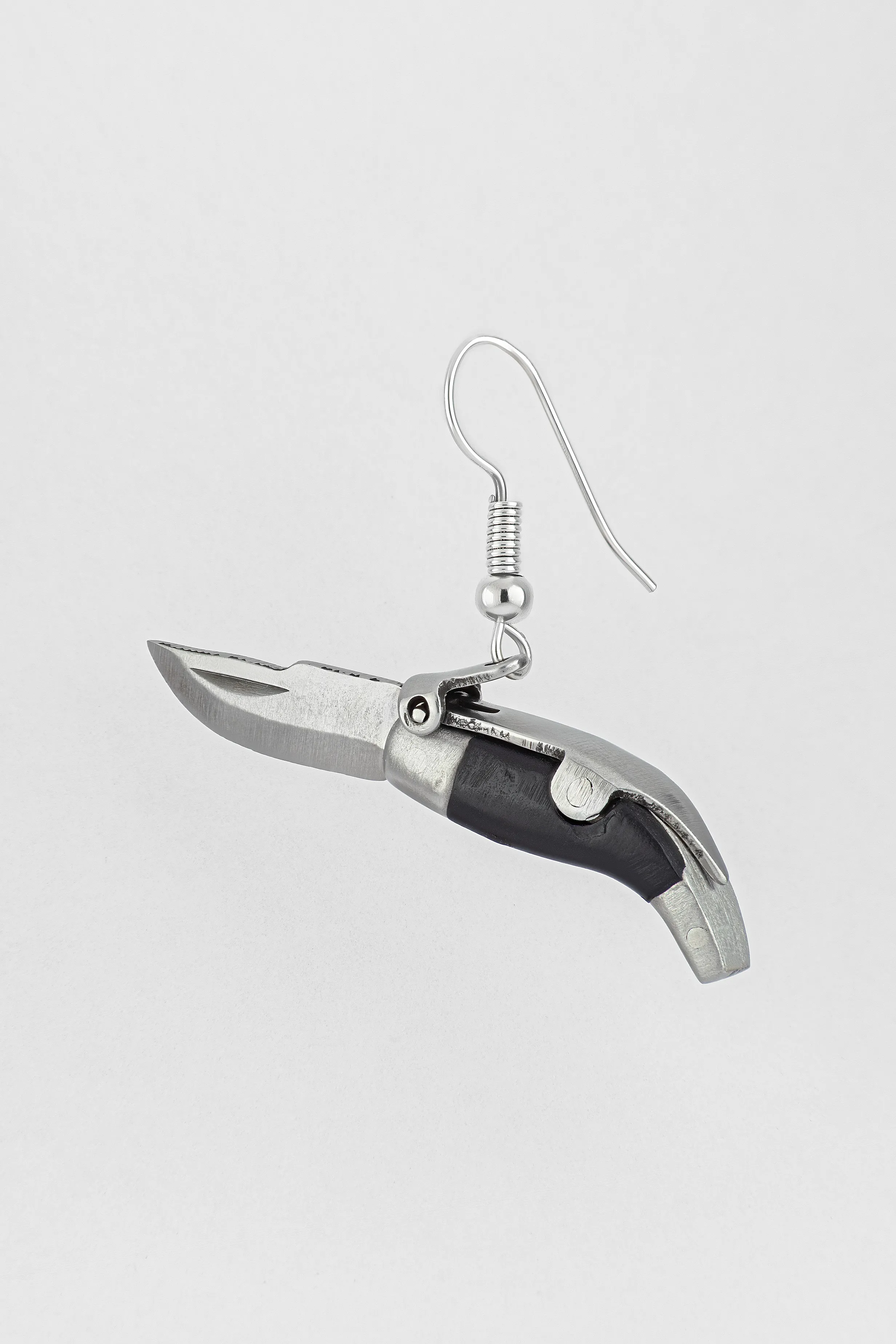
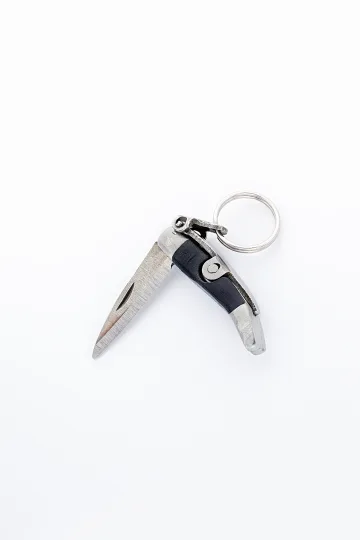
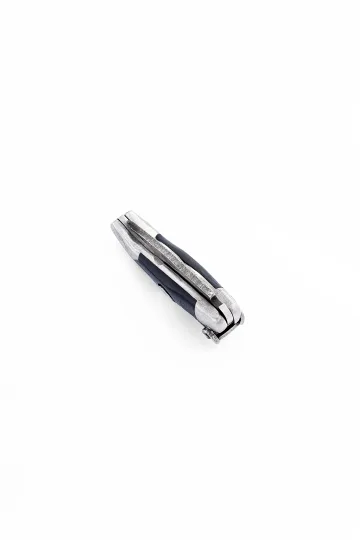
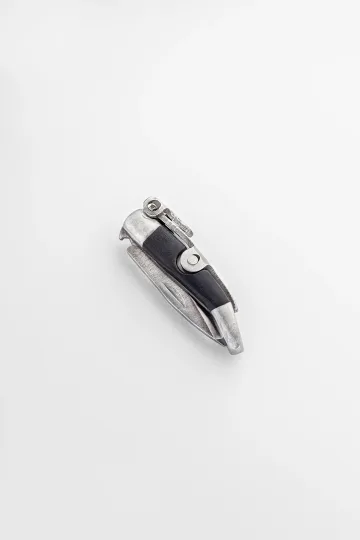
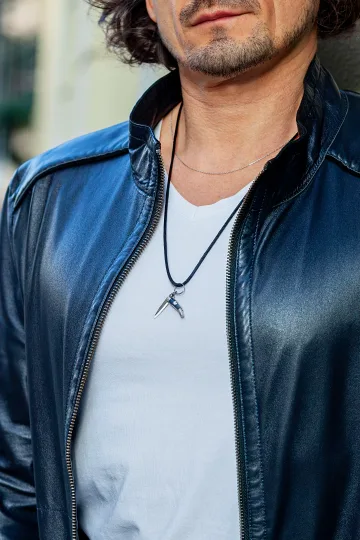
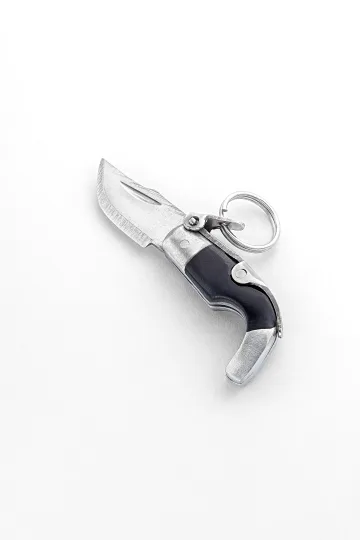
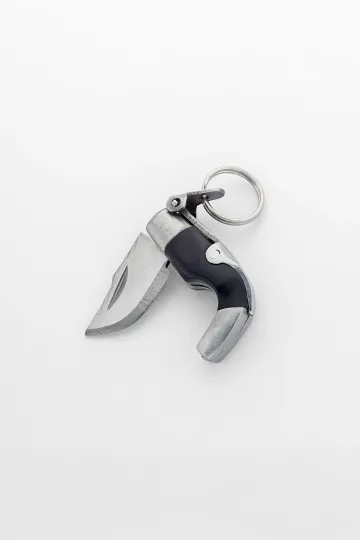
CAPAORA mini knife pendant
The 18th-century Spanish navaja in miniature: 40 mm of stainless steel, a real folding mechanism and a Palanquilla lock that clicks. An affordable gift to remember.
Authentic · Ships from Spain · 14-day returns
Jewellery with lepidolite
The softness of the stone dictates which pieces suit it. The general rule: lepidolite is good where it is shielded from knocks and friction. Pendants, earrings, and smooth beads are its element. Rings are possible but call for caution. The setting is most often taken in 925 sterling silver: the cool silvery metal underlines the lilac tone, and the micaceous sheen of the stone echoes the gleam of silver.
- Pendants and drops are the ideal form. A stone hanging at the chest is not knocked about like a ring, so it lives long and keeps its colour. People make smooth cabochons in silver, flat plates of natural shape, and pendants flecked with pink tourmaline.
- Earrings are a light choice. The stone is soft and not heavy, so earrings do not drag at the lobe, and the lilac tone freshens the face of people with a cool colouring. Drop earrings are best chosen with a smooth, streamlined shape.
- Bead bracelets are the most popular form. But beads rub against one another and lose their sheen over time, so a lepidolite bracelet is worn more carefully than an agate or quartz one. Take it off when you work with your hands.
- Rings are a beautiful thing but one that demands attention. Choose a closed bezel setting where the metal caps the stone with a rim and takes the knocks on itself. Take the ring off when you wash your hands or work. Better worn for an occasion than for work.
How to choose lepidolite and tell it from a fake
Buying lepidolite is simpler than buying costly gems, but there are still things to watch.
Colour. Good natural lepidolite has a soft, living tone with play and unevenness, with light and dark zones. What should put you on guard is a perfectly even, gaudy violet colour with no nuance: that is how dyed material or an imitation looks.
Lustre. The most reliable mark. Real lepidolite has the pearly, silky shimmer of mica that flows as you turn the stone. Plastic and dyed glass give a flat, dead gleam with no micaceous play.
Structure. Under a loupe, or with a careful eye, a natural stone shows fine flakes and layering. A smooth glassy mass with no structure at all gives away an imitation.
Hardness and weight. Lepidolite is soft, easily scratched, and feels lighter than glass. If a stone sold as lepidolite is noticeably hard, will not scratch, and is heavy like glass, you are more likely facing another material, dyed agate for instance.
An honest seller. Ask about origin and treatment. A conscientious seller will say whether the stone is natural or stabilised with resin. Stabilisation is a normal method for a soft stone, and there is nothing to be ashamed of in mentioning it.
How not to confuse it with similar stones
Lepidolite is sometimes mixed up with other lilac stones. The differences help you understand what you are paying for:
- Amethyst, a variety of quartz, hardness 7, transparent, with a bright glassy play. Lepidolite is soft, opaque, scaly.
- Charoite, a rare stone from a single deposit, hardness around 5 to 6, with a characteristic fibrous, flowing pattern. Markedly harder and dearer than lepidolite; its pattern flows rather than flakes.
- Fluorite, more transparent and also harder than lepidolite.
- Sodalite, bluish violet, harder and more uniform in colour.
Do not chase cheapness at any cost: a very low price on a large, bright stone is a frequent sign of dyed or artificial material. Lepidolite already belongs to the affordable segment, so it is better to take a small honest natural stone than a big bright imitation.
Send a friend a discount code, they save on their first order.
Myths about lepidolite
Around lepidolite, as around any popular stone, plenty of exaggeration has grown. Let us sort through the main misconceptions honestly, in the cards below. A level-headed view of the stone makes it more useful: you stop waiting for miracles and start valuing what it really gives, colour, texture, and a rare scientific biography.
Frequently asked questions about lepidolite
Is it true there is lithium in lepidolite?
Yes, this is the stone's chief chemical feature. Lepidolite belongs to the group of lithium micas and carries lithium in its crystal lattice. Lithium together with manganese is exactly what sets the colour. Historically lepidolite was one of the main natural sources of the metal: lithium, rubidium, and caesium were mined from it industrially through the whole 19th century and the start of the 20th. That said, the lithium is firmly bound in the mineral and does not pass through the skin into the blood, so lepidolite on the body does not work as a lithium medicine.
Is it dangerous to wear lepidolite, since it contains lithium?
No, wearing lepidolite is completely safe. The lithium is locked in a solid crystal lattice and is not released into the skin or the air during ordinary wear. This is not a radioactive or toxic mineral. The confusion comes from the fact that purified lithium salts in tablets are dangerous in overdose, but a stone on the wrist is something quite different: nothing leaches out of it. The one sensible precaution is mechanical: if the stone has crumbled, do not grind it to powder and inhale the dust, as with any mineral dust.
Is lepidolite a precious stone?
No, lepidolite counts as a lapidary and collector's stone, not a precious one in the strict sense. The precious category traditionally takes in hard, transparent, rare stones with bright play: diamond, ruby, sapphire, emerald. Lepidolite is soft, opaque, and common, so it costs little, in the affordable segment of gems. But that does not make it lesser: its value lies in colour, texture, history, and a pleasant softness in the hand.
Can you wet lepidolite and wash it with water?
Better not. Lepidolite is soft, hardness only 2.5 to 3.5, and made of thin mica layers. Long contact with water gradually weakens the bonds between the flakes, especially if the stone is cracked or stabilised with resin. Hot water, soap, steam, and chlorinated water do the most harm: they matte the surface and destroy the sheen. Take lepidolite jewellery off before a shower, a bath, the pool, and the washing-up. To clean it, it is enough to wipe the stone with a dry or barely damp soft cloth.
How does lepidolite differ from amethyst?
These are different minerals, though both can be violet. Amethyst is a variety of quartz: hardness 7, transparent or semi-transparent, with a bright glassy play of light. Lepidolite is a lithium mica: hardness 2.5 to 3.5, usually opaque, with a matte or pearly silky lustre. They are easy to tell apart even without instruments: amethyst is hard, cannot be scratched with a fingernail, and lets light through. Lepidolite is softer, shows a layered scaly structure on close inspection, and is almost always opaque.
How does lepidolite differ from charoite?
Both are lilac-violet, but they are different minerals. Charoite is a rare stone found in only one place on Earth, where it took its name. Charoite is harder (hardness around 5 to 6), with a characteristic fibrous, pearly flowing pattern, and markedly dearer, because it occurs in just one deposit. Lepidolite has a scaly pattern rather than a fibrous one, and it is softer. If you see a striking violet stone with wavy pearly swirls, noticeably harder, it is more likely charoite.
What is stabilised lepidolite?
It is lepidolite soaked in colourless resin for strength. The natural stone is soft and often loose, its flakes prone to chipping. To turn the fragile micaceous mass into a material fit for polishing and long wear, cutters soak it in resin, which glues the flakes from within. Stabilised lepidolite is stronger and holds a polish longer. This is an honest and common method when it is disclosed to the buyer: stabilisation does not make the stone a fake, it is still the same natural lepidolite, only reinforced. What should put you on guard is not the presence of stabilisation but its concealment, or the swap of the stone for an artificial material.
Can you wear lepidolite every day?
You can, with allowance for the softness. A pendant and earrings suit daily wear almost without limits, because they are shielded from knocks and friction. A bracelet, and a ring above all, call for caution: on the wrist and finger the stone catches surfaces more often and loses its sheen faster. If you want to wear lepidolite constantly, choose a pendant or earrings for weekdays, and spare the bracelet and ring. Take jewellery off before a shower, sport, and cleaning.
Does lepidolite fade in the sun?
Yes, the lilac and pink tones are sensitive to ultraviolet, and under constant bright sun the colour can pale slightly over the years. This is a common trait of many violet and pink stones: ultraviolet gradually destroys the colour centres. The trouble lies not in ordinary daylight but in long direct sun. Do not keep lepidolite on a bright windowsill and do not wear it for weeks under a blazing sun. In a box or a pouch the lilac tone will stay rich for decades.
Which metal suits lepidolite best?
Most often lepidolite is set in 925 sterling silver, and this pairing is reckoned the happiest. The cool silvery gleam of the metal underlines the cool lilac tone of the stone, and the pearly mica shimmer echoes the gleam of silver. The result is a whole look in a single cool palette. Yellow gold and gilding visually quarrel with the cool colour of the stone, so if you want gold, white gold is the better pick.
What to do if lepidolite has dulled or scratched?
Since lepidolite is soft, fine scratches and a loss of sheen are inevitable over time, especially on bracelets and rings. A deep polish is best left to a professional: lepidolite needs a fine abrasive, low speeds, and careful hand finishing, or the flakes will chip away. At home you can only lightly freshen the stone with a soft cloth, without abrasive pastes and stiff brushes. The best strategy is prevention: wear it carefully, take it off before physical work and water, and store it apart from hard jewellery.
Can lepidolite and amethyst be worn together?
Yes, this is one of the most harmonious colour pairings: both violet, but with different texture, amethyst giving transparency and a glassy gleam, lepidolite a matte depth. One thing to remember: amethyst is hard (hardness 7) and lepidolite is soft, and in a bracelet the hard amethyst beads will abrade the mica through friction. To avoid this, separate them with silver spacer beads, or build the set from separate pieces: a bracelet with amethyst and a pendant with lepidolite.
Is lepidolite fragile in everyday jewellery?
It is delicate rather than brittle in a shattering sense. The softness means surfaces and harder stones scratch it, and a sharp knock can chip a thin edge, so the smart move is to set it where it is protected. A pendant and earrings carry almost no risk; a ring with an open setting is the most exposed. Stabilised material and a closed bezel both add resilience, which is why most everyday lepidolite pieces lean on those two safeguards.
The essentials of lepidolite
- What it is. A lithium mica, a soft lilac stone, a fluorosilicate of potassium, lithium, and aluminium. The only common gem with a noticeable lithium content.
- Physics. Hardness 2.5 to 3.5 on Mohs, density about 2.8 to 2.9 g/cm³, monoclinic system, perfect cleavage, pearly silky lustre, usually opaque.
- History. Described at the end of the 18th century, named for its scaly structure. Rubidium was discovered from it and lithium mined industrially.
- Where. It grows in pegmatites alongside tourmaline and beryl. The best specimens come from Brazil, Madagascar, the United States, and Moravia.
- Colour. From pale lavender to deep rose-violet. The tone depends on lithium and manganese; the natural colour is soft, with play.
- Care. Dryness, protection from knocks, shade from the sun, storage apart from hard stones.
- Jewellery. Pendants and earrings are best, bracelets and rings more cautiously. The ideal metal is 925 sterling silver.
If you strip the esoteric foam out of the talk about lepidolite, something more valuable remains: a stone with an honest history. A lilac mica in which the chemists of the century before last found rubidium, and from which they mined the very lithium that later became a remedy for mood swings. A mineral from the depths of pegmatites, soft and cool, pleasant to hold in the hand. Behind the beautiful lilac stone stands a large, living science rather than an invented legend, and that is its true value.
Buying it as a gift? Each one arrives ready to give.
 A branded Zevira box and a little card come with every order.






About Zevira
We make jewellery for those who seek in a stone not its sparkle but its character and history. Lepidolite in our collection is a lilac lithium mica set in 925 sterling silver: smooth pendants, bracelets of pure lilac beads, earrings, and intergrowths of lepidolite with pink tourmaline. Each piece is assembled so the soft stone serves long and stays vivid: a careful setting, selected material, and a clear story of the stone in the product card.