Old money jewellery: what people wear where nothing is ever bought
A style with no moment of purchase
An old money signet cannot be bought. It can be inherited, cut to order, or worn without ever taking it off until it becomes yours. The whole style runs on the same rule: pieces are not chosen from a display case, they are handed over, mended, and worn out.
That is where most of the confusion starts. Someone searches for where to buy old money jewellery and lands on rows of thin chains and smooth rings. You can buy them, but you cannot buy your way into the style, because the piece here is recognised not by its shape but by its age and by the marks of service on it. A ring lifted from its box in front of you and wrapped in tissue still says nothing about you at all.
The good news is that the mechanism repeats. It asks not for an inheritance but for a different way of handling objects: buy rarely, mend instead of replacing, wear the same things for years, and stop fearing that metal will darken. What follows is how such a set actually comes together, what counts as noble wear and what counts as a ruined piece, and where the line runs past which repair no longer saves anything.
A wardrobe nobody assembled on purpose
An inherited set is never designed. A ring arrives down one branch of the family, earrings down another, a watch from a decade that belonged to nobody you knew. Not one piece was chosen to match its neighbour, because when each was bought the neighbour did not yet exist. Hence its defining trait: it refuses to reduce to a common denominator. Yellow gold sits beside white, a heavy brooch from two centuries ago lies next to a post-war chain as thick as a finger.
Seen from outside, that refusal reads as quiet confidence. Seen from inside it is simply a family chronology laid out across a box. Trying to bring the set to a single look, to melt everything into one metal and buy the missing pieces to complete it, kills exactly the thing it was valued for.
Why this is not quiet luxury
The two styles get confused constantly, though they answer different questions. Quiet luxury answers how to buy something expensive so it does not read as a price tag: which alloy, which stone, in what order to build a collection, where the bottom of the budget sits. Old money answers something else: what to do with the things already sitting in a biscuit tin up in the loft.
The first is assembled in one deliberate evening and comes down to money. The second is never assembled at all, it accumulates, and it comes down to time and to having a good workshop nearby. The principles, materials, marks and order of building a quiet-luxury collection are worth reading on their own, so there is no point repeating them here. From this point on the subject is objects that have no moment of purchase in your biography at all.
What a stranger sees and what an insider sees
A stranger sees restraint: a thin chain, grey silver, a watch with no glint to it. It looks to them like a person who simply does not care for jewellery. An insider sees something else, and looks in specific places: at a necklace clasp clearly younger than the necklace, at a ring shank worn soft along its edge, at re-cut engraving, at an earring wire whose colour differs slightly from its setting.
Each of those details means the piece went back to a workshop. It is repair, not the hallmark, that works as the main signal here. A new piece cannot fake it, because there is nothing in it yet to mend.
Wear the symbol, don't just read about it. These are in stock:


Inheritance as a way to build a set
A set that gets handed down is built not like a collection but like an archive. It has no author and no plan, but it has dates. Understanding this mechanics matters more than any list of must-have pieces, because it is exactly what explains why such a set can never be bought in one go.
The set grows by occasions, not by lists
Pieces enter a family on occasions, and the occasions are finite: a birth, a christening, coming of age, an engagement, a wedding, an anniversary, a funeral. Each occasion yields one object, rarely two. The set therefore grows in jolts, with years of silence between additions, and that is the first thing separating it from a collection built to a plan.
The list of occasions also explains the strange contents of the box. There are earrings and a ring, often a cross or a locket, more rarely a brooch, and almost nothing bought simply because someone liked it. An impulse buy does not survive in such an archive: it does not outlast a change of generation, and it is the first thing taken to the pawnbroker when money is short.
The mechanism is older than the idea of a family box. English wills of the sixteenth to eighteenth centuries carried a standard clause instructing that memorial rings be handed to friends and kin, paid for out of the deceased's money: the object arrived in another household on a precise occasion and with an exact date on the band. That is how sets came together in which not one piece had been chosen by its owner.
The consequence for whoever inherits such a set is plain. The order of pieces in the box is not an ancestor's taste but the timetable of their life, and it should be read as a chronicle, not a curated edit. The piece that seems random and matches nothing else is usually the most firmly dated of all: it came for one specific event and had no other purpose.
Who hands a piece over, and when
Handing over rarely happens through a will. Far more often the piece is given while the giver is alive and for a particular reason: a wedding, the birth of a child, a move, the start of an independent life. The moment is the giver's to choose, and the choice is rarely about the value of the object, far more often about who it suits by temperament.
From this follows something seldom said aloud. Asking about the pieces in advance is not tactless but sensible: an object loses its history not when it is sold but when the last person who knew whose it was and where it came from dies. After that only nameless metal remains, and the name cannot be restored by anything.
Write down a little, and be specific: who the piece came from, in what circumstances, what was said about it, whether there was a repair and what kind. In museum practice this chain is called provenance, and a note made in the owner's lifetime outweighs any later reconstruction from memory. Three lines on paper beside the box do more than a valuation: the valuation speaks about the metal, the note about belonging.
Why the set has gaps
An inherited set arrives incomplete, and that is its working state, not a misfortune. There is no second earring. There is no chain for the pendant. There is a ring for a finger you do not have. The gaps come from wars, moves, divisions of estate and ordinary losses, and they are so much in the order of things that their absence is suspicious: a full, even, unblemished set gives away a single purchase.
Gaps are closed not by restoration but by changing a piece's function. A lone earring becomes a pendant. A ring that will not fit goes onto a chain. A brooch with a broken pin becomes a pendant on a ribbon. Each of these decisions keeps the object in wear rather than in the box, and it is wear that keeps a piece alive.
A piece that does not suit you: what to do with it
The most common fork in the road. You inherit a heavy ring and you wear thin ones. You inherit yellow metal and white suits you. The first urge to melt it down or sell it is almost always premature, because a person's feeling for a shape changes more slowly than they think, and a piece rejected at twenty-five often becomes the favourite at forty.
The sensible order is this: first wear it as it is, adjusting neither the piece nor your wardrobe to fit it, then try changing the scenario, and only then touch the metal. The ring moves to another finger or onto a chain, the brooch goes onto a coat rather than a dress, heavy earrings are worn with hair pinned up. Irreversible operations are left to last, and they are decided once: what is melted down cannot be put back together.
A grandmother's brooch goes on a coat and goes alone. Add earrings and three rings and you are wearing a costume, not a piece. Do not argue with me.
How inherited pieces are actually worn: a stylist's read
An inherited object puts its owner at a loss more often than it delights: it is heavier, larger and older than anything they usually wear. Below is a short conversation with a Zevira stylist about fitting such a piece into an ordinary wardrobe without turning the look into a costume.
Where do you start if you inherit a piece noticeably larger than what a person usually wears?
I shrink everything around it first, not the piece itself. If a massive brooch arrives, I take the earrings off entirely and leave the neck bare. A large object stops shouting when there is nothing beside it to argue with. I choose a dense, matte fabric, because on a shiny surface old gold reads as an accident.
How many inherited pieces can be worn at once?
One, and this is arithmetic, not self-denial. A set like this is incomplete by its nature, and a person who puts everything on at once says exactly the opposite of what they meant. When I build a look, I leave one old piece and add things with no age to them: a smooth chain, plain earrings, a clean neckline. The old piece takes the solo, the rest is accompaniment.
Where do you put a piece that suits nothing in the wardrobe?
I change the background, not the piece. A brooch impossible on a dress lives happily on a coat, on the lapel of a jacket, on dense knitwear at the shoulder. A large cross I place over a roll-neck rather than into a neckline, or it sinks and snags. And I look at the piece under the light it will be seen in: daylight and evening light send old silver and old gold in different directions, and a piece dull in the office comes alive by dinner.
How do you wear a piece that is clearly the wrong size?
I change the scenario, not the size. A ring that is too big I put on a chain, and I choose a length that lets it sit below the collarbone and not hide in the neckline. An earring left without its pair I wear as a single, but then I ask for the hair on that side to be pinned back, or it reads as a loss. I leave reworking the metal for the very end, once every other option has been tried.

Turn on your camera, pick earrings, a pendant or a ring, and see the piece on yourself in real time.
Switch items in one tap.
Everything runs in your browser: no photo or video is ever uploaded.
Where the habit of not buying came from: a short history
The idea that jewellery is received rather than acquired is older than the fashion for it by roughly two thousand years. For a long stretch it was not an idea at all: the right to wear certain things was handed out by birth and by office, and money took little part in the handing.
The gold ring that could not be bought
In Rome the ring worked not as ornament but as a mark of rank. Pliny the Elder, writing in the first century, gave rings a good part of his book on gold and silver and described how the gold ring turned from a token of an envoy's authority into a badge of class: first senators wore it, then the knights, and iron was left for everyone else.
The right to a gold ring was called the ius anuli aurei and was granted by decision, not by purchase. A wealthy freedman could pay for a house, a table and a carriage, but the ring came only from the hands of authority, as a separate grant. The gap between money and the mark was fixed in law, and it gave rise to the whole later aesthetic in which a visible purchase loses to an invisible inheritance.
The workings of the grant show in who received the ring: a freedman for services to his patron, a man in office, someone authority had decided to raise in rank. In each case the object marked a passage into another condition, not a lucky buy, and the passage was recorded publicly. Wearing a ring without the right was a breach of order, not a lapse of taste, which is why the mark worked at all: doing without it cost less than claiming it unlawfully.
The man who first in his line reached the highest offices had his own Roman name: novus homo, a new man. Cicero, made consul in 63 BCE, carried the label all his life and defended himself against it in speech after speech. The contrast of old blood against new money, around which the whole style is built today, was invented neither in the twentieth century nor in the nineteenth.
The laws that decided who could wear what
Medieval and Renaissance Europe carried the same logic on in writing. English sumptuary statutes were reinforced by royal proclamations, and the proclamation of 1574 set out by rank who was allowed cloth of gold, purple silk and sable: one thing for a duke, another for an earl, a third for a knight. A merchant who had grown rich did not appear on the list, however much money he held.
Spain handled the same task through its pragmatics. Decrees of the sixteenth and seventeenth centuries limited gold and silver brocade, the number of servants, the trimming of carriages and the size of a collar: the reform of 1623 replaced the bulky ruff with a plain golilla and cut back the court's show of luxury. The point was not thrift but legibility: dress and jewellery were supposed to show one's station, and a purchase was not meant to scramble the code.
These laws worked badly and died slowly. The English sumptuary statutes were repealed by Parliament in 1604, the Spanish pragmatics were reissued reign after reign, which means one thing: they were broken constantly. Yet repeal did not abolish the habit, it moved the distinction from paper to the eye. Once anything could be bought, people began to tell rank by what cannot be bought: by the age of a piece and by the path it took to reach a person.
For jewellery the consequence was long-lived. A piece you cannot buy by law can only be received, and what is received is guarded and passed on. Hence the habit of mending, restringing and resetting stones rather than replacing the object with a new one: replacement in such a system was not luxury but loss.
Rings handed out by will
By the seventeenth century England had a custom that looks odd now but was then an everyday norm: the deceased left money for rings for friends and kin, and those rings were given out at the funeral. The band carried the dead person's name, the date of death and their age, so the object arrived in a house with a ready biography and someone else's date in the most visible place.
Such rings were paid for out of the estate and handed out alongside the testator's other instructions, that is, they were an obligation on the heirs, not a gesture of goodwill. For the recipient it meant a piece he had not chosen, not bought and could not return: it came by another's will and with another's name on the band. The way an object appears, described today as a trait of the style, was in seventeenth-century England set out in law.
Shakespeare's will, signed in 1616, contains exactly such a line: to three fellows of his company, John Heminges, Richard Burbage and Henry Condell, he left money for memorial rings. The line about rings stands among the bequests of property, between the house and the money. Two of the three, seven years later, published the first collected edition of his plays.
Such rings went out from every large funeral and settled in families who had no connection to the dead. As generations turned, the name on the band stopped meaning anything, yet the knowledge held that the ring was old and that it was being passed on. The mechanism of the inherited set is visible here in its pure form: the object outlives both the occasion and the memory of the occasion.
How a piece learned to carry its own date
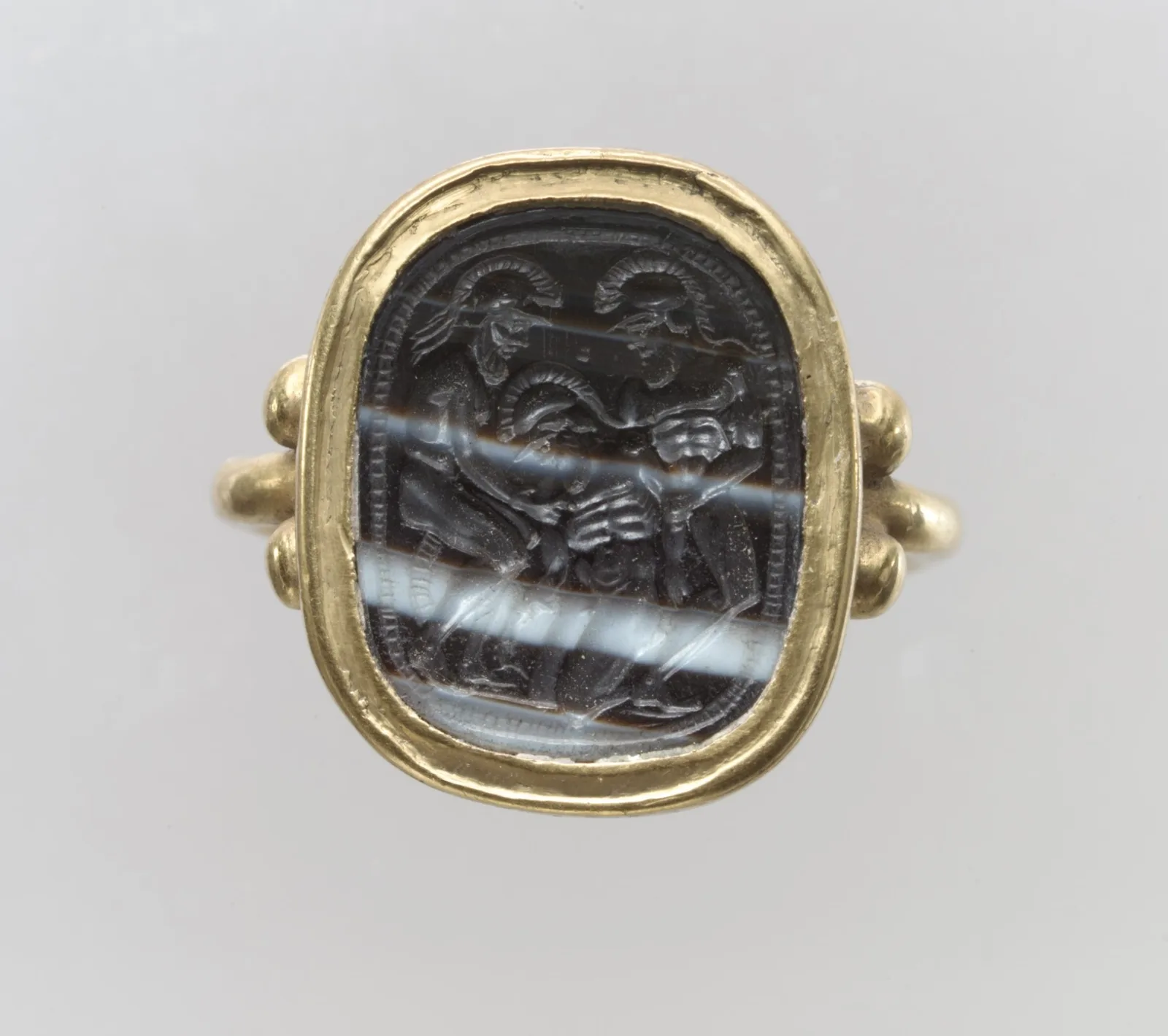
An inherited object differs from a merely old one in that its age is provable, and here the British system is the home example. Hallmarking in Britain has run without a break since 1300, when London silver was ordered to be tested at Goldsmiths' Hall, and the word hallmark means literally a mark from that hall. The date letter in the mark gives the year of assay, so English silver is dated to the year rather than to the era.
The Spanish system is built differently, and works well as a contrast. Marking there is called contraste, and the mark is made up of the assay office stamp, the maker's mark and the fineness as a number. A piece like that is dated not by a letter but by the maker's mark: it is registered with the assay authority, and through it an expert traces the workshop, the town and the period it worked in. A full account of fineness and marks lives in a separate article, and for an inherited object one conclusion is enough: the mark is the single part of a piece that speaks about its age on the record, and it is the first thing to wear away. A full breakdown of fineness and hallmarks lives in a separate article.
The mourning that filled the family boxes
The nineteenth century added the last layer to this structure. After the death of Prince Albert in December 1861 Queen Victoria wore black for forty years, and all of Britain received a detailed etiquette of mourning. The ornament allowed in deep mourning turned out to be jet, and the town of Whitby in Yorkshire, which had worked it since the Iron Age, became a workshop for an entire era.
Mourning pieces were made not for a display window or a season: they were commissioned on a death, worn for years and left to children together with the story of exactly who was being mourned. The hair of the dead was woven under a locket's glass and into bracelet plaits, and it was material, not a keepsake insert. It was precisely the nineteenth-century mourning wave that filled European boxes with the contents now pulled down from the loft and called old money.
Patina: where noble wear ends
The word patina is used loosely in talk about jewellery, taken to mean any dirt and any darkening. The difference between the mark of time and simple neglect is in fact quite specific, and it is visible to the naked eye once you know where to look.
What actually ages in the metal
Silver does not darken from dirt. It reacts with sulphur compounds in the air, in sweat, in rubber, in wool and in egg yolk, and forms a layer of silver sulphide on the surface, the familiar grey-black film. The process runs constantly and cannot be stopped, only slowed by storage in a dry, closed place.
Gold behaves otherwise. It does not oxidise, but it gathers a net of microscopic scratches from cloth, skin and other objects, and the mirror shine turns gradually into a soft glow. This is not damage but a change in the character of the surface: polished gold throws light back sharply, worn gold scatters it. The difference is especially clear when a new piece of the same alloy is set beside it.
Marks that read as a biography
Wear has a recognisable pattern, and it repeats across every piece. A ring wears most on the outer side and underneath, where it rubs against the neighbouring finger. A pendant polishes on the side that lies against the body. A chain clasp thins where it was opened with a fingernail. The inside of a shank goes down more evenly than the outside: there is no relief there, no ridge for the film to cling to, and the metal comes away in a continuous layer.
It is exactly this regularity that separates real wear from fake. An artificially aged piece darkens evenly, or the reverse, most in the visible spots, because it was worked over from the outside and as a whole. On a genuine piece the film stays in the hollows of the pattern and leaves the raised parts, so the relief reads better than it would on a new one.
This is also how a dealer reads a piece, and they look not at the general appearance but at four points. The edges of a watch case: a sharp edge means the case was never polished, a soft one means the opposite. The pin of a brooch and its catch: a tip worn down to a cone speaks of decades of wear on heavy cloth. The inside of a shank against the outside: the difference in the depth of the marks shows whether the ring was taken off at night. And the heel of an earring, the spot where the wire enters the setting, because there the wear comes from fingers, not from cloth.
The line: when a piece is already dead
Noble wear does not touch the structure. The moment the structure is touched, the talk of beautiful marks is over. The signs after which a piece goes to a workshop at once: a stone moving in its setting, a claw bent back or worn to a thread, a shank thinned to the state of wire, a chain link sprung open, an earring wire that will not close, a clasp that opens by itself.
Worth listing separately is what is no longer wear but damage: deep dents on a smooth surface, a crack in enamel, a chip on a stone, a setting deformed by a blow, saw cuts left by a previous careless repair. Such marks do not turn into history with time, they turn into the loss of the piece.
Why polishing to a mirror wipes a piece out
Polishing removes metal. Not dirt but a layer of metal, and it cannot be given back. On a piece with a pattern or engraving, aggressive polishing first flattens the relief: edges smooth over, small details dissolve, the engraving loses its depth. After a few such visits an old piece looks like a modern replica of itself.
Hence a simple rule for handling an inherited object: cleaning yes, polishing rarely and locally. The black film is taken off the raised parts and left in the hollows, and the piece then looks more contrasted than after a full reset.
There is a second cost, remembered too late. The polishing wheel eats the hallmark first: it is shallow and sits on the most accessible flat, on the inside of the shank or the edge of the clasp. A piece with a worn mark stops proving its age and its composition, and that record cannot be restored: a new mark is struck only by the assay office and only in its own name, with today's date.
Customer reviews
Zevira is a real jewellery shop. Genuine payments, deliveries and customer thank-yous.
🥰🥰🥰 gracias

Ok, ¡gracias! 🙂

A culture of repair instead of replacement
Here runs the real border between the style and its imitation. The style lies not in what a person wears but in what they do when a piece breaks. One logic says "I will buy a new one," the other says "I will take it to the workshop," and the second is far older than the first.
Restringing a strand
A pearl or bead necklace is built more honestly than most jewellery: it carries a consumable part right inside it. The silk or cotton thread bends constantly on the edges of the holes and frays from within while still looking whole on the outside. A stretched thread gives itself away by gaps between the beads and by sagging, and from that point to a break is usually not far.
Pearls worn regularly are restrung roughly every year or two, a rarely worn strand can stand on one thread for several years. The job is cheap and quick, and skipping it costs more than all the rest of the repairs put together: a strand scattered across the pavement is rarely gathered back and never fully. A detailed account of thread materials, knots and signs of wear lives in a separate article on restringing.
Wire, post and clasp: the consumables of earrings and chains
In an earring it is not the setting or the stone that breaks but the wire: a thin loop of metal that bends daily in the same spot. It is replaced or extended, leaving the front untouched, and this counts as no interference with the piece. The same goes for a necklace clasp: the spring tires, the tongue wears down, and one day the piece slips off the neck without the owner noticing.
The workshop rule is simple: replace what is bound to wear out, keep what carries the face of the piece. The old clasp is not thrown away but put in the box with the papers. If the piece is ever valued as an antique, the original fittings will matter more than its working condition.
Straightening a setting and tightening claws
A stone is held by thin metal claws, and they wear against clothing exactly like everything else. A jeweller tightens them with a tool and builds up the thinned ones with metal. The work takes minutes, and skipping it costs a stone: a dropped stone is found roughly never.
Checking a setting is taught by a simple method. Hold the piece to your ear and tap the stone lightly with a fingernail: a loose stone answers with a faint rattle. The second method is more reliable but needs a loupe: on a healthy setting the claw lies flat against the stone, on a sick one a gap shows between them. It is easier to tie the check not to the calendar but to an event: before putting a piece away after wearing it, and after any knock against something hard.
Cleaning that does not erase history
Home cleaning of an inherited piece differs from cleaning a new one in its aim: not to bring back shine but to remove what stops the metal breathing. Beyond that begins another territory, and there is no point repeating it here: the order of safe home cleaning, including the folk recipes that work as an abrasive, is set out in a separate guide.
For an old piece one correction is added to the general rules. An ultrasonic bath is not allowed for pearl, coral, turquoise, enamel, and any glued or filled inserts: ultrasound knocks the filler out of cracks, delaminates nacre and lifts enamel in flakes. An inherited object is dangerous precisely because nobody remembers what its inserts are made of, and under a film of tarnish enamel cannot be told from lacquer. If you do not know the composition, keep to water and cloth.
How many times a single piece can be mended
Repair has a limit, set not by the number of visits but by how much of the original metal is left. A ring survives several resizings, but each takes part of the shank, and one day only a full replacement of the lower section remains. A chain endures many solderings until the links themselves thin to a state where the joint holds worse than the metal around it.
The guideline is this: as long as repair adds material or restores geometry, it prolongs the life. The moment repair starts removing material, the clock is running. From then the piece is moved to rare wear, put on for occasions and kept separately, and it quietly lives out to the next owner as a piece for best rather than for every day.
Upload a photo of your pet, someone you love, or an object. We'll build a 3D model and hand-cast it in pewter.




The signet: the logic of the object and the finger
The signet is the one object in this set invented not for beauty. It was a working tool, and its whole present form is the memory of a job it has long stopped doing.
A seal, a monogram and a coat of arms are three different objects
A true seal is a tool for taking an impression, and the design on it is cut in reverse and in depth, because the point of the object is not how it looks on the finger but how the mark comes out in wax. The impression stood in for a signature where literacy was rare. A cameo is built the opposite way: it is raised and gives no impression at all, so it was never a tool, it was carved for the image itself. A monogram is two or three of the owner's letters read straight, and it gives no impression. A coat of arms belongs to a line and is not chosen by taste: it is either inherited or not.
Mixing the three logics is unwise, and cutting a stranger's arms found in a reference book is especially so: to those who understand it, this looks about like a stranger's surname on a calling card. Heraldry, engraving, the ritual of handing over and the seating of the signet on the finger are covered at length in a separate article on the family heirloom. Here a short pointer is enough: the classic place is the little finger of the non-dominant hand, and the size is taken a touch loose, because the face is sometimes turned into the palm.
A signet with no pedigree: what to cut into it
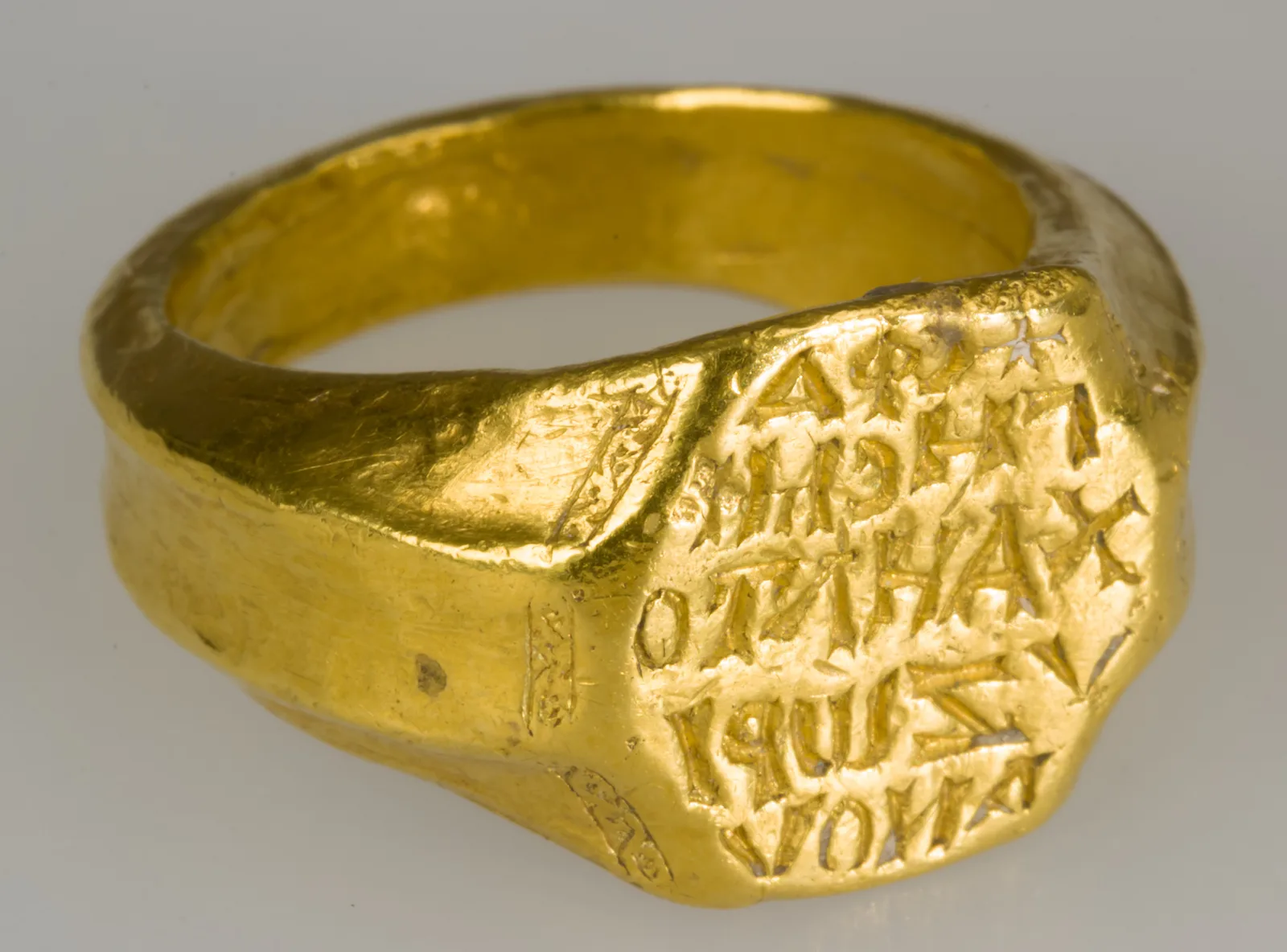
If there is no coat of arms in the family, enough options remain, and all of them are more honest than an invented shield. A monogram of initials set in a row or woven into a single mark. A date that means something to you. A short motto of two or three letters. A sign of a craft or a place the family is tied to. A smooth, blank face left for the next owner to engrave.
The last option is more interesting than the rest, and it is chosen more often than you would think. A blank face means the object was started not for oneself but for the line to grow into, and the first owner deliberately leaves the decision to a descendant. This is exactly the mechanism by which heirloom pieces are started: someone one day buys the first one.
The first question the engraver is asked is the order of letters in a monogram. It is set not by ancient tradition but by the language and habit of a particular family: in different countries initials are put together differently, and the only scheme that always works is your own initials in the order you say them aloud. Everything else will have to be explained to each person who reads it.
The pearl strand that outlives three generations
Pearl stays the great survivor of the box, and it does so despite its reputation as a delicate material. The answer is that what wears out in a necklace is not the pearl at all.
Why the strand serves longer than its owner
Nacre is a layered material, and in hardness it yields to the stones it is worn beside. Yet a pearl has no setting to loosen, no claws to wear down, no clasp to tire. It has a hole and nothing more. There is nothing in the pearl itself to break, so a necklace put together in a great-grandmother's time still exists with the same pearls on a different thread: the consumable here is the thread, not the bead.
The second reason for its long life is everyday. A necklace is worn for occasions rather than daily, and mechanical knocks on it are rare. The chief enemy of a pearl is not time but perfume, hairspray and the acids that dissolve nacre. The rule "put on last, taken off first" solves most of the problem.
The third reason is historical, and it explains why such strands are handed on at all. Before cultured pearl, a necklace was assembled over years: grains were matched one by one for size, shape and shade, and a finished even strand was the result of long sorting, not a single purchase. The value there rests on the assembly, not on the single pearl, which is why a strand is not broken up in a division of estate, unlike a parure with its interchangeable pieces.
What ages faster than the pearl itself
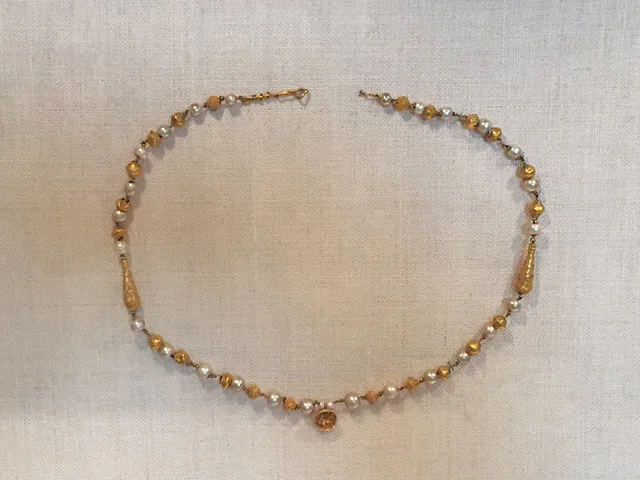
In order of wear: first the thread, then the clasp, then the surface of the pearl itself. The thread darkens and stretches from skin oils, the clasp loosens at its hinge, and the nacre dulls only under wrong storage, usually in an airtight box where it dries out and cracks.
Hence the counter-intuitive point: a pearl needs humidity, and the best storage for it is being worn. A strand that has lain in a safe for years without movement comes out in worse condition than one regularly taken out and put on. The types of pearl, the criteria of quality and the full order of care are covered in a large guide to pearl.
The length re-tied for each generation
An inherited strand rarely arrives the length you would have chosen. And this is exactly the case where change is free: length is no part of the body of the piece. When restringing, the strand is shortened or lengthened by adding pearls of a similar size and shade, and the removed ones are kept in the same box.
The logic of choosing length is simple. A short strand at the base of the neck works under a closed collar and a high neckline, a medium one sits below the collarbone and lives best with an open neckline, a long one is worn in a single loop for evening or doubled for day. One and the same strand can pass through all three states and return to the first, and each such change is made by a jeweller, not a factory.
How to tell that a strand should go to the workshop
There are two signals, and both are visible without tools. The first: gaps between the pearls that were not there before. The second: sound. Pearls on a worn thread start to tap against each other, because the knots between them have rubbed down and stopped holding the distance. A full diagnosis, from the colour of the silk at the knot to a pull test, is set out in the article on restringing, and it is worth a look before the necklace goes rolling across the pavement.
CAPAORA mini knife pendant
The 18th-century Spanish navaja in miniature: 40 mm of stainless steel, a real folding mechanism and a Palanquilla lock that clicks. An affordable gift to remember.
Authentic · Ships from Spain · 14-day returns
A watch as an inherited object
A watch enters this set more often than most things, for a clear reason: it was given for events, it is marked with a date of manufacture, and it has a mechanism that can be serviced. No other piece of jewellery combines these three properties at once.
Why they are thin and without shine
Watches worn with a shirt every day were made flat not from a love of restraint but because of the cuff: the case had to slide under it without effort, or the watch was taken off and stopped being worn. Hence the narrow strap, the plain dial and the minimum of decoration. Anything that sticks out catches on cloth and lives briefly, so decoration on such watches was cut to the minimum and the case made as flat as the mechanism inside allowed.
The matte look arrives by itself. The glass gathers a net of fine scratches, the polished case loses the sharpness of its reflection, the strap darkens from skin. Gradually the watch stops glinting altogether, and it is this muted look that people now try to imitate with artificial ageing, though it is reached by ordinary wear. The historical side of the subject, from the first pocket mechanisms to the wrist, is covered in a separate piece on watches.
A mechanism that can be serviced
The key thing that sets a watch apart from other jewellery is that inside it is a working machine. The oil thickens, parts wear, accuracy drifts, and once every few years the mechanism needs to be taken apart, cleaned and reassembled. A watch serviced on schedule reaches a third generation still running.
With a watch that has stood for years it is the reverse: dried oil glues the assemblies together, and the very first winding drives the wheels along dry pivots. Hence the rule for the owner: if a watch comes to you stopped, do not wind it. The jeweller first, the running second. Forcing the mechanism to move grinds away what cannot be replaced, and the rare original parts for an old calibre are no longer made.
What makes a watch impossible to pass on
Not everything that reaches you will reach the next owner. A watch drops out of the line of inheritance for three reasons, and all three are predictable. First: the mechanism is out of service and parts for it are no longer made. Second: the case was over-polished until its edges were lost, and the piece lost both its look and part of its metal. Third: the dial was redone, the original replaced with a new one because the old looked spotted.
The last is especially galling, because spots on a dial are precisely its age. The collector's rule here matches the rule of family keeping: keep what is original, replace what is consumable, service regularly. The strap is a consumable, the glass is a consumable, the mechanism is serviced, the case and dial are left alone.
The reverse is also true, and it rests on papers. A watch that still has its box, its guarantee, workshop receipts and recorded service dates passes on as a documented object: from those papers a jeweller sees what was changed and when, and does not open the mechanism blind. Where there is no service history, the wrong parts are usually found under the cover, fitted without a record, and establishing the age of the mechanism becomes a job of its own.
Hence a rule of keeping that costs less than any repair: everything that came with the watch lives with the watch. The removed strap, the old glass, a spare bracelet link, a receipt half a century old. The value of those scraps of paper becomes clear at the exact moment the piece passes to the next owner and they ask what in it is original.
Leave your email, we'll send your discount code. No spam, unsubscribe anytime.
The code arrives by email, valid on your first order.
Why there is never a full matching set here
A ready parure, where the earrings echo the pendant and the pendant echoes the ring, is built the opposite way to everything above. It was assembled by one person in one go, and it announces the fact louder than any inscription.
A matching set gives away a single purchase
A matching set announces itself by two things at once: a single date and a single hand. The pieces in it agree in metal, finish and clasps, because they were made together to one plan, and they date to one year. Inherited pieces do not agree with each other, because they were bought decades apart, from different makers and for different occasions, and this disagreement is the signature of time.
Hence a practical conclusion for anyone building a set themselves. Three pieces bought in one day from one seller will read as a set, even if they are formally different. Spreading purchases across time is more useful than matching them by style: the difference in dates is exactly what later reads as history.
The parure: the full matching set was invented at court, not in a shop
The full set has its own history, and it is courtly, not commercial. A parure in eighteenth- and nineteenth-century France meant a set assembled to one plan: a tiara, a necklace, earrings, a brooch, bracelets, sometimes a comb, all in a common case with a fitted nest for each piece. The parure existed for the ceremony, where one was expected to appear in full array, and it was ordered all at once, like a court gown.
What happened next was always the same. Heirs divided the set among themselves, stones were reset into new mounts as fashion changed, the cases emptied. In 1887 the French state sold off the crown jewels, and sets assembled over decades went out piece by piece to different buyers and were reset anew. A whole historical set is therefore a rarity: such things were broken up faster than they were built.
For the inherited box the lesson is simple. If there ever was a set in the family, it reached you as a fragment: one earring, a brooch with no comb, a necklace with no bracelets. A gap in the set is not a loss but the normal trace of how such things have lived over the last two hundred years.
Different metals on one person
The ban on mixing metals was invented for shop-bought sets and does not apply to an inherited one. On one hand a yellow ring from one grandmother lives happily beside a white one from another, because each piece arrived separately and nobody is obliged to justify their pairing. The techniques that make a mix legible are covered in a separate article on mixing metals; an inherited set needs just one of them, and it is not about beauty but about place: pieces must not compete for the same zone of the body.
The one-piece-per-zone rule does not work here
In a minimalist logic each zone gets one piece: one chain, one pair of earrings, one ring. An inherited set is built differently, because pieces arrive by occasion, and occasions accumulate. Two rings on one hand are the norm here, if one is a wedding band and the other came from a mother.
There is still a limit, and it is not aesthetic but physical: pieces must not rub against each other. Two rings on neighbouring fingers grind each other's edges, a chain with a pendant scratches a second chain, a bracelet knocks against a watch glass. What limits combinations here is not taste but wear.
The Spanish corner: jet, coral, filigree and the family cross
The idea of inherited jewellery as diamonds came from English-language sources and barely holds in southern Europe. The role of the object that gets handed down is played here by other materials, and they cost noticeably less while meaning noticeably more.
Jet: the black stone handed to children
Jet, in Spanish azabache, is not a mineral but fossilised wood, a variety of brown coal. It is light, warm to the touch and takes on a charge from friction. In Spain protective amulets were carved from it for centuries, and the chief of them is the fist with the thumb pushed between the fingers, the very charm hung on infants. Spanish jet, known as azabache, is the local name for the material worked along the pilgrim road.
The craft was strictly ordered. The guild of azabacheros in Santiago de Compostela took shape in 1443, and the workshops stood as a separate quarter by the northern portal of the cathedral, in the so-called azabachería. The statutes set a minimum thickness for carved pieces, obliged the master to sign his work and expressly forbade selling pressed coal dust as genuine jet, so the fake turned out to be as old as the trade itself.
In family use a jet amulet works as the first handed-down object: it is put on in infancy, taken off in childhood and placed in the box until the next child is born. The material does not object, but it demands a regime. Jet is organic, not stone, so water, salt, cosmetics and perfume are hostile to it. How fast this works is shown by conservators' practice: one immersion in chlorinated water is enough for the surface to degrade, and one day on a beach is enough for the damage to show. It is also soft and dislikes a knock against something hard or a sharp change of temperature. What exactly happens to the surface, and why a cloth cannot bring it back, is covered below in the section on building a set. The history of the material, the carvers' craft and the link to the pilgrim road are set out in a separate article on azabache.
Coral in the dowry of the south
Red coral shares with jet the role of a child's amulet all along the Mediterranean coast, but it lives longer in another role: in the dowry. Coral beads and earrings entered the set a girl received on marriage, and passed on down the female line together with the chest.
A dowry in Spain was drawn up before a notary. The carta de dote listed everything the bride brought into the house, down to a single strand of beads, and by such inventories one sees that coral stood on the list beside linen and tableware, not among the jewels. That is what kept the object in the house: a piece entered in an inventory was touched last, because a document and another's memory of it stood behind it. Coral survived not thanks to its price but thanks to the record.
For wear, coral is demanding: it is soft, porous and does not tolerate acids, cosmetics or household chemicals. That is exactly why old coral strands usually look faded, and restoring the colour by polishing is pointless, it removes the surface layer. The properties of the material, its shades and questions of origin are gathered in a piece on coral.
Filigree as the local measure of skill
Filigree is lace made of the finest wire, soldered without a single cast part. In the Spanish tradition it has held for centuries, from Galician work to the silver spherical buttons worn in the costume of the central provinces. A piece of this kind is handed down for one reason: it cannot be reproduced quickly, and it costs the master's working time, not the weight of the metal.
For inheritance, filigree has a peculiarity: it is fragile to bending and almost impossible to repair once deformed. Bent openwork straightens badly, so such pieces are kept in a separate box and worn for occasions. The technique, the regions and the way to tell true filigree from a cast imitation are covered in an article on filigree.
The cross that runs down the female line
A family cross in a Spanish house is rarely gold and almost never stones. It is a silver or jet object tied to a specific place: to a local shrine, a monastery, a pilgrim road. Because of that tie the cross is not swapped for a costlier one even when money appears, because to replace it is to lose the address.
The path of such an object was set by the dowry. The cross entered the bride's chest alongside linen and tableware, and along that line it travelled on, from mother to daughter, tied not to a will but to an event: to a christening, a wedding, the birth of a first child. One of the most recognisable Spanish forms, the cross with two crossbars and a reputation as a charm, is covered in an article on the Caravaca cross.
How to build such a set without an inheritance
Here begins the practical part, the reason people usually search for the subject at all. There is no inheritance, no box from a grandmother, and yet a set is wanted. It can be built, but not by the method people usually try.
Buy a piece that will age, not an "antique"
The difference between these two strategies decides everything. The first buys a simple object of a material that changes with time and gives it ten years. The second buys an object already made to look old and gives it nothing. In ten years the first becomes what the second is pretending to be.
Selecting by this criterion is not hard. Solid silver and gold without plating, natural nacre, plain leather, uncoated steel all age well. Gilding over a base alloy, electroplating of any colour, glued inserts, enamel on a thin base all age badly. The first group gathers character, the second simply wears out and at some point looks shabby.
Jet does not fall into the first group, though it looks eternal. Its surface gathers nothing, it loses: regular contact with water takes the depth out of the shine, and sea salt and chlorine strip the top layer. Only a jeweller can bring the look back, and only by re-polishing, that is, by removing another layer of material. Such a piece is not worn out but guarded, and in an inherited set it lives by a different rule from silver: silver darkens and gains by it, jet dulls and loses by it.
Why imitated age reads worse than a plain new piece
Artificial ageing works from the outside and all over, while real wear goes point by point and by contact. Hence a difference visible even without experience: an aged piece has no asymmetry. Living wear is always one-sided, because a person is one-sided. A ring wears on the side where the neighbouring finger is, a pendant polishes on the side lying against the body, a bracelet behaves differently on the left arm and the right. A piece tumbled in a barrel of abrasive is worn evenly on all sides, because it was processed, not worn.
So the new and honest always beats the new pretending to be old. A smooth silver ring with no decoration says nothing extra about itself and starts gathering age from the first day. A ring covered in artificial blackening and deliberate dents says exactly one thing: it was made this way last week.
Where to start: three pieces
The starter set is built from three objects, and the logic is functional, not decorative. First: a piece for daily wear you will not take off, usually a ring or a chain. Second: a piece for occasions, larger and more visible, worn a few times a year and therefore not worn out. Third: a piece with an address, that is, tied to a place, a family or an event, whether a cross, a monogram or a date.
After that the set grows by itself, on the same occasions it grew on for everyone else. The only thing that matters is not to buy everything in one month: three pieces acquired years apart begin to differ from each other in condition, and it is exactly that difference that later reads as depth. The process cannot be hurried, but it can be started earlier.
Mistakes that make a set look bought yesterday
Gathered together, these slips are recognised instantly. Everything of one tone and one thickness. Every piece in equally perfect condition, not a single scratch on any of them. Fashionable shapes that date to the exact season. Engraving done in a machine font in a fake-old style. A set from one collection. Clasps and fastenings matching in style across every piece at once.
What these signs have in common is one thing: they speak of a single date. This is cured not by replacing pieces but by time and a variety of sources: one piece ordered from a jeweller, another bought on a trip, a third handed down from a family friend. Different paths of arrival give different wear, and different wear is exactly what a purchase cannot fake.
How long it takes
The honest answer: longer than you would like, and the calendar has nothing to do with it. The pace is set by wear, not by the length of ownership. Silver on a finger changes faster than the same silver in a box; uncoated gold loses its mirror more slowly than silver darkens; a watch glass gathers its net of scratches at exactly the rate the owner catches it on door handles. A piece taken off at night and worn for occasions ages many times more slowly than one never taken off at all.
You can tell a set has stopped looking bought not by the length of time but by a sign: the pieces in it diverge in condition. One ring has darkened in its engraving, another has worn on the edge, a third is still new. As long as every piece looks the same, the set reads as one purchase, whatever year it happened in.
But time works the other way too. A person who started at twenty-five holds, by forty, pieces with fifteen years of wear behind them and the first occasion to hand something on. Heirloom pieces are started exactly like this: someone one day buys the first and begins to wear it.
Send a friend a discount code, they save on their first order.
Why the style became a mass search
Interest in the subject grew fast and almost without the jewellery trade's help, which is curious in itself. Usually supply starts a fashion in jewellery; here it happened the other way round.
A demand for an object with a past
Demand for things with a history rises where everything else has become replaceable. Clothes are renewed before they wear out, electronics are changed by the support cycle, furniture at a move, and jewellery remains a rare category of object able to outlive its owner. An inherited piece answers this directly: it has already proved it lasts, by the very fact of its existence.
The observation is not new. As far back as 1899 Thorstein Veblen, in "The Theory of the Leisure Class," described conspicuous consumption: an object is acquired not for use but for what it says about its owner. From there the mechanism runs itself: once a sign becomes buyable, it stops distinguishing, and what begins to distinguish is what cannot be bought, that is, the age of the object and the path by which it reached a person.
The second motive is calmer. A person with no roots in a particular place looks for them in objects, and a piece with a date and a name works as an anchor. This explains why the search grew precisely among a generation that moves a great deal: a suitcase holds little, and what goes into it gains weight.
What in this style reproduces and what does not
Almost everything reproduces, except one thing. You can buy simple pieces of good materials, wear them for years, mend instead of replacing, not polish to a mirror and spread purchases across time. The result is exactly the set in question, only with your own history instead of a stranger's.
What does not reproduce is the tie to particular people. A ring your mother wore differs from an identical ring bought yesterday by exactly this and nothing else. That is why buying other families' pieces at a market gives an object but not the effect: a stranger's history reads as stage dressing, while your own begins only on the first day of wear.
Where the copy breaks
A copy of the style gives itself away at two points. First: too much jewellery at once. An inherited set is always incomplete, and a person who puts on everything they own at once announces that they bought it all at once. Second: the absence of any repair marks. Not one replaced clasp, not one tightened claw, not one re-cut engraving, while the pieces are supposedly half a century old.
Hence a simple test of your own set's honesty. Look at whether it holds a single piece you have worn enough to take to a workshop. If not, the set is still new, and that is fine: every archive has a first day.
Pieces that begin a history
Uncoated silver, crosses, monograms, blank faces for engraving. The kind you mend and hand on, not swap for new.
Facts that surprise
- Sheffield plate, invented in the 1740s by Thomas Boulsover, gives itself away precisely by age: on worn edges a reddish copper base shows through. It is by this line on the edges that an old plated piece is told from solid silver.
- The word patina came from Italian and described the film on old bronze. It was carried over to silver by outward likeness, though the chemistry differs: on bronze it is copper oxides and carbonates, on silver it is sulphide.
- A heavy faceted stone is not strung on thread at all: it is set on a steel cable in a nylon sheath, because the sharp edges of the drill-hole saw through silk in a season.
- Red coral gets its colour from organic pigments, and they fade in light. A strand left for years by a window drifts from red to a pinkish tone, and there is nothing left to bring the shade back.
- Mourning etiquette prescribed both the colour of the dress and the ornament allowed by stage: in deep mourning only black, unshining materials were permitted, and in half-mourning grey and lilac were added to the black.
- The date letter in the British hallmark was compulsory until 1999, then became voluntary. So antique English silver is dated to the year, while modern silver may not be dated at all.
- Engraving inside a shank dies not from time but from resizing: the seam runs along the lower part of the ring, exactly where the date usually sits.
- The knot between pearls is not there for looks: it keeps the beads from rubbing together and holds the whole strand from scattering if it breaks.
Frequently asked questions about old money jewellery
What is old money style in jewellery?
It is a set of pieces formed through inheritance and long wear rather than through purchase. The logic is old: in Rome a gold ring was granted for rank, English and Spanish laws of the sixteenth and seventeenth centuries assigned jewellery by station, and an object out of reach of money could only be received. Today the law stops nobody from buying anything, so there is nothing left to distinguish by except the age of a piece and the marks of its service.
How does old money differ from quiet luxury?
By the point of entry. Quiet luxury starts with a purchase and answers the question of what to take today so it does not read as a price tag; its principles and materials are covered in a separate guide. Old money starts with a box you already have and answers what to do with it. The first is solved with money in an evening, the second is not solved with money at all.
Can you build such a set if nothing was ever handed down in the family?
Yes, and this is the most common case. The selection then goes not by style but by reparability: solid metal, standard fittings, joints on solder and on thread rather than on glue. A piece a jeweller has no way to mend drops out of the mechanism entirely, because the whole style rests on repair, not on purchase. A glued insert, a hollow link and plating instead of metal mean exactly this: the first defect ends not at a workshop but in a drawer.
How do you find out how old an inherited piece is?
By the hallmark, not by looks. British silver carries a date letter and reads to the year. In the Spanish contraste system the mark is made up of the assay office stamp, the maker's mark and the fineness as a number, and the route to a date runs through the maker's mark registered with the assay authority. A full account of the systems lives in the article on fineness and marks. If the mark is polished away, indirect signs remain: the type of clasp, the method of soldering, the shape of the wire, traces of handwork under a loupe.
Do you need to polish an inherited ring to a shine?
No, and this decision should be not so much taken as spoken aloud at the workshop. The order is put by the joint: tighten the claw, change the wire, adjust the size, and as a separate line you specify that no finishing is needed, neither wheel nor chemical bath. While you are at it, ask them to photograph the hallmark and engraving before the work starts: if something changes afterwards, it will show at once rather than ten years later at a valuer.
Is it worth buying jewellery at flea markets and in antique shops?
As an object yes, as a history no. A stranger's family engraving does not become yours and often reads as stage dressing. It is wiser to choose pieces there with no personal marks: smooth rings, plain chains, solid settings. Before buying, look over the claws, the shank and the clasp, and check for traces of old re-soldering on the lower part of a ring: it means the size has already been changed and less spare metal is left.
How often should a pearl strand be restrung?
The term is set by the thread material, not the calendar. Silk is softer, drapes more beautifully and holds a tight knot, but it stretches and fears water, so it lasts the least. Nylon is stronger and calmer about moisture, but the knot sits worse on it. Elastic thread will not do for pearl at all: it loses its spring from cream and perfume and breaks without warning. What suits particular beads is covered in the article on restringing.
Can you rework a grandmother's piece to suit yourself?
You can, and the talk with the jeweller here weighs more than the reworking itself. Bring the piece whole, together with its box and papers if they survive, and ask them to photograph the hallmark and engraving before the work starts. Everything the jeweller removes along the way, take with you: the old wire, the removed stone, the metal offcuts. And ask straight out what will become impossible after this operation. The jeweller always has an answer, it is just rarely asked for.
Buying it as a gift? Each one arrives ready to give.
 A branded Zevira box and a little card come with every order.












What remains when the fashion passes
Interest in this style will one day fade, as any search fades. What remains is the mechanism older than the fashion for it: an object is bought rarely, worn long, mended instead of replaced, and one day handed on. It worked when it had no name, and it will go on working when the name is forgotten.
The only thing this mechanism asks of a beginner is to start. Not with a hunt for a stranger's old things, but with one plain object of a material that changes with time. In ten years the very marks people search other families' boxes for today will appear on it, and they will be your marks, not stage dressing.
About Zevira
Zevira works in Albacete, where metalwork is part of the region's history. We make pieces meant for long wear and for repair: solid silver without plating, crosses and monograms, plain shapes with no seasonal signs. Engraving is possible on most of the range, including the blank faces left for a future date.
About the age of things we speak plainly: silver will darken, gold will lose its mirror shine, leather will change colour. That is the very mark of time people search other families' boxes for today.