Question Mark Pendant: The Most Philosophical Piece of Jewellery You Can Wear
Introduction
A professor I once knew wore the same necklace every single day for eleven years. Not a cross. Not a heart. Not a gemstone. A tiny silver question mark, dangling just below the collar of whatever shirt he happened to grab that morning.
Students would ask about it. He'd just smile and say, "It reminds me to stay confused." That always got a laugh. But he meant it. In a world that rewards certainty and punishes doubt, he chose to wear the symbol of not-knowing around his neck every day.
That story stuck with me, and it turns out he's far from alone. Question mark pendants have quietly become one of the most meaningful pieces of symbolic jewellery you can own. Not because they're trendy (though they are having a moment). But because no other symbol quite captures that mix of intellectual humility, rebellion against easy answers, and genuine curiosity about what the hell is going on.
This is the story of the question mark: where it came from, what it means, why philosophers loved it, and why wearing one around your neck might be the most honest statement you can make.
Wear the symbol, don't just read about it. These are in stock:

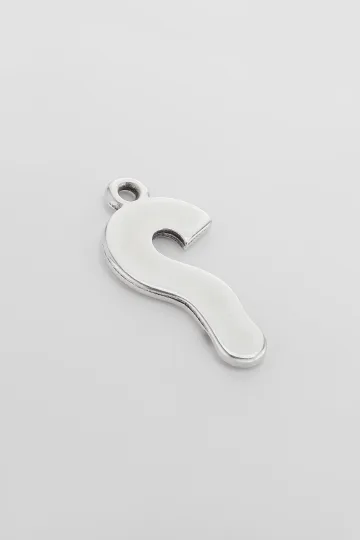
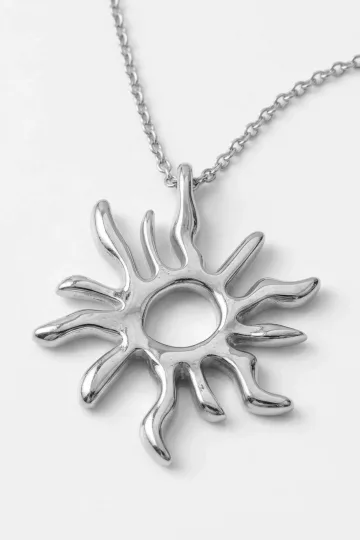
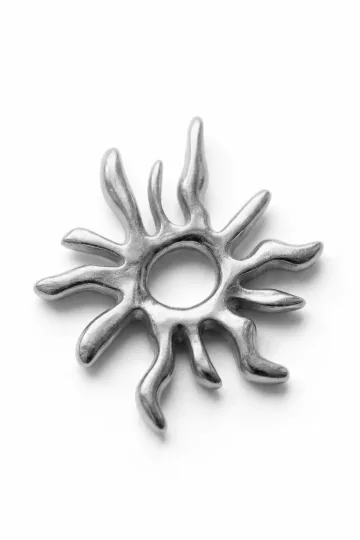
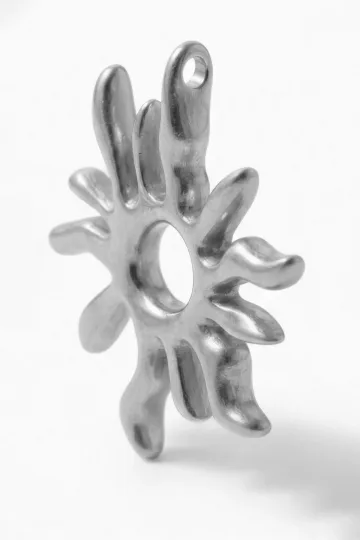
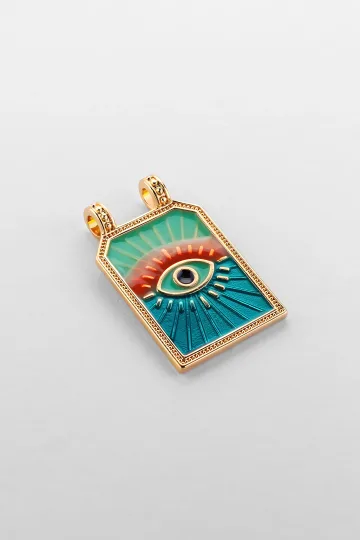



Where Did the Question Mark Come From
The question mark has a surprisingly murky origin story. Which feels appropriate, honestly. Even the symbol itself doesn't have a clear answer.
The most widely accepted theory traces it back to the Latin word "quaestio," meaning question. Medieval scholars would write "qo" at the end of sentences to indicate a question, the "q" above the "o." Over centuries of hurried handwriting, the q morphed into a curved stroke and the o shrank into a dot. And just like that, you have the ? we know today.
But there's a competing theory. Some historians believe the question mark derives from a musical notation used by medieval monks. When chanting liturgical texts, they needed a way to mark where the voice should rise at the end of a phrase, the way your voice naturally goes up when you ask something. The symbol they used looked remarkably like a modern question mark.
A third theory points to Alcuin of York, an English scholar who served as Charlemagne's chief advisor in the 8th century. Alcuin is sometimes credited with developing a system of punctuation that included the "punctus interrogativus," literally the questioning point. His version looked a bit like a lightning bolt with a dot beneath it.
Whatever the true origin, the question mark began appearing regularly in European manuscripts by the 9th century. Early printers standardised it during the 15th and 16th centuries, and by the time the printing press spread across Europe, the ? was a fixed part of every Western language's punctuation toolkit.
Here's what's interesting though. Not every culture uses the same symbol. In Greek, a semicolon (;) serves as a question mark. Arabic uses a mirrored version of the question mark that faces left. Armenian has its own unique mark that sits above the last vowel of the interrogative word. Spanish, of course, uses the inverted question mark at the beginning of a question, that distinctive upside-down ? you see at the start of a sentence.
The question mark is also one of the few punctuation marks that genuinely changes how you read a sentence. Consider the difference between "You're leaving" and "You're leaving?" Same words, completely different meaning. That tiny curved line with a dot underneath it shifts everything.
For centuries, the question mark lived exclusively on paper. But in the 20th century, it started to escape. Designers noticed that the ? has an almost organic, elegant shape, that beautiful S-curve sitting on top of a single point. It translates naturally into jewellery, sculpture, and graphic design. The question mark isn't just a punctuation mark anymore. It's a visual symbol with its own aesthetic power.
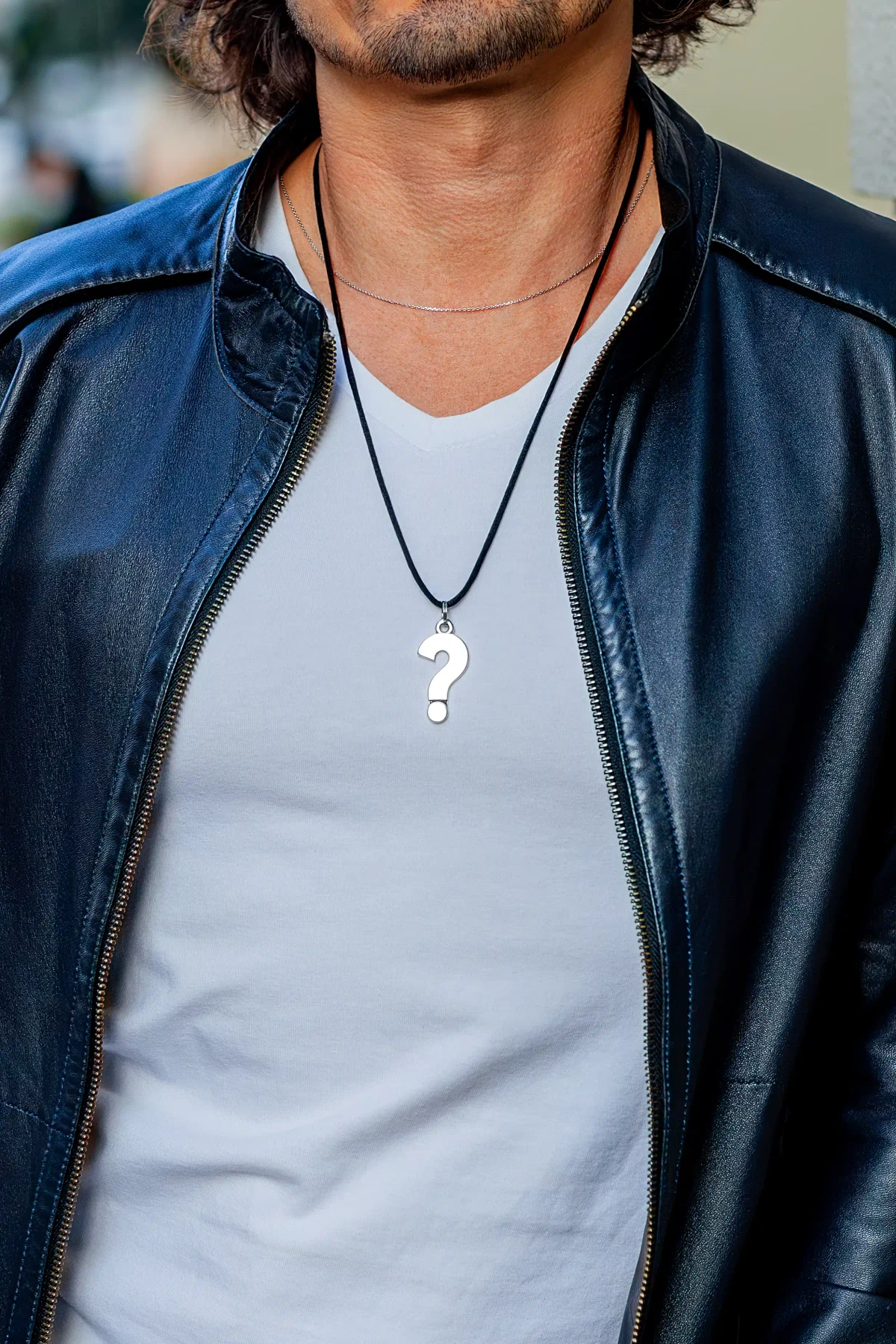
A question mark rides on a bare collarbone, collar open. Never choke it under a tie: knots are where questions go to die.
How to wear a question mark pendant
Over years on shoots and in fitting rooms the question mark has passed through dozens of looks with me. Here is what actually works, sorted by occasion.
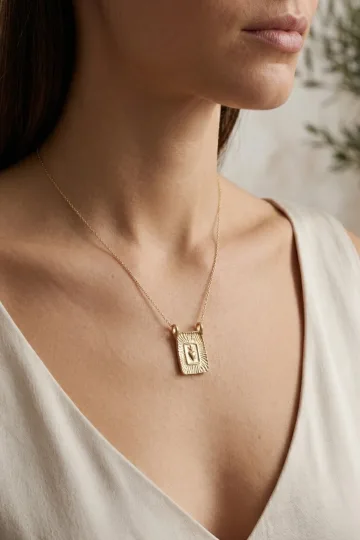
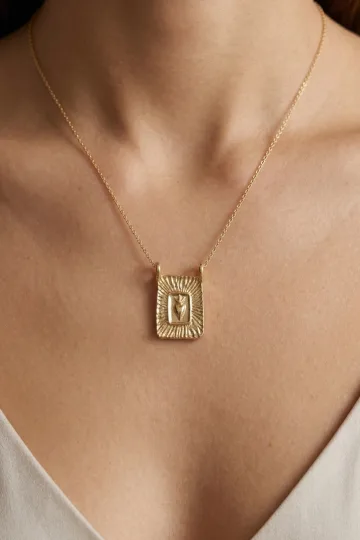
What do I wear a question mark with every day? For daily wear I recommend a thin 45-55 cm chain and a medium pendant over a plain base: a white tee, a grey knit, a shirt with an open collar. The calmer the fabric and the more neutral the colour, the more clearly the curve reads. Under a V-neck it lands right in the centre, its strongest position; under a round neck I choose a shorter chain so the pendant rests on the fabric instead of hiding.
Is it right for the office? Yes, as long as you keep it restrained. I recommend silver or matte gold, 45-50 cm, so the mark sits just under the top button of a shirt. Under a jacket it reads as a quiet detail, not a loud accent. A strict dress code is no verdict here: the question mark lives happily under clothing and starts conversations by the coffee machine.
How do I build an evening look? For evening I choose an open neckline and a smooth fabric in a deep colour: wine, emerald, black. A gold mark on a longer chain falling to mid-chest catches warm light and holds one precise accent. A clean backdrop, one symbol, nothing extra.
Silver or gold, which do I pick? I look at the skin undertone. For a cool undertone I suggest silver and white gold: they get along with blue, grey and black. A warm undertone takes yellow gold, which comes alive on beige, olive and warm brown. If you want to wear it with a stack of pendants, keep them in one palette or deliberately mix metals: the question mark is not a symbol that demands strict rules.
Who does it suit, and how do I layer it? It suits almost everyone, but especially those who like details with subtext and cannot stand empty jewellery. For a solo look I take a 45-55 cm chain and give the pendant quiet around it. For layers I add an eye pendant, a star or a moon and play with different lengths so the symbols do not tangle. One accent by day, a little more freedom at night. If you want a full symbolic combination, the question mark becomes its leading question.
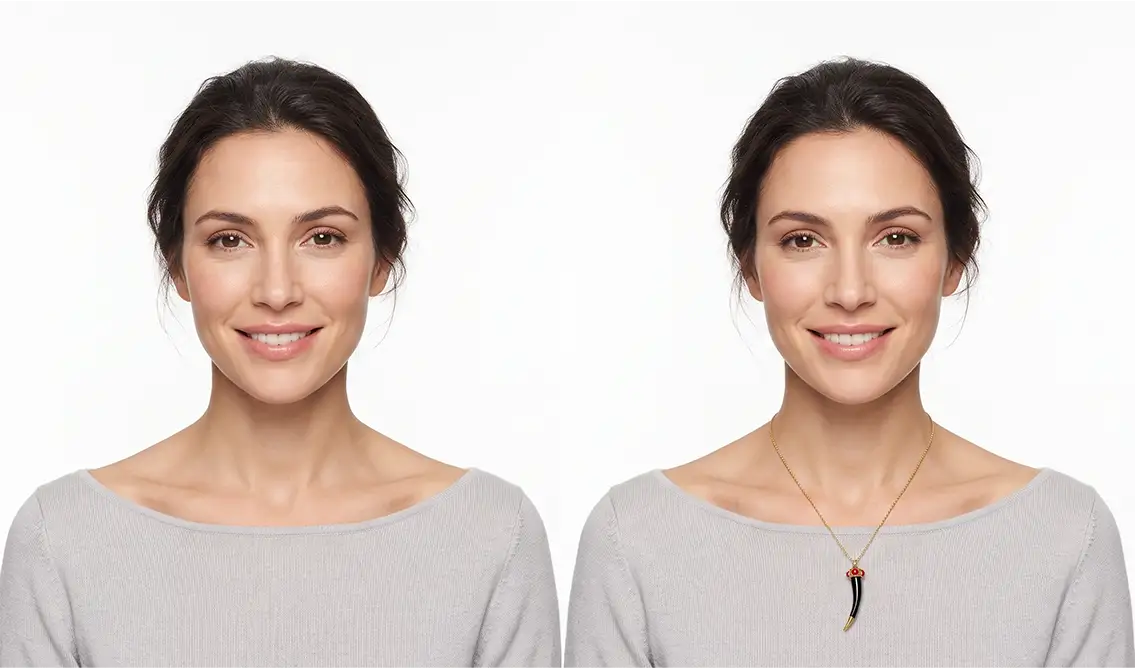
Turn on your camera, pick earrings, a pendant or a ring, and see the piece on yourself in real time.
Switch items in one tap.
Everything runs in your browser: no photo or video is ever uploaded.
The Philosophy of Questioning
If the question mark has a spiritual home, it's philosophy. The entire discipline runs on questions. And some of history's greatest thinkers built their entire worldview around the act of asking rather than answering.
Socrates and the Art of Not Knowing
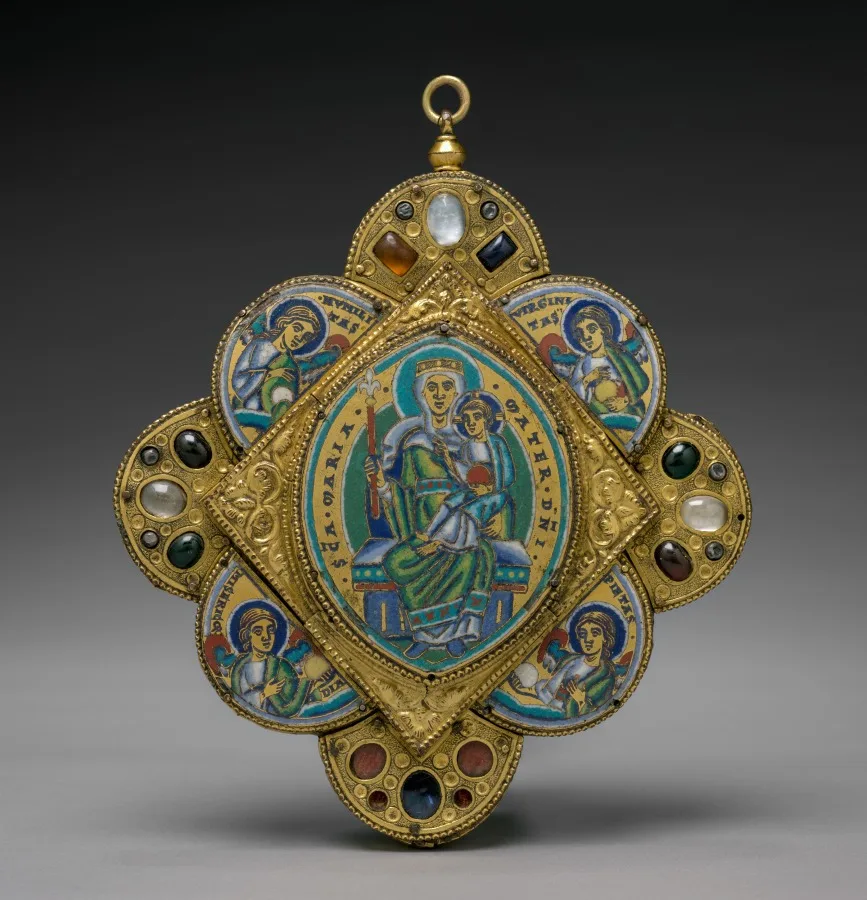
You can't talk about questions without starting here. Socrates, the barefoot Athenian who wandered through markets asking people uncomfortable questions until they wanted to strangle him, essentially invented the idea that wisdom comes from admitting ignorance.
His famous line, "I know that I know nothing," isn't false modesty. It's a method. The Socratic method works by asking question after question, peeling back assumptions like layers, until the person you're talking to realises they don't actually know what they thought they knew. It's annoying. It's brilliant. And 2,400 years later, every decent teacher still uses some version of it.
Socrates never wrote anything down. We know his ideas through Plato's dialogues, which are literally structured as conversations full of questions. The entire foundation of Western philosophy is built on the format of one person asking another, "But what do you actually mean by that?"
Wearing a question mark is, in a very real sense, wearing the Socratic tradition on your chest. It's a commitment to staying curious, to not settling for the first answer, to being the kind of person who digs deeper when everyone else has already moved on.
Existentialism: The Question as Identity
Fast-forward about 2,300 years to Paris in the 1940s. Jean-Paul Sartre, Albert Camus, and Simone de Beauvoir are sitting in cafes, chain-smoking, and wrestling with the biggest question of all: does life have any inherent meaning?
Their answer (maybe not, and that's actually the point) gave birth to existentialism. For the existentialists, the question isn't a step on the way to an answer. The question IS the thing. Human existence is fundamentally a question mark. We're thrown into the world without a manual, without a clear purpose, and the entire project of being alive is figuring out what to do with that radical uncertainty.
Camus put it memorably: "The only serious philosophical question is whether life is worth living." Not exactly light reading. But the core idea is liberating when you sit with it. If there's no pre-written script, then you get to write your own. The question mark becomes not a sign of confusion but a sign of freedom.
Simone de Beauvoir extended this to identity itself. "One is not born, but rather becomes, a woman," she wrote. Identity isn't fixed. It's a question you keep answering, revising, questioning again. The person you are at 20 is a question the person you are at 40 will answer differently.
Eastern Traditions: Zen and the Beginner's Mind
The love of questions isn't a Western monopoly. In Zen Buddhism, the concept of "shoshin" (beginner's mind) is the practice of approaching every experience as if for the first time. No assumptions. No expertise. Just pure, open curiosity.
Zen koans are the ultimate question marks. These are paradoxical riddles designed to short-circuit rational thinking. "What is the sound of one hand clapping?" "What was your face before your parents were born?" There's no logical answer. That's the point. The koan forces you to sit with the question itself, to let go of the need for resolution.
In Hinduism, the tradition of "neti neti" (not this, not this) approaches the divine through negation, through questions about what ultimate reality is NOT, rather than trying to pin down what it is. The question becomes a path to understanding.
The Sufi tradition in Islam has a similar thread. Rumi, the 13th-century poet, wrote entire volumes about the beauty of not knowing, about the spiritual power of staying in the question. "Sell your cleverness and buy bewilderment," he advised.
Across cultures and millennia, the pattern is the same: the wisest people tend to be the ones who are most comfortable with uncertainty. The question mark, as a symbol, captures that idea perfectly.
Upload a photo of your pet, someone you love, or an object. We'll build a 3D model and hand-cast it in pewter.


The Question Mark in Art, Fashion, and Pop Culture
The question mark jumped from manuscripts to culture a long time ago, and it keeps showing up in unexpected places.
In visual art, the ? became a motif during the Surrealist movement. Rene Magritte played with questions constantly. His paintings ask "What is this? Is it what you think it is?" without ever giving a straight answer. Salvador Dali used question-mark-like curves in his melting clocks and distorted figures. The Surrealists understood that art's job isn't to answer questions but to make you ask better ones.
Pop art picked up the baton. Andy Warhol was essentially a walking question mark. Is this art? Is this soup? Is there a difference? His entire career was built on questioning boundaries between high and low culture, between art and commerce.
In fashion, the question mark emerged as a design element in the punk movement of the 1970s. Punk was all about questioning authority, rejecting norms, refusing to accept the status quo. The ? showed up on band posters, zines, and patches. It was a natural fit for a movement whose core message was "why should we?"
The Riddler from Batman comics (first appearance: 1948) made the question mark his entire identity. His green suit covered in question marks became one of the most recognisable villain costumes in comic book history. The character took the question mark from intellectual symbol to pop culture icon.
In music, the question mark has been a recurring lyrical and visual theme. The band ? and the Mysterians (yes, that's their actual name) had a number-one hit in 1966 with "96 Tears." The question mark in their name wasn't just punctuation. It was their brand, their mystique, their statement that they couldn't be easily categorised.
More recently, the ? has become a staple in streetwear and jewellery. Designers have noticed what that medieval scribe noticed centuries ago: the question mark is a beautiful shape. That graceful curve, the decisive dot, the balance of uncertainty and precision. It translates into pendant forms, ring designs, and earring shapes with an elegance that most letters and symbols can't match.
In the age of social media, the question mark has taken on additional meaning. In a world where everyone seems to have strong opinions about everything, wearing a ? is almost countercultural. It says "I'm not sure" in a world that demands certainty. It says "tell me more" in a world of hot takes.
Customer reviews
Zevira is a real jewellery shop. Genuine payments, deliveries and customer thank-yous.
🥰🥰🥰 gracias
Ok, ¡gracias! 🙂
What a Question Mark Tattoo Means
The question mark is one of the most common minimalist tattoo motifs, and thousands of people search for what it stands for. The meaning is almost always personal rather than dictionary-defined. A small ? on the wrist, behind the ear, or on a finger usually says one of three things: the wearer is standing at a fork in the road and honestly admits they don't have the answer; they have made curiosity their backbone and refuse to pretend they have it all figured out; or it marks a specific stretch of doubt they came through alive.
A question mark on skin carries a heavier layer too. In some prison and military traditions the symbol was inked as a mark of undefined status or quiet disagreement with a verdict handed down by circumstance, the sign of someone who refuses to put a full stop where others place one for them. That is part of the wary reaction it still draws from older generations. Younger wearers rarely read that shadow and take the mark for its clean meaning: curiosity, searching, an open ending.
A question mark pendant does the same work as the tattoo, but it stays honest about the future. A tattoo is an answer frozen in skin forever, a question that can no longer be asked again. A pendant can be taken off, passed on, moved to a new chain, tucked under a collar one day and worn openly the next. A symbol of doubt that stays open itself sits closer to the point than an indelible line. For anyone testing the idea of a tattoo but not ready for the permanence, a pendant often turns out sharper and softer at once.



The Question Mark in the Digital Age
Over the past few decades the question mark has found a new life it never had in all its centuries on paper. It became one of the first buttons a person taps in the morning: a search bar is essentially a machine for turning questions into answers, and every query starts with an invisible ?. The question mark icon sits on help buttons, on tooltips, on anything that says "not sure, ask here." The symbol quietly became the face of the act of reaching for knowledge itself.
In messaging the ? picked up tone. A single mark at the end of a flat message reads like a raised eyebrow. Three in a row, "???", is no longer a question but an emotion, a mix of surprise and a demand to explain. The emoji with two question marks, one red and one grey, lives its own life in memes about confusion. The question mark learned to carry both the meaning of a sentence and the state of the person behind it.
There is a flip side that has turned the question mark pendant into something close to a gesture of resistance. Social feeds reward certainty: a sharp opinion gathers more attention than an honest "I don't know." Against that backdrop, someone wearing a symbol of doubt around their neck makes a quiet but visible statement. They signal a willingness to stay in the question where a loud answer is expected. In an age overfed with opinions, that looks almost like a luxury.
Why Curiosity Is the Most Powerful Human Trait
Let's talk about why the thing the question mark represents, curiosity, is genuinely one of the most important characteristics a person can have.
Psychologists have been studying curiosity seriously since the 1950s, and the findings are remarkably consistent. Curious people are, on average, happier. They have stronger relationships. They perform better at work. They live longer.
Research on the brain suggests that curiosity is linked to dopamine activity in a way similar to anticipating a reward. In other words, your brain literally rewards you for wanting to know things. The pleasure doesn't come from getting the answer. It comes from the wanting itself.
Some researchers argue that curiosity can matter as much as raw intelligence for academic performance. Read that again. Being curious may matter as much as being smart. The students who asked the most questions, who wanted to understand "why" rather than just memorizing "what," consistently outperformed their peers with higher IQ scores.
In professional settings, curiosity has been linked to innovation, better leadership, and reduced group conflict. Research suggests that teams led by curious leaders tend to generate more creative solutions. Why? Because curious leaders ask questions instead of giving orders. They create environments where people feel safe to say "I don't know" and "what if?"
Curiosity also seems to keep the mind active. Many people find that staying intellectually curious throughout life helps them feel mentally sharp and engaged. The brain, it turns out, tends to respond to being used, and few things exercise it like genuine questioning.
But here's what really makes curiosity special: it's connective. When you ask someone a sincere question about their life, their work, their opinion, it builds a bridge. Curiosity is the opposite of judgment. You can't genuinely ask "why do you think that?" and be dismissive at the same time. The question requires openness.
In romantic relationships, research by psychologist Todd Kashdan found that the single biggest predictor of a successful first date wasn't attractiveness, income, or shared interests. It was curiosity. The people who asked genuine questions and listened to the answers were rated as dramatically more attractive by their dates.
So when you wear a question mark pendant, you're not just wearing a symbol. You're wearing the representation of arguably the best thing about being human. The urge to look at the universe and say, "Okay, but what's actually going on here?"
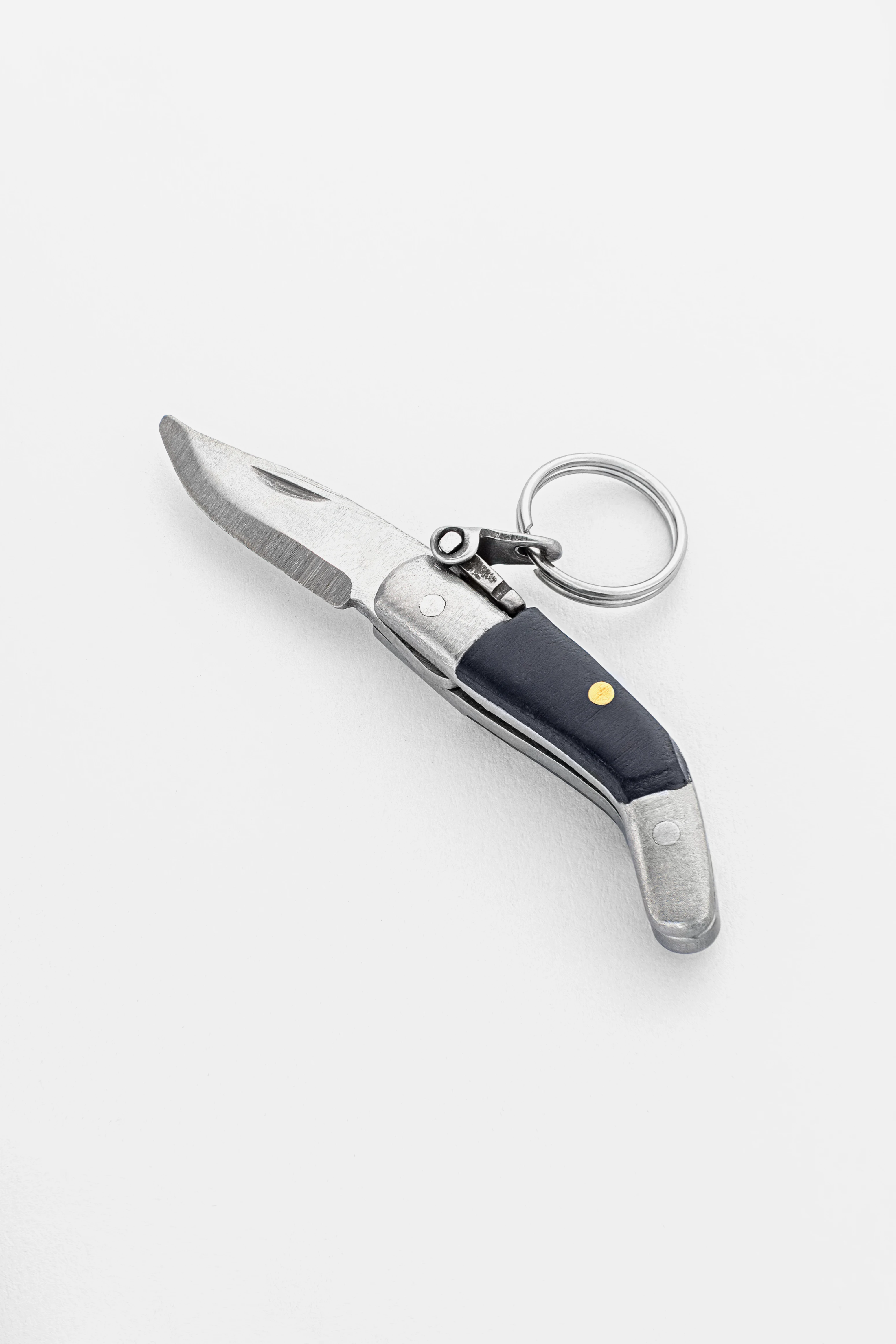
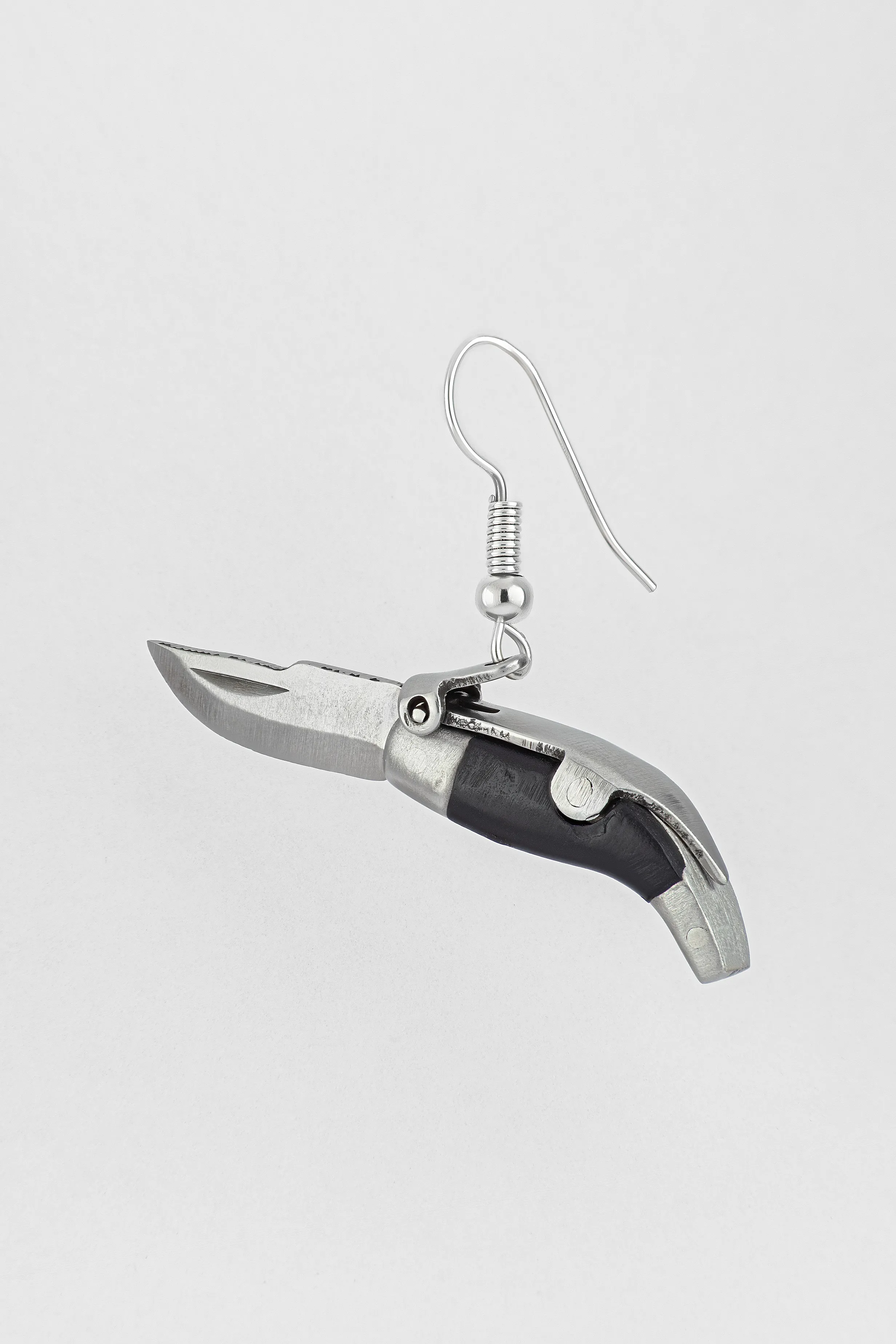
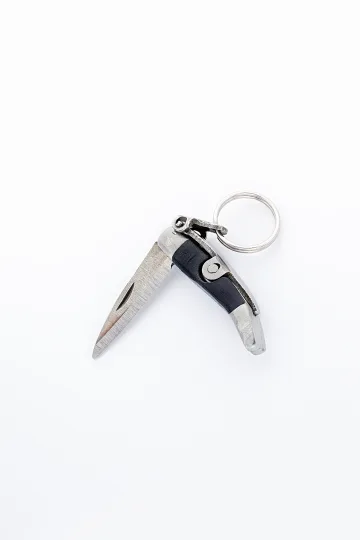
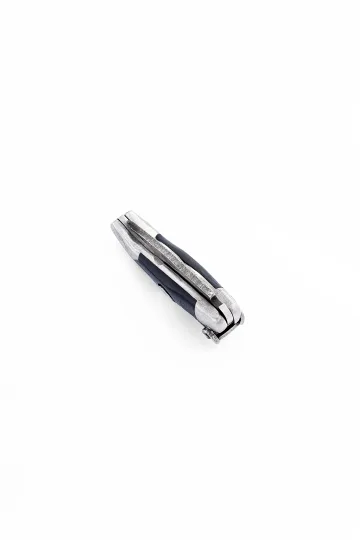
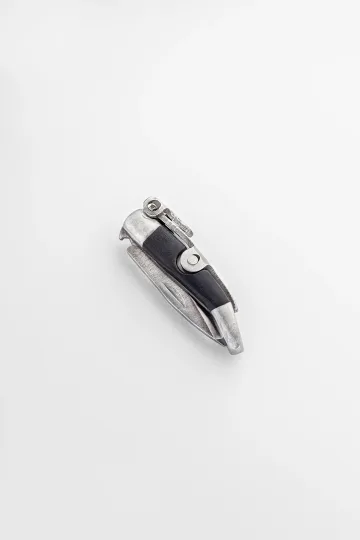
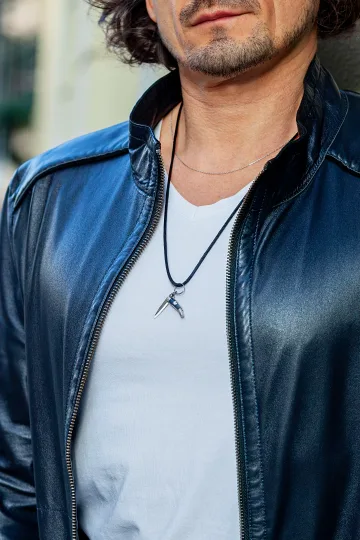
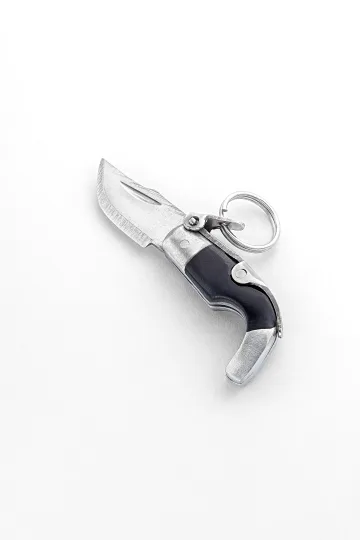
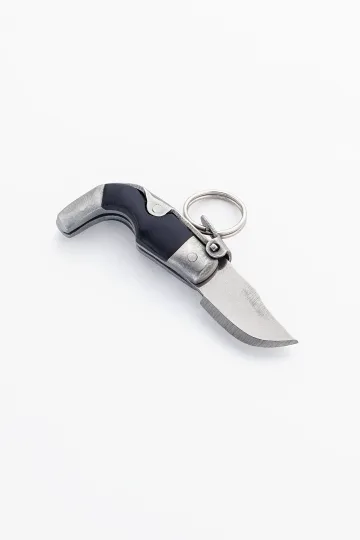
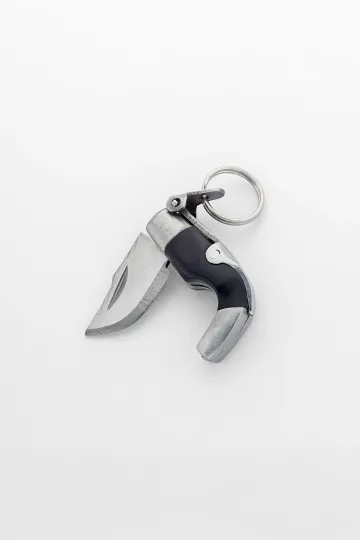
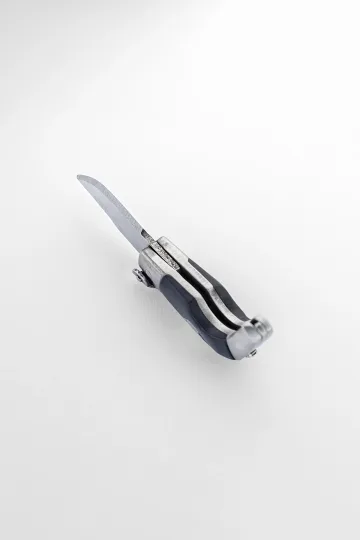
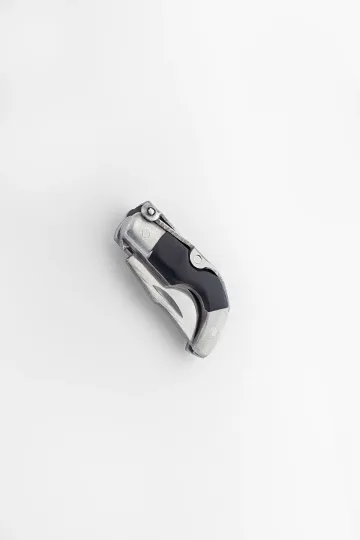
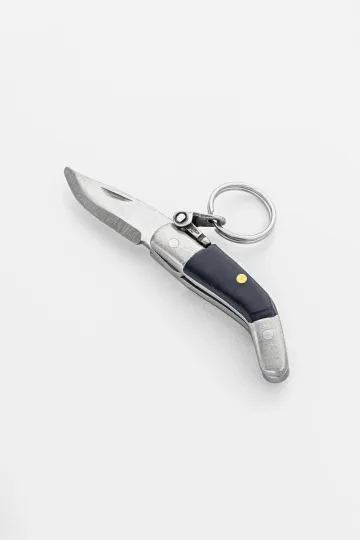
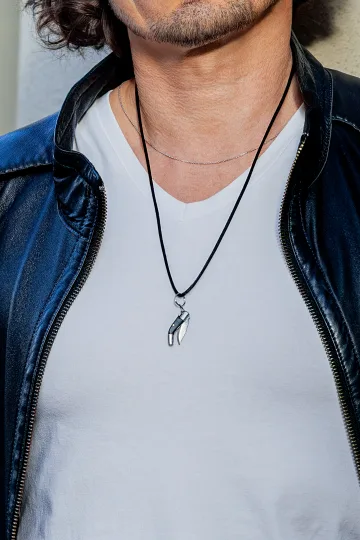
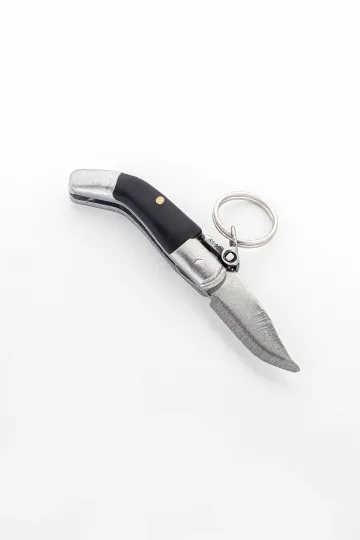
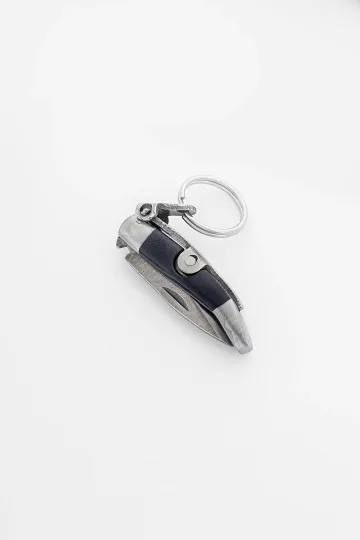
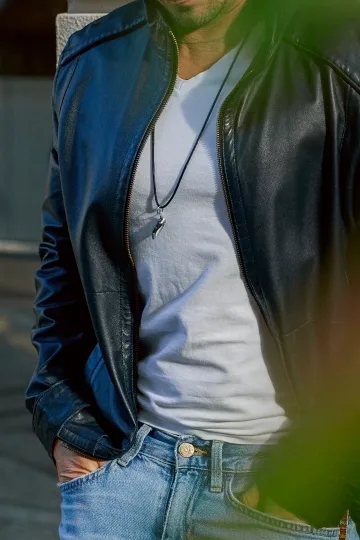
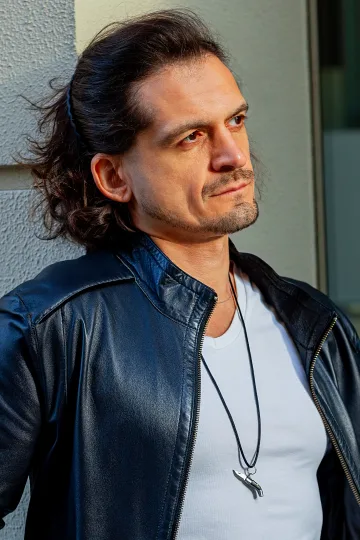
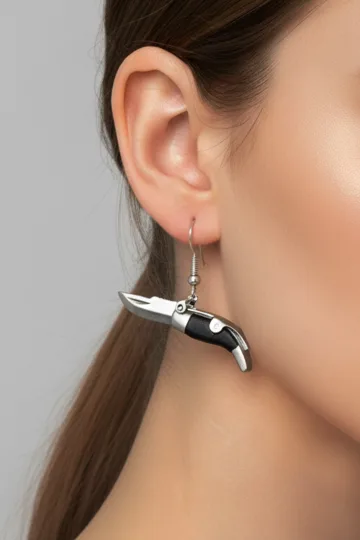
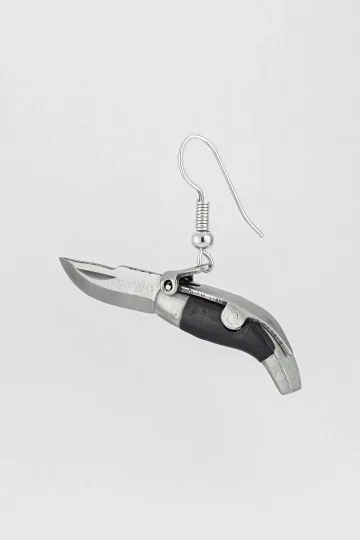
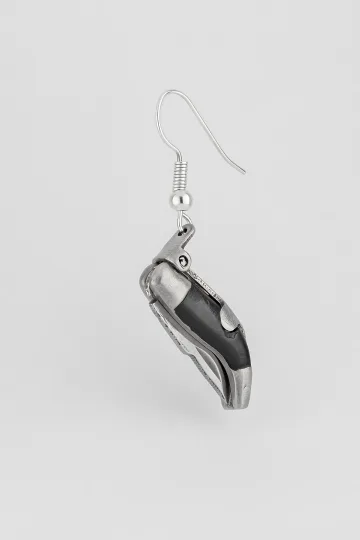
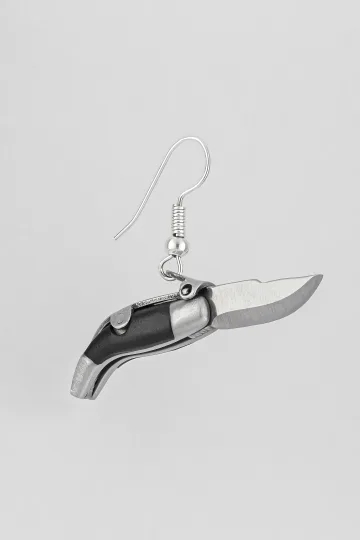
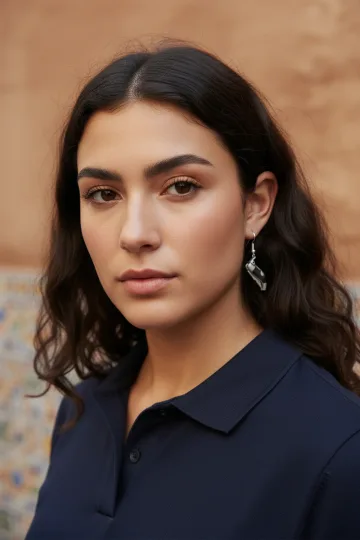
CAPAORA mini knife pendant
The 18th-century Spanish navaja in miniature: 40 mm of stainless steel, a real folding mechanism and a Palanquilla lock that clicks. An affordable gift to remember.
Authentic · Ships from Spain · 14-day returns
Which Metal to Choose for a Question Mark Pendant
The question mark has a thin, flowing shape, so the metal decides almost everything: how the curve sits and how long the pendant keeps a clean line. Here are the materials worth ordering this symbol in, so the question reads clearly instead of blurring into an unrecognizable hook.
925 silver: graphic and coolly precise
Silver gives the question mark that drafting-board clarity. The curve comes out sharp, the dot at the bottom stays tight, and the cool sheen of the metal underlines the geometry. The 925 hallmark means 92.5% pure silver with a touch of copper for strength, enough to keep the thin line of the pendant from bending in daily wear. Silver darkens over time, but for a question mark that reads as a plus: patina in the recesses gives the symbol relief, as if the question gains depth. Cleaning it at home takes five minutes. If you want to dig into hallmarks and care, see the breakdown of 925 silver and what the hallmark means.
Gold: a warm curve
Gold pulls the question mark in another direction, warm and soft. Yellow gold at 14 to 18K makes the curve feel alive, almost handwritten, as if the symbol were drawn with a pen. White gold sits closer to silver in coolness but is harder and does not darken. Rose gold adds an intimate, diary-like note. Choosing the shade is choosing the character of the question itself: strict and scientific, or warm and personal. What sets each apart and why one tone costs more is laid out honestly in the guide to white, yellow, and red gold.
Engraving: hiding an answer inside the question
The question mark almost asks for something to be written on the back. A date, initials, a short phrase, the coordinates of the place where it all was decided. You get a double layer: an open question on the outside, and a quiet answer on the reverse that only you know. This turns the pendant into a personal object rather than one of a run. What exactly to engrave and how not to overdo the length is gathered in a separate piece on jewellery engraving.
Leave your email, we'll send your discount code. No spam, unsubscribe anytime.
The code arrives by email, valid on your first order.
Who Wears Question Mark Jewellery
Not every symbol is for everyone. The question mark attracts a specific kind of person, or rather several specific kinds of people who share a common thread.
The Thinkers and Seekers
Philosophers, scientists, researchers, writers. People whose daily work involves asking questions that don't have easy answers. A physics professor trying to understand dark matter is living inside a question mark every day. A novelist building a world from scratch is asking, "What if things were different?"
For these people, a question mark pendant isn't a fashion choice. It's a professional badge. It says, "Questions are my business, and business is good."
You'll find question mark jewellery on therapists, too. Good therapy is built almost entirely on questions. "How did that make you feel?" "What do you think that means?" "What would it look like if things were different?" A therapist wearing a question mark is essentially wearing their job description.
The Rebels and Nonconformists
Every rebellion starts with a question. "Why do we have to do it this way?" "Who decided that?" "What happens if we refuse?"
The question mark has deep roots in countercultural movements. Punk, grunge, hip-hop: all of them began with people questioning the rules they inherited. The ? is the symbol of everyone who's ever looked at the way things are and said, "Yeah, but does it have to be like this?"
This isn't about being contrary for the sake of it. It's about the refusal to accept things at face value. Question mark wearers tend to be people who read the fine print, who ask for sources, who don't forward that article without checking whether it's actually true.
In a world of conformity, the question mark is a quiet act of resistance.
Students, Graduates, and Lifelong Learners
A question mark pendant makes a remarkable graduation gift (more on that in the gift section). But it resonates with anyone who sees learning as a lifelong project rather than something you finish at 22.
The best students aren't the ones with all the answers. They're the ones with the best questions. Einstein didn't start with E=mc2. He started with, "What would it look like to ride alongside a beam of light?" The equation came from the question.
People who wear question marks tend to be readers. The kind of people who have seven tabs open and three half-finished books on the nightstand. People who go down Wikipedia rabbit holes at 2am and emerge knowing things about medieval Icelandic poetry that they'll never use but are unreasonably glad they learned.
If you know someone like this (and you probably do, because you're reading a 6,000-word article about question mark jewellery, which makes you exactly this kind of person), then you understand the appeal intuitively.
The Question Mark as a Symbol of Searching for Yourself
There is a separate reason people reach for this symbol at particular stretches of life. The question mark is a precise marker of the state where old answers have stopped working and new ones have not been found yet. Searches like "who am I really" and "how to find myself" are typed by millions, and almost always the same thing sits behind them: a fork in the road where the previous version of yourself has ended.
These forks arrive on a schedule nobody warns you about. Around twenty-five comes the first crisis, when the degree is earned but where to go with it is unclear. Closer to forty a second wave hits: life has more or less come together, yet a question sounds inside, is this the life you actually wanted. A divorce, a move to another country, the loss of someone close, walking away from a profession you poured years into, each such event wipes out part of the answers about who you are. In those moments a person is a walking question mark.
Wearing a symbol of doubt in such a period is not an admission of weakness but honesty with yourself. A cross, a star, or initials fix something already settled. The question mark, by contrast, grants permission not to know until you know. It lifts the pressure to decide at once and turns the emptiness of uncertainty into an open field where you can try things. Many buy a pendant like this precisely as an anchor for a time of change: a small reminder that being in the question is normal and even fruitful, that a person who has outgrown old answers is moving forward, not back.
The question mark works well in this role as quiet support for someone close who is going through their own fork. It gives no advice and pushes no forced cheer, it simply acknowledges: yes, you are in the question right now, and that is a worthy place to be. Sometimes that acknowledgement is exactly what a person is missing.
How to Choose a Question Mark Pendant
The symbol is simple, but plenty of details decide the result. Here is what to look at so the pendant reads as a meaningful sign rather than a random squiggle.
Proportion and size
The question mark lives on its curve, so what matters is less the height of the pendant than the air inside it. Too small and the symbol gets lost, turning into a hook of uncertain shape; too large and it weighs on the look. For an everyday solo piece people take a pendant from one and a half to two and a half centimetres: at that size the eye reads both the loop and the dot. If the mark is meant as a quiet detail under a collar, shrink it; if it is the main accent on an open neck, size it up.
Line thickness and the dot
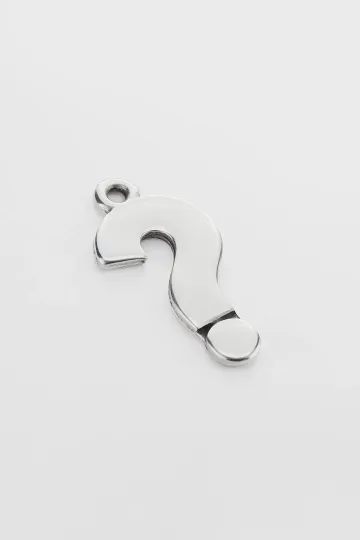
A thin line gives the symbol lightness and a handwritten feel; a thick one makes it more assured and graphic. Look separately at the lower dot: that is what turns an abstract squiggle into a recognisable question mark. A good pendant separates the dot from the curve with a clear gap, so the symbol reads instantly, even at a glance. If the dot merges with the hook, from a distance it stops being a question and becomes a badge of another kind, and the whole meaning of the piece blurs.
Chain and length
A thin chain gives all the attention to the symbol; a thick one competes with it for the eye. For a question mark people almost always pick a delicate weave. Match the length to the neckline: 45 cm lays the pendant at the collarbone, 50 to 55 cm takes it lower, to the centre of the chest. How not to miss the fit on a particular neck is covered in detail in the guide to chain length. Anyone who likes calm lines without excess will find the approach in the piece on minimalist jewellery closer, where the symbol works precisely through the quiet around it.
The Question Mark Pendant as a Gift
Few pieces of symbolic jewellery work as well as gifts as the question mark pendant. Here's why, and here's who to give it to.
For graduates. Graduation isn't the end of learning. It's the beginning of a phase where nobody assigns you the questions anymore: you have to find your own. A question mark pendant says, "The best questions are still ahead of you." It's more thoughtful than a generic piece of birthstone jewellery and more wearable than a diploma frame.
For teachers and professors. The people who spend their lives trying to make other people curious. A question mark pendant acknowledges the core of what they do: not dispensing facts, but igniting the urge to ask.
For career changers. Someone who's leaving one field for another is stepping into a massive question mark. That takes courage. A pendant that symbolises the beauty of not-yet-knowing is a powerful way to say "I support your leap."
For new parents. This one might sound odd, but hear me out. If you've ever spent time with a three-year-old, you know that children are question-mark machines. "Why is the sky blue?" "Why do cats purr?" "Why do I have to wear pants?" A question mark pendant for a new parent is a reminder to never get tired of those questions, because the day they stop asking is the day something's gone wrong.
For retirees. Retirement is often framed as the period of answers: you've figured it out, now relax. But the best retirements are full of questions. "What do I want to do now?" "What have I always wanted to learn?" "Where haven't I been?" A question mark pendant says "the adventure continues."
For yourself. Yes, buying symbolic jewellery for yourself is completely valid. You don't need someone else to give you permission to wear a symbol that resonates with you. If you identify with the question mark, wear the question mark.
Pair the question mark pendant with other pieces that speak to seeking and mystery. The mystic eye symbols tradition offers complementary pieces, and symbolic jewellery in general has a way of creating meaningful combinations.
Buying it as a gift? Each one arrives ready to give.
 A branded Zevira box and a little card come with every order.




Question Mark vs Other Symbolic Pendants
How does the question mark compare to other popular symbolic pendants? Here's an honest breakdown.
Question mark vs infinity symbol. The infinity symbol says "forever." It's about endlessness, continuity, eternal love. The question mark says "what next?" It's about openness, possibility, the unknown. Infinity is an answer; the question mark is the question. Both are beautiful, but they serve very different emotional needs.
Question mark vs eye (Evil Eye / All-Seeing Eye). Eye symbols are about protection and awareness: watching, seeing, guarding. The question mark is about seeking and wondering. The eye says "I see." The question mark says "Do I?" They actually complement each other beautifully, which is why layering them works so well. Read more about mystic eye symbolism.
Question mark vs cross. The cross represents faith, certainty, a defined belief system. The question mark represents the search itself. They're not opposites: many deeply religious people are also deeply questioning, but they carry different energies. The cross is an answer; the question mark is the ongoing conversation.
Question mark vs heart. Hearts are about emotion, love, connection. The question mark is about intellect, curiosity, the mind. But here's the thing: real love is full of questions. "Who are you?" "What do you need?" "How can I be better?" A question mark can be just as romantic as a heart, in the right context.
Question mark vs star. Stars symbolise guidance, aspiration, reaching for something. Question marks symbolise the search itself. Stars say "aim there." Question marks say "but should I?" Again, great layering partners.
For a complete breakdown of jewellery symbolism, check out the complete guide to jewellery symbols. And if you're drawn to the mystical side of things, the tarot jewellery guide explores another tradition where symbols carry deep personal meaning.
Send a friend a discount code, they save on their first order.
Surprising Facts About the Question Mark
- A mark for rhetorical questions was already invented, and it did not catch on. In 1580 the English printer Henry Denham proposed a reversed question mark to flag questions that expect no answer. The idea lasted a couple of decades and quietly disappeared. Four centuries later we still blur the sincere question and the rhetorical one in writing.
- The question mark has an official twin fused with an exclamation mark. In 1962 the ad man Martin Speckter came up with the interrobang, a ligature of ? and ! for phrases like "you're serious?!". The mark was even cast in metal for typewriters in the 1960s, but it never entered wide use. A perfect footnote for the theme: even an attempt to close the question with an exclamation stayed a question.
- In Greek the question mark looks like our semicolon. A Greek reading a line with the ";" symbol sees a question, not a pause. The same little mark means opposite things in two alphabets.
- Spanish asks the question twice. In Spanish writing a question opens with an inverted "¿" and closes with the ordinary one. The reader knows the sentence is a question before reaching the end of it.
- Armenian has its own question mark, and it does not go at the end. The small sign is placed right above the stressed vowel of the interrogative word, not on the tail of the sentence.
- Programmers call the question mark a question every day. In most programming languages the ? handles the condition "if yes, one thing, if no, another." Even in code the symbol stayed a fork, a point of choice between two paths.
- The shape is older than printing. By the 9th century scribes were already drawing a recognisable ? by hand in European manuscripts, six centuries before the first printing press made it a standard of punctuation.
Wear the symbol, don't just read about it. These are in stock:

Frequently Asked Questions
What does a question mark pendant symbolise? A question mark pendant symbolises curiosity, intellectual openness, and the courage to question. It represents the belief that asking good questions matters more than having all the answers. Different wearers attach different personal meanings: for some it's about philosophy, for others it's about rebellion, and for many it's simply about staying curious.
Is a question mark necklace appropriate for formal occasions? Absolutely. On a fine chain, a question mark pendant is subtle and elegant enough for any setting: work, events, even black-tie if you style it right. It's not loud or flashy. It's a quiet, sophisticated symbol that tends to attract positive attention.
Who is a question mark pendant a good gift for? Graduates, teachers, writers, scientists, philosophers, career changers, lifelong learners, anyone going through a transition, and anyone who values curiosity. It's one of the most thoughtful gifts you can give because it says "I see that you're a thinker."
Can men wear question mark pendants? Yes. The question mark is a completely gender-neutral symbol. It looks equally good on any person, with any style. There's no gendered tradition around it.
What does the question mark mean in different cultures? The question mark is nearly universal in Western languages, though its shape varies. The symbol represents inquiry across all cultures. In some spiritual traditions, it connects to the concept of "the seeker" or "the questioner" as an archetype of wisdom. It doesn't carry negative connotations in any major culture.
What should I pair a question mark pendant with? Other symbolic pieces work beautifully: eyes, stars, moons. You can also pair it with simple geometric shapes for a minimalist look. For layering, try different chain lengths and mix the question mark with one or two other meaningful symbols.
Does a question mark pendant have any spiritual meaning? Not in a traditional religious sense. But it connects deeply to philosophical and spiritual traditions that value questioning: Socratic philosophy, Zen Buddhism, existentialism, Sufism. Many people wear it as a symbol of their spiritual seeking rather than any specific faith.
Is it weird to buy a question mark pendant for yourself? Not at all. Symbolic jewellery is personal. You don't need someone else to gift you a symbol that resonates with who you are. If the question mark speaks to you, wear it.
Silver and gold jewellery, wedding bands, symbolic pendants, paired sets.
Conclusion
The question mark is a strange little symbol when you think about it. A curve and a dot. Simple enough that a child can draw it. Complex enough that philosophers have built entire careers around what it represents.
Wearing one around your neck is a quiet declaration. It says you value curiosity over certainty, questions over answers, the journey over the destination. It says you're the kind of person who reads the whole article, who stays for the second act, who isn't satisfied with "because that's how it's always been done."
It's the most philosophical piece of jewellery you can wear. Not because it has all the answers. But because it never stops asking.
And honestly? That might be the most human thing a piece of jewellery can do.
Wear the symbol, don't just read about it. These are in stock:



About Zevira
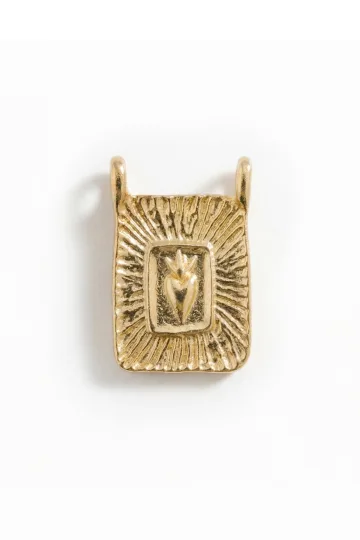
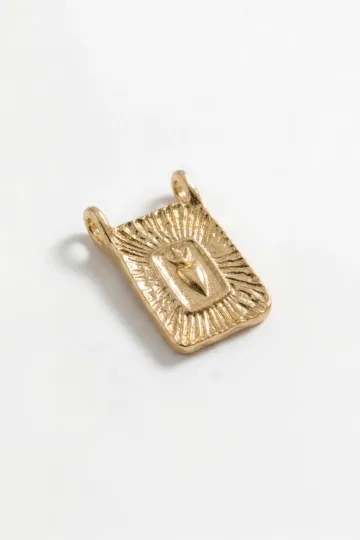
Zevira makes jewellery in the artisan tradition of Albacete, Spain. The question mark feels close to the craft itself: every piece starts with a question about what shape to give a symbol so that the curve and the dot read as a real statement rather than a logo.
Here is what you can find with us around the question mark theme:
- Question mark pendants in 925 silver and 14-18K gold
- Minimalist pendants on a fine chain for a solo look
- Symbolic pendants for layered combinations with the question mark
- Paired question mark pendants as a sign of mutual curiosity
- Question mark paired with an eye, a star, or a moon for a cosmic mood
- Pieces with personal engraving for a graduate, a teacher, or a seeker
Each piece is made by hand, with the option of personal engraving. 925 silver and 14-18K gold.