Bloodstone Jasper: The Red Stone Warriors Carried for Millennia
What this stone is, where the red comes from, and why it was tied to battle
In English-speaking tradition the word "bloodstone" gets pulled in two directions. Strictly, it can mean the dark green chalcedony flecked with red, but in everyday jewellery talk the same blood-coloured name often travels to the dense red jasper we are dealing with here, and to the deep red haematite (iron oxide) that shares the look. What turns this jasper red is plain iron. The same iron that oxidises in the cracks of the rock over millions of years and gives the stone the colour of dried blood. That is where the name comes from, and that is where the old link to war comes from too: fighters wore a stone the colour of blood because it matched what they saw on the field. There is no mysticism in it. There is geochemistry and a coincidence of colour.
Let us go through it properly: what red jasper is made of, how it forms, where it is mined, how it differs from ruby, haematite and red agate, how to tell the real stone from glass, and how to care for it. We will touch the symbolism too, but without promises or incantations.
Wear the symbol, don't just read about it. These are in stock:






What red jasper is: composition, hardness, structure
Bloodstone jasper belongs to the jaspers, and jasper is a variety of chalcedony, which is to say cryptocrystalline quartz. The backbone of its composition is silicon dioxide (SiO2), while traces of iron oxides and hydroxides supply the whole range from brick red to brown. In red jasper the colouring agent is most often haematite (Fe2O3) and sometimes goethite. It is exactly these iron-bearing impurities that make the jasper opaque and dense.
Structurally this is not a single crystal like a ruby but an aggregate of tiny quartz grains fused together. Quartz crystallises in the trigonal system, yet in jasper no individual crystals are visible to the eye: their size is measured in microns. That is precisely why the stone gives a matte or waxy surface rather than the glassy glint of facets. Light barely passes into its depth, scattering on the grains and returning, hence the muffled, dense colour.
Key physical properties:
- Mohs hardness: 6.5 to 7. This is the level of quartz. The stone will not be scratched by a steel blade and copes calmly with everyday wear, though harder particles (quartz dust, sand) will dull the polish over time.
- Density: roughly 2.6 to 2.65 g/cm3. A touch above water and ordinary glass, so in the hand bloodstone jasper feels noticeably heavier than a plastic imitation.
- Structure: cryptocrystalline aggregate. There is no cleavage, the fracture is conchoidal or splintery, which is what lets the stone be polished into smooth cabochons.
- Optics: opaque. Its refraction is like that of chalcedony, around 1.53 to 1.54, but the dense iron inclusions make it hard to measure on a polished face. There is no dispersion or play of colour, no pleochroism: for an aggregate these concepts simply do not work as they do for a transparent single crystal.
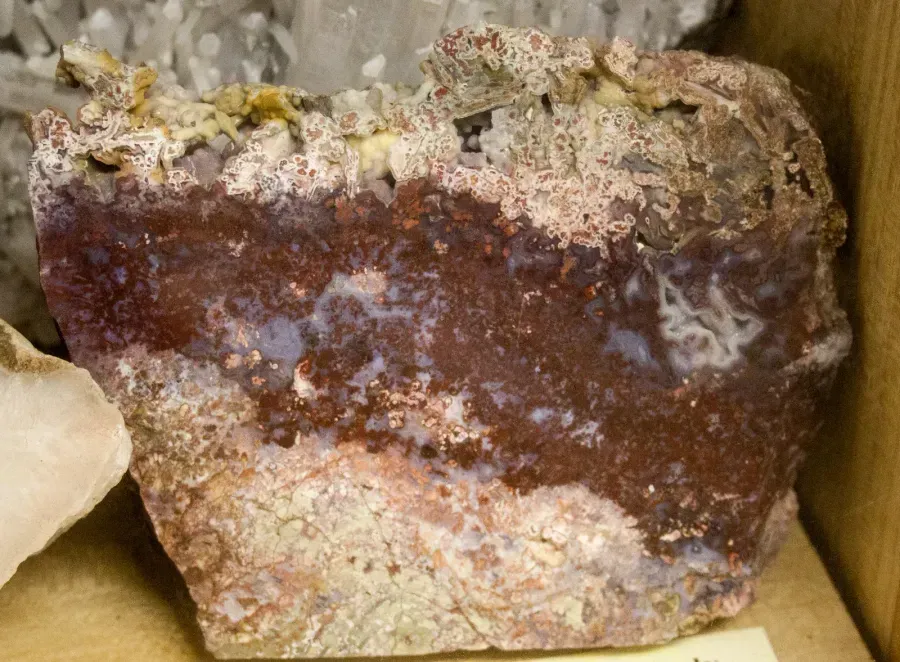
The dark and reddish-brown dots in red jasper are concentrations of iron oxides settled into pores and microcracks. The more contrasting the pattern and the richer the red, the higher the stone is valued decoratively.
Bloodstone belongs on bare skin under an open collar, not smuggled under a tie. Pair it with gold and you have missed the point entirely.
What to wear bloodstone jasper with
Over years on shoots and fittings this red stone has passed through dozens of looks on my hands. Here is what actually works, and what only looks as though it does.
What do I wear bloodstone jasper with every day? For daily wear I recommend one piece and a dark, dense background: a chunky-knit jumper, a heavy shirt with rolled sleeves, leather or denim. A red stone on grey and black reads at once, without noise. I choose either a bracelet of 8 to 10 millimetre beads or a signet, but never both: two accents fight each other.
Is it right for the office? Yes, as long as you keep it restrained. I suggest a signet with a closed silver setting on the index or middle finger, under a shirt with a turned-back cuff. The stone shows in the moment of a handshake and a gesture, and that is enough. Sterling silver gives a cold, businesslike tone; the closed setting adds weight and takes away spare glint.
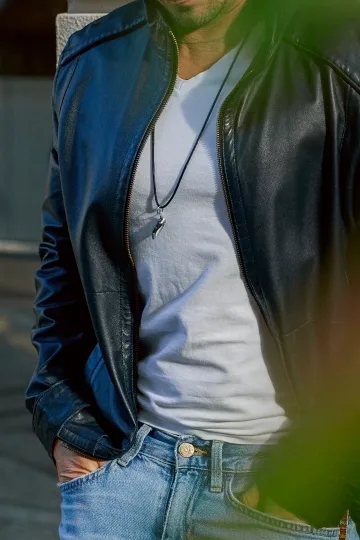
How do I build an evening look? For going out I choose a dark shirt with an open collar and a pendant on a leather cord on the chest. I wear a length of 60 to 70 centimetres, so the stone lies at heart level rather than crowding the throat. For a pendant I recommend a larger stone, 18 to 25 millimetres: a small one gets lost on an open chest.
Which stones do I pair it with? I keep to a dark range: bloodstone jasper with onyx or black tourmaline. One metal across the whole look, I never mix silver with gold. One red accent at a time and the rest muted: that way the stone speaks instead of drowning among pendants.
Who does this stone suit? Anyone who likes the weight of a piece in the hand and a quiet colour with no glare. It falls well on dark textures, leather and coarse knit, and looks as good on a young hand as on a mature one. Gender has nothing to do with it: it is only a question of setting and size. Look at the stone in daylight, not under the yellow lamp of a display case, which pulls out any red.

Turn on your camera, pick earrings, a pendant or a ring, and see the piece on yourself in real time.
Switch items in one tap.
Everything runs in your browser: no photo or video is ever uploaded.
How red jasper forms in nature
Jasper is born where silica precipitates out of silica-rich solutions. Most often this happens in sedimentary and volcanogenic-sedimentary layers: hot hydrothermal solutions, or simply silica-rich groundwater, fill the pores and cavities in the rock and slowly lay down quartz. If those same solutions carry iron, it oxidises and gives red, brown and yellow colouration.
Some jaspers are tied to ancient volcanic systems and underwater lava flows, where silica was released from cooling volcanic glass and redeposited. The process runs over geological timescales, millions of years, at low temperatures compared with the deep crystallisation of precious stones. The result is a dense, tough rock that can be cut and polished without fear of it splitting along planes.
Why red rather than any other colour
The colour of jasper is not set by the silica, which is colourless, but by the iron compounds that arrived with the solutions. Oxidised ferric iron in the form of haematite gives the red and brick tones. Where the iron is partly hydrated and present as goethite, yellow and ochre appear. A mixture gives the russet range. It takes only a change in the oxidation state and the quantity of iron for the same material to yield stones running from pale pink to an almost black cherry.
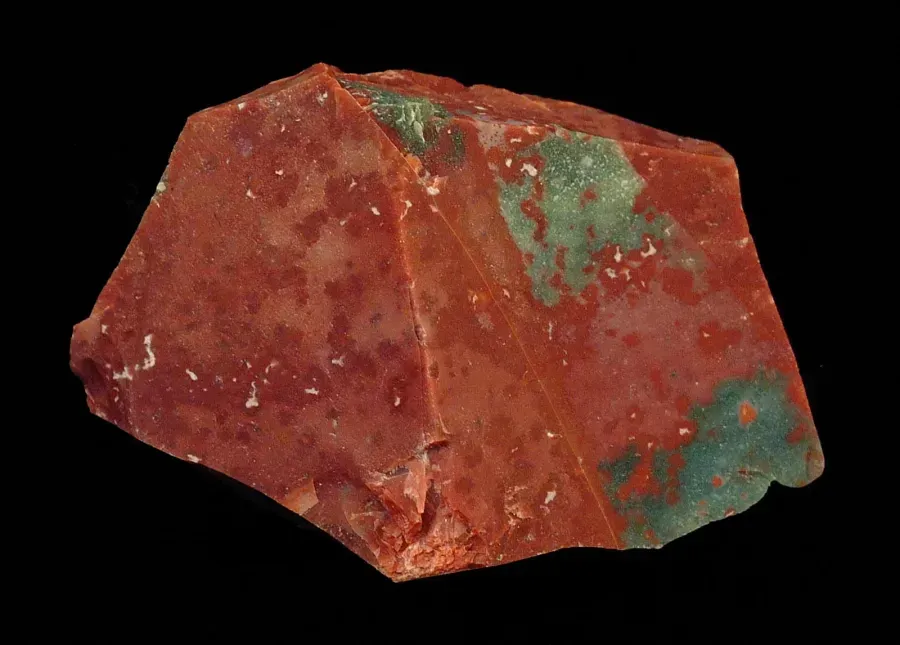
What makes this interesting is that red and green often lie side by side in one piece of rock. The green zones are places where the iron stayed in its reduced ferrous form or bound into other minerals, while the red are the oxidised layers. That is why a single block of jasper can carry red, green and yellow banding at once: it is a record of how the chemistry of the solutions changed at different stages. British collectors will know the effect from the Lake District and from the beaches of the Yorkshire coast, where waterworn jasper pebbles show exactly this banding.
What a cryptocrystalline aggregate means in plain terms
The word aggregate means the stone is assembled from a mass of tiny grains fused together rather than grown as a single crystal. The quartz grains in jasper are so small that the boundary between them is invisible to the eye and to a loupe, hence the prefix crypto, hidden. This structure is what separates jasper from transparent rock crystal, which forms as large faceted crystals.
The practical consequence is simple. A single crystal has cleavage planes along which it splits under a blow. An aggregate has none, so the fracture runs along a random conchoidal surface, and the stone comes out tough and resistant to chipping. That is why jasper was cut for centuries into objects that had to take punishment: seals, hilts, pommels, tabletops. A transparent gem of the same mass is far easier to break.
The same property explains why jasper survives so well in the archaeological record. Flint and chert, its close relatives in structure, were worked for tools precisely because a conchoidal fracture can be controlled and gives a sharp edge. Jasper sits in that family, which is why red jasper flakes and scrapers turn up on prehistoric sites across Britain and northern Europe alongside flint.
How mottled patterns and breccias form
The most expressive jaspers are the mottled and brecciated ones rather than the evenly coloured. A breccia forms when already hardened rock cracks under movement of the crust and the cracks are later filled by fresh silica carrying iron. The result is a mosaic of fragments cemented in a matrix of a different colour. Sometimes the fragments are red and the cement pale, sometimes the reverse.
Landscape patterns, in which red mixes with yellow, brown and green and suggests mountains or a sunset, arise from the same causes: the chemistry of the solutions varied over time, the iron oxidised and then did not, and the sediment settled in layers. Every pattern is unrepeatable, and that is what makes jasper interesting to lapidaries. It is also exactly why a perfectly uniform red material without a single mark should put you on guard: nature is rarely that tidy.
Customer reviews
Zevira is a real jewellery shop. Genuine payments, deliveries and customer thank-yous.
🥰🥰🥰 gracias

Ok, ¡gracias! 🙂

Geography: where red jasper is mined
Jasper occurs all over the world, and its red varieties are mined at many deposits:
- India. One of the main suppliers of red jasper to the ornamental-stone market, especially Rajasthan and the central districts.
- Brazil. Large deposits of jaspers in many colours, including richly red and landscape types.
- The United States. Deposits across the western states, known for landscape and red varieties.
- Australia. Ornamental jaspers, including dark and dense grades.
- Southern Africa. A steady source of red and brecciated jaspers prized by lapidaries.
Red jasper is mined in a good many other countries too; the stone is widespread, and that is exactly why it has always been more affordable than rare transparent gems.
How bloodstone jasper differs from ruby, haematite, agate and granite
Red stones are routinely lumped together when they are in fact completely different minerals. Here are the differences you can see with the naked eye and that matter when buying.
From ruby. Ruby is corundum, a single crystal of aluminium oxide, transparent, hardness 9 on the Mohs scale, with a glassy lustre and a play of light across its facets. Bloodstone jasper is opaque, matte, hardness 6.5 to 7. These are stones from entirely different weight classes, both in price and in properties. Historians often mistook red spinel for ruby, another transparent crystal, but it has nothing to do with jasper.
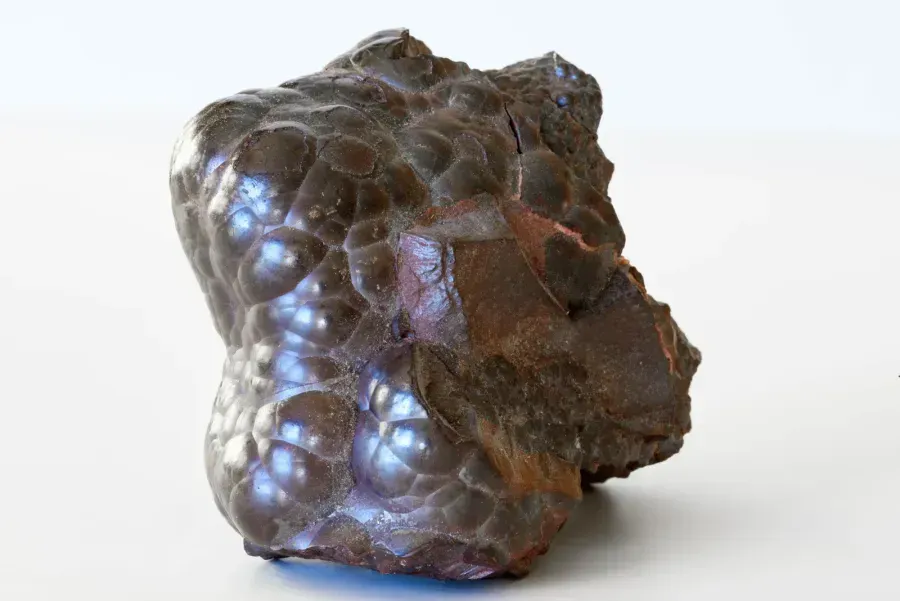
From haematite. Haematite is pure iron oxide (Fe2O3), a heavy mineral with a metallic lustre and a characteristic cherry-red streak on unglazed porcelain. Bloodstone jasper merely contains haematite as an impurity, while its backbone is silica. Haematite is markedly denser (around 5 g/cm3) and gleams like metal when polished, whereas red jasper gives a soft, waxy sheen. Haematite as a stone in its own right is a separate subject.
From agate. Agate is also a chalcedony, but usually banded and often translucent. Bloodstone jasper is dense, non-translucent, either a uniform red or marked with chaotic iron-rich patches, with no concentric bands.
From granite. Granite is a coarse-grained igneous rock of feldspar, quartz and mica, its grains visible to the eye. Its red colour comes from feldspars, not from a jasper structure. Granite goes into facing stone and monuments; red jasper is cut into inlays and cabochons. More on granite in jewellery and interiors.
Upload a photo of your pet, someone you love, or an object. We'll build a 3D model and hand-cast it in pewter.




History: the red stone among warriors and regalia
People have worked red jasper since deep antiquity; it is one of the earliest ornamental stones. What follows is what belongs to the stone's well-documented history, without invented dates and names.
The ancient world
Jasper was carved into seals, amulets and inlays as far back as Mesopotamia and ancient Egypt. From it people made cylinder and signet seals that secured documents: an impression in clay or wax served as the owner's personal signature. The stone's red colour was linked with blood and life force, so jasper amulets were often worn as protective charms.
In Egypt red jasper was used in funerary amulets. One such amulet, the "knot of Isis" (the tyet), was carved precisely from red stone, and the texts expressly instructed that it be made red, the colour standing for the blood of the goddess and the protection of the deceased. It is a rare case where an ancient source itself explains the choice of colour.
Antiquity and the Middle Ages
In the Graeco-Roman world jasper was prized by gem cutters. From it they carved intaglios and cameos with images of gods, heroes and military scenes. The stone was hard enough to hold fine carving and at the same time affordable.
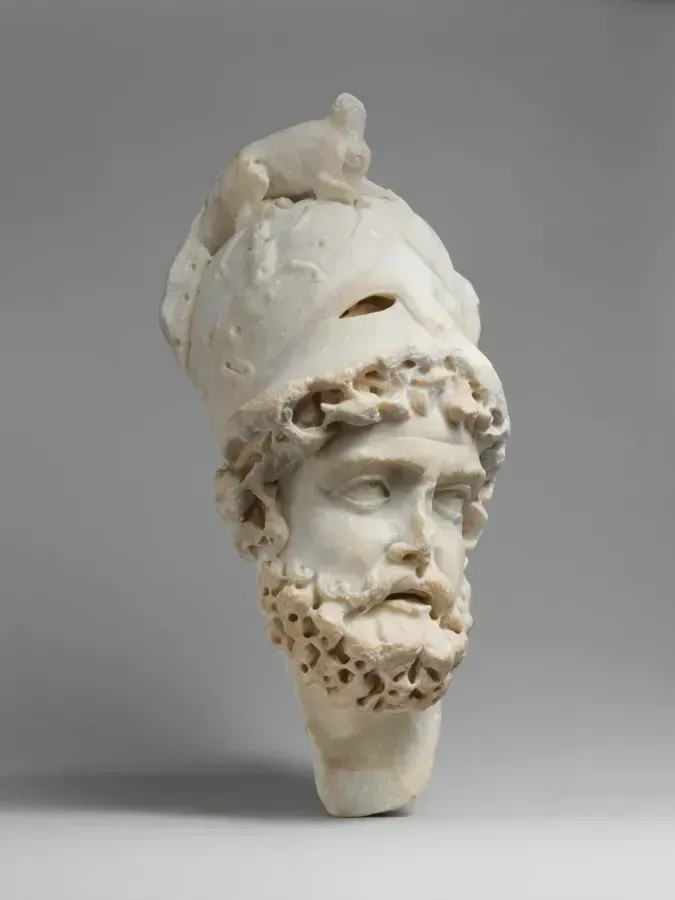
In the Middle Ages red jasper, like many gems, was described in lapidaries, the compendiums of stone lore. A reputation clung to it as a stone that "stops blood" and grants endurance; such notions held on in the written tradition for a long time, though no real medical basis lies behind them. Jasper was set into signet rings, including those worn by people entitled to sign orders.
The modern era
The flowering of jasper as a stone of grand decorative art came in the eighteenth and nineteenth centuries. Across Europe, from large jasper monoliths craftsmen cut vases, bowls and tabletops for palace interiors; some pieces reached enormous size and weight. Red and mottled jaspers went into mosaics and fireplace facings. In parallel, red jasper continued to be cut for signets and men's rings, the stone holding engraving and looking severe.
By the middle of the twentieth century jasper had settled firmly into two roles: an inexpensive ornamental and jewellery stone, and a material for large lapidary works. The military symbolism of the red stone had by then become part of folklore rather than everyday practice.
The Christian legend of blood on the stone
A separate branch of this history belongs not to red jasper but to its green relative, heliotrope. Heliotrope is chalcedony too, but dark green with red specks and blotches that look like drops of blood. English calls it bloodstone for exactly that reason, and this is where a genuine confusion begins that trips up buyers constantly. In English usage bloodstone means the green heliotrope, while several other languages use their equivalent word for red jasper or for red haematite. The colours are opposites; the legend is shared.
Medieval Christian tradition linked heliotrope with the Crucifixion. The story held that drops of blood fell onto green jasper at the foot of the cross and stained the stone forever. Because of that, heliotrope was cut into religious gems, engraved with scenes of the Passion and kept as a relic. There is no historical basis for the account, it is a devotional legend, but it set the stone's reputation for centuries and put heliotrope into cathedral treasuries across Europe.
The practical lesson is worth carrying into a shop. When a seller talks about a blood stone, always ask which one is meant: green heliotrope with red flecks, or solid red jasper. They are different stones with different appearances and different prices, and an online listing translated from another language will often have picked the wrong one.
Heliotrope has one more claim in the British calendar. It is one of the traditional birthstones for March, sharing the month with aquamarine in most modern lists, and older British lists gave it the month outright. Red jasper has no such slot, which is another useful way to keep the two apart.
Red jasper among different peoples
A red stone the colour of blood caught the imagination almost everywhere it was found. In Mesopotamia and the Levant red jasper counted as a stone of fertility and protection, linked to blood as the source of life. Across the Near East it was cut into amulets against the evil eye and into seals bearing protective inscriptions.
Indian tradition associated red stones in general with the energy of action and the lower centres of the body, and red jasper was worn as a stone of stamina and physical strength. Across the Caucasus and Central Asia dense red and mottled jaspers went into knife hilts, pommels and belt fittings, where the stone both decorated the weapon and was held to guard its owner.
In Roman Britain red jasper intaglios travelled with the army and the administration, and they turn up regularly in excavation, most famously among the finds from the bath drains at Bath, where rings slipped off wet fingers and stayed there for eighteen centuries. Among the indigenous peoples of North America jasper served both as tool material and as an object of exchange, with the red varieties particularly valued for their colour.
This universality has a simple explanation. The stone is hard, handsome, takes a finish and occurs on many continents, so every culture found a use for it and an interpretation to go with it.
Why warriors in particular
The link between the red stone and war rests on several plain things at once. First, the colour: a stone the shade of dried blood read naturally as a sign of battle, wounds and endurance. Second, hardness and toughness: jasper does not fear knocks and does not split along planes, so it could be set into a hilt or a pommel without any fear of the inlay cracking in a fight. Third, availability: a transparent gem was beyond the means of an ordinary fighting man, whereas dense red jasper was within reach of the rank and file.
Old lapidaries added the belief that a red stone staunches bleeding and confers courage. There is no real effect behind that, but in an age when a wound often meant death, any object with a reputation for guarding against blood loss was worn willingly. So a coincidence of colour, the strength of the material and a piece of bookish folklore combined into the durable image of a fighting stone.
There is a fourth factor that gets overlooked: jasper takes an engraving and keeps it. A warrior's ring often doubled as his seal, and a seal had to survive being carried in the field for years. Softer decorative stones wore smooth; jasper did not. The stone was chosen for the same reasons a tool is chosen, and the symbolism grew up around the practicality rather than the other way round.





Varieties of red jasper
Jasper is a collective name for a multitude of colours and patterns. Those counted as bloodstone jasper or standing close to it:
- Red (brick) jasper, an even, dense red from finely distributed haematite. The classic bloodstone jasper.
- Brecciated red jasper, fragments of red material cemented by quartz, with a marked pattern of broken pieces.
- Landscape and mottled jasper, red combined with yellow, brown and green, the pattern resembling scenery.
- Leopard jasper, a reddish-brown ground with rounded light spots.
It is worth separating two distinct meanings. In mineralogy there is a blood-red haematite, and the bloodstone name is sometimes applied precisely to it, to the dense red variety of iron oxide. When the talk is of jewellery red jasper with iron-rich patches, jasper is what is meant. When buying, always check which stone is actually in front of you: jasper is lighter and matte, haematite is heavy and gleams like metal.
How to tell genuine bloodstone jasper from a fake
Red jasper is usually imitated with dyed glass, plastic or pressed crumb. Simple checks:
- Weight. Natural stone is denser than plastic. Glass is close in density, so weight alone will not settle it; you need other signs.
- Hardness. Glass and plastic are softer than quartz. Jasper (6.5 to 7) is not scratched by a steel needle, whereas the needle leaves a mark on glass. Test on an inconspicuous spot.
- Surface and pattern. Natural jasper has uneven colour, with shifts of tone, brown and dark inclusions, sometimes small natural flaws. An even, garish red with no structure, and suspiciously identical bubbles inside, give glass away.
- Warmth to the touch. The stone at first feels cool and warms in the hand more slowly than plastic.
- Lustre. A waxy or matte sheen is normal for jasper. A frankly metallic gleam means you are more likely holding haematite, and a mirror-glass shine means it is glass.
If the stone is expensive or sold as a rare variety, it makes sense to ask for a gemmologist's report.
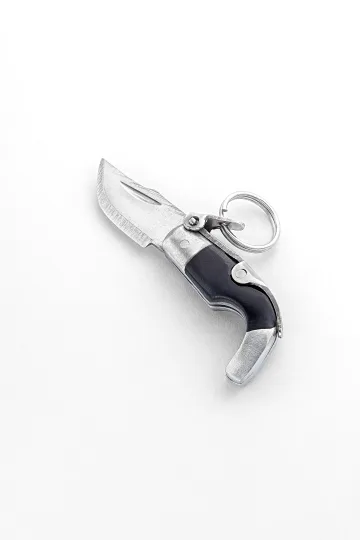
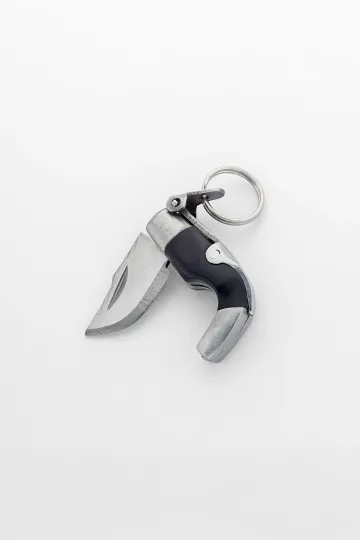
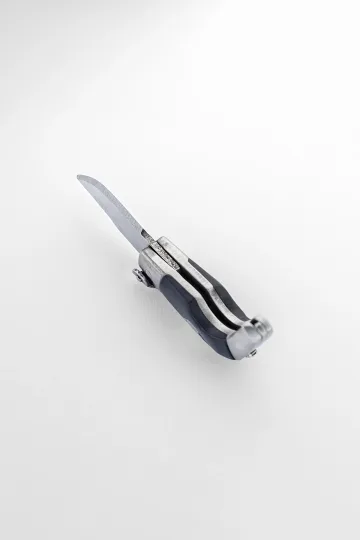
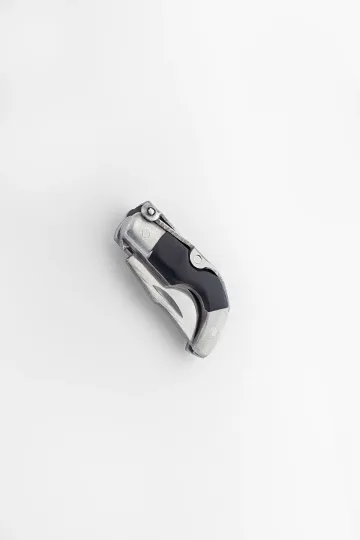
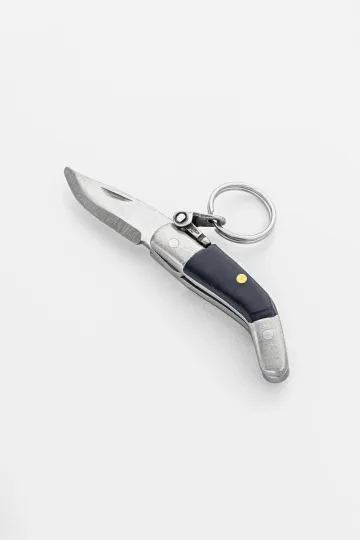
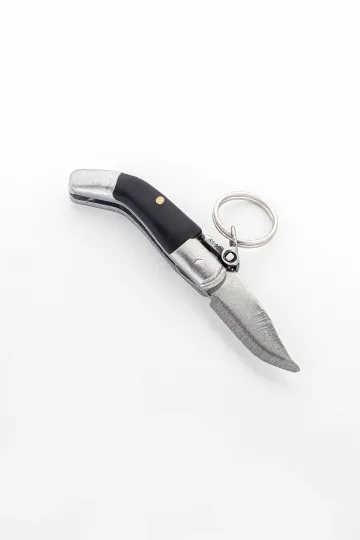
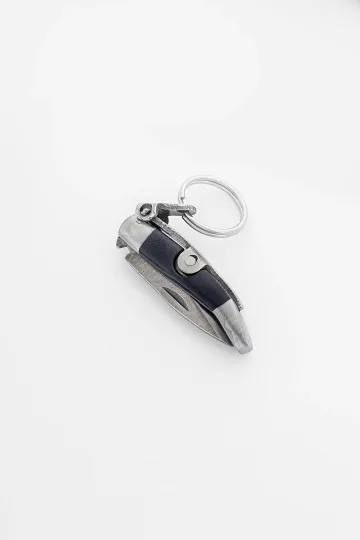
CAPAORA mini knife pendant
The 18th-century Spanish navaja in miniature: 40 mm of stainless steel, a real folding mechanism and a Palanquilla lock that clicks. An affordable gift to remember.
Authentic · Ships from Spain · 14-day returns
Is red jasper treated
Here it is important to separate two cases, which sellers often confuse.
The first: jasper is dyed. Porous, pale jaspers are soaked in dyes to pull the colour up to a bright, even red. Natural haematite red is almost always uneven, with brown and dark zones; the dyed sort sits suspiciously smoothly and often runs into cracks in thin, sharp lines. If you wipe such a stone with a cloth dampened in acetone or alcohol, a pinkish trace sometimes stays on it. On undyed natural jasper there will be no trace.
The second: jasper is stabilised with resin. Loose or fractured grades are impregnated with a colourless polymer resin so the stone holds a polish and does not crumble when cut. Stabilisation does not change the colour, but it lowers the surface hardness and tolerates ultrasound, steam and solvents poorly. Held to the light, the edges of such a cabochon are sometimes a little cloudier than natural ones.
A separate story, often sold under the name of jasper, is pressed crumb. Fine stone or haematite dust is mixed with a binder and moulded. You can recognise it by the over-even mass with no natural pattern and by the identical rounded bubbles inside. This is no longer a solid stone, and it should not cost what a solid one costs. Natural dense red jasper needs no treatment: its value lies precisely in the fact that the colour was given by haematite, not by a dye.
Leave your email, we'll send your discount code. No spam, unsubscribe anytime.
The code arrives by email, valid on your first order.
How to choose a stone for a signet, bracelet or pendant
Different pieces suit different stone, and the choice should follow the form of the object.
Signet. Takes the densest, most uniform material. On the large face of a cabochon any pattern is seen in full, so an even, deep red with no pale bald patches is what is valued here. Choose the face to match the hand: 12 by 10 millimetres and larger look confident on a broad palm, 10 by 8 is calmer. The surface is better smooth, with no chips along the edge, because it is the edge of the signet that most often bangs against tables and door handles.
Bracelet. Here, on the contrary, the pattern wins. Beads of 8 to 10 millimetres let you string a strand where each stone differs slightly in tone and inclusions, and that lives better than perfectly identical spheres. Check that the holes are drilled through the centre, or the beads will sit crooked. On a finished bracelet, tug the strand: a quality assembly on a steel cable or strong elastic does not have play.
Pendant. Here the stone works on the texture and on contrast with skin or dark cloth. Either a uniform cabochon or an expressive slice with a natural pattern will suit. For a pendant on the chest take a larger stone, 18 to 25 millimetres on the long side: a small stone on an open chest under an unbuttoned collar gets lost.
There is one general rule: look at the stone in daylight, not under the yellow lamp of a display case. Warm artificial light pulls out any red and masks brown zones and cracks.
Carving and engraving: bloodstone jasper as a seal
Red jasper has a quality for which it was chosen as a seal for millennia: a hardness of 6.5 to 7 is enough to hold fine carving and not crumble, yet the material is not so hard that carving turns into hard labour, as it does with corundum. The cryptocrystalline structure with no cleavage means the cutter runs across the stone evenly, not chipping it along planes. That is exactly why ancient masters carved intaglios for signet rings from jasper.
Modern engraving on a jasper cabochon is possible, but with reservations. Deep figured carving is done with an abrasive or ultrasonic tool; ordinary graver engraving does not work on such a stone, which crumbles the point. A small monogram or mark is more often applied with a laser, which does not depend on hardness. If you want a signet specifically for sealing, remember that an intaglio is cut in mirror image, in the negative, so that the impression in wax reads correctly.
A matte engraved surface should not be repolished together with the whole stone: the pattern would smooth away. Guard the carving from the same abrasive dust that dulls a smooth polish.
Care and wearability
A hardness of 6.5 to 7 makes bloodstone jasper convenient for everyday wear: it does not fear accidental contact and is not scratched by odds and ends in a pocket. But that does not mean the stone is indestructible.
- Cleaning. Warm water, mild soap, a soft brush or cloth. Ultrasound and steam are best avoided, especially on a stone with cracks or a glued setting in its mount. Rule out aggressive household chemicals.
- Storage. Apart from harder stones (quartz, corundum, topaz), which can scratch the polish. A soft pouch or a compartment in a box will do.
- Wearability. Jasper has no cleavage, so it will not split along a plane, but a strong point blow on the edge of a cabochon can leave a chip. Keep rings and signets clear of blows against hard surfaces.
- Light and heat. Avoid sharp overheating and prolonged heating: it can cause microcracks. The stable natural colour does not fade in sunlight, but dyed imitations may.
With everyday wear the polish can be refreshed by a craftsman every few years.
Symbolism, short and honest
In tradition red jasper was tied to blood, endurance and warrior courage; old lapidaries credited it with the power to stop bleeding and grant resolve. This is part of the stone's history and cultural context, no more than that. The mineral has no proven physical or medical effect: red jasper does not cure illness, does not affect blood pressure and does not change character. It is worn for its colour, its dense, dignified look, and whatever meaning a person invests in it. That is how it deserves to be treated: a handsome, sturdy stone with a long history.
What lies behind the image of a fighting stone
The image of the warrior's red stone survives not because of demonstrated properties but because of three things locking together: the colour of blood, the strength of the material and an old bookish belief about endurance. In that sense red jasper is more honest than many gems. It promises neither luck nor wealth; its symbolism is direct and severe, and it is about composure rather than fortune. Someone who chooses a stone like this is usually looking for a reminder of how they intend to hold themselves, not for a charm. That is a reasonable and grown-up way to relate to an object.
It also means the stone carries no obligation. Nobody has to believe anything to wear it. The history is real, the folklore is documented as folklore, and the object on the hand is a piece of handsome rock with an unusually long service record.
The stone and character, without the esoteric
A mineral does not alter character or affect mood, and that needs saying plainly. But an object on the hand does work as an anchor for a habit: your eye falls on the signet and you remember why you put it on. The effect is purely psychological and identical for anything chosen with intent, whether a ring, a father's watch or a small keepsake worn under a shirt. Red jasper suits that role well because of its restrained appearance. It neither shouts nor looks like a toy, which is exactly what you want from something meant to be a private reminder rather than a display.
This is also the reason the stone reads well in professional settings where jewellery is otherwise unwelcome. A dark red cabochon in a plain silver signet passes as a family piece rather than as an ornament, and nobody asks about it.
Who red jasper suits and how it is given
A red ornamental stone is tied to no gender, age or status. But it has a character, and it will sit closer to some people than others.
Who the stone suits
Red jasper appeals to people of a composed, direct style, those who care about the weight of an object in the hand and about a restrained, unshowy colour. It looks right on anyone who wears dark clothing, dense textures, leather and heavy knitwear. Age makes no difference: on a young hand a signet reads as character, on an older one as a familiar part of the look. It suits a woman exactly as well as a man, and the only real questions are the setting and the size of the stone.
If your wardrobe runs to bright colour and light fabric, red jasper is harder to place. It is a stone that wants a quiet background, and it competes rather than harmonises with strong colour elsewhere in an outfit.
Red jasper as a gift
A stone with a warrior's reputation is often given as a mark of respect for someone's endurance: at a significant threshold, a new post, a coming of age, or as support through a difficult stretch. The meaning is set by the giver's words rather than by the mineral itself, and a gift like this works best when the reason is said out loud rather than left implied.
A good format for a gift is a signet or a bracelet in a solid silver setting: the object is durable, gets worn for years and does not go out of fashion. If the recipient dislikes jewellery, a pendant on a leather cord is the safe answer, since it is easy to keep under a shirt and makes no statement to anyone else. Silver hallmarked at a British Assay Office carries a date letter, which quietly turns the gift into something datable years later.
Which finger a signet goes on
There is no strict law, only habits. A signet most often goes on the little finger or the ring finger of the working hand, less often on the index finger when someone wants the stone visible in a gesture or a handshake. A large stone is better kept on a quieter finger so that it does not catch on everything. The main rule is practical: a signet should sit firmly but come off without soap, otherwise the edge of the stone will be knocking against objects all day long.
The British convention described for armorial signets, the little finger of the non-dominant hand, applies less here, since a jasper signet is a personal object rather than a heraldic one. Comfort decides it.
Send a friend a discount code, they save on their first order.
About Zevira
Zevira makes jewellery for the people who wear it, not for the display case. We work with natural stones, red jasper, garnet, onyx, tourmaline, and sterling 925 silver. Bloodstone jasper goes into our signets, bracelets and pendants: the stone holds a severe cabochon cut, looks good in a dense silver setting and takes daily wear calmly.
We pick the stones by colour and pattern and make the setting with weight to spare, so the piece is felt in the hand. These are pieces that serve for decades and that you would not be ashamed to pass on.
Buying it as a gift? Each one arrives ready to give.
 A branded Zevira box and a little card come with every order.









Myths and reality
| Myth | Reality |
|---|---|
| Bloodstone jasper cures anaemia and stops bleeding | No. This is an old bookish belief built on the chime of colour and blood. Anaemia is treated with iron and vitamins, not with a stone. |
| Bloodstone jasper must be charged under the moon | The moon has no effect on the mineral. Care means cleaning and careful storage, not rituals. |
| Bloodstone jasper is a kind of ruby | No. Ruby is a transparent corundum of hardness 9. Bloodstone jasper is an opaque red jasper of hardness 6.5 to 7. |
| Only warriors wore red jasper | The warrior symbolism existed, but jasper was carved into seals, amulets, inlays and large decor for all kinds of people. |
| The brighter and more uniform the red, the more natural it is | Rather the opposite. Natural jasper has uneven colour, with inclusions; a perfectly even red more often gives away dyed glass. |
| Bloodstone jasper and haematite are the same thing | No. Haematite is a heavy iron oxide with a metallic lustre. Jasper is silica with an iron impurity, light and matte. |
Facts that surprise
A stone with a history this long has collected a great many curiosities. Here are the ones that change how you look at an ordinary red cabochon.
Red jasper and bloodstone are different stones
The commonest source of confusion in the whole subject. In English, bloodstone means green heliotrope with red specks. Several other languages use their own word for a blood stone to mean red jasper, or sometimes red haematite. The colours are opposites and the legend is shared, so buying a blood stone from a description translated out of another language is a reliable way to receive something other than what you pictured. Ask for the mineral name and the colour, in that order.
Jasper was a signature before it was an ornament
Thousands of years ago red jasper was cut into seals rather than pendants. A ring with an engraved intaglio served as a person's signature: the impression in clay or wax confirmed that a letter or an order was genuine. The red stone on a finger was therefore closer to a passport and a notary's stamp than to a piece of decoration, and losing it was a serious matter rather than an inconvenience.
Intaglios are cut in mirror image
For the impression in wax to read correctly, the carver cuts the image as a negative and reversed: letters mirrored, anything that should stand proud cut as a hollow. The ancient engraver worked while holding the finished impression in his head rather than the thing in front of him on the stone. That demanded no less skill than the fineness of the lines themselves, and it is why an unfamiliar antique intaglio often looks wrong until you press it into something.
Jasper was carved into objects the size of a person
The familiar cabochon in a ring is only one life of this material. In the eighteenth and nineteenth centuries European lapidary workshops cut whole jasper monoliths into vases, bowls and tabletops on a scale that required special transport, with the final polishing taking years. The same rock served both in a finger ring and in a palace hall. Victorian Britain had its own smaller version of the fashion: Scottish pebble jewellery, in which jasper, agate and carnelian were inlaid into silver brooches by the thousand.
Red and green come from the same iron
It looks as though red and green in jasper must be different impurities. In fact it is the same iron in different states: oxidised gives red, reduced shifts towards green. A banded red and green stone is effectively a chronicle of how the chemistry of the groundwater changed over time, layer by layer, and it can be read a little like tree rings.
A perfectly even red is a bad sign
With most goods, uniformity is a virtue. With jasper it is the reverse. Natural haematite red is nearly always uneven, with brownish zones and dark specks. A colour that is too smooth and garishly identical more often gives away dyed glass or a dyed porous stone than a rare stroke of luck. If a strand of beads shows every bead identical, treat that as evidence rather than as quality control.
The stone shrugs off a knife but fears sand
A hardness of 6.5 to 7 means the steel of an ordinary knife will not mark jasper. But ordinary household and street dust is largely quartz of the same hardness, which is exactly what dulls the polish over time. The stone outlives the knife and slowly surrenders to sand, which is why a well worn old jasper signet has a soft satin surface rather than a mirror one.
Signets with bloodstone jasper, bracelets and pendants of natural red jasper.
Wear the symbol, don't just read about it. These are in stock:

Frequently asked questions
Is bloodstone jasper a stone or a mineral? It is a rock, a dense red jasper, a variety of chalcedony. The backbone is silica (SiO2); the red colour comes from an impurity of iron oxides, chiefly haematite.
What is its hardness? 6.5 to 7 on the Mohs scale, at the level of quartz. For jewellery that is dependable: the stone is not scratched by steel and withstands everyday wear.
How does bloodstone jasper differ from haematite? Haematite is pure iron oxide, heavy, with a metallic lustre and a red streak. Bloodstone jasper is a silica jasper in which haematite is only an impurity; it is lighter and matte.
Where is red jasper mined? In India, Brazil, the United States, Australia, Southern Africa and a number of other countries. The stone is widespread, and so historically affordable.
Can a woman wear bloodstone jasper? Of course. It is simply a red ornamental stone; its wearability does not depend on gender. It is only a question of style and setting.
How do you tell the real stone from glass? By hardness (a steel needle does not scratch jasper, but it scratches glass), by the uneven natural colour with inclusions, and by the matte rather than mirror lustre.
How do you care for bloodstone jasper? Warm water with mild soap and a brush. Store apart from harder stones, guard it from blows on the edge and from strong overheating. Ultrasound and steam are undesirable.
Is bloodstone jasper expensive? No, red jasper is among the affordable ornamental stones. The price of a piece comes mainly from the work and the metal of the setting, not from the cost of the stone itself.
Does the colour fade? The natural colour of jasper is stable and does not fade in sunlight. A dyed imitation may fade, which is one more reason to check the stone.
Bloodstone jasper is a dense red jasper with a long history: it was carved into seals in ancient kingdoms, into inlays and amulets in antiquity, into palace decor in the modern era. Plain iron gives it its red, its hardness lets you wear the stone every day, and its availability always made it a stone not only of the nobility. Take it for its look and the character of the material, not for promises, and it will serve for decades.