Snake Jewellery: Why the World's Most Feared Animal Became Its Most Worn Symbol
Introduction
There is a photograph from 1839 that changed jewellery history. It shows a ring. Not a diamond solitaire, not a gold band, not anything you would expect from a royal engagement. It is a snake. A coiled serpent in gold, with an emerald set in its head and rubies for eyes. Prince Albert gave it to Queen Victoria, and she wore it for the rest of her life.
That single ring launched an obsession with serpent jewellery that lasted the entire Victorian era. But the truth is, Albert was not inventing something new. He was tapping into a symbol that was already thousands of years old. The Egyptians carved cobras onto the crowns of their pharaohs. The Greeks put the snake on the staff of their god of medicine. The Hindus wrapped a cobra around the neck of Shiva. The Aztecs worshipped a feathered serpent as the creator of the world.
Wear the symbol, don't just read about it. These are in stock:




No other animal in human history has been simultaneously so feared and so revered. We are hardwired to flinch at snakes. Psychologists have demonstrated that even infants who have never seen a real snake will react to snake-shaped objects faster than to any other form. And yet, across every continent and every major civilisation, people have taken this creature that triggers our deepest survival instincts and turned it into something they want to wear on their bodies.
That paradox is the entire point. And it is why snake jewellery runs far deeper than any trend. It is one of the oldest, most layered, most psychologically rich symbols in the history of human adornment.
Why the snake became humanity's most loaded symbol
Before we get into specific cultures and eras, it is worth understanding why the snake, of all creatures, carries so much symbolic weight.
The answer starts with biology. Snakes do things no other animal does. They shed their skin entirely, emerging renewed. They can kill with a single bite or heal with their venom (modern medicine derives antivenoms and even some cancer treatments from snake toxins). They move without legs, which to ancient people seemed like magic. They live in the ground, connecting them to the underworld, but also climb trees, connecting them to the heavens. They can go months without eating. Some species give birth to live young while others lay eggs.
This biological versatility made the snake the ultimate blank canvas for human meaning-making. Depending on which quality you focus on, the snake can symbolise:
Renewal and transformation (shedding skin). Death (venomous bite). Healing (venom as medicine). Wisdom (watchful, patient, silent). Fertility (phallic shape, prolific breeding). Eternity (the ouroboros, the snake eating its own tail). Protection (the cobra rearing to strike). Temptation (the Garden of Eden). Earth energy (living in the ground, connected to the planet itself).
No other animal covers that range. A lion is courage. A dove is peace. An eagle is power. But a snake is all of these things and their opposites simultaneously. It heals and it kills. It protects and it threatens. It represents both wisdom and temptation, both death and rebirth. That duality is what makes it irresistible to jewellery designers and wearers alike.
There is also an aesthetic dimension. The snake's form is naturally suited to jewellery. A serpent coils around a finger as if it was designed for ring-making. It wraps a wrist like a bracelet already in progress. It drapes across a collarbone like a necklace that evolved there. Very few animal forms translate so effortlessly to adornment. The snake does not need to be abstracted or simplified to work as jewellery. It already is jewellery.
Customer reviews
Zevira is a real jewellery shop. Genuine payments, deliveries and customer thank-yous.
🥰🥰🥰 gracias
Ok, ¡gracias! 🙂
A snake wants a finger or a wrist to coil around. On a short chain it just chokes.
What to wear a snake with
Over years on shoots and runways the snake has passed through dozens of looks with me. Here is what actually works, sorted by occasion.
What do I wear a snake with every day? For daily wear I recommend a thin single-coil ring or a small pendant on a short chain. Over a plain tee, jeans or a light shirt, a snake like this reads as a personal sign rather than jewellery on display. I suggest keeping to a calm shape without a large stone, so the snake never argues with your clothes and stays easy to wear without taking it off.
Where does a snake work best? Its strongest position is a ring or a bracelet. On a ring the snake wraps the finger, on a bracelet it runs along the wrist, and in both cases the form itself does the work, that living line of the body. A two or three coil ring holds the eye better than a flat one, and a wrapping bracelet reads as an extension of the arm. A pendant works too, but on the finger and the wrist the shape opens up fully.
Silver or gold for my skin? Here I go by undertone. For cool skin I recommend silver or white gold, for warm skin gold, which lights the skin from within. A snake with a stone in the eye is its own conversation: emerald, ruby or onyx works as one precise accent, so under it I suggest a calmer shape that keeps the stone the main thing.
How do I build an evening look? For evening I choose an open neckline and a smooth fabric in a deep colour: wine, emerald, black. A large snake as the single accent belongs here, a massive multi-coil ring or a pendant with an eye stone. One rule: if the snake is large, keep the space around it empty, and it will carry the whole look.
Who does it actually suit? Anyone who likes pieces with meaning and does not mind attention on the hands and neck, whatever their age or gender. If you are unsure, I suggest starting with a thin ring on the middle or index finger: it shows when you gesture but never overloads the look. From there it becomes clear whether you lean toward a quiet everyday snake or a large evening one.

Turn on your camera, pick earrings, a pendant or a ring, and see the piece on yourself in real time.
Switch items in one tap.
Everything runs in your browser: no photo or video is ever uploaded.
The snake in the ancient world
Egypt: Wadjet, the uraeus, and Cleopatra's asp
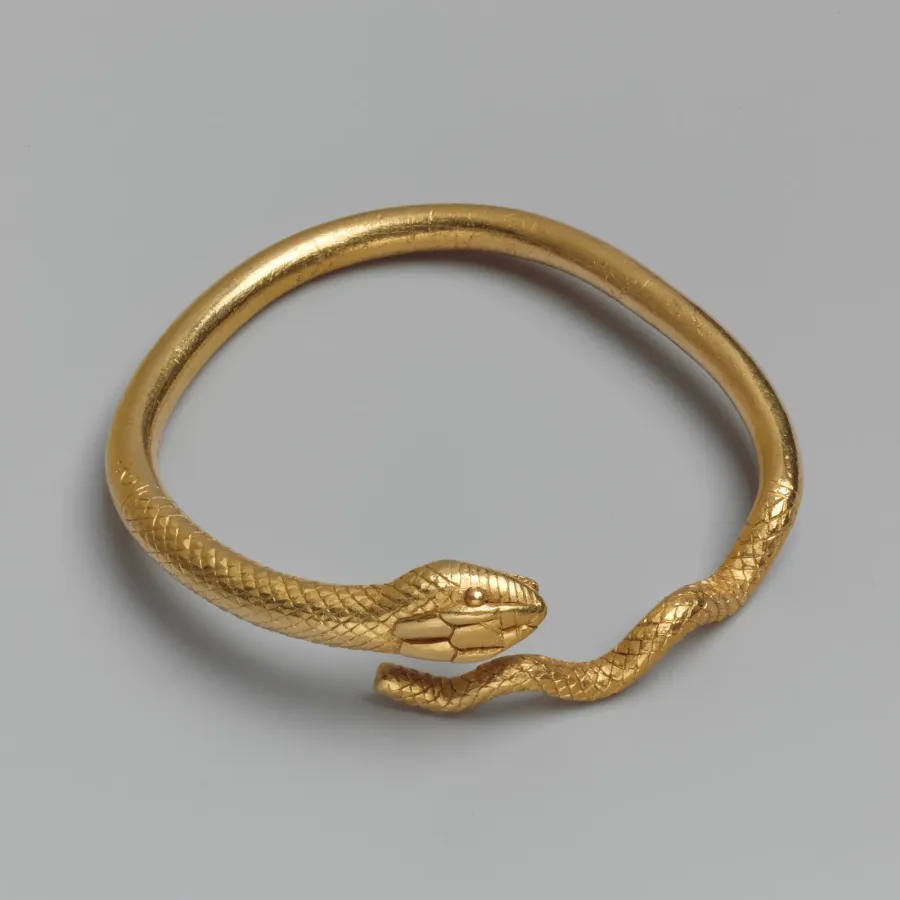
If you want to understand how seriously ancient cultures took the snake, start with Egypt. The snake was not just respected there. It was the single most important royal symbol in Egyptian civilisation.
The uraeus was the rearing cobra placed on the pharaoh's crown. Every single pharaoh from the earliest dynasties onward wore it. The cobra on the brow represented Wadjet, the snake goddess of Lower Egypt, who was believed to spit fire at the pharaoh's enemies. This was not decorative. This was protective magic of the highest order. The pharaoh literally wore a cobra on his forehead because without it, he was not fully pharaoh.
Wadjet was one of the oldest deities in the Egyptian pantheon, far older than the more famous gods like Osiris and Isis. Her name means "the green one," and she was associated with the papyrus plant, the fertile marshlands, and the vitality of the Nile Delta. Her image as a cobra was the first symbol of royal authority in Egyptian history, predating the double crown, the crook, and the flail.
But Wadjet was not the only snake deity. Meretseger, "she who loves silence," was a cobra goddess who protected the Valley of the Kings. Workers in the royal tombs left offerings to her, asking for protection against actual snakebites (a real hazard in the desert) and spiritual threats alike. Renenutet was a cobra goddess of harvest and nourishment, often shown breastfeeding the pharaoh. Apophis (Apep) was the great serpent of chaos who tried to devour the sun god Ra during his nightly journey through the underworld. Every night, the gods battled Apophis, and every morning, the sun rose again.
The snake in Egypt was not one thing. It was the entire spectrum, from protector to destroyer, from nurturer to chaos itself. And Egyptian jewellery reflected that. Gold cobra amulets have been found in tombs dating back over 4,000 years. The famous death mask of Tutankhamun features a prominent uraeus cobra alongside a vulture, representing the unity of Upper and Lower Egypt. Cleopatra herself, the last pharaoh, famously chose death by asp (likely an Egyptian cobra), choosing the most symbolically potent exit possible. She did not simply die. She returned to the protection of Wadjet.
For modern jewellery, the Egyptian legacy matters because it established the snake as a symbol of sovereignty and divine protection. When you wear a snake on your finger or your wrist, whether you know it or not, you are inheriting 5,000 years of that tradition.
Greece: Asclepius, medicine, and the Minoan snake goddesses
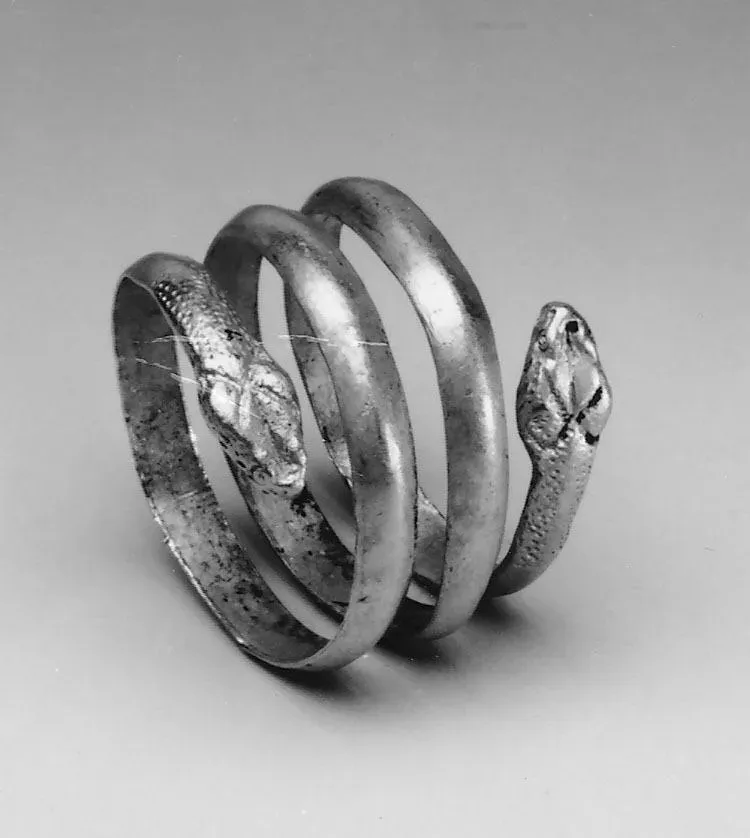
Greece took the snake in a different direction. While Egypt made it royal, Greece made it medical, mystical, and feminine.
The most enduring Greek snake symbol is the Rod of Asclepius: a single snake wrapped around a staff. Asclepius was the god of medicine and healing, and his symbol became the universal emblem of the medical profession. Today, when you see a snake on a pharmacy sign, an ambulance, or a hospital logo, that is Asclepius. His symbol has been in continuous use for approximately 2,500 years, making it one of the longest-running logos in human history.
Why a snake for healing? The Greeks observed that snake venom could kill but also, in controlled doses, could treat certain ailments. They also saw the snake shedding its skin as a metaphor for recovery: the patient sheds the old, sick body and emerges renewed. In the healing temples of Asclepius (called Asclepieia), actual live snakes were kept and allowed to roam among patients sleeping on the temple floor. The snakes were non-venomous Aesculapian snakes, and their touch was considered part of the healing process.
But the Greek snake tradition goes back further than Asclepius. The Minoan civilisation on Crete, roughly 1600 BCE, produced the famous Snake Goddess figurines found at the palace of Knossos. These small ceramic figures show a woman holding snakes in both hands, her arms raised, wearing an elaborate tiered skirt and an open bodice. Scholars have debated for a century what exactly she represents, but the consensus is that she embodies a goddess or priestess associated with the earth, fertility, and the protective power of the snake.
The Minoan Snake Goddess is significant for jewellery history because she establishes one of the oldest associations between women, snakes, and personal adornment. She wears the snakes. They are not weapons or tools. They are something closer to what we would now call accessories, symbols of her power displayed on her body. That idea, that wearing a snake is an expression of personal power, runs straight from Minoan Crete to a modern snake ring.
Athens also had a sacred snake. The Athenians believed that a great serpent lived beneath the Acropolis, protecting the city. This guardian snake was associated with Athena herself and was fed honey cakes by the priestesses of the Erechtheion. When the Persians invaded Athens in 480 BCE and the snake reportedly refused its food, it was taken as a sign that Athena had abandoned the city. The entire population evacuated.
India: Naga serpent deities and the cobra of Shiva
India's relationship with the snake is possibly the richest and most complex of any civilisation, and it remains vibrantly alive today.
The Nagas are a class of serpent deities in Hindu and Buddhist mythology. They are not simple snakes. They are powerful beings who can take human form, guard treasures, control weather (especially rain), and serve as protectors of the dharma. Naga kings like Vasuki and Shesha play critical roles in Hindu cosmology. Shesha, the thousand-headed serpent, supports the god Vishnu as he rests on the cosmic ocean between cycles of creation. Vasuki served as the rope in the great churning of the ocean, one of the most important creation stories in Hindu mythology.
Shiva, the supreme deity of destruction and transformation, wears a cobra around his neck. This is not a threat. It represents his mastery over fear and death. Shiva handles the most dangerous thing in nature with casual ease, the way you might drape a scarf. The cobra also represents the kundalini energy that Shiva has fully awakened and integrated. In some depictions, the cobra's hood frames Shiva's face like a halo.
The festival of Nag Panchami, celebrated across India during the monsoon season, is dedicated entirely to snake worship. On this day, live snakes (or images of snakes) are offered milk, flowers, and prayers. Women pray to the nagas for fertility, protection of their families, and prosperity. Snake stones (nagakals) are installed in temples and under sacred trees, and devotees pour milk over them.
In Indian jewellery, the naga motif has been continuous for thousands of years. Snake anklets, snake arm bands, snake rings, and snake pendants are part of classical Indian adornment. The snake is considered auspicious. Wearing it is not about fear or edginess. It is about inviting protection, wisdom, and connection to the divine. Temple jewellery from South India frequently features naga motifs, and snake-shaped gold ornaments are common in bridal jewellery traditions.
This is perhaps the biggest cultural difference in snake symbolism. In the West, wearing a snake often carries a hint of rebellion or danger. In India, it is fundamentally sacred and protective. Both readings are valid, and both have deep roots.
Norse: Jormungandr and Nidhogg
Norse mythology gives us two of the most dramatic snakes in all of world mythology.
Jormungandr, the Midgard Serpent, is so enormous that it circles the entire world and bites its own tail. It is the Norse version of the ouroboros, and it is central to the cosmology. As long as Jormungandr holds on to its own tail, the world holds together. When it lets go at Ragnarok (the Norse apocalypse), the oceans rise, the world shakes, and the final battle begins. Thor and Jormungandr kill each other in the last fight.
Jormungandr is not evil in the simplistic sense. It is a boundary keeper. It defines the edge of the known world. It holds everything inside the circle. This makes it a powerful symbol for anyone who sees themselves as a protector, a container of chaos, someone who holds things together through sheer endurance.
Nidhogg is the dragon-serpent that gnaws at the roots of Yggdrasil, the world tree. While Jormungandr circles the world's edge, Nidhogg attacks its foundation. It represents entropy, the slow decay that eventually undoes all things. In Norse poetry, Nidhogg also feasts on the corpses of oath-breakers and murderers in Nastrond, the Norse equivalent of hell. It is both a cosmic force and a moral enforcer.
Viking jewellery was rich in serpent motifs. Arm rings, brooches, and pendants featuring intertwined snakes were common across Scandinavia and wherever the Vikings travelled. The serpent in Viking art is rarely realistic. It is abstracted into flowing, interlocking patterns, becoming part of the extraordinary knotwork that defines Norse decorative art. These designs influenced European art for centuries and continue to inspire jewellery makers today.
Upload a photo of your pet, someone you love, or an object. We'll build a 3D model and hand-cast it in pewter.



The snake in religion and spiritual traditions
The Garden of Eden: the serpent that changed everything
The most culturally dominant snake story in the Western world is, of course, Genesis. The serpent in the Garden of Eden persuades Eve to eat the fruit of the Tree of Knowledge, and as a result, humanity is expelled from paradise.
What makes this story so interesting for symbolism is that it cuts both ways. On one reading, the serpent is the villain: the deceiver, the tempter, the one who introduced sin and suffering into the world. On another reading, the serpent is the liberator: the one who gave humanity knowledge, self-awareness, and free will. Without the serpent, Adam and Eve would have stayed in Eden forever, innocent but unknowing, never fully human.
Gnostic Christians actually took the second reading seriously. In some Gnostic traditions, the serpent of Eden was a hero, a messenger of true knowledge (gnosis) sent to wake humanity from ignorance. The Ophites, a Gnostic sect, explicitly worshipped the serpent as a bringer of wisdom.
This dual reading is why the snake in Western jewellery carries a complexity that, say, a cross or a dove does not. When someone wears a serpent, they might be referencing the tempter, the sage, the rebel, or all three at once. The symbol is genuinely ambiguous, and that ambiguity is part of its appeal.
Moses and the bronze serpent that heals
Most people who know the Eden story do not know about Nehushtan: the bronze serpent that Moses mounted on a pole, as described in the Book of Numbers. When the Israelites were dying from snakebites in the desert, God instructed Moses to make a serpent of bronze and raise it on a staff. Anyone who looked at the bronze serpent was healed.
The parallel with the Rod of Asclepius is striking. Both feature a snake on a pole with the power to heal. Scholars have debated for centuries whether there is a direct historical connection or whether this is a case of convergent symbolism. Either way, the bronze serpent shows that even within the Judeo-Christian tradition, which generally casts the snake as negative, there exists a powerful counter-narrative: the snake as healer, as vehicle of divine mercy.
The Nehushtan was eventually destroyed by King Hezekiah because the Israelites had started worshipping it as an idol. Even in its destruction, it confirms the snake's power. People could not help but venerate it.
Mesoamerica: Quetzalcoatl, the feathered serpent
Quetzalcoatl is one of the most important deities in Mesoamerican religion, worshipped by the Aztecs, Maya, and earlier civilisations for over a thousand years. The name means "feathered serpent" in Nahuatl, combining the quetzal bird (symbol of the heavens) with the coatl (serpent, symbol of the earth).
Quetzalcoatl was a creator god, a giver of knowledge, a patron of wind and learning. He was credited with creating humanity, inventing the calendar, and discovering maize (corn). His temples feature massive carved serpent heads with open jaws, and the famous pyramid at Chichen Itza is designed so that on the spring equinox, shadows create the illusion of a serpent descending the staircase.
The feathered serpent represents the union of earth and sky, matter and spirit. As a symbol of cycles and return, Quetzalcoatl connects to the ouroboros tradition: the serpent that contains all beginnings and endings.
In jewellery, the feathered serpent tradition lives on in Mexican and Central American metalwork, where snake motifs carry both indigenous spiritual meaning and contemporary artistic expression.
Kundalini: the serpent energy within
In yogic and tantric traditions, kundalini is described as a coiled serpent sitting at the base of the spine. Through meditation and practice, this serpent energy rises through the chakras (energy centres along the spine), and when it reaches the crown of the head, the practitioner achieves enlightenment, spiritual awakening, or union with the divine.
The imagery is vivid: a sleeping snake, coiled three and a half times, waiting to be awakened. When it wakes, it ascends, and everything changes. This is probably the most personal and internalised form of snake symbolism. The serpent is not out there in the world. It is inside you. It is a potential waiting to be realised.
Kundalini symbolism has entered mainstream culture through yoga and wellness movements. A snake pendant or ring worn by someone who practices yoga or meditation may reference this tradition specifically: the awakened serpent, the energy moving upward, the body as a vehicle for transformation.



The snake in fashion and jewellery history
Queen Victoria and the snake that started a century of style
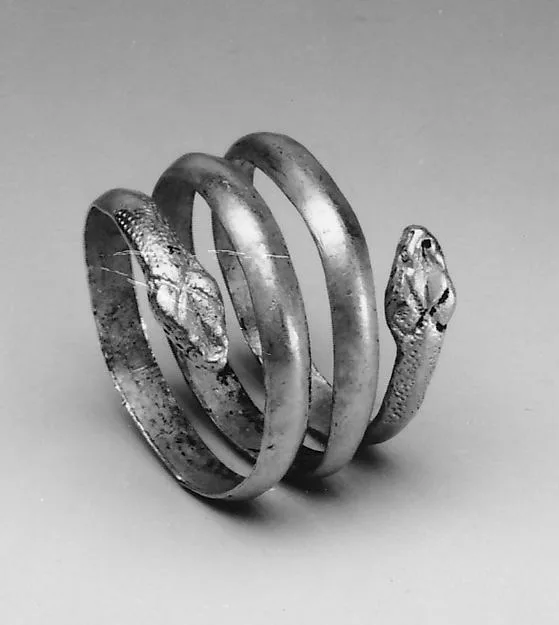
In 1839, Prince Albert of Saxe-Coburg and Gotha proposed to Queen Victoria with a ring shaped like a coiled snake. The head was set with an emerald (Victoria's birthstone), and the eyes were rubies. Victoria adored it. She wore it constantly. She was painted wearing it. And because Victoria was the most influential woman in the world, every fashionable woman in Britain and beyond wanted a snake ring too.
The timing mattered. Victoria became queen at 18, married at 20, and became a style icon at a time when mass media (newspapers, lithographs, early photography) was making royal fashion visible to millions of ordinary people for the first time. Before Victoria, royal jewellery influenced the aristocracy. After Victoria, it influenced everyone.
The Victorian snake ring became one of the defining jewellery pieces of the 19th century. Jewellers across Europe produced them in every material and price range: gold with gemstones for the wealthy, silver or pinchbeck for the middle classes, jet and vulcanite for mourning. Snake bracelets that coiled multiple times around the wrist became equally popular. Snake necklaces, brooches, and hair ornaments followed.
The symbolism was specific in the Victorian context. The snake represented eternal love (the endless coil, with no beginning and no end), wisdom, and fidelity. It was not seen as dangerous or rebellious. It was romantic. A snake ring was a love token, a promise of forever. Giving a woman a snake ring was saying: my love for you has no end.
After Albert died in 1861, Victoria's grief transformed the snake into a mourning symbol as well. She wore her snake ring in jet and black enamel versions, and snake mourning jewellery became widespread. The snake, which had symbolised eternal love, now symbolised eternal grief, the refusal to let go of someone who has passed. The same form, but the meaning had darkened.
Art Nouveau: Lalique, Mucha, and the golden age of the serpent
If the Victorian era made the snake popular, Art Nouveau (roughly 1890 to 1910) made it extraordinary.
Art Nouveau was a design movement obsessed with nature, flowing lines, and organic forms. And no natural form suited Art Nouveau better than the snake. Its sinuous curves, its flowing body, its ability to coil and intertwine, these were exactly what Art Nouveau artists were looking for: natural beauty translated directly into decorative art.
Rene Lalique, the French jeweller and glass designer, created some of the most stunning snake jewellery ever made. His serpent pieces combined gold, enamel, glass, and gemstones into objects that were as much sculpture as jewellery. A Lalique snake necklace from this period might feature an enamelled serpent with opalescent wings, wrapped around a branch of glass flowers, with a woman's face emerging from the coils. These pieces were fantastical, erotic, and technically astonishing.
Alphonse Mucha, the Czech artist whose posters defined the Art Nouveau aesthetic, frequently included snakes in his work. His lithographs of women draped in serpents, with flowing hair and jewelled snake bracelets, created an entire visual vocabulary that jewellers eagerly translated into wearable form.
The Art Nouveau snake was different from the Victorian one. The Victorian snake was about love and eternity. The Art Nouveau snake was about beauty, sensuality, and the power of nature. It was also, importantly, about feminine power. Many Art Nouveau snake pieces feature women and serpents together, not as victim and predator, but as allies. The woman holds the snake or wears it as an extension of herself. There is no fear. There is partnership.
This era produced snake jewellery of such extraordinary quality that pieces from Lalique, Fouquet, and Vever now sell for hundreds of thousands at auction. They represent a peak in the art of serpent jewellery that has never quite been matched.
Italian high jewellery and the rise of the flexible serpent
No discussion of snake jewellery is complete without the mid-twentieth-century Italian workshops that popularised the flexible serpent bracelet. From the late 1940s onward, Roman jewellers refined a serpent tradition that became one of the most recognisable in the world.
Some of the most celebrated early pieces were snake watches: flexible gold bracelets that coiled around the wrist like a living serpent, with a small watch face hidden in the snake's head. These pieces used a tubular gold construction in which the metal tubes interlocked without solder, creating a flexible, springy coil that moved with the wrist. They were technical marvels for their time.
The look became closely tied to mid-century film glamour. During the early 1960s, Hollywood stars filming historical epics in Rome were frequently photographed wearing serpent jewellery from Italian workshops, and the imagery spread worldwide. The pairing felt natural: the glamour of the era met one of the oldest symbols in adornment, the serpent.
Over the following decades, the serpent grew from a single motif into an entire design language across watches, bracelets, necklaces, and rings. Snake scales were translated into pave-set stones, textured gold, and coloured stone mosaics.
This tradition proved something important: a single animal symbol, treated with enough creativity and craft over enough decades, can come to define an entire style of fine jewellery.
Modern: the snake ring revival
Snake jewellery has surged again in the 2020s, and the reasons are both cultural and aesthetic.
Modern musicians and fashion figures have been photographed wearing snake rings, contributing to the normalisation of serpent jewellery across genders. The snake ring, in particular, has become one of the most searched jewellery items online, with "snake ring meaning" consistently trending.
Part of the appeal is the gender-neutral quality. A snake ring does not read as specifically masculine or feminine. It occupies a space that works across the entire spectrum, which makes it ideal for an era where gender boundaries in fashion are increasingly fluid.
There is also a psychological component. In a world that feels unstable, the snake's association with transformation, shedding old skin, starting over, and finding wisdom through difficulty resonates. People are drawn to symbols that acknowledge complexity rather than offering simple reassurance. The snake does not say "everything is fine." It says "things change, and change can be powerful." That is a more honest message, and people recognise it.
Social media has amplified this. Snake rings photograph beautifully. They create visual interest on hands, which are constantly visible in selfies and video calls. A coiled snake on the index finger is an instant conversation piece, a way to signal that you are someone who carries meaning on your body without needing to explain it.
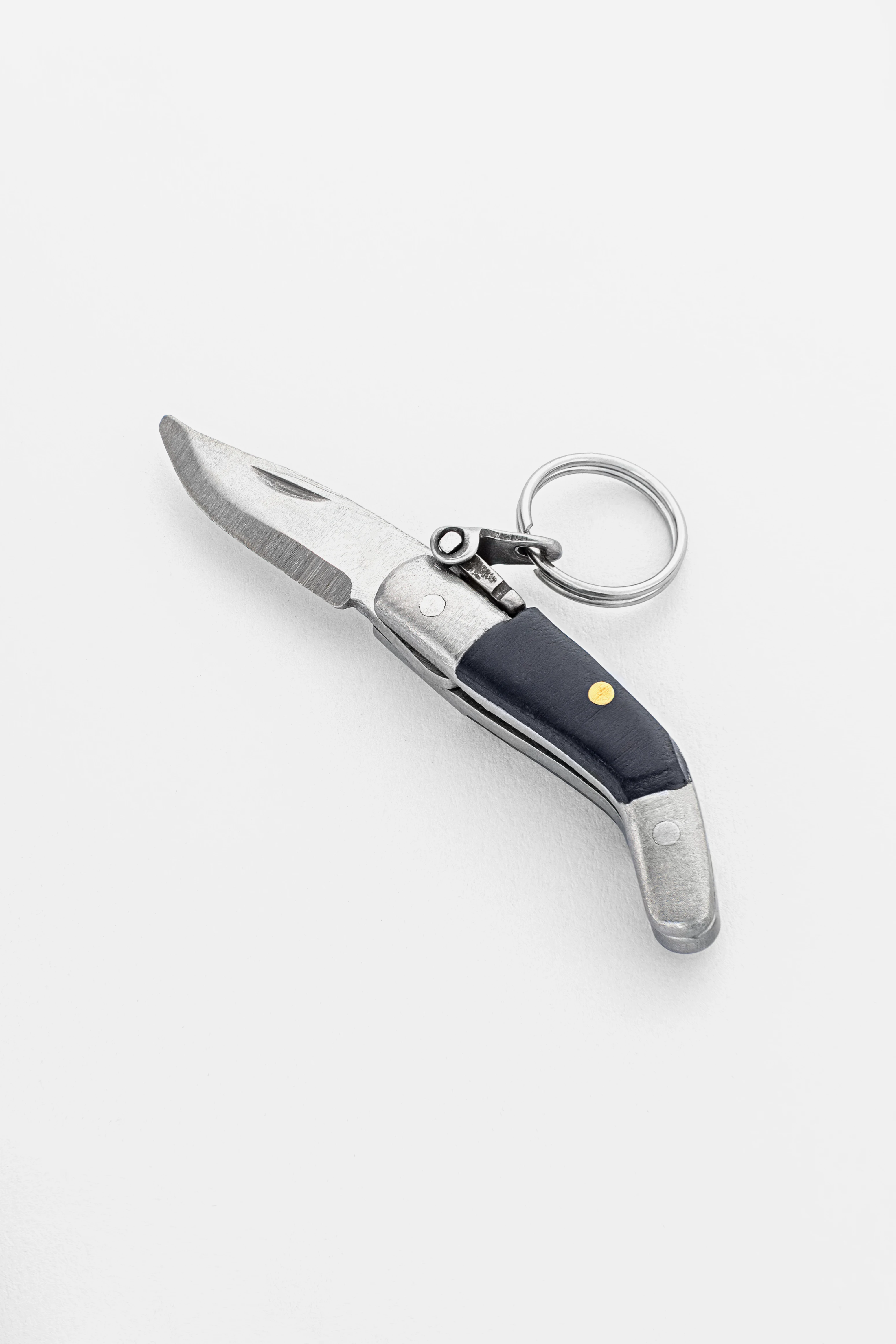
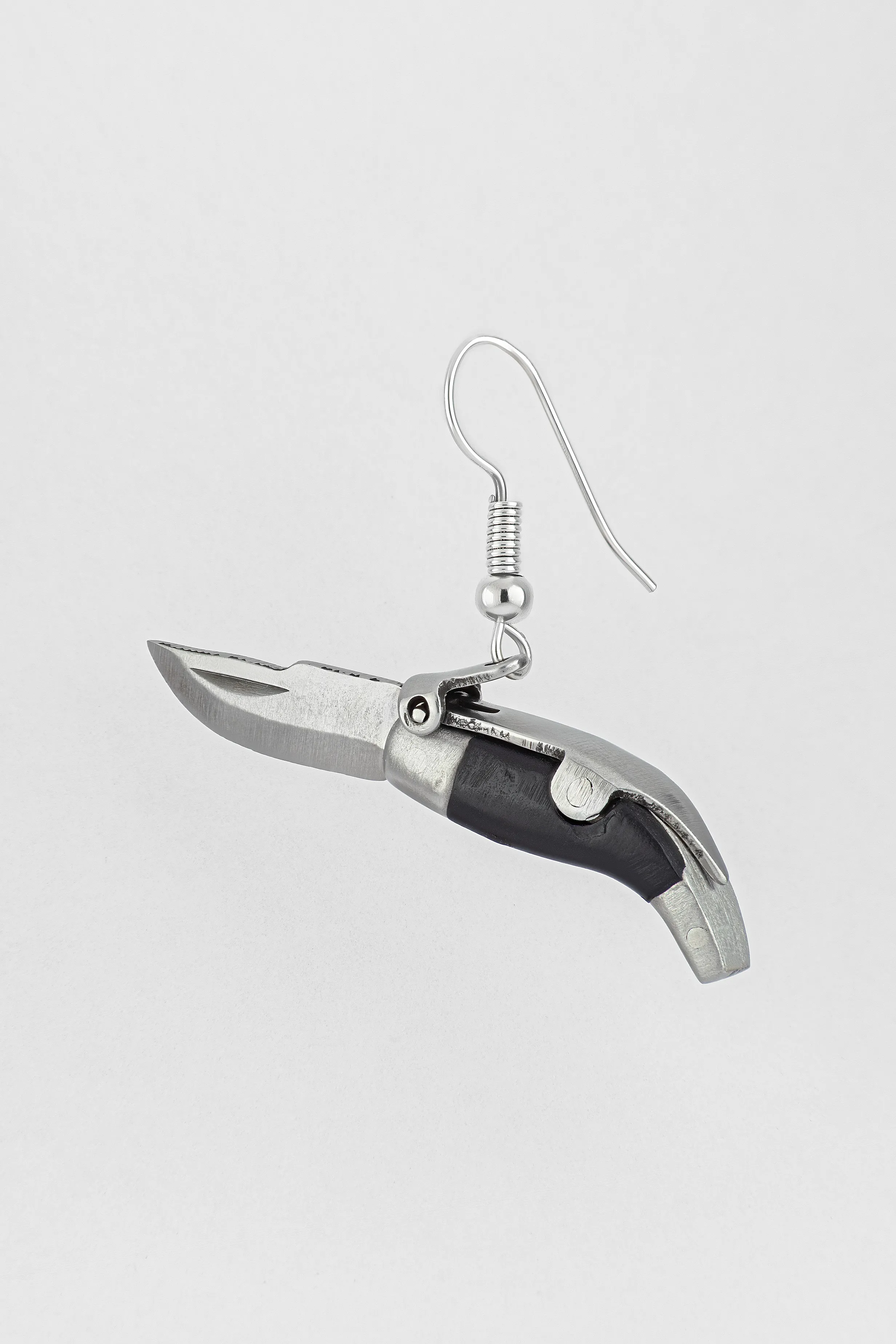
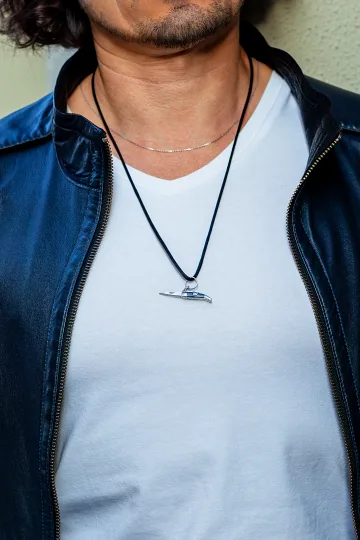
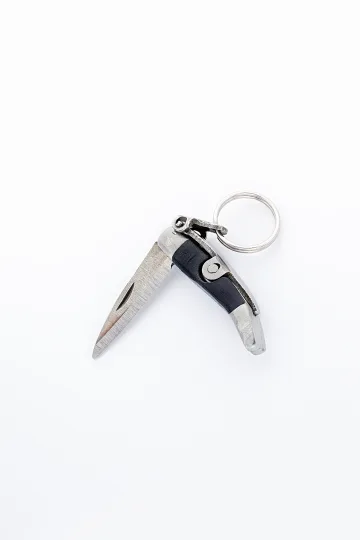
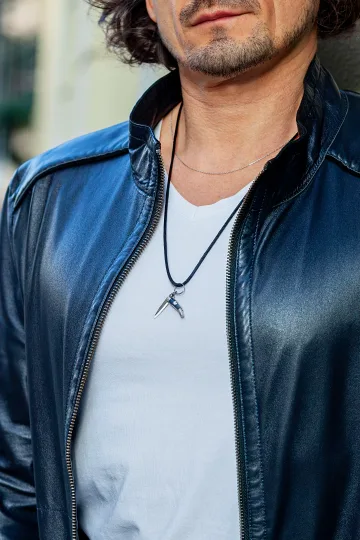
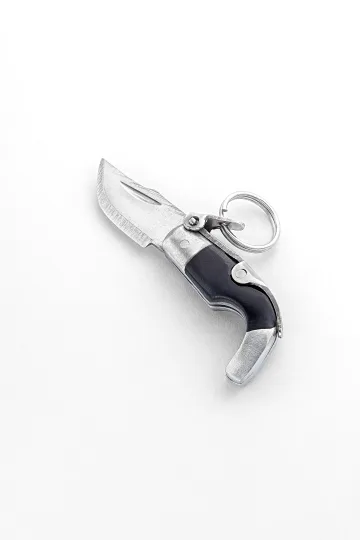
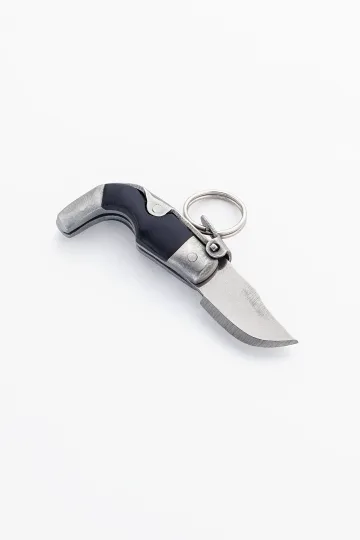
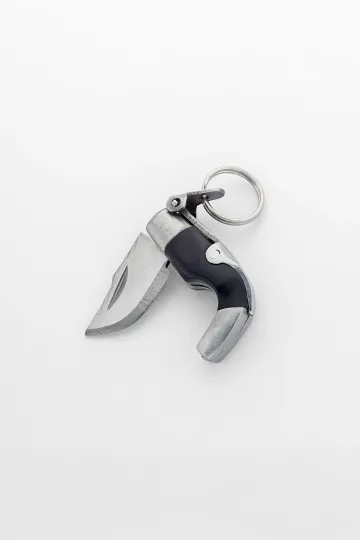
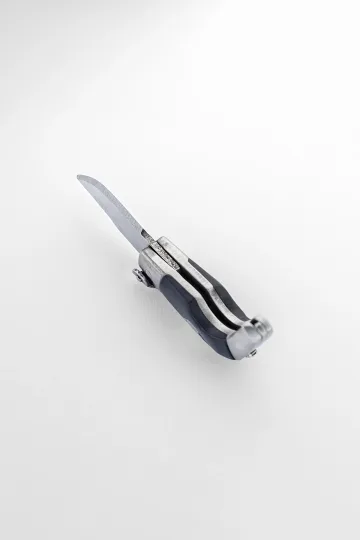
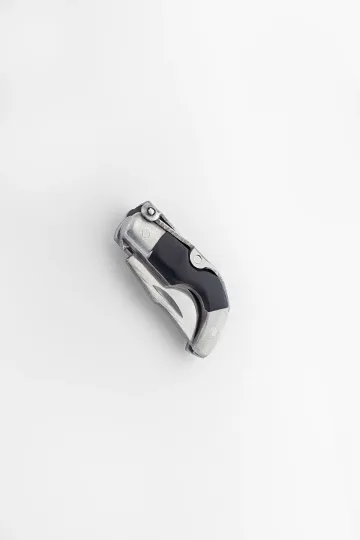
CAPAORA mini knife pendant
The 18th-century Spanish navaja in miniature: 40 mm of stainless steel, a real folding mechanism and a Palanquilla lock that clicks. An affordable gift to remember.
Authentic · Ships from Spain · 14-day returns
Types of snake jewellery and what they mean
Snake rings: the wrap-around and what it symbolises
The snake ring is the most iconic form of serpent jewellery, and it works because the shape is so natural. A snake coiling around a finger looks like it belongs there. It does not feel forced or abstract. It feels like the snake chose to be there.
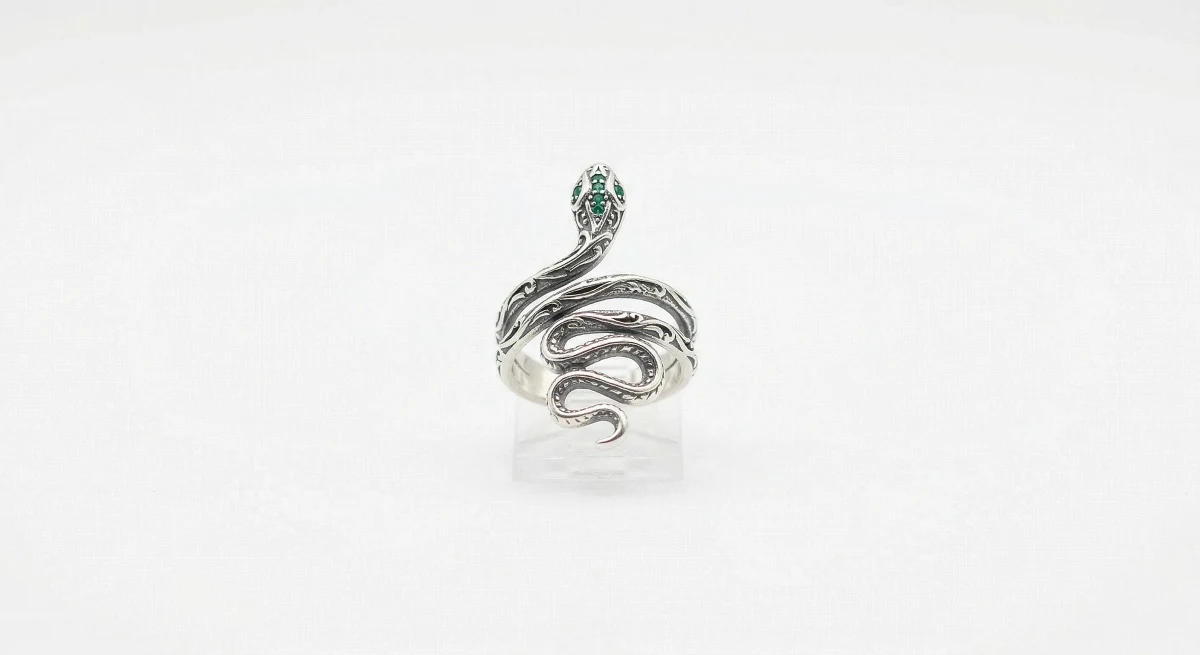
The most common design has the snake wrapping once or twice around the finger, with the head resting on top and the tail trailing away. This creates a sense of movement even in a static piece. The ring looks alive. Variations include double-headed snakes (representing duality), snakes with gemstone eyes (adding personality and colour), and snakes biting their own tail (the ouroboros, representing the cycle of life, death, and rebirth).
The symbolism of a snake ring on different fingers shifts slightly. On the index finger, it reads as authority and intention. On the middle finger, it is balanced and visible. On the ring finger, it references the Victorian love tradition. On the pinky, it carries associations with personal style and independence.
Open-coil designs, where the snake does not complete a full circle, are particularly popular because they fit a range of finger sizes without adjustment. Fully coiled designs that wrap two or three times around the finger make a stronger statement. The choice between them is partly practical and partly about how much presence you want the piece to have.
Snake bracelets: coiling the wrist
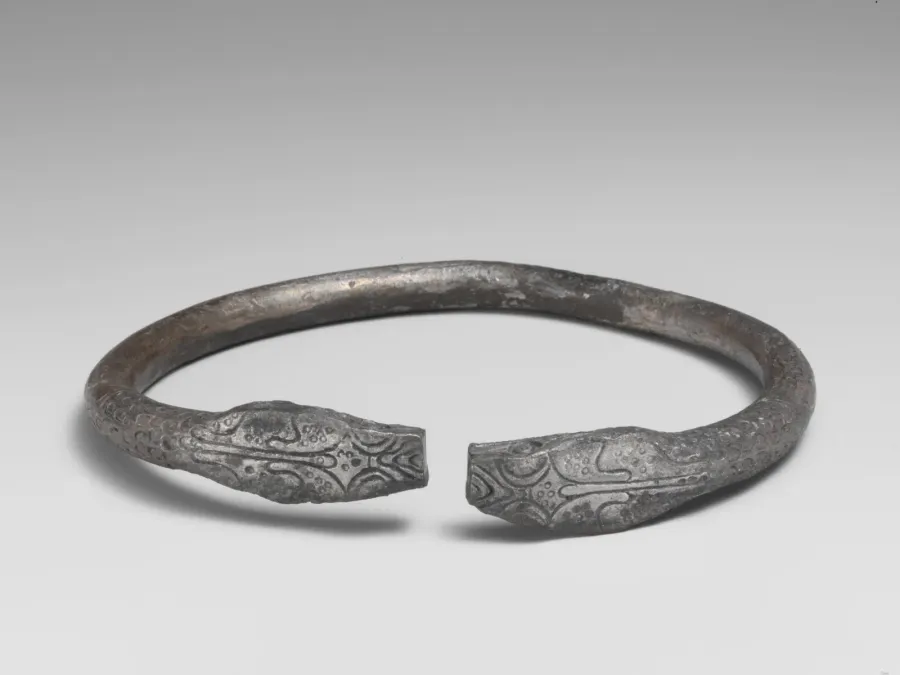
Snake bracelets have been made since at least ancient Egypt and Greece, and the design concept has barely changed. A serpent coils around the wrist one, two, or three times, with the head and tail as the terminals. The simplicity of the concept is part of its genius. The bracelet IS the snake. There is no separation between the form and the function.
In the Victorian era, snake bracelets were among the most popular jewellery pieces produced. In the Art Nouveau period, they became sculptural masterpieces. In the Italian high jewellery tradition, they became enduring icons.
A coiling snake bracelet carries the symbolism of protection (the snake guards the pulse point, your life force), transformation (it wraps and rewraps, endlessly), and power (it occupies space, it commands attention).
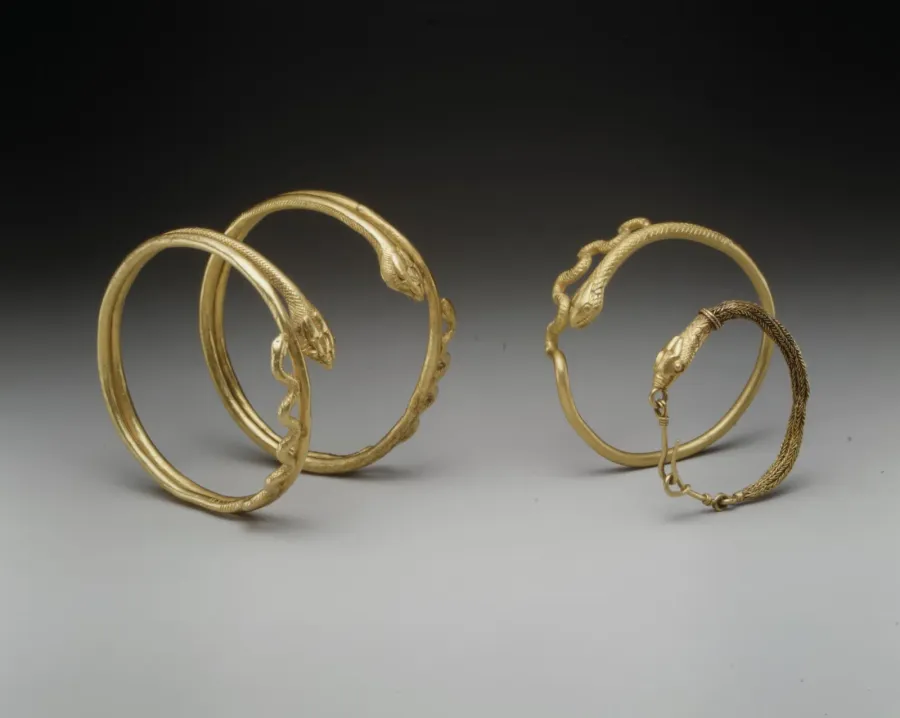
Upper arm versions, known as armlets, have their own history. In ancient Egypt and Greece, snake armlets worn above the elbow were associated with warriors and high-status women. They reappeared in the Victorian era as a romantic gesture and again in Art Nouveau as dramatic fashion statements. An upper arm snake today carries all of that weight: power, status, and deliberate theatricality.
Snake pendants and necklaces
Snake pendants range from small, subtle serpents on delicate chains to statement necklaces where the snake becomes the chain itself. A necklace where the snake body forms the chain and the head serves as the clasp or centrepiece is one of the most elegant designs in all of jewellery.
Snake pendants work particularly well when paired with other symbolic pieces. A snake pendant layered with an eye of destiny or celestial motifs creates a narrative on the body: wisdom, protection, cosmic awareness.
Choker-length snake necklaces, which sit close to the collarbone, have a particular visual impact. They reference the Egyptian practice of wearing wide collar necklaces, and a snake in that position reads as both protective and powerful. A long pendant snake on a chain, by contrast, draws the eye downward and reads as more meditative, more personal.
Snake earrings
Snake earrings are a relatively modern development but have become enormously popular. Designs range from small studs featuring coiled snakes to long drops where the serpent appears to crawl up the earlobe or wrap around the ear. The asymmetrical potential (one snake earring, one plain) adds to their versatility.
Ear cuff designs that wrap around the outer ear have become particularly sought after. They create the illusion of a snake wrapping itself around the ear, which is visually striking without requiring a piercing at all. For anyone who wants dramatic serpent jewellery with minimal commitment, the ear cuff is the answer.
Materials and forms: what to look for in serpent jewellery
The material you choose for snake jewellery affects both the symbolism and the longevity of the piece. Silver has the widest historical precedent in European serpent jewellery. It is the material of the moon, associated with cycles and intuition, and its cool grey tone suits the snake's ambiguous nature. Sterling silver snake rings and pendants photograph especially well.
Gold carries different connotations. Yellow gold connects most directly to the Egyptian tradition, where gold was the colour of the sun and immortality. The pharaoh's uraeus was always gold. A gold snake ring inherits that solar authority. Rose gold, with its warmer tones, reads as more romantic, more aligned with the Victorian love tradition.
Oxidised silver, which is deliberately darkened to create depth in the details, is particularly effective on snake pieces because it emphasises the scales and makes the three-dimensional quality of the design visible even in small pieces. The contrast between polished high points and darkened recesses brings the snake to life.
For gemstones, the most historically significant choices are emerald (which Victoria wore in her snake ring's head, and which carries associations with wisdom and growth), ruby (for the eyes, representing life force and passion), and onyx or jet (used in Victorian mourning jewellery, now associated with power and gravity). A snake with a single gemstone eye is one of the most effective designs in symbolic jewellery: the eye suggests intelligence, attention, and awareness.
The quality of scale detail matters enormously. A snake with individually carved or engraved scales is a different category of object from one with merely implied texture. The scale pattern on a well-made snake piece catches light differently at every angle, giving the piece an organic quality that makes it feel alive in a way that few other jewellery forms achieve.
Leave your email, we'll send your discount code. No spam, unsubscribe anytime.
The code arrives by email, valid on your first order.
How to wear and care for serpent jewellery
Snake pieces work well mixed with other symbolic jewellery, but they also hold their own as single statement pieces. A snake ring on the index or middle finger draws attention when you gesture, which is part of its appeal. Layering a snake ring with plain bands on adjacent fingers gives it context without competition.
For care, the detailed surface of a good snake piece requires slightly more attention than a plain ring or pendant. Scales and carved details trap soap residue and debris over time. The simplest maintenance is a soft brush (a clean toothbrush works well) with warm water every few weeks, followed by drying with a soft cloth. Avoid ultrasonic cleaners on pieces with stones set in the eye sockets, as vibration can loosen settings in small calibrations.
Sterling silver snake pieces will develop a patina in the recesses of the scale detail over time. Many wearers consider this an improvement, as it deepens the visual contrast and gives the piece more character. If you prefer the silver bright, a silver polishing cloth works on the raised surfaces without necessarily reaching the recesses. Oxidised pieces should not be polished at all, as polishing removes the intentional darkening.
Gold pieces require less maintenance but should still be cleaned periodically. A drop of mild dish soap in warm water, a soft brush, a rinse, and a dry cloth is all that is ever needed. Remove snake rings before activities that might bend them, such as heavy lifting. The coiled form of most snake rings means they can be distorted if subjected to significant lateral pressure.
Store snake pieces away from other jewellery to avoid scratching. The scale detail and any stone settings can be damaged by contact with harder pieces. A soft pouch or a lined box compartment is ideal.
Snakes in the mind: dreams, fear, and fascination
Freud, Jung, and the serpent in the unconscious
Sigmund Freud, inevitably, saw the snake as a phallic symbol. In Freudian dream analysis, a snake represents repressed sexual energy, masculine power, or anxieties around sexuality. If you dream about snakes in Freud's framework, it is about desire and its discontents.
Carl Jung took a broader view. For Jung, the snake was a symbol of the unconscious itself: the deep, instinctual layer of the psyche that lies beneath our rational, civilised surface. A snake appearing in a dream signalled that the unconscious was active, that something buried was trying to surface. It could represent transformation (shedding skin), healing (the Asclepian tradition), or confrontation with the shadow, the hidden parts of yourself that you have not yet integrated.
Jung also connected the snake to the archetype of the ouroboros, the self-consuming, self-renewing cycle that he saw as fundamental to psychological wholeness. In Jungian thought, you cannot become a complete person without confronting your own serpent nature: the dark, the instinctual, the parts that make you uncomfortable.
Whether or not you subscribe to Freudian or Jungian psychology, the fact that both of the 20th century's most influential psychologists gave the snake a central role tells you something about its psychological power. The snake sits at the intersection of fear and fascination, and that intersection is where the most powerful symbols live.
Why we fear snakes and wear them anyway
Ophidiophobia, the fear of snakes, is one of the most common phobias in the world. Evolutionary psychologists argue that it is an adaptive trait: humans who feared snakes survived longer than those who did not, so the fear was selected for over millions of years.
And yet we are drawn to them. We put them on our fingers, our wrists, our necks. We pay significant money for the privilege of wearing a creature that triggers our primal alarm system.
This is not contradictory. It is the point. Wearing a snake is an act of mastery over fear. It says: I acknowledge the danger, and I am not controlled by it. I can take the most threatening thing in nature and make it beautiful. I can transform fear into adornment.
That psychological shift, from fear to fascination, from threat to beauty, is one of the deepest things a piece of jewellery can do. It is also, not coincidentally, exactly what the snake itself represents: transformation.
What wearing a snake means today
The meaning of a snake piece depends on the wearer, but some common threads emerge.
Transformation. You are someone who has shed a skin, changed a life, or emerged from something difficult as a different person. The snake is your proof that change is possible.
Wisdom. Not academic wisdom, but the lived kind. The kind that comes from experience, from mistakes, from paying attention. The snake observes before it acts. So do you.
Protection. Like Wadjet on the pharaoh's crown, a snake piece can function as an amulet. It says: do not underestimate me. I have my own defences.
Eternal love. Following the Victorian tradition, a snake ring given as a gift carries the meaning of endless devotion, love with no beginning and no end.
Feminine power. From the Minoan Snake Goddess to Cleopatra to the Art Nouveau serpent women, the snake has a long association with feminine strength, independence, and self-possession.
Healing. Following the Asclepian tradition, a snake can represent recovery, resilience, and the process of becoming well.
Rebellion. In the post-Eden Western context, the snake still carries a hint of the outsider, the one who questions the rules, the one who chooses knowledge over obedience. For some wearers, that is exactly the point.
The beauty of the snake as a symbol is that all of these meanings can coexist in a single piece. You do not have to choose. The snake holds them all.
Send a friend a discount code, they save on their first order.
Frequently asked questions about snake jewellery
What does a snake ring mean?
A snake ring can mean many things depending on context and intention. The most common meanings are transformation (the snake sheds its skin), eternal love (the Victorian tradition, where a coiled snake represented love without end), wisdom, protection, and healing. In the context of the ouroboros (a snake biting its own tail), it specifically represents the eternal cycle of death and rebirth.
Is it bad luck to wear snake jewellery?
No. In most cultures around the world, snake jewellery is considered protective and auspicious. In Indian tradition, snake ornaments are worn specifically for good luck and divine protection. In Egyptian tradition, the cobra was the pharaoh's most powerful protective symbol. The idea that snakes bring bad luck is primarily a modern Western folk belief with no deep historical basis.
What does a snake eating its own tail mean?
That is the ouroboros, one of the oldest symbols in human history. It represents eternity, cycles, renewal, and the interconnection of all things. You can read the full story in our ouroboros guide.
Why did Queen Victoria have a snake engagement ring?
Prince Albert gave Victoria a snake ring because, in the 1830s, the serpent symbolised eternal love and wisdom. The ring was gold with an emerald (Victoria's birthstone) set in the snake's head and rubies for eyes. Victoria treasured it for life, and it set the fashion for snake jewellery across the entire Victorian era.
Why is Italian snake jewellery so famous?
Mid-twentieth-century Roman workshops popularised the flexible serpent bracelet from the late 1940s onward, refining a tubular gold construction that coiled around the wrist like a living snake. The look became closely tied to the film glamour of the early 1960s, when stars in Rome were often photographed wearing serpent pieces. Italian serpent jewellery has remained one of the most recognisable traditions in fine jewellery ever since.
What does a snake symbolise in a dream?
Interpretations vary. In Freudian psychology, snakes in dreams often represent repressed desires or sexual energy. In Jungian psychology, they represent the unconscious mind and the process of transformation. In many folk traditions, dreaming of a snake is a sign of change, healing, or the need to pay attention to something you have been ignoring.
Which finger should you wear a snake ring on?
There is no single rule. Traditionally, the ring finger connects to love symbolism. The index finger represents authority. Many people wear snake rings on the middle finger for maximum visibility. The choice is personal, and any finger works.
Is snake jewellery suitable for men?
Absolutely. Snake jewellery has been worn by men across cultures for thousands of years, from Egyptian pharaohs to Viking warriors to modern musicians. Snake rings in particular have seen a major resurgence in men's fashion. The symbol is inherently gender-neutral.
What is the difference between a snake and a dragon in jewellery symbolism?
In most Western traditions, a dragon is a winged, fire-breathing creature, while a snake is wingless and earthbound. In jewellery symbolism, the snake tends to emphasise cycles, healing, and wisdom, while the dragon carries stronger associations with power, protection of treasure, and raw elemental force. In Norse mythology, Jörmungandr is technically a serpent, while Fafnir from the Völsunga saga is more accurately a dragon. In Eastern traditions, particularly Chinese and Japanese, dragons are serpentine in form and carry broadly positive connotations of imperial power and good fortune. The boundary between the two is cultural rather than fixed.
What metals work best for snake jewellery?
Silver is the most historically common choice for European snake jewellery and suits the symbol's cool, ambiguous quality. Gold, particularly yellow gold, connects to the Egyptian tradition and reads as more solar and authoritative. Oxidised silver, with its deliberate darkening in the recesses, enhances scale detail and is ideal for pieces where the three-dimensional carving is important. Vermeil (gold-plated silver) offers the warmth of gold at a more accessible point and holds detail well. The choice depends on whether you want the snake to read as powerful and warm or precise and cool.
How should I clean and store snake jewellery?
Use a soft brush with warm water for regular cleaning. Avoid ultrasonic cleaners if the piece has stones. Sterling silver will patina in the scale recesses over time, which deepens the visual character. Polish only the raised surfaces if you prefer a brighter finish. Store snake pieces in a separate soft pouch or box compartment, away from harder jewellery that could scratch the scale detail.
Silver and gold jewellery, wedding bands, symbolic pendants, paired sets.
Buying it as a gift? Each one arrives ready to give.
 A branded Zevira box and a little card come with every order.




Conclusion
The snake is not like other symbols. It does not offer simple comfort or a single readable message. It is simultaneously the most feared and the most revered animal in human history, and that duality is precisely what makes it so compelling on the body.
From the uraeus on the pharaoh's crown to Queen Victoria's engagement ring to an Italian heritage serpent bracelet coiled around a wrist in 2026, the snake has never stopped being relevant. It has simply added new layers of meaning with each generation that wears it. Egyptian protection, Greek healing, Indian devotion, Victorian romance, Art Nouveau beauty, modern transformation. All of it is there, all of it is available, every time someone slips a snake ring onto their finger.
If you are considering snake jewellery, know that you are stepping into a tradition that is older than recorded history. The snake was the first animal we feared, the first we worshipped, and the first we wore. It will also be the last. Some symbols fade. The snake never does.
Explore more symbolic jewellery and its meanings at Zevira.
Wear the symbol, don't just read about it. These are in stock:

About Zevira
Zevira makes jewellery in the artisan tradition of Albacete, Spain. The snake is one of those symbols that comes alive in the detail: the worked scales, the raised head, the gemstone eye. Handwork is what gives the body that living line, the very line jewellers were chasing back in ancient Egypt.
Here is what you can find with us on the snake theme:
- Snake rings that coil once or twice around the finger
- Bracelets that wrap the wrist, with engraved scales
- Pendants and necklaces where the snake body becomes part of the chain
- Earrings and ear cuffs with a serpent motif
- The ouroboros: a snake biting its own tail, as a symbol of eternity
- A gemstone eye (emerald, ruby, or onyx) for a striking accent
Every piece can be personalised with engraving, with the option of personal engraving. Sterling silver 925 and 14 to 18K gold.