Tiger's Eye and Hawk's Eye: Why One Stone Shifts From Gold to Blue
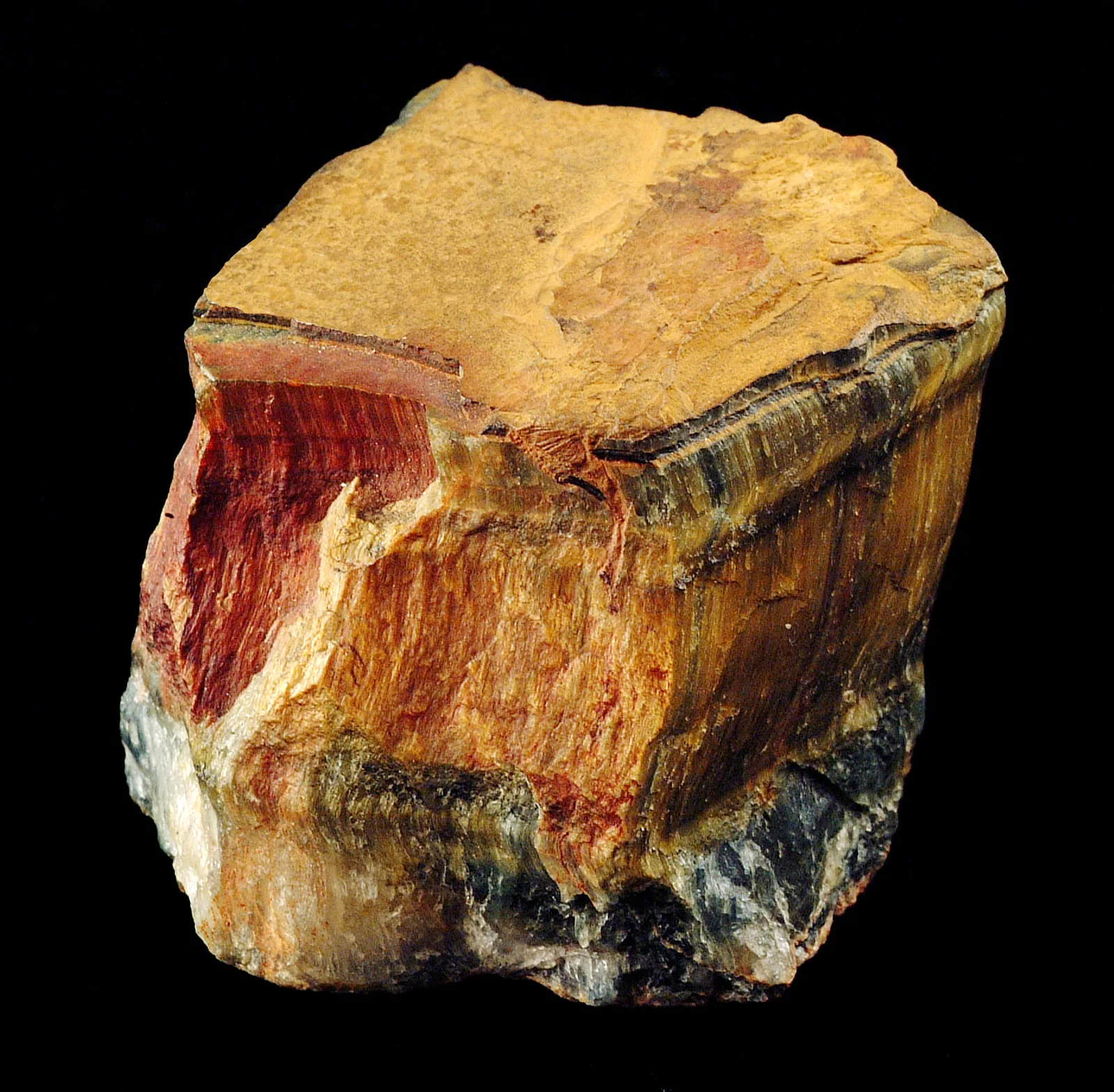
Tiger's eye and hawk's eye are the same stone at two different ages. Nature first builds the bluish-grey hawk's eye, then the iron locked inside it oxidises and rusts, turning the stone into golden-brown tiger's eye. So tiger's eye is essentially an "aged" hawk's eye, and there is a halfway stage where blue and gold zones sit side by side in a single piece. That one goes by bull's eye, or iron's eye.
The effect that gave the stone its name is called chatoyancy, the "cat's eye". Tilt a polished cabochon under a lamp and a narrow band of bright light runs across it, like a pupil that follows you around the room. That band is the reflection off thousands of parallel fibres inside the stone, lying like threads in a length of silk.
Here we will take both stones apart properly: what they are made of, how one turns into the other, where they come from, how to tell them from dyed fakes, and how to look after them. No mysticism, and no promises that a stone will "do" anything on your behalf.
What Cat's-Eye Quartz Is: Composition, Hardness, Optics
Tiger's eye and hawk's eye are varieties of quartz with fibrous inclusions that produce the cat's-eye effect. Both belong to the "cat's-eye" family of quartzes, which also includes pietersite, the "storm in a stone", its closest relative with the same kind of fibrous structure but a swirled rather than straight pattern of light.
Nature took fine mineral needles of the amphibole crocidolite, laid them out in parallel bundles, then slowly flooded them with quartz (silicon dioxide, SiO2). When that mass is cut across the fibres and polished into a domed cabochon, the needles reflect light as a single narrow bright band. That is chatoyancy, the cat's eye.
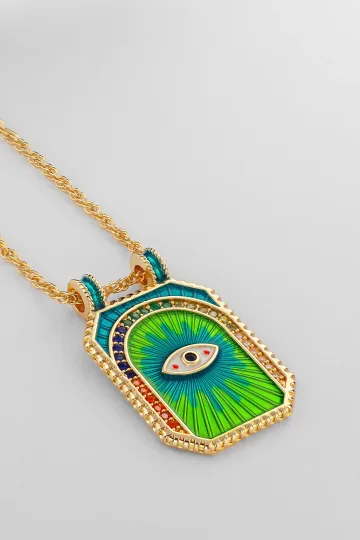
Wear the symbol, don't just read about it. These are in stock:







Chemistry and Physics
The dry facts worth leaning on when you buy:
- Chemistry: a quartz base (SiO2) plus crocidolite fibres (a sodium-iron amphibole), partly or wholly replaced by silica. The colour comes from iron.
- Crystal system: the quartz base is trigonal, but because of the fibrous inclusions the stone behaves as a dense aggregate rather than a single crystal.
- Hardness: about 7 on the Mohs scale, harder than glass and window panes, on a par with ordinary quartz.
- Density: roughly 2.6 to 2.7 g/cm3, meaning 2.6 to 2.7 times heavier than water.
- Refractive index: around 1.53 to 1.55, like quartz. Cat's-eye quartz has no dispersion (the flashes of colour you see in a diamond); its beauty lives in the band of light, not in faceting.
- Lustre: silky thanks to the fibres, almost glassy on a good polish.
- Optical effect: chatoyancy (cat's eye), a narrow band of light that travels across the fibres.
The colour difference between hawk's eye and tiger's eye rests on a single element, iron, and on how far it has oxidised. In hawk's eye the crocidolite fibres are not yet oxidised, so the stone keeps a cool bluish-grey and blue-green tone. In tiger's eye the iron has oxidised into hydroxides (in plain terms, into natural "rust"), and the stone has turned golden-brown, honey, amber.
To the touch a polished stone is cool and smooth. A hardness of 7 is high, above many popular gems, so cat's-eye quartz holds a polish well and is fit for everyday wear. It is sensitive, though, to knocks on the edge of the cabochon and to swings in temperature, more on that below.
Chatoyancy: Where the "Eye" Comes From
The cat's-eye effect comes not from a single embedded "pupil" but from a host of parallel fibres. Light falling on them reflects in such a way that it gathers into one narrow bright line, set at right angles to the run of the fibres. The finer and straighter the fibres, and the better the polish, the sharper and brighter the band.
That is exactly why cat's-eye quartz is always worked as a cabochon, a smooth domed shape with no facets. Faceting would kill the effect: the band of light would shatter and vanish. And the stone is cut strictly across the fibres; a lengthwise cut would turn the "eye" into a dull, flat surface.
The Cat's-Eye Quartz Family
Tiger's eye and hawk's eye are not loners but part of a large family of shimmering quartzes. The difference within the family comes down to colour and how the fibres lie:
- Hawk's eye: bluish-grey, blue-green, sometimes almost steel. Unoxidised crocidolite, straight parallel fibres.
- Tiger's eye: golden-brown, honey. The same stone, but the iron has oxidised and turned ruddy.
- Bull's (iron's) eye: an intermediate stage with reddish-brown and dark zones; sometimes the name is given to heat-treated tiger's eye.
- Pietersite: the fibres run in many directions, crumpled by tectonics, so the light flows not in an even band but in swirling whirls. A wider palette, including a rare stormy blue.
What sets tiger's eye and hawk's eye apart from pietersite is order: their fibres lie even and parallel, so the band of light runs straight. Pietersite has the same starting material, but twisted, so its light flows chaotically.
An Honest Frame on Symbolism
Cat's-eye quartz is credited with qualities of character: protection, confidence, clarity of sight. That is part of the culture of stones and crystal lore, not a property of the mineral. There is no proven effect on the mind or the body. There is more on symbolism below, in its own short section, kept in proportion.
Geology: How Hawk's Eye Becomes Tiger's Eye
To make sense of both stones, picture a slow chemical reaction stretched over millions of years. It all begins with the fibrous mineral crocidolite. This is a blue asbestiform amphibole that grows in fine parallel needles.
Stage One: Hawk's Eye
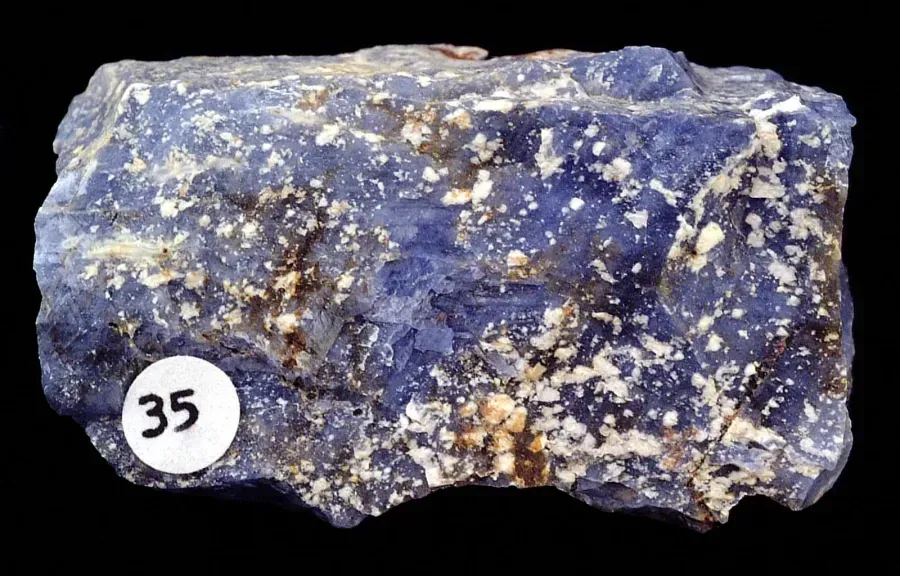
First, silica-rich solutions start to replace the crocidolite fibres with quartz, while the blue colour still survives. The fibres lie in even bundles, the quartz soaks through them, and when such rock is polished it gives a cool blue-grey sheen with a cat's-eye effect. This is hawk's eye, the earlier, unoxidised stage.
Stage Two: Oxidation and Tiger's Eye
Over time the iron inside the fibres oxidises: it turns into iron hydroxides, which are essentially natural rust. The blue fades and gives way to a golden-brown, honey range. The stronger the oxidation, the warmer and richer the stone becomes. That is how hawk's eye turns into tiger's eye.
What happened to the rock, step by step:
- First, fine parallel fibres of blue crocidolite grew.
- Silica-rich solutions began replacing them with quartz while keeping the structure, and so hawk's eye was born.
- The iron in the fibres slowly oxidised into hydroxides.
- The blue tone gave way to gold and brown, and tiger's eye emerged.
- In the transitional zones blue and gold sat together, and that is bull's eye.
This is why nature throws up pieces where a single slab shows both blue and gold bands: the stone froze halfway through its transformation. Such specimens are prized in particular, because in them you can see the geological reaction itself.
South Africa: The Main Source
Most of the world's tiger's eye and hawk's eye comes from South Africa, above all from the Northern Cape near the town of Prieska. There you find ancient ironstone beds in which the crocidolite formed. South African material is regarded as the benchmark for fibre quality and the strength of the optical effect.
Australia, Namibia and Other Countries
Tiger's eye is also mined in Western Australia, where deep reddish-brown tones turn up. Hawk's eye and tiger's eye are recorded in Namibia, India, Myanmar, Brazil, the United States and Canada. The Namibian deposits are interesting because pietersite, the twisted, "stormy" cousin of cat's-eye quartz, is found there too. Quality and shade depend a great deal on the source: Australian tiger's eye tends to be warm and reddish, the South African a classic golden-brown.
From Vein to Jewellery
- Mining. Rock with fibrous veins is taken from the ironstone beds.
- Sorting. The rough is graded by colour, fibre direction and the strength of the sheen.
- Sawing. Blocks are cut strictly across the fibres, to catch the cat's-eye effect.
- Shaping. Slabs are formed into cabochons, smooth domed shapes with no facets.
- Polishing. The surface is brought up to a mirror, or the band of light will not open up.
- Matching and setting. The stone is set in metal; for earrings, a pair of cabochons close in tone and sheen direction is chosen.
At every step some material is lost, but cat's-eye quartz is common and inexpensive overall, which keeps it one of the most affordable shimmering stones.
Customer reviews
Zevira is a real jewellery shop. Genuine payments, deliveries and customer thank-yous.
🥰🥰🥰 gracias
Ok, ¡gracias! 🙂
A tiger's eye owns the room on its own. Sit a second shimmering stone beside it and both die on the spot. One eye per body, no arguments.
What to Wear With Tiger's Eye and Hawk's Eye
Over years on shoots, dozens of rings and pendants with this stone have passed through my hands. Here is what actually works, sorted by occasion. One rule holds throughout: the band of light already draws the eye, so the clothing around it should be a background, not a rival.
What do I wear golden tiger's eye with every day? For daily wear I recommend golden tiger's eye against a warm, earthy range: beige, ochre, brown, khaki, tweed, suede, knitted textures. A pendant on a leather cord or a beaded bracelet reads calm and easy. The warm stone asks for warm metal, so I suggest yellow or rose gold, or brass.
And what does cool hawk's eye go with? Bluish-grey hawk's eye I choose for a cool palette: grey marl, dark denim, black, graphite, a white shirt. For metal I reach for the cool end: sterling silver, steel, white gold. That way the stone and the setting speak in one key instead of arguing.
What do I pair it with for the office? For the office I suggest a restrained format: a small cabochon in a ring or earrings, no heavy signets. Tiger's eye sits well with a warm-toned business wardrobe, hawk's eye with a cool suit. One tidy stone reads as a quiet detail rather than a loud accent.
How do I build an evening look? For evening I choose a large cabochon pendant on a bare neck or a chunky ring that catches the light at every gesture. A smooth fabric in a deep colour works better as a backdrop than a busy print. An open zone at the collarbone or a free wrist gives the stone room to show its band of light in full.
Can I layer it with other stones? Here I recommend restraint: cat's-eye quartz does not like a crowd of shimmering neighbours. Two different moving sheens side by side cancel each other out. Give the stone calm company: smooth silver or gold, a matte companion stone, and its band of light stays the hero.

Turn on your camera, pick earrings, a pendant or a ring, and see the piece on yourself in real time.
Switch items in one tap.
Everything runs in your browser: no photo or video is ever uploaded.
History: An Ancient Warrior's Amulet and the Eye of a God
Unlike pietersite, which was only discovered in the twentieth century, tiger's eye has been known to people for a very long time. It is one of the old ornamental stones, around which genuine traditions grew up, rather than ones invented by sellers.
Ancient Egypt and the "All-Seeing Eye"
In ancient Egypt golden striped stones were linked with the sun and with the gaze of the gods. Tiger's eye and similar materials were used for the eyes in statues of deities: the shimmering band was thought to give the image a "living" gaze. The stone carried protective, solar symbolism, a tie to Ra and to the idea of the all-seeing eye.
Rome: The Soldier's Stone
Roman legionaries, by some accounts, wore carved tiger's eyes as talismans before battle. The stone was held to be a charm that lent courage and guarded against wounds. This reputation as a "warrior's stone" has lasted to our own day: tiger's eye is still linked with courage and resilience.
A Nineteenth-Century Puzzle: A Pricing Mistake
A curious historical episode: in the nineteenth century tiger's eye was valued extremely highly, almost as a precious gem, because its sources were unknown and the material was thought rare. When large deposits were found in South Africa late in the century, the price crashed, and the stone went from costly rarity to an affordable ornamental material. It is a good lesson: a gem's worth often rests not on its properties but on a belief in its scarcity.
Why the Stone Has a Solid Reputation for Protection
Tiger's eye's protective symbolism grew out of its looks. The band of light gliding across the surface reads as a wary, watchful gaze, "an eye that never sleeps". Hence the durable link with the guardian, with protection and watching. This symbolism was not dreamed up recently; it reaches back to antiquity.
A Timeline in Dates
- Ancient Egypt: shimmering stones used for the eyes in statues of gods, symbolism of the sun and protection.
- Ancient Rome: legionaries wear carved tiger's eyes as battle talismans.
- Nineteenth century: the stone is highly valued because its sources are unknown.
- Late nineteenth century: large deposits are found in South Africa and the price crashes.
- Twentieth to twenty-first centuries: tiger's eye and hawk's eye become common, affordable ornamental stones.
Upload a photo of your pet, someone you love, or an object. We'll build a 3D model and hand-cast it in pewter.


Types and Shades: From the Blue Hawk to the Golden Tiger
Although it is, in essence, one stone at different stages, by colour you can pick out several recognisable types.
Hawk's Eye (Bluish-Grey)
The early, unoxidised stage. A cool blue-grey, blue-green, sometimes almost steel tone with a silky sheen. Named for its likeness to the eye of a bird of prey. Hawk's eye is a touch scarcer than tiger's eye and is valued for its restrained, "northern" palette. It is sometimes called hawk-eye, and that is the same thing.
Tiger's Eye (Golden-Brown)
The best-known and most common variety. A warm golden, honey, amber-brown with a bright travelling band of light. Named for its likeness to a predator's eye and for the striping that recalls a tiger's coat. The cleaner the gold and the brighter and straighter the band of sheen, the higher the value.
Bull's (Iron's) Eye
An intermediate or treated stage: reddish-brown, dark red, almost black tones. It results when tiger's eye is heated (naturally in the earth or artificially), and the iron gives a deeper red. A dramatic option, loved for its warmth and richness.
Multicoloured (Blue-Gold)
The most interesting specimens combine blue and gold zones in a single piece, a frozen moment of hawk's eye turning into tiger's eye. Such stones are prized because the whole geological story is visible at once.
The palette of cat's-eye quartz:
- Golden-brown: classic tiger's eye, the most frequent.
- Honey and amber: warm, "sunny".
- Bluish-grey: hawk's eye, restrained and cool.
- Blue-green: a rarer shade of hawk's eye.
- Reddish-brown: bull's eye, dramatic.
- Blue-gold: transitional, prized by collectors.
What Matters More Than Colour: The Strength and Sharpness of the "Eye"
The value of cat's-eye quartz rests on two things: colour and the quality of the chatoyancy. The band of light should be bright, narrow, even and mobile, running across the stone as you turn it. A dull, blurred or broken sheen lowers the value even with a lovely colour. When choosing, always turn the stone under a lamp: the real beauty reveals itself in motion.
What to ask the seller:
- Which stone is it: tiger's, hawk's or transitional.
- Natural colour, or dyed or heated.
- How bright and even the band of light is.
- Whether the sheen is whole, or there are cloudy, broken patches.
- Whether there are chips on the edge of the cabochon.




How to Tell Cat's-Eye Quartz From Similar Stones and Fakes
Tiger's eye is a cheap stone, so it is faked less often than expensive gems. But dyed versions turn up frequently, especially the bright-blue, red and green "tiger's eyes" that do not exist in nature. Let us go through the differences.
The Main Sign of Authenticity: A Moving Band
Genuine cat's-eye quartz shows a narrow bright band of light that runs across the stone as you turn it under a lamp. That is the cat's eye. Glass and plastic rarely give such a live, moving sheen: in imitations it is either dead or painted on. Always ask to turn the stone.
Cat's-Eye Quartz and Its Doubles
- Pietersite: the band of light is not straight but swirled into whirls, with a wider palette. If the sheen "flows" chaotically, it is pietersite, not tiger's eye.
- Cat's eye (chrysoberyl): also gives chatoyancy, but it is a different, dearer and harder mineral with a sharper, brighter band.
- Glass with a fibrous coating ("ulexite", "fibreglass"): an artificial material with a very even, "perfect" eye and air bubbles inside.
- Dyed quartz or agate: an unnatural bright blue, red, green or purple, with dye sitting in cracks.
Signs of a Dyed Fake
Natural tiger's eye comes in gold, brown, honey, reddish-brown; hawk's eye in blue-grey and blue-green. A bright-blue, neon-red, emerald-green, pink or purple "tiger's eye", on the other hand, is almost always a dyed or heat-treated stone.
- An unnaturally bright, "chemical" colour the stone never shows in nature.
- A concentration of dye visible in cracks and along the girdle.
- A colour that is even and flat, without natural transitions.
- A shade that fades or shifts in the sun over time.
A note: moderate heating to deepen the red tone (bull's eye) is a common and usually honest practice, not deception. The problem lies specifically in hidden bright dyeing passed off as natural colour.
Glass and Plastic
Cheap imitations are made of glass or plastic with a fibrous coating. They are given away by air bubbles inside, warmth to the touch (glass and plastic warm in the hand faster than stone), a suspiciously light weight, and a too-even, "correct" eye without a single flaw. Natural quartz is cool and heavier than plastic.
A Buyer's Checklist
- Turned the stone under a lamp: the band of light is bright, narrow and mobile.
- The colour is natural for the stone: gold, honey, brown, blue-grey.
- No build-up of dye on the girdle or in cracks.
- The stone is cool and a little heavy for its size.
- No bright neon blues, reds or greens passed off as natural.
Leave your email, we'll send your discount code. No spam, unsubscribe anytime.
The code arrives by email, valid on your first order.
Care and Storage
A hardness of 7 makes cat's-eye quartz tough and easy to wear day to day; it is harder than most household surfaces and holds a polish well. But the "eye" lives on the polish, and the fibrous structure is sensitive to knocks on the edge and to swings in temperature. A few simple habits add years to the stone's life.
What to Do and What to Avoid
You can:
- Wipe it with a soft dry or slightly damp cloth.
- Store it in a separate soft pouch or a fabric-lined compartment of a box.
- Now and then rinse it under cool water and dry it at once.
You should not:
- Soak it for long, especially in hot water.
- Clean it with ultrasonic baths or steam: vibration and a sharp rise in heat are dangerous for the fibrous structure.
- Use abrasives, baking soda, salt or harsh household chemicals.
- Drop it onto tiles or stone, as the edge of the cabochon may chip.
- Store it loose with hard stones (diamond, corundum, topaz) that will scratch the polish.
- Leave it under direct scorching sun for hours: dyed stones fade, and overheating is undesirable for natural ones too.
Take the jewellery off before sport, cleaning with chemicals, the shower and sleep. Keep perfume and cosmetics off the stone itself.
How Hardness Affects Wearability
A hardness of 7 is one of cat's-eye quartz's advantages: it is harder than the rock crystal in glass, and enough that the stone does not scratch in ordinary life. So tiger's eye suits rings and bracelets worn every day. In a ring, choose a setting that covers the edge of the stone, which shields the cabochon from knocks. A beaded bracelet will survive active wear better than a fragile cabochon edge in a ring.
If the Polish Goes Dull
Over time, friction against cloth and skin can wear the gloss slightly, and the "eye" turns duller. This is normal and fixable. Do not polish the stone at home with pastes: it is easy to ruin the geometry of the cabochon. Take the piece to a jeweller or a lapidary; re-polishing takes only minutes and brings the sheen back. It is a rare procedure, usually once every few years with active wear.
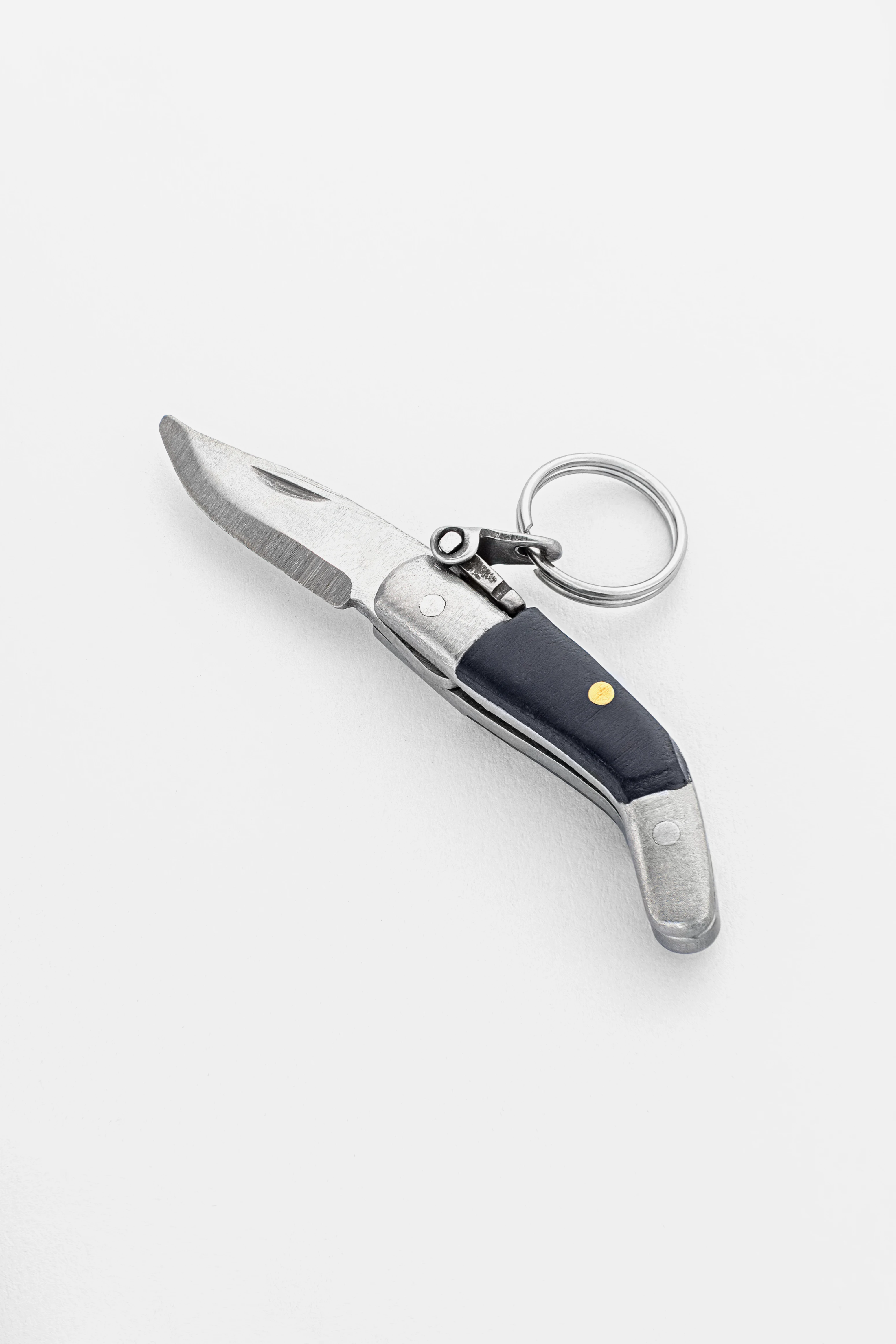
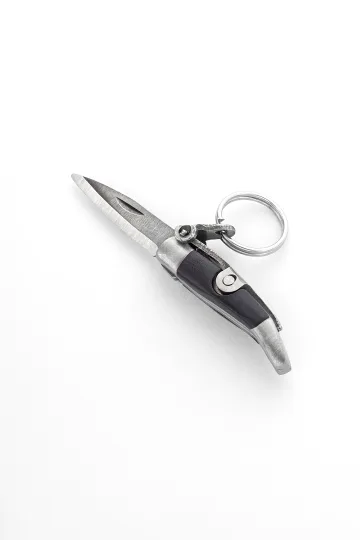
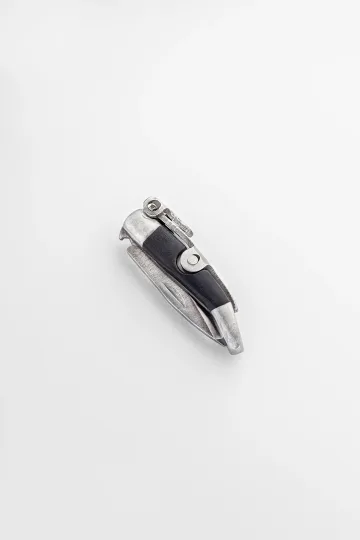
CAPAORA mini knife pendant
The 18th-century Spanish navaja in miniature: 40 mm of stainless steel, a real folding mechanism and a Palanquilla lock that clicks. An affordable gift to remember.
Authentic · Ships from Spain · 14-day returns
Symbolism: What Tradition Says
Everything below is cultural symbolism and crystal-lore tradition, not a medical or physical fact. The mineral has no proven effect. We describe what people believe, not what will "happen".
In tradition, cat's-eye quartz is credited with several themes, and almost all of them grew out of the stone's appearance:
- Protection and watchfulness. The band of light reads as a wary gaze, "an eye that never sleeps", hence the reputation of a guardian stone. Tiger's eye shares this theme with other "protective" minerals; tradition assigns similar symbolism of warding off and grounding to black tourmaline too.
- Confidence and courage. From the ancient reputation of a "warrior's stone" grew a modern association with resolve and self-reliance.
- Clarity of sight. The golden tiger's eye is linked with practicality and a level-headed decision, the blue hawk's eye with a more detached, "bird's" view from above.
The stone "does" nothing by itself. If it supports a person at all, it does so as any meaningful reminder object does, through attention and habit, not through some mystical radiation. There is nothing shameful in that, but nothing to overstate either.
Jewellery With Cat's-Eye Quartz: Rings, Pendants, Earrings, Bracelets
Tiger's eye and hawk's eye are versatile and inexpensive stones, so everything is made from them: from chunky men's rings to slim beaded bracelets. Let us go through them by type of jewellery and by setting metal.
Rings
A ring is a good way to show off the "eye": the stone is always in motion with the hand, and the band of light runs across it with every gesture. A cabochon is used, a smooth domed shape with no facets, because that is what opens up the chatoyancy. A faceted cut does not suit cat's-eye quartz: facets break up the band of light.
Warm gold (yellow or rose) supports the honey tone of tiger's eye. Cool sterling silver works well with the bluish-grey hawk's eye. A chunky cabochon in a plain setting looks restrained and masculine.
What to look for:
- The setting covers the edge of the stone: this protects the girdle from chips.
- The cabochon sits firmly and does not wobble.
- The band of light shows and moves as you turn your wrist.
- The size is in proportion to the hand.
Pendants
A pendant is the format for a large stone, where the whole band of light is on show. Worn on a chain or a leather cord. A tiger's eye pendant is a classic men's piece; hawk's eye reads sterner and cooler.
Earrings
In earrings, cat's-eye quartz calls for a matched pair: the two cabochons must agree in tone and in the direction of the band of light. Light, small cabochons in silver or gold make a fine everyday choice. The clasp should be secure.
Bracelets
A beaded bracelet is the most affordable and popular format. Beads of 8 to 10 mm on an elastic cord show several "eyes" at once, running around the circle as you turn your wrist. The format is sturdier than a fragile cabochon in a ring and survives active wear. Tiger's eye is easy to combine with other stones.
Men's Accessories
Thanks to its restrained golden-brown tone, tiger's eye is one of the most "masculine" stones. It is made into cufflinks, signet rings, prayer beads, tie clips and chunky rings. Bull's eye and hawk's eye add depth and coolness to the same masculine line.
The Metal Colour to Suit the Stone Colour
- Golden and honey tiger's eye: yellow and rose gold, brass. Warm to warm.
- Reddish-brown bull's eye: rose and yellow gold.
- Bluish-grey hawk's eye: sterling silver, platinum, white gold. Cool to cool.
- Blue-green hawk's eye: silver, steel.
- Men's pieces: steel, titanium, oxidised silver.
Steel and titanium also suit those with a silver allergy. The main thing in a setting is protection for the cabochon edge from knocks.
Send a friend a discount code, they save on their first order.
Frequently Asked Questions
What is tiger's eye in plain terms?
It is an ornamental stone, a variety of quartz with parallel fibrous inclusions that reflect light as a narrow bright band. As you turn it under a lamp, that band runs across the stone like a pupil, which is why it was called an "eye". Tiger's eye is golden-brown, honey. With a hardness of about 7 on the Mohs scale, the stone is tough, inexpensive and very common.
How does tiger's eye differ from hawk's eye?
They are the same stone at different stages. Hawk's eye is the earlier, unoxidised stage: bluish-grey and blue-green in tone. Tiger's eye is the later one: the iron inside the fibres has oxidised into hydroxides (essentially rust), and the stone has turned golden-brown. So tiger's eye is an "aged", oxidised hawk's eye. There are also transitional pieces where blue and gold sit together in one stone.
Why does the stone change colour when you turn it?
It is the cat's-eye effect, chatoyancy. Inside the stone lie thousands of fine parallel fibres. Light reflects off them so that it gathers into one narrow bright band across the fibres. As you turn the cabochon, the band glides over the surface, as if alive. The colour of the stone does not change; only the shining line of light moves.
Where are tiger's eye and hawk's eye mined?
The main source is South Africa, above all the area near the town of Prieska in the Northern Cape. There lie ancient ironstone beds in which the crocidolite formed. Tiger's eye is also mined in Western Australia (where reddish tones occur), and hawk's eye and tiger's eye in Namibia, India, Myanmar, Brazil, the United States and Canada.
Which cat's-eye quartz is dearer?
On the whole both tiger's eye and hawk's eye are inexpensive, affordable stones. Hawk's eye is a touch scarcer than tiger's eye, so it sometimes costs a little more. But what settles it is not colour but the quality of the effect: a stone with a bright, narrow, even "eye" and no cloudy zones is valued above a dull example of any shade. Transitional blue-gold pieces are prized by collectors.
Is there such a thing as dyed tiger's eye?
Yes, and fairly often. The natural stone comes in gold, brown, honey, reddish-brown and blue-grey. A bright-blue, neon-red, emerald-green, pink or purple "tiger's eye", though, is almost always dyed or artificially treated quartz. Signs of dyeing: an unnaturally bright "chemical" colour, dye in cracks, fading in the sun. Moderate heating to deepen the red (bull's eye) is an honest and common practice.
Can you wear tiger's eye every day?
Yes. Its Mohs hardness is about 7, harder than glass and most household surfaces, which is enough for everyday wear, so the stone suits rings and bracelets well. But it does not like sharp knocks against hard surfaces: a chip can form on the edge of the cabochon, so in a ring choose a setting that covers the girdle. Take the jewellery off before sport, cleaning with chemicals and sleep.
Can you get tiger's eye wet?
Brief contact with cool water does no harm: the stone can be rinsed and wiped with a soft cloth. But long soaking is undesirable, especially in hot water. Cat's-eye quartz is quartz with fibrous inclusions, and sharp swings in temperature can affect the stone over time. Salt and salt solutions are best avoided: salt is abrasive. Take the jewellery off before the shower, the sauna and swimming.
What is bull's eye?
Bull's, or iron's, eye is tiger's eye with a deeper red and reddish-brown colour. It forms when tiger's eye is heated: naturally inside the earth or artificially in treatment. With heating the iron gives a richer red tone. It is the same variety of quartz, just "hotter" in colour. Moderate heating for bull's eye is an ordinary and honest jewellery practice.
Is tiger's eye a precious or semi-precious stone?
By the old classification, tiger's eye and hawk's eye are counted among ornamental stones. They are varieties of quartz, and quartz is common, so cat's-eye quartz is not "precious" in the classic sense (like diamond, corundum, emerald). It is an affordable, inexpensive, but beautiful and durable stone. Curiously, in the nineteenth century, while the sources were unknown, tiger's eye was valued almost as a precious gem.
How can I tell real tiger's eye from a fake?
The main sign is the moving band of light. Turn the stone under a lamp: in genuine cat's-eye quartz a narrow bright line runs over the surface. The second sign is colour: the natural stone is gold, brown, honey or blue-grey, while bright neon blues, reds and greens give away dyeing. The third is temperature and weight: glass and plastic warm in the hand faster, and are lighter than stone. The fourth is flaws: in a natural stone the "eye" may be slightly uneven, in artificial fibreglass suspiciously perfect.
Are tiger's eye and pietersite related?
Yes, they are close relatives from the same quartz "cat's-eye" family. Both are quartz with fibrous crocidolite inclusions. The difference lies in the order of the fibres: in tiger's eye and hawk's eye they lie in even parallel bundles, so the band of light runs straight. In pietersite the fibres are twisted by tectonics, so the light flows in swirling whirls and the palette is wider, including a rare blue. Pietersite is scarcer and dearer.
Does tiger's eye fade in the sun?
The natural stone, whose colour comes from the iron within its structure, is stable in short bursts of sun and does not fade. Dyed imitations, on the other hand, can fade and shift in shade under direct rays, and that is an indirect way to suspect a fake. Even so, a natural stone should not be kept under scorching sun for hours: the issue is the heat and the swings in temperature, undesirable for quartz with a fibrous structure.
Can you wear tiger's eye with other stones?
Yes. The one aesthetic rule is: do not overload the look with shimmering stones. Cat's-eye quartz is "loud" in its sheen, and two different "moving" stones side by side cancel each other out. One or two calm companions (smooth silver or gold, a matte stone), and the band of light stays the hero. This is advice about aesthetics, not about "energy compatibility".
Does tiger's eye darken over time?
The natural stone neither darkens nor lightens of its own accord: its colour is set by the iron within the structure, not by an unstable coating. What can change is the surface sheen: friction against skin and cloth wears the polish slightly, and the "eye" dulls. This is fixable with re-polishing by a craftsman. If, however, the stone has noticeably changed shade or faded, you are most likely looking at a dyed imitation.
Quick Takeaways
- Tiger's eye and hawk's eye are one quartz at different stages: hawk's eye (blue, unoxidised) turns over time into tiger's eye (gold, oxidised).
- The base is SiO2, the fibres are crocidolite, hardness about 7 on the Mohs scale, density 2.6 to 2.7 g/cm3.
- The cat's-eye effect (chatoyancy) gives a narrow moving band of light from parallel fibres; the stone is always cut as a cabochon across the fibres.
- The main source is South Africa; also Australia, Namibia and other countries.
- Unlike pietersite, tiger's eye has an ancient, real history: Egypt, Rome, a reputation as a "warrior's stone".
- Fakes are dyed quartz in neon colours and fibreglass; they are given away by chemical colour, dye in cracks and bubbles.
- The symbolism (protection, confidence, clarity) grew out of the stone's appearance; it is cultural tradition, not a proven fact.
- A durable, inexpensive stone for daily wear; keep it from knocks on the edge, hot water and scratches.
Buying it as a gift? Each one arrives ready to give.
 A branded Zevira box and a little card come with every order.











About Zevira
At Zevira we love stones with an honest origin and a living light inside, and cat's-eye quartz is just such a stone: its "eye" runs across the surface with every movement of the hand. We choose our material by purity of colour and strength of the band of light, by the evenness of the fibres, and we set the cabochons so the stone is always in motion with you: in warm metal for golden tiger's eye, in sterling silver for the cool hawk's eye.
We talk about stones honestly: where there is history and where a pretty legend, where a fact and where a tradition. Tiger's eye is under no obligation to "do" anything for you, but if you want to wear a durable, inexpensive stone with a real ancient history and a recognisable gaze inside, it is hard to find anything more practical.
Find your gaze in a stone
Rings, pendants and bracelets with natural tiger's eye and hawk's eye, in gold and blue-grey. Every stone with its own moving band of light. We will match a piece to your shade and your occasion.
See jewellery with tiger's eyeWant to dive deeper into the world of shimmering, "moving" stones? Read our look at pietersite, the "storm in a stone", the twisted cousin of tiger's eye with a stormy blue. And if you are curious about how stones get into jewellery at all, and why some are prized while others are not, take a look at the history of jewellery making.