The Troll Cross (trollkors): meaning of the Scandinavian iron amulet
Scandinavians believed a troll feared not the sword but a plain piece of iron. Cold, forged, freshly drawn from the smith's fire, it drew a line the unseen folk would not cross. The troll cross, or trollkors, is that same belief folded into a small bent amulet, the kind that hung above the barn door and rode on a cord at the throat.
Its shape is odd and easy to remember: a bent iron rod closed into a loop, faintly like a rune or a twisted letter. Nothing extra, no shine, only metal and intent. The whole point lives in that roughness. The troll cross is not jewellery in the usual sense but a working tool of northern folk magic.
Here is the order of things ahead: what this amulet is, where it came from, what in it is ancient and what was invented recently, what it is forged from, how it is worn, how it differs from the vegvisir, the mjolnir and the valknut, and why a piece of bent iron still hangs by the doors of Scandinavian homes.
Why the troll feared iron
To understand the troll cross, you first have to understand the fear that gave it life. In Scandinavian folklore the human world sat next to a world of creatures best left un-angered: trolls in the mountains, the huldrefolk and the hidden people under the hills, nixies in the water. The border between those worlds was thin, especially at dusk, at crossroads, near water, and on the threshold of the house. People needed a way to keep that border shut.
Iron became that way. All across Northern Europe ran the conviction that cold iron drives off the unseen. The logic behind it varied. Some said iron belonged to people, to smiths and to fire, and so was alien to the old forest and mountain beings who were older than metallurgy. Others tied the power of iron to the forge itself, to the taming of fire and the turning of ore into weapon and tool. Others simply knew it from their grandmother: lay a horseshoe over the door and a knife in the cradle, and there will be no changeling.
Wear the symbol, don't just read about it. These are in stock:




The troll cross gathered all of that belief into one object. It takes the material the unseen fear and gives it the form of a closed sign, one that holds its protection all the time, without ritual and without words. Simply because it hangs in place.
From the very start it helps to separate two layers. The first layer is the folk belief in the protective power of iron, and in Scandinavia that belief really is old, deep and well documented. The second layer is the specific bent amulet named "troll cross," and its traceable history is far shorter and far more curious than it looks at first glance. Both layers are real. They just belong to different eras, and an honest conversation about the amulet has to keep both in mind.
What the troll cross is
The name and its spelling
The word trollkors is built from two Swedish and Norwegian roots: troll (troll) and kors (cross). Literally, "cross against trolls" or "troll's cross." In English the form troll cross took hold, in part because the amulet reached a wide audience largely through English speaking shops and forums. All these names point to one and the same object.
The word "cross" here has nothing to do with Christianity. It means a crossing, an intersection of lines, a sign, not a crucifix. In the Scandinavian folk tradition many protective marks that people drew, forged or carved were called "crosses," and most of them had no connection to the church.
What it looks like: bent iron and the shape of a sign
The classic troll cross is a length of forged iron rod, bent so that one end curls into a loop or a ring while the line itself forms a recognisable curve. From a distance the silhouette suggests either a rune, or a twisted capital letter, or a schematic human figure with one arm raised. There is no single "correct" drawing of it, and it is fairer to admit that at once: different smiths bend it in their own way.
One thing is common to all versions: a rough, handmade, forged plasticity. A troll cross should not look jewellery-smooth. Hammer marks, a slight asymmetry, the dark texture of the metal, these are not flaws but part of the image. The amulet came from the forge, not from a jeweller's window, and a good example remembers that.
The loop, the ring and the open line
The loop deserves its own attention. In many versions of the troll cross the line does not stop at the curve but closes into a ring, or nearly closes, leaving a small gap. Folk readings of this detail differ. Some see in the ring the image of a protective circle, an enclosed space that evil cannot enter. Others, on the contrary, prize the openness: the break as a trap in which the unseen tangle and get stuck.
Neither of these explanations can be called the only true one, because the troll cross has no strict canon. It grew out of living folk practice, where each village, and sometimes each smith, held its own ideas. This flexibility of meaning is not a weakness of the amulet but its nature.
Wall version and body version
Historically the troll cross lived in two sizes. The large one, forged from a thick rod, hung in the house and the farmstead: over the door, at the entrance to the barn, above the cradle, near the hearth. It was part of the home, not part of a costume. The small one, light, on a cord or a chain, was worn on the body, closer to the skin, as a personal amulet on the road and beyond protected walls.
That division survives today. Large forged troll crosses are bought as an object for the home and the workshop, while compact pendants are bought as jewellery with a story. The meaning is the same in both cases. Only the scale changes, along with what exactly the amulet "covers": the dwelling or the person.
Customer reviews
Zevira is a real jewellery shop. Genuine payments, deliveries and customer thank-yous.
🥰🥰🥰 gracias

Ok, ¡gracias! 🙂

A troll cross is forged, not polished. Black iron or dark steel on a rough cord, and for gloss and gold there is a softer amulet.
How to wear the troll cross
We have gone through the history of the sign, now for the wearing. I have gathered here what actually works once you take the troll cross out of the legend and hang it on a living person or by a door.
Which metal should the troll cross be? The amulet was born in the forge, so I choose a dark metal to match its character. I recommend forged iron or blackened steel to anyone who wants an honest, harsh thing with hammer marks: it holds the Scandinavian aesthetic and does not pretend to be dressy. I advise silver for those who want to lead the cross closer to jewellery, since it does not stain skin and reads cleaner under a neckline. Polished gold, on the other hand, is out of place on this amulet: the troll cross is about rough iron, not shine, and the gloss smothers all of its character.
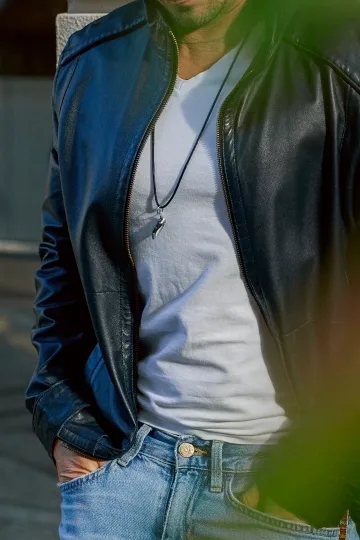
Leather cord or chain? For the forged texture I advise a rough leather or waxed cord: it keeps the amulet in the northern key and does not argue with the dark metal. I choose a thin chain when I need to soften the iron and present the troll cross as an ordinary pendant. The rule is simple: the harsher the sign itself, the rougher the cord you take, otherwise a thin chain under a heavy forged cross looks like a borrowed part.
Wear it on the body or hang it at home? Here you have two different objects. The large forged cross I put together not for a look but for a home: over the front door, at the threshold, in the workshop, where it works as an expressive iron object. For wear on the body I recommend a compact version, 2 to 4 cm, so it lies flat and does not pull at the neck. Do not try to put a wall amulet on yourself: a heavy cross spins, tips over and tires you within half a day, while a light one hangs calmly and reads.
What to pair the troll cross with? When I build a look for a client, I keep the cross the main sign and do not load it with rivals. Good company is northern amulets from one world: the vegvisir as a sign of the path, the mjolnir as a symbol of strength, the valknut as a sign of Odin. If you want layers, give the cross its own length of chain so the form is not pinched between other pendants. In layers I advise keeping the metals in one tone: dark to dark, silver to silver.
Who suits the troll cross and how to set it? The form is graphic and severe, and it suits everyone regardless of gender and age, especially those who love an honest thing with texture. A large cross I recommend for a wide neck and a solid build, a compact one for a slim frame. And check the fit before buying: the sign should lie face forward and not spin on the cord. The optimum is a medium weight and a cord with a little friction, which holds the cross in view, in the open zone of the neckline, rather than sinking it under the clothing.

Turn on your camera, pick earrings, a pendant or a ring, and see the piece on yourself in real time.
Switch items in one tap.
Everything runs in your browser: no photo or video is ever uploaded.
History: Scandinavian folk magic and forged iron
Iron as the border between worlds
The belief in the protective power of iron is older than any recorded lore about the troll cross. Ethnographers who gathered Scandinavian folklore in the nineteenth and early twentieth centuries recorded dozens of customs in which iron served as a barrier against the supernatural. A knife or a pair of scissors went into a newborn's cradle so the underground folk could not swap the child for one of their own. A steel needle was pinned into the clothes of a woman in childbed. An axe or a scythe was left by the door during birth and burial, the dangerous liminal moments.
The logic is always the same. Iron is the material of people, drawn from the earth and tamed by fire. The beings of the old world, trolls and the hidden folk, were said to fear its touch. So an iron object placed on a border (a threshold, a window, a cradle, a gate) shuts the passage. The troll cross is that same border, only shaped into a permanent sign that no one has to fetch and lay down again each time.
Cold iron and the special power of the metal
In Scandinavian and, more broadly, Northern European belief, the protective power was often assigned not to any iron but to "cold iron." The phrase sounds poetic, yet behind it sits a simple idea: the power lived in the metal as such, in its earthly, human nature. Iron was called "cold" in contrast to living fire and in contrast to the soft precious metals, fit only for adornment.
Untreated or hand-forged iron was prized above all. A nail pulled from an old building, a broken piece of a scythe, a fragment of a horseshoe: such objects were held to be stronger than a new shining product, because they carried the trace of labour and time on them. A separate strand of belief gave special might to iron from meteorites, the "heavenly metal" that people did not mine but received ready-made from the sky. The troll cross grows from this same soil: the meaning here is carried not by the shape in itself but by the material the shape was bent from.
Hence the attitude toward the sound of metal. Scandinavians believed the unseen were frightened by both the sight and the clang of iron: the scrape of a knife on a scythe, the strike of a hammer, the ring of a bit of iron hung by the entrance in the wind. A sharp metallic sound was thought to cut the thin border between worlds and to drive off any who had crept too close to the threshold. In this logic the troll cross on a cord, brushing against a buckle or another pendant, worked on the eye and the ear at once.
The smith as a figure of power
Behind the iron amulet stands the figure of the smith. In Scandinavian society the smed, the smith, held a special place. He worked apart, by the fire, and he did what no one else could: he drew metal from ore, bent it, tempered it, turned it into weapon, tool and adornment. A craft bound to fire and to the transformation of matter was wrapped in an aura of the supernatural in many cultures, and the north was no exception.
Scandinavian mythology knows the great smith Volund (Wayland in the Anglo-Saxon version), a master of more than human skill, whose story is full of revenge, flight and enchanted work. In the old tales a smith can forge both blades and fates. An amulet that came from the forge carried a reflection of that reputation. It was not an ordinary piece of metal but the work of a man who, alone in all the district, commanded fire.
The link with the Odal rune
The shape of the troll cross reminds many people of the Odal (Othala) rune, a sign like a diamond with legs splaying downward. There is a resemblance: in both, the line closes into a loop and grows "legs." From this came the popular idea that the troll cross is the "rune of the home," since Odal governs ancestral property, inheritance and the protection of the hearth.
This connection deserves caution. There is no direct historical proof that smiths bent the troll cross specifically as the Odal rune. The reverse is more likely: a modern eye, familiar with runes, recognises the known silhouette in the curve and builds meaning onto it. That in itself does not make the reading "wrong," since symbols often gather meanings after the fact. But it is more honest to speak of a visual kinship and a lucky overlap of the home-protection theme than of a proven origin. It is also worth remembering separately that the Odal rune was appropriated in the twentieth century by movements with a grim reputation, whereas the troll cross stayed a neutral folk amulet, and there is no need to mix these contexts.
Trolls and the hidden folk in belief
What exactly the amulet guarded against is clear from the Scandinavian tales themselves. Trolls are large, strong and dangerous creatures living in the mountains, the forests and under great stones. Some tales make them stupid giants who turn to stone in the sun, others make them cunning and vengeful neighbours. Beside them in folklore live the hidden folk, the huldrefolk and the underground people: outwardly almost like humans, yet dwelling in the hills and inclined to drag off livestock, children and careless travellers.
Substitution caused a special fear. According to belief, the underground folk could steal an unbaptized infant and leave one of their own in its place, a changeling (bytting). That is exactly why the cradle was ringed with iron. A troll cross over the crib or the door worked the same way, only not once but all the time. It kept the house locked against beings that could not be seen but in whose existence the village had no doubt.
The Dalarna find and the modern revival
Here begins the most interesting and most honest part of the story. The troll cross gained mass fame not in deep antiquity but in the late twentieth century, and largely thanks to the Swedish region of Dalarna. A common version links the modern amulet with a local craftswoman from Osterdalarna, who reproduced an old forged iron object found in her family's farmstead and began to make such amulets for sale. From there the piece spread across fairs, tourist shops, and later the internet.
Dalarna seems no random choice for this role. It is a region with a living craft tradition and a strong sense of folk identity, the very area that gave the world the painted Dala horse. Here folk amulets and souvenirs are not museum antiquity but part of a working trade. The troll cross fit naturally into that line: old belief, a new way of presenting it, hand forging as a mark of authenticity.
Bengt Lindvall and the current form
If you dig into where exactly the looping curl that is sold today as a troll cross came from, the trail leads not to the Viking Age but to the twentieth century. A widespread attribution links the current recognisable form to a Swedish smith named Bengt Lindvall, who worked in Dalarna. By this account he reproduced an old iron object from his family farmstead and began forging such amulets for sale, and from there the form spread across fairs, shops and the internet.
This story is worth taking calmly and soberly. There is no documentary museum confirmation of an "ancient troll cross" in exactly this drawing, and serious collections of Scandinavian amulets do not know it as a distinct ancient type. Iron amulets in general, on the other hand, are wonderfully well documented: horseshoes, nails, knives, rings. The honest picture comes out like this: the old belief in iron is real and reaches back through the centuries, while the specific "troll cross" as a recognisable object with a name and a form took shape recently, and one well-known smith played a visible part in that. This does not devalue the amulet. It only sets it in its rightful place in time.
Sweden and Norway: regional shades
Although the name trollkors sounds almost the same in Swedish and Norwegian, the amulet lives a little differently in the two countries. In Sweden it is more firmly tied to the craft scene of Dalarna and to the image of a folk souvenir, a neighbour of the painted Dala horse and of forged trinkets from the fairs. Here the troll cross is part of a recognisable regional trade, a thing you bring back from a trip to the mountain country.
In Norway the theme of the huldrefolk and the underground people rings louder, and the fear of a swapped child and of livestock led off into the hills lingers especially vividly in the tales. Norwegian beliefs about the nisse, the household spirit of the farm, and about the creatures of the fjords and mountains give the amulet its own colouring: it stands closer to living farmstead folklore than to the souvenir shelf. The difference is small and the borders are blurred, but it shows that the troll cross is not one single "canon" but a living sign that each region reads in its own way.
The pan-Scandinavian background is worth keeping in mind too. The belief in iron against the unseen was not a Swedish or a Norwegian peculiarity but a shared northern inheritance, including Denmark and rural Finland with their customs of laying metal in the cradle and driving a knife into the doorpost. The troll cross simply gathered that village-scattered practice into one recognisable object with a name. So the argument over "whose it is" makes no sense: the amulet grew from a belief common to the whole Scandinavian world, and its particular form was a gift of the Dalarna craft scene.
What here is ancient and what is new
Put honestly, it all comes together like this. What is ancient and well documented is the conviction that iron protects against trolls and the hidden folk. In Scandinavia that belief is more than a few centuries old, and it left its trace in dozens of customs. The specific bent amulet under the name "troll cross," in the form in which it is bought and worn today, is largely a product of a folk revival of the last few decades, grown on genuinely old soil.
There is nothing insulting to the amulet in this. Almost all living traditions work this way: an old core, a new cut. Anyone who wears a troll cross for the sake of the handsome northern form and the link to a real folk belief in iron stands on firm ground. Anyone who sells it as an "ancient Viking artifact" is simply passing wish for fact. The difference between these positions is exactly the difference between respect for a tradition and its embellishment.
The meaning of the troll cross
Protection from trolls and evil forces
The main and direct meaning of the amulet is sewn into the name itself: protection from trolls and every kind of ill-willed unseen thing. In the Scandinavian picture of the world this is not an abstract "evil in general" but a concrete circle of beings that can harm the home, the livestock and the person. The troll cross sets an iron barrier between them and the owner.
Unlike amulets that reflect another's gaze or envy, the troll cross works against supernatural neighbourhood as such. It is not about people and their emotions but about the world beyond the human border: mountains, forests, the dark corners of the barn, the road at dusk. Where the alien begins, forged iron draws the line.
Amulet of the home and the farmstead
The second large layer of meaning is the protection of the dwelling and the farmstead. A large forged troll cross was historically an object of the home, not of a costume. It hung over the front door, at the gate of the cattle yard, beside the hearth, that is, at the points where the house meets the outer world and where, by belief, the border runs thinner.
Livestock played a special role. The cow and the horse were the living wealth of the peasant family, and a sick or vanished animal meant disaster. Belief tied such misfortunes to the mischief of the hidden folk, and the iron amulet over the barn was meant to prevent it. In this sense the troll cross stands closer to a household amulet than to a personal talisman: it guards not so much the person as their whole way of life.
A symbol of the threshold and the border
The troll cross is, at heart, an amulet of the border. Its place is always where one space passes into another: the door, the gate, the window, the edge of the cradle. In the folk magic of the north the threshold was a special, dangerous zone, neither inside nor out, and it was precisely on the threshold that protection was needed most.
From this grows a wider, almost philosophical reading of the amulet, one close to a modern person. The troll cross is a sign of the ability to hold a border: between one's own and the alien, between the home and chaos, between what you let into your life and what you leave outside. In this sense it stays clear even to someone who believes in no trolls at all.
A personal amulet on the road
The small troll cross worn on the body carried protection beyond the home. In Scandinavian folklore the road was a time of vulnerability: the traveller left the guard of familiar walls for the forest, the water, the crossroads, the places where the unseen felt freer. An amulet on a cord took part of the household protection along.
This function sits well on the present day. Today the "road" is business trips, moves, new cities and unfamiliar places. A personal troll cross works as a quiet reminder of home and as an amulet that, unlike its forged wall-hung sibling, is always with the owner.
Upload a photo of your pet, someone you love, or an object. We'll build a 3D model and hand-cast it in pewter.




Materials: forged iron, steel, silver
For the troll cross the material is not a decorative trifle but part of the essence. The amulet was born from a belief specifically in iron, so the choice of metal ties directly to the meaning. Below are the main options and what is worth knowing about each.
Forged iron
Historically and symbolically this is the main material. The meaning of the amulet is bound to iron and to the forge, so a forged iron troll cross stands closest to the original. Hand forging gives an uneven, living surface, warm in texture, with hammer marks. Each example is a little its own, and in that lies its authenticity.
Iron has one feature: it rusts. Some owners see the light patina and rust bloom as an asset, a sign of real metal and of time lived. Others prefer the piece to be treated with a protective coating or wax. For a household amulet over the door, honest rust is fitting. For a body pendant that touches skin and clothing, most people choose a protected metal or a different one.
Stainless steel
The pragmatic modern choice. Steel is, in essence, the same iron with additives, so the symbolic link to "iron" protection stays, while the drawbacks of the original metal fall away. Stainless steel of grade 316L does not darken, does not fear water or sweat, leaves no marks on the skin, and holds the shape of the sign for years.
A steel troll cross suits those who wear the amulet constantly and do not want to think about care. It fits everyday and street looks, and it survives moisture and time easily. The symbolism stays in the form and in the iron nature of the metal, not in the rarity of the material.
Silver
A silver troll cross is a step toward jewelry. The metal is noble, pleasant in color, hypoallergenic in the form of 925 sterling silver, which is durable enough for daily wear. Silver leads the amulet away from the harsh forge aesthetic toward something finer and more jeweler-like.
From the point of view of pure tradition, silver is a compromise: in folklore the power of the amulet is tied specifically to iron, not to a precious metal. But in practice many choose the silver version for its look, its durability and the fact that it does not stain skin and clothing. The form keeps all of its recognisable meaning; only the carrier material changes.
Bronze and brass
Copper alloys give a warm, slightly archaic tone and render the relief of the bent sign well. Bronze takes on a patina over time that many find noble and fitting for a symbol ancient in spirit. Brass is brighter and closer to gold in colour, and cheaper than bronze.
The copper alloys have one common downside: they can leave a dark or greenish mark on the skin. The cause is the reaction of copper with sweat and cosmetics, and it is not a defect. It is worth reading separately about why jewelry turns skin green and how to avoid it, if the warm metal is what draws you.





Who it suits and who receives it as a gift
The troll cross is not tied to gender, age or faith. It is an open folk amulet, not a closed cultural or religious symbol, and anyone can wear it. No Swede or Norwegian would consider it appropriation if a person from another country puts on a troll cross, all the more so if they know the history of the sign.
It is most often chosen by:
- Lovers of Scandinavian culture and northern folklore. The troll cross is a natural amulet for those who feel close to the sagas, the runes and the world of trolls and the hidden folk.
- Those who value the idea of protecting the home. A large forged version over the door suits as both a protective object and an expressive piece of interior.
- People who love a rough, honest thing. In a world of smooth, polished jewellery, forged iron with hammer marks draws those to whom texture and craft matter.
- Skeptics for whom meaning matters, not magic. The history of the amulet and its link to a real folk belief are interesting in themselves, while belief in trolls stays a private matter.
- As a gift with character. The troll cross carries a clear, kind wish: protection of the home and of the one who lives in it.
As a gift the amulet is especially good for a housewarming: the wish for a guarded home reads at once and sounds warm. Choosing a version to fit the occasion is easier with a jewelry gift guide by occasion. For someone moving or settling into a new place, an iron sign by the door is a simple and meaningful gesture.
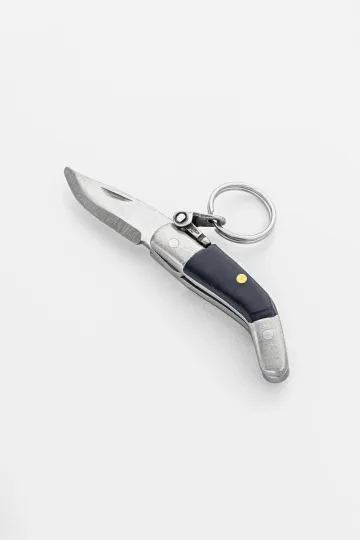
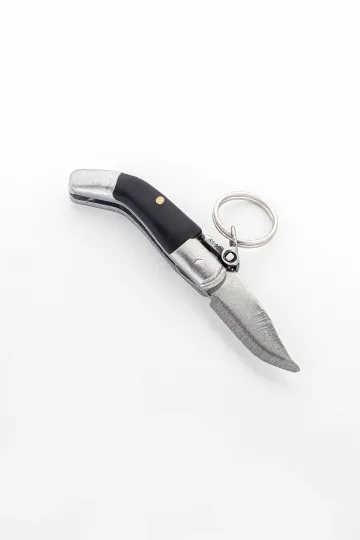
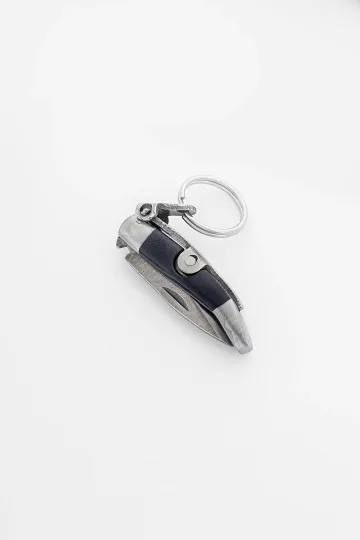
CAPAORA mini knife pendant
The 18th-century Spanish navaja in miniature: 40 mm of stainless steel, a real folding mechanism and a Palanquilla lock that clicks. An affordable gift to remember.
Authentic · Ships from Spain · 14-day returns
How to choose a troll cross
Forging versus stamping
The first thing worth looking at is the method of making. Mass stamping gives an even but faceless sign with a blurred relief, one with no character and no trace of a hand. Hand forging keeps a living texture: irregularities, hammer marks, a slight asymmetry. For an amulet whose whole essence is forged iron, the way it was born is no trifle but half the meaning.
If authenticity draws you, look for versions with honest handwork, where you can see that the metal was bent and struck rather than stamped out. Such a thing stands closer to the spirit of the tradition, where each troll cross came out from under the hammer separately. Ideal smoothness here is, on the contrary, a sign of industrial stamping, not an asset.
Shape and proportions
Since the troll cross has no strict canon, it matters that a given form be whole and readable. A good sign is balanced: the loop does not eat the whole figure, the line does not look like a random curl, the bend is confident. A bad example looks like a piece of wire bent at random.
Look at the silhouette as a whole. The troll cross should be recognisable at a glance and hold its form rather than crumbling into meaningless swirls. If the amulet "reads" and its weight and density can be felt in the hand, that is a good sign of the maker's care for the thing.
Size
For a body pendant a size of about 2 to 4 centimetres is comfortable. Smaller than two and the sign is lost on the chest and does not read; larger than four and it begins to look heavy and to press. For a masculine look and a wide neck people take closer to the upper limit, for a slim build closer to the lower.
A household, wall-hung troll cross is a completely different scale: from ten centimetres and up, so the sign is visible by the door and holds as a standalone object. Here the reverse logic works: the larger and rougher it is, the more convincing the amulet looks on the wall and the clearer its role as a guardian of the entrance.
Leave your email, we'll send your discount code. No spam, unsubscribe anytime.
The code arrives by email, valid on your first order.
The troll cross and other Scandinavian amulets: what is the difference
The northern tradition knows many protective and meaningful signs, and the troll cross is easy to confuse with its neighbours by theme. Let us sort out the differences, so you can choose your own.
The troll cross and the vegvisir
The vegvisir is a "path pointer," a sign of eight ray-staves that, by a late Icelandic belief, helps you not to lose your way in bad weather and to find the road home. Both amulets are young in their current form, and both grew on genuine northern soil, but their themes differ. The vegvisir is about the path and orientation, about not getting lost. The troll cross is about the border and the protection of the home, about not letting the alien in.
They are convenient to wear as a pair precisely because of this difference. The vegvisir leads along the road, the troll cross guards the home to which that road returns. One is about movement, the other about the threshold.
The troll cross and the mjolnir
The mjolnir, the hammer of Thor, is the most famous Scandinavian amulet and an object with a real archaeological history: little hammer pendants are found in Viking Age burials by the dozen. The mjolnir is bound to a specific god, Thor of the Scandinavian pantheon, to thunder, strength and protection through might.
The difference in spirit is marked. The mjolnir is an active force, a hammer with which the god crushes giants. The troll cross is a passive barrier, an iron border that does not strike but keeps out. The mjolnir leans on the authority of a deity and on an ancient find, the troll cross on a nameless folk belief in metal and on the smith's craft.
The troll cross and the valknut
The valknut, the "knot of the slain," is three interlaced triangles, a sign bound to Odin, warriors and the passage between life and death. The valknut is a symbol of fate and initiation, far darker and "higher" in theme than the everyday household troll cross.
If the troll cross solves an ordinary task (to keep the home, the livestock and the loved ones safe from the unseen), then the valknut is more about worldview, about an attitude to death, courage and the will of the gods. Both are northern, yet they live on different floors: one by the threshold of the home, the other on the border of the worlds of the living and the fallen.
The troll cross and the aegishjalmur
The aegishjalmur, the "helm of awe," is a symmetrical sign of eight ray-tridents radiating from a center, known from late Icelandic manuscripts of magical symbols. Its purpose differs from that of the troll cross: the aegishjalmur is a sign of intimidation and steadfastness, tied to instilling fear in an enemy and not flinching yourself. It stands closer to warrior and incantatory magic, to "active" formulas drawn on the body or on an object.
Against this the troll cross is emphatically everyday and passive. It does not intimidate and does not incant; it simply stands on the border as a piece of iron. The aegishjalmur is drawn and traced as a sign-formula, the troll cross is forged as an object-barrier. Both are northern and both are about protection, but one protects through force and will, the other through material and place.
The troll cross and the horseshoe
Closest in spirit to the troll cross are not the loud mythological signs but the humble horseshoe over the door. Both are iron amulets of the threshold, both hold not on the name of a god but on belief in the metal itself. A horseshoe nailed above an entrance was just as much a folk remedy against the unseen across all of Europe, including Scandinavian villages, and people argued about it in exactly the way they argued about the loop of the troll cross: points up, so "luck does not run out," or points down, so it "pours onto the one entering."
The kinship here is no accident. The troll cross and the horseshoe grow from one root, from the conviction that forged iron on the border of the home shuts the passage to the alien. The difference is that the horseshoe is a ready working object that became an amulet by chance, while the troll cross is an amulet from the start, a form invented to be a sign. In essence they are two shoots of one old belief in iron.
The troll cross in popular culture
The troll cross lives both as an amulet and as part of modern northern identity and craft culture. In Sweden and Norway it has long become a recognisable souvenir and a mark of "folk" taste, a thing brought back from a trip to the mountain regions along with wool, wood and forged trinkets.
A separate and lively environment is the smiths' fairs and craft festivals. There the troll cross is a welcome exhibit: it is simple in concept yet beautifully shows off the skill of forging, so smiths gladly make it for a crowd. The viewer sees the whole path of the amulet in a few minutes: the glowing rod, the hammer blows, the bend, the loop, the finished sign taken from the anvil while still hot.
The troll cross was strongly pushed along by the wave of interest in the Scandinavian theme in film, games and music of recent decades. The northern aesthetic came into fashion, and with it the whole set of signs: runes, Thor's hammer, ravens, world trees and amulets like the troll cross. It is only worth remembering the border between historical truth and handsome stylization: much of what is presented as "ancient Viking heritage" is in fact a modern reworking, and the troll cross is a telling example of an honest young tradition on an old foundation.
The psychology of the amulet
You do not have to believe in trolls for the troll cross to "work." The mechanisms that make a protective amulet useful are quite earthly and well described, and the antiquity of the belief has nothing to do with it.
A sense of control over the border. A person needs to feel that their space is protected and set apart from the outer chaos. A sign by the door or on the neck gives a simple bodily sense that "a line has been drawn here." This lowers background anxiety, like a lock shut for the night, even though we rationally know the lock is not all-powerful.
The "lucky object" effect. Psychology describes an effect in which a person who is sure they have their talisman with them acts calmer and more collected. The mechanism is not magic but reduced anxiety, greater concentration and a sense of support. For many people the troll cross does exactly this, especially in new and unfamiliar circumstances.
Ritual and passage. To hang an amulet over the door of a new home or to put it on before a journey is a small ritual, and rituals restore a sense of controllability where much does not depend on us. To mark a beginning, to note the threshold, to tell yourself "now I am under protection," all of this works toward steadiness without demanding belief in the supernatural.
An anchor of identity. To wear a troll cross means to quietly declare your roots, tastes and values: an interest in the north, a love of craft, the idea of a protected home. Anchors of identity raise inner steadiness, and in this sense a piece of bent iron honestly serves a thoroughly modern person.
There is nothing supernatural in this. The amulet does not change reality; it changes the owner's attitude to reality, and it does so in a noticeable and useful way.
Facts about the troll cross that surprise
The amulet is younger than it seems. The troll cross in its current form gained mass fame only in the late twentieth century, largely thanks to the Swedish region of Dalarna. What is ancient is the belief in the protective power of iron, not the bent sign under this name.
Iron really was laid in the cradle. The custom of protecting a newborn with iron (a knife, scissors, a needle beside the infant) is well documented by Scandinavian ethnographers. The fear of a child swapped by the underground folk was a real part of village life.
The "cross" here is not about the church. In the name trollkors the word "cross" means a sign and an intersection of lines, not a Christian symbol. The folk protective "crosses" of the north mostly had no connection to the church.
The smith was nearly a sorcerer. A craft that tames fire and metal was wrapped in an aura of the supernatural. Scandinavian mythology knows the great smith Volund, and an object from the forge carried a reflection of that reputation for power.
The amulet has no strict drawing. Different masters bend the troll cross in their own way: with a full loop, with a gap, with legs of varying length. These are not different amulets but a living folk form without a single canon.
The resemblance to the Odal rune is more coincidence. The popular idea that the troll cross is the "home rune" Odal is handsome, but there is no direct historical proof of such an origin. Recognizing the rune in the curve is the view of a modern person familiar with runes.
Dalarna is no accident. The region linked with the amulet's revival is famous for a living craft and a folk identity, the very area that gave the world the painted Dala horse. Folk amulets here are part of a working trade, not museum antiquity.
The horseshoe and the troll cross are kin. Both are iron amulets of the threshold, and both hold on belief in the metal itself, not on the name of a god. The argument over which way to hang a horseshoe mirrors the argument over the loop of the troll cross: the folk magic of iron had no single canon anywhere.
Silver, steel, Scandinavian symbolism, amulets, leather and chain cords.
Send a friend a discount code, they save on their first order.
Frequently asked questions about the troll cross
What does the troll cross mean? The troll cross (trollkors) is a Scandinavian amulet of forged iron in the form of a bent, closed sign. Its main meaning is the protection of the home, the farmstead and the person from trolls and the hidden folk. At its root lies the old northern belief that cold iron drives off the unseen.
Is the troll cross an ancient Viking symbol? Not quite. What is ancient and well documented is the Scandinavian belief in the protective power of iron. The bent amulet itself under the name "troll cross," in its current mass form, is largely a product of a folk revival of the last few decades, linked with the Swedish region of Dalarna. It is more honest to call it a young tradition on an old foundation.
Why is it iron specifically that protects from trolls? By Scandinavian belief, iron is the material of people, drawn from the earth and tamed by the fire of the forge, and therefore alien to ancient beings like trolls and the underground folk. An iron object on a border (a threshold, a window, a cradle) was held to be a barrier the unseen could not cross.
Are the troll cross and the Odal rune one and the same? No, although the forms are similar. The Odal rune is a sign of the Elder Futhark with its own meaning of ancestral property and inheritance. The troll cross is a folk iron amulet with no strict drawing. The similarity of silhouette gave rise to the popular pairing, but there is no direct historical proof of a common origin.
Which material is best to choose for a troll cross? Closest to the tradition is forged iron, but it rusts and needs care. Stainless steel keeps the "iron" symbolism while staying undemanding, not darkening and not staining skin. Silver leads the amulet toward jewellery. For the home over the door, iron is fitting; for daily wear, steel or silver.
How should the troll cross be hung at home? The traditional places are the border of the home with the outer world: over the front door, at the gate, beside the hearth, at the entrance to the workshop. There is no single strict rule about a side or a direction; folk customs differed from place to place. The main thing is the idea itself of a sign on the threshold.
Can I wear a troll cross if I have no Scandinavian roots? Yes. The troll cross is an open folk amulet, not a closed cultural or religious symbol. Lovers of northern culture and craft wear it all over the world, and this is not considered appropriation, especially if you know the history of the sign.
Can the troll cross be worn together with other amulets? Yes, and this is common. The troll cross goes well with the vegvisir, the mjolnir and the valknut, as well as with runic symbolism. The main thing is not to overload the look: one or two signs read stronger than a fistful of pendants on one chain.
Who invented the modern troll cross? A folk amulet cannot have a single author in the strict sense, but the current recognisable form is most often linked with the Swedish smith Bengt Lindvall from Dalarna, who in the twentieth century reproduced an old iron object and began forging such amulets for sale. From there the form spread across fairs, shops and the internet.
What size of troll cross should I choose? For a body pendant a size of about 2 to 4 centimetres is comfortable: smaller is lost on the chest, larger presses on the neck. For the home over the door people take a wall version from ten centimetres and up, so the sign reads at the entrance and holds as a standalone forged object.
Is the troll cross the same as a horseshoe over the door? Very close in spirit. Both are iron amulets of the threshold, both hold on belief in the protective power of the metal itself. The difference is that the horseshoe is a working object that became an amulet by chance, while the troll cross is a sign from the start, a form invented to protect. They can be seen as two shoots of one old belief in iron.
Does an iron troll cross rust? Yes, forged iron takes on a patina and rust bloom over time; that is its nature. For a household amulet over the door, light rust is fitting and even adds to the look. For wear on the body, iron is usually coated with wax or a protective compound, or people choose stainless steel and silver, which do not darken and do not stain skin.
Scandinavian amulets and symbolism in silver and steel, handmade.
Buying it as a gift? Each one arrives ready to give.
 A branded Zevira box and a little card come with every order.













Conclusion
The troll cross is more honest than most "ancient" amulets by the very fact that its history does not hide its seams. In it a genuine old belief in the protective power of iron joins with a thoroughly modern folk form, grown from the craft of the northern regions. One rests on the other, and together they give a thing with real meaning rather than an invented pedigree.
A piece of forged iron bent into a recognisable sign does a simple and clear job: it draws a border. Between the home and chaos, between one's own and the alien, between what you let in and what you leave outside. Whether you believe in trolls, value the beauty of the harsh northern form, or simply love the idea of a protected threshold, the troll cross stays one of the most human amulets of the north. It promises no miracles. It holds the border, and the rest you do yourself.
Wear the symbol, don't just read about it. These are in stock:

About Zevira
Zevira makes jewellery in the artisan tradition of Albacete, Spain. Scandinavian symbolism is among the themes close to us: an ancient form, readable without words, equally at home on a rough leather cord and on a thin chain. We reproduce the troll cross with respect for its forge nature, in a balanced, whole form and in modern materials and proportions.
Here is what you can find with us on the theme of northern symbols:
- Scandinavian amulets: troll cross, valknut, mjolnir, vegvisir
- Runic pendants in silver and steel
- Leather and chain cords of various lengths for an amulet of any size
- Paired and set versions for those who collect northern symbolism
- The option of personal engraving
Every piece can be personalised with engraving. 925 silver and stainless steel.