Bone and horn in jewelry: the material older than metal, ethics, types and how to tell it from imitation
Bone and horn were the plastic of the ancient world. People carved combs, needles, clasps and beads from them thousands of years before anyone smelted the first metal, and in the nineteenth century sailors filled long months at sea by scratching ocean scenes into polished whale teeth. Cheap, tough, obedient to the blade, the material lay literally within reach of anyone who butchered an animal.
Today bone and horn sit inside a fog of myths and worries. Some people confuse them with elephant ivory and avoid the whole subject. Some buy a "bone" figurine without realising they are holding painted plastic. Some cannot tell a carved ox horn from a banned walrus tusk. This article puts the ideas back in their places: how bone differs from horn and from tusk, which materials are legal and which are forbidden, how to tell real bone from imitation and from ivory, and why origin matters more here than beauty.
Bone, horn and tusk: three different materials people mix up
How bone differs from horn
Bone and horn sound like neighbours, but they are different tissues with different structure. Bone is the hard mineralized tissue of the skeleton: inside it sits a scaffold of collagen soaked in calcium phosphate, threaded with a network of tiny channels that carried blood vessels in life. Under a microscope, and even under a loupe, bone shows minuscule dots and short dashes, the cross-sections of those very channels. Bone is dense, white or cream, heavier than it looks, and when carved it crumbles into a fine powder.
Horn is a completely different story. It is made of keratin, the same protein found in nails, hair and hooves. Keratin is layered, and it can be heated, softened and bent, something you can never do with bone. Horn is usually darker, translucent when held to the light, its colour running from honey to almost black, often with smoky streaks. A cut through horn reveals not channel-dots but long parallel fibres, like pressed layers.
Wear the symbol, don't just read about it. These are in stock:




What a tusk is and why it stands apart
A tusk is a modified tooth, not bone and not horn. Elephant ivory, walrus tusk, sperm whale tooth, narwhal tusk, fossil mammoth tusk, all of them are built from dentine, the same tissue as the core of an ordinary tooth, often with a layer of enamel. Dentine is denser than bone, with no visible pores, cream-white, with a distinctive internal pattern. It was tusks, not livestock bone, that were prized above everything for centuries, and it is tusks that sit at the centre of every ban today. Any conversation about tusk runs almost immediately into the law, so it gets its own large section below.
A simple structure test
The difference is easiest to remember through three pictures. Bone: matte, white, peppered with fine dark specks and dashes from its channels. Horn: warm, translucent, streaked lengthwise, glowing when held to the light. Tusk: dense, poreless, with a distinctive geometric pattern that in elephant ivory forms a characteristic mesh. If a material lets light through and warms quickly in your hand, you are probably holding horn. If it feels coolish, heavy and speckled, that is bone.
Why all three burn but do not melt
There is a shared trait that links bone, horn and tusk and separates them from plastic: all three are organic, and under strong heat they do not melt, they char with the smell of burnt protein. Bone and tusk are mineralized and barely burn, leaving a scorched dot, while horn as pure keratin softens under heat and smells of singed hair. Plastic behaves differently: it melts, draws into a thread and smells of chemicals. This shared "protein" nature explains why all three materials fear heat and dryness, and why they are cared for gently, like leather, rather than like stone.
Types of bone and horn in jewellery
Cattle and buffalo bone
The most common and most legal material for bone carving is the bone of large cattle, beef and buffalo. It comes as a by-product of the meat trade, dense, white, holding fine carving well and polishing to a satin sheen. From it people make beads, pendants, rings, inlays, handles and figurines. Buffalo bone is a touch denser and larger than beef bone, prized for its even white tone. Well-boiled and bleached bone has no smell and over time takes on a soft ivory yellowing, which collectors count as a virtue rather than a flaw.
Buffalo and ox horn
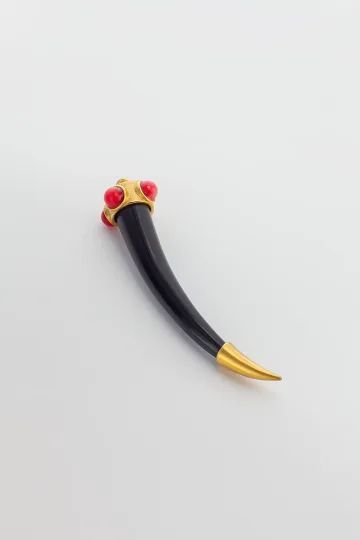
The black and dark-honey horn used for combs, bangle rings, earrings and buttons is most often the horn of the water buffalo or the domestic ox. Buffalo horn is almost black, sometimes with grey and amber veins, polishes beautifully and throws warm highlights in the light. Horn is easy to bend into rings and wide bangles: heated keratin obediently takes a shape and sets. Each horn is unique in its pattern, so no two identical combs exist, and that is part of the charm.
Antler and velvet
Antler stands apart. Unlike the hollow horn of a buffalo, antlers are dense bone tissue that the animal sheds every year. Shed antlers are gathered in the forest and on farms without harming the deer, which makes the material one of the most ethical in the group. A cut through antler reveals a characteristic porous core inside a dense shell, and that contrast looks striking in pendants and handles. Young antlers in their velvety skin are called velvet, but jewellery uses the already hardened, shed material.
Scrimshaw: engraving on bone and tooth
Scrimshaw is a technique in which a fine engraved drawing is cut into a polished surface of bone or tooth, and then black or coloured pigment is rubbed into the lines so the image shows through. Its home was the whaling ships of the nineteenth century, where sailors carved ocean scenes, vessels and portraits into teeth and bone. Today scrimshaw is done on legal livestock bone and on legal alternatives, keeping the method itself: a needle, patience and rubbed-in ink. Antique scrimshaw on banned material is a separate legal zone, covered below.
Mother-of-pearl: a distant relative from the same world
Mother-of-pearl belongs to the same group of organic animal materials, the inner layer of a mollusk shell. By chemistry it is calcium carbonate with protein, in essence a cousin of bone and horn: also not a stone, also grown by a living organism. Mother-of-pearl often sits beside bone and horn in a single piece, adding an iridescent shimmer where bone gives a matte whiteness. If this material interests you in particular, we have a separate breakdown of mother-of-pearl in jewelry.
Bone as tortoiseshell: what replaced the forbidden
There used to be one more organic material standing in the same row as bone and horn, the shell of the sea turtle, called tortoiseshell, which was used for combs, spectacle frames and box inlays for its warm amber-mottled pattern. Today the trade in genuine turtle shell is banned just as strictly as ivory, because turtles were hunted to the edge for it. Any modern piece with a tortoiseshell pattern is either tinted horn or plastic: the pattern is imitated, while the material itself left legal trade long ago. Knowing this is useful so you do not mistake dyed horn or plastic for a "real tortoiseshell comb" and overpay for an imitation.
Horn belongs on a bare wrist over rumpled linen, never under a cufflink. Keep the mirror steel for the elevator doors.
How to wear bone and horn
Over years on shoots I have run dozens of horn bangles and bone bead strands through looks. Here is what actually works, sorted by occasion.
What do I wear bone and horn with every day? For everyday I recommend warm texture against warm fabrics: bone beads or a horn pendant on a waxed cord over a linen shirt, suede or rough cotton. A light top lifts honey horn, a dark one turns it into the accent. Bone and horn read grounded, so I suggest keeping a calm palette around them, no gloss and no sparkle.
Dark horn or light bone for my clothes? Here I go by contrast. Against light clothing I choose the almost black buffalo horn, it reads graphic. Against dark clothing I take light bone or honey horn so the material does not sink. If you want tone on tone, I stay with a mid honey shade: it gets along with both light and dark.
How do I bring in a wide horn bangle? A wide horn I like on a bare wrist with a rolled sleeve, so the whole curve shows. I suggest wearing it solo or with one thin companion chain, not in a pile of bangles. A large horn arc is a statement on its own, and breaking it up with trinkets does it no favours.
Which metals and materials do I pair it with? Bone is selective. I recommend warm brass, bronze, aged silver, and I keep cold mirror steel and white gold away from it, they clash. For neighbours I choose wood, mother-of-pearl, amber, jet: natural to natural. Mother-of-pearl adds an iridescent flash to matte bone, amber picks up the honey tone.
Who does this material suit and how do I not overdo it? It suits those who value texture and history over a mirror shine. One piece of advice: keep the scale balanced. Large bone beads want a clean top and few other pieces, while a fine carved pendant tolerates layers. And do not mix five organic materials in one look, pick one or two, or it turns into a craft fair.

Turn on your camera, pick earrings, a pendant or a ring, and see the piece on yourself in real time.
Switch items in one tap.
Everything runs in your browser: no photo or video is ever uploaded.
Customer reviews
Zevira is a real jewellery shop. Genuine payments, deliveries and customer thank-yous.
🥰🥰🥰 gracias

Ok, ¡gracias! 🙂

History: from the Paleolithic to Art Nouveau
The Paleolithic: the craftsman's first material
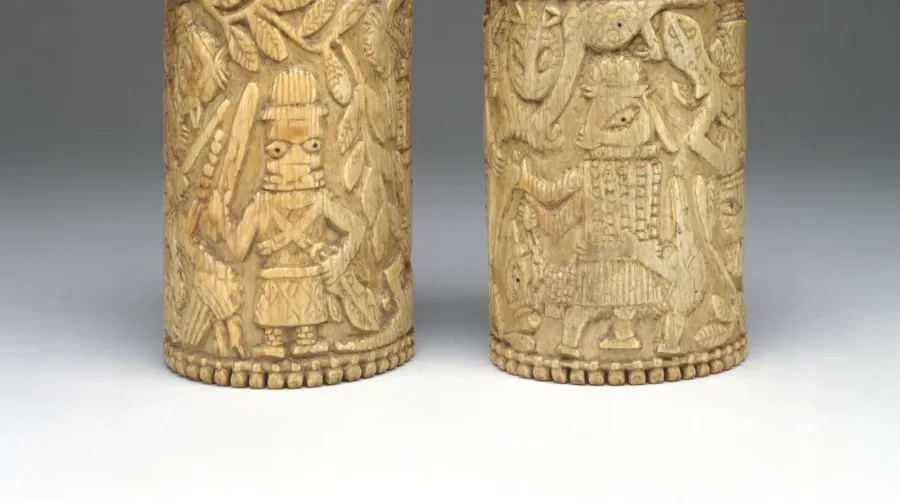
Long before metal, humans carved bone and horn. Archaeologists find bone needles with eyes tens of thousands of years old, bone pendants, beads from drilled teeth, figurines of animals and people made from mammoth tusk. Bone was available to every hunter: tougher than wood, easier to work than stone, it served for tools and ornaments at once. A drilled fang or a carved bead were among the first personal objects a person wore on the body for beauty and as a sign of belonging.
Combs, buttons and the everyday life of past centuries
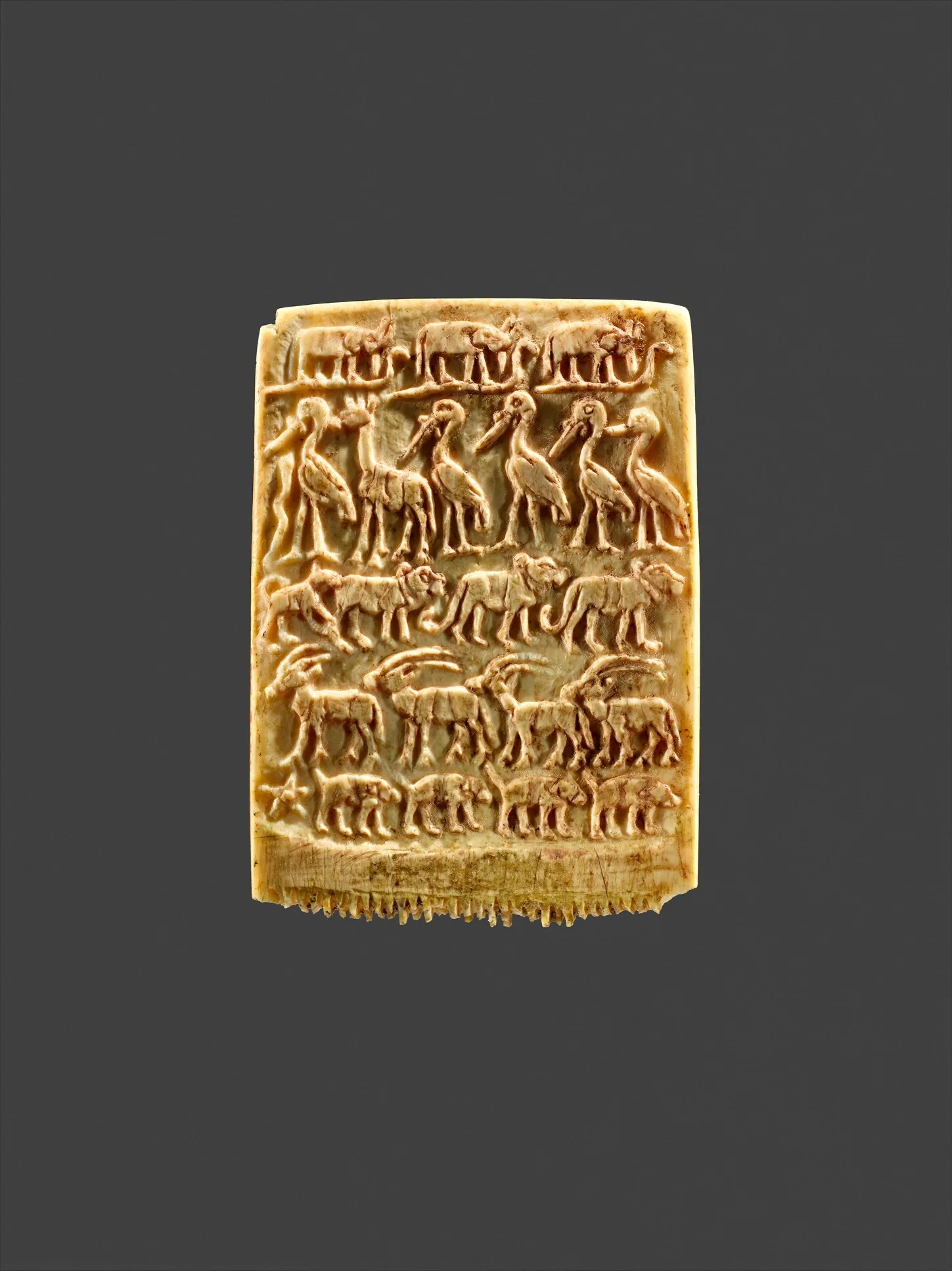
For centuries bone and horn stayed the material of daily life. Hair combs, buttons, knife handles, knitting needles, sewing needles, box inlays, all of it was carved from cheap and available raw material. A horn comb sat on every housewife's table, a bone button fastened both a peasant's shirt and a gentleman's frock coat. This material was no luxury, it was the workhorse of the craft, and that is exactly why there is so much of it in museums of daily life and so little in treasuries: it became expensive only now, once it became rare.
Scrimshaw of the nineteenth-century whalers
The golden age of scrimshaw fell on the era of the great whaling expeditions. A voyage could last years, and in long hours of calm the sailors took a polished whale tooth or piece of bone, scratched in ships, lighthouses and women's portraits with a needle, and rubbed soot or ink into the lines. The finished object was given to the wife or sweetheart waiting on shore. This is the folk art of sailors, and genuine examples of that era are museum treasures today. A modern maker repeats the same technique, but now on legal material, without a whale tooth.
Art Nouveau: horn as an artist's material
At the turn of the nineteenth and twentieth centuries horn suddenly went from a material of the poor to a material of high art. Art Nouveau masters loved it for its translucency and plasticity: heated horn was bent into flowing stems, insect wings, petals. Combs, tiaras and pendants of tinted horn with enamel and semiprecious stones became a hallmark of a style that searched nature for its forms. Horn played beautifully into the flowing lines of the age, in places where metal would have been too rigid and cold.
Bone carving across different cultures
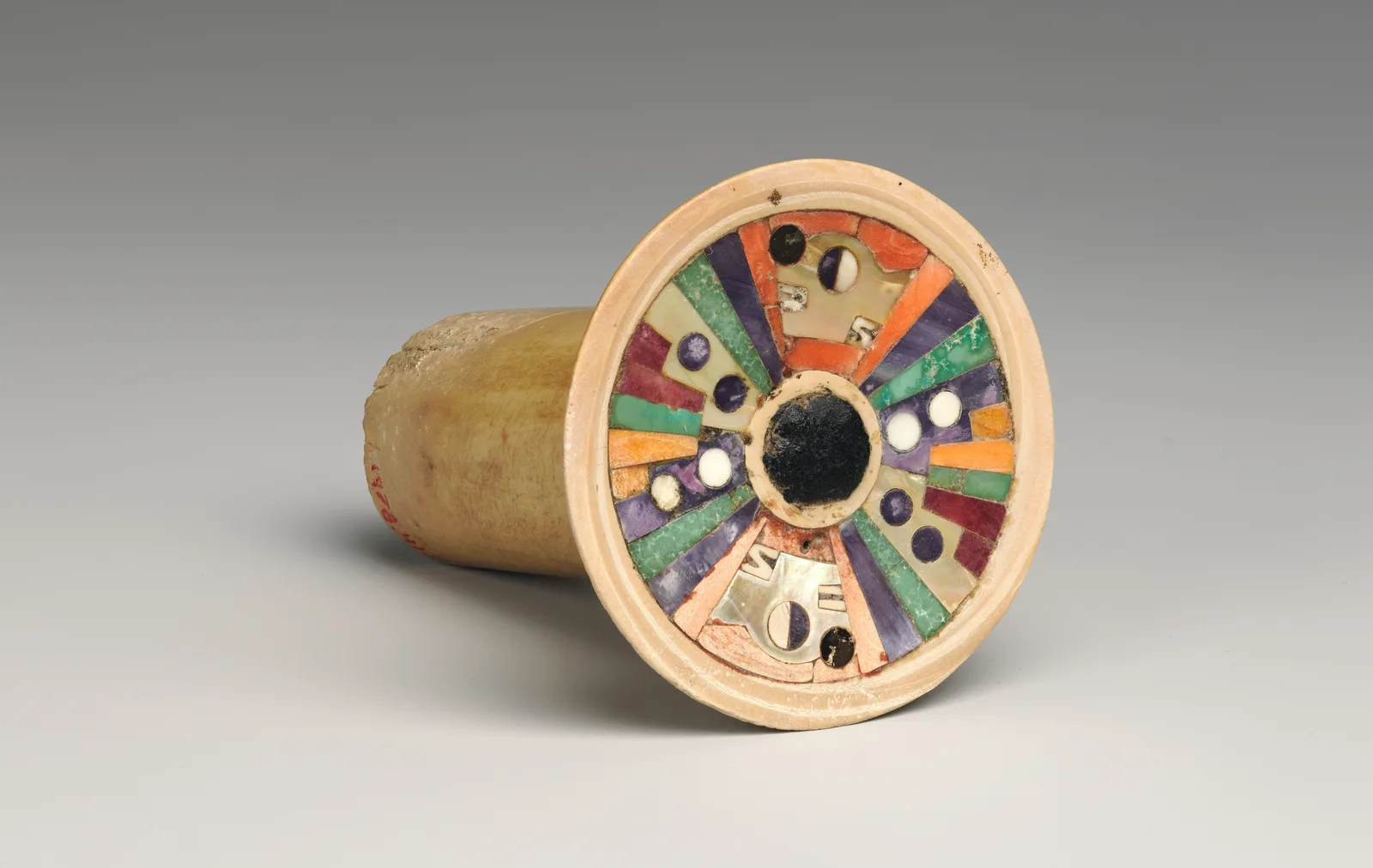
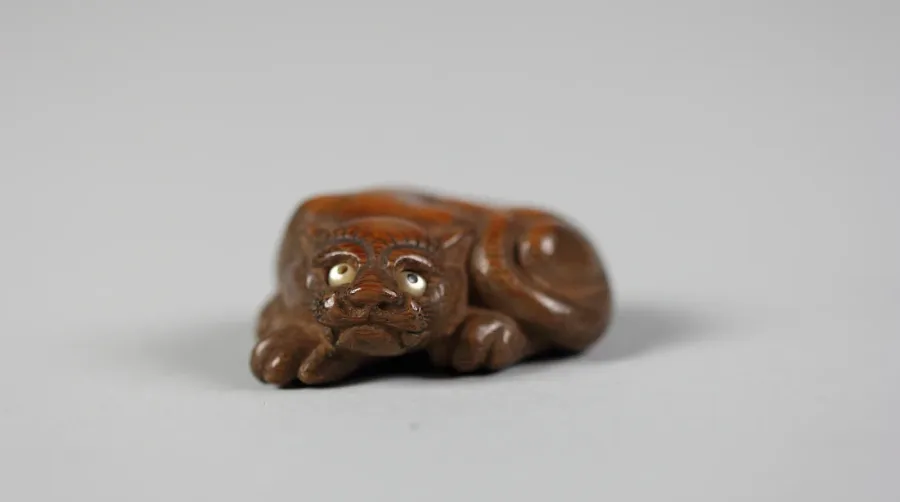
Bone and horn were carved everywhere people lived, and each region worked out its own hand. In the north, masters of Indigenous peoples carved figures of sea animals and hunting scenes from bone, using every scrap of hard-won material. In China and Japan bone carving reached the level of miniature sculpture: Japanese netsuke, tiny carved counterweight toggles for a sash purse, were made among other things from bone and horn, and the fineness of the work still astonishes. In Europe whole guilds of comb makers and button makers worked in bone. This spread of traditions explains why bone ornaments fit so naturally into folk and ethnic aesthetics: behind every method stands somebody's centuries-old craft.
Why bone gave way to plastic
In the twentieth century cheap plastic almost displaced bone and horn. The first plastics, things like celluloid and galalith, were created precisely as imitations of expensive organic materials: they faked ivory, horn and tortoiseshell for mass-produced combs and buttons. Plastic was more profitable for a factory: it was poured into moulds by the thousand without any hand carving. So the material that had fed the craft for thousands of years slipped into the background, and it returned in a new role, as a conscious choice of those who value handwork and natural texture, rather than as a raw material used out of necessity.
Upload a photo of your pet, someone you love, or an object. We'll build a 3D model and hand-cast it in pewter.




Ethics and the law: what is allowed and what is not
Ivory and walrus tusk are banned
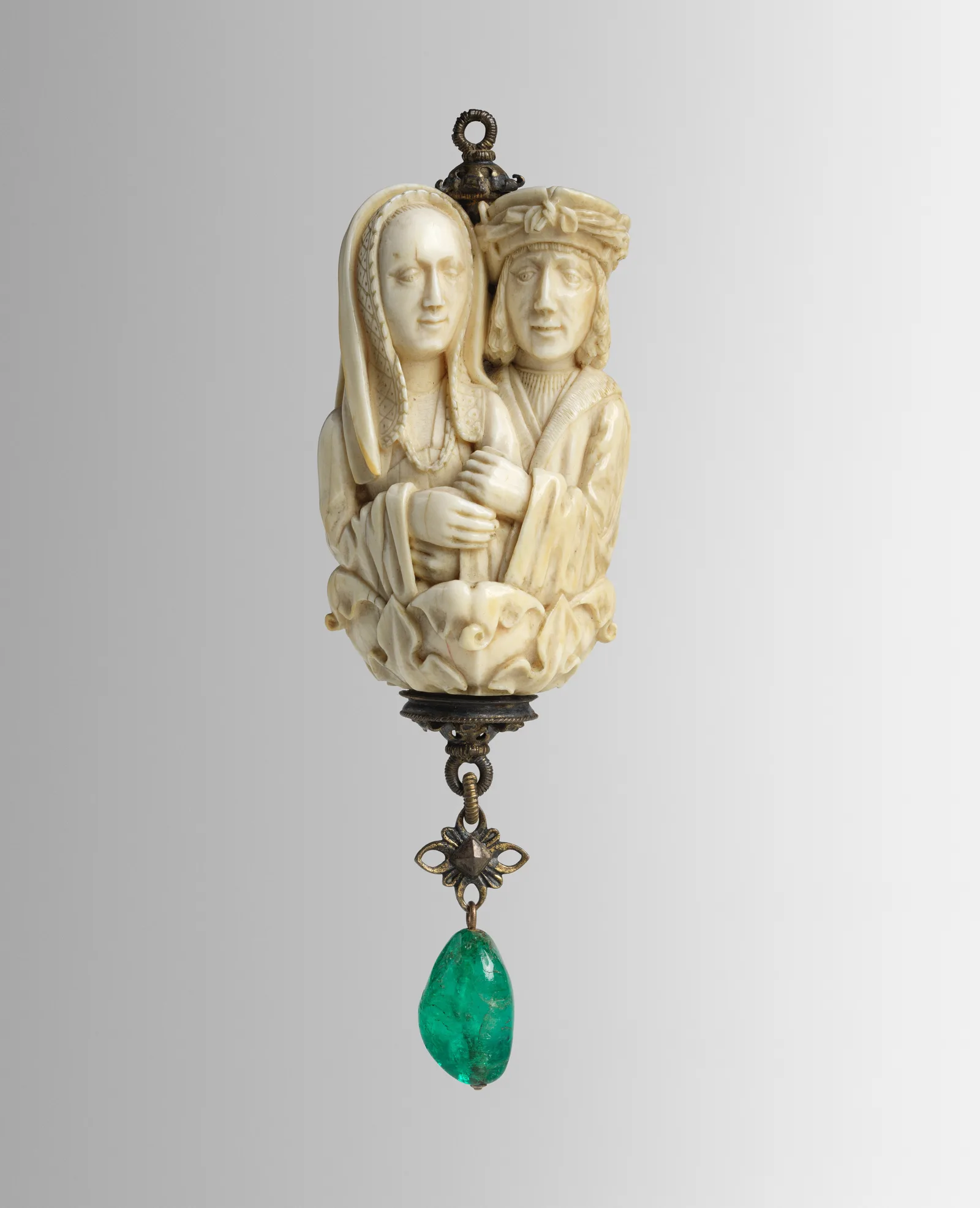
The main thing to know before buying anything "bone": elephant ivory, mammoth tusk in a number of countries, walrus tusk, sperm whale tooth and narwhal tusk are heavily regulated. The international CITES convention and the national laws of many states ban or sharply restrict trade in items made from these materials, in order to stop the poaching that for decades mowed down elephants, walruses and whales. Buying such a thing can be a direct breach of the law and a way of funding poaching, even if the seller assures you that "this one is old". The rules differ by country and tighten periodically, so at any doubt it is better to steer clear of the material.
What is legal: livestock bone and horn as a by-product
The good news is that beautiful bone and horn jewellery needs no banned raw material at all. The bone and horn of domestic livestock, beef and buffalo, are a by-product of the meat trade. Animals are not killed for their horn or bone, the material remains after meat and leather are produced, otherwise it would simply go to waste. Antlers are gathered already shed, with no harm to the animal. It is from this legal and available raw material that the vast majority of modern bone and horn ornaments are made, and it is what you should look for on the label.
Antiques and why "old" is not always legal
There is a widespread misconception that any old bone object is automatically legal. It is not. For antique items of ivory and other regulated materials, many countries require documents of age and origin, certificates, and sometimes the sale is forbidden entirely regardless of age. Without papers an old tusk figurine is a legal risk, not a bargain find. If a piece came down through inheritance, it is wiser to check its status before putting it up for sale or carrying it across a border.
Horn the material and the Italian horn amulet (cornicello): do not confuse them
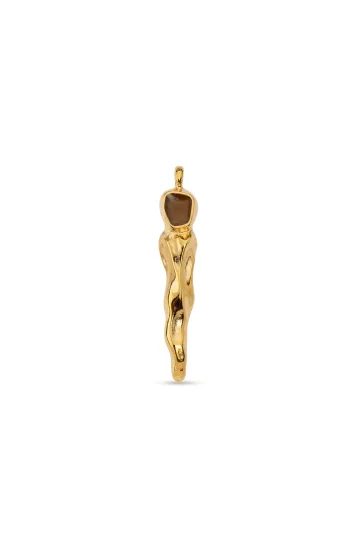
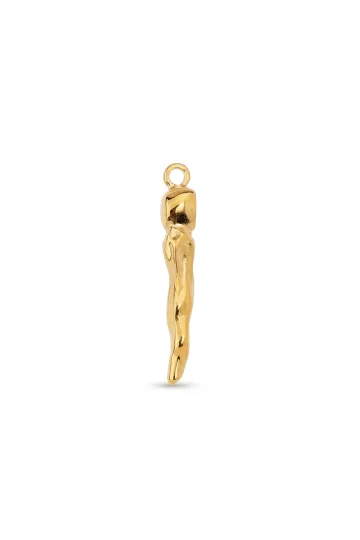
Here it is important to separate two completely different "horns" that are easy to blend by the word alone. This article is about horn as a physical material: the keratin of buffalo or ox from which combs and bangles are cut. The cornicello, by contrast, is a form and symbol, an Italian protective amulet shaped like a small curved horn, which guards against the evil eye and brings luck. A cornicello is made from anything: gold, silver, red coral, horn, but its essence is in its meaning, not its material. If you are interested in the symbolism and history of the amulet, there is a separate breakdown of the meaning of the cornicello. Here the talk is only about the material and how to handle it.
Why origin matters
For bone and horn origin matters more than for any metal or stone, for two reasons. The first is legal: the legality of a piece is decided by which animal the material came from and by what method. The second is ethical: the difference between livestock bone as a by-product and a tusk taken by a poacher is the difference between recycling waste and killing an endangered species. An honest seller will always name the material plainly: "buffalo horn", "beef bone", "shed antler". Vague phrasing like "natural bone" with no species named is a reason to ask a question, not to reach for your wallet.





How to tell bone and horn from plastic and from ivory
Bone versus plastic
Most often it is plastic that is passed off as bone, and telling them apart is easier than it seems. Bone feels coolish to the touch and warms in the hand slowly, while plastic warms almost at once. On the surface of real bone, under a loupe, you can see the finest pores and dashes, the traces of those channels, whereas plastic has a perfectly uniform surface, sometimes with air bubbles inside or a seam from the casting mould. Bone is heavier than light plastic and pleasantly weighty. Sound gives it away too: bone beads tapped together make a dry click, plastic sounds duller.
Horn versus plastic
Horn is identified by its translucency and its layering. Held to the light, real horn glows with a warm, uneven colour, with smoky streaks and lengthwise fibres, while plastic is either opaque or lets light through too evenly. The surface of horn is layered, and under strong magnification you can see parallel fibre lines. Horn, like bone, does not warm in the hand instantly. And one more thing: natural horn is almost never a perfectly single colour along its whole length, whereas dyed plastic is uniform and predictable.
The hot needle test: with great care
An old craftsman's trick for telling plastic from organic material is touching a heated needle to an inconspicuous spot. Bone and horn give off a smell when heated, like singed hair or burnt protein, since that is what they are. Plastic melts and smells of chemicals, of synthetics. This test is destructive: it leaves a tiny dot, and it must not be done on a finished piece, much less on someone else's or an expensive one. In the market this check is used rarely and only on a hidden spot with the owner's permission. For a buyer the visual signs are more reliable: pores, weight, translucency, thermal conductivity.
The Schreger pattern: how ivory is identified
Genuine ivory has a unique identifying mark, the Schreger lines. On a cross-cut of an elephant tusk you can see a mesh of intersecting arcs forming a diamond pattern that no other material gives. By the angle at which these lines intersect, specialists tell elephant ivory from mammoth tusk and from imitations. Livestock bone gives no such pattern, it has a speckled structure of channels. Knowing about the Schreger lines is useful for the opposite reason: if you are offered a piece with such a mesh, it is most likely regulated ivory, and that is where you should recall the entire section on the law.
Working the material: dyeing and carving
How bone and horn are cut
Bone is cut almost like hard wood: it is sawn, turned, drilled, sanded and polished, only here the dust is white and fine, and the work must be done wet or with breathing protection. Horn is first softened with heat, warmed with steam or in hot oil, then the hollow tube of horn is unfolded into a flat plate or bent into a ring, and only then it is cut and polished. This ability of horn to become plastic under heat is what sets it apart from bone, which cannot be bent at all: it can only be removed with the blade.
Dyeing and tinting
Bone takes dye well, because its porous structure soaks up pigment. Historically bone was tinted with infusions, tea, coffee, mineral dyes, to get an ivory, honey or dark shade, and sometimes to imitate expensive ivory. Horn is usually not dyed all over, its natural shades from honey to black are varied enough as it is, but in the scrimshaw technique ink or coloured pigment is rubbed into the engraved lines. Knowing about dyeing is useful for a buyer: an even, unnatural colour is a reason to suspect either dye or plastic outright.
Polishing and finish
Both bone and horn polish to a satin, softly glowing sheen, without the aggressive mirror of metal. A final wax polish brings out the natural pattern: the speckling of bone, the smoky fibres of horn. It is exactly this warm matte glow that gives away a natural material: plastic more often shines coldly and uniformly, while bone and horn glow from within. A good maker does not hide the material's natural unevenness but turns it into a virtue, since it is precisely that which proves authenticity.
Inlay and combining with metal
Bone and horn rarely work alone: they are often set into metal, wood or into each other. Bone inlays are mounted on a silver or brass base, mother-of-pearl dots are set into a horn plate, and dark horn is inserted into light bone for contrast. Such inlay demands precise fitting, since organic material and metal react differently to moisture and heat, and a poorly assembled piece comes apart at the seams over time. That is why the maker's hand matters especially in composite pieces: beautiful material is easy to ruin with a rough fit, while good work holds for decades and ages evenly.
Leave your email, we'll send your discount code. No spam, unsubscribe anytime.
The code arrives by email, valid on your first order.
Ethical alternatives to bone and horn
Tagua: vegetable ivory
The best-known alternative to tusk is tagua, the nut of a South American palm, which is called vegetable ivory. The dried core of the nut becomes dense, hard and cream-white, it is cut and polished almost like bone, and on a cut surface it gives a noble matte sheen. Tagua is entirely vegetable, renewable and requires no animal at all, which is why it is loved by those who want the look of bone without ethical questions. Tagua is made into beads, pendants, buttons and carved figurines, and it is offered more and more often as a conscious replacement for banned materials.
Wood, fruit pits, shell
Besides tagua, nature offers a whole range of plant materials that give a warm organic texture with no animal involved: hardwoods, lacquered shell, pressed seeds and fruit pits. They are light, warm to the touch and pair well with silver and natural stones in a folk style. If the very idea of a natural, living material in jewelry appeals to you, look at our breakdown of wood in jewelry: many of the care and styling methods for wood and bone are shared.
Other organic materials of the same circle
Beside bone and horn in the world of organics stand materials each with its own history and its own rules. Amber is the fossilized resin of ancient trees, warm and light, and there is a separate piece on amber in jewelry. Jet is black fossil coal-wood, used for mourning jewelry and the Spanish azabache, and there is a breakdown of jet and azabache. All these materials share one thing: they are organic, warm and need gentle care, unlike hard, indifferent stone.
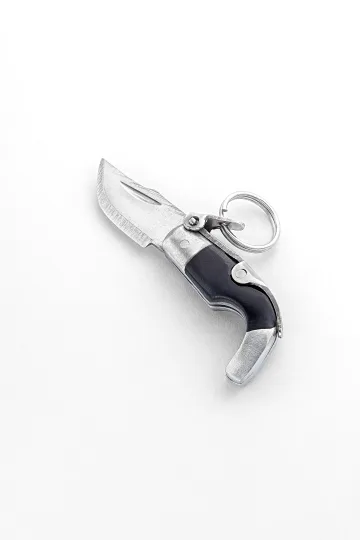
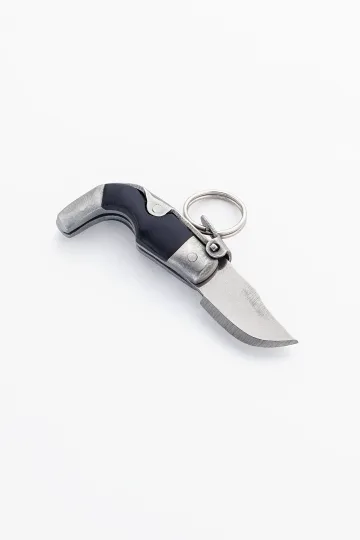
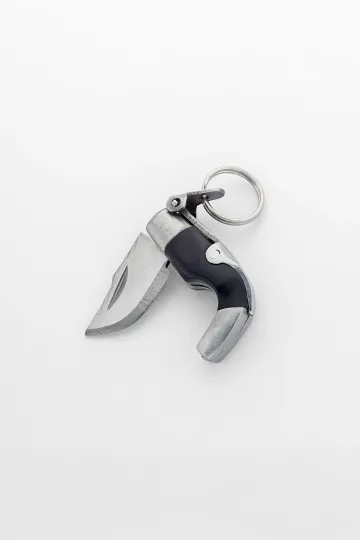
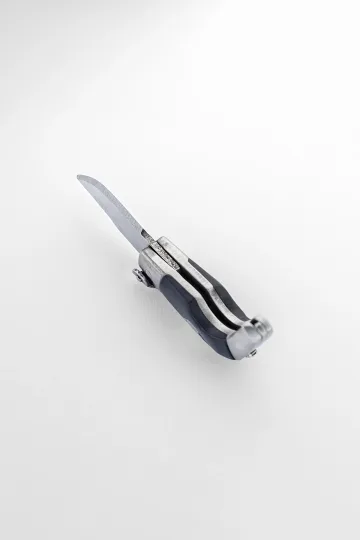
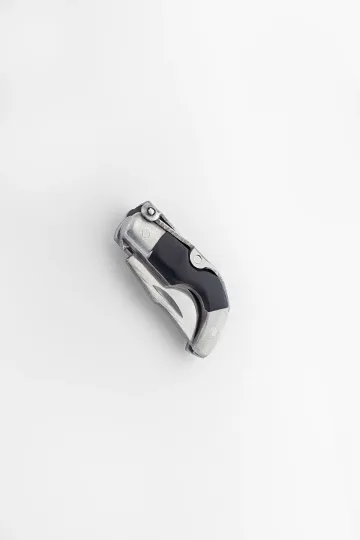
CAPAORA mini knife pendant
The 18th-century Spanish navaja in miniature: 40 mm of stainless steel, a real folding mechanism and a Palanquilla lock that clicks. An affordable gift to remember.
Authentic · Ships from Spain · 14-day returns
Caring for bone and horn
What the material fears
Bone and horn are former living tissue, and they behave accordingly. The main enemies are water, heat and over-dry air. Long soaking softens and warps horn, and makes bone soak up moisture and darken in patches. Heat from a radiator, a hairdryer or direct sun dries the material out, and it cracks. Paradoxically, air that is too dry is harmful too: without natural moisture horn and bone become brittle. The best place to store them is a soft pouch or a box away from heating and the window, beside something that neither gives off nor pulls moisture sharply.
Why it yellows and cracks
A light yellowing over time is normal and even a sign of authenticity: real bone slowly gathers a warm ivory tone that collectors call patina. But cracks and delamination are already a signal of over-drying or a sharp swing in humidity. Horn can split along its natural fibres if it is over-dried or struck. Aging is slowed by an occasional light wipe with a soft oil or a special wax, which feeds the surface and keeps it from drying out, like a leather strap.
How to clean it properly
Bone and horn are cleaned with a dry or slightly damp soft cloth, without soaking, without aggressive chemicals, without ultrasonic baths, which are fine for metal but ruinous for organics. If you need to remove dirt, dampen the cloth slightly and wipe dry at once, not letting the water soak in. Once a season the surface can be fed with a drop of mineral or special oil, rubbed in almost dry. Perfume, hairspray and hand cream are better applied before you put the piece on: alcohol and fats stain the porous surface.
Facts that surprise
Bone needles are older than writing
Bone needles with an eye, used to sew clothes from hides, are tens of thousands of years older than any writing and any city. People knew how to make a fine needle eye in bone long before they learned to write words down. In essence the tailor's needle is one of the oldest precision tools, and it was made from bone.
Horn bends, bone does not
Many people are surprised to learn that a wide horn bangle was not made from a sawn block but from an unfolded and bent tube. Horn becomes plastic under heat, like a thermoplastic, and can be flattened into a sheet or bent into an arc. Bone cannot do this at all: it can only be cut. This difference is a direct consequence of the fact that horn is keratin and bone is mineralized tissue.
Scrimshaw was made on the open sea out of boredom
A whole branch of folk art was born from plain boredom. Sailors on whaling ships spent years at sea, and in hours of calm they scratched pictures into teeth and bone for the wives left at home. Nobody considered these things art, they were given as keepsakes, and today genuine examples are kept in museums of maritime history.
Tagua looks like tusk but it is a nut
Vegetable ivory, tagua, is on a cut surface almost indistinguishable from real tusk in colour and sheen, though it is only the dried core of a palm nut. It was carved into cameos and buttons back when cheap plastic had not yet pushed it out of the factories, and today it has returned as an ethical replacement for the banned material.
Yellowing is a virtue, not spoilage
Buyers are often alarmed when a white bone object warms over time to an ivory yellow, and think it has spoiled. In fact this is natural patina, prized separately in antique bone: an even honey-cream tone gives away age and authenticity, while too white a colour is sometimes the opposite, a sign of bleaching or plastic.
Send a friend a discount code, they save on their first order.
Frequently asked questions
Is it legal to buy bone and horn jewellery?
Yes, if it is the bone and horn of domestic livestock: beef, buffalo, deer. This is a by-product of the meat trade, and trading in it is allowed. Other things are banned or strictly controlled: elephant ivory, walrus tusk, sperm whale tooth, narwhal tusk, and in a number of countries mammoth tusk. Before buying, make sure the seller names a specific legal type of material.
How do I tell bone from plastic at home?
Four signs work without destructive tests. Pores: under a loupe bone shows the finest dots and dashes, while plastic has a uniform surface. Weight: bone is noticeably heavier than light plastic. Thermal conductivity: bone is coolish and warms in the hand slowly, plastic warms at once. Sound: bone beads click dryly, plastic sounds duller. If all four point to organic material, you are most likely holding real bone.
How does horn differ from bone by sight?
Horn is translucent and glows with a warm, uneven colour when held to the light, with smoky streaks and lengthwise fibres. Bone is matte, white or cream, does not let light through, and under a loupe shows a speckling of channels. Horn can be bent after heating, bone cannot. And horn is usually darker, from honey to black, while bone is light.
Can bone and horn jewellery get wet?
Long contact with water is best avoided. Bone soaks up moisture and can darken in patches, horn warps and delaminates from long soaking. Take such jewellery off before a shower, a pool, the sea and washing dishes. If the surface gets dirty, wipe it with a slightly damp cloth and dry it at once, not letting the water soak in.
Why has my bone ornament yellowed?
A light, even yellowing is natural patina: real bone gathers a warm ivory tone over time, and in antique pieces this is prized. The warning signal is different: yellow patches in uneven spots, cracks, delamination. They point to over-drying, contact with cosmetics or a sharp swing in humidity. Prevention is gentle storage away from heat and an occasional feeding with oil.
Are ivory and livestock bone the same thing?
No. Ivory is elephant tusk, that is a modified tooth of dentine, with the unique pattern of Schreger lines, and trade in it is heavily restricted. Livestock bone is ordinary skeletal bone of beef or buffalo, with a speckled structure of channels, a legal by-product. They are different tissues, different law and a completely different ethics.
What is scrimshaw?
Scrimshaw is a technique in which a fine engraved drawing is cut into polished bone or tooth with a needle, and ink or pigment is rubbed into the lines so the image shows through. It arose on the whaling ships of the nineteenth century. Today scrimshaw is done on legal livestock bone and on ethical alternatives, repeating the method itself but without the banned material.
What ethical alternatives are there to bone and horn?
The main one is vegetable ivory, tagua: a palm nut cut almost like tusk but with not a single animal. Beside it stand hardwood, lacquered shell, pressed seeds. From the animal circle, but as a by-product, shed antler and beef and buffalo bone are legal. All of them give a warm natural texture without ethical or legal risk.
The short version
Bone and horn are a material older than metal, warm, living and honest. Bone is mineralized skeletal tissue with a fine speckle, horn is layered keratin that bends under heat, and tusk is a tooth of dentine, and it is tusks that are banned. The bone and horn of domestic livestock as a by-product, and shed antler, are legal and ethical, while ivory, walrus tusk and whale tooth are a legal and moral risk. Pores, weight, thermal conductivity and sound help tell organics from plastic, and the Schreger pattern gives away ivory. The material fears water, heat and over-drying, yellows beautifully with age, and if you want the look of bone without questions, there are tagua and wood. The main thing here is not the shine but the origin: an honest seller will always name the specific type and the way it was obtained.
Silver, warm metals, natural and coloured stones, symbolism, matching sets.
Buying it as a gift? Each one arrives ready to give.
 A branded Zevira box and a little card come with every order.








About Zevira
Zevira is a Spanish brand from Albacete, a city of metalworking masters. We love objects with character and natural texture: warm metals, living patina, organic materials and symbolism with a history. If this world is close to you, start with the breakdown of mother-of-pearl in jewelry or amber in jewelry: the same rules of gentle care and the same warm character.