Natural gemstone bead necklaces: how to build a layered piece without drowning in strands
Wear the symbol, don't just read about it. These are in stock:
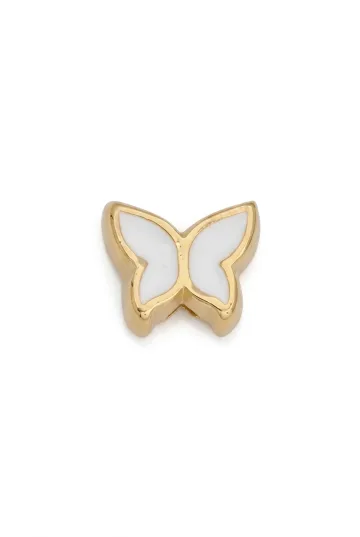
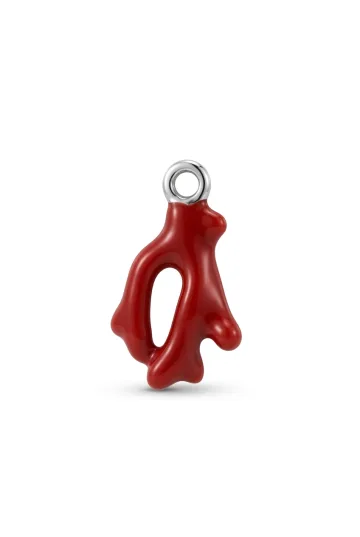


Where a strand begins
The oldest known piece of jewellery is not a ring or a bracelet. It is a string of beads. Two drilled sea-snail shells found at the Skhul site in present-day Israel were worn on a thread roughly 100,000 years ago. A bead is older than any metal, any faceting, and almost any word in our languages. When you put on a strand of stone, you repeat a gesture more than a thousand centuries old.
A single strand of agate weighs about as much as a handful of small pebbles, and that is the first thing you feel wearing stone instead of metal. The stone warms against the skin within a minute, every bead carries its own pattern, and a strand of a dozen such beads already changes how you hold yourself. A layered gemstone necklace comes together from weight, colour and length, not from a rulebook, and you can assemble one in an evening.
This guide is about how to mix stones across several strands, which gems actually hold their shape as beads, how to choose lengths so the rows do not tangle, and how to slip a thin gold chain into the mix. Along the way there is a little history: where the stone in beads came from thousands of years ago, and why these particular minerals survived into today's strands. The properties of each stone on its own live in separate guides that I link to here, while this piece is about composition.
Which stones suit beads
Not every gem works on a long strand. In beads a stone works through mass and colour, not through facets, so the materials that make the cut are dense, tough minerals that do not crumble when drilled and that hold a polish. This set of materials settled in the Bronze Age: Egyptian and Mesopotamian strands carry exactly the same stones as today's beads, because the physics of drilling has not changed in five thousand years. Here are the ones strung into strands century after century.
Agate
Agate is the workhorse of stone beads. A banded chalcedony, dense, unbothered by chips, found in almost any colour from grey-white to a deep dyed blue. It is easy to cut into round and faceted beads, and it takes both a matte and a mirror polish. Banded agate gives a living pattern down the strand, with every bead slightly different.
Toughness and a tolerance for drilling are exactly why agate became a bead thousands of years ago. Chalcedonies like agate and carnelian do not split along a plane the way quartz or feldspar does, so you can draw a long thin channel for the thread without risking a crack. That technical trait, not beauty, decided which stone survived in beads to our day. If you want one calm strand for every day, start with agate. A full breakdown of the varieties and shades sits in the agate guide.
Carnelian
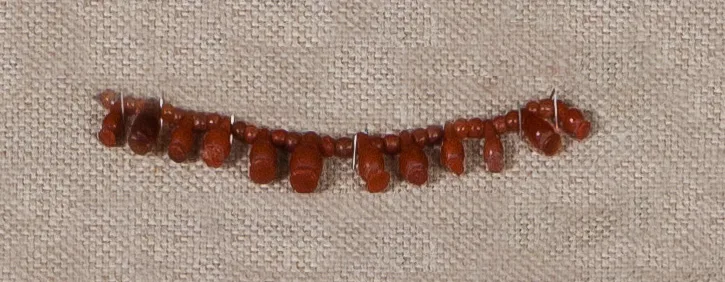
Carnelian is a warm orange-red chalcedony, a structural cousin of agate, but with a colour all its own. On a strand it glows from within in sunlight, the semi-transparent beads letting light through. Carnelian loves the company of gold and of dark stones: beside black onyx it reads brighter still.
Carnelian beads travelled the farthest of any stone bead. In the third millennium B.C., craftsmen of the Indus Valley, in what is now Pakistan and India, cut long faceted beads from it and etched white patterns onto them with an alkaline mordant. These beads spread across the entire ancient world and turn up thousands of kilometres from where they were made: in the royal cemetery of Ur in Mesopotamia, in the tombs of Egypt. When you hold a strand of carnelian, you are holding a format that was an item of international trade before money was invented. The stone itself and its shades are covered in the carnelian guide.
Black onyx
Onyx is a deep black stone with an even surface, matte or mirror-bright. In a layered necklace it works as an anchor: a strand of onyx settles a busy composition and pulls it together. Black beads slim the neck visually and give contrast to any pale stone.
Onyx is also a chalcedony, kin to agate and carnelian, and it went into beads for the same reason: toughness and an even, chip-free polish. The name itself comes from the Greek word for fingernail, after the stone's thin translucent layers. Ancient carvers prized banded onyx because you could cut a cameo into it, with a pale layer standing in relief on a dark ground. In beads those layers are more often reduced to an even black, and then the stone works as a deep, calm backdrop. What the stone is and how it differs from sardonyx is set out in the onyx article.
Lapis lazuli
Lapis lazuli is a saturated blue stone flecked with gold pyrite. In beads it looks the most expensive of all: a single strand of lapis reads as the jewellery of someone of rank, which is why Egyptian kings wore it. The blue is deep and dense; it does not fight gold but amplifies it.
Lapis has a rarity almost no other stone shares: for thousands of years the world's finest blue came from a single point on the planet. The Sar-i Sang mines in the Kokcha valley of northern Afghanistan, in the Badakhshan mountains, have worked for an estimated six to seven thousand years and rank among the oldest active mines on Earth. The blue stone in Tutankhamun's funerary mask and in those same royal tombs of Ur was mined right there. A lapis bead made the journey from the Afghan mountains to the Nile and the Euphrates back in the Bronze Age, along trails that later became part of the caravan roads. The stone's history and properties are gathered in the lapis lazuli guide.
Tiger's eye
Tiger's eye is a golden-brown quartz with a silky sheen that runs across the bead as you turn it. That moving glint is called the cat's-eye effect, and it works best in a round polished bead: each bead down the strand comes alive in the light in turn. The colour is warm, honey-amber, with dark and light bands. It pairs most easily with black onyx, gold findings and honey agate. The stone is dense and durable, an excellent everyday candidate.
Amethyst
Amethyst is a purple quartz, from pale lilac to a deep wine. On a strand it carries itself cool and dressy at once: the bead is semi-transparent, lets light through and plays a little inside. Faceted beads give more sparkle, smooth rounds read softer. Amethyst's colour fades in strong sun, so it is best not to leave the strand in the light for long. It suits silver better than yellow gold and likes the company of rock crystal and grey-white agate. A strand of amethyst works well as a single colour accent in a cool composition.
Turquoise
Turquoise is a sky-blue or blue-green stone, often veined with a dark web called the matrix. In beads it brings an instantly recognisable southern tone and argues beautifully with carnelian and coral-red beads alongside it. Turquoise is soft and porous, the most delicate of the common stone gems on a strand, and it asks to be worn more carefully than the rest. Natural turquoise is often stabilised with resin for strength, and that is standard practice, not a fake. On a strand it works as a large block of colour and needs a quiet background.
Jasper
Jasper is a dense, opaque stone in earthy tones: brick red, sand, green, with swirls and landscape patterns. On a strand it is the quietest of the gems, matte and warm, with no shine or play. That is exactly why people love it: a strand of jasper grounds a busy composition like a neutral base, and every bead still carries its own pattern. It pairs easily with anything warm: with carnelian, tiger's eye, wood and copper. The stone is very hard and undemanding, fit for rough daily wear.
Howlite
Howlite is a white stone with grey veining, much like marble to look at. In beads it is prized for its clean matte white: a strand of howlite gives lightness and contrast next to dark stones. Howlite dyes easily, and it is what most often gets made into imitation "turquoise" and other coloured fakes, so suspiciously cheap, bright turquoise is almost always dyed howlite. White howlite on its own is good: it softens the brightness of neighbouring stones and works as a pale pause in the strand. The stone is soft and porous and soaks up dye and grime quickly. It pairs with black onyx, lapis and silver.
Rock crystal
Rock crystal is colourless, transparent quartz, clear ice in a bead. On a strand it gives a glassy shine and air: the clear beads catch light and visually lighten a heavy stone strand. It is the universal diluent, slipped between coloured stones to let them breathe and keep them from blurring into one solid block. It goes with everything and looks especially good beside amethyst and pearl. Because the stone is clear, the thread shows through it most of all, so knotted stringing is particularly at home here.
Aventurine
Aventurine is most often a green quartz with a soft shimmer of golden sparks inside, given off by tiny flakes of mica. The effect is called aventurescence, and in a polished bead it gives not a surface shine but a quiet inner glow. Green aventurine is calm and muted, and there is a peach variety too. On a strand it works as a soft colour without shouting and sits well beside rock crystal and silver. The stone is dense and durable, good for every day.
Baroque pearl
Baroque pearl is pearls of irregular shape, each one its own. On a strand they give a soft, uneven shimmer, lively and warm, unlike a perfectly round pearl. A baroque strand lies beautifully over rows of stone: organic sheen against matte stone is a lovely contrast of textures. There are separate guides on the kinds, shapes and lengths of pearl: on pearl itself and on pearl necklace length.
Heavy agate wants an open collarbone, not a turtleneck. Choke the neck with fabric and you may as well take the beads off.
How to wear stone beads
Hundreds of stone strands have passed through my hands on shoots, from a single modest row of agate to four layers for an evening frame. Here is what actually holds a look together, sorted by occasion and by stone.
What do I wear stone beads with every day? For daily wear I recommend one or two rows of a calm stone over a plain top: grey-white agate, jasper or tiger's eye on a linen shirt, a cotton dress or knitwear. A light top lifts the stone, a dark one turns the strand into the accent. I suggest resting a heavy row on an open collarbone rather than a tight neckline, or the stone presses and looks coarse.
How do I match the stone to skin tone? For warm skin with a golden undertone I recommend warm stones: carnelian, honey agate, golden baroque pearl, they carry the warmth of the face forward. For cool skin with a pink undertone I suggest onyx, lapis, grey-white agate. When you want one bright row, I choose contrast: warm carnelian on cool skin reads as a precise accent.
How do I wear beads with different necklines? Under an open V-neck I choose long rows and a larger stone, they lead the eye down and do not fight the fabric. Under a high neckline I take short strands up to 45 cm so the lowest row does not drown. The rule is simple: I pick the length for the neckline, not the other way round, the stone should land in the open zone.
How do I build a layered evening look? For evening I suggest three rows stepped 4 to 5 cm apart with one leading colour and the rest in support: lapis in the centre, grey agate and onyx behind it. On top I recommend throwing a thin paperclip gold chain, it pulls the coloured rows into one composition and gives shine against the matte stone.
Who actually suits stone beads? Anyone who loves texture and weight rather than the glint of facets. Stone is loud on its own, so it wants a calm plain background and an open cut. On a slim long neck I choose short rows, on a medium or fuller frame I happily reach for long strands and several layers.

Turn on your camera, pick earrings, a pendant or a ring, and see the piece on yourself in real time.
Switch items in one tap.
Everything runs in your browser: no photo or video is ever uploaded.
How to mix stones across strands
Building a layered stone necklace is a question of balance, not of quantity. Too many bright shades together turn busy, one colour across every strand looks dull. The scheme that works is simpler than it seems.
The rule of one lead colour
Pick one stone to lead and let the rest support it. Lapis leads, say, while grey agate and black onyx are the background. Or carnelian takes centre stage while cream agate and baroque pearl temper its brightness. One hero, two or three extras: then the composition reads instead of fragmenting.
Contrast of texture beats contrast of colour
A smooth, mirror-bright bead next to a matte one looks more interesting than two glossy beads of different colours. So mix the finishes: polished onyx, matte agate, uneven baroque pearl. The eye catches on the change of surface, and the rows stop merging into one mass.
Bead size from top to bottom
The classic logic of a layered necklace: small beads in the short top row, large ones in the long bottom row. That keeps the composition from tipping forward and visually lengthens the neck. If every row is the same large bead, the necklace presses down; if every bead is small, it gets lost in the neckline.
How many strands to take
Two strands is a calm base that is hard to ruin. Three is already a noticeable piece and asks for an open neckline. Four or more is an evening outing and the territory of bigger looks. Start with two strands of different lengths, then add.
Customer reviews
Zevira is a real jewellery shop. Genuine payments, deliveries and customer thank-yous.
🥰🥰🥰 gracias

Ok, ¡gracias! 🙂

Lengths and layering strands
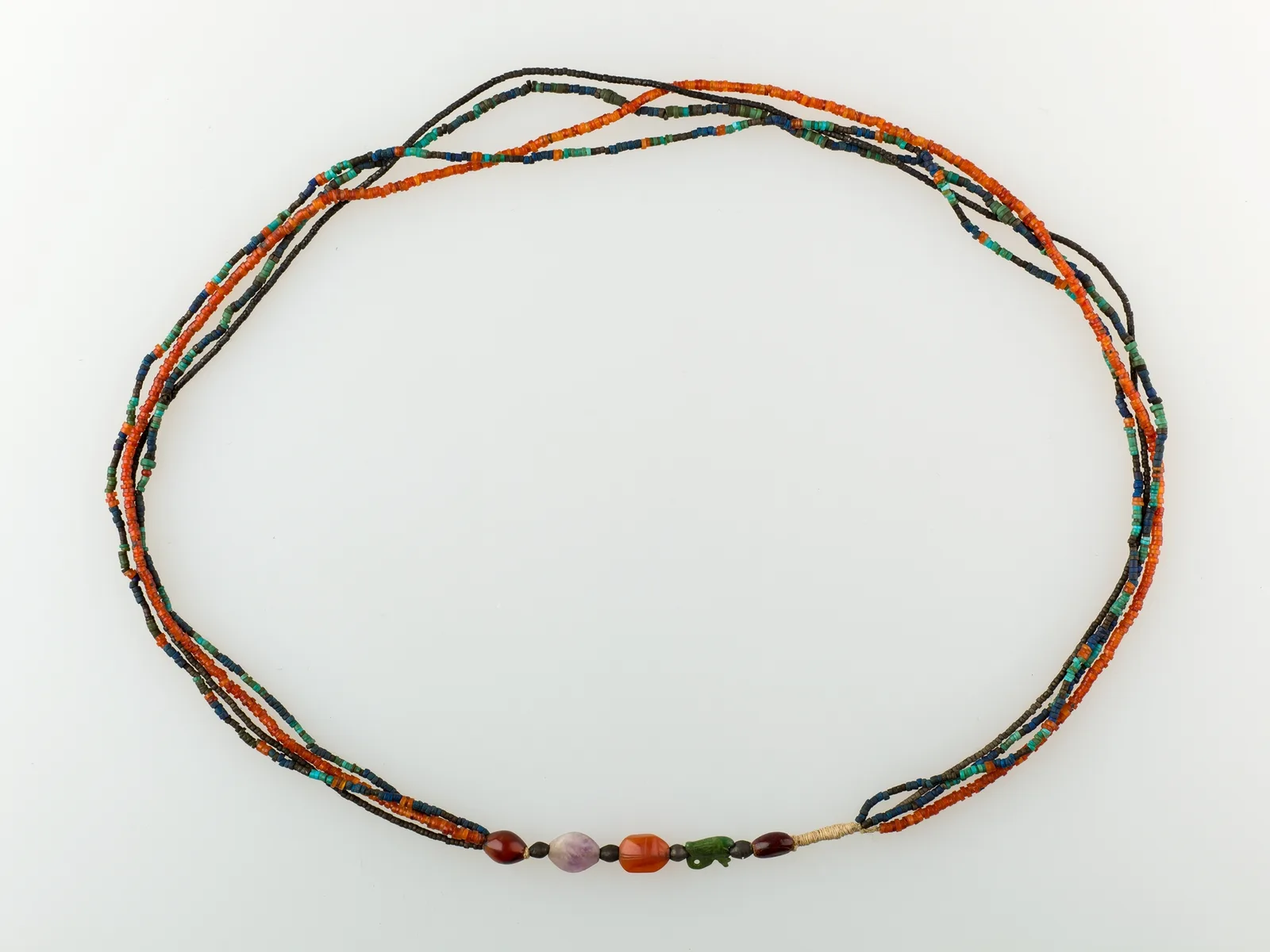
A multi-strand bead necklace is not a discovery of recent seasons either. Wide collar necklaces of several bead rows, the so-called wesekh, were assembled in ancient Egypt from carnelian, turquoise, lapis and faience and worn by the living and in burial alike. The logic is exactly today's: several tiers of different length, stepping down from neck to chest. The picture above of a four-strand necklace shows this principle, more than four thousand years old.
The main mistake of a layered necklace is rows of equal length: they tangle, lie on top of one another and look like one thick strand. The rows should step, and the gap between them should show.
A working gap between rows is 4 to 5 cm. Then each strand reads on its own, and you can see there is more than one. A basic set for the neck: a top row of about 40 cm sits at the base of the neck, a middle one about 45 cm, a bottom one about 50 cm running to the collarbones. Those three tiers give a tidy stair without confusion.
For a longer look, add one very long row (60 cm or more) that drops to the chest and works as a separate accent. You can wear it on its own or over the short rows. The logic of lengths is set out in detail in the necklace chain length guide, and it applies fully to stone strands.
Under a high neckline take short rows, up to 45 cm, or the lowest strand drowns in the fabric. Under an open neckline the long rows that lead the eye downward are the ones that work. On building layered looks from different pieces there is a separate guide to combining several pieces of jewellery.
Upload a photo of your pet, someone you love, or an object. We'll build a 3D model and hand-cast it in pewter.




Stone and a gold chain
The most current move in stone beads is to add a thin gold chain to the rows. Metal against stone gives two effects at once: shine beside the matte mineral and lightness beside the mass. The necklace stops being ethnic and turns restrained.
A paperclip chain works best, with elongated rectangular links. Its geometry argues with the roundness of the beads, and the argument is a handsome one: a hard linear chain underlines the soft balls of stone. Take a chain thinner than the stone rows and set it either as the very top short row or as the lowest long accent.
Gold ties differently coloured stones into one composition: a warm metal is the common denominator for carnelian, lapis and onyx all at once. If the rows look like a jumble, add a gold chain and they pull together. Silver does the same with cool stones, but gold is more versatile.
Do not mix more than two metals in one necklace, and do not overload the chain with pendants when there are already several rows: the stone carries enough weight on its own. One smooth chain over three rows of stone is already a finished look.
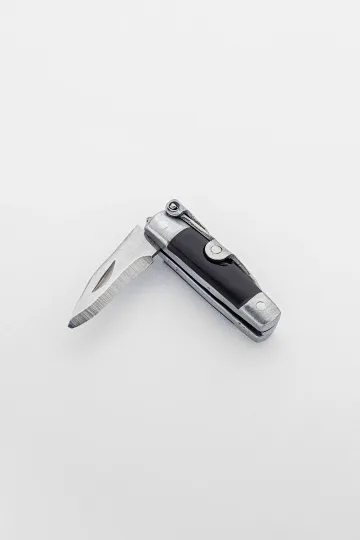
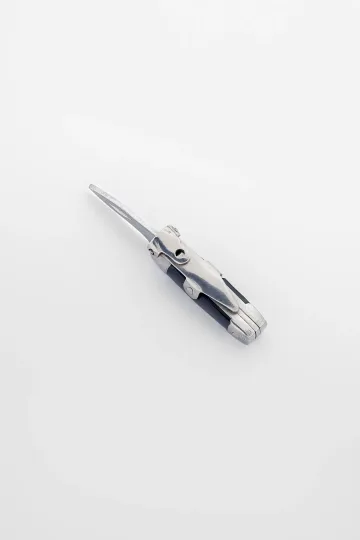
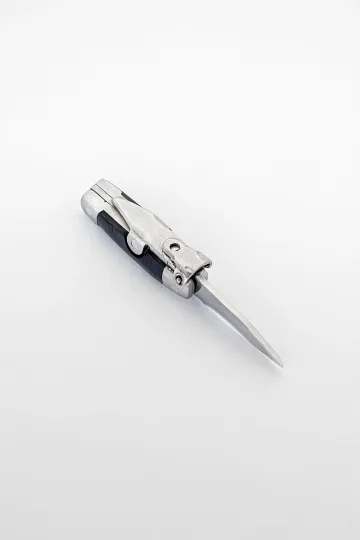
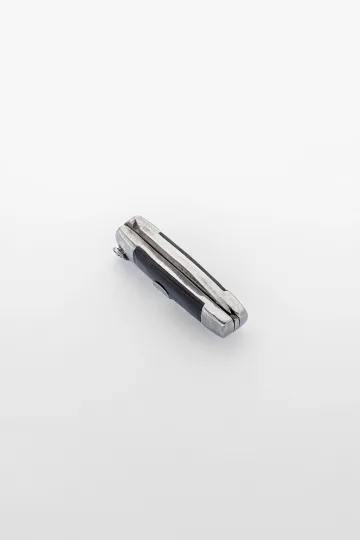
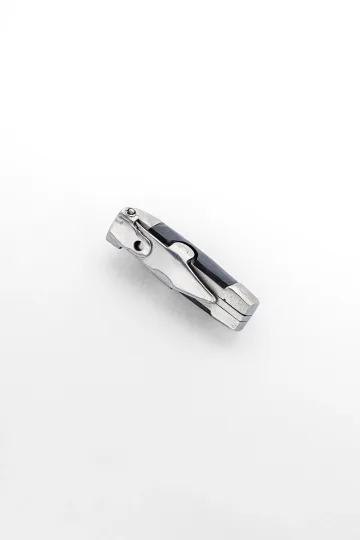
CAPAORA mini knife pendant
The 18th-century Spanish navaja in miniature: 40 mm of stainless steel, a real folding mechanism and a Palanquilla lock that clicks. An affordable gift to remember.
Authentic · Ships from Spain · 14-day returns
How a stone strand is assembled
What a strand is built on and what clasp it carries decides whether the piece lasts a year or decades. It is worth working out what to choose for your beads.
What beads are strung on
The base of a stone strand has three working options.
Silk thread with knots is the classic for pearl and fine stone of medium to large calibre. Silk is soft, the beads sit on it pliantly, and knots are tied between them. The serious drawback: it stretches and darkens from skin oil, so every few years the strand is restrung. Instead of natural silk people often take a nylon thread of the same kind; it is stronger and ages more slowly.
Jeweller's beading wire is a thin steel cable of many strands in a nylon coating. It barely stretches, holds the weight of heavy stone and does not snap from a tug, so it is used for dense strands without knots, with the beads sitting flush. The ends are clamped in metal crimps. The wire is stiffer than silk and you do not tie knots on it, but it is the best choice for heavy minerals like agate and onyx in one tight row.
Silicone elastic is a stretchy cord that beads are strung on without a clasp: a bracelet or short beads simply pull over the head. There is nothing to fasten, and it is the easiest thing to assemble. But elastic dries out and snaps over time, heavy stone stretches it faster, and it is no good for a long strand. Silicone is fine for light bracelets, not for a serious stone necklace.
Why knots between beads
A knot between every pair of beads solves two problems at once. First: the beads do not rub against each other, and hard stone on stone, or pearl on pearl, quickly wears the surface and the holes. The knot puts a soft buffer between them. Second, and more important: if the strand breaks, the knots hold the beads in place, so you do not have to gather a scattered row off the floor; at most one or two beads are lost. That is why fine stone and pearl are always strung with knots, even though it takes longer and costs more. On a dense strand of inexpensive beads the knots are often skipped for speed and a tight fit.
Types of clasp
How easy the clasp is decides whether you wear the beads or they stay in the box.
A lobster clasp is the most familiar fastening, a spring-loaded hook with a tongue. It is reliable and holds firmly, but a small one is hard to fasten one-handed behind your back. For stone beads take a larger lobster clasp; it is easier to find by feel.
A toggle is a clasp made of a ring and a bar: the bar is pushed through the ring and lies across it. It fastens easily, often one-handed, and looks like a decorative detail itself, so it is often brought round to the front, onto the chest. On a very light strand the bar can slip out, but stone beads are never short on weight.
A magnetic clasp is two magnets in metal caps that pull together on their own. It is the easiest of all for anyone whose fingers do not cooperate; you can fasten it blind in a second. But a magnet holds more weakly than a clasp and may not hold a heavy strand of large stone through a sudden movement. It is good for light and medium beads; for a heavy necklace a lobster clasp or toggle is more secure.
Length for your neck: choker, princess, matinee
Length changes the look more than the stone itself, so it is worth choosing deliberately. The lengths have settled names, and they apply to a stone strand just as to a pearl one.
How to measure your length
Wrap a tape measure or a piece of string around your neck where you want the beads to sit, and take the reading at the base of the neck; that is your zero. From there you add on to work out where a strand of a given length will fall. Bead calibre matters too: large beads eat a couple of centimetres of fit, and the thicker the row, the shorter it sits.
Choker: 35 to 40 cm
A choker sits snug at the base of the neck. On a stone strand a choker is best in small or medium beads: large heavy stone worn close presses down and looks coarse. A choker of agate or tiger's eye opens the neck and suits an open neckline and a slim collarbone. On a wide or short neck take a choker at the upper end of the length so it does not sit too tight.
Princess: 42 to 48 cm
This is the most versatile length, the strand lying at the collarbones. The princess suits almost any neckline and any bead calibre, and it is where to start if you are unsure. A single row of lapis or carnelian at princess length is a finished everyday piece. In a layered necklace the princess length is usually the middle row.
Matinee: 50 to 60 cm
A matinee drops to the chest, below the collarbones. This length loves large stone and a noticeable bead: the strand leads the eye downward and works well over plain clothing and a closed top. A matinee of large agate or jasper is an accent in its own right. In a layered necklace the matinee is usually the long bottom row.
Opera: 70 to 90 cm
The opera is a long strand that lies on the chest or below. You can wear it loose, knot it, or double it into a short two-row strand. An opera of a light stone like rock crystal or aventurine gives an evening look without heaviness. For large, dense stone this length is already a real weight on the neck, which is worth bearing in mind.
Leave your email, we'll send your discount code. No spam, unsubscribe anytime.
The code arrives by email, valid on your first order.
Hardness and character of stone
Stones on a strand differ greatly in durability, and that decides how they are worn and stored. Jewellers measure hardness on the Mohs scale from 1 to 10, where 10 is diamond and 1 is soft talc.
What Mohs hardness means
The scale shows what scratches what: a stone with the higher number scratches the one with the lower, and not the other way around. Household dust and sand are mostly quartz at about 7, so anything softer than seven dulls over time simply from rubbing against dust and clothing. The takeaway is simple: stones of hardness 7 and up hold a polish for years, while anything below that needs to be kept from scratches.
Hard stones: agate, onyx, the quartzes
Chalcedonies and quartzes hold the top of the scale. Agate, carnelian, onyx, tiger's eye, amethyst, rock crystal, aventurine and jasper stand at about 7 on Mohs. These are tough minerals: hard to scratch, they do not crumble and they hold a mirror polish through daily wear. That is exactly why chalcedonies have gone into beads for thousands of years; the physics is on their side. Such strands can be worn with almost no caution, guarding them only against knocks on hard surfaces.
Delicate stones: turquoise, howlite, lapis, pearl
Here the scale drops, and these stones need gentler wear. Turquoise stands at about 5 to 6 and is porous, howlite is softer still at about 3 to 4, lapis is around 5 to 6 and also dislikes rough handling. Pearl is organic altogether, its hardness about 2 to 3, softer than a fingernail in some varieties. A soft stone scratches on that same household dust, dulls from rubbing and fears knocks. These strands are taken off first and stored separately, so that hard agate does not scratch delicate turquoise in the same box.
What a stone fears: water, cosmetics, ultrasound
A stone strand has three common enemies. Water and long damp harm porous stones and organics: turquoise, howlite, lapis and pearl absorb water and dull, while silk thread rots and breaks from water. Cosmetics, perfume, cream and household chemicals settle on the stone as a film and work into the pores, so the piece goes on last, after perfume and make-up. Ultrasonic cleaning, the kind used on diamonds, is contraindicated for almost all beads: the vibration knocks the filler out of pores, crumbles stabilised stones, shatters pearl and loosens the knots on the strand. Stone beads are cleaned only with a soft dry cloth.
Who suits stone beads
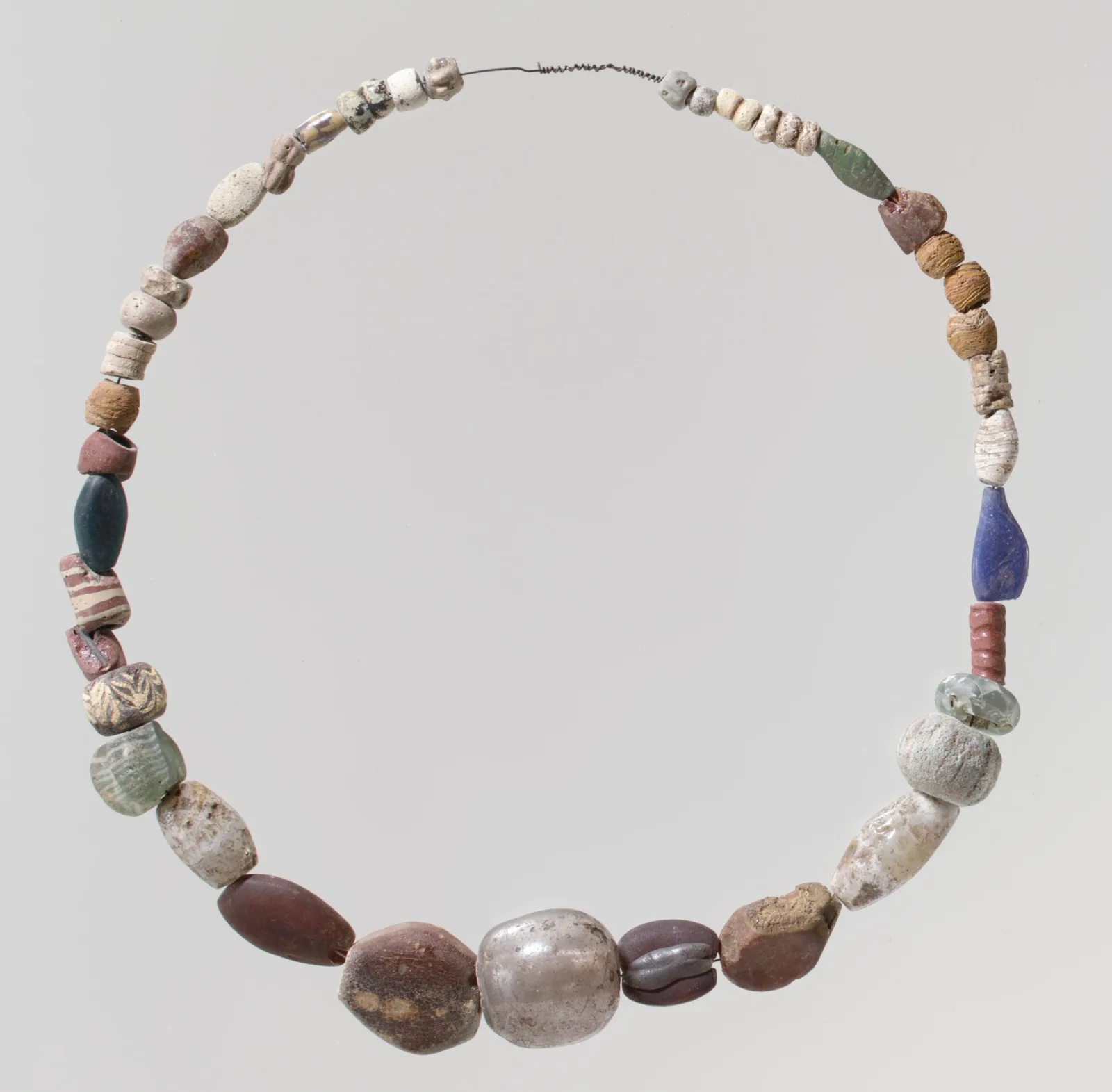
A layered stone necklace is a piece for those who love texture and weight rather than the sparkle of facets. It suits open necklines, simple cuts, plain clothing: the stone is loud enough on its own and needs a quiet background.
Stone beads sit well on a medium or full neck silhouette, adding proportion to it. On a thin, long neck the short rows work better, so as not to draw it out further. For pinned-up hair and bare shoulders the large rows suit; for loose hair, the small.
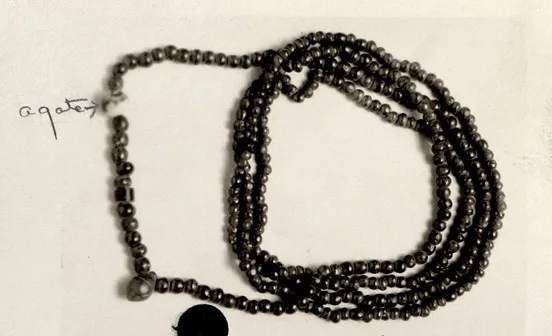
It is a rewarding gift: stone lasts, the strand can be restrung and lengthened, and the form does not go out of fashion. One good strand of agate or lapis outlives a dozen seasonal pieces. The bead is the most durable of all kinds of jewellery: stone beads outlast the metal of the setting, the thread and the owner, which is why archaeologists read the age and connections of ancient cultures from them. The Frankish necklace in the picture above lay in the ground for fifteen hundred years, and the glass and agate beads in it survived to a museum case.
Caring for the strand
Stone is nearly eternal, but the thread holding it is the weak link of any beads. That is what needs looking after.
Stone beads are traditionally strung on silk thread with a knot between each bead: the knots keep the beads from rubbing against each other and insure against scattering if the thread breaks. Silk stretches over time and darkens from skin oil, so every few years the strand is worth restringing with a specialist. It is inexpensive and adds decades to the life of the piece.
The knot between beads is no invention of recent jewellers. All prayer ropes were born from knots on a cord. Monks on Mount Athos tied knots on a rope to count their prayers, and that string is called komboskini in Greek, from the word for the knot of a codex. The Greek komboloi later came out of it, the familiar worry beads people now run through their fingers not to count prayers but to settle the hands and the mind. So the knotted stringing that holds your stone beads is a direct descendant of the prayer rope.
Take stone beads off before a shower, sport and sleep: water and sweat destroy silk fastest, and sharp tugs tear the thread. Lapis and carnelian dislike household chemicals and long water; porous stones lose their polish to it.
Store beads laid out straight, not in a heap: a coiled strand kinks and wears through faster at the bends. Best to hang them or lay them out flat in a separate compartment, so hard stones do not scratch neighbouring pieces. Wipe the beads with a soft dry cloth after wear, with no water and no products.
If the composition includes baroque pearl, care for it as pearl, which is gentler than stone: a soft cloth only, no chemicals, put it on after perfume and cosmetics rather than before.
Send a friend a discount code, they save on their first order.
Beads: facts that surprise
A stone strand looks like a simple thing, but behind every bead runs a story tens of thousands of years long. A few facts that change how you see a handful of round stones.
Beads are older than all other jewellery
The oldest reliable jewellery of humankind is beads, not rings or pendants. Two shells of the sea snail Nassarius from the Skhul site were drilled and worn on a thread roughly 100,000 years ago, while younger finds from Blombos Cave in South Africa date to about 75,000 years. Many of the shells show the characteristic wear of rubbing against a thread. The urge to string something beautiful on a cord is older than speech in its present form.
The word "bead" once meant "prayer"
The English word bead goes back to the Old English bede, which meant prayer. The shift in meaning came from the rosary: small balls of bone, wood or amber were strung on a thread to count off the prayers said, and those balls gradually came to be called by the same word as the prayer itself. So the name of a spiritual act moved onto an object. The thread of beads and the counting of prayers run together across more languages than English alone.
Carnelian was carried thousands of kilometres before coins existed
In the third millennium B.C., long faceted carnelian beads made by Indus Valley craftsmen spread across the entire ancient world. They turn up in the royal tombs of Ur in Mesopotamia, thousands of kilometres from the workshops. A carnelian bead was a high-status import in an age when money as such did not yet exist.
All the finest blue came from one gorge for thousands of years
The deep blue lapis for the whole ancient world, from Egypt to Mesopotamia, was mined in one place: the Sar-i Sang mines in Afghan Badakhshan. By various estimates the mines are six to seven thousand years old, and they are called among the oldest active mines on the planet. The blue on Tutankhamun's mask and in the jewellery from Ur came from that gorge.
Beads served as money for centuries
A string of beads was not only an ornament but a means of payment. Cowrie shells served as money across a vast area from Africa to China, glass beads settled accounts in the trade of the Old World and the New, and in some cultures wealth was long measured in strings of beads. Ornament and purse were for centuries one object, worn around the neck.
The worry beads run for calm were born from knots
The Greek komboloi and their Turkish relatives are run through the fingers today not to count but to settle the hands and the mind, to occupy them with a rhythm. They grew out of the prayer string: monks tied knots on a rope to count prayers, and from that knotted rope a straight line runs to the worry beads familiar now. The same knot holds stone beads between one and the next.
Drilling stone was mastered long before metal
A long thin channel in a hard carnelian bead is no crude work. Indus Valley craftsmen drilled chalcedony with special elongated drills of an even harder stone, turning them with a bow drive and feeding in abrasive, and a single long bead took days of unbroken work. It was a separate, narrow profession passed down by inheritance, thousands of years before a metal tool appeared. By the drill marks on ancient beads, archaeologists tell one workshop from another and one era from the next.
Turquoise has two homelands
Turquoise was loved independently at opposite ends of the Earth. In ancient Egypt it was mined in Sinai as early as the third millennium B.C., and the Sinai turquoise mines are among the oldest known shafts in the world. On the other side of the globe, the peoples of the American Southwest cut turquoise into beads and mosaics long before the Europeans arrived. One stone, two independent cultures, and in both it became the stone of sky and protection.
Archaeologists divide human history by beads
Beads are so durable that they outlast almost everything else in a burial. From the material, shape and method of drilling, scholars determine the age of a site, its trade links and the skill level of a whole culture. A handful of stone balls is, to an archaeologist, the passport of an era.
FAQ
Can you mix different stones in one necklace?
Yes, and it is the basis of layered stone beads. The main rule: one stone leads on colour, the rest support it. Mix textures (matte and glossy), not just colours, and the composition reads.
Which stone is most practical for everyday beads?
Agate. It is dense, does not crumble, is unbothered by chips, holds a polish and comes in any colour. A row of grey or white agate suits almost any clothing and skin tone.
How many strands should a beginner take?
Two strands of different lengths with a 4 to 5 cm gap. It is a calm base that is hard to ruin. Once you are used to the weight and the logic of lengths, add a third row.
Why does the thread break and how do you avoid it?
What breaks is usually not the stone but the silk thread, stretched by water, sweat and tugs. Take the beads off before a shower and sleep, store them laid out straight, and restring the thread with a specialist every few years.
Does a gold chain suit stone beads?
Yes, it is the most current move. A thin paperclip chain gives shine next to matte stone and pulls differently coloured rows into one composition. Take a chain thinner than the stone rows, and no more than two metals.
How does baroque pearl differ from regular pearl in beads?
Baroque pearl is irregular in shape, each pearl its own, and the row gives a lively, uneven shimmer. It contrasts beautifully with matte stone and lies as the top or bottom row over the stone strands.
How do you choose a stone for your skin tone?
Warm skin suits carnelian, honey agate, golden pearl. Cool skin suits onyx, lapis, grey-white agate, white pearl. A contrasting stone (warm on cool skin or the reverse) works as one bright accent row.
Can you wear stone beads under a high neckline?
You can, but take short rows up to 45 cm, or the lowest strand drowns in the fabric. Under an open neckline the long rows that lead the eye downward are the ones that work.
What is best to string stone beads on?
For pearl and fine stone of medium calibre, take silk or nylon thread with knots between the beads. For heavy stone in one tight row, jeweller's beading wire is better; it holds the weight and does not stretch. Silicone elastic is only good for light bracelets and inexpensive beads; for a serious necklace it is too weak.
How do you choose bead length for yourself?
Wrap a string around your neck where you want the beads to sit, and take the reading. A choker of 35 to 40 cm sits at the base of the neck, a princess of 42 to 48 cm at the collarbones and suits almost everyone, a matinee of 50 to 60 cm lies on the chest, an opera of 70 to 90 cm is worn long or doubled. A large bead eats a couple of centimetres of fit.
Which stones in beads are the most delicate?
Pearl (Mohs hardness about 2 to 3), howlite (3 to 4), turquoise and lapis (5 to 6). They are softer than household dust, scratch, and fear water and cosmetics. The hard agate, onyx, tiger's eye and other quartzes stand at about 7 on Mohs and hold a polish for years. Take the delicate stones off first and store them apart from the hard ones.
Can you clean stone beads with ultrasound?
No. Ultrasonic cleaning crumbles glued and stabilised stones, knocks the filler out of turquoise pores, shatters pearl and loosens the knots on the strand. Stone beads are wiped only with a soft dry cloth, with no water and no products.
Why these stones in beads and not just any?
Beads have for centuries selected dense, tough minerals that do not crumble when drilled and that hold a polish: chalcedonies like agate, carnelian and onyx, plus dense lapis. Stones that split along a plane will not hold a long thin channel for the thread. That selection settled back in the Bronze Age, which is why Egyptian and Mesopotamian strands carry exactly the same minerals as today's beads.
The takeaway: a strand you can build in an evening
Natural gemstone beads are a story of weight, colour and length, not of complicated rules. One lead stone, two or three supporting ones, a contrast of textures, rows stepped with a 4 to 5 cm gap and a thin gold chain on top: that is enough for a finished look.
The stone outlives fashion and its owner, the thread can be restrung, and the form of a layered necklace was assembled in Egypt from the same carnelian and lapis. Start with two rows of agate, add carnelian or lapis for colour, throw a baroque pearl over the top, and the necklace is done. You will build the piece by the same logic people used a hundred thousand years ago, just in a single evening.
Beads and necklaces in natural stone: agate, carnelian, onyx, lapis and baroque pearl, in one row or several, with a gold chain or without.
Buying it as a gift? Each one arrives ready to give.
 A branded Zevira box and a little card come with every order.















About Zevira
Zevira is a Spanish jewellery house from Albacete. Stone beads are one of the oldest jewellery formats: they are strung on silk thread, with knots between the beads, and the strand can be restrung and lengthened.
What you can find with us among stone necklaces:
- Single-row strands of agate, carnelian, onyx and lapis for a calm look
- Layered necklaces of several rows with a chosen contrast of stones
- Compositions with baroque pearl over the rows of stone
- Necklaces with a thin gold paperclip chain alongside the stone
- Stone chosen for skin tone and for an open or closed neckline
The length of the rows can be matched to the look. Natural stone, silk thread, 925 silver and gold in the findings.