Coordinate Couple Pendant: A Gift with an Exact Address
The first working GPS satellite went up in 1978, and the full system came online by 1995. Before that, a meeting point lived in words: "by the fountain near the cathedral." Coordinates say the same thing, only precisely. A coordinate couple pendant pins down one fact: two people share a single dot on the map, and that dot matters more than any abstraction about love in general.
Where the Coordinate Format on Jewellery Comes From
The idea that a place can matter in its own right is ancient. Towns were founded by ritual: a priest drove a plough along the line of the future walls, and a spot on the ground earned a name and a status. Pilgrims did not walk to just any church but to a precise address, Jerusalem, Santiago de Compostela, Canterbury. A relic was tied to where it was kept: the one place in the world where exactly that object lay. Country memory worked the same way: "past the ditch, by the old birch," "by the stone where the horse is buried." These were spoken coordinates, clear to your own people and useless to strangers.
Digital geography pushed that logic to its limit. From the year 2000, when the deliberate signal degradation was switched off for civilians, GPS accuracy improved to a few metres. Google Maps (2005) made coordinates visible to anyone: a long press on a point, and the numbers appear. From that moment, anyone can learn the coordinates of a first date in under thirty seconds. A couple pendant takes one such point and moves it onto metal. Not "mine," not "yours," but one shared point. The shortest definition of a couple: two people who have an address in common.
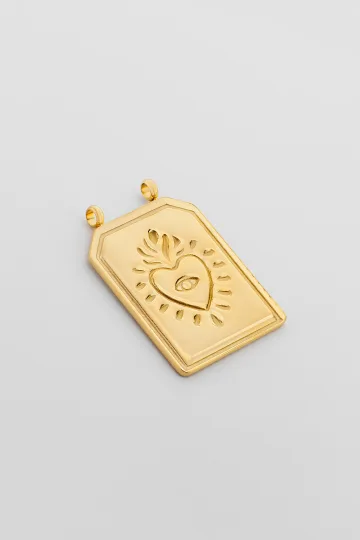
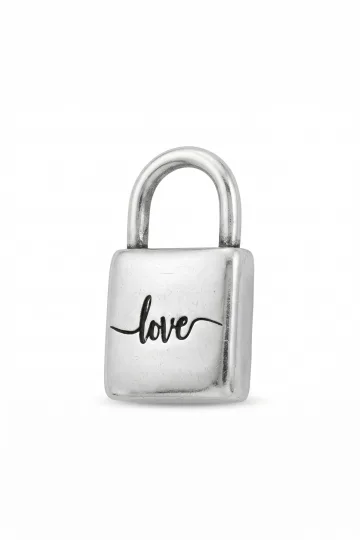
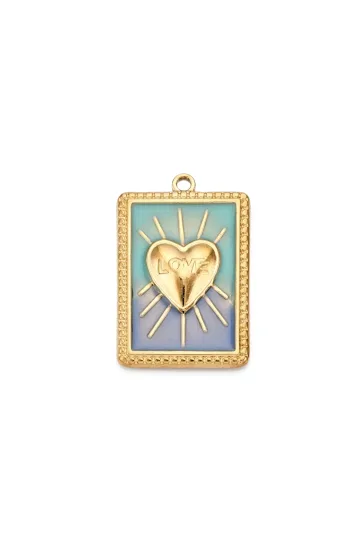
Wear the symbol, don't just read about it. These are in stock:

Which Places Work as Coordinates
Technically you can engrave any numbers, but emotionally not all of them land. Coordinates have to be tied to a personal story, or they are decoration rather than meaning. The categories that hold up:
- Where you met. The point before which you were strangers and after which you were not. The pattern: the more ordinary the place, the stronger the symbol. The London Eye is recognised by everyone, which is exactly why it isn't personal. The corner cafe where you happened to sit at the same table belongs only to you.
- The first date. It differs from meeting by intention: meeting is often chance, a date is a decision. That is why it gets remembered in more detail.
- The proposal. The category with the highest charge. The coordinates of a proposal often go on a pendant as a companion to the rings: the date on the ring, the place on the pendant.
- The register office or the church wedding. The point where the bond became recognised. A caveat: a register office can relocate, the coordinates stay accurate but there may no longer be a building on them. Churches are steadier.
- The first shared flat. The address where you started living together. The flat usually changes later, and these coordinates become the anchor of the beginning.
- The maternity hospital or the house where a child was born. The point at which a couple became a family. A pendant like this is sometimes made as an heirloom for the child.
- A trip that changed the couple. Not necessarily a landmark, a bridge, a cafe on a mountain road, a beach where a big decision was made. A geotagged photo helps recover the coordinates: open it in the gallery and you see where it was taken.
- A holiday home or a parents' house. A place that does not change for decades. Not "where we met" but "where we return." A frequent choice for a gift to the older generation.
- A parent's homeland. The coordinates of the village where your partner's mother was born. For couples living far from their family roots, and for people who have emigrated, this carries unusual weight.
- School or university. If the story began at a desk or in a hall of residence. Strongest of all for the big anniversaries, ten, twenty, thirty years.
A Place Without an Address: Sea, Mountains, a Plane
Not every important place has a street and a house number. Couples meet on a cruise, propose on a mountain viewpoint, spend their first night together in a tent. These points have coordinates too, and sometimes they work harder than street ones.
- Open water. A point in the middle of the sea is fixed exactly as one on land: the satellite sees the vessel, not the shore. If you know the name and date of the cruise, the liner's route is published, and from it you can recover the approximate point for the day in question. On water, take three decimal places: metre accuracy on the open sea is pointless, the ship was moving anyway.
- Mountains and trails. A summit or pass often has no postal address, but it has precise coordinates in hiking maps (OpenStreetMap, tracking apps such as Maps.me). Elevation above sea level is sometimes added as a third line: "2,804 m" under the latitude and longitude says more about the place than a number on the flat.
- A plane. If the important conversation happened in flight, you cannot fix the exact point, the aircraft covered hundreds of kilometres. People take the coordinates of the departure or arrival airport, or of the city flown over, worked out from the flight time and route. That is more honest than an invented dot over the ocean.
- A point that no longer exists on the ground. A demolished house, a vanished beach, a flooded village. Coordinates outlive the object (more on that in the FAQ below), and for such places they are the only way to keep the address.
Which Places to Avoid
- Too famous. The Eiffel Tower, the Colosseum, the Taj Mahal are recognised instantly and worn by thousands of couples. Coordinates work as a symbol through uniqueness. If your place is near a tourist site, take the point next to it, the cafe you watched the tower from, not the tower itself.
- Fictional. Coordinates from a book or a film are tied to someone else's narrative, not to your story. If you want a reference, take a place linked to the book through you, for instance the library where you read it together.
- Too vague. "54°N, 1°W" covers tens of kilometres, it is "York, somewhere." A minimum of three or four decimal places, otherwise the coordinates lose their point.
- Places from past relationships. A new relationship wants new coordinates. An address from a previous marriage on a pendant with a new partner points not to the present but to something closed.
- "Just pretty" places you have never been. Without a personal link the numbers are an ornament, not a record. A dull place with a real story beats a beautiful one without.
Upload a photo of your pet, someone you love, or an object. We'll build a 3D model and hand-cast it in pewter.




Coordinates want a bare collarbone and an open collar. Never drowned under a jumper.
What to Wear with a Coordinate Pendant
Dozens of these pendants have passed through my hands, and the conclusion is one: all the styling here serves a single thing, that the tiny numbers actually read. Here is what works, on set and in life.
How do I wear it every day so the numbers show? I recommend a thin chain and a plain top, white or beige cotton: on a smooth background the engraving reads, on a patterned fabric it disappears. For length I suggest 42 to 45 cm, so the pendant lies above the neckline with most necklines. A bar or a coin with weight lies face forward and does not spin, and that is the condition for the line to be seen.
What do I wear it with at the office? I choose oxidised silver: dark letters on light metal are legible even when small. The pendant sits above the top shirt button and reads as a personal mark, not a loud feature. A glossy polish without darkening I would not advise under artificial light, it flares and the numbers are lost.
How do I build an evening look? For the evening I recommend contrast and an open neckline: it frees the space, and the pendant becomes the centre. Gold or silver with a deep oxidised line belongs here, in warm light the coordinates read more sharply. I keep a plain chain with no neighbouring pendants so all the attention stays on the numbers.
A bar or a coin? I suggest a bar for a short decimal line and a minimalist look, it lies flat and slips under the collar neatly. I choose a coin when the format is richer, degrees with minutes, or when the pendant is two-sided: coordinates on the outside, a name or date on the reverse. The weight of the coin helps it lie face forward.
Can I layer it with other chains? A thin chain alongside does no harm, but a second engraved plate I would not advise: two texts compete, and the eye does not know what to read. Keep earrings and rings in the same metal as the pendant. If you want layers, give the coordinates their own length line and do not pin them between other pendants.

Turn on your camera, pick earrings, a pendant or a ring, and see the piece on yourself in real time.
Switch items in one tap.
Everything runs in your browser: no photo or video is ever uploaded.
How Coordinates Actually Work: Latitude and Longitude in Plain Words
Before the numbers go onto metal, it helps to understand what you are engraving. It cuts the chance of a mistake and makes the meaning of the gift easier to explain to the person receiving it. The whole system comes down to two numbers that together point at one spot on a sphere.
What Latitude Is
Latitude shows how far north or south of the equator a point sits. The equator is zero, the North Pole is 90 degrees north, the South Pole 90 degrees south. London lies at roughly 51 and a half degrees north, Edinburgh close to 56, Barcelona around 41, Sydney about 33 south. In writing, latitude comes first and carries the letter N for north or S for south. Lines of equal latitude run parallel to the equator, which is why they are called parallels: the further from the equator, the shorter the line.
What Longitude Is
Longitude shows how far east or west a point sits from the prime meridian, which by agreement runs through Greenwich in south-east London. From zero, longitude climbs to 180 degrees east (E) and 180 west (W), and on the far side of the planet east and west meet again. London sits at about 0.13 degrees west, Rome near 12 east, New York around 74 west. Longitude is written second. Together the two numbers give a single point: only one place on Earth carries exactly that pair.
Why Order and Sign Must Not Be Muddled
The commonest amateur error is to swap latitude and longitude, or to lose the hemisphere letter. The numbers 51.50 and 0.12 for London become a spot in the Gulf of Guinea if you reverse them and hand over 0.12, 51.50. Dropping the N or the W is more dangerous still: a coordinate with no hemisphere is read as north and east by default, so a point in the southern or western hemisphere travels thousands of kilometres. The rule is simple: latitude first with N or S, longitude second with E or W, and always check that the point landed where it was meant to land.
How a Receiver Knows Where You Are
A satellite broadcasts a signal continuously with an exact time stamp on it. The receiver in a phone picks up signals from several satellites at once and works out how long each one took to arrive. From those delays it calculates the distance to every satellite, and the intersection of those distances is your position. To fix a place in three dimensions the device needs at least four satellites in view. That is why accuracy drops in dense streets or a narrow valley: part of the sky is blocked and fewer satellites are visible. For a coordinate on jewellery this means one thing. Take the point in the open air, or refine it later on a satellite map, rather than trusting a raw reading taken in a stairwell or under a glass roof.
Customer reviews
Zevira is a real jewellery shop. Genuine payments, deliveries and customer thank-yous.
🥰🥰🥰 gracias

Ok, ¡gracias! 🙂

Coordinate Formats: Which to Choose for Engraving
A single point can be written a dozen ways. The format affects the length of the line, the readability, and the character of the piece.
Decimal degrees (DD). The most compact and modern: 51.5074°N, 0.1278°W. Accuracy is set by the number of decimal places:
- 2 places (51.50°), about 1.1 km, finds the district;
- 3 places (51.507°), about 110 m, a building or a square;
- 4 places (51.5074°), about 11 m, a specific building;
- 5 places (51.50735°), about 1 m, bench accuracy;
- 6 places, about 11 cm, excessive.
For engraving, people take 4 or 5 places: the accuracy you need while still fitting on a narrow bar (about 18 characters).
Degrees, minutes, seconds (DMS). The classic navigation format: 51° 30' 26" N, 0° 07' 40" W. There are 60 minutes in a degree and 60 seconds in a minute; one second is about 31 m. The degree symbols visually fill the line, and the piece reads at once as "coordinates." The downside is length: a full record with hemisphere markers runs to about 25 characters, and not every bar will take it.
What3words. Every three-by-three-metre square has an address made of three words, for example index.home.raft. The most poetic format: three words instead of numbers, with versions for 60-plus languages. The catch is that the words are random and not always a pretty combination. Check the exact address for your specific point on what3words.com before ordering.
Plus Codes (Google). A short code instead of numbers, about 10 characters such as 9C3XGV4C+2X, with no hemisphere markers. Handy for engraving and for places without a clear address. You get the exact code for your point in Google Maps.
Geohash. A string of letters and digits, for example gcpvj0 for a spot in central London. The more characters, the more precise: eight give accuracy of about 20 metres. It looks like a code, with meaning clear only to the initiated, a good option for couples connected to programming.
MGRS. The NATO military standard, a single string of the form 30U XC 12345 67890. The most compact of the military formats, it reads like a cipher. Chosen by couples where one or both have a forces background.
The logic of choosing: a narrow bar (3 to 4 cm) suits decimal degrees, Plus Codes, or Geohash. A wider plate (5 cm and up) takes DMS over two lines and looks classic. The "map and compass" aesthetic is DMS; the "technical code" is MGRS or Geohash; the "poetry of place" is what3words; "minimalism" is decimal degrees. The same format looks different on paper and on silver, so it helps to see a sample at real size before ordering.




What to Add to the Numbers
Coordinates on their own are dry information. A phrase, a date, or initials beside them turn the pendant from a navigation tool into a personal record.
Latin phrases work as a universal language: in your own tongue the obvious sounds banal, in Latin it gains weight.
- Ubi nos coepimus, "where we began";
- Hic et nunc, "here and now";
- Locus amoris, "the place of love";
- Semper hic, "always here."
Typeface. A monospaced face (Courier-style) reads as technical and navigational and underlines the nature of the numbers. A serif gives the vintage look of an old map. A sans-serif is modern minimalism. Decorative faces will not do for coordinates: "1" gets confused with "I," "0" with "O," and you will be reading this piece for years.
Size and lines. Coordinates run to 12 to 25 characters. On a 4 cm bar that means a typeface 1.5 to 2 mm high, on a 2.5 cm coin about 1 mm. Going below 1 mm is unwise: without magnification it becomes unreadable. The gap between the latitude and longitude lines is roughly the height of the type.
Small symbols set off the numbers without competing with them: a heart between latitude and longitude, a star as a separator before a date, a compass rose for a navigational feel, a dot or a cross for minimalism. The symbol should stay within a quarter of the height of the digits.
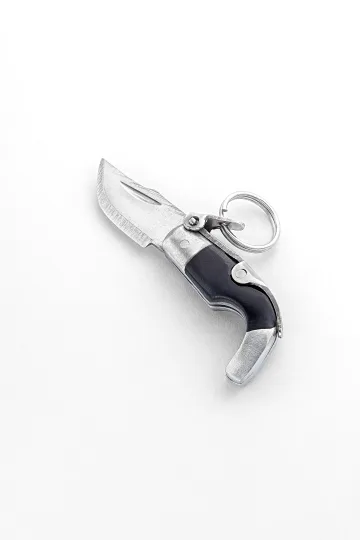
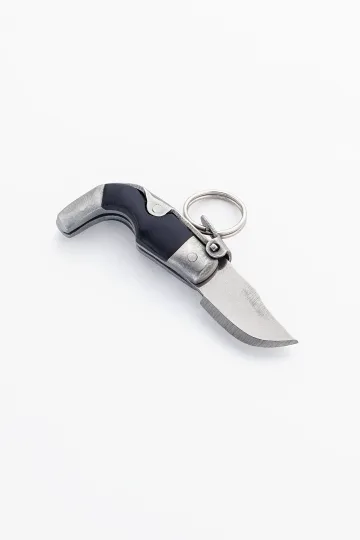
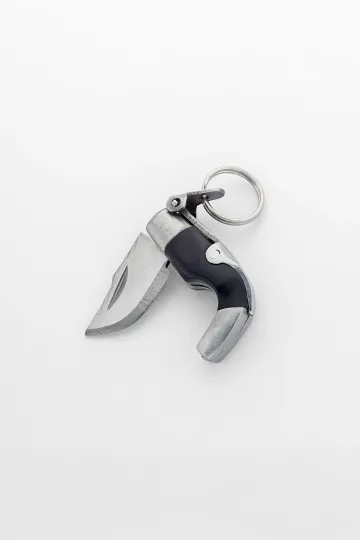
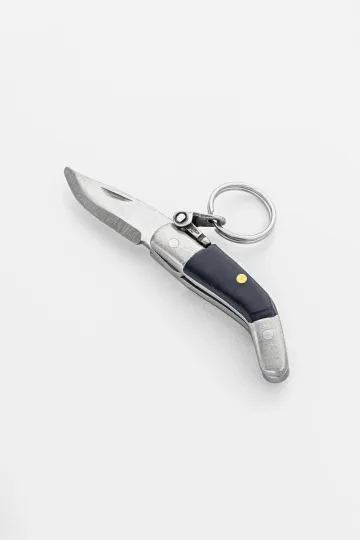
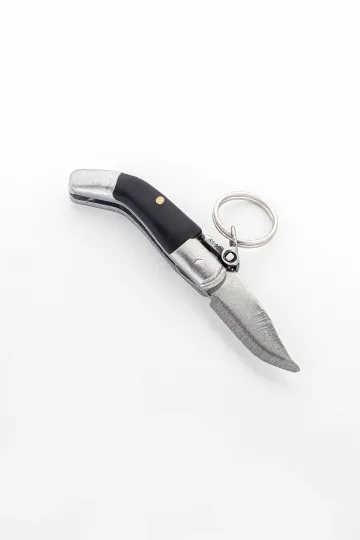
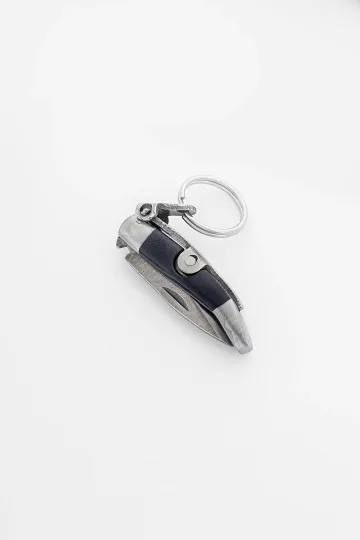
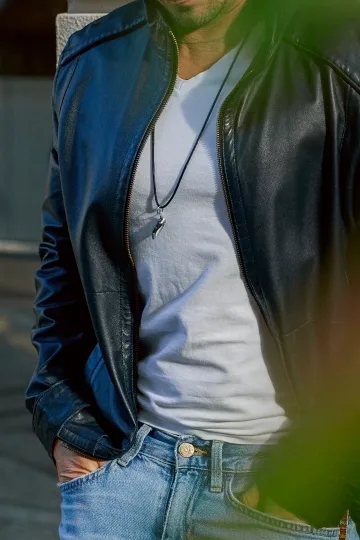
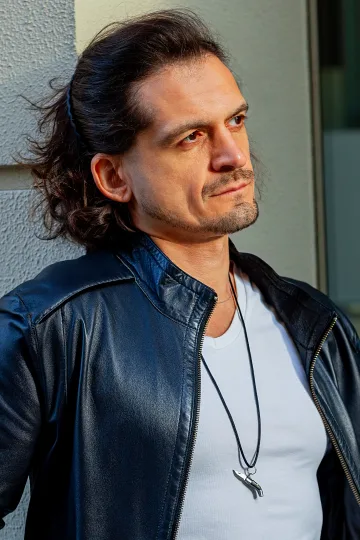
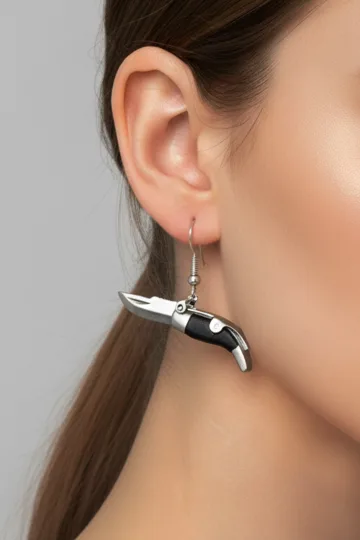
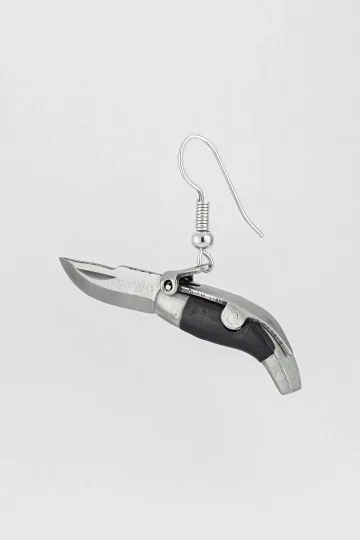
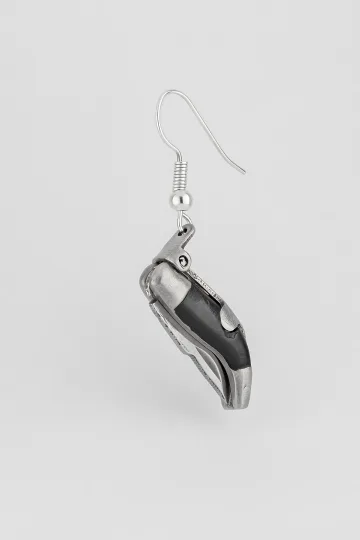
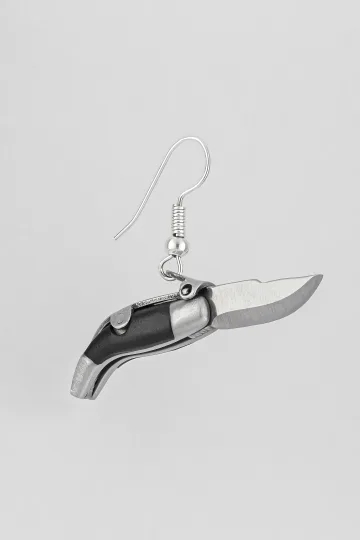
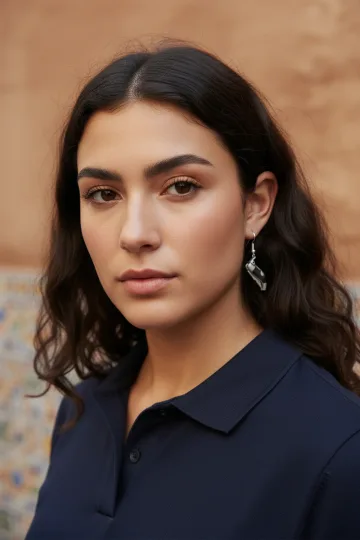
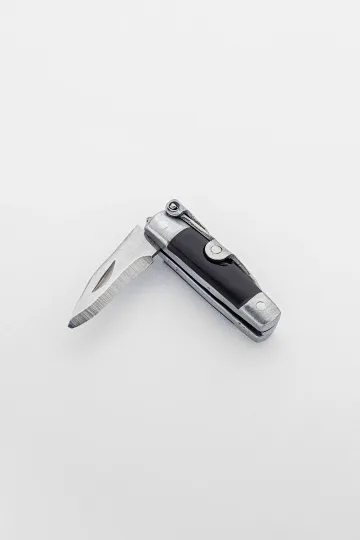
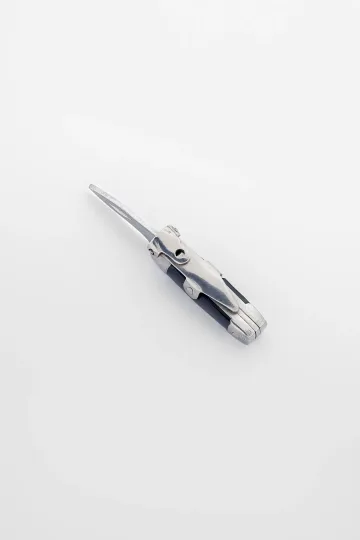
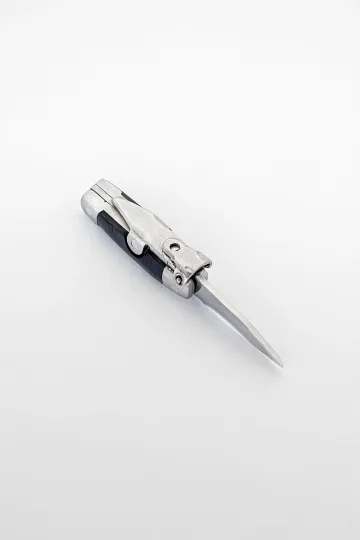
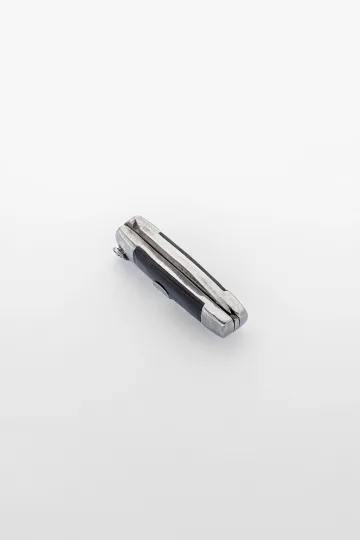
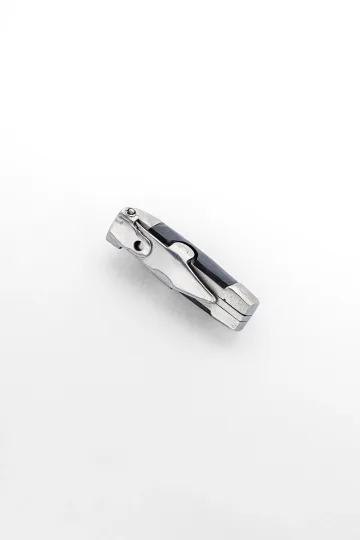
CAPAORA mini knife pendant
The 18th-century Spanish navaja in miniature: 40 mm of stainless steel, a real folding mechanism and a Palanquilla lock that clicks. An affordable gift to remember.
Authentic · Ships from Spain · 14-day returns
How to Verify Coordinates and Engrave Them on Metal
Engraving is permanent: a wrong digit can only be fixed by melting down or replacing the piece. Checking at several levels is non-negotiable.
Cross-check in several apps. Do not trust one. Open Google Maps, long-press the point (or right-click, "What's here?"), note the coordinates. Repeat in Apple Maps and in OpenStreetMap or Bing Maps. A discrepancy under 5 metres is normal, take any value. Over 50 metres means the apps have pinned the point to different parts of the building; clarify what your point actually corresponds to: the entrance, the centre, the front door.
Satellite check. Type the coordinates into Google Maps search in satellite view. If the arrow points at the right building, you are good. If it has drifted onto the house next door, correct it. The satellite shows physical reality, while the map schematic is sometimes offset.
Coordinate system. WGS84 is the international standard, used by GPS and all the main apps (Google, Apple, OpenStreetMap, Bing). Old national survey maps may give a different datum, with discrepancies of a few tens of metres. For a piece of jewellery this is not critical, but if you take coordinates from an old source, check the system.
Laser or hand engraving. For dry numbers, laser is usually better: micrometre accuracy, even depth, fine type without loss of legibility. Hand engraving with a burin costs more and takes longer; it makes sense for an artistic effect, which coordinates do not have.
Depth. The standard on silver, 0.1 to 0.3 mm: the numbers are clearly visible and hold up for years. Surface engraving (under 0.1 mm) wears away quickly with daily wear. Deep engraving (0.5 to 1 mm) boosts the contrast but weakens a thin bar.
Metal. Gold is softer than silver, and on 24K (pure) engraving holds worse than on 14K. On 925 silver the recesses of the letters can be oxidised with a liver-of-sulphur solution, giving dark letters on a light ground, with the numbers readable at once. Oxidised areas must not be cleaned with abrasives, or the darkening will rub off.
A test engraving. A good craftsperson will run a trial in the same face and size on a sample plate. That lets you see how the format sits on metal and adjust the typeface, line height, and depth before the main work.
Paired Jewellery as an Old Tradition
Coordinates are a new wrapper around a very old idea. For thousands of years people have worn objects that are incomplete on their own and take on meaning only in a pair. The coordinate pendant joins that line and simply swaps half a heart for a shared point on the map.
The Broken Coin and the Puzzle Ring
In antiquity and through the Middle Ages there was a custom of breaking a coin or a ring in two: each party took a piece, and the halves fitted together proved that the bearer was the right person or that a promise still stood. Agreements, betrothals and recognitions after years of separation were built on this. In England the split tally stick worked on the same principle for the Exchequer, with each side holding a piece of one grain of wood. The logic matches a pair of pendants exactly: the value sits not in either piece alone but in the fact that they match.
Rings with a Secret Inscription Inside
Engraving hidden on the inner face of a ring, out of anyone else's sight, was being done long before lasers. Posy rings, popular in Britain from the fifteenth century onwards, carried short lines of verse in Latin, French or English on the inside of the band, legible only to the wearer taking the ring off. A coordinate engraved inside a pendant is a direct descendant of that habit: the meaning stays with you, and the outside shows nothing but clean metal.
Paired Pendants of the Twentieth Century
The split heart, one half worn by each person, spread around the world in the last century as a mass format for friendship and love. It taught a whole generation the underlying idea, that a piece of jewellery can be designed as one of a pair rather than being paired by accident. A coordinate pendant argues with the split heart on one point: each of its two pieces is whole and good-looking in its own right, and the pairing comes from shared geography rather than from a cut through the middle.
How Coordinates Differ from the Older Formats
A half works only while both parts are near each other, or while somebody remembers the other one. A monogram or a date is tied to people and events, and those change. A coordinate is tied to a point on the planet, and that point depends on nobody's memory and nobody's relationship. That is its strength: an old format in spirit, but durable in a way the older formats never managed.
Leave your email, we'll send your discount code. No spam, unsubscribe anytime.
The code arrives by email, valid on your first order.
Ideas for a Coordinate Couple Pendant
The format is flexible, from one point on two identical pieces to complex combinations.
- One address on two identical pendants. The cleanest option when there is a single main place. Both wear identical pieces; sometimes the partners' separate initials are added.
- Swapping city coordinates. She wears the coordinates of his city, he wears hers. It works strongly for couples apart: you look at your pendant and see where the other one is right now.
- The distance between two points. For couples apart, people engrave not only the two points but the number of kilometres between them. Any online calculator works out the as-the-crow-flies distance (the haversine formula, the same one used in sat-navs); take the straight-line distance, not the road distance, it is more constant. "1,847 km" under two cities reads as a promise: the distance is finite and you can see it.
- Two points on one pendant. When you cannot pick a single place: the meeting coordinates on top, the wedding below. A small map of a personal geography. More than two points is not worth it, it overloads the piece.
- The start and end of a journey. The coordinates of the start on one pendant, the finish on the other. It keeps the whole route without choosing a single moment.
- Coordinates in different shapes. The numbers are the same, the shape is not: a coin for her, a bar for him. Pairing through content rather than form. A solution for couples with different tastes.
- Coordinates plus a date or time. "51.5074°N, 0.1278°W, 18:47," if the moment mattered, the exact time adds authenticity.
- Coordinates in a partner's handwriting. Modern craftspeople engrave scanned handwriting. The figures written in her hand, on his pendant, and the reverse.
- Coordinates around a stone. A stone in the centre, the numbers as a ring around it, the classic shape combined with a geo-code.
- An inner or hidden engraving. The pendant smooth on the outside, the coordinates inside, an heir to old rings with a secret inscription hidden from outsiders. For those who value privacy.
- A two-sided coin. Coordinates on one side, a name or date on the other. The pendant changes its meaning depending on which way it is turned.
Which Date to Tie the Gift To
A coordinate pendant is not bound to one occasion, but some dates strengthen it specifically, because the gift itself is about a shared point of beginning.
- The anniversary of meeting, not the wedding. Most couples mark the wedding and forget the date of the first meeting. A pendant with the coordinates of where you met turns a forgotten date into an occasion: you are giving not "an anniversary in general" but the precise day and place it all started from.
- The silver wedding, 25 years. In the tradition of anniversaries, 25 years is silver. A 925 silver pendant with the coordinates of the register office or the church matches the symbolism of the date literally: the metal of the gift is the name of the anniversary.
- The golden one, 50 years. The same logic for 14K gold: the coordinates of the first shared flat or the house where the children grew up, in gold, for the half-century.
- A move or emigration. Before a change of country, a pendant with the coordinates of the home you are leaving works as an anchor. It is given not for a celebration but at a moment of rupture: the place you will not return to live in stays around the neck.
- The birth of a child. The coordinates of the maternity hospital are given not to a partner but to the couple as a family, sometimes in three copies at once, so one goes to the child when grown.
Best avoided: giving coordinates as a routine gift for a generic holiday with no link to a place. The format rests on a personal geography; on a calendar occasion without your own point, it is hollow.
How to Give a Coordinate Pendant
The piece already carries meaning, but the way it is given strengthens or weakens the effect.
- At the very point. The strongest scenario: you stand on the place whose coordinates are engraved, your partner opens the box and realises the numbers are the address under their feet. The match of object and real ground stays in the memory for a long time.
- Without explanation. The pendant is handed over on an ordinary evening. The partner types the numbers into a map, sees the point, and recognises the place. It works if the place definitely belongs to the couple's shared narrative, otherwise it ends in an awkward pause.
- With a printed map. In the box, alongside the pendant, lies a screenshot of the map with the point marked. The clearest option for those who dislike riddles.
- A paired box. If the set is a pair, put both pendants in one box side by side. The moment the partner sees there are two pieces and they are identical is an emotion of its own.
- By post for a couple apart. When you cannot give it in person, the piece travels thousands of kilometres to the recipient. The waiting time becomes part of the gift.
Send a friend a discount code, they save on their first order.
Paired Coordinate Jewellery in a Set
A coordinate pendant is one of the formats of couple jewellery, and it is often combined with others.
Coordinates are engraved on couple rings too: an inner engraving with the date and place of the wedding is a classic. More on the formats: Engraved couple rings: a guide to choosing.
An engraved bracelet is an alternative to a pendant: on the wrist the numbers are visible in a gesture, when you drink coffee or work. More here: Engraved couple bracelets: formats and ideas. A "bracelet plus pendant" set with the same coordinates suits couples where the partners prefer different types of jewellery.
You can build a full set: rings with the date, pendants with coordinates, bracelets with initials, each piece holding its own layer of the story. More here: The full couple jewellery set: how to build it. A general overview of every couple-jewellery format, in the hub: Couple jewellery: the complete guide. The coordinate format stands apart in that it does not work through "halves": each pendant is whole, and what makes them a pair is the shared point on the map.
Facts That Surprise People
Coordinates look like dull technical matter until you start digging. A few things here change how the numbers on your neck read.
A Degree of Longitude Means Different Distances at the Equator and at the Pole
One degree of latitude is roughly 111 kilometres almost everywhere. A degree of longitude, however, shrinks towards the poles: at the equator it is the same 111 kilometres, at the latitude of London about 69, and near the pole it approaches nothing at all. The meridians converge on a single point. So an identical error in the last digit of longitude carries you a good deal less far off target in a northern city than the same error would at the equator.
The Prime Meridian Has Moved from the Historic Line
The brass strip at the Greenwich observatory, where visitors queue to be photographed with a foot in each hemisphere, actually lies about a hundred metres from the true zero of the modern coordinate system. The old line was set by a transit telescope, while the present system puts zero slightly to the east. Stand exactly on the historic mark and your phone will show you a small eastern longitude rather than nought.
Coordinates Outlive Almost Everything
A building comes down, a cafe closes, a street is renamed, a country changes its borders and its name, and the numbers of the point stay exactly as they were. The coordinates of a first meeting will read the same in a hundred years as they do today. That is a rare property in a gift: nearly everything we give ages along with its occasion, and a point on the map does not.
The Sixth Decimal Place Is Already Centimetres
Coordinate precision climbs in steps of ten. Four decimal places gives you metres, five gives about a metre, six gets down to tens of centimetres. Seven separates points a few centimetres apart, which is well beyond what an ordinary phone can honestly deliver. For jewellery there is no sense in going past the fifth decimal: you would be engraving a precision the instrument itself never had.
The Civilian Signal Was Deliberately Degraded
Until 2000 the military intentionally coarsened the signal available to civilian receivers, and the error ran to a hundred metres. The practice was called selective availability. When the distortion was switched off, the accuracy of consumer navigation improved several times over in a single day. So the popular habit of pinning down exact coordinates in daily life is younger than many of the marriages those coordinates now commemorate.
Altitude Is the Third Coordinate
Latitude and longitude describe a point on the surface, but a place also has a height above sea level. On flat ground it is ignored, yet for a summit, a mountain pass or a viewpoint a third line with the altitude says more about the place than the flat pair of numbers. A full coordinate is three values; in everyday use the third one simply stays silent.
Three-Word Addresses Exist for the Whole Planet
The surface of the Earth has been divided into squares three metres by three metres, and every square given a name made of three ordinary words. That works out at around fifty-seven trillion squares. It means a tent in an empty field, a bench in a park and the middle of a bridge each have a human-readable address, even where there is not a street name within miles. As an engraving it reads warmer than digits, though it depends on one service staying in business, which the plain numbers do not.
Buying it as a gift? Each one arrives ready to give.
 A branded Zevira box and a little card come with every order.








FAQ
How do I choose the coordinates for a couple pendant?
Make a list of meaningful places: where you met, the first date, the proposal, the wedding, the birth of children, the first flat, important trips. Pick the one main place, the one without which your story would not have come together. Usually that is where you met or where you proposed. If several places matter equally, make one pendant with two sets of coordinates or two separate pieces.
Which coordinate format is best for engraving?
For most pendants it is decimal degrees with 4 or 5 decimal places (51.5074°N, 0.1278°W): shorter than DMS and fits on a narrow bar. On a wider plate or a coin, DMS works, it is visually richer. What3words is for those who want three words instead of numbers. Plus Codes and Geohash suit technically minded couples.
What if the place no longer exists?
Coordinates point to a spot on the map, not to a building. If the cafe has closed or the house has been demolished, the numbers stay accurate, and the memory of what was there is yours to keep. This is one of the advantages of coordinate jewellery: it does not depend on the durability of physical objects.
Can I change the coordinates on an already engraved pendant?
Laser engraving cannot be erased so that the metal becomes smooth again. You can grind the surface, removing a layer of metal, but that reduces the thickness of the piece. For thin bars this usually does not work, there is too little metal. It is simpler to order a new pendant.
Is it safe to wear the coordinates of my home?
Coordinates give accuracy down to the building, but not to the flat, the floor, or the residents' names. On their own they do not let a stranger learn more about you than they already know. If you are worried, engrave the coordinates of the nearest junction or park 50 to 100 metres from home, the meaning is kept and the exact address stays private.
Which silver is best for engraving coordinates?
925 silver is the standard: soft enough for quality laser engraving and durable enough for daily wear, it takes oxidation well, which boosts the readability of the numbers. Pure 999 silver is too soft for everyday jewellery. 14K gold lasts longer and does not tarnish, but engraving on silver looks more "navigational."
How do I care for an engraved pendant?
Uncoated 925 silver should be wiped with a soft cloth every one to two months. Clean the recesses of the engraving with a soft toothbrush and warm soapy water. On oxidised (dark) areas, do not use abrasive pastes, they rub off the darkening. 14K gold does not tarnish but collects a film of grease. Taking the pendant off in the shower and when working with cleaning products is a good habit.
Will a coordinate pendant suit a man?
Coordinates are a neutral visual language with no gendered associations. In oxidised silver, steel, or white gold, the pendant reads as a restrained technical object. A minimalist bar with numbers often becomes the first piece of jewellery for a man who used to wear only a wedding ring and a watch. The alternative is a coordinate bracelet on the wrist.
Can I give a coordinate pendant to someone other than a partner?
Yes. Coordinates are not tied to a romantic context. The coordinates of a childhood home can be given to a mother, the coordinates of the place where you grew up together to a friend. A paired pendant with a single geography works for any pair of people who have a shared meaningful place.
Can I order a pendant with the coordinates of a place I have never been to?
Technically yes. If the place matters for another reason (your parents come from there, you dream of going, it entered your shared story through stories told), the coordinates will work as a symbol. The point is that the place should have a real meaning, not just be pretty.
Wear the symbol, don't just read about it. These are in stock:





Conclusion
A coordinate couple pendant works at the crossing of technology and human memory. Of the modern formats of personalised jewellery, coordinates are arguably the most stable. A date blurs in the memory, a name shifts its meaning depending on how a relationship turns out, a phrase dates. The place stays a point on the map forever: a hundred years from now, the coordinates of your first meeting will be exactly the same as today.
51.5074°N, 0.1278°W. With no explanation, those are just numbers. With one, that is the place where a shared story began for two people. The difference between those two states is the meaning of coordinate jewellery.
925 silver, 14K gold. Laser engraving of coordinates, dates, initials. Paired sets, two pieces with a single geography. A free check of the point on the map before engraving.
About Zevira
Zevira makes jewellery in the artisan tradition of Albacete, Spain. Personalisation is one of our core directions: engraving of coordinates, dates, initials, and short phrases on 925 silver and 14K gold.
What we have for couple jewellery with coordinates:
- Horizontal bars for two lines of coordinates in decimal or DMS format
- Round coins and plates with two-sided engraving
- Paired sets, two identical pieces with a single geography
- Bracelets and rings with coordinate engraving
- Engraving with a date, a phrase, or initials in addition to the numbers
- Before engraving, the craftsperson checks the point on the map and sends a mock-up for approval
Every piece can be personalised with engraving. The engraving is laser, with a prior cross-check of the coordinates in Google Maps and OpenStreetMap. Paired sets are packed together, in one shared box.
Related reading:
- Couple jewellery: the complete guide
- Engraved couple rings: a guide to choosing
- Engraved couple bracelets: formats and ideas
- The full couple jewellery set: how to build it
- Engraving on jewellery: what to engrave
- The silver locket: a complete guide to choosing
- The compass rose in jewellery: meaning and symbolism
- The anchor in jewellery: meaning and symbolism