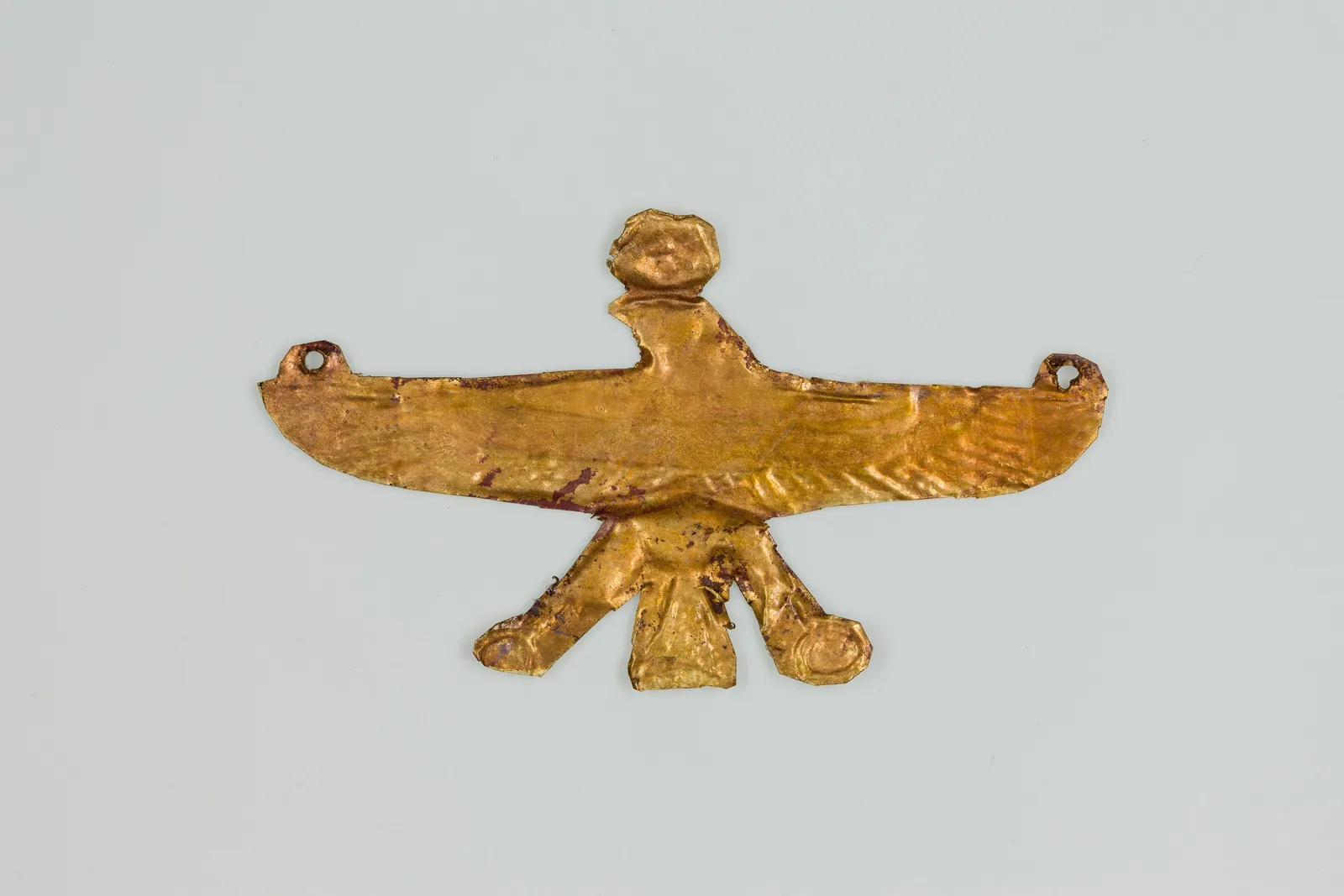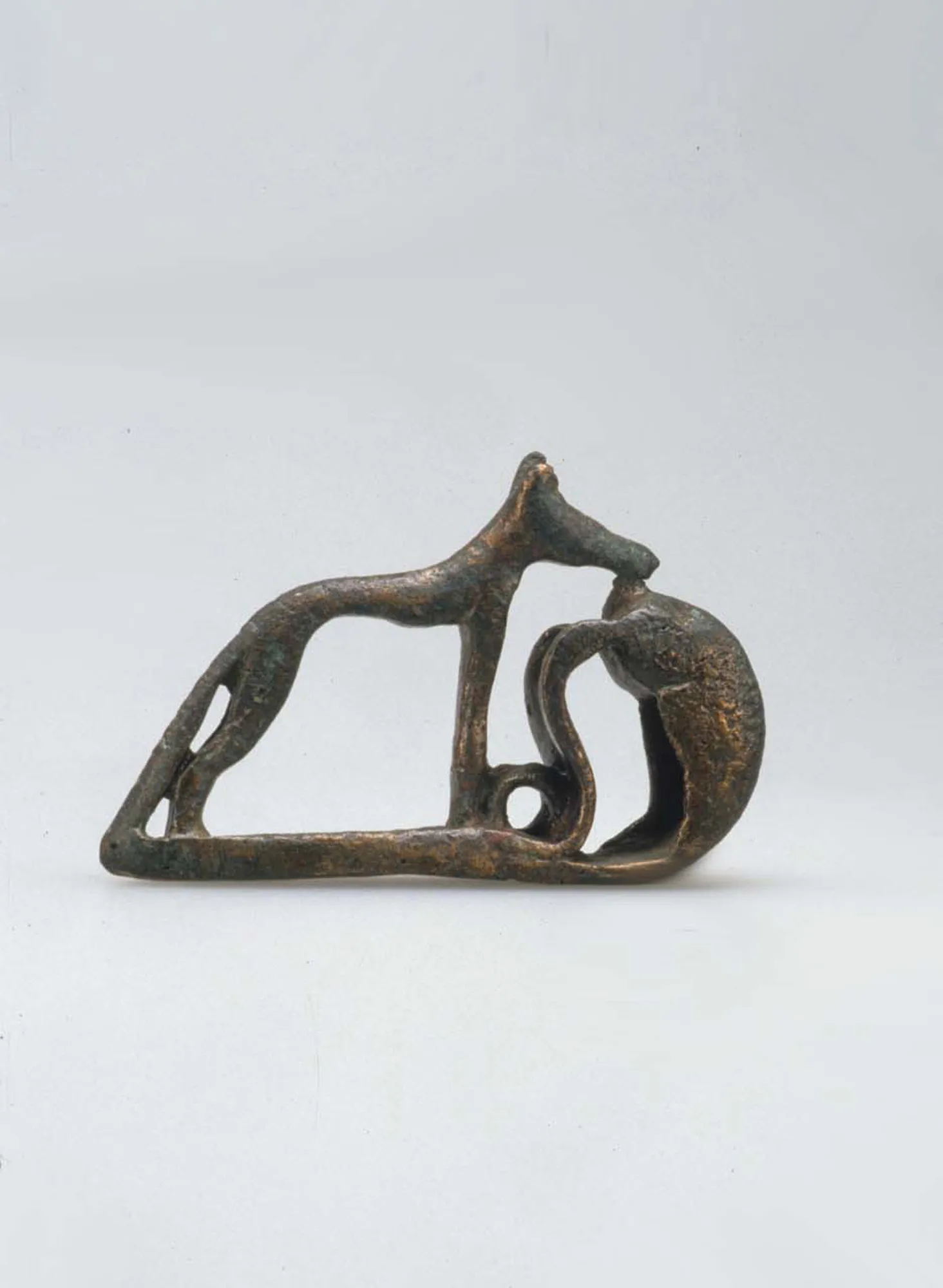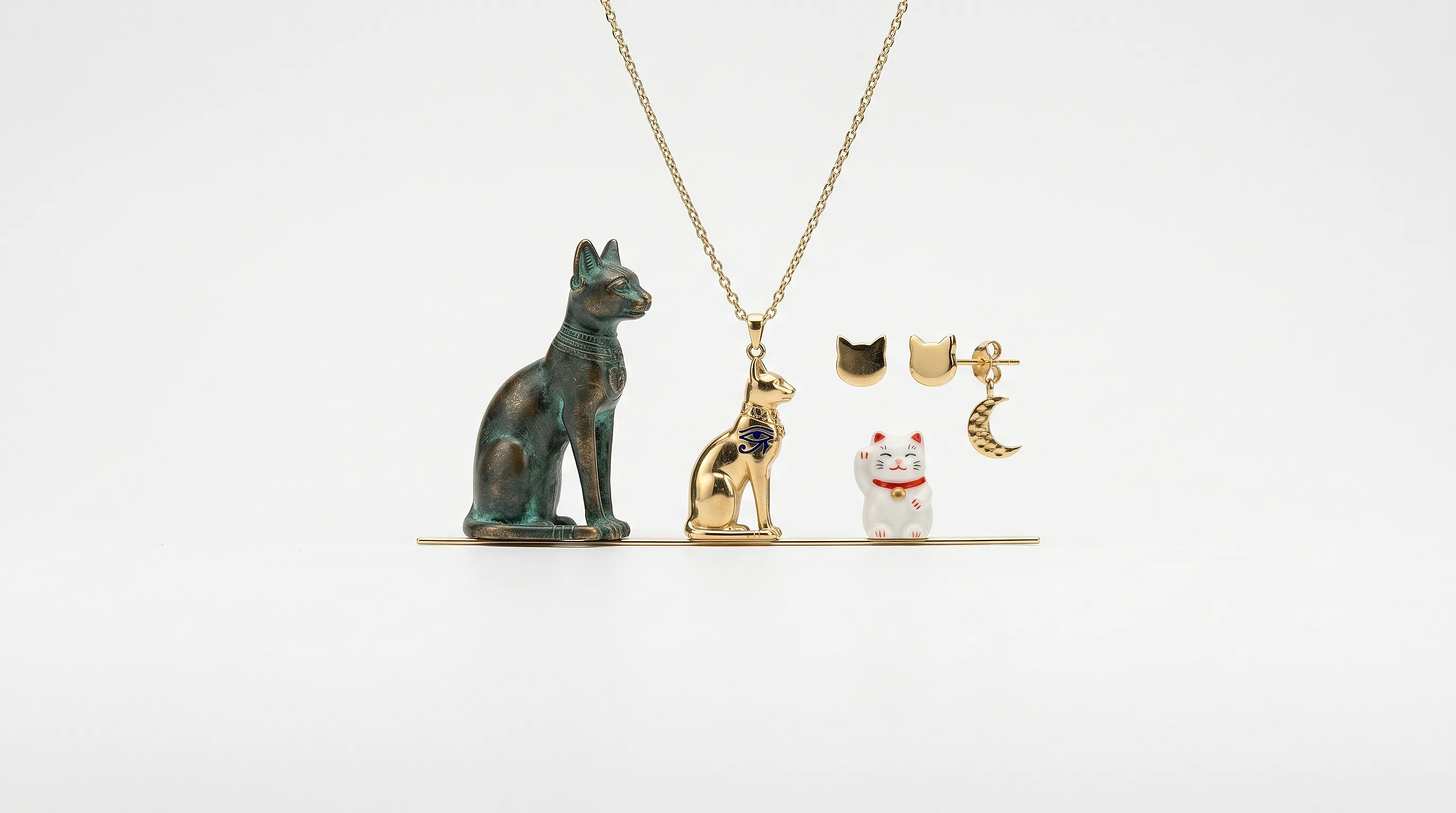
Hathor: the Egyptian goddess of love and music, the meaning of the symbol and its jewellery
A goddess with cow horns and a sun disc between them presided over love, music, dance and joy, and her temples rang with sistrums. For the Egyptians the cow stood both for the vault of heaven and for the milk that feeds the living. So tenderness and nourishment met in a single deity.
Hathor is one of the oldest and most likeable figures in the Egyptian pantheon. She was worshipped for more than three thousand years, from the first dynasties to Roman times, and across those centuries she gathered a whole armful of meanings under her name: love, beauty, music, dance, the merry intoxication of festival, motherhood, and the welcome given to the dead at the threshold of the other world. Few gods held so wide a circle of concerns, and almost always the theme was the joy of life rather than the fear of it.
This guide calmly works through three things. Who Hathor is and how to recognise her by her iconography, where her cult grew from and why she was called the Lady of Turquoise, and how her image lives on in jewellery: in the menat necklace, in turquoise, in gold, and in the motif of the sistrum. We will stay with what is known of the ancient religion, treating it with respect, and we will neither mock the faith of the Egyptians nor pass late invention off as fact. The goddess of love deserves an attentive account, not a cheap retelling. As the conversation unfolds it will become clear why her signs sit so easily in jewellery and still sound warm thousands of years on.
Who Hathor is: horns and the sun disc
A woman with cow horns and a solar disc
Hathor's classic form is recognisable at a glance: a slender woman wearing a crown of two curved cow horns with a sun disc resting between them. This headdress became her signature in Egyptian art. The horns speak of the cow, Hathor's animal; the disc points to the sun and to the goddess's bond with the sun god Ra. Sometimes the crown gained a tall feather or a rearing uraeus cobra, a sign of royal and divine power. In her hands the goddess often holds a sceptre and the sign of life, and around her neck she wears a heavy necklace we will discuss in detail below.
It is important not to confuse this crown with the very similar headdress of the goddess Isis, who in later centuries took over exactly the same symbol. What helps tell them apart is the label beside the figure and the overall subject of the scene. When horns with a disc appear in jewellery today, the reference is most often to Hathor as the earliest owner of the sign, and only after her to Isis, who inherited it.
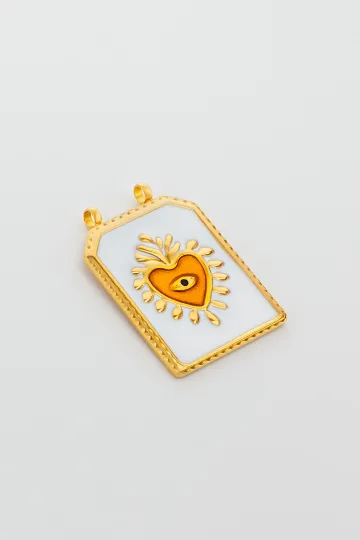
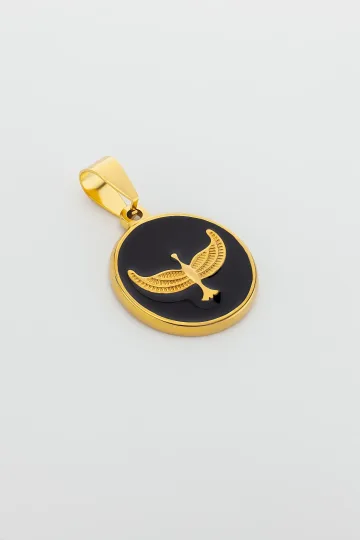
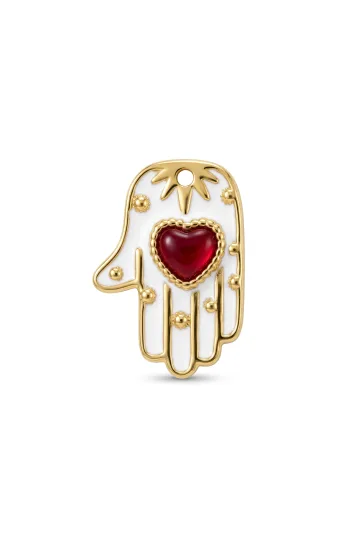
Wear the symbol, don't just read about it. These are in stock:





Hathor in the form of a cow
Hathor could also be shown fully as a cow, calm, large, with a sun disc between her horns and a necklace at her neck. In this form she is nurse and protector: the cow gave the Egyptians milk, and so life, and the goddess in this guise watched over both the living and the dead. On some monuments Hathor's cow steps out of a papyrus thicket or from a mountain slope, meeting a person at the border of two worlds. There is an intermediate version too, where a female figure was left with cow ears, a subtle reminder of her animal shape.
The cow was nothing low or comic to the Egyptians. They imagined the sky as an enormous cow whose body was strewn with stars and whose legs stood at the four corners of the world. Hathor was that celestial cow, the vault beneath which life goes on. Her cow form therefore reads not as earthbound but, on the contrary, as a mark of the goddess's cosmic scale.
The sistrum and the menat necklace as attributes
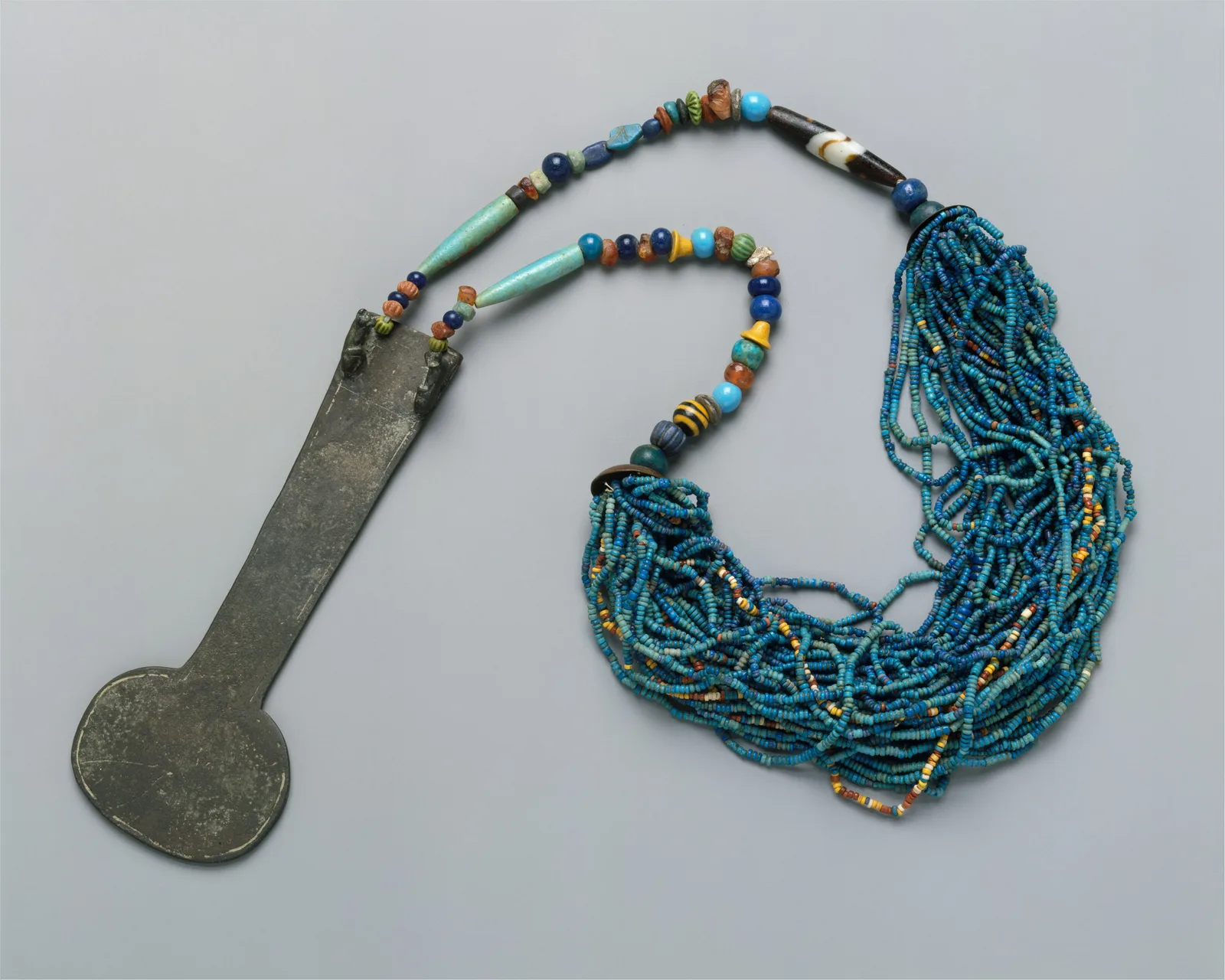
Two objects accompany Hathor more than any others: the sistrum and the menat necklace. The sistrum is a sacred rattle, a handheld instrument with a frame and loose crossbars that jingle when shaken. The menat is a heavy multi-tiered necklace with a massive counterpoise, which also sounded when shaken in dance. Both objects are tied to sound, music and the rhythm of temple service, and both became personal signs of the goddess. Hathor's priestesses were shown precisely with the sistrum and the menat in their hands, offering the goddess their jingle as a gift she favoured.
This sonic nature sets Hathor apart from many other deities. Her cult was loud, musical, full of singing and stamping feet. The sistrum and the menat passed from the temple into everyday symbolism and remain to this day the most recognisable signs of the goddess of joy, far more telling than a solemn portrait.
Hathor the sky cow and Lady of Heaven
Hathor had many titles, and one of the loveliest sounds like Lady of Heaven. The Egyptians linked her to the daytime sky, to the sunset behind which the sun goes to rest, and to the very edge of the visible world. Her name in ancient Egyptian sounded roughly like Hut-Hor, meaning House of Horus, that is, the heavenly vessel of the solar falcon Horus. Sewn into that name is the idea that the goddess is the sky itself, inside which the sun moves.
From this grows the doubleness of her image. Hathor is gentle, loving, merry, but she is also the mistress of the vast heavenly vault, a calm power that holds the sun within her. That breadth makes her a figure of the first rank, not a sweet minor goddess. Love and music were no trifle to the Egyptians; they stood at the centre of the world, and it was a goddess of cosmic scale who kept them.
Before moving to the history of the cult, it helps to hold the overall portrait in mind. Hathor is a union of tenderness and grandeur, of cow and sky, of caress and the huge open space overhead. She was responsible for the very things people live for: love, beauty, music, the joy of meeting, and quiet care for those close by. The Egyptians saw in her not a capricious patroness of pleasures but a deep force that keeps life warm. That is exactly why her symbols sit so well in jewellery: they speak of the bright side of existence without a single dark note.
In jewellery Hathor's image works softly and without pressure. Her signs do not threaten or frighten; they wish well, wish warmth and inner accord. The menat necklace, turquoise, gold, the face of the goddess with cow ears all read as a wish for love and joy to the wearer. Next we will look at how this language took shape historically and why it still sounds convincing thousands of years later. Each of these signs grew from a living cult in which the goddess was praised with song and dance, and a modern pendant keeps an echo of that festival.
Trying the symbol on is easier than it seems. Hathor asks neither special faith nor a knowledge of hieroglyphs for her signs to work. It is enough to understand what stands behind the form: the counterpoise necklace speaks of music and celebration, turquoise of the protection of travellers and miners, gold of the goddess herself, who was called the Golden One. Once these meanings are clear, a piece stops being merely a pretty thing and becomes a small statement about what matters to a person, plain and close without any explanation.
Below we will gather these meanings into a single picture: from the temple at Dendera and the turquoise mines of Sinai to the meaning of the goddess and her place among jewellery. Along the way it will be clear how Hathor is close to the neighbouring Egyptian gods and how she differs from them, so that her signs are not muddled and you wear exactly what you mean. Let us start with her most expressive attribute, the menat necklace, which stands on the border between jewellery and holy object and best explains why the goddess's cult was so musical and joyful.
The menat necklace is worth pausing over. It looks like an ornament, but in essence it is instrument and amulet at once. A heavy counterpoise, which hung down the back, balanced the tiers of beads at the front, and the whole thing rang as it moved. A priestess shook the menat before the goddess, and this sound was held pleasing to Hathor no less than the scent of incense. Hence the object's double life: it is both attire and the voice of the service. In a modern menat pendant both meanings fold into one warm gesture.
The history of Hathor's cult
Dendera: Hathor's chief temple
The heart of Hathor's worship was the city of Dendera in Upper Egypt, where her huge temple complex stood. The building that has come down to us belongs to the late, Greco-Roman period, but a sanctuary on the site existed long before, its roots running into deep antiquity. Dendera's walls are covered with reliefs of the goddess's face: her countenance with cow ears crowns many columns, gazing at the visitor from several directions at once. Splendid festivals were held here, music sounded, processions moved through, and the whole temple was arranged as a place for people to meet the goddess of joy.
Especially famous was the festival in which the statue of Hathor from Dendera was carried by boat up the river to meet the statue of the god Horus from the city of Edfu. This meeting was imagined as a sacred union of two deities, accompanied by rejoicing, singing and abundant feasting. Such celebrations show that Hathor's cult was not a gloomy ritual but a national festival of life, where religion and merriment did not quarrel but merged.
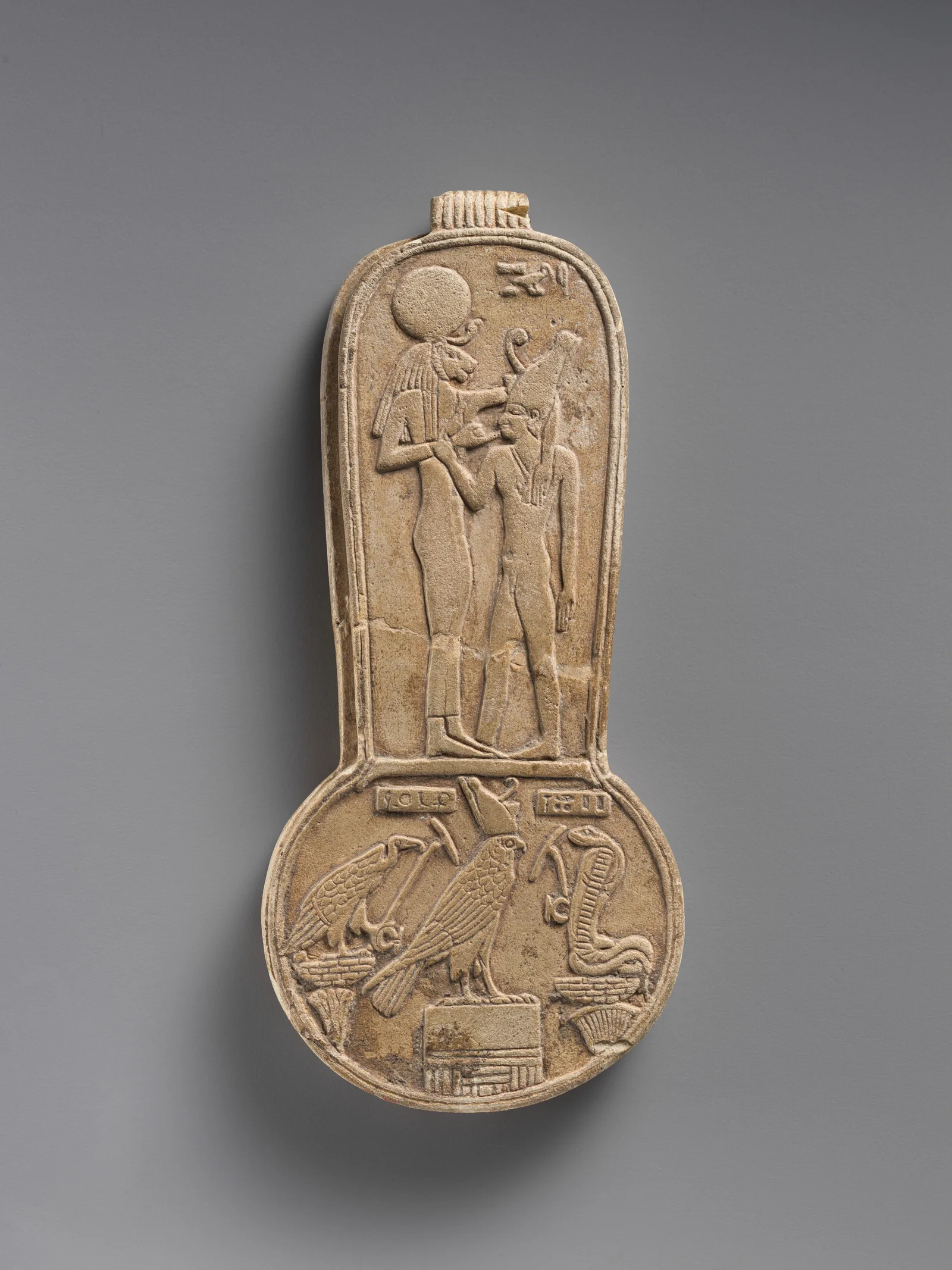
The goddess's face deserves a word of its own. Hathor was shown not in profile, as most Egyptian gods are, but full face, so that she looked out at whoever entered. This is a rare device in Egyptian art, where figures are almost always turned sideways. Hathor's frontal face, with its broad features, heavy wig and cow ears, created a sense of the goddess's living presence, meeting a person face to face. It was this frontal countenance that became her most reproduced image: it looks out from the capitals of Dendera's columns, from sistrum handles, from amulets and mirrors. In jewellery the same device still works, for a face turned toward the viewer reads warmer and more directly than a stern profile.
Lady of Turquoise and the mines of Sinai
One of Hathor's most telling titles sounds like Lady of Turquoise. The goddess was honoured as patroness of the mines, above all the workings of the Sinai peninsula, where the Egyptians extracted turquoise and copper. At the place called Serabit el-Khadim, among harsh mountains, stood her temple, and the miners, setting off into the dangerous desert after the stone, asked Hathor for protection and luck. So the goddess of love and music turned out to be mistress of underground riches as well, patroness of those who quarried the blue and green stone.
This link is no accident. To the Egyptians turquoise was a stone of joy and renewal, its bluish-green colour recalling young greenery and fresh water, life itself. It is only logical that the patroness of such a stone should be the goddess of joy and beauty. Hence the firm pairing in symbolism: Hathor and turquoise read together, and a piece with turquoise easily reads as a sign of her protection. We will speak of the goddess's stones separately below.
Hathor and Isis: a merging of images
Over the centuries the images of Hathor and Isis drew so close that they became hard to tell apart. Isis, originally a goddess of royal power and magic, mother of Horus, gradually took over Hathor's crown of horns and sun disc, and with it many maternal traits. In later centuries it is Isis who comes to the fore of Egyptian religion, absorbing the power and appearance of the older goddess. Hathor does not vanish, but part of her glory passes to her younger neighbour.
Understanding this merging helps avoid confusing the two goddesses in jewellery and in museum halls. If a figure with horns and a disc nurses the infant Horus, you are most likely looking at Isis in her maternal role. If the same crown tops a goddess of music, dance and merriment, the subject is Hathor. A separate study of the second of them tells more about the goddess Isis and the Egyptian pantheon, where you can see how the roles of the Egyptian deities were interwoven.
Hathor and the Eye of Ra: the fierce side
The gentle goddess had a second, harsh aspect. By one myth Ra, grown old and angered at humankind for their disrespect, sent against them his punishing Eye in the form of the fierce lioness Sekhmet, who was identified with the raging aspect of Hathor. The lioness set about slaughtering humanity and worked herself into such a frenzy that the gods feared for the fate of the world. So they resorted to a trick: they poured red beer, like blood, across the ground. The goddess drank it, grew drunk, calmed down and turned back into the mild Hathor, patroness of joy.
This myth matters because it explains Hathor's link with intoxication, music and festival not as empty merriment but as a force that soothes rage and returns balance to the world. Festivals in her honour with abundant drink repeated this story: through merriment, wrath turned to mercy. So tenderness and fearsome power lived together in one goddess, and both sides were held necessary for the order of things.
Take Hathor in warm gold with turquoise, on a soft neckline. She is about joy; cold steel is out of place here.
How to wear Hathor: what to pair it with, metal and chain length
Hathor is about joy and warmth, so I build the look from light: warm gold, bluish-green turquoise, a soft neckline. I have gathered here what I advise clients by occasion.
What to wear with Hathor every day? For an everyday look I recommend a smallish pendant with the goddess's face or a menat pendant in warm gold on a chain of medium length. I choose a calm plain backdrop: milk, sand, olive, warm grey. Against warm fabric gold sounds soft and joyful, and a turquoise inset adds a bright accent without overloading the look. A busy print with an Egyptian motif argues, so I advise keeping the backdrop smooth.
Which metal and stone to choose for the colour of the clothes? I advise keeping the metal warm: yellow gold or gilding is closest to the idea of the goddess who was called the Golden One. Cold steel I do not advise here; it dulls the joy of the symbol. I match turquoise to a warm palette: sand, cream, terracotta, grass green. With blue and deep green I recommend adding lapis lazuli beside the turquoise, so the look gathers into a single Egyptian chord rather than scattering into different stories.
How to choose the chain length for the neckline? I match the length to the neckline. Under a soft round or shallow neckline I advise a short chain of around forty-five centimetres; the pendant sits at the collarbone and reads best there. Under a closed top I recommend dropping the pendant to fifty or fifty-five centimetres, closer to the upper chest. A multi-tiered menat needs room, so under a wide pendant I choose an open neckline without extra detail.
What size of piece to put together? I match the size to the task. A small Hathor face or sistrum of one and a half to two centimetres I recommend as a quiet personal sign under a shirt or a light jumper. A large menat pendant of three to four centimetres I choose when the symbol leads the whole look and reads from a distance. Earrings and a ring with turquoise I gather in one tone with the pendant, so the Egyptian motif sounds whole.
What suits weekdays, and what suits going out? For weekdays and a restrained setting I choose a fine pendant with the goddess's face or a turquoise ring, where the symbol reads as a calm talisman of good spirits. For the evening, by contrast, I recommend a large menat in warm gold with turquoise on an open neckline. Polished gold plays on smooth fabrics, and the bluish-green stone comes alive in soft light.

Turn on your camera, pick earrings, a pendant or a ring, and see the piece on yourself in real time.
Switch items in one tap.
Everything runs in your browser: no photo or video is ever uploaded.
Hathor in art and temples
Hathor left a mark on Egyptian art clearer than many gods, and the cause is her recognisable face and the Egyptians' love of her festivals. Where other deities look out in a stern profile, Hathor gazes straight at the viewer with a broad face and cow ears. This device made her image lively and close, and craftsmen gladly repeated it on columns, mirrors, sistrum handles and tomb walls.
Hathoric columns and capitals
A special mark of Hathor's temples is the columns crowned with her face. The top of such a column was carved into the head of the goddess with cow ears, and the face looked out to all four sides, so that whoever entered met Hathor's gaze from wherever they came. Above the face itself an image of the temple gateway, the naos, was often set, echoing the shape of the sistrum. These capitals are called Hathoric, and they survive best at Dendera, where rows of such columns lead into the depths of the sanctuary. The same motif appears at Thebes and in Sinai, everywhere the goddess's temples stood. A direct gaze from the height of a column turned a whole hall into a place of Hathor's presence.
Mirrors with a handle in the goddess's shape
The Egyptians thought of a bronze mirror as a little sun: the round polished disc repeated the sun disc in Hathor's crown, and the goddess herself presided over beauty and reflection. So a mirror's handle was often cast in the shape of her face with cow ears, or as a papyrus stalk topped with the goddess's head. Holding such a mirror, a woman held Hathor herself, patroness of beauty, and looked at her own face through the goddess's sign. Many such mirrors have come down to us in museum collections, and in them you can see clearly how closely the goddess was tied to self-care and to the joy of looking at the world.
The nursing cow and tomb paintings
A separate and touching line in art is Hathor as a cow nursing a human. From the sanctuary at Deir el-Bahri comes a statue of Hathor's cow, beneath whose chin stands the figure of a king pressed to the udder: the goddess feeds the ruler with her milk, granting him strength and life. In the paintings of Theban tombs of the New Kingdom, Hathor's cow often steps from the slope of the western mountain to meet the dead, promising them coolness and care beyond the threshold. Vine motifs belong to the festive side of the goddess too: the tomb ceiling of the noble Sennefer at Thebes is painted all over with clusters of grapes, and wine and its heady lift pointed the Egyptians straight to Hathor, mistress of merriment. So art kept both of her aspects at once, the nurse and the patroness of festival.
The sistrum and the menat: music as cult
The sistrum: a sacred rattle
The sistrum is a handheld musical instrument that became the chief sign of service to Hathor. It looked like a frame on a handle, through which loose metal crossbars with jingling discs were threaded. When shaken the sistrum gave off a dry ringing rustle, something like the sound of wind in the reeds. The handle was often crowned by Hathor's own face with cow ears, so that instrument and goddess could not be separated. There were two main forms of sistrum: one shaped like the naos temple gateway, the other like an arch.
The sound of the sistrum was held sacred, able to rouse the goddess's favour and drive off evil forces. It was held in the hands of priestesses, queens and noble women during rites. In jewellery the sistrum motif appears as an elegant nod to music and to Hathor herself: a pendant in the shape of a sistrum or with her face on the handle reads as a sign of joy, rhythm and lightness. It is a rare case where a musical instrument became a full jewellery symbol.
There is a subtler meaning hidden in the sistrum's sound too. The Egyptians believed that the dry rustle of the crossbars recalled the noise of wind in a papyrus thicket, and the papyrus marshes were held to be the place where the cow goddess hid and guarded the young sun god. Shaking the sistrum, a priestess seemed to repeat that protective rustle, driving off evil and inviting Hathor's mercy. That is why the instrument was held both at feasts and in solemn rites, where the melody mattered less than the sacred jingle itself. A small sistrum in a pendant carries an echo of this idea: a quiet sign of joy that also protects.
The menat: the counterpoise necklace
We have already mentioned the menat, but it deserves a separate look, because it stands on the line between jewellery and holy object. It is a heavy necklace of many strings of beads with a massive flat counterpoise that hung down the back and balanced the front. To wear the menat was a privilege, and to shake it before the goddess a part of the service. The counterpoise was often adorned with the face of Hathor or of a lioness goddess, and by that alone the object was known to be sacred.
In symbolism the menat carries several meanings at once: music and rhythm, joy and festival, and also the life force and abundance the goddess grants her worshippers. It was offered to the living and the dead alike as a wish for well-being in this world and the next. A modern menat pendant inherits exactly this warm meaning: it wishes the wearer love, joy and fullness of life while remaining a recognisable ancient Egyptian sign.
Music and dance in the temple
Service to Hathor was perhaps the most musical in the whole Egyptian pantheon. Her festivals were filled with singing, playing on sistrums and harps, the rhythmic ring of the menat, stamping and dance. The goddess was thought to rejoice in this noise and to answer it with favour. Hathor's dancers and singers held a place of honour at the temple, and the music itself was no diversion for amusement but a form of worship, an offering as much as bread or incense.
From this musical core the whole image of the goddess grows. Hathor presided not over abstract love but over the kind that shows itself in song, in dance, in a shared feast and celebration. That is why her signs speak of living, sounding joy rather than quiet contemplation. A piece with Hathor's motifs seems to carry an echo of that ancient ringing, a wish that life should have room for music and merriment.
Customer reviews
Zevira is a real jewellery shop. Genuine payments, deliveries and customer thank-yous.
🥰🥰🥰 gracias
Ok, ¡gracias! 🙂
The meaning of Hathor
Love and beauty
First of all Hathor is the goddess of love and beauty. People turned to her in matters of the heart, asking for a return of affection, a happy union, accord between lovers. In this role she watched over both bodily attractiveness and deep heartfelt attachment, without drawing a sharp line between them. The Egyptians were not ashamed of love and did not think it base, so the goddess who answered for it stood high and was honoured sincerely. To wear Hathor's sign was to wish oneself or another love in the fullest sense: warm, mutual, joy-giving.
Joy, music and the intoxication of festival
The second great meaning of Hathor is joy in all its kinds: merriment, music, dance, festival, the light lift of a good mood. She was called Lady of Merriment and of drink, and this link, as we have seen, came from the myth of soothing wrath through drink and rejoicing. But behind it stands a bright thought: joy heals, merriment reconciles, music returns balance to the world. Hathor guarded precisely this healing power of festival. Her sign wishes not empty revelry but the kind of joy that makes a person softer and kinder to those around them.
Motherhood and womanhood
As the sky cow and nurse, Hathor watched over motherhood, childbirth and the care of infants. Women expecting a child and mothers raising children turned to her. On this side the goddess is linked to the seven Hathors, goddesses of fate who, it was believed, appeared at the newborn's cradle and foretold its lot. In the goddess's image womanhood was understood broadly, as beauty and love and at the same time as the capacity to give life, to feed and to protect. So Hathor is dear to those for whom the theme of motherhood and feminine strength matters in its warm, creative sense.
Birth in Egypt took place under the care of a whole circle of kindly powers, and Hathor stood at its heart. Beside her, at the bed of the woman in labour, household protectors were called on, the squat Bes and the pregnant Taweret, who drove misfortune from mother and child. Women came to Hathor's sanctuaries with a plea for conception and an easy birth, left modest offerings, hung up tablets with a prayer. The goddess of love passed naturally into the goddess of birth: what begins in attraction and tenderness ended, for the Egyptians, at the cradle, and this whole field was held by Hathor alone.
Guide of the dead in the West
Hathor also had a role at the threshold of death. She was called Lady of the West, that is, of the land of sunset where the dead go. In this role the goddess met souls at the border of the other world, stepping out to them as the sky cow from a mountain slope or from a thicket, and gave them coolness, shade and drink for the road. Death in her presence lost part of its terror, for it was not a fearsome power that came to meet you but a loving nurse. So the goddess of joy accompanied a person on the last journey too, promising care even there. This trait shows how whole her image was: love, for the Egyptians, did not end with life.
Her particular guise here is Lady of the Sycamore, the tree that grew at the desert's edge on the border of the living and the dead. In this image the goddess leaned half out of the sycamore's trunk and handed the deceased bread and water, supporting them at the threshold. A tree giving shade and fruit in the midst of dry ground suited a goddess whose task was to comfort and to feed. So even death, for the Egyptians, met not emptiness but an outstretched hand with drink and food, and the West in her presence was imagined not as an end but as a passage under the care of a loving power.
Gathering Hathor's meanings together, it is easy to see why her symbolism sits so well in jewellery. Love, beauty, joy, music, motherhood, care even beyond the threshold of life fold into a whole wish for warmth and fullness. Unlike fierce protective signs, Hathor's signs frighten nothing; they wish well. That makes them a fine choice both for oneself and as a gift to someone close, to whom you want to wish the bright side of existence.
Next we will speak concretely: in what forms Hathor comes into jewellery, which stones and metals are tied to her, and how to care for such pieces. The goddess's symbolism is expressed through several recognisable motifs, and it is worth taking each in turn so as to choose consciously rather than at random.
Upload a photo of your pet, someone you love, or an object. We'll build a 3D model and hand-cast it in pewter.


The seven Hathors and the roles of fate
Hathor rarely stood alone: alongside her chief image lived derived roles in which the goddess seemed to multiply and reach into new areas of life. The best known of these is the seven Hathors, prophetic sisters who decided human lot.
The seven Hathors: prophetic sisters at the cradle
By Egyptian belief, seven Hathors appeared at the bed of a newborn and pronounced its fate all at once, the good and the ill that awaited a person on the way. They were imagined either as seven young women with sistrums and menats, or as seven cows. In the tales that have come down to us, the seven Hathors foretell the hero an early death or an unhappy love, and the whole plot is built around an attempt to cheat their verdict. Behind this image stands the thought that a single goddess of love holds both the beginning of life and its future in her hands, and that birth and fate are inseparable. The sevenfold form strengthened the weight of the prophecy: the word of one goddess was multiplied into seven voices.
Goddess of love charms and dreams
People turned to Hathor directly in matters of the heart too. In the love songs preserved on papyri and potsherds, lovers call on the Golden One, that is Hathor, asking for a meeting and a return of feeling. The goddess was thought able to bring hearts together, to send a prophetic dream, to incline a desired person to answering tenderness. This charm was no black sorcery: people came to the lady of love for the same thing they come to her for now, for warmth, an answer and accord. In jewellery this meaning survives as a quiet note: Hathor's sign was worn as a talisman of kind feeling too.
Serabit el-Khadim: a temple in the turquoise mountains
We have already spoken of the goddess's turquoise, but her Sinai sanctuary deserves a word of its own. At the place called Serabit el-Khadim, high among bare mountains, the Egyptians set a temple to Hathor, Lady of Turquoise, right by the mines. Hard expeditions were sent here after stone and copper, and those who took part left in the sanctuary stone stelae thanking the goddess for luck and protection. It was here, among the miners and scribes of a distant frontier, that some of the oldest specimens of alphabetic writing were found, the so-called Proto-Sinaitic inscriptions. Hathor's temple at the desert's edge shows how far the goddess's reach extended: she guarded both the love and music of the capital's festivals and the people of dangerous underground labour many days' journey from the Nile.
Hathor in jewellery
The menat as a talisman pendant
The menat necklace remains the truest sign of Hathor in jewellery. In modern making it is rarely reproduced whole; more often the maker takes the characteristic counterpoise pendant with the goddess's face or stylises the multi-tiered form in a pendant. Such a pendant carries the meaning of music, joy and fullness of life, and Hathor's face with cow ears makes the reference legible to those who know the symbol. The menat is good because behind a beautiful form stands an ancient and kindly meaning, pleasant both to wear oneself and to explain in a gift.
Hathor's turquoise
Turquoise is Hathor's stone by right, for the goddess was called Lady of Turquoise and patroness of the mines where it was extracted. A piece with turquoise reads as a sign of her protection and joy, especially if the stone is set in warm gold or paired with Egyptian motifs. The Egyptians prized turquoise's bluish-green tone as a colour of renewal and life, and beside the goddess's image it sounds especially fitting. A turquoise pendant, earrings or ring with Egyptian symbolism is a soft, bright way to wear Hathor's sign without a direct image of the deity.
The sistrum and Hathor's face in pendants
The sistrum motif and the goddess's own face with cow ears come into jewellery as a subtler, knowing reference. A pendant in the shape of a sistrum speaks of music and rhythm, while a small face of Hathor, recognisable by the ears and the hair, serves as a compact personal sign of the goddess of joy. Such pieces are loved by those who value Egyptian symbolism in earnest and want to wear not a general ornament but a specific, legible image. Hathor's face is often set at the centre of a pendant or on a signet, where it works as a calm talisman of good spirits.
The cow, horns and sun disc
The most direct sign of the goddess is her crown: two curved horns with a sun disc between them. In jewellery this motif is used both as a standalone pendant and as a detail on a figure of the goddess. It reads strongly and unambiguously, pointing to the sky cow and to Hathor's bond with the sun. It is worth remembering that Isis wears the same symbol, so paired with other details it matters which subject forms around the crown. As a standalone sign, horns with a disc are beautiful in their clean geometry and antiquity, plain without words to anyone familiar with Egyptian symbolism.



Materials and care
The goddess's gold
Gold is Hathor's metal in the most direct sense, for one of her names sounded like the Golden One. The Egyptians linked gold's warm gleam to the flesh of the gods and to eternal, untarnishing light, and so to Hathor herself. A piece with her symbolism in gold or gilding sounds truest to the idea: the metal's warm tone chimes with the sun disc of her crown and with the joyful nature of the goddess. Gold holds the fine detail of face and horns well, does not darken with time and lies softly on the skin, so for Hathor's image it is the first choice.
Turquoise, lapis lazuli and faience
Of stones and materials, turquoise is most firmly tied to Hathor, her own stone. Beside it lapis lazuli is fitting, a deep blue stone the Egyptians prized as a piece of the night sky and often joined with gold. Egyptian faience is a story of its own, a glazed ceramic of bluish-green tone from which beads, amulets and the very necklaces were made. Faience repeated the colour of turquoise and was more affordable than the stone, so it was worn very widely. For a piece in Hathor's spirit, the pairing of warm gold with a bluish-green stone or faience is the most recognisable and historically true.
Caring for the piece
Care depends on the material. Gold is undemanding: it is enough to wipe it now and then with a soft cloth and rinse it in warm water with a drop of mild soap. Turquoise is harder to keep, a fairly soft and porous stone that fears cosmetics, perfume, household chemicals and long contact with water. Turquoise is best put on last, after cream and scent, and taken off before a shower or cleaning. Ultrasonic cleaning is not used on turquoise, as it can damage the stone. Lapis lazuli is soft too and dislikes acids, so it is likewise kept from chemicals. Necklaces with beads and faience are best stored separately, so that hard items do not scratch the surface, and fastened so that the threads do not chafe.
Leave your email, we'll send your discount code. No spam, unsubscribe anytime.
The code arrives by email, valid on your first order.
Hathor in culture and heritage
Hathor's image did not stay shut within Egypt's borders and did not die with the pharaohs. Her signs, the sound of her sistrum and the very idea of a goddess of joy spread through the Mediterranean and left a trace in other cultures.
Hathor and the Greek Aphrodite
When the Greeks came to know the Egyptian gods, they looked, by habit, for a match among their own. They drew Hathor close to Aphrodite, goddess of love and beauty, and in this comparison there is truth: both answered for attraction, tenderness and the joy of union. Several Egyptian cities tied to Hathor the Greeks simply called the city of Aphrodite. This likening did not erase the differences, for the Egyptian goddess had traits Aphrodite lacks entirely, from the sky cow to the guide of the dead. But the very fact that a foreign people recognised their own goddess of love in Hathor speaks to the clarity of her image: a patroness of warmth and beauty was understood without translation.
The sistrum as a sign of joy beyond Egypt
The sistrum, Hathor's ringing rattle, outlived the Egyptian temples. Together with the cults of the Egyptian gods it spread through the Mediterranean world, and its dry ringing rustle sounded far from the Nile as a sign of festival and sacred joy. An instrument born with the goddess of music became one of the most recognisable objects of Egyptian life, understood even where little was known of Hathor herself. In this the sistrum's fate resembles that of her signs in general: the form outlived the faith, and the warm meaning of joy and lightness stayed with it. That is why the sistrum motif lives so naturally in jewellery today.
Psychology: why people choose the image of Hathor
Behind the choice of a sign there almost always stands a feeling, and with Hathor it is unusually bright. Her image draws those to whom joy as such is dear, not loud or showy but warm, musical, spread through an ordinary day. A person chooses such a sign when they want to keep at hand a reminder of lightness, of the right to merriment and beauty without guilt for them.
The second string is womanhood in a wide, creative sense. Hathor speaks not of outward effect but of inner warmth: of care, of maternal softness, of the capacity to give and receive love. Her sign is closer to those who value this side in themselves or want to strengthen it, for whom accord and tenderness matter more than a show of force. The nurse goddess and Lady of Heaven joins care with dignity, and this combination reads in her image without any sweetness.
Finally, Hathor draws people of music and movement, all for whom sound, rhythm and dance are no idle amusement but a way to live and to feel. The goddess directly presided over these arts, and her sistrum and menat speak in a language they know. Choosing Hathor's sign, such a person seems to admit aloud that joy, music and love stand at the centre of their world, not at its edge. In this lies the whole secret of the goddess's pull: she gives permission to be warm and alive, and that permission sounds across thousands of years as clearly as it did in her temples.
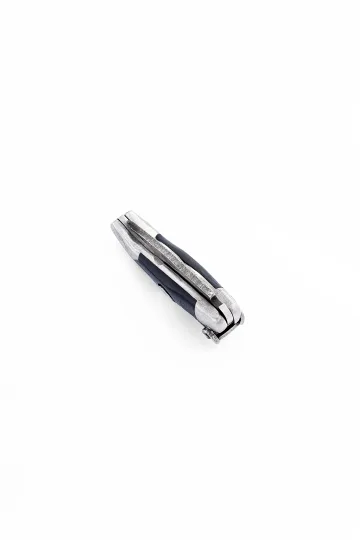
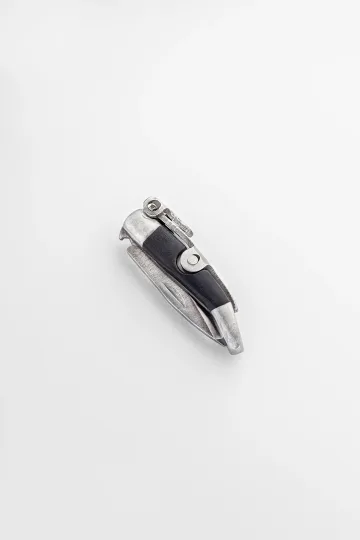
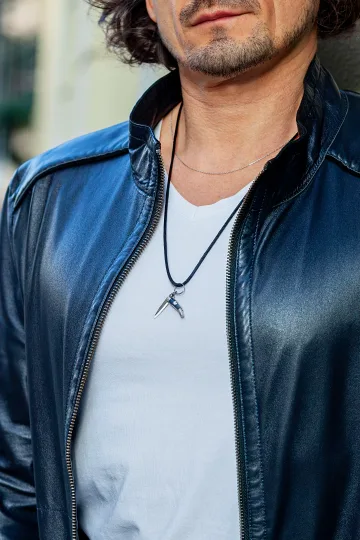
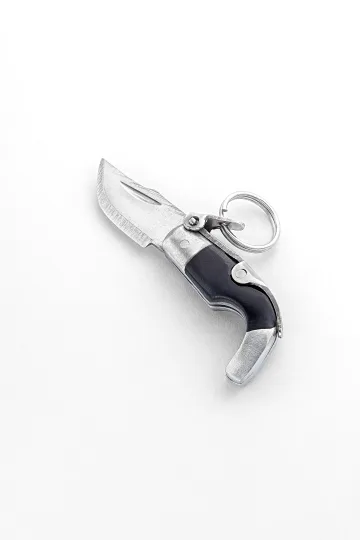
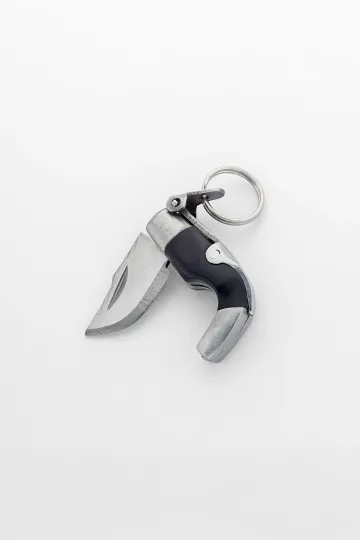
CAPAORA mini knife pendant
The 18th-century Spanish navaja in miniature: 40 mm of stainless steel, a real folding mechanism and a Palanquilla lock that clicks. An affordable gift to remember.
Authentic · Ships from Spain · 14-day returns
Who it suits and who to give it to
Who Hathor is close to
Hathor suits those to whom the bright side of life is dear: love, music, joy, beauty, warmth in relations with those close by. Her sign sits well on creative people tied to music, dance and singing, since the goddess directly presided over these arts. She is close, too, to those for whom the theme of motherhood and feminine strength matters in its creative, caring sense. Finally, Hathor suits anyone who loves Egyptian symbolism and looks in it not for a fierce talisman but for a kind, warm image. Unlike stern protective signs, her symbolism frightens nothing, so it is easy and joyful to wear.
Hathor as a gift
As a gift Hathor is almost a sure thing, since her meaning is a wish for love, joy and fullness of life, and such a wish is fitting on almost any occasion. A menat pendant or a turquoise piece with Egyptian motifs is given to a loved one as a sign of tenderness, to a friend as a wish for joy, to an expectant or new mother as a warm symbol of care and feminine strength. It is good to add a short note to the gift with an explanation: a few words about the goddess of music and love, her necklace and turquoise, make the piece meaningful and memorable. Such a gift speaks not of status but of a kind wish, and so it touches more than an expensive trinket without meaning.
Hathor and neighbouring symbols
The Egyptian pantheon is closely interwoven, and Hathor stands beside several gods whose signs are easy to confuse or, on the contrary, to combine well. Let us look at the three most common neighbourhoods, so as not to muddle the symbolism and to understand exactly what you are wearing.
Hathor and Isis
Hathor stands closest to Isis, and we have already seen how their images merged. Both wear the crown of horns with a sun disc, both are tied to motherhood and care. The difference is in emphasis: Hathor is older and answers above all for love, music and joy, whereas Isis is the goddess of royal power, magic and faithful married love, mother and protector of Horus. In later centuries Isis comes forward, absorbing the older goddess's traits. If you want to make sense of this pair and of the structure of the Egyptian pantheon, a study of the goddess Isis and the Egyptian gods helps.
Hathor and Bastet
With the cat goddess Bastet, Hathor shares a bright, feminine and joyful nature. Both presided over merriment, music, women and the protection of the home, both tied to festivals and dance. The difference is in form and element: Hathor is cow, sky and love in a wide sense, Bastet is cat, the household hearth and a soft but tenacious protection. Both goddesses embody a kindly rather than fearsome power, so their symbols keep good company in an Egyptian theme. A study of the cat and the goddess Bastet tells more of the second, where you can see how the Egyptians prized the feminine principle in its warm guise.
Hathor and the ankh
The ankh, the Egyptian cross of life, often appears beside Hathor: the goddess holds it in her hand as a sign of the giving of life, and to the dead in the West she offers this same symbol along with coolness and drink. The link here is direct: Hathor gives life and its continuation, and the ankh is the very hieroglyph of life. In jewellery the two signs combine easily; together they read as a wish for a living, full, joyful life. A study of the ankh, the Egyptian cross of life tells more about the sign itself.
The table above draws Hathor's neighbours into one row, so the difference reads at a glance. Keeping it in mind, it is easy to put together a meaningful Egyptian set: for instance, complement a Hathor pendant with turquoise with an ankh as a sign of life, or join it with the image of Bastet if you want to strengthen the theme of feminine joy and protection. The symbols of the Egyptian pantheon were conceived as a single language, and knowing their differences helps to speak it precisely rather than pile everything into a general ornament.
It is worth remembering the reverse side of such neighbourhood too. Because of the shared crown, Hathor and Isis are confused most often, and in shops they are frequently labelled at random. The sistrum and the menat, by contrast, belong to Hathor almost exclusively, so by them the goddess is recognised more surely than by the crown. The ankh is neutral and suits any Egyptian figure, whereas the cat Bastet and the cow Hathor set different moods: the first is closer to home and hearth, the second to the sky and love in a wide sense. Understanding these shades makes it easier to choose exactly the sign you want to wear, rather than a random pretty Egyptian motif, and not to pass one goddess off as another by inattention.
Clearing up misconceptions
Around Hathor, as around any ancient goddess, a good deal of confusion has grown. Part of it comes from a blending with neighbouring deities, part from shallow retelling. Let us work through several common misconceptions calmly and to the point.
The first misconception: that Hathor and Isis are one and the same goddess. Their images did indeed draw close in later centuries, and they wear the same crown, but historically they are different deities with different roots. Hathor is older and answers for love, music and joy, Isis for royal power, magic and motherhood. The merging of traits does not undo the fact that at first these were two separate figures.
The second misconception: that Hathor is only a goddess of pleasures and merriment, an unserious power. In fact her image is far wider and deeper: she is the sky cow, Lady of Heaven, patroness of the mines, guide of the dead. Joy in her cult was understood as a healing and reconciling force, not as empty revelry. To reduce Hathor to a goddess of parties is to lose most of her meaning.
The third misconception: that the cow in the goddess's image is something earthbound or comic. To the Egyptians the cow meant sky, milk and life, and the sky cow they imagined as the whole starry vault. Hathor's cow form speaks not of simplicity but of the goddess's cosmic scale, feeding and guarding the world.
Send a friend a discount code, they save on their first order.
Facts that surprise
Hathor is one of those figures where an unexpected detail hides at almost every step. Here are several facts that change the way one looks at the goddess of love.
First. Hathor's name in ancient Egyptian means House of Horus, that is, the heavenly vessel of the solar falcon. It turns out that the goddess is the sky itself, inside which the sun moves. The tender name of the lady of love hides a cosmic image of the starry vault.
Second. By one myth, humankind was saved from slaughter by ordinary beer tinted red. The enraged goddess in the form of a lioness took it for blood, drank it, grew drunk and became the mild Hathor again. So a festival with abundant drink in her honour repeated the ancient plot of soothing wrath with joy.
Third. Hathor was held to be Lady of Turquoise and patroness of the Sinai mines. Miners, setting off after stone into the harsh desert, asked her for protection, and the goddess of love turned out to be mistress of dangerous underground labour as well.
Fourth. The menat necklace served as both ornament and musical instrument. It was shaken in dance before the goddess, and this sound was held an offering pleasing to her on a par with incense. Ornament and prayer merged in a single object.
Fifth. The sistrum, Hathor's sacred rattle, was often crowned with her own face with cow ears, so that instrument and goddess could not be told apart. The sound of the sistrum was thought able to rouse the goddess's mercy and drive off evil.
Sixth. The seven Hathors, by Egyptian belief, appeared at a newborn's cradle and foretold its fate. A single goddess seemed to multiply into seven prophetic sisters who decided a person's lot from the first days of life.
Seventh. Hathor met the dead at the threshold of the other world as the sky cow, stepping out to them from a mountain slope and offering coolness and drink for the road. The goddess of joy accompanied a person even in death, promising care there too.
Frequently asked questions
Who is Hathor in simple terms?
Hathor is an ancient Egyptian goddess of love, beauty, music, dance and joy, and also of motherhood and care. She was shown as a woman with a crown of cow horns and a sun disc between them, or wholly in the form of a cow. She is one of the oldest and most honoured goddesses of Egypt, patroness of the bright side of life.
What do the horns and sun disc on Hathor's head mean?
The horns point to the cow, Hathor's sacred animal, and the sun disc between them to the sun and to the goddess's bond with the sun god Ra. Together they form her recognisable crown. Isis later took over the same sign, so by the crown alone the two goddesses are told apart by the subject of the scene and the label.
How does Hathor differ from Isis?
Hathor is older and answers above all for love, music, joy and motherhood. Isis is the goddess of royal power, magic and faithful married love, mother of Horus. In later centuries their images merged, and Isis took over Hathor's crown and part of her traits, but by origin they are two different goddesses.
Why is Hathor linked to turquoise?
The goddess was called Lady of Turquoise and honoured as patroness of the mines, above all the Sinai workings where the stone was extracted. The Egyptians linked the bluish-green colour of turquoise to renewal and life, which matched the goddess's joyful nature. So turquoise became her stone, and a piece with it reads as a sign of Hathor's protection.
What is the menat necklace?
The menat is a heavy multi-tiered necklace with a massive counterpoise that hung down the back. It was a personal sign of Hathor and at the same time a musical instrument: it was shaken in dance, and the sound was held pleasing to the goddess. In symbolism the menat carries the meanings of music, joy, life force and abundance.
Who suits a piece with Hathor's symbolism?
It suits those to whom love, music, joy and beauty are dear, creative people, and also anyone close to the theme of motherhood and feminine strength. Hathor's sign frightens nothing; it wishes well, so it is easy to wear and fitting to give to loved ones, friends, expectant and new mothers.
Can you wear the sign of Hathor without believing in the Egyptian gods?
Yes. Hathor's symbolism works as a wish for love, joy and fullness of life regardless of religious views. You can wear it both as a beautiful historical image and as a meaningful talisman of good spirits. This breaks no respect for the ancient religion: you are turning to cultural heritage, not appropriating someone else's faith.
Which metal and stone to choose for a Hathor piece?
Truest to the idea is warm gold or gilding, since one of the goddess's names sounded like the Golden One. Of stones, turquoise is closest, her own stone, with lapis lazuli and bluish-green Egyptian faience fitting beside it. The pairing of warm gold with a bluish-green stone is the most recognisable and historically true.
Conclusion
Hathor is a rare goddess in whom the bright side of life is gathered almost whole. Love and beauty, music and dance, joy and festival, motherhood and care, and even the gentle meeting of the dead at the threshold of the other world. Behind the guise of a tender cow and the ring of a sistrum stands a figure of cosmic scale: the vault of heaven, Lady of Heaven, mistress of the turquoise mines, fearsome and kindly at once. The Egyptians honoured her for more than three thousand years, and almost always the theme was warmth, not fear.
In jewellery Hathor's image works softly and kindly. The menat necklace wishes music and fullness of life, turquoise speaks of protection and renewal, gold chimes with the sun disc of her crown, and the goddess's face with cow ears serves as a calm sign of joy. Not one of these signs frightens anything; all are turned to the bright side of existence. That is exactly why Hathor's symbolism is so easy to wear oneself and to give to those close by.
The honest conclusion is simple. Hathor asks neither special faith nor a knowledge of hieroglyphs for her signs to sound. It is enough to understand what stands behind them: an ancient goddess for whom love, music and joy were no trifle but the core of the world. What you pour into her necklace or turquoise is what it will mean, and the goddess's older sense will stay with you as a warm wish to live in love and joy.
Gold, silver, turquoise, Egyptian symbolism and meaningful gift sets.
Buying it as a gift? Each one arrives ready to give.
 A branded Zevira box and a little card come with every order.






About Zevira
Zevira works in Albacete, Spain, a town with a long craft tradition in jewellery-making. Hathor is part of our collection of symbols, where the goddess of love and music sits beside other ancient signs in which form and meaning hold together.
What you can find with us in the Egyptian theme:
- Pendants with the menat necklace motif and Hathor's face
- Pieces with turquoise and bluish-green stones
- Pendants with horns and a sun disc, the goddess's crown
- Egyptian symbols in warm gold and gilding
- Paired and gift sets with meaning
Personal engraving is available. We work in 925 silver and gold of fourteen to eighteen carats.