Anubis: Egyptian god of the afterlife, the meaning of the symbol and the jewellery
Anubis is usually called a god of death, yet the Egyptians saw something else in him: a guardian and a guide, the one who leads through the dark and holds the scales at the judgment. Jackals prowled along the edges of the necropolis, digging in the sand, and people read them not as defilers of graves but as sentinels set to watch over the dead.
Out of that observation grew one of the most recognisable images of the ancient world: a black canine head on human shoulders, a calm gaze, a straight back. Anubis does not threaten and does not punish. He stands at the threshold between life and whatever comes after it, and his work is quiet, precise, almost craftsmanlike. He prepares the body, leads the soul through the corridors of the underworld, and makes sure the scales of justice tip honestly.
This guide takes Anubis slowly and without scare stories. Who he is within the Egyptian pantheon, why his colour speaks of rebirth rather than mourning, how he lost and reshaped the role of the chief god of the dead, what happens at the weighing of the heart, and how the ancient image lives on today in a pendant, a ring, an amulet. Respect for another people's ancient faith is no pose here: behind the figure of Anubis stands a whole, thought-through picture of death as a crossing rather than an end.
Let us settle the tone at once. Anubis is not a horror-film character or a "lord of darkness" out of pop culture. Within his own religion he was a support and a comfort, a god entrusted with the most vulnerable thing of all, the passage of the dead into eternity. It is from this side that he is most interesting, and it is this side we will look at in detail.
Who Anubis is: the jackal at the scales
Anubis is the ancient Egyptian god of burial, embalming and the afterlife crossing, shown as a man with a jackal's head or as a black reclining jackal. His Greek name is Anubis; the Egyptian is Inpu or Anpu. In the settled pantheon he was counted the son of Osiris and Nephthys, raised by Isis, and the right hand of the lord of the underworld at the judgment of the dead. His role is clear and complete: he guards the body, leads the soul, and holds the scales.
What Anubis looks like: the jackal at the scales
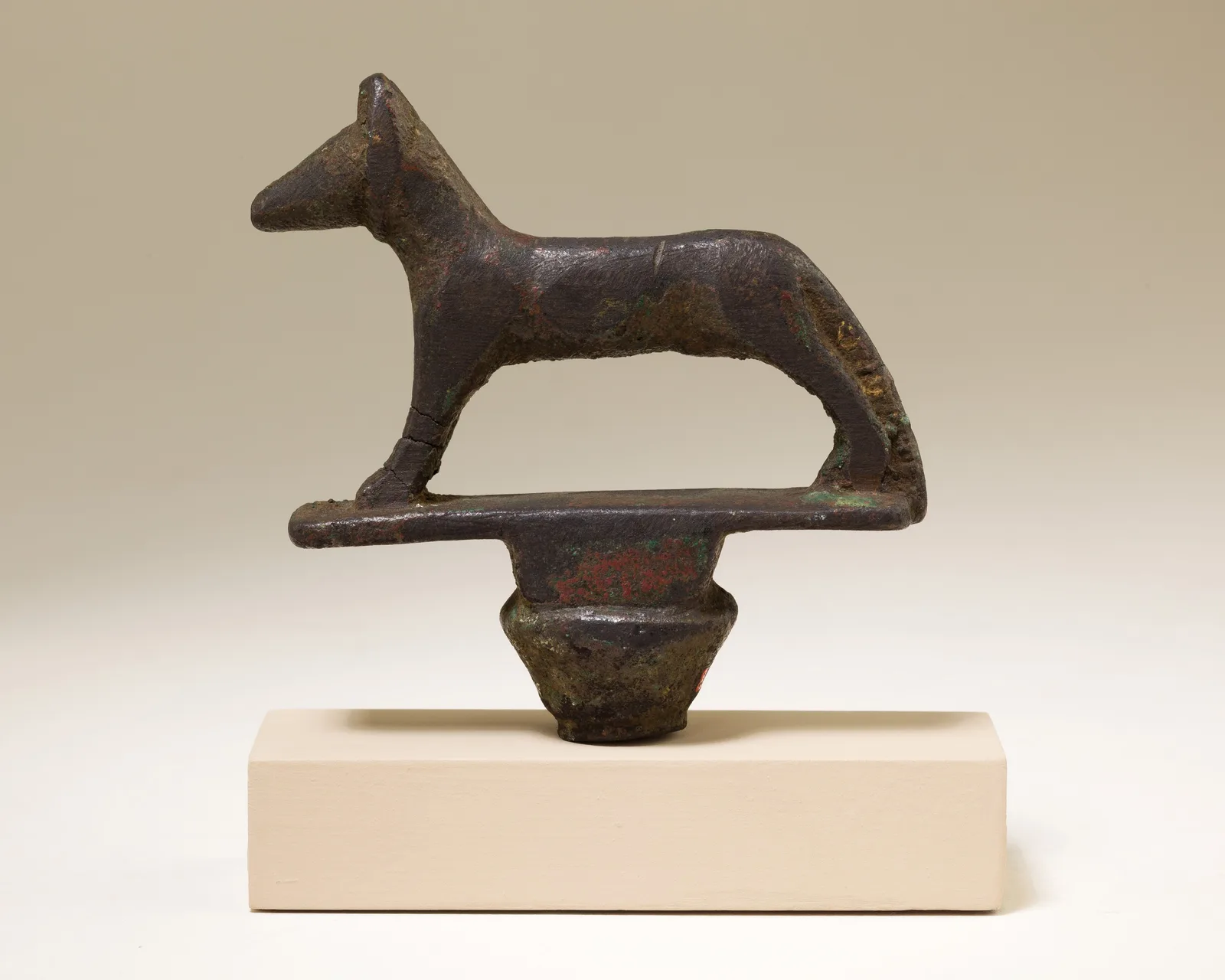
The canonical form of Anubis is made of two shapes. The first is a black reclining jackal with alert ears, often on top of a tomb or shrine, like a sentry at his post. The second is a man with a human body and a jackal's head, standing at the scales or bending over a mummy. The head is elongated, the ears sharp and upright, the muzzle narrow. In his hands he often holds the was-sceptre and the ankh, signs of power and eternal life. This posture, gathered and attentive, reads instantly: before us stands not a warrior but a servant, busy with his work. Anubis also had a special emblem, the imiut: a headless animal skin tied by the tail to a pole and lowered into a jar. This odd-looking sign stood in places of embalming and was drawn beside the god from the earliest times, and it too pointed to his link with the rite of preparing the body.
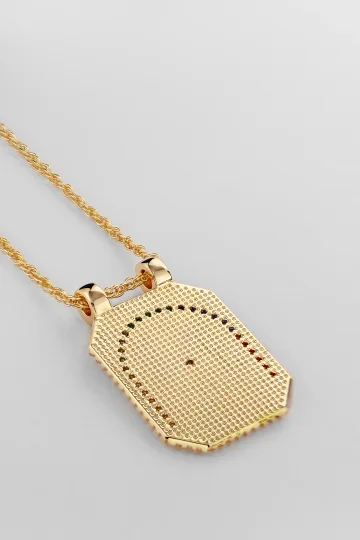
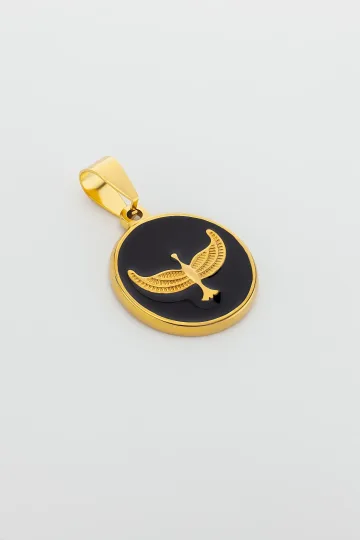
Wear the symbol, don't just read about it. These are in stock:






The colour black: fertile earth and rebirth, not mourning
The black of Anubis is easy to mistake for a sign of grief, yet in Egypt it meant precisely the opposite. Black was the fertile silt the Nile left on the fields after the flood, and on that silt the whole life of the country depended. Black too became the body treated with resins and natron during embalming. Both blacks spoke not of death but of rebirth: as the field comes back to life under the black silt, so the dead one is prepared for a new life. That is why Anubis was painted black, the colour of promised resurrection rather than of fading.
The name and epithets: "he who is upon his mountain"
Behind the name of Anubis trails a string of titles, each describing a facet of his work. He was called "he who is upon his mountain," picturing the jackal keeping watch over the necropolis from a high ridge above the valley. He was named "foremost of the westerners," lord of the dead, for the west, where the sun set, was the side of the dead for the Egyptians. Another title, "he who is in the place of embalming," pointed directly to his role in the workshop where the body was prepared. These names build up the portrait of a professional god, with his own post, his own direction and his own craft.
Jackals at the necropolis: where the image comes from
The image of Anubis grew from a simple and rather grim observation. The Egyptians buried their dead at the edge of the desert, and by night jackals and wild dogs came to the fresh graves, digging keenly in the sand. The logic of ancient people turned the threat into protection: if this beast is drawn so strongly to the dead, let it be the one to guard them. So the wild scavenger became a divine sentinel, set to watch over bodies and escort souls. In this transformation you can see the whole Egyptian cast of mind, where the frightening was made sense of and tamed rather than rejected. The beast feared at the graves took the place of the keeper of the threshold.
Out of that ancient observation was born a symbol that has come down to us almost unchanged. A jackal's head on human shoulders reads today as clearly as it read four thousand years ago, and there lies the durability of Egyptian iconography: it was built on simple, vivid images, understood without a caption. That is exactly why Anubis sits so well in jewellery. His silhouette is recognisable at a glance, and his meaning, protection and guidance, sounds serious, without carnival dread.
Before we turn to the judgment and the afterlife journey, it is worth seeing how long and how deeply Anubis was woven into Egyptian life. He was no minor spirit at the edge of the pantheon. In the earliest ages it was he who held the leading role in the fate of the dead, and only later did other gods share it with him. The history of his cult is the history of a gradual reshuffle, in which the god does not vanish but changes posts, remaining indispensable.
The history of the cult
Anubis is one of the oldest gods of Egypt, and his worship stretches across the whole three-thousand-year history of the land. He appears already in the earliest royal texts, long before the myths we know today took shape. To trace his path is to watch the Egyptian picture of death itself change.
The Old Kingdom: chief god of the dead
In the age of the Old Kingdom, the time of the pyramid builders, Anubis was the supreme god of the dead, and this is his first, most ancient role. In the Pyramid Texts, carved on the walls of royal tombs, he is addressed as the chief overseer of burial, the one who receives the dead king and secures his eternity. The developed cult of Osiris had not yet formed, and it was Anubis who answered for the ruler's passage into the other world. His name sounds in the oldest funerary formulas more often than many others, and that tells us how much weight he carried at the start of Egyptian history.
How Osiris displaced Anubis
In time Osiris came to the fore in the sphere of the afterlife, the slain and risen god whose story gave people hope of their own resurrection. He became king of the dead, and Anubis yielded him the supreme role, yet was neither erased nor forgotten. Egyptian thought acted elegantly: it did not abolish the old god but reassigned him. Anubis became the son and helper of Osiris, the one who prepares the body and leads the soul to the throne of the new lord. So the most ancient god of the dead turned into the guide and embalmer serving the new king of the underworld, keeping all his weight in the practice of burial. The goddess Isis and the whole Egyptian pantheon wrote Anubis into the family history of Osiris, and he took a firm place within it.
Embalming and the Anubis mask
Anubis was held to be the patron of embalmers and the very first embalmer himself, for by the myth it was he who gathered and treated the torn body of Osiris, making the first mummy. From that legend grew a real ritual practice. The priest who led the embalming would, during the rites, put on a mask with a jackal's head, and in that moment became, as it were, Anubis, acting with his hands. Such masks have survived to our day, and by them you can see how literally the Egyptians understood the god's presence in the workshop. One such ceramic mask with a jackal's head, through which the priest looked out through slits at the neck, has survived whole and is kept in a European museum, showing plainly what the rite looked like from the inside. The work on the body was a sacred act, not a craft in the everyday sense, and it was led by a god embodied in the priest.
The rite itself took about seventy days and rested on a strict order of actions. The body was opened, the entrails removed and laid in four vessels, which are called canopic jars, under the protection of special guardian gods. The brain was taken out and not kept, while the heart was left in the body, for it was the heart that would lie on the scales. The body was covered in natron, a natural soda from the salt lakes, and held so until it lost all its moisture. Then it was anointed with resins and oils, which darkened the skin, and wrapped in layers of linen bandages, with amulets tucked between the turns. This work went on in a special workshop called the "pure place" or the "house of embalming," and it was led by that same masked priest.
The chief centre of this craft was Saqqara, the vast necropolis by the ancient capital of Memphis. There, from generation to generation, the embalmers worked, and there too, underground, ran the catacombs dedicated to Anubis. The role of the priest in the jackal mask was no theatre but the very core of the rite: in those hours, by Egyptian belief, the god himself acted through the man's hands, repeating what he had once done with the body of Osiris. That is why embalmers were regarded with a double feeling, reverence for their sacred knowledge and unease before those who came so close to death.
The Duat: the journey through the underworld
The Egyptians called the underworld the Duat, and it was no peaceful meadow but a complex region with gates, guardians, lakes of fire and dangerous beings. The dead had to pass through this land, knowing the right words and names, and here Anubis acted as the guide. He led the soul along the corridors of the Duat, helped it evade the traps and brought it to the hall of judgment. The role of the guide between worlds, the one who knows the road in the dark and lets no one lose the way, became one of the central features in the image of Anubis. It is precisely this that makes him, in a modern reading, a god of the crossing rather than a god of doom.
Beside Anubis in this role stood another jackal-headed god, Wepwawet, whose name is translated as "opener of the ways." If Anubis led the soul and guarded it, Wepwawet went ahead and scouted the road, clearing the passage through the dangerous regions. The two jackal gods complemented each other: one opened the way, the other accompanied along it. In time their roles were often blended, and both images merged into a single idea of the guide who knows the road in the dark.
Through the Duat, too, the boat of the sun passed each night. Ra, the sun god descended at dusk into the underworld, sailed through its twelve hours of night and fought the powers of chaos so as to rise again in the east at dawn. This nightly journey of the sun ran along the same corridors as the road of the dead, and so the Duat was for the Egyptians a place of daily renewal, from which both the sun and the soul came out to new life.
Centres of the cult of Anubis
Anubis had his own cities and shrines, where he was honoured especially warmly. The Greeks called the chief of them Cynopolis, the "city of dogs," for there the god's jackal was surrounded with care, and the killing of a sacred dog was held a grave crime. Anubis was honoured too at Abydos, the great centre of the funerary cult, and in the necropolises of Thebes, where his figures guarded the entrances to the rock-cut tombs. The priests of Anubis answered for the rites of embalming and burial, and their craft rested on strict rules handed down from generation to generation. This branching network of shrines shows that Anubis was no abstract idea but a living god of everyday religion, turned to whenever a death fell in a family and the body had to be sent into eternity by all the rules.
Anubis is worn in black silver or with onyx, on a bare neck. Gold does not suit him; he is a god of the night, not of the parade.
How to wear Anubis: what to pair it with, metal and chain length
Anubis likes a dark ground and a restrained presentation, so I build the look from the palette of the clothing rather than from the figure itself. Here is what I recommend to clients when they choose this symbol.
What to wear Anubis with every day? For everyday wear I recommend a profile pendant in blackened silver on a medium-length chain over plain fabric. A busy print argues with the graphics of the jackal's head, so I choose a smooth ground: black, grey, graphite, dark blue. On cool dark fabric, oxidised silver reads as gathered and deep, and the sharp ears of the profile keep the silhouette clean.
Which metal to choose for the colour of the clothing? Anubis suits a cool, dark palette, so by default I advise blackened silver or silver with onyx. Gold I recommend sparingly, only for a ceremonial look and better in a pair with a black stone, as that very Egyptian pair of gold and blackness. One metal across the whole look keeps the picture severe, so I do not advise mixing silver with gold in a single set.
How to choose the length of the chain? I match the length to the neckline. For an open collar I advise a short chain, so the profile falls into the zone by the collarbone, where it reads best. For a closed top I recommend dropping the pendant lower, onto the upper chest, so the figure is not lost on dense fabric. Long versions I leave for a layered dark look, where Anubis goes into the lower tier of chains as an accent. I match the weight of the chain to the figure: a massive pendant needs a denser chain, a light amulet suits a thin one.
What size of figure to choose? I match the size to the task. A small profile or amulet I recommend to those who wear the symbol quietly, closer to a personal charm: it does not stick out and is fitting under a shirt. A large figure of the seated god or a wide signet I choose when Anubis works as a noticeable graphic accent. I look at the face and height too: a tiny profile is lost on broad shoulders, while a large figure overwhelms a slight build.
What suits weekdays, and what for going out? For weekdays and a restrained setting I choose a signet ring with an engraved profile or a small pendant, where the symbol reads severely and quietly. For the evening, by contrast, I recommend a large dark pendant or gold with onyx on a long chain under smooth black fabric. Oxidised silver adds a graphic edge to weekdays, while the ceremonial gold version I keep for the occasion.

Turn on your camera, pick earrings, a pendant or a ring, and see the piece on yourself in real time.
Switch items in one tap.
Everything runs in your browser: no photo or video is ever uploaded.
The weighing of the heart and the feather of Maat
The climax of the afterlife journey was the judgment, and its central scene, the weighing of the heart, became the most famous image of Egyptian religion. It was painted in the Book of the Dead, the scrolls laid in the tomb as a guidebook to the underworld. In this scene Anubis holds a key place at the scales.
The judgment of Osiris and the hall of two truths
The judgment of the dead took place in a hall called the hall of two truths. There Osiris, king of the dead, sat on the throne, and around him the judge-gods were ranged. The dead person spoke the "negative confession," listing the wrongs he had not done: he did not steal, did not lie, did not wrong the weak, did not defile the holy. But words alone were not enough; proof was required, and the scales gave it. Anubis led the dead into the hall and brought him to the scales, acting as the master of this strict ceremony. The god's calm matters more here than any menace: the judgment was not a reprisal but a precise test of the life that had been lived.
The heart against the feather of Maat
On one pan of the scales the heart of the dead was laid, on the other the feather of the goddess Maat, who embodied truth, order and justice. The heart, for the Egyptians, was the seat of mind, will and conscience, the focus of everything a person had done in life. If the heart proved no heavier than the light feather, then the life had been lived in accord with truth, and the dead was declared justified. A heart heavy with evil deeds outweighed the feather and condemned its owner. Anubis watched the pointer of the scales and made sure the weighing went flawlessly, while the god Thoth recorded the verdict. The image is simple and deep: you are judged not by an outside law but by your own heart, laid on the scales against truth. So that the heart would not betray its owner in that moment, the Egyptians placed a special amulet on the breast, the heart scarab. On it was carved a spell begging the heart not to testify against its master and not to tip the pan. This detail shows how seriously the Egyptians took the judgment: they prepared for it in advance, tucking a charm into the mummy's bandages for exactly the case when eternity was at stake.
Ammit: devourer of the unworthy
Beside the scales waited a creature named Ammit, whose name is translated as "devourer of the dead." She was shown as a monster with the head of a crocodile, the body of a lion and the hindquarters of a hippopotamus, joining the three beasts most dangerous to an Egyptian. If the heart outweighed the feather and the dead was found unworthy, Ammit devoured his heart, and that meant final destruction, a second and true death with no hope of eternity. Ammit was no villain in our sense; she carried out the sentence, cutting the unworthy off from eternal life. Her presence gave the judgment its weight: the stake was eternity itself.
Anubis as the impartial weigher
The key trait of Anubis at the judgment is impartiality. He is neither prosecutor nor defender; he is the one who watches over the honesty of the scales. In this lies his greatness: the god of the crossing plays along with neither the dead nor the judges but ensures that truth is measured exactly. This role explains why Anubis was honoured without fear, entrusted with the most crucial moment of the fate after death. He was believed in precisely because he could not be bribed and could not be mistaken. In a modern reading, such impartiality sounds like a symbol of inner honesty: keep your heart light, live so that the scales have nothing to outweigh.
Anubis in art and archaeology
We know Anubis both from texts and from objects that have come down to us whole. He was painted on tomb walls, carved from wood and stone, drawn on scrolls, and these monuments are kept today by the largest museums in the world. By them you can see how the Egyptians imagined their god of the crossing and how his image changed from age to age.
The guardian statue from Tutankhamun's tomb
The most famous image of Anubis was found in 1922 in the tomb of Tutankhamun. At the entrance to the treasury lay a wooden figure of a black jackal with alert ears, covered in dark resin and gilding, on a portable shrine under a linen cover. The god literally guarded the most precious chamber of the tomb, like a sentry at his post, and his posture repeated the one the Egyptians painted on the tops of shrines. This figure, now in the Egyptian Museum in Cairo, has become for us the standard image of Anubis the guardian.
The Papyrus of Ani and the Book of the Dead
The scene of the weighing of the heart is best preserved by the Papyrus of Ani, the most famous copy of the Book of the Dead, made around three thousand years ago and kept today in the British Museum. Across its openings Anubis leads the dead scribe Ani to the scales, bends to the pan and checks the pointer, while the god Thoth records the outcome, Osiris sits on the throne, and Ammit waits a little apart. This scroll and dozens like it made the image of the jackal at the scales recognisable for millennia to come. The spells of the Book of the Dead, chapter one hundred and twenty-five above all, described in detail the judgment and the words the dead spoke before the forty-two judge-gods of the hall of two truths.
Tomb frescoes and burial goods
Anubis was painted on the walls of royal and private tombs, most often in the scene over the mummy: the god bends to the body lying on a lion-footed bier and completes the embalming. Such paintings survive in the necropolises of Thebes, in the Valley of the Kings and the Valley of the Queens. His figure fell too on sarcophagi, amulets, seals and stelae, where the goddess Isis and her sister Nephthys mourned the dead beside the jackal-headed guide. The abundance of these objects tells us that Anubis accompanied the Egyptian both in myth and in the real furnishing of the tomb, from a painted wall to a tiny charm between the layers of bandages.
Amulets and seals with the jackal
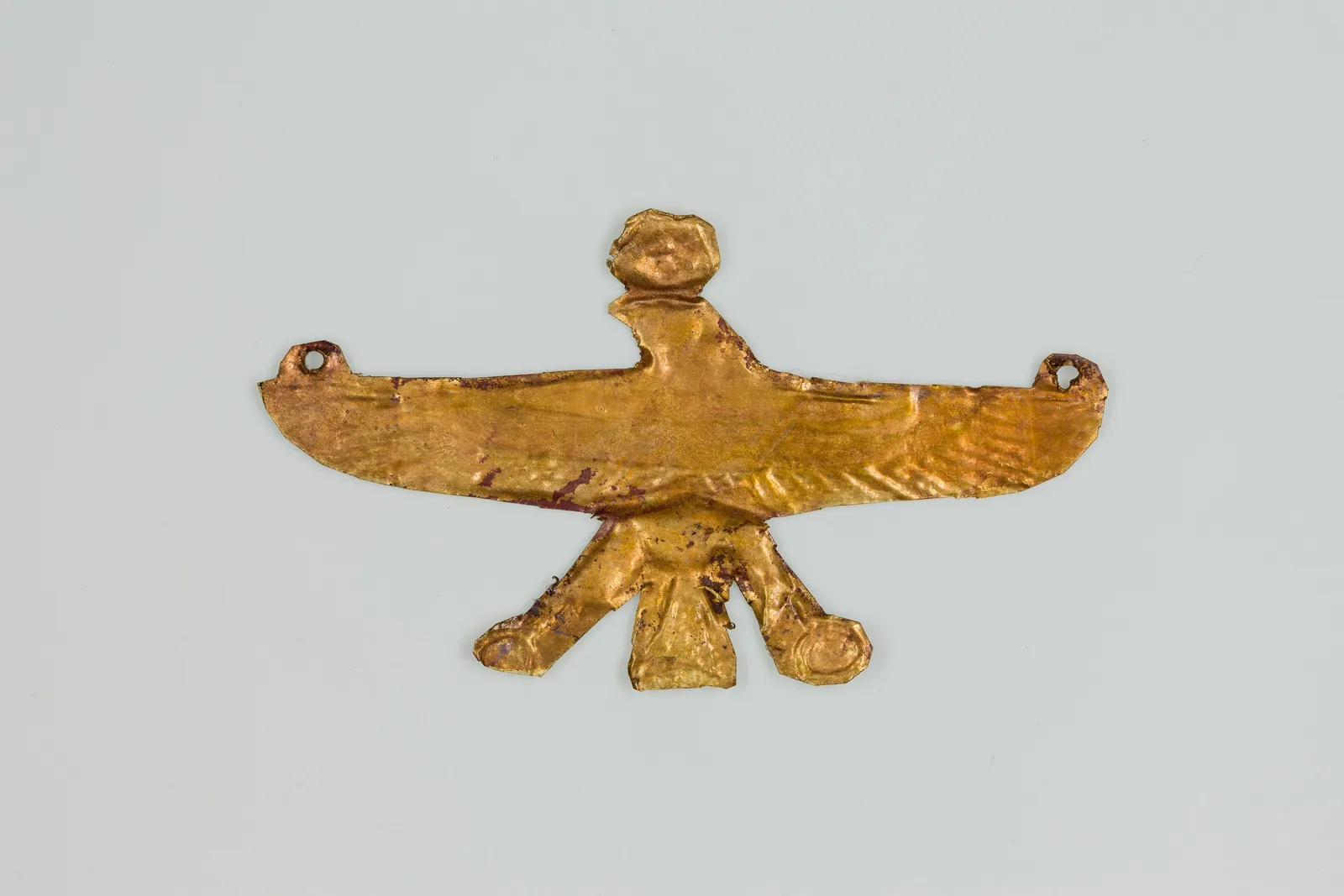
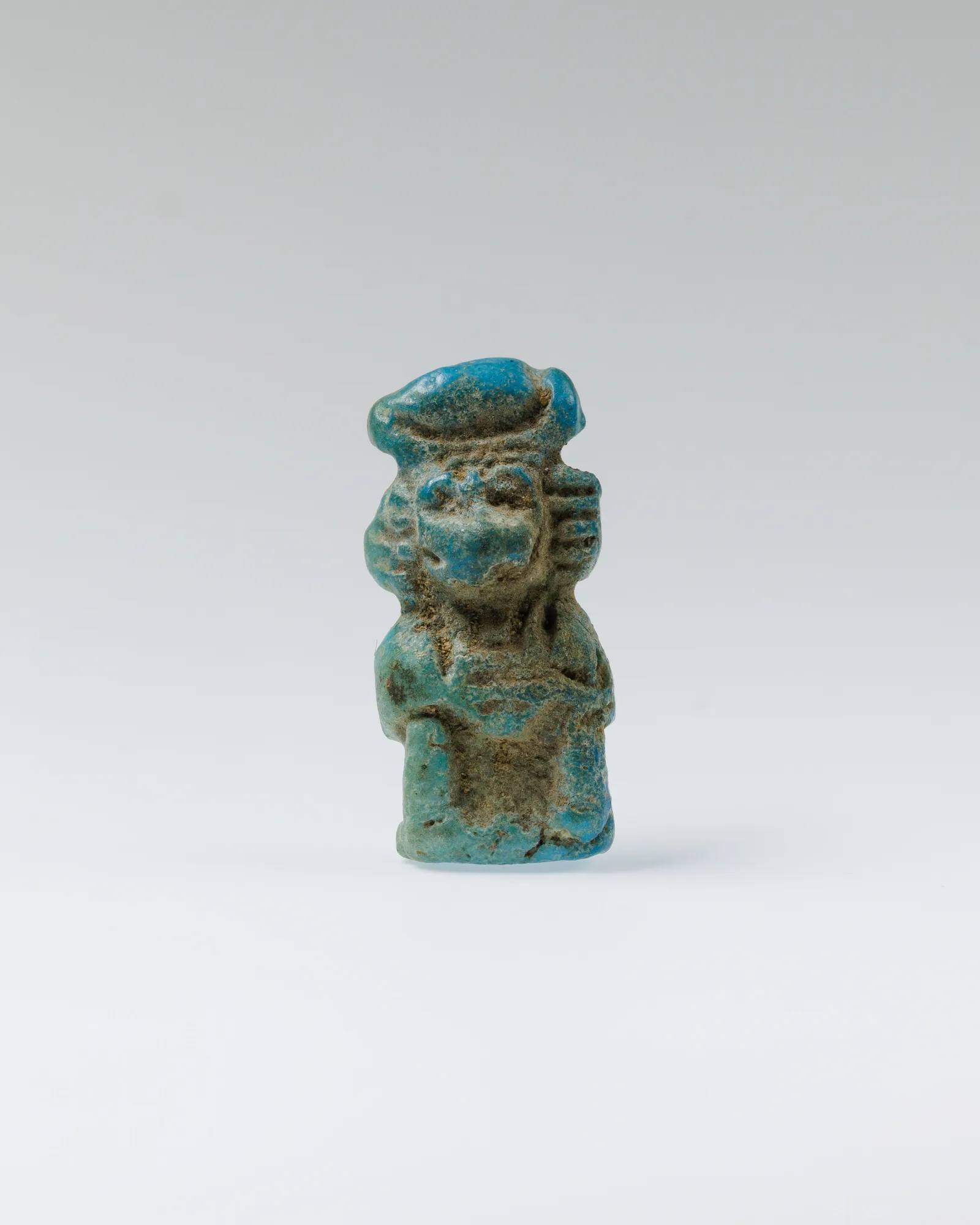
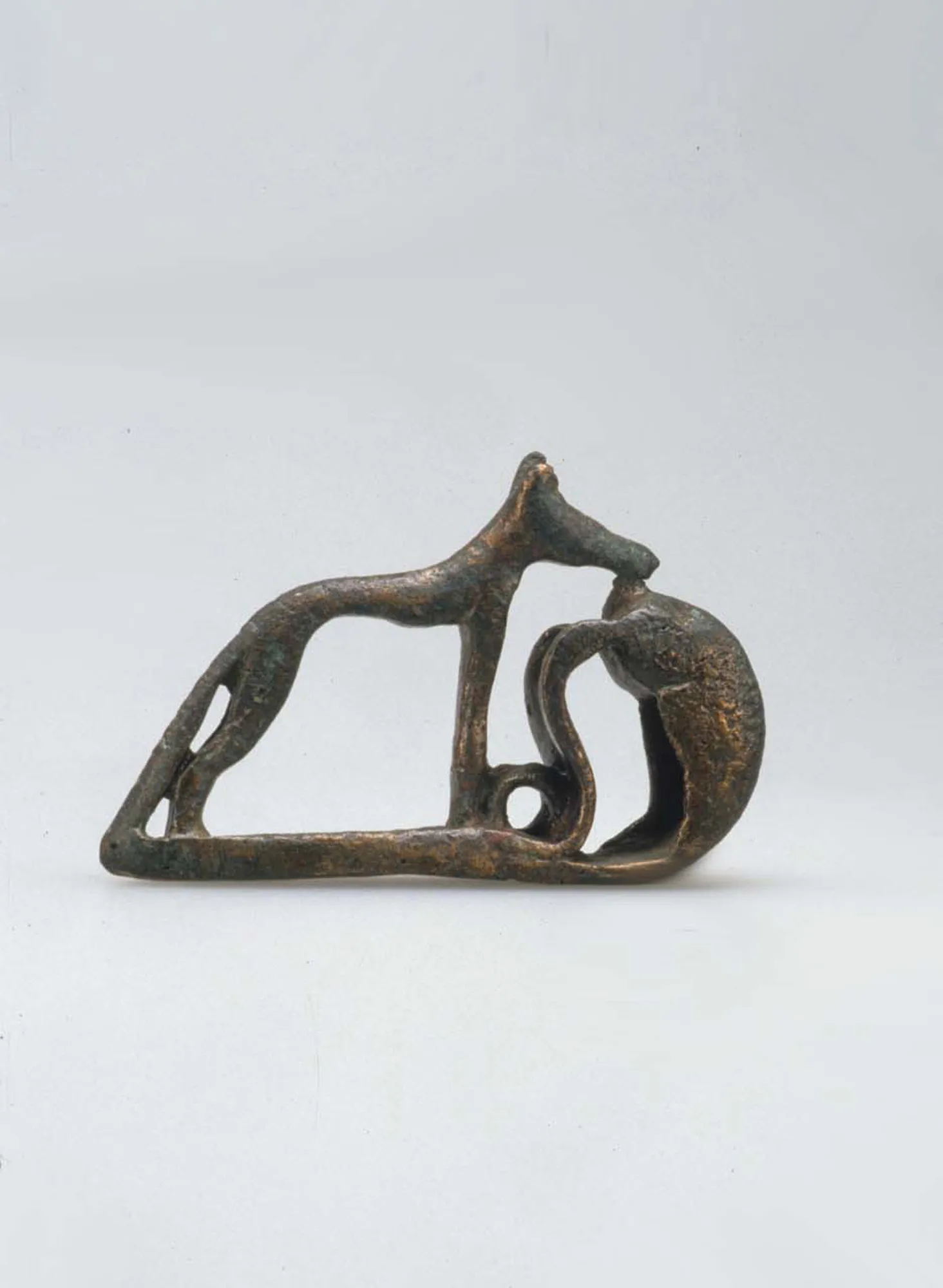
A separate and the most numerous group of finds is the small amulets of Anubis, made of faience, bronze and stone in whole series. They were worn by the living as a charm and tucked into the mummy's bandages as protection on the crossing. A figure of a sitting or reclining jackal the size of a finger-joint came into the hands of an ordinary Egyptian far more often than a great temple statue, and through it the god was near in daily life. The image of Anubis was cut too on seals, scarabs and signet rings, stamping his profile into clay and wax. It is precisely this tradition of a tiny worn sign that is closest to how Anubis lives on in jewellery today: a small figure with its owner, set to watch over them every day.
Customer reviews
Zevira is a real jewellery shop. Genuine payments, deliveries and customer thank-yous.
🥰🥰🥰 gracias

Ok, ¡gracias! 🙂

Famous finds and excavations
Egyptologists have dug up both images of Anubis and the places where he was worshipped in the flesh, with temples, cemeteries of sacred animals and traces of a whole trade around the cult. These finds show that Anubis was a god of everyday religion, not an abstract idea of the funerary texts.
Saqqara and the "Anubieion"
The chief centre of the worship of Anubis by Memphis was a temple precinct the Greeks called the Anubieion. It stood over the vast necropolis of Saqqara, where the embalmers worked from generation to generation. Underground, archaeologists have found catacombs dedicated to Anubis, long galleries into which, for centuries, mummies of dogs and jackals were brought. These mummies number in the millions: a pilgrim would buy an embalmed animal from the temple and leave it to the god as a petition, and whole workshops lived off the breeding and burial of sacred dogs.
Mummies of jackals and dogs
Animals for Anubis were mummified all over Egypt, but especially many are found at Saqqara and in the neighbouring necropolises. Some are grown dogs, some puppies a few days old, raised at the temple specially for offerings. These finds opened for historians a whole side of the ancient economy, where piety and craft were woven together: the demand for a gift to the god sustained the kennels, the embalmers and the traders at the shrine. Behind the pilgrim's quiet devotion stood a well-tuned temple machine.
Cynopolis, the "city of dogs"
In Middle Egypt stood a city the Greeks named Cynopolis, the "city of dogs," in Egyptian Hardai. There Anubis was honoured especially warmly, living dogs were surrounded with care, and the killing of a sacred dog was held a grave crime. Ancient authors even recalled a quarrel between Cynopolis and a neighbouring town over the sacred animals, when outsiders harmed a revered beast. Nearby, in other nomes, shrines to Anubis were set up by the necropolises, and his standard with the figure of a reclining jackal was carried in funerary processions.
Hymns and offering formulas
The name of Anubis stands in the most widespread funerary inscription of Egypt, the offering formula carved on stelae, sarcophagi and statues. It began with words about the offering the king makes to the god, and often named Anubis in particular, "he who is upon his mountain," "lord of the sacred land," asking for the dead a worthy burial and offerings. This formula was repeated thousands of times across the whole of Egyptian history, and by it you can see that Anubis was turned to by literally everyone who prepared their own crossing or a loved one's into eternity. There survive too separate hymns to the god, which praise him as the keeper of the secrets of embalming and lord of the sacred land, and these lines carry the voice of living faith rather than dry rite.
Upload a photo of your pet, someone you love, or an object. We'll build a 3D model and hand-cast it in pewter.




Meaning and symbolism
From the myth and the cult grows a set of meanings that Anubis carries as a symbol. All of them rest on his work as the guardian of the crossing, and none reduces the god to plain "death."
Protection in transition
The first and chief meaning of Anubis is protection at the moment of the crossing. He guarded the body from destruction and the soul from the dangers of the afterlife road, standing watch where a person is most defenceless. Hence his role as a charm: the symbol of Anubis reads as a plea for protection at a hard threshold, whether in the ancient sense of the passage into eternity or, in the modern one, any great change of life. The god set to guard the most vulnerable became a sign of reliable protection.
Guide between worlds
The second meaning is guidance. Anubis led the soul through the dark of the Duat, knowing the road and letting no one lose the way. The role of the guide, the one who walks beside you in the unknown and brings you to the goal, makes Anubis a symbol of accompaniment through change. The Greeks later drew him close to their Hermes, guide of souls, and named this union Hermanubis, recognising in the Egyptian god the same function of a leader between worlds. As a sign, Anubis says: you are not alone on the hard road; there is one who leads.
Loyalty and service
The canine, jackal nature of Anubis adds to the image the theme of loyalty. The dog at the grave, which does not leave the dead, reads as an embodiment of devotion carried to the end. Anubis is faithful to his work and to his lord Osiris; he is a servant, not a ruler, and his dignity lies in a duty fulfilled. So the symbol of Anubis is close to people who value loyalty, reliability and service to something greater than themselves. It is the sign of one who keeps his word and does not leave his post. In this loyalty there is a calm strength: it rests not on loud oaths but on the daily doing of one's work, and so it reads as the sign of a person you can rely on in the hardest moment.
Embalmer and keeper of secrets
Anubis kept the secrets of embalming, the sacred knowledge of how to prepare the body for eternity. To this is tied a facet of his image as the keeper of hidden knowledge, an initiate in things unavailable to the ordinary person. In modern symbolism this trait draws those attracted by ancient knowledge, esotericism, the mysteries of Egypt. Anubis here reads as the guardian of the threshold, both between life and death and between the everyday and the hidden. The sign of the initiate who knows more than he says.
Anubis in jewellery
The ancient image passes into metal surprisingly well. The jackal's head is graphic, the silhouette recognisable, and the meaning serious without gloom, which is why Anubis has long lived in pendants, rings and amulets.
Pendant with the jackal's head
The most widespread format is a pendant in the shape of a jackal's head or the figure of a seated Anubis. The god's profile, with its elongated muzzle and sharp ears, reads instantly and works as a strong graphic accent. Such a pendant is worn both as a charm of the crossing and as a sign of interest in Egyptian culture. The jackal's head is often given in close-up, stressing the recognisable silhouette, while the full figure of the seated god is chosen by those closer to the classic canon of the image.
Black silver and onyx
The symbolism of the black colour of Anubis leads naturally to dark materials. Oxidised, blackened silver repeats the very black that meant rebirth to the Egyptians and lends the image a graphic depth. Black onyx or obsidian, as an inlay or a whole figure, strengthens this meaning, tying the piece to the colour of the fertile earth and of promised resurrection. The dark palette makes Anubis gathered and severe, without carnival brightness, and conveys the spirit of the original most precisely.
Signet ring and the profile of Anubis
The profile of Anubis sits well on the face of a signet ring, inheriting the ancient tradition of carved gems and seals with the figures of gods. A signet with a jackal's head reads as a sign with character, restrained and weighty. An engraved profile on a dark ground or a relief on silver turns the ring into a personal emblem. This format is close to those who prefer to wear a symbol on the hand rather than the neck, and who value the link with the ancient culture of signet rings.
Paired and amulet formats
Anubis is often taken in a pair with other Egyptian signs: with the ankh as a sign of life, with the Eye of Horus as a charm, with the scarab as a symbol of rebirth. In the amulet format the god is made a small three-dimensional figure, worn as a charm on a chain or a cord. Such a small Anubis works as a personal sentinel, a quiet companion set to watch over its owner. A set of several Egyptian symbols builds up into a coherent whole with a shared theme of crossing, protection and eternal life.
The choice of format is the choice of which facet of Anubis you want to wear. A profile pendant stresses recognisability and graphics, dark onyx strengthens the theme of rebirth, a signet adds severity and a link to the tradition of seals, and a small amulet puts the accent on protection. No one version is more "correct" than the others; everything is decided by what is closest to you in meaning and in image. Next it is worth going into materials, because it is the metal and the stone that set the character of a piece bearing so strong a symbol.







Materials
The image of Anubis calls for materials that hold his seriousness and dark palette. Not all will do, and each has its own logic.
Blackened silver
Oxidised silver is the most precise material for Anubis. The darkened recesses repeat his black colour and stress the relief of the jackal's head, making the image graphic and deep. 925 silver is durable, wearable every day, and holds the fine working of the muzzle and ears well. The oxidation should be protected: aggressive cleaning strips the patina from the hollows, and with it the whole meaning of the dark palette. It makes sense to polish only the raised edges, leaving the recesses dark for the sake of contrast.
Onyx and obsidian
Black onyx and volcanic obsidian tie the piece to the symbolism of the fertile earth and rebirth directly through colour. Onyx gives an even, deep black with a soft sheen; obsidian adds a glassy depth and a light reflection. Of these stones are made inlays for pendants and rings, and sometimes whole carved figures of Anubis. A dark stone suits the image of the god of the crossing better than bright gems: it is calm, weighty and does not argue with the seriousness of the symbol. When choosing, it is worth checking the onyx for chips at the edges of the setting and the obsidian for the absence of cracks.
Gold and gold plating
Gold gives Anubis a ceremonial, high-status tone and recalls the treasures of the Egyptian tombs, where gold meant the flesh of the gods and incorruptibility. A gold figure of Anubis or a gold profile on a dark ground reads as a premium, solemn version of the symbol. Gold-plated silver gives a warm gold tone at a reasonable cost, but the coating wears off the raised edges over time, and that is worth bearing in mind for daily wear. The combination of gold with black onyx is especially apt: it repeats that very Egyptian pair, the gold of the gods and the black of rebirth.
Care
A piece with Anubis, blackened above all, likes gentle care. A soft cloth and dry storage prolong the life of the patina and the coating. Blackened silver should not be cleaned with abrasives or ultrasound, or the dark palette will leave the hollows. Onyx and obsidian fear knocks and sharp changes of temperature; it is best to take them off before hard work and sport. Gold plating is kept from friction and aggressive cosmetics. If the piece has a stone, check the tightness of the setting from time to time, so the figure does not loosen and the inlay does not fall out.
Leave your email, we'll send your discount code. No spam, unsubscribe anytime.
The code arrives by email, valid on your first order.
Psychology: why people choose Anubis
Behind the choice of such a symbol there is almost always an inner reason, and it is rarely about a dark aesthetic alone. Anubis draws those close to the themes of crossing, memory and protection, and by what a person finds in this image you can see what matters to them.
The pull toward the theme of transition
Anubis is a god of the threshold, and he is often chosen in the very moments when the person stands at a threshold. A move, a change of path, the end of one stage and the start of another chime with the image of one who leads through the unknown and lets no one lose the way. The symbol here works as a support: it reminds you that a hard road has a guide, and that a crossing is not a cliff-edge but a movement toward the new. People living through a great change are drawn to Anubis for exactly this calm promise of a path.
Memory of the departed
Another frequent reason is memory. Anubis is the guardian of the dead, and his sign is often taken in connection with a loss, as a quiet tribute to a loved one. There is nothing morbid in this: Egyptian logic saw in death not an end but a crossing, and the sign of the jackal carries precisely this calm attitude. To wear Anubis in memory of the departed is to keep with you not grief but a promise, that the road goes on and that there is one who leads along it gently.
The need for protection
The third reason is protection. Anubis guarded the most vulnerable, and he is chosen as a charm by those to whom the feeling of a covered back, of a reliable sentinel at their side, matters. Such a person values loyalty and reliability both in others and in themselves, and finds in the gathered figure of the god a sign of these qualities. The dark, severe aesthetic here is not about threat but about the calm strength of one who keeps his post and does not abandon what is entrusted to him. Anubis is close to people for whom depth of meaning matters more than shine, and who choose a thing for what it means.
Who it suits and who to give it to
Anubis is a symbol with character, and in that lies its strength. It suits those who seek a sign with depth, and works well as a meaningful gift with a clear message.
Who the symbol of Anubis suits
The symbol of Anubis is close to people drawn to ancient Egypt, its mythology and aesthetic. It suits those who value the themes of protection, crossing and inner honesty, and who do not fear a serious symbol. The sign sits well on a person living through a great change, for Anubis is the god of the threshold and of accompaniment in the unknown. He is close too to those who prize loyalty and service, and to those drawn by hidden knowledge and esotericism. The dark, graphic aesthetic of Anubis attracts lovers of severe, weighty jewellery without brightness. Gender makes no difference here: a strong, gathered image suits both men and women.
Anubis as a gift
As a gift, Anubis is chosen with a clear meaning. He is given as a charm of the crossing to one who stands at a threshold of change: before a move, a change of path, a new great stage. He is given as a sign of protection and reliable accompaniment, with the wish not to lose the way on a hard road. Such a gift is fitting too for a person absorbed by Egypt, a collector of symbols, a lover of history. Dark silver with Anubis reads severely and seriously, while a version with gold and onyx turns the gift into a ceremonial gesture. It is worth adding to the piece a few words that Anubis is a guardian and a guide, not a god of doom, so the meaning unfolds rightly.
CAPAORA mini knife pendant
The 18th-century Spanish navaja in miniature: 40 mm of stainless steel, a real folding mechanism and a Palanquilla lock that clicks. An affordable gift to remember.
Authentic · Ships from Spain · 14-day returns
Anubis and neighbouring symbols
Anubis does not live alone but in a family of Egyptian signs, and beside them his meaning shows more clearly. Comparison helps to understand what exactly the image of the jackal is strong in among the other symbols of Egypt.
Anubis and the ankh
The ankh is the Egyptian cross with a loop at the top, the sign of life and eternal existence. Anubis is often shown with an ankh in his hand, and this combination is deeply logical: the god of the crossing holds the symbol of life, because his work leads not to an end but to an eternal continuation. If Anubis answers for the road through death, then the ankh, the cross of life marks the very goal of that road, a life that is not broken off. As a pair they read as the crossing and its reward.
Anubis and the scarab
The scarab, the sacred beetle rolling its ball, was for the Egyptians a sign of rebirth and the rising sun. Its meaning rhymes with Anubis through the theme of resurrection: both speak of a new life after the dark. But their accents differ. The scarab is about rebirth itself, about the morning sun rising anew, while Anubis is about the road and the protection along it. Together they build up into a whole thought: the guide leads through the dark, and the scarab promises the dawn at the end.
Anubis and the Eye of Horus
The Eye of Horus, the wedjat, was a powerful charm of health, wholeness and protection. It guarded against evil and restored what was lost. Beside Anubis you can see the division of roles: the Eye of Horus, the wedjat guards against harm and illness in this life, while Anubis guards on the crossing into the next. Both signs are protective, but they work on different stretches, one in the world of the living, the other at the threshold. That is why they are often worn together as a double guard, the daily and the threshold one.
Anubis and Bastet
Bastet, the cat goddess, is also tied to an animal form, but her sphere is the opposite. The cat and the goddess Bastet answered for the home, joy, fertility and the protection of the dwelling, for the warmth of everyday life. Anubis answered for death and the crossing, for the severe side of being. Together they outline the breadth of the Egyptian pantheon: from the home hearth under the cat's paw to the threshold of eternity under the jackal's watch. The comparison shows that the Egyptians did not divide gods into good and evil but distributed among them the different regions of life and death.
The table makes the difference plain: each Egyptian symbol has its own form, its own region and its own meaning, and Anubis among them answers for the most crucial zone, the crossing and the protection along it. Understanding this division of roles makes it easier to build a meaningful set, where the signs complement each other rather than repeat the same thought. Anubis with the ankh is crossing and life, Anubis with the scarab is road and dawn, Anubis with the Eye of Horus is double protection. Each pair sounds in its own way.
Anubis in culture: from Hermanubis to today
The image of Anubis did not stay locked in ancient Egyptian religion. He outlived that religion itself, passed to the Greeks and Romans, and then survived into our time as one of the most recognisable signs of Egypt.
Hermanubis among the Greeks and Romans
When Egypt entered the Greek and then the Roman world, the gods of the two cultures began to draw close. Anubis, the guide of souls, was joined with the Greek Hermes, the leader of the dead, and the resulting figure was named Hermanubis. He was shown now as a man with a jackal's head in Greek dress, now with the features of both gods at once, sometimes with a palm branch or the herald's staff in his hand. Hermanubis was honoured in Hellenistic Egypt and entered the Roman shrines of Isis, where he was known as a guardian and a guide. So the Egyptian jackal gained a second life already in the ancient pantheon, and his name sounded far beyond the valley of the Nile.
The magical papyri
The name of Anubis often appears in the Greco-Egyptian magical papyri of the first centuries of our era, collections of spells and rites. He was turned to as a herald and a guide, a mediator between the world of the living and the world of the dead, able to carry a request to the other powers. These texts show that even at the twilight of the ancient religion Anubis was remembered precisely as the one who knows the road in the dark, not as a fearsome punisher. The role of the leader and mediator outlived the temples in which it was born.
How the image reads today
Anubis has come down to us above all as an emblem of ancient Egypt, on a par with the pyramid, the scarab and the ankh, the cross of life. His black profile with the sharp ears is recognised even by those who could not name a single other Egyptian god. In jewellery, graphics and design he reads as a sign of mystery, protection and a link to antiquity. Behind this recognisability stands the same old logic: before us is the keeper of the threshold, not a bogeyman, and it is precisely the severe, gathered side of the image that makes it so strong a symbol thousands of years on.
Myths and misconceptions about Anubis
Around Anubis there has grown up a great deal of confident but inexact assertion, mostly from pop culture, where he has been turned into a fearsome "god of death" and a villain. It is worth calmly separating the historical image from the cinematic one. Part of the misconceptions mixes different ages, part ascribes to Anubis a role not his own, and part simply frightens where the ancients saw comfort and order. Below are sorted the most frequent of them, so that behind the figure of the jackal the real Egyptian god shows through, not a carnival mask.
The difference between the image from the films and the historical Anubis is fundamental. The Egyptians did not fear him as a monster but entrusted to him the most precious thing, the fate of a dead loved one. His black colour promised rebirth, his scales meant justice, his hands prepared the body for eternity. When a modern person chooses the symbol of Anubis, they connect precisely to this ancient logic of protection and crossing, not to the late scare stories. Understanding the difference also makes wearing the symbol meaningful: it is the sign of a guardian, not a bogeyman.
Send a friend a discount code, they save on their first order.
Facts that surprise
Anubis has gathered over the millennia so many stories that some sound unexpected even to those who reckon they know this god.
First. The black colour of Anubis meant not mourning but life. The Egyptians tied black to the fertile Nile silt and to the promise of rebirth, and so they painted the god of the crossing in that very colour of hope, not of fading.
Second. The beast of Anubis may not be a jackal. For a long time it was held to be jackal-like, but modern research has brought the "Egyptian jackal" close to the African golden wolf. So the god with the canine head may turn out to be a wolf rather than a jackal, and the debate about it goes on.
Third. Anubis was the chief god of the dead before Osiris. In the most ancient age of the pyramids it was he who held the supreme role in the fate of the dead, and only later did Osiris take it upon himself, while Anubis became his helper and guide.
Fourth. The embalming priests worked in a mask of Anubis. The one leading the rite put on a mask with a jackal's head and in that moment became, as it were, the god himself. Such masks have come down to our day and confirm how literally the Egyptians understood the presence of Anubis in the workshop.
Fifth. The brain of the dead was thrown away, while the heart was left. The Egyptians held the heart to be the seat of mind and conscience, and so kept it in the body for the judgment, while the brain, seeing no value in it, was removed and not preserved. It was the heart that was later laid on the scales before Anubis.
Sixth. The loser at the judgment faced not torment but disappearance. If the heart outweighed the feather of truth, the monster Ammit devoured it, and this meant final destruction, a second death without eternity. The Egyptian hell was not eternal fire but complete non-being.
Seventh. The Greeks joined Anubis with their Hermes. In the age when Egypt and the Greek world mingled, Hermanubis appeared, a god-guide of souls in whom the shared role of a leader between worlds was recognised. So the jackal and the winged herald merged into a single figure.
Eighth. Anubis had catacombs with millions of dogs dedicated to him. Under Saqqara archaeologists have found underground galleries into which, for centuries, mummies of dogs and jackals were brought as a gift to the god, and they number in the millions. Pilgrims bought such mummies from the temple and left them to Anubis as a petition, and a whole trade lived off this piety.
Frequently asked questions
Who is Anubis in simple terms?
Anubis is the ancient Egyptian god of burial, embalming and the afterlife crossing, shown as a man with a jackal's head or as a black jackal. He was held to be the patron of embalmers and the guide of the soul into the underworld, and at the judgment of the dead he held the scales. In essence he is a guardian and a leader at the threshold between life and eternity, not a "god of death" in the gloomy sense.
Is Anubis a god of death or not?
It is more accurate to call him a god of burial and the crossing rather than of death. The king of the dead for the Egyptians was Osiris, while Anubis answered for the practical side: the preparation of the body, the accompaniment of the soul through the underworld and the honesty of the judgment. His role is that of guardian and guide, so the image of Anubis is closer to a keeper of the threshold than to an embodiment of doom.
Why is Anubis shown black?
The colour black in Egypt meant not mourning but rebirth. So looked the fertile Nile silt that brought the fields to life, and the body treated with resins during embalming. Both meanings spoke of a new life, so the god of the crossing was painted black as a sign of resurrection. In jewellery this symbolism is conveyed by blackened silver, onyx and obsidian.
Is Anubis a jackal or a wolf?
Traditionally he is held to be a god with a jackal's head, and so he was called for centuries. But modern research has shown that the beast called the "Egyptian jackal" is closer to the African golden wolf. So strictly speaking the question is open, and Anubis can be called both a jackal and a wolf god. For the symbolism this changes nothing: what matters is the image of the keen sentinel at the graves.
What does the weighing of the heart mean?
This is the central scene of the judgment of the dead. On one pan of the scales was laid the person's heart, on the other the feather of the goddess of truth, Maat. If the heart was no heavier than the feather, the life was held righteous and the dead was justified. A heart heavy with evil deeds condemned its owner, and the monster Ammit devoured it. Anubis watched over the honesty of the scales, remaining impartial.
Can you wear the symbol of Anubis?
Yes, the symbol of Anubis is worn as a charm of crossing and protection, a sign of interest in ancient Egypt, or a personal emblem of loyalty and inner honesty. It is not tied to anything dangerous or ill: within his own religion Anubis was a support and a defender of the dead. It can be worn with any attitude, from a deep absorption in Egyptian culture to a pure love of a strong graphic aesthetic.
Who does jewellery with Anubis suit?
It suits those drawn to Egypt, to the themes of protection and crossing, to the aesthetic of dark silver and onyx. It sits well on a person in a period of change, for Anubis is the god of the threshold. He is close too to those who value loyalty, reliability and hidden knowledge. Gender does not matter here: a gathered, severe image suits both men and women, and the format, from pendant to signet, is chosen to taste.
How does Anubis differ from Osiris?
Osiris is the king of the dead, lord of the underworld, the risen god who gave people hope of eternal life. Anubis is his helper and guide, the one who prepares the body, leads the soul through the Duat and holds the scales at the judgment. Earlier the chief god of the dead was Anubis, but with the rise of Osiris he yielded him the throne and became the master of the crossing. One rules, the other accompanies.
Conclusion
Anubis is one of those ancient gods whom pop culture has simplified to a frightening mask, though behind it stands a far subtler and more human figure. The Egyptians entrusted to him the most vulnerable thing, the passage of the dead into eternity, and saw in the black jackal not death but a reliable guardian and guide. His colour promised rebirth, his scales meant justice, his hands prepared the body for a new life. He was a support at the moment when a person is most defenceless.
In jewellery Anubis works on all these levels at once. For some it is a charm of crossing and protection at a hard threshold. For others a sign of loyalty, service and inner honesty, that very lightness of heart that was weighed at the judgment. For others still simply a strong graphic image of ancient Egypt, recognisable at a glance. Dark silver, onyx and gold convey his spirit most precisely, repeating the Egyptian pair of the colour of rebirth and the flesh of the gods.
The honest bottom line is simple. Anubis is not a bogeyman or a lord of darkness but a god of the threshold, who knows the road in the dark and lets no one lose the way. What you pour into this image, protection, loyalty or a love of history, is what it will mean, while he remains what he was four thousand years ago: the quiet, precise guardian of the crossing.
Silver, gold, the symbolism of ancient cultures, protective charms and paired sets.
Buying it as a gift? Each one arrives ready to give.
 A branded Zevira box and a little card come with every order.














About Zevira
Zevira works in Albacete, Spain, a town with a long craft tradition in metalwork. The symbols of ancient cultures are part of our collection, where Egyptian signs, charms and mythological images live in clean forms of silver and gold. We love things with a history thousands of years long and carry it into modern design without needless pathos.
What you can find with us near the theme of Anubis:
- Pendants with Egyptian symbolism in silver
- Pieces in blackened silver for a graphic, dark aesthetic
- Inlays of black onyx and obsidian
- Signet rings with engraving
- Gold-plated versions with a warm tone
- Paired and gift sets with the symbolism of protection and crossing
Personal engraving is available. We work in 925 silver and gold of fourteen to eighteen carats.