Judgement in Tarot: Meaning, History and Jewellery by the Symbols of Arcana XX
Three years ago you stopped writing. You simply put the unfinished novel in a drawer and convinced yourself it had been a whim. Then you reached the same conclusion again, when someone offered you a column. And again, when a friend asked you to write something for their site. The call was there. You heard it. And every single time a reason appeared not to answer.
Or a different situation: five years ago you treated someone unfairly. Nothing catastrophic, you just lost your nerve at the wrong moment. Since then it has sat somewhere inside you as a quiet weight. It does not stop you living, but it does not let go either. And suddenly, out of nowhere, you think of that person again and realise you want to say something to them. Not to justify yourself. Just to name things for what they were and let them go.
That is Judgement. Arcana XX of the Tarot. The card is not about reward in the afterlife, nor about punishment for sins. It is a card about life sometimes sounding a horn and waiting for an answer. About the past being open to revision, and the chance to find in it something you finally need to release. About a calling you ignored that has not vanished, only waited.
This piece works through Arcana XX in full: its iconography, history, symbolism, the psychology of forgiveness and vocation, cultural parallels, and the jewellery that carries this meaning. The card as a cultural artefact with eight centuries of history.
Arcana XX in the Structure of the Deck: Between the Sun and the World
Judgement holds the twentieth position in the Major Arcana. Before it stands Arcana XIX, the Sun, a card of clarity, childlike openness and direct light. After it comes Arcana XXI, the World, the final card of the cycle, signifying completion and integration. Judgement stands exactly between these two poles.
It is the penultimate card of the Major Arcana, and that matters. The journey the Fool began at position zero is almost finished. Trials, transformations, losses and revelations have all been passed through. There was the Tower with its destruction, the Moon with its fears, the Star with hope restored. The Sun has already risen, given light and warmth. But before entering the final circle of the World, the call must be answered. You must stop, look back, and decide who you want to be next.
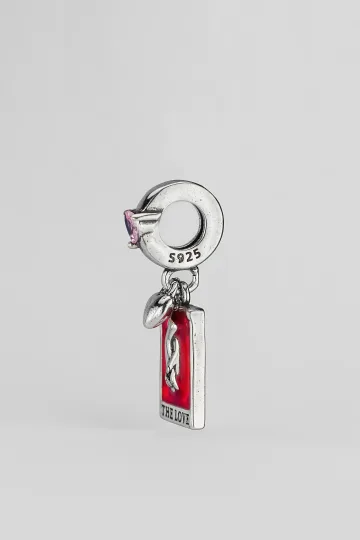
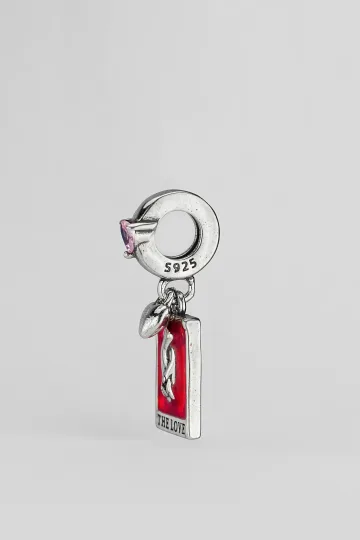
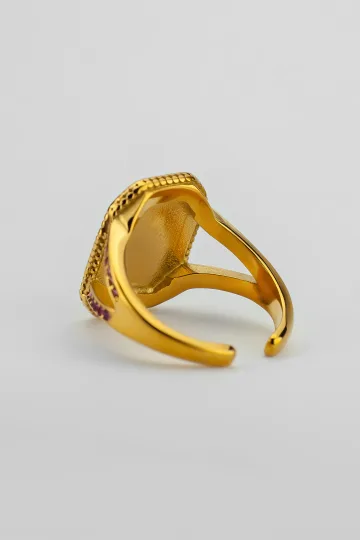
Wear the symbol, don't just read about it. These are in stock:







It is no accident that Judgement sits near Death (Arcana XIII) in the same field of meaning. If Death is transformation through letting go, then Judgement is transformation through awareness. Death takes. Judgement asks whether you are ready to rise.
In numerology the number 20 reduces to two: 2+0=2. The Two in Tarot is the High Priestess, keeper of hidden knowledge, the card of intuition and inner voices. Judgement literally contains a two within it: the call from outside and the answer from within. The one who hears the trumpet, and the one who rises from the water.
The Hebrew letter assigned to Arcana XX in the Waite system is also worth noting: Shin (ש), the twenty-first letter of the alphabet, which literally means "tooth". In the Kabbalistic tradition Shin is the letter of Fire, symbolising a flame that burns and illuminates at the same time. The fire element of Arcana XX receives a Kabbalistic confirmation here: this is not a quiet, gradual change but a flame that breaks through.
The path of Arcana XX on the Tree of Life runs from Hod (Glory, Mercury) to Malkuth (Kingdom, Earth). It is the descent of the heavenly into the earthly, the joining of the higher with the concrete. The call of the trumpet on the card comes from above, out of the clouds, yet reaches the figures standing in the water on the ground. The heavenly and the earthly meet in the moment of awakening.
History: How the Card Changed From Visconti to Crowley
Visconti-Sforza: The Triumph of Fame
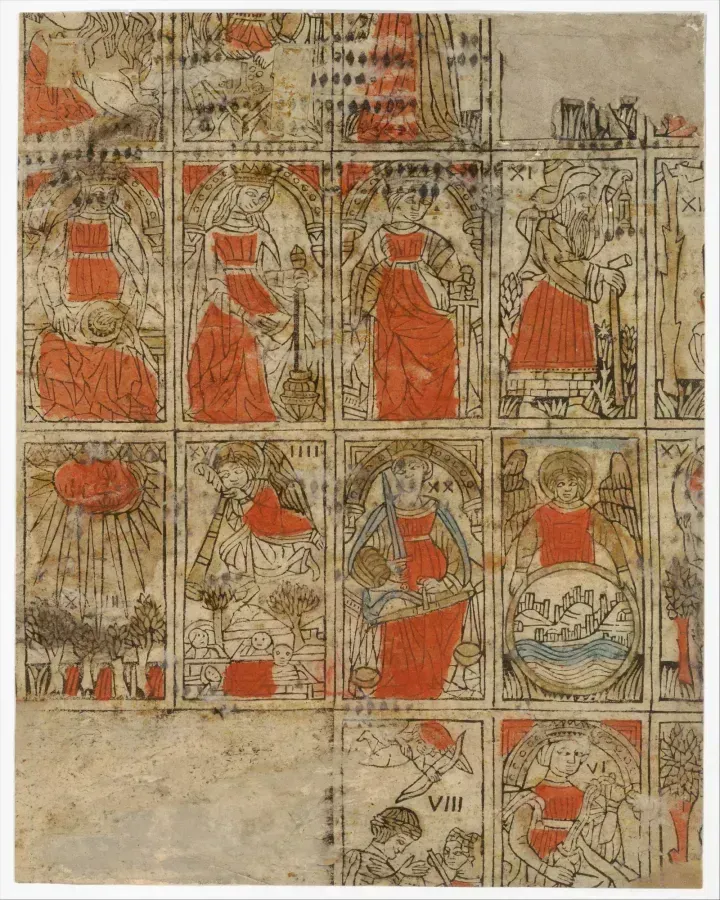
The oldest surviving Tarot cards date from the mid-fifteenth century, the Visconti-Sforza deck, made at the Milanese court. In that deck the present Arcana XX was called Trionfo della Fama, the Triumph of Fame. Instead of an angel with a trumpet, the card showed an allegorical figure of Fame with a trumpet, and beneath her famous figures from the past. This was a direct reference to Petrarch's "Triumphs", a poetic cycle in which Fame conquers Love, Death conquers Fame, and Eternity conquers everything else.
Il Giudizio, Judgement, appeared later, when Tarot cards began to include overt Christian imagery. An angel with a trumpet and the dead rising from their graves were legible to anyone in the fifteenth and sixteenth centuries, raised in a culture saturated with images of the Last Judgement.
The Tarot of Marseille: Le Jugement
In the sixteenth and seventeenth centuries the Tarot of Marseille spread across Europe, a standardised type of deck. Le Jugement (Judgement) showed an angel in the clouds with a trumpet, and beneath it three human figures rising from rectangular coffins or sarcophagi. An image close to the one Waite would later develop.
The Marseille Judgement is visually harsher: grey tones, strict symmetry, less space. It appeals to the medieval image of the Dies Irae, the Day of Wrath. It was from the Marseille tradition that the habit came of seeing something frightening in this card, although its meaning was always more complex.
Waite-Smith 1909: The Modern Canon
Pamela Colman Smith, under the direction of Arthur Edward Waite, created in 1909 a deck that became the world standard. Judgement in this deck is a developed scene saturated with detail. It was this image that became the basis for the overwhelming majority of modern interpretations.
Waite deliberately kept the Christian iconography, but his reading in "The Key to the Tarot" (1911) stressed not the fear of judgement but awakening. Resurrection here is not punishment but possibility. The dead rise not because they are afraid, but because their hour has come.
The context in which the deck was made matters too. The year 1909 is a specific historical moment, not a random date of publication. It is the moment when occult societies were going through an active period of rethinking ancient traditions. Waite and Smith both belonged to the Hermetic Order of the Golden Dawn, whose members worked on a synthesis of Kabbalah, astrology, alchemy and Western occultism. Their Judgement is an attempt to create an image working at several levels at once: Christian, Kabbalistic and archetypal.
Pamela Colman Smith drew quickly and with inspiration. By the accounts of her contemporaries, she created the cards in a few months, many of them in the trance state of an artist seized by an image. Her Judgement stands out for a particular intensity: the large angel takes up almost a third of the card, the figures below have raised their hands in a gesture that is at once pleading and joyful. It is this combination of fear and ecstasy that makes the Waite-Smith card so memorable.
Crowley and Thoth: The Arcana "Aeon"
Aleister Crowley, in the Thoth deck (1943, painted by Lady Frieda Harris), renamed Judgement "The Aeon". He considered the traditional image outdated and tied to a Judeo-Christian worldview. The Aeon card in his system depicts the change of world epochs through images of Egyptian mythology: Nuit, Hadit, Horus.
This is a telling moment: Crowley accepted the philosophical principle of the card (the change of epochs, awakening to the new) but rejected its specific religious language. Modern scholars often hold a similar position: the archetype of the card is deeper than its Christian shell.
A phoenix wants a long chain and an open collar, swinging as you stride. Bury it under a tie and you have a stuffed bird, not a rebirth. Don't you dare.
What to Wear Jewellery With the Symbolism of Judgement With
I have taken the symbols of Arcana XX through dozens of looks on set. The phoenix, the cross, the ankh, the butterfly each live in an outfit differently, and here is what I advise by occasion.
How do I wear a Judgement symbol every day? For weekdays I recommend a small pendant on a fine chain over a simple top: a grey or white tee, light knitwear, a soft cotton shirt. A round neckline gives the piece some air, and it reads as a personal, deliberate thing. A phoenix or butterfly the size of a fingernail works exactly this way, noticed close up rather than across a room.
Is it right for the office? It is, as long as you keep restraint. I suggest one accent, a calm metal and a medium chain length under a closed top or a blazer. Silver with a light patina I pair with grey, navy, graphite. An ankh or a cross in this context reads as a strict, almost ascetic sign.
How do I build an evening look? For the evening I choose a large, detailed pendant on a long chain. A deep V-neckline, black or wine-coloured silk, a smooth dense fabric give a background to a detailed phoenix. I keep earrings minimal here and rings calm.
What do I wear for a special occasion? For the anniversary of a rebirth or entering a profession I suggest 14K gold or oxidised silver with a warm undertone. A dress or suit in a deep colour, and no competing jewellery nearby.
Who does this symbolism suit at all? Those who love things with meaning and are not afraid of depth. The rule is simple: a long chain and one accent are almost always more precise than a stack of small things. If you want a layer, build it around one theme, the Star on the short and the phoenix on the long, not from the random.

Turn on your camera, pick earrings, a pendant or a ring, and see the piece on yourself in real time.
Switch items in one tap.
Everything runs in your browser: no photo or video is ever uploaded.
The Waite-Smith Iconography: What Is Shown and Why
The Judgement card in the Waite-Smith deck is densely packed with symbols. Each element carries a concrete meaning, placed there deliberately.
The Archangel Gabriel With the Trumpet
In the centre of the upper part of the card is a large figure of an angel in the clouds. By Tarot tradition this is the archangel Gabriel, messenger of God in the Abrahamic religions. It was Gabriel who, in the Islamic tradition, delivered the words of the Quran to the Prophet. In Christianity he announced to Mary the birth of Christ. In Jewish apocalyptic literature he sounds the horn at the end of time.
The trumpet is his chief attribute on this card. The sound of a trumpet in the symbolism of different cultures means one and the same thing: a call that cannot be ignored. It pierces the silence, reaches everyone without exception, demands an answer. It is not a warning and not a threat, but information: the time has come.
The angel does not look down on those who rise with anger or indifference. His gaze is directed into the distance, to one side. Gabriel performs his function: he delivers the call. What to do with it is decided by those below.
The Flag With a Red Cross on White: The Cross of Saint George
From the trumpet hangs a square white flag with a red cross. This is the cross of Saint George, a symbol known in English and European heraldry. White stands for purity and a new beginning. The red cross stands for sacrifice, redemption, rebirth through suffering.
In Christian symbolism this flag is linked to the First Letter to the Corinthians, chapter 15, a key New Testament text on the resurrection of the dead: "As in Adam all die, so in Christ all shall be made alive." Waite was a Freemason and a connoisseur of occult symbolism; such references were deliberate for him.
The flag also reads as a banner of victory: the battle is not lost. The past from which the figures rise was not in vain. Victory is possible.
Three Figures Rising From Coffins: A Family
Beneath the angel three human figures rise from rectangular box-coffins floating in grey water. Their hands are raised, their faces turned to the angel. They are naked, and this is a symbol of complete openness, of vulnerability without defence. Nothing to hide, nothing to drag along. Only the person themselves before the call.
The three figures are a man, a woman and a child. The traditional interpretation: a family, three stages of life, past and future in one frame. A deeper reading: these are different parts of one person. The man is the conscious, acting principle. The woman is the intuitive, feeling one. The child is innocence, potential, the part uncontaminated by the past.
All three rise at once. The call of Judgement is not selective. It reaches everything: action, feeling and pure potential in equal measure.
The placement of the figures is interesting: they are in the water, but they do not drown, they rise. Water in Tarot traditionally symbolises the unconscious, the emotional sphere, what is hidden beneath the surface. Rising from the water is the coming into the light of what has long been submerged. Memory, feeling, a calling you were hiding from yourself.
Mountains in the Distance: Eternal Obstacles
In the background of the card are grey mountains receding into the depth. They appear on many cards of the deck: on the Moon, on Death, on the World. This is a kind of visual signature of Smith: mountains as the image of the unchanging, the eternal, of what was before us and will be after. In the context of Judgement the mountains are usually read as eternal, unchanging obstacles, what always was and always will be. Judgement says: the obstacles are real, but they are no reason not to answer the call. They are simply part of the landscape.
Some scholars see in the mountains of Judgement a reference to Mount Sinai from the Book of Exodus: it was there that trumpets sounded before God appeared to Moses. The trumpet on the card and the mountains in the distance create a similar image: the great revelation happens at the foot of the mountains, not at their summit. The call reaches those who are below.
The grey of the mountains contrasts with the whiteness of the flag. There is the constant, the harsh, the insurmountable, and there is the possibility of rebirth against that background. These two things do not contradict each other.
The Grey Sea and the Dark Sky
The whole scene unfolds against a grey sea and a heavy dark sky with clouds. This is not a landscape of triumph in the usual sense; the triumph of Judgement is rather sombre. There is no golden light, no rainbow. There is a harsh, serious space in which something very important is happening.
The grey sea is especially significant. In Tarot water symbolises the unconscious, hidden emotions, what is not seen from the surface. The coffins float in this sea, which means the figures in them were in the unconscious itself, in the repressed, in what a person was hiding from themselves. Their rise from the water is literally the coming into the light of what was long concealed.
The dark sky with clouds is the moment before dawn. No longer night, but not yet day. The space of the call is always a little twilit. This is not accidental. Gabriel's trumpet sounds not at midday, when everything is obvious, but at the moment when a person could still sleep a little longer, wait a little more. That is exactly when it breaks through.
The very absence of beauty in this landscape is an important feature of Judgement. It is not a promise of pleasure. It is an invitation to the difficult but necessary. The one who answers the call will find themselves in a grey sea under a heavy sky, but they will be standing, not lying.
The Nakedness of the Figures: Vulnerability as a Condition
The three figures on the card are naked. This is a deliberate symbolic choice. In the biblical tradition nakedness before the fall meant a state of complete openness before God, without shame, without masks, without defence mechanisms. After the fall, clothing became a cover, a way to hide.
Judgement returns us to the state before the covers. To stand naked before the call means to appear as you are, without social roles, without achievements on a CV, without excuses. This is radical honesty. It is exactly what the card demands.
Psychologically this means renouncing the persona, the "mask" we wear in the social world. Jung described the persona as a necessary tool for interacting with society, but warned: when the persona becomes the real "self", a person loses themselves. Judgement is the moment when the persona is removed, and a living human being stands there.
Archetypal Meaning: Awakening and the Call
Arcana XX describes several overlapping layers of meaning. None of them reduces to religious fear.
Awakening. Not gradual, not smooth. The trumpet of Judgement is a sharp, unexpected call from the depths. Something you put off, ignored, or thought impossible suddenly stands at full height and demands an answer. The card says: the time has come to stop thinking about it, to get up and stand.
Awakening in the context of Judgement differs from the awakening of the Star. The Star (XVII) is a gentle restoration of hope after the dark night. Judgement is the doorbell at seven in the morning. Maybe you are not ready for it. Maybe you are still in your pyjamas. It does not matter. Someone is already on the doorstep, waiting.
The call of vocation. Judgement is one of the most "vocational" cards in the deck. It is about a person having something they are drawn to with a persistence that does not vanish despite years of ignoring it. The writer who convinced themselves they are a manager. The musician who became an accountant. The teacher working in a corporation. The trumpet of Judgement sounds in exactly such situations.
An important caveat: Judgement does not propose dropping everything right now. It proposes to stop pretending the trumpet is not there. The first step is acknowledgement. The second is decision. The third is action. The card stands at the first step.
Re-evaluating the past. This is not a card of self-flagellation. It does not propose chewing over old mistakes again and again. It proposes looking at the past differently, from the position of someone who has already changed, already grown, already sees what they did not see back then. Re-evaluation gives the chance to rewrite your relationship to what has passed, without rewriting what passed itself.
The difference between self-flagellation and honest re-evaluation is fundamental. Self-flagellation is cyclical: it comes back again and again, leads to no change and keeps a person a victim of their own past decisions. Honest re-evaluation is linear: you looked, understood, accepted, moved on. Judgement is about the second.
Forgiveness. One of the main layers of meaning in the card. Forgiving yourself is not justification and not amnesia. It is the acknowledgement of a fact: you were a different person then, you acted with the understanding you had, you made a mistake you can no longer correct. And now you can put it in its place and move on. Forgiving another, by the same logic: not to excuse, but to stop carrying them inside you.
Forgiveness in the context of Judgement is above all the liberation of the one who forgives. Not the person who is forgiven. You carry the weight not for them. You carry it yourself, and the weight sits in you, not in them. Lifting the weight is an act towards yourself.
Rebirth. The figures on the card do not die, they are reborn. Whatever happened before this moment, it is not final. Judgement is the card of a second chance. A third. As many as you like. As long as you hear the trumpet and are ready to rise.
An honest reckoning. There is one more layer of meaning in Judgement that is often missed: it is a card of honest stock-taking. Not in the sense of "I have so many problems", but in the sense of "let us look the truth in the eye". What of what has been is really worth continuing to carry? What is not? What was important, and is that importance still real? And what seemed important but turned out to be a habit or someone else's expectation?
Judgement asks these questions without pity and without harshness. Simply as an honest inventory of what there is.
Upright: Five Scenarios
Judgement upright speaks of awakening, the call and readiness to answer. It is an active card of transition.
First scenario: the inner call is finally heard. Something has been building inside for a long time, a wish to change profession, repair a relationship, admit a mistake, begin what was put off. Judgement says: the moment has come. Not tomorrow, not when "everything settles". Now. It is frightening, and that is exactly why it matters.
Second scenario: a period of honest self-assessment. You are ready to look at yourself without embellishment, without self-justification and without self-flagellation. Simply honestly. This is a rare state, and Judgement marks it. Honest self-assessment is the beginning of any real change.
Third scenario: forgiveness as liberation. Suddenly you realise you are ready to forgive, yourself or another. Not because you "should" or it is "right". Simply because you are tired of carrying it and can see the weight is no longer needed.
Fourth scenario: a turning point in a career. Judgement often appears when a person stands before a choice tied to vocation. To stay in the safe, the familiar, the well-paid, or to answer the call of what is truly yours.
Fifth scenario: a new stage after the completion of something important. Recovery, the exit from a hard stretch, the end of a long project. The card says: what was, was; now you can rise and go.
Customer reviews
Zevira is a real jewellery shop. Genuine payments, deliveries and customer thank-yous.
🥰🥰🥰 gracias

Ok, ¡gracias! 🙂

Reversed: Five Scenarios
The reversed Judgement describes situations where the call is there but a person does not answer it, for various reasons.
First scenario: deliberate ignoring of a vocation. "I hear it, but not now." "It is not for me." "It is too late for me to start." The reversed Judgement is the card of someone who muffled the trumpet because they fear what will happen if they answer.
Second scenario: a harsh, self-condemning inner critic. You are so strict with yourself that you cannot forgive a single past mistake. Every failure spins around again and again. This is not responsibility, it is a pit. The reversed Judgement says: you judge yourself more harshly than any real court ever could.
Third scenario: fear of change and a reluctance to look back. Re-evaluating the past seems too painful, and a person prefers not to touch what was. This works for a while, but the call does not vanish. It grows louder.
Fourth scenario: doubt about the validity of your own experience. "Maybe I imagined it." "Maybe I am not good enough for this." "Maybe it works for others but not for me." The reversed Judgement is doubt about the value of your own vocation.
Fifth scenario: putting off an important conversation or act. There is something you need to say or do, but you are dragging it out. The card asks: are you waiting for the right moment, or are you simply afraid?
Judgement and Other Cards: Connections of Meaning
Death (XIII) + Judgement (XX). A classic combination of transformation on two levels. Death is transformation through letting go: something has ended, the past stage is closed. Judgement is transformation through awareness: after the stage is closed comes the understanding of what exactly has changed. Together the cards describe a full cycle of transition.
The Star (XVII) + Judgement (XX). Hope meets the call. The Star is faith that after a hard period things will be better. Judgement says: that better is already knocking at the door. Together this is a heartening combination for someone who has long walked through the difficult.
Judgement (XX) + The World (XXI). Judgement is the last exam before the final completion of the cycle. The World is integration, wholeness. Together they say: answer the call, and the cycle will close. Ignore it, and you will have to walk the same road again.
The Fool (0) + Judgement (XX). A rare but strong combination. The Fool begins the journey without experience and without fear. Judgement sums up that journey. Together it is a reminder of who you were at the start and who you became.
The Tower (XVI) + Judgement (XX). The Tower destroyed something from outside; Judgement asks what you will build on the freed ground. A painful but productive combination.
Upload a photo of your pet, someone you love, or an object. We'll build a 3D model and hand-cast it in pewter.




Pluto and the Element of Fire: Astrological Correspondence
In the Golden Dawn system used by Waite, Arcana XX was linked to the element of Fire, and this is a precise match. Fire breaks through darkness, demands space, asks no permission. It destroys and warms at the same time. The call of Judgement works by the same logic: it appears exactly when you are not ready for it, and that is exactly why it is real.
After the discovery of Pluto in 1930, astrologers added it to Arcana XX. Pluto in astrology is the planet of transformation through collision with what has been repressed. It governs processes that happen in the depths: what has long accumulated and finally broken to the surface. Death and rebirth are its main themes. Everything that was dead, with Pluto, sooner or later demands either final burial or resurrection.
In astrology Pluto is linked to the sign of Scorpio. This is the sign of depth, mystery, intensity, transformation through crisis. Scorpio does not fear the dark, it lives in it and knows what is down there. The link of Pluto with Judgement is exact: the card speaks of what has long waited in the depth of the unconscious, in the dark waters from which the three figures rise.
The period of a Pluto transit across the personal points of a natal chart is described by astrologers in much the same way as the experience of Judgement: the sense that the old way of living no longer works, a collision with what was denied, intense pressure towards transformation. Pluto periods are never easy, but afterwards a person is different, not because they became better, but because they became more themselves.
It is interesting that before the discovery of Pluto, the Golden Dawn system assigned Mars to Judgement. That too is precise: Mars is the planet of action, energy, breakthrough, readiness to take a step. The link with Mars describes exactly what is needed in the moment of the call: not reflection, but movement. Modern astrologers often consider both correspondences: Mars as the energy of the answer to the call, Pluto as the depth of the transformation process itself.
Judgement in World Traditions: Parallels
The archetype of Judgement, of a call heard and answered, appears in different cultures under different names. This is not a coincidence. It is a sign that the experience the card describes belongs to the human being as a species, not to any single religious tradition.
Christianity: The Last Judgement and Forgiveness
The iconography of the card is taken directly from the Christian tradition of the Last Judgement, the Dies Irae, the Day of Wrath. But what is shown on the Waite card is closer to another gospel image: the raising of Lazarus and the general resurrection of the dead from 1 Corinthians 15. "Death, where is your sting? Hell, where is your victory?" is not fear but triumph.
In Christian theology forgiveness is a central theme: God forgives the one who repents, and a person is called to forgive others. The prayer "Forgive us, as we forgive" establishes a direct link between forgiveness received and forgiveness given. Judgement as a card of forgiveness fits organically into this tradition without reducing to it.
Judaism: Yom Kippur, the Day of Judgement and Forgiveness
In the Jewish tradition Yom Kippur (the Day of Atonement) is the highest day of judgement and forgiveness. In those ten days from Rosh Hashanah to Yom Kippur, called the Ten Days of Repentance, a person is called to review the past year: whose forgiveness to ask for harm done, and what to correct in oneself. God cannot forgive what was done to another person until the person themselves asks forgiveness of the one harmed. This is fundamental: forgiveness requires action, and intention is not enough.
The sound of the shofar (the ram's horn) in the synagogue at Rosh Hashanah is literally in harmony with Gabriel's trumpet on the card. This is not a coincidence. Both traditions use the same archetypal image: the sound of an instrument calling to awakening. Awakening not from sleep, but from the habitual flow of life without an honest look at oneself.
Judgement in this context is not a punitive mechanism but a period of honest review and the restoration of relationships. It is exactly this reading that comes closest to the archetypal meaning of Arcana XX.
Buddhism: Nibbana as Awakening
In the Buddhist tradition awakening (bodhi) is not resurrection in the literal sense, but a very precise parallel to what the card depicts. The moment when illusions dissolve and a person sees things as they are, this is that very call of the trumpet. Not external, but internal. Not one-time, but possible at any moment.
Nibbana (nirvana) in early Buddhism is not death and not disappearance, but the fading of what prevented clear seeing. After this fading a person is not destroyed, they are free. The figures rising from the coffins on the Judgement card do exactly this: they rise from the state in which they were submerged and become free for the new.
Hinduism: Moksha as Liberation
Moksha in Hinduism is liberation from the cycle of rebirths, the attainment of a state beyond karmic conditioning. It is the final goal of the spiritual path. Judgement as a card of liberation and rebirth resonates with this concept: not a fearsome judgement with retribution, but a stepping beyond what held you.
In the tradition of Advaita Vedanta (non-duality), liberation happens through the realisation that the gap between the individual "self" and universal being was an illusion. This too is a version of the awakening of Judgement: the moment when you see what was always there and understand that the cause of your being stuck existed only in the mind. The three figures rise not because the world changed, they rise because something changed within.
In the Buddhist tradition there is the concept of a "turning" (paravritti), a moment in meditation or in life when the habitual way of seeing things suddenly reveals itself as a construction, not reality. After this turning a person cannot return to the previous level of not-seeing. The trumpet of Judgement works the same way: once you have heard it, to pretend nothing happened is to consciously choose the reversed card.






A Jungian Reading: Individuation and the Voice of the Self
Carl Gustav Jung described the process of individuation as a path on which a person gradually integrates the unconscious parts of themselves into the conscious personality. This is not always a comfortable process. Often it includes a collision with what a person has suppressed, ignored or denied in themselves.
Judgement in a Jungian reading is the moment when the Self, the deepest centre of the psyche, the archetype of wholeness, speaks loudly enough for the ego to finally hear. This is exactly the situation Jung described through the image of "vocation": an inner voice that knows more about you than you yourself think, and that demands attention.
The ego of Judgement is the person who hears the trumpet. The three figures rising from the water are the parts of the psyche that were long in a repressed state. Their rise is painful and frightening, but it is exactly this that leads to wholeness.
Jung spoke of the "path of individuation" as something that happens in the second half of life. Judgement is a typically "second-half" card. It is not a card of youth with its limitless possibilities (that is the Fool and the Magician). It is a card of someone who already has something to re-evaluate, something to forgive and something to be freed from.
In the Jungian system the Shadow is those aspects of the personality that the ego rejects or does not recognise as its own. This can be a wide spectrum: "bad" qualities, unacknowledged talents, suppressed desires, unrealised potential. Judgement is an invitation to meet the Shadow not in horror, but in readiness to integrate it.
The three figures rising from the water can be read through the lens of three main archetypes of the Jungian path: the Persona (the man, the social role), the Anima/Animus (the woman, the soul) and the Child (untouched potential). When all three rise at once, this is an image of full integration: a person is no longer torn between who they pretend to be, what they feel inside, and who they could become.
The symptoms that the analytical psychologist J. Zinkin describes as a "call to individuation" are strikingly similar to what the Judgement card describes: a growing sense of meaninglessness in the current life, recurring dreams with a particular theme, the impossibility of continuing as before despite outward wellbeing. The trumpet of Judgement in a therapeutic context is a symptom that cannot be cured with pills. It can only be answered.
The Psychology of Forgiveness: Worthington's Research
Everett Worthington, a professor of psychology at Virginia Commonwealth University, devoted several decades to the study of forgiveness. His own story turned him into a practitioner rather than a theorist: his mother was murdered by a burglar in 1995, and Worthington kept a detailed journal of his own process of forgiving the perpetrator.
His model is called REACH (an acronym):
R, Recall: Recall the pain caused as it was, without exaggeration and without understatement. Do not flinch and turn aside, but look honestly.
E, Empathise: Try to understand what drove the person who caused the pain. Not to excuse, but to understand. What were they going through? What was their story? This is one of the hardest stages.
A, Altruistic gift: Forgiveness is a gift you give, not because you should or will get something in return. You give it freely, as a gift, drawing on the experience of having once been forgiven yourself.
C, Commit: Fix your decision to forgive. Write it down. Say it aloud. Do not let the decision remain only an inner intention.
H, Hold on: When the pain returns, and it will return, remind yourself of the decision you made. Forgiveness is not an event but a process. "Holding on" is a practice.
Worthington stressed an important distinction: forgiveness and reconciliation are different things. You can forgive a person you will never see again. It is inner work, not necessarily a conversation with the offender. Judgement in Tarot describes exactly this inner work.
There is research on self-forgiveness too. It shows that self-forgiveness does not happen through repeating "I forgive myself" as a mantra. It happens through acknowledgement (yes, I did this), taking responsibility (not self-flagellation, but recognition of your role), an attempt to make amends where possible, and a conscious decision not to carry this weight any further. This is exactly what the three figures on the Judgement card do: they rise, they are vulnerable, they are turned to the light.
Leave your email, we'll send your discount code. No spam, unsubscribe anytime.
The code arrives by email, valid on your first order.
The Psychology of Vocation: From Frankl to Plotkin
Viktor Frankl survived Auschwitz and Dachau and from that experience created logotherapy, a school of psychology based on the search for meaning. His key thesis: a person can endure almost any "how" if they have a "why". Vocation for Frankl is not a luxury and not a privilege, but a basic need: to live in a way that has meaning.
Frankl said that meaning cannot be invented or assigned to oneself. It must be found, in a concrete situation, in a relationship, in creative work. The trumpet of Judgement in this context is the voice of a meaning you already know but avoid. The card asks: why are you not yet going to where the meaning is?
His book "Man's Search for Meaning" describes the concentration camps as a place where the most essential thing is laid bare: what a person does when everything is taken from them except the ability to choose their attitude. People who survived psychologically often held on to something concrete, the image of a loved one, unfinished work, the conviction that they were needed by the world. This is the work of Judgement under extreme conditions: the trumpet sounds even where it is almost impossible to hear it.
Bill Plotkin, a depth ecologist and psychologist, developed the concept of the "call of nature", the idea that every person has their own "gift for the world" waiting to be embodied. In his system most of life goes into preparing for this gift: accumulating experience, passing through trials. Judgement is the moment when the preparation is finished and it is time to begin to give.
Plotkin describes several stages of human development, and at each of them there is its own "call of nature". In youth it is the call to exploration. In maturity it is the call to realise the gift. In old age it is the call to pass on wisdom. Judgement as a card is not tied to one age: it arises when a person is ready for the next stage, regardless of what their documents say.
Both authors say one thing: vocation is real. It does not vanish because you ignore it. It grows quieter in the bustle and louder in the silence. Judgement is the silence in which the trumpet is finally heard clearly.
There is a simpler psychological truth about putting off a vocation: people often do not do what they consider their true work because they are afraid of disappointment. Until you have tried, you can believe you could have. As soon as you try, that illusion disappears. The fear of losing an imagined version of yourself is stronger than the fear of losing the real one. Judgement says: the illusion will not help any more. The trumpet has sounded. It is time to find out who you really are.
Judgement in Literature
Literature is better than other arts at showing inner processes. The archetype of Judgement (awakening, vocation, forgiveness) appears in the most varied texts, often with no connection to Tarot cards at all.
Dostoevsky: "Crime and Punishment" as an Inner Trial
Raskolnikov in Dostoevsky goes through a version of Judgement stretched across the whole novel. The murder is not the climax but the opening. Everything that follows is the inner trial he holds over himself. Sonya Marmeladova plays the role of Gabriel: she neither accuses nor excuses. She says: go and confess. You hear the call, answer it.
Forgiveness in Dostoevsky is impossible without this answer. Raskolnikov will not find inner peace until he rises from his psychological coffin and steps out into the street with a confession. The novel is a precise literary embodiment of the archetype of Arcana XX.
George Eliot: "Middlemarch" and the Unanswered Call
Dorothea Brooke marries believing she has found a great cause to serve, only to discover she has tied herself to a dry, fearful scholar whose great work will never come. Her own version of the trumpet is the slow, painful recognition of her real situation and her refusal to let it crush the larger life still possible for her. Eliot, herself a Victorian who left provincial respectability for an honest if scandalous life, knew the cost of answering a call from inside. The novel reads as a long study of Arcana XX: who hears the call, who muffles it, and what the difference makes by the end.
Camus: "The Fall" as Anti-Judgement
Jean-Baptiste Clamence in Camus's "The Fall" hears the call when he once walks past a drowning woman and does not jump in to save her. That moment becomes his personal Judgement. But Clamence makes the opposite choice: instead of rising from his psychological coffin, he sinks deeper into it. Instead of confession, an endless confession without repentance, which is at once self-flagellation and a way of avoiding a real judgement of himself.
"The Fall" is a clever, bitter book about what happens when Judgement is heard but no answer is given. Clamence lives in a reversed Arcana XX: the sound of the trumpet does not fade, but he has turned it into background noise he has learned to live with.
Ibsen: "A Doll's House" and a Slammed Door
Nora Helmer spends the play in the role her marriage assigned her, until a crisis forces her to look at her own life honestly. The famous final scene, when she walks out of the family home, is a literal rising from a psychological coffin: she stops being the doll and becomes a living person before the call of her own life. Ibsen's Nora heard the trumpet at the very moment she realised she had never been taken seriously as an adult. The slammed door is her answer to it.
Tolstoy: "Resurrection" as a Quiet Trial
The title of the novel is literally a translation of what the Judgement card depicts. Nekhlyudov, a juror, recognises in the defendant a woman whose life he once ruined. This is his personal call of the trumpet. He cannot pretend he has not recognised her. Everything that follows is his attempt to answer the call: first through money and legal help, then through a deeper acknowledgement of his role. The novel reads as a near-literal staging of Arcana XX.
CAPAORA mini knife pendant
The 18th-century Spanish navaja in miniature: 40 mm of stainless steel, a real folding mechanism and a Palanquilla lock that clicks. An affordable gift to remember.
Authentic · Ships from Spain · 14-day returns
Judgement in Cinema
"Magnolia" (Paul Thomas Anderson, 1999). One of the most precise cinematic images of Arcana XX. Several characters in a single day pass through their personal demons: fathers and children, lies and confession, forgiveness and the refusal of it. Tom Cruise's role, a seduction guru who learns of his dying father, is a classic Judgement structure: a call from a past he did not expect. The final scene is a literal apocalyptic sign (a rain of frogs, a reference to the Book of Exodus). After this sign each character stands before their own call. Some answer. Some do not.
"It's a Wonderful Life" (Frank Capra, 1946). A classic in which the main character, George Bailey, stands on the brink of suicide, convinced his life was meaningless. The angel Clarence shows him what the world would have been without him. This is literally a review of the past and a re-evaluation of one's own life, exactly what Judgement does. The ending: George returns to life with a new understanding of his worth.
"Doctor Strange" (Marvel, 2016). A less academic example, but precise by archetype. Strange, a surgeon who loses his hands and with them his identity. His meeting with the Ancient One opens for him another world and another vocation. The journey to Nepal is a literal exit from his psychological coffin: he has lost his former life and is forced to find a new one. This is a classic Judgement structure: there was one person, they heard the call, they rose from their psychological coffin as someone different.
"Silent Light" (Carlos Reygadas, 2007). A Mexican film in the Plautdietsch language, one of the most unusual works with the Judgement archetype in cinema. A Mennonite torn between his wife and his lover, in the finale, experiences a literal resurrection: a dead woman rises. Reygadas deliberately uses the gospel image, but in a context with neither religious moralising nor mysticism. Simply a moment when something returns to life. Quiet, impossible, real.
Comparing the Cards of Completion: Death, Tower, Judgement, World
Jewellery by the Symbols of Judgement: Meaning and Choice
The iconography of Arcana XX is rich in symbols, each of which has long existed in jewellery in its own right. This makes it possible to wear the meaning of the card without wearing the card itself.
The Phoenix: Rising From the Ashes
The phoenix is the most direct symbol of Judgement in the world of jewellery. The bird that dies in fire and is born again from the ashes literally embodies what the three figures rising from the coffins depict. Rising after destruction. A new beginning on the ash of the past.
In Egyptian mythology the phoenix was called Bennu, the sacred bird of Heliopolis, linked to Ra and the cycle of the death and rebirth of the sun. The Bennu was depicted as a large bird on top of the sacred Benben stone, one of the first symbols of the rising sun. In the Greek tradition the phoenix lived 500 years, burned and was reborn. The specific number of the life cycle varies from source to source, but the principle itself is unchanging: complete destruction precedes complete rebirth.
In alchemy the phoenix was a symbol of transmutation, the highest transformation in which the gross becomes pure. The stage of nigredo (blackness, decomposition) precedes rubedo (redness, reunion). The phoenix burns in nigredo and is reborn in rubedo. The Arcana of Judgement stands precisely at this threshold.
A phoenix pendant on a long chain is one of the most precise pieces for the symbolism of Judgement. The bird looks upward or spreads its wings, the metal darkens towards the base and lightens towards the top, and this play of oxidation and shine itself tells the story of rising from darkness to light.
A phoenix piece suits those who have passed through something destructive and come out of it a different person. It is not a piece for before the trial, but a piece for after. Read more on the symbolism of the phoenix: The Phoenix and the Firebird in Jewellery.
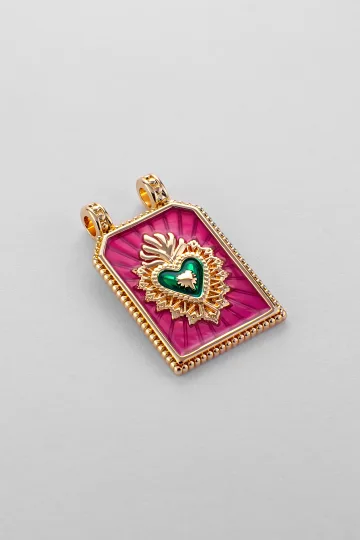
The Sacred Heart: Openness to the Call
The Sacred Heart in the Catholic tradition is the heart of Christ, open, surrounded by a crown of thorns and crowned with fire or a cross. A symbol of love through suffering, of openness through vulnerability.
In the context of Judgement the Sacred Heart is the readiness to answer the call despite its being painful. An open heart means not defencelessness but the courage to be present with what is. This is exactly what the figures on the card do: they rise with open hands, vulnerable, without armour.
A Sacred Heart pendant is worn as a symbol of love that has passed through a trial. Full breakdown: The Sacred Heart: the Meaning of the Jewellery.
The Cross: The Sign of Gabriel's Flag
The flag hanging from Gabriel's trumpet is the cross of Saint George on a white background. The cross in jewellery carries several meanings at once: sacrifice and resurrection, ending and new beginning, the visible point where the vertical (the spiritual) meets the horizontal (the earthly).
In the context of Judgement the cross is especially precise: it is the sign that through the end comes the beginning, through loss renewal. Not a mourning symbol, but a symbol of passage. Detailed breakdown: A Cross on a Necklace: Meaning and Symbolism.
The Butterfly: Metamorphosis
The butterfly is one of the most precise symbols of metamorphosis in nature. The caterpillar literally dissolves inside the cocoon: its tissues break down and reassemble in a different form. This is not a metaphor. It is what happens physically. The butterfly is not an improved caterpillar, it is a creature created anew.
In Greek the word "psyche" means both butterfly and soul. Judgement proposes exactly this kind of transformation: not gradual improvement, but a rebuilding from within. A person who answers the call of Judgement does not become "better", they become different. The symbolism of the butterfly in detail: The Butterfly in Jewellery: the Meaning of the Symbol of Transformation.
The Ouroboros: A Cycle, Not an End
The ouroboros, the serpent biting its own tail, is a symbol of the endless cycle of death and rebirth. In alchemy it stood for the stage of nigredo, decomposition, after which follow albedo (purification) and rubedo (reunion). The beginning of the cycle contains its end, and the other way around.
Judgement stands at the end of the Major Arcana, the penultimate position. After the World a new cycle begins with the Fool. The ouroboros describes this structure precisely: the finale always contains a new beginning within it. The meaning of the symbol: The Ouroboros: the Serpent Biting Its Tail.
The Ankh: The Key of Life
The Egyptian ankh, a cross with a loop at the top, is literally called the "key of life". It was an attribute of the gods who grant life: Isis, Osiris, Ra. To hold the ankh meant to hold in your hand the very possibility of living.
In the context of Judgement the ankh is what you receive when you finally answer the call: life in a fuller sense, existence with an understanding of what for, rather than a mechanical movement through the days without a goal. Full breakdown: The Ankh: the Egyptian Cross of Life.
Who Jewellery With the Symbolism of Judgement Suits
Jewellery with the symbols of Arcana XX carries a concrete charge of meaning. It works as a visible reminder of a specific life experience or aspiration.
A person after therapy. A course of psychotherapy often ends with exactly such an experience: something rethought, something forgiven, what was previously a blind spot now visible. A piece with the symbolism of Judgement (phoenix, ankh, cross) can become a point that fixes this transition. Not an amulet, but a memorial marker.
A person after long silence. Someone who for years did not say something important, about themselves, their wishes, their pain, and finally decided to. A first conversation with a parent after a long coldness. A confession of feelings that had been put off. A letter that lay for a long time in drafts.
A person forgiving themselves for the old. A mistake they have thought about for years. A decision that gave no peace. A moment of cowardice they cannot forgive themselves for. Judgement says: you were a different person then. It is time to allow yourself to be different now.
A person standing before a change of vocation. Leaving a corporation for their own business. Moving from management to teaching. The decision to begin what they long considered impossible for themselves. Judgement as jewellery is not a recipe and not an amulet, but a question you keep around your neck: I hear the call. I answer.
Someone who has completed a recovery. After illness, after treatment for an addiction, after a long convalescence. A piece with a symbol of rebirth (phoenix, butterfly, ankh) for a person who has literally risen.
Send a friend a discount code, they save on their first order.
A Gift With the Symbolism of Judgement: Occasions
Entering a profession. When a person finishes their training and enters a profession as a full participant. Not a general graduation, but a specific professional transition: a doctor's first independent project, a teacher's first time in front of a class after their placement, a lawyer's first client.
The end of a recovery. After serious treatment or a long convalescence. A piece with a symbol of rebirth as recognition of the road travelled. This is a delicate but precise gift.
The anniversary of an important rebirth. The anniversary of leaving a toxic relationship. A year of sobriety. A year after a catastrophe survived. Judgement is the card not of an event but of a turning point. Marking its anniversary is fitting.
Reconciliation after a long coldness. A piece given together with a conversation that finally took place. A phoenix or an ankh as a symbol that this can be turned around.
Styling: How to Wear Jewellery With the Symbolism of Judgement
Close to the heart. Pendants with the symbolism of Judgement are traditionally worn on a long chain, about 55 to 70 cm, so that the piece sits in the area of the heart or lower. This is not a decorative position. It is a symbolic choice: the call of Judgement is heard from within, and a piece with its symbolism is fittingly kept close to the source. A phoenix on a long chain moves as you walk and seems to breathe, and that is right for a symbol of rebirth.
Pairing with the Star. The Star (Arcana XVII) and Judgement form a strong combination of meaning: hope and the answer to the call. If you wear several pieces together, the Star on the short chain, Judgement on the long. Or a bracelet with the Star and a pendant with a phoenix. A silver star and a pendant with a cross is a classic combination that reads at once as traditional and rich in meaning.
Metal. For the symbolism of rebirth and transformation, 925 silver is natural, especially with a dark patina that brings out the detail. An oxidised phoenix looks like a bird that has come out of fire: dark at the base, light at the wingtips. This in itself tells a story. 14K gold suits a more ceremonial reading, when the piece marks a specific event: the end of a recovery, the anniversary of an important decision. Rose gold softens the image, if a less severe version is needed.
One accent. Judgement is not an easy card. A piece with the symbolism of awakening and transformation is better worn as the single accent in a look, not in a layered ensemble. One strong thing speaks more precisely than five. The exception: if the whole ensemble is built around one theme, for example a paired "journey" look with a phoenix, an ouroboros and an ankh on different lengths, then the layering works as a narrative.
Everyday and ceremonial. A small phoenix or butterfly on a fine chain suits every day. A large, detailed phoenix with worked feathers or a Sacred Heart for special moments. One piece can work in both contexts depending on size and execution.
Combinations of Judgement With Other Cards in Life: Three Pairs
Death + Judgement (XIII + XX): "an ending and an awareness". If something in your life has ended (a relationship, a job, a stage) and you stand before the question "what next", this is the time for Judgement. Death closed the chapter. Judgement asks: what did you understand? This is not about grieving what is gone, it is about the readiness to take with you what is worth taking and to leave what stayed in the past. Jewellery: an ouroboros (the closed cycle) plus a phoenix (a new beginning from the ash).
The Star + Judgement (XVII + XX): "hope and action". The Star restores the faith that everything will be all right. Judgement reminds you: all right does not arrive on its own. You have to answer the call. The Star gives strength, Judgement points the direction. Without the Star, Judgement frightens. Without Judgement, the Star stays a dream. Jewellery: the Star on a short cord, a phoenix or an ankh on a long chain.
Judgement + The World (XX + XXI): "the last step". Judgement is the penultimate card. The World is the finale. Between them stands the decision. If you already hear the call but put off the answer, the World reminds you: the cycle will close only after the answer. Without an answer to Judgement the cycle does not close, and the Fool starts again with the same unresolved theme. Jewellery: a cross (passage) and an ankh (life on the other side).
How to read these combinations in life, not in a spread. Tarot cards are psychological mirrors, and divination is only one way to use them. If you recognise your current situation in the combination "Death + Judgement", it is not because "it came out that way". It is because the archetypes are real, and your life situation falls into one of the patterns they describe. Jewellery with the symbols of these cards is a way to wear that recognition with you.
Frequently Asked Questions
Is Judgement a frightening card?
No. It can frighten, because it proposes changing something. But the fear here is not in the card, it is in the reader. Arcana XX describes awakening and a call. This requires courage, but not fear. The difference: fear paralyses, a call demands an answer. The card condemns no one and punishes no one. It asks: do you hear? Are you ready to answer?
Is it about death?
No. The card shows figures who rise, not die. Death in Tarot is Arcana XIII, and it is about something else: transformation through loss. Judgement is about transformation through awareness. Death closes. Judgement opens. If they appear next to each other in a spread, it is a full cycle: Death closed what was, Judgement raises what will be.
How do you tell a vocation from an illusion?
A good question, and the answer is not simple. Several signs: a vocation returns, an illusion disappears at the first real contact with it. A vocation requires effort and promises no ease, an illusion always looks attractive and free of difficulty. A vocation is tied to something concrete that you can do or can learn. An illusion is usually about who you want to "be", not what to do. And one more sign: a real vocation frightens a little precisely because it is real. An illusion does not frighten, it beckons.
Judgement in a love reading: what does it mean?
In the context of relationships Judgement often means an important conversation that has been put off. A confession of feelings. A talk about what matters but is frightening to name aloud. Or a rethinking of past relationships, not in order to return, but in order to understand and draw a line. Reversed in the context of love is a refusal to talk about what should long have been said, or being stuck in past relationships without movement.
Judgement in the "advice" position: what to do?
The card in the advice position speaks plainly: answer the call. Stop putting it off. Do what you have long been putting off under various pretexts. If the advice frightens you, that does not mean it is wrong. The Judgement card never advises the easy. But it also does not advise the rash: first an honest look, then action.
Is the reversed Judgement always bad?
No. The reversed Judgement speaks of resistance to the call, of the inner critic, of the fear of change. This is not a catastrophe but a diagnosis: something is stopping you from answering. Understanding exactly what is stopping you is already half the way. Sometimes the reversed Judgement simply says: now is not the time. That too is a possible answer, if it is honest and not cowardly.
Why are there three figures on the card?
The traditional interpretation: a man, a woman and a child, three stages of life or three principles in a person. A more psychological reading: action, feeling and potential. All three rise at once: the call of Judgement reaches every level of the personality, the conscious mind, the feelings and the untouched potential. Some interpreters see in them three generations of a family: past, present and future, all joined by one call.
How often does Judgement appear in spreads?
Judgement is not one of those cards that appears every time. It appears at moments when something fundamental stands at the threshold of a decision. If it appears often within a short period, it is a signal that life is insistently calling towards a specific theme: forgiveness, vocation or transition.
Can you wear jewellery with the symbolism of Judgement without a connection to Tarot?
Of course. The phoenix, the cross, the ankh, the butterfly, all these symbols have existed for thousands of years independently of Tarot. Knowing their link to Arcana XX adds depth, but the jewellery works without it too. Symbols act through what you put into them. A person who wears a phoenix as a memory of their recovery after illness wears the same essence as a person familiar with the iconography of the card.
Buying it as a gift? Each one arrives ready to give.
 A branded Zevira box and a little card come with every order.













Conclusion
Judgement is a card that does not ask whether you are ready. The trumpet is already sounding. The only question is whether you will pretend not to hear, or whether you will rise.
Over eight centuries of its existence in different forms this card has accumulated layers of meaning that cannot be confused with any other. The Visconti-Sforza with its Triumph of Fame. The Marseille Le Jugement with its harsh sky. The Waite-Smith with Gabriel, the flag and the three risen figures. Crowley with his "Aeon" and the change of world epochs.
All the versions say one thing: something has ended, something is beginning, and between them stands a moment that demands a decision. The past can be re-evaluated. A vocation can be heard. Forgiveness is possible. Rebirth is real.
The symbols of this card, the phoenix, the cross, the Sacred Heart, the ankh, the ouroboros, the butterfly, all describe one and the same archetypal experience, the exit from a frozen state into movement. Each carries its own long history, and together they form a language in which one can speak of this experience without resorting to words.
The trumpet of Judgement does not sound often. But when it does, it is heard clearly. Not because it is loud. Because it is yours.
Jewellery with the symbolism of Judgement (phoenix, cross, ankh, butterfly, Sacred Heart) is not a talisman and not an amulet in the magical sense. It is a visible sign that you hear and are ready to answer. A sign you keep with you as a reminder: the call came. You rose.
Silver, gold, wedding rings, symbolism, paired sets.
About Zevira
Zevira makes jewellery in the artisan tradition of Albacete, Spain. Judgement is one of the deepest cards of the Major Arcana, about awakening and forgiveness. Its symbolism (phoenix, cross, Sacred Heart) often becomes jewellery for those who have walked a long road and heard the call from within.
What you can find with us for the symbolism of Judgement:
- Phoenix pendants as a symbol of rebirth from the ashes
- Sacred Heart pendants for those who have opened to a vocation
- Cross pendants in various styles
- Butterfly pendants as metamorphosis
- The ouroboros as a cycle and a return
- The ankh as the key to a new stage
- Paired "Star and Judgement" pendants for a couple who have come through a crisis together
Each piece is made by hand by a craftsman, with the option of personal engraving. We work with 925 silver and 14 to 18K gold.