Justice in Tarot: Meaning of Arcanum 11, the Symbolism of Scales and Sword
A litigator named Daniel sits in a meeting room at half past eleven at night. In front of him: two folders of documents, a cup of cold coffee, and a question with no right answer. His client is technically correct under the law. But here the law does not line up with what Daniel privately calls "the decent thing." He can win the case and feel he has lost something else. Or he can drop the tactic that guarantees victory and rely on something far less reliable.
That night Daniel is not thinking about Tarot. But the card that describes his state most precisely is called Justice.
Arcanum 11 is not a card about good triumphing over evil. It is a card about the fact that every choice has consequences, and those consequences will arrive. It is about weighing, not about winning. About responsibility, not reward. The sword in the right hand does not promise that everything will turn out fine. It promises that what is false will be cut away.
What follows is Justice from every angle: the card's history from the Italian courts of the fifteenth century to the Waite system, the iconography and every symbol, the archetype of cause and effect, the mythology from Maat to Themis to Kali, the philosophy from Kant to Marcus Aurelius, the parallels in literature and film. And, crucially, which pieces of jewellery resonate with this theme, and why the sword, the scales, and the feather work as symbols of Justice just as well as the card on the table.
Where Arcanum 11 sits in the Tarot: the numbering confusion
The first thing that throws most readers is the card's number. In different systems Justice occupies different positions, and the difference is purely a matter of bookkeeping.
In the 1909 system of Arthur Edward Waite and Pamela Colman Smith (the very deck that became the standard for most of the twentieth and twenty-first centuries) Justice holds position eleven. The Wheel of Fortune (X) stands before it, the Hanged Man (XII) after. This means Waite placed Justice later than Strength.
In older decks, in the Marseille tradition of the seventeenth and eighteenth centuries, the order was reversed: Justice stood at position eight, Strength at eleven. This is the order Aleister Crowley inherited in his Thoth deck, where the card received a new name: Adjustment.
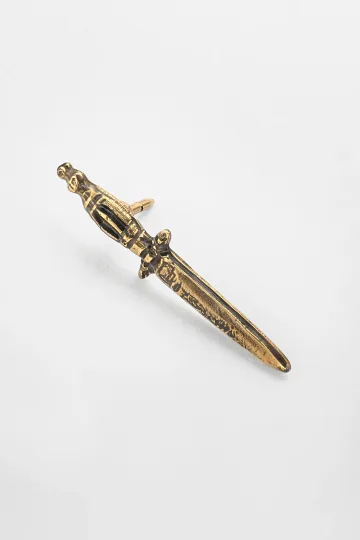
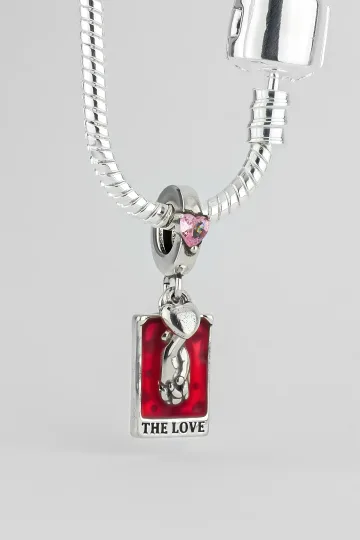
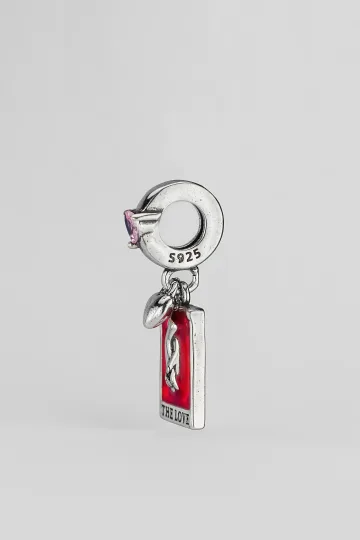
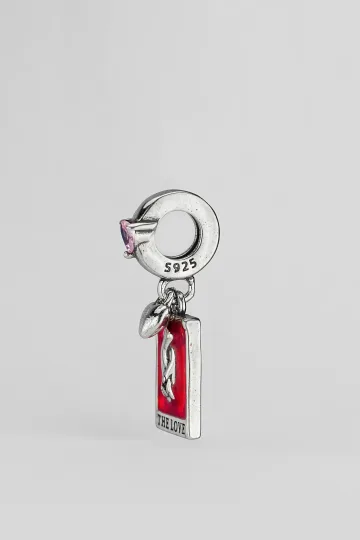
Wear the symbol, don't just read about it. These are in stock:






Why did Waite swap them? It comes down to astrology. The Order of the Golden Dawn, to which Waite belonged, built correspondences between the arcana and the zodiac signs. Leo, in a particular counting system, governs the eighth position, and Leo appears precisely on the Strength card (strength taming the lion). Libra, the zodiac sign of Justice, comes eleventh, after Leo. For Waite this mattered more than preserving the old order.
Crowley disagreed. He returned Justice to the eighth position and renamed it Adjustment, stressing not a static equilibrium but a dynamic process of balancing. For Crowley, justice was not a judge on a throne but a constant mechanism of cosmic levelling.
A practical rule: if Justice sits at XI in your deck, you are holding the Waite tradition. If at VIII, the Marseille or Thoth line. The meaning of the card does not change. What changes is its place in the Fool's journey through all the arcana.
The history of Justice: from Visconti to Waite-Smith
The Justice card appeared alongside the first tarot decks in the Italian courts of the fifteenth century. In the Visconti-Sforza deck (around 1450, one of the oldest to survive) Justice, Iustitia, is shown as a female figure with a sword and scales. This is the classic iconographic type, descended from the ancient personifications of the virtues.
Medieval theology singled out four cardinal virtues: Prudence, Justice, Fortitude, and Temperance. All four appeared in the early Italian tarot as allegorical figures. Among them Justice held a special status: it is the only virtue that by definition involves other people. The other three can be practised in solitude. Justice without another person is impossible.
The Marseille tradition of the seventeenth and eighteenth centuries standardised the image: La Justice sits on a throne between two columns, a sword in the right hand, scales in the left, a crown on her head. This iconography held steady across three centuries.
In 1909 Pamela Colman Smith, working under Arthur Edward Waite, created the image of Justice that most people see today. Smith added concreteness and symbolic depth. The red robe, the purple curtain between the columns, the square stone in the crown, the slender gold crown, the white shoe barely visible beneath the hem. Every detail carries meaning.
Aleister Crowley, in his Thoth deck (illustrations by Frieda Harris, 1940s), reworked the image radically. His Adjustment is not a woman on a throne but a woman as a pair of scales. A literal embodiment of balance: the figure stands on the point of a blade, her head crowned with a double pyramid, her body itself a weighing mechanism. For Crowley this expressed the idea that justice is not an external judge but a structural principle of the universe.
Once you understand which tradition a card comes from, its symbols read more precisely. Waite stresses human justice: choice, responsibility, law. Crowley stresses the cosmic: automatic levelling, karma as a mechanism rather than a punishment.
Wear the sword point up, never hilt up. A blade that hangs like an apology has already lost the case.
What to wear the symbols of Justice with
The sword, the scales, and the feather I style differently: each has its own length, its own metal, its own occasion. Here is what I recommend to clients choosing a symbol of Justice for themselves or as a gift.
How do you wear a sword pendant every day? I recommend a slender vertical sword in silver on a mid-chest chain, over a plain roll-neck or a shirt. The stricter the neckline, the sharper the blade reads: against a high collar it becomes a short, clear line, and no better backdrop exists for it. Point up, always.
Where do the scales sit best? I suggest the scales to anyone who loves a soft symmetry. Miniature scales on a mid-length chain fall well under an open round neckline where the collarbones show. Silver holds a businesslike look; I bring in gold when the clothing runs warm: sand, wine, olive.
Feather in silver or in gold? For everyday wear I choose silver: the feather lifts an outfit where a suit can feel heavy. A gold feather I save for the evening and a warm palette, where on bare skin it reads as a noticeable but never loud accent.
How do you build an evening look? For an evening out I recommend a deep V-neck and a pendant on a long chain that drops below the collarbones. Gold works here, on a black or wine-coloured dress. If you want two chains, let one carry the symbol and the other stay plain.
And wearing the sword and scales together? You can, but carefully. I suggest one lead pendant, with the second symbol smaller and on a different length so the lines do not argue. One strong sign almost always beats a scatter of small ones: pick the lead and give it its own length.

Turn on your camera, pick earrings, a pendant or a ring, and see the piece on yourself in real time.
Switch items in one tap.
Everything runs in your browser: no photo or video is ever uploaded.
The iconography of the Waite card: symbol by symbol
The Waite-Smith image of Justice is one of the most iconographically dense in the deck. Every element carries its own layer of meaning.
The red robe and its folds
Red on the Waite cards generally signals action, will, vital force. On the Justice card it is neither blood nor aggression. It is the red of administrative authority: the colour of cardinals, of judicial robes, of state ceremony. The figure is empowered to act. This is not a counsellor or a witness. This is the one who delivers the verdict.
The folds of the red robe matter especially as a symbolic layer: passion here is not destroyed but ordered. The robe does not hide the body, it clothes it. Reason governs impulse, but the impulse has not gone anywhere. Interestingly, the same red robe appears on the Emperor (IV), the symbol of established law and worldly power. Justice inherits that tradition but adds a dimension of impartiality the Emperor lacks.
The sword in the right hand
The sword is vertical, its point raised upward. This is fundamental. A sword held straight up means: the decision is made, the verdict is delivered, there is no more doubt. This is not a sword raised to strike, it is a sword after the decision, a sword of readiness.
The right hand is the active side. In Western symbolism the right hand is the side of action, of logic, of reason. A sword in the right hand means: the decision was reached by reason, not by feeling. This is clarity, not cruelty.
The sword is double-edged. This is an important detail often overlooked. A double-edged sword cuts both ways. The truth it embodies applies to everyone, both to the one who judges and to the one being judged. Justice makes no exceptions for its own.
What the sword means as a standalone symbol, how it works in jewellery, and the story it carries can be read in the full guide to the sword in jewellery.
The scales in the left hand
The left hand is the receiving side. In the Waite tradition it is the side of intuition, of perception, of what is received rather than given. The scales in the left hand say: the process of weighing happens through logic. Something is taking into account what cannot be measured.
The scales are held in mid-air, that is, not yet settled. This is not a finished decision. It is a process. The figure is still weighing, still listening. Only afterwards does the sword come down.
The crown with the square stone
A crown of yellow metal with a small square stone at its centre. The square in Tarot symbolism is stability, earthly reality, the four directions, the four elements. The square stone means the justice of this figure is rooted in reality, not in ideals. It is not heavenly justice but earthly, practical, applicable. Stability as the foundation of judgement: before the sword is raised, a firm point of support is needed.
The purple curtain and the columns Jachin and Boaz
Behind the figure hangs a purple curtain between two grey columns. Purple has traditionally symbolised nobility and high spiritual standing: it was worn by emperors and cardinals. Justice acts from an elevated position, not out of self-interest.
The same iconography appears on the High Priestess (II). There the curtain conceals mystery and the unconscious. Here it signals that justice operates within an established space, beyond which lies something inaccessible to us.
The two columns are a recurring Masonic symbol that Waite uses on several cards. They are Jachin and Boaz, the two bronze pillars at the entrance to Solomon's Temple, described in the First Book of Kings. Jachin means "he will establish," Boaz "in him is strength." They embody duality: law and mercy, rigidity and flexibility, past and future. Justice sits between them, holding both sides at once. The same pair appears on the High Priestess, an archetypal reminder that wisdom works in the space between poles.
The white shoe
Beneath the red robe a white shoe is barely visible. White in the Waite system is purity of intention. It is a small detail that says: whatever this figure's decisions, her intent is clean. Behind these scales and this sword there is no personal malice.
The archetype: cause and effect, choice and its price
Justice is one of the few arcana that promises no happiness, warns of no danger, and reveals no secret. It simply describes a mechanism. You chose. From that choice a consequence will grow. The consequence will arrive.
This is neither a threat nor a promise. It is a law, as neutral as the law of gravity.
In psychological terms the Justice archetype is close to the Super-Ego of the Freudian scheme: an authority that remembers everything you have done and keeps the count. But unlike the Freudian Super-Ego, which is often cruel and irrational, the Justice of Tarot is impartial. It does not punish out of sadism. It restores equilibrium.
It is also the archetype of mature responsibility. Not the kind that says "I am guilty, punish me," but the kind that says "I see what happened, I understand my part in it, and I accept the consequences without excuses." These are fundamentally different stances. The first comes from weakness, the second from strength.
Justice appears in a reading when a person stands before a choice with a moral dimension. Or when the consequences of past choices have already begun to arrive. The card does not say that bad consequences are coming. It says that honest ones are.
One of the strongest interpretations of the card: the person is themselves the subject of justice, their own judge. Justice is not something done to you. It is what you do to yourself every time you look honestly at your actions and their price.
Upright and reversed
Upright Justice
Upright, the card says: the system works. Not perfectly, not like a fairy tale, but the chain of cause and effect exists and functions. If you acted honestly, it will be taken into account. If someone acted dishonestly towards you, that too will not vanish.
Key themes: responsibility for your actions, an objective view of the situation, legal matters moving towards resolution, moral clarity, a weighed decision made after reflection.
An important nuance: upright Justice does not necessarily mean you will win. It means the assessment will be honest. Sometimes an honest assessment is not in our favour. The card calls on you to accept that rather than resist it.
Reversed Justice
The reversed position opens several lines of meaning, and they do not contradict one another.
First: avoiding responsibility. A person sees the consequences of their actions but refuses to accept them. They shift the blame, find excuses, pretend nothing happened. Reversed Justice signals: this does not work. The scales keep weighing even when you have turned away.
Second: injustice from outside. The system is not working honestly. Bias, corruption, circumstances that make an honest outcome impossible. In this reading the card does not accuse, it describes reality: sometimes justice does not come, and you have to acknowledge that in order to move on.
Third: judging yourself too harshly. A person condemns themselves more severely than they deserve. They apply standards to themselves that they apply to no one else. This too is an imbalance. The scales must be levelled in both directions.
Customer reviews
Zevira is a real jewellery shop. Genuine payments, deliveries and customer thank-yous.
🥰🥰🥰 gracias
Ok, ¡gracias! 🙂
The Scales of the Zodiac: Justice as the card of Libra and Venus
In the esoteric tradition of Tarot (above all in the Golden Dawn system and the Waite deck) Justice corresponds to the zodiac sign Libra and the planet Venus.
Libra is the only zodiac sign that represents an inanimate object. All the others are living beings (Aries, Taurus, Gemini) or mythological figures. Libra is an instrument of measurement. There is a philosophy in this: justice is not a personality, not a will, not a character. It is a mechanism.
The link with Venus seems unlikely at first glance. Venus is the planet of beauty, love, harmony. What is it doing beside a sword and scales? The answer is that Venus governs both romance and the aesthetic sense of balance. Beauty as a balance of proportions, love as harmony between people. Justice is also harmony, only on the ethical plane. When everything is weighed, when each has received their due, a particular beauty of orderliness emerges.
In astrology Libra is the sign that wants everyone to be well. It weighs, considers, postpones the decision because it sees both sides. This is its strength and its weakness. Justice in Tarot inherits this quality: it does not hurry. It weighs. Only when the weighing is complete does the sword rise.
By element, Libra is Air. Air is linked to reason, communication, concepts. The decisions Justice makes are decisions of reason, not instinct. This is an important distinction from other cards tied to fire or earth: here a cool head and a clear thought are at work, not an impulse.
Maat in Ancient Egypt: the path to the judgement of the dead
Before the Greeks invented Themis and the Romans Justitia, the Egyptians had already practised their own understanding of justice for three thousand years, embodied in the goddess Maat.
Maat is one of the oldest and most philosophically rich figures of Egyptian mythology. She personified not even justice so much as something broader: Ma'at in ancient Egyptian meant order, truth, balance, the harmony of the universe. It was a cosmic principle that held the world in being. Without Maat came chaos, Isfet. Her attribute is an ostrich feather.
Psychostasia: the weighing of the heart against Maat's feather
The most important thing linking Maat to the Justice card of Tarot is the ritual of psychostasia. The Book of the Dead describes a judgement of the dead taking place in the Hall of Two Truths. Before Osiris, on enormous scales, the heart of the deceased was weighed against the feather of Maat. The heart is a metaphor for conscience, for the entire sum of thoughts and deeds lived across a lifetime. The feather is the absolute and unchanging standard of truth.
If the heart was lighter than the feather, or equal to it, the soul passed into eternal life and bliss. If heavier, it was devoured at once by a creature named Ammit: the body of a lion, the head of a crocodile, the hind legs of a hippopotamus. The person vanished completely, with no right to the afterlife.
This image resonates directly with the Justice card: scales, weighing, an absolute standard. There is a striking inversion here: in the Egyptian version justice works through the most immaterial object, a feather. Not gold, not force, not lineage. And it is precisely this feather that can outweigh a human heart.
Thoth as scribe, the 42 judges, and the negative confession
The procedure of the judgement of the dead was meticulously arranged. Beside the scales stood Anubis with his jackal's head; he operated the scales directly. Thoth, the god of wisdom and writing with the head of an ibis, recorded the result. He set down every word of the confession spoken, and he registered the outcome of the weighing. Thoth is the first court clerk in human history.
Before the weighing, the deceased recited the "negative confession," a list of forty-two statements about what the person had not done in life. "I have not killed. I have not lied. I have not stolen. I have not cheated the scales. I have not taken what belonged to another. I have not spoken blasphemy." Each of the 42 statements was addressed to one of 42 special judges, assessor gods who stood in a semicircle in the Hall of Two Truths. Each was responsible for a particular type of offence from his nome, his region of Egypt.
This structure, a panel of 42 specialised judges, each assessing his own aspect of life, strikingly resembles a modern jury with a division of expertise. The philosophical difference between Maat and the later goddesses of justice matters: Maat is not a separate judge. She is the principle itself, working automatically. The heart either matches the feather or it does not. No one decides arbitrarily. It is pure structure without personal whim.
Maat was depicted as a seated or standing woman with a feather on her head, sometimes with wings stretched to the sides; those wings protected and sheltered. Her name appears in the names of pharaohs: "Maat-ka-Ra" ("Justice, the soul of Ra") was the coronation name of Queen Hatshepsut. Egyptian trials took place under her symbolic patronage, and the courtroom was called the "Hall of Maat." The appeal to her was not rhetorical: an Egyptian judge literally took on the function of Maat as he entered the hall.
The symbolism of Maat's feather and its meaning in jewellery is a large topic of its own. More in the guide to the meaning of the feather in jewellery.
Upload a photo of your pet, someone you love, or an object. We'll build a 3D model and hand-cast it in pewter.



Themis and Greek justice
The Greek Themis (Θέμις) is a goddess of the second generation, a Titaness. Daughter of Uranus and Gaia, which makes her older than the Olympians. Her name translates as "law," "that which is established," "what is laid down by nature." This is not justice as a subjective assessment but the structural order of the cosmos itself.
Before his marriage to Hera, Zeus was married to Themis. This speaks to her place in Greek theogony: she stands before the Olympian era, she embodies the prior, natural law out of which alone a civilised law can grow. Her daughters are the Horae (the Seasons) and the three Moirai: Clotho, who spins the thread of life, Lachesis, who measures it out, and Atropos, who cuts it. These are the same scales in another metaphor: each thread its own length, and it cannot be changed.
Themis had a sanctuary at Delphi, one of the most sacred places of the Greek world, even before Apollo settled there. By some versions of the myth, it was she who first founded the oracle at Delphi and only later handed it to Apollo. This matters: Themis stands at the origin of Pythian prophecy, at the origin of knowledge of the future. Justice and foresight are linked: to see clearly is to judge accurately.
Notably, in the Greek tradition Themis is not blind. She sees and judges from knowledge. Her daughter Dike embodied justice in a more personal, human sense, the immediate fairness of earthly affairs. It is the later, Roman tradition that makes the goddess of justice blind. And this is a fundamental difference in philosophy: the Greek goddess knows the truth and judges from knowledge, the Roman one does not look so as not to be biased.
The Justice card in most decks is also not blind. The Waite figure looks straight at us. This is a choice, not an oversight: the Justice of Tarot sees. It is impartial not through ignorance but through the choice not to let personal interest sway the decision.
It is worth pointing out that Themis's daughter Dike carried a different emphasis: she was the goddess of specifically human justice in concrete cases, not of cosmic law. In the mother-daughter pair you can see the same duality as on the card: the principle (Themis, sword, right hand) and the practice (Dike, scales, left hand). One sets the standard, the other applies it to living situations.
Roman Justitia: a goddess at the emperor's side
Roman Justitia can be called a political project. Her cult took shape under the emperor Augustus, as part of a large-scale effort to build a new state religion that would sanctify the power of the principate. Augustus shaped Rome as the embodiment of order, law, and virtue, and Justitia became one of the key symbols of that programme.
On coins of the early empire Justitia was shown as a standing woman with scales in one hand and a cornucopia or sceptre in the other. The sword appeared later, as imperial traditions hardened. The inscription IVSTITIA on the coins was a literal political statement: the emperor's power guarantees justice.
The blindfold, considered obligatory for the image today, was not part of Roman Justitia. It is a later medieval addition that gained popularity in the Renaissance through engravings and became standard in the sixteenth and seventeenth centuries. Some authors read the blindfold as a symbol of impartiality, others, ironically, as a symbol of the system's own blindness. The image was read two ways from the moment it appeared.
The classic silhouette of Justitia, familiar to us from courthouse façades the world over (scales, sword, blindfold), took shape precisely then, in the sixteenth and seventeenth centuries, as a synthesis of the Greek Themis, the Roman Justitia, and the medieval allegorical tradition.
In jewellery the image of Themis and Justitia is represented chiefly through their attributes: scales, sword, crown. Each of these objects carries its own symbolism. On the symbolism of the shield and protective images, more in the guide to the meaning of the shield in jewellery.




Kali as the dark side of justice
If Maat and Themis represent ordered, procedural justice, the Indian tradition holds an image that embodies its dark and necessary side. Kali, goddess of time, destruction, and transformation, carries her own connection to the Justice archetype, however unobvious.
In iconography Kali stands on the prostrate body of Shiva or dances upon it. This image is often understood as the triumph of chaos over order, but the traditional interpretation is otherwise: Shiva here is the motionless, absolute consciousness, and Kali is his active, transforming power. Without Shiva, Kali lacks a foundation; without Kali, Shiva cannot act. This is not domination but the interdependence of two aspects of reality.
Kali's necklace of skulls is one of her most recognisable and terrifying attributes. But the skulls in this iconography do not stand for killings: each skull symbolises a destroyed ego, an illusion of selfhood consumed. Kali strips a person of the layers of false identity, with the same mercilessness with which the sword of Justice cuts through falsehood. This is not cruelty but radical liberation.
Kali protects dharma, the universal order, the duty of each being according to its nature. In this she is closer to Maat than she first appears: both embody a principle that works above personal preference. Dharma does not ask whether it is convenient for you to follow your path.
The double-edged sword of Waite's Justice carries the same shade: truth can be uncomfortable. The scales do not ask whether you find the result of the weighing convenient. Justice, like Kali, does what is necessary.
Karma and cause and effect: Hinduism and Buddhism
The concept of karma is one of the easiest to misunderstand. The popular notion reduces it to a system of rewards and punishments: do good and you get good, do bad and you get bad. But this is not karma in its philosophical sense.
The Sanskrit word "karma" means literally "action." Karma is the law that every action produces a consequence, called vipaka. Vipaka translates as "ripening" or "fruit." Not punishment, not reward, but ripening. An apple does not "punish" the blossom that fell in spring. It is simply the result of a process.
In Buddhist philosophy karma does not presuppose an external judge who distributes recompense. There is no heavenly bookkeeping. There is a mechanism: intentional actions create imprints in the stream of consciousness which, under the right conditions, sprout. The key word is intentional. Random actions, or actions without clear intent, are karmically less significant. This is not moralism, it is a description of psychological causality.
The Hindu concept of karma includes three types: sanchita karma (accumulated from past births), prarabdha karma (the portion already "set in motion" in the current life, which will inevitably bear fruit), and kriyamana karma (what is being created now). The concept unfolds across several lifetimes, and this is the fundamental difference from Western Justice, which works within a single biography.
Crowley, in renaming the card Adjustment, caught exactly this: not a moral trial but an automatic balancing. His Adjustment works like a physical law, impersonally, like Buddhist vipaka, like a matrix of causes and effects without a personal judge.
A practical consequence of the Buddhist understanding of karma for working with the Justice card: the mechanism does not look for the guilty and does not hand down sentences. If it seems to you that the card "accuses," that is a reading drawn from a culture of punishment. Buddhist vipaka simply describes: here was a sowing, here will be a harvest. Bitter fruit? You can examine what sowing produced it. Not for self-flagellation but for understanding and changing the next sowing. This is exactly what the scales on the card do: they do not punish, they measure with a precision no external court can give.
Scales and sword in the history of jewellery and symbolism
Scales from Greek weights to a jewellery motif
The balance as an instrument appeared long before the first coins: as early as third-millennium-BC Mesopotamia it was used to weigh grain, metals, and spices. The Greeks developed standardised stone and metal weights that allowed honest trade between different city-states. A dishonest balance in Greek culture was considered a religious violation, not merely a breach of law: behind the scales stood Dike, goddess of justice, daughter of Themis.
In Rome the balance became an official instrument of the state. Roman argentarii, the bankers, weighed coins on special scales with precise weights. Scales and weights as objects were part of legal culture: their images were struck on coins and included in official insignia.
In the alchemical tradition of the Middle Ages and the Renaissance, the scales gained a new layer of meaning. The Great Work, the alchemical operation of transmuting base metals into gold, was described through the image of precise scales: the ingredients had to be weighed perfectly for the reaction to proceed correctly. The alchemical scales became a symbol of precision both chemical and spiritual, a symbol of weighing one's intentions before the great work.
As a jewellery motif, scales appeared in pieces for the legal professions from the Renaissance onward. Gold and silver scale pendants were given to judges and notaries on taking office. A miniature pair of scales as a pendant on a bracelet or chain is the modern embodiment of that tradition.
In the Islamic jewellery tradition scales appear in the context of the Day of Judgement: the Quran describes the weighing of every person's deeds on the mizan, the scales of justice. This is a direct parallel to the Egyptian psychostasia, but without the feather of Maat: good and evil deeds are weighed. Images of the mizan occur in ornamental art and calligraphy, though they are less common in jewellery because of restrictions on figurative imagery.
The sword in the Eastern tradition
Western jewellery symbolism of the sword is well known. But the sword as a symbol of justice and spiritual power has a rich Eastern history.
The Japanese samurai considered the katana an extension of his soul, and this was not a metaphor but a literal conviction set down in the samurai code of Bushido. The katana was forged with prayers and rituals; it could not be handed over carelessly, it was meant to die with its owner or pass to a descendant as a sacred object. The sword was the embodiment of the master's vital force. To use it without dire necessity, for display or threat, was considered a profanation.
In the Vaishnava tradition of Hinduism, Vishnu holds the Sudarshana discus in one of his four hands rather than a sword in the European sense, but in some incarnations he is accompanied by Nandaka, the sacred sword, the embodiment of knowledge that cuts through ignorance. Khadga, the double-edged sword of Bhairava, the fearsome aspect of Shiva, embodies in iconography the cutting of the bonds of karma, the destruction of all that holds a being in the cycle of rebirth.
The double-edged sword of Waite's Justice echoes this Eastern idea: not a sword that defeats an enemy, but a sword that cuts through illusion. It points upward, and that matters: it is not for killing something external, it is for clarifying something internal.
Leave your email, we'll send your discount code. No spam, unsubscribe anytime.
The code arrives by email, valid on your first order.
Jung on the shadow and integration: the path through Justice
Carl Gustav Jung developed the concept of the Shadow, the sum of everything we have repressed from our conscious self-image. It is everything that seems to us unworthy, weak, shameful, or forbidden. The Shadow does not vanish through repression. It accumulates and, at the least convenient moment, manifests in the external world: as irritation at people who do what we forbid ourselves, as the projection of our own fears onto others.
For Jung, Justice is the archetype that meets the Shadow in the process of individuation. The path to the Self, to a whole personality, necessarily includes a moment of recognition: here is the part of me I hid. Here are my real motives, not the ones I declared. Here is the price I did not pay and will have to pay.
This is not self-destruction. Jung specifically noted: integrating the Shadow does not mean permitting yourself everything bad. It means knowing the truth about yourself, not turning away from it. A Shadow that is seen becomes less dangerous. A Shadow that is not seen runs the person from behind their back.
This is precisely why Justice occupies a central place in the Fool's journey: it is the moment when brushing off the account is no longer possible. Not because an external judge has arrived. But because the path to greater depth demands an honest look at what has been done.
In this sense Justice is not a final authority but a tool on the way to wholeness. The encounter with it is painful exactly to the degree of the gap between who a person believes themselves to be and who they actually are.
Jung described the process of individuation as a path passing through several obligatory encounters: with the Persona (the mask we wear), with the Shadow (the repressed), with the Anima or Animus (the inner image of the opposite principle), and finally with the Self. Justice in this scheme is the encounter with the Shadow, obligatory and unavoidable. It cannot be skipped, only postponed. Postponement turns the Shadow into something darker and less manageable.
This is why a person to whom the Justice card keeps coming often feels not a fear of punishment but something deeper: a vague sense of a debt to themselves. Something for which they have not yet taken responsibility. Something they have not looked at honestly. The scales on the card are held in the air: until the weighing is complete, they will not tip to either side. And that suspension is felt physically.
Stoicism and justice: Marcus Aurelius and Seneca
The Stoics developed one of the strictest ethical systems of antiquity. At its base lie the four cardinal virtues we have already met in the history of the Tarot: prudence, justice, fortitude, and temperance. For a Stoic, justice, justitia, was not an external law to be obeyed but an internal principle to be followed.
Marcus Aurelius, Roman emperor and Stoic philosopher, returns to the theme of justice again and again in the Meditations. Justice for him is above all justice towards those around you. Not abstract but concrete: this person before me deserves my honest treatment right now. His famous remark that, on waking in the morning, the first thought should be a readiness to meet difficult people, is not pessimism. It is a call to prepare for justice as a daily practice rather than a festive event.
Seneca, another pillar of the Stoic tradition, wrote of the court of conscience as the strictest and most precise court that exists. In his letters to Lucilius he put it this way: no one is more alone than a person who lives with an unclean conscience. Conscience is a balance that cannot be deceived. It works even when no one is watching.
Epictetus, a Stoic among former slaves (a circumstance eloquent in itself), formulated the division between what is in our power and what is not. In our power: our judgements, aims, desires, and aversions. Outside our power: the body, property, reputation, power over others. The Justice of Tarot works in precisely that first zone, the zone of what truly depends on the person. The card does not promise that an external court will be just. It speaks of an internal account that is kept regardless of any external tribunal.
The Stoics coincide with the Justice card on a fundamental point: justice is not something that comes from outside. It is what a person practises daily through conscious choice. The sword in the figure's hand is a decision reached by reason. The scales are the practice of weighing each choice before acting.
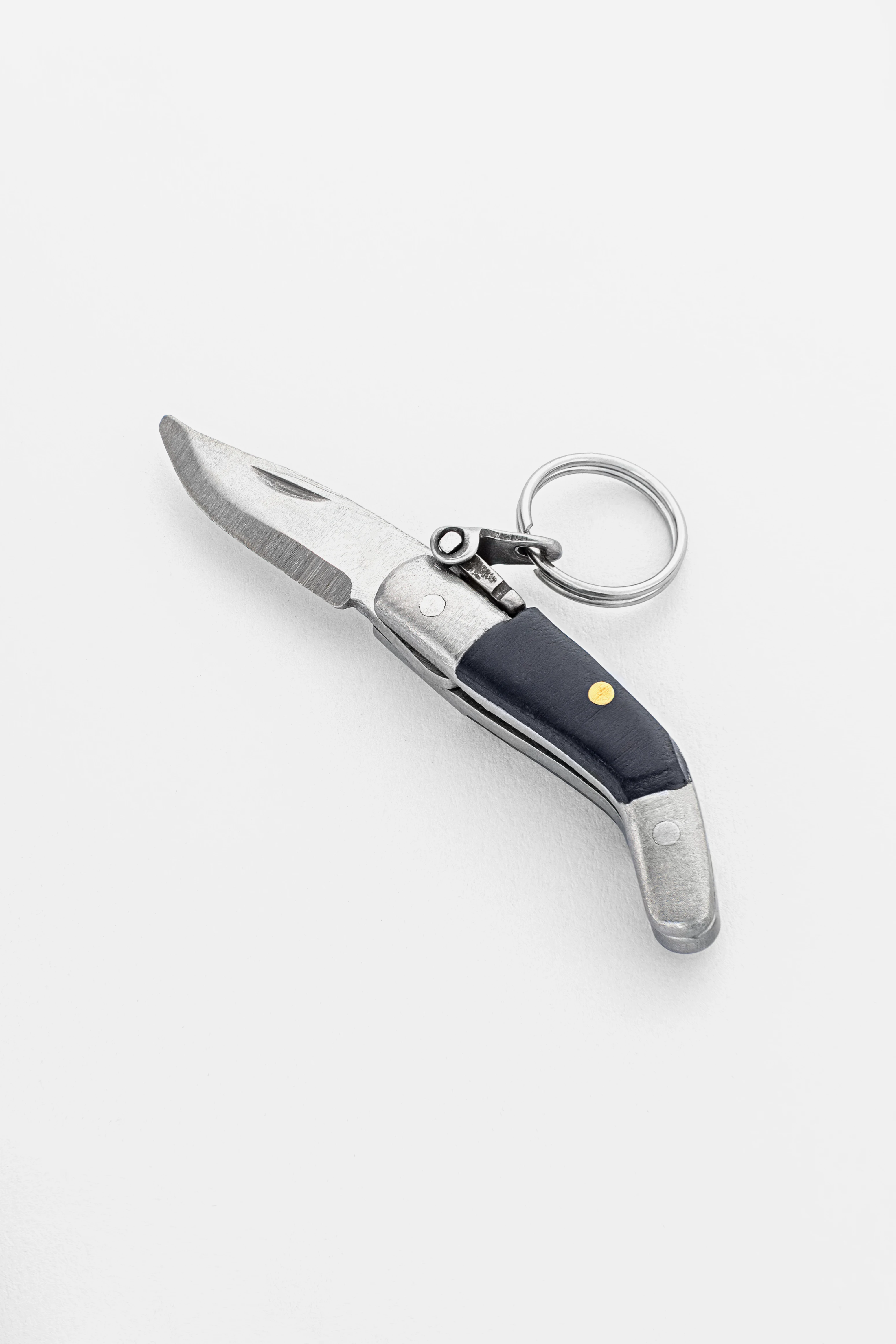
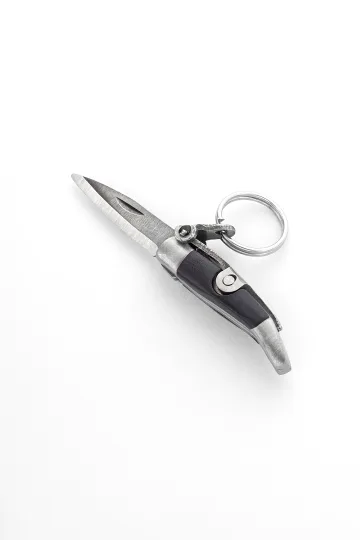
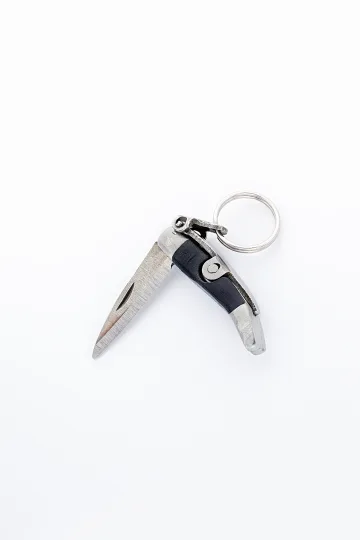
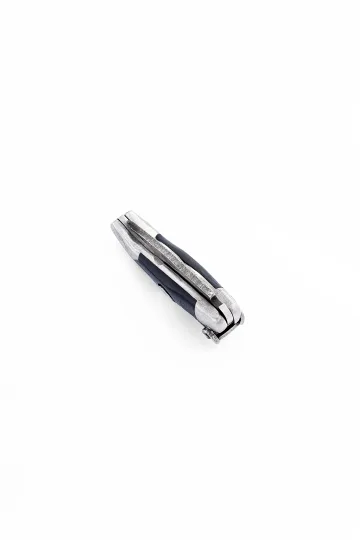
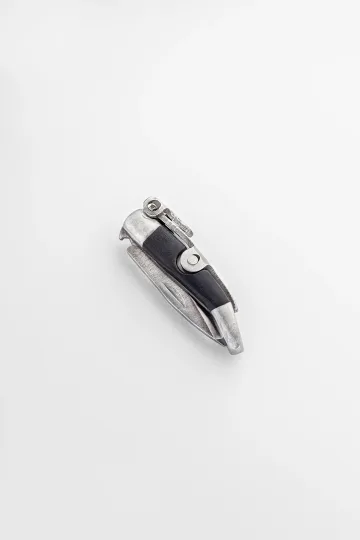
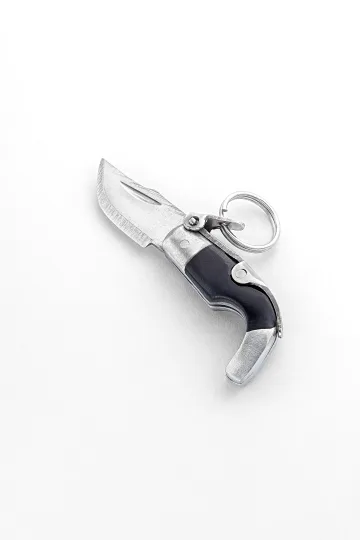
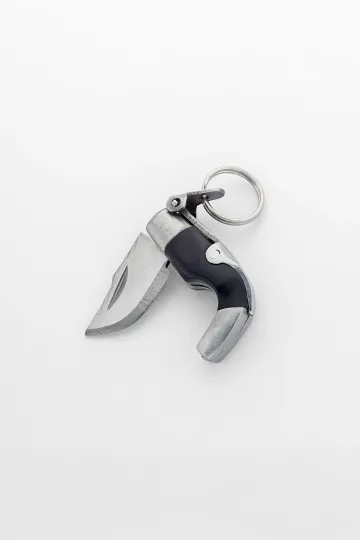
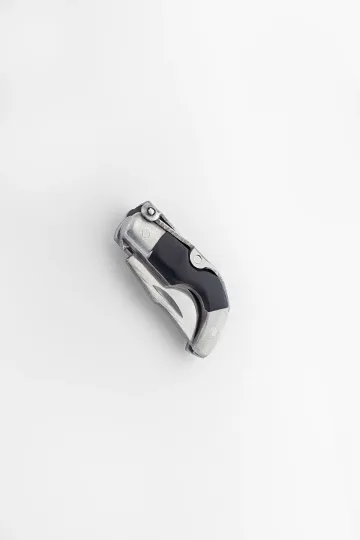
CAPAORA mini knife pendant
The 18th-century Spanish navaja in miniature: 40 mm of stainless steel, a real folding mechanism and a Palanquilla lock that clicks. An affordable gift to remember.
Authentic · Ships from Spain · 14-day returns
Kant on the categorical imperative
Immanuel Kant formulated one of the most famous statements in the history of philosophy: "Two things fill the mind with ever new and increasing admiration and awe, the more often and steadily we reflect upon them: the starry heavens above me and the moral law within me."
The starry sky is the order of nature, which exists independently of the person. The moral law is the order of ethics, which exists within the rational being itself, not because God or the state prescribed it, but because reason itself, by its own nature, demands it.
Kant's categorical imperative is an attempt to formalise this inner law. Its main formulation: "Act only according to that maxim whereby you can at the same time will that it should become a universal law." Put more simply: do only what you would be willing to allow all people to do always.
This is the very structure of Tarot's Justice, expressed in philosophical terms. The scales on the card weigh exactly this: not "is it advantageous to me?" and not "will I be punished?", but "am I prepared for this to be the norm for everyone?". The sword of clarity rises when the answer has been found.
Kant radically separated morality from consequences: a right act is right in itself, regardless of what comes of it. This is not entirely the Tarot's position: the Justice card is very attentive to consequences. But on the point that the moral law works within, not without, Kant and Arcanum XI fully agree.
Kant also distinguished legality from morality. A legal act is one that conforms to the law. A moral act is one performed out of respect for the law, not out of fear of punishment or calculation of gain. Daniel the litigator from the opening of this piece stands at precisely this Kantian fork: his choice is legally possible either way. The question is the inner source from which it is made. The Justice of Tarot, like Kant, asks not "what is advantageous" and not "what is permitted," but "out of what is this done."
The psychology of moral judgement: Kohlberg and Haidt
Psychology took up the question of how people actually make moral decisions in the second half of the twentieth century.
Lawrence Kohlberg, an American psychologist, proposed six stages of moral development, building on the work of Piaget. The first two, the pre-conventional stages, rest on fear of punishment and the pursuit of reward. The next two, the conventional stages, rely on conformity to social norms and laws. The last two, the post-conventional, on universal principles and an inner ethic. Only at the fifth and sixth stages, by Kohlberg's account, does a person act on something close to the principle of Tarot's Justice: an honest assessment regardless of what those around think and how it will turn out for them personally.
Jonathan Haidt, a researcher of moral judgements, proposed a different model. His Moral Foundations Theory identifies six basic intuitions: care and harm, fairness and cheating, loyalty and betrayal, authority and subversion, purity and degradation, liberty and oppression. Haidt found that most moral judgements are made intuitively first and rationalised afterwards.
This matters for understanding the card: the Justice archetype is a call to do the reverse. To raise conscious weighing above intuitive reaction. This is precisely why the scales are in the left (intuitive) hand and the sword in the right (rational): first hear both sides, then deliver the decision. The card offers a methodology that runs against the psychological grain, and that is exactly its strength.
One more important contribution from the psychology of morality: Haidt's research shows that people more readily accept injustice when it comes from a system rather than from a specific person. If an algorithm made an unjust decision, people are less angry than if the same decision were made by a judge. This is called the effect of moral distancing through automation. Applied to the card: the Justice of Tarot does not permit this distancing. It returns personal responsibility to the person, removes the system as a shield. This is exactly what makes the card uncomfortable for those used to hiding behind "the rules" and "circumstances."
Justice in literature and film
The theme of justice, choice, and reckoning is one of the central ones in world literature.
Shakespeare, "The Merchant of Venice"
Shylock demands a pound of flesh by contract, and this is his lawful right. Portia, acting as advocate, finds the answer: you may take the flesh, but you may shed no blood in doing so, because the contract does not provide for it. A technically correct ruling. But it destroys Shylock as completely as it would have destroyed Antonio. The whole of "The Merchant of Venice" is a conversation about how the formally just and the morally just are different things.
Dostoevsky, "Crime and Punishment"
Raskolnikov kills the old pawnbroker, convinced of his own rightness: "I have the right." The whole novel is the process by which an internal justice overtakes him long before any trial. The psychological punishment precedes the legal one and proves more genuine. Dostoevsky poses the question: can a person pass a sentence on themselves more precise than any external system? Reversed Justice in its most expanded form.
Camus, "The Stranger"
Meursault kills a man and behaves at his trial with complete indifference. The court, however, condemns him not so much for the murder as for the fact that he did not weep at his mother's funeral. Camus shows a system that judges not deeds but a failure to feel according to social norms. The scales are inverted: what is condemned is not what was done but how one behaves. The arcanum in its reversed position.
The absurd in Camus is precisely the gap between the human demand for meaning and the silence of a world that offers none. Justice in such a universe cannot work as the Tarot describes. Camus opposes all the goddesses of justice at once, Maat and Themis and Justitia alike. His "Stranger" is an artistic stress test of the archetype: what if the scales do not work? The Tarot card does not deny the question. It assumes the scales work within, even when there is chaos outside.
"12 Angry Men" (dir. Lumet, 1957)
One juror against eleven. He is not certain of the defendant's guilt. Over two hours of discussion he persuades the rest. The whole film is a demonstration of how the scales work: slowly, against resistance, under the pressure of the majority, but when the weighing is done honestly, the result differs from what the intuitive answer was. It is the perfect illustration of upright Justice in a reading.
García Márquez, "Chronicle of a Death Foretold"
The whole novel is the story of how something everyone knew in advance, and no one stopped, came to pass. The brothers announced they would kill Santiago Nasar. Everyone knew. No one warned him. The murder happened. Where is the justice here? Where is the responsibility?
The Justice card comes in exactly such situations: when collective irresponsibility and collective guilt have mixed so thoroughly that neither scales nor sword can separate them cleanly. The novel poses the question the legal system has always struggled with: who bears responsibility when everyone is a little bit guilty? The Justice of Tarot is broader: it weighs inaction, connivance, and silence as well. This is precisely why the novel is called a "Chronicle" and not a "Detective story": the investigation is finished before it begins. The guilty are known. Only one thing is unknown: how to live with it.
Batman: unresolved Justice
Batman as a cultural archetype is one of the most interesting examples of Justice held in suspension. He knows what it would take to truly end crime in Gotham. He knows he could kill the Joker. But he does not, precisely because it would break his single principle. His Justice limps: he uses violence, but not to the end, and creates a system that inevitably reproduces what it fights. Batman is a man with scales in his left hand and, in his right, not a sword but a fist. He weighs, but instead of a decision he punishes. This is reversed Justice in action.
Justice in readings: lawsuit, divorce, disputes, dilemmas
A court case and legal matters
This is a direct reading that cannot be ignored. Justice upright, in a question about a court case, says: the process is proceeding honestly, be ready for a fair decision. This is not a guarantee of victory but a guarantee that the decision will be based on real facts rather than bias or connections.
Reversed, it is a warning: something in the system is working improperly, or you yourself are not viewing the situation objectively.
Divorce and family disputes
Justice on questions of divorce is the card of an honest division. Not necessarily an easy one. Upright, the card says: if both sides are honest about their needs and claims, the division will be fair. Reversed, it points to one of the sides concealing information or using legal mechanisms manipulatively.
Justice does not say whether you should divorce. It says how the process ought to go.
A moral dilemma
When a person stands before a choice with an ethical dimension and the Justice card appears in the "what to take into account" position, it says: look at this objectively. Take yourself out of the equation. What would you say if it were not you?
A useful question for working with the card in a dilemma: "If I described this situation to an honest person whom I respect, what would they think of my choice?" That is the function of the scales: to remove your own judgement from the zone of personal interest.
Assessing the past
In the "past" position, Justice describes a period when the account was settled: either the person received the consequences of their actions or finally accepted responsibility. It concluded and laid the foundation for the present.
Combinations with other cards
Justice + High Priestess: the decision requires both logic and inner knowing. Intuition and reason must work together.
Justice + Wheel of Fortune: what seems like luck or bad luck is in fact the consequence of past actions. There is no chance.
Justice + Judgement (XX): a major reckoning. Possibly the conclusion of a long life cycle with a full account of everything done.
Justice + Death: transformation through accepting consequences. Something ends precisely because the account has been settled.
Justice + The Moon: the visible picture does not reflect reality. Someone is concealing information, or the person themselves does not see the situation clearly. The scales cannot weigh what is hidden.
Justice + The Lovers: a choice with a moral dimension in a relationship. You need to weigh honestly what lies behind the desires of both sides.
Send a friend a discount code, they save on their first order.
Famous Tarot readers on Justice
Experienced tarot readers traditionally describe Justice as one of the most concrete cards in the deck. If the Moon or the Hanged Man leave room for interpretation, Justice arrives with clarity.
Rachel Pollack, in "Seventy-Eight Degrees of Wisdom," emphasises a point often missed: Justice looks straight at you. It is the only card in the deck where the figure openly meets your gaze with an expression of complete calm. Pollack reads this as a call to honesty: the card sees you as clearly as you see it. There are no illusions on either side.
The tarot reader Mary Greer, author of "Tarot for Your Self," describes Justice as a card that appears more often than others in readings for people in transitional periods. Not because they have done something bad, but because the transition itself demands an honest reckoning. What did I take, what did I give, what did I build, what did I destroy. This inventory is necessary so that the next period begins from clarity rather than from an unprocessed remainder of the past.
The Spanish tarot scholar Javier Mascó, author of several systematic works on the iconography of the decks, points out that in most traditions Justice is the only card never depicted with closed eyes, even within the blindfolded-Justitia tradition. This is a deliberate choice by tarot readers: the card sees. Justice that does not see is not justice.
Modern tarot readers working in a therapeutic context note a particular type of client for whom Justice is "their" card: people with a high internal standard, who are more demanding of themselves at times than of others. For them, reversed Justice often reads not as avoiding responsibility but as excessive severity. The scales need to be levelled in that direction too.
There is an interesting practice of working with the card in paired or group readings. When Justice appears in the "third party" or "independent witness" position, experienced readers read it as an invitation to step out of one side of the conflict and look at the situation from a neutral point of view. This is not always comfortable. Sometimes the view from Justice's position shows that both sides are right in their claims. Sometimes the opposite, that both are wrong. The card does not resolve the conflict. It creates the condition under which an honest resolution becomes possible.
Readers working with clients in a divorce or a corporate dispute note one regularity: Justice upright calms anxiety more strongly than the "kinder" cards. Why? Because it speaks of a mechanism, not an outcome. People in conflict often fear not loss but arbitrariness. Justice says: there will be no arbitrariness. That is a different promise from "everything will be fine," but often a more needed one.
Jewellery by the symbols of Justice: sword, scales, feather, and ouroboros
If you are choosing a piece of jewellery that resonates with the Justice archetype, there is no single "correct" symbol here. The card is many-layered: it is about balance (scales), about decision (sword), about the standard of truth (feather), about the cycle of cause and effect (ouroboros).
The sword: vertical clarity
A sword pendant is one of the most direct ways to wear the Justice archetype. It is precisely the vertical sword, not sheathed and not raised to strike but lifted point-up, that reads as a symbol of a decision already made, of clarity without doubt.
Unlike the sword on the Death card (XIV) or the Tower (XVI), where it destroys, the sword of Justice is creative in its clarity. It separates truth from falsehood without destroying either.
The full guide to the meaning of the sword and to jewellery with this symbol can be found in the article on the sword.
The double symbol of "sword and scales" in a single piece is a rare jewellery composition, found mainly in personalised pieces for those in the legal professions. A silver pendant with such a pair of elements carries a very specific message: the decision was made with care.
The scales: balance in metal
A miniature pair of scales as a pendant or amulet on a chain is one of the enduring symbols in jewellery for lawyers, judges, people whose profession involves assessment and measurement. But scales in jewellery work more broadly than a professional emblem.
As a motif, scales speak of something valuable beyond the legal context: I weigh before I decide. I do not act on impulse. I hold both sides in mind at once.
For jewellery, scales are especially interesting in two states: perfectly level (equilibrium achieved) and slightly tilted (the process continues). The first speak of calm. The second of the honesty of the process.
The feather of Maat: the lightness of the standard
The feather is one of the most unexpected yet precise symbols of Justice in jewellery. Through the image of Maat and psychostasia, the feather becomes the standard of absolute truth: the thing against which conscience is weighed.
A feather in jewellery is usually read as a symbol of freedom or lightness. In the context of Justice it gains an additional layer: lightness as an ideal. A heart that has lived honestly is light. The feather you wear at your neck is a reminder: be light.
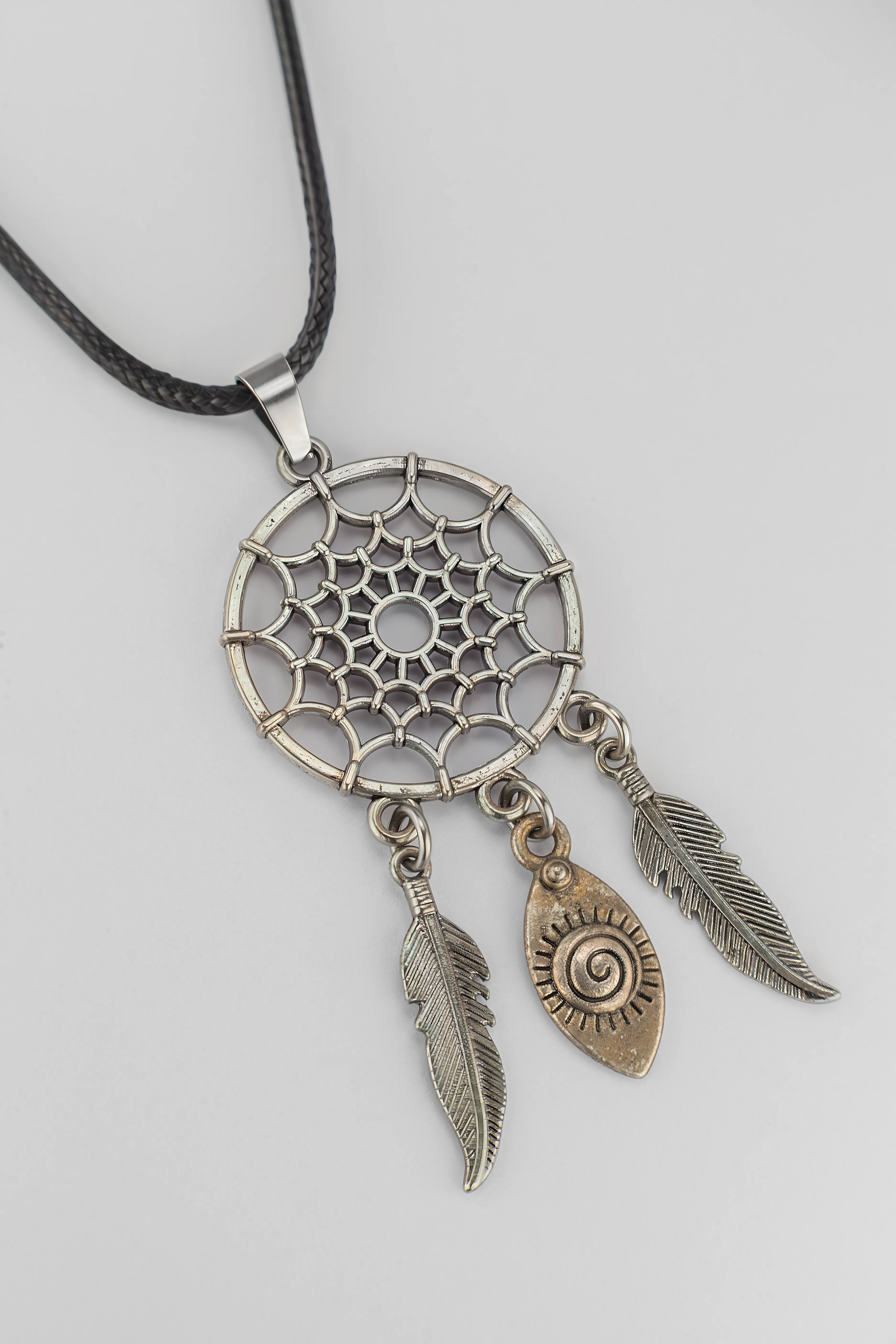
More on the feather and its meanings in the guide to the meaning of the feather.
The ouroboros: the cause returns to the cause
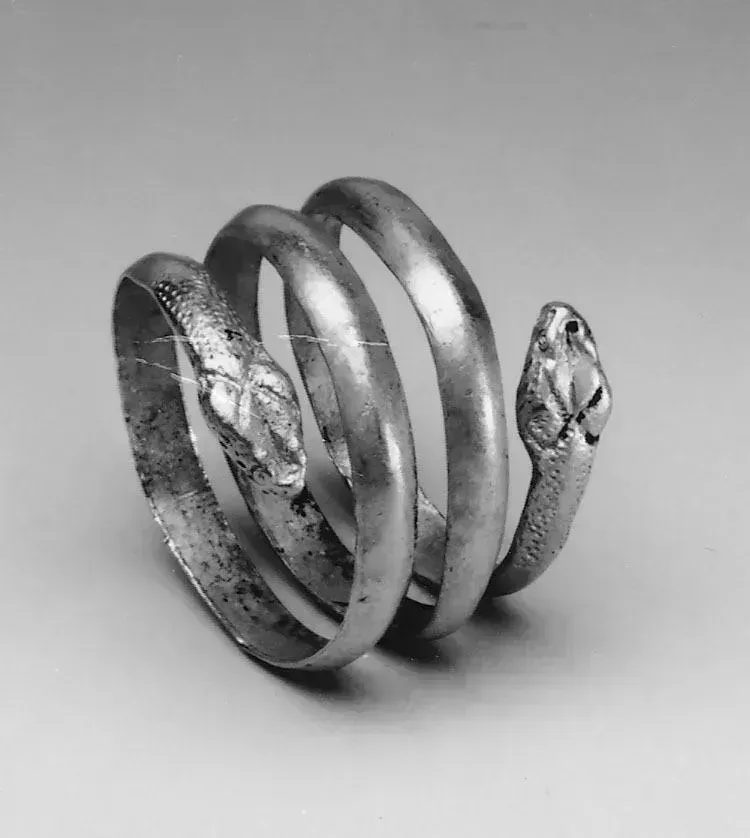
The ouroboros, the serpent biting its own tail, is one of the oldest symbols of cyclicity. In the context of Justice it embodies the idea that cause and effect are not linear but circular. What you do returns to you, and not as punishment from above but as a structural principle.
This is exactly what the Waite tradition means when it speaks of karma as a mechanism rather than a moral assessment. The ouroboros does not condemn. It describes.
A piece with an ouroboros beside a sword or scales speaks of an understanding: everything comes back around. More on the symbolism of the ouroboros in the article on the ouroboros.
Justice among the Major Arcana: a place in the Fool's journey
If we accept the Waite numbering, Justice stands at position eleven, at the centre of the Fool's journey through the 22 arcana.
By this point the Fool has already passed through the Magician (tools and will), the High Priestess (secret knowledge), the Empress (creativity and fertility), the Emperor (structure and law), the Hierophant (tradition and faith), the Lovers (choice in relationships), the Chariot (victory through willpower), Strength (power through gentleness), the Hermit (solitude and wisdom), and the Wheel of Fortune (the cyclicity of fate).
Justice appears after all that experience as a kind of examination: what did you do with what you received? How did you use the tools given by the Magician? Did you accept the secret knowledge of the Priestess? Did you honour the law of the Emperor? Did you pass the test of the Wheel?
This is not the journey's end. After Justice will still come the Hanged Man (sacrifice for understanding), Death (transformation), Temperance (synthesis), the Devil (shadows and attachments), the Tower (destruction to the foundations), the Star (hope after chaos), the Moon (illusions and fears), the Sun (clarity and joy), Judgement (a call to awakening), and the World (the completion of the cycle). But it is at this central point of the journey that the card says: look around. Take a provisional reckoning. You bear responsibility for where you have ended up.
On the symbolism of the Fool and the start of this journey, read the guide to the Fool (Arcanum 0). On the Magician, the article on Arcanum 1.
FAQ
Are Justice in Tarot and karma the same thing?
Their fields of meaning overlap but do not coincide. Karma is a concept from Indian philosophy that assumes the carryover of the consequences of actions between lives and a complex system of moral accounting. The Justice of Tarot works within a single life and a single situation. Both describe cause and effect in a moral dimension, but karma is larger in scale and includes metaphysical assumptions that the Tarot card does not.
Why is Justice without a blindfold while the statue of Justitia has one?
The legal Justitia with the blindfold is an image that took shape in Europe in the sixteenth and seventeenth centuries. The blindfold means: the court does not look at the person, only at the law. The Waite Tarot draws on a different tradition, closer to the Greek Themis: justice sees and knows. Its impartiality comes not from ignorance but from the choice not to give in to personal interest. These are different philosophical positions on the nature of justice.
Does Justice predict the outcome of a trial?
A Tarot card does not predict the future in a literal sense. In a reading, Justice on a legal question points to the character of the process: whether it is being conducted honestly, whether there is a chance of an objective decision. It is food for thought, not a horoscope.
What does it mean if Justice often appears in readings?
The card's frequent appearance usually points to one of two situations. Either the person is in a long period when they need to take responsibility for something important. Or they are avoiding it, and the card appears again and again precisely because the matter is not closed. A useful question to ask: what exactly am I unwilling to weigh objectively?
Justice in the position of a person's feelings towards me: what does it mean?
This is one of the most interesting questions. In the position of feelings, Justice points to the person relating to you objectively, without rose-tinted glasses and without unfounded suspicion. They assess you honestly: your actions, words, conduct. This is a rational rather than an emotional stance. What exactly that means for the relationship depends on the context.
How does Arcanum 11 Justice differ from the Judgement card (XX)?
Justice works within the human world and human time: the deed, the consequence, the account. Judgement (XX) is a final rethinking of a whole lived life or an entire cycle, a kind of awakening to a wider perspective. Justice is an intermediate examination. Judgement is the final one.
Justice and Strength (VIII): what is the difference?
Strength is power through gentleness: taming without violence, acceptance without surrender. Justice is power through clarity: a decision without pity for illusions. Both cards are about power, but of different qualities. This is exactly why Waite's swapping of their places mattered: he wanted inner power (Strength) to precede outer judgement (Justice).
How do you wear a piece with the Justice symbol without knowing Tarot?
Any of the card's symbols (sword, scales, feather) works beautifully without knowledge of Tarot. The sword as a symbol of clarity. The scales as a symbol of a weighed approach. The feather as a symbol of lightness and truth. Tarot only adds an extra layer of meaning for those familiar with the system.
Buying it as a gift? Each one arrives ready to give.
 A branded Zevira box and a little card come with every order.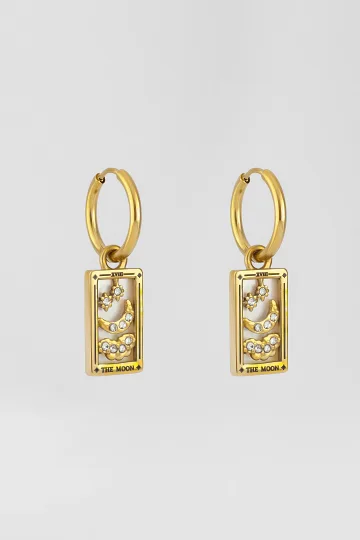










Conclusion
Daniel the litigator, at half past eleven at night, made his decision. Not the most advantageous for him professionally. But the only one he can live with when he looks in the mirror. The scales within him settled on a single mark, and he felt it.
The Justice card promises no happiness. It promises no victory. It promises that everything will not necessarily be fine. It describes a mechanism in which everyone lives, whether they wish to or not. Every choice is weighed. Every action has a consequence. The sword of clarity is raised, and it does not ask whether this is convenient for you.
That sounds strict. But there is liberation in it too. If the consequences are honest, then the effort is honest as well. If I act rightly, that does not guarantee a reward, but it does guarantee that I remain myself. The scales that weigh everything weigh this too.
Three thousand years ago the Egyptians imagined the moment of final judgement as a weighing of the heart against a feather. The feather is the absolute minimum of matter, almost nothing. The idea was simple: if you have lived rightly, your heart can become light as almost nothing.
The Stoics said: judge yourself each day, before the external judge arrives. Kant said: act so that the principle of your action could become a universal law. Maat said: the scales do not lie. They all described one and the same thing: a mechanism that does not sleep and is not distracted.
Justice is not the most popular card in the deck. People more readily draw the Star or the Sun, the cards of hope and joy. Justice is uncomfortable precisely because it is a mirror without flattery. But there is something calming in the very fact of its presence: the world is not arbitrary. The sword of clarity is raised not against you. It is raised for you, so that you may see more clearly.
To make the heart light is the long-term task of Justice.
Silver, gold, wedding rings, symbolic pieces, matching sets.
About Zevira
Zevira makes jewellery in the artisan tradition of Albacete, Spain. The symbolism of Justice (sword, scales, feather) works in our collections as a language of its own, without the need to explain every symbol.
What you can find with us under the symbolism of Justice:
- Sword pendants in 925 silver, vertical, with a diamond-shaped cross-section
- Pieces with the ouroboros as a symbol of cause and effect
- Feathers in silver: slender, finely detailed pendants
- Shields as a symbol of protection and weighed strength
- Personalised pieces with engraving
Every piece can be personalised with engraving, with the option of personal engraving. We work in 925 silver and in 14-18K gold.