Temperance in Tarot: Meaning of Major Arcana 14, Iconography and Jewellery
She had been seeing the client for almost a year. Anxiety, loss, a long stretch where life seemed to move with a grinding catch in it, like a joint that has not been used in a while. Then, near the end of one session, the woman said quietly, "You know, this morning I woke up and didn't immediately remember that I was hurting. For the first few seconds I was just there." The therapist wrote it down. Not as a victory, not as the end of anything. As the moment when something started to settle into place.
That is Temperance.
Not the silence after an explosion. Not the absence of pain. The first morning when the opposites inside you stop fighting and start negotiating. Arcanum XIV in Tarot comes right after Death, and that order is no accident: it describes neither an ending nor a beginning, but the quiet, almost invisible work of integration, when what was torn apart begins to fuse again.
This card carries a long history: from medieval Italian decks to Aleister Crowley, the Waite iconography with its loaded symbols, the alchemical tradition, the astrology of Sagittarius, the archetypes of the Tao and the golden mean. And it explains why the dove of peace, the angel's feather, the butterfly and the wave become jewellery for people living through a season of reassembly after some kind of collapse.
Place Among the Arcana: Card 14 and What Comes After Death
The Tarot holds twenty-two Major Arcana. Read them as a single journey, and roughly at the midpoint stands Death (XIII), a card not of literal ending but of transformation: something important finishes, leaves, changes shape. After Death, a person faces one question: what now? You are no longer who you were, and you do not yet know who you are becoming.
Arcanum XIV, Temperance, is the answer to that question.
In numerology the number 14 reduces to 1 + 4 = 5. The five is tied to motion, change, adaptation. It is not stability in stillness but balance in movement, like a cyclist who stays upright precisely because they keep pedalling, not because they have planted their feet. Temperance as an archetype is an active process, never a passive state.
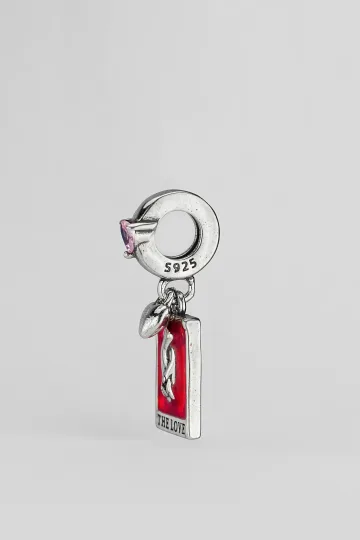
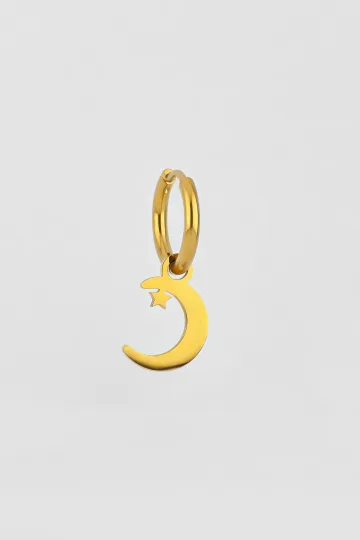
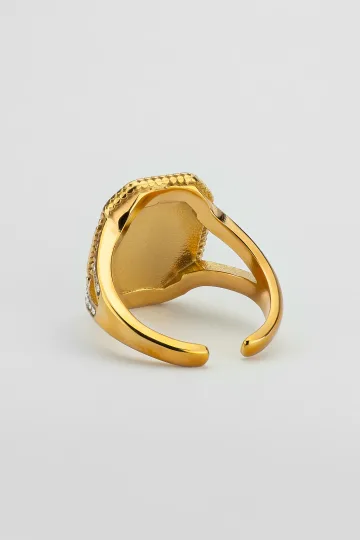
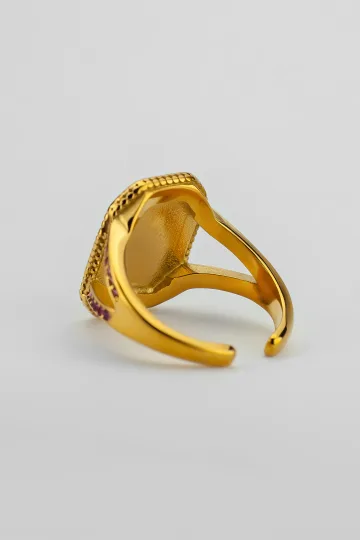
Wear the symbol, don't just read about it. These are in stock:






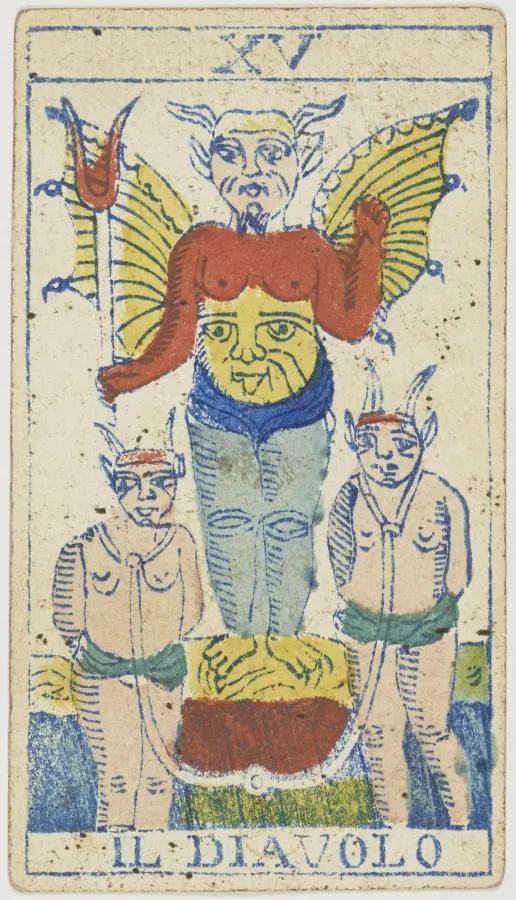
Its neighbour matters too: after Temperance comes the Devil (XV), the card of attachments, illusions, everything that keeps a person in chains. And here lies something less obvious: the integrated, balanced person will still meet temptation. Temperance does not protect you from the Devil forever, it hands you a tool for the encounter.
Between Death and the Devil, Temperance takes the alchemist's position: it gathers what is left after the breakdown and begins the work of joining. Not gluing, not patching, but genuine fusion.
Widen the view to the whole journey of the Fool through the Arcana. The first half, from the Magician to the Wheel of Fortune, is the outer world: tools, structures, trials, encounters. The second half, from Justice to the World, is the inner work: authenticity, the shadow, transformation, integration. Temperance sits deep in that second half, where the work of transformation is already underway, and the question is no longer "change or not" but "how do I hold balance while changing?"
That makes Arcanum XIV a card for people already on the road. Not for those about to begin, and not for those who have finished. For those who are right now inside the chrysalis, where the old form has dissolved and the new one is only just gathering. For more on the journey through the Major Arcana, see our guide.
The History of the Card: From Visconti to Crowley
Visconti-Sforza: Virtue as Allegory
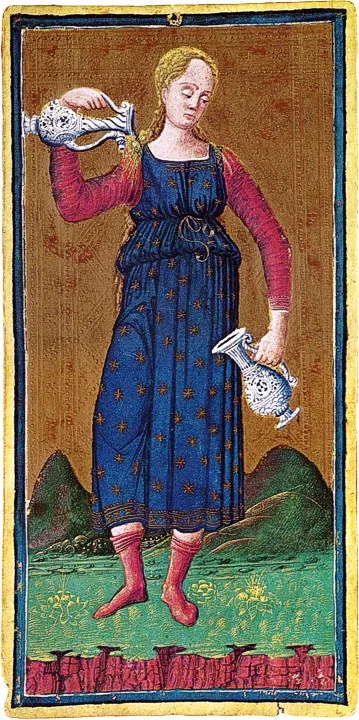
The earliest surviving images of the Temperance card date to the middle of the fifteenth century. In the Visconti-Sforza deck, made around 1450 for the Milanese court, Temperantia appears as a young woman pouring water from one vessel into another. No wings, no feet in the water, simply a personification of virtue in the spirit of medieval allegorical painting.
Temperantia was one of the four cardinal virtues of classical ethics: Prudentia (Prudence), Justitia (Justice), Fortitudo (Fortitude) and Temperantia (Temperance). The medieval Christian tradition read her literally: moderation in food, drink, pleasure. Monastic restraint as the highest form of virtue.
Yet even the early Italian decks carried a broader sense: mixing water with wine was a practice that signalled civilisation set against barbarism. A Greek or a Roman who drank their wine undiluted was seen as a savage.
The Marseille Tradition: La Tempérance
In the Marseille decks of the seventeenth and eighteenth centuries, standardised by French masters for mass production, the image stays steady: a female figure pours liquid between two cups. The card was named La Tempérance, and in the divinatory tradition of the time its meaning was plain, moderation, abstinence, self-control.
It is worth noticing that the Marseille decks gave the figure no wings. She stayed human. One foot might rest at the water's edge, but the image kept its earthbound quality: this was an allegory of virtue, a character out of moral philosophy, not a heavenly being.
It was in the nineteenth century that the French occultists, Antoine Court de Gébelin, Jean-Baptiste Alliette (Etteilla) and later Éliphas Lévi, began to read the Tarot systematically through Hermetic philosophy, Kabbalah and astrology. In his "Dogme et rituel de la haute magie" (1854 to 1856), Lévi tied the Major Arcana to the letters of the Hebrew alphabet and to planetary correspondences. Temperance received its astrological link to Sagittarius, a reading that Waite picked up and developed. The figure's transformation into a winged angel happened precisely in this period of reinterpretation. Before that, these had been simply illustrated cards for play.
Waite-Smith 1909: The Angel Between the Elements
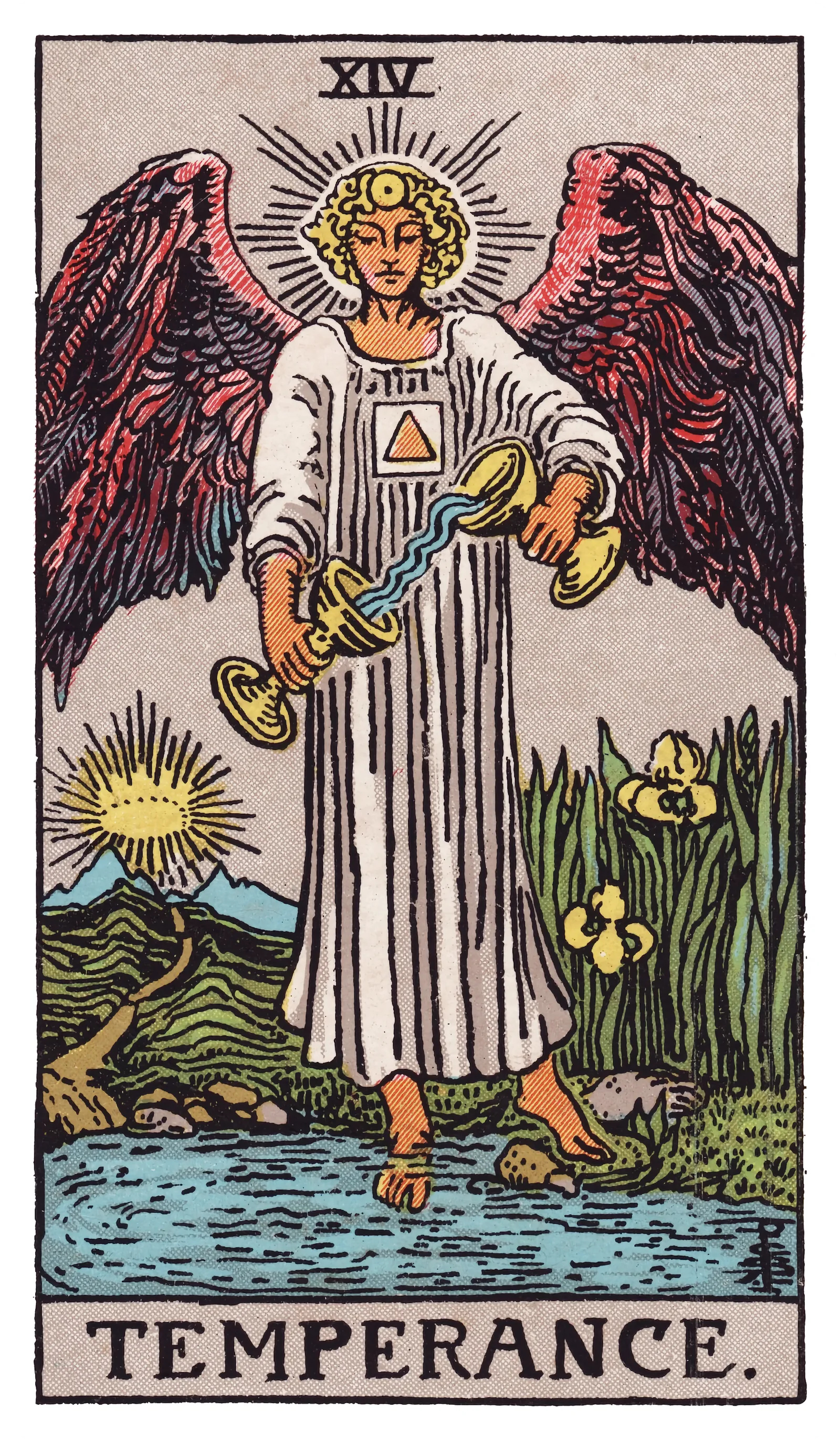
In 1909, under the direction of Arthur Edward Waite, Pamela Colman Smith created the image that became canonical. Here Temperance turned into an angel, a winged androgynous figure in white robes with a red triangle inside a square on the chest. One foot in the water, the other on land. Two golden cups in hand, the liquid arcing between them in defiance of physics. On the brow, a solar sign. In the distance, mountains and a rising sun, reached by a path through a meadow of irises.
Waite was a member of the Order of the Golden Dawn, steeped in Kabbalah, alchemy and Christian mysticism. Into the Temperance card he encoded virtue, yes, but more an alchemical process of joining opposites. The liquid flowing against gravity is not physics, it is alchemy.
Crowley's Thoth: "Art"
In his Thoth deck (made with the artist Frieda Harris in the 1940s, published posthumously in 1969), Aleister Crowley renamed this card "Art." For him, Temperance as mere abstinence was too narrow a notion. "Art" in his scheme is the highest alchemical operation: the joining of opposing principles in the Great Work (Magnum Opus).
On the Thoth card the figure holds a torch and a cup, fire and water joined. It is a more radical version of the same process: not mixing so much as transmutation. The lion and the eagle, symbols of sulphur and mercury, have become a single beast. Crowley wrote, "Art is the marriage that results from the Lovers."
It is worth setting Waite's deck beside the Thoth. Where Waite saw equilibrium and healing, Crowley saw fiery transmutation. Both are right on their own level. Waite's Temperance is a process at the midpoint of the road, where patience is still required. Crowley's Art is the moment when the opposites no longer simply mix but are transformed into a third, wholly new quality. This is no contradiction but two successive stages of one process: first the mixing, then the transmutation.
Comparing these two traditions helps explain why Temperance is so often underrated. Beside the Wheel of Fortune, the Tower or the Moon it looks quiet. But that very quiet is the point. Alchemical processes call for a steady temperature, not a flame. The Great Work is not an explosion. It is long, even labour.
An angel sits on quiet silver, never on a gold rope thick as a thumb. You cannot fake stillness with sparkle, so don't even try.
How to wear Temperance jewellery
Angel, butterfly, dove, wave: over the years I have built these symbols into dozens of looks. Here is what actually holds the aesthetic of Arcanum XIV, sorted by occasion.
What do I wear an angel or a wave with every day? For daily wear I recommend a silver pendant on a fine chain over a plain tee, a linen shirt or soft knitwear. Muted tones (milk-white, grey-blue, sand, warm grey) echo the watery palette of the card better than bright contrasts. An open collar or a V-neckline gives the pendant room to read without arguing with your clothes.
Is this symbolism right for the office? Yes, as long as you keep it restrained. I suggest a small angel in profile or a drop under a shirt or a fine jumper: the piece shows as you move rather than lying on display. Here I choose 925 silver or white gold, no large stones, with a smooth or barely textured surface.
How do I build an evening look? In the evening I deepen the theme with layers: a fine chain with a butterfly, a slightly longer one with an angel, a third with a wave. Each symbol carries its own meaning, transformation, presence, flow. Against silk or flowing fabric these fluid forms sit better than strict geometry, and moonstone or mother-of-pearl gives a soft shimmer without a cold blaze.
Which metal and stones should I choose? My main choice is 925 silver and white gold, the lunar, watery palette of the card. For stones I recommend moonstone, aquamarine, white topaz, mother-of-pearl, amazonite. I suggest avoiding dark, heavy stones (obsidian, hematite, black onyx): they carry a different energy.
Who does this aesthetic actually suit? Less by looks than by mood: those moving through change, recovery, a calm reappraisal of life. Two rules that never fail. First, keep the length medium (40 to 50 cm) so the symbol sits near the collarbones, in the zone of breath. Second, choose one metal for the whole look, a single tone supports the idea of balance rather than clutter.

Turn on your camera, pick earrings, a pendant or a ring, and see the piece on yourself in real time.
Switch items in one tap.
Everything runs in your browser: no photo or video is ever uploaded.
Waite's Iconography: Every Symbol
The Winged Angel
The figure on Waite's card is an angel, but an ambiguous one. Its sex is undefined, its face calm. Tradition identifies it either as the archangel Michael, guardian and warrior, or as the archangel Raphael, the healer.
The case for Raphael is the stronger one here. Raphael in angelology is linked to healing (the name literally means "God has healed"), to journeys and to mediation between the elements. He appears in the Book of Tobit as a traveller who accompanies a man through his trials. His attributes, the pilgrim's staff and the fish, belong to water and to movement, which fits the image of Temperance more closely.
Michael, the warrior and defender, appears more often in contexts of judgement and battle. Temperance does not battle, it joins.
The figure's androgyny is deliberate: neither the masculine nor the feminine principle dominates. This is not the absence of sex but its integration. The alchemical tradition called it the Rebis, the twofold being, the result of opposites joined.
Two Golden Cups and Liquid Against Gravity
The central act of the card is the pouring of liquid between two cups. But the liquid runs at an angle, against gravity, in a way that never happens in the physical world.
This is the key to reading the card. Temperance does not describe limitation or passive restraint. It describes an active, alchemical, almost magical joining of what ordinary logic says cannot meet: water and fire, the conscious and the unconscious, past and future, "who I was" and "who I am becoming."
Two cups, two principles. The liquid between them, the process of their joining. The arc the stream forms is the path of transmutation, stepping past the laws of Newton.
One Foot in Water, the Other on Land
The angel stands with one foot in the water (the unconscious, feeling, intuition, the current) and the other on land (the conscious, the material, the stable, form). Not wholly in either element, a stranger to neither. This is balance made literal: not a choice between the two, but presence in both at once.
Eastern traditions describe this state as "being and not being at the same time," what Laozi called the Tao: the way that is neither this nor that yet holds both. In the Buddhist tradition it is the middle way, neither asceticism nor indulgence, but balance in motion.
The Triangle Within the Square on the Chest
On the angel's white robe is a geometric figure: a triangle set inside a square. In alchemical and Kabbalistic symbolism this is one of the basic forms: the square stands for the four elements, the four elements of the world (earth, water, air, fire), the four directions. The triangle inside the square is the spiritual principle (three, the number of the Trinity, the creative force) held within material limit.
Put simply: spirit placed within matter. Not opposed to it, placed inside it. This is neither prison nor escape, it is incarnation. Temperance as a card says that spiritual work happens not beyond the material world but within it.
The Solar Sign on the Brow (the Hexagram)
On the angel's brow is a solar disc or a hexagram, depending on the deck and the reading. The solar sign ties the angel to higher consciousness, to the principle of the Self in the Jungian sense: not the ego but a deeper centre of the personality that organises the integration.
The hexagram, the Star of David, is itself a symbol of opposites joined: the upward triangle (fire, masculine) plus the downward triangle (water, feminine). Its presence on the angel's brow underlines that Temperance is not everyday restraint in behaviour but the realisation of a higher principle of unity.
Irises by the Water
Along the riverbank, beside the angel's foot, grow irises. In the Western tradition the iris is linked to the goddess Iris, messenger of the gods and personification of the rainbow. The rainbow is a bridge between sky and earth, between elements, between worlds. The iris as rainbow is present wherever light and water meet, which fits the card's theme exactly.
In the Christian tradition the iris is also tied to the Virgin Mary and to purification. In the Japanese tradition, to protection against evil spirits. In nineteenth-century jewellery the iris was a popular Art Nouveau motif, standing for grace and for the link between nature and the spirit.
The most telling parallel here is the function of the goddess Iris as a go-between: she alone among the gods could move freely between Olympus and Tartarus, between the living and the dead, between the elements. The irises on the card are not mere decoration. They mark the territory of the mediator, that place on the bank where land meets water. This is exactly where the angel stands. This is where the mixing happens. A threshold space in which what is impossible in either element alone becomes possible.
The Path and the Rising Sun Between the Mountains
Far from the angel a landscape opens: two mountains, and between them a rising sun. A path leads to the horizon. In Waite's iconography mountains mark the height of attainment and the test of it. They frame the sun, they do not block it.
The path to the rising sun is the path to completion, to the World (Arcanum XXI), to full integration. Temperance shows this path as real: it is there, it is visible, it leads to the light. But the angel stands here, on the bank, still at the start of that path. The rising sun is a promise, not a fact.
The path between the mountains is striking in its concreteness. It is not an abstract horizon, it is a visible track through a meadow of irises. In Waite's iconography such a path appears in several cards and always means one thing: the road exists, it can be walked, others have walked it before you. The difference is that on some cards the person is already moving along it, while on Temperance the angel stands on the bank. The work here, by the water, is not yet finished. The path into the distance will open once the mixing is complete.
This gives the card a particular structure of time: the present, the work by the water; the future, the rising sun. Temperance is a card for those doing the work now, without trying to leap straight to the finish.
The Archetype: Balance, Healing, Alchemy
The Alchemical Marriage: Sulphur, Mercury, Salt
In the alchemical tradition the Great Work (Magnum Opus) passed through several stages, each described as a transformation of three primal principles: sulphur (Sulphur), mercury (Mercurius) and salt (Sal).
Sulphur stood for the active, fiery, masculine principle, desire, will, passion. Mercury, the mobile, fluid, mediating principle, the spirit between body and soul. Salt, the passive, stable, bodily principle, form and mass.
Temperance in the alchemical reading is the moment of "Coagulation" (Coagulatio): the reunion of the purified elements into a new whole. Not a mixture in the ordinary sense, but a genuinely new compound, where the components have changed their nature in the act of joining. The alchemists called this coniunctio, the sacred marriage.
In Jungian psychology Carl Jung worked this metaphor out in detail. Individuation, the process of becoming whole, he described through the same alchemical vocabulary: integrating the shadow aspects of the personality, joining anima and animus, the marriage of the conscious and the unconscious.
The structure of the Great Work itself included several well-known stages:
Nigredo (the blackening), the opening stage of breakdown and dissolution, where everything that was loses its form. In the Fool's journey this is Death (Arcanum XIII).
Albedo (the whitening), purification, the emergence from the blackness, the first signs of the new. This is the beginning of Temperance, the angel appearing in white robes.
Citrinitas (the yellowing), the appearance of the "gold" of consciousness, the first signs of wisdom. The rising sun on the Temperance card.
Rubedo (the reddening), full completion, the appearance of the "philosopher's stone," the new quality of the personality. This is the World (Arcanum XXI), the end of the road.
Temperance describes exactly the passage from Albedo to Citrinitas: the whiteness of purification is already there, the gold of wisdom is beginning to show in the distance. The work is underway.
The Tao and the Middle Way: An Eastern Parallel
In the Taoist philosophy of Laozi (sixth to fourth century BCE) the central principle is the "middle way" (zhong dao), not in the sense of compromise or half-measures, but of moving in accord with the nature of things. Water in Taoism is the ideal metaphor: it takes the shape of any vessel, flows downward, bends around obstacles, and yet wears away stone.
The image of the angel pouring liquid can be read in exactly this key: not the effort of control, but the skill of directing what already flows. Wu wei (non-action) is not passivity, it is action in keeping with the nature of the situation, without imposing.
The "Tao Te Ching" says, "Those who know do not speak, those who speak do not know." Temperance is the card of silent knowing: not declarations about balance, but its practice. The angel makes no speeches, it pours liquid. For anyone seeking Temperance in their own life, the lesson follows: this is not a principle to be talked about, but a principle practised in quiet.
The Buddhist middle way (Madhyamapratipada), proclaimed by the Buddha after he turned from the extremes of asceticism and hedonism, describes the same idea from another angle. The prince Siddhartha Gautama, who had worn his body down with fasting, heard a lute being played: strung too tight, the strings snap; strung too loose, they make no sound. The necessary tension is the middle way.
Temperance in Tarot carries the same principle: neither suppression nor licence. The right tension.
The Tibetan practice of tonglen, developed within the lojong system, works with a similar principle: the practitioner deliberately breathes in suffering (their own and others') and breathes out relief. They neither avoid the dark nor hide in the light, but let both pass through them. This is Temperance as a meditative practice: not a rule for living, but a quality of breath.
Aristotle and Mesotes: The Golden Mean
Long before Laozi and long before the Tarot, Aristotle in the "Nicomachean Ethics" (fourth century BCE) set out the principle of mesotes (the mean) as the foundation of a virtuous life. Each virtue is the mean between two vices: courage, between cowardice and recklessness; generosity, between miserliness and extravagance; justice, between self-interest and spinelessness.
Temperance in this system is one of the virtues, but also the principle on which all the others are built. Without it no other virtue is possible: anger without measure becomes rage, love without measure becomes obsession, care without measure becomes smothering control.
Aristotle was not offering "a bit of everything" as a cheap saying. He was speaking of precise tuning: the mean is different for each person and each situation. To find it is practical wisdom (phronesis).
And phronesis for Aristotle is not theoretical knowledge but practical skill. It is not something you can read in a book and acquire. It is gained through experience, through mistakes, through navigating particular situations. Arcanum XIV is the card of practical wisdom in exactly the Aristotelian sense: not philosophical reasoning about balance, but the skill of finding it in motion, in this day, this relationship, this moment.
The Stoics developed the same theme in the principle of "appropriate action" (kathekon): the action that suits the nature of a being in a given moment. Not the ideal action in theory, but the best available in real conditions. Stoic Temperance is not some unreachable perfection of balance, but the constant practice of the best available fit.
In World Culture: Zen, the Buddha, Aesop, the English Novel
Aesop's fable of the hare and the tortoise is one reading of the Temperance theme: it is not speed that wins but steady balance in motion. The tortoise neither dawdles on purpose nor hurries on purpose, it moves at its own pace.
In Japanese culture the principle of "hara hachi bu" (eating to eighty per cent fullness, not to the limit) is both a dietary observation and a philosophical principle: leave room for life to continue. This is Temperance in action.
The Zen master Shunryu Suzuki said, "In the beginner's mind there are many possibilities, in the expert's mind there are few." Temperance keeps the capacity to renew, never letting the system close itself off.
In the Indian musical tradition there is the idea of the "raga," a melody that is really a state, a time of day, a season and an emotion all at once. Ragas meant for the morning cannot be played in the evening: each time of day asks for its own sound. This too is Temperance, not as restriction but as precision: the right thing at the right moment.
Goethe in "Faust" gave the same idea through Mephistopheles: the spirit that denies all that exists turns out, in the end, to be part of the force "that always wills evil and always works good." Opposites balance each other, and in their interaction they bring forth a third thing that was in neither of them. The alchemical joining yields not a sum but a new quality.
This is especially worth grasping if you want to understand why Temperance does not advise "being restrained" in the dull sense. It advises letting the opposites interact, suppressing neither, and watching what is born of that interaction.
In George Eliot's "Middlemarch" there is a figure remarkably close to Temperance in Caleb Garth, the land agent: a plain man who neither fights his circumstances nor flees them, who meets what comes with a quiet, embodied steadiness. He does not explain balance, he lives it, and those around him are quietly healed by his presence. Chekhov, by contrast, built many of his characters around broken balance: a person who leaned too far into one thing, career, love, fear, nostalgia, and lost the ability to notice the rest. His "Man in a Case," Belikov, is a literal inverted Temperance: a man who sealed himself off from the world for the sake of false stability, never letting the two cups interact.
At the other end of the scale sit the long, slow river mornings of nature writing, the kind of state close to upright Temperance: a person hurrying toward nothing, when something inside levels out on its own in the presence of water and sky. Not a meditative technique, simply a space that lets integration happen.
Customer reviews
Zevira is a real jewellery shop. Genuine payments, deliveries and customer thank-yous.
🥰🥰🥰 gracias
Ok, ¡gracias! 🙂
Upright and Reversed
Upright: Flow, Integration, Healing
Upright, Temperance is the card of active equilibrium. Keywords: balance, integration, healing, alchemy, patience, the middle way, flow, adaptation.
Temperance upright appears when a person is in the middle of integration, after a hard period, after a loss, after a transformation. It is not the end of the pain, but the start of the reassembly. The signal: you are moving in the right direction, even if you cannot see the finish.
In practical terms the card advises: do not hurry, do not force, trust the process. The liquid flows against gravity, this is possible, but it takes angelic patience, not human haste.
Temperance also speaks of the right mixing of resources: in work, in relationships, in caring for yourself. Where is the imbalance right now, too much of one thing and too little of another? Which "cup" is overflowing, and which is nearly empty?
In relationships, upright Temperance is the card of mature interaction between two people with different temperaments, values or histories. Not merging (where boundaries are lost) and not distance (where contact becomes impossible). Mixing, precisely, where both stay themselves yet remain in contact. Therapists call this "differentiation in closeness": close enough for the contact to be real, separate enough not to dissolve.
In matters of creativity, upright Temperance says: you have all the ingredients, what is needed now is the right temperature and time. Do not force it, do not expect the result ahead of schedule. The Great Work does not hurry. For different readings of the Tarot cards as they relate to jewellery, see our overview of the Major Arcana.
Reversed: Extremes and Rupture
Reversed Temperance describes a break in the equilibrium. Two main readings:
First: excess and extreme. A person goes too far to one side, into work, into caring for others at their own expense, into stress, into pleasure, into some dependency or compulsion. The cups no longer interact, the liquid pours out of one and never reaches the other.
Second: a blocked flow. Something will not let movement happen. The integration has stalled: a person is stuck between two states, in neither the old nor the new, and the motion has stopped. This is not a bad place in itself, but it is dangerous to linger in.
Reversed Temperance is not a "bad" card. It points to what needs attention, to the place where regulation is required.
The myth that reversed Temperance means alcoholism or some other addiction exists because the word "temperance" in nineteenth-century English was tied literally to the movement for sobriety. That is a historical layer, not the core meaning of the card.
Upload a photo of your pet, someone you love, or an object. We'll build a 3D model and hand-cast it in pewter.

Sagittarius and Jupiter: The Astrology of Temperance
In the Western tradition of astrological Tarot, Temperance is linked to the sign of Sagittarius (23 November to 22 December) and its ruler Jupiter.
Sagittarius: Seeking Meaning in Motion
Sagittarius is a mutable Fire sign. Its symbol is the centaur with a bow. The centaur is a being of double nature: the lower part animal (instinct, body, earth), the upper human (mind, spirit, purpose). The centaur is not torn between these natures, it is both of them.
This is the symbolism of Temperance made literal: the integration of two natures, two principles in one being that stands steady not because it destroyed one of its parts, but because it learned to join them.
Sagittarius does not aim at the nearest target. It looks to the far horizon: meaning, philosophy, the journey. Temperance as a card shows exactly this path to the horizon, the rising sun between the mountains.
The mutability of Sagittarius matters: the mutable signs (Gemini, Virgo, Sagittarius, Pisces) know how to adapt, to change shape, to pass from one state to another. This is not weakness but flexibility. Sagittarius shifts the angle of the arrow in flight if it sees a truer mark. Temperance is the card of flexible balance, not the rigid balance of the scales. The scales are static: two pans must come to rest at one level. The balance of Sagittarius is dynamic: the archer corrects the angle while moving.
In the chiropractic tradition there is the idea of "proprioception," the body's ability to sense its position in space and to correct it continually without conscious effort. A good dancer, a good fighter, a good skier has highly developed proprioception. Sagittarius and Temperance are the proprioception of the spirit: a constant, automatic, unconscious calibration of balance as you move.
Jupiter: Expansion and Wisdom
Jupiter, the largest planet in the solar system, in astrology governs expansion, growth, wisdom, philosophy and higher law. It is not the planet of extreme events (those are Uranus and Pluto) but the planet of meaning and of luck over the long run.
Jupiter's link to Temperance is not obvious at first: how do you tie a principle of expansion to a principle of moderation? The answer is that Jupiter is not "more" but "deeper." It widens the horizons of understanding, not the volume of consumption. The real Jupiter is wisdom that grows through the integration of experience, not through the accumulation of events.
In practical terms: a Jupiterian phase in a Sagittarian life is the time when a large, sometimes painful experience begins to settle into understanding. That is exactly the process Temperance describes.
Jupiter is traditionally tied to travel, education and higher knowledge. All three are about crossing borders: geographical, intellectual, spiritual. Travel as a metaphor for Temperance is precise: you stand between two shores, between the old and the new, between who you were and who you are becoming. You are on the way. Jupiter blesses exactly that in-between, asking you not to have already arrived.
In a Sagittarian's reading, Temperance often turns up as the leading card during periods of study or a shift in worldview: when the old system of belief no longer works and the new one has not yet set. The angel with the cups is the image of a person letting these two worldviews interact, in no hurry to declare a winner.
Archangel Michael Versus Raphael: Two Readings of the Angel
The question of exactly which angel Temperance depicts stays open in the tradition, and both options yield important meanings.
Archangel Michael
Michael (Hebrew Mikha'el, "Who is like God") in the Jewish, Christian and Islamic traditions is the leader of the heavenly host, the defender, the conqueror of evil. His attributes are the sword and the scales of justice. He is often shown in armour.
The link to Temperance is built through the scales: balance as the principle of justice. Michael weighs, assesses, restores the balance where order has been broken. In this reading Temperance is not a gentle merging but a just rebalancing.
Archangel Raphael
Raphael (Hebrew Rafa'el, "God has healed") in the apocryphal tradition (especially in the Book of Tobit) is the companion of the traveller, healer of body and spirit, mediator. He accompanies Tobias on his long journey, helps restore the father's sight, reunites those who were parted. His function is restoration: not judgement but healing.
For Temperance as a card of healing and integration, Raphael fits better: he is not a warrior but a physician. He does not cleave with a sword, he mixes the ingredients of the remedy like an alchemist. In the Jewish tradition it is Raphael who governs the element of water, which matches the image of the angel by the water.
Jewellery with angels reflects both of these images: the warrior and the healer. An angel pendant with wide-spread wings is protection. An angel with folded wings, in a posture of rest, signals healing.



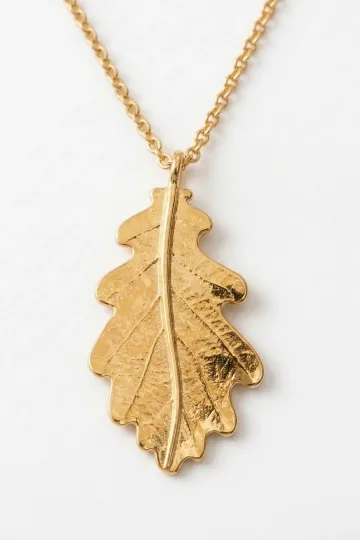
Jewellery: What to Wear for the Energy of Temperance
The Dove of Peace: Reconciling Opposites
The dove, in most cultures, is a symbol of peace, reconciliation and a messenger between worlds. In the Western tradition it goes back to Noah's dove, which brought the olive branch: a sign that the warring of the elements was over, that what had been divided had rejoined the shore.
In Christian symbolism the dove is tied to the Holy Spirit, to the mediator between the heavenly and the earthly, which matches the function of the Temperance angel exactly. Picasso's dove as the emblem of a peace movement adds a more secular sense: the end of conflict, a readiness for dialogue.
A dove pendant works well as jewellery for people moving through reconciliation, with another person or with themselves. For more on the symbolism of the dove and the feather as an angelic link, see our guide to feather-symbol jewellery.
The Feather: An Angelic Link and Lightness
The feather in jewellery carries several layers of meaning at once, all relevant to Temperance. In the Egyptian tradition the feather of Ma'at is the symbol of truth and balance: the heart of the dead was weighed against a feather on a set of scales. The feather's lightness meant purity.
In angelic symbolism the feather is the trace of an angel's presence, its calling card. To find a white feather in an unexpected place is, in folk tradition, a sign from above. This is not naive magic but a language of symbols: something light and unexpected as a signal of balance.
The feather as jewellery works well during integration: a reminder of the lightness still possible even after a hard stretch. For more on the meaning of this symbol, see the feather jewellery guide.
The Butterfly: Metamorphosis Complete
The butterfly is the most direct symbol of successful transformation. Inside the chrysalis the caterpillar literally dissolves, its tissues break down into their basic components, and from this "primal substance" an entirely different creature is assembled. It is a precise biological metaphor for alchemy.
If Death (Arcanum XIII) describes the moment of dissolution, then Temperance (XIV) is the moment when something inside the chrysalis begins to take form. The butterfly as jewellery suits not the start of a transformation but exactly this point: when the process is underway, when the form is beginning to show.
The monarch butterfly in particular has become a symbol of psychological resilience and recovery in contemporary culture. A detailed look at this symbol appears in our guide to the meaning of the butterfly in jewellery.
The Wave and Water: Flow Without Struggle
Water as an element is the through-line of Temperance. The angel stands in water. The liquid flows between the cups. Irises grow by the water. The unconscious, intuition, the current, all of it is the element of water.
Jewellery with waves, drops, flowing forms reflects the principle of wu wei well: movement without resistance. The wave does not break the shore by force, it comes and goes in its own rhythm, and that is its strength. Sea jewellery with waves and natural forms is covered in our guide to maritime jewellery.
The Angel Pendant: The Most Direct Symbol
The angel pendant is among the most popular in jewellery. In the context of Temperance it works on several levels: the angel as healer, the angel as mediator between the elements, the angel as witness to the process of integration.
An angel with open wings, active protection. An angel with wings drawn in or folded, a presence nearby, a calm accompaniment. For the theme of Temperance the second type fits better: not stormy protection, but quiet, healing presence.
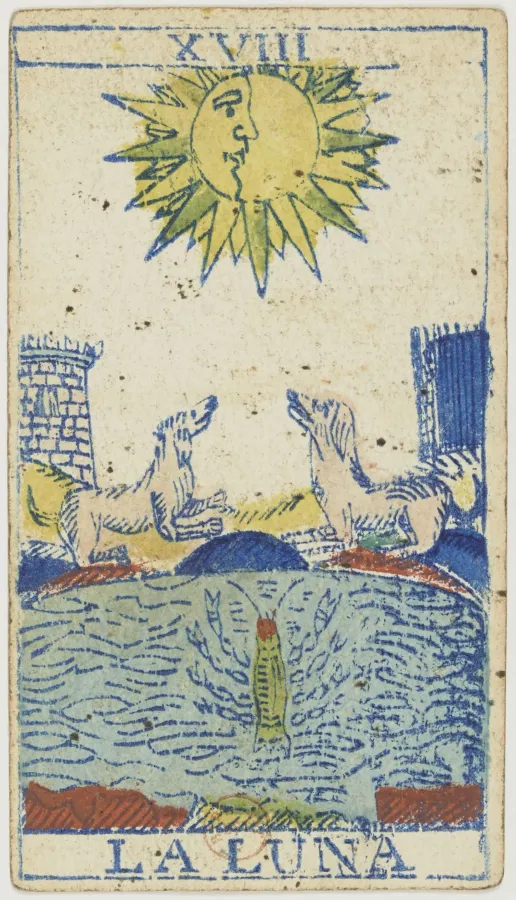
In silver, angel pendants carry a lunar, intuitive symbolism, kin to Arcanum 18. In gold, a solar, conscious, guiding principle. Both metals suit Temperance: the choice depends on what is needed more right now, a leaning on intuition or on clarity.
When choosing the materials of an angel pendant for this theme, avoid heavy, massive forms. Temperance is not a showpiece, it is a reminder meant to be present quietly. A fine chain, a small angel in profile, nothing excess. Jewellery for the energy of Temperance is worn close to the body, not for display.
A Gift for the Energy of Temperance
When should you give jewellery with the symbolism of Arcanum XIV? This is a gift not "for happiness" and not "for luck." It is a gift for a particular moment:
For a person in recovery, physical or psychological. A long convalescence calls for exactly the energy the card describes: patience, method, trust in the process.
For a person in the middle of a great transformation, when the old has gone and the new has not yet set. That in-between is often felt as a failure, as a defeat. Temperance says: no, this is a normal part of the process, and the real work lives right here.
For a couple moving through reconciliation or a serious conversation. Two cups, two people. Jewellery as a symbol of readiness for mutual mixing, without dissolving and without war.
For yourself, in a period when two opposing desires live inside you and there is no telling what to do with that. Temperance does not say "choose one." It says "let them meet."
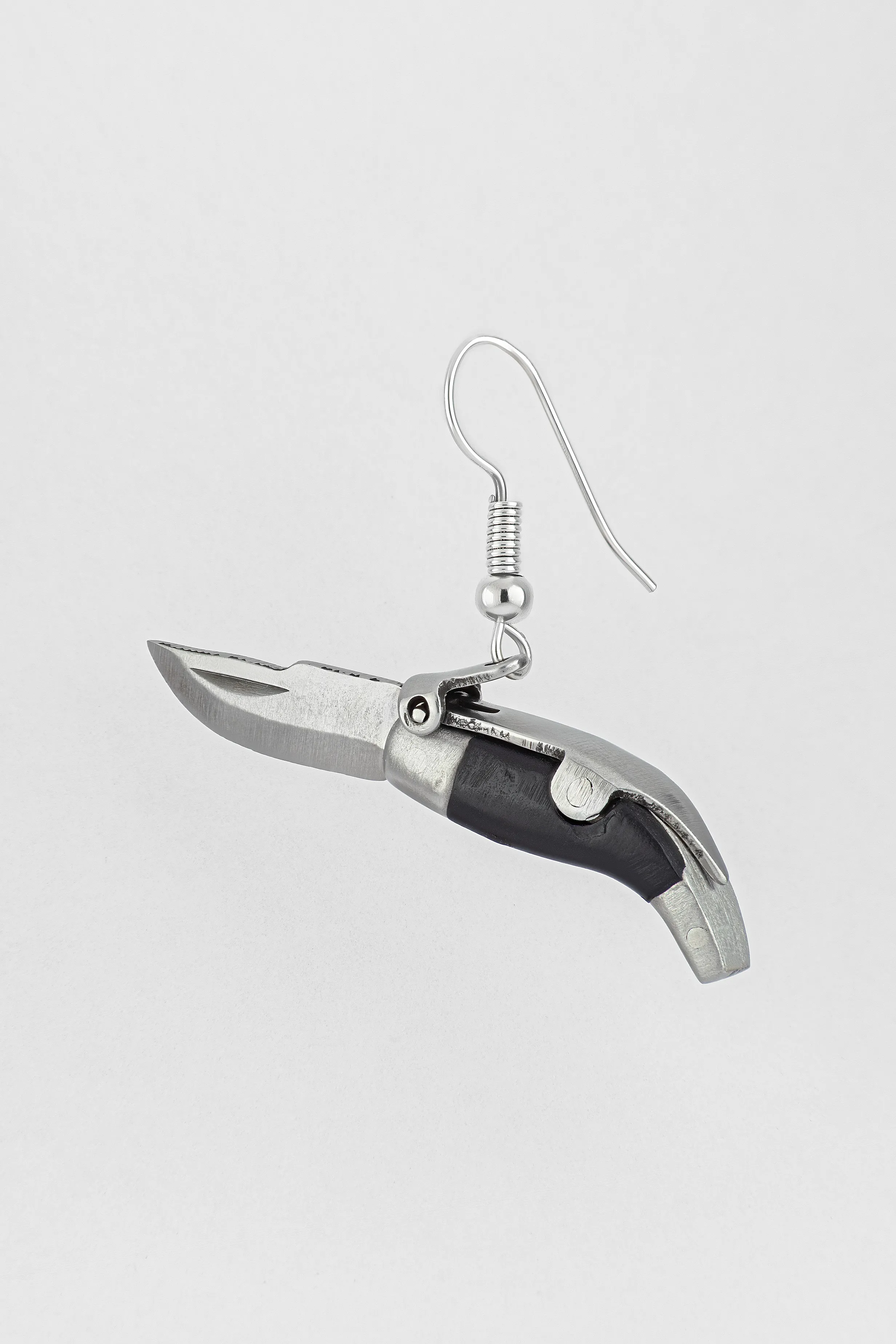
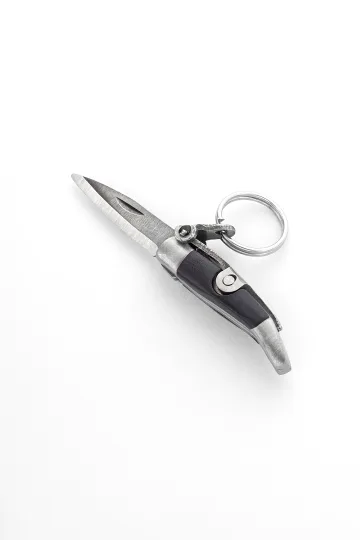
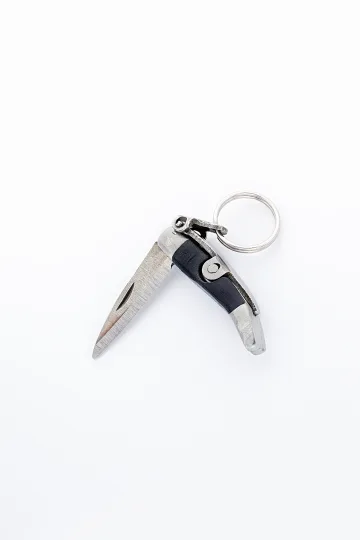
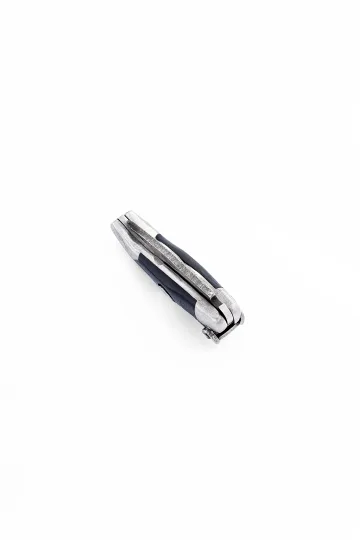
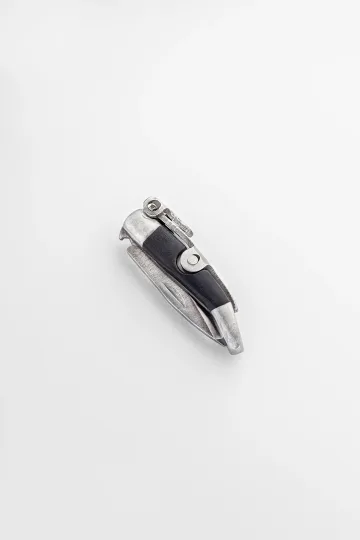
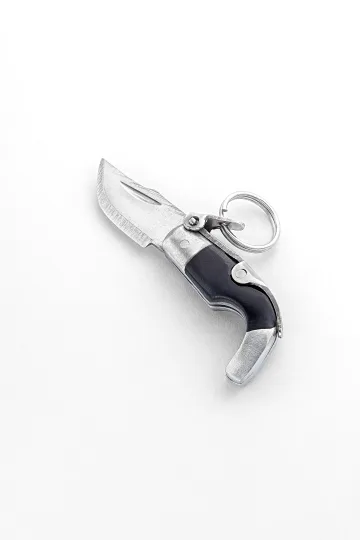
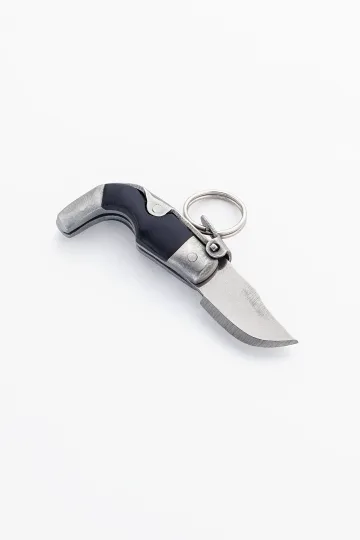
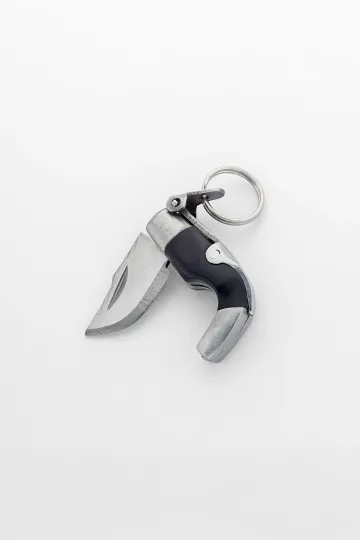
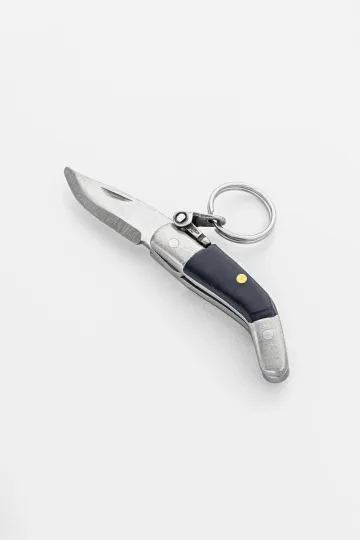
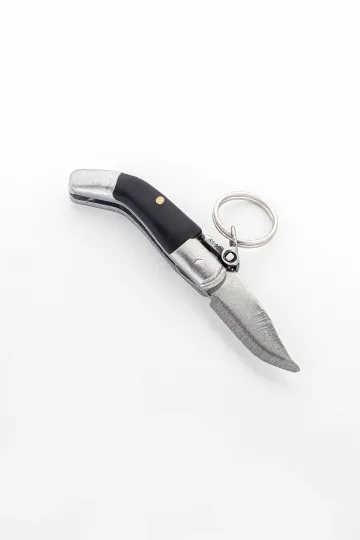
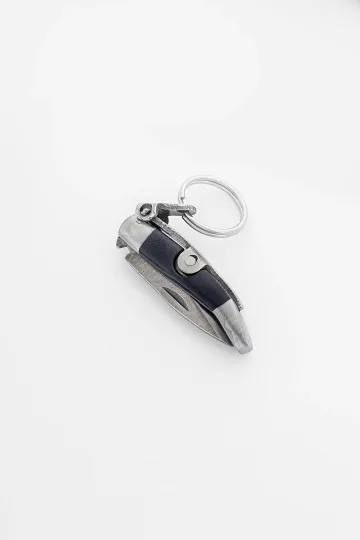
CAPAORA mini knife pendant
The 18th-century Spanish navaja in miniature: 40 mm of stainless steel, a real folding mechanism and a Palanquilla lock that clicks. An affordable gift to remember.
Authentic · Ships from Spain · 14-day returns
Temperance and the Star: The Most Healing Pairing in Tarot
Two arcana often stand side by side in the minds of people who work with Tarot as a tool for psychological reflection: Temperance (XIV) and the Star (XVII). Both carry the theme of healing. The difference between them is important and instructive.
The Star appears right after the Tower (XVI), the card of sudden collapse, of the ruin of what seemed unshakable. The Tower falls apart. The Star shines over the ruins. It is the card of hope: after destruction there is light, and it is visible already. The Star is passive healing: the light simply is, it does not have to be earned or made. It pours of itself.
Temperance is active healing: the angel works. The liquid pours. The process moves. Temperance asks for patience and participation, even when that participation looks like "just hold the cup and let it flow."
Together they describe two phases of recovery after a hard experience. The Star is the moment when, after the catastrophe, you see the first light and understand: this is not the end. Temperance is the period after, when you take that light and begin the work of integration: gathering what is left and making something new from it.
The sequence Tower, Star, Temperance (read non-linearly) is one of the most significant narratives in Tarot. Destruction brought freedom (the Tower). Hope appeared (the Star). The real work began (Temperance).
In jewellery this narrative can be carried by three pieces: a bracelet with a lightning bolt (the Tower), a pendant with a star (the Star), a charm with an angel or a butterfly (Temperance). Three stages on one wrist. Not a set, a story.
Temperance Across Different Decks: How the Image Shifts
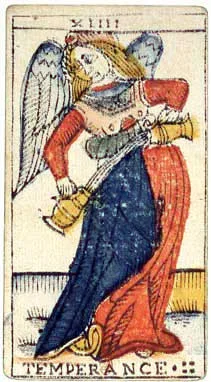
In the century and more since the Waite-Smith deck, several thousand author decks have been created. Each artist read Arcanum XIV in their own way. It is an interesting cross-section of what artists considered central to the image of Temperance.
The Thoth Tarot of Crowley and Harris. Here the card is called "Art." Harris drew an androgynous figure with one white face and one black, a literal depiction of coagulatio, the union of opposites. A golden lion embraces a white eagle. This is no peaceful angel by a river, it is active transmutation at its peak. The card's energy is far more intense than Waite's.
The Wirth Tarot. Oswald Wirth created his deck in 1889 under the influence of Éliphas Lévi. His Temperance is pure allegory without the fine details of landscape: the figure pours liquid, the wings are severe, the pose monumental. No irises and no path. Wirth saw in this card above all a cosmic principle, not a personal story.
The Tarot of William Blake. In this author deck Arcanum XIV reaches back to Blake's own imagery, to his poetic visions of the marriage of Heaven and Hell. Blake was convinced that true creation happens through the union of opposing principles, and his "Marriage of Heaven and Hell" is literally what the alchemists called coniunctio. Blake's vision and the Temperance of Tarot speak of the same thing: opposites do not destroy but enrich one another.
The Universal Waite. One of the most widespread modern versions. Here the emphasis shifts to softness: the angel looks calm and gentle, the colours more pastel. This is the most "therapeutic" version of the image, oriented toward healing and peace.
The very range of these readings shows that Arcanum XIV carries several simultaneously true meanings. Temperance can be a quiet, healing presence or an active alchemical transmutation, depending on the point in the process a person has reached.
Leave your email, we'll send your discount code. No spam, unsubscribe anytime.
The code arrives by email, valid on your first order.
Temperance and Psychology: Jung, Perls, Hakomi
The image of Temperance, the angel joining opposites, finds precise parallels in several strands of twentieth-century psychology.
Jungian Individuation
Carl Gustav Jung described psychological health as the process of individuation, becoming whole through the integration of every part of the psyche, including the shadow, the anima/animus and other archetypal complexes. Jung used the alchemical metaphor directly to describe this process: the psyche works like an alchemical laboratory in which the lead of the ego is transformed into the gold of the Self.
In Jungian terms what the Temperance angel does is literally coniunctio, the sacred marriage of opposites. The conscious (the foot on land) and the unconscious (the foot in water) do not fight but interact. The result of that interaction is the birth of the Self, a deeper centre of the personality that organises both levels.
Jung stressed that individuation is not the attainment of perfection but the acceptance of wholeness. Not the removal of the shadow, but its recognition as part of oneself. Temperance in this context is not the card of "a good person without faults" but the card of a person who has found a way to live with all their parts.
Gestalt and Unfinished Gestalts
In the Gestalt therapy of Fritz Perls the central concept is the "unfinished gestalt," a situation, reaction or feeling that was interrupted and never found a natural completion. Unfinished gestalts accumulate and get in the way of contact with the present.
The work of a Gestalt therapist is in many ways like the work of the angel with the cups: to let the unfinished process finally complete itself. This is not forcing and not analysis, it is the creation of conditions in which the natural flow can run without obstacle. Temperance in this sense is the card of therapeutic work, the recognition that some processes simply need to be completed.
Hakomi and Gentle Presence
The Hakomi therapeutic method, developed by Ron Kurtz in the 1970s, works with somatic experience through the principle of "loving presence": the therapist neither interprets nor directs, but creates a space in which the client's body and psyche find their own way to healing.
This is a very precise metaphor for the Temperance angel: it does not hurry, does not analyse, does not make decisions for the water in the cups. It simply holds the cups and lets the liquid flow. Healing happens not through effort but through a rightly made space.
Hakomi also works with "core beliefs," deep, often unconscious narratives about the self that limit the flow of life. Transforming them is alchemy in the psychological sense: dissolve the old form and let the new one gather on its own. This is exactly what Arcanum XIV describes.
In Readings: When Temperance Appears
The "What Is Happening Now" Position
Temperance in the current position is a signal that a person is in the middle of active integration. Something important has finished, and now the work of assembling the new from the remains of the old is underway. The card says: this is normal, it takes time, do not rush.
The "Advice" Position
In the advice position Temperance recommends: find the mean. Look at where, in this situation, there are extremes, where you have put in too much or too little. Do not let one cup overflow. This can be about energy, time, attention, feeling.
The "Obstacle" Position
In the obstacle position Temperance (often reversed) says: what is getting in the way is imbalance. Either you are hurrying too much and not letting the process complete naturally, or you are stuck in one of the extremes and unwilling to move toward the mean.
In Questions of Health
In questions of health Temperance is traditionally read as positive: a card of recovery, rehabilitation, the gradual return of strength. Not instant healing, but a process. After illness, after an operation, after prolonged stress. "You will be well, but not at once. The process is underway."
In Questions of Relationships
In questions of relationships Temperance speaks of reconciliation, of finding balance between two people. Not a passionate reunion, but a calm, mature interaction. Two cups, two people. The liquid flows both ways.
In Questions of Career and Money
In career readings Temperance advises finding the balance between ambition and steadiness, between work and the rest of life. A good sign for long projects that call for method. Not for an instant rise, but for steady growth.
Temperance in Other Cultural Contexts: Music, Architecture, Cooking
The principle of Temperance as precise mixing left philosophy and the cards behind long ago.
In music. Harmony is a mathematically precise ratio of sound frequencies at which they do not compete but reinforce one another. The fifth (a ratio of 3:2), the octave (2:1), the third (5:4) are not arbitrary choices but physically grounded proportions at which two sounds create a third, richer effect. A chord does not temper the individual notes, it lets them interact in a particular way. This is a precise metaphor for Temperance: not the suppression of individual principles, but the finding of a ratio at which they enrich each other.
In cooking. A sauce is alchemy in the literal sense: the right ratio of acid to fat, of sweet to salt, creates a quality found in no single ingredient alone. French cuisine with its principle of the sauce mère (the mother sauce) is a tradition in which moderation as the precision of ratios is the basis of everything. To over-salt is reversed Temperance: one cup overflowing.
In architecture. Vitruvius described three principles of good architecture: firmitas (strength), utilitas (utility), venustas (beauty). None of them should dominate at the expense of the others. The most durable buildings are those in which all three principles stand in the right proportion. Excessive ornament at the cost of strength is reversed Temperance in architecture. The golden ratio as a mathematical principle of proportion is Temperance formalised into numbers.
In medicine. Hippocrates framed the principle of medicine through the idea of krasis, the right mixing of the four humours (blood, phlegm, yellow bile, black bile). Health is balance. Illness is imbalance, when one humour dominates at the expense of the rest. Arcanum XIV describes the same thing, but in the language of spiritual and psychological health. The angel mixing the liquids is, in a sense, a physician restoring krasis.
Combinations in Readings
Temperance + the Star (XVII): One of the most healing combinations in Tarot. The Star, hope after the destruction of the Tower, a calm light at the end. Together with Temperance it describes deep healing: the process is underway (Temperance), and at the end there is light (the Star). For jewellery: a bracelet with angel and star charms.
Temperance + Death (XIII): The cards stand literally side by side in the deck. Together they describe a full cycle of transformation: something has finished (Death) and the integration of the new has begun (Temperance). This is not frightening, it is the normal order of things.
Temperance + Strength (VIII): Strength as the archetype of taming through love and patience complements Temperance. Both archetypes are about gentle power over a situation: not forceful suppression, but fine work. Together they describe a mature, steady inner stance.
Temperance + the World (XXI): Temperance as the process, the World as its completion. You are on the path to integration, and that path leads to wholeness. One of the more reassuring combinations for a long period of transformation.
Temperance + the Devil (XV, reversed): The reversed Devil means release from limitation, the breaking of chains. Beside Temperance it says that release comes precisely through integration: not through rebellion and rupture, but through slow, patient reconciliation with what is.
Reversed Temperance + the Tower (XVI): A warning combination: imbalance (reversed Temperance) leads to collapse (the Tower). Not a catastrophic prophecy, but a signal: if balance is not restored now, the situation will slip out of control.
Temperance + the Wheel of Fortune (X): The Wheel turns: what was on top goes down, and the reverse. Beside Temperance it is a reminder that balance does not mean stopping the wheel. It means the ability not to cling to either the summit or the depths. To be on the wheel, but to identify with none of its positions.
Temperance + the High Priestess (II): The High Priestess keeps the secret knowledge, what cannot be passed on in words, only lived. Beside Temperance this combination describes deep inner work that happens in silence. The process is not visible from outside, it is deep within. A good combination for periods of retreat, solitude, intense inner work.
Temperance + the Hermit (IX): The Hermit carries light to others, though he himself moves in the dark. This combination describes a person passing through a long period of integration alone, without the support of a group, without recognition from outside. The angel works quietly, the Hermit shines in the dark. Both are patient.
Send a friend a discount code, they save on their first order.
Temperance for a Couple: Jewellery as a Language
Temperance is a rare card in how fitting it is for paired jewellery. Two cups, two people. The liquid flowing between them is a current that asks for the participation of both.
Paired jewellery with the symbolism of Arcanum XIV works differently from the traditional "two lovers" or "split heart." It speaks not of merging but of interaction. Not of "we are one" but of "we are two who make something third."
What suits a couple in the context of Temperance:
Two bracelets in the same metal but different weave: one, earth; the other, water. Both in 925 silver, but one with a smooth surface (calm, earth), the other with a wave texture (flow, water). Together they form a pair without symmetry, just as the angel stands with one foot in water and the other on land.
Two pendants: an angel and a wave. One person wears the angel, the presence that holds the space. The other wears the wave, the movement that brings the change. Neither is more important. Both are needed.
Rings with engraving. On the inside of each, a single word describing what that person brings to the pair. Not names, not "forever," but a concrete function: "earth" and "water," "fire" and "air," "morning" and "evening."
A pair of butterfly pieces: one butterfly as two wings. This is the direct image of Temperance, one figure carrying two principles within it, flying not because they coincide but because they work together.
For symbolic jewellery for couples, see our guide to paired jewellery.
How to Wear Jewellery for the Energy of Temperance
The symbolism of Arcanum XIV leans toward a particular aesthetic: soft, unmonumental, without loud detail. Temperance does not step to the front, it works quietly.
Metal. 925 silver is the main choice. It carries the lunar, watery symbolism that fits the theme exactly. White gold adds refinement without weight. If you want gold, then 14K yellow, not bright but warm, like the rising sun on the horizon.
Form. Flowing, fluid forms are preferable to angular ones. Jewellery with organic lines, like water taking the shape of its vessel. Pendants with soft silhouettes (butterfly, angel, dove, wave) work more precisely than geometric symbols.
Size. Small or medium. Temperance is not an accent, not a declaration. It is a reminder that lives close to the body. A small angel on a fine chain is closer to the theme than a large pendant.
Layers. Temperance works well in a layered set where each symbol carries its own meaning. An example: a fine chain with a butterfly (transformation), a longer one with an angel (presence), a third with a wave (flow). Three different aspects of one process.
What does not work. Aggressive, sharp forms (spikes, claws, sharp geometric symbols) contradict the energy of the card. Heavy, massive jewellery with large stones, too. Temperance is not a display, it is a presence.
Stones. Of the stones, these work best:
- Moonstone: softness, intuition, lunar water
- Aquamarine: the calm of water, transparency
- White topaz: purity of intention
- Mother-of-pearl: the organic, the link to sea and moon
- Amazonite: a soft turquoise, the link to nature and balance
Better to avoid dark, heavy stones, obsidian, hematite, black onyx. They carry a different energy.
Buying it as a gift? Each one arrives ready to give.
 A branded Zevira box and a little card come with every order.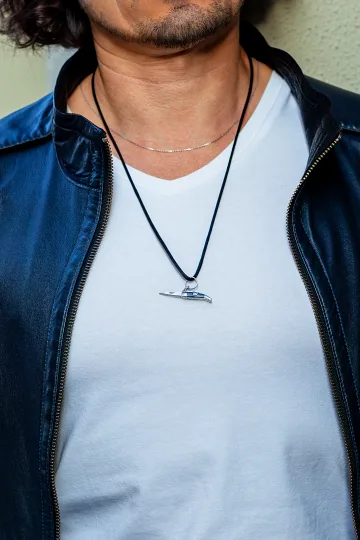





FAQ
Is Temperance the card of abstinence from alcohol?
Historically the word "temperance" in nineteenth-century English really was associated with the movement for sobriety (the Temperance Movement). That left its mark on some readings of the card. But within the Tarot system, Temperance is the principle of balance and integration, applicable to every sphere of life: energy, attention, feeling, action. Reading it through alcoholism is a historical and cultural layer, not the heart of the archetype.
Who is on the card, the angel Michael or Raphael?
The tradition is divided. Waite did not name the angel openly. Most modern interpreters lean toward Michael as the "chief" archangel. But iconographically and thematically Raphael fits better: he is the healer and traveller who accompanies people through difficult passages. The choice of reading depends on how you understand the function of the card: as judgement and the restoration of order (Michael) or as healing and accompaniment (Raphael).
What does the triangle within the square on the angel's robe mean?
It is an alchemical and geometric symbol. The square, the four elements, the material world, earthly limit. The triangle inside, spirit, the creative principle, the Trinity. Spirit placed within matter, not opposed to it. Temperance says: spiritual work happens within life, not beyond it.
Temperance in a reading on love, a good sign?
Upright, yes, a good one. It is the card of mature, balanced interaction between two people. Not a passionate beginning, but steady, healing relationships. If you are seeking an answer to "will our relationship recover?", upright Temperance says: the process is underway, give it time. Reversed, a signal of imbalance: someone gives too much, someone too little.
Why is Temperance linked to Sagittarius and not Libra?
The logic is not obvious at first. Libra is the clear symbol of balance. But in the Western esoteric tradition the link between an arcanum and the zodiac is built on a direct correspondence of the image. Sagittarius as a mutable Fire sign carries the idea of flexibility and search: not the static balance of Libra, but a dynamic balance in motion, like an archer adjusting the aim. Jupiter as ruler adds wisdom and the philosophical reflection on experience.
Meditation with Temperance: how to use the card?
Temperance works well as an object of contemplative practice. Look at the card carefully: where in your life right now is one "cup" overflowing and the other nearly empty? Which opposites inside you have not yet found a way to talk to each other? The image of the angel patiently pouring liquid works as a reminder: integration is a process, it has its own pace, and it does not need to be hurried.
Practice with the card: place Temperance in front of you. Close your eyes for a few minutes. When you open them, ask yourself one question: "What in me right now is asking to be mixed?" Write down the first answer that comes, without analysis. That is your personal Temperance theme for this period.
Temperance in a reading on work: what does it mean?
Upright Temperance in a work reading speaks of the need for balance: between work and rest, between effort and recovery, between different projects. A good sign for long processes that call for patience. Reversed, a signal of overload or a misalignment of priorities.
Why is the card called Temperance if it shows an angel rather than a person?
In the medieval allegorical tradition the virtues were often depicted as personified figures, angelic or like goddesses. Temperance-Temperantia was an allegory: not a particular being, but an embodied principle. When Waite and Smith turned her into an angel, they kept this logic: Temperance is a principle that works through us yet reaches beyond human effort. The angel as a mediator between the elements is more precise than a human: it belongs to both worlds.
How do Temperance and Strength (Arcanum VIII) relate?
Both arcana are about gentle work with what cannot be broken by force. Strength tames the lion through love, it is about the relationship to the inner beast, to the instincts. Temperance mixes opposing liquids, it is about the relationship to two different parts of yourself or a situation. Strength fits better when you need to accept something you used to reject. Temperance fits better when you need to set up interaction between two things that never found a common language. In some traditions they are placed side by side as two phases of one work: first acceptance (Strength), then integration (Temperance).
Can you wear jewellery with Temperance symbolism without knowing Tarot?
You can. The symbols of angel, butterfly, dove and wave carry meaning in themselves, independent of Tarot. Jewellery with an angel is jewellery about protection and healing presence. With a butterfly, about transformation. With a dove, about peace and reconciliation. Tarot only adds another layer of meaning for those interested in the archetypal system. But the core meaning of these symbols works without that context.
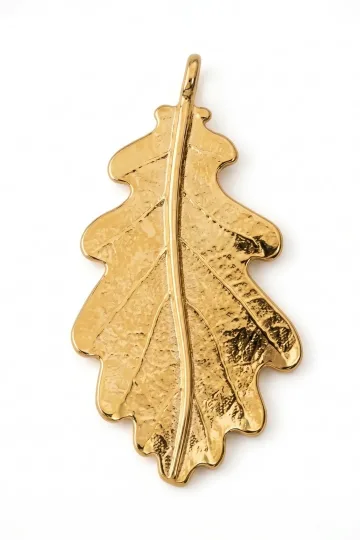
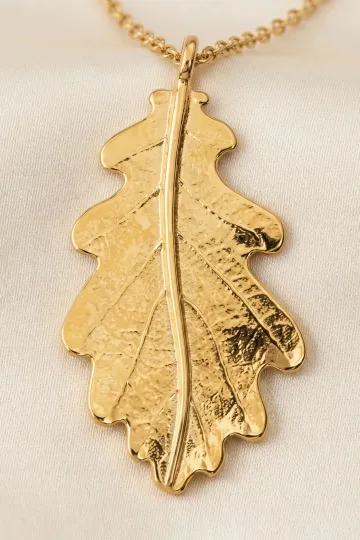
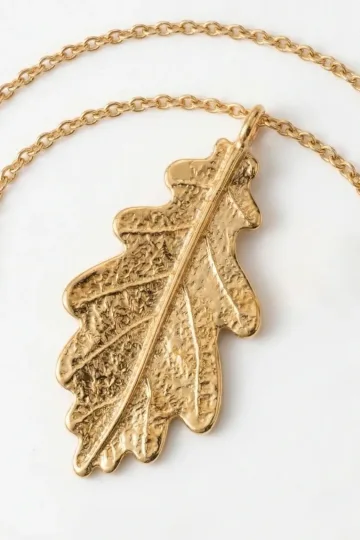
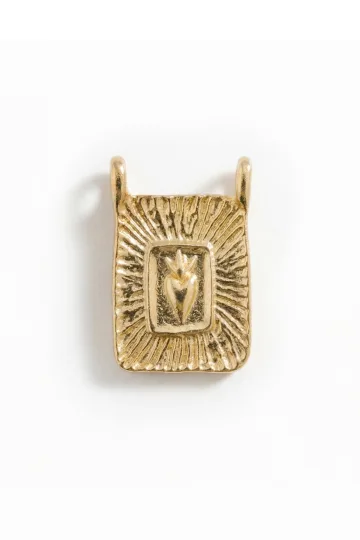
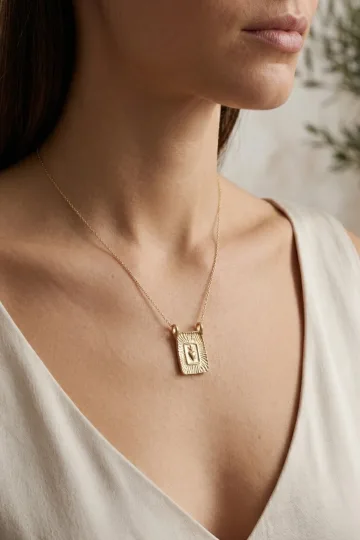
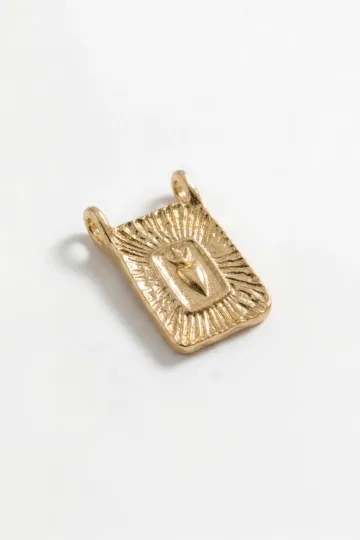
Wear the symbol, don't just read about it. These are in stock:

Conclusion
That client who woke and for a few seconds simply was, without pain, without the memory of pain, did not "get well" that morning. Her story did not end. But something important happened: two cups inside her began to interact. The one that held the pain, and the one that held "just living."
Temperance does not promise completion. It describes movement. The angel by the water with two cups does not stand on the bank forever, it goes to where the sun rises between the mountains. But first it does its work here: patiently, against gravity, the liquid from cup to cup.
The jewellery that resonates with this archetype, the dove of peace, the angel with open wings, the butterfly at the moment of hatching, the wave at the moment of a calm tide, does not say "you are already fine." It says "the process is underway." That is something else. Sometimes it matters more.
Arcanum XIV has existed in Tarot for six hundred years. In that time millions of people have seen in the image of the angel by the water exactly that: the moment when what was broken begins to gather again. Not because the card is special. Because that moment is part of any human experience.
Temperance gives no answer to "what comes next." It answers the question "can I take my time." Yes. You can. The angel by the water is in no hurry. The liquid flows against gravity, and that alone is already impossible, already alchemy, already reason enough to slow down and trust.
The next time you want to force something, to rush yourself or someone near you, remember the angel with the cups. It does not hurry the water. It simply holds the cups and lets the current happen.
That is often enough.
Silver, gold, wedding rings, symbolic pieces, paired sets.
About Zevira
Zevira makes jewellery in the artisan tradition of Albacete, Spain. Temperance as the archetype of integration and healing shows in pieces that carry the language of quiet recovery.
What you can find with us for the symbolism of Temperance:
- Angel pendants in silver and gold, with different wing styles
- Butterfly charms, the symbol of a finished transformation
- Feather pieces, lightness after something heavy
- Wave bracelets and pendants, the principle of flow without struggle
- Paired jewellery for two in balance
Each piece is made by hand by a craftsperson, with the option of personal engraving. We work with 925 silver and 14 to 18K gold.