The Moon in Tarot: Meaning, Symbols, and Jewelry Symbolism of Arcanum 18
It's 3 AM. You're lying awake and staring at the ceiling. Sleep slipped away somewhere halfway through, and now something unfinished keeps spinning in your head: not a thought, not a fear, but something in between, with contours you can't quite grasp. Outside the window it's neither dark nor light. The moon floods the room with whitish light that shows everything slightly differently than it actually is. Shadows are a little longer than they should be. Angles a little sharper.
This is the Moon's state. Not nightmare and not enlightenment. Not anxiety and not peace. Something shimmering between them, where the boundary between real and imagined turns unstable. Where the unconscious lifts from the bottom what waking consciousness preferred not to notice.
Arcanum 18, the Moon, is one of the most complex and at the same time most honest images in Tarot. It promises no salvation and threatens no catastrophe. It simply says: night exists. Darkness is real. And passage through it is possible, as long as you don't pretend it isn't there.
What follows is the card's history from the first Italian decks to Crowley's Thoth, a reading of every symbol in Rider-Waite-Smith iconography, the Moon's links to world mythology, astrology and depth psychology. And, above all, how jewellery with lunar and wolf motifs becomes the visible language of this archetype.
The Moon's Place in the Arcana: Darkness Between Star and Sun
Arcanum 18 stands between two of Tarot's most reassuring cards. The Star, Arcanum 17 is hope after the trial, recovery, the soft light that rises when the storm dies down. The Sun (19) is clarity, joy, direct light without shadows.
Between them, right in the middle, stands the Moon. This position is no accident.
The Fool's journey through the Major Arcana describes not the biography of a particular person but the passage of consciousness through different kinds of experience. After the Tower (16), the wrecking of old structures, the Star appears: the first breath after catastrophe. But before the full light of the Sun, you have to pass through the Moon, through the darkest place on the path. Through what cannot be skirted, only crossed.
Wear the symbol, don't just read about it. These are in stock:
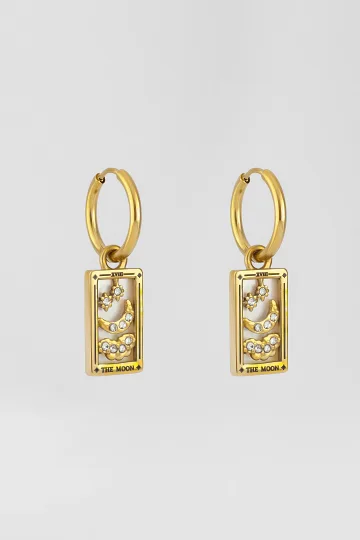


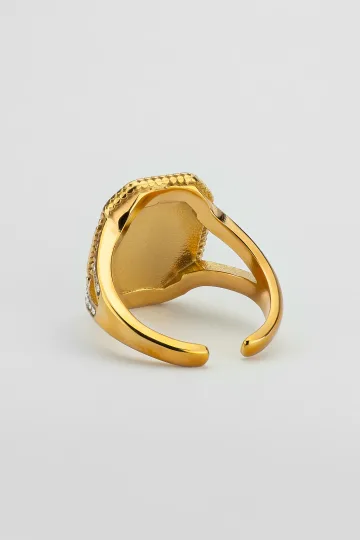
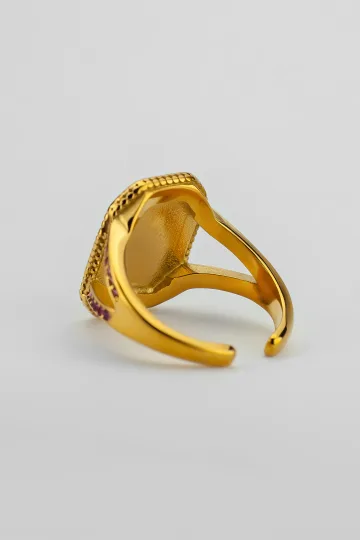
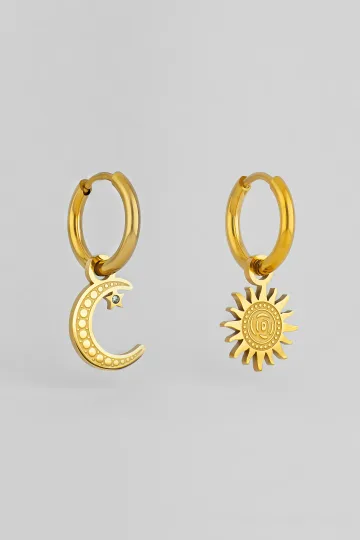

The Moon describes a period when the old is already broken and the new is not yet built. When landmarks are gone and the familiar map of reality no longer matches what you see. This is not a crisis in the sense of catastrophe. It's a transition: unavoidable, uncomfortable, but working.
The number 18 in Tarot numerology folds into 9 (1+8). The nine in the Major Arcana is the Hermit (9): solitude, inner search, a lantern that lights only the next step. The Moon and the Hermit are tied by this shared number: both are about walking alone through darkness. The difference is that the Hermit has a lantern. The traveller in the Moon has nothing but unreliable moonlight.
In the context of the universal path of initiation, the Moon matches what mystical traditions call the "night of the spirit", the dark night of the soul in John of the Cross, Orpheus's descent into Hades, Inanna's passage through the seven gates of the underworld. This is not punishment and not a mistake. It's a mandatory stage, without which the light of the Sun would be only a pretty picture rather than lived knowledge.
The Card's History: From Visconti to Thoth
Early Italian Decks: La Luna
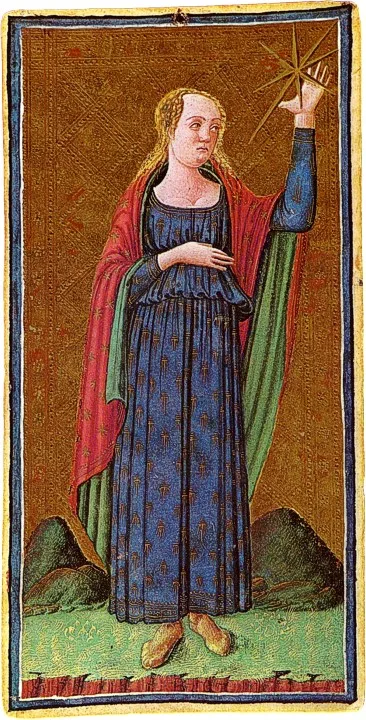
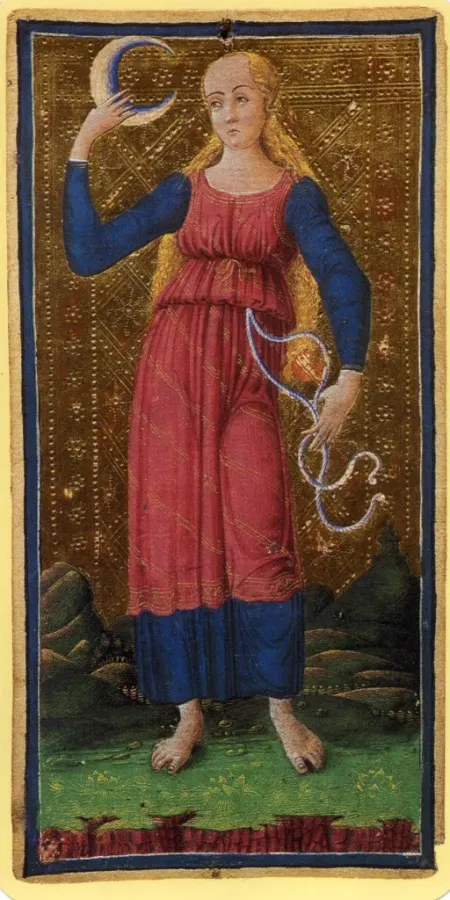
The card La Luna appears in the earliest known tarots, made for the North Italian courts of the 15th century. In the Visconti-Sforza deck (around 1450, Milan), the Moon is shown as a female figure holding a lunar disc above her head. The image is plainly astrological: one of the seven planets of traditional astrology, personified in the Italian court fashion of the time.
The visual language of these early cards was more direct than that of later decks. The Moon meant the Moon: a celestial body governing night, cycles, moisture, dreams. No psychology in the sense we read into it today, only astrological allegory.
In another early Italian deck, the Florentine Minchiate (16th century), the Moon is already shown more symbolically: a huge lunar disc, figures below, a hint of water.
The Marseille La Lune: the Iconography Crystallizes
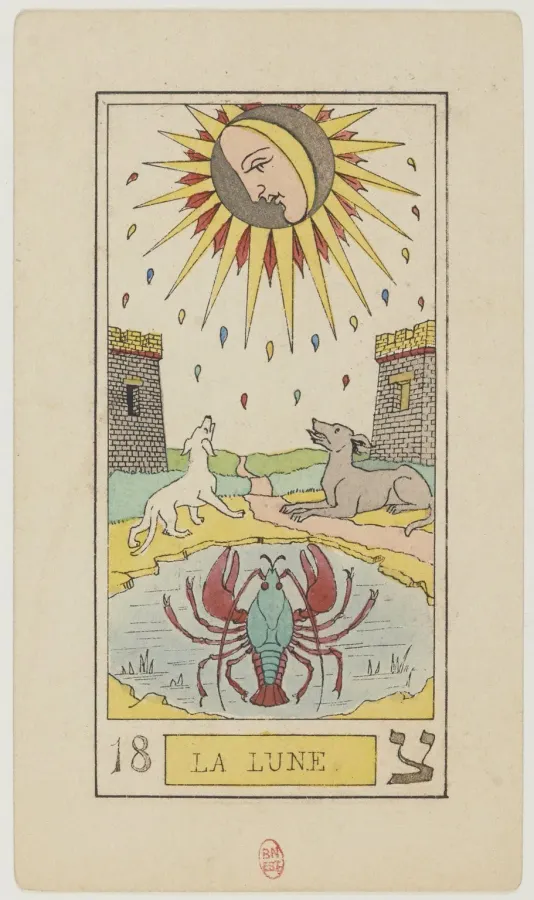
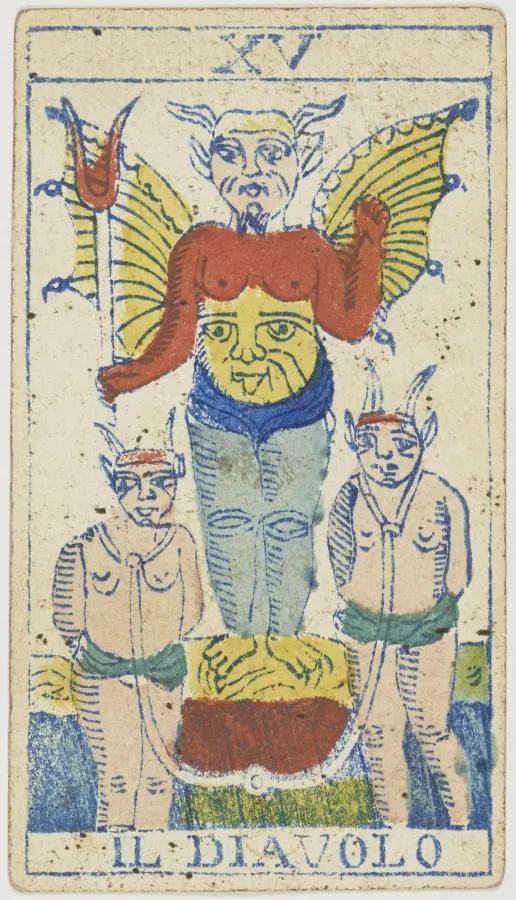
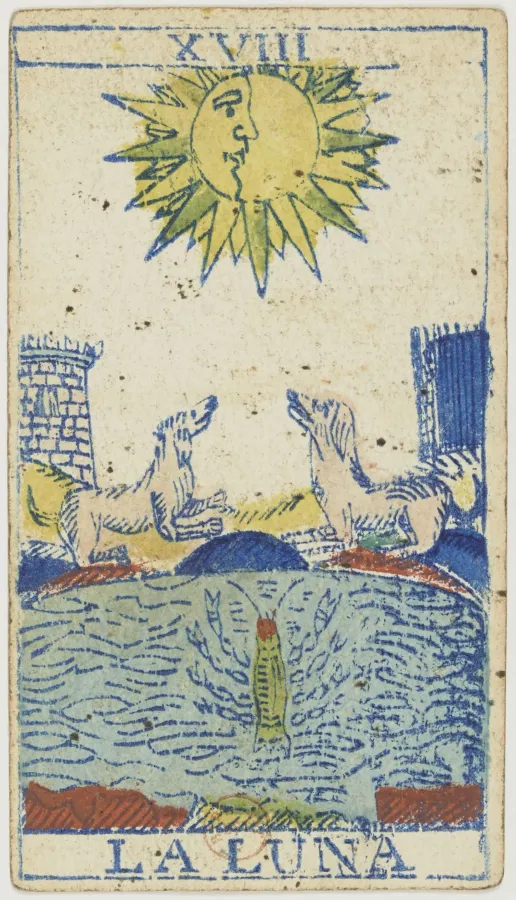
In the Marseille Tarots of the 16th and 17th centuries, the Moon's iconography begins to take on the shape Waite would later develop. La Lune in classic Marseille decks shows:
- A large lunar disc with a human face at the top of the card
- Drops falling from the disc (in some versions rendered as dots or tears)
- Two animals below, most often a dog and a wolf or two dogs
- Towers on either side
- Water or a pool with a crustacean creature in the foreground
The Marseille tradition was practical and living: decks were made for play, not for occult systems. But card imagery formed through generations of engravers and image carriers, and by the 17th and 18th centuries La Lune had a stable visual appearance.
One detail of the Marseille Moon is especially interesting: the drops falling from the disc. Some traditions read them as dewdrops, others as blood, others as "heavenly moisture." In Waite's system they become the fifteen drops of the Hebrew Yod. The Marseille tradition left this detail deliberately ambiguous, which is itself characteristic of the Moon archetype.
Rider-Waite-Smith 1909: a Psychological Turn
Arthur Edward Waite and Pamela Colman Smith created in 1909 the Moon version that became canon for most modern card readers. Their reworking was both artistic and carefully thought through in meaning.
Waite, a member of the Hermetic Order of the Golden Dawn, worked in an occult system where every element of a card carried a precise meaning. Pamela Colman Smith, an artist with theatrical training and a sharp symbolic instinct, translated that system into a visual image you could read like a scene, like a moment from the play of life.
The main Waite-Smith changes compared with the Marseille tradition:
The Moon got a more complex face: full and crescent at once, with human features, lighting the landscape with unreliable light. It gives off not the warmth of the sun but a strange, contour-bending light that makes familiar things strange.
The crab crawling out of the water became more distinct. No longer a decorative detail but the symbol of a creature rising from the bottom.
The road winding toward the horizon between two towers added a plot: this is the path you have to walk. It is not straight and gets lost in the mist.
Crowley's Thoth: the Astral Plane and Intuitive Dread
Aleister Crowley, in his Thoth system (developed from 1938, published posthumously in 1969), gave the Moon card another dimension. In Thoth the Moon is the card of illusion in the deepest sense: of anxiety and fear, but more so of the very nature of maya, the illusoriness of perceived reality.
In the Thoth system the Moon is tied to the astral plane, that region between physical reality and pure spirit where images and desires blend with truth. The artist Frieda Harris depicted in her version of the card an intricate geometric construction Crowley described as the lunar illusion in action.
Crowley held that the Moon in Tarot describes exactly the moment when vision turns unreliable, when intuition can be either revelation or self-deception. The traveller's task is not to trust what you see but to learn to tell the difference.
A labradorite flashes on a black dress and dark silver. On pastel it plays dead, and frankly so would I.
What to Wear Moon Symbolism With
When I put a lunar look together for a client, I start not from sparkle but from the quiet around the stone. Here is what actually works for me, by occasion.
What do you wear with a moonstone every day? For everyday I recommend a thin chain with a small moonstone cabochon over a plain turtleneck, a linen shirt or a simple tee. Cool tones (grey, graphite, dark blue) bring out silver and the blue glow better than a warm beige. For a deep neckline I suggest a single pendant on a longer chain, and for a high neck a short length or earrings.
Does lunar symbolism work at the office? It does, if you keep it restrained. I choose one moonstone in silver, without sparkle or layers. A business setting loves brevity, and a single fine detail reads as taste rather than a loud accent. A strict dress code is no sentence: the stone sits happily under the top button.
How do you build an evening look? For the evening I recommend a large labradorite that flashes blue and green in motion under artificial light. A black, wine or emerald dress turns the stone into the centre of the look, and crescent earrings add rhythm.
How do you mix metals and layers? Keep to one temperature. I suggest oxidised silver with white gold and platinum, while yellow gold sounds foreign in lunar looks. I build layers by length: a short crescent, a mid-length stone, a long pendant, so the eye moves top to bottom without crowding.
Who does this archetype suit? Those who live in half-tones: the thoughtful, the nocturnal, those drawn to depth. For length I recommend 45 centimetres and one accent for a slender neck and an open neckline, and for layering I combine 40 and 55.

Turn on your camera, pick earrings, a pendant or a ring, and see the piece on yourself in real time.
Switch items in one tap.
Everything runs in your browser: no photo or video is ever uploaded.
Rider-Waite-Smith Iconography: Every Symbol
The Moon with a Face: Dual Light
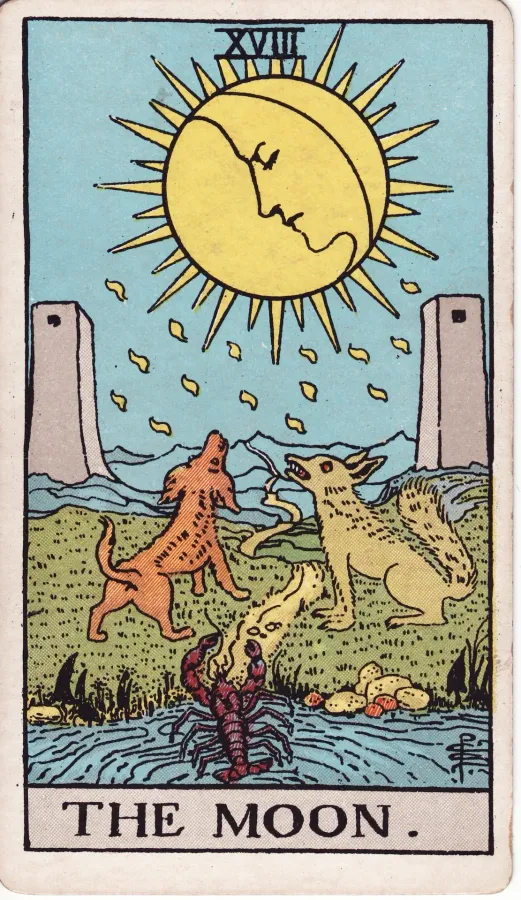
In the upper part of the card, at the centre, hangs an enormous Moon with a human face. This is a full moon: it combines both the full disc and the crescent, which makes the image astronomically impossible but symbolically exact.
The Moon reflects the sunlight but adds its own: changes it, distorts it, makes it unreliable. The Sun shows things as they are. The Moon shows the shadows of things. The face of the Moon on the card looks down at the traveller, but it's not a look of care, it's the look of a witness: it sees but does not interfere.
Fifteen drops of Yod, symbols shaped like the Hebrew letter Yod, fall from the lunar disc. Yod is the initial letter of God's name in Kabbalah, a symbol of spiritual seed, of potency. Fifteen drops correspond to the number 15, which in Tarot numerology points to the Devil, Arcanum 15: illusion, bondage, the material trap. But the same drops are also a spiritual rain, tears, dew. As with everything in the Moon card, they can be read in opposite ways.
The Crab from the Water: the Unconscious Rises
From the pool in the foreground crawls a crab, in some readings a lobster or crayfish. This is a creature that lives in the depths, in what cannot be seen from the surface. Its emergence from the water symbolises the rise of unconscious content: the images, fears, desires and memories that usually stay below the level of awareness.
The crab is vulnerable and slow on land. It is built for life in water, for pressure and darkness. Forced to rise to the surface and move through moonlight, it is out of its element. This is an exact image of what happens when repressed psychic content begins to show itself: uncomfortable, slow, foreign to daytime consciousness.
The pool behind it is the unconscious itself: bottomless, with no visible boundaries, reflecting moonlight so that surface and depth look the same.
Wolf and Dog: the Wild and the Tamed
Two animals howl at the moon on either side of the path. The right one, lighter, is a dog. The left one, darker, is a wolf.
The dog and the wolf are two poles of one nature. The dog is tamed, socialized, living in the human world, having accepted its rules and traded part of its wildness for safety and belonging. The wolf is wild, instinctive, following its own laws, beyond the full grasp of the civilized mind.
Both howl at the Moon. Both acknowledge its power. Training did not cancel the lunar call. Civilization did not remove instinct. Beneath the surface of the socialized self lives the same nature that cries out in the night.
In Jungian psychology this pair can be read as the relation between the persona (the dog, the public self) and the shadow (the wolf, the repressed aspects): both are present, both react to the same thing, but differently.
Two Towers: Guardians of the Crossing
On the horizon stand two identical towers, on either side of the winding road. They mark the threshold between the familiar world and the unknown.
Unlike the towers of the High Priestess, which stand for fundamental opposites (Jachin and Boaz), the towers of the Moon are identical. There is no obvious difference here between left and right, between good and bad. The unknown is the same on both sides.
The path runs between the towers and gets lost somewhere beyond the horizon, in mountains or mist. The traveller doesn't know where it leads. There is no map. There are no landmarks. There is only the next step in a light that makes everything equally unreliable.
In historical terms, two towers on the horizon are also an image of city gates: leaving the safe space for the outer, uncontrolled world. The crossing from the known into the unknown.
The Winding Road: a Path Without Guarantees
The road begins at the water and runs between the towers toward the horizon. It is not straight, which visually sets the Moon card apart from many other arcana. This is a path with no straight lines, no clear direction, with turns that prevent you from seeing what lies ahead.
The winding of the road tells you there is no shortest way here. You can't set a course and walk straight. You have to follow the bends without knowing where they lead, trusting the movement itself rather than a route calculated in advance.
This is an exact image of the processes the Moon describes: therapy does not run straight. The creative breakthrough is not scheduled. Coming out of a dark period does not look like a line on a graph.
The Archetype of the Moon: When Intuition Is Anxious
The High Priestess and the Moon are tied to one astrological symbol, the Moon. But they describe fundamentally different ways of existing within that link.
The High Priestess knows that she is in the dark. She sits at its entrance and holds that knowledge calmly, with dignity, as part of her nature. Her intuition is quiet, confident, in no need of confirmation.
The Moon (Arcanum 18) describes a person who has fallen into the dark and isn't sure there is a way out. Their intuition exists, it is real and often accurate, but it is coloured by anxiety, uncertainty, an inability to tell the real from the imagined.
That is the essential difference: the Priestess governs the lunar space. The traveller of the Moon is swallowed by it.
The Unconscious as Territory
Arcanum 18 describes what psychology calls the unconscious. This is not mysticism and not metaphor. The unconscious is the processing of information that happens below the level of conscious attention. Most of our mental life, up to 95% by some estimates, happens there.
Fears stored in the body. Patterns of reaction formed in childhood. Desires too contradictory to admit consciously. Memories that can't be summoned directly but that shape every decision.
When the Moon card appears in a reading, it's a signal: something from this territory is rising to the surface. It can feel unsettling, because we're used to a particular version of ourselves, the one visible in daylight. The night version is different.
Illusions: When You Don't Know What's Real
The Moon creates illusions. Not because it is cruel, but because that is how it works: it lights things, but not fully. Familiar things look different. Shadows seem like creatures.
In psychological terms, the illusions of the Moon are cognitive distortions running in night mode. Catastrophizing: a small problem swells to the size of disaster at 3 AM. Projection: someone else's behavior is read through the lens of your own fears. Magical thinking: random events are linked into meaningful patterns.
The card does not say all this is unreal. It says: check. What frightens you now may be the shadow of a real thing, not the thing itself.
Fears: the Archive of the Unlived
The fears the Moon raises are often not new. They are old fears, unworked, unlived, postponed for later. From childhood. From past relationships. From experience that was too painful to stay in contact with.
The dark night Arcanum 18 leads into is, in a sense, a meeting with this archive. Unpleasant, often uncomfortable, sometimes frightening. But the archive exists whether or not you look at it. The Moon simply creates the conditions in which it is harder to ignore.
Customer reviews
Zevira is a real jewellery shop. Genuine payments, deliveries and customer thank-yous.
🥰🥰🥰 gracias
Ok, ¡gracias! 🙂
Upright and Reversed Meanings
Upright: Darkness as Part of the Path
In the upright position the Moon describes a period when something hidden rises to the surface. It can show up in different ways: anxiety with no clear cause, recurring dreams or images, the sense that something is wrong without being able to name what. A creative impulse coming from the dark, irrational part of the psyche rather than from planning.
In relationships, the upright Moon can point to something unspoken: fears not voiced, suspicions without grounds or with grounds that are hard to put into words. In a professional context, a period of uncertainty with no clear plan, no guarantees, no landmarks.
The message of the upright Moon is not alarming but directive: don't run from what is rising. Let it come out. What stays in the dark, unlived, does not vanish; it rules from the unseen.
In the position of advice or current situation, the upright Moon says: stop. Don't make decisions now, because you don't see the full picture. Direct action under the influence of fear or illusion leads the wrong way. First let what is hidden show itself.
The upright Moon as a description of a person in a reading shows someone who is currently in transition: this is not weakness and not a problem, it's a state. It should be met with patience rather than attempts to force a clarity that isn't there yet.
Reversed: Illusions Dissolve or Intensify
The reversed position of the Moon is read in two ways, and that itself is characteristic of the archetype.
First version: the dark period is ending. Illusions dissolve, fears lose their power, landmarks return. The light of the Sun on the path. This is the reading that speaks of movement out of darkness into clarity.
Second version: fears and illusions intensify, denial becomes active. A person refuses to see what is visible by moonlight and hides in even deeper darkness. The reversed Moon in this sense is a warning: you cannot endlessly postpone the meeting with what rises from the depths.
In a reading the context and the neighbouring cards matter: what surrounds the Moon? What is the theme of the reading? Whether the straightforward meaning (dissolving) or the reverse (intensifying) applies depends on the overall picture of the spread.
Upload a photo of your pet, someone you love, or an object. We'll build a 3D model and hand-cast it in pewter.

Kabbalah and the Path of Qoph: the Body as Gate of the Unconscious
In the Tarot system developed by the Hermetic Order of the Golden Dawn and elaborated by Waite, each Major Arcanum corresponds to a Hebrew letter and a path on the Kabbalistic Tree of Life.
The Moon (Arcanum 18) is tied to the letter Qoph (ק) and the eighteenth path. Qoph literally means "back of the head", both anatomically and in the sense of what stands behind, what is invisible from a direct view.
This is an exceptionally precise metaphor for the card. The Moon describes what lies behind, beyond the horizon of direct vision. The back of the head is the blind spot of literal sight: we don't see what is right behind us. What's more, the back of the brain (the occipital cortex, the limbic system) handles exactly what the Moon symbolises: the processing of visual images, emotional memory, fear, archaic reactions.
The path of Qoph on the Tree of Life joins Netzach (Victory, the emotional nature) with Malkuth (the Kingdom, the physical world). It is a descent from the emotional to the material. Fears that began as abstract feelings end up embodied in the body: which is exactly what the picture of the Moon describes.
The body as the gate of the unconscious explains a great deal in this card. The fears that rise in Arcanum 18 rarely stay pure thought. They are bodily states: tension in the shoulders, quickened breath, heaviness in the chest. The crab crawls out of the water for a reason: it is the image of how bodily experience rises to the surface of awareness, slowly, awkwardly, from the depths.
Somatic approaches in psychotherapy (Peter Levine, Bessel van der Kolk) describe exactly this route: trauma is stored in the body. The path to its integration runs through the body, through words and thought. The Moon speaks of this in the language of symbol many centuries before neuroscience appeared.
Pisces and Neptune: the Moon's Astrology
In Waite's system, built on the work of the Hermetic Order of the Golden Dawn, each Major Arcanum is assigned an astrological symbol. Arcanum 18, the Moon, corresponds to the sign of Pisces and to the ruler of Pisces, Neptune.
Pisces: the Last Sign of the Zodiac
Pisces is the twelfth and last sign of the zodiacal circle. In archetypal astrology this makes it the keeper of the collective experience of all twelve signs: it carries the trace of every one before it.
Pisces is described as the most permeable sign, with thin boundaries between self and other, between the real and the imagined, between the conscious and the unconscious. This is not a flaw but a special kind of perception. Pisces often knows more than it can explain. Its understanding is intuitive, not analytical.
This is the same quality Arcanum 18 describes: knowledge that comes from the depths rather than from the surface. Access to what the rational mind would rather not notice.
The trap of Pisces, like the trap of the Moon, is the inability to tell the real from the imagined. When permeability turns into merging, when intuition turns into anxious fantasy.
Neptune: Lord of the Depths and Illusions
Neptune in astrology governs the unconscious, dreams, mysticism, illusions and everything that dissolves clear boundaries. It is a planet not of certainty but of merging: where does "I" end and "other" begin? Where does reality stop and fiction start?
A strong Neptune in a birth chart often describes people with developed intuition, creative imagination and a leaning toward mystical experience. The same people not infrequently meet confusion, self-deception, difficulty with practical decisions.
Neptune was discovered in 1846, first mathematically (Adams and Le Verrier), then by observation (Galle). The discovery fell in an era when psychoanalysis did not yet exist but the idea of the unconscious was already beginning to form. Neptune entered the astrological system at the same time as the awakening of interest in the depths of the psyche.



The Moon in World Cultures
Selene and Luna: Greco-Roman Goddesses of the Night
In Greek myth the Moon is Selene (Σελήνη), goddess of the full moon, ruling the night and the moon. She is the sister of Helios (the Sun) and Eos (the Dawn), part of the three aspects of the solar day and night.
The best-known myth of Selene is her love for the mortal shepherd Endymion. She fell in love with him so deeply that she asked Zeus to grant him eternal sleep, so she could visit him each night and he would stay forever young. Endymion sleeps on Mount Latmos, and Selene visits him again and again. This is a myth of love for the unattainable, of attraction to what cannot be fully had.
The Roman equivalent is Luna, who gave her name both to the card and to words like "lunar" and "lunatic." The temple of Luna on the Aventine Hill was one of the oldest in Rome.
Artemis and Diana: the Huntress and the Lunar Maiden
Artemis, goddess of the hunt, the moon and the woods, holds a special place in Greek myth in connection with the Moon, even though strictly speaking the Moon is Selene. Artemis is the lunar maiden in the guise of a huntress: independent, living in the forest, not subject to social laws.
If the Priestess (Arcanum 2) is linked to Artemis in her quiet, self-sufficient aspect, the Moon (18) is linked to her in the aspect of the night forest: the darkness where beasts live, and danger, and something wild beyond the reach of civilisation.
Diana, the Roman equivalent, became in folk tradition the patroness of witches. Medieval treatises described witches flying at night in Diana's retinue, which reflects the link of the nocturnal, feminine, lunar aspect with the kinds of knowledge official culture preferred not to acknowledge.
Hecate: the Dark Moon
Hecate is the three-faced goddess of magic, crossroads and the dark moon. If Artemis is the new moon or the full moon in its triumph, Hecate is the waning moon, the dark moon, the hidden part of the lunar cycle.
Hecate governs the aspects Arcanum 18 shows most clearly: transitional states, the space of crossroads (where you have to choose without knowing what lies ahead), magic available only at night, the dead who have not found rest.
Her attributes are torches (to see in the dark), keys (to open hidden doors), dogs (her constant companions). Hecate's torches light not so that everything becomes clear, but so the traveller can move on. Not knowledge, but the ability to keep going.
The cult of Hecate was widespread in Greece and Asia Minor. At crossroads stood the Hecataea, three-sided statues of the goddess. This literally embodied the idea of the Moon: to stand at a crossroads and not know which road to choose.
Chang'e: the Chinese Goddess of the Moon
Chang'e (嫦娥), goddess of the moon in Chinese myth, lives in a palace on the Moon in eternal solitude. Her story is tragic: she drank an elixir of immortality not meant for her and rose to the Moon, where she now dwells forever.
In some versions of the myth she took the elixir by accident, in others on purpose, saving it from an evil man. The moral ambiguity is characteristic of the lunar archetype: was her act a rescue or a theft? Is her fate a punishment or a special kind of existence?
Chang'e is often shown with a rabbit pounding in a mortar on the moon. The rabbit is another lunar symbol in many Asian cultures: the shadow on the full moon is read as the figure of a rabbit.
The Mid-Autumn Festival in China is dedicated to the Moon and to Chang'e. It is a family holiday, a time of reunion, yet its central image is a goddess forever cut off from everything she loved.
Tsukuyomi: the Japanese God of the Moon
In Japanese myth the Moon is Tsukuyomi-no-Mikoto (月読命), god of the moon, born together with the Sun goddess Amaterasu and the storm god Susanoo.
Tsukuyomi killed the food goddess Uke Mochi because she served food prepared in an unpleasant way. Amaterasu was so outraged by this killing that she turned away from Tsukuyomi forever. That is why, the myth says, the Sun and the Moon never appear in the sky at the same time: they are in eternal conflict.
This myth describes the split between the lunar and solar principles, between darkness and light, that cannot be bridged by dialogue. It is neither war nor reconciliation; it is a constant alternation in which the presence of one means the absence of the other.
The Moon in Mesopotamian Myth: Nanna and Sin
Among the oldest moon gods in human history are the Sumerian Nanna and the Akkadian Sin. Unlike most other mythological traditions, in the Mesopotamian system the Moon is a male god, senior in the pantheon, father of the Sun.
Nanna governed time and counting: he moved across the sky in predictable cycles, providing the basis for the first calendars. His main temple at Ur (modern Iraq) was one of the largest religious structures in the Near East. The priesthood of Nanna's temple kept lunar observations that became the foundation of the first systematic astronomy.
This is an important shift of emphasis: the Mesopotamian Moon is not anxious and not irrational. It is precision, rhythm, a basis for measurement. The same celestial object that in one tradition symbolises the chaos of the unconscious symbolises in another the order of time.
Inanna and Lunar Initiation
The Sumerian myth of Inanna, goddess of love and war, contains one of the oldest accounts in world literature of a descent into the underworld. Inanna goes down into the realm of the dead, ruled by her sister Ereshkigal, and at each of the seven gates she takes off one attribute of power: her crown, earrings, necklace, breastplate, belt, bracelets, robe.
Naked and defenseless, she dies in the underworld. Then, with the help of the gods, she is reborn and rises back. This is one of the oldest stories of death and resurrection, but read not as tragedy but as transformation: she returns changed.
This myth describes exactly what Arcanum 18 speaks of: a path through darkness in which you have to strip off everything protective and live through it. On the other side, what is unreachable on this one becomes possible.
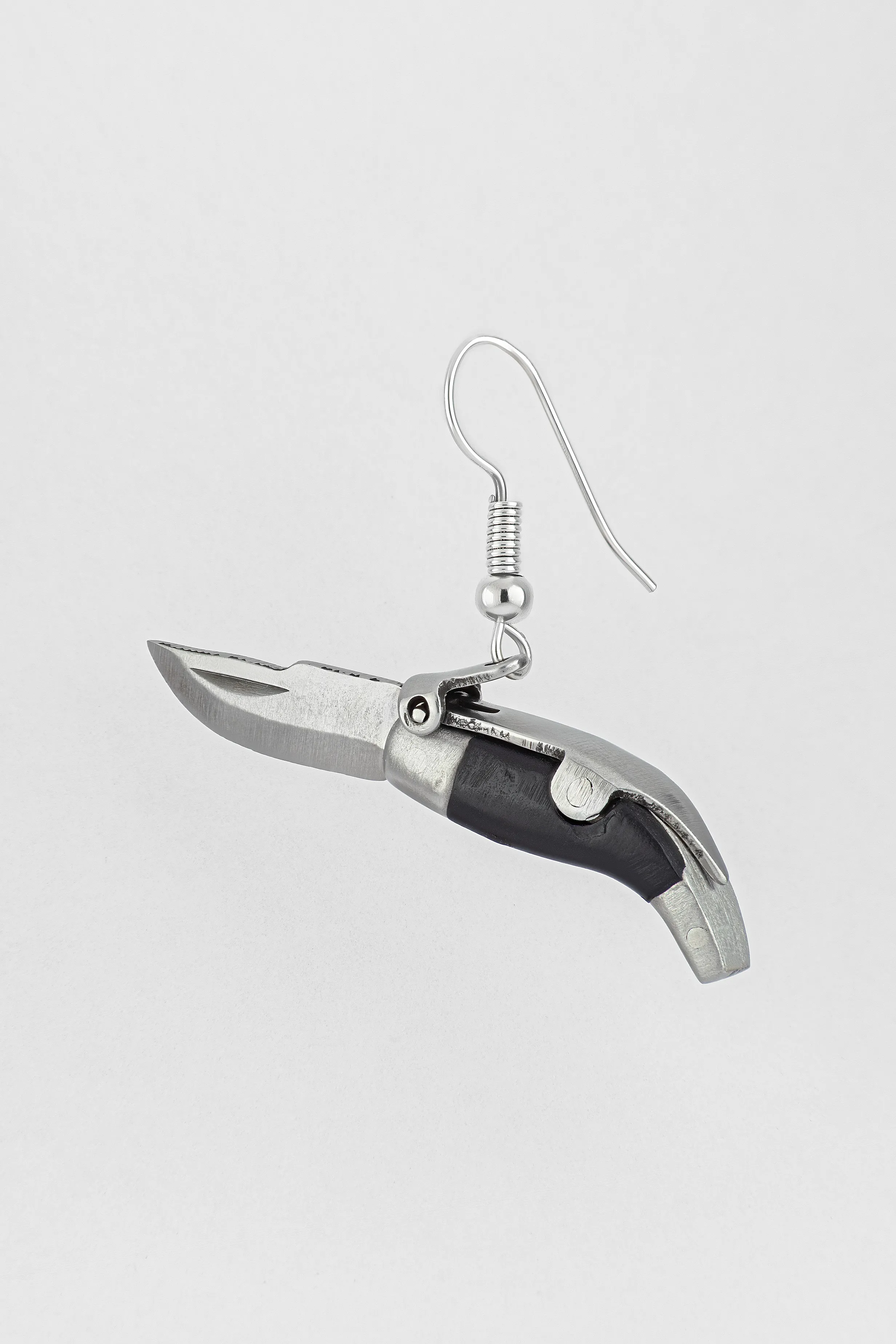
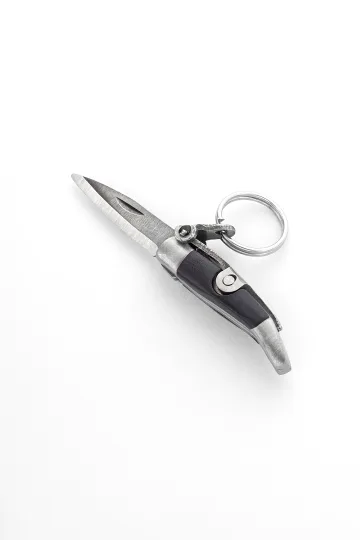
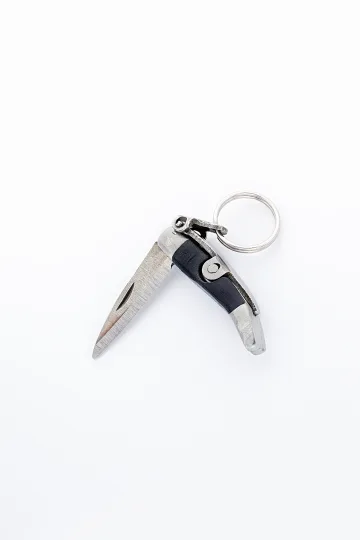
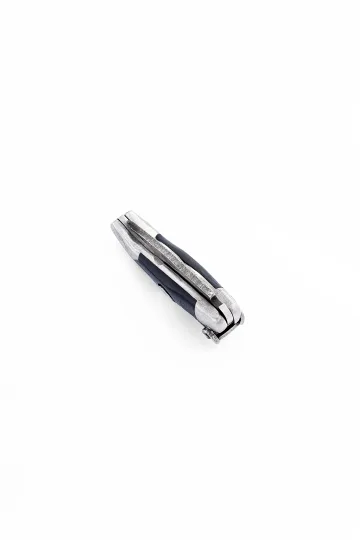
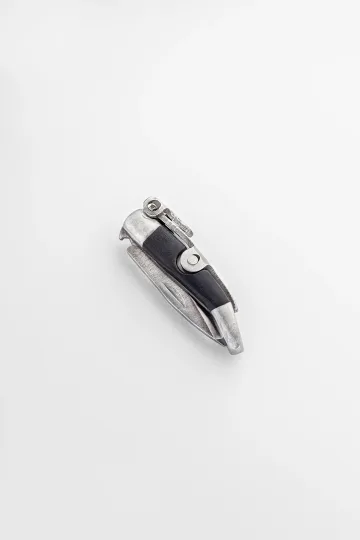
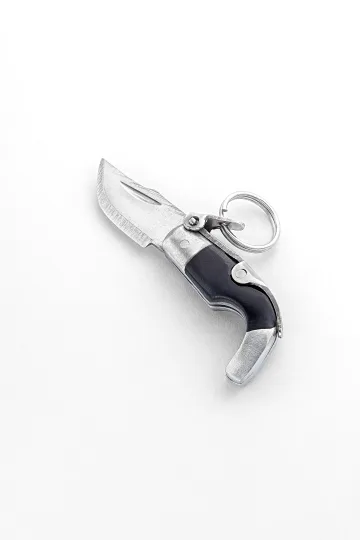
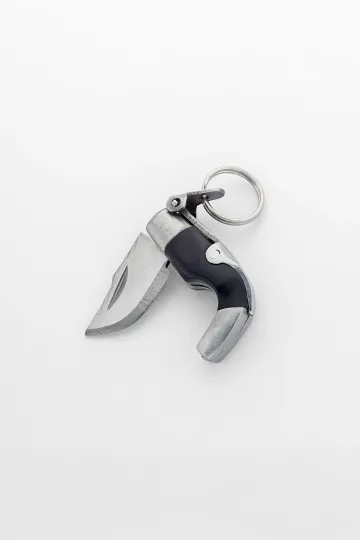
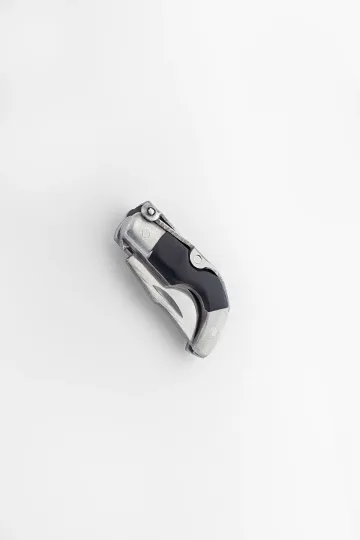
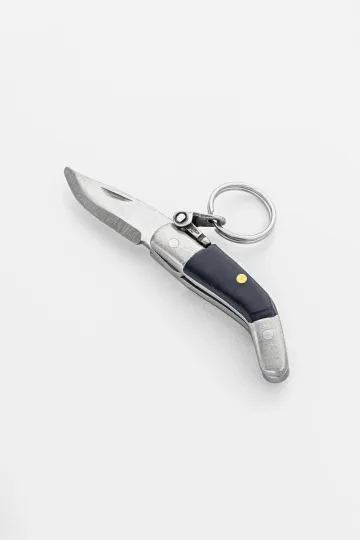
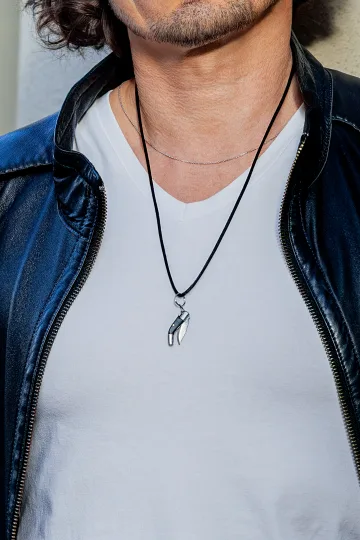
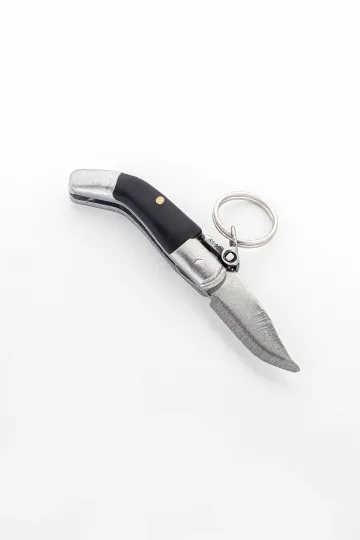
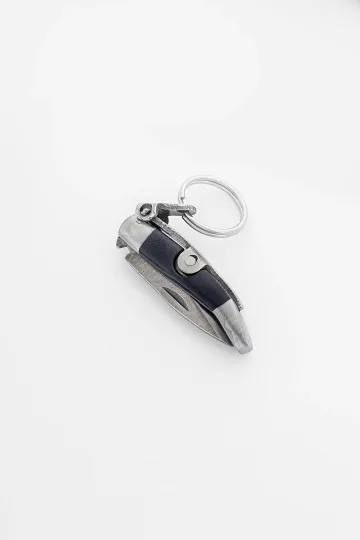
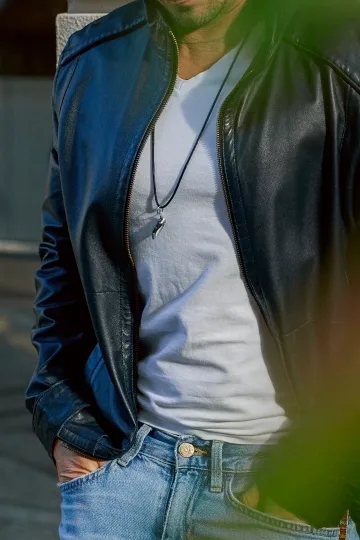
CAPAORA mini knife pendant
The 18th-century Spanish navaja in miniature: 40 mm of stainless steel, a real folding mechanism and a Palanquilla lock that clicks. An affordable gift to remember.
Authentic · Ships from Spain · 14-day returns
Lunar Cycles and the Body: Science and History
Circadian Rhythms
The human body is governed by an internal clock with a period of about 24 hours, synchronized with the earthly day through light. These are circadian rhythms: they regulate sleep and wakefulness, body temperature, hormone production, cognitive function.
The Moon affects circadian rhythms indirectly, through light. A full moon creates nighttime illumination strong enough to disrupt melatonin production and change sleep quality. Several studies, including work in Current Biology (2013), found a correlation between moon phases and sleep quality in people even in the absence of direct moonlight, which cast doubt on a purely mechanistic explanation.
Whether there is a direct biological influence of the Moon on human behaviour (beyond light) remains an open question. The data are mixed. But the idea that our biological rhythm is tuned to a celestial cycle is by no means irrational.
The Lunar Cycle and the Menstrual Cycle
The average length of the menstrual cycle (28 days) is close to the lunar month (29.5 days). Whether this is coincidence or something more is a matter of debate in the scientific community.
A 2021 study in Science Advances showed that for some women the lunar and menstrual cycles can synchronize and desynchronize depending on exposure to artificial light. This suggests the link may have been more significant before electric lighting and has been partly lost in the modern environment.
Historically, most cultures created lunar calendars to track both astronomical and biological cycles. The earliest known human counting devices, made 25,000 years ago (the Ishango bone and others), are interpreted by a number of researchers as lunar calendars.
Lunar Calendars
Most ancient civilisations began with lunar or lunisolar calendars. The Babylonian, Hebrew, Chinese and Islamic calendars are based on the lunar month. The month as a unit of time is, etymologically, a lunar month: the English "month" and the German "Monat" are tied to "moon" and "Mond."
The shift to solar calendars (the Julian, then the Gregorian) in the European tradition marked a certain change: from rhythmic, cyclical time to linear time. The Moon, with its constant phases, keeps a different kind of time, one that does not move forward but returns.
Jung: Shadow, Unconscious, and the Lunar Archetype
Carl Gustav Jung wrote no special work on the Moon arcanum of Tarot, but his conceptual apparatus describes the experience of this card more precisely than almost any other psychological language.
The Personal Unconscious
The personal unconscious, in Jung's terms, is the layer of the psyche that holds everything forgotten, repressed, unrealized or not yet realised. It is an archive of the past, but not a dusty storeroom; it is an active, dynamic territory whose contents constantly shape conscious life even when we don't suspect it.
When the Moon appears in a reading and points to fears and illusions, it speaks of exactly this: the personal unconscious is activated. Something there is rising. This doesn't mean you should be afraid. It means it is time to meet what has long been waiting to be met.
The Collective Unconscious and Archetypes
Beyond the personal unconscious, Jung described the collective unconscious: a layer of the psyche shared by all humanity, holding the universal patterns of experience he called archetypes.
The Moon is one of the oldest and most universal archetypes. The image of the Moon with a face, the cyclical goddess with her phases, the nighttime fear by a pool of water, all these symbols recur in mythologies with no geographic link to one another. This suggests they arise from a common human depth rather than from a particular cultural tradition.
Arcanum 18 activates exactly this archetypal level. The fears it raises can be both personal (from individual history) and collective (from the shared human archive).
The Shadow: What Cannot Be Removed from Life
The shadow in Jungian psychology is the sum of the repressed aspects of the personality. Everything the "I" doesn't want to claim as its own: aggression, fears, shame, desires that seem unacceptable, a strength that seems dangerous.
The shadow rarely reduces to something plainly bad. Positive qualities can be repressed in it too: a strength that was punished in childhood, or a talent whose acknowledgment seemed too risky.
The Moon creates the conditions in which the shadow becomes visible. Moonlight does not expose like sunlight: it makes the shadow visible differently, through what is projected outward. We see the shadow in another person until we recognise it in ourselves. We fear the darkness until we meet what lives in it.
Anima and Animus: the Nocturnal Nature of the Counterpole
Besides the shadow, Jung described the archetypes of Anima and Animus: the images of the counterpole in the psyche. For a man, the Anima is the inner feminine image, carrying emotionality, intuition, the capacity for relationship. For a woman, the Animus is the inner masculine image, carrying direction, logic, action.
The Moon in the Jungian system is closely linked to the Anima: inconstant, changing, intuitive, resistant to rationalization. When the Moon appears in a reading, it is often a signal that exactly this aspect of the psyche is active now and demands attention: an emotional reality the rational mind would rather ignore.
Work with the Moon card, like work with the Anima, calls not for victory over it and not for merging with it, but for dialogue. Acknowledgment: this is part of me. This too is real. A refusal of the illusion that one can be only rational or only intuitive.
Psychoanalysis and the Dark Night: from Freud to Contemporary Approaches
Sigmund Freud described the unconscious above all through repressed desires and conflicts. His "id" is the part of the psyche that follows the pleasure principle, obeys no rational limits, and speaks precisely in night mode: through dreams, slips, symptoms.
While Jung widened the concept to the collective unconscious and archetypes, later psychoanalysts, among them Donald Winnicott and Wilfred Bion, developed the concepts of the "good enough mother" and "containment": the ability to bear dark content without being destroyed by it. This is a direct analogy to the task Arcanum 18 sets: don't flee from what rises, and don't be swallowed by it. Pass through.
Contemporary mindfulness-based psychotherapy (MBSR, ACT) describes a similar process: observing thoughts and fears without identifying with them. This too is the night path of the Moon: seeing the wolf and the dog, the crab and the towers, without running and without freezing.
Leave your email, we'll send your discount code. No spam, unsubscribe anytime.
The code arrives by email, valid on your first order.
The Psychology of Dreams: What Happens at Night
The Moon is the card of dreams. Not in the sense of "all this is unreal," but in the sense that the same mechanisms work here as in dreams.
REM and the Processing of Emotion
During REM sleep (the rapid eye movement phase) the brain processes emotional experience. It is in this phase that dreams with a plot occur. The neuroscientist Matthew Walker showed in sleep research that REM sleep effectively reworks emotionally charged memories, lowering their affective charge without erasing the memory itself. People deprived of REM sleep are more emotionally reactive and cope worse with stress.
So dreams are not random images but active nighttime work to integrate emotional experience. The Moon as an archetype is tied to exactly this work: the dark, the unseen, what happens at night and leaves a trace by morning, but not always an explanation.
Recurring Dreams
Recurring dreams, the ones that return again and again, often point to unworked material. An injustice accepted without protest. A fear that was repressed rather than worked through. An unfinished inner conflict.
This is a direct theme of the Moon: what rises again and again despite attempts to repress it? Arcanum 18 often appears in readings tied to something repeating: patterns in relationships that play out over and over. Fears that return under different names.
Psychotherapy, especially the psychoanalytic and Jungian kinds, deals with exactly this: working with what rises again and again from the unconscious until it is integrated.
Nightmares: Fears That Speak Directly
Nightmares are a special case. Unlike ordinary dreams, they interrupt sleep, leave physical traces (a racing heart, sweating), and often replay in the same plots: pursuit, falling, the inability to move.
Research on nightmare disorders (in particular the work of Barry Krakow) shows that chronic nightmares are often tied to unprocessed traumatic experience. Imagery Rehearsal Therapy (IRT) invites a person to rewrite the nightmare plot, creating an alternative outcome, and to run it through the mind regularly. It works: the nightmares grow rarer.
This is exactly what the Moon speaks of: the plot exists not to torment. It exists to be seen and changed. The animals on the card, the wolf and the dog, are not enemies. They are characters you need to get to know.
Hypnagogia: the Borderline Light
Hypnagogia is the state between waking and sleep, when images, sounds and sensations begin to appear. Little scenes with no context. Faces of people you don't know. Landscapes you've never seen.
This state is described as intensely creative: many artists and writers deliberately entered it, delaying sleep to catch hypnagogic images. Salvador Dali fell asleep with a key in his hand: when he sank into sleep, the key dropped and woke him, fixing the last image at the border.
This is the territory of the Moon card: the space in between, where daytime consciousness has already left but the nocturnal has not fully taken over. The most productive and the most disorienting space at once.
The Moon in Literature and Cinema
Coetzee's "Disgrace" and Nocturnal Knowledge
In J. M. Coetzee's novel "Disgrace" (1999) the nocturnal space sets the conditions in which the main thing happens: violence, its consequences, the impossibility of returning the past. The moon in Coetzee is not romantic but merciless: it lights without warmth, lays bare without compassion.
This is an exact analogy to the card: the Moon is neither kind nor cruel. It simply creates a visibility that daylight does not provide.
Barry Jenkins's "Moonlight"
Barry Jenkins's film "Moonlight" (2016, Oscar for Best Picture) is named for a dialogue in which an older woman tells a boy: "In moonlight, black boys look blue. You blue?"
Moonlight in the film is not the night of threat but the night of possible identity: of who you can be in the dark, when social expectations aren't watching. The main character, Chiron, exists in several versions of himself, with no direct passage between them, only a lunar gap.
Lars von Trier's "Melancholia"
Lars von Trier in "Melancholia" (2011) shows the planet Melancholia bearing down on Earth as an outer embodiment of depression. The night scenes of the film, in which the heroine Justine lies naked under the light of the approaching planet, have become canonical.
Night in von Trier is the only space in which certain truths are available. Justine, paralyzed by day by a depression that won't let her function, finds a special clarity at night: she knows what will happen and accepts it. A lunar truth.
Tarkovsky's "Mirror"
Andrei Tarkovsky in "Mirror" (1975) builds the film on the principle of a dream: no linear plot, no clear cause and effect. There are images returning from memory and childhood, nighttime recollections with an owl, the wind, a burning barn, a mother.
"Mirror" describes exactly the territory the Moon maps: a place where past and present are not separated, where dream and memory are indistinguishable, where the most important thing is not stated but only lived through in an image.
Coetzee Again: a Night Without Salvation
There is another lunar dimension in the same Coetzee novel: a night that does not end well and gives no purification. The main character does not become better. He does not fit what he has lived through into his life and does not gain wisdom. He simply carries on what happened.
This is an honest reading of the Moon: not every dark night ends in dawn. Not every path between the towers leads to the Sun. Sometimes the Moon is just the Moon: long, uncomfortable, without guarantees.
Goethe's "Faust": the Nocturnal Laboratory and Mephistopheles
In Goethe's "Faust" night is the time when Mephistopheles enters Faust's life. The devil works in the lunar space: where daytime rationality is weakened, where desire and fear speak louder than reason.
Faust at the start of the tragedy is doomed precisely by lunar experience: he knows everything that can be known by daylight, and that knowledge does not satisfy him. He wants what is beyond the horizon, in the darkness. Mephistopheles is not a chance interlocutor but an answer to the lunar request: show me what the rational world hides.
The link with Arcanum 18 is direct: a request into the darkness may be answered, but not always with what you expected.
Jewellery with the Symbolism of the Moon (Arcanum 18)
The card's iconography gives concrete jewellery images: the full moon with a face, the crescent, the wolf silhouette, labradorite with its shifting flash, moonstone with its inner light. This is the visible language of the archetype: dark, changeable, lit by unreliable light.
Moon Phases: the Whole Cycle
Jewellery showing the lunar phases (waxing, full, waning) is tied above all to the High Priestess (Arcanum 2) as the symbol of the threefold lunar cycle. But for Arcanum 18 the full moon matters most: it is what lights the card, what makes visible what is hidden in the dark.
Pendants with a full moon in silver, rings with a lunar relief, earrings with lunar discs are a direct embodiment of the Moon archetype. A full moon in jewellery is not the optimism of the Sun nor the quiet confidence of the Priestess. It is power, ambiguity, a light that shows everything differently.
For a detailed guide to the meaning of moon phases in jewelry, see the article on moon phases.
The Crescent: Transition and Uncertainty
The crescent is the phase in which the moon is not whole. The waxing crescent is a promise of the future, something not yet realised. The waning crescent is completion, letting go, departure.
For the Moon archetype the crescent describes the transitional state more precisely than the full disc: you are not yet where you are going, but no longer where you came from. A crescent on a thin chain, crescent earrings, pendants with a crescent set in dark silver, all of these are jewellery of the period of transition.
On the meaning of the crescent and star in detail, see the guide to crescent symbolism.
Moonstone: the Moon's Main Stone
Moonstone is a stone of adularescent blue glow. When you turn it under a light source, a blue gleam slides across its surface, an optical effect caused by the scattering of light between the layers of the mineral.
This is the perfect visual image of the Moon card: something glowing from within, but inconstantly. The angle changed and the light disappeared. A different angle, and a flash again. Moonstone shows different things to those who look differently.
In a silver setting, especially a dark or matte one, moonstone tells the story of Arcanum 18 precisely: darkness in which light sometimes appears. Rings with a large cabochon, pendants with a moon or a teardrop on a silver chain, earrings with a shimmering stone, all of this is the language of the Moon in jewellery.
Everything about moonstone, its properties and how to choose jewelry, is in the detailed moonstone guide.
Labradorite: the Darkness in Which Colour Lives
Labradorite is dark on the outside and flashes blue, green and gold from within at a certain angle. This is labradorescence, an optical effect that depends strictly on the viewing angle: look straight on and there's almost nothing. Tilt it a little, and there's a flash.
For the Moon archetype labradorite is the stone of illusion and hidden knowledge at once. What it shows is real (the colour really is there), but it is available only under certain conditions. That is exactly how lunar knowledge works: real, but changeable, not yielding to a direct look.
Large labradorite cabochons in oxidised silver, rings and pendants with a dark stone that flashes in motion, these are jewellery for those who have accepted darkness as part of their nature and aren't afraid that not everyone will see what is inside.
More on labradorite is in the guide to labradorite and its meaning.
The Wolf: the Wild Aspect
The wolf from the Moon card is the dark beast on the left, the one that is not tamed. In jewellery the wolf carries several related meanings: a wild nature that does not bow to social norms, loyalty to the pack, the nocturnal instinct that hears what the daytime mind doesn't register.
Pendants and rings with a wolf in the context of the lunar archetype speak of accepting your "shadow" nature, the part that howls back at the moon regardless of upbringing. This is not aggression and not a threat; it is acknowledgment of the fullness of your nature, which doesn't reduce to its socially acceptable part.
On the meaning of the wolf in jewelry symbolism, see the article on the wolf.
Form and Metal
For jewellery in the image of the Moon, silver rings truer than gold: cold lunar light rather than solar warmth. Oxidised silver with a dark patina works especially well: it gives exactly the image you want, a darkness out of which something glows.
Stones in silver: moonstone in white and blue versions, labradorite, black tourmaline, dark amethyst. These are stones with an inner life, changing with angle and lighting.
Form leans toward the circle, the half-circle, the teardrop. The lunar disc, the crescent, the drop, the crab, the spiral (an archaic sign of the moon). Not sharp angles, not straight lines: curves, winding and indefinite contours.
How to Wear Jewellery with Moon Symbolism
Everyday. A small crescent or a moonstone cabochon on a thin chain, under clothing or in view. This is a personal symbol that needs no explanation. It works in any context and doesn't overload the look.
A creative period. When you write, draw or make something out of the dark, this is the time for a large labradorite: a ring with a big cabochon, earrings with a shifting stone. They heighten the sense of working in lunar territory.
A hard period. If you're going through a dark stretch, jewellery with a wolf or with the full moon and a face is a reminder: darkness is part of the path, not the end. Not jewellery of happiness, but jewellery of endurance.
Night practices. Meditation, keeping a dream journal, psychotherapeutic work. Jewellery with a lunar motif in these contexts is a tuning, a deliberate entry into the lunar space.
As a pair. A "Moon and Wolf" pendant or a crescent-plus-wolf set in silver describes both sides of the card at once: the wild nature and the path through the darkness. For those who want to wear the whole archetype, as well as its gentler part.
For men. Lunar symbolism suits men exactly as it suits women. A pendant with a wolf, a ring with labradorite, a silver bracelet with a lunar disc read clearly in a masculine context too, especially for artists, writers, those who work in night mode.
The Moon in Readings: When It Appears
Arcanum 18 appears in a reading in situations united by one trait: something important is not directly visible. Most often this is:
A period of uncertainty. A decision needs to be made, but there isn't enough information. Or there is information, but you can't be sure of its reliability. The Moon doesn't say "wait until it becomes clear." It says: learn to move under conditions of uncertainty.
Anxiety with no clear cause. A person feels unease but can't explain its source. The Moon points out: the source exists, it just lies below the level of awareness. This doesn't mean the anxiety should be ignored or taken as truth. It should be listened to as a signal.
A creative breakthrough. The Moon is anxiety. It is also the area of the psyche from which the artistic, the irrational, the non-rational comes. Many artists, writers and musicians describe their work as working in lunar mode: something arrives from an opaque source, resists planning, and exists at its own rhythm.
Intuition that needs checking. The Moon is anxious intuition, unlike the calm certainty of the Priestess. It is a signal that something is felt but not yet verified. Trust the feeling, but not fully, until you've checked.
A nocturnal period of life. A long stretch of uncertainty, transformation, when there's no clarity and no landmarks. The Moon here is not a diagnosis but a confirmation: yes, you are in the night. Yes, it is hard. Keep walking.
Deception or self-deception. The Moon often appears in situations where something is deliberately hidden, or where a person hides from themselves what they know. This is not an accusation but an invitation to honesty. What do you see but prefer not to name? What does someone say whose words don't match your sense of things? The Moon says: listen to the discrepancy.
A passage between phases of life. A major transition: growing up, leaving a relationship, the death of someone close, the start of a new stage. These are not joyful events, but not pure tragedies either. The Moon accompanies any serious transition, because a transition always passes through the dark space between what was and what will be.
Send a friend a discount code, they save on their first order.
Combinations with Other Cards
The Moon and the Star (17). This is movement from hope to darkness or from darkness to hope, depending on the order. The Star before the Moon: you got a moment of reprieve, but the dark work is still ahead. The Moon before the Star: you have passed through darkness and are coming into the light.
The Moon and the Sun, Arcanum 19. A direct account of the path: darkness precedes the dawn. This is not a promise of an immediate happy ending, but a confirmation: beyond the Moon there is the Sun. The path exists.
The Moon and the High Priestess (2). An interesting pair: both lunar arcana, but fundamentally different. The Priestess knows what she is doing in the dark. The Moon does not. Their pair can speak of needing to find in yourself the Priestess's capacity: the calm holding of dark knowledge rather than anxiety over it.
The Moon and the Magician (1). A pair of intuition and action. The Magician wants to act; the Moon says: wait, not everything you see is as it seems. A useful combination for those inclined to act before the real situation clears up.
The Moon and the Devil (15). Both are about traps: the Devil about outer, visible chains, the Moon about inner illusions. Their pair speaks of a situation where a person is held not by circumstances but by their own perception, which distorts reality.
The Moon and the Tower (16). Together they describe destruction followed by the loss of landmarks. The Tower has shattered the familiar structure. The Moon is the period afterward, when nothing is stable. It predicts a hard but necessary transition.
The Moon and the Hermit (9). Two cards of the inner path. The Hermit walks alone with a lantern; he already knows where he is going, he chose solitude. The Moon is the traveller with no lantern and no map, but with movement. Together they speak of a long period that calls for both solitude and patience with uncertainty.
The Moon and Judgement (20). An interesting pair: the Sun (19) is followed by Judgement (20), the card of awakening, the call, a new beginning. If the Moon and Judgement stand side by side in a reading, it says the dark period is nearing its end: the call is heard, the path is beginning to clear. But the Moon warns: not yet all, not quite yet.
The Moon and the Lovers (6). The archetype of choice meets the archetype of uncertainty. This speaks of relationships in which something is unclear: feelings are real, but their nature or prospect is undefined. Do I need this? Is what I see real? The Moon suggests waiting until the fog lifts before making decisions.
The Moon and the High Priestess (2) in the position of advice. The Priestess says: be silent and listen. The Moon says: something is rising. Together this is the strongest instruction for inner work: listen to what is rising, with patience and without panic. The Priestess gives the method, the Moon gives the material.
Who the Moon Archetype Suits in Jewellery
This is not about an astrological sign and not about age or gender. It's about an inner makeup.
Artists, writers, musicians. People whose creativity comes from an irrational source. Those who know that the best work arrives from nowhere clear, at an odd hour, and is never planned. Jewellery with the Moon is an acknowledgment of the source.
Psychologists and psychotherapists. People who work with what is beneath the surface. Their professional space is lunar territory: what isn't visible until it comes out. Moonstone or a wolf in the consulting room is a personal symbol of the profession.
Those going through a transitional period. A change of work, relationship, place of living, a loss, illness, leaving a familiar context. A period when the old landmarks no longer work and new ones haven't appeared yet. The Moon is jewellery for this "in between."
People with a strong Neptune or Moon in the birth chart. Cancer, Pisces, Scorpio, or the Moon in key positions. These people live in the lunar space by nature: depth of feeling, permeability, a leaning toward symbolic thinking. The jewellery resonates with their natural structure.
Night people. Those who work at night or think better after midnight. Writers on a deadline, programmers solving a problem at 2 AM, parents of small children who have lost the difference between day and night. The owl of Athena works the night shift, and so does the Moon.
Those engaged in inner work. Meditation, psychotherapy, journaling, mindfulness practices. People for whom the inner world is no less real than the outer.
Buying it as a gift? Each one arrives ready to give.
 A branded Zevira box and a little card come with every order.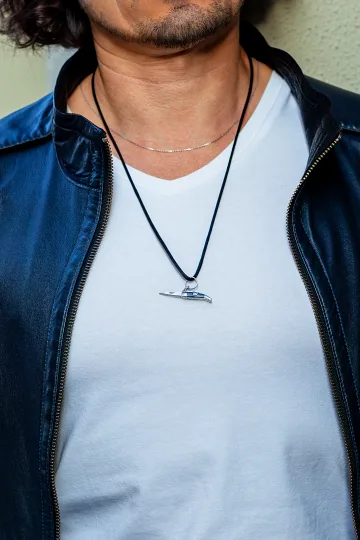







FAQ
What does the Moon mean in a Tarot reading? The card points to a period of uncertainty in which something is hidden or distorted. This can be anxiety, illusions, fears that rise from the unconscious. It is also a card of intuition, if an anxious one: something is felt but not yet verified. The card's advice: don't run from what is rising, but don't take what you see in unreliable moonlight as absolute truth.
How does the Moon (18) differ from the High Priestess (2)? Both cards are lunar, but they describe fundamentally different things. The Priestess is the calm, confident intuition of someone who knows they are in the dark and holds that knowledge with dignity. The Moon is the anxious intuition of a traveller lost in the dark. The Priestess governs the lunar space. The traveller of the Moon is swallowed by it.
What do the wolf and the dog on the card mean? They stand for two parts of nature: the tamed and the wild. The dog is socialized, having accepted human rules. The wolf is instinctive, following its own laws. Both howl at the moon, that is, both react to the lunar call regardless of training. It is about how civilisation doesn't remove nature, only hides it.
What are the Yod drops on the card? Fifteen drops shaped like the Hebrew letter Yod fall from the lunar disc. Yod is the initial letter of God's name in Kabbalah, a symbol of spiritual potential. Fifteen is a reference to the number of the Devil (XV), the link to the material. Overall it is a dual symbol: spiritual rain and illusion at once, heavenly seed and trap. The ambiguity is characteristic of the Moon.
Which zodiac sign is the Moon (Arcanum 18) linked to? In the system of Waite and the Golden Dawn, Arcanum 18 is linked to the sign of Pisces and its ruler Neptune. Pisces is the most "permeable" sign, with blurred boundaries between self and other, between the real and the imagined. Neptune governs the unconscious, illusions, mysticism. It is an exact astrological correspondence for the card of the unconscious and illusions.
What does the reversed Moon mean? Two possible readings. First: the dark period is ending, illusions dissolve, landmarks return. Second: fears and illusions intensify, denial becomes more active. The context of the reading determines which reading fits. In both cases the card is about engaging with what is hidden rather than ignoring it.
Which stones are linked to the Moon card? Moonstone, with its adularescent blue glow, is the Moon's main stone. Labradorite, dark on the outside and flashing from within, describes the duality of the card: darkness in which light lives. Dark amethyst, black tourmaline. These are all stones with an inner life, changing with angle and lighting.
Can you wear Moon jewellery without practising Tarot? Yes. Jewellery with the moon, moonstone, crescent or wolf carries its own meaning outside the Tarot system: cyclicality, intuition, lunar rhythms, the acceptance of darkness as part of life. It works as a personal symbol, as an aesthetic, as a reminder of your own nature, independent of any reading.
Wear the symbol, don't just read about it. These are in stock:

Conclusion
The Moon is the most honest card in Tarot. It doesn't promise it will be easy. It gives no instructions. It simply lights the night path with the light it has: unreliable, contour-changing, making the familiar strange.
The crab crawls from the water. The wolf howls in the dark. The dog answers. The road runs between the towers and disappears beyond the horizon. This is not a nightmare. It is a description of the part of experience that exists in every life and cannot be skirted, only crossed.
Jewellery with lunar motifs, moonstone with its inconstant light, labradorite with its hidden fire, a crescent on a thin chain, all of it is the visible language of the archetype. To wear it is not to wish for darkness. It is to acknowledge that darkness is part of the path. And that the path goes on.
After the Moon comes the Sun. Always.
The Moon asks nothing of you but movement. Not courage, not readiness, not an understanding of where you're going. Just the next step between the towers, in unreliable moonlight, with the wolf on the left and the dog on the right.
That is enough. It has always been enough.
See other articles in the cycle on Tarot and jewelry: the Tarot jewelry hub, the High Priestess, Arcanum 2, the Star, Arcanum 17, the Sun, Arcanum 19.
Silver, gold, wedding rings, symbolism, matching sets.
About Zevira
Zevira makes jewellery in the artisan tradition of Albacete, Spain. The Moon is one of the central motifs in our collections: from the full lunar disc with a face to a thin crescent on a chain.
What you can find with us under the symbolism of the Moon:
- Pendants with moonstone and labradorite
- Pendants and earrings with a crescent moon
- Rings with the moon phases
- Silver jewellery with a wolf motif
- Paired "Moon and Wolf" pendants
Every piece can be personalised with engraving by a master, with the option of personal engraving. We work with 925 silver and 14-18K gold.