The Star in Tarot: Meaning, History and Jewellery Behind the Symbols of Arcanum 17
The Star is the quiet that comes after the storm, not before it. The seventeenth Arcanum sits wedged between two disasters: the Tower thunders behind it, the Moon floods in ahead. A breathing space the length of a single exhale. Not a promise that nothing will ever fall again. Just clear sky in the short pause between what has already collapsed and what is still to come.
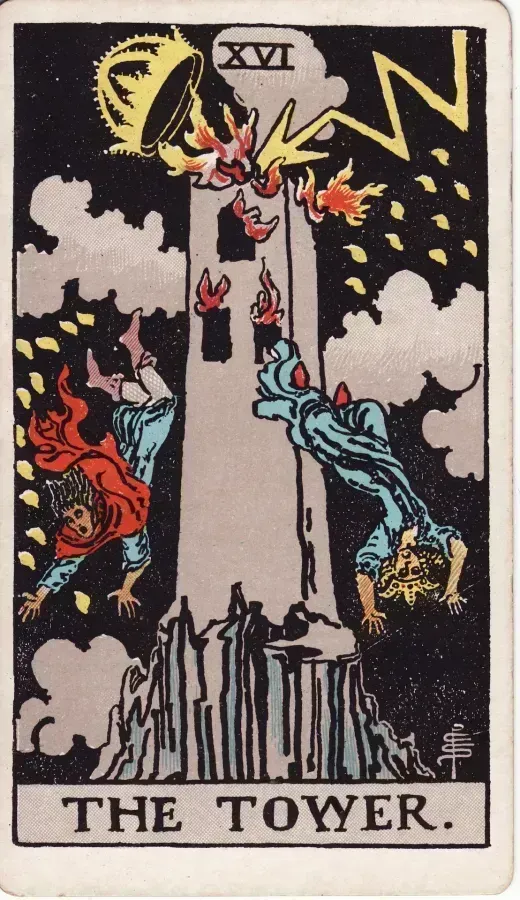
In the Tarot deck the Star occupies exactly this spot: number 17, straight after the Tower (XVI) and before the Moon (XVIII). The Tower shatters illusions with a crash and a bolt of lightning. The Moon drowns everything in fog, dreams and the anxieties of the unconscious. And between them, in that brief reprieve, stands the Star. A woman by the water. A night sky. A silence in which you can hear your own breathing. Hope that cannot be proven, yet is hard to deny.
This article is about the card, its symbolism, and the jewellery people wear as a physical reminder that the light never went away. It was simply behind the clouds.
Card number 17: its place in the deck
Within the structure of the Major Arcana (there are 22 of them, numbered 0 to 21), the Star holds a rare position. It follows destruction and precedes a descent into the depths. A transitional moment, a narrow window between what has fallen and what is still to be lived through.
Arcanum XVI, the Tower, lands the blow. Lightning strikes the tower, figures tumble from it. This is the card of sudden collapse: the redundancy, the breakup, the diagnosis, the move, the end of something that felt permanent. It hurts, but the illusions burn away along with everything else.
Arcanum XVII, the Star, comes next. Not with ready answers. Just with the clarity of an open sky.
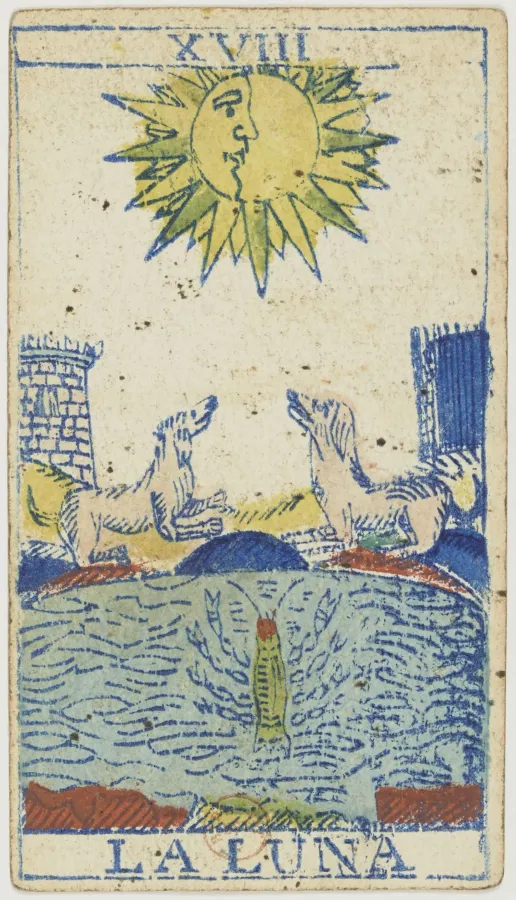
Arcanum XVIII, the Moon, comes after. Fog, fears, the chaos of the subconscious. The Star does not save you from any of it. It only grants a pause before the next plunge, the one explored in more detail in the symbolism of the Moon as the eighteenth Arcanum.
Arcanum XXI, the World, closes this whole journey. But that is still a long way off. The Star says: you have come through the wreckage and you can see the sky. That is already a great deal.
Read the full breakdown of the three key Tarot cards in jewellery here
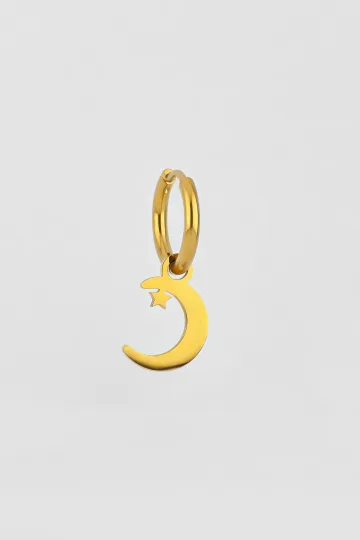
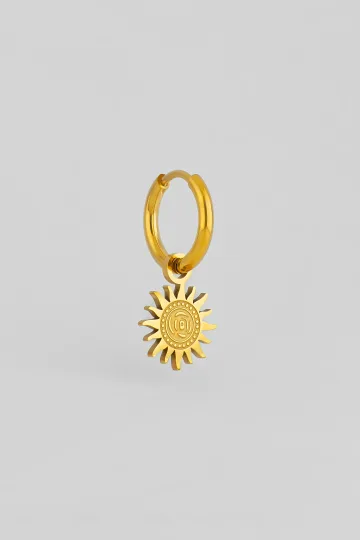
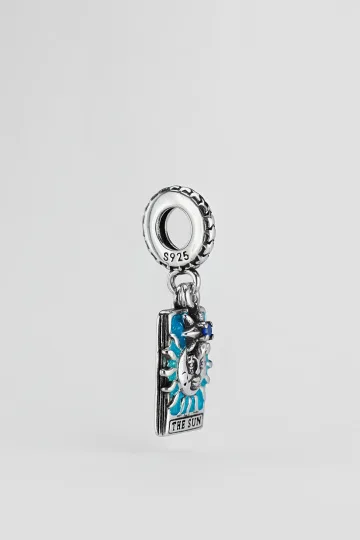
Wear the symbol, don't just read about it. These are in stock:




The Star through the ages
The card's story does not begin in 1909, when Pamela Colman Smith picked up her brush. It begins in the fifteenth century at the Milanese court, passes through the workshops of French printers, and reaches us after several centuries of reinvention.
Visconti: stargazers at court
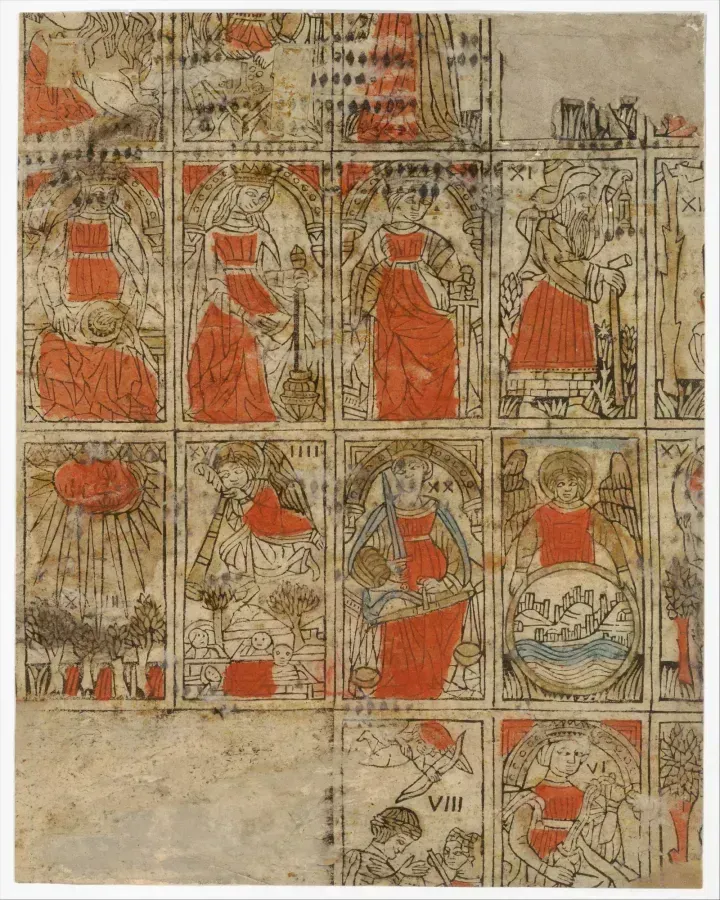
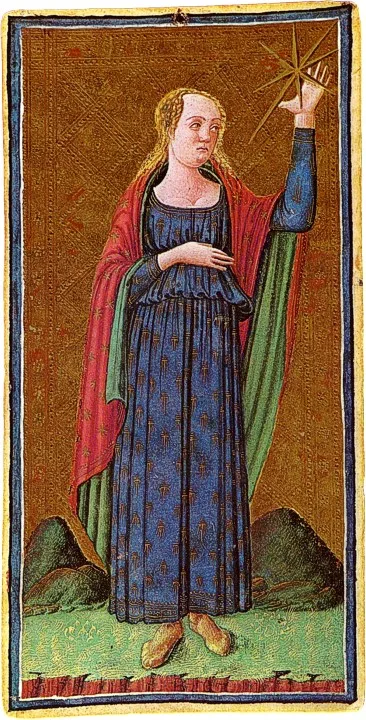
The earliest known Tarot decks were made around 1450 for the Visconti-Sforza family, who ruled Milan. These were not cards for fortune-telling: expensive illuminated decks were produced as a game for the nobility and as an allegorical teaching tool. On the early Star cards a woman holds a single large star in front of her or above her head, like a torch. Sometimes she is an astrological figure, a stargazer in long robes with an astrolabe. Astrology at the Italian courts of the fifteenth century was a serious science: court astrologers cast horoscopes to guide affairs of state, and the night sky was read like a political text.
The card in this version carried a practical meaning: knowing the position of the stars gave you a measure of power over time and fate. The Star was the instrument of a sage, not yet an image of hope.
The Marseille deck: L'Etoile with the bare figure
In the seventeenth century, in the French city of Marseille and the print houses of Lyon, a stable standard for the Tarot deck took shape. The Tarot de Marseille became the canon for much of Europe over two centuries. This is where the iconography we recognise today was born.
On the Marseille card L'Etoile already shows a bare woman kneeling by the water. She holds two jugs and pours from them. Above her a large eight-pointed star is ringed by seven smaller ones. The landscape is schematic, almost flat. But the structure is already there: an unclothed body by the water under a starry sky.
In the Marseille tradition the bareness was not read as erotic. It was allegorical, like the engravings of Truth, who was drawn unclothed because truth wears no veils. The woman on the Star card is bare in that same sense: after the wreckage, once everything outward has fallen away, what remains is the pure essence.
Waite-Smith 1909: detail and life
In 1909 Arthur Edward Waite and the artist Pamela Colman Smith created a deck for the Rider Company that became the most widely reproduced in history. Smith took the Marseille design and gave it life: she enriched the landscape, worked out the figure in detail, and added an ibis perched on a tree. The woman by the water became more concrete, and the space around her gained depth.
Waite was a member of the Hermetic Order of the Golden Dawn, which systematised the links between Tarot, Kabbalah, astrology and alchemy. It was through this order that the Star acquired its astrological correspondence with Aquarius and its precise place on the Tree of Life. None of the iconographic details in the Waite-Smith deck are accidental: every element was chosen on purpose.
Crowley and the Thoth: Nut as the goddess of the sky
In 1944 the Thoth deck appeared, created by Aleister Crowley together with the artist Frieda Harris. In this system the Star is linked to the Egyptian goddess Nut, goddess of the night sky. Nut was depicted as a woman whose body arches over the earth in the shape of the heavens, with stars scattered across her skin. Harris rendered the figure in a geometric style with explicit Aquarian astrological attributes. The emphasis shifted from hope to transcendence: the Star in the Thoth is first of all a cosmic principle, not a personal reprieve.
Four versions (Visconti, Marseille, Waite-Smith and Thoth) show how a single image travels through the ages, keeping its core while changing its shell.
One star, worn high and worn alone. Five pendants at once is not a constellation, it is a jumble sale. Don't you dare.
How and with what to wear the star
Over years on shoots the star has been through dozens of looks with me, from everyday to evening. Here is what actually holds a look together, by occasion.
How do I wear a star every day? For daytime I recommend a fine chain with a single eight-pointed star over a plain top: a white tee, grey knitwear, a light shirt. A round or V-neck opens the neck, and the star settles right at the collarbone. I suggest a cool metal, silver or white gold: the shine reads as daytime and calm, and it gets along with anything.
Is the star right for the office? Yes, if you keep it restrained. I choose one medium-length pendant, 45 to 50 cm, over a blouse or a fine roll-neck, no layers and no large stones. A matte finish works better than a mirror one here: colleagues see a tidy detail, and the meaning stays yours.
How do I build an evening look? For evening I suggest dark fabric and bare shoulders, and the star opens up. In the earrings I recommend labradorite: the dark iridescent stone echoes the night sky. Gold plating or yellow gold warm the look and catch the warm light of a room.
And for a special occasion? For a completion, an anniversary or a point of reckoning I choose a large star, from 3.5 cm, as the only accent. I suggest putting the other pendants away so the symbol speaks alone. A pared-back outfit, one strong sign near the face.
Who does the star suit? Anyone who values quiet signs over loud ones. Two rules that never fail. First: the star works best as the shortest strand, with longer chains added below it. Second: one expressive sign near the face reads better than five competing pendants. If you want layers, give the star the top line.

Turn on your camera, pick earrings, a pendant or a ring, and see the piece on yourself in real time.
Switch items in one tap.
Everything runs in your browser: no photo or video is ever uploaded.
The eight-pointed star: from Sumerian Ishtar to the European decks
The central star on Arcanum XVII has eight points. This is not an arbitrary detail. Behind it lies a history four and a half thousand years long.
Ishtar and the seal of Venus
In the Sumerian and Akkadian traditions of Mesopotamia, the eight-pointed star was the symbol of the goddess Ishtar, mistress of love, war and fertility. She was shown as an eight-petalled rosette or an eight-pointed star. The sign appears on Sumerian cylinder seals from around 2500 BC. The Babylonians used it on kudurru boundary stones as a mark of heavenly protection.
Ishtar was identified with Venus, the brightest planet. Venus traces a five-pointed pattern across the sky over eight years, and its alternation as morning and evening star (an eight-year full cycle, eight appearances) tied the number eight to the planet and to the goddess.
Venus as the morning star
To ancient observers, Venus was two different stars. In the morning, before dawn, it blazed in the east: the herald star, the forerunner of the Sun. In the evening, after sunset, it appeared in the west: the keeper of the dusk. The Sumerians named them differently, the Greeks knew them as Eosphorus (the morning one) and Hesperus (the evening one), until ancient observers realised they were one and the same planet. Exactly who made that discovery is uncertain: it has been credited to the Pythagoreans, and also to Parmenides.
The eight-pointed star inherited this double quality: it is both the morning marker and the evening light. Both functions at once. That is precisely what makes it a fitting symbol for a card that carries duality within it: the subconscious and the conscious, earth and water, light after darkness.
The road through Europe
Through Phoenician trade, through Persian influence, through Hellenistic culture, Ishtar's eight-pointed star spread across the Mediterranean world. In Rome it was tied to Venus. In early Christian symbolism the eight-pointed star became a symbol of the Mother of God and of the Star of Bethlehem. Knights set it on their shields. Heraldry raised it to the rank of a heraldic charge. By the fifteenth century, when the first Tarot decks were being assembled, the eight-pointed star was a sign any educated European could read, layered with meaning.
When Smith drew the eight-pointed stars on Arcanum 17, she was reproducing an image already four and a half thousand years old.
Waite-Smith iconography: every symbol
The RWS card shows a bare young woman. She kneels by a pool. In each hand she holds a jug: one she pours into the water, the other onto the ground. Above her a night sky: one large eight-pointed star and seven smaller ones, also eight-pointed. Behind her a tree, with a bird perched on it. The landscape is peaceful, grass, water, a distant hill. No tension at all.
The bare woman: openness and authenticity
The woman wears nothing. In Tarot symbolism nakedness means vulnerability in the best sense: nothing to hide, nothing surplus, complete openness. After the Tower, where everything external collapsed, that bareness reads as honesty. You are who you are. No armour, no roles, no social coverings. This is not weakness, it is authenticity.
The posture matters: she is not standing, not walking, not running away. She kneels, steady, with intent. Her body is calm. This is neither a pose of grief nor a pose of triumph. It is the posture of someone simply doing what needs to be done: pouring water. Focused, without wasted movement.
Compare her with other bare figures in the Tarot. The Lovers (VI) depict Adam and Eve before the fall: innocence before experience. The World (XXI) shows a bare dancer in the triumph of completion. The Star stands between them: this is bareness after destruction, the honesty of those who have nothing left to lose and yet still have something to give.
Two jugs: conscious and subconscious, both at once
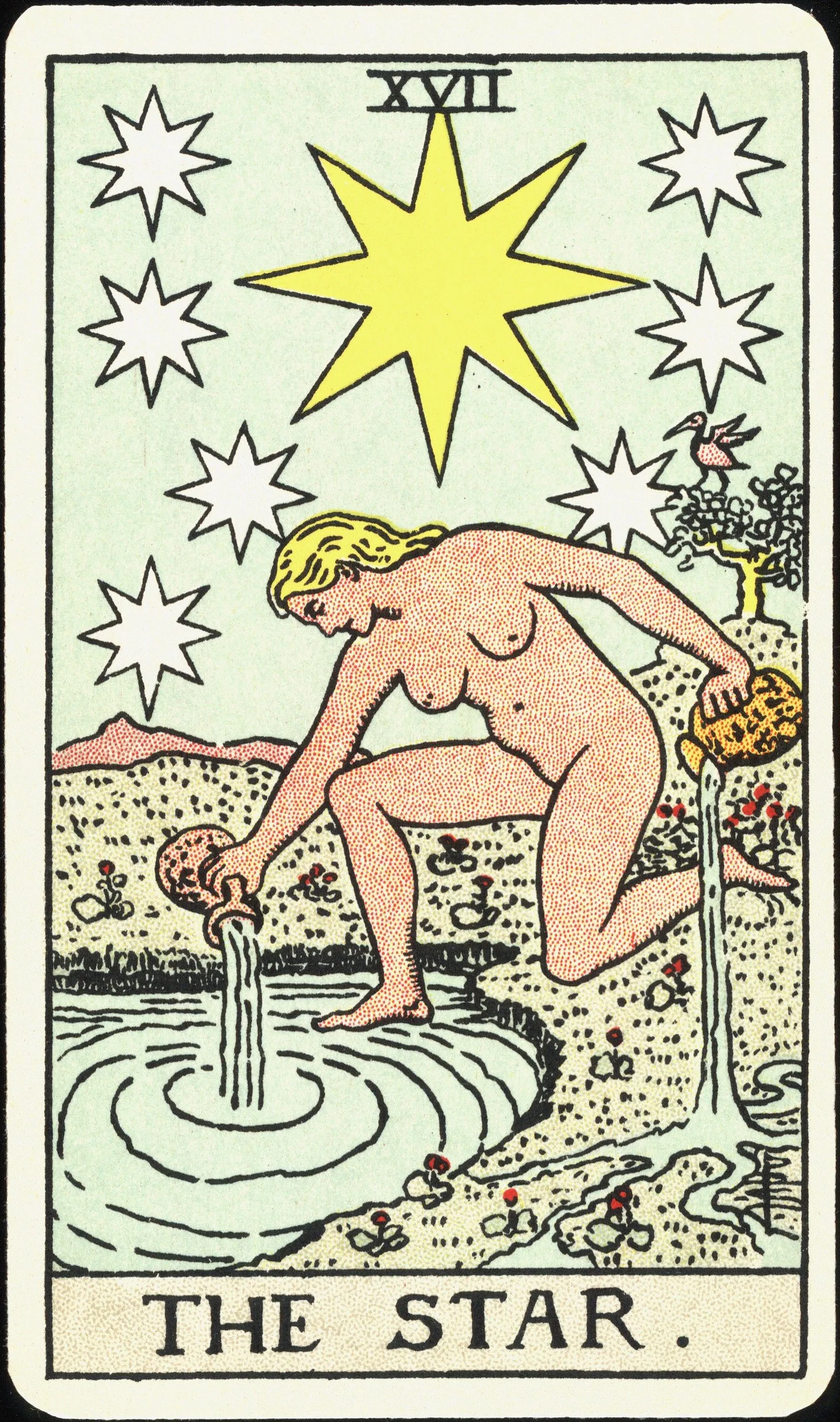
The woman holds two jugs and pours them at the same time: one stream into the pool, the other onto the land. The two jugs are the dual nature of a person: conscious and subconscious, mind and intuition, the visible and the hidden.
Into the pool the water flows into the subconscious, the inner world, dreams and images. Onto the land it flows into material life, into the body, into practice, into what you can touch with your hands. The Star does not say: choose one. It says: feed both at once. Recovery requires both inner work and life in the real world, both at the same time.
Notice that the water pours from both jugs without stopping. This is not hesitation between two choices. It is a steady flow in two directions at once. The Star is about integration, not about choosing.
One jug into the pool, the other onto the ground: between worlds
The pool is still water. A mirror. It reflects the sky. When the woman pours into the pool, she seems to join the sky and the depths: the stars overhead and their reflection in the water become one. It is an image that works on several levels at the same time.
The ground beneath the second jug receives the water in silence. It does not reflect. It absorbs. This is the feeding of living things: roots, seeds, fertility. The difference between the pool and the ground is the difference between contemplation and action. Both are needed.
The woman on the card stands literally between worlds: the sky above her, the water before her, the ground beneath her. She belongs fully to none of these spaces. She is the point of transition.
The large star
The central star on the card has eight points. The eight rays matter: in symbolism eight stands for infinity (the figure 8 turned on its side), the renewal of a cycle, balance between the world below and the world above. Nineteenth-century occult traditions linked this star to Sirius, the brightest star in the night sky. Others read it as the Pole Star, the fixed point by which you find your bearings.
The essence is the same: this is a beacon star, a star you steer by. Not a warm glow but a cold reference point. It does not promise the road will be easy. It shows you where north is.
The seven smaller stars
Seven stars circle the large one. Tarot traditionally links the seven with the seven classical planets (Moon, Mercury, Venus, Sun, Mars, Jupiter, Saturn) and with the seven chakras. Seven is fullness, the completion of a cycle. The seven smaller stars around the central one read as: everything in balance, every level lit.
The pool
Water stands for the subconscious, for dreams, for the world of feeling. The pool (unlike a rushing river) is calm, still water, a mirror. A chance to see your own reflection. The Star stands by quiet water, not by a storm. This is a moment of contemplation, not of struggle.
The ground
Water pours onto the ground too. The ground is material life, the body, the practical dimension. Inspiration and hope feed both the inner and the outer at once. Life in the real world is watered as well.
The ibis on the tree: Thoth and unseen wisdom
Behind the woman is a tree, and on it a bird. Waite deliberately used an ibis, the sacred bird of the Egyptians. The ibis was a symbol of Thoth, god of wisdom, knowledge and writing. Thoth recorded the judgements of the dead, invented writing, and kept the secrets of the gods.
The ibis appears here without ceremony: it simply sits on the branch, watching. It takes no part, passes no judgement, does not interfere. Wisdom is present, but it does not command. This is an important nuance: the card does not say wisdom shouts and points the way. It says wisdom is simply here, close by. It is available to anyone willing to notice it.
The tree the ibis sits in symbolically links sky (the bird perched high) and earth (the roots below). Once again the axis between worlds, the same structure as the two jugs.
The Pole Star in navigation: a history of finding one's way
The Star card calls it a beacon, a marker in the dark. This is no metaphor conjured out of thin air. Behind it lies a real history of navigation.
The Phoenicians: the first systematic seafarers
Around 1200 to 800 BC the Phoenicians of Tyre, Sidon and Byblos built a trading network across the whole Mediterranean, and later beyond it. Around 600 BC, according to Herodotus, Phoenician sailors circumnavigated Africa. That was impossible without navigating by night.
The Greeks called the Pole Star Cynosura (the dog's tail, that is, the tail of Ursa Minor) and used it to find their bearings. The Phoenicians preferred the Pole Star of Ursa Minor precisely because of its closeness to the celestial pole. The Greek poet Aratus, around 270 BC, wrote that the Phoenicians "hold their course by the Little Bear", whereas the Greeks steered by the brighter Great Bear.
The Vikings: the polarimeter and the stone compass
In the ninth to eleventh centuries the Vikings reached Iceland, Greenland and North America. They crossed the North Atlantic without a magnetic compass (which appeared in Europe only in the twelfth and thirteenth centuries). How did they find their way?
One theory, supported by finds, points to the "sunstone" (a calcite crystal). This mineral polarises light and lets you locate the position of the sun even on an overcast day. At night the Vikings steered by the Pole Star. With a clear sky they knew: as long as Polaris was visible, the direction north was known.
Medieval seafarers and the astrolabe
In the Middle Ages European sailors mastered the astrolabe, an instrument that let them determine latitude from the angle between the horizon and the Pole Star. The Arab navigators of the Indian Ocean developed similar instruments. The Age of Discovery in the fifteenth and sixteenth centuries would have been impossible without precise knowledge of the stars.
When Columbus crossed the Atlantic in 1492, he regularly measured latitude by the Pole Star using a quadrant. Any drift off course was read from the stars.
The sextant: the peak of celestial navigation
In the eighteenth century the invention of the sextant made it possible to measure angles between stars and the horizon accurately, even on a rolling deck. The sextant remained the principal navigational instrument right up to the arrival of GPS in the twentieth century. Every ship's officer knew several navigation stars by heart: Sirius, Vega, Altair, Rigel.
Polaris, Sirius, Aldebaran, beautiful points in the sky. They were a coordinate system that for centuries kept people from getting lost at sea. When the Star card calls it a marker, a genuine, functional history stands behind that word.
Sirius: Sopdet in Ancient Egypt, Anubis and Isis
On the Waite card the large star is often associated with Sirius. This is no accident.
The flooding of the Nile by a star
Egyptian civilisation depended on the Nile. The river's annual flood brought fertile silt to the fields and was the foundation of all agriculture. The Egyptians learned to predict its onset from an astronomical event: the heliacal rising of Sirius, the star's first appearance on the horizon before dawn after a period of invisibility. This happened around our 19th or 20th of July. The flood began at roughly the same time.
The Egyptian new year began with the rising of Sirius. The year was divided into three seasons: akhet (the flood), peret (growth) and shemu (harvest). The star literally set time in motion. Priests kept precise astronomical records over thousands of years.
Sopdet and the goddess Isis
The Egyptians called Sirius Sopdet, or Sothis. The star was identified with the goddess Isis, and its yearly return to the night sky was read as the goddess returning after tragedy and searching. In the myth, Isis sought the body of her murdered husband Osiris, cut apart and scattered by Set. When she gathered the remains, Osiris was reborn, and Isis conceived Horus. The rising of Sirius became a symbol of that resurrection and the start of a new life.
The parallel with the Star card is obvious: a woman by the water after destruction, carrying the beginning of a new cycle.
Anubis and the road to the stars
Anubis, the jackal-headed god, was the guide of souls to the afterlife. He was associated not with Sirius but with a constellation the Egyptians called the "jackal" (roughly our Ursa Minor or Orion). Yet the link between Anubis and the stars is direct: he showed the dead the way across the starry sky to the realm of eternity.
Egyptian star mythology created an image that passed through Greek, Latin and medieval European culture and settled into the Tarot. Sirius as a sign of a new beginning, a rising after the dark. It is an archetype that the Star card reproduces three thousand years later.
The Star of Bethlehem: history, astronomy and an icon of hope
The star that showed the way to the wise men became one of the most enduring images in Western culture. Whatever your religious convictions, it is an image of guiding light in the night, a precise metaphor for Arcanum XVII.
Historical theories
The Gospel of Matthew describes a star that the wise men (magi, astrologers from eastern lands) saw in the east, which led them to Bethlehem. The text does not explain the nature of the phenomenon. Researchers have proposed several theories:
A conjunction of Jupiter and Saturn in 7 BC. The two bright planets came together three times over a single year in the constellation Pisces. For Babylonian astrologers this was a significant event: Jupiter was associated with royal power, Saturn with the people of Israel, Pisces with eschatological expectation. The German astronomer Johannes Kepler first proposed this theory in 1614.
The appearance of a new star or comet. In 5 to 4 BC Chinese and Korean astronomers recorded several unusual stellar phenomena.
A conjunction of Jupiter and Venus in 2 BC created a bright merging of the two planets.
No single theory has been settled conclusively. But the very image of a star that points the way to those searching through the dark became a cultural archetype that lives on regardless of astronomical accuracy.
An icon of hope
In Western culture the Star of Bethlehem means: even in darkness there is a light you can walk towards. The travellers who followed it did not know exactly where they would arrive. They walked by a marker. That describes the meaning of Arcanum XVII precisely: not a map of the route, but an indication of direction. Walk towards the place where the light is.
This image has settled so deeply into collective memory that it works outside any religious context. The star that guides is a universal symbol.
The Seven Sisters: the Pleiades in the myths of the world
The seven smaller stars on Arcanum XVII call up a direct association with the Pleiades, the star cluster in the constellation Taurus. It is a cluster of hundreds of stars, of which six or seven are visible to the naked eye (depending on how sharp your sight is). Almost every ancient culture noticed the Pleiades and built stories around them.
The Greek myth: the seven daughters of Atlas
In the Greek tradition the Pleiades are the seven daughters of the Titan Atlas and the nymph Pleione: Alcyone, Maia, Electra, Taygete, Asterope, Merope and Celaeno. Zeus turned them into stars to save them from the hunter Orion. One of the sisters, Merope, was thought the faintest because she was ashamed: she alone married a mortal rather than a god.
The Pleiades oriented the Greeks within the agricultural calendar. Their rising at dawn around May marked the start of the sailing season and the time to sow. Their setting before dawn in autumn spoke of harvest time and the end of voyaging. Hesiod, in Works and Days, uses the Pleiades directly as astronomical markers for farming.
The Navajo: seven sisters and the start of the story
For the Navajo (Diné) of the American southwest, the Pleiades cluster is called Dilyéhé. In one narrative they are seven girls a bear chased through the forest. The Great Spirit lifted them into the sky. In another version they are a stalk of corn unfurling skyward.
For the Navajo too the Pleiades are an astronomical marker: their position in the sky indicated the time for the winter ceremonies.
Aboriginal Australia: 40,000 years of observation
The astronomical tradition of Aboriginal Australians is among the oldest documented anywhere. Some of its elements may be 40,000 years old. The Pleiades appear in the mythology of many groups. For the Kuringgai people of the Sydney region the Pleiades are seven women pursued by the men of Orion's Belt. This is the same structure as in the Greek myth (Orion chasing the Pleiades), arising independently on the other side of the planet.
The independent emergence of a single myth across separate cultures is exactly what Jung called the collective unconscious: images so deeply rooted in human psychology that they surface again and again.
On Arcanum XVII the seven stars around the central one carry this whole layer: the Greek daughters of Atlas, the Navajo Dilyéhé, the Australian seven women. The number seven in the night sky is an image thousands of years old that needs no explanation.
Customer reviews
Zevira is a real jewellery shop. Genuine payments, deliveries and customer thank-yous.
🥰🥰🥰 gracias

Ok, ¡gracias! 🙂

The Star in Kabbalah: the path of Heh, the window, clear sight
The Order of the Golden Dawn, to which Waite belonged, systematised the links between the Tarot cards and the Tree of Life from Jewish Kabbalah. Each Arcanum received a correspondence to a letter of the alphabet, a path on the Tree, and an astrological body.
The letter and its meaning
In the Golden Dawn system the Star corresponds to the letter Heh (there are also versions with Tzaddi, depending on the tradition). Heh means "window". The letter has a shape that is interpreted as a window frame: a rectangle with an opening. A window is the boundary between inner and outer. Through it you can see the sky, but you can also step outside.
The meaning of the letter, a window, describes the state of the Star card precisely: the moment when, after darkness indoors (the Tower, destruction), a person looks out of the window and sees the starry sky. This is not yet stepping outside (that comes later), it is first the looking. Clear sight. The realisation that the sky is out there.
The path on the Tree of Life
The path the Star occupies on the Tree connects the sephiroth Netzach (Victory, the world of images, emotion and inspiration) and Chokmah (Wisdom, the first glimmer of the divine intellect). This is the path from sensory experience to higher wisdom. Hope as a route: from what you feel to what you understand.
Netzach, the sphere of Venus, is tied to beauty, love and creativity. Chokmah, the sphere of the primary impulse, is tied to revelation and insight. The path between them is the path a person walks when, after destruction, they begin to see clearly and arrive at an understanding of a higher order.
The number 17 and the eight
The number 17 in numerology reduces to 1+7 = 8. Eight is the renewal of a cycle, infinity (the figure 8 on its side), balance. The Star card carries this eight in its number, in the shape of its stars (eight rays), and in the geometry of its very iconography. Three layers of one number.
The Star according to Jung: a guiding archetype in crisis
Carl Gustav Jung studied symbols all his life. He explored why certain images appear again and again in the myths, dreams and religions of completely different cultures.
The collective unconscious and the archetype
Jung called this the collective unconscious: a layer of the psyche shared by all humanity, which speaks the language of archetypes. An archetype is not a specific image but a structural principle that can take many forms while keeping its essence.
The Star is an archetypal image in this sense. Light in the dark, a marker in chaos, hope after catastrophe. These images are so fundamental that they are reproduced independently across every known culture.
Ego-death and the first point of recovery
In Jungian analytical psychology the experience the Star describes has a precise name. It is the moment after ego-death: the breaking down of the old image of the self, the familiar structure of identity. The theme of an inner dying of the old and the birth of the new is explored most fully in the meaning of the thirteenth Arcanum, Death, where transformation is shown without any literal fear of the end. The Tower demolishes that structure. The Star is the first point from which you can begin to build a new one. Not the old one. A different one.
Jung described this process in the context of individuation, the long road to wholeness of the personality. Crisis (the Tower) destroys patterns that no longer work. It is painful. But after the destruction comes a possibility that was not there before: to construct yourself differently. The Star is exactly such a moment. The field is cleared. The starry sky is visible.
The mandala and the eight-pointed star
Jung wrote at length about the mandala as a symbol of psychic wholeness. The eight-pointed star is geometrically close to a mandala: symmetrical, centred, unfolding from the centre, its rays equal. This is no coincidence. A symmetrical form that opens out from a centre is an image the psyche reproduces in the moment it reaches towards wholeness. Again and again, across different cultures, in different eras.
A guiding archetype in a real crisis
Jung noted that in a moment of crisis logic is of little help. Explanations do not work. What helps is an image you can return to. A star in the night sky, clear, cold, steady. That is exactly such an image. It does not explain. It orients.
Upload a photo of your pet, someone you love, or an object. We'll build a 3D model and hand-cast it in pewter.




Aquarius and Uranus: the astrology of the Star
In the astrological system of Western Tarot the Star corresponds to the sign of Aquarius and its modern ruler Uranus. This link is no accident.
Aquarius carries water yet remains air
Aquarius is an air sign. It is a paradox that reflects the heart of the card: water (intuition, the subconscious, nourishment) spreads through air (thought, vision, connection). Aquarius thinks in systems, seeing the social and the universal where others see only the personal.
The woman with the jugs on the card is archetypally Aquarian: she pours water not for herself, she feeds both the water (the pool, the collective subconscious) and the ground (the material world). This is an act for another's sake, not for her own. Nonconformity: doing something that matters rather than what is expected.
Aquarius sees what others do not. Sometimes this looks like oddness. But the Star is not a card of social conformity: it is about the clarity of one's own vision, available precisely because the person stands a little apart from the general flow.
Uranus: insight and the breaking of a pattern
Uranus is the planet of sudden revelation, of broken patterns, of disruption to the familiar. In astrology Uranus governs revolutions, inventions, unexpected insights. That feeling when, after a long deadlock, the answer suddenly arrives. Not because you worked hard. Simply because the sky cleared.
This is the energy of the Star: not a slow, gradual recovery (that is Venus or the Moon), but the moment when something abruptly becomes clear. The instant the storm passes, it becomes visible. Uranus works exactly like that: fast, unexpected, like a flash.
A birth date between 20 January and 18 February (Aquarius) makes the card especially close. But the Star resonates with anyone living through a period of renewal after destruction, whatever their sign.
The seven smaller stars: chakras, planets, days of the week
The seven stars around the central one carry their own meaning. Tradition pins specific correspondences to each of them.
The seven classical planets
Before the telescope, astrologers worked with seven heavenly bodies: Moon, Mercury, Venus, Sun, Mars, Jupiter, Saturn. Each governed a particular principle: the Moon emotion and instinct, Mercury communication, Venus love and beauty, the Sun identity, Mars action and will, Jupiter growth and wisdom, Saturn structure and limits.
The seven stars on the card are these seven principles, all at once, in balance. The Star says: after the destruction all seven levels remain. They did not disappear. They simply waited for the fog to lift.
The seven chakras
The Indian chakra system describes seven energy centres of the body: from muladhara (the base) to sahasrara (the crown). Each chakra corresponds to a particular aspect of experience: survival, sexuality, will, love, speech, sight, connection with the higher.
The seven stars around the central one read as the seven chakras lit by a guiding light. The large eight-pointed star above the woman's head sits in the position corresponding to the crown (sahasrara): the link with what lies above. Light pours down and illuminates every level.
The seven days of the week
In the Western tradition the seven days of the week were named after the seven classical planets. Monday the Moon, Tuesday Mars, Wednesday Mercury, Thursday Jupiter, Friday Venus, Saturday Saturn, Sunday the Sun. Seven is a fine number: it is a complete cycle of time, the week, the grid a person lives within.
The seven stars on the Star card take in the whole cycle. All seven days are lit. The whole of time is covered.
The Star in literature
The image of the star as a marker in the dark runs through world literature not as decoration but as a structural element of meaning.
Dante: "and once more I saw the stars"
Dante's Divine Comedy ends each of its three parts with the word "stars" (stelle). The close of the Inferno is especially exact: after passing through every circle of hell, climbing up from the darkest place, Dante writes "and thence we came forth to see again the stars". It is the first thing visible after leaving the underworld. Not the sun, not daylight. The stars. The night sky as the first sign that the dark is behind you.
Structurally this is precisely the passage from the Tower to the Star. Dante came through the worst (the Tower), climbed up, and saw the starry sky (the Star). A long road still lies ahead, but the first thing that speaks of the way out is the stars.
Saint-Exupéry: The Little Prince and stars as connection
In The Little Prince the stars are the sky. They are a way of being present for those who have been lost. At the end the narrator says that now, when he looks at any star at night, he hears laughter. All the stars are laughing. The star has become a way of keeping a connection with what no longer exists in its familiar form.
This is an exact parallel with the card: the Star does not promise that everything will return. It speaks of another way for what matters to be present. The marker remains even when the particular person or situation is gone.
Hemingway: stars as a silent constant
Hemingway returns to the image of the night sky in several works. In A Farewell to Arms a night sky with rain and no stars creates an oppressive atmosphere of loss. In The Sun Also Rises the starry sky over Spain appears in moments of quiet balance. Hemingway's stars are silent, they do not explain or console, but they are there. That is precisely their function: simply to be, to make it possible to find one's bearings.








The Star in cinema
Cinema works with images, and the image of a star as a marker in dark times turns up in unexpected places.
Kusturica, Time of the Gypsies: the sky as escape from an earthly hell
In Emir Kusturica's Time of the Gypsies (1988) the protagonist Perhan suffers one destruction after another: betrayal, the loss of those close to him, a descent into the criminal world. In several key scenes Kusturica uses the night sky as a counterpoint to what happens below. The sky is right there, the stars are right there, while the earth burns. This is the visual structure of the Star card: chaos below, a cold light above that does not go out.
Scorsese, After Hours: the night as a maze and the stars as the way out
In Scorsese's After Hours (1985) the protagonist moves through a nocturnal New York like a maze with no exit. One after another the doors close. But at the end he steps out of the darkness. Formally the escape is accidental, yet figuratively the night ends, and the first light he sees is white, clean, almost starlike. The structure, passing through chaos to a marker, is the very movement from the Tower to the Star.
Labradorite: the story of its discovery and the myths of the Innu
Labradorite is a stone with labradorescence: an iridescent, rainbow shimmer within a dark body. Blue, green, gold, sometimes red and violet flashes as you turn it under the light. Visually it is the closest thing to a night sky scattered with stars.
Discovery in 1770
European scientists first described the mineral in 1770 on the Labrador peninsula in Canada. Moravian missionaries working among the region's indigenous peoples sent samples to Europe. The mineral was named after the place of its first description, although the Innu and other peoples had known it long before any European.
Geologically labradorite is a variety of plagioclase feldspar. The labradorescence effect is created by thin layers within the stone that scatter light differently at different angles. The light was always there, you simply have to look at the right angle.
Innu myths: the northern lights inside the stone
According to the lore of the Innu (the hunters of Labrador), the stone holds the northern lights inside it. Once a great warrior struck the coastal rocks with his spear, and most of the aurora burst free and lit up the sky. Part of it stayed inside the stone. That is why labradorite glimmers: a remnant of that light still lives within it.
Another version: labradorite is the bones of the ancestors, turned to stone yet never losing their light.
These myths describe the metaphor of the Star card with great precision: the light was always there, inside, simply not always visible. You need the right angle, the right light, the right moment. A dark stone with fire within is a literal embodiment of Arcanum XVII.
Moonstone in the Indian and Sri Lankan traditions
Moonstone, an adularia with a milky inner glow, is linked in the Indian tradition with lunar power, intuition and the female cycle.
The Indian tradition: tears of the Moon and night intuition
In India moonstone (chandrakant or chandra-mani) is revered as sacred. Its layered white glow, adularescence (named after Mount Adular in Switzerland, where good specimens were found), was thought to be moonbeams frozen in the stone. Indian traders would display it only at the full moon, because they believed it shone brighter then. To give a moonstone to a loved one in the light of a full moon was held by some peoples to be a way of opening the future before them.
The stone was connected with the goddess Lakshmi and with the lunar cycles. It was recommended to people who needed to strengthen their intuition and inner sight, especially in periods of uncertainty.
Sri Lanka: the source of the finest stones
The finest moonstones were historically mined in Sri Lanka (above all in the Matara district). They are distinguished by a bluish glow with a floating blue sheen inside, known as blue adularia. This type is considered the most precious.
Sri Lankan jewellers worked with moonstone for thousands of years. The tradition credited it with the power to calm the emotions and steady the mood: like moonlight, which is neither harsh nor scorching, yet bright enough to show the way.
The link with the Star card
In the context of Arcanum XVII moonstone carries the card's quiet side. If labradorite is the bright flash of a marker, moonstone is a soft, constant glow. A light that does not shout, yet is always near. Intuition that works in the dark without effort. This describes the state of the Star precisely: not a blinding flash but a calm clarity.
Leave your email, we'll send your discount code. No spam, unsubscribe anytime.
The code arrives by email, valid on your first order.
The Star in spreads: after the Tower, therapy, recovery, an anniversary
A card in a spread says one thing standing alone and another standing beside others. Context matters.
After the Tower: the obvious pair
When the Tower and the Star fall in the same spread, the sequence is clear. Destruction and reprieve. Watch the positions: if the Tower is in the past and the Star in the present, it says the period of destruction is behind you, now is the time to rebuild. If the Tower is in the present and the Star in the future, it says the present chaos will end and clarity lies ahead.
Coming out of therapy
The Star often turns up for people finishing a long stretch of psychological work. Therapy is a kind of controlled demolition of inner patterns (the Tower), after which a new sky opens (the Star). In this context the card says: the work bore fruit, you see differently now. It is not the end of the road, but an important point on it.
Recovery after illness
After a serious illness or treatment, the Star in a spread says: body and spirit are granted a reprieve. Do not demand an immediate return to how things were. Stand by the water, pour the water, look at the sky. That is the work of this period.
An anniversary and a point of reckoning
At the new year, on a birthday, on an anniversary, the Star says: you have a marker. The direction is visible. This is a fitting moment for an intention: not a plan, not a promise, but a direction. Which way to move in the period ahead.
Combinations of the Star with other cards
Beside different Arcana, the Star reveals different facets of its meaning.
The Star + the High Priestess (II). Both stand by water, both carry duality. Together they point to a period when inner knowing and outer inspiration work as a pair. A strong moment for creative work or meditation.
The Star + the Empress (III). Clarity joins with fertility. After a period of recovery, growth begins. The Star sets the direction, the Empress gives the strength to bring it into being.
The Star + the Lovers (VI). The marker is applied to a relationship. A couple who have come through a crisis (the Tower) receive the Star and begin to build their bond on a different foundation. More honest, more open.
The Star + the Moon (XVIII). The most common sequential pair. The Star gives clarity before the plunge into the subconscious. If both fall side by side, it says: you will soon have to work with the depths, but right now there is a pause. Use it to strengthen your marker.
The Star + the Sun (XIX). The path from a marker to full light. If both Arcana are in the spread, the movement from hope to joy has already begun, and the nineteenth Arcanum, the Sun leads from nocturnal clarity out into open day.
The Star + the World (XXI). A very strong pair: a marker and a completion. The person knows where they are going, and the road leads to wholeness.
The Star + the Ace of Cups. Recovery opens an emotional beginning. After a period of being closed, the heart is ready to receive.
The Star + the Ten of Pentacles. Clarity of direction will lead to material stability. Not quickly, but surely.
Upright and reversed
Upright, the Star speaks of recovery, hope, clarity after a hard period, inspiration, inner peace and a readiness to accept help.
Reversed, the card points to lost faith. Not a catastrophe, but the state in which a person no longer believes anything will change. When optimism feels naive and hope feels like a waste of energy. Apathy, disappointment, a disconnection from oneself.
The reversed Star is not a sentence. It is a diagnosis. An acknowledgement that faith is unavailable at this moment. That too is information: you need to find where it was lost.
CAPAORA mini knife pendant
The 18th-century Spanish navaja in miniature: 40 mm of stainless steel, a real folding mechanism and a Palanquilla lock that clicks. An affordable gift to remember.
Authentic · Ships from Spain · 14-day returns
The woman on the card: who is she
In every version of the Star, from the Marseille deck to modern editions, the woman remains the central figure.
In Tarot, male and female images carry different qualities. The female figures of the Major Arcana are the High Priestess (II), the Empress (III), Justice (VIII), Strength (XI) and the Star (XVII). Each carries her own aspect of the female archetype.
The High Priestess keeps the mystery, closed off, veils and pillars. The Empress is abundance, fertility, the body of the earth. Justice is the scales, the sword, the balance of law. Strength tames the lion through inner force. The Star is open, bare, pouring water, sitting by the pool in the silence of the night.
The Star is the only one of them fully bare and fully out in the open, beneath the sky, without protection. This is not weakness. She is a figure with nothing to hide once everything external has fallen away. There is a particular power in that openness: a person who has lost everything surplus sees clearly.
The female image in this context reads as the image of a receptive force. She does not build, does not fight, does not wait for a verdict. She pours water. She nourishes. This is an active, yet quiet, act.
Jewellery built on the symbols of the Star
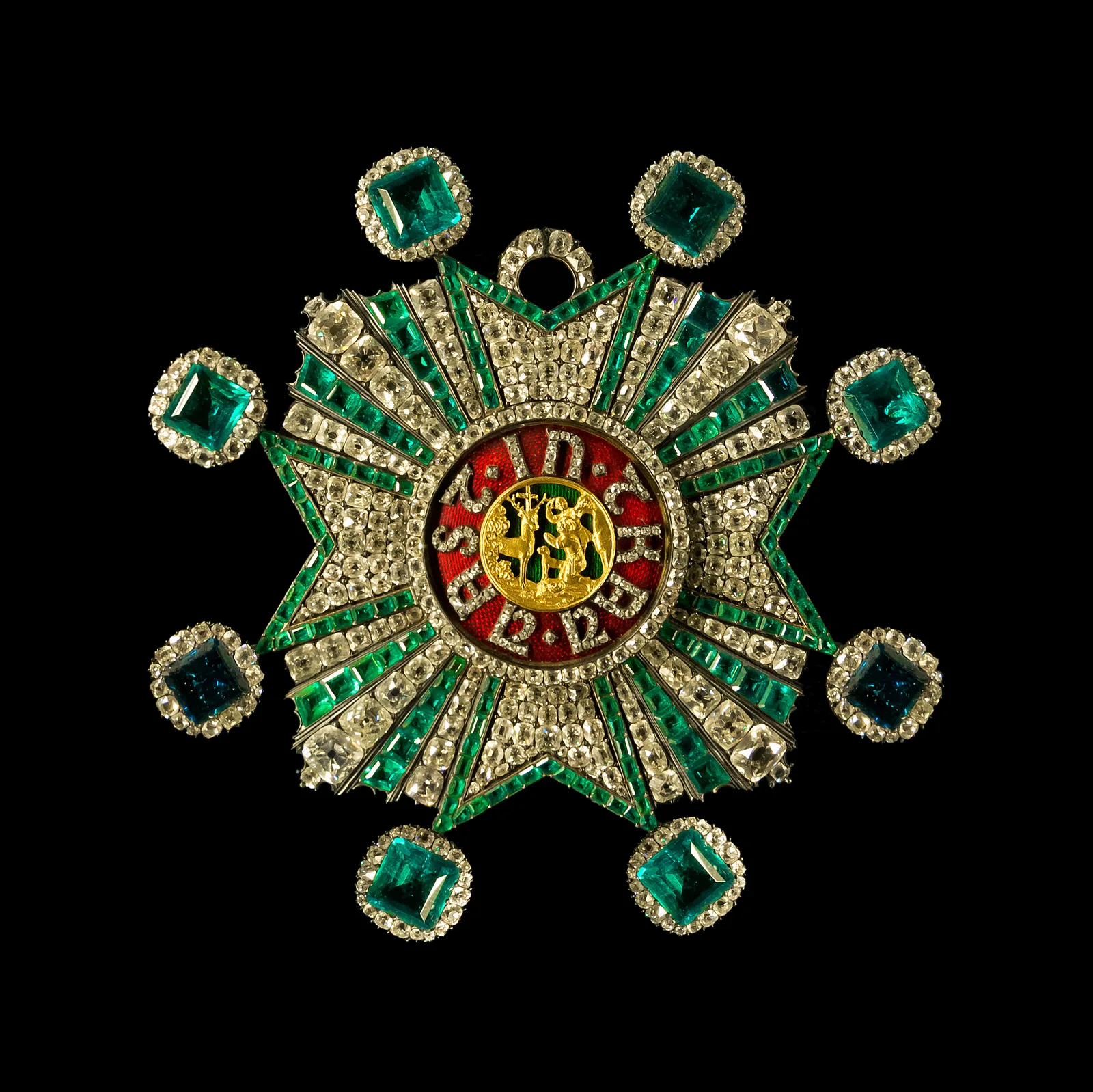
The seventeenth Arcanum offers a rich visual foundation for jewellery. This is one reason the star theme is so durable in jewellery design: behind its beauty stands a concrete meaning.
The celestial collection: jewellery with celestial motifs
Jewellery with celestial motifs (stars, crescents, constellations, suns) is a direct visual quotation of Arcanum 17. The star on the card is not metaphorical: these are specific eight-pointed stars on a dark sky. To wear a star is to keep, quite literally, a symbol of a marker close to you.
Celestial jewellery: a guide to the symbolism of sun, moon and stars
The star and the crescent together
The crescent with a star is one of the most enduring symbols in the history of jewellery. In the Tarot context it is the neighbouring presence of the Moon (XVIII) and the Star (XVII): two consecutive Arcana. A crescent with a five-pointed or eight-pointed star on a single piece literally illustrates the passage between the cards.
The crescent and the star: the meaning of the symbol and the jewellery
Sun and moon side by side
The sun and moon pairing in jewellery carries the same dual nature as the two jugs on the Star card: day and night, conscious and subconscious, masculine and feminine. After the Star comes the Moon, after the Moon the Sun. A piece with both motifs is a whole arc of the journey.
Sun and moon in jewellery: the meaning of a dual symbol
Labradorite: the stone with light inside
Labradorite, the stone with its iridescent rainbow shimmer within, is visually the closest thing to a night sky full of stars. A dark base, flashes of blue, green and gold. Look at it from one angle and you see an ordinary grey stone. Change the angle and colours flare up inside.
This is an exact metaphor for the Star in Tarot: the light was always there, you just need the right angle of sight.
Labradorite: the meaning of the stone, its varieties and jewellery
Moonstone: hope and intuition
Moonstone, with its adularescence (a soft milky glow), is linked to intuition, inner light and feminine symbolism. In the context of the Star it carries the card's quieter side: not a dazzling beacon but a soft glow visible in the dark. Moonstone and the Star together give an image: a light that does not shout, yet is always near.
Moonstone: meaning, varieties and feminine symbolism
The shape of the star: which to choose
The eight-pointed star (the octogram) is an exact quotation of the card: these are precisely the stars depicted on Arcanum XVII. Eight rays, cyclicity, renewal. This is the choice for those who want a deliberate reference to the card.
The six-pointed star (the hexagram) is another common option, carrying additional symbolism of the balance of opposites.
The five-pointed star (the pentagram) is the most common in jewellery and carries different meanings in different traditions.
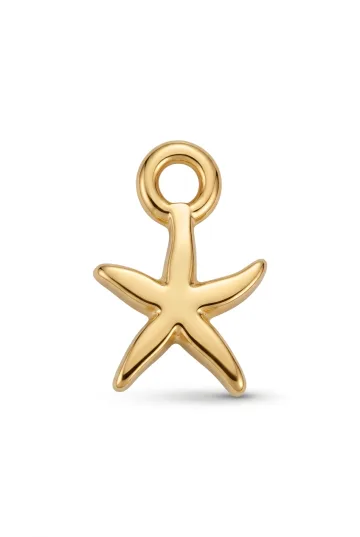
Star charms on bracelets let you assemble a constellation from several pendants of different sizes, like the seven stars around the large one on the card.
Material and finish
Sterling 925 silver is the classic choice for a celestial theme. The cold white shine of the metal conveys the character of a nocturnal glow well. With oxidising and patina, the relief details become more expressive, especially on three-dimensional stars.
Gold plating (yellow gold, 14 or 18 carat) warms the look. A star in gold plating reads warmer, less severe, closer to a beacon than to a cold navigational point. It is a question of mood.
Rose gold is softer than either. If the piece is a gift for a woman going through a recovery, rose gold adds extra warmth without excessive ceremony.
A matte finish draws less attention than a mirror one. For an everyday piece with a personal meaning that is a plus: the star is there, it is with you, but it does not shout.
The size of the piece
A small pendant (1.5 to 2 cm) for everyday wear, under clothing or over it. Discreet, close to the body.
A medium pendant (2.5 to 3 cm) is noticeable without being aggressive. It works well as a standalone accent on a fine chain.
A large star (from 3.5 cm) is a piece for occasions when you want to speak openly through a symbol. It suits celebratory days, completions, points of reckoning.
Who the Star piece suits
Someone coming out of a hard period. After illness, after a breakup, after a redundancy, after any event that turned the familiar order upside down. The Star says symbolically: the sky has cleared, there is a marker.
After finishing treatment. Jewellery as a marker of the end of one period and the start of another. An acknowledgement: this happened, and now things are different.
A graduate. The end of a long path, with uncertainty on the other side. Here the Star reads as: you have a marker, the course will be found.
Someone who has finished a long project. A year of work, a book, a build, a difficult deal. Completion calls for recognition.
Someone after therapy. Psychological work is also a kind of dismantling of an inner Tower. Here the Star is a good reminder that a new sky has opened.
A gift to oneself at the new year. A conscious intention at the turn of the year: I can see my star, I know my direction.
Someone who waited a long time for good news and finally received it. After a diagnosis with a good ending, after a long-awaited event, after the resolution of a difficult matter.
Someone working in the creative arts or in science. The Star corresponds to Aquarius, the sign tied to unconventional thinking, innovation and systems vision. This is a piece for those seeking a marker in their work, when the road is long and not always obvious.
The Star as a considered gift
A piece bearing the symbol of the Star works as a gift precisely because it says something specific. That sets it apart from jewellery with no narrative.
When you give someone a star after a hard year, you are saying: I know you have been through something serious. And I can see that your sky is clear now. Behind the beauty of the object stands this meaning.
How to frame the meaning of the gift. If there is no card, you can write a few words on a slip of paper: what the symbol is and why now of all times. That turns the piece into a personal gesture rather than another item of jewellery.
The link with Tarot. If the recipient knows Tarot, a direct reference to Arcanum XVII is clear. If not, it is enough to say: the star is a navigational one, you steer by it in the dark. The meaning is the same.
For what occasion. The end of treatment, graduation, the close of a hard year, the first month after a major change, the moment when a person finally sees clarity ahead. The Star is fitting wherever there is a passage from the dark to the open.
How to wear and combine it
A star pendant as the main accent. A single eight-pointed star on a fine chain. Nothing surplus. It works with any look.
A constellation: several pendants. A large star and a few smaller ones around it, as on the card. You can assemble it from individual charms or choose a single piece with several elements.
With a star pendant and moonstone. A metal piece with a star plus a ring or bracelet with moonstone. A celestial theme, but without overload.
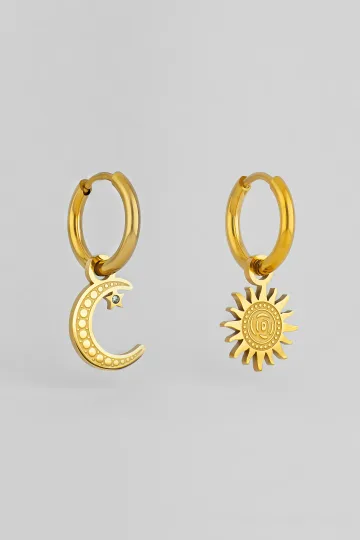
A celestial set. A star, a crescent and a sun earring. The whole celestial theme at once. It works as an ensemble rather than a collection of random pieces, because the theme is unified.
With labradorite. Earrings or a ring with labradorite plus a star pendant. The dark iridescent stone and the shine of the metal complement each other.
Metal. Silver is closer to the night sky and lunar energy. Gold plating adds warmth. White gold or rhodium give a neutral cold shine, closer to starlight.
Layers and chain length. A star on a short chain (40 to 45 cm) sits at the collarbone and is clearly visible. On a 50 to 55 cm chain it drops into the décolletage. Worn in layers, the star plays the role of the shortest strand, with longer pieces joining it.
Star earrings. Small star studs complement the look without duplicating the pendant. Or the reverse: bold star earrings and a neutral pendant. The accent can be placed in different ways.
Seasonality. The star is universal across seasons: in summer on bare skin it works one way, in winter from beneath a collar or over a jumper another. Dark clothing brings out the metallic shine more strongly.
The Star across different Tarot decks
The Waite-Smith iconography became the standard, but there are hundreds of other decks, and each interprets the Star in its own way. This is interesting because it shows what stays constant in the image and what depends on interpretation.
The Marseille deck. More schematic. A woman by the water with jugs and stars above her. Fewer details, more structure. No ibis, a simplified landscape. But the core of the image, the pouring water, the starry night sky, the female figure, is exactly the same.
Modern feminist decks. In a number of decks of recent decades the woman on the Star has become a central image of strength rather than vulnerability. Her bareness reads as liberation. This is a legitimate interpretation that stays within the original meaning.
Decks with natural imagery. Some artists place on the Star not an abstract woman but a concrete landscape: a mountain lake at night, a meadow under a starry sky, a lantern's light over the water. An image without a figure, but with the same structure: light above, water below, silence.
What stays constant across all versions: light in the dark, water as a symbol of the inner world, openness without protection. This is the core that survives through every transformation.
Send a friend a discount code, they save on their first order.
The Star and contemporary culture
Celestial symbolism in jewellery has been on the rise since the mid-2010s and the surge has held steady. Stars, moons, constellations, suns: these motifs have moved from a niche space into the mainstream.
There are several reasons. A growing interest in astrology and Tarot among younger audiences in North America and Western Europe. A shift in demand towards jewellery with personal meaning: people more often choose symbols with substance, with beauty paired to meaning. The visual culture of the internet, where a celestial aesthetic works well.
In this context the Star sits at the intersection of several waves: celestial symbolism, Tarot, mindful wearing. This is no passing fashion, it is several independent waves reinforcing one another.
Interest in the meaning of the Star and its symbolism holds steady and rises noticeably towards two points in the year: in January (the season of Aquarius, the card's sign) and at the end of December, when people are thinking about their intentions for the new year.
Users searching for jewellery by Tarot symbolism often arrive through informational queries: they first study the meaning of the card, then look for a piece. This means that meaning is valued on a par with aesthetics.
Themed jewellery by Tarot
If the Star resonates, it is worth looking more broadly at Tarot as a theme for jewellery.
Tarot jewellery: the meaning of the cards and why people wear them
There you can find which card is closest: if the Star speaks of hope after destruction, the Sun speaks of joy and confidence, the Moon of trusting the subconscious, the Lovers of choice.
FAQ
What does the Star card mean in Tarot? The Star (Arcanum XVII) means hope, recovery, clarity and an inner marker after a difficult period. It is the card that follows the Tower (destruction) and foretells the Moon (a plunge into the subconscious). Its central image: the light is there, even when it has long been out of sight.
Why does the Star have eight points? The eight-pointed stars on the card carry the symbolism of cyclic renewal and infinity. Eight, in numerical symbolism, is tied to the completion of one cycle and the start of the next. This is why an eight-pointed star in jewellery is considered a more precise quotation of the card than a five-pointed one.
Is the Star a good card in Tarot? Upright it is unambiguously positive: hope, recovery, inspiration. Reversed it points to lost faith and apathy, which matters as diagnostic information but is not a sentence. In any position the Star carries no threat.
Which stone suits the Star? Labradorite, for its inner iridescent glow that quite literally recalls starlight in the dark. Moonstone, for its link with intuition and a quiet inner light. Sapphire (deep blue), for the colour of the night sky.
Who should you give a star piece to? Someone who has finished a hard period and is beginning a new one. A graduate, someone after illness, someone after completing a difficult project, at the new year as a symbol of intention. The piece works as a physical reminder: the marker is there.
How does the Star differ from the Moon in Tarot? The Star is clarity, an external marker, hope, the quiet after the storm. The Moon is fog, the subconscious, dreams, fears and intuition without a logical base. The Star (XVII) comes before the Moon (XVIII): first the pause and the clarity, then the plunge into the depths.
Do you need to believe in Tarot to wear a piece with a card's symbol? No. A star piece is a star. Its meaning, a guiding light, hope, a marker in the dark, is clear regardless of how you feel about divination. Tarot here is simply a very detailed and beautiful system that explains why the symbol works the way it does.
Which zodiac sign is linked to the Star in Tarot? Aquarius (20 January to 18 February) and its modern ruler Uranus. It is an air sign, tied to independent thinking, systems vision and unexpected insights. If your sign is Aquarius, the Star is doubly your card. But the card works for anyone living through a period of renewal.
Can you wear a Star piece all the time? The Star works well as a permanent talisman rather than a one-off. Unlike cards tied to specific events (the Lovers, the Tower), the Star carries a steady meaning: a marker, an inner light, a reminder that hope does not disappear. This suits everyday wear.
How do you combine a Star piece with other Tarot cards? The Star goes well with the Moon (XVII and XVIII, neighbouring Arcana) and the Sun (XIX). The three cards together are a path from clarity through depth to full light. The Star with the Tower is thematically exact but visually contrasting. As jewellery: a star pendant plus a moon earring plus a sun ring, a considered celestial set with a narrative.
What is the difference between a star piece and a piece with the Star card? A piece depicting the card itself is a literal quotation: it shows the woman, the water, the stars, all at once. A piece in the shape of a star is a symbol of the card. Both work. The card is more concrete in meaning, the star-symbol more universal and easier to combine with other pieces.
The Star and the quality of silver: what to know when choosing
Jewellery with celestial motifs is most often made in sterling 925 silver. This is the jewellery standard: 92.5% pure silver and 7.5% alloy (most often copper), which gives the metal its hardness.
An eight-pointed star as a form demands good detail. Fine rays, clean geometry. Cast from poor metal, the details lose their crispness. Look at the angles of the rays: they should be even.
A hallmark or a 925 stamp on the piece is essential. For gold-plated jewellery it is worth knowing the thickness of the coating: from 0.5 microns is decorative plating, from 2.5 microns is already sufficient for permanent wear.
Caring for jewellery with celestial motifs
A practical section worth reading before you buy.
Silver. Silver darkens from contact with air, sweat and some cosmetics. For star pendants with fine relief details, tarnish may at first emphasise the form (this is patination), then begin to look untidy. Clean with a soft cloth or special silver wipes. Store in a closed box or an airless zip bag, which slows the oxidation.
Gold plating. Plated pieces call for careful handling. Contact with perfume, sweat or household chemicals strips the coating. Put it on after applying any products. Take it off before showering, swimming or sport. Store it separately so it does not scratch against other jewellery.
Stones. Labradorite and moonstone are semi-precious stones with a hardness of 6 to 7 on the Mohs scale. Sturdy enough for everyday wear, but knocks are best avoided. Clean with warm water and mild soap, with a soft brush. No ultrasound and no harsh agents. Labradorite is sensitive to acids: lemon juice, vinegar and aggressive household products can spoil the surface.
Storing a set. If you are assembling a celestial set, it is best to store each piece separately. The pendant with its chain in one slot or pocket, the earrings in another. Metal scratches against metal.
Buying it as a gift? Each one arrives ready to give.
 A branded Zevira box and a little card come with every order.














Narrative through jewellery: why it works
People have worn charms, amulets and symbols of intent from the very beginning of jewellery's history. It is a documented anthropological fact: the first ornaments found in Palaeolithic burials already carry symbols. This is not decoration for its own sake. It is intention made fixed. Meaning worn on the body.
Many people notice a simple thing: a physical object that carries an intention helps you hold onto it. Every time a person sees the pendant on themselves or touches it, the association with the meaning arises. It is a simple but effective mechanism of reminder.
The star as a symbol is especially good in this role. It speaks briefly and exactly: the light is there, the marker is there. Nothing more needs explaining. It is understood at the level of the image, without words.
Jewellery by Tarot symbolism is also, in part, a dialogue with tradition. When you put on an eight-pointed star, you join an image that is centuries old. Seafarers held their course by the stars. Egyptian priests counted the risings of Sirius. Pamela Colman Smith drew eight rays in 1909. One form, one meaning, much time.
For a person in a period of transition this matters. Your situation is unique, but your need for a marker is universal. The Star says: many have looked up into the dark and found a direction. You will too. This is not consolation. It is navigation.
Conclusion
In every known edition of the Tarot, the Tower stands before the Star. This is not chance or anyone's whim: it is a structural truth of the deck, assembled and refined over several centuries.
Destruction happens. Then comes the pause, in which the sky is clear and starry. Then the next stretch of the road begins, and there will be its own darkness there. But the Star says: between the Tower and what comes next, there is this moment. The night after the storm, a clear sky, a woman by the water, silence, a marker.
A star piece, a pendant, a ring or an earring, is a way of carrying this moment with you. A reminder that the light has not gone away. It was there all along, the clouds simply got in the way of seeing it.
After the Tower the Star always comes. It is written into the deck. It is true for the cards. And it is true beyond them.
An eight-pointed star at the neck, on a finger, in the ear, is a small reminder that the sky exists. That it was there on that stormy night when it could not be seen. And that it stays there after any storm. Not because anyone promised it, but because that is how stars are: they go nowhere when it is cloudy. They simply wait for it to clear.
Silver, gold, wedding rings, symbolism, matching sets.
About Zevira
Zevira makes jewellery in the artisan tradition of Albacete, Spain. The Star is a favourite Arcanum of those coming out of a hard time: after the Tower, after a loss, after a long wait. The celestial line is in the collection steadily, all year round.
What you can find with us under the symbolism of the Star:
- Star pendants (eight-pointed, in the style of the card)
- Pendants with labradorite as the stone of shimmering starlight
- Pendants and earrings with moonstone (hope and intuition)
- "Sun and moon" celestial sets with the accent on the star
- A gift to yourself after a long recovery
Every piece can be personalised with engraving by a craftsperson, with the option of personal engraving. We work in sterling 925 silver and 14 to 18K gold.