The High Priestess in Tarot: Meaning, History, and Jewelry by Arcana II Symbols
Picture a full moon night. The window is open, a soft breeze moves the pages of a book. A woman sits in silence and reads. Not because she has to, but because she feels that the answer she cannot yet put into words is somewhere on the page in front of her. She knows before she understands. She trusts what cannot be spoken aloud. Her phone is off. No one is waiting on a reply. Just her, the book, the moon.
That is the High Priestess in ordinary life. The Second Arcana of Tarot does not describe a mystical role or a profession. It describes a state: quiet knowing that lives deeper than language. The archetype of someone who holds, listens, understands before others do, and knows how to live with that without requiring acknowledgment.
This article traces the card's history from the fifteenth century to Waite, unpacks every visual symbol in the image, follows the threads into mythology, astrology, and Kabbalah, and shows how jewellery with lunar, mystical, and intuitive motifs becomes a personal language for this archetype.
The Priestess in the Deck: Second in Order, First in Mystery
In the standard Tarot system, Arcana II follows the Magician. The Magician (I) acts, speaks, and lays out his tools on the table. The Priestess (II) is silent and watches. This is not passivity in the sense of inaction. It is a different kind of power: the power of perception, retention, and understanding without the immediate need for explanation.
If the Magician consciously commands the four elements, placing them before him like working instruments, the Priestess holds a fifth: what lives between the elements, what cannot be broken down into symbols. She completes rather than concedes. Active and receptive principles in the Major Arcana are separated by design. Without the Priestess, the Magician becomes a showman. Without the Magician, the Priestess loses her point of contact with the world.
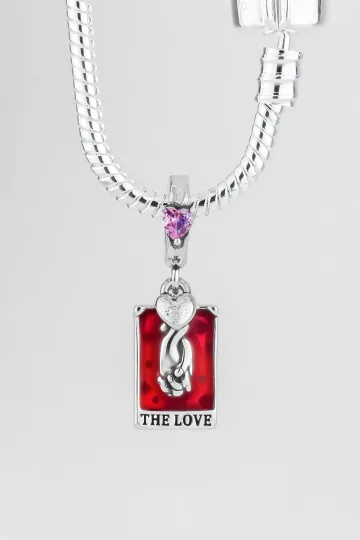
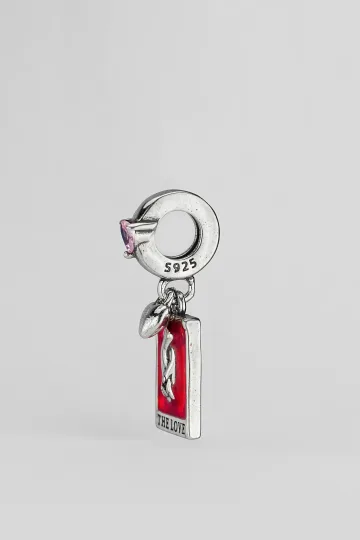
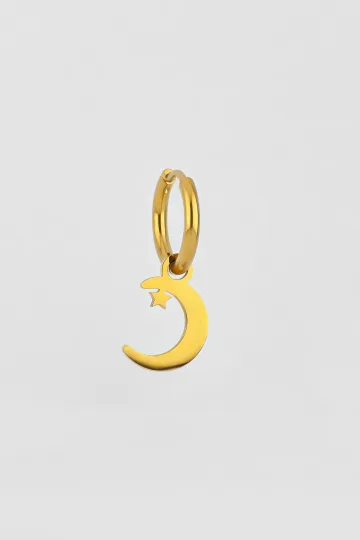
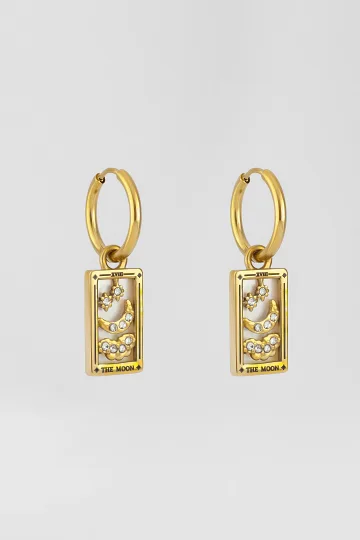
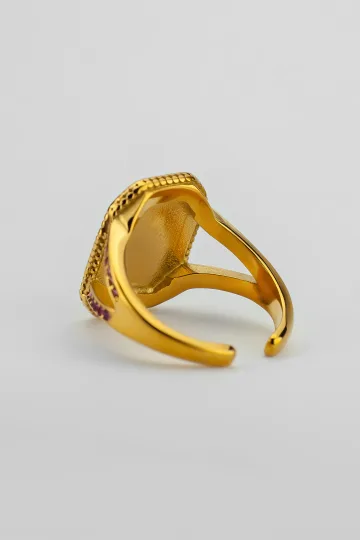
Wear the symbol, don't just read about it. These are in stock:






The number two in Tarot numerology means pair, balance, mirror. Two pillars behind the Priestess, two sides of the veil, two crescents in the crown, two states of any knowledge: hidden and revealed. The entire card is built on a duality that resolves not by choosing one side but by holding both at once. That is a distinct skill: seeing both banks of a river without crossing to either.
In astrology, two corresponds to the Moon: changeable, cyclical, reflecting light rather than generating it. The Priestess is exactly that. She receives knowledge, holds it, and returns it at the right moment, asking neither for authorship nor recognition.
If you read Tarot numerology as a continuous narrative, the Fool (0) begins the journey without knowledge, the Magician (I) acquires tools, and the Priestess (II) learns to be quiet and wait. This is the second step of initiation: stop in the middle of the information stream and hear what lies beneath the noise.
The Papess in History: From the Visconti Deck to the Legend of Pope Joan
Visconti-Sforza: A Forbidden Image from the Fifteenth Century
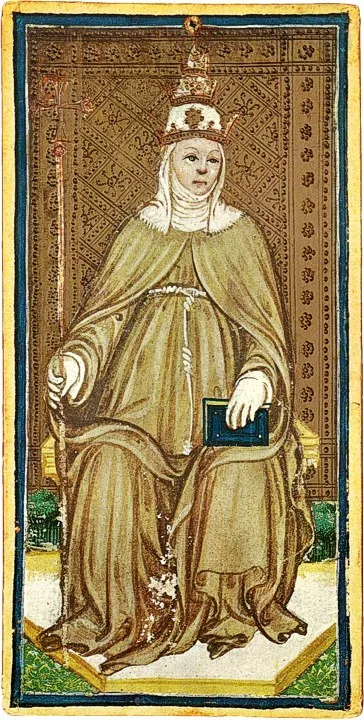
The earliest Tarot decks that survive in painted form were created around 1450 for the ducal house of Visconti-Sforza in Milan. Among the Major Arcana of this deck is a card that caused genuine scandal at the time: La Papesse, the female pope, dressed in papal robes and wearing a triple tiara.
Tarot historian Gertrude Moakley identified a likely historical model for the figure: Sister Maifreda da Pirovano, a relative of the Visconti family, was chosen as leader of a heretical sect known as the Guglielmites. Her followers believed that their founder, Guglielma of Bohemia, had been the incarnation of the Holy Spirit and that after Guglielma's death, Maifreda would become the first female pope of a new world order, lead a new apostolic college, and celebrate the first new mass. The Inquisition burned Maifreda in 1300 in Milan.
Including the image of a burned heretical "papess" in a deck commissioned by the Visconti family could have meant several things: a tribute to a relative, a quiet gesture against papal Rome, or simply an extraordinarily expensive provocation. The artist Bonifacio Bembo, who created the deck, depicted the figure in the tiara, book in hand, head covered, and the card went on to develop its own symbolic life entirely independent of any specific historical model.
Some decks of the period removed the card or replaced it with neutral figures precisely because of its provocative content. Where it remained, it was consistently associated with forbidden knowledge held by a female figure in religious garments.
The Legend of Pope Joan: A Secret That Has Held for Centuries
Running in parallel with the historical model was the folkloric one. The legend of Pope Joan, a woman who allegedly occupied the papal throne under a male name, has been documented at least since the thirteenth century. The chronicler Jean de Mailly mentions her around 1250, and Martin of Opava describes the story in more detail around 1265. According to the most widespread version, she was born in Germany or England, was extraordinarily learned, travelled in male disguise, became a monk, then a cardinal, and finally pope under the name John VIII. Her secret was revealed when she unexpectedly gave birth during a papal procession in the street.
The historical authenticity of this figure cannot be established. The official papal lists for the relevant period were revised and edited across centuries. But the legend itself circulated continuously from the thirteenth through the seventeenth century. It said that intellect and spiritual authority belong to knowledge, not to sex. That hidden knowledge can be concealed beneath any appearance. That such knowledge eventually surfaces regardless of social control.
These are precisely the themes that would later concentrate in the Priestess card: concealed knowledge, forbidden authority, the secret held behind external form.
English-language scholarship on Pope Joan includes Donna Woolfolk Cross's historical novel "Pope Joan" (1996), which revived mainstream interest in the legend, and the academic treatment in Valerie Hotchkiss and Patrick Henry's work. The legend's staying power across seven centuries is in itself evidence of how resonant the idea remains: a woman who holds knowledge equal to or greater than the institution she inhabits, concealed by necessity.
The Marseille "La Papesse" and the Path to a Universal Image
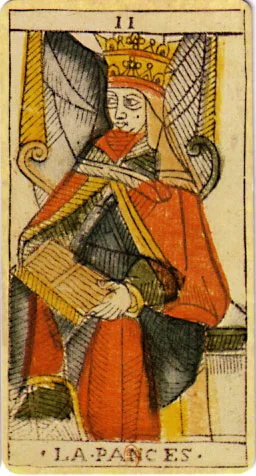
In Marseille Tarot decks of the sixteenth through eighteenth centuries, the card retained the name La Papesse and its iconography: a woman with a triple tiara, an open book or scroll, and heavy ecclesiastical garments. The image was recognizably religious but had already separated from any specific historical model. She had become a figure for the keeper of text, of hidden law, of concealed knowledge as such.
Some European Tarot manufacturers removed the card entirely or replaced it with Juno, La Belle Papesse, or other allegorical figures to avoid provoking ecclesiastical censorship. But in decks where La Papesse remained, her meaning stayed consistent: inner knowledge that cannot be taken to the public square. Knowledge that belongs to whoever is capable of holding it.
During this period the card began acquiring the semantic weight that Waite would later develop: not ecclesiastical power but the power of knowledge over oneself. Guardian, not hierarch.
Waite and Colman Smith: The Birth of the High Priestess
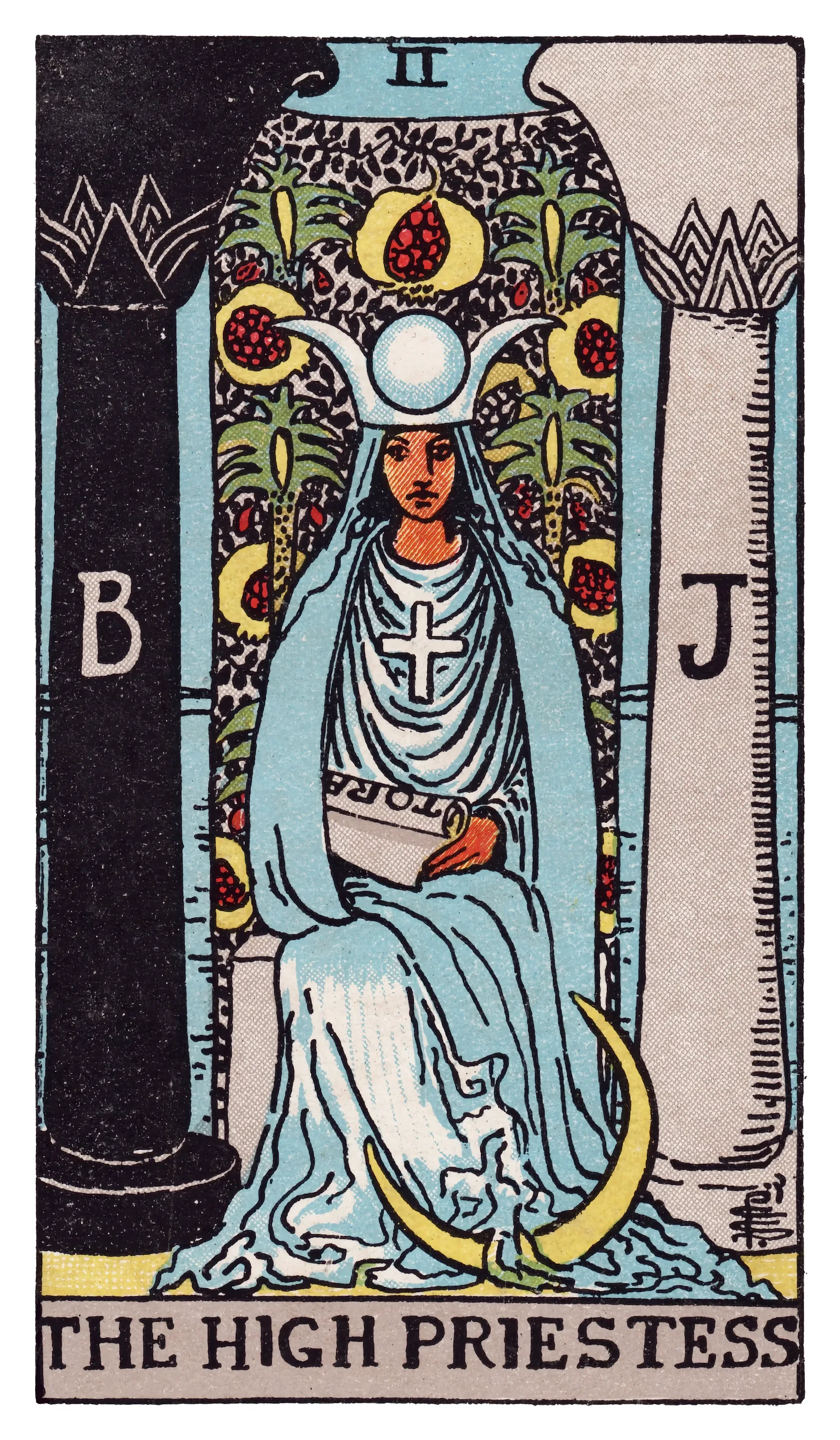
Arthur Edward Waite and artist Pamela Colman Smith redesigned the card in 1909 for the Rider-Waite-Smith deck. They removed the papal tiara, abandoned the direct Catholic references, and created a fundamentally more universal image. The High Priestess in their version reads simultaneously through occultism, Jungian psychology, feminist theory, and mythology, without being anchored to any specific religious tradition.
Waite was a member of the Hermetic Order of the Golden Dawn and worked within an occult system in which every element of every card carried a precise symbolic meaning. Everything in the new Priestess: the pillars, the crown, the garments, the scroll, the veil, was chosen intentionally and systematically. Pamela Colman Smith translated this system into a visual image, and the result became the canonical version.
When people speak today of the High Priestess in Tarot, they mean almost universally the Waite version, even when holding a different deck in their hands.
The symbolic revolution Waite and Colman Smith achieved was translating the image from a specific religious register to an archetypal one. The Papess belonged to her era. The High Priestess belongs to any era that contains a person who knows how to be quiet and know.
Aleister Crowley's Thoth Tarot (designed with Lady Frieda Harris, painted 1938-1943) takes the High Priestess in a different direction, calling the card simply "The Priestess" and centring her in a fully esoteric, Thelemic frame, with geometrically complex projective geometry patterns. The Thoth version is the most explicitly occult of the major lineages. But Waite's remains the reference.
A crescent wants cool silver and a dark collar. A gold moon in daylight is bad taste, and I won't hear otherwise.
How to Wear Priestess Jewellery
Over years on shoots and runways I have carried lunar symbolism through dozens of looks. Here is what actually works, sorted by occasion.
What do I wear this with every day? For daily wear I recommend a thin silver crescent on a chain over a white shirt, grey cashmere or dark linen. The cool metal adds a quiet detail you notice on second glance. A light top lifts the silver softly, a dark one turns it into a hushed accent at the collarbone. One precise piece is more honest here than a handful of pendants.
Is it right for the office? Yes, as long as you keep it restrained. I suggest a short moonstone pendant in silver or white gold, 45 to 50 cm, so the stone sits just under the top button. Under a jacket it reads as a personal sign, not a display. A strict dress code is no obstacle to lunar taste.
How do I build an evening look? For evening I choose layers and a dark backdrop. A longer moonstone pendant against black, wine or graphite elongates the line, and the blue flash wakes up more than it would on pale fabric. Gather two or three silver pendants of different lengths: the crescent higher, the stone lower. Labradorite asks for the same deep tone, its flares open up on nocturnal colours.
Which metal and stone should I choose? The Priestess leans cool: silver, white gold, rhodium. I add yellow gold only in touches, as a warm counterpoint, no more. Moonstone gives a soft glow, labradorite a hidden fire; stacked in thin rings on one hand, the two stones hold a good conversation. Moon-phase earrings I recommend with hair up and a bare neck, where they work as the single accent.
Who does this look actually suit? Anyone who loves restraint, nocturnal tones and minimalism, anyone closer to the mood of quiet than of shine. Lunar symbolism needs no special occasion: a crescent lives as calmly on a weekday as on an evening. The main rule is simple: fewer pieces, more meaning. One considered crescent beats five random pendants on a single chain.

Turn on your camera, pick earrings, a pendant or a ring, and see the piece on yourself in real time.
Switch items in one tap.
Everything runs in your browser: no photo or video is ever uploaded.
The Waite-Smith Iconography: Every Symbol Reads
The Two Pillars, Jachin and Boaz: The Gates of Solomon's Temple
Behind the Priestess stand two pillars, one black and one white. This is a direct reference to the biblical description of Solomon's Temple: two bronze pillars at the entrance, named Jachin (on the right, "he shall establish") and Boaz (on the left, "in him is strength"). The First Book of Kings describes their installation with architectural precision. The Temple was built by Solomon in Jerusalem around the tenth century BCE as the earthly embodiment of the divine dwelling. The pillars stood not only as structural elements but as the boundary between profane and sacred space.
The letters J and B on the pillars in the Waite deck indicate exactly these names. In the Masonic tradition, well known to Waite, Jachin and Boaz are key symbols of the first-degree lodge: Masonic brothers ritually recreate the space of Solomon's Temple by passing between these pillars. Waite introduced this symbolism deliberately, addressing readers who knew their Masonic iconography.
In the symbolic system of the card, the pillars mean any fundamental duality: light and shadow, manifest and hidden, conscious and unconscious, masculine and feminine, birth and death. The list continues indefinitely because duality is a principle, not a specific pair.
The Priestess sits precisely between the pillars, leaning toward neither. This is a considered position: not neutrality but the simultaneous holding of both sides. She knows both banks without identifying with either. The wisdom of the Priestess is exactly this: understanding that truth lives in the space between extremes, not in choosing one of them.
The Crown with Lunar Phases: The Triple Goddess
On the Priestess's head is a crown with three elements: a waxing crescent on the right, a full moon disk at the centre, and a waning crescent on the left. This is the precise iconography of the Triple Goddess: Maiden, Mother, Crone. Three phases of the lunar cycle, three stages of any cycle at all, three types of knowledge: emerging, mature, completing.
The crown speaks to time: the Priestess stands outside of linear time; she sees simultaneously the beginning, the flowering, and the end. For understanding jewellery, this is the key symbol: pieces with moon phases carry exactly this meaning, the complete cycle as a whole, not a single point within it.
The crown also corresponds to the iconography of Isis with her horns and lunar disk, and to the iconography of Hecate in her triple form. Both archetypes are clearly present in the card.
Read more about moon phases and their meaning in jewelry in our dedicated guide.
The Crescent at Her Feet: Lunar Foundation
Beyond the crown, a crescent moon lies at the feet of the Priestess. This element corresponds directly to the iconography of Mary in the Catholic tradition, the Woman Clothed with the Sun with the moon under her feet from Revelation, and simultaneously to the Egyptian goddess Isis. The crescent indicates not dominance over the moon but rootedness in lunar rhythms. The Priestess stands on the crescent as on a foundation.
In jewelry, crescent moon pendants and earrings are closely connected to this image in the jewelry context: the crescent as foundation, as a point of support within the space of the cycle.
The Blue Mantle: Water and Spiritual Depth
The Priestess's blue garments associate with water, flow, depth. In elemental symbolism, water corresponds to intuition, emotion, and what moves without taking rigid form. Blue in Western symbolism is also the colour of sky, spiritual height, and hidden knowledge.
Behind the pomegranate veil, a body of water is visible: a lake or sea, a symbol of the unconscious. This is the space hidden behind the visible. The Priestess sits at the entrance to it, guarding it while not locking it shut. She knows what lies behind the veil, but the decision to enter belongs to each person.
Colour in the card's iconography is not decorative. Blue in Waite's system consistently means spiritual depth and knowledge that arrives through perception rather than analysis. The mantle flows down and merges with the water behind the veil, making the figure of the Priestess a continuation of the very element she guards.
The TORA Scroll: A Partially Concealed Text
On the Priestess's lap, a scroll is partially visible with the inscription TORA. Waite explained this as an abbreviation that can be read circularly as TARO, that is, Tarot itself as a system of hidden knowledge. Whatever the interpretation, the scroll denotes hidden law: knowledge she holds but reveals only partially.
Part of the scroll is concealed under the mantle by design. The Priestess knows more than she shows. Her knowledge is not for general distribution. She holds it for the right moment, for the right person. This detail matches the image of the Papesse with her book in the Marseille tradition: the text exists, it can be read, but not all of it is visible at once.
Notably, the Priestess holds her scroll closed on her lap, in contrast to the Papesse in Marseille decks who holds her book open. Waite intentionally amplified the element of concealment.
The Pomegranate Veil: The Myth of Persephone
Between the pillars hangs a veil covered with pomegranates and palm leaves. The pomegranate is consistently associated with the myth of Persephone: by eating the seeds of a pomegranate in the underworld of Hades, she became bound to spend part of each year there. The pomegranate marks transition between worlds, cyclicality, the border between the visible and the invisible.
The crimson-gold seeds on the blue background of the veil represent a visual meeting of two realms: the underworld and the celestial waters. This is exactly the threshold space the Priestess inhabits. The palm leaf in Egyptian symbolism is associated with Thoth, god of wisdom and writing. Together, pomegranate and palm form a pattern that says: here lives knowledge of death and rebirth, of mystery, of passage.
The veil is neither open nor closed. It exists as a threshold. The Priestess sits at this threshold but does not invite passage through it without preparation. The timing of the knowledge's opening is hers to determine, not the observer's.
The Priestess in Kabbalah: Path Gimel from Tiferet to Keter
Astrological Correspondence: The Moon and the Lunar Principle
In the Tarot tradition developed by Waite on the basis of the Golden Dawn system, every Major Arcana is assigned a planetary or zodiacal symbol. The High Priestess corresponds to the Moon.
The Moon in astrology rules the unconscious, cycles, intuition, bodily memory, and instinctive response. Unlike the Sun, which governs conscious expression and identity, the Moon is how we respond before we think. How our body knows before the mind does. How we feel the mood in a room before anyone says a word.
Lunar rhythms are the rhythms of the body, of sleep, of emotions, of unpacked knowledge that has accumulated over years. This is precisely why the Priestess, the card of deep knowledge and intuition, stands under lunar rulership. She does not produce her own light; she reflects and holds.
In natal astrology, a strong Moon in Cancer, Scorpio, or rising often describes a person who lives by the Priestess principle: feels first, understands second, speaks third. If she speaks at all.
Path Gimel: From the Heart to the Summit
In the occult correspondence between Tarot and the Kabbalistic Tree of Life, the High Priestess is associated with the Hebrew letter Gimel and the thirteenth path. This path connects Keter (the Crown, the highest unity) with Tiferet (Beauty, the heart centre) and is the longest single path on the Tree of Life.
Tiferet sits at the centre of the Tree and is considered the point of equilibrium, where the higher and the lower, the conscious and the unconscious, converge. Keter stands at the summit and symbolises pure being, undivided unity before all distinction. The path of Gimel connects heart and crown: it is the movement from personal understanding to cosmic awareness.
Gimel means "camel." The image is precise: a camel can cross the desert without water, carrying its load through drought, delivering it intact. The Priestess as camel carries knowledge across the arid space of uncertainty, through the period when nothing is clear and there are no external markers, until it reaches the centre. She does not lose the water of knowledge along the way.
The thirteenth path crosses the Abyss separating the higher and lower Sephiroth. This is the crossing of the unknowable, a zone where there are no concepts, no forms. The Priestess lives here: between what can be known and what cannot be expressed in words. She holds this gap not as a problem but as her natural state.
Customer reviews
Zevira is a real jewellery shop. Genuine payments, deliveries and customer thank-yous.
🥰🥰🥰 gracias

Ok, ¡gracias! 🙂

Isis, Artemis, Hecate: The Triple Goddess and the Priestess
Isis: The Lunar Mother of All Knowledge
The Egyptian goddess Isis in her image combines everything the Priestess describes: wisdom, lunar nature, the holding of secret knowledge, and the capacity to reconstruct wholeness from fragments. Her iconography with horns and a lunar disk on her head passes directly into the Priestess's crown image: the same tripartite symbol, the same connection to lunar cycles.
Isis gathers the body of Osiris from fourteen fragments scattered by Set across the world and restores the lost wholeness. This is the archetypal action of the Priestess: gathering dispersed knowledge, restoring the pattern from scattered details, seeing the whole where others see only pieces.
In Greco-Roman syncretism, Isis was identified with Demeter, Aphrodite, and the Moon. Her cult was the longest-lasting of all: it persisted from the era of the Old Kingdom to the fifth century CE, when the last temple of Isis on the island of Philae was closed by order of Emperor Justinian. Nearly four thousand years of one goddess's presence in culture is itself testimony to the power of the archetype.
Isis's central role in Egyptian magic also matters. She was considered the goddess-sorceress who held the True Name of Ra. To know the true name was to have power over a thing. The Priestess holds a scroll with partially concealed text: she too knows names she does not speak aloud.
Artemis: Knowledge Through the Experience of Solitude
The Greek Artemis, goddess of the moon and the hunt, lives outside the ordinary rules of human society. She is unmarried, not bound by social obligations, not dependent on anyone's approval. Her world is the forest, the night, chosen solitude. Artemis knows paths that do not appear on maps; she hears what is not audible to others.
This is exactly the independence and self-sufficiency the Priestess carries. Artemis's knowledge was gained not from books or other people's words but from the direct experience of the nocturnal forest, from unmediated contact with the cycles of nature.
Artemis protects those who call on her, but on her own terms. She does not come at the first summons. Her knowledge is given to those who know how to wait. In the iconography of Artemis, the silver crescent moon is a constant attribute: the goddess literally carries the symbol of cyclical knowledge. The crescent at the Priestess's feet and the crescent of Artemis rhyme across millennia.
In the Roman pantheon, Artemis became Diana, and her cult in Ephesus united both traditions. The great Temple of Artemis at Ephesus was one of the Seven Wonders of the Ancient World, a repository of knowledge about the feminine principle.
Hecate: The Triple Guardian of the Threshold
Hecate, the three-faced goddess of magic, crossroads, and lunar phases, adds another dimension to the Priestess archetype. Standing at the crossroads, Hecate looks simultaneously in three directions. She does not choose the path for the traveller; she holds the torch so the traveller can see.
The triple crown of the Priestess with its three moon phases corresponds directly to the triple nature of Hecate: Maiden, Mother, Crone. Three directions of the crossroads. Three branches of the path. Both figures exist on the threshold, between worlds: Hecate literally stands at the crossroads, the Priestess sits between the pillars at the veil.
Hecate knows the underworld, the earthly world, and the sky, and her knowledge is complete precisely because it encompasses all three levels. In Greek sources she is called "the seer in darkness" and "she who sees clearly by torchlight." This is not metaphor: Hecate holds fire in the dark and illuminates the crossroads for those who have lost their way between choices.
In jewellery symbolism, the triple moon is the direct iconography of Hecate. A pendant with three lunar disks or a piece with a triple crescent is simultaneously a symbol of the Tarot Priestess and of Hecate. Both images say the same thing: complete knowledge includes all three phases, not just one.
Persephone and Pomegranates: Cyclical Knowledge of Both Worlds
The pomegranate veil behind the Priestess points to Persephone, the goddess who lives in two worlds. The pomegranate seeds bound her to the underworld and made her passage between worlds obligatory, cyclical. But this is not purely tragic. Persephone knows both worlds from the inside. Her understanding of death and birth is personal, lived, not theoretical.
The Priestess stands before the pomegranate veil as the guardian of this knowledge of the double world. She is neither here nor there; she stands at the threshold between them. That is her place.
The Priestess Through Jung: Anima and the Shadow Feminine
Anima: The Receptive Principle in Jungian Psychology
Carl Gustav Jung developed the concept of Anima as the archetypal image of the feminine principle in the male psyche and as the symbol of receptive, intuitive function in general. The Anima is the part of the psyche that does not act but perceives: receives images, accumulates sensory experience, hears what has been rationally ignored.
The High Priestess in the Jungian interpretation of Tarot is the personification of Anima in its highest expression: not instinctive, not seductive, but wise. She does not capture, does not destroy, does not seduce. She holds and waits. This is the psychic function that says: wait, you haven't understood everything yet. Let the information settle. Let your unconscious finish its work.
For women, the Priestess archetype means something different: not an external image of Anima but an internal structure. It is the part of female psychology that holds its own space apart from social expectations, that does not hurry toward self-disclosure, that knows the value of silence.
The Medium and the Dark Aspect: Shadow Femininity
Jung warned about the shadow side of every archetype. The shadow side of the Anima is not destruction and aggression but manipulative opacity. The Priestess that has gone into shadow becomes not a keeper of knowledge but a holder of power through deliberate impenetrability. She says "I know but I won't tell you" not out of wisdom but out of a desire to control.
In psychotherapy this is the pattern of passive dominance: someone who holds others in a state of uncertainty through deliberate silence. For those who work with archetypes consciously, this shadow pole is important to know. The distinction between wise holding and manipulative opacity is one of the key questions the card puts to the reader.
The Witch as a Third Face
In folk and Romantic tradition, the image of the witch often carries Priestess qualities: knowledge inaccessible to ordinary people, a nocturnal existence, connection with the moon and plants, the capacity to see what others do not notice. In psychological terms, the "witch" is not a malevolent figure but a woman who holds her knowledge outside social systems.
The Priestess in this dimension is the guardian of what cannot be institutionalized: intuition, sensory knowledge, bodily wisdom. A culture that values only verified and public knowledge has always been suspicious of those who hold something different. This is exactly the figure who was burned alongside Maifreda in the thirteenth century and whom Waite remade into the wise guardian of the threshold.
The witch in contemporary American culture has undergone significant rehabilitation. Films like "The Craft" (1996), "Practical Magic" (1998), and "The Witch" (2015) each represent different facets of this archetype: the adolescent claiming power, the domesticated magic of chosen family, and the deeply unsettling raw wildness of the witch who belongs to no human community. In "Dune" (2021 and 2024), the Bene Gesserit order is one of the most complete contemporary film representations of the Priestess archetype: women who hold hidden knowledge across generations, who see patterns that others cannot, who exercise power through perception rather than force.
Upload a photo of your pet, someone you love, or an object. We'll build a 3D model and hand-cast it in pewter.




Moonstone: Geology, Mining, History of Wear
Adularescence: The Physics of Inner Light
Moonstone, a variety of feldspar from the orthoclase-albite group, owes its luminosity to structural features at the micro level. Inside the stone, extremely thin layers of two mineral phases alternate: orthoclase and albite. When light enters the stone, it reflects and refracts at the boundaries between these layers, creating the optical effect called adularescence: a soft, almost floating bluish light that appears to move under the surface as the angle of view changes.
The thinner the layers and the more precise their alternation, the more beautiful the effect. The finest stones produce what is called a three-dimensional glow: the light appears to have depth rather than just surface presence. This is a physical explanation, but it does not make the phenomenon any less compelling. Looking at a fine moonstone is genuinely looking at something that lives inside.
Moonstone's hardness on the Mohs scale is 6 to 6.5. It is durable enough for everyday wear in rings and bracelets, though it requires care: hard impacts can create fractures in the layered structure. For earrings and pendants the risk is lower. Cabochon cutting is optimal: it emphasises the inner life of the stone better than any other form.
Sri Lanka, Myanmar, India, Madagascar: The Major Sources
Classic moonstones with rich blue glow have historically come from Sri Lanka, primarily from the area around Matara in the south of the island. Sri Lankan stones are valued for the transparency of their base and the intensity of their blue sheen. They defined the canonical image of "moonstone" in jewellery from the Art Nouveau era onward.
Myanmar provides stones with a stronger blue tone in the base and an intense blue glow. Myanmar moonstones are less transparent than Sri Lankan ones, but their sheen is sometimes more saturated. Indian moonstones more frequently show rainbow adularescence: multiple colours simultaneously, from blue through orange. This is the so-called "rainbow moonstone," technically not pure orthoclase but closer to labradorite, though the term is used interchangeably in the trade.
Madagascar has been one of the major moonstone suppliers to the world market since the late twentieth century. Madagascar stones vary in quality: exceptional specimens with deep adularescence can be found alongside average-quality material. Overall, Madagascar expanded the availability of moonstone and brought its average market price down.
Two Thousand Years of Jewellery History
Moonstone has been known as a jewellery material for at least two thousand years. Roman jewellers valued it for its association with the lunar goddess Diana. The Indian jewellery tradition held moonstones in particularly high regard: in Sanskrit the stone is called chandrakanta, literally "beloved of the moon." Indian mythology attributed to it the power to evoke visions of the future by the light of the full moon.
The true flowering of moonstone in Western jewellery came with the Art Nouveau movement at the turn of the nineteenth and twentieth centuries. Jewellery artists, primarily French and German, fell for moonstone because of its organic, natural aesthetic: it fit perfectly into the floral and feminine imagery of the style. Moonstones began appearing in pendants with nymphs and butterflies, in tiaras with lunar crescents, in rings with botanical ornament.
At Zevira's jewellery studio, moonstone stays in the collections year after year precisely because its visual language remains precise: adularescence is a literal embodiment of the Priestess principle, something is inside, it glows, but you cannot grasp it.
Caring for moonstone is straightforward: a soft cloth, neutral soap when needed, storage apart from harder stones to avoid scratches. Ultrasonic cleaners should be avoided: they can disrupt the layered crystal structure. With proper care, moonstone keeps its glow for many years and over time becomes more personal, accumulating the faintest traces of wear.
Read more about moonstone, its properties and meaning in jewelry in a dedicated guide.






Labradorite: Discovery and Art Nouveau
1770: Labrador and the First Description
Labradorite was formally described and named in 1770 after the mineral was found on the Labrador Peninsula in Canada. The discovery is attributed to Moravian missionaries working among the Inuit: they were the first to bring samples to Europe, where the mineral received its name from the place of discovery.
The Indigenous peoples of Labrador, including the Inuit and the Mi'kmaq, knew the stone long before European contact. According to one version of an Inuit legend, the Northern Lights had fallen to the shore and frozen in the rocks, and labradorite was their fragments. The legend explained labradorescence, the iridescent coloured glow inside the dark stone, which genuinely resembles the aurora borealis in miniature.
The physics of the phenomenon: in labradorite, as in moonstone, light undergoes interference at thin layers of different crystalline phases. But in labradorite the layers are thicker, and the result is different: not a soft bluish glow but vivid, saturated flashes of blue, green, gold, and red when the stone is turned. This effect is called labradorescence, named after the stone that gave it a name.
Labradorite's hardness is 6 to 6.5 on the Mohs scale, roughly matching moonstone. Technically, both stones belong to the feldspar group. Major deposits today: Finland (Finnish spectrolite), Madagascar, Mexico, Norway, Canada.
Art Nouveau: Labradorite as the Material of a New Aesthetic
Art Nouveau opened labradorite to high jewellery. Before the late nineteenth century, the stone was used primarily as a decorative material: tabletops, decorative inlays in interiors. Art Nouveau artists found in labradorite what they were looking for: a natural material with an unpredictable, living character.
Rene Lalique, the central figure of Art Nouveau jewellery, worked with labradorite alongside other natural and semi-translucent materials. The style demanded organicism, flow, a rejection of rigid geometry: labradorite, with its iridescent, unrepeatable pattern, fit this program perfectly. Pieces featuring female figures, dragonfly wings, and sinuous stems often included labradorite as a central element.
In German and Austrian Art Nouveau and Jugendstil jewellery, labradorite appeared in substantial pendants with silver settings, often combined with enamel. This tradition established the durable association of labradorite with a mystical, nocturnal aesthetic that persists to this day.
Today labradorite holds a secure place in jewellery that works with themes of hidden knowledge, intuition, and inner fire. In the aesthetic of the Priestess, it stands alongside moonstone: if moonstone glows softly for all, labradorite ignites only for those who look from the right angle.
Read more about labradorite's meaning and properties in jewelry.
The Priestess in Literature and Film
Cassandra: Knowledge Without the Right to Speak
Cassandra of Troy saw the future accurately. Her curse was that no one believed her. The knowledge was absolute, but it was not received by those around her. This is the reversed Priestess in literary form: the intuition is there, but it is blocked not from within but from without, through the refusal of others to acknowledge its validity. Cassandra's tragedy is the tragedy of knowledge that is correct but impossible to transmit.
The image of Cassandra has lived in literature for millennia not because it is exotic but because it is recognisable. The person who feels something important and cannot make anyone hear them knows Cassandra without Homer. The Priestess in the upright position is Cassandra who has learned to be quiet and wait for the right moment. Reversed, she is Cassandra who cannot get a word in.
Lady of Shalott and the Pythia: Mirror Versus Direct Gaze
The Lady of Shalott in Tennyson's poem sees the world in a mirror, not directly. Her space is mediated perception, reflection. While she looks only in the mirror, she is safe. When she turns to the window and looks directly, the cycle is broken. This is a precise image of the upright and reversed Priestess: the first sees through her inner mirror and is safe; the second reaches for direct seeing and loses her power.
The Pythia at Delphi, the oracle of Apollo, spoke on behalf of the god in a voice that required interpretation. Her answers were never direct. Knowledge was given in a form that required deciphering. This is the principle of the Priestess: she does not hand out ready answers. She creates conditions in which the answer can be heard by the person who asked.
The Delphic oracle functioned for several centuries as the principal political and personal consultant of the Greek world. Kings consulted the Pythia before wars. Private individuals sought answers about death and birth. The operating principle of the oracle, the indirect answer requiring interpretation, coincides precisely with the card's principle: the Priestess does not deliver a clear directive. She creates space for understanding.
Emily Dickinson is another figure that maps cleanly onto this archetype: a recluse who refused publication, who held her immense body of work almost entirely private during her lifetime, who wrote in dashes and blanks, encoding rather than disclosing. Her poems routinely circle the unnameable rather than name it. She is the Priestess of American poetry, the one who kept the scroll partly covered.
The Misunderstood Seer: Intuition Outside the System
A recurring figure in folklore and literature is the young outsider who sees what others do not notice and is dismissed for it. Her knowledge is not accepted within the system: her peers mock her beliefs and treat her perception as eccentricity. She does not defend her right to see through aggression; she simply continues to see.
She holds and receives. She does not hurry to explain. Her inner world is stable against external pressure. At the moment when precise perception is needed, she is the one who turns out to be right. This is the upright Priestess in narrative form: the person whose inner knowledge is initially ignored, then proves indispensable.
Lunar symbolism often attaches to such characters from their first appearance, and the general air of someone who is fully present in a dimension others cannot access gives them an aesthetic that rhymes with the Priestess: something real and true, concealed behind a surface that strikes others as strange.
Joan of Arc: Hearing What Cannot Be Proven
Joan of Arc (c. 1412-1431) is one of the most compelling historical figures for the Priestess archetype: a young woman who acted from inner voices and visions that she held as more authoritative than any external institution. She was not a scholar, not an aristocrat, not a priest. She was a keeper of inner knowing who refused to let the institution overwrite it.
The trial records of her condemnation at Rouen are among the most remarkable documents of the fifteenth century. Joan was asked repeatedly to disavow her voices, to accept that what she had heard was delusion. She refused. Not from stubbornness but from something closer to the Priestess principle: the knowledge is what it is. The outer authority does not determine the inner truth.
Joan was burned in 1431, rehabilitated by Rome in 1456, and canonized in 1920. Her story illustrates both the upright Priestess (the one who holds internal knowledge with precision and calm) and the price exacted from such figures by the systems they exist within.
Leave your email, we'll send your discount code. No spam, unsubscribe anytime.
The code arrives by email, valid on your first order.
Twelve Lunar Phases and the Cycles of the Body
Astronomy: The Moon That Counts
The lunar synodic month, the time from one new moon to the next, is approximately 29.5 days. During this period the moon moves through a series of visually distinct phases. The classical system identifies eight major ones: new moon, waxing crescent, first quarter, waxing gibbous, full moon, waning gibbous, last quarter, waning crescent. But a more detailed tradition identifies twelve phases, establishing parallels with the twelve signs of the zodiac or the twelve months of the solar year.
Twelve lunar phases in such a system create a map of waxing and waning not only of light but of energy, activity, and perception. The new moon is the time of beginning and inward turning. The waxing moon is the time of action and accumulation. The full moon is the time of culmination and clarity. The waning moon is the time of release and integration.
The precision of lunar counting was a practical necessity: agriculture, navigation, and medicine in pre-industrial cultures depended substantially on the lunar calendar. Planting, livestock care, harvest, and surgical procedures in medieval medicine were all correlated to lunar phases. The moon was the most accurate publicly available timekeeper.
Tracking Cultures: From Stonehenge to the Menstrual Calendar
Stonehenge on the Salisbury Plain was built partly as a lunar observatory: rows of stones oriented toward lunar rise points at specific intervals. This was not coincidence but the result of centuries of sky observation. The builders of Stonehenge knew the lunar cycle with enough precision to embed it in architecture.
The Indian Panchang, the traditional astrological calendar, is based on dividing the lunar month into thirty lunar days (tithi). Each tithi has a particular quality: favourable for some activities, unfavorable for others. This system remains actively used in Indian astrology and in the planning of significant events.
The connection between the lunar cycle and the menstrual cycle has been noted in many cultures independently: the average duration of both is close to 29.5 days. In folk traditions of Europe and Asia, the female cycle was regularly correlated with the lunar one. Modern medicine approaches this connection with caution: synchronization occurs but is not a physiological norm. Nonetheless, the practice of tracking bodily cycles through the lunar calendar remains a living practice for many people.
Jewellery with lunar phases worn daily carries this principle: a reminder that the human body and natural rhythms correspond, and that awareness of the cycle is a practice, not merely a symbol.
Moonstone as a Cycle Journal
In some practical traditions associated with lunar tracking, moonstone is worn during the waning moon and removed at the new moon, placed under the open sky that night as a symbolic "recharge." This is not a mandatory practice or a magical ritual in any strict sense: it is a way of embodying the abstract principle of cyclicality in a concrete physical action. Remove the ring, place it in moonlight, put it on in the morning renewed. A small ritual that recalls: knowledge also has phases.
The Priestess's triple-moon crown describes not merely an astronomical fact but a principle of relationship to time. Wisdom does not accumulate linearly: it rises, reaches fullness, then retreats inward to rise again on the next turn. This is an uncomfortable idea for a culture that values only growth. The Priestess holds it calmly.
The Priestess in Readings: Intuition in Career, Love, and Health
Upright: The Inner Voice Is Heard
In the upright position, the High Priestess speaks of deep intuition that is active and accurate right now. The inner voice is audible; trusting it is warranted. This is a time for quiet work: meditation, reading, thinking, solitude. Not a time for loud declarations.
The upright Priestess in an advice position says: stop before you act. Listen. What you feel is more accurate than what others are saying.
As a description of a person or a situation, the upright Priestess describes deep knowledge, restraint, the capacity to keep a confidence, wisdom through perception. This is someone who can be trusted with what cannot be trusted to anyone else.
Career and Professional Decisions
In a career reading, the Priestess appears when a person has accumulated enough experience but does not yet know how to apply it. This is not a situation of deficit: the information is there. It is a situation of ripening: the knowledge is not yet ready for public expression, and there is no need to force it. The card advises using this time for observation rather than declaration.
In concrete situations: when choosing between two offers, the Priestess says do not act from urgency, act from understanding. If the intuition is silent or uncertain, that is a sign that the information needed for the decision is still insufficient, even if everything looks clear on the surface. The Priestess in a professional context often points to the necessity of behind-the-scenes work: a preparatory period invisible to others.
Love and Relationships
In a love reading, the upright Priestess describes a situation where the important thing is not to rush events. If a relationship is only beginning, the card advises allowing it to develop naturally without forcing definition. What needs to be revealed will reveal itself.
The Priestess in relationships can also indicate a person with a deep inner life who opens slowly and only when they feel the moment is right. This is not coldness or detachment: it is the careful holding of oneself as something of value. Pressure here is counterproductive.
Health and Bodily Cycles
In questions of health, the Priestess points to the need to listen to the body: not to suppress early signals with logic or busyness, but to notice patterns. The body knows before the mind has packaged the symptoms into understandable words. The card advises paying attention to what has already been noticed but not yet voiced even to oneself.
The lunar phases in the Priestess's crown speak in this context about the cyclicality of bodily condition: not every day is the same, not every month is the same. The body lives in rhythms, and working with those rhythms rather than against them is the essence of the Priestess approach.
Reversed: When Noise Drowns the Signal
In the reversed position, the Priestess describes a situation where the inner voice is there but not being heard. The reasons may vary: information overload, chronic anxiety, others' opinions placed above one's own. The knowledge is blocked; the intuition is silent not because it does not exist but because it cannot get a word in.
The reversed Priestess in relationships can point to the concealment of something important: secrets that destroy rather than protect. Distance where openness is needed.
Another pole of the reversed Priestess: excessive secrecy. Knowledge that is already ready to be shared is being held back from fear or a drive toward control. Holding crosses into withholding; wisdom becomes paranoia. The Priestess who never opens anything ceases to be a guardian and becomes a jailer.
CAPAORA mini knife pendant
The 18th-century Spanish navaja in miniature: 40 mm of stainless steel, a real folding mechanism and a Palanquilla lock that clicks. An affordable gift to remember.
Authentic · Ships from Spain · 14-day returns
Combinations with Other Cards
The Magician and the Priestess: Active and Receptive
The Magician (I) acts on the world; the Priestess (II) perceives it. The Magician knows what to do. The Priestess knows what is actually happening. Neither mode is complete on its own: action without perception is blind; perception without action is sterile.
Together in a reading, these cards amplify or balance each other. The Magician next to the Priestess says: the knowledge is there, time to act. The Priestess next to the Magician advises: before acting, listen, because not everything visible corresponds to what is.
In occult tradition, the Magician-Priestess pair is sometimes interpreted as an allegory of the conscious and unconscious, Sun and Moon, Animus and Anima in the Jungian sense. This is not a hierarchy: both principles are equally valid, simply different in nature and timing.
The Empress: After the Guardian Comes Embodiment
Arcana III, the Empress, is often interpreted as the next step after the Priestess. If the Priestess holds knowledge inside, the Empress embodies it in the world: gives birth, creates, nurtures, makes it tangible. The first three Arcana form a sequence: action and tools (Magician), knowledge and perception (Priestess), embodiment and birth (Empress).
The Priestess next to the Empress in a reading says: the knowledge is already there, it is time to begin creating. This union of two feminine Arcana describes the complete creative cycle from perception to embodiment.
The Moon (Arcana XVIII): Light and the Dark Side
The Moon (XVIII) is the dark side of the same lunar principle. If the Priestess represents conscious engagement with intuition and wise holding of knowledge, the Moon represents fears, illusions, what hides in the unconscious and controls us without our awareness.
Both cards connect to the lunar world, but the Priestess knows what is in the darkness and holds that knowledge with confidence. The Moon describes the traveller lost in the dark who does not know whether what they see is real. When both cards appear in a reading, the signal is: the intuition is there, but fears are interfering with its operation.
The Hermit and the Priestess: Two Kinds of Solitude
The Hermit (IX) and the Priestess are both associated with solitude and inner knowledge. The difference is in movement: the Hermit seeks, walks; his solitude is active. The Priestess waits, holds; her solitude is rooted. Together they describe the complete arc of spiritual seeking: movement outward (Hermit) and movement inward (Priestess).
Read about other cards in the deck and their symbolic connections to jewelry in the Tarot jewelry guide and the article Tarot cards decoded: Sun, Moon, Lovers.
Tarot Readers on the Priestess
How Practitioners Describe Meeting the Card
Experienced tarot readers consistently single out the High Priestess as one of the most difficult cards to interpret in concrete situations. The reason is that her message is always about what is missing from the reading: knowledge that does not yet exist, time that has not yet come, silence needed before speaking.
Rachel Pollack, author of the classic "78 Degrees of Wisdom," treats the Priestess as the archetype of primary femininity before any social definition. For Pollack, this is the card of potentiality: everything that may become has not yet been determined. The Priestess holds this state as valuable in itself, not hurrying its transformation into something specific.
Murry Hope, in her analysis of the Arcana, connects the Priestess to the cosmic principle of Binah, the receptive power of the universe that precedes all active creation. This is not passivity in any trivial sense, but primary receptivity without which no birth is possible. The Priestess in this interpretation is not waiting; she is holding potential in the correct state until the moment of embodiment.
The Priestess in Study and Practice
A reader who has maintained a long practice notices a pattern: the Priestess most frequently appears for people going through a transitional period that has not yet externally resolved. A new job not yet found, a relationship not yet defined, a decision not yet made. The card in such a situation does not say "wait a little longer" as advice in patience. It says: in the silence of this period there is information worth noticing before the period ends. After it ends, understanding this will be harder.
This quality, the capacity to value a transitional state as such, is what makes the Priestess archetype a meaningful orientation in life, not only in divination. Culture pushes toward certainty. The Priestess recalls: uncertainty is not a defect of the situation. It is the situation's informative part.
Jewellery by the Symbolism of the Priestess
The iconography of the card gives several entirely concrete jewellery images: the moon in all phases, the crescent as its own motif, stones with inner light, symbols of hidden seeing and the third eye. This is a direct translation of the archetype into material form. Wearing a piece with the Priestess's symbolism is choosing a visible sign of an invisible inner state.
Moonstone: The Principal Stone of the Priestess
If the High Priestess has a stone, it is moonstone. Its adularescent glow, the floating bluish light moving under the surface, is an optical phenomenon that precisely describes the archetype: something is inside, it glows, but it cannot be grasped. Look directly and there is almost nothing. Turn the stone slightly and a flash of blue.
Moonstone is consistently associated in jewellery history with intuition, lunar cycles, the feminine principle, and the water element. It is most expressive in cabochon cutting, which emphasises the stone's inner life rather than geometric precision. Rings with large moonstone cabochons in fine silver settings, moon-shaped pendants with moonstone inside, earrings with several stones of different sizes visually recalling phases: all of these are a direct conversation with the Priestess's image.
Moonstone comes in several varieties: classic white with blue shimmer, rainbow with multicoloured flash, peach with warm overtones. For the Priestess's symbolism, the white and blue come closest: cold lunar light rather than solar warmth.
Moon Phases: The Symbol of the Complete Cycle
The Priestess's crown shows three lunar phases simultaneously. A piece with the full cycle depicted, waxing, full, and waning moon in sequence on a pendant, ring, or bracelet, is the visual formula of the archetype: compact and precise.
Such pieces speak not of a specific point in the cycle but of cyclicality as the organising principle of time and knowledge. Beginning, flourishing, completion. All of these are parts of one continuous movement, not three separate events.
Bracelets with triple moon charms, pendants with the triple lunar symbol, earrings with paired phases: these are the steady jewellery language for those who live in rhythm with the cycle.
Crescent: The Sickle at the Priestess's Feet
The crescent moon is one of the most consistent jewellery motifs associated with the Priestess archetype. Unlike the full lunar disk, the crescent indicates transition: waxing or waning, a moment between that itself contains movement.
In jewellery aesthetics, the crescent is equally elegant across very different contexts: a gold crescent on a fine chain as a minimal pendant, crescent-shaped earrings, a crescent charm on a bracelet. Silver is more authentic here than gold, but gold reads as a tribute to the solar-lunar unity.
A horizontal crescent with the horns facing down is visually more stable and reads as a "cup" or "boat," a receptive principle. A vertical crescent with horns up carries a different image: aspiration, rising. For the Priestess's symbolism, the horizontal reads closer: reception rather than aspiration. But this is a nuance the wearer chooses according to their own sense.
The full collection of meanings for this symbol and its variations is in the article on the crescent moon and star in jewelry.
Third Eye and Labradorite: Seeing Beyond the Surface
The symbol of the third eye stands beside the Priestess archetype across several planes of meaning simultaneously. Both symbols point to the capacity to perceive what is not accessible to ordinary sight.
Read more about the third eye symbol and its meaning in jewelry in our dedicated article.
Labradorite is optically close to moonstone in its nature but its labradorescence works differently. From inside the dark stone, at the right angle of view, blue, green, gold, and turquoise ignite. Moonstone glows softly in any direction. Labradorite ignites only for those who look from the right angle.
This is a precise metaphor for hidden knowledge that is visible not to everyone, only to those who occupy the right position. Labradorite cabochons in a dark setting, especially in matte silver or oxidised bronze, produce pieces with genuine inner life.
Read more about labradorite properties and meaning in jewelry.
Mystic eye symbols pair naturally with the Priestess aesthetic: see our guide to mystic and eye symbols in jewelry for the full range.
Form, Metal, and Combinations
For pieces in the Priestess's image, silver works more authentically than gold: the cold lunar glint of silver is closer to the card's symbolism than the solar warmth of yellow metal. White gold, palladium, or rhodium plating occupy the same territory.
In form, the Priestess tends toward the vertical: elongated pendants, teardrop stones, crescents, lengthened symbols. Fine chains, barely visible, work better than heavy ones. Minimalism or deliberate asymmetry.
The combination of moonstone and labradorite in a single set creates a dialogue between two kinds of knowledge: the manifest glow and the hidden fire.
Send a friend a discount code, they save on their first order.
Who the Priestess Archetype Fits
Pieces with Priestess symbolism are worn by those who work primarily through perception. This is not a professional portrait or a demographic category, but a description of an internal mode.
Psychologists, therapists, psychiatrists: their work is holding other people's stories, listening without immediate response, sustaining space for another person. The Priestess describes this skill more precisely than any professional credential.
Editors, curators, architects of meaning: people who know what works before they can explain why.
Researchers and scientists in the synthesis phase: when the data has been gathered, the analysis done, and the wait begins for the meaning to assemble into a coherent picture.
Mediators, negotiators, diplomats: people who hear what is not said and know how to work in the space between two sides. Literally between two pillars.
Crisis counselors and palliative care specialists: professions in which the ability to be present alongside what cannot be fixed is the key skill. The Priestess knows that not every pain needs immediate resolution. Sometimes the task is simply to be there and hold the space.
For all of these, a piece with the Priestess's symbol is not a decorative choice. It is a professional marker, a personal sign, a visible declaration of how the person engages with the world.
When to Give a Piece with Priestess Symbolism
A professional milestone. When someone completes their training, defends a dissertation, opens their own practice in a field where intuition and accumulated knowledge come first. A piece with the Priestess symbol at that moment says: you already know enough. Trust that knowledge.
A significant life transition. Not necessarily a joyful one. The end of a long period, a change of role, stepping out of something familiar. A moment when inner sense rather than external markers is the anchor.
Support in a hard time. When someone is going through something heavy and needs a reminder that their perception is accurate, that what they feel is real.
A birthday for people with a strong Moon in their natal chart: Cancer, Scorpio, Pisces, or the Moon on the Ascendant. These people live by the Priestess principle by nature, and a piece resonates with their internal structure.
FAQ
What does the High Priestess mean in a Tarot reading? The card points to the need to listen to the inner voice and not rush events. It often appears at a moment when the person already knows the answer but doubts its accuracy. The Priestess says: trust your perception. Give the knowledge time to surface on its own.
What stone corresponds to the High Priestess? The principal stone is moonstone with its adularescent blue glow. Additional stones: labradorite, amethyst, silvery topaz, white opal. All share the image of inner light that is not immediately visible and only appears at the right angle or in the right mood.
What are the pillars Jachin and Boaz on the card? A reference to the two bronze pillars at the entrance to Solomon's Temple, described in the First Book of Kings. Jachin means "he shall establish," Boaz means "in him is strength." In the card's symbolism they represent any fundamental duality: black and white, hidden and manifest, conscious and unconscious. The Priestess sits between them, holding both poles simultaneously.
Why is there a pomegranate veil behind the Priestess? The pomegranate references the myth of Persephone and her cyclical passage between worlds. The veil marks the threshold between the visible and the invisible. The Priestess stands at this threshold but does not invite passage through it without preparation.
What does the reversed Priestess say? The reversed position describes a blockage of intuition: the inner voice is there but is being drowned out by noise, anxiety, or external influence. It sometimes points to excessive secrecy: knowledge that is ready to be shared is being held back beyond necessity.
What does the TORA scroll in the Priestess's hands mean? The scroll with the inscription TORA indicates hidden law, held knowledge. Waite interpreted it as an abbreviation readable in a circle as TARO. Part of the scroll is concealed under the mantle by design: the Priestess knows more than she shows.
Can you wear Priestess symbolism if you have no interest in Tarot? Yes. Pieces with the moon, moonstone, crescent, third eye, and mystic symbols carry independent meaning apart from the Tarot system. They speak to intuition, cyclicality, and inner knowledge as such, without requiring any involvement in divination or the occult.
How does the Priestess differ from the Empress in jewellery? The Priestess connects to the moon, silver, stones of inner light, minimalism, and mystery. The Empress connects to fertility, rose quartz, the abundance of natural forms, and warm gold. One holds; the other embodies. In jewellery these are fundamentally different aesthetics.
Buying it as a gift? Each one arrives ready to give.
 A branded Zevira box and a little card come with every order.














Conclusion
The High Priestess stands between two pillars without choosing either. She holds that truth lives in the interval, not in a fixed point. Her instrument is not a sword or a wand: her instrument is silence, attention, and the patience to know before the time comes to speak.
Pieces in her image, the moon in its phases, the crescent, moonstone with its blue glow, the seeing eye symbol, labradorite with its inner fire, are a personal language for those who trust inner knowledge and carry that choice visibly. A visible sign of an invisible principle.
Arcana II remains one of the most difficult cards in Tarot precisely because it speaks of what cannot be transmitted directly. Only through symbol. Only through image. Only through a silent piece of jewellery that is read by those who know how to read silence.
Fifteen centuries from the Milanese Papess to the Waite Priestess, and a century more after, have assembled an image that does not age. Not because it is mystical, but because it describes something very simple and very necessary: the person who knows how to hold knowledge quietly until it is time to speak.
See more in the Tarot and jewelry cycle: the Tarot jewelry hub, a detailed reading of individual Tarot cards.
Sterling silver, gold, wedding rings, symbolic pieces, paired sets.
About Zevira
Zevira handcrafts jewellery in Albacete, Spain. The High Priestess is a favourite archetype of those who work with intuition: therapists, designers, mediators. Her symbolism (moonstones, moon phases, crescent) remains a steady line in our collections year after year.
What you can find from us under the High Priestess symbolism:
- Moonstone pendants and earrings
- Moon-phase and crescent pendants
- Third eye and mystic symbol pendants
- Labradorite earrings and rings
- Paired pendants "Priestess and Magician" as receptive and active
Every piece is handcrafted by a master, with personal engraving available. We work with sterling silver 925 and 14-18K gold.