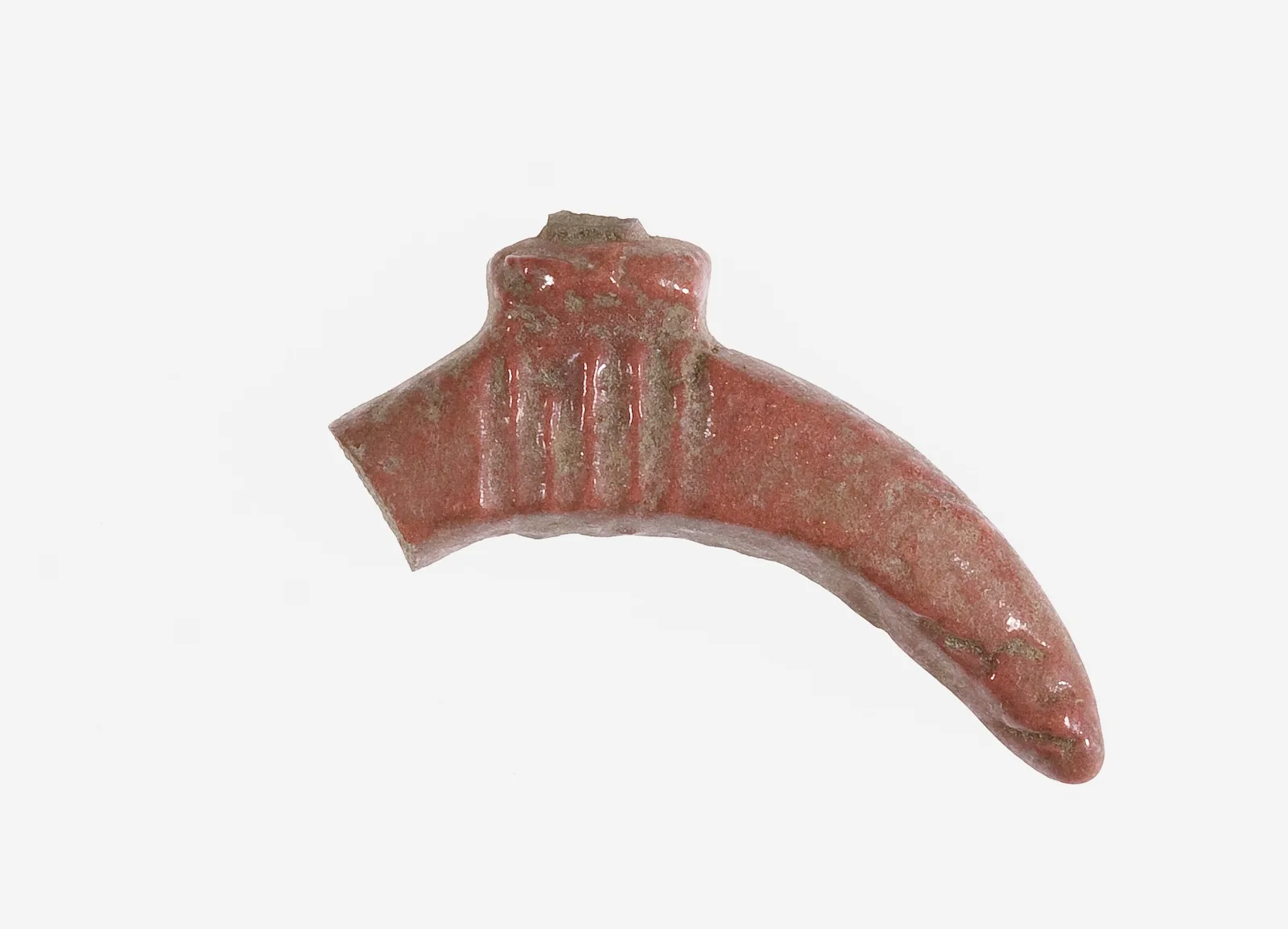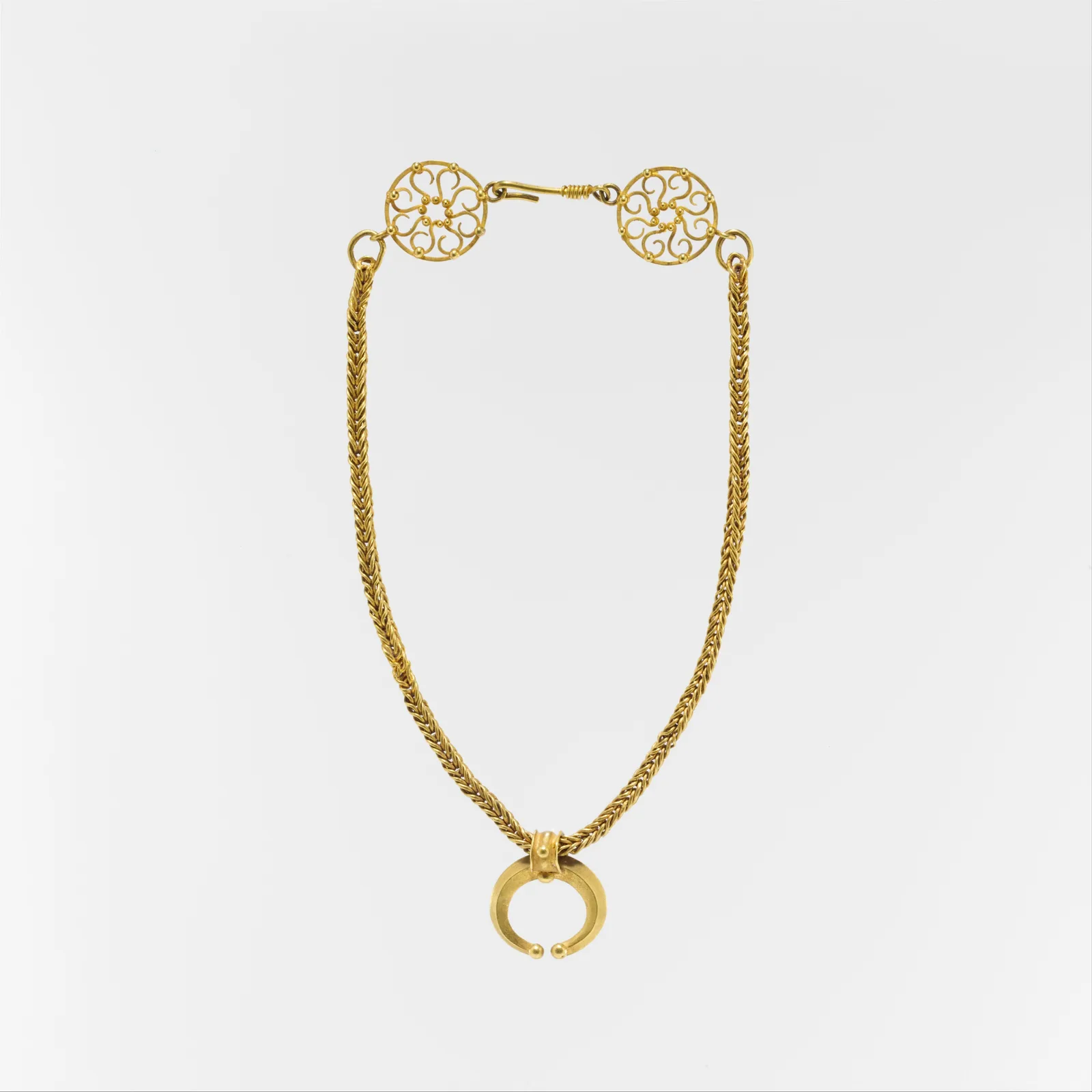
Lunula: the crescent moon amulet worn horns down
The lunula was always worn horns down, and that was no whim of the goldsmith. An inverted crescent reads not as a waxing moon but as a vessel: open at the top, ready to be filled. For the women who wore it across ancient Europe and the steppe, that vessel meant fullness, fertility and the female principle. The sharp tips, pointed toward the earth, did not threaten an enemy so much as draw every good thing toward the wearer and hold it close.
This article is about one specific amulet, not about the moon in general. The lunula is a crescent shaped pendant that women began wearing thousands of years ago, from the Bronze Age Near East to Celtic Ireland, Roman Italy, the Balkans, Byzantium and the Slavic lands. We will trace where it came from, why people confuse it with the Islamic crescent and the astronomical moon sign, what its horns and types and techniques mean, and how to read a lunula today, now that craftspeople make them by hand again.
What a lunula is and why the horns point down
What a lunula looks like
A lunula is a pendant shaped like a sickle or a crescent moon turned with its horns down. At the top sits a loop or eyelet for a cord or chain, and at the bottom two pointed or rounded tips. The space between the horns was often left open, sometimes filled with a lattice, a tiny cross or a single bead. People wore the lunula at the throat as a standalone pendant, strung it into a necklace among beads and coins, hung it from a headdress or from chest ornaments. A married woman might wear several at once.
Why the horns face down rather than up
This is the key detail that identifies a lunula. Turn the crescent horns up and you get the familiar waxing sliver, a sign of the sky and the night light. Drop the horns toward the earth and the ancient eye saw something else: a cup, a boat, a cradle, a shape that holds and gathers. A vessel is tied to water, milk and moisture, and through them to fertility and motherhood. So the lunula is not an ornament chosen for its outline alone but a female sign of receiving and fullness. The inverted crescent seems to scoop up blessing and keep it from spilling out.
Wear the symbol, don't just read about it. These are in stock:



The lunula and the female body
The crescent with lowered horns was linked by ancient peoples to the female body and its rhythms. The moon waxes and wanes over roughly the same span as the female cycle, so many cultures treated the moon as the patron of women, of those giving birth and those nursing. On a young woman a lunula read as a sign of readiness for motherhood, on a married woman as a guard over fertility already arrived. Men almost never wore such pendants: it was an emphatically female object, like earrings.
Where the name comes from
The Latin word lunula simply means little moon, and it is the term archaeologists and historians settled on to name this find. The ancient makers were unlikely to have used any single agreed word. The term entered scholarly use in the nineteenth and twentieth centuries, as burial mounds and hoards began to be excavated systematically and a common name was needed for crescent shaped pendants. Today lunula names both the archaeological type and the modern replicas made from the same models.
History: from the Bronze Age to the medieval crescent
The Bronze Age and the first crescents on the chest
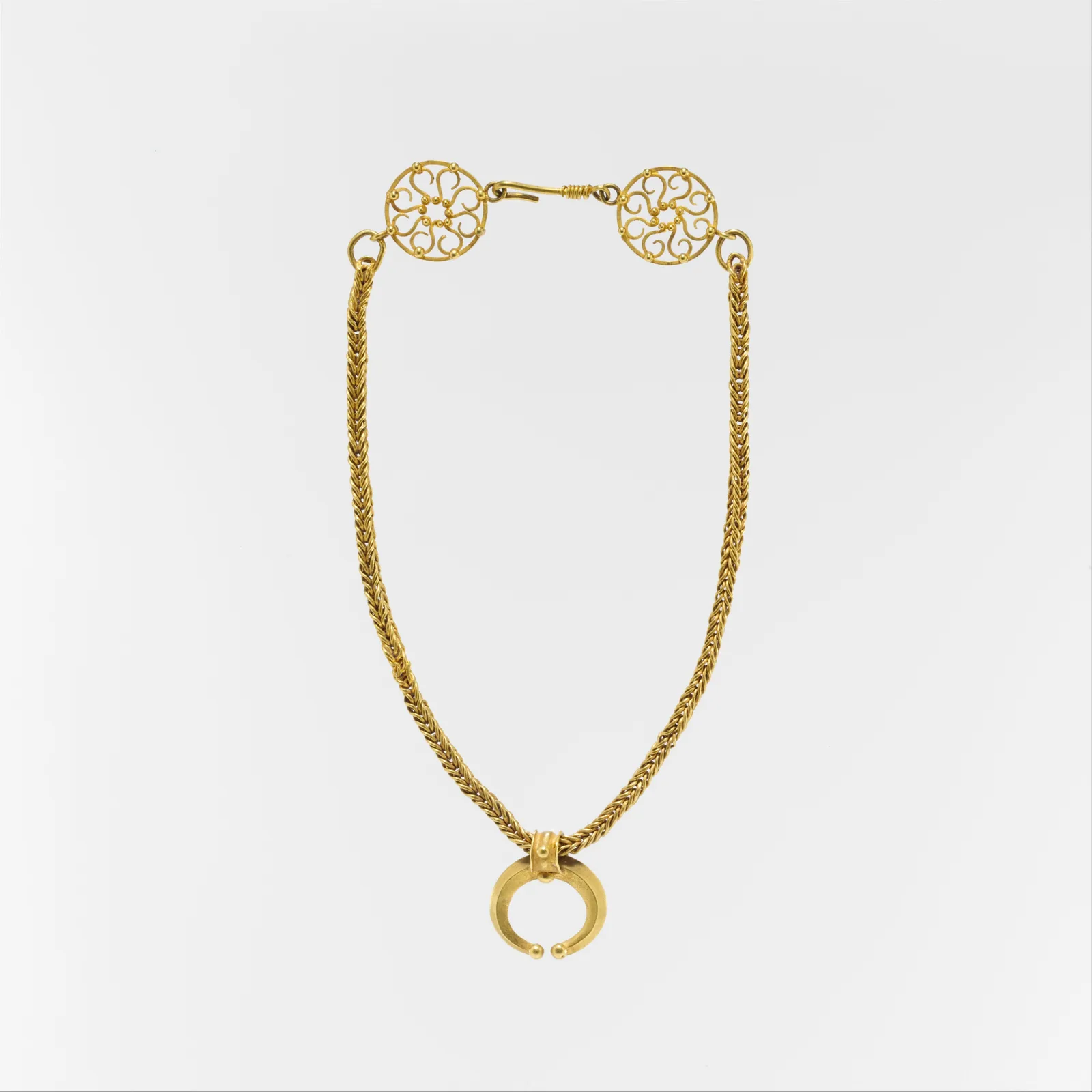
Crescent pendants are thousands of years old. The moon as ornament and amulet appears already in the Bronze Age among the peoples of the Near East, the Mediterranean and the steppe. The moon was one of the chief heavenly bodies for the farmer and the herder: by it they counted months, chose times for sowing and slaughter, read the weather. Small wonder they wore it on the body. The earliest metal crescents are cast slivers of bronze, plain, without ornament, with a single loop. Even then they were tied to women and fertility.
Celtic gold lunulae of Ireland and Britain
Among the most striking early examples are the gold lunulae of the Atlantic west. In the early Bronze Age, goldsmiths in Ireland and Britain hammered thin sheets of gold into broad flat crescents, decorated near the tips with finely incised geometric bands of triangles, chevrons and hatching. Dozens of these survive, the great majority from Ireland, and they count among the finest gold work of prehistoric Europe. These were collar like ornaments worn at the throat, and their wide thin form shows how early the crescent had already become a prestige object, not merely a charm.
Roman lunulae worn by women and girls
In the Roman world the crescent amulet had a clear and documented role. The lunula was a standard protective pendant for women and especially for girls, the female counterpart to the bulla worn by boys. A Roman girl received her lunula in infancy and wore it until marriage, when she set aside childhood things. Made in gold for wealthy families and in bronze or bone for the rest, the Roman lunula guarded against the evil eye and ill fortune. Its survival across the empire, from Italy to the provinces, helped carry the crescent image to the peoples on Rome's borders.
The steppe peoples: the lunula on the grass sea
In the steppes north of the Black Sea the crescent was worn by Scythians and Sarmatians, the nomads of the Iron Age. Metal mattered enormously to them: gold and bronze went into plaques, torcs, earrings and pendants. The crescent fitted that world as one of the amulets tied to the sky and to the fertility of the herds. Sarmatian women, who held noticeably more standing than their neighbours, wore rich sets of ornaments, and crescent pendants turn up among them. Through the steppe the image of the moon vessel travelled to settled neighbours in every direction.
The Balkans and Byzantium
The crescent kept its place around the Mediterranean and the Black Sea long after Rome. In the Balkans and the Byzantine world it survived both as ornament and as amulet, now reworked in new techniques. Byzantine goldsmiths set crescent forms into earrings and pendants, framing them with scrolls and openwork, and their craft radiated outward along trade routes. This Byzantine influence is one reason later medieval crescents to the north grew so refined: the patterns and techniques travelled with merchants, brides and tribute.
The Slavic lands: a household amulet
Among the early Slavs the crescent became one of the commonest female ornaments, found again and again in hoards and graves. These were small cast pendants of bronze and low grade silver, affordable to ordinary families and not to the elite alone. The farming year ran on the lunar calendar, so the sickle for the harvest and the crescent on the chest echoed one another directly: both spoke of the harvest and of time. The moon vessel became a family amulet, handed down the female line. Other protective objects of that same world are covered in our guide to protection amulets and talismans.
The medieval peak
The real flowering of the crescent pendant comes in the tenth to twelfth centuries, as towns grew and craft grew more complex and goldsmiths mastered fine techniques. Lavish crescents appear in silver and gold, covered with filigree and granulation, with enamel and niello. They turn up in hoards alongside other treasures: when a town faced danger, valuables were buried, and many stayed in the ground for centuries. A wealthy townswoman wore a broad crescent as part of a formal set, a poorer villager a plain cast piece of bronze. One form, very different prices.
How archaeologists date a lunula
A precise date is set not by the pendant alone but by everything that lay beside it. The type of temple ring, the shape of the beads, coins in a hoard, the character of the burial rite, the soil layer in a town, all of this together narrows the time to decades. The crescent itself also hints at its era: early cast slivers are simpler, later filigree and cross bearing pieces are more complex and more Christianised. Metal and fineness, the way the loop is fixed, the set of pendants attached, all add detail. From a handful of silver in a woman's grave grows a fairly exact picture: when she lived, where she came from, how well off her family was.
What came after
As fashions changed, the crescent slowly left everyday wear. Small crosses, icon pendants and new pendant forms pushed it aside. But the image of the moon on the chest did not vanish entirely: it survived in folk costume, in embroidery, in the shapes of earrings and dangles in the north. And in the twentieth and twenty first centuries the lunula returned as a deliberate reconstruction, which we come to below.
Horns down, on a bare collarbone, never over a turtleneck. A crescent worn horns up? Let someone else make that mistake.
How to wear a lunula
Narrow silver crescents and heavy filigree lunulas from reenactment sets have both passed through my hands. Here is what actually works once the piece has to sit on a real person, not in a display case.
What do I wear a lunula with every day? For daytime I recommend a narrow silver lunula on a fine chain over a plain top: a white shirt, grey knit, a linen dress. A light top lifts the metal, while a dark one (charcoal, pine, navy) turns the crescent into a clean accent. Wear it horns down and dead centre, so the bowl reads clearly instead of tipping to one side.
How do I match the length to the neckline? I always choose the length for the neckline, never the other way round. With a V-neck I take a 45-50 cm chain so the lunula lands in the open zone by the collarbones. With a round or boat neck I go shorter, 40-45 cm, or the crescent disappears under the fabric. Over a high collar I use a longer chain so the piece rests on the knit instead of hiding beneath it.
Wide filigree or narrow, which one do I choose? It depends on the job. I pick a narrow, smooth lunula when I want a quiet everyday detail. I reach for a wide filigree piece with granulation when the jewellery is meant to lead: a smooth top in a rich colour and few other accents. Two large pieces side by side fight each other, so under a wide lunula I keep the earrings small or leave them off.
Can a lunula be worn in a set with other pendants? Yes, as long as you keep the hierarchy. In the historical dress the lunula was always the main sign on the chest, and the beads and dangles worked for it. I suggest the same now: one lunula leads, everything else stays background. If you want layers, give the lunula its own length and do not hang a second large crescent beside it, two moons in one look argue.
Silver or bronze, which do I take? By skin: a cool undertone loves silver, a warm one carries bronze with its green patina just as well. By meaning, I suggest silver as the refined everyday choice and bronze for an ethnic, reenactment look where the ancient, museum texture matters. Gold I keep for dressed-up occasions, exactly as it was in antiquity.

Turn on your camera, pick earrings, a pendant or a ring, and see the piece on yourself in real time.
Switch items in one tap.
Everything runs in your browser: no photo or video is ever uploaded.
Meaning: the moon, the female principle, protection of the family
The moon as the female light
In many ancient cultures the sun is male and the moon female. The moon is softer, more changeable, tied to night, water, dreams and mystery. For early farming peoples the moon was the light that governs the growth of all living things: grasses, livestock, the child in the womb. To wear the moon on the chest meant to stand under its patronage, to keep close the heavenly force responsible for birth and the continuation of life. We tell the wider story of lunar symbols in our piece on moon phases in jewelry.
Fertility and motherhood
The central meaning of the lunula is fertility. The crescent vessel scoops up moisture and blessing, as a field takes the rain and a woman a new life. To a young woman the lunula wished a good marriage and healthy children, to a married woman it guarded a pregnancy and a nursing already begun. In this it sits close to the idea of the mother goddess, patron of those in labour, a figure many ancient cultures placed at the centre of women's lives.
Protection of the woman and the family
Beyond fertility, the lunula worked as a shield. The sharp horns, turned downward, were thought to drive off evil forces, the evil eye, spoiling and the fears of the night. A woman and her children were felt to be the most vulnerable point of the family, and an amulet on the mother's chest guarded the whole household with her. The richer and more elaborate the lunula, the more protective signs went into it: granules, lattices, crosses, plant scrolls. Each motif was another layer of defence.
The lunar cycle and time
The lunula is also a calendar on the body. The moon measures out months, and by it people counted the span of a pregnancy, the festivals, the work in the field. Sometimes broad crescents carry rows of dots or notches, and scholars argue over whether these marked the days of the lunar month. There is no firm answer, but the link between the moon and the counting of time was obvious to anyone who farmed. To wear a lunula was to carry the rhythm of nature with you.
Water, dew and milk
The moon was tied to moisture: dew was thought to fall by night beneath the crescent, and the tides and the sap of plants were believed to obey the moon. The crescent vessel gathers that moisture in symbol. A mother's milk, dew on the grass, rain over the field folded into one image of the female nourishing power. For this reason crescents were often hung with small teardrop dangles below: they completed the idea of moisture that flows down and gives life.
Moon, water and harvest in a single knot
For the ancient farmer the link between moon, water and fertility was not poetry but observation. He saw the tides of great rivers and seas answer the crescent, the dew fall thicker on clear moonlit nights, the sap in a tree seem to follow the phases. From these observations grew a single knot: the moon governs moisture, moisture feeds field and herd, and on the harvest the very life of the family depends. The crescent vessel gathered that whole knot into one sign. Putting it on, a woman tied herself to the rain over the ploughland, to the milk in her breast, to the water in the well. It is no accident that the lunula often carried teardrop dangles: they finished the image of flowing, life giving water and made the amulet a small model of the cycle of water and fertility.
Customer reviews
Zevira is a real jewellery shop. Genuine payments, deliveries and customer thank-yous.
🥰🥰🥰 gracias
Ok, ¡gracias! 🙂
Types of lunula: from the narrow horned to the closed cross piece
The narrow horned lunula
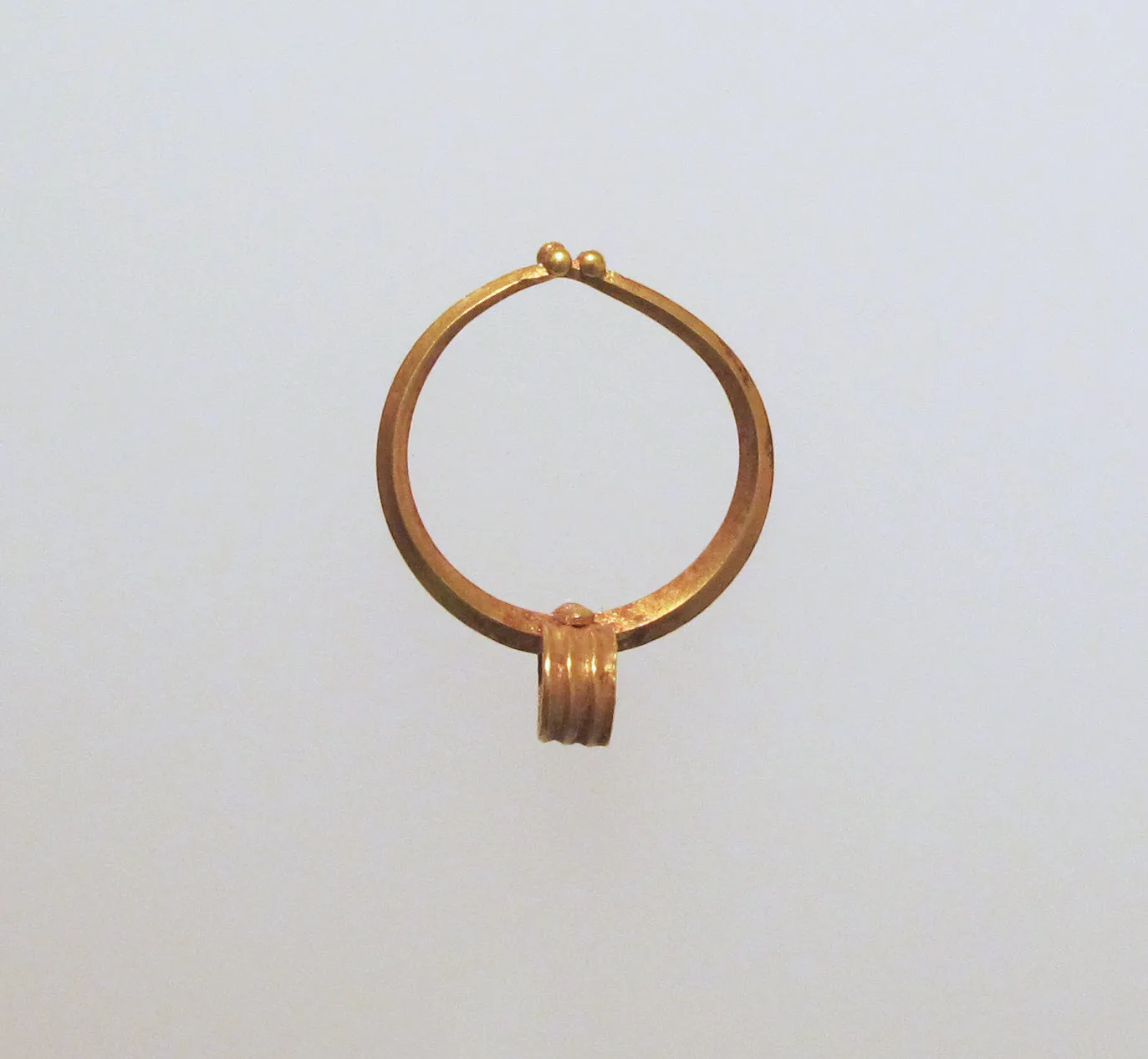
The earliest and simplest type is a narrow thin crescent with sharp diverging horns. Such pieces were cast in bronze, sometimes silver, without elaborate ornament. They sit close to the pure image of the moon and appear among many peoples long before the medieval era. The narrow horned lunula is the base form from which all the others grew. Modern makers love to repeat it for its restraint.
The broad lunula
The broad lunula is a massive crescent with a smoothly curved body and a large field for ornament. It was here that filigree and granulation unfolded at full strength: the body was covered with scrolls, lattices, rows of granules, sometimes set with enamel. Broad crescents were formal, costly things for noblewomen. They turn up in the richest hoards. In sheer area of metal and complexity of work this is the peak of the type.
The three horned lunula
A distinct ornate variant is the three horned lunula, which besides its two side horns has a third projection in the middle of the lower edge. Sometimes more teeth were added. The extra horns strengthened both the decoration and the protective meaning: more sharp tips, more defence. Three horned crescents are often richly worked and turn up among high status finds. Their silhouette is unmistakable, almost a crown turned upside down.
The closed lunula and the cross lunula
A special type is the closed lunula, in which the horns are joined by a bar or a lattice, so that the crescent becomes an almost solid plate with cut outs. At the meeting of paganism and Christianity the cross lunula appears: a small cross set in or above the field between the horns. This is no contradiction but a deliberate joining of two protections, more on that below. Closed and cross bearing crescents belong already to a mature, Christianising age.
Regional differences
The lunula was not uniform across cultures or regions. In the south, nearer the Byzantine sphere, richly filigreed and granulated pendants prevailed, shaped by Mediterranean craft. Farther north crescents appear more often within jingling sets hung with dangles, in coarser and louder execution. Among western and southern Slavs, among the Balts and the Finno-Ugric neighbours, crescent pendants had their own patterns and proportions. From such details an archaeologist can often tell where a buried woman came from, the way a turn of speech can place a stranger's home region.
The lunula and the reliquary cross
Sometimes the crescent was worn in one set with a reliquary cross, a hinged box cross, or hung with small dangles in the form of spoons, keys and combs. Such a set is called jingling: the dangles rang as the wearer walked, and that ringing was itself thought to drive off evil. The lunula was the chief female sign within it, and the rest completed its meaning. For more on the shared language of protective objects see the guide to protection amulets and talismans.
The lunula within a set of temple rings
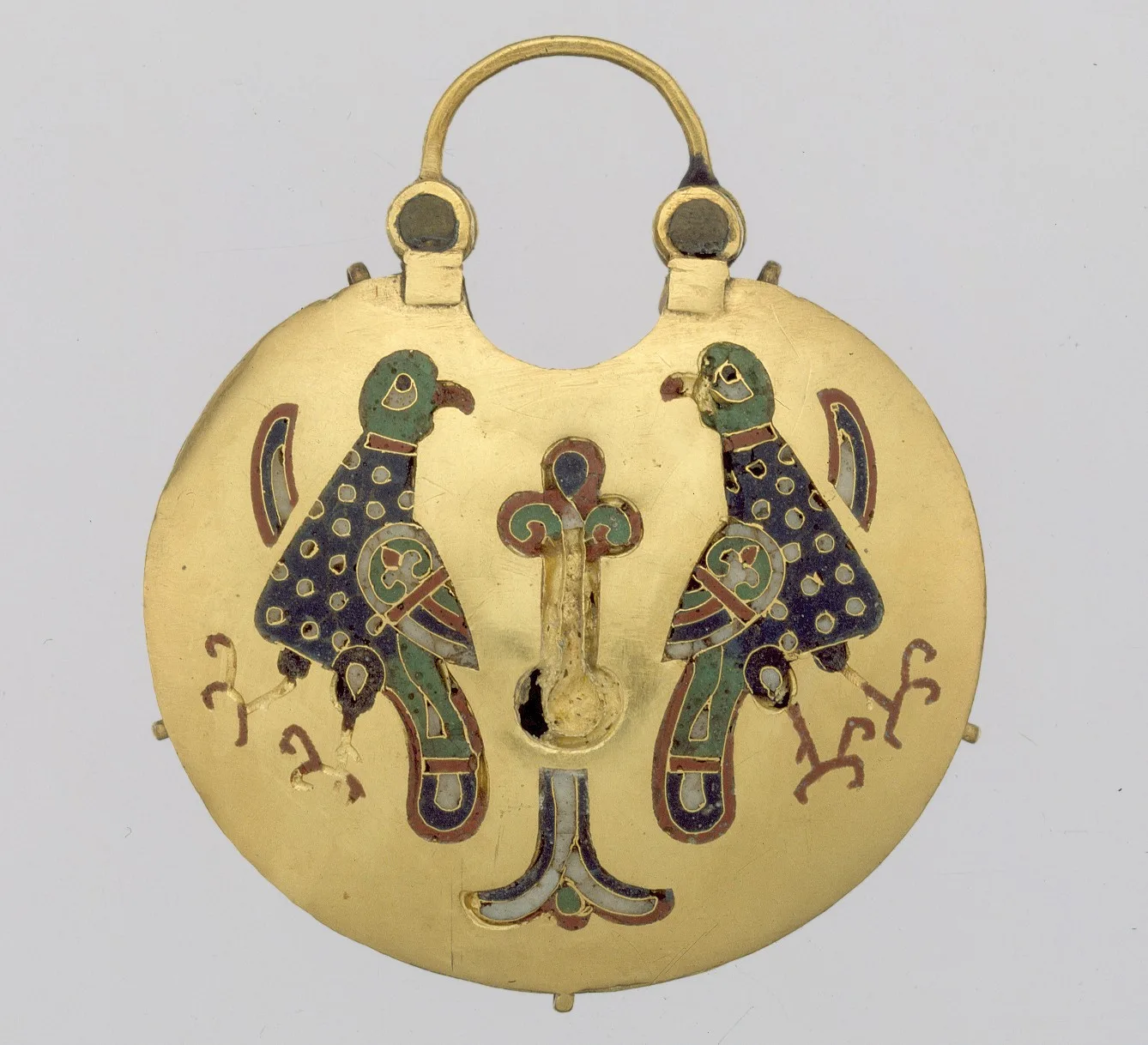
The lunula rarely hung alone. A woman's full attire was made of several parts, and the crescent pendant took its place on the chest, while at the temples, woven into the hair or hung from the headdress, swayed the temple rings. Each tribe wore its own type of such ring, and a crescent at the throat together with the rings at the face built a complete portrait: sex, wealth and origin could all be read at a glance. To study the lunula apart from the rest of the costume is to see half the picture.
Upload a photo of your pet, someone you love, or an object. We'll build a 3D model and hand-cast it in pewter.



Pagan to Christian: the crescent with a cross
What the dual faith age was
After the conversion of much of Europe, Christianity did not abolish the old beliefs overnight. For several centuries people lived in a layered state of dual faith: they went to church and at the same time kept pre-Christian customs, amulets and festivals. This was not so much a war as a layered coexistence. A woman could wear a baptismal cross and a lunula at once and see no contradiction in it. Both objects protected, simply in different ways.
The crescent and the cross in one piece
The clearest evidence of this dual faith is the cross lunula, when the Christian symbol was placed directly inside the older form. Archaeologists find silver crescents with a small cross cast or soldered into the field. The result is a double amulet: the ancient force of the moon and the new force of the cross together. For the wearer it was a way to lose nothing, to secure the support of both the old and the new. We examine a related doubleness of the lunar image in the article on the crescent moon and star, although that symbol is quite different in origin.
Why the church tolerated it
The church did not approve of open paganism, but small everyday amulets like the crescent long stayed outside its strict attention. The form was familiar, female, unprovocative. Gradually the lunar symbol was either displaced by the cross or merged with it in the cross lunula. The dual faith age did not end by decree, it dissolved over several centuries, leaving us hybrid finds as a monument to a transitional era. The pre-Christian male amulets of that same world are covered in our piece on the axe of Perun and Thor.
What it tells us about people
The crescent with a cross is an honest portrait of the medieval person: he did not choose cleanly between worlds but stacked his protections in layers. For the modern reader this is a useful lesson. Wearing an old symbol does not mean renouncing a faith, or conversely lapsing into paganism. For most people it is a link to ancestors and to a place, not a religious manifesto.



Who wears a lunula today
A female amulet at heart
The lunula was historically a female sign, and it is worn in that role still. It is jewellery for a girl or a woman drawn to the idea of the moon, of female strength, of a link to family and nature. No special conditions are needed: the lunula asks for no initiation or rite, it is part of a cultural heritage open to anyone. By its meaning it has never suited a man, and male protective symbolism has signs of its own.
For girls and young women
A plain silver lunula makes a fine first meaningful amulet for a girl or a teenager. A small cast pendant without sharp details is comfortable to wear and carries a gentle, kindly meaning: a wish of health, of female happiness, of protection. For such a gift it is best to take a small narrow crescent on a thin chain, without heavy dangles.
For grown women
A grown woman chooses a lunula more by aesthetics and by personal meaning. For some the link to ancestors and roots matters, for others the lunar, female symbolism appeals without any ethnic accent, and some simply love the crescent shape. A broad filigreed lunula makes a visible accent, a narrow one slips into an everyday set. It is a piece easy to wear daily that does not look like a costume if you choose a quiet execution.
As a gift with meaning
The lunula is a good gift when you want to give an idea and not only a pretty object. It is given on the birth of a daughter, at a coming of age, to a young mother, to a woman who treasures her roots. Unlike an impersonal ornament, the lunula has a story you can tell, and that makes the gift personal. The main thing is to explain the meaning briefly: the moon vessel, female strength, protection of the family.
Materials and techniques: silver, bronze, filigree and granulation
Silver as the chief metal
Most often the lunula is made of silver. Historically silver was more available than gold and yet noble enough for an amulet, and its cold lunar shine suits the theme of the moon perfectly. Modern crescents are usually made of sterling silver of 925 fineness: it is strong, holds fine filigree and granulation, and over time takes a soft patina that brings out the pattern. We write in detail about what that fineness stands for in the guide silver 925: what it means.
Bronze and other historical metals
Plain crescents were cast in bulk from bronze and copper alloys: this was the metal for everyone, cheap and within reach of a villager. A bronze lunula takes a green patina over time, and many reenactors prize this living effect as a mark of authenticity. Gold crescents existed too, but those were objects of the highest rank, rare finds. For everyday wear today bronze works well as a budget historical option and silver as the noble one.
Filigree: a pattern made of wire
Filigree is the technique in which a pattern is laid out from fine twisted or smooth wire and soldered to a base. On crescents, filigree made scrolls, lattices and an edging for the horns. Thin silver wire, twisted into cords, creates a lacy design that catches the light. Medieval goldsmiths handled filigree with virtuosity, and the best crescents are small masterpieces of the craft.
Granulation: a pattern made of beads
Granulation is the technique of the tiniest metal beads soldered to the surface in a pattern of rows, triangles and clusters. Each bead was made from a scrap of wire melted into a droplet and then fixed to the base with no visible solder. On crescents granulation was often combined with filigree: the wire set the outline, the granules filled the fields. This is delicate work, and an abundance of even granules was always a mark of a costly piece.
Enamel, niello and casting
Besides filigree and granulation, crescents were decorated with enamel, flooding cells with coloured glass, and with niello, rubbing a dark alloy into a sunken design so that it stands out against the silver. The simplest crescents were simply cast whole in a mould, with the relief ready made. Modern production combines casting for the base with hand finishing of the pattern, which lets makers repeat historical models while keeping the cost reasonable.
Leave your email, we'll send your discount code. No spam, unsubscribe anytime.
The code arrives by email, valid on your first order.
A modern reading and reconstruction
The return of the lunula
The lunula came back into use through interest in ancient and folk culture, historical reenactment and handmade jewellery craft. Makers study museum finds and repeat them as faithfully as possible: the same silhouette, the same filigree, the same granulation. Alongside, modern interpretations appear that take only the recognisable moon vessel shape and keep the pattern restrained for everyday taste. Both paths are alive: some want an exact copy from a burial mound, others simply a beautiful lunar sign.
Reenactors and historical accuracy
In the world of historical reenactment the lunula is made after specific finds tied to a region and a century. Here the metal, the technique, the form of the loop and the set of dangles all matter. Such a lunula is part of a costume, worn at festivals, in museum programmes, in family traditions. For the reenactor it matters not to confuse the types and not to hang a formal southern crescent on a plain northern set. This is respect for the material, not pedantry.
The lunula beyond ethnicity
Many wear the lunula simply as a beautiful piece with a lunar theme, putting no ethnic meaning into it. There is nothing wrong with that: the form is self sufficient and looks well. Lunar symbolism is popular in general now, from moon phases to crescents, and the lunula fits naturally into that row as the oldest and most feminine of the lunar signs. We write about the neighbouring sky motifs in the guide celestial jewelry: sun, moon and stars.
How to choose your lunula
When choosing, it helps to decide what matters more: historical accuracy or comfort in daily wear. For everyday use take a narrow or medium width silver lunula without heavy dangles, on a strong chain. For a look with an accent, a broad filigreed one. For a gift with meaning, a plain but well made piece that will last for years. Check that the loop is secure and that the horns do not catch on clothing with sharp edges.
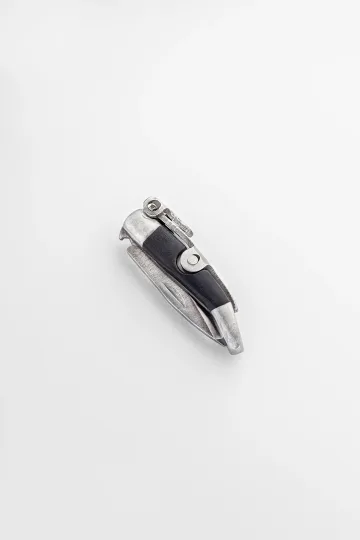
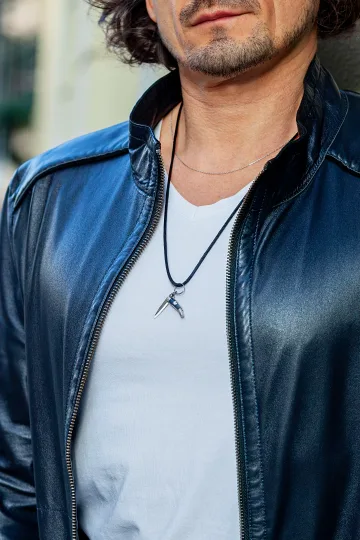
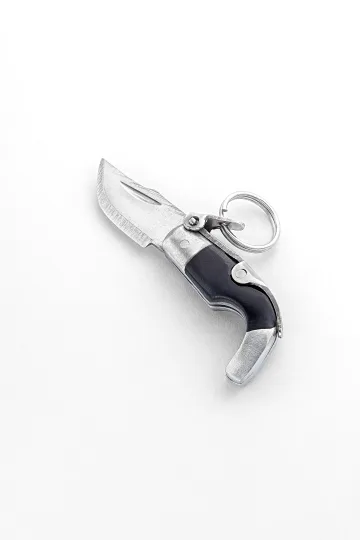
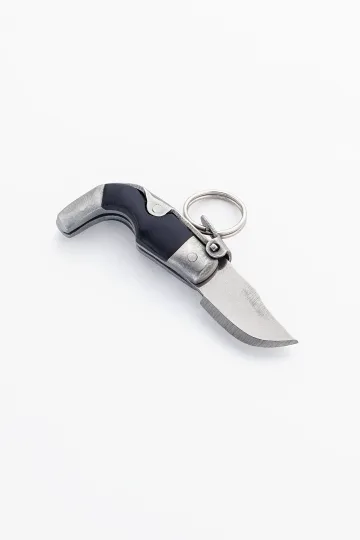
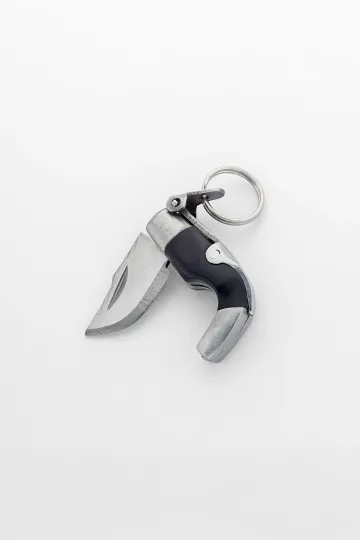
CAPAORA mini knife pendant
The 18th-century Spanish navaja in miniature: 40 mm of stainless steel, a real folding mechanism and a Palanquilla lock that clicks. An affordable gift to remember.
Authentic · Ships from Spain · 14-day returns
Lunula, crescent and the Islamic crescent: not the same
How the lunula differs from the Islamic crescent
This is the chief misunderstanding to clear up. The Islamic crescent, the hilal, is shown horns up or sideways, often together with a star, and it is tied to the Islamic lunar calendar and to the state symbolism of a number of countries. The lunula is a female amulet worn horns down, without a star, pre-Christian in origin, about fertility and protection of the family. All they share is that both go back to the image of the moon. They are different objects from different cultures, and to confuse them is like confusing a cross with a plus sign.
The lunula and the crescent with a star
The crescent with a star is a separate established symbol with its own history, largely eastern and political. The lunula has no star; its field is filled with filigree, granulation, a cross or a lattice, but never a star. If you see a crescent with a star inside or beside it, that is already a different sign and must be read differently. We examine it in a separate article on the crescent moon and star, so as to keep things clear.
The lunula and the astronomical moon sign
In astronomy and astrology the moon is often shown as a crescent with horns sideways or up, as a waxing or waning sliver. That sign is about phases and cycles, about celestial mechanics, not about an amulet. The lunula is not an astronomical symbol: its horns point down precisely because it is a vessel and not a phase marker. If the theme of changing lunar phases appeals to you in its own right, we have a separate piece on moon phases in jewelry.
How to spot a lunula at a glance
Remember three marks. First: the horns point down, forming a vessel. Second: there is no star between or above the horns. Third: the pattern is filigree, granulation, dots, sometimes a small cross, all in an ancient folk spirit. If all three match, you are looking at a lunula. If the horns point up and there is a star, that is already a different, eastern or state symbol. This simple check settles almost every argument.
Facts that surprise
The lunula was worn long before the Slavs
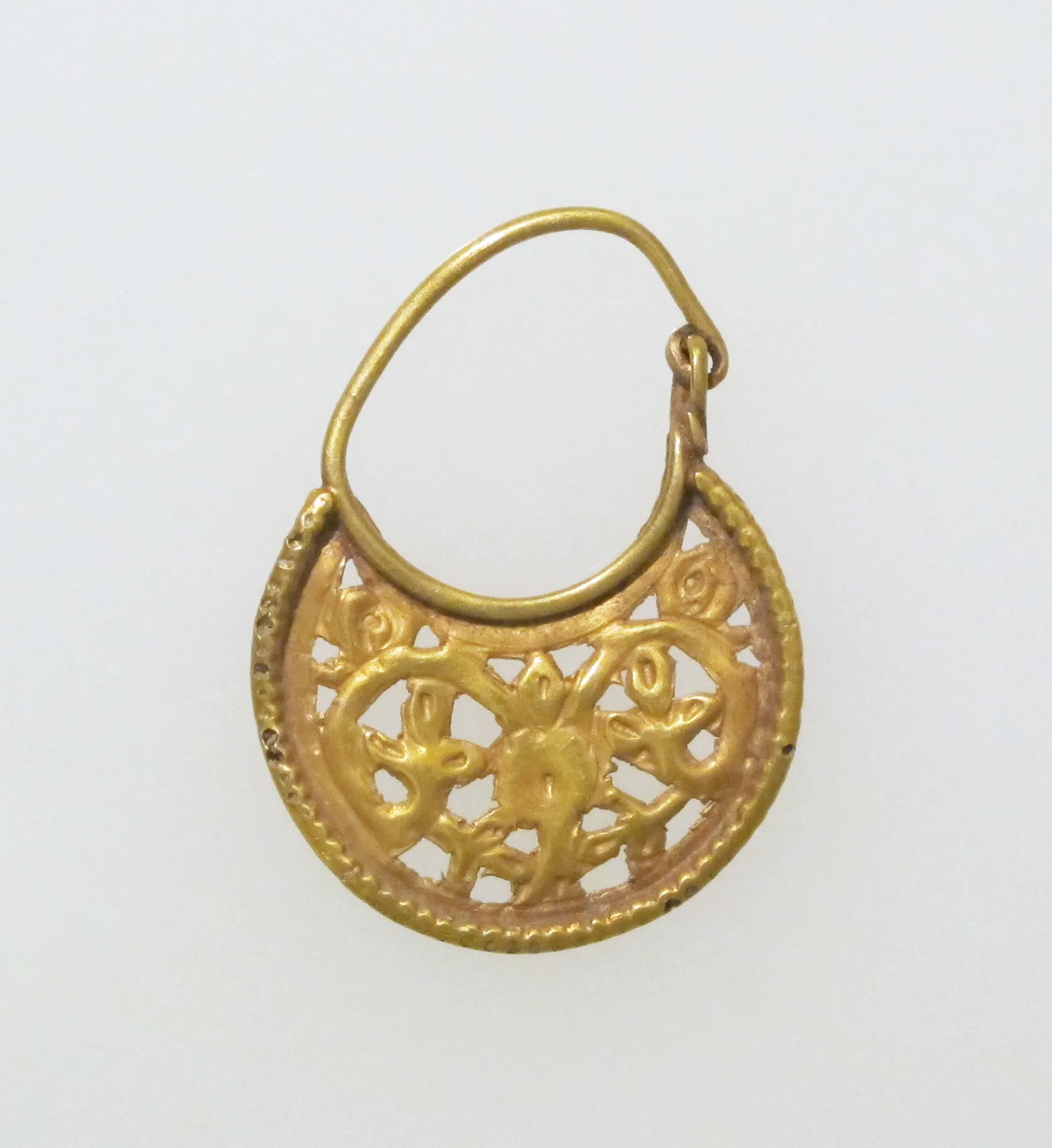
Crescent pendants are thousands of years older than the medieval cultures most people associate them with. They are found in the Bronze Age among the peoples of the Near East and the Mediterranean, in Celtic Ireland and Roman Italy. No single people invented the lunula; many inherited an ancient Eurasian image of the moon vessel and made it their own, decorating it each in its own way. The amulet that can feel local to one culture is in fact one of the oldest and most widespread female symbols of humankind.
Lunulae were buried in the ground, and so they survived to us
Many of the most beautiful crescents reached museums precisely because they were buried in the ground as hoards before invasions and fires. The owners hoped to return, and did not, and the silver lay in the earth for centuries. The misfortune of some became a gift to archaeologists: whole sets of jewellery survived untouched. Without that habit of hiding valuables we would know far less about lunulae.
The jingle of jewellery was thought to be an amulet
Crescents were often worn within jingling sets: with spoon, key and bell dangles that rang as the wearer walked. That ringing was no idle decoration. People believed the ring of metal drove off evil spirits and the evil eye. So the amulet worked by both sight and sound, and a woman in such attire moved under the protection of a quiet, melodic ringing.
A cross inside the moon is not a maker's mistake
When you see a silver lunula with a Christian cross in the centre, it can look like a muddle of symbols. In fact it is deliberate dual faith: people stacked the protection of the old moon and the new cross together. Such hybrid amulets are not naivety but a thoroughly logical strategy for their time, to let slip no source of strength.
The harvest sickle and the crescent on the chest are one image
The link between the lunula and the harvest is no romantic's invention. The farmer saw one and the same sickle twice: in the sky as the moon and in the hand as the reaping tool. Both spoke of the harvest, of time, of the giving and taking power of nature. To wear the crescent moon on the chest meant to keep close that link between sky and field, the one that mattered most to anyone who worked the land.
Send a friend a discount code, they save on their first order.
Caring for a lunula
A silver lunula
A silver lunula darkens over time, especially in the recesses of the pattern, and there is nothing alarming in that: a light patina brings out the filigree and granulation, making the relief more expressive. If you want to return shine to the smooth areas, wipe the piece with a special silver cloth, leaving the recesses dark for contrast. A lunula with a complex pattern does not like aggressive polishing to a mirror: it eats away the play of light. The general rules for silver care are gathered in our guide silver 925: what it means.
A bronze lunula
A bronze lunula takes a green patina, and many want exactly that: it gives the piece an ancient, museum look. If the green residue leaves a mark on skin or clothing and that bothers you, wipe the pendant with a soft cloth and, if you like, cover it with a thin layer of wax or special lacquer. It is usually not worth removing the patina entirely from a reenactor's lunula: it is part of the look. You can take it off with a mild citric acid solution, but do so deliberately.
Filigree and granulation: gentleness first
Fine filigree and small granulation are the most fragile parts of a lunula. They are easily bent and clogged with dirt under rough cleaning. Do not scrub the pattern with a stiff brush and do not use abrasive pastes. The best way to bring a filigreed lunula back into order is warm water with a drop of mild soap, a soft brush and careful drying. Store the lunula separately so that other pieces do not catch on the protruding horns and wire.
Everyday wear
Take the lunula off before a shower, a pool, sport and sleep: water, sweat and friction speed up tarnishing and wear out the chain. Apply cosmetics, perfume and creams before putting the piece on, so the chemistry does not settle on the metal. Every few months check the loop and the clasp of the chain: it is the eyelet of the lunula that bears the load and may thin over time. Simple attention adds years to the amulet's life.
Frequently asked questions
Which way is a lunula worn, horns up or down?
Horns down. This is its defining trait. The inverted crescent forms a vessel, a symbol of fullness, the female principle and fertility. Hang a lunula horns up and the whole meaning is lost; you get an ordinary waxing crescent, which no longer has anything to do with this amulet.
Is the lunula a pagan or a Christian symbol?
By origin it is a pre-Christian, pagan female amulet linked to the moon and fertility. But in the age of dual faith it was often joined with a Christian cross in one piece. So there is no clean opposition of paganism and Christianity here: the lunula outlived the conversion and for a time coexisted peacefully with the cross.
Can a lunula be worn together with a baptismal cross?
Yes, and historically it was done. In the dual faith age a woman calmly wore both a cross and a lunula, and sometimes a cross was set inside the lunula itself. If for you the cross is a religious object and the lunula a cultural and aesthetic one, there is no contradiction in combining them.
How does the lunula differ from the Islamic crescent?
By origin, form and meaning. The Islamic crescent is usually horns up, often with a star, tied to the Islamic lunar calendar and to state symbolism. The lunula is worn horns down, without a star, and is about female fertility and protection of the family. The only thing they share is the underlying image of the moon.
Can a man wear a lunula?
Historically the lunula is a female amulet, and by its meaning it does not suit a man. Male protective symbolism has its own signs, for instance those tied to the thunder god. If a man likes the lunar theme, it is better to choose a neutral lunar motif rather than the female lunula specifically.
Which material is best for a lunula?
For everyday wear and durability, sterling silver of 925 fineness is ideal: it is noble, holds a fine pattern and takes a beautiful patina. Bronze is good as a budget and historically faithful option, but it leaves a green mark and needs care. Gold is a rarity and a luxury, as it was in antiquity.
What do filigree and granulation on a lunula mean?
They are old jewellery techniques of decoration. Filigree is a pattern of fine wire, granulation a pattern of the tiniest soldered beads. On medieval crescents they created a lacy relief and were a mark of a costly, masterfully made piece. Today they are repeated on quality replicas.
Is a lunula a good gift for a girl?
Yes, a plain silver lunula is a good, meaningful gift for a girl or a young woman. Take a small narrow pendant without sharp details or heavy dangles, on a thin strong chain. The meaning of the gift is kind: a wish of health, of female happiness and protection, and it is easy to explain to a child.
Conclusion
The lunula is one of the oldest and most legible female amulets that has come down to us. The moon horns down, the vessel that gathers blessing, the moon as patron of women and fertility, protection of the family through protection of the mother. Over thousands of years the image travelled from the bronze slivers of the steppe and the gold lunulae of Celtic Ireland to the filigreed silver of the medieval towns, survived the conversion in the form of dual faith, and returned today as a living reconstruction and simply a beautiful piece with a lunar theme. The main thing to remember is that the lunula is neither the Islamic crescent nor the astronomical phase sign, but its own ancient sign of the vessel and of fullness.
Sterling silver 925, symbols, amulets, lunar and celestial motifs, matching sets.
Buying it as a gift? Each one arrives ready to give.
 A branded Zevira box and a little card come with every order.




About Zevira
Zevira is jewellery with meaning: sterling silver 925, clean forms and symbols backed by a real story rather than empty fashion. We make pieces that are a pleasure to wear every day and not embarrassing to pass on. Lunar and protective motifs read with us as part of a living tradition, not a costume: it is clear where the form comes from, what it means and why you want to wear it.