Mokume-gane: the Japanese woodgrain metal born from samurai swords
The technique behind today's wedding bands with grain that looks like a slice of old timber was not invented in Japan in the 17th century for rings at all. Swordsmiths devised it to decorate the guards of samurai swords. The word itself breaks into two parts: "mokume" means "wood eye", the pattern of growth rings on a cut log, and "gane" (from "kane") means "metal". Literally it reads as "metal with the grain of wood".
This is not a coating, not a print, not engraving. These are layers of different metals fused together, then forged, cut into, and ground back so that a pattern no one could draw on purpose rises out of a flat surface. Silver, copper, and special Japanese alloys with black and grey patina are stacked, bonded into a single billet, and opened up to reveal the pattern hidden inside. Every piece comes out one of a kind: the grain cannot be repeated, not even by the maker.
This article is about how one of the most expressive ways to work metal grew out of a samurai-era craft, why such a ring sits in the upper segment, how it differs from steel damascus, whether you can get it wet and resize it, and how to tell true mokume from a cheap imitation of it.
What mokume-gane is and where it came from
What the word itself means
The name is made of three characters and reads as "moku-me-gane". "Moku" is wood, "me" is eye or vein, and together "mokume" means the figure of wood fibres, that same pattern of annual rings you see on a cut trunk or a board. "Gane" is the voiced form of "kane", metal. The Japanese named the technique literally after what the result resembles: metal painted with the texture of wood. In English the spelling "mokume-gane" has settled in, the form "mokume gane" also appears, and both are fine.
Who invented it and when
The invention is credited to a master named Denbei Shoami, who worked in the city of Akita in northern Japan in the first half of the 17th century, around 1600 to 1650, during the Edo period. Shoami was a platerer, that is, a master of the metal fittings on weapons. Historians argue over the exact date and over whether he was the sole author, but tradition firmly ties the birth of the technique to him and to this period. The first name for the method was different, "guri-bori", after its likeness to carved guri lacquer, and only later did the poetic "mokume-gane" stick.
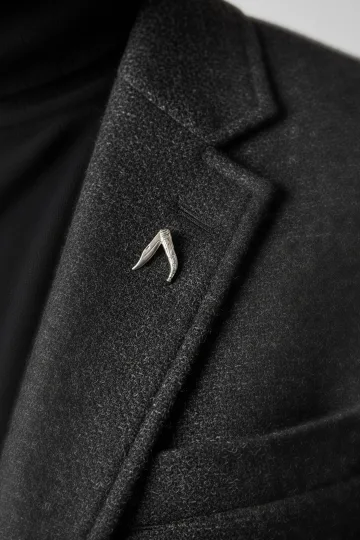
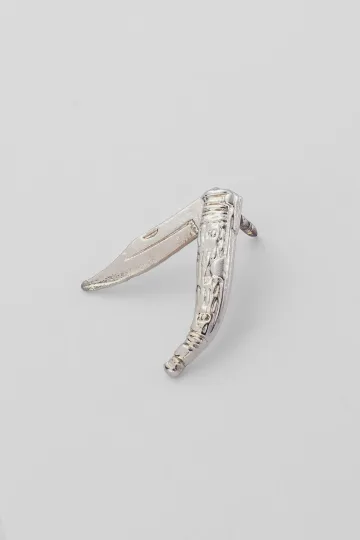
Wear the symbol, don't just read about it. These are in stock:






Why the technique was born in the Edo period
Edo was two and a half centuries of peace within Japan, from 1603 to 1868. The long peace did a strange thing: warriors stopped fighting, yet demand for richly decorated weapons only grew. The sword became less a tool of war than a mark of status and an object of art. Swordsmiths, with fewer battle commissions coming in, channelled their skill into decoration. It was in this milieu, where the finest finish on blades and their mounts was prized, that mokume-gane appeared as a way to make metal painterly.
Why a samurai needed patterned metal
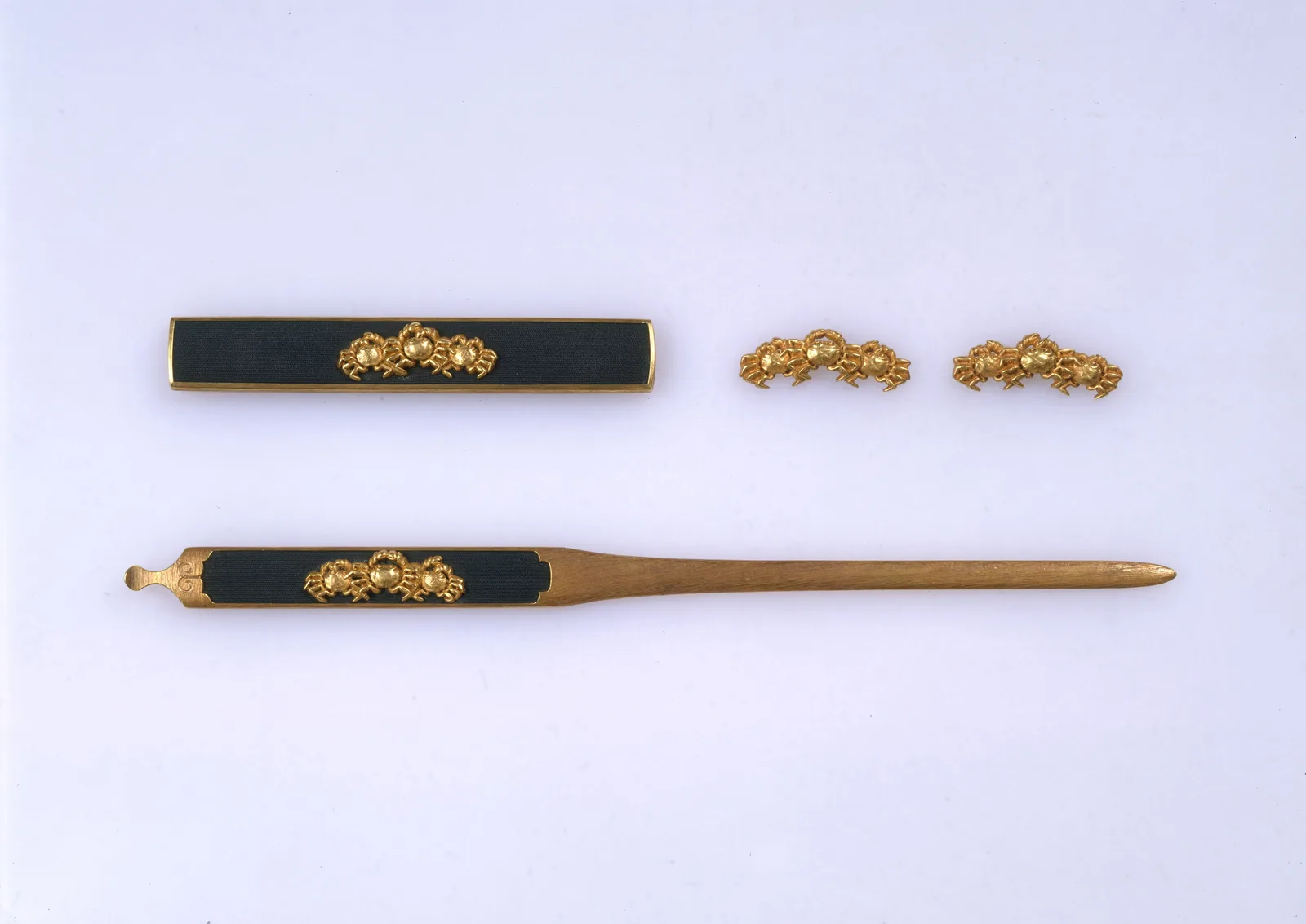
A samurai's sword is far from a single blade. It is a whole set of parts: the tsuba (the guard, a round plate between hilt and blade), the fuchi and kashira (collar and pommel of the hilt), the menuki (decorative ornaments tucked under the wrapping), the kozuka (handle of the small knife in the scabbard). All these parts were a field for jewellery work. Mokume-gane gave the swordsmith what plain metal could not: depth, a play of colour, the sense that the surface is alive. A patterned tsuba read as the maker's signature and as a sign of the owner's taste.
How the technique reached the West
For a long time mokume-gane stayed a guild secret in Japan. After Japan opened to the world in the late 19th century, Western jewellers saw these pieces for the first time at international exhibitions and were astonished. But the real spread of the technique in the West came in the second half of the 20th century, when metallurgists and metal artists decoded and described the process of diffusion bonding, replacing the dangerous traditional fusion with controlled heating in a furnace. From that point mokume stopped being only a museum curiosity and came into studios, and from there into wedding bands.
What patterned metal meant in Japanese culture
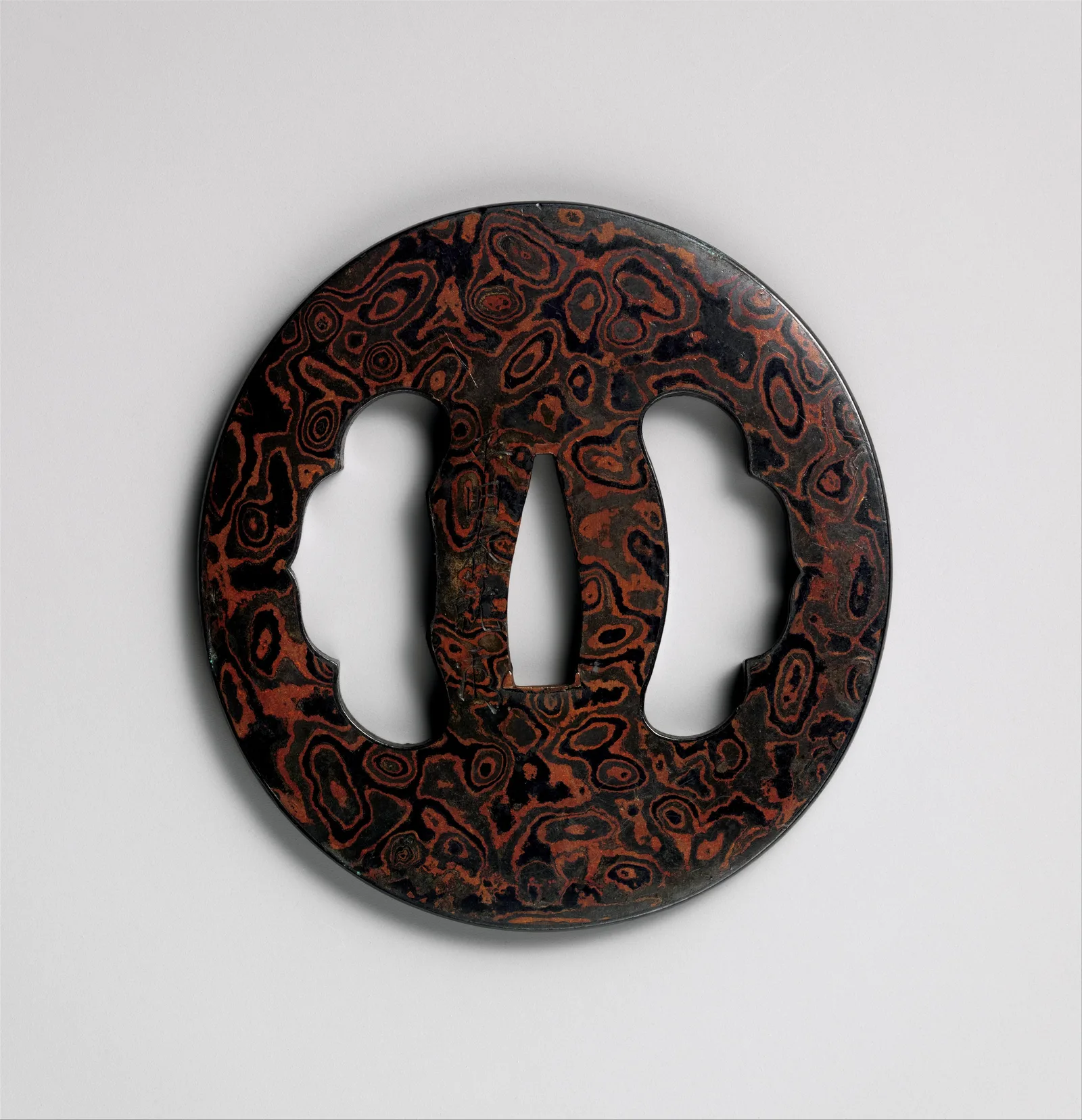
In Japanese aesthetics the worth of a thing was measured not by the costliness of the material but by the subtlety of the idea and the maker's hand. A pattern that cannot be drawn deliberately and that is born from the very nature of the metal answered this taste perfectly. In mokume people saw the same thing they saw in the random runs of glaze on a tea bowl or in the cracks of aged ceramics: a beauty in which both the human and the material take part. This outlook, where imperfection and unpredictability rank above glossy evenness, did much to make the technique a favourite among the masters of sword mounts.
The modern revival of the technique
In the second half of the 20th century mokume-gane went through a second birth. Metal artists in the West took the process apart afresh, described the heating regimes, and replaced the risky traditional fusion with controlled bonding in a furnace with a regulated atmosphere. Publications, masterclasses, and whole studios specialising in the technique appeared. Today mokume is made in Japan, in Europe, and in America, and it was this second wave that carried the woodgrain pattern into the windows of jewellery showrooms and into wedding bands, where it had never been seen before.
How mokume-gane is made
The layered billet: where it all starts
It all starts with a stack of thin sheets of different metals, laid up like a layer cake. The sheets are carefully cleaned of any dirt and oxides, because the bond will happen at the molecular level and any grime between the layers leaves a defect. The more layers, the richer the future pattern. A small billet may hold from ten to two or three dozen, and complex work runs to dozens and even hundreds. This stack is clamped between steel plates in a vice so that the layers press against one another during heating.
Diffusion bonding: joining without solder
The real magic is that the layers join with no solder and no glue at all. The stack is heated in a furnace or forge to a temperature just below the melting point of the most fusible of the metals. At this threshold the atoms at the layer boundaries start to move and to migrate from one metal into another, growing toward each other. This is called solid-state diffusion bonding: the metals stay solid yet fuse into a monolith. If the maker misjudges the temperature and the metal starts to melt, the billet slumps and becomes scrap. The process therefore demands precise control and experience; with traditional masters it ran almost at the edge of melting and was reckoned extremely risky.
Forging and drawing out: densifying the monolith
The fused billet is then forged. Forging solves two tasks at once: it densifies the metal, driving out any voids along the layer boundaries, and it draws the blank out, making each layer thinner. The harder the billet is forged and rolled, the finer and tighter the pattern will sit. Between forgings the metal is annealed from time to time, so it softens again and does not crack from work hardening. At this stage the layered billet still looks like a plain striped blank, with the pattern still hidden inside.
How the pattern is born: cuts, dimples, and drawing
The pattern itself appears when the maker disturbs the evenness of the layers. There are several methods, and each gives its own figure. If you drill dimples or press hollows into the blank and then grind the surface back to flat, the cut layers open into concentric rings, and you get that very wood eye. If you cut grooves across the surface with a chisel and then flatten it, you get a flowing, wavy pattern. Twisting the billet gives a spiral figure, and plain rolling without cuts leaves a straight layering, like the annual rings of an even board. The maker pictures in advance what pattern is wanted and works the blank accordingly.
Etch and patina: how the colour contrast is brought out
After grinding, the surface is still often pale: the various metals are silvery and hard to tell apart. To make the pattern come alive, the piece is etched with special solutions. The Japanese tradition uses a rokusho solution, which colours the copper alloys black, grey, olive, and brown while leaving silver and gold light. The etch selectively darkens some layers and leaves others untouched, and the hidden pattern emerges as contrast, like a developed photograph. This is where it is decided whether the pattern will be sharp and graphic or soft and shimmering.
Mokume belongs with linen and leather, not with a disco ball. And don't you dare buff it mirror-bright, the patina outclasses the shine.
Who it suits and how to wear mokume-gane
After years spent working with metal I have learned one thing about mokume: you cannot hide this pattern and you cannot shout over it. Here is what actually works, sorted by occasion.
On which pieces does the pattern show best? The woodgrain figure needs room, so I suggest a wide ring, cufflinks, a flat pendant plate or a watch case, where the metal's swirls can be seen whole. On a thin chain or a small earring the pattern is lost, there is simply nowhere to show it. The calmer the form, the louder the figure speaks, which is why I almost always choose a spare setting with no extra decoration.
Is mokume for every day or for a special occasion? I recommend wearing it every day, that is its element. The matte depth comes out precisely in constant wear, and in soft daylight the pattern reads best. In the evening under spot lamps mokume does not blaze like polished metal, and that is honest: it is about texture, not shine.
How do I combine it with other rings and metals? In colour mokume gets along with almost anything: the warm copper layers chime with gold, the light silver ones with silver. It is enough to echo one of its tones in a neighbouring piece. But silver-copper mokume is softer than steel and platinum, so I advise moving a hard neighbour off the same finger, or giving mokume a finger of its own, otherwise it will scratch.
Which clothes and style does it work with? I choose mokume for a restrained wardrobe and a natural aesthetic: linen, leather, coarse knit, quiet colours. Against that background the pattern works as the single accent and argues with nothing. With a deliberately glossy, shiny look mokume goes less well, a mirror shine smothers its matte depth.
Does mokume suit a wedding or couple ring? As matching jewellery it comes into its own most fully. Two rings from one billet are kindred in figure but never repeat, and over time each settles in its own way on its owner. I recommend an everyday pair worn without taking off: a shared source and two different paths read clearly, with no sugary formulas.

Turn on your camera, pick earrings, a pendant or a ring, and see the piece on yourself in real time.
Switch items in one tap.
Everything runs in your browser: no photo or video is ever uploaded.
Which metals are layered, and why
Silver, copper, and the base pair
The most common and relatively accessible combination is silver and copper. Silver stays light, copper after etching turns a warm brown-pink, and the contrast between them gives a readable pattern without exotic alloys. This pair is ductile, forges well, and forgives the maker small mistakes. The character of copper itself, and why it ages so beautifully under a patina, is worth reading about in the separate piece on copper in jewellery. Silver in jewellery is a large topic of its own, and on hallmarks and properties there is the article on silver 925.
Shakudo: the Japanese alloy with black patina
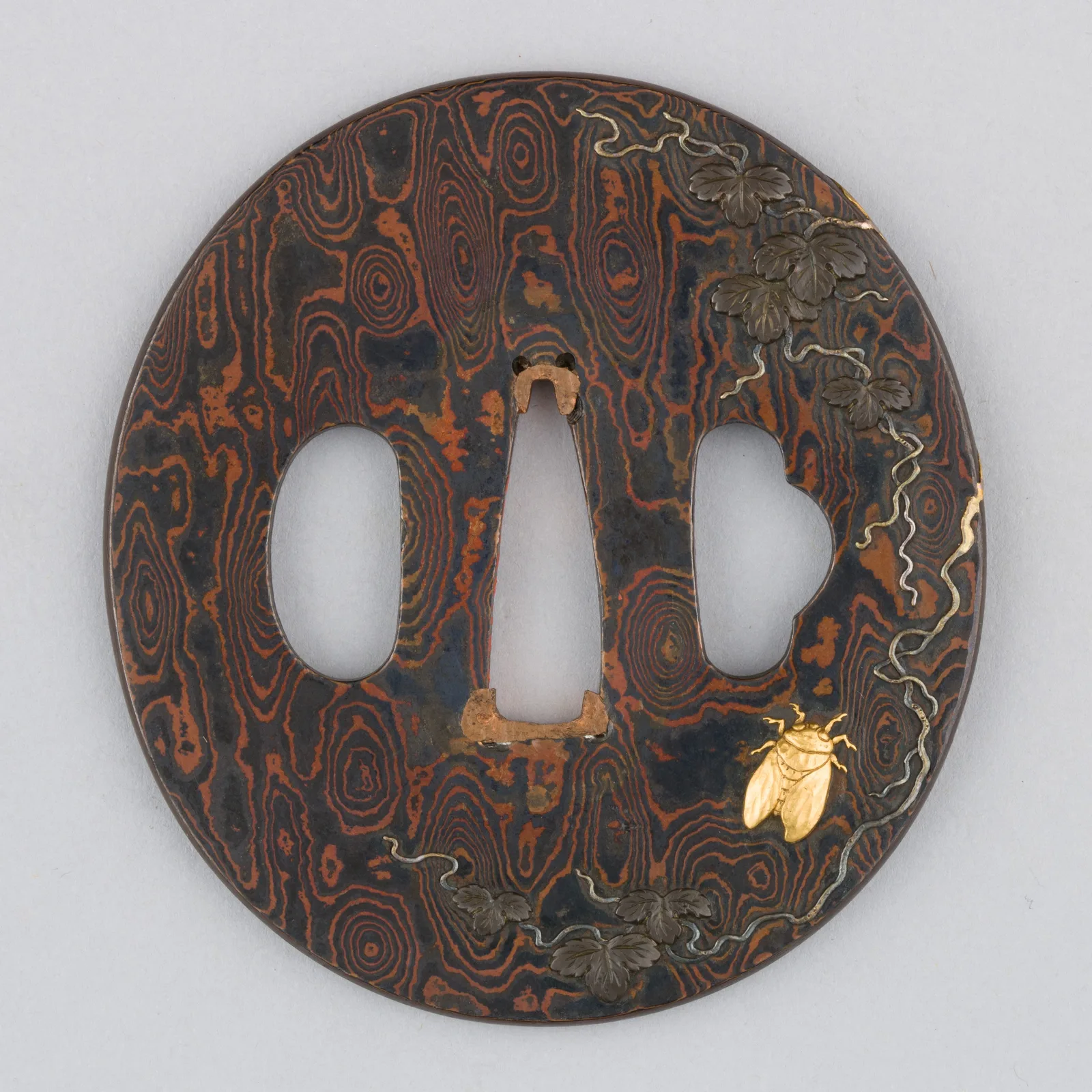
Shakudo is an alloy of copper with a small share of gold, usually a few percent. On its own it looks like dark copper, but after treatment in a rokusho solution it takes on a deep blue-black patina, like lacquer or blued steel. It is shakudo that gives mokume-gane that precious black layer you cannot get from plain silver or copper. In traditional Japanese sword-mount work, shakudo was prized no less than gold, because its black colour was held to be noble and hard to achieve.
Shakudo and shibuichi: grey and olive tones
Alongside shakudo the Japanese used shibuichi, an alloy of copper with silver (the name literally means "one quarter", after the share of silver). After etching, shibuichi shifts to grey-steel and olive-grey tones, filling the gap between black shakudo and white silver. Combining shakudo, shibuichi, and silver in one billet gives a whole range from black through grey to white, and the pattern comes out not two-tone but stepped, with real light and shade. The spellings "shakudo" and "shibuichi" are the standard ones in English.
Cupronickel and nickel silver: light alloys
In more accessible modern work, light copper-nickel alloys such as cupronickel or nickel silver are sometimes taken instead of costly silver. They give a silvery layer, are durable, and are inexpensive. The drawback is that they contain nickel, which can irritate sensitive skin, so for rings and other pieces in long contact with the body these alloys are used more cautiously. For brooches and pendants, which touch the body little, this is a sensible way to lower the cost of the pattern without losing impact.
Gold and platinum: the upper register
In premium work, yellow, rose, and white gold are added to the layers, and platinum more rarely. A gold layer does not darken with etching and stays a bright warm accent among the grey and black. A ring where rose gold flickers through the woodgrain reads as warmer and dearer. Platinum complicates the bonding because its melting point is high, but it gives a hard-wearing light layer. The more precious the metals in the stack, the higher the class and price of the finished piece.
Why contrast in colour and in patina matters
The secret of beautiful mokume lies not in the number of metals but in how they differ in colour and, above all, in how they react to the etch. Take two alloys that are too alike, and after grinding and patina the pattern will be limp and hard to read. The maker picks the layers so that some darken strongly, others barely darken, and others give an intermediate tone. Then from a single billet the etch brings out a pattern with real depth. The base of the technique is therefore always a pair or trio of metals with different patina behaviour, and the beauty of each metal taken alone is secondary here.
Customer reviews
Zevira is a real jewellery shop. Genuine payments, deliveries and customer thank-yous.
🥰🥰🥰 gracias
Ok, ¡gracias! 🙂
Why mokume-gane is so costly and labour-intensive
How much handwork is in one piece
Every stage of mokume is done by hand and hardly lends itself to a production line. Preparing the sheets, assembling the stack, controlled bonding, repeated forging with annealing, cutting the pattern, grinding, and etching make a long chain of operations in which a slip at any step ruins the whole blank. One billet can take days to come into being, and only a few rings come out of it. This is handwork by an artist from start to finish, which is why mokume-gane holds steadily in the upper price segment, on a level with jewellery in precious metals that carries complex handwork.
The high reject rate
Mokume forgives less than almost any other technique. Clean a sheet poorly before bonding, and the layer will not fuse, leaving a hidden delamination that shows up under forging. Overheat the billet slightly, and the metal slumps. Overdo the forging without annealing, and a crack runs. An experienced maker loses part of the blanks even with a settled process. This reject rate, built into the technique, also goes into the cost of the finished ring: you pay for the billets that never made it to the counter too.
Why it cannot be sped up or made cheaper
The technique fundamentally cannot be put on a conveyor and stay true mokume. You can print a pattern on metal, you can apply an imitation, but a genuine layered monolith requires bonding and forging, and that means time, equipment, and the maker's hand. Any attempt to economise either lowers the quality of the bond and sets up future delaminations, or turns the piece into an imitation. Honest mokume-gane stays costly by nature, then, not by markup.
Upload a photo of your pet, someone you love, or an object. We'll build a 3D model and hand-cast it in pewter.



Mokume-gane in wedding bands
Why wedding bands in particular
Of all jewellery, mokume-gane is found most often in wedding and matching bands, and this is no accident. A ring's pattern is unrepeatable: even from one billet two rings come out different, because the cut of the layers is its own in every spot. For a symbol of union, such uniqueness reads plainly: your ring exists as a single copy, just like your pair. A ring is also a small form, on which an expressive pattern is seen whole and large, unlike a tiny part.
The pattern as a metaphor for union
Mokume is often called the figure of two elements that have become one. Different metals fuse into a monolith that can no longer be split into layers, and yet each keeps its own colour. The result is an image of a union where two have grown together inseparably, but have not dissolved into one another. For a wedding band this is a strong and honest metaphor, with no sweetness: not "two halves", but two independent metals forged into one common thing. If the idea of matched jewellery appeals to you, look into the guide to jewellery for couples.
How mokume is paired with a stone
Mokume-gane is rarely left with no accent at all in an engagement pair. A patterned band is often paired with a single stone in a plain setting, so that the metal's figure and the stone do not fight for attention. A diamond or coloured gem is set in a smooth rim or a spare setting, and all the play stays with the woodgrain of the ring. For those choosing a stone for an engagement alongside this, the full guide to diamond wedding bands will be useful.
His and hers ring from one billet
A lovely move that couples like: to order two rings, his and hers, from one and the same layered billet. Their pattern will be kindred, from one source, but not identical, because the rings are cut from different parts of the blank. This is a literal embodiment of the idea of a shared beginning and two different paths. Such matched sets are made to order, and the wait is usually longer than usual, because the maker bonds and forges a billet specially for the pair.
The band design: outer layer and core
A mokume ring has a structural subtlety. The patterned layer is sometimes through the full thickness of the ring, and sometimes only on the outside, over a strong inner core of gold, platinum, or a stainless base. Solid mokume is prettier at the edge and more honest, but softer and fussier in wear. A ring with a patterned top on a strong core is sturdier and holds its round shape better, but the pattern shows only on the outside. This is worth clarifying with the maker before ordering, because both strength and the chance of future repair depend on the construction.
Who a mokume ring suits
Mokume-gane is chosen by those drawn to a thing with character rather than to flawless conveyor shine. If you like a piece to settle in over time, to darken in the hollows of the pattern and grow warmer, mokume will please you for a long time. But if you want a ring that looks box-fresh for years and are not ready to take it off for cleaning and the pool, it is worth looking at mokume on a strong core or at dense metals. This is not a question of better or worse, but of how the character of the metal matches your way of life.



Care for mokume-gane: can you get it wet, and does it scratch
Is mokume afraid of water
Brief contact with water does not bother mokume-gane: washing your hands, getting caught in rain, rinsing the ring are all fine. The danger is not water itself but aggressive chemicals and long soaking. Pool chlorine, sea salt, household cleaning agents, and acidic mixtures attack the copper layers and the patina, so it is better to take the ring off for the pool, the sea, and cleaning. After contact with water the piece is simply wiped dry. The rule is simple: splashes are no threat, chemicals and long damp are harmful.
Does the pattern scratch
The hardness of mokume depends on the metals in the layers. Silver and copper are relatively soft, so such a ring over time gathers a web of fine scratches and loses its first shine, like any silver piece. This does not spoil the pattern; the figure does not go anywhere, it is inside the metal through its whole thickness, but the surface goes matte. Many owners actually love this settling-in. If you want greater durability, choose rings with gold, platinum, or a strong core; they keep their look longer.
Will the pattern wear away over time
The main advantage of mokume over any coating: the pattern is not a film on the surface but the structure of the whole metal right through. No matter how much you grind, rub, or wear it, the pattern will not wear off, because under the top layer are the same layers. A scratched or dulled mokume ring can be repolished and re-etched by a jeweller, and the pattern comes back fresh. This is the root difference from a printed imitation, where the pattern lives only on the surface and rubs off with it.
Does mokume darken, and does it need cleaning
The layers with copper and patina darken over time from contact with skin, sweat, and air, and this is a normal process. Some prize the darkening as a noble age, others prefer to restore the original contrast. Light darkening is removed with a gentle polish or a special silver cloth, without touching the patinated dark layers aggressively, or you may upset the contrast the maker intended. Serious cleaning and renewal of the patina is best left to a jeweller who knows which layers in the ring to darken and which to keep light.
How to store mokume
Store mokume like jewellery with copper and silver: in a dry place, apart from other pieces, so it does not scratch or get scratched, ideally in a soft pouch or a box with anti-tarnish paper. Extra contact with moisture, creams, and perfumes shortens the time to the next cleaning. If the ring is set aside for a long while, wipe it dry and put it in a sealed pouch; then the patina and contrast will keep longer.
Six fast checks, no tools. Leave your email, we'll send the PDF and a discount code.
No spam, unsubscribe anytime.
How to tell true mokume from an imitation
Print and laser made to look like mokume
The most common fake of mokume is a pattern printed on uniform metal. A steel, titanium, or cheap silver ring is given a pattern by laser, paint, or a chemical method, imitating woodgrain runs. On the shelf it looks similar and costs many times less, but it is a pattern on the surface, not the structure of the metal. The main test: in true mokume the pattern is visible on the edge too, on the rim of the ring, because the layers run right through. In a print the edge is single-toned, the pattern only on the face.
An abnormal price as a signal
Genuine mokume is always handwork in the upper segment. If a ring with a rich multicolour woodgrain is sold at the price of an ordinary mass-stamped piece, it is almost certainly an imitation. Price is no guarantee of authenticity, but a sharply low price for a complex pattern is a red flag. True mokume cannot cost the same as a mass-market trinket, because days of handwork and a reject rate are built into it.
A perfectly identical pattern
Another sign of a fake is repeatability. If a shop has ten rings with an absolutely identical pattern, this is a print or a stamp from one die. True mokume cannot be repeated: every cut of the layered billet is unique, and two genuine rings always differ in their runs. Sameness of pattern across a batch gives away mass application, not handwork forging.
What an honest seller should say
Genuine mokume is sold with a description of the metals in the layers and often with the name of the maker or studio. An honest seller will tell you which alloys are bonded, whether it is solid mokume or a pattern on a core, how to care for it, and whether it can be resized. Evasive answers about a "Japanese coating technology" or an unwillingness to name the metals are a reason to grow wary. The real technique is not shy of its composition; on the contrary, the makeup of the layers is part of its worth.
Can you wear a mokume ring with other jewellery
Mokume sits calmly next to other rings, but there is a nuance of hardness. If a hard ring of platinum or steel sits next to it on the finger, it can scratch the softer silver-copper mokume through friction. To avoid this, a mokume ring is either worn on its own or placed in a stack so it touches the hard neighbour less. In colour, mokume is friendly to mixing: the warm copper and gold layers chime with gold, the light silver ones with silver, so building a harmonious pair with it is not hard.
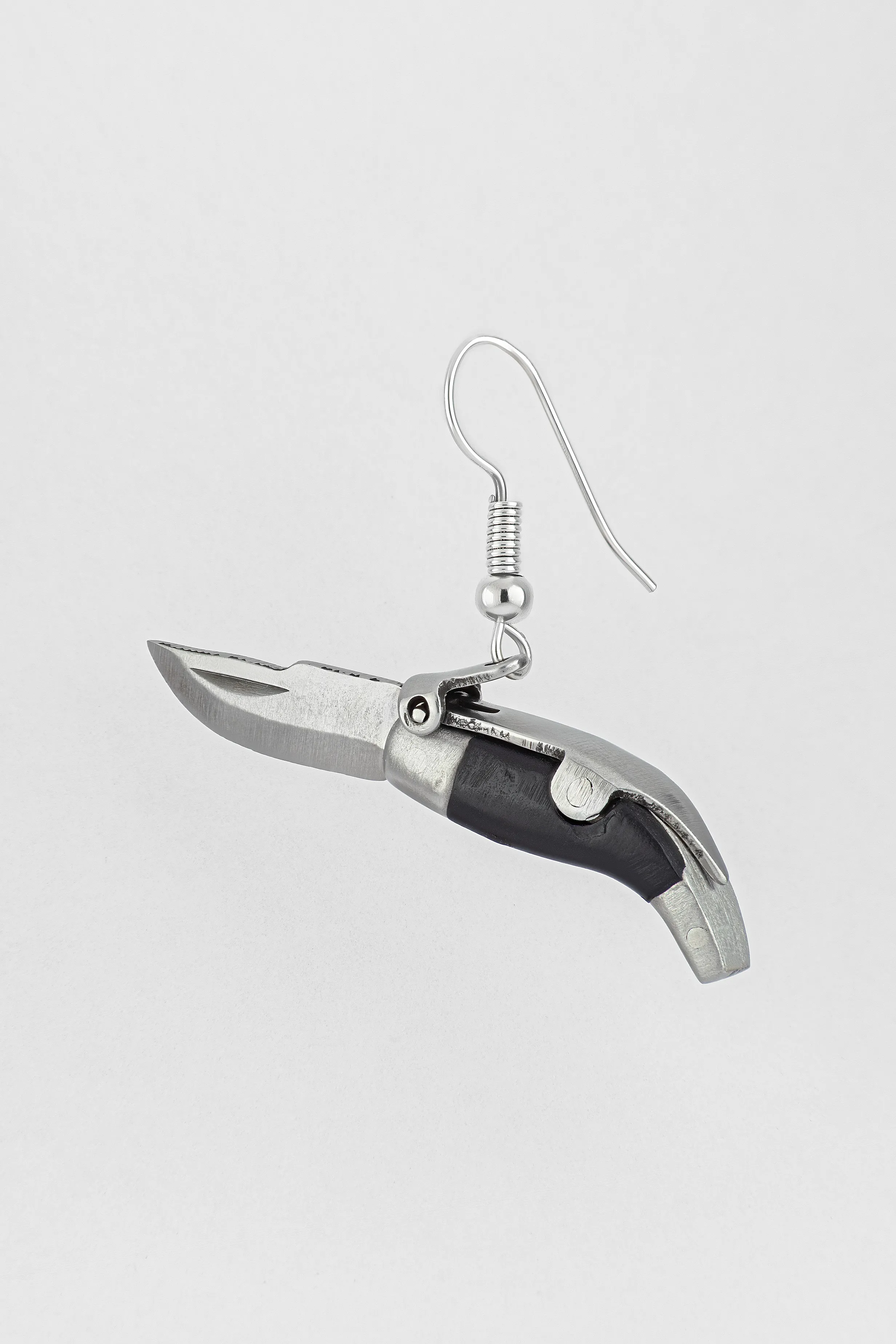
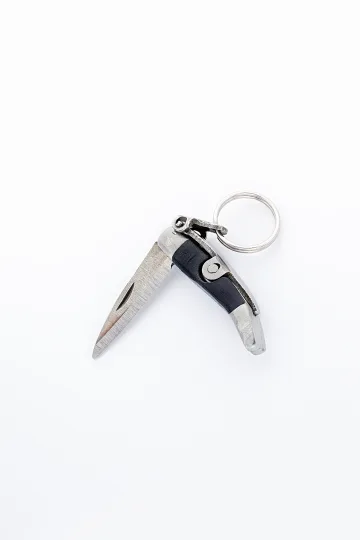
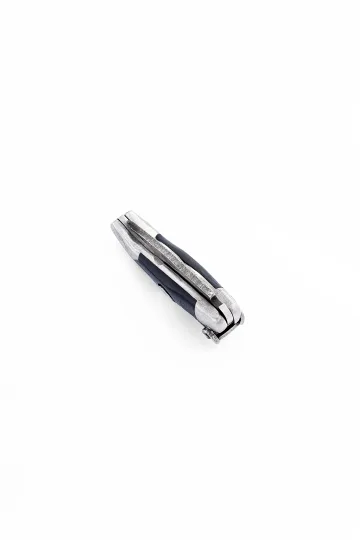
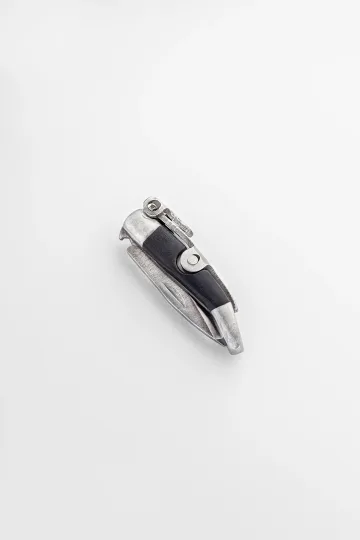
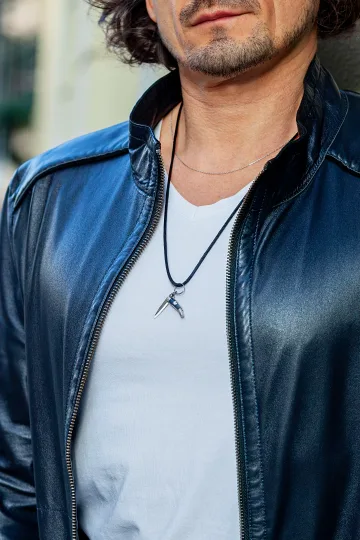
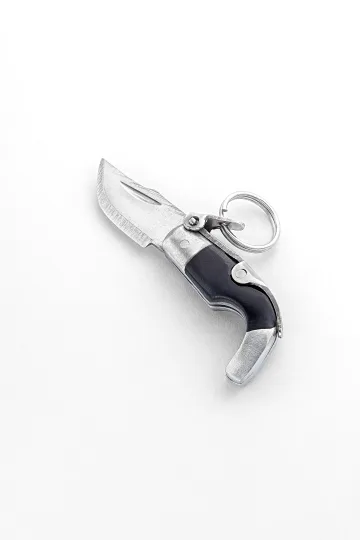
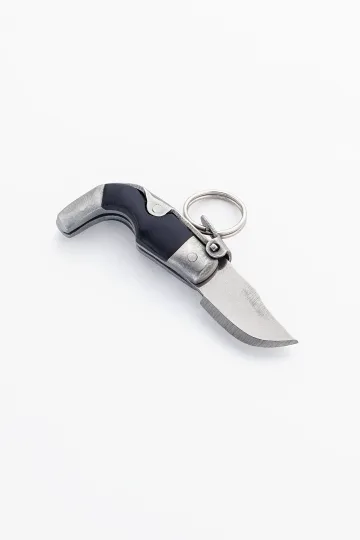
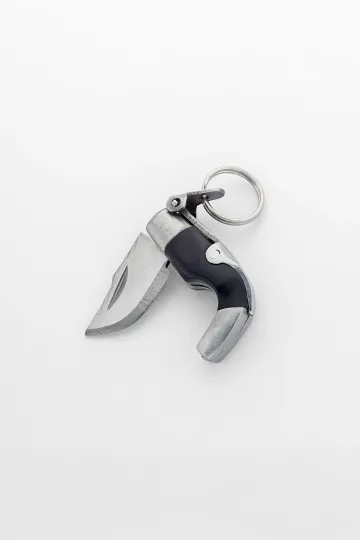
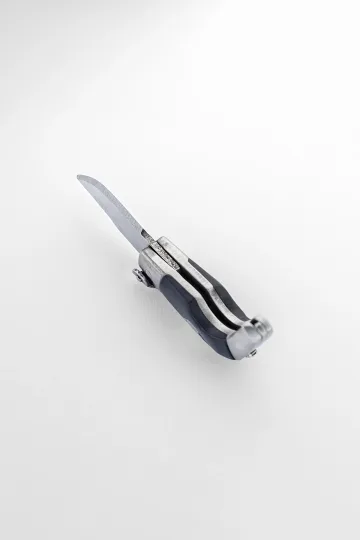
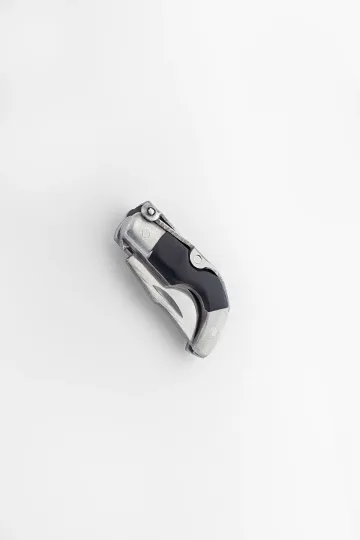
CAPAORA mini knife pendant
The 18th-century Spanish navaja in miniature: 40 mm of stainless steel, a real folding mechanism and a Palanquilla lock that clicks. An affordable gift to remember.
Authentic · Ships from Spain · 14-day returns
Mokume-gane and damascus: the difference
Different metals, different history
Mokume and damascus steel are often confused because of their similar flowing patterns, but they are quite different things. Damascus is patterned steel, an iron-based alloy with carbon, and its pattern is born from differing carbon content in the layers. Mokume is coloured metals: silver, copper, gold, Japanese alloys, and its pattern is coloured rather than steely. Damascus is about blades and strength, mokume about colour and jewellery. On a close jewellery technique with a history you can read in the piece on Toledo damascene, though there it concerns gold inlay on steel rather than layers.
The pattern of steel versus the pattern of coloured metals
In damascus the pattern shows because different steels react differently to acid etching: some darken, others stay light, and a contrast of grey with steel emerges. There is no colour as such, only gradations of grey and silver. In mokume the contrast is coloured: black shakudo, grey shibuichi, white silver, yellow and rose gold, copper pink-brown. So damascus reads strict and stern, in a weapon-like way, while mokume is warmer and more painterly, closer to a slice of wood or stone with veining.
Strength and purpose
Damascus steel is hard and springy, it was created for blades and holds an edge; in jewellery it is more often made into men's rings and accessories with an eye to ruggedness. Mokume is softer, because at its base are coloured metals, and it is more decorative and jewellery-like in character. Steel damascus can rust and needs protection from corrosion; mokume does not rust but darkens and patinates. The choice between them is a choice between stern steel and a warm coloured pattern.
Repair and resizing of mokume-gane
Can a mokume ring be resized
A mokume ring can be resized, but it is harder and riskier than an ordinary one. The trouble is that any soldering or stretching touches the layered structure and the pattern. A small increase an experienced jeweller will manage with careful stretching, especially if the ring has no stone. A serious change of size requires a cut, an insert or removal of a section, and re-soldering, after which the pattern at the seam has to be matched and re-etched so the joint is invisible. The size of a mokume ring is therefore best determined as precisely as possible when ordering.
Why repair is harder than usual
The difficulty of repair lies in two things. First, the heat of soldering can disturb the diffusion bond of the layers and the patina, so the work must be done by a master who understands mokume, not just any jeweller down the road. Second, after any intervention the contrast of the pattern must be brought out again by etching, or the repaired section will differ in colour. For the same reason not every workshop takes on mokume repair, and it is wiser to turn to the one who made the ring, or to a specialist in the technique.
What to do with deep scratches and dents
Surface scratches come off with repolishing, and the pattern only refreshes from it. Deep dents and nicks are harder: they are eased out carefully, remembering that the layers are thin and heavy deformation can tear them. After straightening and polishing the piece is re-etched to restore the contrast. The good news is that thanks to the through structure of the pattern, almost any mechanical damage to the surface is reversible, as long as a knowing master takes it on.
Can you add a stone or engraving later
Setting a stone into a finished mokume ring or making an engraving is technically possible, but with reservations. Engraving on the patterned metal disturbs the figure where the inscription goes, so it is often hidden on the inner side, where the layers are touched less. Setting a stone requires cutting a seat, which is also an intervention into the layers, and it is better to plan the stone in advance, at the making stage. If you anticipate future personalisation, tell the maker before the work begins, so a place can be left for it.
Facts that surprise
Mokume-gane is older than the word "jeweller" in our modern sense of fashion: the technique was devised for combat, if ceremonial, weapons, and only centuries later passed to jewellery.
The name is poetry, not technique. "Wood eye of metal" describes not the way it is made but only the result, a pattern like a slice of wood. The process itself has nothing to do with wood.
Two rings from one billet are always different. However hard you try, the cut of the layers cannot be repeated, so in matched mokume rings the pattern is kindred but never identical.
The pattern lives right through, not on the surface. You can grind the top layer away completely, and beneath it the same figure appears, because the layers pierce the whole metal.
The black in mokume is not paint and not a coating, but the patina of the shakudo alloy. Copper with a drop of gold turns blue-black of its own after treatment, and the Japanese prized this colour on a par with gold.
Traditional bonding ran almost at the edge of melting and was reckoned dangerous: the master caught the moment when the layers had fused but had not yet slumped. The modern furnace with temperature control turned a risky art into a manageable process.
Shibuichi literally means "one quarter", after the share of silver in the copper alloy. The Japanese named their art alloys by their recipe, the way cooks name dishes by their makeup.
The number of layers in complex work reaches hundreds. They are stacked, bonded, cut in half, stacked again, and bonded again, doubling the count with each cycle, like making puff pastry.
Send a friend a discount code, they save on their first order.
Frequently asked questions
What is mokume-gane in simple terms? It is a Japanese technique in which thin layers of different metals (silver, copper, gold, special alloys) are bonded into a single billet, then forged, cut into, and ground so that a pattern resembling the annual rings of wood emerges on the surface. The pattern is unique to each piece and runs through the whole metal rather than being applied on top.
Why is mokume-gane so costly? It is handwork by an artist from start to finish, with a long chain of operations where a slip at any step ruins the blank. To the cost of labour is added a high reject rate and often precious metals in the layers. The technique cannot be put on a conveyor without losing quality, so it holds steadily in the upper segment.
Can you get a mokume-gane ring wet? Brief contact with water does no harm: washing your hands and getting caught in rain are fine. The danger is pool chlorine, sea salt, and household chemicals, which attack the copper layers. For water work, cleaning, the pool, and the sea it is better to take the ring off, and to wipe it dry after contact with water.
Will the pattern wear off over time? No. The pattern is the structure of the whole metal right through, not a film on the surface, so it does not rub off. A scratched or dulled ring is repolished and re-etched by a jeweller, and the figure comes back fresh. In this mokume differs fundamentally from a printed imitation.
How do you tell true mokume from a fake? The main test is by the edge: in true mokume the pattern is visible on the rim of the ring too, because the layers run right through, while in a print the edge is single-toned. Be put on guard by too low a price for a complex pattern and by a perfectly identical figure across several pieces, since genuine mokume is always unique.
How does mokume-gane differ from damascus? Damascus is patterned steel on an iron base; its pattern is grey and steely, made for strength and blades. Mokume is coloured metals (silver, copper, gold, Japanese alloys); its pattern is coloured and painterly, the technique decorative and jewellery-like. Damascus can rust, mokume does not rust but darkens and patinates.
Can a mokume ring be resized? It can, but it is harder and riskier than an ordinary ring, because soldering and stretching touch the layers and the pattern. A small increase is done by careful stretching; a serious change requires a cut, soldering, and a repeat etch so the pattern matches. The work must be done by a master who understands the technique, so the size is best determined precisely when ordering.
Does mokume-gane darken, and does it need cleaning? The layers with copper darken over time from skin, sweat, and air, and this is normal. Light darkening is removed with a gentle polish or a silver cloth, without touching the patinated dark layers aggressively. Serious cleaning and renewal of the contrast is best left to a jeweller who knows which layers in the ring to keep light and which dark.
In short
Mokume-gane was born in 17th-century Japan in the hands of Edo-period swordsmiths as a way to decorate the guards of samurai swords, and only centuries later did it come into wedding bands. Its essence is at once simple and hard: layers of silver, copper, gold, and Japanese alloys are bonded into a monolith, then forged, cut into, and etched so that a pattern like a slice of wood emerges. This figure is unrepeatable, lives through the whole metal, and does not wear off, which makes it an honest metaphor for the union of two different things grown into one. The technique stays handmade, costly, and fussy, but therein lies its worth: every ring is the only one, and a genuine layered metal cannot be faked by anything but a surface print, which is easy to spot by the edge.
Silver, warm metals, matching rings, coloured stones, and symbolism with a history.
Buying it as a gift? Each one arrives ready to give.
 A branded Zevira box and a little card come with every order.




About Zevira
Zevira is a Spanish brand from Albacete, a city of metalworkers. We love things with character: warm metals, living patina, complex techniques, and jewellery with a history. If the world of metal and its patterns appeals to you, start with the piece on copper in jewellery or the guide to silver 925, and for those choosing rings for a couple, the guide to jewellery for couples will be useful.