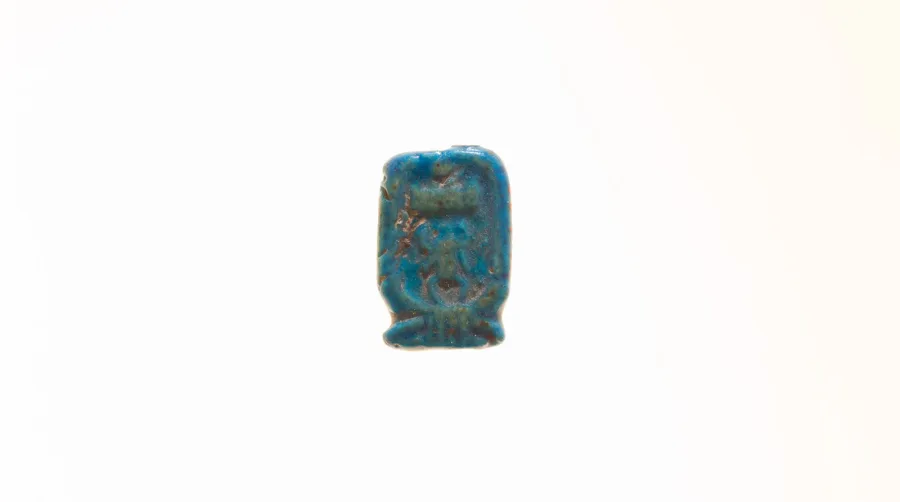
The Name Cartouche: The Jewel in Which Ancient Egyptians Sealed a Name Under the Protection of Eternity
The Egyptians did not draw the oval of a cartouche for looks. It was a loop of rope folded double and knotted at the end, a protective sign meaning that everything inside the ring was guarded and would exist forever. Inside went a name. In Egyptian belief the name was part of the soul, and erasing it meant truly killing a person, for good. So pharaohs carved their names into ovals on stone built to outlast the millennia.
Today that same oval hangs on a chain, and inside it people write not the name of Ramesses but their own, the name of a child, or of someone they want to keep close. The cartouche pendant became the most recognisable piece of jewellery brought home from Egypt, and one of the few things where hieroglyphs work as a personal mark rather than a decorative pattern. This article is about what a cartouche actually means, how a name is turned into hieroglyphs, why it counted as protection, and how to tell an honest Cairo jeweller's work from a stamped piece made for tourists.
What a Cartouche Is: The Oval, the Loop, and the Name Inside
Cartouche Is Not an Egyptian Word but a French Soldier's Word
The word "cartouche" itself is not Egyptian. It was coined by French soldiers in Napoleon's army, who in the late eighteenth century were the first to see Egyptian hieroglyphs on monuments in great numbers. The oval frames with their mysterious signs inside reminded the soldiers of a paper rifle cartridge, in French a cartouche. The name stuck in scholarship and remains to this day, though it has nothing to do with cartridges. The Egyptians themselves called the shape something entirely different.
Shenu: The Ring That Has No End
In Egyptian the oval was called shenu, a word related to the verb meaning "to encircle," "to go around." Shenu is a ring, a closed line with no beginning and no end. The same idea hides in another Egyptian sign, the shen ring, a circle with a horizontal bar at the bottom, which stood for eternity and for everything the sun circles on its journey. The cartouche is a stretched shen: the circle was drawn out into an oval so a long name would fit inside, but the meaning stayed the same, protection all the way around.
Wear the symbol, don't just read about it. These are in stock:

Why an Oval, Not a Circle or a Square
A pharaoh's name was made of several hieroglyphs and would not fit inside an ordinary circle. The oval solved the problem: it could be drawn out exactly as far as a long name required. The hieroglyphs inside were read by the same principle as the rest of Egyptian text, toward the side the faces of birds and people look. The horizontal bar at the end of the oval, that very knot of rope, always closed the shape at the bottom or the side, making it clear the name was ringed, the name was guarded.
What Separates a Cartouche From Just a Frame of Hieroglyphs
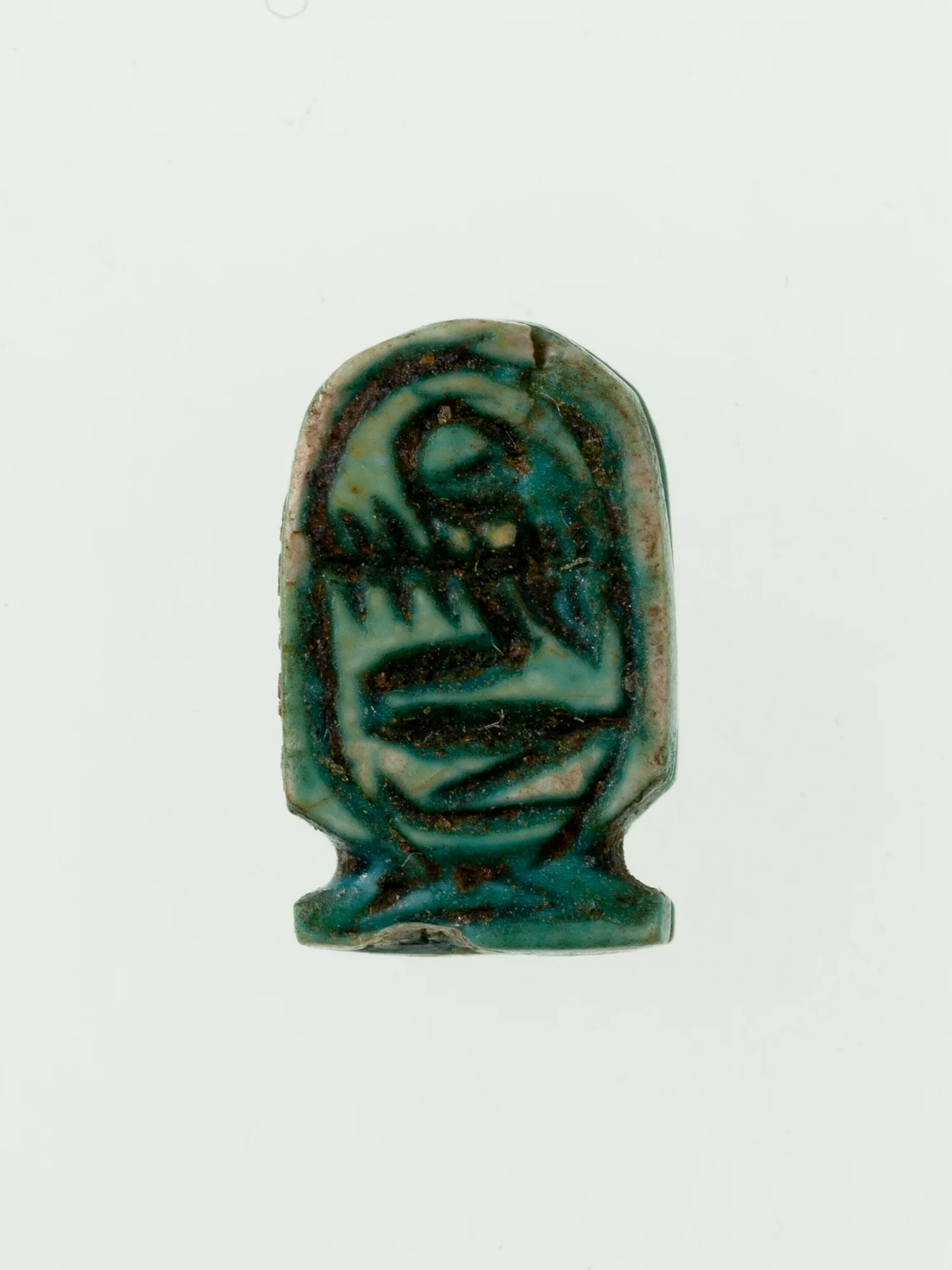
Not every inscription in hieroglyphs is a cartouche. A cartouche is specifically the oval around a royal name. If the hieroglyphs run in a line or column without a ring, it is ordinary text: a prayer, a dedication, a list of offerings. The oval was a privilege: it went to the names of pharaohs, later to the names of queens and certain gods. An ordinary Egyptian wrote a name without a frame. So a modern pendant in which your name is ringed by a cartouche essentially grants you a status that three thousand years ago belonged to kings alone.
The History of the Cartouche: From the Old Kingdom to the Rosetta Stone
When the Oval Around a Name First Appeared
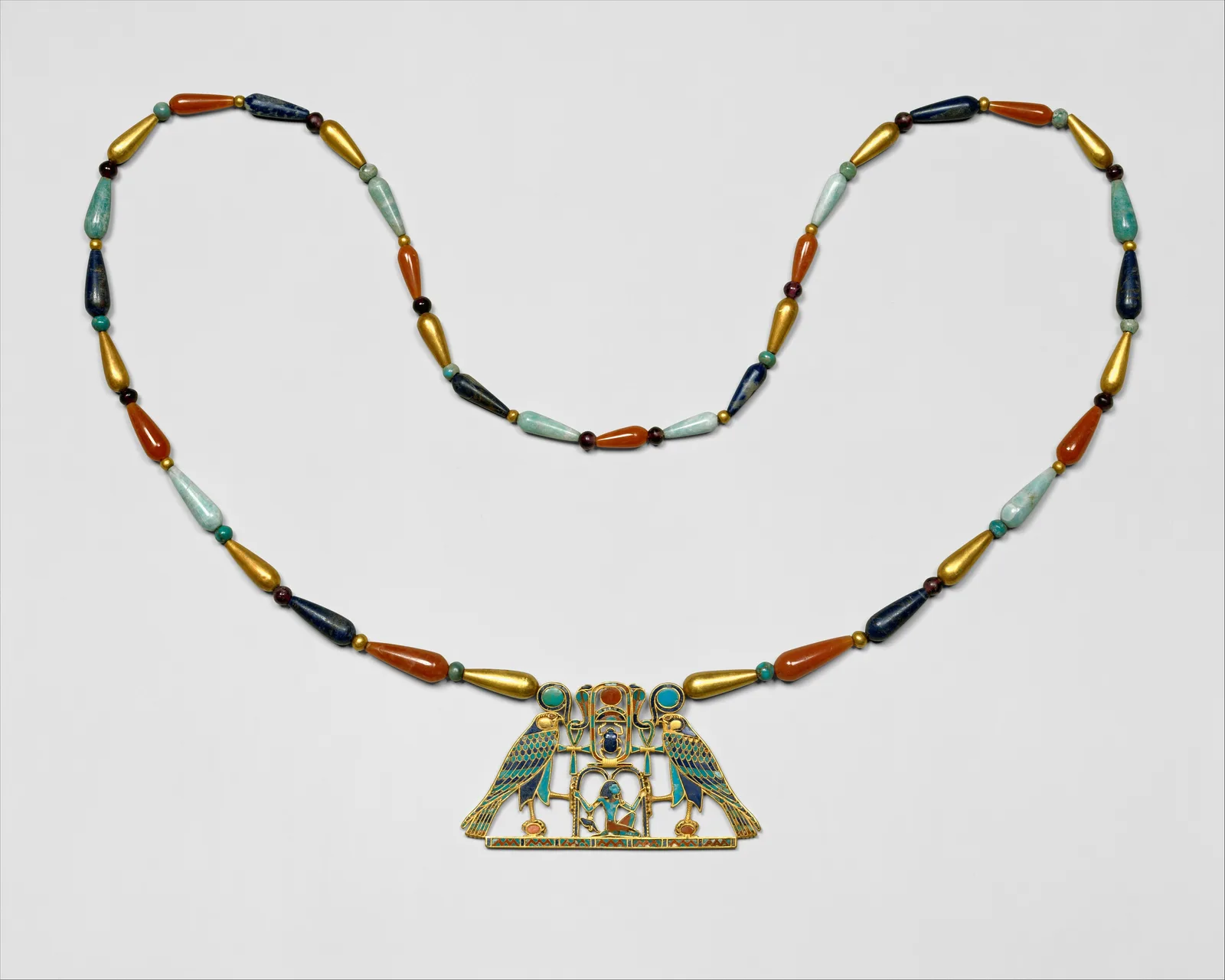
Ringing the royal name began in the Old Kingdom, around the middle of the third millennium B.C. One of the early examples is the cartouche of pharaoh Sneferu, father of the builder of the Great Pyramid. Before that, rulers' names were written in a rectangular frame called a serekh, depicting a palace facade with the falcon Horus on top. The oval gradually displaced the rectangle as the sign of the king's personal name specifically, and by the age of the pyramids the cartouche had become an obligatory part of the royal titulary.
The Five Names of a Pharaoh and Which Ones Went Into the Oval
A pharaoh had not one name but five, a full titulary. Of these, two main ones were enclosed in a cartouche: the throne name, which the king took on accession, and the personal name, given at birth. The personal name was usually preceded by the epithet "Son of Ra," stressing his divine origin. So on monuments you often see two ovals side by side: one holding the throne name, the other the name by which we know the pharaoh today. The other three names of the royal titulary were written without a frame.
Tutankhamun: The Name Brought Back From Oblivion
Tutankhamun is famous not for great deeds but for the fact that his tomb was found almost untouched in 1922. His cartouches covered the sarcophagi, thrones, chests, and the golden mask. The name itself means "living image of the god Amun." Curiously, Tutankhamun changed his name: he was born Tutankhaten, in honour of the sun disk Aten, raised up by his presumed father Akhenaten. After the collapse of the reform the boy was renamed, restoring the name of the old god Amun to the oval. The name in the cartouche was politics as much as religion.
Cleopatra: The Cartouche That Helped Crack the Hieroglyphs
Cleopatra's name played a role the queen never suspected. Her cartouche, found on an obelisk and in temple inscriptions of the Greco-Roman period, became one of the keys to decipherment. The name "Cleopatra" is Greek, foreign to the Egyptians, so it was written not in picture-words but sound by sound, in phonetic signs. Comparing Cleopatra's oval with Ptolemy's, scholars saw that the repeating letters, both p's, both o's, the l, the t, stood in the expected places. The cartouche turned out to be not a riddle but a hint.
The Rosetta Stone and Champollion's Obsession
For fifteen hundred years the hieroglyphs were silent: the last inscription was made at the end of the fourth century, and then the skill of reading them died along with the Egyptian priests. The Rosetta Stone, a slab carrying one decree in three scripts, hieroglyphic, demotic, and Greek, supplied the key. The Greek text was read freely, and it mentioned Ptolemy. The Frenchman Jean-Francois Champollion, obsessed with Egypt since childhood and a speaker of Coptic, the last descendant of the Egyptian language, proved in 1822 that hieroglyphs are not pure idea-pictures but a mix of signs for sounds and signs for concepts. The starting point was precisely the names in the cartouches.
Erasing Names: A Weapon of Posthumous Revenge
The cartouche protected a name, but a name could also be destroyed on purpose. Victors and successors sometimes hacked out the cartouches of unwanted predecessors, chiselled them off the walls, recut them for themselves. This was an attempt to execute the soul, not ordinary vandalism: without a name the dead lost their footing in the afterlife. The names of Hatshepsut, a woman pharaoh, were methodically erased after her death; the traces of Akhenaten and his sun religion were also scraped out of history. The very fury with which the ovals were destroyed proves how seriously the Egyptians took the power of a name.
A cartouche wants bare skin at the collarbone, not a turtleneck. Hide your own name under a collar and you may as well leave it at home.
How to Wear a Cartouche
Over years on shoots the name oval has passed through dozens of looks for me, from denim to evening silk. Here is what actually works, sorted by occasion and by the type of cartouche.
What chain length should I wear a cartouche on? I recommend a medium length so the vertical oval sits just below the collarbones and every hieroglyph reads. A short chain hides the lower signs under the collar, too long a one drops the oval to where clothing swallows it. A large silver cartouche I hang on a denser chain, a thin gold one on a fine cable or curb link.
Gold or silver for my skin? For a warm undertone I suggest yellow or red gold: it echoes the historical original and lights up the relief of the signs. For a cool undertone I choose silver or white gold, which give a clean shine and read the engraving well. If you are unsure, a large silver oval forgives almost any outfit.
Which neckline flatters it most? Under an open V-neck I recommend a larger vertical cartouche: it lands right in the centre of the open zone. Under a closed or high collar I suggest a more compact oval and a slightly shorter chain, so the name rests on the fabric rather than hiding. A horizontal name-plate cartouche I keep for an even round neckline.
Can I wear it alongside other pendants? A cartouche is self-sufficient, so I usually give it its own line and hang nothing beside it. The one logical companion is the scarab: above the oval or as a double-sided pendant. If you want layers, give the cartouche its own length so it does not drown among the chains.
Who is it for, and for what occasion? I give a cartouche to the person who already owns every usual thing: it is personal by definition, and no two are alike. The name oval fits a birth, a christening, an important date, or a memory of a trip to Egypt. The name inside is gender-neutral, so the piece suits a man and a woman equally.

Turn on your camera, pick earrings, a pendant or a ring, and see the piece on yourself in real time.
Switch items in one tap.
Everything runs in your browser: no photo or video is ever uploaded.
Customer reviews
Zevira is a real jewellery shop. Genuine payments, deliveries and customer thank-yous.
🥰🥰🥰 gracias

Ok, ¡gracias! 🙂

How a Name Is Written in Hieroglyphs: An Alphabet That Is Not Quite an Alphabet
A Hieroglyph Is Not a Letter One to One
The chief misunderstanding among tourists: that each of our letters supposedly corresponds to exactly one hieroglyph, as in a cipher. It does not. Egyptian writing is mixed. Some signs convey sounds, some whole words or concepts, some make no sound at all and only hint at the meaning of the neighbouring word. Among the sound signs there are some that convey a single consonant and some that convey two or three at once. So "translating" a name into hieroglyphs is always an approximation, a matching of signs by sound, not a mechanical swap of letters.
Single-Consonant Signs: The Closest Likeness to Our Alphabet
Within this system there are about two dozen signs, each conveying one consonant sound. They are loosely called the "Egyptian alphabet," and these are exactly what is used when a modern name is written in a cartouche. The owl is the sound "m," the lion an "l" (more precisely a sound close to it), the hand "d," water shown as a zigzag "n," the vulture a breathy sound close to "a." With these building blocks a name is assembled by its sounds, the way a child builds a word from sounds rather than from ready-made words.
Where Did the Vowels Go
The Egyptians, like many Semitic peoples, usually did not write vowels. They recorded a skeleton of consonants, and the vowels were understood from context. So we know the exact sound of ancient names only approximately: "Tutankhamun" is a conventional reading, the real vowels are lost. For a modern name this means that some vowels are conveyed with special prop signs (the vulture, the reed, the quail chick), and elsewhere they are simply dropped. There may be more than one equally "correct" version of the same name.
Why the Name "Anna" and the Name "Ivan" Look So Different
The length and pattern of a cartouche depend on how many sounds a name has and what they are. A short name gives a few signs and a compact oval, a long one stretches it out. The same sound can sometimes be conveyed by different signs, and the craftsman chooses by the beauty of the composition: so the birds face the same way, so tall and short signs alternate. That is why two cartouches with the same name from different jewellers can differ. This is not a mistake but a property of a script that leaves room for choice.
What to Do With Sounds the Egyptians Did Not Have
European names contain sounds that simply do not exist in Egyptian: a hard rolled "r," certain hisses, "ts," "ch." They are conveyed by the nearest sign in sound, or by a combination. "Ts" is split into "t" and "s," and "v" is often written with the same sign as "u." This is exactly that conventional element: a cartouche is not a passport but a sound portrait of a name in the means of three thousand years ago. An honest seller will tell you this; anyone who insists there is a "single correct" hieroglyph for each letter is bluffing.
Upload a photo of your pet, someone you love, or an object. We'll build a 3D model and hand-cast it in pewter.




Why a Cartouche Is Considered a Protective Charm
The Name as Part of the Soul in Egyptian Belief
To understand why the name was protected, you need the Egyptian idea of the person. The soul, in their belief, was made of several parts. There was the ka, the life force, a double to whom food and drink were brought after death. There was the ba, the personality, shown as a bird with a human head. And there was the ren, the name. The name was seen not as a label but as a real component of the being: as long as the name is spoken and written, the person continues to be. The cartouche ringed the ren in a protective loop, insuring the most vulnerable part of the soul against disappearance.
Protecting the Name Means Protecting Against the Second Death
The Egyptians feared not so much physical death as the "second death," final nonexistence, when a person is forgotten and their name vanishes. The shenu oval was a shield against exactly this. The closed loop magically fenced the name in, the way a wall fences in a house. Carved into eternal stone and ringed by a cartouche, the name was meant to sound through eternity and hold its owner in being. The modern pendant inherits precisely this logic: you wear your own name inside a protective ring.
The Shen Ring, the Cartouche, and the Idea of the Eternal Circle
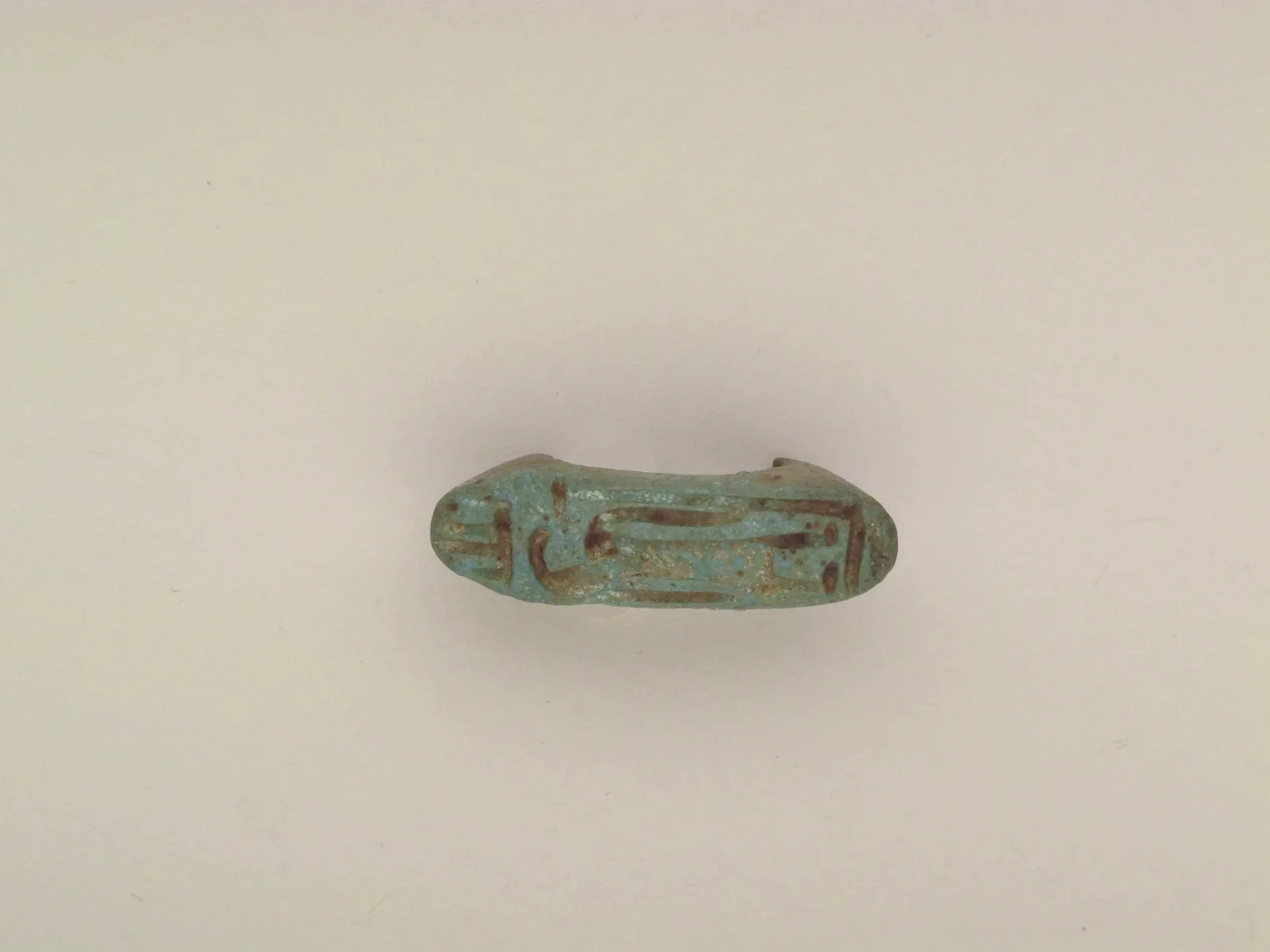
The cartouche belongs to a whole family of circular charms. The shen ring was held in the talons of the vulture goddess Nekhbet and the falcon Horus, spreading protection over the pharaoh. The same closed circle lies at the root of other cultures: the snake biting its own tail, the Celtic knot with no ends, the wedding ring. The idea is shared and ancient: whatever is closed into a circle has no vulnerable edge through which evil can enter. The cartouche simply stretched that circle to fit a name inside.
Why the Name, Rather Than a Face or a Figure
You might ask why the Egyptians protected the name and not the portrait. The answer lies in their magic of the word. A spoken and written name had the power to summon the very thing: to know a god's true name was to have power over him, hence the myths in which gods hide their secret names. The image mattered too, but it was the name that made a person addressable in both worlds, the living could call the dead, the gods could recognise him. The oval around a name is an address sealed shut.





The Cartouche as a Souvenir From Egypt: What to Look For
Why the Cartouche Became the Calling Card of Egyptian Bazaars
Of all Egyptian motifs the cartouche fit the souvenir market perfectly for one simple reason: it is personal. A scarab or an ankh can be bought ready-made, but a cartouche is made for a specific person, with their name. That turns a trinket into a personal object and justifies a higher price. So in Cairo, Luxor, and Hurghada dozens of workshops offer to "make your cartouche while you drink your tea." Quality, meanwhile, ranges from genuine handmade gold to thin stamped pieces passed off as handwork.
Gold or Silver: What Egypt Offers
The classic tourist cartouche is made in gold or silver. Gold costs more and is considered the "proper" choice, silver is more affordable and larger for the same money. Egypt has historically traded in gold, and the hallmark there is usually honest, but for that very reason it matters not to confuse weight and purity: a thin gold plate can weigh less than it looks. Silver is better bought with a clear 925 hallmark and a stamp. The color of the metal here is a matter of taste and budget; what makes a cartouche a charm is not the metal but the name inside.
How to Tell Handwork From Stamping
A genuine handmade cartouche is assembled from separate hieroglyphs soldered onto an oval base or cut into a plate. You can see the thickness of the signs, slightly uneven, living edges, sometimes tool marks on the back. A stamped cartouche is flat, the pattern identical on hundreds of copies, the signs slightly blurred because the die is worn. Ask to see another cartouche with a different name: if the hieroglyphs differ only in the set of signs while the carving style is identical to the millimetre, you are looking at stamping. This is not a flaw in itself, but such a piece is not worth the price of handwork.
Checking the Name: The Tourist's Main Trap
The most common deception is not the metal but the name. The tourist cannot read hieroglyphs and takes it on trust. It happens that the oval holds not your name but a random set of signs, or even the same word given to everyone alike. The defence is simple: ask the craftsman to write your name in signs on paper and explain each one, which sound it conveys. Photograph the "Egyptian alphabet" in advance and check at least the first two letters yourself. An honest workshop will do this gladly, because it has nothing to hide.
How Much Time and Effort a Real Cartouche Takes
It helps to understand why a handmade name oval costs more than a ready scarab. The craftsman first breaks the name into sounds, selects hieroglyphs, plans the composition so the birds face one way and tall and short signs alternate. Then he carves or saws out each hieroglyph, solders it to the oval base, cleans the seams, polishes. One cartouche takes hours, and a complex one, with enamel or inlays, takes days. So the promise of "your cartouche in five minutes while you drink tea" usually means a pre-prepared stamped piece into which they only add your initials.
What Should Not Worry You, and What Should
Do not worry if your cartouche does not match a picture from the internet letter for letter: variation is normal. Do not worry if the vowels are conveyed "strangely," that is a property of the script. What should put you on guard is something else: if the seller calls the cartouche "ancient," "found," or "antique," it is almost certainly untrue, the export of genuine antiquities from Egypt is forbidden by law, and there can be no authentic artifacts on a market stall. Your cartouche is most honestly bought as exactly what it is, a new object made today with an ancient meaning.
Leave your email, we'll send your discount code. No spam, unsubscribe anytime.
The code arrives by email, valid on your first order.
Materials and Forms of the Cartouche
Gold: The Classic Closest to the Original
A gold cartouche comes closest to the historical model: royal names were carved into gold itself on sarcophagi and masks. The warm yellow metal sets off the relief of the hieroglyphs and does not tarnish over time. The color of gold can be chosen to suit skin and taste: yellow refers to antiquity most directly, while white and rose sound more contemporary. If you are choosing between shades, a breakdown of yellow, white, and red gold will help. For a charm worn every day and passed down to children, gold earns its price through durability.
Silver: A Large Cartouche at an Accessible Price
Silver gives more metal for less money, so a silver cartouche can be made large and expressive. Its cool shine reads engraving well, and the light darkening in the recesses of the signs is even a benefit: it brings out the relief, like patina on an old object. Silver is softer than gold and more demanding in care, but it forgives experiments with size and form. It is a sensible choice for a gift when you want a striking piece without a premium price.
Enamel: The Colour the Egyptians Themselves Loved
The Egyptians adored colour. Their jewellery blazed with blue lapis lazuli, turquoise, and the glassy paste we call Egyptian faience. Modern enamel returns this palette to the cartouche: the hieroglyphs or the background are filled with blue, turquoise, or black, echoing the range of ancient sarcophagi. A coloured cartouche looks more festive than gold monochrome and closer to how royal names actually appeared, since carving in stone was often painted. It is worth remembering the care such pieces need: enamel does not like blows or sharp changes in temperature.
Cartouche Plus Scarab: A Double Charm
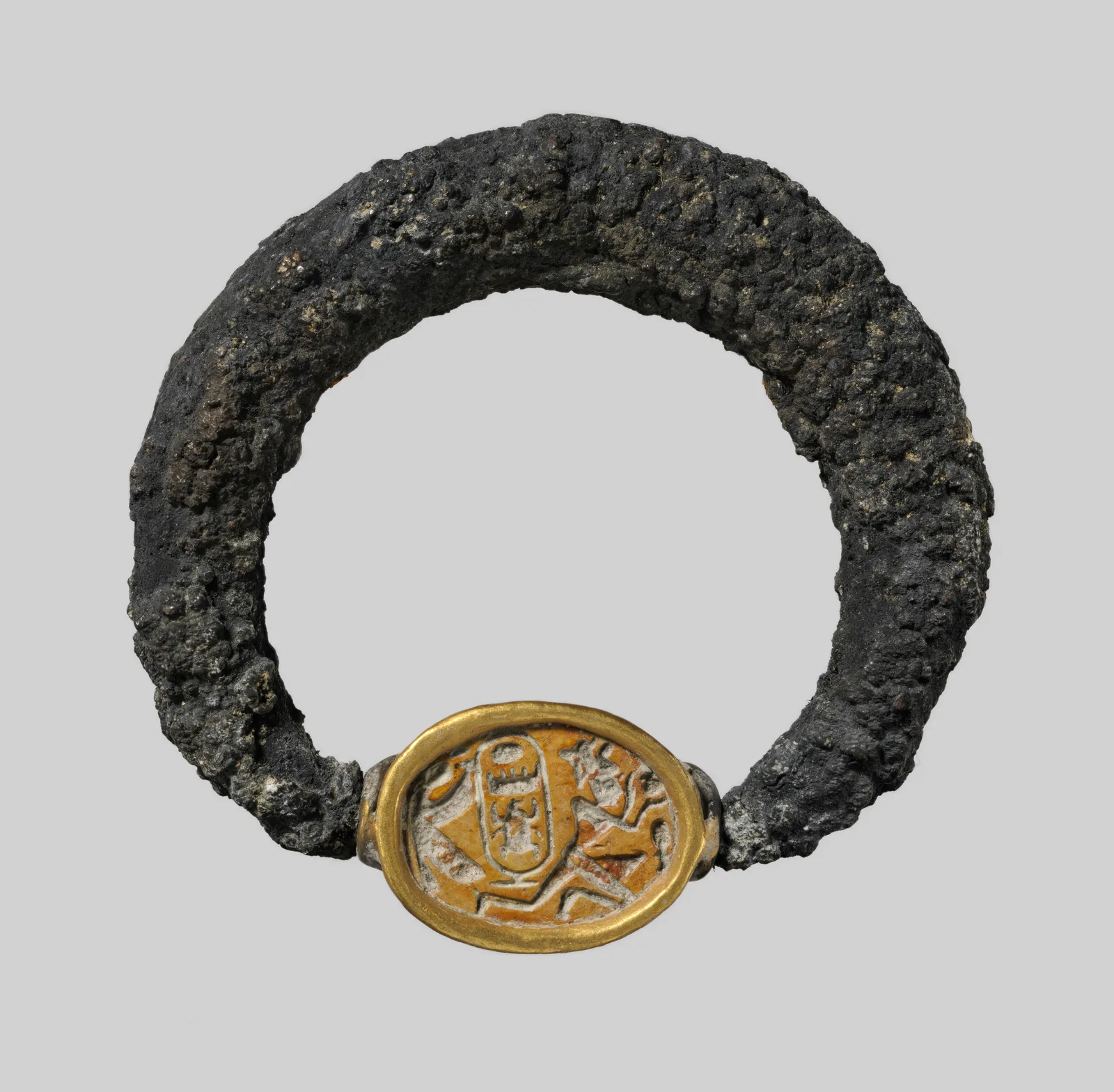
A frequent and logical pairing is the cartouche together with a scarab. The scarab beetle was for the Egyptians a symbol of rebirth and the rising sun, placed on a mummy's chest as a heart amulet. The combination is simple in meaning: the scarab handles renewal and luck, the cartouche handles protection of the name. They are worn either as a two-sided pendant or as a piece where the scarab crowns the oval from above. The result is a jewel that gathers two Egyptian protective motifs into one object.
Form and Mounting: Vertical, Horizontal, Ring
A cartouche is made vertical (the name reads top to bottom, the oval hangs like a column), horizontal (the oval lies flat, the name runs in a line), and even as a ring or a bracelet plate. The vertical is the most recognisable and convenient for a long name. The horizontal suits a short name and reads like a name plate. On a ring or bracelet the cartouche becomes a permanent personal mark that is never taken off. The choice of form is a question of the length of the name and how the piece will be worn.
CAPAORA mini knife pendant
The 18th-century Spanish navaja in miniature: 40 mm of stainless steel, a real folding mechanism and a Palanquilla lock that clicks. An affordable gift to remember.
Authentic · Ships from Spain · 14-day returns
Myths About the Cartouche and Egyptian Magic
The Myth of the "Curse" That Trails Everything Egyptian
The rumour of the "curse of the pharaohs" attached itself to Egypt after the deaths of several people involved in the opening of Tutankhamun's tomb. The newspapers of the 1920s inflated the coincidences into a mystical punishment, and the shadow fell on everything Egyptian, cartouches included. In fact the statistics confirm no abnormal number of deaths among those who worked in the tomb; many lived long lives. A cartouche with your name carries neither curse nor harm: it is an inscription, not a sarcophagus. There is nothing here to fear.
The Myth That You Cannot Wear Someone Else's Name
Sometimes people are warned that it is dangerous to wear a cartouche with an "ancient" pharaoh's name. The logic is imaginary: the names of Tutankhamun or Ramesses are simply words meaning "living image of Amun" or "born of Ra." There is no trap in them. The point is rather that your own cartouche is more meaningful: the Egyptian idea is exactly to protect your name, your part of the soul. A foreign royal name you wear as a souvenir, your own as a personal charm. There is no danger in either.
The Myth of the "Single Correct" Spelling of a Name
Sellers sometimes lean on authority: only theirs is the "real, verified" spelling, while the neighbour's is "wrong." We have already seen why this is a bluff: Egyptian writing allows for variants, the vowels are conventional, one sound is conveyed by different signs. There is no canonical cartouche for the name "Maria" or "Sergei," because those names did not exist in ancient Egypt at all. There is only a faithful approximation by sound. Anyone selling the "single correct" version is selling certainty, not truth.
The Myth That Hieroglyphs Are a Secret Code
The romance of mystery makes people think hieroglyphs hide encrypted messages. No: it is a full writing system used for keeping accounts, writing tales, curses, and love songs. Since Champollion they are read as calmly as Latin. What gives a cartouche its air of mystery is not a code but our own unfamiliarity with pictures in place of letters. A name in an oval is not a magic formula but your name, written in an ancient way, and that is its honest beauty.
The Myth That a Cartouche Is "Charged" and "Works" on Its Own
The esoteric market loves to promise that an amulet is "charged with the energy of the pyramids" and acts automatically. Here it is worth staying clear-eyed. A cartouche is not a device or a battery. Its power is exactly what culture and the owner put into it: memory, the name, the bond with a person, the sense of being protected. This is psychologically real work, but not magical work. A cartouche is worth wearing because it means something to you personally, not because it supposedly radiates something measurable.
Caring for a Cartouche
Cleaning a Gold and a Silver Oval
A gold cartouche is cleaned gently: warm water with a drop of soap, a soft brush along the recesses of the hieroglyphs, then dried thoroughly. Gold does not tarnish, so it is enough to wash off skin oil and cosmetics. A silver cartouche darkens over time, and that is fixable: a special cloth or a short bath in a silver-cleaning solution will return the shine. With silver there is a nuance: a light darkness deep in the signs looks noble and brings out the relief, so it is worth polishing only the raised parts to a mirror, leaving the "shadow" in the grooves.
Why the Brush Belongs in the Recesses of the Hieroglyphs in Particular
A cartouche is all fine relief: grooves, the outlines of birds, notches. It is in these recesses that dirt, particles of cream, and dust collect, making the signs cloudy and "clogged." Regular cleaning with a soft brush along the lines of the hieroglyphs keeps the pattern crisp and legible. Hard brushes and abrasive pastes are forbidden: they wear down the fine carving and scratch the metal. The more detailed the cartouche, the gentler the care.
Enamel and Stones: A Special Regime
If a cartouche has enamel or inlays, the regime is stricter. Enamel fears blows, swings in temperature, and aggressive chemistry: no boiled baths or silver solutions, only wiping with a damp soft cloth. Stones and faience-imitating paste are also kept away from ultrasound and hot water. Take such a cartouche off before sport, the shower, the pool, and sleep. An enamel cartouche lasts long exactly to the degree that it is worn carefully.
What to Do With the Dulled Relief of Gold
Gold does not tarnish chemically, but a relief cartouche still dulls from a film: a microscopic layer of skin oil, particles of cream and powder fill the grooves and kill the shine. If a simple soapy bath does not help, the trouble is exactly the clogged recesses. Soak the cartouche for a few minutes in warm soapy water so the film softens, then go along the lines of the hieroglyphs with a soft brush, strictly along them, not across. A final drying with a soft lint-free cloth returns the sharpness to the signs. The mirror shine of the raised edges is restored with a special gold cloth, lightly, without pressure.
Storage So the Hieroglyphs Do Not Wear Away
A cartouche with relief is stored apart from other jewellery so that chains and rings do not scratch the fine carving. A soft pouch or a separate compartment of a box is best. Silver is additionally protected from darkening by keeping it away from moisture and placing an anti-tarnish strip beside it. When you take it off at night, always put the cartouche in the same place: a named object is the most painful to lose. Careful storage is half the longevity of a piece with a fine pattern.
Send a friend a discount code, they save on their first order.
Facts About the Cartouche That Surprise
Cartouches Cover Monuments Around the World, Far Beyond Egypt
Thanks to the fashion for everything Egyptian after Napoleon's campaigns and the discovery of Tutankhamun's tomb, cartouches and Egyptian motifs spread into the architecture of the whole world. Obelisks carried off to European capitals bear real royal ovals on their sides. And imitations of them decorate facades, gravestones, and interiors in the Egyptian Revival style. So you can meet a cartouche far from the banks of the Nile: on an old bank, a cemetery monument, or above the door of a nineteenth-century mansion.
The Name in the Oval Was Sometimes Written "Backwards"
Hieroglyphs read toward the side the faces of birds and people are turned. On paired, symmetrical inscriptions, for example on either side of a doorway, craftsmen mirrored the cartouche so the signs "looked" toward the centre of the composition. So the same cartouche appears turned to the right and to the left: this is not an error but a rule of symmetry. A modern pendant is usually made in one direction, convenient for reading, but the historical "mirroring" is perfectly legitimate.
The Most Famous Face of Antiquity, and We Read Its Real Name Only Approximately
The mask of Tutankhamun, a symbol of all Egypt, bears a name we pronounce only by convention. Without written vowels, "Tutankhamun" is a reconstruction: the authentic sound is lost. The same goes for almost all the famous pharaohs. The result is a paradox: the names that cartouches guarded for the sake of eternal sound have reached us as a skeleton of consonants, while the sound we guess at. The protection of the form worked, the protection of the voice only in part.
Erasing a Name Was Worse Than Destroying a Statue
For an Egyptian, knocking a name off a monument was more terrible than smashing the figure. A statue could be replaced, but without a name the dead lost their address in eternity and were doomed to nonexistence. So the cruelest posthumous punishment was not destruction but striking from the records, scraping out the cartouche. This logic survives in us in expressions like "to strike from memory" and "to erase a name." The cartouche was a shield against exactly this kind of reprisal.
Not Every Name in an Oval Belongs to a Person
Cartouches enclosed the names of far more than earthly people. The oval was granted to certain gods, to deified kings, and even to particular sacred concepts in later eras. This only underlines that the cartouche is not a "king's sign" but a sign of the special, protected status of whoever is inside. When you wear your own name in an oval, you inherit exactly this idea, a name raised to the rank of the guarded and the important.
Frequently Asked Questions About the Name Cartouche
What Is a Cartouche in Simple Terms?
It is an oval frame with a horizontal bar at the end, inside which the ancient Egyptians wrote the name of a pharaoh. In Egyptian the oval was called shenu and meant protection and eternity: everything inside the ring is guarded. Today "cartouche" means a piece of jewellery, a pendant, where the owner's name is written in hieroglyphs inside such an oval.
Can My Name Be Translated Into Hieroglyphs Exactly?
Exactly, in the sense of "letter for letter," no, and that is normal. Egyptian writing conveys mainly consonants and implies the vowels, and it has no signs for several of our sounds. A name is written approximately, by sound, by selecting the nearest hieroglyphs. So several equally acceptable versions of one name are possible, and a "single correct" spelling does not exist.
Why Is a Cartouche Considered a Protective Charm?
Because for the Egyptians the name was part of the soul, the part called the ren. As long as the name sounds and is written, the person continues to exist. The closed shenu oval magically fenced the name off from disappearance, protecting the owner from the "second death," final oblivion. A cartouche with your name inherits this idea of the name under protection.
A Cartouche With a Pharaoh's Name or With Your Own: Which Is Better?
It depends on the aim. A pharaoh's name (Tutankhamun, Cleopatra) is a souvenir and a reference to history, with no danger in it. Your own name is more meaningful as a personal charm: all the Egyptian logic is built around protecting your own name, your own part of the soul. For a gift and for everyday wear, people usually choose their own name or that of a loved one.
What Metal Is Best to Order a Cartouche In?
Gold is closest to the historical model, does not tarnish, and lasts decades, the choice for a piece worn every day and passed down. Silver is cheaper and lets you make the cartouche large and expressive, but needs care against darkening. Enamel adds colour close to the real painted sarcophagi. What makes a cartouche a charm is the name inside, not the metal, so choose by budget and taste.
How Not to Buy a Fake or Shoddy Work in Egypt?
Check three things. The name: ask the craftsman to write it in signs and explain each sound, and check at least the first letters against a photo of the "Egyptian alphabet." The work: a handmade cartouche is assembled from separate hieroglyphs with living edges, a stamped one is flat and identical. The metal: take silver with a 925 hallmark and a stamp, gold with a clear hallmark. And do not believe the words "ancient" or "antique": the export of genuine antiquities from Egypt is forbidden.
Is There a "Curse" Connected to the Cartouche?
No. The legend of the "curse of the pharaohs" was born from newspaper sensations of the 1920s after the excavation of Tutankhamun's tomb and is not borne out by facts: those involved in the work lived, on average, ordinary, long lives. A cartouche is an inscription with a name, not a sarcophagus, and it carries no harm. You can wear it with complete peace of mind.
Who Is a Cartouche a Good Gift For?
Lovers of history and Egypt, travellers who brought home a memory of the Nile, people who already have all the usual things, and loved ones whose name you want to "ring with protection." A cartouche is made for a specific name, and no two are alike, so it works well as a personal gift: for the birth of a child, an important date, or simply as a token of care.
A cartouche turns a name into a jewel and a charm at the same time: the ancient shenu oval in which Egyptians kept the names of their kings under the protection of eternity for three thousand years. The Zevira collection holds name and symbol pendants on which you can gather your own meaning, a name, an initial, a protective sign, and wear it every day.
Buying it as a gift? Each one arrives ready to give.
 A branded Zevira box and a little card come with every order.













About Zevira
Zevira makes jewellery that carries meaning, not only shine. We tell the story of each symbol honestly: where the truth is, where the lovely legend is, and where the sales myth is. The cartouche is for us an example of how an ancient idea, to protect a name, is still alive and works not by magic but by memory and the bond with a person. If you want to wear a sign with a real story behind it, not an empty ornament, you are in the right place.