Types of Piercing Jewelry: Materials, Sizes, and What to Wear in Every Piercing
Nine out of ten problems with a fresh piercing come not from the piercing itself but from the metal that goes into it. A cheap nickel alloy brings itching, redness, and a channel that refuses to heal for months. The body can be pierced in about thirty different points, and for almost every one of them the answer to "what should I buy" starts with the metal and only then moves to the shape.
This is a buyer's guide to piercing jewelry, not to the piercings themselves. Below you will find the full picture: the types of body piercing jewelry (barbells, rings, labrets, curved bars, tunnels), which metal to choose for a fresh piercing versus a healed one, how to read a piercing size guide without getting lost, and exactly what to wear in each point, from the earlobe to the navel. Every zone gets its own paragraph: which jewelry, which metal, which size, where it goes, and how long it heals. If you want the anatomy of the piercings themselves rather than the jewelry that goes in them, there is a separate breakdown of body piercing types.
Types of Piercing Jewellery: The Main Body Piercing Jewellery Types
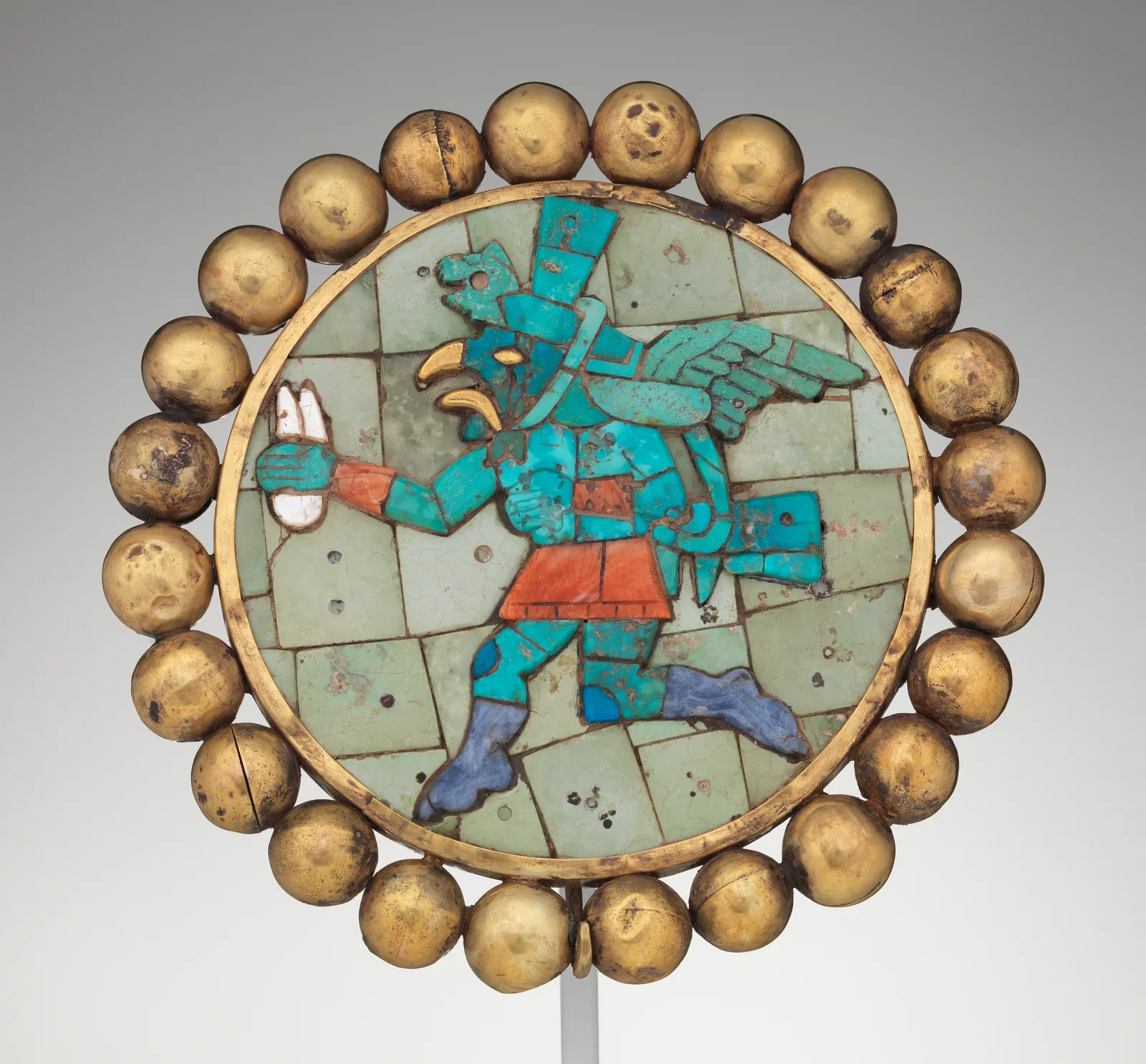
Before we talk about zones, it helps to understand the hardware itself. There are not many shapes, and each one is built for particular piercings. Once you know how a barbell differs from a banana, or a clicker from a labret, you stop buying blind.
Barbell: A Straight Bar With Two Beads
A barbell is a straight threaded bar with balls or other ends that screw onto both sides. It is the classic piece for tongue piercings, the industrial ear piercing, and some cartilage placements. One ball is usually fixed and the other removable, so you can insert and change it. Both the thickness and the length of the bar are matched strictly to the piercing: a barbell that is too long wobbles and snags, while one that is too short presses on the tissue. For a fresh piercing you take a barbell with extra length to allow for swelling, then swap it for a shorter one later.
Wear the symbol, don't just read about it. These are in stock:












Curved Barbell (Banana): For the Navel and Brow
A banana is a curved barbell, a bar bent into an arc with balls on the ends. The shape follows the natural curve of the tissue, which is why the banana is the main belly button ring for the navel (navel piercing) and a common choice for the brow. A straight barbell in the navel would press and provoke rejection, whereas a curved one sits along the anatomy of the fold. The top and bottom balls are usually different sizes: smaller below, larger above or set with a charm, stone, or crystal. For a fresh navel piercing you take a smooth titanium banana with no heavy dangles, and add decoration only after it heals.
Clicker Ring With a Hinged Latch
A clicker is a ring where part of the arc opens on a tiny hinge and snaps shut with a click, which is where the name comes from. It is easy to insert and remove, nothing unscrews, and nothing gets lost. Clickers are made for the septum, the nostril, the helix, the daith, the brow, and the lobe. They are often set with a line of small stones along the arc. This is the most practical ring for most ear and nose piercings: it holds firmly, changes in seconds, and needs no knack. For a fresh piercing a clicker works if it is made from implant grade titanium and sized correctly.
Circular Barbell (Horseshoe): An Open Ring
A circular barbell, or horseshoe, is an open ring shaped like the letter U with two removable balls on the ends. It is a versatile shape: septum, nostril, brow, helix, nipple, intimate piercings. Its main advantage for the septum is that a horseshoe is easy to hide by flipping the ends up and into the nose. The balls can be swapped for coloured ones, stone-set ones, or spikes and cones. Diameter and thickness are chosen to suit the zone. A horseshoe is simpler in construction than a clicker and often cheaper, though changing the balls is a little less convenient.
Labret Stud: A Post With a Flat Back
A labret stud is a post with a flat disc back on one side and a screw-on or push-in end on the other. It was invented for the piercing below the lip (hence the name), but the flat back turned out to be ideal almost everywhere: it does not press from the inside, does not snag, and stays comfortable during healing. A labret goes into the nostril, the helix, the tragus, the conch, lip piercings, and a fresh lobe. Many piercers consider a flat-back labret stud the best first jewellery for most face and ear piercings precisely because the back is so comfortable.
Threadless (Push-Pin): Jewellery With No Threads
Threadless, literally "no threads," is a system where the end does not screw on but slots into a hollow post thanks to the slight spring tension of a bent pin (push-pin). It holds firmly, comes out with a gentle pull, and there are no threads to strip. These pieces are prized for quick decoration changes: one post, and the tops (stones, stars, clusters) swap out like attachments. Threadless labrets are popular for the helix, the conch, the nose, and the lobe. A quality threadless system in titanium is a convenient and safe option for both a fresh and a healed piercing.
Nostril Screw and L-Shaped Stud for the Nostril
For the nostril, jewelry was designed to stay put without any clasp. A nostril screw is a stone on a post whose lower end curls into a spiral: it goes in with a slight twist and holds inside the nose on its own. Alongside it are the L-shaped stud and the straight stud with a fixed back. All of them show only a small stone or ball on the outside, with the mechanism hidden inside the nostril. For more on nose shapes, the septum, and fake jewelry, there is a full guide to septum and nose jewelry.
Tunnel and Plug for the Stretched Lobe
A tunnel and a plug are jewellery for stretched piercings, most often the earlobe. A plug is solid, while a tunnel is hollow through the middle with an opening. They go into a channel that has been stretched gradually, from a standard thickness up to centimetres. Material is critical here: for a freshly stretched channel you use something smooth and non-porous (titanium, glass, quality steel), and you save organics (wood, horn, stone) for a fully healed, soft lobe, otherwise the porous surface collects grime and irritates. Stretching is a discipline of its own: rushing it tears tissue and leaves a scar.
316L Stainless Steel, Titanium, Gold: Which Metal Is Safe
This is the key section for a buyer. Changing the shape of a piece is easy, but the metal in a fresh piercing decides whether it heals quietly or turns into months of inflammation. The rule is simple: the fresher the piercing, the cleaner the metal must be.
Implant Grade Titanium ASTM F136: The Gold Standard
Implant grade titanium of the ASTM F136 grade (the Ti-6Al-4V ELI alloy, the same one used for bone implants) is the best choice for a fresh piercing. It is biocompatible, releases no nickel into the tissue, is very light, and is tolerated even by hypersensitive skin. Titanium can be anodized into color with no coating to wear away. If a piercer puts ASTM F136 implant titanium, or the closely related ASTM F1295, into a fresh piercing, that is a sign they take healing seriously. For the properties of the metal itself, there is a full breakdown of titanium in jewelry.
Grade 23 vs Grade 5: Why Titanium Has Grades
Titanium is sold in numbered grades, and the number is not marketing. Grade 5 is the plain Ti-6Al-4V alloy used across aerospace and general engineering. Grade 23 is the same alloy with the interstitial elements, oxygen, nitrogen, carbon and iron, held to much lower limits, which is what the ELI in Ti-6Al-4V ELI stands for: Extra Low Interstitial. That cleaner chemistry is exactly what ASTM F136 specifies, and it is why Grade 23 is the material used for surgical implants that stay inside the body for years. Grade 5 is stronger in some respects and cheaper, but it is not certified for implantation.
For a fresh piercing this distinction matters. A seller who states ASTM F136 or Grade 23 is telling you the material has a recognised medical specification behind it. A seller who says only "titanium" may be selling Grade 5, Grade 2 commercially pure titanium, or an unspecified alloy, and none of those carry the same guarantee. Commercially pure titanium (Grades 1 to 4) is also nickel free and generally well tolerated, but it is softer, so threads wear and small ends deform more readily. If you are buying for a healed piercing the difference is largely academic; if you are buying to wear through a healing channel, ask for the specification and buy from someone who can give it.
316L Stainless Steel and 316LVM: When It Works and When It Does Not
Surgical 316L stainless steel jewellery, and its cleaner version 316LVM (vacuum remelted), is the familiar, strong, affordable material for body jewellery. It holds a polish and suits most people in a healed piercing. One caveat matters: steel contains nickel, bound within the alloy. Normally it barely releases at all, but for a person with a pronounced nickel allergy steel may not work, and in a fresh wound the risk is higher. Many piercers still prefer titanium for a fresh piercing and keep steel for the healed channel.
14k and 18k Gold: For a Healed Piercing Only
Gold for piercing should be of a high enough karat, at least 14k, ideally 18k, with no dubious alloying metals. Pure gold is too soft, so other metals go into the alloy, and here lies a trap: cheap low-karat gold, or white gold with nickel, irritates the skin. High-karat yellow and rose gold are usually tolerated well. The main point: gold goes into a fully healed piercing only. Gold plating in a fresh wound is a no: the thin layer rubs off against the tissue and exposes the base metal underneath.
White Gold and Rhodium: A Hidden Risk
White gold deserves its own warning, because it looks like the safest possible choice and frequently is not. Gold is yellow; to make it white it has to be alloyed with a whitening metal, and historically that metal was nickel. Nickel white gold is still made and still sold, and in a piercing channel it behaves exactly like any other nickel-bearing alloy. Palladium white gold is the alternative and is far better tolerated, but it costs more and is not always what you get unless you ask.
The second layer of the problem is rhodium plating. Almost all white gold sold at retail is rhodium plated, because rhodium is brilliantly white and the underlying alloy is usually a little grey or yellowish. Rhodium itself is inert and harmless. The difficulty is that plating is a surface, and surfaces wear. On a ring worn on a finger, rhodium lasts a year or two before it needs redoing. Inside a piercing channel, with constant movement against soft tissue, it wears through far faster, and once it does, the skin is in contact with whatever the alloy underneath happens to contain.
The practical conclusion: white gold belongs in a long-healed piercing, if at all, and it should be palladium alloyed rather than nickel alloyed. If you want the cool white look in a fresh or recently healed channel, implant titanium gives you the same colour without the chemistry problem, and it never needs replating. Under the EU nickel restriction, carried in Annex XVII of REACH and retained in Britain, items intended to be inserted into pierced parts of the body must not release nickel above a very low limit, which is the legal expression of the same advice.
Niobium: Pure and Hypoallergenic
Niobium is another metal piercers love for its purity. It is inert, contains no nickel, is tolerated well by sensitive skin, and, like titanium, anodizes into colours with an electric current. It costs more than steel and turns up less often, but for anyone whose skin reacts to virtually everything, niobium and implant titanium are the two safest choices. Niobium looks slightly darker and grayer than polished titanium, and for safety in a fresh piercing the two sit in the same league.
Anodised Titanium: Colour With No Coating
Anodised titanium is the same implant titanium given colour by a thin oxide film formed under an electric current. The gold, blue, purple, or rainbow tone comes not from paint or plating but from the thickness of the film, so the colour does not bleed off against the tissue the way gold plating does. An anodised ASTM F136 titanium piece stays safe for the skin because under the colour is the same biocompatible metal. Over time and friction the colour may dull a little, but it does not flake off in sheets like a cheap coating.
PVD Coating: Black Titanium Without Paint
Black body jewellery is usually made by physical vapour deposition, shortened to PVD. In a vacuum chamber a source material, most often titanium nitride or a carbon-based compound, is vaporized and deposited onto the piece as an extremely thin, hard, bonded layer. It is not paint and not electroplating. The layer is measured in fractions of a micron, it is chemically stable, and it bonds to the substrate rather than sitting on top of it, which is why PVD black holds up far better than any lacquer or black rhodium.
Two caveats keep it honest. First, PVD is still a coating, and any coating can eventually be breached by abrasion, so what sits underneath matters: PVD over implant titanium is a reasonable proposition, while PVD over an unmarked alloy is a gamble with a black lid on it. Second, black is the one finish where wear shows immediately, since a scuff exposes bright metal against a matte dark ground. For that reason most piercers keep black ends for healed piercings and for pieces that do not sit against a moving surface.
Anodised colour and PVD are often confused because both produce colour without paint. The difference is worth holding onto: anodising grows an oxide film out of the metal itself and can be stripped and redone, while PVD adds a new material on top. Anodising cannot produce black on titanium; only PVD can. If a seller offers black anodised titanium, that is a description that does not exist.
What to Avoid: Nickel, Brass, and Unmarked "Medical Steel"
In a fresh piercing, and in any channel prone to inflammation, there is no place for cheap costume jewelry, brass, nickel silver, or sterling silver. Silver oxidizes in a wound and leaves a dark stain (argyria), while brass and nickel silver contain copper and nickel and often cause irritation. A separate trap is the label "medical steel" or "surgical alloy" with no grade stated: anything can hide behind it. Look for a specific marking (ASTM F136, 316L, 316LVM) and a seller who names it. Nickel is the cause of most reactions, and there is a dedicated piece on the mechanism of nickel allergy in jewelry.
Implant-grade ASTM F136 titanium and 316L surgical steel: barbells, clickers, labrets, septum rings, belly pieces. Want to be first to know at launch?
To keep every metal in view at once, the comparison table below shows what is safe for a fresh piercing, what is hypoallergenic, and what to save for a healed channel and special cases.
Customer reviews
Zevira is a real jewellery shop. Genuine payments, deliveries and customer thank-yous.
🥰🥰🥰 gracias

Ok, ¡gracias! 🙂

Titanium in a fresh piercing, gold later. Rushing into gold is not boldness, it is inflammation.
How to style your piercing jewellery
The medical side is covered, so now for the styling. I have gathered here what actually works when a piercing stops being just a hole and becomes part of a look.
How do you match the metal to your skin tone? For a warm undertone (skin with a golden, peachy cast) I recommend warm gold on a healed piercing, since it lights the skin up. For a cool undertone (pinkish, porcelain) I suggest silvery titanium or steel, which do not fight the skin. If you are unsure, titanium is universal: cool but neutral, and it suits almost everyone. On a fresh piercing the choice is settled in any case, implant titanium, so save the games with metal colour for later.
Minimal or a bold piercing? For a quiet look I choose a flat labret or a tiny ball sitting flush with the skin: it reads as a detail, not a statement. For character I go with a stone-set clicker, coloured anodised titanium, or a larger shape. The rule is simple: a bold piece works when it is the only one in a zone. Five loud points in a row are not courage, they are visual noise.
How do you build an ear stack? When I build a client's ear stack, I keep one accent and small pieces around it. A large clicker on the helix plus two or three tiny labrets on the lobe and tragus read as a deliberate line. Mixing metals is fine, but then keep one dominant tone and let the second be an accent. And give each piercing its own height, so the pieces do not climb over one another.
Does a piercing fit a work dress code? It does, if you play it down. For a strict dress code I recommend titanium or steel in a nude or silvery tone, flat labrets, minimal shine. One tidy lobe or helix piercing reads as polish, not rebellion. Save the large rings and coloured titanium for freer settings.
One piercing or a composition? For anyone who likes restraint, I suggest one expressive piercing and the best piece of jewellery you can afford. For anyone who builds a look in layers, a composition works, but a built one, not a random one. Two rules that never let me down. First: the metal in a fresh piercing is chosen for safety, not for looks. Second: one strong accent is always more honest than a scatter of small pieces with no idea behind it.

Turn on your camera, pick earrings, a pendant or a ring, and see the piece on yourself in real time.
Switch items in one tap.
Everything runs in your browser: no photo or video is ever uploaded.
Allergy and Safety: Nickel, Reaction, Infection
Metal is chosen not out of snobbery but because skin knows how to answer an unsuitable alloy. Let us look at how allergy shows up, how it differs from infection, and what to do about it.
How a Nickel Allergy Shows Up
Nickel allergy is the most common contact allergy to metal. In a piercing it looks like persistent redness around the channel, itching, dryness, and flaking skin, sometimes a piercing that weeps and stubbornly refuses to heal for weeks or months. The classic sign: the inflammation sits right around the jewellery and settles down once you swap the metal for pure titanium. If your skin has ever reacted to cheap costume jewellery, jeans studs, or belt buckles, take nickel in a piercing seriously and go straight to implant titanium or niobium.
Allergy or Infection: How to Tell Them Apart
Allergy and infection are easy to confuse, yet they are treated very differently. Allergy is itching, dryness, and redness around the outline of the jewellery, often symmetrical, with no severe pain or pus, dragging on sluggishly and easing when the metal changes. Infection is mounting pain, swelling, heat around the piercing, yellowish or greenish discharge with an odour, and sometimes a general feeling of being unwell. Infection is a reason to see a doctor, not to change the metal. The simple rule: itching and dryness point more often to the metal, while pain and pus point more often to infection. Self-treatment is a poor idea in either case, especially if things get worse.
How to Test a Metal for Nickel
You do not have to take a seller's word for it. Dimethylglyoxime spot test kits, usually sold in Britain as nickel test kits through pharmacies and online, cost very little and take about a minute. A drop of the reagent and a drop of ammonia solution go onto a cotton bud, the bud is rubbed against the metal, and if free nickel is being released the bud turns pink. No colour change means no detectable release at the threshold the test is designed for. It is the same method the enforcement authorities use as a screening tool for the nickel restriction, which is a decent endorsement for a kit that fits in a drawer.
The test has limits worth knowing. It detects nickel that is available at the surface, not nickel bound in the bulk of an alloy, so a piece of 316L steel will usually pass even though nickel is present in the alloy. It also cannot see through plating: a nickel-bearing base under intact gold or rhodium will read clean until the plating wears. And it does not work as an allergy diagnosis; only a dermatologist with a patch test can tell you what your skin actually reacts to.
Where the kit earns its keep is on unlabelled and second-hand pieces, on cheap ends bought without a specification, and on the clasps and posts of costume jewellery that live near a healing piercing. Test once, label the piece, and you never have to wonder again.
What to Do If You React
First, do not remove the jewellery from a piercing that is angry. Taking the bar out of an inflamed channel can close the surface over trapped fluid, and an abscess is a far worse problem than the irritation you started with. The exception is a piece you already know is the wrong metal, and even then the correct move is to replace it rather than to leave the channel empty.
The sequence that works: swap the piece for implant titanium or niobium, keep it clean with sterile saline twice a day, stop using anything harsher (no surgical spirit, no tea tree oil, no antibacterial handwash on the site), and give it two weeks. Contact irritation from metal usually settles noticeably within that window once the offending alloy is gone. If your piercer is willing to do the change for you, let them; a clean swap on a sore channel is harder than it looks with wet fingers and a small mirror.
Escalate rather than persist if the picture changes. Spreading redness, increasing pain, heat, thick discharge, a fever, or a red streak running away from the site are signs of infection, and infection needs a GP or a walk-in centre rather than another change of metal. Likewise, if a reaction to what you believed was titanium keeps recurring, the metal is very probably not what it was sold as, and the piece should go in the bin rather than back in your ear.
Upload a photo of your pet, someone you love, or an object. We'll build a 3D model and hand-cast it in pewter.




Piercing Size Guide: Gauge, Diameter, and Length
Even the perfect metal will not save you if the size is off. Piercing jewellery has three key measurements: the thickness of the bar, the diameter (on rings), and the length (on barbells and labrets). The thickness is set by the piercer at the moment of piercing, and you should not change it yourself.
Bar Thickness (Gauge)
Thickness is measured in millimetres and, in the English-speaking system, in gauges (gauge, shortened to G): the higher the gauge number, the thinner the bar. Typical piercing gauge sizes: lobe and nose around 0.8 to 1.0 mm (18 to 20G), ear cartilage, brow, lip, and navel more often 1.2 to 1.6 mm (14 to 16G), tongue and nipple usually 1.6 mm (14G). When you buy new jewellery to replace the old, match the thickness to what is in place now, down to a tenth of a millimetre: thinner will wobble, thicker will not fit without stretching and pain.
Ring and Horseshoe Diameter
Diameter is the size of a ring, clicker, or horseshoe across, in millimetres, measured by the inner opening. For the nostril it is usually 6 to 8 mm, for the septum the range is wider (8 to 10 mm and more if you want to flip and hide it), for the helix and daith 6 to 10 mm. A ring that is too small presses and digs in, one that is too large sticks out and catches on clothing and hair. If in doubt, check the diameter with the piercer who did the work, or try a fake ring of a similar size.
Bar Length on a Barbell, Banana, and Labret
On a straight barbell, a banana, and a labret, what matters is not the diameter but the length of the bar. It should match the thickness of the pierced tissue plus a little extra for swelling in the first weeks. A bar that is too long moves and snags, while one that is too short presses on the tissue from both sides and hinders healing. That is why a fresh piercing gets jewellery with extra length, and once the swelling drops (usually after a few weeks) you swap it for something shorter and neater. For the tongue this extra is especially important: it swells a great deal.
Ball and End Size
The ends have a size too, usually 3 to 5 mm across. A ball that is too large overbalances and drags the jewellery, while one that is too small can slip through a stretched channel. The threading on balls comes as external (threads on the bar) or internal (threads in the ball, with a smooth bar). Internal threading is safer for a fresh piercing: the smooth bar passes through the channel without scraping the walls with threads. Threadless systems have no threads at all, which is gentler still on the tissue.




Body Piercing Jewellery by Zone: What to Wear in Each Piercing
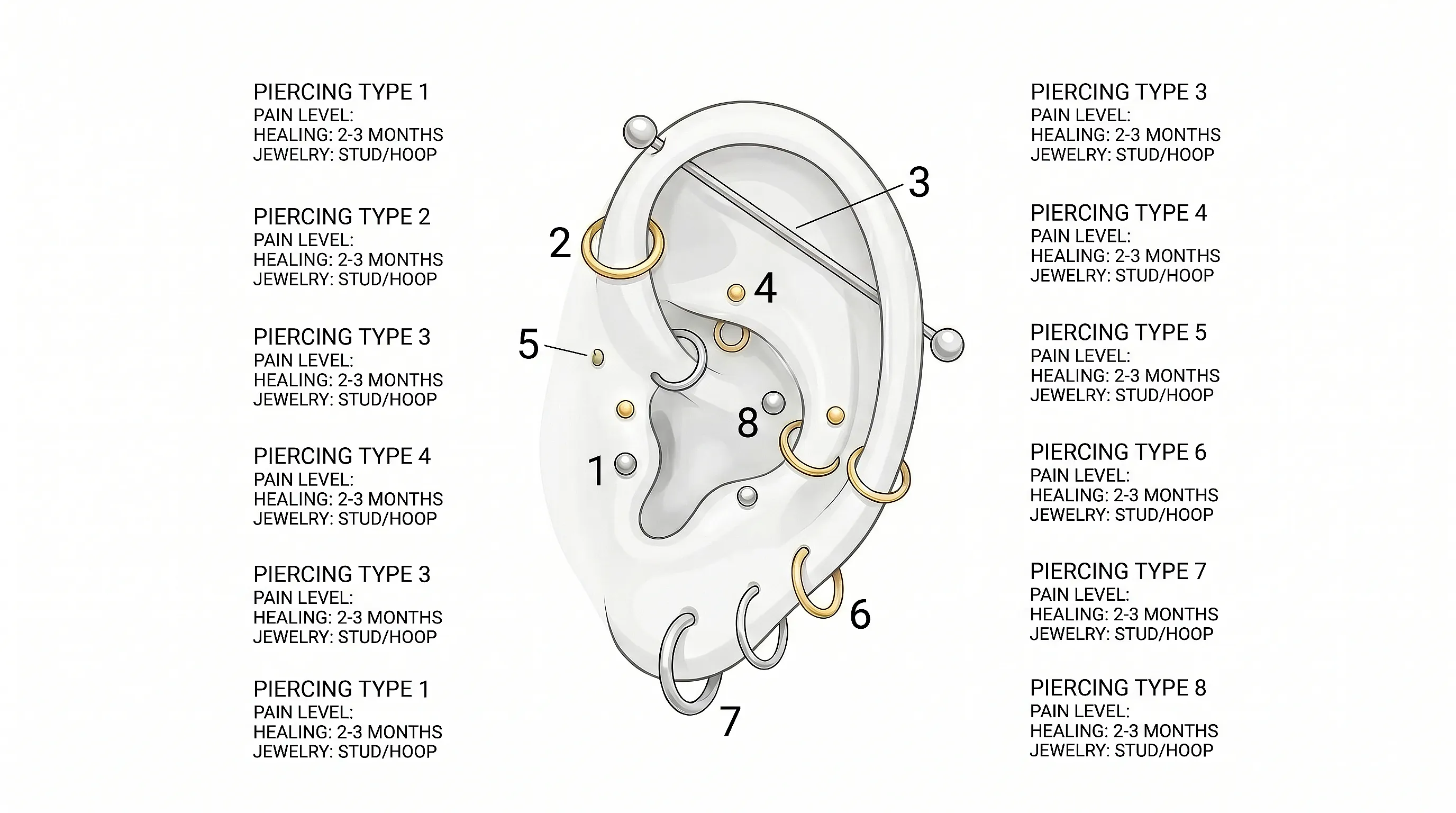
This is the most practical section. Below, for each piercing: which jewelry, which metal and size, whether and where it goes, how long it heals, and what to wear it with. Ear piercings come first because there are the most of them. If you want a detailed map of the ear points specifically, there is a breakdown of ear piercing types.
Earlobe (Lobe)
The lobe is the simplest and quickest piercing, soft tissue with no cartilage. Jewellery for a lobe piercing is a labret stud, a small clicker, or a thin ring. The lobe heals fast, usually in 6 to 8 weeks, because it has a rich blood supply. For a fresh piercing you take implant titanium or 316L steel, thickness 0.8 to 1.0 mm. Once the lobe has healed you can wear 14k to 18k gold and any design you like. The lobe holds several piercings in a row, and it is a comfortable place to begin your acquaintance with piercing.
Helix: The Upper Ear Rim
The helix is a piercing along the upper curl of the ear cartilage. Helix jewellery is a flat-back labret stud, a clicker, or a small horseshoe, thickness usually 1.2 mm (16G), ring diameter 6 to 8 mm. Cartilage is fussier than the lobe: it heals longer, on average 3 to 6 months and more, and is prone to bumps and keloids with poor metal or trauma. So for a fresh helix you take only ASTM F136 implant titanium, no steel of questionable grade. A labret is more comfortable than a ring during healing, and the ring goes in once the piercing has matured.
Tragus: The Nub in Front of the Ear Canal
The tragus is a piercing of the small cartilage nub in front of the ear canal. Because the spot is tight, the ideal jewellery is a short flat-back labret stud with a small top (stone, ball, star), thickness 1.2 mm. A ring is worn in the tragus too, but only after healing, since a fresh piercing is more comfortable with a labret. The tragus heals slowly, 3 to 6 months, and dislikes being knocked by headphones and phones. Metal should be pure titanium only, as the spot is tight and prone to irritation.
Conch: The Bowl of the Ear
The conch is a piercing of the wide cartilage bowl of the ear, closer to the centre of the shell. The name comes from "conch," a shell. Depending on the point you wear either a labret with a top or a large clicker ring that wraps the edge of the ear (outer conch). Thickness is 1.2 to 1.6 mm. The conch heals slowly, from 3 months to a year, since the cartilage there is dense. For a fresh piercing a labret in implant titanium is more comfortable, and the ring goes in later. The conch looks good in a composition with the helix and lobe, but it is better to build a "constellation" of piercings one at a time, letting each heal.
Daith: The Inner Cartilage Fold
The daith is a piercing of the inner cartilage fold at the entrance to the ear canal. Because of the curve, almost only a ring goes there: a clicker or horseshoe, diameter 8 to 10 mm, thickness 1.2 to 1.6 mm. The daith is often chosen for the look of a ring that sits handsomely deep in the ear. It heals in 3 to 6 months and longer. Metal for a fresh piercing should be implant titanium only. The daith is credited with easing migraines, but there is no serious evidence for that, and you should not get the piercing as a treatment: it is jewellery, not medicine.
Rook: The Ridge Above the Daith
The rook sits in the fold of the antihelix, the ridge of cartilage running above the daith. The tissue there is thick and doubled over, which makes it one of the more demanding ear piercings both to perform and to heal. Jewellery is a curved barbell, thickness 1.2 to 1.6 mm, length 8 to 10 mm at first to allow for swelling, with a smaller ball on the visible end so it does not push against the ridge. Rings are possible in a settled rook but rarely comfortable at the start, since a ring works the channel every time the ear brushes a pillow. Healing runs 6 to 12 months, and honest piercers quote the longer figure. Implant titanium only in a fresh rook, and expect a downsize appointment at around six to eight weeks.
Snug: Along the Antihelix
The snug, sometimes called the anti-helix piercing, runs horizontally through the inner ridge of the ear, roughly level with the middle of the ear. It is anatomy dependent in a way most piercings are not: if your antihelix does not project enough, a competent piercer will decline to do it rather than place a piercing that will reject. Jewellery is a small curved barbell or a tight clicker ring, thickness 1.2 mm, diameter 6 to 8 mm, and the fit has to be close because a long bar catches on everything. Healing is slow, 6 to 12 months, and the snug has a reputation for irritation bumps that take patience rather than intervention. Titanium only, and no ring changes until the channel is genuinely settled.
Antitragus: The Ridge Opposite the Tragus
The antitragus is the small ridge of cartilage opposite the tragus, just above the earlobe. Like the snug, it depends on having enough cartilage to work with, and a shallow antitragus is a reason to choose a different placement. Jewellery is a curved barbell or a small clicker, thickness 1.2 mm, diameter 6 to 8 mm. Because the site sits where headphones, glasses arms and phone cases all make contact, it is worth thinking about daily habits before booking: over-ear headphones and a fresh antitragus are an unhappy combination for the first few months. Healing takes 6 to 12 months. Implant titanium, a flat back or a small ball, and no sleeping on that side for longer than you would like.
Industrial Piercing
An industrial is two cartilage piercings joined by a single long straight barbell (usually the upper helix and the opposite edge). The jewellery is a straight barbell 32 to 38 mm long, thickness 1.6 mm (14G), in implant titanium. It is one of the most demanding piercings: two points heal at once, joined by a rigid bar, so the tendency toward irritation and bumps is higher. Healing is long, from 6 months to a year. Metal is critical: pure titanium only, no compromises, and the barbell should have extra length for swelling.
Nostril: The Wing of the Nose
The nostril is a piercing of the wing of the nose, the most recognisable nose piercing. Jewellery is a nostril screw, an L-shaped stud, a labret, or a small clicker ring, thickness 0.8 to 1.0 mm, ring diameter 6 to 8 mm. The wing heals in 2 to 4 months, as the tissue has a good blood supply. For a fresh piercing you take implant titanium or 316L steel, and a flat-back labret is the most comfortable during healing. Once healed, gold and thin rings are fine. The wing hides easily: a screw shows only a tiny stone on the outside.
Septum: The Nasal Divider
The septum is a piercing of the soft strip at the base of the divider, the so-called sweet spot, rather than the cartilage. Jewelry is a circular horseshoe or a clicker, diameter 8 to 10 mm, thickness 1.2 to 1.6 mm. The main advantage: a horseshoe is easy to hide by flipping the ends up into the nose, so the septum works with a strict dress code. It heals in 2 to 4 months. Metal for a fresh piercing should be implant titanium only, as the spot is sensitive. For shapes, fake jewelry, and how to hide a septum, there is detail in the nose jewelry guide.
Septril: The Complex Piercing at the Nose Tip
The septril is the most technically demanding piercing in the nose and is not a starting point. It only becomes possible once a septum has been stretched, usually to 4 mm or larger, because the septril passes from the underside of the nose tip upward into the existing stretched septum channel. In effect it is a piercing that exits through another piercing, which is why a piercer will want to see a well healed and adequately stretched septum before discussing it at all.
Jewellery is typically a short labret with a flat back seated in the septum channel and a small disc or gem sitting at the tip of the nose, thickness matched to the stretched channel. Length has to be exact, since a septril bar that is too long moves inside the nose and one that is too short buries the disc. Healing is slow and highly individual, and the site is unforgiving of knocks. Implant titanium only, threadless or internally threaded, and a piercer with genuine experience of the placement rather than a first attempt.
Bridge: The Piercing Across the Nose Root
The bridge is a horizontal surface piercing of the skin fold between the brows, at the root of the nose. Jewellery is a straight or slightly curved barbell with balls on the ends, thickness 1.2 to 1.6 mm. The bridge is temperamental: the needle passes under the skin, not through the nose, and surface piercings tend to migrate and reject because the skin there is thin and mobile. It heals longer and does not suit everyone, with much depending on the anatomy of the nose root. Metal should be implant titanium only, and expectations should be realistic: the body pushes some bridges out over time.
Brow (Eyebrow)
The brow is a vertical surface piercing through the edge of the eyebrow. Jewellery is a curved banana barbell or a small horseshoe with balls, thickness 1.2 to 1.6 mm, diameter 8 to 10 mm. Like the bridge, the brow is a surface piercing prone to migration, so the curved shape is preferable to the straight one: it presses less on the tissue and rejects less often. It heals in 2 to 4 months. Metal is implant titanium. Balls can be swapped for stones and spikes once healed, and a fresh piercing is worn with smooth titanium ends.
Labret: The Piercing Below the Lip
The labret (as a piercing, not the jewellery shape discussed above) is a point in the centre below the lower lip. The jewellery is precisely a flat-back labret stud: the disc lies against the inner mucosa and does not damage the gums and teeth the way a ring would. Thickness is 1.2 to 1.6 mm, length with extra for swelling, as the lips swell noticeably. It heals in 2 to 3 months. Metal should be implant titanium only, since jewellery in the mouth is in constant contact with the mucosa. A flat back and a smooth inner part here are not a luxury but protection for the teeth and gums.
Medusa and Philtrum: Above the Upper Lip
The Medusa, also called the philtrum, is a piercing in the centre of the groove above the upper lip, beneath the nose. Jewellery is a labret with a flat back inside and a decorative top (stone or ball) outside, thickness 1.2 to 1.6 mm. It heals in 2 to 3 months. Metal is implant titanium, as for all oral piercings. The Medusa echoes a labret piercing below nicely, but two symmetrical piercings (above and below) heal in turn, not at once. The inner part should be smooth and flat to protect the teeth.
Monroe and Madonna: Above the Lip to the Side
The Monroe (left) and Madonna (right) are piercings above the upper lip to the side, imitating a beauty mark. Jewellery is a short labret with a small stone top, thickness 1.2 mm. It heals in 2 to 3 months. Metal is implant titanium. As with all lip piercings, a flat smooth back inside is critical: the point sits close to the gums and teeth, and a rough end grinds the enamel and provokes gum recession over time. The outer top is kept small so it does not catch during eating and speaking.
Tongue
The tongue is a piercing along the central line. Jewellery is a straight barbell, thickness 1.6 mm (14G), with plenty of extra length: the tongue swells a great deal, so the first barbell goes in long, and after 2 to 4 weeks you swap it for a shorter one. Metal should be implant titanium only, in constant contact with the mucosa and teeth. It heals in 4 to 6 weeks. Important: once the swelling drops, a barbell that is too long taps against the teeth and enamel, so the switch to a short one is mandatory. The lower balls are kept not too large so they do not injure the floor of the mouth.
Snake Eyes and Other Tongue Placements
Beyond the standard central barbell there is a family of tongue placements, and they are not equally sensible. Snake eyes is a single horizontal barbell through the tip of the tongue, with a ball showing on each side, and it is the one most piercers now decline. The bar binds the two muscular halves of the tongue together, which restricts movement and can affect speech, and the balls sit exactly where they rub the gum line behind the lower front teeth. Gum recession and enamel damage are common enough that the placement has moved from fashionable to discouraged within the profession.
Venom bites, a pair of barbells set either side of the central line, avoid the muscle-binding problem but double the swelling and double the hardware in contact with the teeth. A horizontal tongue piercing through the flat of the tongue and a tongue web piercing through the frenulum underneath are further variations, each with its own healing pattern and its own way of failing. The frenulum piercing in particular has a short life expectancy, since the tissue is thin and tears readily.
If you want a tongue piercing that will still be there in five years, the plain central barbell in 1.6 mm implant titanium remains the sensible choice, with a firm downsize once the swelling settles and PTFE or a soft-ended bar considered if enamel wear becomes an issue. Whatever the placement, ask your dentist to look at the gum line at your regular check-up; they will notice recession long before you do.
Navel (Belly Button)
The navel is the most popular body piercing. Jewellery is a banana, a curved barbell, thickness 1.6 mm (14G), with a small ball below and a large or decorative one above. A straight barbell does not go in the navel, as it presses. The navel heals slowly, 6 to 12 months, because the fold moves constantly with bending and rubbing against clothing. For a fresh piercing use only a smooth implant-titanium banana with no heavy dangles, and hang decoration after healing. If you want belly button gold jewellery, it goes in only once the piercing is fully healed. The navel dislikes tight waistbands and rough seams while it heals.
Nipples
A nipple piercing goes through the base of the nipple. Jewellery is a straight barbell or a horseshoe ring, thickness 1.6 mm (14G), diameter to suit the anatomy. It heals slowly and temperamentally, 6 to 12 months, as the zone is delicate and prone to irritation. Metal should be implant titanium only. The first barbell is taken with extra length for swelling. Among nipple piercing types, a straight barbell is the most common starter, while a ring usually goes into a healed piercing, since a fresh one is more comfortable with a barbell. A symmetrical pair is pierced at the same time so they match in height. Nipples dislike friction from rough fabric and unsupported sport during healing.
Intimate Piercings
Intimate piercings are a large group of their own, and the jewellery depends on the specific point: most often horseshoe rings, clickers, and curved barbells, thickness 1.6 mm and up, in implant titanium. The general rule is the same as everywhere: pure biocompatible metal, size strictly to the anatomy, extra for swelling, an experienced piercer. Healing varies widely by point, from a few weeks to half a year. This is a zone where doing it yourself is especially out of place: both the piercing and the jewellery choice are handled only by a specialist in the field.
Surface Piercings and Microdermals
A surface piercing is a shallow piercing on flat skin (neck, collarbone, decolletage, lower back) where there is no natural rise of tissue. It is held by a special curved surface bar (staple) or by a microdermal anchor, which is implanted as a single plate under the skin, with only the threading for a changeable top coming out. Thickness is usually 1.2 to 1.6 mm, and metal is implant titanium only. Surface piercings and microdermals tend to reject and migrate more than any others, heal slowly, and demand care. You change the top, but you leave the anchor itself alone.
Leave your email, we'll send your discount code. No spam, unsubscribe anytime.
The code arrives by email, valid on your first order.
First Jewellery or a Replacement: The Difference Is Fundamental
The same piercing at different stages needs different jewellery. A fresh channel and a healed one are two separate situations, and mixing them up is costly.
A Fresh Piercing: Only Implant Titanium and Extra Length
A fresh piercing gets the cleanest and most comfortable option: implant titanium ASTM F136 (or niobium), a smooth bar with internal threading or a threadless system, a labret or banana to suit the zone, with extra length for swelling. No gold, silver, coatings, dangling stones, heavy decoration, or dubious steel. The job of the first jewellery is not to decorate but to let the channel heal without irritation. That is why the first jewellery is always smooth, light, biocompatible, and correctly sized, rather than the prettiest.
A Healed Piercing: Gold, Design, and Rings Are Fine
Once a piercing is fully healed (not merely when it looks healed on the surface), the whole range opens up. You can wear 14k to 18k gold, designer tops, stones, rings instead of labrets, coloured anodised titanium, and threadless ends to match your mood. Here the metal is chosen by aesthetics and skin tone: warm gold for a warm undertone, silvery titanium and steel for a cool one. You can change jewellery in a healed channel freely, keeping your hands and the piece clean. The first change of a fresh piercing, though, is best left to a piercer.
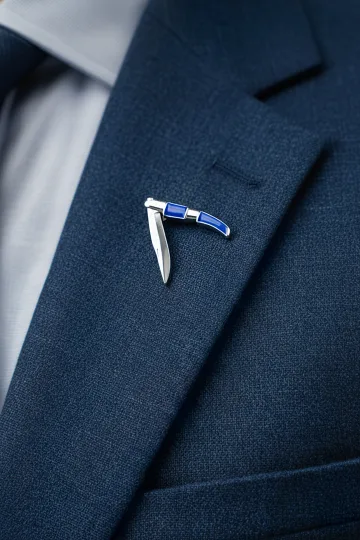
CAPAORA mini knife pendant
The 18th-century Spanish navaja in miniature: 40 mm of stainless steel, a real folding mechanism and a Palanquilla lock that clicks. An affordable gift to remember.
Authentic · Ships from Spain · 14-day returns
Aftercare and Healing: The Essentials
Jewellery and care are connected: even perfect titanium will not save a piercing if you traumatize it and fail to rinse it. Below are the basics, with details always taken from the piercer who did the work.
What to Clean a Fresh Piercing With
A fresh piercing is rinsed with a mild saline solution: sterile saline or a pharmacy piercing spray, a couple of times a day, with clean hands, gently clearing away crusts. Aggressive products (alcohol, peroxide, iodine, chlorhexidine on a permanent basis) are wrong for a fresh piercing: they dry and irritate the tissue and slow healing. Twisting the jewellery "so it does not stick" is not needed: that is an outdated, harmful piece of advice, since rotation traumatizes the channel. The exact routine is given at the studio where the piercing was done.
Healing Times by Zone
Times vary widely. The lobe heals fastest, 6 to 8 weeks. The nostril and septum, 2 to 4 months. The tongue, 4 to 6 weeks, but with a mandatory switch from a long barbell to a short one. Lip piercings, 2 to 3 months. Ear cartilage (helix, tragus, conch, daith, industrial) is slow, from 3 months to a year. Navel and nipples, 6 to 12 months. Surface piercings and microdermals are temperamental and unpredictable. A piercing looks ready on the outside before the channel has formed inside, so there is no rush to change the first jewellery.
Downsizing: Swapping to a Shorter Piece
Downsizing is the step most people have never heard of and the one that quietly decides how a piercing ends up looking. A fresh piercing is fitted with a deliberately long bar so that swelling has somewhere to go. Once the swelling subsides, usually somewhere between two and eight weeks depending on the site, that extra length becomes a liability: the bar rocks in the channel, snags on hair and clothing, and levers the entrance of the piercing every time it moves. Movement is precisely what stops a channel from settling.
Timing varies by zone. A tongue barbell is downsized at two to four weeks, and this one is not optional, since a long bar taps against the back of the front teeth. A navel banana is typically downsized at six to eight weeks. Cartilage piercings, helix, rook, conch, are usually downsized at six to twelve weeks even though full healing takes far longer. A lobe rarely needs it at all.
Book the downsize with the piercer who did the work rather than doing it yourself. They will judge the correct length by eye against the settled tissue, and the change is quick, clean and inexpensive, often included in the original price at a good UK studio. Skipping it is the single most common reason a piercing that was placed perfectly ends up sitting at an angle a year later.
Bumps by the Piercing: Granuloma and Keloid
A lump beside a healing piercing causes more panic than it deserves, and the first thing to establish is which lump it is. By far the most common is a simple irritation bump: a soft, pinkish swelling right at the entrance of the channel, appearing after a knock, a snag, a bar that is too long, or a change of jewellery too early. It is a mechanical problem with a mechanical solution. Remove the cause, downsize if the bar is long, leave it alone otherwise, and it usually shrinks over weeks.
A hypertrophic scar or pyogenic granuloma is firmer, redder and may weep a little. It stays within the boundary of the piercing and it responds, slowly, to removing irritation and to saline compresses. Some settle over months. A keloid is a different thing altogether: it grows beyond the original wound, keeps growing, is firm and rubbery, and is more common in people with a family history and in darker skin tones. Keloids do not resolve on their own and are treated medically, usually with steroid injections, so a lump that keeps expanding is a reason to see a GP or a dermatologist rather than a reason to buy another cleaning product.
What not to do, in any of the three cases: do not squeeze, do not apply tea tree oil, aspirin paste, or the various remedies that circulate online, do not remove the jewellery from an inflamed piercing, and do not add more cleaning. Over-cleaning causes as many bumps as under-cleaning. Sterile saline twice a day, no other products, no fiddling, and patience measured in months rather than days.
Facts That Surprise
Tongue Swelling Calls for "Two Barbells" in a Row
The first barbell in the tongue goes in deliberately long, with a centimetre of extra room, because the tongue swells so much that a short bar would simply dig into the swollen tissue. After 2 to 4 weeks, once the swelling has dropped, the barbell must be swapped for a short one, otherwise the long bar starts tapping the teeth and grinds the enamel for years. In effect, one tongue piercing means two different pieces of jewellery: one for the first month and one for afterward.
Titanium Colour Is Physics, Not Paint
Anodised titanium changes colour not from a dye but from the thickness of the transparent oxide film formed by an electric current. Light refracts in that film, and the eye sees a gold, blue, or purple tone, the same effect that makes an oil film on a puddle iridescent. There is nothing to paint, so the colour does not flake off in sheets, and one titanium piece can be shifted from blue to purple simply by changing the voltage.
A Microdermal Holds by an "Anchor" Under the Skin
Where there is no natural rise of tissue, jewellery is held by a microdermal: a tiny plate anchor with holes, implanted under the skin, with only the threading for a changeable top coming out. Skin grows through the holes in the plate and fixes it. This is closer to a small implant than to a classic piercing, which is exactly why microdermals are placed and removed only by a piercer.
The Septum "Sweet Spot" Is Soft, Even Though the Divider Is Hard
The nasal divider feels hard to the touch, and it seems as if the septum is pierced through cartilage. In fact, right at the base there is a thin soft strip of tissue, the sweet spot, between the stiff cartilage and the lower edge. When the needle hits it, the piercing is almost painless, though it looks alarming. The septum's reputation as a very painful piercing rests precisely on people imagining a needle in cartilage.
Stretching the Lobe Is a Marathon, Not a Sprint
You can stretch a lobe up to a tunnel only slowly, step by step, increasing the thickness by fractions of a millimetre and giving the tissue weeks to adapt. Trying to skip a size tears the tissue, leaves a scar, and causes a "blowout," a rim turned inside out that cannot be fixed without a surgeon. Experienced stretchers take years. This is a rare case in piercing where patience matters more than either boldness or money.
An Industrial Is Two Piercings on One Barbell
An industrial looks like a single piece of jewellery, but it is two separate cartilage wounds rigidly joined by a straight barbell. Each heals on its own, while the shared bar keeps them from moving independently, which is why the industrial is considered one of the most demanding piercings for metal and care. Any compromise on the purity of the titanium hits both points at once.
The Gauge System Came From Wire Drawing
The gauge numbers that run backwards, where a bigger number means a thinner bar, look arbitrary until you know where they came from. They are inherited from wire drawing. Wire is made by pulling a rod through a series of progressively smaller holes in a draw plate, and the gauge number originally recorded how many times the wire had been pulled through. Three passes gave 3 gauge, eighteen passes gave 18 gauge, and naturally the more times the wire had been drawn, the thinner it was. The scale counts operations, not thickness, which is why it runs the wrong way.
Britain had its own version of this, the Standard Wire Gauge, fixed by an Order in Council in 1884 and used across British engineering for a century. Body piercing inherited the American Brown and Sharpe scale instead, so the two sets of numbers do not match, and this is one more reason to buy by millimetres wherever a seller offers them. A 14G bar is 1.6 mm, a 16G is 1.2 mm, an 18G is 1.0 mm, and a millimetre figure never needs translating.
Pierced Ears Are Older Than the Pyramids
The oldest known pierced ears belong to the man found frozen in the Ötztal Alps in 1991, who died around 3300 BC. His earlobes were pierced and stretched to somewhere between 7 and 11 mm, which means lobe stretching predates the Great Pyramid of Giza by roughly eight centuries. Ear ornaments recovered from the Royal Cemetery at Ur are of comparable antiquity, and gold earrings from Sumerian and early Egyptian burials sit in museum cases across Europe, the British Museum among them.
The point worth taking from this is that piercing is not a modern subculture invented in the twentieth century. It is one of the oldest continuous body practices for which we have physical evidence, appearing independently in Europe, the Near East, Africa, South Asia, and the Americas. What has changed is the metallurgy: the people who first stretched their lobes had gold, copper, bone, wood, and stone, and every one of those materials is still in use somewhere today.
Niobium Is Named After the Daughter of Tantalus
Niobium and tantalum sit beside each other in the periodic table, behave almost identically in chemistry, and were confused with one another for decades. Tantalum was identified first and named after Tantalus, the figure from Greek myth condemned to stand in water he could not drink. When the second element was finally distinguished from it in the mid nineteenth century, the chemist naming it chose Niobe, the daughter of Tantalus, to record the family relationship between the two metals.
There is a British footnote to this. The element had been isolated earlier, in 1801, by Charles Hatchett, working at the British Museum on a mineral sample sent from Connecticut, and he called it columbium. The two names competed in the literature for a century and a half, columbium favoured in America and niobium in Europe, until the international chemistry bodies settled on niobium in 1949. Older metallurgical texts still say columbium, which occasionally confuses anyone reading an old specification.
Implant-grade ASTM F136 titanium and 316L surgical steel: barbells, clickers, labrets, septum rings, belly pieces. Want to be first to know at launch?
Send a friend a discount code, they save on their first order.
Frequently Asked Questions
Can you put gold in a fresh piercing?
Better not. A fresh piercing is a wound, and it takes the cleanest, most stable metal, implant titanium ASTM F136 or niobium. Gold, even high-karat, is softer and contains alloying metals, and cheap gold with nickel irritates a fresh wound. Gold plating is off-limits entirely: the thin layer rubs off against the tissue and exposes the base. High-karat 14k to 18k gold waits for the stage when the piercing is fully healed, and then it serves for years.
Titanium or steel: which to choose?
For a fresh piercing and sensitive skin, choose ASTM F136 implant titanium: it is lighter, cleaner, and releases no nickel. Surgical 316L and 316LVM stainless steel jewellery is cheaper, strong, and suits most people in a healed piercing, but someone with a nickel allergy is better with titanium. If the budget allows and the piercing is fresh, titanium is the safer bet. In a healed channel with no allergy, steel works beautifully.
Why is a piercing not healing for months?
Most often there are three causes: an unsuitable metal (nickel, a cheap alloy), trauma (twisting the jewellery, knocking it, sleeping on the piercing), and aggressive care (alcohol, peroxide). Persistent redness and itching around the outline of the jewellery hint at allergy, and a switch to implant titanium helps. Pain, swelling, and pus are signs of infection and a reason to see a doctor. Sometimes the culprit is simply the wrong size: a bar that is too short presses on swollen tissue.
From what age can you get pierced?
It depends on the country and the rules of the specific studio, and for minors a parent or guardian is almost everywhere required to be present and consent. Some piercings (tongue, intimate, nipples) responsible piercers will not do before adulthood at all. Health and healing matter more than haste: immature tissue and active growth are an added risk factor. Always check the specific rules with the studio in advance.
Can you sleep with a new piercing?
You can sleep, but not on the piercing. Pressure and friction against the pillow in the first weeks are a common cause of irritation, bumps, and jewellery migration, especially with ear cartilage piercings. Do not sleep on your side on a fresh ear piercing; better on your back or the other side. A clean pillowcase changed often helps, as does a travel pillow with a hole for the ear for those who cannot manage otherwise.
Piercing and an MRI: do you need to remove the jewellery?
Usually yes. Before a magnetic resonance scan you are asked to remove body jewellery. Modern implant titanium is non-magnetic and in most cases does not interfere with an MRI, but that call is made by the doctor and the clinic protocol, not the piercing's owner. Steel and jewellery of unknown composition come out without question. The difficulty is that a fresh piercing cannot be left empty for long, or the channel closes, so plan a scheduled procedure in advance and discuss a temporary dielectric insert (bioplast) with your piercer.
Should you change a piercing during pregnancy?
Healed piercings usually do not mind pregnancy. As the belly grows the navel can feel tight, and then the banana is swapped for a longer, more flexible one (including a flexible bioplast insert) so the skin does not stretch against rigid metal. Nipples during nursing are a separate matter: jewellery is taken out for the nursing period so it does not get in the way or pose a risk. A new piercing during pregnancy is not advised, as healing runs slower and more temperamentally.
How do you know it is time to change the first jewellery?
By the zone's healing time, not by appearance. A piercing looks ready on the outside far earlier than the channel forms inside, and an early change traumatizes the tissue and introduces grime. A guide: the lobe after 6 to 8 weeks, the nostril and lip after a couple of months, ear cartilage and the navel considerably longer, up to half a year or a year. The exact moment is best judged by the piercer who did the work. The first change of a fresh piercing is best left to them too.
Is a piercing gun safe?
No, and this is one of the few points on which the professional consensus is unanimous. A gun does not pierce, it forces a blunt stud through the tissue by impact, which crushes and tears rather than cutting cleanly. That trauma means slower healing, more scarring, and a higher chance of complications. The guns themselves are plastic and cannot be autoclaved, so the body of the device is cleaned rather than sterilised between customers, and the studs are usually plated costume metal of unstated composition rather than implant titanium.
On cartilage a gun is worse still. Shattered cartilage does not knit back together the way soft tissue does, and a gun-pierced helix has a markedly higher rate of persistent infection and deformity. The Association of Professional Piercers and equivalent bodies across Europe advise against guns for any placement, and reputable British studios do not own one.
The alternative is a hollow needle, single use, sterile, opened in front of you, by a piercer working in a licensed premises. In England and Wales that licensing sits with the local authority, and a studio should be able to show you its registration without being asked twice. The cost difference between a gun and a needle is small; the difference in outcome is not.
Can you swim with a new piercing?
Not for the first several weeks, and the reason is bacteria rather than water itself. A healing piercing is an open channel, and swimming pools, hot tubs, lakes, rivers, and the sea all carry organisms that a fresh wound has no defence against. Hot tubs are the worst offender, since warm water is an excellent culture medium and pseudomonas infections of fresh cartilage piercings are well documented. Chlorine does not sterilise the water, it merely keeps the count down, and it dries and irritates healing tissue on its own account.
The usual guidance is to stay out of water you cannot drink for the first four weeks at minimum, and considerably longer for cartilage, the navel, and nipples, which heal in months rather than weeks. Waterproof plasters and sealants help a little on a flat site like a navel but seal poorly around ear and nose piercings, and a dressing that traps water against the piercing is worse than no dressing.
Showering is fine from day one and is in fact the easiest way to keep a piercing clean: let plain warm water run over it, do not scrub, and rinse with sterile saline afterwards. If you do end up in a pool or the sea before you meant to, rinse with saline as soon as you can and watch the site for a few days rather than assuming the worst.
How do you know the jewellery has become too small?
The commonest signs are pressure and disappearance. If the entrance of the piercing looks tight against the disc or ball, if the tissue has begun to swell around the ends, or if the ends are visibly sinking into the skin rather than resting on it, the piece is too short. On a ring, the equivalent sign is a ring that no longer moves freely and presses into the tissue at one point.
Two things cause this. The first is weight gain, pregnancy, or ordinary changes in body composition, which is why navel and nipple piercings often need a longer bar in circumstances that have nothing to do with the piercing. The second is swelling from irritation, and that is the important one, because a piece that has become tight through swelling makes the swelling worse in a feedback loop. Embedding, where the tissue grows over the end of the jewellery, is the endpoint of that loop and needs a professional rather than a mirror and a pair of pliers.
Never wait it out. A bar that has become too short should be replaced with a longer one within days, not weeks, and any piercer will do the swap quickly. Keep the original longer piece from your downsize appointment rather than throwing it away; it is exactly the size you will need if this happens.
Conclusion
Choosing piercing jewellery starts not with the shape but with the metal and the stage. A fresh piercing takes pure implant titanium ASTM F136 in the right size and smooth, light hardware with no decoration, whether it is a labret for the ear, a banana for the navel, or a barbell for the tongue. Once the channel has healed, everything opens up: high-karat gold, coloured titanium, rings, designer tops, metal to match the skin tone. The shape follows the zone (labret and clicker for cartilage, banana for the navel and brow, horseshoe for the septum), and the size is matched to the piercing down to a tenth of a millimetre. Two rules hold it all together: clean metal for a fresh wound, and a good piercer instead of advice off the internet.
Buying it as a gift? Each one arrives ready to give.
 A branded Zevira box and a little card come with every order.





About Zevira
Zevira builds jewellery meant to be worn every day, not hidden in a box for special occasions, and it bets on honest materials: pure titanium and surgical steel where metal touches the skin, high-karat gold where durability matters. We carry that same principle into the piercing jewellery we are preparing for launch: implant titanium ASTM F136 and 316L steel, smooth hardware, and sizes for every zone, from the lobe to the navel. If you are choosing between titanium and gold, between a labret and a ring, between a fresh piercing and a replacement, write to us and we will help you pick the metal, shape, and size.