The Tetragrammaton: Amulet Meaning, History and How to Wear It
Introduction: four letters people were afraid to say out loud
In ancient Jerusalem, one man spoke the four-letter name of God once a year, in a single room of the Temple. This is the Tetragrammaton, יהוה, four consonants: Yod, He, Vav, He. For centuries no one read it aloud. People stepped around it with the word "Lord." It was around these four signs that an amulet later took shape, one the Western tradition calls the most powerful protective symbol of all.
Search for "the most powerful amulet in the world" and you land on the pentacle of the Tetragrammaton: a double triangle set with Hebrew letters, the figure Éliphas Lévi placed at the summit of his system in the nineteenth century. Behind that image sits a very long and very serious history: the biblical text, Kabbalah with its tree of sefirot, medieval grimoires, the Christian mystics of the Renaissance.
This guide sets out what the Tetragrammaton actually is, where the reputation as "the strongest charm" came from, how the pentacle of the name differs from the Seal of Solomon and the pentagram, how such an amulet is worn, and whether anything stands behind it beyond tradition. The conversation runs with respect for the faith of millions of people and without promises of miracles: the sign carries a rich history, and that is enough to wear a piece with meaning.
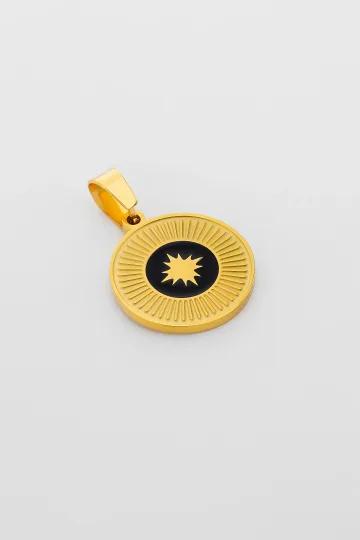
Wear the symbol, don't just read about it. These are in stock:


What the Tetragrammaton is
The four letters of the name
The word "tetragrammaton" is Greek and simply means "four-lettered." That is the name given to the sacred name of God in the Hebrew Bible, written with four consonants: יהוה. In Latin script this becomes YHWH. There are no vowels in the writing, because ancient Hebrew script was consonantal: the reader restored the vowel sounds from memory and tradition.
The name appears in the text of the Tanakh around 6,800 times, more often than any other designation of God. It is not a title or an epithet like "the Most High" or "Lord of Hosts," but a proper name that, according to the biblical account, was revealed to Moses at the burning bush. In the Book of Exodus this name is tied to the formula "I am that I am," and its root points back to the verb "to be." From that comes the theological idea: the name denotes not an attribute but being itself, eternal existence.
Yod, He, Vav, He: reading the signs
The four letters read as Yod (י), He (ה), Vav (ו) and again He (ה). The order matters, because each letter was later assigned its own meaning. Yod, the smallest letter of the alphabet, shaped like a tongue of flame, was thought of as the spark, the first point of creation. The first He opens that point into a plane. Vav, a vertical stroke, joins above and below, heaven and earth. The second He completes the descent into the material world.
In Kabbalah this quartet is read as a diagram of creation from the top down: from pure divine will to the world made flesh. A single letter turns into an entire cosmology, and that is precisely why the Tetragrammaton became not a word but an object of contemplation and meditation.
The Tetragrammaton in plain terms
Strip away the scholarly detail and the Tetragrammaton is the personal name of God in the Hebrew Bible, written with four consonant letters. The word came from Greek and literally means "made of four letters." Unlike "Lord" or "the Almighty," which describe a role or a quality, this is a name, the way a person has a name. Its peculiarity is that tradition instructed people to write the name but never to speak it aloud, so over thousands of years its living sound was forgotten. For the reader this means something simple: where an old translation prints the word "Lord" in capital letters, those same four signs almost always lie beneath it. The amulet takes this name and turns it into a wearable symbol, legible without any knowledge of Hebrew.
What the name means: "I am that I am"
A separate question is what the name itself means, as opposed to how it sounds. The biblical account ties the four letters to the verb "to be." When Moses asks at the burning bush for the name of the one who sent him, he hears a formula usually rendered "I am that I am" or "I will be what I will be." From this comes the central theological reading: the name denotes not some particular attribute of God but his very being, eternal and dependent on nothing. Other names describe a role, "the Most High," "Lord of Hosts," while the Tetragrammaton points to what stands behind every role. For the person who wears the sign, this lends the four letters a particular weight: they speak not of might or wrath but of the plain fact of eternal presence.
Why the name of God is written with four letters
The question of why exactly four letters surprises many people, since the name contains no vowel at all. The reason lies in the structure of ancient Hebrew writing: it recorded only consonant sounds, and the reader supplied the vowels from memory. The name is made of the signs Yod, He, Vav and again He, and all of them belong to the so-called weak, semi-vowel letters. This gave the name a particular quality: it sounded smooth, almost like a breath. Later the number four itself became a subject of interpretation. It was linked to the four directions, the four elements, the four worlds of Kabbalah. So a technical feature of writing turned into a separate layer of meaning, and the four-letter name came to be read as a compact map of the cosmos.
How the Tetragrammaton is written in Hebrew
In Hebrew the name is written right to left with four letters: yod (י), he (ה), vav (ו) and again he (ה). Written out, it looks like יהוה. Rendered in Latin script it becomes YHWH. There is an important detail: in sacred scrolls and printed editions the name is often set apart, and devout scribes carried out a special preparation before writing it. In jewellery engraving the letters are arranged either in a row or along the points of a triangle or hexagram, one at each corner. Whether the sign reads as the genuine name or only as an approximate pattern depends on the accuracy of the lettering, which is why makers give the shape of the letters particular attention.
Where the word "tetragrammaton" itself comes from
The word "tetragrammaton" is not Hebrew but Greek, and that often surprises people. It is built from "tetra," four, and "gramma," letter, so literally "four-lettered." The term was put into circulation by Greek-speaking Jewish and early Christian authors of the first centuries CE, who needed a way to speak of the sacred name without pronouncing it. Calling the name "the thing made of four letters" turned out to be a convenient workaround. So a curious situation arose: the most Hebrew of all words entered world culture under a Greek nickname. The English "Tetragrammaton" is a direct borrowing of the Greek term, and it has settled into scholarly and esoteric writing as a neutral label for a name that would otherwise have to be spelled out in full.
The pentacle of the Tetragrammaton as an amulet
The amulet people are looking for when they search for the strongest charm is not the inscription itself but a particular seal. The classic pentacle of the Tetragrammaton looks like a hexagram or double triangle, with the four letters of the name inscribed in its field, often one at each point, sometimes surrounded by other divine names and the signs of the planets. This design came out of ceremonial magic and occult treatises, where it was held to be the supreme seal of protection.
It is worth keeping two levels apart. In Judaism the name is holy in itself and is not worn as a talisman in the occult sense. The pentacle bearing that name belongs instead to the Western esoteric tradition, which borrowed the Hebrew letters as a source of power. A piece of jewellery usually carries this second image: a seal with letters, a pendant or a medallion.
Why it is called the most powerful amulet
The reputation as "the strongest" did not form by accident. In the logic of ceremonial magic, the power of a sign was measured by the authority of the name it carried. And in the Western model of the world there is no name higher than the name of the one God. Since the Tetragrammaton stands at the top of that hierarchy, a seal bearing it was automatically declared the summit of protective signs. Éliphas Lévi wrote plainly that this name, drawn according to the rules, commands every force.
It is worth holding a sober correction in mind. "The most powerful" is a judgment within a particular symbolic system, not a measurable property of metal and engraving. The amulet works as an anchor for attention, a mark of belonging to a tradition, and an object of memory. From here on this guide runs with respect for that tradition and without promises of miracles.
The jewelled form adds a modern reading to an ancient sign. A seal with the four letters can be worn openly as a pendant, tucked into a locket, or engraved on the inner face of a ring. The metal sets the tone: silver sounds restrained and folk-like, gold ceremonial, blackened steel severe and almost austere. The size of the sign decides whether it will be a quiet accent near the collarbone or a visible detail in a themed look. The way it is worn also speaks to the owner's character: an open seal declares belonging to a tradition, while a hidden locket or an engraved ring keeps the name private, the way it was in the original practice. There is a separate matter of engraving: fine Hebrew letters need precise cutting and enough depth, or they get lost on bright metal, while oxidation darkens the lines and gives the name back its legibility. Here legibility matters more than shine, since the whole meaning of the piece rests on the name itself, not on the play of light across the surface. Next we trace where each detail of this image came from, starting with the biblical text and ending in the occult studies of the nineteenth century.
A holy name goes under the collar, not over the noise. Silver keeps it austere. Gold turns a sacred sign into a market stall.
What to wear the Tetragrammaton with
The seal with the name has been through dozens of looks with me, on shoots and for evenings out. A sign with a history like this does not behave like an ordinary pendant; it has its own rules. I have gathered here what actually works, by occasion.
Which metal do you recommend for this sign? For a severe, traditional look I recommend silver: the engraving reads clearly on white metal, and the dark patina in the lines of the letters adds age to the sign. I choose gold when I am building a look around a single precious piece; it sounds ceremonial and asks for noble textures, silk, velvet, smooth wool. Blackened steel goes with an austere, almost monastic look. I keep one rule ironclad: one temperature of metal across the whole look, silver with silver, gold with gold, no mixing.
Wear it openly or tuck it under the collar? It depends on what a person wants to say. An open seal on a chain I recommend to those who wear the sign as a statement of belonging to a tradition. A hidden hinged locket or an engraving on the inner side of a ring I advise when the name is dear as something private, closer to the original practice, where it was not put on show. Under a strict dress code it is the ideal move: the sign stays with the owner under the shirt, and no regulation can touch it.
What chain length should one choose? I choose the length for the neckline, not the other way around. If the sign is worn openly, the seal should fall into the open zone near the collarbone or a little lower, not hide under the collar. For a V-neck I recommend a longer chain, so the sign settles at the centre of the open triangle. For a closed high collar I advise a shorter length, so the seal reads above the fabric.
Can a look be built from several signs? It can, but keep them in one symbolic family. Alongside the seal of the name I advise a small hexagram or a Hebrew initial letter; such a row reads as a considered set. A severe seal gets lost in a heap of mismatched pendants, so I choose its neighbours by meaning, not by number. If you want layers, give each chain its own length so the signs do not overlap.
And for a special outing or a shoot? For a shoot or a formal outing I choose the most expressive option: a large silver seal with deep oxidation, or a gold medallion against a dense fabric in a rich tone, wine, graphite, dark blue. That way the sign catches the light and reads on camera, and the name stays the hero of the look.

Turn on your camera, pick earrings, a pendant or a ring, and see the piece on yourself in real time.
Switch items in one tap.
Everything runs in your browser: no photo or video is ever uploaded.
The history of the name
The Tetragrammaton in the Tanakh
The four letters first appear in the oldest layers of the Hebrew Bible. The name stands in the story of the creation of the world, in the history of the patriarchs, in the psalms. The key episode is the revelation at the burning bush in the Book of Exodus, where Moses asks how to name the one who sent him and receives in answer a name of four consonants. From that moment the Tetragrammaton becomes the personal name of the God of the covenant, setting him apart from the gods of neighbouring peoples.
The oldest sources outside the Bible confirm that the name was in real use. It appears on the stele of the Moabite king Mesha in the ninth century BCE, in the letters from the fortress of Lachish, and on the tiny silver scroll-amulets from the Hinnom valley, which record a priestly blessing. Those silver strips of the seventh century BCE, by the way, are one of the earliest examples of the name being worn on the body as protection.
The ban on pronunciation
Over time a rule took hold: write the name, but do not say it aloud. The reason lay in reverence and in a wish not to break the third commandment, which forbids taking the name of God in vain. By the era of the Second Temple, reading the name aloud was restricted to worship, and after the destruction of the Temple in 70 CE the living pronunciation all but disappeared.
A single ceremony remained as the exception: the high priest spoke the name on Yom Kippur, the Day of Atonement, inside the Holy of Holies. When the Temple fell, that thread too was cut. The exact vocalization, meaning which vowels sounded between the consonants, was lost, and scholars still argue over the reconstruction, most often leaning toward the reading "Yahweh."
Adonai and Elohim in place of the name
To read the sacred text aloud without speaking the name itself, substitutes were introduced. In place of the Tetragrammaton people said "Adonai," which means "my Lord," or, if Adonai already stood beside it, "Elohim," that is "God." In everyday speech devout people replaced the name with the word "ha-Shem," literally "the Name."
This tradition explains an oddity of many translations. Where the original has the Tetragrammaton, English Bibles usually print "LORD" rather than the name. The reader sees a title, and beneath it hide the very four letters that have not sounded aloud for two thousand years.
Jehovah and Yahweh: where the vocalizations came from
The form "Jehovah" was born from a misunderstanding among medieval scribes. In the Masoretic manuscripts the vowel marks of the word "Adonai" were added to the consonants of the Tetragrammaton, as a reminder to read the substitute. Christian Hebraists of the late Middle Ages took this cue for the real vocalization and read the hybrid as "Jehovah." So an error became a familiar name in European languages for several centuries.
Scholarly reconstruction offers a different reading. Comparison with the Greek transcriptions of early authors and with the form of the name embedded in other words points to a pronunciation close to "Yahweh." Both forms, "Jehovah" and "Yahweh," are attempts to recover a sound that tradition deliberately left silent.
Kabbalah and the tree of sefirot
In Jewish mysticism, Kabbalah, the Tetragrammaton became the centre of an intricate system. The world, according to Kabbalah, unfolds through ten sefirot, the stages or vessels of divine light, and the four letters of the name are distributed across that scheme. Yod corresponds to the highest wisdom, He to understanding, Vav to the six middle qualities, the second He to kingship, the presence embodied in the world.
Another Kabbalistic idea is the four worlds. Creation is divided into four levels: the world of emanation, of creation, of formation and of action. Each letter of the Tetragrammaton is set in correspondence with its world. The name becomes a map of the entire cosmos folded into four signs, and its contemplation turns into a spiritual practice rather than a simple reading.
Kabbalists paid particular attention to the way the name can be "expanded." There is a practice of writing out the Tetragrammaton with the full spelling of each letter's name, and depending on how those names are spelled, the sum changes and yields different numbers. Each such variant was linked to its own level of being and its own aspect of the divine. For the mystic this was not an arithmetical game but a way to walk meditatively through the stages of creation, holding the same name in mind across its different unfoldings. This very layering is what made the four letters an inexhaustible object of contemplation across the centuries.
The name on the mezuzah and at the threshold of the house
A separate strand of the name's life is tied to the home. In Jewish tradition a mezuzah is fixed to the doorpost, a small case holding a scroll on which verses from Deuteronomy are written. The reverse of the scroll often bears the name "Shaddai," the Almighty, and the letters of that name are read as an acronym for the phrase "Guardian of the doors of Israel." The Tetragrammaton itself is present in the text of the scroll, within the biblical verses.
This practice shows that the idea of the sacred name at the threshold as protection for the house is very old and very much alive. It echoes the silver scroll-amulets of the Iron Age and the folk custom of marking signs at the entrance. A jewelled amulet with the name is, in effect, a portable and personal version of the same thought: what the mezuzah does for the house, the pendant does for the person, staying with them on the road and beyond the walls.
Grimoires and the Key of Solomon
In medieval and Renaissance Europe, the Hebrew names of God entered Christian occult literature through grimoires, the manuals of ceremonial magic. The most famous of them, the Key of Solomon, was attributed to the legendary wisdom of King Solomon and contained dozens of pentacles, seals inscribed in Hebrew and Latin. The Tetragrammaton held a special place in these books as the name of highest authority, the one that "binds" spirits.
It helps to grasp the logic of these texts clearly. Their authors almost always cast themselves as Christians and treated work with the names of God not as sorcery but as a higher, "divine" magic set against the demonic. The Tetragrammaton served as a seal that supposedly guaranteed the summoned forces would obey rather than harm the operator. From this came the name's reputation as absolute protection.
The Christian Kabbalah of the Renaissance
At the end of the fifteenth century, Florentine and German thinkers joined Kabbalah to Christian theology. Giovanni Pico della Mirandola (1463-1494) argued that Kabbalah confirmed the truths of Christianity, and Johann Reuchlin devoted whole treatises to the Tetragrammaton. The famous idea was born: insert a fifth letter, Shin, into the four letters of the name, and you get the Pentagrammaton, a name that Christians read as the name of the Savior.
This play with letters was no idle amusement for the age. Scholars seriously believed that the mysteries of salvation were encoded in the structure of the sacred name. So the Hebrew Tetragrammaton became common property of Western esotericism, a bridge between Jewish mysticism and Christian symbolism, and it was in this form that it reached the occultists of the nineteenth century.
Éliphas Lévi and the nineteenth century
The French occultist Éliphas Lévi, writing in the middle of the nineteenth century, gathered a scattered tradition into a coherent system. In his book "Dogma and Ritual of High Magic" (1856) he declared the Tetragrammaton the key to all magic and tied it to the Tarot cards, the elements and the planets. It was Lévi who fixed the image of the pentacle with four letters as the supreme protective sign, and he wrote at length about its power to command the invisible.
After Lévi the baton passed to the occult orders at the turn of the twentieth century, above all the Hermetic Order of the Golden Dawn in London. There the Tetragrammaton was built into rituals, into the symbolism of the elements, into the structure of initiatory grades. Through these orders and their publications the image spread across all of Western esotericism and reached popular culture, and with it the jewellery counter.
The Pentagrammaton: the five-letter name
Alongside the Tetragrammaton, its enigmatic relative appears in Renaissance texts, the Pentagrammaton, that is, the five-letter name. Christian Kabbalists inserted a fifth letter, shin (ש), into the middle of the four and produced a combination they read as the name of the Savior. The logic was theological: add to the name of the creator a letter that stands for fire and spirit, and the name seems to gain a voice and become pronounceable. For the thinkers of the day this served as proof that the mystery of the incarnation was encoded in the very structure of the sacred name. The Pentagrammaton hardly ever appears on jewellery, but it is worth knowing about: it shows how a single stroke of the pen turned a Jewish symbol into a Christian one without changing its foundation.
The Tetragrammaton and the Christian Trinity
In Christian art the four letters of the name were often placed inside a triangle, and this was no accident. From ancient times the triangle served as a sign of the Trinity, three persons of one God, and the name inside it indicated that the reference was to the God of the Bible. This motif, the name in a radiant triangle, adorned altars, domes and title pages of Bibles in the Baroque age. For the artist it was a way to depict the undepictable: not to paint God in human form, but to show him through his true name. So the Hebrew Tetragrammaton became part of Christian symbolism without losing its link to the original text. The pairing of four letters and a triangle can still be found on old churches all across Europe.
The Tetragrammaton in Judaism, Christianity and esotericism
It helps to draw together how one and the same name lives at once in three traditions. In Judaism it is a holy thing: the name is written but not spoken, treated with the utmost reverence, and its use as a talisman is judged with restraint. In Christianity, through the Kabbalah of the Renaissance and the art of the Baroque, the four letters became a sign of the same one God and adorned churches. In Western esotericism, from the grimoires to Éliphas Lévi, the name was turned into the supreme seal of protection and the key of ceremonial magic. The same set of letters reads as a holy name, as a theological symbol and as an occult seal. This triple life is what makes the Tetragrammaton such a rich and contested sign at the same time.
Customer reviews
Zevira is a real jewellery shop. Genuine payments, deliveries and customer thank-yous.
🥰🥰🥰 gracias

Ok, ¡gracias! 🙂

Symbolism and meaning
The link between the letters and the elements
One of the most enduring readings ties the four letters to the four elements. Yod is matched with fire, the first He with water, Vav with air, the second He with earth. The logic is the same as in Kabbalah: a descent from the finest energy to the densest. Fire as pure impulse, water as form, air as connection, earth as embodiment.
This scheme made the Tetragrammaton a convenient centre for rituals working with the elements. In the magic of the Golden Dawn each letter answered to an element, a direction, a season and a type of spirit. For a piece of jewellery this opens a fine possibility: a seal with four letters can be read as a compact map of the four beginnings of the world, gathered into a single sign.
The Tetragrammaton and the four worlds of Kabbalah
Beyond the elements, the four letters point to the four worlds of Kabbalah already mentioned. Atziluth, the world of emanation, corresponds to Yod. Beriah, the world of creation, to the first He. Yetzirah, the world of formation, to the letter Vav. Assiah, the world of action, to that second He which closes the name below, in matter.
This reading gives the amulet a vertical dimension. It reads not as a flat sign but as a ladder from the invisible to the visible. A person wearing the seal symbolically keeps that whole vertical with them, from pure intention to its embodiment. Here lies the inner meaning that tradition poured into the four letters.
Numerical value: gematria
In the Jewish tradition each letter has a numerical value, and adding these numbers, gematria, was held to be a way of revealing hidden connections. Yod is 10, He is 5, Vav is 6, the second He is again 5. The sum of the Tetragrammaton equals 26. The number 26 became a distinct symbol of the presence of God, found encoded in many places in the biblical text.
Another way of counting yields the number 72. Add up the letters of the name in a growing triangle, that is Yod, then Yod-He, then Yod-He-Vav and so on, and you arrive at 72. From this grew a separate tradition of the "seventy-two names of God," each of which was considered a particular channel of power. For the history of the amulet this matters: gematria gave the sense that behind the sign stood a precise, almost mathematical structure, not a random string of letters.
The seventy-two names of God
From the Tetragrammaton the Kabbalists derived not just a single number but a whole list of names. Taking three neighbouring verses from the Book of Exodus, each of seventy-two letters, they combined them in a particular way and obtained seventy-two names of three letters each. Each such name was linked to its own angel, its degree of the zodiacal circle and a concrete need: protection on the road, healing, reconciliation. These names were copied onto protective tablets and amulets, and through occult literature they reached the modern era. For the owner of a seal with four letters this adds depth: behind the visible name stands a whole system of dozens of derivatives, each with its own purpose, and all of it grows from a single root.
The Tetragrammaton and guardian angels
The tradition of the seventy-two names is closely bound to the idea of angels. In the Kabbalistic lists each name corresponds to its own angel, and a person could learn their "own" patron from their date of birth. The idea travelled far beyond Judaism, and in the nineteenth century it grew popular among European occultists, who drew up detailed tables of correspondences. In this system the Tetragrammaton stands as the root from which all the angelic names branch out, like limbs from a trunk. On amulets the name of God was sometimes surrounded by the names of the four archangels, Michael, Gabriel, Raphael and Uriel, one for each direction. So the seal turned into a small map of the heavenly hierarchy, with the name at the centre and the forces subordinate to it around it.
The Tetragrammaton in Christian symbolism
The Tetragrammaton took root in Christian art as well, especially in the Baroque age. Four Hebrew letters in the radiance of a triangle, the symbol of the Trinity, can be seen above altars, on church pediments, on engravings in Bibles of the seventeenth and eighteenth centuries. For the artists it was a way to depict the undepictable: to show God himself through his true name rather than through a human figure.
Such use softens the notion that the sign belongs to the occult alone. Across the centuries the same four letters shone both on the pages of a grimoire and above a church altar. This makes the Tetragrammaton a rare symbol that lives in several traditions at once without belonging wholly to any one of them.
A separate tradition formed around the number seventy-two. From the name, read as a growing triangle, people derived the so-called seventy-two names of God, each of three letters. In Kabbalah they were tied to angels, to degrees of the zodiacal circle, to concrete needs and requests. These names were copied onto amulets and protective tablets, and through occult literature they reached the modern era. For the owner of the seal this is one more layer of meaning: behind the four visible letters stands a whole system of dozens of derived names, each with its own purpose.
Out of this rich symbolism grows a concrete object held in the hand. Next we look at how the pentacle of the Tetragrammaton is actually built, how it differs from the neighbouring signs it is constantly confused with, and by what marks to tell one from another.
Upload a photo of your pet, someone you love, or an object. We'll build a 3D model and hand-cast it in pewter.




The pentacle of the Tetragrammaton as a protective charm
The double triangle and the four letters
The classic pentacle of the name is built around a hexagram, a figure of two overlaid triangles. The upper triangle, point up, is traditionally read as fire and ascent, the lower one, point down, as water and descent. In and around the field of this figure the four letters of the Tetragrammaton are placed, sometimes joined by the names of archangels, the signs of the planets, Latin mottoes.
The point of the composition lies in the idea of balance and completeness. Two triangles are the joining of opposites, above and below, spirit and matter, and the name at the centre is the principle that holds them together. The result is a sign that is not aggressive but balancing, which matters for understanding it: tradition saw in it a shield and an order, not a weapon.
What the pentacle of the Tetragrammaton looks like
For anyone searching out this sign for the first time, it helps to know what it looks like. Most often it is a circle or disc within which a six-pointed star of two overlaid triangles is drawn. At the points of the star, or at its centre, sit the four Hebrew letters of the name. Around them there often run additional inscriptions: the names of archangels, Latin mottoes, the signs of the planets, a ring of dots or rays. The composition is always symmetrical and closed, because a closed form was read in tradition as completed protection. On a piece of jewellery the design is simplified for legibility: the star and the four letters are kept, and the small details that would be lost in metal are removed. It is exactly this recognisable pairing, the star and the four letters, that sets the pentacle of the name apart from its neighbouring signs.
The seal of protection in ceremonial magic
In the grimoires the pentacle of the Tetragrammaton had a very concrete function. The operator drew it on parchment or metal, or traced it on the floor as part of a protective circle. It was believed that the name of highest authority would not let the summoned forces cross the boundary and do harm. By the same logic the seal was carried on the person as a portable version of that circle, a shield always in effect.
The making of the seal followed strict rules. The grimoires prescribed what metal to use, on what day and hour, with what ink to draw the letters, which names to set beside them. The power of the sign was thought to depend on the precision of the work no less than on the name itself. Hence the particular attention to material: silver was linked with the Moon and purity, gold with the Sun and the highest authority. The jewellery tradition inherited this sensitivity to metal even after the ritual context faded into the past.
From here runs a direct line to the jewelled amulet. A pendant or medallion with the four letters is the domestic, everyday form of the same idea of protection. A person does not trace a circle on the floor before leaving home; they put a sign around their neck. The scale and setting change, but the original thought stays the same: to carry with you the name that tradition held to be the strongest.





The Tetragrammaton, the Seal of Solomon and the pentagram: how to tell them apart
How it differs from the Seal of Solomon
Confusion arises here constantly, because both signs are often drawn on the basis of a six-pointed star. The difference lies in the essence. The Seal of Solomon is first of all a geometric figure, a hexagram, and a legend of King Solomon's signet ring, with which he commanded spirits. Its power is ascribed to the form itself and to the figure of the king.
The pentacle of the Tetragrammaton puts the emphasis not on a figure but on the letters. Here the main thing is the name inscribed in the sign, while the geometry serves as a frame for the name. Put it this way: the Seal of Solomon is about the ring and its owner, while the pentacle of the Tetragrammaton is about the name of God itself. In practice the two images often merge, and a single amulet may carry both the hexagram and the four letters at once.
How it differs from the pentagram
With the pentagram things are simpler at the level of geometry. The pentagram is a five-pointed star, the sign of the five elements and of Pythagorean harmony. The Tetragrammaton in its pure form is four letters, and its pentacle is usually built on a six-pointed star rather than a five-pointed one. The different number of points is the first and most reliable mark.
There is a difference of meaning as well. The pentagram is a symbol of the structure of the world, of the five elements and the microcosm of the human being. The Tetragrammaton is a name turned upward, toward the source. The two are sometimes joined in a single esoteric system, but by origin they are different things: one grew out of Greek geometry and folk magic, the other out of the Hebrew sacred text. More about the neighboring signs is gathered in the general full guide to protective charms, amulets and talismans.
Leave your email, we'll send your discount code. No spam, unsubscribe anytime.
The code arrives by email, valid on your first order.
The Tetragrammaton in culture and art
Four letters in painting and engraving
In European art the image of the Tetragrammaton flourished in the Baroque age, and especially in the decoration of churches and books. Artists placed the four Hebrew letters in a triangle surrounded by rays of light and clouds, and sometimes in a ring of angelic heads. This motif was called the "radiant name" and was set above altars, on ceilings, on the title pages of Bibles of the seventeenth and eighteenth centuries. The idea was bold: to depict the invisible God himself not through a human figure but through his true name.
Protestant artists and engravers were especially eager to use this device, since for them a direct image of God in human form was theologically contested. The name in a triangle solved the problem: it pointed to the presence of the Creator without turning him into a portrait. From there the letters spread onto church pediments, gravestones, emblems, and even on certain state symbols of the late modern era one can meet echoes of this "eye and name in radiance."
The Tetragrammaton in Tarot and occult systems
Éliphas Lévi took a further step, linking the four letters of the name to the four suits of the Tarot and the four elements. He matched Wands with Yod and fire, Cups with the first He and water, Swords with Vav and air, and Pentacles-coins with the second He and earth. So the whole deck turned into an unfolding of a single name, and the cards of the Major Arcana received correspondences to the Hebrew letters. This scheme became the foundation of nearly all occult readings of the Tarot in the twentieth century.
The logic here is the same as in Kabbalah: the name as a key from which the structure of a whole world is derived. For the history of the amulet this matters, because it fixes on the Tetragrammaton the role of a universal cipher rather than an ordinary inscription. A person wearing the seal symbolically keeps with them not a single word but a folded map of correspondences that Western esotericism built up over centuries.
The name in legend: the golem and the power of the word
The Tetragrammaton is also tied to one of the most famous Jewish legends, the story of the golem. By the Prague tradition, a rabbi brought a clay man to life by writing the sacred name on its forehead or placing the written name in its mouth, and to stop the golem the name was removed. The legend speaks directly of the belief that the name of God carries a creating power, the very power by which the world was made.
This story explains much about the attitude toward the four letters. The name was thought of not as a label but as an active word, capable of breathing life in and taking it away. From this came both the caution of the tradition and the reputation of the pentacle as the supreme sign. In a piece of jewellery this idea sounds as a quiet echo: the seal carries not an image of power but the very formula around which a whole mythology of the word was built.
The Tetragrammaton as a tattoo: meaning and appropriateness
More and more often people choose the four-letter name not for a pendant but for a tattoo, and here it is worth thinking ahead. On one hand, a tattoo of the Tetragrammaton reads as a permanent mark of belonging to a tradition of contemplation and protection. On the other, for believers this name is a holy thing, and marking it on the skin is not directly approved in Judaism, since a tattooed body is associated with the prohibitions of the Torah. If the decision is made, the accuracy of the lettering is important: an error in a Hebrew sign changes the meaning or renders the inscription meaningless, and a tattoo is harder to correct than an engraving. For anyone who wants to wear the symbol flexibly, a pendant or a ring gives the same connection to the meaning while leaving the freedom to remove the sign or pass it on.
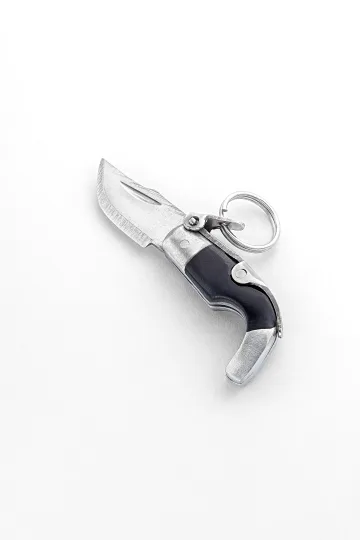
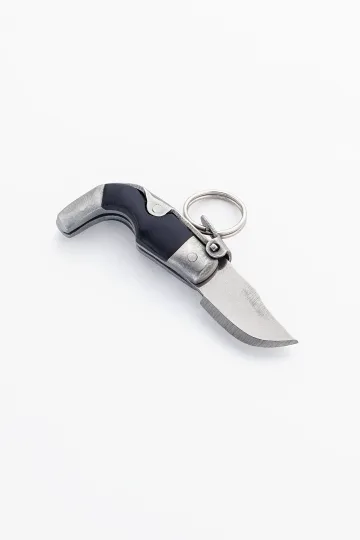
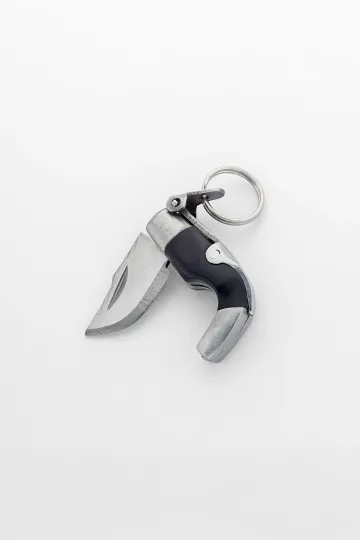
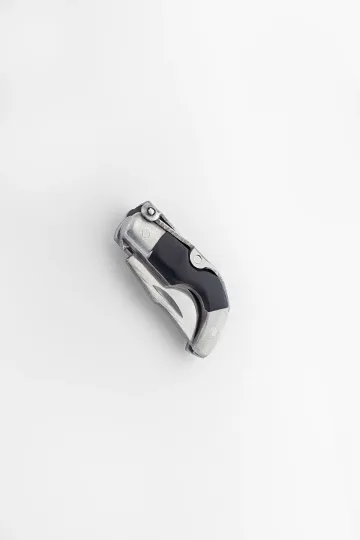
CAPAORA mini knife pendant
The 18th-century Spanish navaja in miniature: 40 mm of stainless steel, a real folding mechanism and a Palanquilla lock that clicks. An affordable gift to remember.
Authentic · Ships from Spain · 14-day returns
Myths and truth about the Tetragrammaton
As many legends have gathered around the four letters as there is history. Some were born in occult circles, some in popular culture, some simply from misunderstanding. Let us take the main claims one by one, separating documented fact from pretty invention.
The general conclusion from these examinations is simple. The Tetragrammaton is not a password for miracles and not a dangerous "forbidden word," as pop culture sometimes paints it. It is a deep religious and cultural symbol with a clear history. Respect suits it better than fear or sensational expectations, and it is with that frame of mind that one should approach the amulet.
How the amulet is worn
Materials: silver as a conductor
The traditional metal for protective signs is silver. In the folk magic of many cultures silver was credited with the power to turn away evil, and the lunar, cold nature of the metal sat well with the image of a charm. For the pentacle of the Tetragrammaton, silver 925 remains the most expressive choice: the engraving of the letters reads clearly on the white metal, and a light oxidation deepens the lines and gives the sign an aged look.
Gold offers a different reading, more ceremonial and "solar." It suits the case where the amulet is thought of less as a folk charm and more as a precious family piece. Steel and blackened metal give a severe, almost austere image. The choice of metal changes the intonation of the sign but not its meaning: the four letters remain themselves in any material.
The engraving of the Hebrew letters deserves a separate word. Yod, He and Vav are fine, precise forms, and whether the sign reads as noble or as crude depends on the cleanness of their cutting. A deeper, unhurried line catches the light and lends the seal a warmth, while a shallow cut lets the letters vanish on a bright surface. Oxidation solves exactly this problem: a dark patina in the recesses makes the light letters stand out and stay legible, and it is legibility of the name that matters most here, since the meaning of the piece rests on it.
Formats: pendant, medallion, ring
The most common form is a seal-pendant on a chain. A flat disc or medallion with engraving shows the whole composition well: the hexagram, the letters, the border. A diameter of two to three centimetres is comfortable for everyday wear, while a larger sign of four to five centimetres becomes a visible accent for a themed look.
A hinged locket lets the sign be hidden inside, for anyone who wants to wear the amulet privately. A ring with engraving on the signet face or on the inner side is the quietest format: the name stays with the owner but is not put on display. This hidden way of wearing sits well with the original tradition, where the name was something private rather than decorative.
The shape of the seal is chosen partly for how the sign will read. A round medallion gives the name a calm, closed field, close to the historical pentacles on parchment. A rectangular or shield-shaped plate recalls the image of a tablet and the seal of a document. A hexagram with letters at its points emphasises the geometry and the link to the elements. For everyday wear a smooth disc without sharp projections is more comfortable; it does not catch on clothing and wears less at the edges. Large accent shapes are saved for a themed outing, when the sign is given the leading role in a look.
How to wear the Tetragrammaton every day
For everyday wear the sign follows a few simple rules. A medium-sized seal on a chain that falls into the collarbone zone reads as a calm accent of meaning and does not get in the way. A smooth disc without sharp projections is more comfortable than a star with jutting points: it does not catch on clothing and wears less at the edges. If the work involves the hands, a ring with engraving on the inner side keeps the name with the owner without putting it on display. Silver darkens over time in the lines of the letters, and this only adds depth to the sign, so daily wear does it no harm. The rule is simple: the calmer the setting, the clearer the name itself sounds, the name for whose sake the piece is put on.
A Tetragrammaton pendant: what to look for when choosing
When choosing a pendant with the name, a few things are worth checking. First, the legibility of the letters: Yod, He and Vav should be cut cleanly and deeply, or on bright metal they blur into an illegible pattern. Second, the correctness of the lettering, since an error in a Hebrew letter changes the meaning and is hard to catch without knowledge of the language, so it is better to take a piece from a maker who understands what they are engraving. Third, size and weight: a disc of two or three centimetres is comfortable for everyday wear, while too large a sign drags on the chain. Finally, it is worth deciding whether contrast is needed: oxidation darkens the lines and makes the letters more expressive, which for this sign is worth more than shine, since the whole meaning rests on the legibility of the name.
The pentacle of protection on the body, not in the circle
In the grimoires the pentacle of the name was traced on the floor or on parchment as part of a protective circle. The jewelled seal carries the same idea onto the body: instead of a circle on the floor, a person puts the sign around the neck and carries the protection along. The change of scale changes the meaning too. A ritual circle acted in one place and one time, while a worn sign accompanies the owner everywhere, so it reads not as a one-off rite but as a constant reminder. This is exactly why the pentacle form on jewellery is made closed and symmetrical, repeating the logic of the circle. For the owner it is a portable version of the old thought: to keep with you a name that tradition held able to hold the boundary between order and chaos.
Who it suits to wear it
The Tetragrammaton suits those to whom Abrahamic symbolism is close and who treat the name with respect. These are people interested in Kabbalah and Jewish mysticism, in the Western esoteric tradition, in the history of symbols. For them the sign is a link with a centuries-long line of contemplation and protection, not a mere ornament.
Delicacy matters here. The name of God is a holy thing for millions of believers, and in Orthodox Judaism the attitude toward wearing it as an amulet is ambivalent. If the sign comes to a person out of respect for the tradition rather than for shock value, it reads with dignity. If what you want is a beautiful symbol without the religious weight, a neutral pentagram or another charm from the general range may be closer.
Can a Christian wear the Tetragrammaton
The question is a natural one, since the name came from the Hebrew Bible. The answer is that through the Christian Kabbalah of the Renaissance and the church art of the Baroque, the four letters entered the Christian tradition long ago. The name in a radiant triangle adorned altars and Bibles, and thinkers saw in it a pointer to the same God to whom Christians pray. So wearing such a sign does not contradict a Christian's faith, provided it is approached with respect rather than for fashion. Many take the seal as a reminder of the true name of the Creator standing behind the familiar word "Lord." Here, as everywhere with this symbol, the frame of mind matters most: a sign worn with reverence for its history reads with dignity in any Abrahamic tradition.
The Tetragrammaton as a gift: to whom and how
Such a sign is given thoughtfully, because meaning stands behind it, not form alone. It suits a person to whom Abrahamic symbolism, the history of writing, Kabbalah or Western esotericism is close. It is good if the recipient is themselves interested in the subject, for then the gift reads as attention to their passion rather than as a random object. An engraving on the back, a date or a short wish turns the seal into a personal keepsake to be passed on. Giving the name of God to someone far from this tradition and skeptical of it is not a good idea: the meaning of the sign will pass them by, and the symbol itself asks for respect. The best gift here is the one that lands in an already living interest rather than imposing an alien symbolism.
Skepticism against tradition
An honest conversation about an amulet is impossible without the question of whether it works. From the point of view of science, engraved metal emits no special fields and drives off no misfortune. To promise otherwise would be a deception. Everything that can be said honestly lies in the realm of psychology and culture.
And that is not little. An anchor-sign helps a person gather themselves, reminds them of their values, creates a sense of being protected, and a calm person really does act more confidently. On top of this the amulet carries aesthetics and memory: it links the owner to a long history, to a text, to a tradition of contemplation. To wear the Tetragrammaton meaningfully is to value exactly this, and not to wait for magical effects.
It also helps to keep in mind how the reputation as "the strongest" came to be. It grew inside a strict symbolic logic, where everything is arranged by a hierarchy of names, and not out of a store of tested cases. This makes the sign interesting as a cultural monument rather than as a guarantee of luck. An honest position wins out over a superstitious one here: it lets you wear a beautiful piece of deep meaning without deceiving yourself or those around you, and answer calmly the questions of what this sign means and where it came from.
Care for the amulet
A silver seal darkens over time, especially in the recesses of the engraving, and this adorns the sign more than it spoils it. If you want to bring the shine back to the raised surfaces, polish them with a soft silver cloth, leaving the lines of the letters dark for contrast. Ultrasonic cleaning is best avoided for oxidised pieces, since it strips the patina.
The fine lines of the Hebrew letters gather dust and traces of cosmetics. A soft brush with a drop of soapy water gently cleans the recesses. Gold pieces are less demanding; a wipe and an occasional wash are enough. Once a year it is worth showing an amulet with stones to a jeweller, to check the settings if the piece has any inlays.
Silver, gold, the symbolism of Abrahamic and esoteric traditions, protective charms and amulets rooted in a living craft tradition.
Facts that surprise
The most frequent name in the Bible, and no one knows how to read it. The Tetragrammaton appears in the Hebrew text around 6,800 times, more often than any other word for God, yet its exact pronunciation is lost. We know with confidence the most repeated name in the book and are unsure of its sound.
Its vowels were "borrowed" from another word. The form "Jehovah" is the result of a mechanical joining of the consonants of the name with the vowels of the word "Adonai." Scribes set the foreign vowels as a hint to read the substitute, and later readers took the hybrid for the real reading.
The name was worn on silver as far back as the seventh century BCE. In the Hinnom valley near Jerusalem two tiny silver scrolls were found with a priestly blessing on which the name is written. These are among the oldest biblical texts of any kind and direct proof that the sacred name was worn on the body as protection almost three thousand years ago.
Add one letter and you get another name. Renaissance Christian Kabbalists inserted the letter Shin into the Tetragrammaton and obtained the Pentagrammaton, a five-letter name they read as the name of the Savior. So a game with a single letter turned a Jewish symbol into a Christian one.
The sum of the letters is 26, and by another count 72. Gematria gave the name numbers that became symbols in their own right. The number 26 stood for the presence of God, while the number 72 gave rise to a whole tradition of "seventy-two names," each held to be a separate channel of power.
The same four letters shone both in a grimoire and above a church altar. In the Baroque age the Tetragrammaton in a radiant triangle adorned the pediments of churches and the engravings of Bibles, while in occult books the same name served as a seal for "binding" spirits. A rare symbol that lives at once in two opposite worlds.
The name was spoken aloud once a year. In the era of the Second Temple the only moment when the Tetragrammaton sounded in full was the service of the Day of Atonement, and only the high priest spoke it in the Holy of Holies. With the destruction of the Temple that thread was cut, and with it the living sound of the name.
Send a friend a discount code, they save on their first order.
FAQ
What does the word "Tetragrammaton" mean?
It is a Greek word meaning "four-lettered." That is the name given to the sacred name of God in the Hebrew Bible, written with four consonants, Yod, He, Vav, He, that is יהוה or YHWH. There are no vowels in the writing, so the exact pronunciation remains a matter of reconstruction.
Is it true that this is the most powerful amulet in the world?
The sign received that reputation from Western ceremonial magic, where the power of a seal was measured by the authority of the name, and no name is higher than the one God in that system. Within the tradition it really is the summit of the hierarchy of protective signs. Beyond the symbolic system, "the most powerful" is a judgment of culture, not a measurable property of an object.
How is the name read correctly, Yahweh or Jehovah?
Scholarly reconstruction leans more often toward the reading "Yahweh," relying on Greek transcriptions and related forms. "Jehovah" is a later hybrid, in which the vowels of the word "Adonai" were added to the consonants of the name. Both forms are attempts to recover a sound that tradition deliberately left silent.
How does the Tetragrammaton differ from the Seal of Solomon?
The Seal of Solomon is first of all a geometric figure and a legend of the king's signet ring, with which he commanded spirits. The pentacle of the Tetragrammaton puts the emphasis on the letters of the name themselves, while the geometry serves as their frame. A detailed look at the neighboring sign can be found in a separate article on the Seal of Solomon.
Can I wear such an amulet if I am not Jewish?
Through Christian Kabbalah and Western esotericism the name has long moved beyond a single religion and lives in a shared symbolic tradition. Wearing it is appropriate if approached with respect rather than for shock value. For believers the name is a holy thing, and delicacy here matters more than fashion.
Which metal is better to choose?
Silver 925 is the most expressive option: the engraving of the letters reads clearly on the white metal, and oxidation deepens the lines. Gold gives a ceremonial, "solar" reading and suits a precious family piece. Steel and blackened metal give a severe, austere image. The meaning of the sign does not change with the metal.
Are the Tetragrammaton and the pentagram the same thing?
No. The pentagram is a five-pointed star, a symbol of the five elements and of Pythagorean geometry. The pentacle of the Tetragrammaton is usually built on a six-pointed star and carries the four letters of the name of God. The different number of points is the most reliable mark, and the origins of the two signs are different altogether.
Does the amulet really protect?
The honest answer lies in the realm of psychology and culture, not physics. Engraved metal emits no fields and drives off no trouble. But an anchor-sign helps a person gather themselves, reminds them of their values and gives a sense of support, and a calm person acts more confidently. What is worth valuing in the amulet is exactly this, along with its aesthetics and its link to a long history.
Conclusion
The Tetragrammaton is a rare case of a symbol that passed through the whole history of Western culture without losing its depth. Four consonants that were almost never spoken aloud became the centre of Jewish mysticism, the summit of occult systems, an ornament on church pediments, and finally an image on a jewelled seal. The reputation as "the most powerful amulet" grew from a simple logic: there is no higher name, so there is no stronger sign.
In jewellery this sign works as a link with a very long line of contemplation and protection. A silver seal for those who value the severe tradition of the charm. A gold one for a precious family piece. A hidden locket or an engraving on a ring for those to whom the name is dear as something private rather than as decoration. The metal promises no magic, but there is enough memory, meaning and beauty in it to wear it with awareness.
To work out which format is closest to you, answer a few questions below: the recommendation takes into account style, metal and how openly you wear symbols.
Buying it as a gift? Each one arrives ready to give.
 A branded Zevira box and a little card come with every order.








About Zevira
Zevira works within the craft traditions of Albacete, Spain. The Tetragrammaton is part of our collection of symbols and protective charms, where it sits alongside other signs of the Abrahamic and esoteric traditions.
What you can find with us bearing this sign:
- Seal-pendants with the four letters of the name in silver 925
- Oxidised pentacles with an aged contrast in the lines
- Hinged lockets for private wear
- Rings with engraving on the signet face or the inner side
- Gold interpretations for a precious family piece
Personal engraving is available. We work with silver 925 and gold 14-18K, in the metalworking heritage of Albacete.