Archangel Michael: the meaning of the protector, his medal and jewellery
The name Michael is not a title. It is a question: "who is like God?" That is an objection to pride, not a claim to power. And yet Christian tradition calls him the archistrategos, the commander of the heavenly host. The strongest of the angels carries a name that denies any rivalry with God at all.
Who is Archangel Michael: a name shaped like a question
Michael appears in Christianity, Judaism and Islam in parallel, with different emphases but a shared core: an angel who stands on the side of order against chaos, and who intercedes for people. Unlike the saints, Michael has no biography. No birthplace, no year of death, no relics. He is not a human being who was canonised but a bodiless spirit, known from a handful of scriptural episodes and from centuries of accumulated tradition. Hence the strange feature of his cult: enormous devotion, almost no facts.
What the name Mi-ka-El means
The Hebrew מיכאל breaks into three parts: "mi" is "who", "ka" is "like", "El" is "God". Literally: "who is like God?" It is not a description of a quality and not a job description. It is a rhetorical question with only one possible answer: nobody. By traditional reading, this is the cry Michael threw at those who wished to make themselves equal to the Creator. The name works as a formula of humility placed in the mouth of the mightiest of the angels. For symbolism this is a rare case: the chief protector is named not for his weapon or his strength but for the acknowledgement of his own limits.
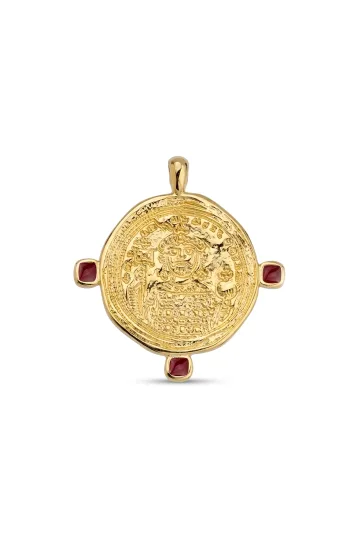
Wear the symbol, don't just read about it. These are in stock:


Michael in Jewish tradition
In the Book of Daniel, Michael is called "the great prince who stands for the children of your people": he is the heavenly patron of Israel, the one who argues for his people in an invisible court. Rabbinic literature developed the image further, making Michael a defender and an advocate who speaks in a person's favour where the accuser speaks against. From this comes the durable link between Michael and the idea of intercession: he defends against an unjust verdict more than he punishes. This legal, courtroom note would later pass into Christian iconography with the scales.
Michael in Christianity
Christian tradition added to the prince-advocate the role of commander of the angelic host. The Book of Revelation describes a battle in heaven where Michael and his angels stand against the dragon, and the dragon is cast down. From that comes the Greek title archistrategos, supreme commander. The Eastern church keeps the Synaxis of the Archangel Michael, the West marks Michaelmas, and by the late Middle Ages Michael was also linked with escorting souls, weighing them and presenting them at judgement. The result is a figure of unusual scope: warrior, judge, guide and advocate at once.
Michael in Islamic tradition
In the Qur'an the archangel appears as Mikail, alongside Jibril, and the text explicitly forbids reviling his name. Islamic tradition credits Mikail with care for the sustenance of creatures and for the natural elements, for rain and for plants: the emphasis shifts from the martial to the nourishing. What stays constant across all three traditions is the framing: he is one of the spirits closest to God, a servant rather than an independent power. This triple citizenship makes Michael one of the very few figures recognised immediately across all three Abrahamic religions.
Why an archangel has no earthly biography
With saints it is simple. There is a life, a place, relics. With an archangel everything is different. His "biography" consists of a few lines of scripture and a great many apparitions, that is, episodes in which he is said to have shown himself to people in specific places. This is exactly why the geography of Michael's cult is built not around a tomb but around sites of apparition, most often on mountains and heights. It is a fundamentally different kind of veneration, and it explains why the major Michaeline shrines are scattered across summits from southern Italy to the coast of Normandy.
The history of the cult: from Gargano to Mont-Saint-Michel
Michael's cult in the West has a clear starting point and an unmistakable signature: a mountain, a cave, an apparition, a sanctuary on a height. From a single Italian cave the tradition spread across Europe, and then crossed to the Americas with the Spanish crown. It is worth following that route, because it explains both the look of the medals and why Michael is so deeply loved in Spain and Latin America.
The cave on Monte Gargano
The principal Western shrine of Michael is the grotto on Monte Gargano in Italian Apulia, on the "spur" of the boot. Tradition holds that at the end of the fifth century the archangel appeared here to the local bishop and declared that the cave was already consecrated by his presence and needed no ordinary rite. The peculiarity of Monte Sant'Angelo is that the sanctuary was not built but inhabited: it occupies a natural cave reached by a stairway going down. From here came the template later copied all over Europe: a Michaeline place is not a plain but a height, and very often a cave or a rock.
Mont-Saint-Michel and the chain of shrines on heights
At the start of the eighth century a similar tradition arose in Normandy: the archangel appeared to the bishop of Avranches and told him to build a sanctuary on a rocky islet in the bay. So Mont-Saint-Michel was born, an abbey on a rock that the tide cuts off from the mainland twice a day. The chain continued: Saint-Michel-de-Cuxa and other mountain houses, Cornwall's St Michael's Mount, the Spanish San Miguel de Escalada. The common principle is visible without effort: Michael is settled between heaven and earth, on a boundary that is hard to climb to. Height here works as a theological argument, not as a scenic location.
Patron of soldiers, of Spain and of Latin America
If he is the commander, he is patron of those who serve. In medieval Europe knightly brotherhoods, town militias and armourers' guilds took Michael as their patron; later sailors turned to him, and in modern times so did those who keep public order. In the Spanish-speaking world San Miguel Arcángel became one of the most recognisable figures of popular devotion: hundreds of parishes and towns carry his name from Spain to Mexico, Peru and Argentina. The medals travelled with the parishes: a small disc with a winged figure and a shield is still worn as casually as a cross.
Michaelmas and the autumn turn of the year
The Western church keeps Michael's feast on 29 September, and in medieval Europe that date meant far more than a church holiday. Michaelmas was one of the quarter days, the dates on which accounts were settled, rents paid, workers hired and field work closed out. The autumn equinox is right beside it, the light is shrinking, the year is turning towards darkness: it is logical that the guardian of this threshold should be the one responsible for the border between light and dark. In the Eastern tradition Michael's principal day falls in November, but the sense is the same: a threshold, and protection at the threshold.
Why the cult took root on edges
Look at a map of Michaeline shrines and a pattern jumps out: they stand on edges. A rock in the tidal zone, a cave on a spur, a house on a pass, a church on a sea cape. The medieval mind read this literally: where the settled world ends and the dangerous one begins, you need a guard. The same logic moved down to the everyday level and has survived to our own day. A Michael medal is most often taken to places where a person feels themselves on a border: onto the road, into a new job, into a foreign city, into hospital. The symbol of the boundary works the same way on a cliff and on a chain.
How an apparition became a sanctuary
The pattern is almost always identical, and it is worth spelling out because it explains how Michaeline places are built. First a tradition of an apparition to a local bishop or shepherd. Then an instruction to build or to occupy the place, often with a detail underlining that the usual consecration is unnecessary. Then a flow of pilgrims, a road, hostels, a town growing around it. That is how the Gargano cave drew an entire pilgrim route towards itself, and how the Norman rock acquired an abbey and a village. The symbol did not stay in the text; it organised the landscape and the economy around itself.
Pilgrim badges and the first medals
Pilgrims who reached Gargano or the Norman rock did not carry home impressions alone. Lead and tin badges showing the holy place and its patron were ordinary things in the late Middle Ages: they were sewn onto a hat or a cloak to show where you had been and to bring back a fragment of protection. Later devotional medals, Michael's among them, grew out of that practice. Only the materials and the print run changed; the meaning, a token of belonging and a reminder of intercession, stayed exactly the same. A useful neighbouring story here is the medal of Saint Benedict and its encoded formulas, which travelled the same road from monastic token to mass-produced medal.
«Michael is worn large and in dark silver, over dense fabric. Pastels and gold plating break the whole character of the image.»
How to wear the Archangel Michael medal: what to pair it with, metal and size
Michael's medal is a dense relief disc, and I build the look around it starting from the background rather than from the pendant itself. Fine modelling drowns on busy fabric and comes alive on smooth. I have gathered here the questions that come up most often at a fitting.
What do I wear the medal with every day? For an everyday look I recommend a medal of about twenty millimetres on a medium-density chain over plain fabric. A busy print argues with the relief, so I choose a quiet background: grey, black, navy, olive. If the medal stays a personal token, I would advise wearing it under a shirt or a sweater and not bringing it out at all; the feel of the object does not change for that.
Which metal should I choose for my colours? I advise matching the metal to the temperature of the whole look. Dark silver with patina I recommend with graphite, khaki and navy, with dense fabrics like denim and wool: the oxidising in the hollows underlines the figure and keeps it readable. Warm gold I take with sand, chocolate and wine. Pastel and pale fabrics work badly with this medal, the character of the look is lost. One metal throughout keeps the picture coherent; mixing silver and gold in one set is not something I would advise.
How do I choose the chain length for my neckline? I match length to the neckline, not to height. For an open collar I advise fifty centimetres, the medal sits at the base of the neck and is visible whole. For a closed top or a roll-neck I recommend fifty-five or sixty, so the pendant drops to the breastbone and does not bulge under the fabric. Hidden wear is also a matter of length closer to sixty. I match the weight of the chain to the medal: a relief disc needs a denser chain, a thin one twists under it and turns the picture back to front.
What size of medal should I choose? I choose size by purpose, not by build. A medal up to fifteen millimetres is the quiet option: it reads close up, sits well under clothing and suits a teenager or anyone who does not want a visible token. Twenty millimetres is universal, the relief resolves at arm's length. Large medals from twenty-five millimetres up I ask people to try on without fail: they need dense fabric and an open neckline, otherwise they outweigh the look and catch on knitwear.
What suits weekdays, and what suits the twenty-ninth of September? For weekdays I choose restraint: a small medal under clothing, matte silver, a simple chain. For the patronal feast on the twenty-ninth of September and for family occasions I recommend bringing the medal out and giving it room: a large medal on a dense chain over dark smooth fabric, collar open, no other pendants nearby. Polished silver belongs here too, it catches the light the way gold grounds do on church images. One rule holds in both cases: the medal stays the only accent on the chest, neighbouring pendants pull attention away from the relief.
Turn on your camera, pick earrings, a pendant or a ring, and see the piece on yourself in real time.
Switch items in one tap.
Everything runs in your browser: no photo or video is ever uploaded.
Michael's sanctuaries: a chain of places on the heights
Michaeline shrines are easy to confuse with one another because they follow a single plan: a climb, stone, a view over water or over a plain. It is worth looking at four of the main sites separately, so that what they share and where they differ both become visible.
The cave on Monte Gargano in Apulia
The Gargano grotto is considered the oldest Western shrine of the archangel and is still in use. Tradition connects it with the end of the fifth century and with the bishop of Siponto, to whom, the story goes, the archangel declared the cave already consecrated. No rite of consecration was performed there, and that detail was repeated afterwards in dozens of legends about Michaeline places all over Europe. The arrangement of the sanctuary itself is unusual for the Latin West: a long stairway descends into the cave, and the worshipper walks not up towards an altar but down, into the body of the mountain. The combination of height outside and depth inside gave Gargano a special place in pilgrim geography: people came by a road of its own, lined with hospices and churches.
Mont-Saint-Michel on its tidal island
The Norman abbey grew out of an early eighth-century tradition of an apparition to the bishop of Avranches. The rocky islet in the bay turned out to be an almost perfect illustration of the theme of the boundary: at high water it becomes an island, at low tide the bared seabed leads to it. Building went on for centuries, adding tiers around the rock, and the result is one of the most complicated engineering objects of medieval Europe, where the church rests on a system of crypts and supporting vaults. The pilgrim flow was such that the village at its foot lived on nothing else. Later the abbey served as both fortress and prison, which for Michaeline places on borders is the rule rather than the exception.
Sacra di San Michele in Piedmont
The Piedmontese abbey sits on a rocky outcrop of Monte Pirchiriano, above the valley through which the Alpine roads ran. Its foundation is placed around the turn of the tenth and eleventh centuries, and the logic of the site reads at once: the house controls the pass and is visible from far below. Inside, a steep stairway survives that leads to the church straight through the rock, and it gives the same sense of ascent as effort that the descent into the Gargano grotto gives. For travellers heading to Rome the Sacra worked as a staging post, and its role was spiritual and thoroughly practical at the same time.
Skellig Michael off the Irish coast
The far western point of this chain is a rocky island in the Atlantic opposite County Kerry. Irish monks built a settlement of beehive-shaped stone cells here, laid dry without mortar, and lived on bare rock among the seabird colonies. The dedication to the archangel became attached to the island in the Middle Ages. The place pushes the Michaeline theme to its limit: beyond it there is no land at all, and the border of the inhabited world runs literally along a cliff edge.
On the "Michael line", without exaggeration
The rough alignment of these points on a map has been discussed for a long time, and a popular idea has grown up around it about a single straight line joining shrines from Ireland to the Mediterranean. It deserves a calm response. There was no shared plan among builders of different centuries and countries; the sanctuaries arose independently out of local traditions. The coincidence has a simpler explanation: Michaeline places were traditionally set on capes, summits and cliffs, and such points in Western Europe are distributed unevenly and run along coastlines. The line here is a handsome map of recent origin rather than evidence of an ancient design.
Iconography: scales, sword and dragon
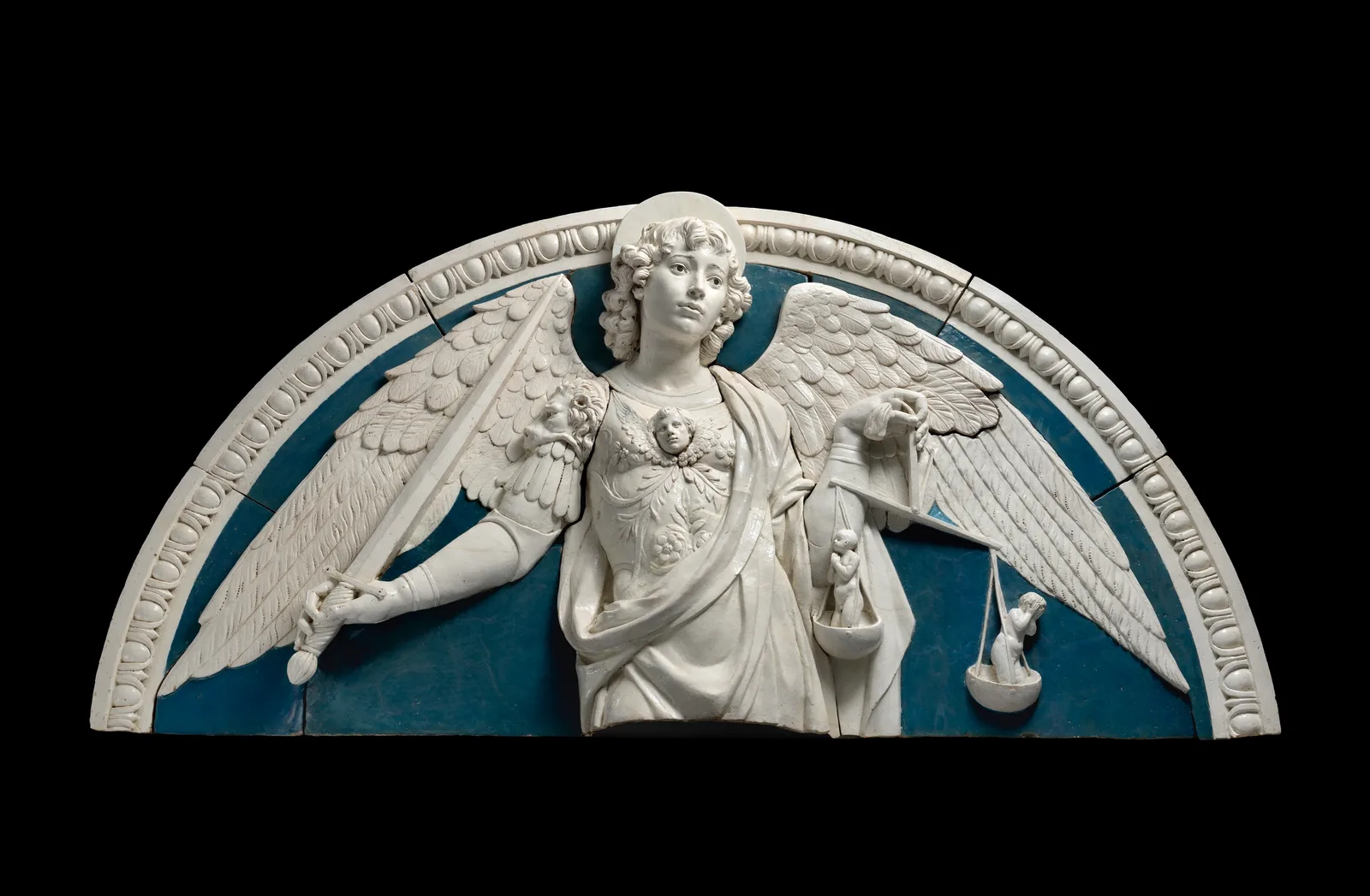
Michael is recognised by a set of attributes that settled in the Middle Ages and has barely changed since. Wings, armour, scales, a weapon, a defeated serpent at his feet. Each object carries a separate function and reads as a separate line. It is worth taking them one at a time, because anyone buying a medal benefits from knowing exactly what is hanging on their chest.
The scales of souls: Michael as the weigher
The attribute that surprises most people is the scales. In Western iconography Michael is often shown holding a beam with two pans on which a person's deeds are weighed. The motif comes from the image of judgement after death and occupied a prominent place in medieval churches, usually at the entrance or on the west portal where scenes of the Last Judgement were set. The emphasis matters: Michael does not pass sentence, he holds the scales and presents the soul. This is still the role of an advocate, not a judge, and it continues directly the line from the Book of Daniel where he speaks in favour of his people.
Sword and spear: symbolism, not belligerence
Medieval thought read the weapon in the archangel's hands allegorically. The sword and the spear are not a call to fight but a sign of discernment and of cutting away: the ability to separate the true from the false, to refuse what drags you down. Church commentators stressed that the struggle in question is with inner inclinations and with spiritual evil, not with people. That is why the gesture shown is almost always calm: the archangel stands upright, his face without anger, the weapon lowered or raised without a swing. Heroic fervour is absent from the canonical iconography; what is there is restrained firmness.
The dragon and the serpent underfoot
The defeated dragon beneath Michael's feet goes back to the image in Revelation where the "ancient serpent" is identified with the tempter. In pictures he is always below, always smaller than the archangel's figure and always already beaten: the dynamics of the fight are barely shown. That is deliberate. The scene shows not a battle but its outcome, a state of order restored after a revolt. Theologically the dragon here stands for pride, exactly the pride against which Michael's name poses the question "who is like God?" The circle closes: the name and the picture say one and the same thing.
The armour and what it means
Michael is almost always dressed in armour, and not an abstract kind but the kind contemporary with the artist: a Roman lorica in early art, knightly plate in the Gothic, a swelling cuirass in the Baroque. This habit of updating the costume speaks of a living cult; the symbol was translated into the language of each era. The meaning of the armour, meanwhile, is stable: it is an image of readiness and composure, familiar from the apostolic phrase about spiritual clothing. Armour covers but does not attack, and that is its role in the composition.
Wings, halo and the colour of the robes
Wings distinguish an angel from a warrior saint and set the heavenly nature of the figure immediately. The halo adds sanctity, while the colour of the robes varies by tradition: Western painting favours red and gold, Eastern icons often use blue and crimson tones. Michael is sometimes painted with bare feet, stressing his bodilessness, sometimes in Roman-style sandals. On a medal all of this shrinks to a silhouette, so what survives in metal are the three most recognisable marks: wings, weapon and the figure underfoot.
The shape of the wings themselves also changed with the era. Early art gives them short and almost geometric, the Gothic stretches them upward and makes them birdlike, the Baroque throws them wide open and fills them with air. A curious separate tradition is the peacock eyes on the plumage, found in Spanish and Italian painting: the motif came from the late antique language of images where peacock feathers meant incorruptibility. In Western painting the halo thinned over time into a barely visible gold rim or vanished altogether, whereas Eastern iconography kept it as a solid circle. On the relief of a medal the halo is usually solved as a raised ring behind the head; otherwise it disappears entirely in such small-scale work.
How to tell Michael from Gabriel and George
The confusion happens regularly, and the figures are not hard to separate. Gabriel is the messenger: he comes with a lily or a staff, without armour and without a defeated serpent, most often in an Annunciation scene. George also strikes a serpent, but he is a horseman, a man and a saint, without wings. Michael stands on the ground, he has wings and armour, and beneath his feet a dragon or scales in his hand. A simple rule: wings plus armour is Michael, wings without armour is Gabriel, armour without wings and on horseback is George.
There are finer markers too, useful when studying old carving. Gabriel often has a raised hand in a gesture of speech, because his scene is always about a word spoken. George is almost always accompanied by narrative props: a horse, a spear broken in the jaws, sometimes a rescued princess and a town in the background. Michael has no surroundings at all; the figure works on its own, and all the narrative is reduced to the beaten creature underfoot. The third recognisable angel, Raphael, is easier still: he walks with a staff and a fish, paired with a young man, and never wears armour. If you want that comparison in full, see the medal of the Archangel Raphael and its meaning. On the miniature of a medal all these differences compress into a single mark: the presence or absence of a plated torso and a mass beneath the feet.
Customer reviews
Zevira is a real jewellery shop. Genuine payments, deliveries and customer thank-yous.
🥰🥰🥰 gracias
Ok, ¡gracias! 🙂
Michael in the Christian East
Eastern tradition knows the archangel under the same name but assembles his image differently, and to someone used to Western medals the Eastern pictures at first look like another character altogether. The difference touches both the title and the set of objects in his hands.
The archistrategos in the Byzantine tradition
The Greek word archistrategos means supreme commander, and in Byzantine usage it attached to Michael more firmly than any other description. Devotion to the archangel was very broad in Constantinople: churches were dedicated to him at the palace, with the army and at springs, and court ceremonial happily used the image of the heavenly host as a mirror of the earthly one. Hence a distinctive trait of Eastern images: Michael appears more often as a courtier or an envoy of the highest authority than as a fighter in the middle of a struggle. He stands frontally, looks straight at the person praying, and holds the marks of his commission rather than the traces of a victory.
Labarum, orb and measuring rod instead of armour and dragon
The set of attributes in the East is noticeably different. Instead of plate armour he often wears a long court robe; instead of a dragon underfoot he is given a staff and a transparent orb, a mirror in which the monogram of Christ's name is sometimes placed. The staff with the labarum sign points to his mission, the orb to authority granted from above and not belonging to the messenger himself. A measuring rod also appears, the thin staff of a surveyor, referring to the idea of measure and order. The dragon and the scales are known in Eastern iconography too, but they take up far less space than in Latin art and barely affect the look of the medals familiar to us. Hence a practical conclusion for choosing: a medal with a winged warrior in plate inherits from the Western branch, while one with a frontal figure in long robes holding an orb inherits from the Eastern.
The Synaxis of the Archangel Michael on 8 November
The main Eastern celebration falls on 8 November in the Byzantine calendar; churches that keep the older reckoning mark the same feast thirteen days later in the civil calendar. The word "synaxis" here means an assembly, a joint honouring of Michael together with all the bodiless powers. The feast appeared earlier than the Western Michaelmas in its late form and is bound up with an understanding of the angelic ranks as an ordered hierarchy. The autumn placement works in the East as it does in the West, marking the year's turn towards the dark season, but no accounting dates were tied to it and no everyday layer of the Michaelmas goose sort grew up around it.
Upload a photo of your pet, someone you love, or an object. We'll build a 3D model and hand-cast it in pewter.
Meaning: protection and discernment
Talking about meaning calls for honesty. Neither church teaching nor common sense credits metal with a power of its own, and promising that a medal will turn aside disaster would be a lie. The sense of a medal lies elsewhere, and that place is entirely real.
Intercession, not a guarantee
In the Catholic tradition a medal is a sacramental, a blessed object and a sign, not an amulet with mechanical effect. The appeal goes not to the thing but to God through the archangel's intercession, and nothing automatic is assumed. The distinction matters: a charm in the folk sense works by itself, a sign of faith works through the person wearing it. Anyone who wants that difference in detail will find the discussion of the Miraculous Medal and its symbolism useful, where the same logic of the sign is taken apart piece by piece.
Discernment as the central meaning
If Michael's symbolism has to be reduced to one word, that word is discernment. The scales weigh, the sword separates, the question in the name cuts off the claims of pride. All three attributes are about the same skill: to see where the truth is and not to confuse it with a convenient counterfeit. Read this way, the medal becomes a reminder of a daily choice rather than of a war with external enemies. That reading is calmer and, honestly, more useful: it gives the wearer a task rather than an illusion of invulnerability.
What a medal actually gives a person
What works here is not the metal but attention. An object on the chest returns you to a decision you made, dozens of times a day, and that is the single verifiable effect: reminding. Psychologists describe similar mechanisms with any personal token, from a wedding ring to a badge on a lapel. A Michael medal sets a specific frame: composure, honesty with yourself, calm in an uncertain situation. There is no need to promise anything supernatural; the ordinary force of a reminder is quite enough to make the object worth having.
Michael in art and culture
Few angels have left so many traces in European art. Michael is present in architecture, in sculpture and in painting, and in different roles: guardian of the entrance, participant in the judgement scene, independent hero of an altarpiece. It is worth walking through the main layers.
Cathedral portals and judgement scenes
Gothic cathedrals put the Last Judgement on the west portal, where whoever enters sees it first. At the centre of the composition is usually Christ, and below, among the risen, stands Michael with the scales. The place was not chosen at random: entering a church was understood as a passage, and a passage needs a weigher. Sculptural groups of this kind survive across France, Spain and Germany, and they largely fixed the durable Western image of the archangel with the beam of the scales in his hand.
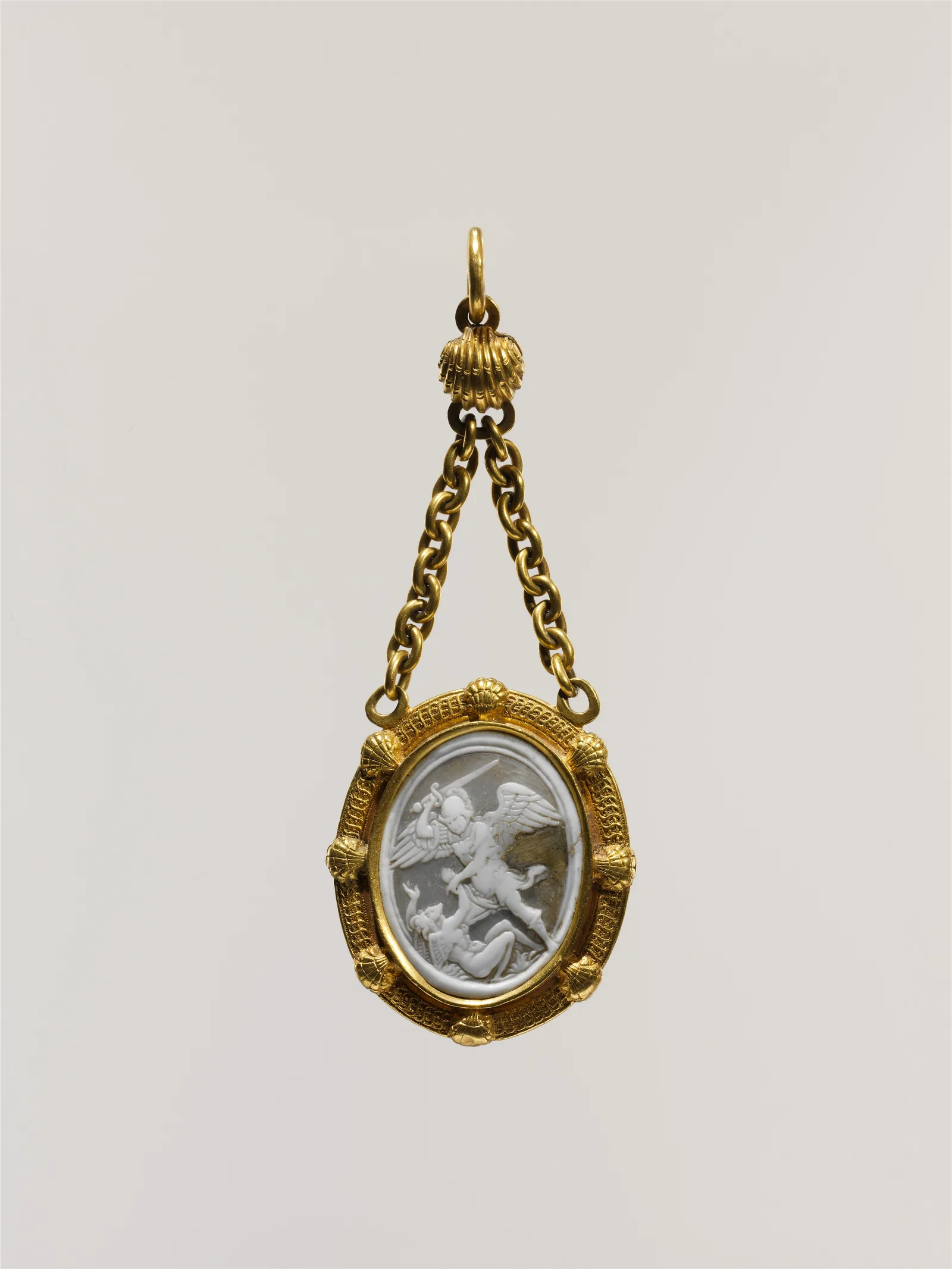
Painting of the late Middle Ages and the Renaissance
Altarpieces with Michael became a genre of their own: the archangel at the centre, the dragon at his feet, scenes from the apparition legends around him. Spanish and Italian painting of the fifteenth and sixteenth centuries was especially fond of minutely rendered armour catching the light, and of sumptuous wings with peacock iridescence. In the Baroque the figure becomes more dynamic, the composition runs along a diagonal, but the set of attributes does not change. The change of styles touched presentation, not content, which for a symbol is rare and speaks to the stability of the canon.
Sanctuaries on heights as works of architecture
A separate cultural line is the architecture of Michaeline places itself. The cave sanctuary at Gargano, the abbey on a tidal island in Normandy, mountain houses in the Pyrenees: all of them solve one engineering problem, how to build and maintain a church where building is inconvenient. The answers were inventive, from stairways cut into rock to multi-storey supporting structures. Today these places read at once as monuments of faith and as monuments of construction, and people visit them with very different motives.



Michael in heraldry and knightly orders
The archangel moved early from the church onto seals, coats of arms and order badges. The logic of that move is clear: anyone depicting authority or a craft needs an image of lawful order, and Michael with his scales suited that role better than most saints.
The French Order of Saint Michael and its collar
The knightly Order of Saint Michael was founded in the second half of the fifteenth century by the French king Louis the Eleventh. The number of knights was small at first, admission counted as a high royal favour, and the badge of the order quickly became one of the most recognisable award objects in Western Europe. It was worn on a massive gold collar whose links were made of scallop shells, a reference to the seashore and to the pilgrim theme. On the pendant sat the archangel above the dragon, exactly the composition that stood on cathedral portals. It is worth pausing here: the order badge is the very case where devotional image and jewellery finally coincided. The medal on the chest did not come out of jewellery fashion but out of the practice of wearing a sign of belonging to a community, whether pilgrimage or knightly brotherhood.
The archangel on civic arms and seals
Michael appears in the arms of towns and regions across Europe, from Brussels to countless smaller places, and almost always in the same pose: a winged figure with a weapon above a defeated serpent. The reasons vary. Sometimes a town grew up around a Michaeline church and took the patron along with the dedication; sometimes the archangel was adopted as a sign of a guarded frontier or a fortress. The seals of town councils and craft guilds repeated the same composition in miniature, and this is another line from which the habit grew of compressing a complex scene into a silhouette on a disc of metal the size of a fingernail.
Scales, trade and the patronage of measurers
A separate and little-known branch of the devotion is tied to crafts where accuracy of measurement decides everything. Traditional lists of patrons assign Michael to grocers, apothecaries and everyone who works with weights and measures. The connection is direct and rests on the attribute: if the archangel weighs a person's deeds, then human scales fall under his patronage too. In a medieval town honest measure was a matter of public order, short weight was punished harshly, and guild statutes were glad to put a heavenly inspector over the subject. So the image with the beam appeared on guild banners, on weights and on shop signs. For the symbolism of the medal this is an important turn: the scales in Michael's hand read both as judgement after death and as everyday honesty in business.
Leave your email, we'll send your discount code. No spam, unsubscribe anytime.
The code arrives by email, valid on your first order.
The Archangel Michael medal as jewellery
Transferring a multi-figure scene onto a disc a couple of centimetres across is a task in itself. What remains of an altarpiece is a silhouette, and whether the medal reads or turns into a murky blur depends on how well that silhouette is assembled. Let us look at what happens to the image under such compression and at what to watch for when choosing.
What survives of the iconography in metal
In miniature the large forms survive: the spread of the wings, the vertical of the figure, the diagonal of the weapon and the mass of the dragon below. Small things such as facial features, the pattern on the armour and the feathers disappear or turn into texture. A good medal is built on exactly this understanding: the maker strengthens the contour and the depth of the relief where recognition is needed, and does not try to cram every detail of the painted original into metal. A bad one tries, and the result looks like a porridge of unreadable bumps.
Round, oval and shield-shaped formats
The classic is the circle, as with most devotional medals: the figure is inscribed in a ring, and a Latin or Spanish inscription invoking the archangel sometimes runs along the edge. An oval gives more height and suits a full-length figure better, so it gets chosen when both wings and dragon need to be shown. The shield shape appears more rarely and works as a nod to the martial theme, but it needs care: the louder the shape shouts about weapons, the less of the original meaning of protection and discernment is left in the piece.
Size, weight and how it wears every day
An everyday medal lives by the laws of everyday life. Too large and it catches on clothing and flips over, too small and the relief is lost. The working range for daily wear is roughly eighteen to twenty-five millimetres on the longer side: the image still reads and the piece does not get in the way. Thickness and weight matter no less: thin stamping wears smooth quickly, while slightly heavier relief holds the drawing for years. To judge how a particular size will sit on you, a try-on helps, and the catalogue has a separate tool for that.
Medal, bracelet charm and keyring
The format of wear changes the tone. On the neck a medal stays a personal token, hidden under clothing and meant above all for the wearer. On a bracelet it becomes visible and works as part of the look alongside the other charms. In a car or on a keyring it turns into a sign of place and road, and this is the oldest of the everyday practices, a direct continuation of pilgrim badges. It is fitting to recall here Saint Christopher and the travellers' medal: the road theme is where these two images overlap most closely.
Materials and formats
Material decides both the appearance and how the piece survives years of daily contact with skin. Devotional medals have their own specifics: relief matters more than shine here, and material is chosen partly for how it holds fine modelling.
Sterling silver and why it is the standard
Silver remains the working standard for medals for several reasons at once. It is plastic enough for a die to transfer fine relief, strong enough for daily wear and affordable enough that a medal can be given without a special occasion. A separate advantage is patina: silver darkens in the hollows of the relief and over time emphasises the drawing by itself, making the archangel's figure more contrasted. On new pieces this effect is often created with deliberate oxidising, and it also returns naturally with wear.
Gold, plating and brass
Gold gives the colour closest to altar painting with its gold grounds, and needs no care against tarnish. Gold-plated silver is a compromise: the look of gold at the weight and price of silver, but the coating on the raised points of the relief wears through over time, and on a medal that shows sooner than on a smooth ring. Brass and bronze are traditional for pilgrim medals, they are cheap and age well, but some people react to them on the skin. For daily wear under clothing that is worth knowing in advance.
Enamel, oxidising and patina
Coloured enamel appears often on Michael medals, usually blue or red on the ground around the figure. It makes the image festive and readable from a distance, but enamel chips when struck, and on a swinging pendant knocks are unavoidable. Oxidising and patina solve the same contrast problem without the risk of chipping: a dark ground in the hollows, bright metal on the raised parts. For an object meant to be worn every day for years, the second route is the safer one.
Chain, length and how it sits
The chain is half the feeling of a medal. Too thin and it twists under the weight of a relief disc, too short and it pushes the pendant out of the neckline. For a medal about twenty millimetres across, a medium-density chain is usual, cable or curb link, fifty to sixty centimetres long, so the medal lies on the breastbone rather than on the collarbones. If it is meant to be worn hidden, take the length closer to the top of that range.
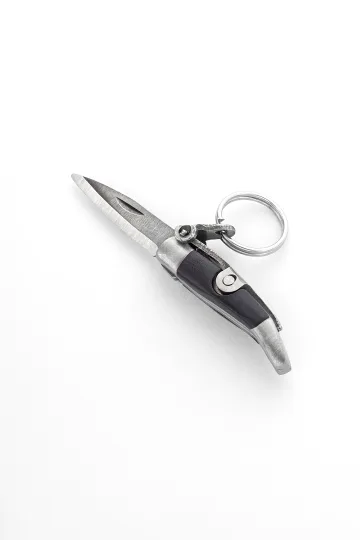
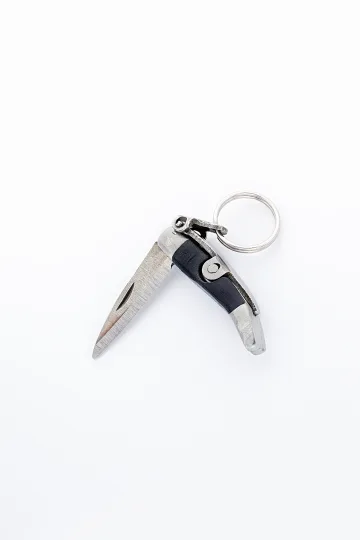
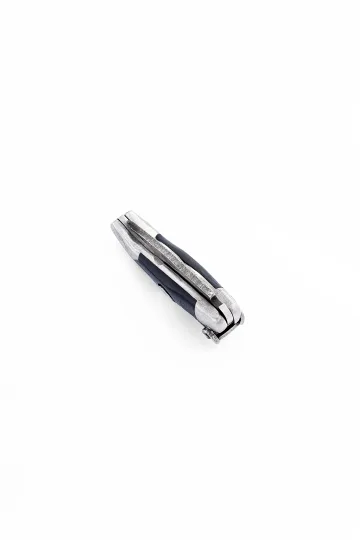
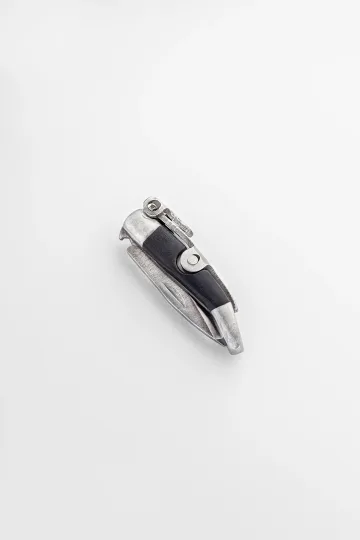
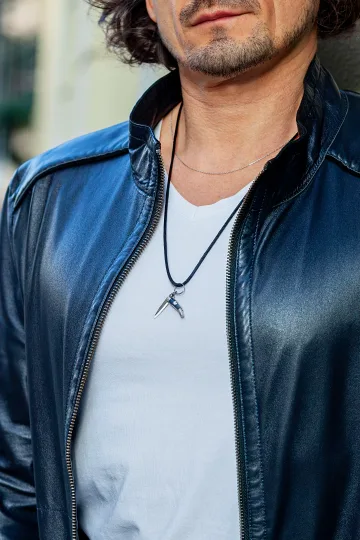
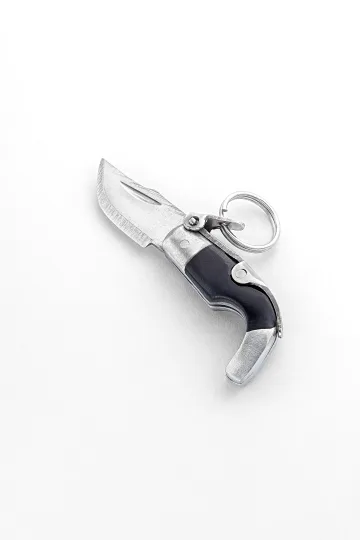
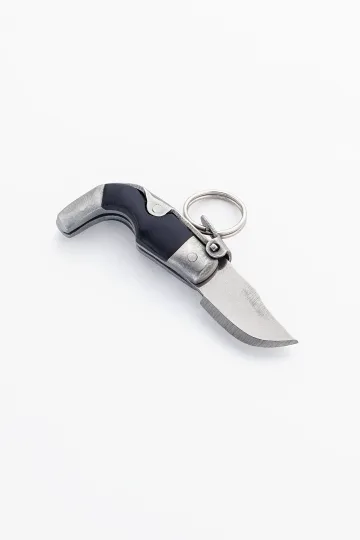
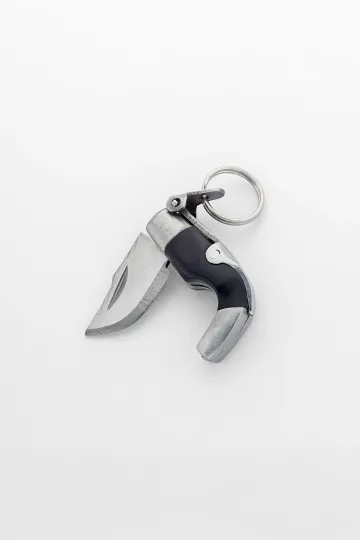
CAPAORA mini knife pendant
The 18th-century Spanish navaja in miniature: 40 mm of stainless steel, a real folding mechanism and a Palanquilla lock that clicks. An affordable gift to remember.
Authentic · Ships from Spain · 14-day returns
Who receives an Archangel Michael medal
This medal has a map of occasions of its own, and it is noticeably wider than people assume. What all the cases share is one thing: the gift marks a transition, a beginning or a responsibility.
The twenty-ninth of September and name days
The Western feast of the archangel, 29 September, is a natural occasion for a gift to everyone called Miguel, Michele, Michael, Michel or Mihai. In Spanish-speaking families the name day of San Miguel is still kept alongside the birthday, and a medal with the patron is the most obvious and most appropriate present for the date. In the Eastern tradition the November feast of the archistrategos is the reference point, but the logic is the same: the gift is tied to a name and a patron, not to a random square on the calendar.
Baptism and confirmation
At a baptism a medal is given as the first personal token, one the child will wear or keep until they are old enough to understand it. Here you choose a modest size, calm relief without sharp edges and a secure clasp. Confirmation or first communion is already a gift to a young person who grasps the meaning of the symbol themselves, and an adult format with more expressive work suits better. A related story about protective signs for the house and the family is set out in the piece on the Caravaca cross and its meaning.
A gift for a new job, a journey or a move
All three cases share one thing: the person finds themselves at the edge of the familiar. From this comes the old practice of giving a Michael medal to those who are leaving, changing city, entering service or taking on work with responsibility for others. The gift reads not as insurance against misfortune but as a wish for composure and a clear head. That is exactly how it should be handed over: with no promises of a miracle, but with the meaning behind the figure said out loud.
Psychology: why people choose the image of a protector
Demand for protective symbolism has not fallen for centuries, and religiosity alone does not explain it: medals are bought by people outside church practice too. The reasons lie in how a person copes with uncertainty.
A material anchor for a decision
An abstract intention does not last long; an object lasts longer. A worn token turns a decision into a physical thing that keeps entering the field of attention and returns you to the original thought. The whole culture of personal symbols is built on this, from a ring to a patch. A medal works the same way: it does not change the circumstances, it supports a chosen position at the moments when the position starts to slip. The mechanism is simple and entirely earthly, and that is exactly why it does not depend on how much the wearer believes.
A sense of control in ungovernable circumstances
A journey, an operation, a court hearing, an exam, a move: situations where little depends on the person. Psychological work on coping describes how in such circumstances people lean on rituals and objects to lower anxiety and recover a sense of agency. A medal occupies the same place as a familiar packing routine or a known route: it does not influence the outcome, but it lowers the internal noise, and with less noise a person acts with more composure. That is a modest but honest answer to the question of what a protective symbol is for.
Why people choose a figure on the side of order
Out of the whole range of protective signs, the Michaeline one stands out for a single quality: it is about order, not about luck. Horseshoes and clover promise the favour of chance, the eye and the hand deflect someone else's ill attention, while the archangel with his scales offers something different: clarity and the right order of things. That request sits closer to people who dislike talk of luck but still need something to lean on. It explains why Michael's image is often chosen by people in strictly practical occupations, from doctors to those who work with risk.
The line between a sign and superstition
A healthy relationship with a symbol is recognised by one mark: the person is not afraid of losing it. If losing the medal causes panic and a feeling of armour stripped away, the sign has turned into superstition and started to govern the wearer. Church logic states this outright: a sacramental replaces neither actions, nor reason, nor responsibility. The practical rule is simple. A symbol supports a decision but does not make it, and the moment the object starts dictating, it is time to put it back in its place as an ordinary thing.
Michael and the neighbouring protective signs
The Catholic tradition has many protective medals, and they are not interchangeable. Each has its own emphasis, its own history and its own typical occasion. Comparing them helps you choose deliberately rather than by looks.
Michael and the Saint Benedict medal
The Benedictine medal is a text amulet: its content is encoded in the letters of Latin formulas, and it cannot be understood without decoding. The Michael medal is built the opposite way round, it is all image and reads at a glance, without a key. Thematically they are close, both are about rejecting evil, but the tone differs: with Benedict the accent falls on the prayer formula and on protecting the house, with Michael on the figure of the advocate and on personal composure. They are often worn together, and there is no contradiction in that.
Michael and the Caravaca cross
The Caravaca cross with its two crossbars is above all a sign of place and family, Spanish in origin and closely tied to the house, the field and the rural calendar. It is hung by the door, taken on a journey, passed down. The Michael medal is more personal and more mobile; it is bound not to a house but to a person and their movements. Simplified: Caravaca is chosen when the thought is of home and lineage, Michael when the thought is of oneself and one's own path.
Michael and Saint Christopher
Christopher is a narrow specialisation: road, transport, travel. His medal is traditionally carried in the car and taken on trips, and all the symbolism gathers around the crossing of a river. Michael has a wider reach; the road is only one case among service, responsibility and inner choice. So Christopher is usually given for a specific journey or to a driver, and Michael for a change of life stage as a whole.
How to choose between them
There is one practical criterion: what request the sign is being taken for. If you want to mark the house and the family, Caravaca is the more logical answer. If the matter is road and transport, Christopher. If you need a prayer text in metal and the protection of a space, Benedict. If the request is about composure, responsibility and the ability to discern, Michael. Mixing is not forbidden, and folk practice does exactly that, but a gift becomes meaningful when the sign answers a specific situation in the recipient's life rather than being picked for a handsome relief.
What all four have in common
For all their differences these medals share a common frame. All are sacramentals, that is, signs rather than acting forces. All travelled from monastic or pilgrim practice to mass wear. All read in the Spanish-speaking world as part of everyday life rather than as a rare church object. And all keep the same honest caveat: what works is not the metal but the intention of the person whom the metal reminds of a decision already made.
Send a friend a discount code, they save on their first order.
Facts that surprise
A great deal of curious material has gathered around the archangel, and the most interesting part concerns not the legends but the very earthly traces of the cult in language, calendar and geography.
A name that argues with itself
The mightiest of the angels carries a name consisting entirely of a denial of his own greatness. "Who is like God?" is not a self-presentation but a refusal of a claim. In the naming systems of world religions this is an extremely rare construction: names usually assert a quality of the bearer rather than deny the possibility of comparing him with the highest.
Michaelmas fed the medieval economy
In medieval England and across most of Western Europe, 29 September was one of the four settlement days of the year. Rents were paid at Michaelmas, workers hired and paid off, the harvest accounted for. The autumn term at some old institutions is still called Michaelmas term, and that is a direct inheritance from the same calendar system.
Geese named after the archangel
In Britain and Ireland the fattened autumn goose was historically called a Michaelmas goose, because it was served at table on 29 September. The date coincided with the end of the agricultural cycle, when the birds were ready. So the archangel's name entered culinary vocabulary through the calendar rather than through theology.
A flower named after a date
Autumn asters in English usage are called Michaelmas daisies, because they bloom exactly at the end of September. This is another example of how the church calendar, before the age of precise dates, worked as the main reference: a season was marked not by a number but by a feast, and plants took their names from saints.
One archangel, three religions
Michael remains one of the few figures recognised at once in Judaism, Christianity and Islam, and in each tradition with an emphasis of its own: defender of a people, commander of the heavenly host, and a servant responsible for the sustenance of creatures. The coincidence of the name against such a divergence of functions is itself a rarity.
The shrines line up
An approximate geographical alignment among the Michaeline shrines from Ireland to southern Italy was noticed long ago, and a popular idea of an "archangel's line" grew around it. It is worth stating carefully: the similarity of the sites is explained above all by the shared tradition of putting Michaeline churches on heights and capes, and there is no strict geometry in the scatter of the sanctuaries.
The autumn term and school vocabulary
The calendar trace of Michaelmas survives into our own time in an unexpected place, the timetable of old educational institutions. The autumn term in a number of British universities and schools is still called Michaelmas, because classes historically began around 29 September, when field work ended and young people could be released to study. Court sessions opening in autumn carried the same name. The result is a rare combination: the name of a bodiless spirit became the label for a slice of the academic and legal year.
An abbey reachable twice a day
Mont-Saint-Michel stands in a bay with one of the largest tidal ranges in Europe. For centuries pilgrims crossed the bared seabed to reach it and risked being cut off by water on the way back. The symbol of the boundary got a literal embodiment in geography: a place you are not always let into.
Frequently asked questions
Who is the Archangel Michael in simple terms
He is an angel whom Christian tradition calls the commander of the heavenly host and an advocate for people. He was never a human being, so he has no life story, no dates and no relics. He is known from a few scriptural episodes, from traditions of apparitions in specific places and from an enormous body of iconography in which he is recognised by wings, armour, scales and the defeated dragon at his feet.
What does an Archangel Michael medal mean
It is a devotional token, a reminder of intercession and of your own composure. The symbolism gathers from three lines: the scales mean weighed judgement, the weapon means the ability to separate what matters from what does not, the beaten dragon means defeated pride. The medal is not held to be an object with power of its own; it works as a personal sign and a reminder.
Can an unbaptised person wear the medal
There is no formal prohibition; the question is honesty with yourself. If the medal is taken as a token of values the person shares, wearing it is appropriate. If it is taken as an amulet with the expectation of automatic effect, the expectation will not be met, and that approach contradicts the very tradition the object belongs to. A considered attitude matters more than formal status.
Does the medal need to be blessed
In Catholic practice a devotional medal is usually blessed, and for a believer that is part of the object's meaning. Blessing does not turn metal into a source of power; it marks the object as a sign of faith and links it to prayer. For someone outside church practice the step is not obligatory, and the medal stays a personal symbol without the ritual part.
How does the Michael medal differ from the Benedict medal
The Benedictine medal is an encoded text: its content is built from the initial letters of Latin prayer formulas, and it cannot be read without decoding. The Michael medal is entirely pictorial, identified at a glance by the figure and the attributes. The first is more connected with protecting a house and with prayer for deliverance from evil, the second with personal composure and discernment.
What size of medal should I choose for daily wear
For everyday use people usually take eighteen to twenty-five millimetres on the longer side. In that range the relief stays readable while the pendant does not catch on clothing or flip over on the chain. For a child take a smaller size and check that the edges are rounded and the clasp holds securely.
When is such a medal given
The commonest occasions are the name day on 29 September for bearers of the name Miguel, Michael and its variants, a baptism, a confirmation or a first communion. A separate group of occasions concerns transitions: a new job, a departure, a move, the start of service. The common denominator in every case is marking a beginning or a responsibility, not an ordinary date.
How do I care for a silver medal
Silver darkens on contact with air and skin, and on relief pieces that is more of a benefit: patina in the hollows underlines the drawing. Polishing a medal to a mirror is a bad idea, the contrast goes along with the tarnish and the figure flattens out. A soft cloth on the raised surfaces is enough, along with taking the piece off before a shower and storing it dry, apart from other jewellery.
Conclusion
The Archangel Michael remains a rare case of a symbol whose name and image say the same thing. The question "who is like God?" cuts off pride, the scales weigh, the weapon separates, the dragon underfoot marks an argument already settled. All of it adds up to one idea about discernment and composure rather than about superiority by force.
That is exactly why the Michael medal has lasted so long and so unremarkably: it promises no invulnerability and trades in no luck. It reminds the wearer of a decision made at the moments when that decision is easiest to forget, on the road, in a new job, in an unfamiliar city, in a situation where little depends on the person. For a symbol that is honest work, and quite enough of it.
A symbol of protection in silver
Medals, pendants and tokens with Christian and protective symbolism in the Zevira catalogue: sterling silver, crisp relief, sizes made for daily wear.
Browse the catalogueBuying it as a gift? Each one arrives ready to give.
 A branded Zevira box and a little card come with every order.




About Zevira
Zevira is a Spanish shop of symbolic jewellery. We work with the craft heritage of Albacete and make pieces that carry content: protective medals, crosses, tokens and pendants with a clear story behind the shape. Every symbol comes with an explanation of where it came from and what it means, so that a piece is chosen deliberately rather than by the picture.