Archangel Raphael: patron of travellers and healer, meaning of the medal
The name Raphael translates as "God has healed". And he is the only angel in the Bible who walks a whole road story beside a human being: he goes on foot, sleeps by a river, negotiates his wages and passes himself off almost to the very end as an ordinary travelling companion called Azariah.
That story explains why a Raphael medal carries a fish and a staff instead of a sword. Why in the Spanish city of Córdoba he stands on columns all over town. Why people slip his medal into the bag of a doctor, a nurse, or someone leaving for a long time. And why, out of all the heavenly protectors, he was given the role not of a rescuer but of a companion.
Who is Archangel Raphael: the name and the role
Raphael is one of the archangels of the Christian and Jewish traditions, known above all as a heavenly healer and a guide on the road. Unlike many angelic names that came out of late apocryphal writing, his name is fixed in a text that entered the Catholic and Orthodox biblical canon. His role is recognisable and unusually earthbound: he walks beside a person along a road and sorts out that person's everyday troubles.
What the name Repha-El means
The name is built from two Hebrew roots: rapha, meaning to heal or to cure, and El, one of the names of God. The literal reading is "God has healed" or "God heals". In the ancient Hebrew tradition a name is not decoration but a description of a task, and here it works literally: the bearer of the name is occupied with healing. Such transparent etymology is rare even among angelic names. Michael's name is a question, "who is like God"; Gabriel's is "the strength of God". Raphael has a specific job sewn into his name, and all the later iconography grows straight out of it.
Wear the symbol, don't just read about it. These are in stock:


One of only three archangels named in scripture
In the biblical books recognised as canonical in the Catholic tradition, only three angels are named: Michael, Gabriel and Raphael. The other names familiar from esoteric literature came out of apocrypha such as the Book of Enoch and never entered official church use. That is precisely why Catholic churches most often show the trio of Michael, Gabriel and Raphael rather than long lists. For jewellery this detail matters: a Raphael medal stands alongside the two most recognisable angelic images in Europe, not among nameless winged figures.
How Raphael differs from Michael and Gabriel
The division of duties between the three archangels reads almost like a division of labour. Michael is the warrior, with sword and scales; his theme is the fight against evil and defence. Gabriel is the messenger; he brings good news, and his theme is announcement and calling. Raphael is the companion and the physician; his theme is the road, health and the good outcome of an ordinary trouble. Michael intervenes from above and decisively. Raphael walks alongside and solves things as he goes. That difference explains why their medals are given for completely different reasons and why they are worn differently too.
Which texts speak about him
The main source is the Book of Tobit, part of the Catholic and Orthodox Bible as a deuterocanonical book and absent from the Jewish and Protestant canons. Fragments of its Aramaic and Hebrew text were found among the Dead Sea Scrolls, which confirmed how old the story itself is. Raphael's name also appears in the Book of Enoch, where he is listed among the angels set over human ailments. Christian tradition additionally links him with the angel who stirred the water at the pool of Bethesda in the Gospel of John, although the text itself names no angel, and this is a line of interpretation rather than a direct statement.
To understand where the staff, the fish and the vessel on the medal come from, the story itself has to be retold. It is short, domestic and nothing like the visions with thrones and chariots. It is a travel tale with a family debt, a night by the water, a wedding and a homecoming. That very ordinariness made Raphael comprehensible to ordinary people and handed the iconography the whole set of objects that reaches modern medals.
The Book of Tobit: the angel who walked beside
The Book of Tobit is a short narrative from roughly the third or second century BC about a devout Israelite in Assyrian exile, his son, and a long journey to collect money. Scholars call it one of the most human books in the Bible: there are no battle scenes or prophecies about kingdoms, but there is a blind father, an anxious mother, a long road, a dog and a wedding. The angel in this story works incognito and reveals himself only at the very end.
A blind father and a debt in a distant city
Tobit, an old man of the tribe of Naphtali, lives in Nineveh and is known for secretly burying executed countrymen against the ban. After one such night he lies down to sleep in the courtyard, and bird droppings fall into his eyes. White films form, his sight goes, the family grows poor. In despair Tobit remembers that he once left a large sum of silver in the keeping of a relative, Gabael, in far-off Media, and sends his son Tobias to fetch it. The boy needs a guide: the road is long, foreign and dangerous. That is how a hired companion enters the story.
The road, a fish from the Tigris and a strange companion
Tobias finds a man who introduces himself as Azariah, son of Ananias, and knows the way. In reality this is Raphael, but neither father nor son suspects it, and the angel calmly hires himself out for wages like any ordinary guide. A dog goes with them, one of the few domestic animals in the Bible with a part in the plot. On the very first night by the Tigris, Tobias goes down to the water to wash and a large fish lunges at him. Azariah tells him to seize it, drag it ashore and keep the heart, the liver and the gall. The young man obeys without understanding a thing. Two thousand years later that same fish will end up in the angel's hand on a silver medal.
Sarah, the trouble lifted and the wedding in Ecbatana
Along the way the companion brings up a relative of Tobias named Sarah, living in Ecbatana. Something terrible has happened to her: seven of her bridegrooms died on the wedding night itself, and despair and shame have settled over the household. Azariah advises Tobias to ask for her hand and explains what to do with the fish's heart and liver. Tobias follows the advice, the trouble lifts, the wedding takes place, and Sarah's house celebrates for the first time in years. While the newlyweds feast, Azariah rides to Gabael himself and brings back the very silver the journey was undertaken for.
The return, the father healed and the name revealed
Tobias comes back to Nineveh with a wife, the money and the fish's gall. He smears his father's eyes, the films come away, and Tobit sees again. The happy family offers their guide half the wealth they have brought home, and only then does Azariah tell the truth: he is Raphael, one of the angels who stand before the glory of the Lord, and he was sent for this family. Then he vanishes. The ending matters for a detail usually lost in retellings: the angel refuses payment and asks that thanks be given not to him. That set into Raphael's image the note of the modest companion who wants nothing in return.
Notice that the whole story is made of objects. A staff that measures out the road. A fish pulled from the Tigris. A vessel carrying the remedy. A bundle of silver. A dog at the feet. Medieval painters had nothing to invent: they simply put into the angel's hands what he actually carried through the plot. That is how the iconography came out so instantly recognisable and impossible to confuse with anything else.
I advise Raphael in warm gold and small, right at the neck. He is about the road and quiet support, not about a loud accent.
How to wear the Archangel Raphael medal: what to pair it with, metal and chain length
I put a Raphael medal together differently from a decorative pendant: the task here is not to make a statement but to let the object live beside a person quietly and neatly. Narrative die-work needs calm surroundings, so I build the look from the neckline and the metal rather than from the figure itself. Here is what I advise clients most often.
What do you wear a Raphael medal with every day? For everyday wear I recommend a modest medal of one and a half to two centimetres on a medium-weight chain, close to the neck, over a plain top or under it. The drawing on the medal is fine, and busy fabric smothers it, so I choose a smooth ground: white, grey, navy, sand. One object at the neck keeps the picture clean, so I do not advise adding further pendants to the same row alongside a narrative medal.
Which metal should you choose for your colour palette? I match the metal to the temperature of the wardrobe. Warm gold or gold plating I recommend with sand, olive, chocolate and wine, where the die-work is softly lit and the subject reads roundly. Cool silver I advise with grey, graphite, navy and black. Oxidised silver I single out for praise because the dark recesses bring out the drawing and the angel's figure stops collapsing into a blur. Mixing silver with gold in one row I do not advise; better to hold to one metal from earrings to chain.
How do you choose chain length for a neckline? I choose length by the neckline, not by height. For an open collar, a shallow neckline or an unbuttoned shirt I advise forty-five centimetres: the medal sits at the collarbone, where the drawing is visible whole. For a closed top, a polo neck or heavy knitwear I recommend fifty to fifty-five, so the medal drops onto the upper chest and is not pushed up by the collar. Beyond sixty I do not go for a narrative medal: it starts swinging as you walk and turning face inward.
What size of medal should you take? Size decides whether the object is a personal token or a visible piece. One and a half to two centimetres I choose when the medal is worn constantly and under clothing: it does not push through the fabric, does not catch on knitwear, does not get in the way of sleep. Two and a half I take for the case where the medal is worn openly and the subject has to read at arm's length; there you can see the staff, the fish and the folds. Larger than three I do not recommend for daily wear: the weight pulls on the chain and the object quickly wears out its welcome.
What suits travel, and what suits an occasion? For a trip I put together the calmest possible option: a small smooth medal with a one-piece bail, a strong chain, no fragile enamels and no moving parts. Such a piece survives a rucksack, an airport and sleeping on a train. For a christening, a wedding, a family celebration or a gift I choose the opposite: a larger medal, a neat raised rim, warm gold, possibly with a date or a name engraved on the reverse. With a formal look I advise clearing everything else from the neck so the medal remains the only object.
Turn on your camera, pick earrings, a pendant or a ring, and see the piece on yourself in real time.
Switch items in one tap.
Everything runs in your browser: no photo or video is ever uploaded.
Iconography: staff, fish and vessel
Raphael is easy to tell apart from any other angel once you know three objects. Not one of them appeared by chance; each has its point in the text of the Book of Tobit. That is the strength of the image: it is narrative rather than decorative. A Raphael medal effectively retells the story through a set of signs, and anyone who knows the plot reads it in a second.
The pilgrim's staff
The first thing that catches the eye is the long staff in the angel's hand. Sometimes it is a plain stick, sometimes a staff with a curved top or a cross-shaped finial. The meaning is direct: Raphael is on the road, he walks rather than hovers. The staff makes him kin to a pilgrim and turns a winged figure into a traveller. In Spanish and Italian iconography the staff is often drawn taller than the angel, underlining the length of the journey. On medals the staff usually runs diagonally across the whole field and sets the composition, which is why Raphael is recognised from a distance by a silhouette with a slanted line.
The fish in the hand
The second identifying mark is the fish, held by the gills or on a cord either by the angel or by Tobias himself. This is specifically the fish from the Tigris, the one whose heart, liver and gall were taken. It should not be confused with the early Christian ichthys sign: there the fish is an acrostic of a confession of faith, here it is a concrete character in a plot. On good medals the fish is shown large, heavy, with the scales worked out, because in the text it was big and the boy could barely hold it. If there is a fish beside the angel on a medal, it is Raphael and no one else.
The vessel of medicine
The third object is a small vessel, a pyxis or flask in which the angel carries the remedy. In Western images it is often lidded and held in the left hand. Sometimes a small box or casket appears instead. The meaning reads at once: a physician with medicine. It is because of this vessel that Raphael became an obvious symbol for apothecaries and medical people, and old pharmacy signs in Catholic cities frequently carried his figure. On a medallion the vessel is usually small and recedes behind the fish and the staff, but a practised eye looks for it and finds it.
Wings, clothing and a travelling bag
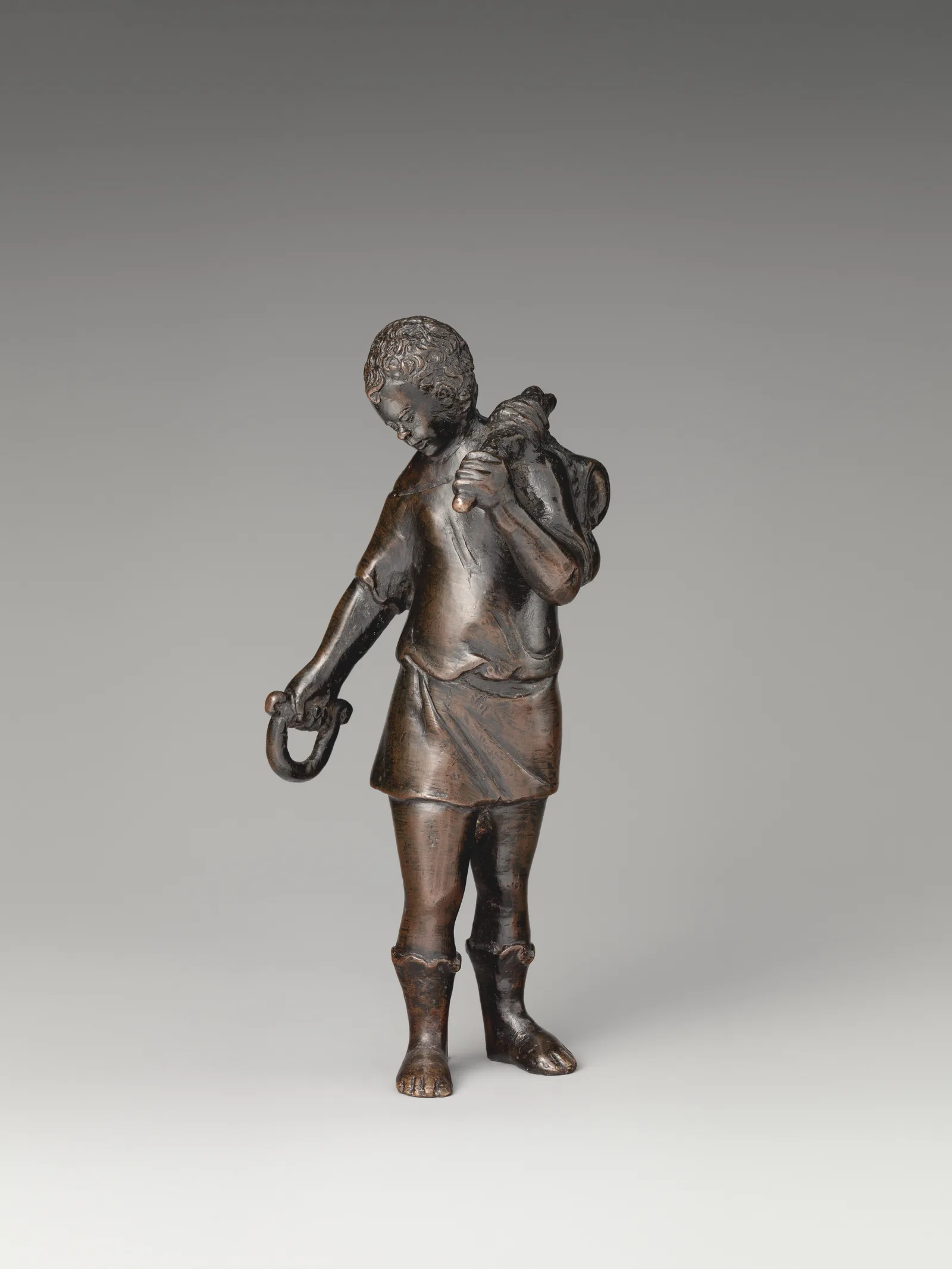
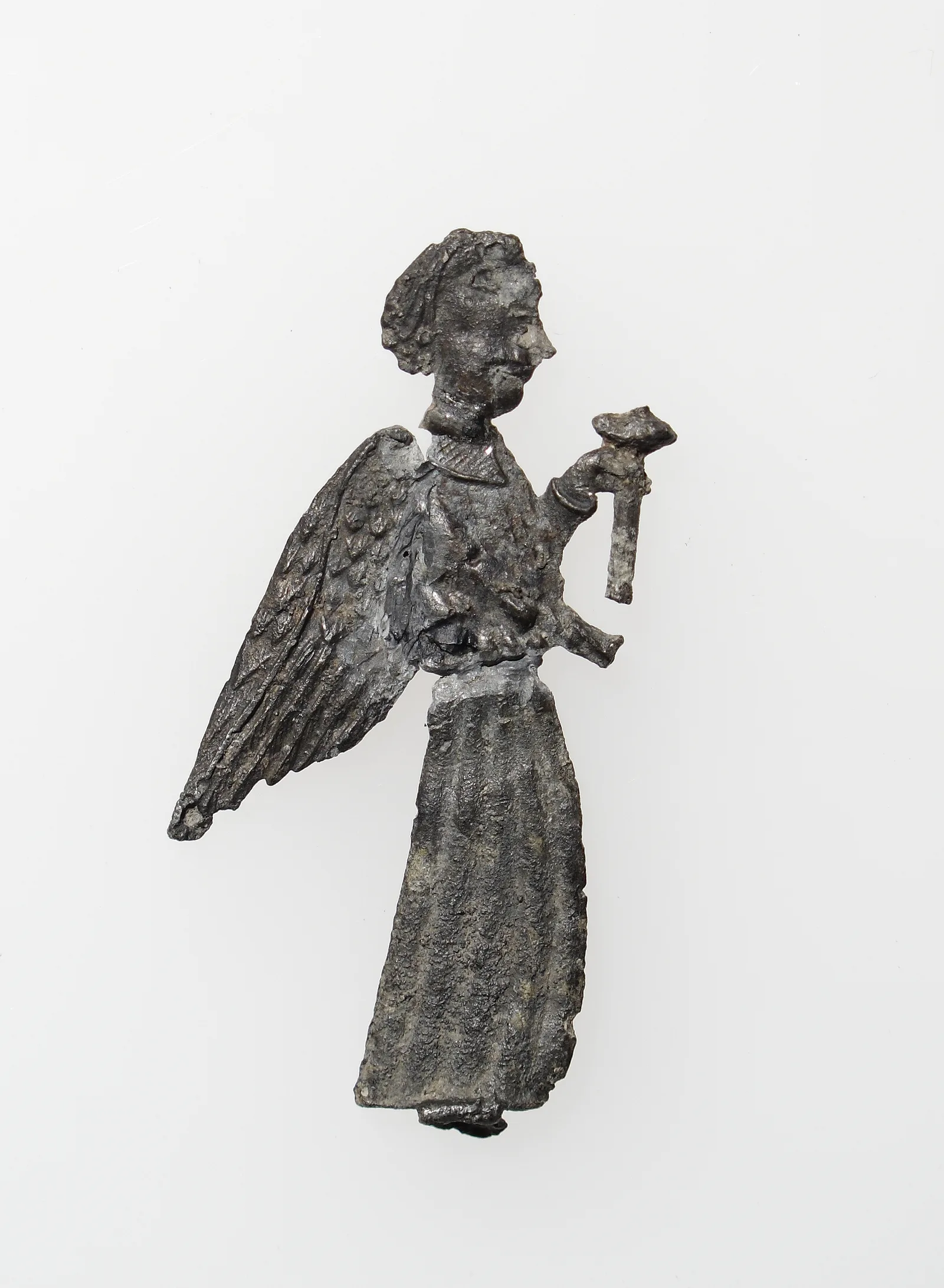
Raphael almost always has wings, but the composition stresses the step rather than flight: one foot forward, the hem of the garment in motion, the body leaning slightly ahead. He is dressed not in armour, as Michael is, but in a belted tunic and a cloak, often tucked up so as not to hinder walking. Across his shoulder hangs a bag or pouch, sometimes a water flask. This is the costume of a wayfarer, not of a warrior or a herald. Jewellery relief conveys these details differently: heavy casting shows both the folds and the strap of the bag, while a thin stamping leaves only the silhouette, the wings and the staff.
Shell, gourd and the pilgrim's marks
In the Spanish tradition, pilgrim attributes are often added to Raphael: a round gourd flask on the staff and a scallop shell on the cloak or hat. This is already a layer from the age of the Camino de Santiago, when everything connected with the road acquired the shared pilgrim kit. The scallop shell is itself an ancient sign of the way, discussed in a separate guide to the Camino scallop shell and its meaning. On medals these details appear less often than the staff and the fish, but they turn up regularly on old Spanish pieces and instantly betray the southern origin of the type.
Tobias alongside and the dog at their feet
A separate iconographic type shows not a solitary angel but a pair: a tall Raphael leading the boy Tobias by the hand, with a small dog running at their feet. This composition was extraordinarily popular in fifteenth-century Italian painting, where "Tobias and the Angel" was painted by the dozen, often commissioned by families sending a son on a long trading journey. In jewellery the paired composition appears on larger oval medallions where there is room for two figures. A solitary Raphael is more compact and works better on a small round.
Now that the set of objects has been sorted out, it makes sense to move to meaning. Care with wording matters here, because it is easy to spin promises around a "healing angel" that no one can back up. Tradition says one thing, advertising often adds another. What follows is what the image of Raphael genuinely means in culture, and what it has never meant.
Customer reviews
Zevira is a real jewellery shop. Genuine payments, deliveries and customer thank-yous.
🥰🥰🥰 gracias
Ok, ¡gracias! 🙂
Meaning: the road, health, the meeting
Raphael's three themes come not from esotericism but straight from the plot: the journey, recovery and a happily arranged meeting. Each of them stuck to him in popular devotion for centuries and reached modern jewellery almost without distortion. They are worth taking one at a time, because the meanings differ and a gift built on each of them looks different.
The road and the safe return
Raphael's central theme is not departure but return. In the Book of Tobit the angel does not save anyone from the road; he walks it together with a human being and brings him home whole, with money, a wife and medicine for his father. That is why a Raphael medal is traditionally given to someone who is expected back. It sets him apart from many road signs where the emphasis falls on protection in the moment. Here the emphasis falls on a closed circle: he set out, he arrived, he came home. The theme of the safe journey is examined in more detail in the piece on the Saint Christopher medal for travellers, and the pairing of these two images deserves the separate comparison given below.
Health and care for the sick
The second theme grew out of the name and out of the ending of the story. Raphael became the intercessor of the sick, of doctors, apothecaries, nurses, carers and the blind. Honesty is needed here: a medal does not cure, and no piece of jewellery can cure anything. The tradition of devotion is about support, hope and asking, not about therapy. A Raphael medal at a bedside, or around the neck of someone looking after a relative, works as a token of attention and as a reminder that care has a point. That is exactly how it should be given: as a gesture of support, not as a promise of recovery.
The meeting, marriage and a good match
The third theme surprises those who know Raphael only as a healer. In the plot he arranges the marriage of Tobias and Sarah, lifts the long trouble from the young woman and gives her household its joy back. Because of this, Catholic tradition made Raphael the patron of happy meetings, engagements and married couples. In Spain and Latin America his medal is sometimes given at an engagement, or to a young couple moving into a new home. For jewellery this is a rare case where one symbol honestly covers both the theme of the road and the theme of family.
A companion, not a rescuer
There is a fourth meaning, less obvious but perhaps the strongest. Raphael performs no spectacular miracles and does not appear in a thunderstorm. He hires himself out as a guide, takes wages, eats, sleeps, gives practical advice and keeps his name to himself until everything is over. This is the image of a dependable travelling companion who simply walks alongside the whole way. That tone is what makes a Raphael medal appropriate for people who have no taste for grandeur: it is not about might, it is about presence.
From meaning it is logical to move to geography. Devotion to Raphael is spread unevenly across Europe: in some places he is one of three archangels and nothing more, while in one Spanish city he literally stands on the squares and bridges and half the older men are named after him. That local density explains a great deal about why the Raphael medal is so familiar in the Spanish-speaking world in particular.
Upload a photo of your pet, someone you love, or an object. We'll build a 3D model and hand-cast it in pewter.

Raphael in culture and devotion
The angel with the fish survived every change of fashion because he caught hold of several durable groups at once: travellers, medical workers and one specific city that chose him as its guardian. These lines are worth taking in turn.
Córdoba and its guardian
In Andalusian Córdoba, Raphael is venerated as custodio, the guardian of the city. The basis is a local account from the end of the sixteenth century tied to an epidemic: according to the priest Andrés de las Roelas, the angel appeared to him and named himself Raphael, appointed to guard this city. After an inquiry the church authorities accepted the testimony, and from then on Raphael became the chief heavenly patron of Córdoba. For the city this is no formality: his name is on churches, on streets, in the personal names of its people. Rafael and Rafaela are still among the most common names in Andalusia.
The Triunfos de San Rafael on the squares
The most visible result of this devotion is the triunfos, stone columns with the archangel's figure on top, set up all over Córdoba. There are more than a dozen, and the best known stands at the Puerta del Puente, beside the Roman bridge over the Guadalquivir at the entrance to the old town. They were raised between the seventeenth and nineteenth centuries as public monuments of thanks. The logic of their placement speaks for itself: the columns stand at bridges, gates and entrances, in other words where a person enters or leaves the city. The guardian is posted at the boundaries of the journey.
Patron of travellers and pilgrims
Beyond Andalusia, Raphael took hold as the intercessor of everyone on the road, sharing that role with several other figures. His version has a particular shade: he is the patron less of speed and transport than of the long journey with a return. Pilgrims, merchants, sailors and later emigrants carried his medal with exactly that meaning. In Spanish port cities a Raphael medal was packed for those leaving across the ocean, and other protective medals often travelled in the same trunk, for instance the Saint Benedict medal with its Latin letters.
Patron of doctors, apothecaries and the blind
The second durable audience is people who work with health. Doctors, pharmacists, nurses and carers see in Raphael a professional patron, and this devotion is older than modern medicine: old hospital chapels and pharmacies in Catholic countries were regularly dedicated to him. Separately, intercession for the blind and for people with eye disease attached to him, directly from the ending of the Book of Tobit. Because of that, a Raphael medal became a traditional gift on finishing medical training and on starting in practice.
The feast day of 29 September
In the modern Catholic calendar Michael, Gabriel and Raphael are celebrated together on 29 September. Before the calendar reform Raphael had his own separate date, 24 October, and some local traditions still remember it. The shift was a simple administrative one: the three archangels named in scripture were gathered into one shared feast. For a gift this is convenient, because the date is fixed and easy to remember. Córdoba, meanwhile, keeps its own celebrations tied to the local account.
Raphael in painting and on pharmacy signs
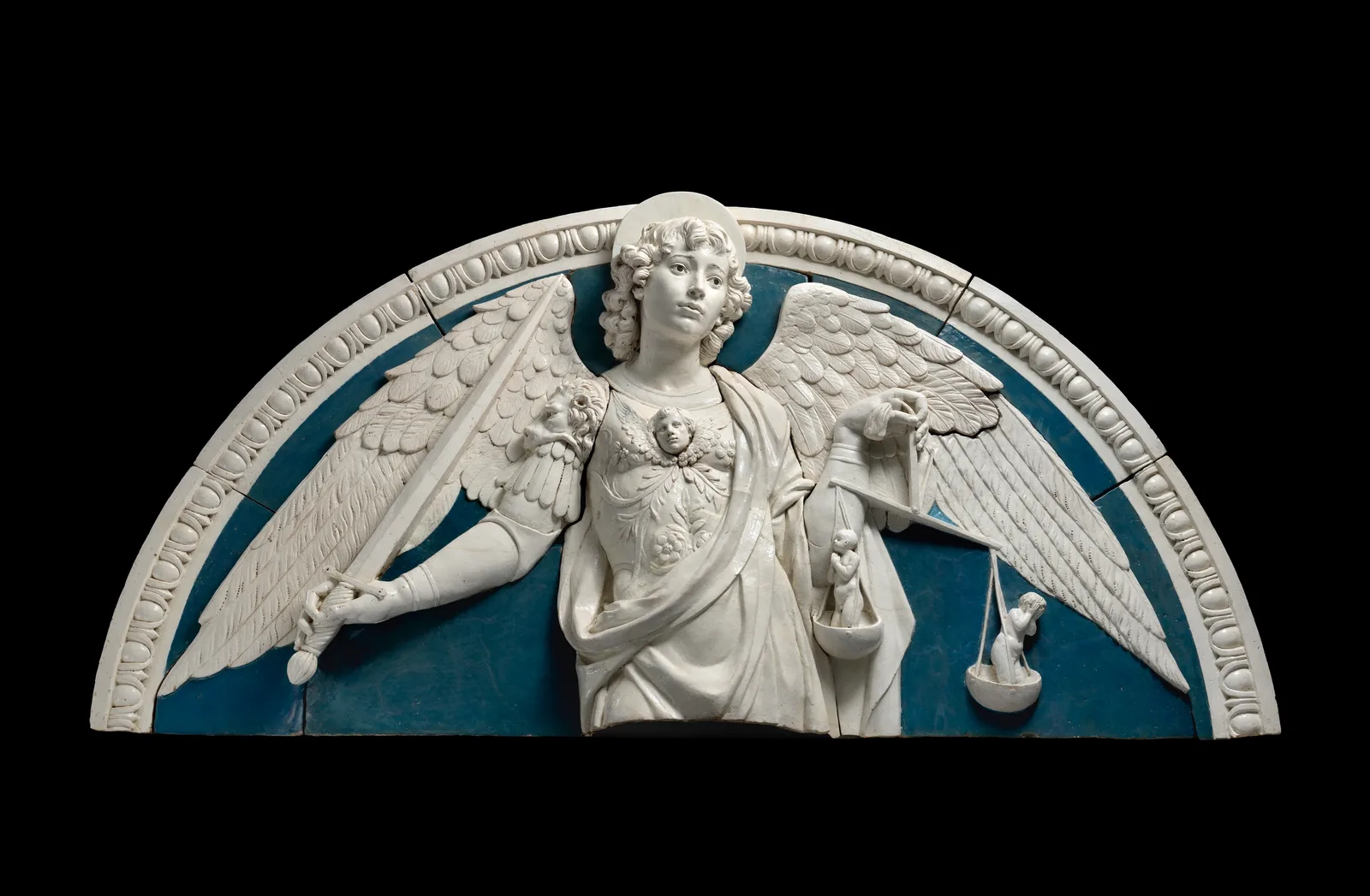
The pictorial tradition did more for Raphael's recognisability than theology did. "Tobias and the Angel" was one of the most sought-after subjects in fifteenth-century Italian painting, often commissioned by merchant families sending their sons on distant journeys. The painting worked as a charm and as a reminder: the boy walks the road, but he does not walk it alone. Later the figure of the angel with the vessel migrated onto the signs of pharmacies and hospitals. So one literary plot produced a whole visual language that is still read without a caption.
From painting and civic sculpture the image passed into a personal object. A medal at the neck is the same plot compressed into two centimetres of metal, and it has its own laws: what fits into relief, what reads at arm's length, what does not snag on clothing. What follows examines the Raphael medal specifically as jewellery, without pious generalities.



The Raphael medal as jewellery
A Raphael medal is neither a miniature icon nor an abstract symbol. It is a wearable object with a plot, and everything depends on how that plot is laid into the metal: whether the figure is recognisable, whether the fish reads, whether the staff turns into a scratch. Here is what a good medal is made of.
What has to be visible on the medal
The minimum set by which a medal is identified as Raphael is a figure in motion, wings, a staff on the diagonal and a fish. The vessel is desirable, but at a small diameter it is often sacrificed. If only wings and a halo remain, you are looking at a generic angel and there is no sense buying it as Raphael. Good relief gives distinguishable folds of clothing and a line of the staff that does not merge with the rim. This is worth checking at arm's length rather than under a magnifier: that is how other people see the medal.
Round, oval and rectangle
The round medal is the most familiar shape and the hardest for a narrative subject: a full-length figure inside a circle comes out small and the details are lost. An oval is stretched vertically and suits a standing figure far better, which is why traditional Spanish Raphael medals are more often oval. A rectangle with rounded corners is a modern solution; it gives maximum height and looks good on a flat chain. The paired composition with Tobias and the dog is worth taking only on an oval or rectangle from two and a half centimetres upward, otherwise the boy becomes a blur.
Inscriptions around the rim
Around the rim a medal usually carries the name in Latin or in the local language: San Rafael, Sanctus Raphael, less often a full invocation. Spanish versions frequently carry San Rafael, which immediately marks out the Andalusian origin of the type. The inscription does double duty: it labels the subject for anyone who does not read the attributes, and it frames the composition so the figure does not run into the edge. Type that is too small at a small diameter turns into a ripple, so on medals under a centimetre and a half the inscription is better shortened or dropped entirely.
The reverse and engraving
The reverse of Raphael medals is usually plain, and that is its chief virtue. It takes a name, a date of departure, a date of graduation, home coordinates or a short phrase. Engraving turns a standard medal into a personal object and noticeably raises the chance that it will be worn rather than put in a drawer. For someone in medicine the date of starting practice makes sense; for a gift before a journey, the date of departure or the name of the city the person is leaving for.
Pendant, keyring or a medal for the bag
Not every medal needs to hang at the neck. Some people carry a Raphael medal on their keys, on a keyring in the car, in a wallet, or sew it into the lining of a travel bag. Formally it is the same object, but the requirements differ: it needs sturdy metal, a thick bail and a minimum of fine projections, because in a pocket with keys a delicate relief wears away within a couple of years. For the neck the opposite holds: fine work and a noble metal win. Decide in advance where the object will live and the choice of material becomes obvious.
Materials and formats
Material determines the look, the service life and who the medal suits. A Raphael medal has an extra condition: the subject is complex, full of small detail, and not every metal carries it. Below is a breakdown of the main options.
Sterling silver 925
Silver remains the main material for religious medals and for narrative medals especially. It holds fine relief well, and its cool sheen shows folds and wings to advantage. An alloy of ninety-two and a half per cent pure silver is strong enough for daily wear. Over time silver darkens, and on a narrative medal that is more of an advantage: patina fills the recesses and gives the figure contrast. A detailed look at the metal is in the guide to 925 silver. For a Raphael medal, silver is a sensible balance of appearance and practicality.
Stainless steel
Steel is chosen by those who need the medal as a working object on the road. It does not tarnish and is unafraid of sweat, seawater, sun and drops onto asphalt. For a long-haul driver, a sailor, a motorcyclist or someone on shift in a hospital, steel is often more sensible than silver. There is one limitation: steel carries fine detail less well, and on a small steel medal the vessel and the fish often merge. If you take steel, take a larger diameter and a deeper relief, or the subject will be reduced to a silhouette.
Gold and gold plating
A gold medal belongs to the level of a family heirloom and a gift for a serious occasion: graduation, coming of age, a move to another country. Yellow gold is traditionally linked with religious medals and looks warm against olive skin; white gold gives a restrained, contemporary look. Gold does not tarnish and outlives several generations, which matters for an object meant to be passed on. A more accessible route is good plating over silver: the same look, with higher demands on care. The difference between a coating and solid metal is set out honestly in the comparison of gold plating and solid gold.
Oxidising, patina and enamel
Over the base metal a medal is often finished further. Oxidising darkens the recesses so the angel's figure stands out from the ground exactly as the engraver intended. Without this treatment a narrative medal in polished silver flares and reads worse. Patina gives the look of an old object and suits an image backed by an ancient text. Coloured enamel is rarer and usually appears on decorative versions: blue water, green clothing. Enamel makes a piece more festive but demands care, because a chip on a small surface is noticed at once.
Size, bail and chain
For a single figure the working range is one and a half to two and a half centimetres in height. Under one and a half the subject falls apart; over three the medal starts living as a visible accent rather than a personal token. On narrative medals the bail is better cast in one piece rather than soldered on butt-to-butt, because the load falls on a single point. A chain of medium weight, forty-five to fifty-five centimetres long: shorter and the medal disappears under the collar, longer and it starts swinging and catching. A thin chain under a heavy medal is the commonest cause of loss.
Leave your email, we'll send your discount code. No spam, unsubscribe anytime.
The code arrives by email, valid on your first order.
Who receives an Archangel Raphael medal
Raphael has an unusually wide range of occasions precisely because his story holds three themes at once: the road, health and the meeting. Below are the concrete situations in which the medal works as a meaningful gift rather than a random trinket.
For someone leaving for a long time
The most direct occasion. Study abroad, a long posting, an expedition, a move, rotational work. The meaning of the gift is exactly the one in the Book of Tobit: not "take care of yourself" said a hundred times, but a small sign that the person is expected back. It is a gift about the return, and it is best spoken of that way. A date engraved on the reverse sits well with a departure: in ten years that number will mean more than the metal.
For doctors, nurses and carers
To a doctor on finishing training, to a nurse starting work, to a carer or to someone who has looked after a relative for years. Here Raphael reads as a professional patron and as recognition of hard work. It is important not to overplay the wording: the gift means respect for the work and support, not a promise that everything will turn out well. For those on shift, steel or dense silver without fine projections is more practical.
For the recovery of someone close, carefully
A Raphael medal is also given in illness, but this is the most delicate of the occasions. The right framing sounds like "I am here" and "hold on", not "this will cure you". The medal does not cure, and any seller who claims otherwise is misleading people. At the same time the tradition of asking Raphael's intercession for the sick genuinely is ancient, and for a believer such a gift will be fitting and understood. For a non-believer it is better to choose another occasion, or to give it with plain words of support and no religious framing.
For an engagement and for a young couple
The Sarah and Tobias thread makes Raphael a patron of happy meetings and of married couples. In the Spanish-speaking tradition his medal is given at an engagement or to newlyweds moving into a new home. It is an unobvious but well-grounded gift, especially if the couple know the story. The paired composition with two figures works well here, or two medals engraved with the same date.
For a name day and for 29 September
Rafael and Rafaela are common names in Spain and Latin America, and 29 September is their name day. A medal of one's own heavenly patron is the classic gift for that day, understood without explanation. It is also a convenient fixed date for anyone looking for an occasion: once a year it arrives by itself.
For yourself, before your own journey
Buying a charm for yourself is entirely normal and no worse than receiving one as a gift. People take a Raphael medal before a move, before a long course of treatment, before starting a new job in an unfamiliar city. It is a way of marking a threshold materially: before this object one life, after it another. There is no naivety in such a purchase; there is sober work with one's own anxiety.
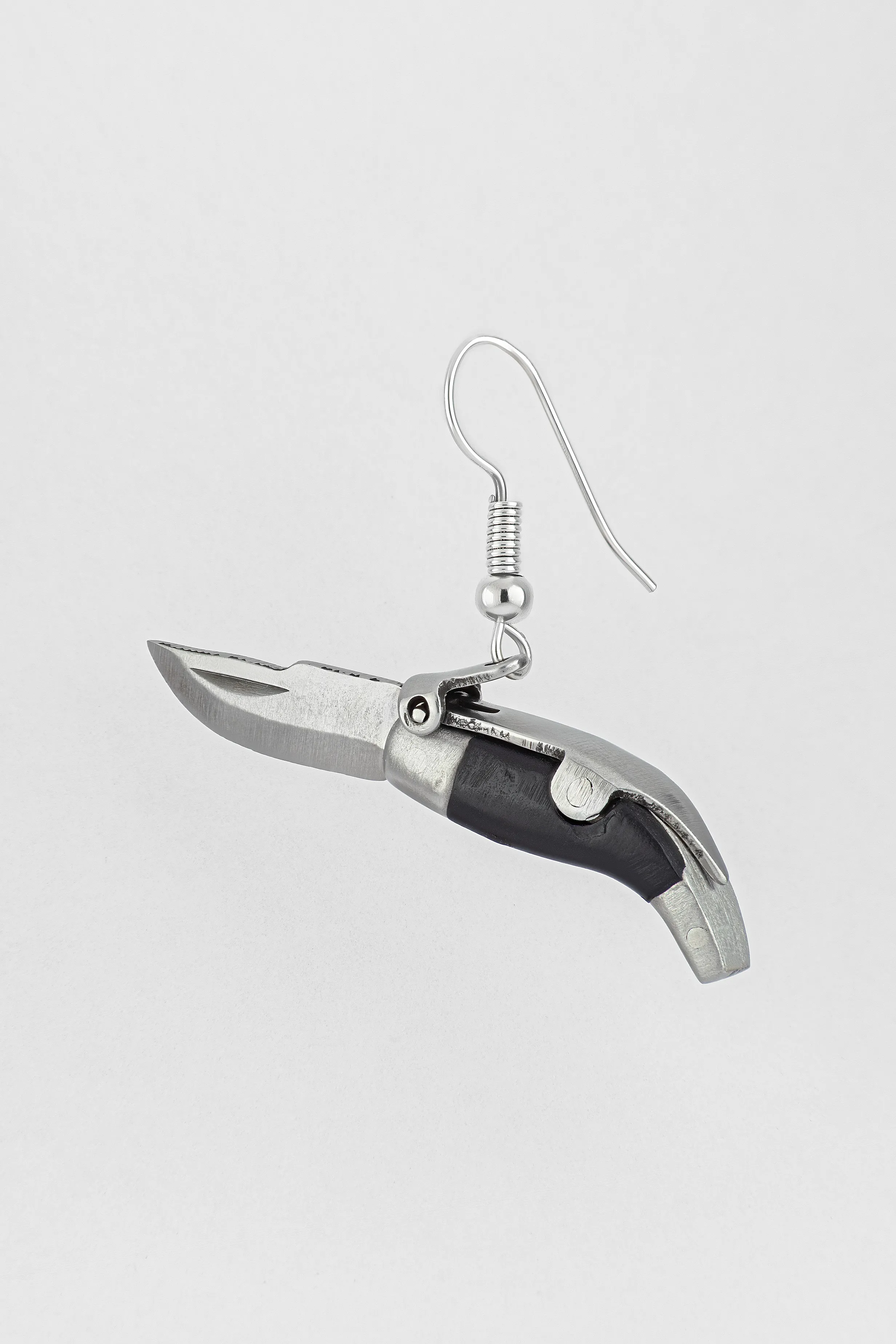
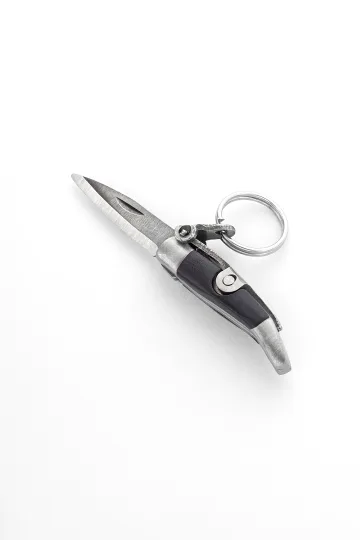
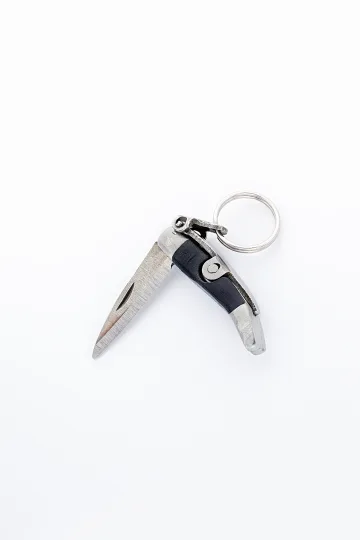
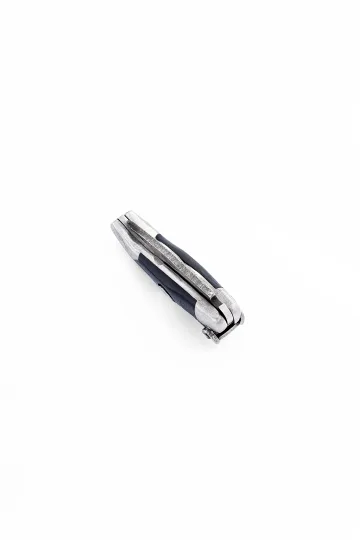
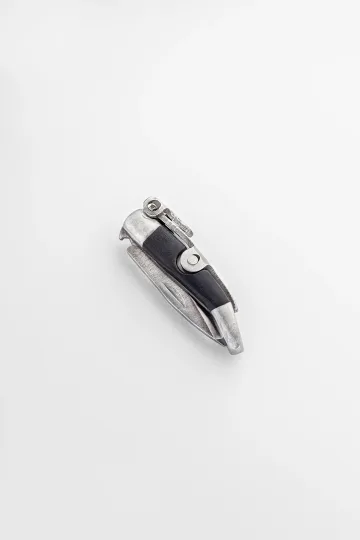
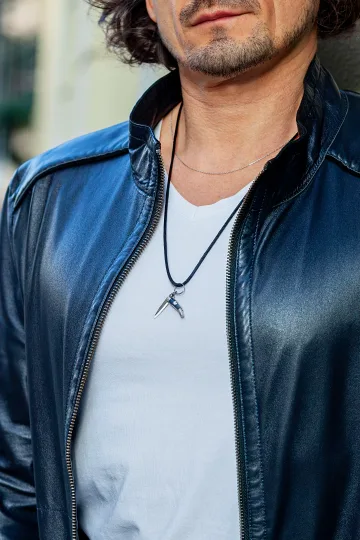
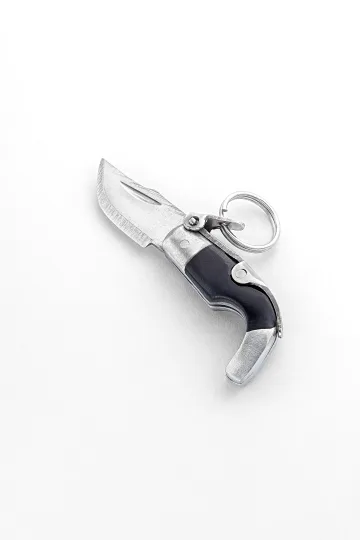
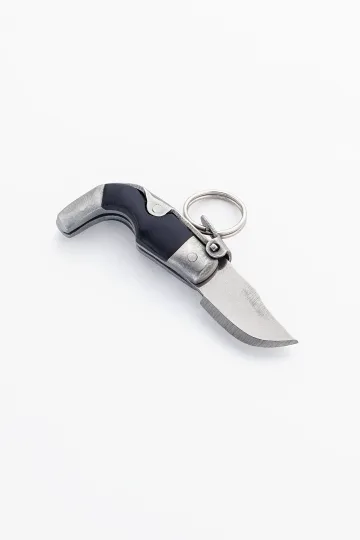
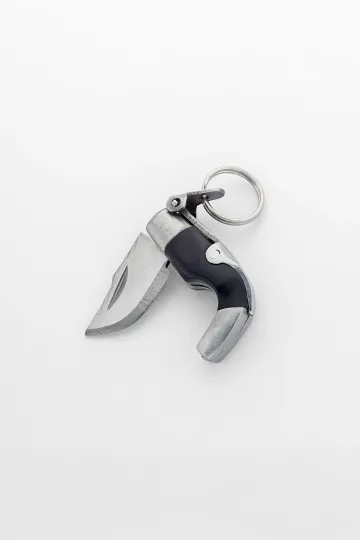
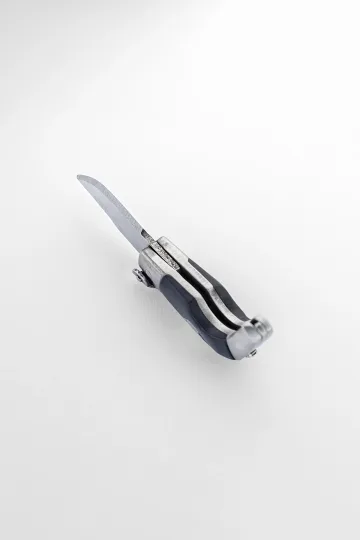
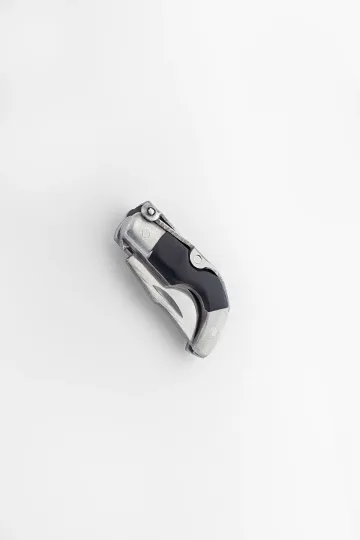
CAPAORA mini knife pendant
The 18th-century Spanish navaja in miniature: 40 mm of stainless steel, a real folding mechanism and a Palanquilla lock that clicks. An affordable gift to remember.
Authentic · Ships from Spain · 14-day returns
Psychology: why people choose the image of a companion on the road
It is worth examining separately why, out of all protective images, people so often choose a companion rather than a warrior. This is not about faith or mysticism; it is about how anxiety in the face of the unknown is built.
A travelling companion works better than a defender
The image of a powerful defender removes fear but underlines the danger: if a warrior with a sword is needed, there must be an enemy ahead. The image of a companion removes fear differently, by sharing the road. It says not "I will fight them off" but "I am walking with you". For a journey, a course of treatment, a move and any long uncertainty, the second formula is more accurate: the main weight there lies not in one dangerous moment but in the long loneliness of the process. Raphael addresses exactly that.
A material anchor for anxiety
Anxiety yields badly to argument and well to ritual. A small object you can touch in a pocket works as a physical point of assembly: the hand finds metal, attention switches from an imagined catastrophe to a concrete thing. Psychologists describe this as grounding through tactile contact. The medal here is not a source of power but a tool for redirecting attention, and it works the same for believers and non-believers.
The ritual before leaving the house
Many people who carry travel medals describe the same habit: before going out, the hand checks that the object is in place. It is a short closing ritual that separates home from the road. People build such rituals for themselves regardless of religion: one touches the pocket with the keys, another repeats a phrase. The medal simply gives the ritual a convenient support. Hence its durability: it is built not into beliefs but into an everyday sequence of actions.
A gift as a permitted form of care
There is one more reason, purely social. Telling an adult "I am afraid for you" is awkward in almost any culture. Handing over a small object for the road is always possible, and it says the same thing without forcing an uncomfortable scene on either party. The Raphael medal is especially convenient in this role because its message is gentle: not about death and danger, but about coming home.
Why a story outlives a symbol
One last observation. Symbols without a plot wear out quickly: they can be explained any way at all, and so they mean nothing in particular. Behind Raphael stands a specific tale with a fish, a dog, a wedding and a blind father. Someone who has had that tale told to them once remembers it for years and wears the medal with understanding. That is exactly why narrative medals stay in families longer than abstract pendants: there is someone to pass them on to, together with the story.
Raphael and neighbouring signs
A Raphael medal is rarely chosen in a vacuum. Usually a person stands in front of several similar medals and cannot see how they differ, because all of them promise protection. The differences are substantial, and they concern not so much strength as the address of the message.
Raphael and Christopher: two different messages about the road
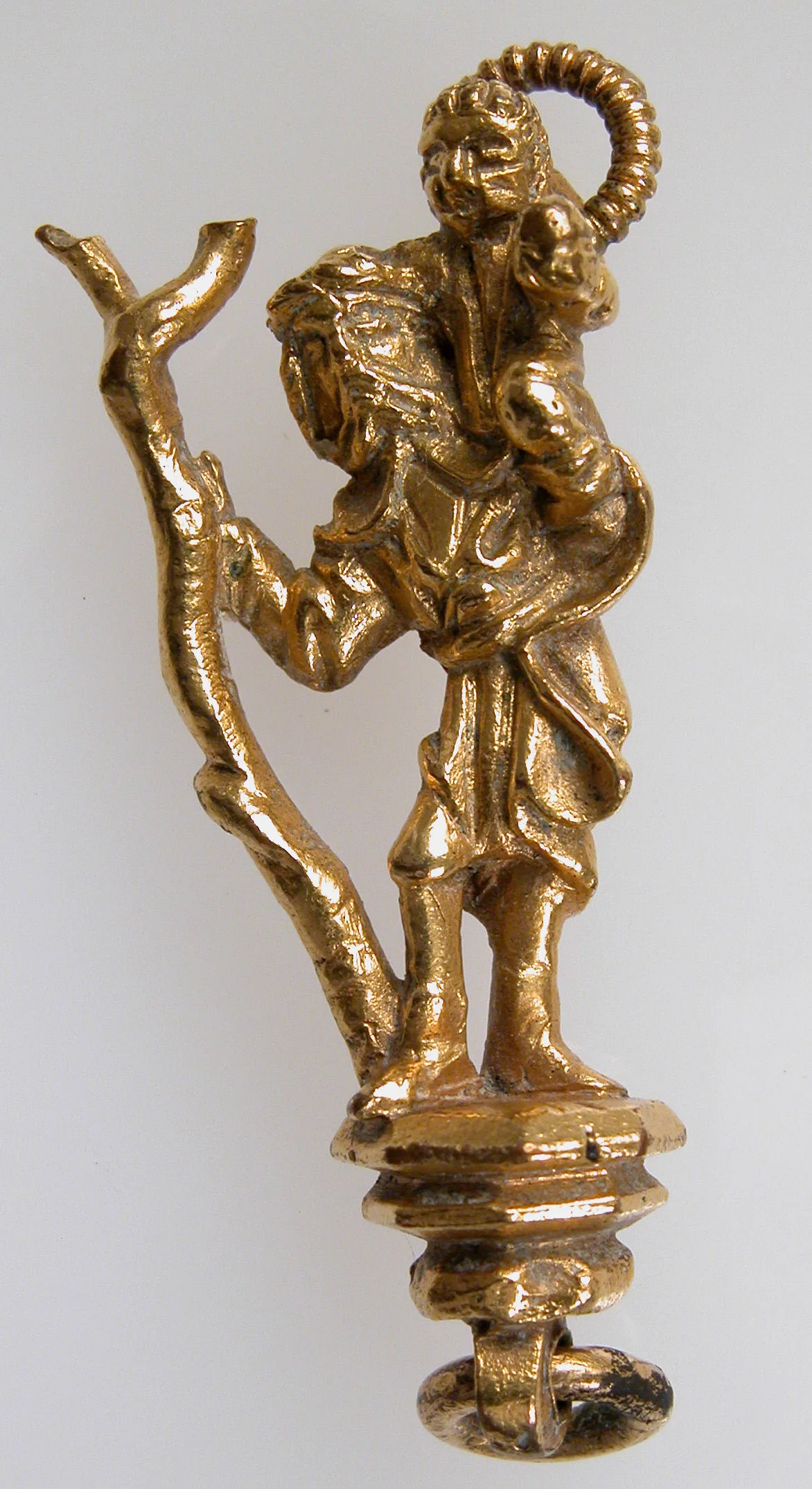
Both are linked with the journey, but they say different things. Christopher is a crossing of a dangerous place here and now: a giant waist-deep in water carries his burden to the other bank. His theme is the moment of risk, which is why he moved so naturally onto the car mirror. Raphael is a long route with a homecoming: he set out, he arrived, he came back with a gain. His theme is duration, not the dangerous point. For someone who drives every day, Christopher is more logical, and he is examined in detail in the guide to the travellers' medal. For someone leaving for two years, Raphael is more logical.
Raphael and Michael: companion against warrior
Michael is the warrior archangel with sword and scales; his image is about struggle, judgement and decisive intervention. Raphael is the guide with staff and fish; his image is about accompaniment and restoration. The difference is visible in the iconography itself: armour against a travelling tunic. A Michael medal fits where a person feels outside pressure and wants a sign of strength, and it is examined in the guide to the Archangel Michael medal. A Raphael medal fits where a person needs not strength but company. Both images belong to the same tradition and sit easily side by side, but their messages are opposite in tone.
Raphael and the Camino shell
The scallop shell is a secular-feeling and very ancient sign of the way, the identifying mark of a pilgrim on the road to Santiago. It is not personified: behind it stands a route rather than an intercessor. Raphael is personified completely; behind him stands the story of one particular companion. People usually choose between them according to their attitude to religious imagery: anyone who wants the theme of the road without angels and saints is closer to the shell, whose meaning is examined in detail in the piece on the Camino de Santiago scallop.
Raphael and the Benedict medal
The Saint Benedict medal is built on a fundamentally different principle: it is not a depiction of a story but an encoded text, a set of Latin letters around the rim and on the cross. It is about protection from evil and works as a formula rather than as a narrative. Raphael works as a narrative and barely works as a formula. Anyone drawn to the idea of an encrypted inscription and dense text on metal will sooner choose the Benedictine medal, examined in a separate guide to the Saint Benedict medal. Anyone who wants a recognisable figure and a clear story is closer to Raphael.
Raphael and the Miraculous Medal
The Miraculous Medal is a Marian image with a fixed composition and a strict history of origin tied to the nineteenth century and a particular vision. It is about the intercession of the Virgin and is worn as a mark of Marian devotion. Raphael is about the road and health. The overlap between them is minimal, and they are often worn together on one chain, which is entirely normal in Catholic practice. The structure and symbolism of the second are examined in the piece on the Miraculous Medal.
Comparison helps with the choice but does not answer the questions that usually come next. A layer of legend, contested interpretation and plain error has built up around Raphael and travels from one description to another. Before taking those apart point by point, it is worth gathering what is genuinely unexpected in this story even for people who know the subject.
Send a friend a discount code, they save on their first order.
Facts that surprise
The Book of Tobit and its angel have been accumulating strange details for more than two thousand years. Below are those that most often cause surprise, including a couple of things that are usually misunderstood.
The angel negotiated his wages
Raphael hires himself out to Tobias not as a heavenly messenger but as an ordinary guide, and the parties discuss terms: a drachma a day plus expenses. The father even checks the pedigree of the man he has hired before letting his son go. There is simply no more domestic episode involving an angel in the biblical texts. That scene set the tone of the whole image: Raphael is built into human life completely, right down to the question of pay.
A dog with an actual part
A dog sets out on the road with Tobias and the angel and comes back with them, running ahead on the return. Domestic animals almost never appear as characters in biblical plots, so this dog became a favourite detail for painters: on dozens of fifteenth-century pictures it runs at the angel's feet. On larger medallions it is sometimes kept, and it is the most reliable clue that what you are looking at is a scene from the Book of Tobit.
The fish on the medal is not the Christian fish symbol
The early Christian ichthys sign and Raphael's fish are different things, constantly confused. Ichthys is a Greek word whose letters unfold into a confession of faith, and it appeared as a secret mark of a community. Raphael's fish is a specific animal from a specific river, from which three parts were taken for a specific need. The resemblance is purely external and the meanings do not overlap.
He had his own date, and it was abolished
Before the reform of the Catholic calendar, Raphael's commemoration fell on 24 October, separately from Michael. After the reform the three archangels named in scripture were combined into a shared feast on 29 September. The old date still lives on in places in parish tradition, which is why different sources give both, and both are right in their own way.
The book about him is not in every Bible
The Book of Tobit belongs to the Catholic and Orthodox canon but is absent from the Jewish and Protestant ones. Because of this, someone raised in a Protestant culture may genuinely not know the story, while a Spaniard or an Italian knows it from childhood. The Qumran finds, meanwhile, confirmed that the text is ancient and existed in Aramaic and Hebrew long before the disputes about canon.
A whole Spanish city counts him as its guardian
Córdoba treats Raphael not as one of the archangels but as the personal defender of the city. Hence the dozen stone columns bearing his figure on squares, at gates and by the Roman bridge, and hence the density of the name Rafael among its people. Few angelic cults are so tightly bound to one geographical point.
He is patron of matchmaking as much as of the sick
Because of his name, Raphael is known as a healer and hardly known as an arranger of marriages. Yet half the Book of Tobit is the marriage thread: the courtship, the trouble lifted from Sarah, the wedding feast. Catholic tradition lists him as patron of happy meetings and of married couples, and in southern Spain his medal is given at an engagement as calmly as it is given for the road.
He hides who he is for almost the whole story
The angel reveals his name only in the penultimate chapter, when everything is already done, and immediately afterwards he disappears, having refused payment. Until then he is Azariah, son of Ananias, to everyone. Such a structure is rare: usually an angel in a text announces from the doorstep who he is and why he has come. Here it is the reverse, and that is precisely why the image came out being about presence rather than about apparition.
With the facts and misconceptions sorted, what remains is to answer the practical questions most often asked before a purchase. They concern meaning, material, and whether the gift fits a particular situation.
Frequently asked questions
What does the name Raphael mean?
The name is built from the Hebrew roots rapha, to heal, and El, a name of God, and translates as "God has healed" or "God heals". It is a rare case where a name directly describes the bearer's role: the whole later tradition of venerating Raphael as intercessor of the sick grew out of this etymology and out of the ending of the Book of Tobit, where the hero's father regains his sight.
Is Archangel Raphael in the Bible?
Yes, he is named in the Book of Tobit, which belongs to the Catholic and Orthodox canon as a deuterocanonical book. It is not in the Jewish or Protestant canon, which is why familiarity with Raphael varies so much between traditions. His name also appears in the non-canonical Book of Enoch. In canonical texts only three angels are named: Michael, Gabriel and Raphael.
How does a Raphael medal differ from a Christopher medal?
Both are about the road, but the emphasis differs. Christopher is protection at a dangerous moment, a crossing of a river, hence his popularity with drivers. Raphael is accompaniment along the whole length of a long journey and a safe return home. Christopher makes more sense for daily driving, Raphael for a long trip, a move or study far from home.
Why is there a fish on the Archangel Raphael medal?
It is the fish from the Book of Tobit. During the night by the Tigris it lunges at the young man, he drags it ashore, and on his companion's advice keeps the heart, liver and gall, which later prove useful. The fish is Raphael's identifying attribute, as the sword is Michael's. It has no connection with the early Christian ichthys sign.
When is the feast of Archangel Raphael?
In the modern Catholic calendar, 29 September, together with Michael and Gabriel. Before the calendar reform Raphael had a separate date, 24 October, and some local traditions still remember it. Córdoba additionally keeps its own celebrations connected with the local account of the city's guardian.
Can a non-believer wear a Raphael medal?
Yes. A considerable proportion of the people who wear such medals treat them as a cultural tradition and a token of care rather than as a profession of faith. The medal requires no rites and commits you to nothing. It is worth understanding, though, that the symbol is Christian and in some contexts will be read that way.
Does a Raphael medal help you recover?
No, and promising that would be a deception. No piece of jewellery replaces treatment or affects the course of an illness. The tradition of venerating Raphael is about asking, hoping and supporting, not about therapy. The practical sense of a medal at a sickbed or around the neck of a carer is psychological: it is a reminder that the person is not alone, and that is a value in itself.
Which to choose as a gift: silver or steel?
It depends on the conditions of wear. Silver carries narrative relief better, looks more refined and suits an occasion gift. Steel is more practical for people constantly on the road or working with their hands: it does not tarnish and is unafraid of water or knocks. If the medal is going onto keys or into a pocket, take steel and take it larger. If it is going to live at the neck, silver wins.
Conclusion
Raphael stands out among heavenly protectors because he does almost nothing spectacularly. He does not appear in a storm, does not raise a sword and pronounces no prophecies. He hires himself out as a guide, walks on foot, advises what to do with a fish, arranges someone else's wedding and leaves without taking payment. His whole story is a few weeks of road beside a frightened boy.
That is why his medal works not as a shield but as a promise of company. It suits someone leaving for a long time who is expected back. Someone nursing a relative and holding on by the last of their strength. Someone starting in medicine and beginning to understand what they have taken on. A silver oval with a figure, a staff and a fish says one short thing: the road is long, but you are not walking it alone.
The Archangel Raphael medals in our range come in 925 silver and steel with legible relief: the wayfarer's figure, the staff, the fish, and a plain reverse ready for a date or a name. A fitting gift for a journey, for someone in medicine, for 29 September, or for yourself before a long road.
Buying it as a gift? Each one arrives ready to give.
 A branded Zevira box and a little card come with every order.




About Zevira
Zevira makes jewellery with character and meaning rather than shiny objects for the sake of shine. We make charms, symbols and medallions in 925 silver, steel and gold, with attention to relief, to the history behind the image and to the option of engraving. Every piece is built to be worn every day and passed on. If you need an object that means something to a particular person for a particular occasion, we help find one.