Saint Jude Thaddeus: patron of hopeless causes, the meaning of the medal and the jewellery
On the 28th of every month, tens of thousands of people walk toward the church of San Hipólito in central Mexico City. Many carry plaster statues dressed in green and white, wrapped in cellophane or held against the chest like a child. The queue stretches for several blocks. This is what devotion looks like to an apostle whose name almost nobody dared to say aloud for centuries.
This article is about how one of the twelve disciples of Christ became the saint of desperate requests, where the green cloak, the tongue of flame above the head and the medallion on the chest came from, and why millions of people from Mexico to Spain wear the Saint Jude medal.
Who Jude Thaddeus was: an apostle, not the traitor
Saint Jude Thaddeus is one of the twelve. He walked with Christ through Galilee, heard the same sermons as Peter and John, and stood in the same room at the Last Supper. And for almost two thousand years he stayed in the shadows, because his name matched the name of the traitor. His entire fate in popular piety grew out of that confusion.
What he is called in different languages
In English he is Saint Jude, or Saint Jude Thaddeus. In Spanish he is San Judas Tadeo, in Italian San Giuda Taddeo, in French saint Jude, in German der heilige Judas Thaddäus. English got lucky with a convenient split: the traitor is Judas, the apostle is Jude, and on paper the two never meet. Spanish and Italian have no such division, both men sound identical, and that is exactly why in Romance-speaking countries the second name Tadeo or Taddeo is almost always attached to the apostle, to cut off the false association immediately. The habit is so ingrained that in Spanish the phrase San Judas Tadeo is pronounced as a single unbroken word.
Wear the symbol, don't just read about it. These are in stock:





Why he is confused with Judas Iscariot
Judah was one of the most ordinary names in first-century Judea, roughly the way John or Juan is ordinary today. It goes back to the tribe of Judah and sounded proud to a Jewish ear. Among the twelve apostles there were two men with it: Judas Iscariot, who betrayed the Master, and Jude, son of James, also called Thaddeus. The evangelist John adds a deliberate clarification, "Judas, not Iscariot," so the reader will not mix them up. The by-name Thaddeus, probably from an Aramaic root meaning heart or breast, served the same purpose as the evangelist's note. But clarifications work poorly in popular memory. On hearing the name a person remembered thirty pieces of silver, and praying to such a saint felt awkward.
What the Gospels actually say about him
Direct information is scarce. He is named in the lists of the twelve in Luke and in Acts; in Matthew and Mark, Thaddeus stands in the same position, and tradition identifies the two. The only scene in which he speaks is in the Gospel of John: at the Last Supper he asks Christ why he intends to reveal himself to the disciples and not to the whole world. The question is human and blunt, with no pious posturing. Beyond that his voice is not heard in the canonical texts. Thin biography is typical for most of the apostles, about whom little more than a name survives, but in the case of Jude Thaddeus the emptiness in the sources combined with an inconvenient name and produced something close to total oblivion.
Why he was called the forgotten saint
Latin piety attached a nickname to him that translates as the forgotten apostle. The logic is simple: people were wary of turning to a saint whose name sounded like the traitor's, and his veneration barely developed while other apostles accumulated churches and confraternities. Out of that neglect came an explanation still repeated in sermons today: since almost nobody came to him, he is free to take on the heaviest requests, the ones no one else will touch. The forgotten saint became the saint of forgotten people. Theologically this is not a doctrine but a piece of devotional reasoning, and yet it is precisely what explains why the register of patronages lists him under hopeless, impossible and desperate cases.
Who Thaddeus is and what the by-name means
The word Thaddeus, Tadeo in Spanish, appears in the Gospels as the apostle's second name. There is no single accepted account of its origin. Most often it is derived from the Aramaic taddaya, tied to the heart or the breast, giving the reading "warm-hearted" or "generous." Another version traces it to a Hebrew name built on the root for praise. Either way the by-name worked as a distinguisher: by calling the man Thaddeus, the speaker made clear that Iscariot was not meant. Over time the by-name fused to the name for good, and it is this pairing that you will see stamped on medals and painted on statues.
Before taking apart the green cloak and the flame above the head, it is worth tracing how a devotion that now gathers crowds of many thousands grew out of a handful of sparse Gospel lines. The road took almost twenty centuries, and most of it passed in silence. The explosive growth happened very recently, within the living memory of the great-grandmothers of today's parishioners, and understanding that chronology clears up half the misunderstandings around the subject at once. Many people are convinced they are looking at an ancient Mesoamerican folk cult fused with Christianity. In fact the mass devotion to Saint Jude is younger than the motor car.
The history of the devotion: from apostle to patron of the hopeless
The story falls into three unequal parts. The first is the life and death of the apostle himself, known through tradition rather than documents. The second is the long centuries of restrained European veneration. The third is the twentieth century, when Saint Jude became, in a matter of decades, one of the most recognisable saints in the Western Hemisphere.
The preaching and martyrdom of the apostle
According to church tradition, after Pentecost Jude Thaddeus preached in Judea, Samaria, Syria and Mesopotamia, and then travelled further east into Persia. There, in the most persistent version, he preached alongside the apostle Simon the Zealot, and both were martyred. That is why the Western calendar commemorates them on a single day, 28 October. The manner of execution is described differently from source to source: most often a blow from a club or cudgel, sometimes an axe or a halberd. These variations fed straight into the iconography, and the object in the saint's hand looks different from image to image. Eastern tradition preserves another account as well, one that links the apostle to Armenia, where he is honoured as one of the country's evangelisers.
The Epistle of Jude in the New Testament
The New Testament contains a short letter inscribed with the name of Jude, brother of James. Tradition connects it with the same apostle, although scholarly debate over authorship has run for a long time and yields no single answer. The text takes up a single page and reads sharply: the author warns the community about people who have slipped inside and are eating away at the faith from within, and calls on his readers to hold to what was handed down from the beginning. It closes with one of the most beautiful blessing formulas in the whole corpus, addressed to the One who is able to keep people from falling and to present them blameless. What matters for the devotion is not the theological dispute but the plain fact: the apostle has a voice of his own in Scripture, and that voice speaks to people holding on in difficult circumstances. It rhymes rather well with his later role.
Veneration in medieval Europe
Europe knew the apostle but approached him with restraint. His relics, by tradition, were brought to Rome and rest in Saint Peter's Basilica, sharing an altar with those of the apostle Simon. Isolated flashes of devotion did occur: in the German lands he was invoked as a helper in grave circumstances, and Saint Bridget of Sweden and Saint Teresa of Ávila both wrote of him as an intercessor to approach precisely with what seems beyond repair. But churches bearing his name were few, and confraternities fewer still. The apostle stayed in the calendar as a name pronounced once a year, on 28 October, together with Simon. No genuine mass movement formed around him in the Middle Ages, and this sets his fate sharply apart from that of Saint Christopher or Saint Anthony of Padua, whom ordinary people had claimed for their own needs far earlier.
The twentieth-century surge: Chicago, Mexico City and the wave of devotion
The turning point came in the 1920s and 1930s. In Chicago, at the church of Our Lady of Guadalupe, a national shrine of Saint Jude was founded by Claretian priests, and the devotion quickly outgrew the parish. During the Great Depression the saint of hopeless causes turned out to be exactly the figure people were looking for after losing work and home. It was then that short notices of thanks began appearing in American newspapers, carrying a set formula of gratitude for a request heard, and the genre survives to this day. In Mexico the devotion settled around the church of San Hipólito in the capital, where the Claretians brought the same practice. Migration did the rest: people moving between Mexico and the United States carried statues with them, and the saint spread on both sides of the border. In less than a century he travelled from a name in the calendar to one of the most recognisable images in Latin America.
Take Saint Jude as a large silver medal on a short chain. A small gold one gets lost, and this saint is not about timidity.
How to wear the Saint Jude medal: what to pair it with, metal and chain length
A saint's medal is built into an outfit differently from an ordinary pendant: it reads as a sign rather than an accent, and there is no point crowding it with neighbours. When I put a look together for a client, I start from whether the medal is worn openly or under clothing, and choose metal, size and length from there. Here is what I recommend most often.
What do you wear a Saint Jude medal with every day? For everyday wear I recommend a medium-sized medal against a plain background: grey, black, navy, olive. A relief portrait gets lost on prints and busy patterns, so smooth fabric always wins. I advise against hanging other pendants on the same chain: a saint on a medal does not sit well next to decorative charms, and the look only gets cleaner without them. One chain, one medal, a quiet top.
Which metal should you choose for your clothing colours? I choose metal by the temperature of the outfit. Silver and oxidised silver I recommend with a cool palette: graphite, grey, navy, white. Gold plating and warm brass I pick for sand, chocolate, burgundy and ochre, since they sit closer to the way the saint looks in church images. Within one outfit I keep to a single metal: chain, medal and rings in one tone look composed, whereas mixing silver with gold on a religious piece looks accidental.
What chain length do you need for a given neckline? I choose length by the neckline. With an open collar or a shallow neckline I recommend a short chain of about 45 cm, so the medal lies at the collarbones and reads in full. With a closed top, a polo neck or a buttoned shirt I advise 50 to 55 cm, so the medal drops onto the upper chest and slides quietly under the fabric. Lengths of 60 cm and more I use when the medal is worn over a jumper as a visible element. I match the weight of the chain to the medal: a heavy large one needs a solid curb or anchor chain, a light small one suits a fine link.
What size of medal should you choose? I choose size by how the piece will be worn. A small format around a centimetre and a half I recommend to those who wear the medal under clothing all the time: it does not get in the way, does not catch, and stays a private sign. A medium format of about two centimetres is universal and works both under a collar and over a T-shirt. Large versions from two and a half centimetres upward I recommend only for wearing over fabric, on a substantial chain and with an uncluttered neckline, otherwise the piece argues with itself. The larger the medal, the crisper the strike needs to be: on shallow relief the apostle's face simply will not read.
How does everyday wear differ from the feast of 28 October? On ordinary days I keep the look quieter: a small medal under clothing, a calm metal, minimal everything else. For 28 October, the apostle's feast day, it makes more sense to bring the medal up and give it room: a large format, a clean plain top, nothing extra at the neck or on the hands. Green and white in the clothing echo the saint's robes, and that works more delicately than direct symbolism. If you are going to church, I advise choosing a version without stones or shine: a restrained piece is more fitting there than a dressy one.

Turn on your camera, pick earrings, a pendant or a ring, and see the piece on yourself in real time.
Switch items in one tap.
Everything runs in your browser: no photo or video is ever uploaded.
The Epistle of Jude: the apostle's only text
Of all twelve disciples, few left any writing behind. Jude Thaddeus formally belongs to that small group: the New Testament contains a letter inscribed with his name. The text is tiny, disputed in its authorship and almost never read in parishes, yet it is what gives the apostle a voice of his own, and without a voice a saint stays a picture.
Twenty-five verses and what they say
The Epistle of Jude fills a single chapter of twenty-five verses, one of the shortest pieces in the New Testament corpus. The author introduces himself in the opening line: a servant of Jesus Christ, brother of James. What follows is a warning to the community about people who came in disguised as their own and are undermining the faith from within, turning freedom into a licence for anything. The author lists examples of apostasy from the history of Israel and finds harsh images for the offenders: waterless clouds, trees without fruit, wandering stars. It all ends with a call to hold firm to what was handed down from the beginning, to pray, and where possible to pull the wavering out. The tone of the letter is businesslike and anxious, with no consoling rhetoric.
A separate feature of the text is that the author quotes freely from books outside the Hebrew canon: a recognisable citation goes back to the Book of Enoch, and the dispute of the archangel Michael over the body of Moses is known from Jewish tradition rather than from the Pentateuch. For the history of the biblical canon this is valuable evidence of what early communities were reading, and it is precisely because of these references that the letter drew caution from commentators for centuries.
Why the authorship is still argued over
Church tradition connects the letter with the apostle Jude Thaddeus, and on that basis Western iconography gave him a book or a scroll in his hand. Scholarly debate runs along a different line: the Greek of the letter is expressive and schooled, which is unusual for a Galilean fisherman, and the reference to the apostles in the past tense may point to a late date. Some researchers see another Jude behind it, brother of James the Just; some allow for the hand of a scribe; some hold to the traditional attribution. There is no definitive answer and probably never will be. For the devotion this changes nothing: in devotional practice the letter has long been attached to the apostle whose face people wear on medals.
The doxology that outlived the letter
The last two verses are far better known than the letter itself. This is the doxology about the One who is able to keep people from falling and to present them blameless before his glory. For centuries the formula was read at the close of services and copied into prayer books, often by people who had no idea where it came from. The thematic rhyme with Saint Jude's later role turned out to be almost exact: a text ascribed to the apostle speaks precisely of holding a person who is about to slip. Preachers use it readily, and part of the popular picture of the saint as a last-minute intercessor grew out of this short fragment rather than out of the legends of his death.
Iconography: green robe, flame, medallion and club
The image of Saint Jude reads at a glance, and that is the result of several ancient motifs added together. Every detail on a statue or a medal has a source in tradition or in the text of Scripture. It is worth taking them in order, because most of the elements slip past the eye unnoticed.
The tongue of flame above the head and Pentecost
A small tongue of flame is often shown above the apostle's head. This is a direct reference to the second chapter of Acts, where the Holy Spirit descended on the gathered disciples at Pentecost in the form of divided tongues of fire, and they began to speak in different languages. The flame above the head is a sign of apostolic dignity and of the gift of preaching received. On images of Saint Jude the detail appears so consistently that it has become one of the main identifying marks: if a small fire burns above a saint's head and a medallion hangs on his chest, you are almost certainly looking at him. Combined with the story of preaching in distant Persia, the flame also reads as the ability to be understood in a foreign land.
The medallion with the face of Christ
On the saint's chest hangs a round medallion with an image of the face of Christ. This refers to the legend of the Image of Edessa, also known as the Mandylion or the image not made by hands. According to the story, King Abgar of Edessa, suffering from a grave illness, sent Christ a request for healing and received in reply a cloth bearing the imprint of his face. Tradition connects the delivery of the image to Edessa with Thaddeus, one of the disciples, although sources disagree over whether this is the apostle from among the twelve or another man with the same name. Western iconography accepted the connection, and the medallion with the face became Saint Jude's personal mark. This is the detail most often carried over into jewellery, and it is what allows people to recognise the saint even when they cannot recall his name.
Club, cudgel and halberd: the instrument of martyrdom
In his hand the apostle holds an object that looks different from image to image: a short cudgel, a club, an axe, or a halberd on a long shaft. The reason lies in the conflicting accounts of his death. Western tradition speaks more often of a blow from a club, Eastern tradition mentions an axe. Artists working at different times and in different lands took whichever version was current where they were, and both survived. The logic here is common to Christian iconography: a saint is recognised by the instrument that killed him. So Peter has the keys and the inverted cross, Catherine the wheel, Lawrence the gridiron. The object in Saint Jude's hand is not a weapon but a sign of faithfulness to the end.
The green cloak and the white robe
The pairing of green and white became the signature of the image. The white tunic points to purity and to apostolic dignity, and the green cloak reads as the colour of hope. In Christian symbolism green is firmly tied to waiting, growth and life, and for the patron of hopeless causes that is an exact fit: a person comes to him when hope is the last thing left. It is in green and white that the plaster statues carried to the church are dressed, and in the same colours that clothing is sewn for household figures. Colour cannot be conveyed on metal medals, so other markers do the work there: the flame, the medallion and the object in the hand. Enamelled versions turn up occasionally, and there the green survives.
Staff, book and scroll
Less often, additional attributes appear. A staff points to long journeys and preaching in foreign lands, as far as Persia. A book or a scroll refers to the letter inscribed with his name and to the apostolic ministry of the word. On some Spanish and Mexican images a small flame appears in the hand instead of above the head, which delivers the same Pentecost meaning by another route. The variety of attributes has a simple explanation: no single canonical scheme was ever imposed from above for this saint, and the image formed from below, out of the work of craftsmen from different workshops. Only the medallion and the flame stayed constant.
How to tell Saint Jude from the apostle Simon and Saint Matthew
Confusion is possible, because Simon the Zealot is commemorated on the same day as Saint Jude, and on old altarpieces the two stand side by side. They are told apart by attributes: Simon usually has a saw, less often a book; Saint Jude has a club or halberd plus the obligatory medallion on the chest. Saint Matthew is sometimes shown with an axe and can be mistaken for him too, but he has no medallion with a face. The rule is simple: the round image of Christ on the chest belongs to Saint Jude alone, and it is his personal identifying mark in painting, in sculpture and in small metalwork. If the medallion is absent, check the other markers before naming the saint.
Customer reviews
Zevira is a real jewellery shop. Genuine payments, deliveries and customer thank-yous.
🥰🥰🥰 gracias

Ok, ¡gracias! 🙂

The meaning: hope where there is none
The sense of this devotion lies on the surface and is easily distorted all the same. Saint Jude carries the role of patron of hopeless causes, causas imposibles in Spanish. The reference is to situations where ordinary means are exhausted: a drawn-out illness, a lost job, a rupture in the family, a court case, addiction in someone close. The Catholic understanding here is strict: the saint does not act on his own and guarantees nothing, he intercedes, which is to say he prays with a person and for them. A medal or an image is a reminder of prayer and a sign of belonging to a tradition, not a mechanism with a promised outcome. The distinction is fundamental, and church texts spell it out separately, because the line between prayer and magical expectation is thin.
What "patron of hopeless causes" means
The wording comes from the devotional reasoning about the forgotten apostle set out above: he was rarely approached, therefore he is free for the hardest requests. Latin practice settled on a stable pair of titles: patron of the impossible and patron of the despairing. Neither means that a request will be granted. It means something else: even when a person considers their situation beyond exit, there is somewhere to bring words. For many, this turns out to be the main content of the devotion, the possibility of not being left alone with trouble. The practical value of such a support is easy to grasp outside a religious context too.
Why people come to him last
There is a widespread popular formula: you turn to Saint Jude when everything else has been tried. It reflects real practice. People come to him after diagnoses, after refusals, after losses. Out of this grows a particular tone of devotion, far less festive than the Marian devotions such as the Miraculous Medal. There you find gratitude and tenderness; here, stubbornness and the last line held. Both tones live inside one tradition and do not argue with each other, they simply answer different states of a person.
What the medal does not promise
This is worth stating plainly, because a good deal of confusion surrounds the subject. The Saint Jude medal does not work as a talisman, does not bring luck automatically, does not remove the need to seek treatment, to litigate and to negotiate. The Church calls such objects sacramentals: they tune a person toward prayer but contain no power in themselves. Anyone expecting a result from the metal puts the object in the place of faith, and the tradition condemns that directly. Anyone wearing the medal as a sign that they have not given up stands exactly where this devotion was born.
Upload a photo of your pet, someone you love, or an object. We'll build a 3D model and hand-cast it in pewter.


Devotion in Europe before Latin America
Before becoming the saint of Mexican streets, the apostle spent several centuries in Europe as a secondary figure. The history of that period explains the main thing: why a cult ready to ignite took so long to catch.
Relics in Rome and a shared altar with Simon
By Roman tradition, the relics of Jude Thaddeus and Simon the Zealot were brought to Rome and placed in Saint Peter's Basilica, where they are venerated at a single altar. This proximity fixed both the shared feast day and the shared iconographic subject: the apostles are painted as a pair, often mirrored, with the instruments of their execution in hand. Pilgrims coming to the altar addressed both at once, and for a long time no separate, directed veneration of Jude Thaddeus took shape. Another branch of tradition links the apostle to the East, to a monastery bearing his name in what is now Iran, but that line developed within the Armenian tradition and barely intersected with Roman practice.
Germany and Austria: helper in grave circumstances
The most visible European veneration of the apostle was in the German lands and in the Austrian territories of the Habsburgs. There he acquired a reputation as a helper in circumstances considered without exit, and in the Baroque era altars and side chapels were dedicated to him, while the name Judas Thaddäus appears in church dedications and in the calendars of confraternities. The logic was the same one that later worked across the ocean: a saint approached by few was perceived as free for difficult requests. The difference is one of scale. In Central Europe this remained a matter for individual parishes and family piety, without processions and without queues in the streets.
The role of religious orders and confraternities
Mass devotion in the Catholic tradition is almost always organised by someone. The Saint Benedict medal spread through Benedictine monasteries, the Miraculous Medal through the Daughters of Charity, the rosary through the Dominicans, who preached bead prayer for many centuries. Jude Thaddeus had no such carrier for a long time. Individual confraternities under his name arose in Spain and in the German lands, Dominican and Franciscan preachers recalled the apostle in sermons on intercession, but no permanent structure to print holy cards and lead pilgrims appeared until the twentieth century. That was when the Claretians took the devotion up, and the result is still visible.
Why he stayed quiet in Europe
Three reasons combine. The first is the name, which in Romance languages sounds indistinguishable from the traitor's and demands an explanation at every mention. The second is the absence of a biography: there is almost nothing to tell about him, and popular devotion feeds on stories. The third is dense competition: the niche of intercessor in difficult matters was already occupied in Europe by Saint Anthony of Padua, Saint Rita and the Marian devotions, each with its own stream of pilgrims. In the New World that niche proved freer, and the apostle took it within a single generation.
Saint Jude in the culture of Latin America
In no other country in the world does devotion to Saint Jude look the way it does in Mexico. Here it has stepped outside the walls of the church and become part of the urban landscape: statues stand in workshops, on market stalls, in taxis, in the windows of small shops. The scale is easiest to grasp through the calendar and through one particular building in the centre of the capital.
The church of San Hipólito in Mexico City and the queues on the 28th
The church of San Hipólito stands at the junction of busy streets near the historic centre of Mexico City. It became the country's principal centre of devotion to the apostle. On the 28th of every month tens of thousands of people come here, and on 28 October, the saint's feast day, the count runs into hundreds of thousands and the surrounding streets are closed off. People carry statues of every size, from a hand's length to human height, dressed in green and white, to have them blessed and to ask for what they need. Masses are said almost without pause all day. Outside, vendors sell holy cards, candles, clothing for the figures, and flowers. The scene is noisy and anything but austere, yet behind it stands a very concrete human need that brings people here.
Why the 28th of every month, not one day a year
The calendar gives the apostle a single feast day, 28 October, shared with Simon the Zealot. The practice of monthly gatherings grew from below: the parish of San Hipólito began saying special masses on the 28th of each month, and the custom took hold so firmly that it is now felt as part of the devotion itself. The logic is clear: if people come to the saint with trouble, waiting a whole year is inconvenient, since trouble keeps its own schedule. Similar monthly dates exist in other popular devotions across Latin America. For a visitor this is a useful marker: the atmosphere of the feast can be experienced twelve times a year rather than once.
Devotion among the young and the urban poor
A striking feature of Mexican devotion is its age. The queues contain many teenagers and young adults, which is uncharacteristic of most traditional devotions. Sociologists and journalists who have written about the phenomenon link it to urban districts with little work and a great deal of uncertainty: the saint of hopeless causes speaks the language of people with nothing left to lose. Clothing, tattoos and pendants bearing the image of Saint Jude have become part of the street aesthetic of whole neighbourhoods. The Church responds to this in various ways: parish priests at San Hipólito consistently urge those who come to distinguish faith from superstition and not to turn a statue into an object of transaction. At the same time the doors are closed to no one, and that is perhaps the main thing to know about the character of this devotion.
Saint Jude beyond Mexico
In the United States the centre remains the national shrine in Chicago, and among the Spanish-speaking communities of California and Texas the devotion is practically indistinguishable from the Mexican one. In Spain the saint has long been known and is venerated more quietly, without mass processions, but medals with his image are sold in any church shop. In Brazil he is São Judas Tadeu, and São Paulo has a large parish under his name with its own stream of pilgrims. In Argentina and Colombia the devotion is also visible. All these places share one trait: people come to the apostle with what is hard to say out loud, and the atmosphere that forms around this is deeply human.





Saint Jude in art and folk craft
The image of the saint rests not on theology but on the hands of craftsmen. It was the artisan workshops that set the scheme recognised today at a glance, and they go on reproducing it in plaster, wood and metal.
Colonial sculpture of New Spain
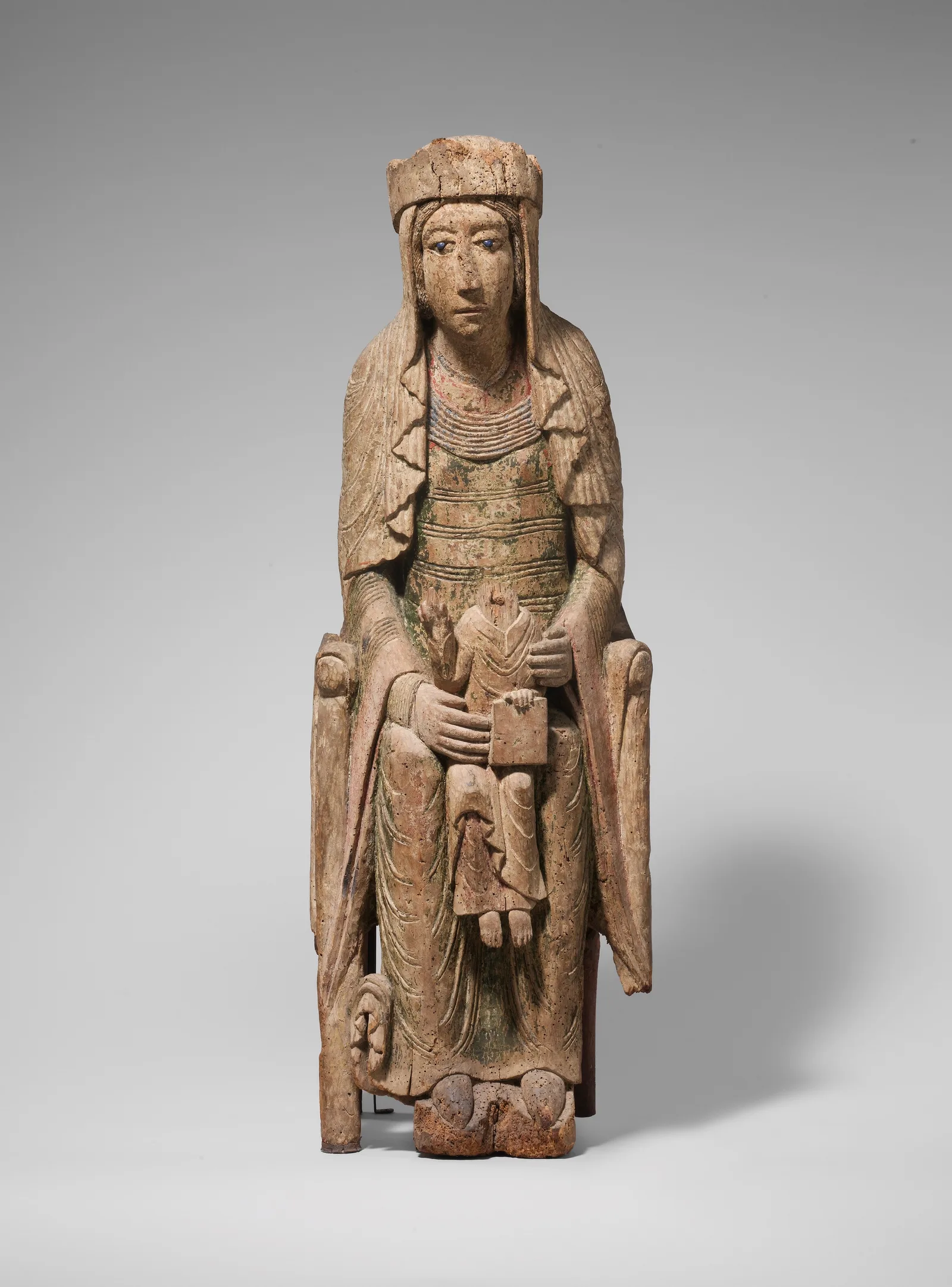
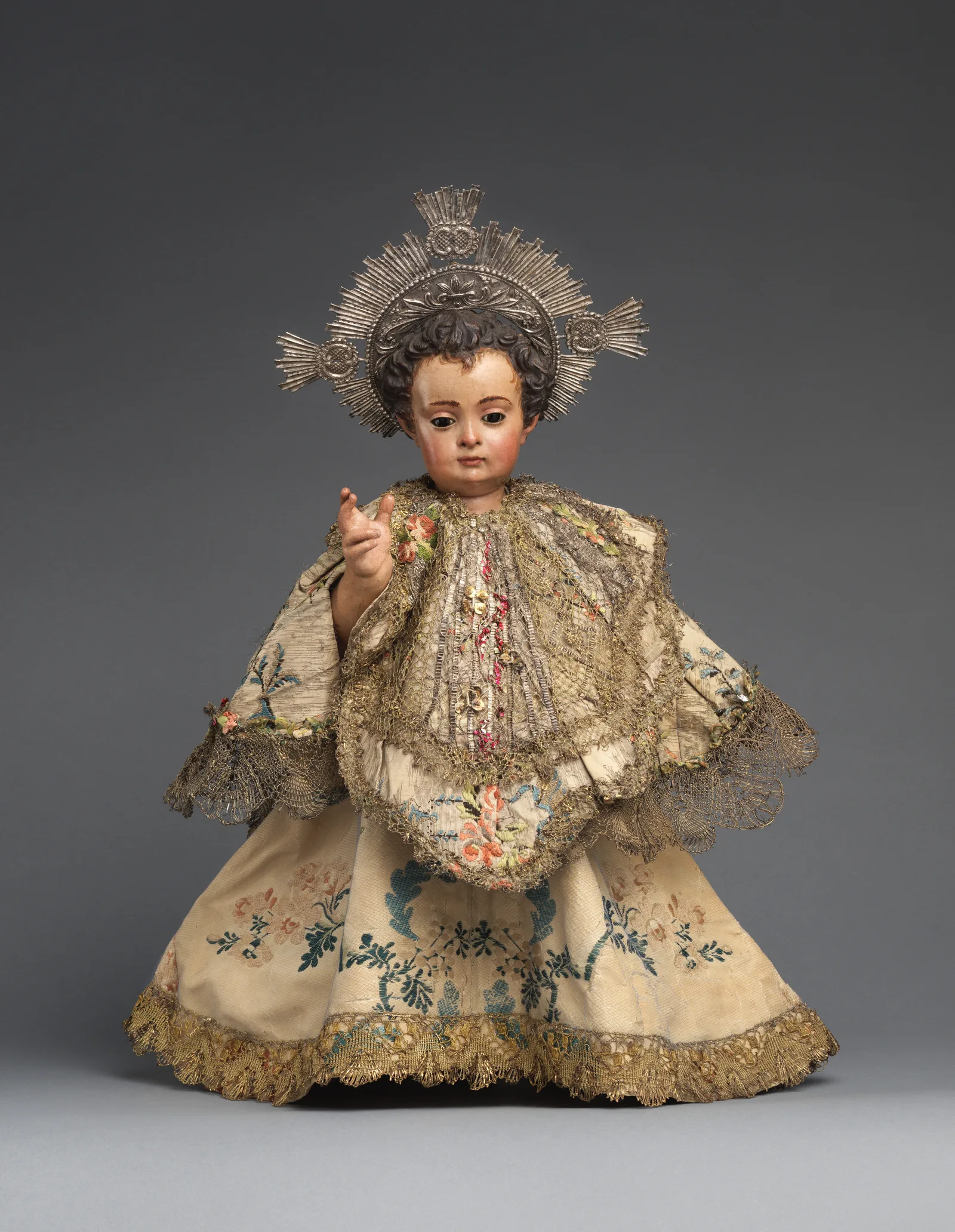
The viceroyalty of New Spain developed a powerful school of polychrome wooden sculpture for altarpieces. A figure would be carved from cedar or a soft wood, covered with gesso, gilded, and then painted over the gold, with the pattern scratched through so the metal showed beneath the clothing. Apostles for side altars were made this way, and Jude Thaddeus was part of the sets of twelve alongside the rest. Faces were made calm, eyes were sometimes set in glass, arms were hinged so the figure could be dressed in real fabric. This tradition of dressing a statue in living clothing survived to our day almost unchanged, and when a statue in a sewn green cloak is carried through Mexico City today, the technique of the colonial workshops is being repeated.
Printed graphics worked in parallel. Engravings and lithographs of saints circulated cheaply, were pasted into prayer books and hung above beds, and provincial carvers checked their iconography against them. The engraving unified the scheme faster than any church decree could: flame, medallion and the object in the hand repeated from sheet to sheet, and the variations gradually wore away.
The green robe and the household altar
The colour pairing took hold in craft. On old European paintings the apostle was shown in anything from red to ochre, whereas the workshops working for mass demand chose green with white and repeated that choice by the thousand. So the detail became identifying: a green cloak reads from a distance on a market stall, in a shop window, and on a figure riding in a taxi.
The household altar in Latin America has a settled form: a corner or a shelf, a cloth, candles, flowers, water in a glass, photographs of family, and one or several figures of saints. Saint Jude takes his place there beside the Virgin of Guadalupe, and he is often re-dressed for 28 October, the way altar statues used to be. A whole craft grew up around this: clothing is sewn for figures of every height, miniature staffs and medallions are sold, chipped plaster is repaired. The same demand feeds the workshops that strike medals, and in that sense the worn holy medal and the household statue came out of the same artisan environment.
Leave your email, we'll send your discount code. No spam, unsubscribe anytime.
The code arrives by email, valid on your first order.
The Saint Jude medal as jewellery
The image moved from the church shop to the jeweller's bench long ago. The Saint Jude medal is worn both as a sign of faith and as a sign of a personal story, and it is worth understanding exactly what is struck on it and how it looks when worn.
What is struck on the medal
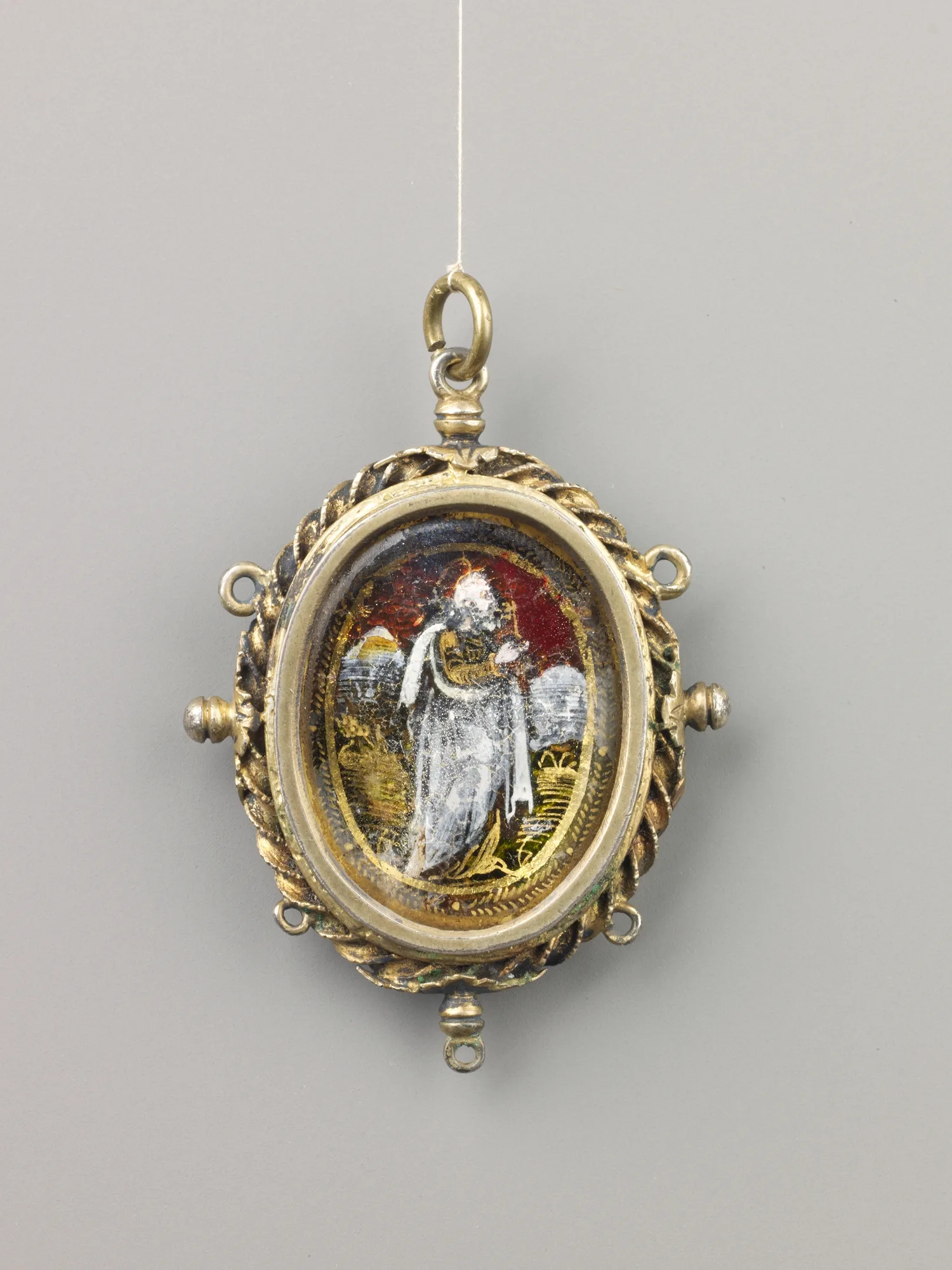
The classic composition is a bust or half-length portrait of the apostle: beard, calm face, medallion with the face of Christ on the chest, tongue of flame above the head. Around the rim there is often a circular inscription reading San Judas Tadeo, sometimes with the addition ruega por nosotros, "pray for us." The reverse is most often a smooth field for engraving, less often a short prayer or a date. Medals also exist showing the apostle full length with a staff. The format may be round, oval or rectangular with rounded corners. The oval is considered the most traditional, as with most Catholic medals, including the Saint Benedict medal.
How the medal sits when worn
It is worn on a chain over the heart, usually at a length of forty-five to sixty centimetres. A short length brings the medal up to the collarbones and makes it visible; a long one drops it below the neckline, and the object stays private. The diameter of traditional medals is modest, most often within a couple of centimetres, because this was originally a thing meant to be worn under clothing. Larger versions are worn on top, as a pendant in their own right. Men more often choose a plain curb or anchor chain and a medal without stones; women more readily take fine chains and a small format, but there is no rigid division here and never has been.
Medal, scapular and statue: different objects
The formats are worth distinguishing. A medal is a flat metal image for wearing. A scapular or cloth reliquary is a soft or three-dimensional case with something enclosed, in fabric or metal. A statue is a household or church object; it is not worn but placed, and it is the statue that people bring to be blessed on the 28th. There is also the estampa, a paper holy card with a prayer, kept in a wallet or a book. All four objects belong to one devotion but live differently: the medal is always on the person, the statue is always in place, the card gets used up, the scapular sits somewhere in between.
Materials and formats
Choosing a material for a religious medal is a question both of taste and of wear. A thing worn daily for years behaves differently from an occasional piece of jewellery. Below is a breakdown of the main options and what happens to them over time.
Sterling silver 925 and its patina
Silver remains the most common material for Catholic medals, and the reason is not cost. The metal is soft enough for the strike to come out crisp and durable enough for daily wear. Over time silver darkens, and patina gathers in the recesses of the relief, making the face and the folds of the clothing easier to read. Many makers oxidise the piece deliberately to get that effect straight away. Polishing a medal to a mirror is not necessary; a darkened piece looks older and carries more dignity. Worn constantly, the raised areas polish themselves against skin and fabric, producing a natural contrast.
Gold plating, brass and nickel silver
Gold-plated silver gives a warm tone, closer to the way church images of the saint look. The layer of gold on a medal worn every day wears through on the high points over time, and this is the normal course of things rather than a defect. Brass and nickel silver traditionally went into mass pilgrimage medals; they are cheap and hold a strike well, but they can oxidise and leave a mark on the skin of sensitive people. Stainless steel is a recent arrival and behaves unlike all the rest: it never darkens, but the relief on it comes out drier, because the metal is hard and takes fine detail poorly.
Enamel, size and engraving on the reverse
Enamelled versions make it possible to keep the green and white, the recognisable colour pairing. Enamel holds up well but fears knocks against anything hard, so a medal like this is better not carried with keys. For size the guideline is simple: a small format for constant wear under clothing, a large one for wearing on top. A smooth reverse almost always invites engraving. Most often a date, a name or a short phrase is engraved. What sits best here is not a wish for luck but something a person wants to keep in memory: the date of an event, the name of the one being prayed for. The same is done with medals of the Virgin of Guadalupe, where the reverse is also traditionally left for a personal inscription.
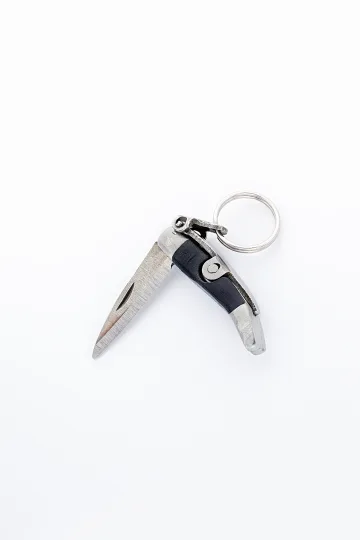
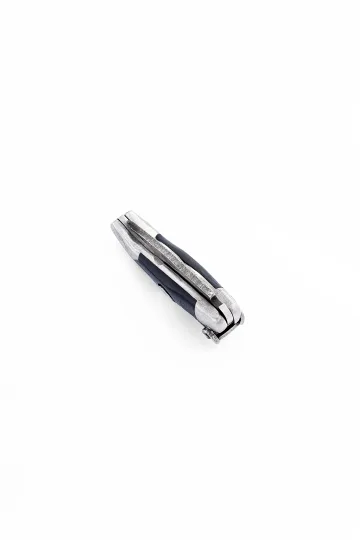
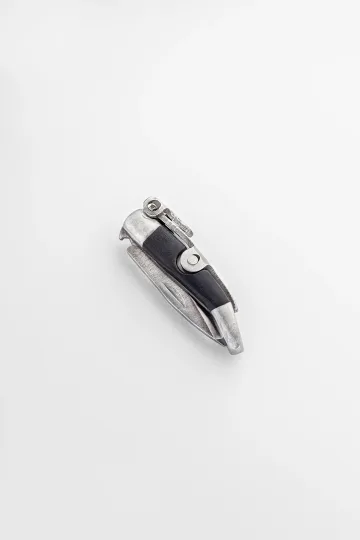
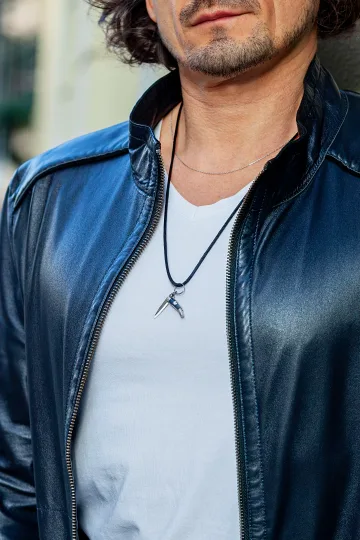
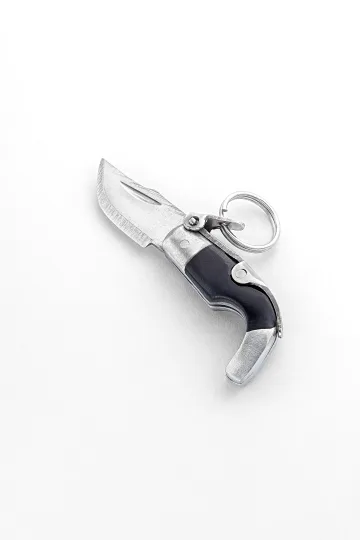
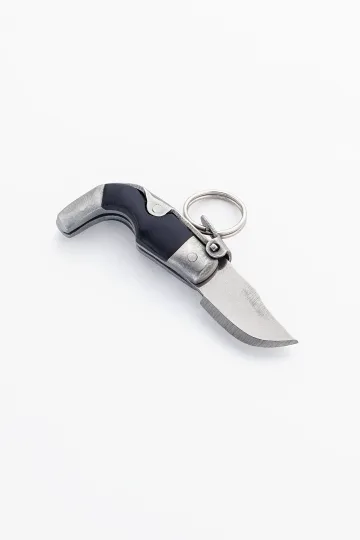
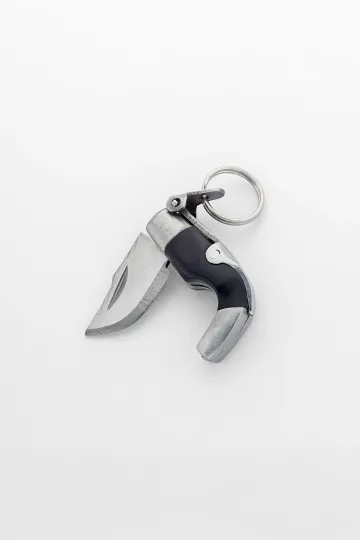
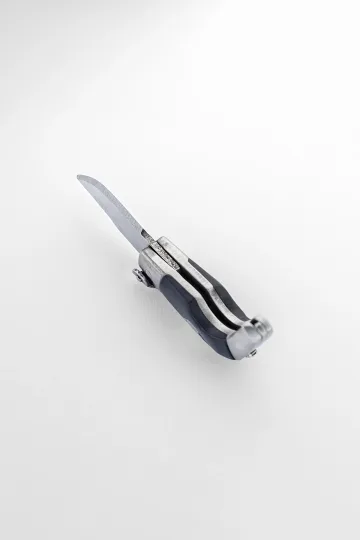
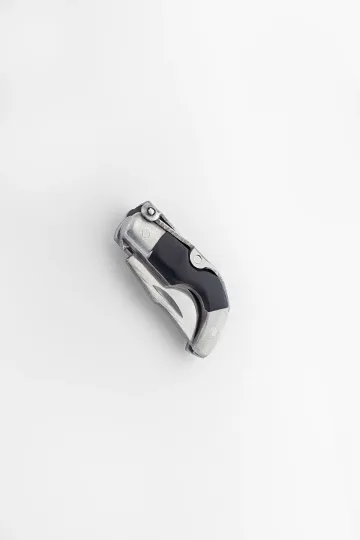
CAPAORA mini knife pendant
The 18th-century Spanish navaja in miniature: 40 mm of stainless steel, a real folding mechanism and a Palanquilla lock that clicks. An affordable gift to remember.
Authentic · Ships from Spain · 14-day returns
Who receives one as a gift, and on what occasion
A religious medal is a gift with special rules. It assumes the giver understands to whom and why it is being handed over, because a misstep here is more visible than with ordinary jewellery.
Baptism, confirmation and name days
The classic occasions are tied to the church calendar of a life. At a baptism the medal is given by godparents, most often bearing the image of the saint whose name the child carries, though a medal of the family's patron is also appropriate. At confirmation a teenager often chooses a saint personally, and Saint Jude is popular among Spanish-speaking young people. The name day falls on 28 October, a natural date for a gift to anyone called Jude, Judas Tadeo, Tadeo or Taddeo. In Latin American families both a medal and a statue are given that day, the second more often to the older generation.
A gift for a hard stretch
A separate and very understandable situation: the medal is given to someone going through a difficult time. Before an operation, during a long course of treatment, after a job loss, in a drawn-out legal case. The point of the gesture is not a promise of a miracle but a message: I am thinking of you and I am on your side. Such a gift calls for tact. It is appropriate if the person has at least some connection to the Christian tradition, and inappropriate if they do not. Devotion must not be imposed, and believers themselves keep that rule more strictly than anyone from outside.
Who this gift will not suit
A medal bearing a saint's image is a confessional object, and to a person outside the tradition it may simply be incomprehensible or unwelcome. Giving it as an exotic curiosity devalues its content. It is also unsuited as a neutral corporate gesture and as a good-luck present, since that is precisely what the devotion rejects. If you want to give a symbolic piece of jewellery to someone without a religious context, it is more sensible to choose something with a broader meaning, from the range of protective symbols for instance, and not put the recipient in an awkward position.
Psychology: why people choose this saint
Mass devotion almost always answers a real need, and in the case of Saint Jude the need is unusually visible. It is worth speaking calmly here, neither reducing faith to psychology nor pretending the human side of the question does not exist.
Permission to ask for the impossible
One of the hardest states to be in is the sense that there is nothing left to ask for and no one to ask. A devotion addressed directly to hopeless causes removes that barrier: it announces in advance that this is exactly where you may come with what seems beyond repair. A person does not have to prove that their case deserves attention. For many this turns out to be the first step out of paralysis, and practical action follows afterwards.
What people actually bring is telling. The notes and thanksgiving notices that have come down to us from the twentieth century repeat one set: illness, a court case, debts, a missing person, addiction in a son or husband, work that cannot be found. These are circumstances where little depends on the person asking and the waiting is long. Putting the request into words, aloud or on paper, does what any act of articulation does: it turns formless anxiety into a concrete matter with a beginning and an end. Priests in parishes where the practice is widespread usually insist on exactly this, asking people to phrase the request in words rather than leave it as heavy silence beside a candle.
The object as an anchor for attention
A medal at the neck works as a physical reminder. A hand touches the metal, and the person remembers what they asked for and what they are holding on for. This mechanism is well known far beyond religion; the rosary, counting bracelets and any wearable sign are built on it. More is said about that mechanic in the piece on the rosary and prayer beads as jewellery, where counting on beads structures prayer and holds attention.
The medal has a property the household statue lacks: it travels with the person and turns up in the moments where no help is expected. A hospital corridor, a courtroom, a conversation with a creditor, a night shift. The metal warms from the body and stops being felt, but take hold of it with your fingers and the whole story attached to it switches on. Hence the practical difference in formats: those who wear a medal as support through a specific hard period usually find a small image under clothing more comfortable, always to hand and visible to nobody.
Belonging and a shared story
Thousands of people in one queue on the 28th is also an experience of belonging. A person sees that they are not alone with their trouble, and the circumstances stop being purely a personal failure. The medal on the chest works as an identifying mark inside that circle, much as shared symbols work in other communities. For migrants cut off from their home places such a sign is also a link to home, and that is precisely why the image survived the crossing of the border so well alongside its devotees.
Saint Jude and neighbouring devotions
The Catholic tradition holds many wearable medals, and they are not interchangeable. Each has its own address and its own tone. Below is a short comparison that helps in choosing deliberately.
How he differs from the Miraculous Medal
The Miraculous Medal is addressed to the Virgin Mary and built around the intercession of the Mother of God and the idea of purity. It is worn constantly and not for any specific reason; it accompanies a whole life. The Saint Jude medal is directed: behind it stands a request about a difficult matter. Both can be worn at once, and in Spanish families that is often done, with two images hung on a single chain.
The origins of the two objects differ as well. The Miraculous Medal appeared in the first half of the nineteenth century in Paris with a prescribed design on both sides, a circular inscription and strict symbolism, and its appearance has barely changed since. The Saint Jude medal never had such a unified scheme: its composition was set by the workshops, so the portrait of the apostle differs from medal to medal in the turn of the head, the presence of a staff and the shape of the object in the hand. Only the flame and the medallion with the face stay constant. For a buyer this means something simple: the Marian medal has a canonical model to check against, while the apostle's medal offers a set of stable markers instead.
The Saint Benedict medal: protection versus intercession
The Benedict medal is above all a protective object, dense with letter symbolism and a prayer of exorcism. Its logic is defensive: to ward off, to fence in. The logic of Saint Jude is petitionary: to ask about something that has already happened and seems beyond repair. The difference resembles that between a shield and a letter. The workings of the Benedictine symbolism are covered in detail in a separate piece, and there you can see how much denser its layer of signs is.
Saint Christopher and patronage on the road
Christopher answers for the road and for travellers; his image lives in cars and on keyrings. This is a devotion of circumstance: while you are driving, you are under his patronage. Saint Jude is tied to no occupation and no place, he is tied to a person's state. That is why his medal is worn constantly, while the image of Christopher often stays in the car.
The Virgin of Guadalupe and the Mexican context
Within Mexico the Virgin of Guadalupe holds an entirely special place; she is a national image and the centre of the country's religious life. Saint Jude looks different beside her: he is closer to private trouble, to the city street, to those who are having a bad time right now. There is no rivalry between these devotions, they cover different registers, and both images stand comfortably in the same house. The role of the Sacred Heart in the same row deserves a separate word: there the centre of gravity shifts toward love and sacrifice rather than petition.
Send a friend a discount code, they save on their first order.
Facts that surprise people
A great deal that is unexpected has accumulated around this saint, and some of the details make it into neither sermons nor guidebooks. Here is what most often surprises even people familiar with the subject.
The mass devotion is younger than radio
It looks like an ancient tradition rooted in the colonial past. In fact the explosive growth came in the 1920s and 1930s, that is, later than the appearance of the motor car and of radio broadcasting. Before that the apostle was known in Mexico but did not stand out among the rest. One of the largest devotions in the Western Hemisphere is less than a hundred years old.
Thanksgiving notices in the newspapers
A distinctive genre took shape in the American and Irish press of the twentieth century: short paid notices thanking Saint Jude for a request heard, often signed only with initials. Such lines were printed alongside the classified advertisements, and in some publications the tradition survives to the present day. For the history of the devotion this is a rare case where popular gratitude left a paper trail that can be counted.
English separated the two Judes
In English the traitor is Judas and the apostle is Jude, and the split is so firmly fixed that native speakers often have no idea the two names share an origin. Spanish, Italian and German have no such convenience, so there the by-name Tadeo or Thaddäus has to be added. A linguistic accident noticeably affected how easily the devotion spread in different countries.
He shares his feast with another apostle
He shares the feast day of 28 October with Simon the Zealot, and on old altarpieces the two are shown as a pair. The reason lies in the tradition of their shared preaching and shared martyrdom in Persia. Yet mass devotion fell to only one of them: Simon stayed in the shadows while Saint Jude gathered hundreds of thousands on the streets of Mexico City.
The medallion on the chest came from another story
The round image of Christ by which the saint is unerringly recognised goes back to the legend of the cloth from Edessa and King Abgar, that is, to an episode in which the apostle himself plays the supporting role of courier. A background detail became the principal identifying mark, while the apostle's own biography remained almost unknown.
Different traditions gave him different weapons
In some images he holds a club, in others an axe or a halberd. This is not artistic licence but a direct consequence of the sources disagreeing about his death. Western and Eastern traditions preserved different versions, and both survive to our day in bronze and plaster.
The green was never decreed from above
No church ruling exists on the colour of Saint Jude's robes. The pairing of green and white formed in popular practice and was fixed through the workshops that made the statues. Today it is felt as obligatory, although in older European painting the apostle was frequently shown in quite different colours.
His letter quotes a book that is not in the Bible
The short epistle inscribed with the apostle's name contains a direct quotation from the Book of Enoch, which entered neither the Hebrew canon nor most Christian ones. The same text retells the archangel Michael's dispute over the body of Moses, known from Jewish tradition rather than the Pentateuch. Because of these references the letter was received with caution for centuries, and today it remains rare evidence of what was being read in first-century communities.
He is in the calendar of the Armenian tradition
The Eastern churches link Thaddeus with preaching in Armenia and honour him as one of the country's evangelisers. The Monastery of Saint Thaddeus in present-day Iran, known as Kara Kilise, is considered one of the oldest Christian churches in the world and is inscribed on the World Heritage list. Western and Eastern devotions developed independently and barely intersected.
With the reliable separated from the invented, it becomes easier to answer the questions people ask most often. Below are the ones that genuinely come up before buying a medal or before a conversation about the devotion with someone close. The answers carry no promises and no pressure, because the subject does not tolerate either.
Frequently asked questions
Are Saint Jude Thaddeus and Judas Iscariot the same person?
No. These are two different apostles among the twelve. Judas Iscariot betrayed Christ; Jude Thaddeus, known in Spanish as San Judas Tadeo, preached after Pentecost and was martyred. The coincidence of names is explained by the fact that Judah was an extremely common name in first-century Judea. The evangelist John adds a deliberate clarification, "Judas, not Iscariot," so readers do not confuse them.
When is the feast of Saint Jude Thaddeus?
28 October in the Western calendar, together with the apostle Simon the Zealot. In addition, parishes in Mexico and in a number of other countries say special masses on the 28th of every month, and these monthly dates have become part of the living practice of devotion, although they are not official feasts.
What does the Saint Jude medal mean?
The medal is a sign of turning to the apostle as an intercessor in difficult circumstances and a reminder of prayer. The flame above the head, the medallion with the face of Christ and the object in the hand refer to Pentecost, to the legend of the Image of Edessa and to his martyrdom. The medal carries no promise of a result.
Can an unbaptised person wear the medal?
There is no formal prohibition; nobody checks documents at the door of a shop. But the meaning of the object lies entirely inside the Christian tradition, and wearing it with no relation to that content turns a confessional sign into an accessory. If the subject interests you, it makes more sense to understand it first and decide afterwards.
Does the medal need to be blessed?
In Catholic practice religious objects are customarily blessed, and this can be done in any parish, usually after mass. A blessing adds no properties to the metal; it means the object is dedicated to a particular purpose and drawn into the life of the Church. A medal without a blessing does not become "wrong," it is simply that a blessed one carries this additional meaning.
What should be engraved on the reverse?
Most often a date, the name of the person being prayed for, or a short phrase from a prayer. Something personal and specific fits better than a general wish for luck. There is little space, so long texts will not go on, and that is more a benefit than a limitation: a short inscription reads better and does not argue with the image on the front.
Can you wear a Saint Jude medal together with a cross?
Yes, this is ordinary practice. A cross and a saint's medal are worn both on one chain and on separate ones. The hierarchy is clear: the cross remains the principal sign of faith, while the saint's medal expresses an appeal to a specific intercessor. Some people hang two images on one chain, for instance Saint Jude and a Marian medal, and in Spanish-speaking families this is common.
Is it true that he is approached only in hopeless situations?
That is how it settled in popular practice, but there is no hard rule. Many people wear his medal constantly rather than in a crisis alone, and turn to him in ordinary circumstances too. The reputation of patron of hopeless causes grew out of devotional reasoning about the forgotten apostle rather than from any church decree, so there is no reason to treat it as a restriction.
Conclusion
Saint Jude Thaddeus travelled a strange road: from an apostle about whom there is almost nothing to tell, to a saint people come to in their tens of thousands. The reason for that road lies in an inconvenient name and in centuries of oblivion, from which popular piety drew an unexpected conclusion: the one nobody called on will answer the hardest call. The green cloak, the flame above the head and the medallion with the face of Christ on the chest add up to an image recognised on any continent.
A medal bearing that image promises no outcome and does not work instead of effort. It does something else: it holds a person in the state where they are still asking and have not yet given up. For many, that turns out to be the main thing. It is worth wearing for those who feel close to this tradition, and worth giving to those who will understand what you meant to say.
Symbolic jewellery by Zevira
Medallions, pendants and chains in 925 silver with symbolism that has been thought through. We make pieces that are worn every day, not taken out for occasions.
View the catalogueBuying it as a gift? Each one arrives ready to give.
 A branded Zevira box and a little card come with every order.




About Zevira
Zevira is a Spanish brand of symbolic jewellery. We work with images that carry a history behind them: religious medallions, protective signs, old European subjects. The Albacete region, where our team lives, is known for a centuries-old tradition of working with metal, and that school shapes our approach to detail. Sterling silver 925, a crisp strike, calm forms without excess decoration. We do not promise that a piece of jewellery will change your life, but we do answer for the thing being made honestly and lasting a long time.