Arrow Earrings: The Shape That Has a Direction
What an arrow earring has to survive
An arrow earring breaks where nobody looks. Not the point and not the feathers, but the passage from shaft to head and the loop that hangs it decide whether the piece lasts a year or a week. The shape looks plain and is put together with more care than a drop, and the whole difference shows up close.
It comes down to geometry. A drop and a hoop have a closed, symmetric outline about the hang point, so they sit level at almost any seat of the hole. An arrow has an open line, its weight gathered at the head, and its loop soldered at the other end. Set that loop off the centre of gravity and the earring turns its point toward the neck or away from it, and keeps doing it however often you right it. A mirror shows that turn at once, a photograph even more so.
The second difference is where the piece lives. Jewellery on the ear is seen together with the outline of the face, which is true of neither a ring nor a pendant: a person's eye returns to yours and takes in the earring on the way. An arrow sets a line, and a line beside an oval reads as a pointer. Add a turn of the head, and the front shows the head and shaft while the profile shows the feathers and the length, so the piece presents itself from two sides with no effort from the wearer.
What an arrow means and where it came from in jewellery is a separate matter, set out in the piece on the meaning of the arrow. Here the subject is the earring as an object: how it is built, what breaks in it, how it sits and what to watch for when buying. The wider talk about earring shapes is kept apart too, in the earring guide.
Wear the symbol, don't just read about it. These are in stock:

The five things sold as an arrow earring
Under one name sit pieces built in fundamentally different ways. The difference is not in the drawing but in what holds the earring in the ear and what happens to it when you move.
The whole arrow
Head, shaft and fletching are cast as one part that hangs from a hook or sits on a post. An arrow like this reads as an object and wants a clear ear. Inside the type there is a variant with two arrows in a single piece, aimed in opposite directions, and it asks for silence around it, or the two angles start to argue. The thing to check on a solid arrow is mass. The part is cast, and past three centimetres the weight climbs faster than a catalogue photo, where the piece always looks weightless, would lead you to expect.
The through-the-lobe arrow
A long thin arrow that looks as though it runs through the lobe: point at the front, feathers at the back. Mechanically it is two elements on a shared bar rather than a single needle, and it is put in from behind. Two things follow. First, it needs a hole near the centre of the lobe, because any offset reads at once as a tilt. Second, it has two places that can work loose, the seat of the front element and the catch of the bar, and both want checking. This is the boldest version of the shape and the most demanding of the ear.
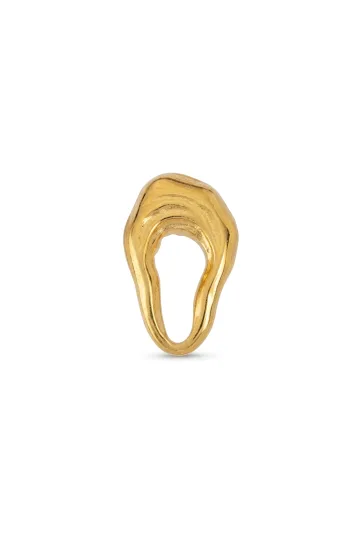
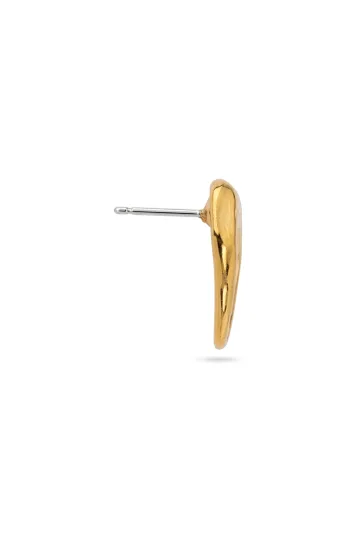
Just the arrowhead
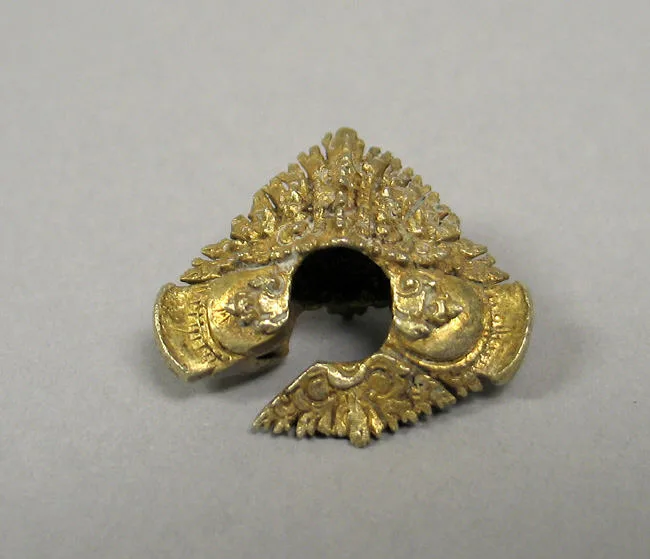
A triangular stud with no shaft. Strictly it is the remnant of an arrow, yet it holds direction and reads the same way on the ear. The mechanics here are those of a stud, post, back and seat on the lobe, and that conversation is had in full in the piece on stud earrings. What matters for our shape is different: an arrowhead has no moving part, so it neither snags nor swings. For anyone with long loose hair, this version gives direction where a long arrow would simply drown in the strands.
The chain threader
A fine chain or a flexible bar drawn through the hole, with a point at one end. It has no clasp, and it holds by its own weight and the friction of the channel. That is exactly why a silicone stopper goes on the back end, and it is not a decoration or an option for a wide hole but a minimum: the penny cap is the only thing standing between you and a loss. On the lobe a threader feels lighter than the other versions, and the reason is plain, a thin chain is less metal than a cast shaft with a head. Length has nothing to do with it, what pulls down is mass, so a chain of dense heavy links will outweigh a short hooked arrow at twice the length. In return it does not forgive haste: a sharp turn of the head over a basin or in a crowd ends the same way. There is a quirk noticed late: the chain creeps through the hole toward whichever side hangs heavier, so the length at the front by evening is no longer the length you set in the morning. The back stopper holds against that creep as well, not only against the piece sliding out of the ear unseen.
The arrow and bow
Head and shaft laid over a bow, sometimes with a string of fine wire. The outline grows wider and lower, and the piece reads as a small scene. The practical difference is real: the bow gives a second place for hair to catch, and the string is the thinnest part of the whole piece, so it breaks first. A snapped string can be replaced, though the join will show, so with a piece like this it is worth asking what the string is made of and whether a spare exists. For anyone who wants the arrow for its clean line, the bow gets in the way, since it returns roundness to the outline.
People come to me with a long polished arrow and complain that it shouts. I swap the polish for a matte finish and ask them to wear it with an open neckline instead of a turtleneck. Same piece, same length, no complaints left: what shouted was the shine and the collar, not the shape.
Wearing the arrow
The commonest complaint about this shape comes out the same way from different people: the arrow feels too literal, too much like a sign. The trouble is not the piece itself but what has been placed around it.
Where do I start if I want an arrow but the idea scares me?
I recommend a short arrow and one ear as the anchor. A length up to three centimetres reads as a graphic mark rather than an emblem, and at that size the shape argues neither with work nor with the rest of a wardrobe. I suggest the long version only once it is clear how the piece behaves in the mirror when the head turns. The beginner's mistake runs the other way: buy the dramatic length first, then find there is nowhere to wear it.
What spoils a look with arrows?
Shine, not shape. A polished arrow catches light across the whole flat of the shaft and turns into a flash by the face, which is why it gets called loud. I choose a matte or satin surface and advise the same to anyone who says it is too much.
The cost of that choice I name up front, so there is no surprise later. Matte is a treatment of the surface, not a property of the metal, and along the edges of the fletching it polishes itself back to a shine over time from clothing and hair, so the piece goes patchy. A polished arrow the owner freshens with a cloth at home, a matte one goes back to the bench for re-satinising, and the interval is a couple of years, not a monthly ritual. I hold the trade fair: shine by the face is seen every day and by everyone, a worn edge shows up slowly and only close to. For anyone who will not go to a bench on principle, I advise not a matte surface but a fine relief along the fletching: it kills the light by geometry, and there is nothing there to wear away.
The second source of the trouble is the collar: a high neck cuts the line across the middle and leaves a jutting stub of the piece.
How do I wear an arrow to work?
Point down and in a metal without shine. A downward arrow is quieter: it leads the eye toward the jawline instead of firing upward. Matte silver or unpolished gold takes out of the shape everything that reads as a challenge, and a good line is what is left. If the dress code is strict, I advise the single-arrowhead version: the direction stays and there is no moving part to pull attention in conversation.
And in the evening?
The exact reverse of all the above. In the evening I choose length, polish and an open neck, because here the arrow works on its own ground: it wants light and it wants movement. The one thing I keep fixed is the empty space around it. No chain at the throat, no second loud earring, no angular buckle. One line by the face and nothing beside it, or the evening look falls apart into details.

Turn on your camera, pick earrings, a pendant or a ring, and see the piece on yourself in real time.
Switch items in one tap.
Everything runs in your browser: no photo or video is ever uploaded.
How the arrow differs from its neighbours
It helps to know when another shape is the honest choice instead of an arrow. The difference between them is not in style but in how they behave on the ear.
The arrow and the drop
A drop is mobile and soft in outline, an arrow rigid and aimed. A drop forgives an inexact hole, any hairstyle and the company of other pieces, because it has neither an angle nor an address. An arrow forgives none of that. What a drop cannot do is the thing an arrow is bought for: it does not point and it underlines nothing, it hangs and swings prettily. For a piece that will work on any day and with any collar, the honest pick is a drop earring.
The arrow and the hoop
A hoop is a closed line with no beginning and no end, an arrow an open one with both. The practical consequence is not weight but leverage: a hoop of the same mass loads the lobe just as much, yet its weight hangs close to the piercing and barely swings. On an arrow that same mass is carried down the length of the shaft, and every step turns that length into a lever that works the hook loose in its channel. So a hoop rides through a whole day without reminding you it is there, while an arrow reminds you by evening. A hoop tolerates company too: two hoops of different diameter share one ear, two arrows do not. Diameters and fit are covered on their own in the piece on hoop earrings.
The arrow against the chandelier and the stud
A chandelier works by volume and the movement of many parts, and it wants an occasion: bare shoulders, an evening, a quiet top. An arrow works with a single line and lives on a weekday, provided the ear is clear. A stud does not work at all, it fills the hole, and that is its strength: it survives sleep, sport and any clothing. The arrow stands between the two and takes a little from each, the visibility of the first and the everydayness of the second, with caveats on both sides. Volume forms are set out on their own in the piece on chandelier earrings.
What the arrow is built from
A part by part reading explains why some arrows live for years while others get lost in the first month.
The head
The most visible part and the most restless. A sharp angle catches hair, a scarf and a collar, and each such catch is a jerk on the piercing. What suffers there is looks, not life: the head takes cosmetic damage, while how long the arrow lasts, a year or five, is settled by the passage from shaft to point and the suspension loop, because the whole load bears there. A rounded or flattened point lives longer, and a truly sharp one asks for the habit of taking the earring off before clothing goes over the head. There is a second weakness few think about: the head is the most jutting spot on the piece, so a fall to the floor lands on it, and after that the arrow stops being straight. Check it not head-on but against the light along the shaft, and any drift shows at once.
The shaft
It sets the length, the weight and the way the piece lies along the cheek. A straight shaft reads stricter, a slightly curved one softer. Length matters more than it seems: an arrow up to three centimetres behaves like a drawing and gets in nothing's way, while past five it starts to live its own life at every step. There is an optical effect as well: a straight shaft draws the line downward and lengthens the neck, a curved one repeats the line of the jaw and softens it. Two arrows of the same length on one person work differently for this reason, and it can only be understood at a mirror.
The fletching
The part that shows the maker's hand. The head and shaft leave almost no freedom, while the feathers can be cut, engraved, built from separate elements or drawn with a single line. It adds little to the weight and much to the reading: it gives the piece depth in profile, and the profile is half of what people around you see. On silver, relief fletching gains from time, because the recesses darken and the drawing reads better for it. To wipe that darkness out clean is to flatten the piece and lose the very thing the relief was cut for.
The back
The side not shown on the display, though it is seen all the time: a long earring turns at every movement of the head. On an honest piece the reverse is finished like the face, the relief repeated or drawn, the join of shaft and hook cleaned up. On a cheap one the back stays flat and matte from casting, and the hook attachment looks like a rough blob of metal. The back settles the seat too: a flat reverse presses to the lobe evenly, a bulging one makes the earring stand off the ear and hang at an angle to the face.
The suspension loop and the centre of gravity
Here sits the real difference between a good arrow and a bad one. The mass gathers at the head, low and forward, and the piece hangs from a loop at the opposite end. Set that loop squarely over the centre of gravity and the arrow hangs vertical and returns to vertical after every movement. Set it off to one side and the piece turns its point toward the neck or away from it, and keeps doing it however often you right it. The cure is a re-solder at the bench, which is why this is a thing to read before buying rather than after the first photograph.
The fitting and the clasp
The weak point of every long earring. A centre of gravity shifted downward rocks the hook inside the piercing, and a plain fishhook fitting works loose on a piece like this faster than on a drop of the same weight. A sensible minimum is a screw fitting or a hinged snap; on an arrowhead stud, a flat back; on a threader, the stopper at the rear. Ask separately whether a replacement is sold. Long earrings lose the fitting first, and a piece with no spare part to be had leaves whole over one small fitting.
Customer reviews
Zevira is a real jewellery shop. Genuine payments, deliveries and customer thank-yous.
🥰🥰🥰 gracias
Ok, ¡gracias! 🙂
The fit, the weight and how it moves
An arrow loads the ear differently from a stud and behaves differently as you walk. Everything to do with the state of the piercing and healing times is for the piercer; here the subject is the piece itself.
Where the piercing sits and why it decides
A through-the-lobe arrow needs a hole near the centre of the lobe and close to level. On a drop or a hoop a shift of a couple of millimetres goes unseen, because the outline is symmetric about the hang point. On an arrow the same shift shows at once: the point drifts sideways. Before buying, it helps to look in the mirror at your current stud and judge where it sits and whether the two ears match. Ears are often uneven, which is ordinary, but for a through-the-lobe arrow that difference weighs more than it does for any other shape.
Weight, not length
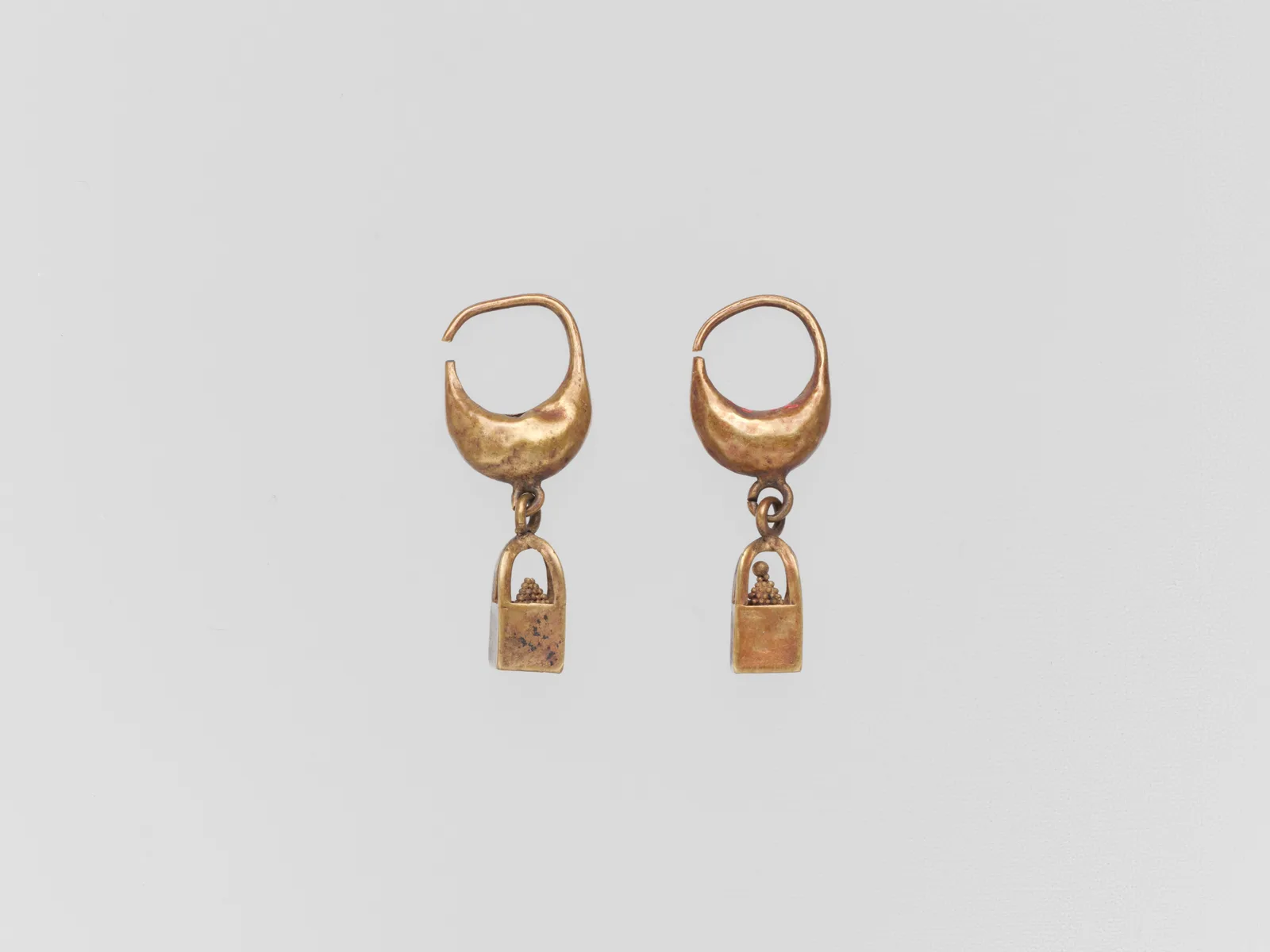
People fear length and it is weight that loads the lobe. A hollow long arrow presses on the lobe less than a short solid one in the same metal, because what pulls down is mass, not centimetres. A practical way to choose: weigh the piece in your hand and set it against the earring you already wear all day without noticing. If the arrow is clearly heavier, its place is the evening drawer rather than the daily one. Heaviness by evening is a signal to swap the pair for a light one, and any question about the state of the piercing itself goes to your piercer, not to the jeweller behind the counter.
How it behaves in motion
A quick test right in the shop: hang the earring over a finger and set it swinging. A good arrow returns to vertical fast and without a rattle. A poor one wavers for a long time, tips sideways or buzzes where the fletching meets the shaft, and that means the hang point was chosen badly or the parts join with play. On the ear a piece like that looks skewed in every photograph. The same test catches a mismatch inside a pair: two arrows should settle in the same time, or they will drift apart in angle as you move.
Upload a photo of your pet, someone you love, or an object. We'll build a 3D model and hand-cast it in pewter.



Metals for a sharp angle
The shape makes a demand of the metal that a drop or a hoop does not: it has to hold a sharp angle and a thin line without sagging.
Silver
The usual choice for this shape. It is soft enough to draw a thin shaft and firm enough to hold an angle against cloth and hair, which are softer than the metal and leave its form alone. What harms silver is contact with anything harder than itself, and a bag or a bathroom holds plenty of that: keys, coins, the rim of a basin, tile. Relief fletching on silver gains from time, because the recesses darken and the drawing reads better for it. There is a practical side too: silver straightens and solders easily, so a bent silver arrow comes back into shape without a trace, while a piece in a hard alloy is likelier to crack on the same bend than to yield.
Gold and gold plating
A warm metal softens the graphic edge of the shape, so a gold arrow reads calmer than a silver one of the same outline. Plating carries a quirk worth knowing in advance: it wears off not across the flat but along the edges of the fletching and at the point, exactly where the piece rubs on clothing and hair. It shows as a paler line along the rim, and the coat can be renewed, though it has to be repeated on the same rhythm, because the cause is the geometry of the piece.
Steel and titanium
The pick for anyone who wants a predictable alloy and a piece that does not darken in air or ask for a weekly wipe. Titanium is lighter than steel for the same volume and carries no nickel, and that is its strong hand. What it does not do is get stiffer. The elastic modulus of titanium alloys runs about half that of steel, so at equal thickness a titanium part springs further under the same push.
That does not make titanium the weaker metal. It springs within its elastic range, which means it returns to its own shape, and it reaches a permanent bend later than 316L steel does, because its yield strength is markedly higher. On the ear the difference reads like this: a titanium arrow snaps back after catching on a jumper, while a steel one of the same thickness more often stays slightly bowed and goes to the bench. Judging the two on a single number is pointless, since their strengths sit in different places.
The practical takeaway is short. Titanium is chosen for its mass and its composition, steel for its price and for the fact that any workshop can straighten and solder it, while titanium is not soldered on an ordinary bench at all: it oxidises when heated in open air, so its joints are threaded or welded in a shielded atmosphere. Hence a rule for a long piece: on a titanium arrow a threaded, take-apart joint is the norm, not a mark of cheap work. If your ear reacts to a metal, work the cause out with your piercer rather than guessing your way up the hallmark scale.
Two metals and a stone
A trick that works better on this shape than on any other: the point in one metal, the shaft and fletching in another. An arrow is made of three clearly divided parts, so a change of colour at a border reads as intent. One caveat: the seam where the shaft meets the head is the most loaded spot on the piece, and it is wiser to run the colour border along the fletching. A stone or enamel is seated in the point, and the logic is the same, an inset in the shaft breaks the line while one in the fletching is lost.
Who it suits and what it sits beside
The shape behaves differently from round earrings, and that is worth weighing before buying rather than after.
By face and hair
A long vertical arrow lengthens, so on a narrow face it pushes what is already there, while on a round soft oval it gives a line the face was missing. Hair decides as much: with loose hair of middling length an arrow is lost outright, only the glint shows and the direction goes. Gathered hair, a short cut or a strand tucked behind the ear give the shape its meaning back. The full breakdown by face type sits in the earring guide; here the principle is what counts.
Next to other shapes
An arrow sits badly beside other sharp-angled things. A triangular pendant, spikes on a bracelet, a pointed buckle in the same look add up to a bundle of prickles. The rule is simple: let there be one angle in an outfit. Everything else near the arrow is better kept round and smooth, and then it becomes a point rather than a chorus. That goes for the frame of your glasses too: a thin round rim gets on with an arrow, a wide angular one starts competing for the same spot by the temple.
Several piercings in one ear
An arrow is built for empty space around it. As soon as a second and third loud object appears beside it, the direction is lost and a jutting sharp element is what remains. For anyone wearing several piercings, it is wiser to keep the arrow the single large piece and reduce the rest to small and smooth: beads, thin rings, flat studs. Order matters as well: the arrow goes in the lower hole, because higher up it runs into the curl of the ear and turns.
One arrow instead of a pair
The shape lives happily alone, and the direction reads even better when there is only one of it. Asymmetry looks deliberate on an arrow rather than accidental, and this is the rare case where losing one earring does not kill the other. The second ear is not left bare, though: a small smooth piece in the same metal goes there. How such pairs are built in full is covered on its own in the piece on asymmetric earrings.
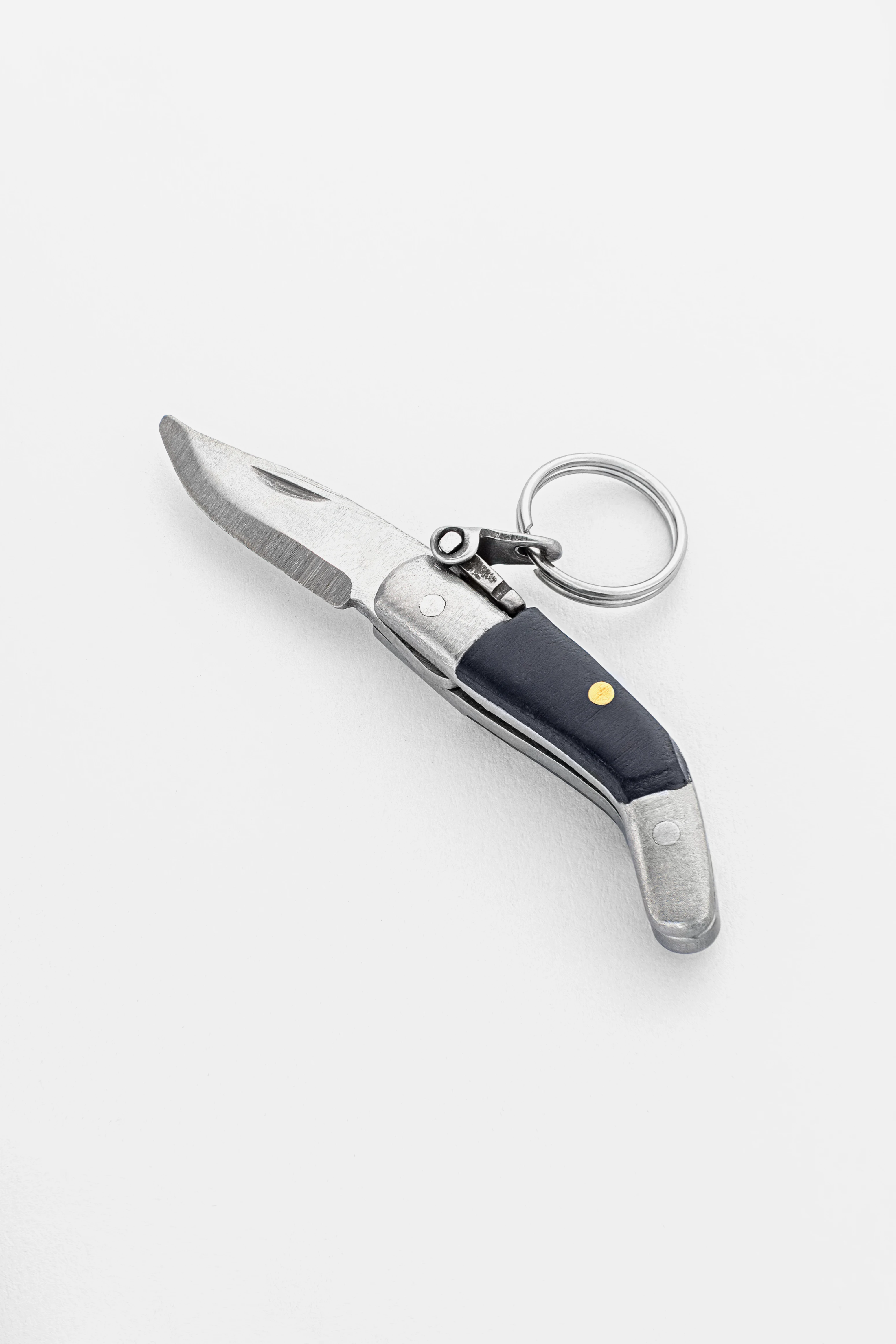
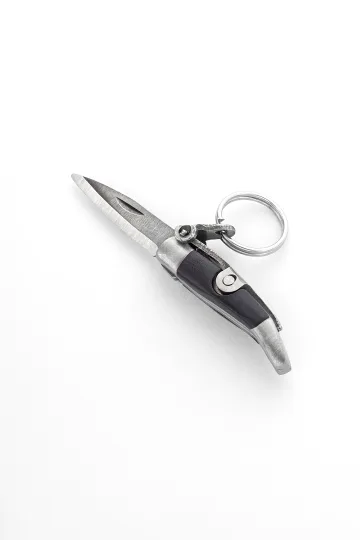
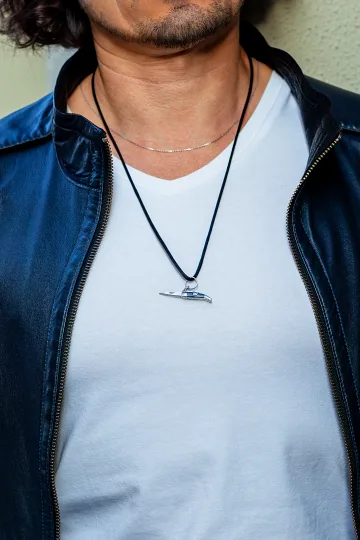
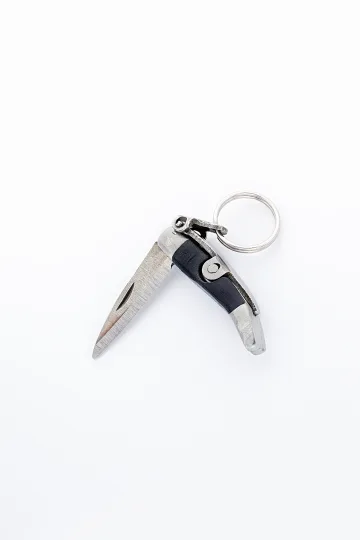
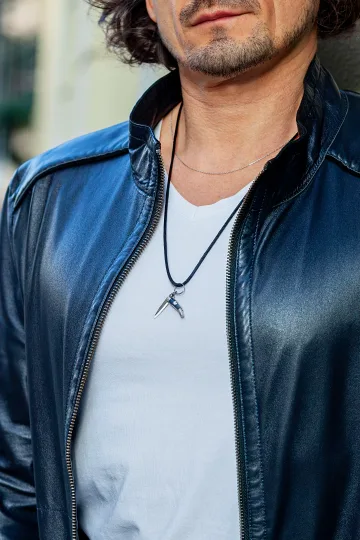
CAPAORA mini knife pendant
The 18th-century Spanish navaja in miniature: 40 mm of stainless steel, a real folding mechanism and a Palanquilla lock that clicks. An affordable gift to remember.
Authentic · Ships from Spain · 14-day returns
Where arrows are cheapened
The shape looks plain, and on that it is made cheaper by ways that do not show at first.
Stamped fletching
The commonest economy. The fletching is punched from sheet together with the shaft, and the result is a flat thing with no depth in profile. From the front it is hard to tell, from the side it is obvious: cut or cast feathers have thickness and a difference in depth between them, punched ones are uniformly flat across the whole area. Check it in profile and in raking light, because straight-on light hides the difference. A catalogue photo shows it too, as long as the shot was not taken dead in front.
Thin walls on a hollow piece
A hollow build is fine in itself, and for a long earring it is wanted, because it takes off weight. The trouble starts when the wall is made as thin as it will go for the sake of another gram or two. An arrow like that dents under a fingertip and cannot be corrected: the metal tears on the fold rather than straightening. You can tell by touch and by ear, a light tap of the nail on the shaft gives a dull sound on a sound piece and a ringing, near foil note on an empty thin one.
A glued-in stone
A stone or enamel in the point often sits on glue rather than in a setting. In the affordable range that is ordinary, though a buyer should know what follows: a piece like this does not take an ultrasonic clean or hot water, and a cloudy ring of glue residue creeps out along the edge of the stone in time. You can read the method by the edge: a setting shows a metal rim or claws, a glued stone lies in a hollow with nothing holding it.
A hook of another metal
The classic trick: a body in a good alloy, a hook in a cheap one. It shows in the colour at the join and in how much faster the hook darkens than the body of the piece. The hook spends longest of all inside the piercing, so this economy hits the people sensitive to composition hardest. The question to the seller is direct: what is the hook made of and does it match the metal of the piece. An answer of 'it is all silver' with no detail usually means there is nothing to detail.
Leave your email, we'll send your discount code. No spam, unsubscribe anytime.
The code arrives by email, valid on your first order.
The arrow as a gift
The shape speaks, so giving it blind is harder than a ring or a chain. There are two practical questions here, and both are asked before buying.
What to settle before buying
The piercing type of the person you are buying for. A through-the-lobe arrow needs a hole near the centre of the lobe, a threader will not suit anyone whose channel is narrow or freshly healed, and an arrowhead stud seats in any healed lobe piercing. The second question is metal: if the person wears only steel or titanium, a silver arrow stays in the box. This is the case where asking outright costs less than guessing, and for anyone unsure, a short arrow on a hook is the most forgiving version of the shape.
A split pair for two people
Two arrows shared between people is a legible gesture, and it has a weak spot. Unlike a pair of matching pendants, the halves of this kind only work together: one without the other reads as an ordinary earring. For anyone who wants a piece that will outlast any relationship, a shape without pairing is the wiser buy. What the direction of the point and a pair of crossed arrows actually say is set out in the piece on the meaning of the arrow; here only the mechanics of the gift matter.
Choosing one in a shop
The shape is plain, so the difference between a good piece and a bad one hides in the small things visible only up close.
Symmetry of the pair
Arrows should be mirrored, not identical. On a good pair the point aims the same way relative to the face, not both to the right: the second case means the piece was assembled from identical blanks with no thought for wear. This is the one detail that cannot be checked from a catalogue, because a single earring of the pair is always what gets photographed. Ordering online, it is worth asking for a picture of both pieces side by side, and a refusal to that is itself an answer.
Shaft thickness at the narrow point
Look not at the overall shape but at the passage from shaft to point: that is where the piece breaks. If the metal there is noticeably thinner than along the rest of the length, the arrow will not last long, whatever the metal or the maker. Check it against the light: hold the earring to a window and run your eye along the outline, and any narrowing shows as a waist. The same trick works where the shaft enters the fletching, the second zone of metal fatigue.
Solder and seams
In good work the fletching and shaft are one piece or joined by solder along their whole line of contact. In poor work they hold at points, and it shows against the light: a gap stays between the parts, dirt packs into it, and the piece parts along it in the end. A fingernail catches the same gap drawn across the seam. This check is what explains why one arrow comes back from the bench as good as new while another keeps a visible seam for good.
What to ask the seller
Not 'is it real silver' but four questions to the point: what the fitting is, whether a replacement exists, whether the piece is hollow or solid, and how the stone is set. The answers settle the weight, the repairability and what the arrow can be cleaned with. A seller who knows the stock answers all four without a pause. A seller who lists the hallmark and the weight of the box is answering a different question, and that too is useful information.
Wear and care
A shape with a sharp end wears differently from a round one, and its care is its own.
Order of putting on and taking off
Arrows go on last, after clothes and hair, and come off first. The reason is mechanical: the point catches on knitwear and on hair, and any snag on a long earring lands as a load on the piercing. From the same rule grows the habit of taking the arrow off before sleep, sport and the pool. Asleep, the piece drives its point into the pillow and works as a lever; in the gym it swings at the rhythm of your stride; and chlorine and salt bite into the solder and into the meeting of two metals.
Storage
Keep arrows apart and lying flat. In a shared box the point hooks chains and drags them out after it, and hanging storage on a stand slowly works the fitting loose, because the piece is always bearing its own weight. For travel they go in a hard case rather than a soft pouch: the pouch guards against scratches but not against the pressure of neighbouring things in a bag, and it is pressure that bends the shaft.
Cleaning
A soft cloth along the shaft and fletching, no abrasive and no powder. Rub along the line, not across it: a crosswise stroke leaves matte streaks on a polished flat, and on a long shaft they show in any light. Ultrasound is best kept away from arrows with a stone set in the point. A matte surface is not polished at all: it smooths itself along the fletching edges from clothing and hair as it is, and extra friction only speeds that patchiness. What brings it back is not paste or a silver cloth but re-satinising at the bench, and that is planned work every couple of years, not a repair.
Send a friend a discount code, they save on their first order.
Repair, breakage and loss
With long earrings this happens more often than with other shapes, and it helps to know the order of things in advance.
What can be fixed and what cannot
A sprung hook and a bent shaft are put right at the bench quickly and without a trace, on silver especially. A torn-off fletching and a crack by the fitting are already a solder on a visible spot, after which the piece rarely looks as it did. A lost threader stopper is replaced for pennies. An arrow with a crack by the suspension loop is better not worn until it is fixed: that is where the whole weight bears, and the second half of the crack arrives without warning.
One earring from a pair
Do not rush to throw the second one out. From a lost pair the arrow does what a drop and a chandelier cannot: it goes on working alone. The remaining earring is worth showing to a bench, and asking at the same time whether the second can be copied from it, which for a plain shape is doable. If copying holds no appeal, the piece moves into an asymmetric pair with a small smooth earring on the other ear, and it looks considered.
Where to look for a lost one
The practice is plain: an arrow travels down and forward, because its weight is in the point. Look not where you stood but along the line of movement, and first of all in your own things: a hood, a scarf, a sleeve lining, the pile of a bag. It leaves the lobe not at once but by catching, and rides with you a while. Prevention takes seconds: every couple of months check the hook with your fingers for play and look at the fletching seam against the light.
A shape with a direction
Jewellery with a clean line and a plain meaning, and no extra decoration crowding it.
Facts that surprise
- Gold is nearly twice as dense as silver: 19.3 grams per cubic centimetre against 10.5. The same arrow cast in the two metals from one mould will pull the lobe harder in gold, though a photograph shows no difference at all.
- On the Mohs scale silver sits around 2.5 to 3, softer than window glass and an ordinary steel key. That is the rule behind what dents a point: cloth and hair are softer than the metal and leave its shape alone, while a silver arrow dents against things harder than itself, keys and coins in a bag, the tile of a bathroom, the rim of a basin.
- The thickness of a fitting is measured in the piercing world not in millimetres but in gauges, and the scale runs backwards: the larger the number, the thinner the metal. The working range for a lobe is 20G, 18G and 16G, which is 0.8, 1.0 and 1.2 millimetres. A jewellery hook usually runs at the thin edge of that range, around 0.8 millimetres, a difference the eye misses and a worn channel feels at once.
- Coloured titanium is not painted. Its shade comes from an oxide film grown by an electric current: the thickness of the film decides which part of the spectrum is cancelled, so blue and gold titanium are one and the same pure metal at different voltages, not two coatings.
- Gold plating is measured in microns, and an ordinary electroplated layer is tens of times thinner than a human hair. The word 'vermeil' is allowed by the American standard only where silver lies under the gold and the gold layer is no thinner than two and a half microns.
- Nickel in European rules is limited not by the alloy's makeup but by its release rate: for parts that go into a piercing, the ceiling is 0.2 micrograms per square centimetre per week. So 'releases no nickel' and 'contains no nickel' are two different claims, and a seller tends to answer the first when asked the second.
- The letter L in the steel grade 316L means low carbon, no higher than 0.03 per cent, and nothing else. Not 'luxury', not 'light': the low carbon is there so the weld keeps its resistance to corrosion.
- The blackening on silver is not dirt and not oxidation from water but silver sulphide, the metal answering the sulphur compounds in the air. That is the reason to keep a piece in a closed bag, where there is little air, rather than in an open dish on a chest of drawers.
Frequently asked questions
How do I tell the length of an arrow earring from a catalogue photo?
You cannot, and that is the main trap of the shape. A piece is shot close and without scale, so a five centimetre arrow and a two centimetre one look the same on the card. Go by the stated length in millimetres, and if there is none, ask the seller for a shot of the piece against a ruler or on an ear. As a guide: a length to the lobe reads as a graphic mark, a length to the jawline already asks for a clear neck and gathered hair.
Can a chain threader be turned into an ordinary earring?
Usually yes, and it is simple: the bench takes the head off the chain and sets it on a hook or a post with a back. The work is short, and afterwards the piece stops getting lost. The reverse conversion is harder, because a solid arrow is too heavy for a threader and would drag down under its own weight. Before carrying it in, it is worth asking how the head was attached, whether it is solid or hollow.
Why does one arrow of a pair sit differently from the other?
Two reasons, and neither is in the piece. First, the holes in two ears rarely sit at the same height or the same angle, and on an aimed shape that shows more than on a round one. Second, the ears themselves are uneven, one with the curl nearer, one further. If the difference bothers you, it is settled not by adjusting the earring but by choosing a shorter length, where the angle has no room to build.
My arrow keeps turning its point toward my neck. What now?
First check the hook: a sprung hook on its own gives a turn, and the bench straightens it in minutes. If the hook is sound, the trouble is the hang point, and that is a re-solder of the loop. A stopgap exists: a silicone cap on the hook at the back holds the piece in one position and stops it spinning. It is best not made permanent, because the load has not gone anywhere.
Do arrow earrings work in cartilage or upper piercings?
A short arrow or a lone arrowhead do, a long one does not: there is less give in cartilage, and a hanging mass is out of place there. If direction in the cartilage is still wanted, a straight bar with an arrowhead instead of a ball keeps the shape without the weight. What can actually go into a given piercing and when is decided by the piercer who made it, because it depends on the seat of the channel rather than on taste.
Can I wear arrow earrings with glasses or headphones?
With glasses, yes, if the arrow hangs below the arm of the frame and does not touch it when the head turns. A thin round frame gets on with an arrow, a wide angular one competes for the spot by the temple. With over-ear headphones a long arrow is better taken off: the cup presses the piece against the neck and bends the shaft, and catches the point on the way off. An arrowhead stud takes both without a caveat.
The fletching has gone dark in the recesses. Is that a fault?
No, for silver it is normal and part of the drawing. Recesses darken faster than the flats, because there is less rub from clothing there, and the relief reads better for it. There is no need to clear the darkness out; the piece will go flat to the eye. If the darkening has spread to the raised parts and turned an even grey, that is tarnish, and it comes off with a soft silver cloth, without pastes or powders.
What do I do if the point gets bent?
Do not straighten it yourself. Thin metal tires at a fold and breaks for good on the second or third try. A correction at the bench takes minutes, and a home attempt often ends with replacing the whole earring. Note too that after straightening the fold stays the weak spot, so that is where the piece bends again: if it has happened twice, it is wiser to move to a model with a thicker shaft.
Buying it as a gift? Each one arrives ready to give.
 A branded Zevira box and a little card come with every order.




What the shape leaves behind
An arrow holds its place in the language of jewellery not because it is pretty but because one line with a beginning and an end speaks of direction without words. As an object it is built more intricately than it looks: weight at one end, the hang at the other, and between them a thin place where everything is settled.
If one practical thing is worth taking from all this, take this: an arrow wants empty space around it. Its job is to be the single piece that is seen, and in that role it works for years.
About Zevira
Zevira gathers jewellery that carries meaning: symbols, history, and shapes with the metalworking tradition of the Spanish interior behind them. We read the arrow the way its old makers did: a line with a beginning and an end, and nothing beyond that.