The Chariot in Tarot: Meaning of Arcanum 7, Symbolism and Jewellery
The body wants to lunge forward right now. The head insists on holding the rhythm. Two impulses inside one person pull in opposite directions, and the winner is not the one who wants it more, but the one who makes both pull the same way. A cycling sprint, a tense negotiation, a deadline at midnight: the mechanism is always the same.
That is exactly what Arcanum 7 is about.
The Chariot in Tarot is not about speed and not about luck. It is about control. About how two opposed sphinxes pull in different directions while the charioteer holds the reins not with his hands but with his will. About the difference between someone who races wherever the current takes him and someone who chooses the direction himself.
This card has a long road behind it: from the first Italian Triumphs to Crowley, from the Waite iconography to the archetype of victory through discipline. And, most of all, why the images that carry the spirit of the Chariot, the compass, the anchor, the wheel, the sword, the shield, become jewellery for people who know how to hold a course when everything pulls them apart. One thing should be clear from the start: this is a jewellery repertoire we choose by the meaning of the arcanum, not a list of objects literally drawn on the Waite card itself.
Where the Chariot sits among the Major Arcana
Tarot has 22 Major Arcana, and each one occupies its place in the sequence usually called the Fool's Journey. Arcanum 7 stands right after the Lovers (VI) and before Strength (VIII).
This order is not random. The Lovers put a person in front of a choice, a split between two paths, between desire and duty, between passion and reason. The Chariot is the answer to that choice. The decision has been made. Now it is time to drive.
After the Lovers, with all their doubt and division, the Chariot says: enough standing at the crossroads. The charioteer already knows where he is going. The task now is different: hold the direction in spite of everything that pulls to the sides.
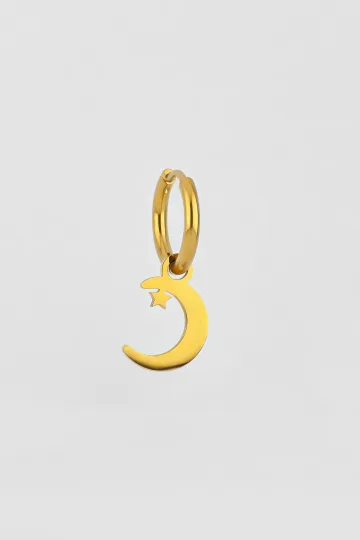
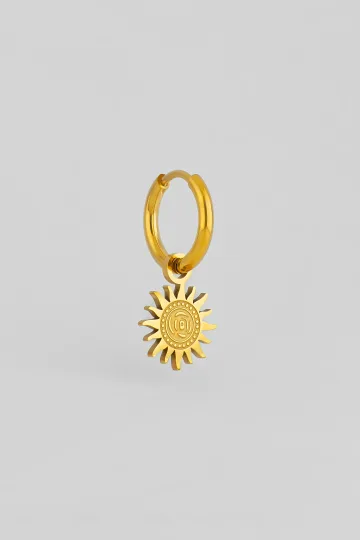
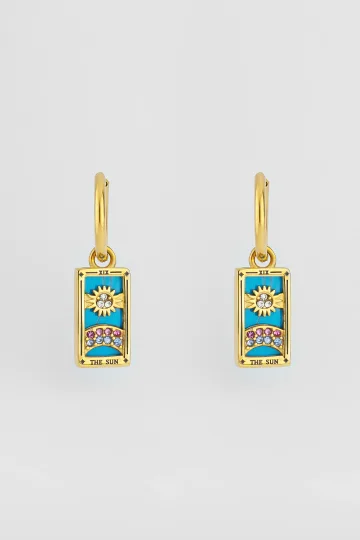
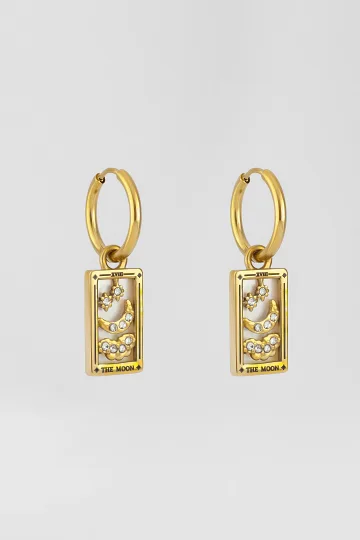
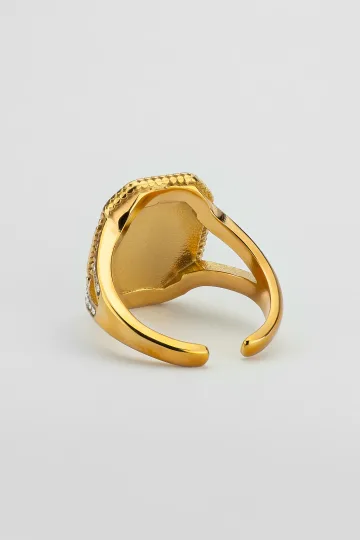
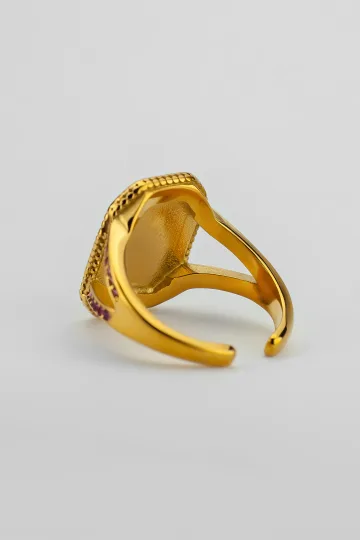
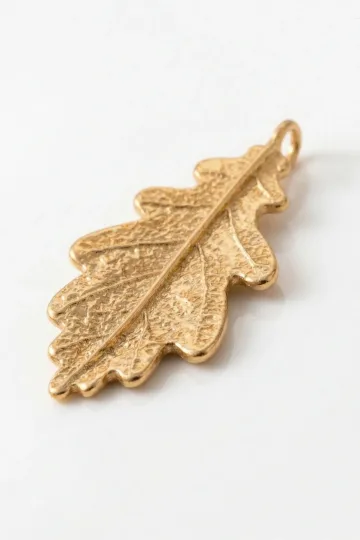
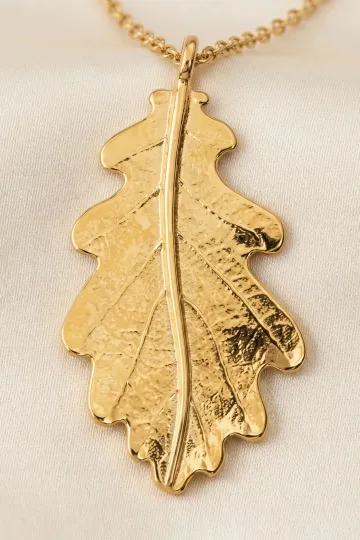
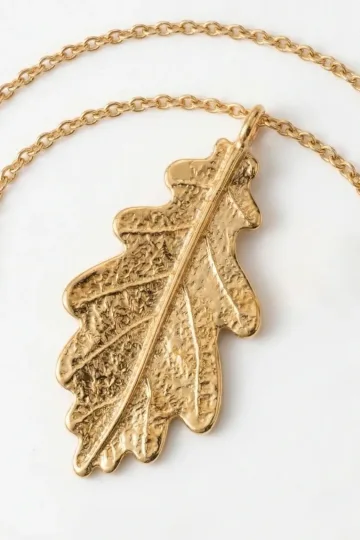
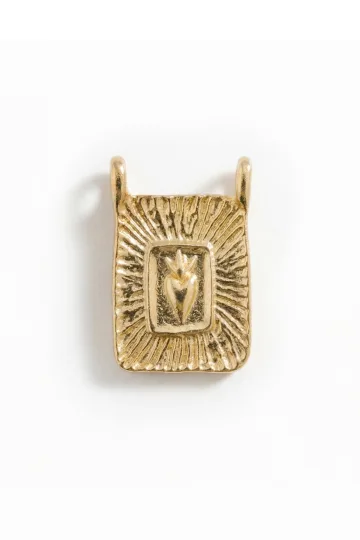
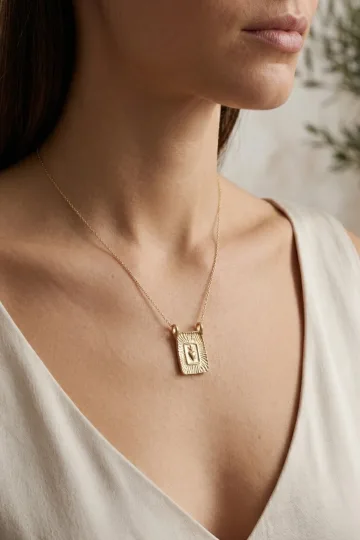
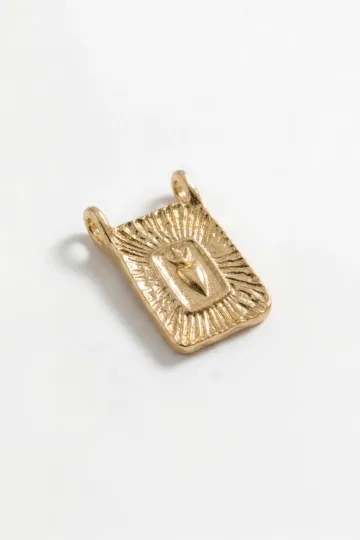
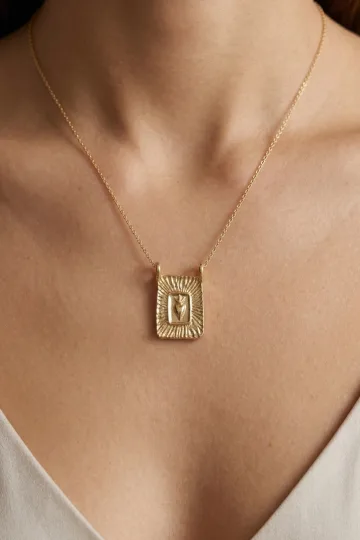
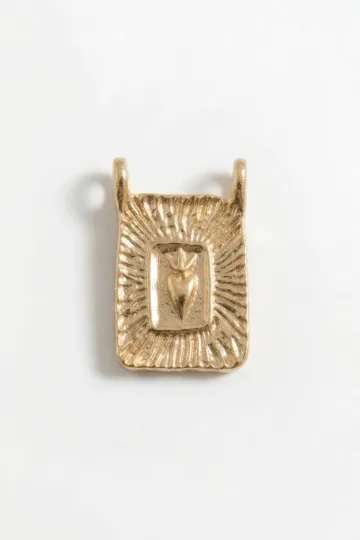
Wear the symbol, don't just read about it. These are in stock:




The eighth card, Strength, develops the same idea another way: there victory is taken through gentleness, by taming the lion with soft hands. The Chariot takes victory through drive and control. These are two schools, and both are needed. The Chariot is a military victory. Strength is a victory of the spirit.
The number seven carries its own weight. In numerology, seven is tied to completeness and the closing of a first cycle. Six is the harmony of relationships. Seven is the person who steps out of that harmony into the world in order to act. Seven days of the week, seven notes, seven wonders of the ancient world: the numerical tradition reads seven as the first real result, the first mature victory.
In the Kabbalistic system, Arcanum 7 corresponds to the path from Binah to Geburah on the Tree of Life. This is the path from understanding to strength, from knowledge to action. Conceptually it fits precisely: the charioteer is strong and understands what he is doing. Strength without understanding does not steer, it breaks.
The card's history: from Italian Triumphs to the Thoth deck
Visconti and the Trionfi: a ceremonial entry
The first cards that became the ancestors of Tarot appeared in Northern Italy in the first half of the fifteenth century under the name trionfi, that is, triumphs. The word itself goes back to the Roman tradition of the triumph: the ceremonial entry of a victorious general into the city on a chariot, cheered by the crowd.
In one of the earliest surviving decks, linked to the Visconti family of Milan, the Chariot card showed a parade scene: a richly decorated chariot, horses, a solemn procession. According to one hypothesis, the image goes back to the real wedding cortege of Bianca Maria Visconti and Francesco Sforza. This is no metaphor, it is literally a triumphal entry into Cremona in 1441.
In the early Italian decks the charioteer was often a woman. This was not an exception but more of a norm. A female figure in armour on a chariot matched the symbolism of Fortune or the female virtues that were popular in the humanist iconography of the fifteenth century.
The Marseille tradition: a warrior without reins
By the seventeenth century, France had developed the standardised Marseille deck, which for several centuries became the basis for mass card production. In the Marseille tradition the Chariot took on a recognisable look.
The Le Chariot card shows a warrior with a sceptre in his hand, a crown on his head, clad in armour. Two horses pull him, and they often look in opposite directions. The detail is essential: there are no reins. The animals pull in different directions, yet the chariot goes straight. How? Only through the will and presence of the charioteer.
This is the conceptual core of all the Chariot iconography: control without physical force. A power that comes from within.
Waite and Pamela Colman Smith, 1909: the starry canopy
The modern canonical image of the Chariot was created by Arthur Edward Waite and Pamela Colman Smith in 1909 for the Rider-Waite deck. Smith filled the card with specific symbols that Tarot scholars spent the rest of the twentieth century decoding.
On the Waite-Smith card a charioteer in armour, with crescent-moon symbols on his shoulders, stands inside an open chariot under a starry canopy. He is not pulled by horses but by two sphinxes: one black, one white. They are not moving, they look in opposite directions. The charioteer holds no reins, only a wand of power in his hand.
Behind his back, beyond the city walls, a river flows. He has already passed through the city gates and moves towards what he has decided. The city, the relationships, the past, all of it stays behind. Open ground lies ahead.
Crowley and Thoth: the four beasts of the Apocalypse
The Thoth deck, created by Aleister Crowley together with the artist Frieda Harris in the 1940s, reimagined the Chariot radically.
In Thoth the Chariot is pulled not by two but by four sphinxes, composed of the four Cherubim: the Bull (Taurus), the Lion (Leo), the Eagle (Scorpio) and the Man (Aquarius). These are the four fixed signs of the zodiac, the four elements. Each sphinx carries the traits of all four, that is, it holds all the opposites at once.
The charioteer in Thoth sits on a throne rather than standing. He does not steer the chariot, he is its centre. In his hands he holds the Holy Grail. Crowley read this card Kabbalistically: the charioteer is a person who has reached a state in which all opposing forces are integrated. He does not control them from outside, he contains them within.
This is a fundamentally different interpretation compared with Waite: in Waite victory is reached by force of will, in Crowley it has already been reached through completeness.
A compass rides bare at the collarbone, not buried under five chains. A charioteer holds a course, not a jumble sale.
How to style the symbolism of the Chariot
I style the symbols of Arcanum 7 differently depending on what someone needs to hold right now: a course, a position, or a strike. I have gathered here what actually works on the body, not just on the card.
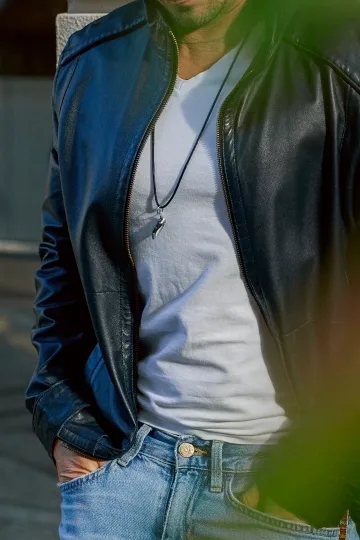
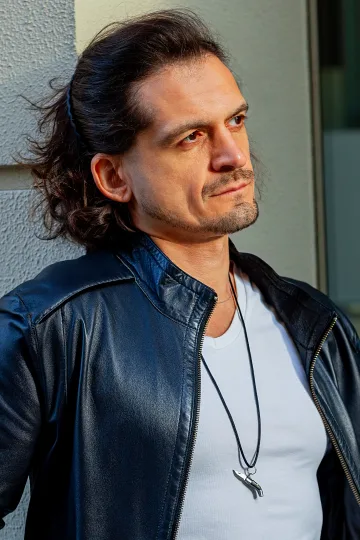
How to wear a Chariot symbol every day? For everyday I recommend one clean pendant on a medium chain (compass, wheel or anchor) over a plain roll-neck or a basic tee. A high neckline leaves the pendant room, and the metal reads as a meaningful accent rather than part of a busy pattern. I suggest silver with a slightly matte surface: it gives the feel of armour and sits well on grey, graphite, dark blue.
And what works for the office? The same logic, but stricter. I recommend a short chain under the collar of a shirt or blazer and a signet ring with a wheel or shield motif on one hand. One noticeable piece, everything else quiet. That builds the look of a person who holds a course, and the clothing does not argue with it.
How to build an evening look? For the evening I suggest playing with length and layers. Build two or three levels: a short chain with a crescent plus a longer chain with a sword or compass below. Under an open or V-neckline this sits perfectly, because chains of different length fill the space rhythmically instead of collapsing into a heap. For a special occasion add a moonstone: its milky shimmer catches the evening light and brings in the astrological layer of Cancer.
Gold or silver for this symbolism? Gold reads as triumph and the sun; I choose it for warm tones: beige, wine, emerald. Silver answers the lunar side of the card, it loves a cool palette and black. Mixing gold and silver here is not a mistake but a hit on the theme: two sphinxes, white and black, in one look. The main thing is an inner logic to the set: movement plus a stop (compass and anchor), will plus feeling (wheel and moonstone).
Who does this symbolism suit, and where to start? It suits those who love minimalism with character, for whom the meaning of a piece matters more than its sparkle. If in doubt, start with one pendant on a long chain so it lies on the chest, in the zone where it shows both under a shirt and over a jumper. One precise piece is always stronger than five random ones.

Turn on your camera, pick earrings, a pendant or a ring, and see the piece on yourself in real time.
Switch items in one tap.
Everything runs in your browser: no photo or video is ever uploaded.
The iconography of the Waite card: every symbol
Two sphinxes: black and white
The central symbol of the card. Two sphinxes pull the Chariot in opposite directions, yet it goes forward. How is that possible?
The black sphinx and the white sphinx are traditionally read as opposing forces that must be held in balance: the conscious and the unconscious, reason and instinct, action and rest, the masculine and the feminine. In the astrological context of the card, which is Cancer, the white sphinx is solar, daytime, outer; the black sphinx is lunar, nocturnal, inner.
The sphinx in the Egyptian tradition is a guardian of the threshold. It guards the entrance to a temple or a tomb. The two sphinxes of the Chariot guard the moment of transition: from intention to action, from preparation to movement.
A detail that is easy to miss: the sphinxes are not harnessed in the usual sense. No reins lead them. They follow the charioteer because he carries within himself something they obey. This is a force that cannot be compelled, only led.
The starry canopy
A canopy covered in stars is stretched above the charioteer's head. Waite explained this as "celestial influences", showing that the charioteer's movement is aligned with a wider order of things.
The starry vault also points to the link with Night and the Moon, ruler of the sign of Cancer. The charioteer moves under the shelter of the heavens, not against them. His will is not isolated, not arbitrary, but part of a larger order.
Armour and the lunar crescents
The charioteer wears armour decorated with various symbols: a square of willpower on the chest, alchemical symbols of transformation, and on the shoulders, on the pauldrons, two lunar crescents, one looking left, the other right.
The lunar crescents on the shoulders point directly to Cancer, ruled by the Moon. They are a reminder of where the charioteer's strength comes from: it is made of discipline, drive, feeling and intuition all at once. Without the moon the armour is empty.
The square as a symbol is especially significant: in the Masonic symbolism that Waite knew well as a Freemason, the square means order, straightness and concreteness. The charioteer does not float in abstractions, he works with the real world.
Scholars note another element of the armour: the magic square of Jupiter on the breastplate. The square of Jupiter is a 4x4 numerical square in which the sum of any row, column or diagonal equals 34. In the occult tradition it is linked to purposeful expansion, to growth governed by reason. The charioteer literally wears on his chest the principle of ordered expansion.
The crown of stars
On the charioteer's head sits a crown with twelve stars, one for each sign of the zodiac. This is the crown of someone who stands under the whole vault of the sky, who holds the entire zodiacal cycle in awareness at once. The twelve stars are twelve aspects of time, twelve qualities that the charioteer has integrated.
The eight-pointed star at the top of the crown appears in different traditions: in Sumerian symbolism as the sign of the goddess Ishtar, in Islamic geometry, in Kabbalah. For Waite it most likely meant spiritual completion: a person who has reached the level of the Chariot has defeated both the outer enemy and the inner chaos.
The wand of power
The charioteer holds a wand in his hand. It is the same wand as the Magician's (Arcanum I), but here it is used differently. The Magician holds the wand as an instrument of creation. The charioteer holds it as a staff of command.
A wand without reins is a very concrete image: power through presence, not through force. No chains, no ropes. Only the clear direction of the will, conveyed through a single touch on the wand.
The city walls behind him
The walls of a city can be seen behind the chariot. The charioteer has left the fortified city and moves into open country. This matters symbolically: the city walls are protection, comfort, the familiar order. Riding out through the gates is the choice of uncertainty for the sake of movement.
The Chariot is not about safety. It is about the readiness to leave safety behind for the sake of a goal.
The river beyond the walls
In the background a river can be seen. Water in Tarot is always tied to the emotional world, to the unconscious, to whatever flows of its own accord. The charioteer rides towards where life flows, he does not hide behind walls.
The river beyond the city walls carries a meaning: it is the border between the ordinary and the larger. Behind the walls lies the familiar world where everything is understood. Beyond the river is open ground without a map. The charioteer has already chosen to leave the walls. Now the crossing lies ahead.
In astrological terms, water is the element of Cancer. The charioteer of the Chariot is born of water, he carries lunar emotion within him, but he does not drown in it. He directs it.
Triumph in antiquity: the Roman tradition of the Chariot
The word "triumph" came into the Italian Tarot straight from Rome. Triumpho was the ceremonial procession of a victorious general through the streets of the city after a military victory. It was a strictly regulated ritual with clear rules: the general entered the city on a quadriga, a four-horse chariot, in a purple toga embroidered with gold, with a laurel wreath on his head. Behind him walked captives, carried trophies, spoils, tablets bearing the names of conquered cities.
Julius Caesar celebrated a triumph four times. Augustus three times. The general Lucullus returned from Armenia with such riches that his triumph in 63 BC was still discussed generations later. The triumph was a religious act, not merely a parade: for a short time the victor was likened to Jupiter, rode under his colours, painted his face red, carried his symbols.
The procession moved through the Forum Romanum, the very heart of the city, towards the temple of Jupiter on the Capitoline Hill. The whole route was a theatre of power: the charioteer looked straight ahead, rode slowly, the people shouted Io triumphe. It was the moment when one man stood literally above the laws of the city, above the mortal level.
But a slave always stood beside him. Behind the triumphant general, holding onto his purple toga, the slave whispered "Memento mori" and "Respice post te, hominem te esse memento", "Remember death" and "Look behind you, remember that you are a mortal man". This counterpoint was built into the ritual on purpose. Glory and the reminder of finitude walked side by side. Celebration and humility in one procession.
Caesar's laurel wreath in the image of the triumph carries a specific meaning. The laurel was dedicated to Apollo, god of victory and the arts. The wreath was given to winners of the Olympic games, to victors of military campaigns, to poets in contests. To wear laurel meant to wear the recognition of a higher power. It is worth noting that Caesar wore the laurel wreath constantly: historians remarked that he also used it to hide his early baldness. Even the chief symbol of triumph has its own human underside.
In the image of the Tarot Chariot this twofold meaning survived. The crowned charioteer rides towards victory, but beyond the city walls everything he gave up for the road stays behind. Triumph is possible, but it is temporary. The steering has to be constant.
Apollo, Helios and Phaethon: the solar chariot in mythology
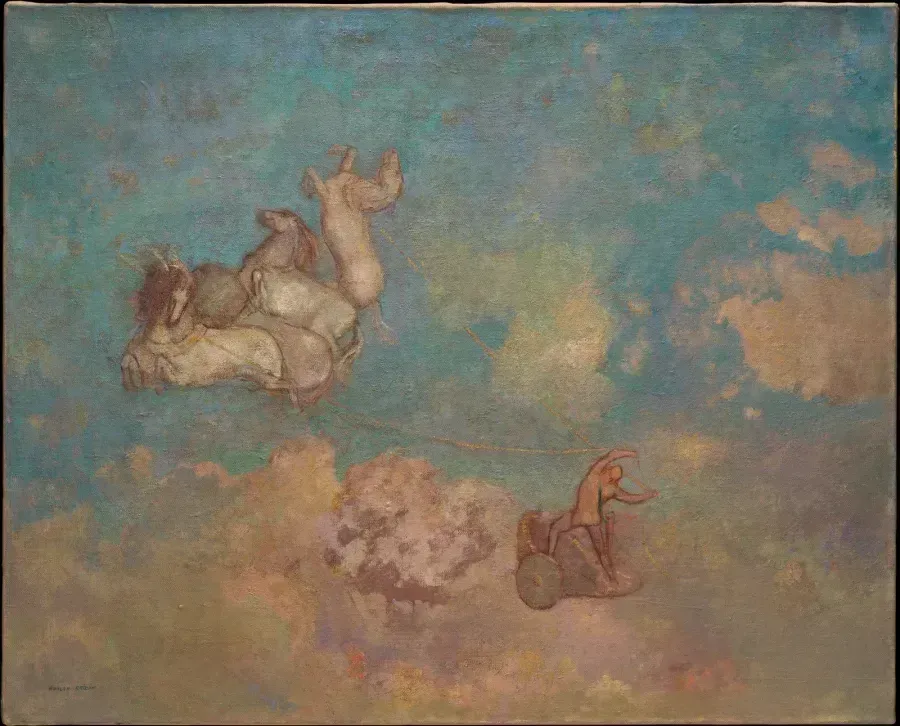
Before it became a Tarot card, the chariot was the sun. In the Greek tradition Helios, god of the Sun, set out every day from the east on a four-horse chariot, crossed the sky and went down into the ocean in the west. There a golden vessel waited to carry him back to the morning point of beginning. The cycle was never interrupted. It was a model of perfect control: every day, the same path, no deviations, no gaps.
Apollo in the later tradition took over the function of Helios and became the driver of the solar chariot. Apollo guides it every day throughout the whole mythological history of the world. Discipline repeated an endless number of times becomes nature itself. This is the upright Chariot in its purest form.
And then Phaethon appears.
Son of Helios by a mortal woman, Phaethon grew up, learned who his father was and went to him with a request. He wanted one thing: to drive the solar chariot across the sky himself, for just one day. Helios hesitated. He knew his horses well: Pyrois, Eous, Aethon and Phlegon were unruly even for him, and he had driven them since the creation of the world. For an inexperienced youth it was impossible.
But Helios had sworn an oath by the Styx, which cannot be broken. He prepared his son, explained the route: keep to the middle road, do not rise too high, do not sink too low, do not stray towards the Serpent or the Altar.
Phaethon climbed into the chariot and lunged forward. The horses immediately felt that the load was wrong. Under unfamiliar hands they left the usual path. The chariot raced upwards, too close to the stars. Then it tilted downwards, towards the earth. Forests burned. Rivers boiled. Seas dried up. Libya turned into a desert. People's skin darkened.
Zeus struck Phaethon with a thunderbolt. The body fell into the river Eridanus.
The myth of Phaethon is a literal story of the reversed Chariot. The strength is there, the desire is there, the intention is honest, but there is no mastery of steering. There is no ability to hold opposing forces in the right balance. The youth wanted the sun and got a catastrophe, not because he was bad, but because he took what he was not ready for.
The gap between the desire to steer and the ability to steer is the central lesson of the myth. In Tarot this is the gap between two states of one arcanum: the upright position, when mastery is present, and the reversed, when it is still not enough.
Phaethon's sisters, the Heliades, mourned him so long that the gods turned them into poplars and their tears into amber. Jewellery was later made from that amber. A solar catastrophe turned into an ornament: this is perhaps the oldest image of loss transformed into a material symbol of memory.
There is a third figure in the solar cycle: Eos, goddess of the Dawn. She rides out first, every day, on a two-horse rose-coloured chariot, opening the path for Helios. Her driving is humbler, less noticeable, without triumph. But without her there would be no day. This is the image of the preparatory Chariot: the work that no one sees but without which the main movement is impossible. In Tarot readings the upright Chariot sometimes speaks of exactly this: the invisible, disciplined work that comes before the visible victory.
Customer reviews
Zevira is a real jewellery shop. Genuine payments, deliveries and customer thank-yous.
🥰🥰🥰 gracias

Ok, ¡gracias! 🙂

The Merkabah in Kabbalah and Jewish mysticism
The word Merkabah in Hebrew means "chariot". It is one of the central concepts of Jewish mysticism, and its history begins with a text that readers of the Bible know as one of the strangest visions in all of Scripture.
The prophet Ezekiel by the river Chebar sees a storm coming from the north. Out of the storm come fire, a cloud, a brightness. Inside are four living creatures with four faces: the face of a man, a lion, an ox and an eagle. Each has four wings. Beside the creatures are four wheels, "like the colour of beryl", wheels within wheels, full of eyes around the rims. When the creatures move, the wheels move with them. Above them is a crystal firmament, above the firmament a throne of sapphire, and on the throne the likeness of a man in fire.
This is the first description of the Merkabah in the Bible. Later Jewish mysticism, known as Kabbalah and Merkabah mysticism, built a whole system on this vision. The four living creatures, the Chayot, became a metaphor for the four elements, the four qualities, the four paths of knowledge. The wheels, the Ophanim, became a symbol of movement, of the constant presence of God in the world through change.
The early mystics who practised the Yordei Merkabah, "those who descend to the chariot", sought to recreate Ezekiel's vision. They entered meditative states in which, by their own accounts, they rose through seven heavenly halls, the Hekhalot, to the throne of God. The journey required absolute concentration and purity of intention: the heavenly guardians at each level demanded passwords and tested the traveller.
To steer the heavenly chariot in this tradition meant not physical movement but inner readiness for an encounter with the incomprehensible. The mystic who reached the Merkabah did not stand above it as a driver, he became part of it, part of the movement of God himself through the world.
The text of Ezekiel was written in the sixth century BC, during the Babylonian exile. Ezekiel writes at the moment when the Jews have lost Jerusalem, the Temple, everything that gave them a sense of God's presence. The vision of the Merkabah is an answer to the question: if God lives in the Temple, and the Temple is destroyed, where is God now? The answer: God moves. His chariot is everywhere. He is not bound to a place. This is a theological turn and at the same time an image of the Chariot: a presence that is preserved not behind walls but in movement. Waite's charioteer too has left the city walls behind. His strength is not in a protected place, it is in himself.
Waite, who knew Kabbalah well through the system of the Hermetic Order of the Golden Dawn, almost certainly had this parallel in mind when he created the starry canopy above the charioteer. The canopy is the heavenly vault of the Merkabah. The charioteer beneath it moves not on his own but within a wider order.
Crowley made the parallel even more explicit: in the Thoth deck the four sphinxes correspond directly to the four creatures of Ezekiel's vision. The Bull, the Lion, the Eagle, the Man. The same group, the same image of integrating all opposing forces into a single, governed movement.
Upload a photo of your pet, someone you love, or an object. We'll build a 3D model and hand-cast it in pewter.




Sphinxes: the Egyptian and Greek traditions
Waite's Chariot has two sphinxes, and behind each lie thousands of years of cultural memory. But the Egyptian sphinx and the Greek sphinx are very different creatures with different roles.
The Great Sphinx at Giza guards the necropolis of Khafre. It is around 4,500 years old. It was carved straight out of a limestone outcrop, a human head on a lion's body, turned to the east. Every year at the equinox the Sun rises directly between the sphinx's paws. The Egyptian sphinx is a guardian, not enigmatic but direct. It guards the entrance, separates the world of the living from the world of the dead, points to the east from which light comes. It asks no questions. It stands.
The Egyptian sphinx was a symbol of the pharaoh's power: the lion's body meant physical strength, the human head meant wisdom. The combination of the two, natural might and reason, gave the image of the ideal ruler. It is no accident that Waite's sphinxes carry the same layer of meaning: two forces in one harness.
The Greek sphinx is something else entirely. It is a winged lion with a woman's head, come from Ethiopia by one account, or born of Typhon and Echidna by another. The Greek sphinx guards Thebes and poses a riddle to everyone who wishes to enter the city. The riddle went: "What walks on four legs in the morning, two at noon and three in the evening?" The answer: a human being. The infant crawls, the adult walks upright, the old man leans on a staff.
Everyone who could not answer was devoured. This went on until Oedipus gave the right answer. Then the sphinx threw itself off a cliff.
The Greek sphinx is a test of knowledge. It does not guard passively, it actively examines everyone. The riddle about a human passing through three ages is a riddle about time and change. Whoever understands the nature of change passes.
The two sphinxes of the Chariot bring both traditions together. The Egyptian aspect: they are guardians of the threshold, keepers of the moment of transition. The Greek aspect: they are a riddle that must be solved not with words but with action. The charioteer does not answer the question with words. He answers with his will, his presence, his wand.
The black and white sphinx are also yin and yang, night and day, the unconscious and the conscious. They pull in opposite directions not out of malice, but because such are their natures. The charioteer's task is not to make them want the same thing, but to create conditions in which their opposing pulls produce one resulting movement.
The Chariot in Buddhism: the Eightfold Path as a chariot
The Buddha gave his first sermon at Sarnath, in the Deer Park, after reaching enlightenment. This event is called the Dharmachakra Pravartana, "the turning of the Wheel of the Teaching". The wheel, the Dharmachakra, became the central symbol of Buddhism. The flag of India shows exactly this wheel with 24 spokes.
The eight spokes of the wheel correspond to the eight elements of the Noble Eightfold Path: right understanding, right intention, right speech, right action, right livelihood, right effort, right mindfulness, right concentration. Buddhists call this path "the chariot to liberation". In Sanskrit, Yana means both "path" and "chariot": Hinayana the lesser chariot, Mahayana the great chariot, Vajrayana the diamond chariot.
The image of the chariot in Buddhism differs fundamentally from the Western one. This is not the chariot of a conqueror but the chariot of awakening. The charioteer does not ride towards an outer victory, he moves towards liberation from suffering. But the principle of steering is the same: the eight aspects of the path must work together, like the eight spokes of one wheel. If one spoke is broken, the wheel does not roll evenly.
In the Theravada tradition the text of the Dhammapada opens with the words: "Mind precedes all phenomena. Mind is foremost, all is made by mind. If a person speaks or acts with an impure mind, suffering follows him, as the wheel follows the hoof of the ox." The chariot here is a metaphor of consequence: actions follow intention with the same inevitability as the wheel follows the hoof.
One Buddhist legend tells of the king Chakravartin, literally "he who turns the wheel". This is the ideal ruler, whose power spreads across the whole world not through force but through virtue. His symbol is a golden wheel that rolls ahead of him, opening the road. Peoples submit to him willingly, because he embodies justice.
The Chakravartin is the Buddhist parallel to the Tarot Chariot: a ruler who moves forward by the force of inner order, not of compulsion. The charioteer without reins, who steers through presence and not through force.
In the Tibetan Buddhist tradition there is the concept of an "inner chariot" as a metaphor for working with the mind. The meditative practices of Vajrayana, the diamond chariot, are built on the principle of transformation rather than denial: anger is not suppressed, it is transformed into clarity, desire into wisdom, fear into fearlessness. This is an exact parallel to the two sphinxes: the dark impulses are not destroyed, they are harnessed. The chariot moves precisely because it contains both the white and the black. Only one of them alone would not move it from the spot.





The archetype of the Chariot: victory through discipline
If the Fool (0) is about a leap with an open heart and the Magician (I) is about the deliberate use of tools, then the Chariot (VII) is about the next level: steering complex, mutually contradictory forces towards a concrete goal.
This is not about the absence of contradiction. The charioteer's two sphinxes look in opposite directions. The contradiction is real. The question is who is in charge: you over them, or they over you.
In Jungian psychology this image echoes the concept of the Self: not the suppression of some aspects of the psyche in favour of others, but their integration into a single, directed movement. The Shadow (the black sphinx) is not killed and not hidden. It becomes part of the harness.
The practical level of the Chariot is familiar to anyone who has worked on a hard task: there is a part that wants to quit. There is a part that wants to keep going. There is fatigue. There is desire. There is the fear of failure. There is the thrill. The Chariot is not about how to silence every voice except the right one. It is about how to make them all pull the same way.
The military archetype matters, but it should not mislead. The Chariot is not about aggression. It is about a discipline that is stronger than aggression. An aggressive commander throws troops into an attack without a plan. The charioteer of the Chariot knows where he is going and goes there calmly, because he steers everything he has.
Upright and reversed meaning
The upright Chariot
The upright Chariot is victory through will and control. Keywords: forward movement, determination, self-discipline, victory, the balance of opposites, single-mindedness.
This is the card of the person who knows what they want and moves towards it despite outer resistance and inner doubt. Not because there is no doubt, but because they are stronger than it.
The upright Chariot answers well to questions about a career, about projects that demand long persistence, about situations where the point is not to give up in the face of difficulty. This is not luck. It is the result of work.
In readings, the upright Chariot often shows that a person already has the resources needed for victory: they simply have to keep moving.
The reversed Chariot
The reversed Chariot carries several possible readings that do not contradict each other.
First: loss of direction. The person moves but does not know where. Or moves where circumstances carry them rather than where they chose. The sphinxes pull in different directions and the charioteer has lost the reins, not literally but inwardly.
Second: overcontrol. The irony of the reversed Chariot is that the wish to control everything can be just as destructive as the absence of control. A person who tries to manage every detail loses the larger picture. The chariot moves, but the driver is so busy checking all the systems that he does not look at the road.
Third: aggression without a goal. When willpower loses its object, it turns into pressure on the people around. The reversed Chariot can point to conflict, to the use of force not for the sake of a goal but for the sake of force itself.
The line between the first and second readings is especially thin: both loss of control and excess of control give the same outer result, movement in the wrong direction. The card invites a question: am I really steering, or only pretending to?
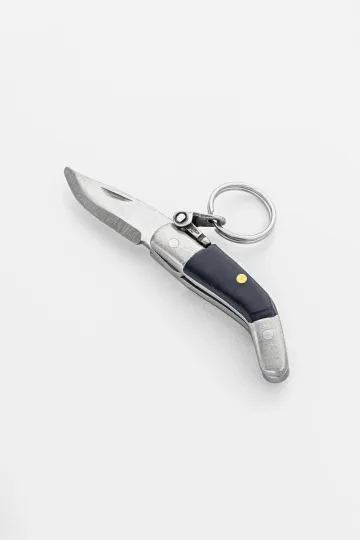
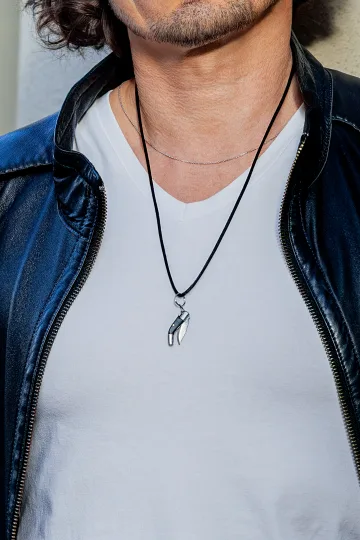
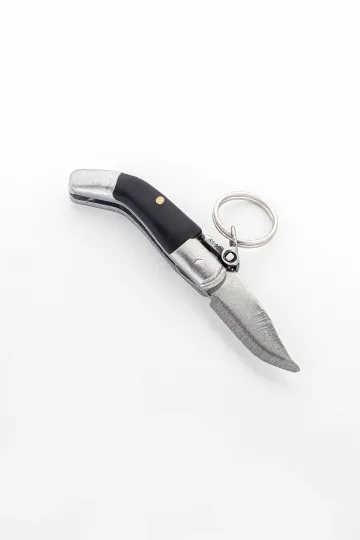
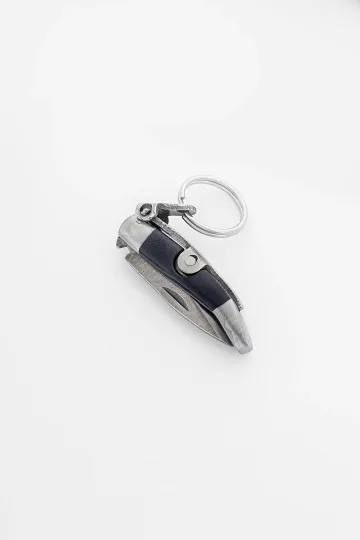
CAPAORA mini knife pendant
The 18th-century Spanish navaja in miniature: 40 mm of stainless steel, a real folding mechanism and a Palanquilla lock that clicks. An affordable gift to remember.
Authentic · Ships from Spain · 14-day returns
Cancer and the Moon: the astrological dimension
The Chariot is linked to the sign of Cancer in the Western astrological system of Tarot correspondences. This is one of those non-obvious correspondences that always surprises people with a passing knowledge of astrology.
Cancer is a water sign ruled by the Moon. Intuition, emotional depth, the bond with home and the past, the protective shell, motherhood. How is that connected to the racing chariot of a victor?
The answer lies in the nature of Cancer as a cardinal sign. Cancer, together with Aries, Libra and Capricorn, is cardinal, that is, initiating. Cardinal energy is initiation, the launch of movement, the start of a new cycle. Cancer begins the summer cycle in the Northern Hemisphere, and that beginning carries a powerful impulse.
The combination of lunar emotional sensitivity with the cardinal impulse of movement gives the image of the Chariot. The charioteer is not an unfeeling warrior made of steel. He feels everything, the crescents on his shoulders are not decorations. But he has learned to direct feeling rather than obey it.
The Moon, ruler of Cancer, is also the ruler of changes, cycles and tides. The charioteer of the Chariot knows how to move in time with them rather than against them. This is not steering through suppression, but steering through an understanding of rhythm.
In jewellery this correspondence opens an interesting line: a crescent or a moonstone combined with symbols of movement (a wheel, a compass, a wand) gives a precise image of Arcanum 7. Lunar sensitivity plus directed will.
The Chariot in literature
When Lew Wallace wrote "Ben-Hur: A Tale of the Christ" in 1880, he created one of the most powerful images of a chariot race in Western culture. The hero, Judah Ben-Hur, wins as an act of justice and the restoration of honour, not as an end in itself. The race in Wallace is many-layered: it is not sport, it is a battle of wills, where victory means giving the family back its name.
Ben-Hur trains for years. He drives a team of four white Arabian horses. His opponent Messala, a former friend turned enemy, races on a dark team. Wallace built the race as a conversation between archetypes: light against darkness, will plus mastery against brute force. Victory goes to the one who knows how to steer, not to the one who is more aggressive.
In "The Lord of the Rings", Tolkien created the Nazgul, the Ringwraiths, who travel on winged creatures. But another detail matters more: the Ring of power itself works like a reversed Chariot. It promises control, command, power over others, but in the end it controls those who wear it. Frodo, carrying the Ring to Mount Doom, is the image of a charioteer trying to hold a direction under the pressure of a force greater than himself. He does not always manage. But he keeps going.
Frank Herbert in "Dune" built a whole cycle on the image of the chariot. Paul Atreides must steer the gigantic sandworms, the Shai-Hulud, literally ride a force incomparably mightier than a human. The Fremen do this by knowing the worms' rhythm, feeling their movement, knowing how to open a segment and hold it with hooks. This is steering through knowledge, not brute force, an exact image of the Chariot. Later Paul loses control over the direction of his own path, caught by the golden path of history: he becomes a charioteer carried along by his own prophecies, that is, a reversed Chariot on the scale of a civilisation.
Michel de Montaigne in his "Essays" described the wise man as one who knows how to steer himself the way an experienced rider steers a horse: not violating its nature, but also not letting it carry him wherever it pleases. Montaigne wrote in the sixteenth century, before Waite's Tarot system, but the image is the same: mastery lies not in suppression but in partnership with the force you carry within.
In English-language poetry the same archetype runs through Tennyson's "Ulysses", where the ageing king refuses to sit still and resolves "to strive, to seek, to find, and not to yield". This is the upright Chariot in verse: age and circumstance pull one way, the will pulls the other, and the will holds the course. The opposite image appears in Robert Browning's runaway momentum, speed and drive without a clear destination, the reversed card: motion that is not steering.
Leave your email, we'll send your discount code. No spam, unsubscribe anytime.
The code arrives by email, valid on your first order.
The Chariot in cinema
The 1959 film adaptation of "Ben-Hur" with Charlton Heston in the lead became one of the most famous epic films of the twentieth century. The chariot race scene, about 12 minutes long, was filmed over several months on the largest film set in the world at that time. More was spent on building the track than on the whole of the first, silent "Ben-Hur" of 1925.
Heston spent months at the reins of a chariot, learning to handle a team of four horses. The trainer told him: "You don't have to win. Just don't lose." That sounds like a direct piece of advice from the card: you do not control everything. But you steer what is in your hands.
The 2016 adaptation with Jack Huston told the same story differently. The modern version focused more on the inner path of reconciliation than on outer victory. The race remained, but the centre of gravity shifted: victory as a condition of forgiveness, not as an end in itself.
Speed races in pop culture constantly reproduce the archetype of the Chariot. The "Fast & Furious" series rests on exactly this: the heroes steer machines at the edge of the possible, and their victories are the result of mastery, not chance. "Gran Turismo" (2023) tells a real story: a gamer with no real racing experience travels the road from a simulator to a professional track. It is literally a story about how inner mastery of steering, honed over thousands of hours, carries over into the real world.
Formula 1 is the modern Chariot in its most obvious form. A driver in a car weighing about 800 kg, at speeds over 350 km/h, with two hundred sensors and a team of hundreds of engineers. But in the end one person holds the wheel. He steers the car, the weather, the tyres, the fuel, the position of rivals, his own psychology under pressure. All of it at once. These are the two sphinxes multiplied by a hundred.
Lewis Hamilton explained in an interview that the best laps on a track happen not when you think about speed. They happen when you stop thinking and simply drive. This is a description of the flow state that Csikszentmihalyi writes about. And it is an exact description of the charioteer of the Chariot: not a struggle with the sphinxes, but movement together with them.
There is one more modern image that maps precisely onto the archetype. Anime and manga, especially the Japanese tradition, created a type of character called in Japanese a "rider". This is a person who steers something incomparably mightier than himself: a giant robot, a monster, an elemental force. Ursula K. Le Guin's dragon riders, the riders of "How to Train Your Dragon", the Eva pilots in "Evangelion", all of them embody the same structure: a small human inside a huge force that does not obey until he learns to steer it not through compulsion but through merging. This is the Chariot in the formats of the twenty-first century.
Will and the psychology of achievement
Behind the image of the Chariot stands a concrete psychological reality, studied in the twentieth and twenty-first centuries with the tools of science.
Viktor Frankl, a psychiatrist who survived four Nazi concentration camps, formulated the theory of logotherapy: the last of the human freedoms cannot be taken away, the freedom to choose one's attitude to circumstances. The prisoner does not choose the conditions, but he chooses how to respond to them. This is steering under conditions of total external loss of control. A chariot without horses, without a road, without reins, but with a charioteer who remains himself.
This thought is often put like this: between stimulus and response there is a space, and in that space lies the freedom to choose our response, and in our response lies our growth. The idea is usually linked to Frankl, though in this crisp form it was spread by his followers. The essence is the same: this space is the charioteer's wand. The external pressure is the sphinxes pulling to the sides. The space between stimulus and response is the place where the charioteer steers.
Angela Duckworth, in her book "Grit" (2016), described the results of years of research: what determines success in long-term tasks? Not IQ. Not natural talent. A combination of passion and perseverance, which she called grit. Duckworth studied West Point cadets, finalists of national spelling competitions, salespeople, teachers in poor districts. In all groups the predictor of long-term results was not initial talent, but the ability to keep going when it gets hard.
This describes the upright Chariot precisely. The sphinxes do not go anywhere. Fatigue comes. Doubt comes. The question is not whether they will come, but who is in charge after they arrive.
Edward Deci and Richard Ryan developed self-determination theory, which singles out three basic psychological needs: autonomy (the feeling that you act of your own will), competence (the feeling of effectiveness) and relatedness (belonging to something larger). When all three are met, motivation is internal and stable. When they are not, movement either stops or comes from fear or compulsion.
The charioteer of the Chariot acts from autonomy: he chose where to go himself. He is competent: he knows how to steer two sphinxes. He is connected: the starry canopy above him is a reminder that his path is part of a larger order. This is not a random set of symbols, it is a model of the inner state in which long-term forward movement is possible without self-destruction.
The psychology of high performance
The Stanford psychologist Carol Dweck developed the theory of two mindsets: fixed ("either I can or I can't") and growth ("I can learn to steer"). The Chariot lives in the growth mindset. The charioteer is not born knowing how to steer two sphinxes. He learns. His armour is the armour of a person who has been through enough battles to know how they work. The twelve stars of his crown are not an innate gift but experience integrated to the level of nature.
There is a reverse side of will: too much control gets in the way. Sports psychologists distinguish two modes of working under pressure. Conscious control, when the athlete thinks about every movement, and automatic execution, when the body does what it knows without the constant supervision of consciousness. The paradox is that with experienced performers it is precisely an excess of conscious control at the moment of performance that lowers quality: the person tries so hard to control everything that they tense up and lose a practised skill.
Waite's charioteer without reins is exactly about this. Reins, physical control, are the mechanism of a beginner. The master holds the wand, sets the direction with his will and lets the body and the learned mastery do the rest. Steering through presence, not through constant manual intervention. The same state Lewis Hamilton described as the best laps, which come when you stop thinking about speed and simply drive.
The neuroscientist Matthew Walker showed that it is during sleep that the brain consolidates motor skills, moving them from slow conscious control to fast automatic execution. An athlete who sleeps eight hours gains more in accuracy and reaction speed than one who trains while short on sleep. A charioteer who recovers steers better than a charioteer who only pushes forward.
And one more principle of the psychology of winners: process thinking instead of outcome thinking. An athlete who thinks about winning performs worse than one who thinks about the next step. A marathon runner who breaks the distance into segments runs it more evenly than one who thinks about the finish from the first kilometre. This is the steering of the two sphinxes: not "how do I reach the goal", but "how do I steer right now, on this stretch of road". The goal sets the direction, but steering happens in the present moment, not in an imagined future.
The Chariot in readings: sport, negotiation, deadline
The Chariot appears in readings in concrete life situations, and each one calls for its own reading.
Sport and competition
When the Chariot comes up before a competition or in the "what will help" position, it is one of the best signs. The card says: you have what you need. The steering of available resources, not luck, not chance. The opponents prepared too, but victory will belong to the one who steers themselves better in the moment of competition.
The upright Chariot in sport speaks of psychological readiness on a par with the physical. Both sphinxes must pull: the body must be ready, and the head too. Reversed in sport, it points to the risk of freezing under pressure: the person will stop steering and start simply reacting.
Negotiation
The Chariot in the position of advice for a negotiation says: you can make it so that the other side wants the same thing you want. This is not manipulation, it is the skill of building a shared direction. Just as the charioteer does not pull the sphinxes by force but creates conditions in which they move forward themselves.
The upright Chariot in negotiation points to a position of strength without aggression. Know what you want. Hold the direction. Do not yield to pressure where the direction is set, and yield where it is not essential. This is the art of discernment, which in our jewellery line we convey through the sword, even though there is no sword on the Waite card itself.
A project deadline
The Chariot in the "state of the project" position says: there is movement, there is direction. The task now is not to generate new ideas, but to finish what has already begun. The sphinxes are already moving. Do not let them stop.
The reversed Chariot at a deadline is a signal of scattered attention: a team or a person is pulling in several directions at once, and the resulting speed is lower than it could be. The card advises: choose one direction and move there.
The start of a contest or a competitive situation
The Chariot at the start of a new competitive cycle, a product launch, an entry into a new market, is a good sign with a condition. The card says: victory is possible, but only on the condition of steering. Not on the condition of a better product or a bigger budget. On the condition that the charioteer holds the wand.
Jewellery with the symbolism of the Chariot
The Chariot card does not give one obvious jewellery equivalent, the way the Lovers give a heart or the Moon gives a crescent. Its symbolic field is richer and less linear. The jewellery reading of Arcanum 7 works through several different images, each of which captures a different facet of the card.
The compass: knowing your direction
The compass, or rather the compass rose, is one of the most precise symbols of the Chariot in jewellery. The Chariot needs a direction: without it, all the charioteer's strength turns into movement in circles. The compass is a tool of orientation that does not say "where to go" but "where the cardinal points are". The charioteer decides for himself.
The compass rose appeared on Mediterranean navigation charts in the fourteenth century. It did not give a route, it gave a system of coordinates. A person with a compass in hand is someone who will not get lost, even if the path is unknown. That is exactly how the charioteer of the Chariot works: the points of reference are clear, the route he lays out himself.
Read more about the meaning of the compass in jewellery in our guide to compass rose jewellery.
The anchor: governed strength
The anchor at first glance contradicts the image of a moving chariot. But the anchor is not about stillness, it is about a governed stop. An anchor dropped at the right moment is what keeps a ship from being swept away by the current. This is the same principle as the charioteer with his two sphinxes: not letting any single impulse become dominant.
In Christian symbolism the anchor was a hidden image of the cross, of hope. In maritime culture the anchor is mastery: knowing when to stop is as important as knowing when to move.
An anchor pendant or a bracelet with an anchor motif suits those who value in the Chariot precisely the ability to hold a position under pressure. The meaning of the symbol is covered in detail in our guide to the anchor in jewellery.
The wheel as a motif
The wheel is one of the most direct visual equivalents of the Chariot. Eight spokes of the wheel as eight directions. Movement with no beginning and no end. The wheel in jewellery also echoes Arcanum 10 (the Wheel of Fortune), but in the context of Arcanum 7 the accent is different: not on luck that turns by itself, but on movement created by will.
A ring with a wheel motif, a wheel pendant, a bracelet with wheel spokes, all of it works as a reminder that movement requires a direction.
The shield: defence through position
The shield in symbolism goes back to the same military context as the Chariot itself. The shield does not attack, it defends. But the shield of the Chariot is not shelter behind walls, it is active defence in movement: you ride forward, and the shield covers you on the road.
A shield pendant or a shield ring suits those who wear the energy of Arcanum 7 as a reminder that movement towards a goal is in itself a form of defence. The one who stands still is vulnerable in a different way than the one who moves. The history and meaning of the shield in jewellery are covered in detail in our guide to shield symbolism.
The sword: precision against brute force
The sword in jewellery is often perceived as a symbol of aggression, but that is not accurate. The sword is a symbol of precision and discernment. It is a tool that cuts rather than crushes. In the context of the Chariot the sword speaks of victory taken not by brute force but by clean, precise action: cut away the excess, focus on the essential.
A sword pendant or a sword ring gives the wearing of Arcanum 7 a vertical sharpness: not the roundness of a shield or an anchor, but the linearity of a blade. The symbolism of the sword in jewellery is covered in detail in our guide to the sword.
The horse as a symbol
The horse in jewellery carries its own powerful symbolism that echoes the Chariot directly. The horse is speed, nobility, cooperation between a human and a natural force. The rider does not suppress the horse, he finds a common language with it. This is the same principle as the charioteer with the sphinxes.
A horse pendant or a horse charm for a bracelet works as an image of partnership between intention and natural energy. Not control through suppression, but steering through mutual understanding.
Send a friend a discount code, they save on their first order.
The Chariot as a tattoo and as jewellery
The symbolism of Arcanum 7 exists in two different jewellery registers, and they carry different meanings.
A tattoo of the Chariot or its symbols, the sphinxes, the wheel, the charioteer, is a permanent statement about oneself. To make it means to say: this is the part of me that does not come off. A person who gets a tattoo with this image says: this is part of me, this is what I am made of. The wheel on the wrist, the sphinxes on the shoulders, the starry canopy on the back, each of these images works as an autobiography written straight onto the skin.
Tattoo culture in the Western world took up Tarot firmly from the 1990s onwards. Among the cards, the most popular for tattoos are the Fool, Strength, the Star and the Chariot: all of them carry images of movement, transformation, victory over oneself. The Chariot is often tattooed in a minimalist style, a single line, the outline of a chariot, or in a detailed artistic one, with the full set of Waite's symbols.
Jewellery works differently. A compass pendant can be taken off. A wheel ring comes off in the evening. An anchor bracelet is chosen for the mood and the task. This is mobile symbolism: jewellery is worn when a reminder is needed, when it resonates with the task of the day or the period of life. To put it on and take it off is also an act of steering. The charioteer chooses when to climb into the chariot.
It is this mobility that makes jewellery with the symbolism of the Chariot especially fitting for its archetype. The Chariot is not about a permanent state, it is about the choice to move. To put on a compass piece on the day of an important negotiation is a small ritual of intention: today I hold the course. To take it off in the evening is agreement that the task is done. Tomorrow is a new day, a new decision.
The combination of tattoo and jewellery gives the full image: a permanent foundation (this is who I am) and a temporary, mobile part (this is my intention today). The charioteer on the chariot plus the wand in hand.
Famous Tarot readers on the Chariot
Practitioners of Tarot with many years of experience describe the Chariot as one of the most "working" cards on concrete life questions.
Rachel Pollack in "Seventy-Eight Degrees of Wisdom" describes the Chariot as a card of "self-sacrifice for the sake of a goal": the charioteer has left the city, left his ties and his shelter, in order to move forward. This is neither a tragedy nor a loss, it is a choice. Pollack notes in particular: the Chariot appears for people who know what they want but are afraid to give up what they already have for the sake of moving towards the goal.
Mary K. Greer, author of "21 Ways to Read a Tarot Card", looks at the Chariot in the context of personal power: the card appears at the moment when a person is ready to take charge of a situation. Not to wait for circumstances to fall into place, but to create them through movement.
In the tradition of psychological Tarot reading, the Chariot is often read as a card of second-order result: the first order is the desire to win, the second is victory through steering oneself. You cannot steer the outer without steering the inner. The two sphinxes are a working image with a concrete technique for working on oneself.
In a Jungian key the Chariot is often described as a card that appears at moments when an inner conflict reaches a point where the task is not to take the side of one of the voices, but to find a way to make both serve a common goal. This is one of the hardest skills: not to suppress contradiction, but to use it as fuel.
A separate line of reading comes from the Thoth deck, where the charioteer holds the Holy Grail. In this key the Chariot is read as a card of what is worth steering for: if there is nothing valuable inside the chariot, the steering itself loses its meaning. Steering is not an end in itself, it serves what the charioteer carries.
Among modern practitioners there is a steady observation: the Chariot in a reading for questions of sport, competition and competitive situations is almost always read as a positive sign if it is upright. This is a rare case where the meaning of the card turns out very concrete: do what you do well, and do it without fear.
Buying it as a gift? Each one arrives ready to give.
 A branded Zevira box and a little card come with every order.













Combinations of the Chariot with other cards
The Chariot and Strength (VIII). Two arcana in a row, two images of victory. The Chariot is victory through control and discipline. Strength is victory through gentleness and patience. Together they describe the full arsenal: know when to apply the force of drive and when to yield.
The Chariot and the Magician (I). The Magician gives tools and intention. The Chariot gives the road. Together they are the pair "I know what to do plus I do it no matter what". A powerful combination for questions about a career and creative projects.
The Chariot and the Lovers (VI). The Lovers made the choice, the Chariot carries it out. This pair says: a decision made from the heart will be backed by the will. The link between an emotional impulse and disciplined action.
The Chariot and the Tower (XVI). A heavy combination: something in motion will go wrong. The Tower is a sudden, collapsing break. Together with the Chariot it is a warning: make sure you are moving in the right direction, otherwise speed will only worsen the fall.
The Chariot and the Star (XVII). One of the best combinations: movement towards the goal will be backed by hope and recovery. After the effort of the Chariot comes the light of the Star.
The Chariot and the Moon (XVIII). The Moon brings uncertainty and illusion. Together with the Chariot it is a signal: you are moving, but where exactly? Check whether wishful thinking is fooling you in place of reality. Direction matters more than speed.
FAQ
Is the Chariot in Tarot a good or a bad card?
The upright Chariot is one of the most clearly positive cards for questions about action, achievement and forward movement. It does not promise an easy path, but it promises victory to the one ready to steer their contradictions rather than give in to them. The reversed version is more complicated, it points either to a loss of direction or to excessive control.
Is it true that the Chariot is linked to Cancer?
Yes, in the system of astrological correspondences of Tarot the Chariot is traditionally linked to Cancer. This correspondence surprises people, because Cancer is associated with emotion and home, not with victorious warriors. But Cancer is a cardinal sign that begins a new cycle, and its lunar sensitivity combined with the cardinal impulse gives the image of the charioteer: emotionally deep, but able to direct his depth.
Why does the charioteer have no reins?
This is one of the key details of the Waite card. The absence of reins means that steering is carried out not by physical force but by will, intention, presence. The sphinxes follow the charioteer not because he pulls them, but because he carries within himself something they obey. This is the most important layer of meaning: the Chariot is about inner mastery, not outer compulsion.
How does the Chariot differ from Strength (VIII)?
Both arcana are about victory, but by very different methods. The Chariot takes victory through discipline, control and drive: the charioteer steers two sphinxes, holding them in the needed direction. Strength takes victory through gentleness: the woman on that card tames the lion with tenderness, not force. The Chariot is Mars, active conquest. Strength is Venus, conquest through acceptance. In real life both qualities are needed.
What does the Chariot mean in questions of love?
In questions of love the Chariot speaks of moving towards a partner or a goal with full commitment, but warns of the danger of excessive control in a relationship. Steering two sphinxes is possible in a business context, but in a relationship both partners are not sphinxes, they are both charioteers. The upright Chariot in a love reading often shows that a person is ready to move towards a relationship or a concrete goal within it.
What jewellery do people close to the energy of the Chariot wear?
A compass (orientation and direction), an anchor (governed strength), a wheel (movement through will), a shield (active defence in motion), a sword (precision and discernment). A moonstone or a crescent adds the astrological dimension of Cancer. Silver with clean lines or gold with an understated form works well.
Can you wear several Chariot symbols at once?
Yes, and it is logical. A bracelet with a compass and an anchor is movement plus a governed stop, a precise image of the Chariot. A chain with a wheel and a moonstone is will plus intuition. A pendant with a sword and a shield is attack and defence together. The main thing is that an inner logic reads between the symbols, not a random set for the sake of looks.
What is the Merkabah and how is it linked to the Chariot?
Merkabah in Hebrew means "chariot". It is the vision of the prophet Ezekiel: four living creatures, wheels within wheels, a heavenly throne. Waite, who knew Kabbalah, built this parallel into the starry canopy above the charioteer. Crowley in the Thoth deck made it explicit: four sphinxes correspond to the four creatures of Ezekiel.
Which metal suits Chariot-themed jewellery best?
Gold is traditionally linked to victory and the solar principle, which matches the upright Chariot. Silver with the lunar aspect of Cancer. Mixed metals work well too: gold and silver as the two sphinxes, black and white. Textured matte silver gives the feel of armour. Polished gold gives the feel of triumph.
Silver, gold, wedding rings, symbolism, matching sets.
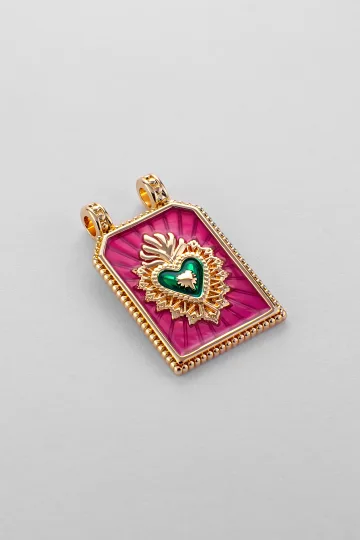
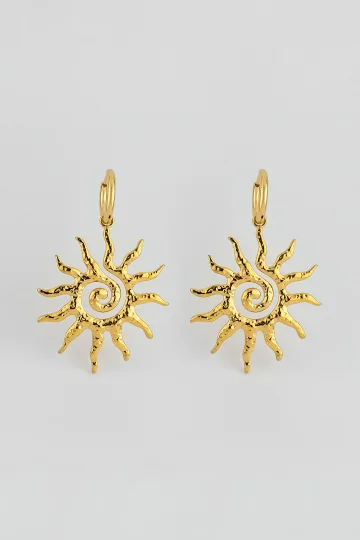
Wear the symbol, don't just read about it. These are in stock:
Conclusion
An athlete at the start line who has to make two opposing impulses pull the same way. A manager at a deadline who knows that fatigue says one thing while the goal demands another. Phaethon, who took the reins without mastery and lost control of the sun. Caesar, entering Rome with a laurel wreath and a slave behind him whispering of death.
All of this is the Chariot.
Arcanum 7 does not promise an easy path. It says that the path is possible if you know how to steer the opposites inside you rather than pretend they are not there. The black sphinx will not go anywhere. Neither will the white. The task is not to destroy one of them, but to drive.
From the early Italian triumphs of the fifteenth century to the starry canopy of Waite-Smith, from the solar chariot of Helios to the heavenly Merkabah of Ezekiel, from the Eightfold Path of the Buddha to Duckworth's research on grit, different traditions describe one and the same experience: victory is the result of steering. Inner steering, which is harder than any outer kind.
Jewellery with the symbolism of the Chariot, a compass, an anchor, a wheel, a shield, a sword or a moonstone, is not a lucky charm. It is a quiet reminder that you have everything you need to steer. All that remains is not to let the wand slip from your hands.
For jewellery with the symbolism of other Major Arcana, see the detailed breakdown in our overview of Tarot jewellery.
About Zevira
Zevira makes jewellery in the artisan tradition of Albacete, Spain. The Chariot as an archetype of victory through control and movement is one of the central meanings in our symbolic line.
What you can find with us under the symbolism of Arcanum 7:
- Compass and compass-rose pendants for those who steer their chariot by the stars
- Anchor pendants for those who value governed strength
- Sword jewellery: precision and discernment instead of brute drive
- Shield jewellery: defence in movement
- Moonstone combined with metal details for the astrological dimension of Cancer
Each piece is made by hand by a craftsman, with the option of personal engraving. We work with 925 silver and 14-18K gold.