The Cross of Saint James: the meaning of the sword-cross of the Order of Santiago
For centuries the knights of one of Europe's oldest military orders sewed a scarlet cross with a sword-shaped hilt onto their white cloaks. Today millions of pilgrims on the road to Compostela recognise the very same shape.
The Cross of Saint James (in Spanish, Cruz de Santiago) is a red cross whose lower arm is drawn out into a blade, while the three upper ends open into heraldic lilies. It was worn by the knights of the Order of Santiago, a brotherhood that guarded the pilgrim roads and took part in the Reconquista. The form outlived the order itself and became one of the most recognisable Spanish symbols: it is stamped on sherry bottles, on the tiles of Compostela, on badges of honour and, of course, on pendants.
Here is the plan. How this sword-cross is built, where the Order of the Apostle James came from, how the Camino de Santiago and the scallop shell fit in, what the sword, the lilies and the scarlet colour mean, what people read into the cross today, and how it differs from the Caravaca, the Maltese and the Cross of Calatrava.
The Cross of Saint James stands apart among Christian crosses. An ordinary neck cross is first of all a sign of faith. The Cross of Saint James carries a double memory: it is both a religious symbol of the apostle, the patron of Spain, and the emblem of a knightly brotherhood with eight centuries of history behind it. These two layers, the spiritual and the knightly, have fused into one spare silhouette that reads without a caption: seeing the red sword-cross, a Spaniard knows at once what it means.
Before we unpack the history of the order and the symbolism of the blade, a quick check of affinity. If you are choosing a cross with character for yourself or as a gift, it helps to work out which format is closest to you: a severe silver sign at the throat, warm gold with scarlet enamel, or graphic steel for every day.
The Cross of Saint James belongs to the family of Spanish order crosses, alongside the crosses of Calatrava, Alcántara and Montesa. All of them grew out of the age of the Reconquista, but it was the Cross of Saint James that travelled furthest beyond heraldry and became a folk sign of the Way. Let us take it apart from bottom to top, from the shape of the blade to the meanings people give it today.
What the Cross of Saint James is
The sword-cross: a blade instead of the lower arm
The first thing that sets the Cross of Saint James apart from an ordinary one is its lower arm. It is not straight but drawn out and pointed, like the blade of a sword with a guard. The upper part stays a cross, while the bottom turns into a weapon ready for battle. Such a cross is sometimes called exactly that, a sword-cross, because it literally joins two objects in one: a sign of faith and a knight's blade. The guard, the crosspiece at the hilt, sets the "shoulders" of the cross, and the point faces downward, as if a sword had been driven into the ground point first, its hilt turned to the sky.
This detail is no decorative whim. The Order of Santiago was a military-monastic brotherhood, where the monastic vow lived side by side with military service. The sword-cross expressed this double nature more exactly than any motto: the hilt folds into a cross, the blade recalls what the brothers held in their hands. The form was not invented all at once; it took shape in the heraldry of the order and settled as its identifying mark.
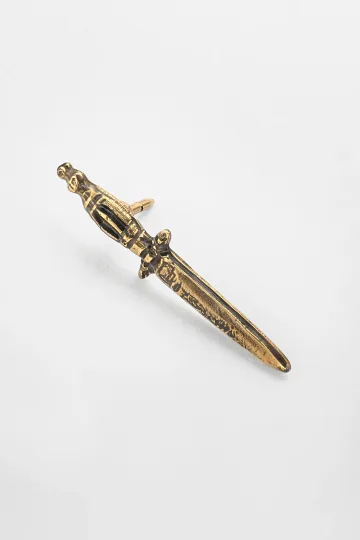
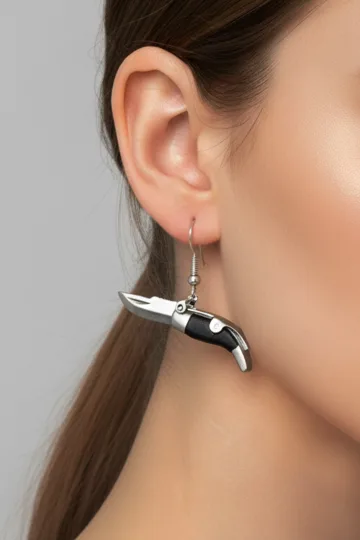
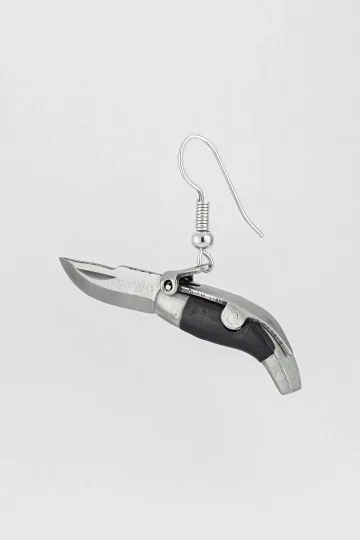
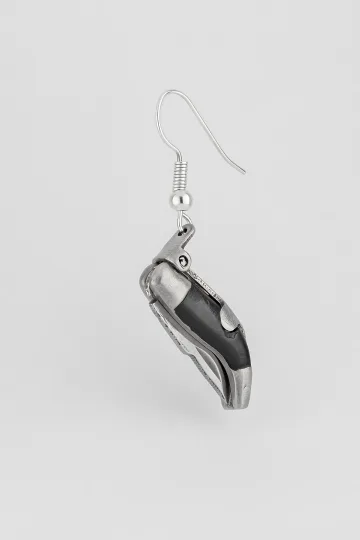
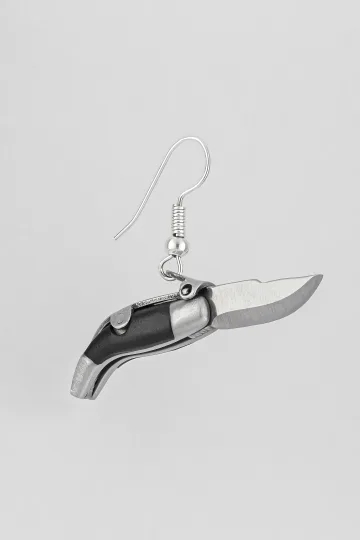
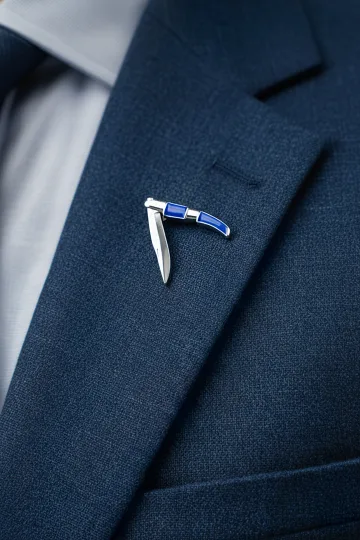
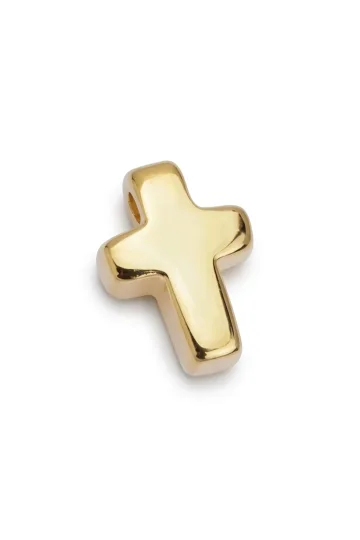
Wear the symbol, don't just read about it. These are in stock:








Three lilies on top: the fleur-de-lis
The three upper ends of the Cross of Saint James usually finish not in straight bars but in open heraldic lilies, the fleur-de-lis. In Christian symbolism the lily is a sign of purity, and in heraldry a mark of nobility and high dignity. On the cross of the order the lilies soften the severity of the sword: a flower above, a blade below, and in one object meekness and strength meet.
There is a practical explanation for the shape too. The petals of the lily widen the ends of the cross, making the silhouette ornate and easy to recognise from a distance, which mattered for an order's emblem on a cloak or a banner. Not every Cross of Saint James carries its lilies at full strength: on the most severe versions the upper ends are only slightly forked, while on ceremonial ones the lilies are worked down to the last petal. But it is exactly the pairing of three lilies and one blade that makes the Cross of Saint James unlike anything else.
Scarlet as an identifying mark
The classic Cross of Saint James is red. The knights sewed the scarlet version onto their white cloaks and banners, and that contrast, red on white, became the colour formula of the order. Red in the Christian tradition is the colour of the blood of martyrs and of apostolic service, and for a military brotherhood also the colour of valour, of readiness to give one's life. So the Cross of Saint James is almost always shown scarlet, whether as enamel on metal, a red thread or paint on a tile.
In jewellery the red is carried by enamel over silver or gold, more rarely by a red stone. Purely metal versions without colour also exist, where the form is held by the sword and lilies and the scarlet is only implied. But the canonical, instantly readable image is precisely the red sword-cross, and most pendants keep to this colour.
Names and spellings
In Spanish the cross is called Cruz de Santiago or Cruz de la Orden de Santiago, that is, "cross of the Order of Santiago." You will also meet the name Cruz-espada, "sword-cross," pointing straight to the form. In English people write "Cross of Saint James," "Cross of Santiago," and "Order of Santiago cross." The word Santiago itself is the Spanish name of the Apostle James: from the Latin Sanctus Iacobus came Sant Iago, and then Santiago. So "Cross of Santiago" and "Cross of Saint James" mean the same thing; one name simply came through the Spanish tradition, the other through the churchly one. All the names point to a single object: a red sword-cross with lilies, the emblem of the Spanish knightly order of the Apostle James.
We have taken the form apart, but behind it stands a living history eight centuries long. Before we go deeper, it is worth seeing how the sword-cross looks in metal today: the severe guard, the sharp blade, the open lilies. Below are a few pieces from the same symbolic family, to try the image on for yourself, and then we return to where the cross came from.
To understand why such a modest sign earned such a reputation, we need to go back to the twelfth century, to the restless frontier between the Christian kingdoms and the Muslim south of the peninsula, where the brotherhood was born.
History: the Order of Santiago and the Reconquista
Twelfth-century Spain: the frontier and the pilgrims
In the twelfth century the Iberian Peninsula was divided. The Christian kingdoms of the north, Castile, León, Aragon, Navarre, had spent centuries taking back land from the Muslim rulers of the south, and historians call this long, broken process the Reconquista. The border between the worlds was not a straight line: it shifted, stalled, ran through mountains and rivers, and along it stood fortresses, monasteries and roads.
Pilgrims travelled these roads from the north. By that time the Camino de Santiago had already taken shape, the road to the tomb of the Apostle James at Compostela, and the flow of people passed through dangerous, half-wild lands. Travellers were robbed and attacked; the roads needed guarding. Out of this need, to protect the pilgrim and to hold the frontier, the Spanish military orders grew, and the Order of Santiago became the best known among them.
The founding of the order around 1170
The Order of Santiago took shape around 1170 in the lands of the kingdom of León. By tradition, at its beginnings stood a small group of knights who set out to protect pilgrims on the road to Compostela and to defend the reconquered lands. The brotherhood quickly won church recognition: in 1175 its rule was confirmed by the Pope in Rome, and the order joined the number of officially recognised military-monastic bodies. The Apostle James, Santiago, became its heavenly patron and gave the order its name, and the red sword-cross became its emblem.
From the very start the order differed from purely monastic brotherhoods in one respect. Its members were allowed to marry, whereas the Templars or the Hospitallers took a vow of celibacy. This brought the Order of Santiago closer to secular knighthood and helped it put down roots in Spanish society: the brothers raised families, passed on lands, wove themselves into the local nobility. The rule still kept its monastic features, obedience, common life, a religious routine, and in this mix of family and service the order found its stability.
The rule and monastic knighthood
The order lived by a rule that joined military discipline with religious. The brothers were divided into knights, who bore military service, and clerics, who led worship and cared for souls. There were commanderies, encomiendas, districts with lands and revenues managed by knights of the order. At the head of it all stood the grand master, the maestre, an elected leader of the brotherhood with enormous power and estates.
The Order of Santiago kept hospitals and shelters for pilgrims, strengthened fortresses, and took part in military campaigns on the frontier. Its wealth grew with the reconquered lands: kings granted the order vast holdings in reward for service, and by the late Middle Ages the brotherhood had become one of the largest landowners on the peninsula. Behind the sword-cross on the cloaks stood not scattered warriors but an organised power with lands, revenues and connections across all the Christian kingdoms of Spain.
Masters, the height of power, and absorption into the crown
By the fifteenth century the masters of the Order of Santiago were among the most powerful men in Castile, and the office of grand master became a prize in political struggle. Such power beside the throne worried the kings. Under the Catholic Monarchs, Isabella of Castile and Ferdinand of Aragon, the crown took the governance of the Spanish military orders into its own hands: the mastership of Santiago and of the other brotherhoods was fixed to the crown, so that the orders' huge lands and power would work for the state rather than against it.
With the end of the Reconquista at the close of the fifteenth century the military task of the orders was spent, and the brotherhoods gradually turned from fighting bodies into honorary knightly institutions. Membership of the Order of Santiago became a mark of noble birth and royal favour, and the red sword-cross migrated from battle cloaks onto ceremonial portraits and family coats of arms. The order outlived the centuries as a sign of honour, and its cross reached our own day, cut loose from war but keeping the memory of it.
The order gave the cross its name and emblem, but the name itself came from a far older figure, from the apostle whose tomb drew pilgrims from all over Europe for centuries. Let us turn to him.
Customer reviews
Zevira is a real jewellery shop. Genuine payments, deliveries and customer thank-yous.
🥰🥰🥰 gracias

Ok, ¡gracias! 🙂

The Santiago cross is worn large and in silver, scarlet enamel against a white shirt. A tiny gold cross misses the point here, it is a sword, not a little heart.
How to wear with the Cross of Saint James: what to pair it with, metal and chain length
The Cross of Saint James is a graphic sign with a strong character, so I build the look from the clothes and the occasion, not from the cross alone. I have gathered here what I recommend to clients for different cases.
What do I wear with the Cross of Saint James every day? For everyday I recommend a medium cross, around 2 to 3 cm, in silver or matte steel on a chain that sits at the collarbone. I match the severe heraldry to a plain top: grey, white, navy, black. The red sword-cross reads cleanest against a calm background, so I would not advise a busy print under it. The blade draws the silhouette down, and the cross sits neatly on the chest.
Which metal and scarlet enamel do I match to the colour of the clothing? I suggest matching the metal to the temperature of the look. Cool silver I recommend for grey, graphite, blue; warm gold or gilt for sand, brown, wine. The scarlet enamel is a separate accent: the red cross sounds especially clean on a white shirt, repeating that very red-on-white formula. For a busy or red top I do not take enamel, so the colour does not argue with itself; there I choose a purely metal version without colour.
How do I choose the chain length for the neckline? I match the length to the neckline. For an open collar or a shallow neckline I recommend a short chain around 45 cm: the cross lands in the zone by the collarbone, where the heraldry reads best. For a closed top I suggest dropping the cross to 50 to 55 cm, onto the upper chest, so the blade is not lost under the fabric. Long chains of 60 to 70 cm I keep for a large ceremonial cross over clothing, or for a layered look of several chains and a leather cord.
Which size of cross do I choose? I choose the size for the task and the build. A small cross on a fine chain I use for hidden, quiet wear and delicate looks: it reads as a sign but does not drag down. A medium one, a couple of centimetres, I recommend as the universal choice; it is visible but not heavy. A large cross with worked lilies and enamel I keep for the ceremonial, pectoral role over clothing. I remember the blade: it visually lengthens the cross, so at equal height the Cross of Saint James looks slimmer than an ordinary one.
What do I choose for weekdays, and what for the road or a gift? Here I build the look around the occasion. For weekdays and a restrained setting I take silver or steel without enamel, where the cross reads as a severe graphic sign. For the road and the Camino I recommend a plainer, sturdier cross, steel or silver on a cord, to wear without a second thought. A ceremonial or gift version, on the contrary, I choose larger, in gold or silver with scarlet enamel and worked lilies, so the piece looks solemn and serves for years.

Turn on your camera, pick earrings, a pendant or a ring, and see the piece on yourself in real time.
Switch items in one tap.
Everything runs in your browser: no photo or video is ever uploaded.
The Apostle James and the Camino de Santiago
Who Santiago is: the Apostle James the Greater
Santiago is the Spanish name of the Apostle James, one of the twelve disciples of Christ, whom church tradition calls James the Greater, to tell him apart from others of the same name. By tradition, after the events of the Gospel James preached on the Iberian Peninsula, and then returned east, where he met a martyr's death. Tied to this same preaching is the legend of the Virgin of the Pillar: by tradition the Mother of God appeared to James at Saragossa on a pillar of jasper, giving him courage in a hard hour. Later, the tradition goes, his remains were miraculously carried back to the northwest of Spain, to the land that would become Galicia.
For Spain, James is no ordinary apostle. He is the patron of the country, Santiago the protector, whose name for centuries rang out as both a battle cry and a prayer. Around his veneration a whole religious geography grew up: the place where, by tradition, his relics were found became one of the three great centres of Christian pilgrimage, on a level with Rome and Jerusalem.
Compostela and the finding of the relics
By tradition, at the start of the ninth century a hermit saw a strange light over a deserted field in Galicia, as though stars were pointing to a certain spot. Excavations, the legend says, uncovered a tomb that was recognised as the burial place of the Apostle James. The very name of the city, Santiago de Compostela, folk etymology links to the Latin campus stellae, "field of the star," though scholars argue over the exact origin of the name.
Over the discovered tomb rose a church, and then a majestic cathedral, and to it pilgrims came from all over Europe. Compostela became the third most important place of Christian pilgrimage, and the road to it, the Camino de Santiago, one of the most famous routes in history. The cross of the order that bore the apostle's name wove itself naturally into this geography: where Santiago is honoured, his sword-cross is known.
The scallop shell and the Way
The Camino de Santiago has its own identifying mark, the scallop shell. It was sewn onto clothing, hung on the staff, fixed to the bag, and by it people recognised someone walking to the apostle or returning from him. The shell became the emblem of the Way, and its fan-like grooves, converging on a single point, were read as many roads leading to one goal, the tomb at Compostela. The scallop shell and its role on the Camino de Santiago deserve a story of their own, so rich is their history.
The Cross of Saint James and the shell are two signs of one theme. The shell marks the pilgrim and the road; the cross marks the order that guarded that road. They are often worn together or set side by side, and both work today as symbols of the Way: one says "I am walking to the apostle," the other "I am under the protection of his knights." In the souvenir shops of Compostela the sword-cross and the shell lie next to each other, two sides of one pilgrim world.
Why the order took the apostle's name
The choice of a heavenly patron for a medieval order was no accident. By the twelfth century the Apostle James was already the chief patron saint of the Christian kingdoms of the peninsula, a symbol of their unity and their struggle. To take his name meant to stand under the most authoritative protection Spanish Christianity had, and to bind one's brotherhood to a national holy thing. The order that guarded the road to the apostle's tomb logically took his name and raised his cross on its cloaks.
So the apostle's name, the road to his relics and the emblem of a knightly brotherhood were tied into one knot. The Cross of Saint James gathered it all at once: the memory of James, the idea of pilgrimage and knightly valour. That is why it proved longer-lived than many other order emblems, for behind it stood both heraldry and one of the most honoured holy places in Europe.
The symbolism of colour and form
Why a sword, not an ordinary cross
The sword in the Cross of Saint James is a plain statement about the nature of the order. The brotherhood was military, its knights held weapons and went into battle, and the cross does not hide this but shows it openly. Yet the blade here is not only a weapon. In the Christian reading the sword is also an image of the word that strikes at falsehood, and a symbol of resolve, of readiness to defend the faith and the weak. The hilt, folding into a cross, subjects the weapon to the faith: the sword serves the cross, not the other way around.
There is a quiet sense of sacrifice in this form too. A sword pointed downward is a lowered sword, not a raised one, a weapon at rest. The knight who wore such a cross read in it a reminder that his strength was given not for himself but for service. So the sword-cross of the Order of Santiago is taken not as a sign of aggression but as a sign of discipline: the weapon is there, but the faith commands it.
Why lilies on the ends
The three lilies on top balance the blade below. If the sword speaks of strength and service, the lily speaks of purity, nobility and spiritual dignity. In Christian symbolism the white lily is an old mark of chastity, and in heraldry the fleur-de-lis is a sign of high birth. By setting lilies on the upper ends of the cross, the order declared that its strength was ennobled by faith and honour, that behind the blade stood not a brigand but a knight under a vow.
The three lilies on three ends are sometimes read in a numerical key too, linked to the Christian Trinity, though this is a later reading rather than the original intent. However that may be, the joining of sword and lilies in one cross makes a rare, expressive image: a weapon below, a flower above, and both belong to one order. Few signs can say so briefly, "strength and meekness in the same hands."
Red: blood and martyrdom
The scarlet colour of the Cross of Saint James carries several meanings at once. The first and chief is the blood of the martyrs. The Apostle James met a martyr's death, and the red cross recalls the price paid for the faith. The second meaning is military: red is the colour of valour and of readiness to shed blood in battle, a natural colour for a military order. The third is purely visual: scarlet on a white cloak is seen from afar, on the battlefield and in procession alike, which was practical for an order's emblem.
In jewellery the red colour holds all this memory in folded form. The owner need not sort through the meanings; it is enough that the scarlet sword-cross reads as a sign of something serious, spilled and suffered, rather than a decorative trinket. That is why makers hold on to the red enamel: take away the colour, and the cross loses part of its voice.
Santiago and the warrior image: how to read it today
The veneration of the Apostle James in Spain has a difficult page. In the age of the Reconquista the image of Santiago Matamoros took shape, the warrior-apostle whom legend showed taking part in battles on the Christian side. This image was born of a time of war and of a war over land, and today it is treated with more unease than it was centuries ago: in many churches and museums it is now presented as a historical monument of its age rather than as a call to arms. To look honestly at this layer means to see in it exactly the history of frontier wars, with all their cruelty, and not a reason to glorify violence.
The Cross of Saint James, meanwhile, long ago outgrew its warlike origin. For most of those who wear it today it is a sign of the Way, of pilgrimage and of Spanish heritage, not a battle cry. Like many old symbols, it no longer lives by the meaning it began with: the form has stayed, but its reading has grown peaceful. Understanding the history of the cross is useful for wearing it with awareness, knowing both the bright and the dark sides of the age that gave it birth.
Upload a photo of your pet, someone you love, or an object. We'll build a 3D model and hand-cast it in pewter.




Meaning today: protection, pilgrimage, valour
A sign of the Way and pilgrimage
Today the Cross of Saint James is first of all a sign of the Way. Thousands of people walk the Camino de Santiago every year, some for faith, some for sport, some to sort themselves out over long days on foot, and the sword-cross has become one of the symbols of that experience. People bring it back from Compostela as a memory of the road walked, give it to those setting off, and wear it as a quiet mark of belonging to the great brotherhood of those who have done the Camino. In this sense the cross has fused with the scallop shell: both speak of the road to the apostle.
For the pilgrim the cross is valued not for its material but for the fact that it has been to the tomb or walked the whole way with its owner. A simple silver or even pewter cross from the shop by the cathedral means more, to the one who arrived, than an expensive thing in a window. Here the Cross of Saint James behaves like any pilgrimage relic: its power is in the road it has travelled.
Valour and keeping one's word
The second layer of meaning comes from the knightly past. The cross of the order was for centuries a sign of valour, loyalty and honour, and that memory is alive still. People wear the Cross of Saint James as a reminder of values that have not gone out of date: keep your word, protect the weak, answer for your deeds. For many this is closer than the religious sense: not a declaration of faith but a quiet personal code, sewn into the form of the sword-cross.
That is why the Cross of Saint James is often chosen by those drawn to the idea of restrained strength, and given as a mark of respect, a recognition of someone's steadfastness or loyalty. The sword in the cross reads here not as a threat but as a promise: to be reliable, to stand by one's own. A symbol of valour does not require the owner to be a warrior; it is enough that they value what that valour stands for.
Protection on the road
The third layer is a folk, protective one. Since the order guarded pilgrims on dangerous roads, the Cross of Saint James settled naturally as a charm for the traveller. People take it on a trip, hang it in the car, give it to those going far away, with a wish for a safe road. Here the cross draws close to other Spanish protective signs, the Caravaca cross and other charms of the road and the home, though each has its own history and its own speciality.
The protective reading does not conflict with the others but completes them. Someone who rarely sets foot in a church may still keep a Cross of Saint James with them as a sign that the road is under protection. In the Spanish-speaking world such an everyday, not strictly church, relationship with holy things is common, and the apostle's sword-cross fits into it easily.








The Cross of Saint James as jewellery
A pendant for the neck
The most common format of the Cross of Saint James is a pendant on a chain or cord. It is worn like an ordinary neck cross, near the heart, but it reads in several roles at once: a sign of faith, a memory of the Camino, a symbol of Spanish heritage. The sword-cross looks good stretched out vertically, and its proportions fall naturally on the chest: the blade draws the silhouette down, the lilies hold the top. The chain length is chosen to suit the neckline and the height, and the cross itself is worn on view or hidden under clothing as the owner prefers.
The Cross of Saint James suits both men and women, but it has a noticeable "masculine" character because of the blade and the severe heraldry. So it is often chosen by those who find a decorative cross alien and prefer a sign with history and character. In women's versions the sword is softened by a fine line and a small size, keeping the graphic quality but removing the heaviness.
Engraving and personalisation
The Cross of Saint James takes engraving well, and this makes it a good personal gift. On the back people put a date, a name, coordinates or a short phrase, most often tied to the Camino: the date of the walk, the name of the starting point, a motto word. For someone who has done the Camino, such a cross with an engraved date becomes a keepsake, like a medal for a long road, only worn near the heart.
People engrave without a link to pilgrimage too: initials, the date of an important event, a short dedication. The smooth fields between the sword and the lilies give the maker room for fine work, and the severe form of the cross does not argue with an inscription. Personalisation turns a standard symbol into a personal thing, and that is exactly why the Cross of Saint James is often given on meaningful dates, where both the sign itself and the word addressed to a person matter.
For pilgrims and as a gift
The Cross of Saint James is given for several clear reasons. The first and most obvious is the Camino: the cross is fitting both before the road, as a blessing, and after it, as a reward for the way walked. The second reason is Spanish heritage: to people with Spanish or Galician roots the sword-cross is given as a sign of the homeland, a piece of Spain that fits in the palm of the hand. The third reason is values: the cross is handed over as a symbol of valour and loyalty to someone one wishes to honour for it.
Gift versions are more often made in silver or gold, with worked lilies and red enamel, so the piece looks solemn and serves for years. For an everyday, travelling version people take a plainer, sturdier cross. In any case the Cross of Saint James reads as a gift with a message, not a trinket: behind it stand the apostle, the Way and eight centuries of knightly history, and that gives weight even to a small cross.
Before we look at metals and sizes, it is worth understanding that the format is largely set by the material. What the cross is made of decides its look, its weight, and the role it is fit for, a severe everyday sign, a ceremonial gift or a charm for the road.
Materials and formats
Silver
Silver is the most common material for crosses of Saint James. It is affordable, it holds the fine carving of the lilies and the clean edge of the blade well, and its cool shine suits the severe heraldic form. For everyday wear people usually choose 925 sterling silver: it is durable, rarely irritates the skin and cleans easily. A silver Cross of Saint James is a sensible middle ground between price, strength and looks, and it is most often in silver that everyday versions are made.
Silver gains especially in a pair with red enamel: the cool metal and the warm scarlet give exactly that contrast, red on white, that was the colour formula of the order. Oxidised, slightly darkened silver adds graphic sharpness to the sword-cross and brings out the relief, so the form reads more crisply.
Gold
A gold Cross of Saint James is the ceremonial, family version. It is given on great dates, passed down by inheritance, and chosen when both the form and the material matter for decades. The warm colour of gold sits well with red enamel and brings out the lilies, and the metal itself does not tarnish and keeps its look for years. A gold cross often becomes a lifelong object, and then passes to the next generation, carrying with it both the history of the order and the history of the family.
Gold also allows finer, more jewel-like work: crisp edges of the blade, neat petals of the lilies, even fields for engraving. That is why the most ornate versions of the cross, where every detail counts, are made in gold. For those who find gold too warm, there are versions in white gold, closer in coolness to silver but more durable.
Red enamel
A distinct expressive detail of crosses of Saint James is red enamel. It is exactly what gives the recognisable image: a scarlet sword-cross gleaming on metal. The enamel is laid into the hollows of the cross and fired, so the colour comes out deep and lasting. The red pulls along all the symbolism of the order, the blood of the martyrs, valour, apostolic service, so enamel versions look "fuller" than purely metal ones.
Enamel needs careful handling. It is durable but afraid of knocks and abrasive chemicals, so a cross with enamel is taken off before the pool, the sea and cleaning with aggressive products. With careful wear the red colour holds for decades. Versions with enamel of other colours exist too, but the scarlet remains the canonical one, because without the red the Cross of Saint James loses half its voice.
Steel and everyday versions
Besides precious metals, crosses of Saint James are made of stainless steel and coated brass. A steel cross is cheaper, barely afraid of water and knocks, does not tarnish, and so suits the road, sport, and daily wear without a second thought. For someone who wants to wear the sword-cross constantly and not think about it, steel is a convenient choice: it holds the clean heraldic form and looks good in a matte or black finish.
Brass and silver-plated versions occupy the ground between steel and silver: they look warmer than steel but need more care. Such crosses are often taken as a travelling or spare version, and also as an inexpensive gift with a message. The material here sets the weight and the price but does not change the essence: the form of the sword-cross is recognisable in gold or in steel alike.
Size and weight for the task
The Cross of Saint James is also chosen by size. A small cross on a fine chain suits hidden, everyday wear and women's looks: it reads as a sign but does not drag down. A medium one, a couple of centimetres, is the most versatile, visible but not heavy, suited to men and women alike. A large cross with worked lilies and enamel is a pectoral, ceremonial thing, worn over clothing on special occasions or as a bold accent.
The weight depends on the metal and on whether the cross is solid or openwork, cast or thin. For everyday wear people take a weight that does not tug on the chain or get in the way, while family and ceremonial crosses can allow themselves to be more massive. The blade in the lower part visually lengthens the cross, so at equal height the Cross of Saint James looks slimmer than an ordinary one, and this is worth keeping in mind when matching the size to a neckline.
The Cross of Saint James is easy to confuse with other Spanish and European crosses, especially in a small image. Let us look at how it differs from its nearest relatives, so as not to make a mistake when choosing.
Leave your email, we'll send your discount code. No spam, unsubscribe anytime.
The code arrives by email, valid on your first order.
How it differs from other crosses
Spanish heraldry knows several order crosses, and beside them stand pan-European forms. Each has its own history, its own context and its own recognisable silhouette. The table below gathers the main differences, and afterwards we look at the most common pairs in more detail.
Santiago and Caravaca
The Cross of Saint James and the Caravaca cross are both Spanish and both protective, but they are different objects. The Caravaca is a double-barred protective cross from Murcia, tied to a legend of an appearance and to a relic of the wood of the True Cross; it has two horizontal crossbars and is often flanked by two angels. The Cross of Saint James is a sword-cross with lilies, the emblem of a knightly order; it has one crossbar, and its lower part is drawn out into a blade. Caravaca is about a miracle and household protection, Santiago about pilgrimage, the order and valour. They share a Spanish origin and a protective reputation, but their forms and histories are quite different, and with a careful look they are hard to confuse.
Santiago and the Maltese cross
The Maltese cross is an eight-pointed star of four arrows converging with their points at the centre, the emblem of the Knights Hospitaller, later the Order of Malta. Its ends are forked and form eight sharp angles, so the form looks like four arrowheads. The Cross of Saint James is built differently: it has an ordinary cross base, the lower arm turned into a sword, and the upper ends opened into lilies. The Maltese cross is symmetrical in every direction and has neither a blade nor lilies. Both came out of the world of military orders, but they belong to different brotherhoods and different countries, and they should not be confused.
Santiago and the Cross of Calatrava
The Cross of Calatrava is the nearest Spanish relative of the Cross of Saint James: both are red, both belong to Castilian military orders of the Reconquista. But their form is different. The Cross of Calatrava is a Greek cross with equal ends, each finishing in a heraldic lily, the fleur-de-lis, and it has no sword. The Cross of Saint James is recognised precisely by the blade below, which Calatrava never has. The easiest way to tell them apart is this: if a red cross has all its ends equal and all with lilies, it is Calatrava, and if the lower end is drawn out into a sword, it is Santiago.
Santiago and the Latin cross
The Latin cross is one vertical and one crossbar, the most widespread form of the Christian cross in the Western tradition, a universal sign of faith with no tie to an order. The Cross of Saint James takes the same base but rethinks it: the lower arm becomes a blade, the upper ends lilies, and the colour scarlet. In meaning the Latin cross is a pure sign of faith, while the Cross of Saint James carries an extra load, of the order, the pilgrimage, the knighthood. So the Latin cross is worn by all Christians without distinction, while the Cross of Saint James is chosen by those to whom the Spanish story of the apostle, the Way and the order matters. The Cross of Saint James grew out of the broad Spanish jewellery tradition with its love of heraldry and religious symbolism, and in that line it is one of the most recognisable signs.
CAPAORA mini knife pendant
The 18th-century Spanish navaja in miniature: 40 mm of stainless steel, a real folding mechanism and a Palanquilla lock that clicks. An affordable gift to remember.
Authentic · Ships from Spain · 14-day returns
Myths about the Cross of Saint James
Around the Cross of Saint James, as around any old symbol, beliefs and simplifications have grown up. Some of them go back to the real history of the order, some were invented later. Let us look at the popular claims and see where the truth is and where the exaggeration.
The very fact that people argue over the cross and spin legends about it is the best proof that it remains a living symbol rather than a museum exhibit. Dead things are not given myths.
Facts that surprise
- The cross is literally a sword. The lower arm of the Cross of Saint James is not a stylisation but a deliberate image of a blade with a guard. Few Christian crosses openly join a sign of faith and a weapon, and almost all of them came out of the world of military orders.
- Married monk-knights. Unlike the Templars and the Hospitallers, the knights of the Order of Santiago were allowed to marry. This rare concession helped the order put down roots in Spanish society and outlive the centuries.
- The apostle's name is hidden in the word Santiago. Santiago is a contracted Sant Iago, "Saint James," from the Latin Sanctus Iacobus. So "Cross of Santiago" and "Cross of Saint James" are the same name, simply shortened in different ways.
- The crown took the order for itself. By the end of the fifteenth century the masters of the order were so powerful that the Catholic Monarchs fixed the mastership of Santiago to the crown, so the brotherhood's huge lands and power would not threaten the throne.
- The cross and the shell are a pair. The sword-cross of the order and the pilgrim's scallop shell are two signs of one world. One marks the brotherhood that guarded the road, the other the traveller, and in Compostela they are sold side by side.
- The sword faces down for a reason. The point of the blade in the cross is turned to the ground, the hilt to the sky. This is a sword at rest, not raised for a blow, an image of strength subject to faith rather than aggression.
- A lily and a blade in one sign. A flower of purity above, a weapon below, a rare pairing that says briefly, "strength and meekness in the same hands." Few coats of arms allow themselves such a contrast so openly.
- The cross outlived its war. The order was created as a fighting brotherhood of the Reconquista, but its cross has reached our own day as a sign of the Way and of heritage, cut loose from war and keeping only the memory of it.
Send a friend a discount code, they save on their first order.
Frequently asked questions
What does the Cross of Saint James mean? It is the emblem of the Spanish knightly Order of Santiago, a red cross whose lower arm is drawn out into a blade, while the three upper ends open into heraldic lilies. It is tied to the Apostle James, the patron of Spain, and to the Camino de Santiago, the pilgrim road to his tomb at Compostela. Today the cross is read as a sign of the Way, of valour and of Spanish heritage.
Why does the Cross of Saint James have a sword? The Order of Santiago was a military-monastic brotherhood whose knights bore both a vow and a weapon. The sword in the lower part of the cross expresses this double nature: the hilt folds into a cross, the blade recalls military service. The point faces down, so the sword reads as a weapon at rest, an image of strength subject to faith rather than a sign of aggression.
What do the lilies on the Cross of Saint James mean? The three upper ends finish in heraldic lilies, the fleur-de-lis. The lily is a sign of purity, nobility and high dignity. On the cross it balances the severity of the sword: a weapon below, a flower above, and together they speak of strength ennobled by honour and faith.
How does the Cross of Saint James differ from the Cross of Calatrava? Both crosses are red and both belong to Spanish military orders of the Reconquista, but their form is different. The Cross of Calatrava has all its ends equal and each finishing in a lily; it has no sword. The Cross of Saint James is recognised by the blade below. A simple rule: a sword means Santiago; all ends with lilies and no sword mean Calatrava.
Who is Santiago? Santiago is the Spanish name of the Apostle James the Greater, one of the twelve disciples of Christ and the patron of Spain. By tradition he preached on the peninsula, and his relics, found again in Galicia, became the holy thing of Santiago de Compostela, the third most important place of Christian pilgrimage after Rome and Jerusalem.
Can I wear the Cross of Saint James if I am not Catholic? Yes. The Cross of Saint James long ago stepped beyond the strictly church object and reads as a sign of the Camino, of Spanish heritage and of knightly values, valour, loyalty, honour. It is worn by believers, by those who have walked the Way, and by those to whom the history appeals or who simply like the severe heraldic form of the sword-cross.
Which metal is best to choose the Cross of Saint James in? For everyday wear 925 sterling silver is the most convenient: strong, inexpensive, not fussy. Gold is chosen for gift and family crosses, worn for decades. Red enamel adds the recognisable scarlet colour but needs careful handling. Steel suits the road and sport, where strength matters more than the value of the material.
Is the Cross of Saint James a men's piece of jewellery? The cross has a noticeable "masculine" character because of the blade and the severe heraldry, and it is often chosen by men. But it is worn by women too: in women's versions the sword is made finer and the size smaller, keeping the graphic quality of the form but removing the heaviness. The symbol is not fixed to one sex; the proportions and the size decide everything.
What is the red colour of the cross, and why is it so important? Scarlet is the blood of the martyrs, the valour of a military order and the colour of apostolic service all at once. Red on white was the colour formula of the Order of Santiago; it was sewn onto the white cloaks. In jewellery this colour is carried by enamel, and without it the cross loses part of its meaning, so canonical versions are almost always scarlet.
Are the Cross of Saint James and the scallop shell the same thing? No, they are two different signs of one pilgrim world. The scallop shell marks the pilgrim and the road to Compostela, while the sword-cross marks the order that guarded that road. They are often worn together, and both work today as symbols of the Camino de Santiago, but their form and origin are different.
Conclusion
The Cross of Saint James has travelled from a battle sign on the cloaks of twelfth-century knights to a symbol of the Camino that pilgrims from all over the world bring back from Compostela today. Its form is set by the sword pointed downward, its character by the three lilies on top, and its scarlet colour keeps the memory of blood, valour and apostolic service. Behind a small cross stand eight centuries of history: the order, the Reconquista, the apostle's tomb and one of the most famous roads in Europe.
Whether you believe the tales of the protecting apostle, have walked the Camino on your own feet, or simply value a severe sword-cross with a rich biography, the Cross of Saint James remains one of the most recognisable symbols of the Spanish world. It knows how to speak briefly of strength and faith, of the road and honour, and it does so with a single spare form that cannot be mistaken for anything else.
Crosses, charms and protective symbols in silver, gold and steel. The Cross of Saint James and much more.
Buying it as a gift? Each one arrives ready to give.
 A branded Zevira box and a little card come with every order.














About Zevira
Zevira makes jewellery in the artisan tradition of Albacete, Spain. The Cross of Saint James is one of those symbols close to us in spirit: Spanish history, a severe heraldic form clear without words, and a living tradition of the Camino behind it. We reproduce the canonical form of the sword-cross with lilies, but in modern materials and proportions, so the cross is comfortable to wear every day.
Here is what you can find with us on the subject of Spanish crosses and charms:
- Crosses of Saint James in silver and gold, with red enamel and without
- Classic neck crosses of various forms for those who seek a severe sign of faith
- Spanish protective crosses in the Caravaca tradition
- Mediterranean amulets and charms for the road
- Chains and leather cords of various lengths for a cross of any size
Personal engraving is possible, including the date and place of the Camino walk. 925 silver and 14 to 18K gold.