Dzi beads: the Tibetan agate "eye" beads you cannot buy, only receive
An old Tibetan belief says a true dzi can never be bought for money. You can find one in the ground, inherit it, or be given it as a gift, but you cannot haggle for it. The beads themselves, the mountain people say, are not stone shaped by human hands but petrified celestial insects, jewellery of the gods fallen from the sky, or the frozen tears of the serpent deities called naga. So a herder who found a dzi on the trail believed it was not he who chose the bead, but the bead that chose him.
Dzi (also spelled zi or gzi, Tibetan gzi) are elongated beads of agate and chalcedony, covered with an etched white pattern on a dark ground. Their most recognisable motif is the circular "eye": from one up to twenty-one of them on a single bead. Tibetans have worn dzi for thousands of years, passed them down through families, sewn them into prayer beads and amulet boxes, and believed the eyes on the stone ward off harm and pull in good fortune. This article is about what dzi actually are, where their legends came from, how ancient craftspeople etched agate with alkali and fire, and how to tell an old bead with a real history from a modern agate imitation.
What a dzi is and why you cannot mistake it for anything else
Stone, shape and pattern: what a dzi is made of
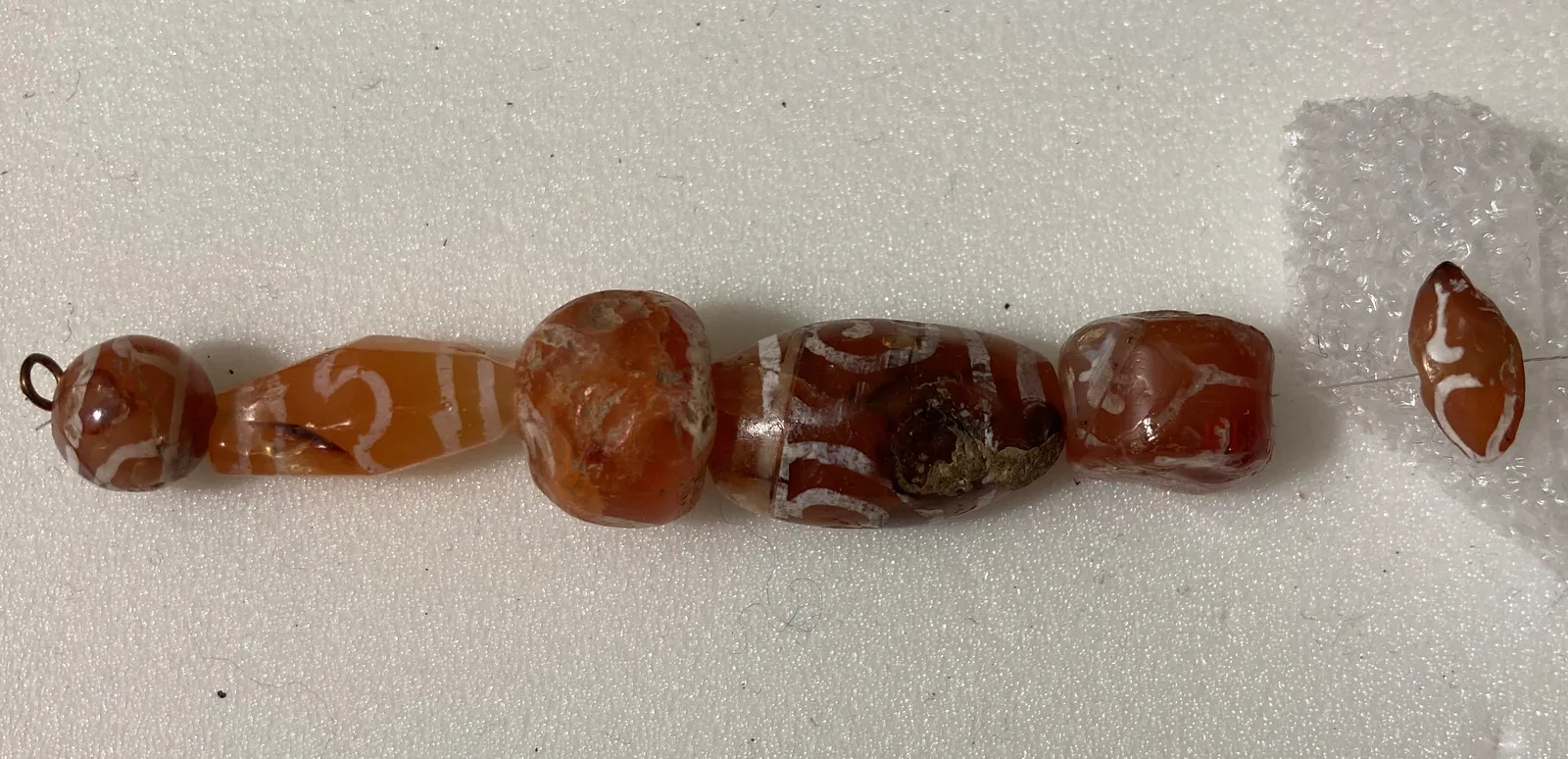
A dzi is a bead of natural agate or chalcedony, both varieties of quartz. The stone is dense and hard, around 7 on the Mohs scale, takes a fine polish and holds its shine for decades. The classic shape is elongated and cylindrical, with slightly rounded ends and a channel drilled along the axis so the bead can be strung on a cord. Lengths usually run from two to five centimetres, though tiny and large specimens both exist.
The defining trait of a dzi is the contrast of its pattern. Across a dark ground, from coffee brown to nearly black, runs a milky white design: stripes, circles, diamonds, zigzags. The white areas are not painted on; they are etched into the stone itself by an ancient process. That is why the pattern never rubs off or fades: it is part of the agate's structure, down to a fraction of a millimeter. The broader nature of this stone and its many forms are covered in the article on agate and its varieties.
Wear the symbol, don't just read about it. These are in stock:




How a dzi differs from an ordinary agate bead
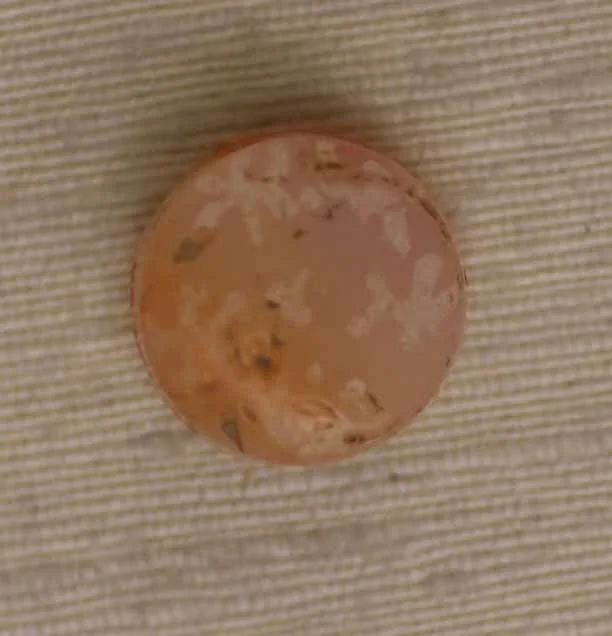
Agate is banded in nature too: concentric layers of different shades are its usual texture. But natural banding is chaotic, following the shape of the cavity in which the stone grew. The dzi pattern is geometric and deliberate: clean circular eyes, sharp lines, symmetry. A design like that does not grow on its own; a person puts it there. It is exactly this human-made yet stone-deep pattern that turns a handsome piece of agate into a dzi.
The second mark is the elongated tubular form with its axial channel. You cannot grind a natural pebble into that shape by accident: the bead was deliberately shaped, drilled and worked. The third mark, on old specimens, is the trace of time itself: micro-scratches, polished facets, patina, all of which we will come to below.
How the name sounds and is written
The Tibetan word gzi translates as "brilliance," "radiance," "splendour." In English and Chinese texts you meet the spelling dzi, while the Chinese tradition calls the beads "heavenly pearls" (tian zhu) or "eye beads." All these names point to the same thing: an elongated agate bead with a white etched pattern, born in Tibet and the neighbouring Himalaya.
What the "eyes" on a dzi mean: the language of the pattern
Why a circle on a dzi is called an "eye"
A closed white circle or oval on a dark ground reads visually as an eye: a dark pupil in a pale rim, or the reverse. Tibetans name it exactly that, "eye" (Tibetan mig). Each eye is thought to be a separate channel of protection and luck, a separate watching charm. The more eyes on a bead, the more complex and, by belief, the stronger its action. That is why dzi are classified first of all by their number of eyes.
The idea of a protective eye appears among countless peoples, from the Mediterranean nazar to the Hindu third eye. The dzi is the Himalayan version of that same ancient intuition: an eye that looks out for you and turns away harm. But a dzi is not a generic eye symbol; it is a specific object, a specific agate bead with a specific count of circles, and the count defines its "specialty."
How many eyes there are: from one to twenty-one
In the tradition the count runs roughly from one to twenty-one eyes. Each number carries its own meaning, and although readings differ between schools, the broad outline is steady. Here is how the pattern is usually read.
One-eyed dzi: clarity of mind, light, beginnings. It is seen as a bead for confidence and personal strength. Two-eyed: harmony of a couple, peace in family and relationships, the balance of masculine and feminine. Three-eyed: one of the most popular, tied to the three "jewels" and to wealth, well-being and health. Four-eyed: removing obstacles, protection from four directions. Five-eyed: the five elements, wholeness, prosperity from every quarter.
Six-eyed: release from sorrows, a way out of a dead end. Seven-eyed: success, fame, wishes fulfilled, and in a popular reading the harmony of the seven chakras. Eight-eyed: protection from the eight calamities, the eight directions of the mandala. Nine-eyed: the summit of the hierarchy, treated separately below. Beyond that the count grows rarer: ten, twelve, fifteen and on up to twenty-one all occur, but they are uncommon, and they are credited with an even more all-embracing patronage.
The nine-eyed dzi: why nine in particular
The nine-eyed dzi (Tibetan gzi mig dgu) stands above all the rest in Himalayan tradition. Nine in Buddhism and in Tibetan culture is the number of perfection and completeness: the nine vehicles of teaching, the nine levels of the cosmos. The nine-eyed is held to be the "queen" of beads, gathering up the meanings of all the others at once: protection, luck, health, wisdom, longevity, abundance. The nine-eyed was the one people most tried to obtain, inherited as the chief family heirloom, and sewed into the very centre of an amulet box.
Because of this status the nine-eyed is also the most counterfeited. If someone offers you an "ancient nine-eyed" at the price of an ordinary agate bead, it is almost certainly a modern imitation. Genuine old nine-eyed beads are few and far between, and each comes with its own chain of ownership.
A dzi belongs on a plain cord in silver, never dangling off a gold chain. Loud metal misses the whole point.
How to wear a dzi
A dark agate bead with an eye on it is a quiet thing with real character, and building a look around it is easier than it seems. Here is what actually works for me, by occasion.
How do you wear a dzi every day? For everyday I recommend a single dzi on a plain leather or waxed cord over a solid tee, a linen shirt or dark knitwear. A light top (white, sand, grey) lifts the white pattern against the dark agate, while deep colours (charcoal, olive, navy) turn the bead into a calm accent. Keep the length so the dzi sits just below the collarbone, on bare skin or on fabric, rather than hiding under the collar.
How do you pair a dzi with metal? Silver is the classic Himalayan choice, and I reach for it almost every time: silver caps on the ends, a thin wrap, or a couple of silver spacers beside the bead. Silver stays cool and never argues with the dark stone. Gold works too, but choose warm, matte gold with no gloss, or it pulls the eye off the dzi, and the bead should stay the centre of meaning.
Dzi with coloured stones: coral, turquoise? Here the old Himalayan trio does the work. I suggest stringing the dzi with red coral and sky-blue turquoise on one cord or bracelet: the dark bead holds the centre, coral adds warmth, turquoise adds air. If the outfit is already busy, leave the dzi alone on a clean cord, one eye is plenty.
How do you wear a dzi on the wrist? For a bracelet I suggest one strong bead between silver or sandalwood spacers on a braided cord, so the dzi sits on the inner wrist near the pulse. That kind of bracelet is easy to turn over in your fingers like a string of beads. One expressive dzi on the arm always reads better than a handful of small beads jumbled together, so do not crowd the wrist.
How do you build a look with a dzi for an evening out? For an evening I choose smooth fabric in a rich colour (wine, emerald, black) and an open collar, so the bead lands on bare skin at the throat. A dzi in silver against a dark ground looks noble and restrained, and only those in the know read its meaning. One accent, a clean line of cord, and no clutter around it, and the bead does its full work.

Turn on your camera, pick earrings, a pendant or a ring, and see the piece on yourself in real time.
Switch items in one tap.
Everything runs in your browser: no photo or video is ever uploaded.
Where dzi came from: legends of origin
Petrified insects and worms
One of the oldest Tibetan legends holds that dzi are living creatures petrified mid-motion. By this belief a dzi in the earth is an insect or a worm crawling under the soil, and the moment a person touches it with a hand or points at it, the creature freezes into stone. So, the mountain people said, you must never shout "dzi!" at the sight of a bead: you would startle it, and it would "die," losing its power. You had to take it in silence, covering it with your palm or with cloth.
This legend explained a strange thing for the farmer: beautiful patterned beads were found right in the ground, in scree, in old graves, as if they had "grown" there. The notion of a living, frozen creature was easier to grasp than the thought of forgotten craftspeople of deep antiquity.
Jewellery of the gods fallen from the sky
A second family of legends ties dzi to the heavens. By some accounts dzi are the beads of celestial beings, worn by the gods, and when the thread broke the beads scattered down onto the land of the Himalaya. By others, the gods deliberately dropped flawed or "rejected" beads below, which is supposedly why some old dzi have chips and cracks: they were "thrown down" from the sky. From here comes the Tibetan name "heavenly beads."
The link between dzi and the sky sits neatly with their protective role. If the bead came from above, then it watches from above too, guarding its owner against what a person below cannot see. So the eye on the stone became a heavenly sentinel.
Tears and treasures of the naga
The third layer of legend reaches toward the naga, the serpent deities of underground waters and hoards in Indian and Tibetan myth. By these tales dzi are the treasures of the naga, their frozen tears or a part of their subterranean riches that sometimes surfaces among humans. In Himalayan tradition the naga guard springs, lakes and the deep earth, and a dzi found near water or in the hills slipped easily into the image of a "gift from the underworld."
These three families of legend, earth, sky and water, do not contradict one another in the popular mind; they fold into a single image: a dzi is no ordinary thing but something arrived from another world, and so it calls for a special respect.
What a sober look says
The skeptical answer is simpler and, in its own way, no less remarkable. Dzi are human-made beads, produced by craftspeople of the ancient Himalayan and Central Asian cultures, most likely thousands of years before our era, by etching agate. The technique is kin to the one used in the Indus valley and the Near East, where agate beads with white etched patterns also turn up. Over time the secret of the specific Tibetan method was lost, the makers were gone, and the beads remained, and it was then, around these "beads without makers," that the legends of sky, insects and naga grew up. The myths, in other words, arose to explain a real loss of craft.
Customer reviews
Zevira is a real jewellery shop. Genuine payments, deliveries and customer thank-yous.
🥰🥰🥰 gracias
Ok, ¡gracias! 🙂
How old dzi were made: a lost craft
Etching agate: alkali, heat and patience
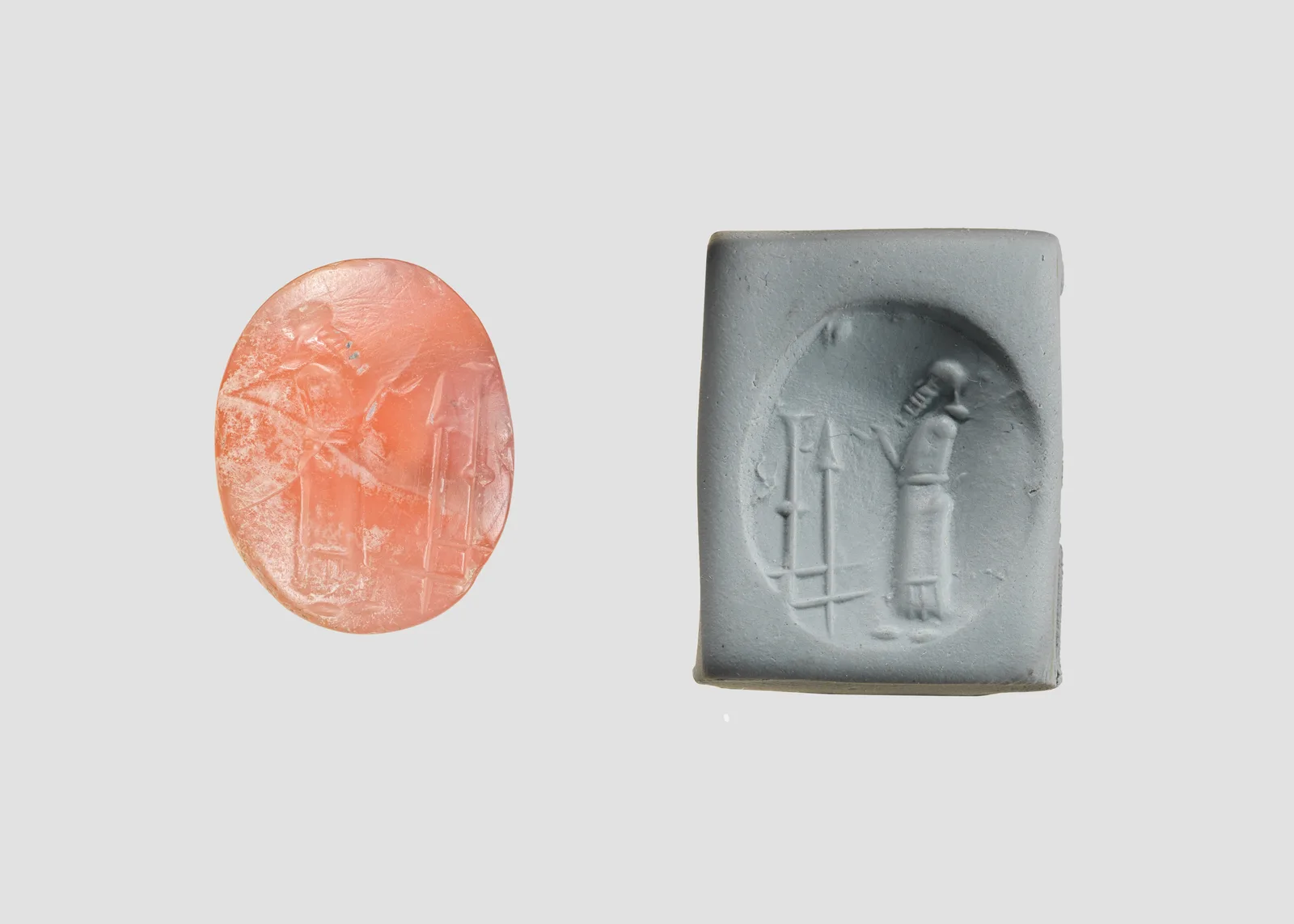
At the heart of genuine old dzi lies the technique of etching agate, known in antiquity across an enormous range from the Indus valley to Tibet. The principle is this: a design was drawn onto the surface of dark agate with an alkaline compound, often based on natural soda, potash or plant ash, and then the bead was heated. Under alkali and heat the treated areas of stone whitened to a depth of a fraction of a millimetre. The result was a durable white pattern that does not sit on top as paint but has entered the stone itself.
A reverse technique also existed: the bead was first whitened all over, then the dark areas were "drawn back in" with a different compound, for example salts of copper or iron, again with heating. By combining both methods a maker could produce complex layered patterns with clean white eyes on a dark ground. The exact recipe differed between cultures, and it was the Tibetan version that was eventually lost.
Why the secret is considered lost
The ancient makers left no written instructions, and the craft was handed down from hand to hand. When that chain of transmission broke, through wars, migrations and the turning of eras, the knowledge departed with the people. Modern craftspeople can etch agate and do so for imitations, but reproducing exactly the texture, the depth of the white and the character of the old beads is hard: old dzi have a particular way the pattern is "soaked" into the stone and a particular softness of transitions that new work copies only roughly.
It is this unattainability of the original that feeds the legends. Since "no one can do it like that anymore," believers say, then surely no human made a dzi. For the collector it is simpler: old dzi are monuments of a lost technology, and they are valued partly as the archaeology of a craft.
How old they actually are
Dating dzi is anything but simple. The stone is etched, it holds no organic matter, radiocarbon cannot be applied directly, and the context of finds is often lost. So estimates for the age of old dzi diverge widely: the talk is of thousands of years, from the late Bronze and early Iron Age to the start of our era. One thing is beyond dispute: the tradition of etched agate beads in this region is very ancient, and authentic old dzi belong to deep antiquity, not to recent centuries.
Upload a photo of your pet, someone you love, or an object. We'll build a 3D model and hand-cast it in pewter.



Types of pattern on dzi: a dictionary of designs
Eyes, stripes and lines
The basic vocabulary of dzi is built on a handful of motifs. The chief one is the eye (mig), a closed circle or oval. The bead is named by its number of eyes (one-eyed, nine-eyed and so on). The second common motif is stripes and lines: lengthwise and crosswise bands that gird the bead. Striped dzi without pronounced eyes are valued too, and are tied to harmony and the smooth flow of life.
Among the linear designs are zigzags and "waves," read as water, movement, protection from obstacles. Diamonds and squares are read as earth, stability, home. The cleaner and more symmetrical the geometry, the higher the quality of the pattern by tradition.
Tiger tooth, lotus, vajra and stupa
Beyond abstract geometry, dzi carry "named" designs. The tiger tooth is a set of drawn-out white wedges resembling fangs; such a dzi is linked to courage, strength, and protection from fear. The lotus on a dzi nods to the Buddhist symbol of purity that grows unstained out of the mire. The vajra (dorje), the ritual diamond scepter, signifies indestructibility, firmness of spirit and enlightened energy. A stupa on a dzi is a symbol of the path to awakening and of reverence for the teaching.
These designs turn a bead into a small Buddhist symbol, worn on the body as deliberately as a mala or prayer beads. The pattern is chosen for its beauty and its meaning at once: the tiger tooth for a fighter, the lotus or the one-eyed for someone seeking clarity.
Special forms: chung dzi and "earth dzi"
A category of its own is the so-called chung dzi. These are generally smaller, simpler-patterned agate beads from the same Himalayan family, kin to the "great" dzi but plainer: with stripes and a pair of eyes, without complex compositions. Tradition counts them as "junior" dzi, more accessible and humbler in status, yet still genuine old beads of the region. You also meet terms like "earth dzi" (phum dzi) for beads of a certain look and origin. For a newcomer one point matters: within the family of old Himalayan agate beads there are gradations, and not every old bead is a "top-tier" nine-eyed.




Old dzi versus new imitations
What is sold under the name "dzi" today
On today's market the word "dzi" means three very different things. The first is genuine old dzi, of that lost technology, few in number and with a history of ownership. The second is modern agate beads etched deliberately "in the dzi manner": honest new work, beautiful, affordable, with no claim to antiquity. The third is outright fakes, where a new bead is passed off as ancient and sold at heirloom prices.
Let us say it plainly and without judgment: a modern etched agate dzi is a fine, beautiful piece of jewellery with meaning. Wearing a new dzi is no "deception" and no "fake," as long as it is sold as new. The problem arises only when a new bead is presented as an old one. So telling the two apart is not a matter of snobbery; it is about paying for what you are actually buying.
What modern imitations are made of
Modern "dzi" are made from natural agate (etched by the old scheme, but by present-day hands), from dyed or tinted agate (pattern on the surface, not soaked in), from pressed stone powder, from glass and even from plastic and resin. The cheaper the material, the more obvious the difference to the touch and under a loupe. Natural agate is cool against the skin, heavy, hard, and will not scratch under a fingernail; glass and plastic are lighter, warmer to the touch, softer.
A separate category is "aged" imitations: a new agate bead is artificially scratched, tinted and tumbled to create the appearance of patina and wear. These are the hardest to expose, and they are exactly what trips up newcomers chasing "antiquity."
Why a genuine old dzi costs a great deal
The price of a genuine old dzi rests on three pillars: rarity (there are physically few of them and no more are being made), lost technology (it cannot be reproduced exactly), and demand (in the Himalayan and East Asian world a dzi is a prestige heirloom and a collecting object). The value of genuine old dzi is, without exaggeration, comparable to serious gemstones, and the cleaner the pattern, the more intact the stone, and the higher the eye count, the higher it climbs.
Naming direct figures here is pointless: the spread is enormous, and the market is full of speculation. A rough bearing is enough: a genuine old nine-eyed dzi is a purchase on the order of an expensive car, not a souvenir off a stall. If an "ancient nine-eyed" is offered for the price of dinner at a cafe, what you have is an imitation, and that is perfectly fine, as long as it is named as one.
Leave your email, we'll send your discount code. No spam, unsubscribe anytime.
The code arrives by email, valid on your first order.
How to tell a genuine old dzi from a fake
Patina and traces of wear
An old dzi has lived for thousands of years in hands, on cords, in amulet boxes. Its surface shows patina: an even, soft, deep shine that builds up over decades of contact with skin and cloth. The facets and edges are polished smooth; there are no sharp fresh corners. Under a loupe you can make out random micro-scratches of varying depth and direction, accumulated across centuries rather than applied all at once. New work has a shine that is either too dry and uniform or, the other way around, artificially "scratched" evenly all over, which is suspect in itself.
An important detail is the naturalness of the wear. Real use wears the stone where it rubbed: at the holes, on the protruding spots. An imitator often "ages" a bead evenly over the whole surface, which never happens in nature.
The bored channels and their shape
The channel through an old dzi was drilled with an ancient tool, and its walls carry the signs: the channel is often slightly conical (drilled from both sides to meet in the middle, so the holes do not align perfectly), the walls are polished by the cord, and at the openings you see a funnel of wear from years of the thread rubbing. On modern beads the channel is usually perfectly cylindrical, even, machine-made, the same diameter all the way through and without any sign of long wear.
Inspecting the channel is one of the most reliable tests. Polished, slightly asymmetrical, worn-in openings are a strong argument for authenticity; a perfectly even machine channel in an "ancient" bead is a red flag.
The depth and character of the white pattern
In a genuine dzi the white pattern has soaked into the stone and is visible in depth, not laid down as a single film on top: at chips and worn spots the white does not "peel off," because it is the altered structure of the agate itself. The pattern has soft, slightly blurred transitions, a natural unevenness of line, the breath of handwork. In a dyed imitation the white sits on the surface and rubs away, exposing the dark stone beneath; in cheap fakes the transitions are too sharp, "printed," identical.
It helps to inspect the bead against a strong lamp: natural agate is translucent at the edges and thin spots, giving a warm glow and an uneven inner structure. Glass shines with an empty, even light; plastic deadens the light. This is not a verdict on its own, but one more brick in the overall picture.
When a low price is the main signal
The most sober filter is the price paired with common sense. Genuine old dzi are few and dear by definition. If an "ancient many-eyed dzi with a certificate" is offered cheaply, with a tale of an attic find and an urgent sale, it is almost certainly an imitation. The best strategy for a newcomer: either honestly buy a modern etched dzi as a beautiful piece of jewellery with meaning and not overpay for the myth, or, if you truly want old antiquity, go to specialists and be ready for serious appraisal and a serious price.
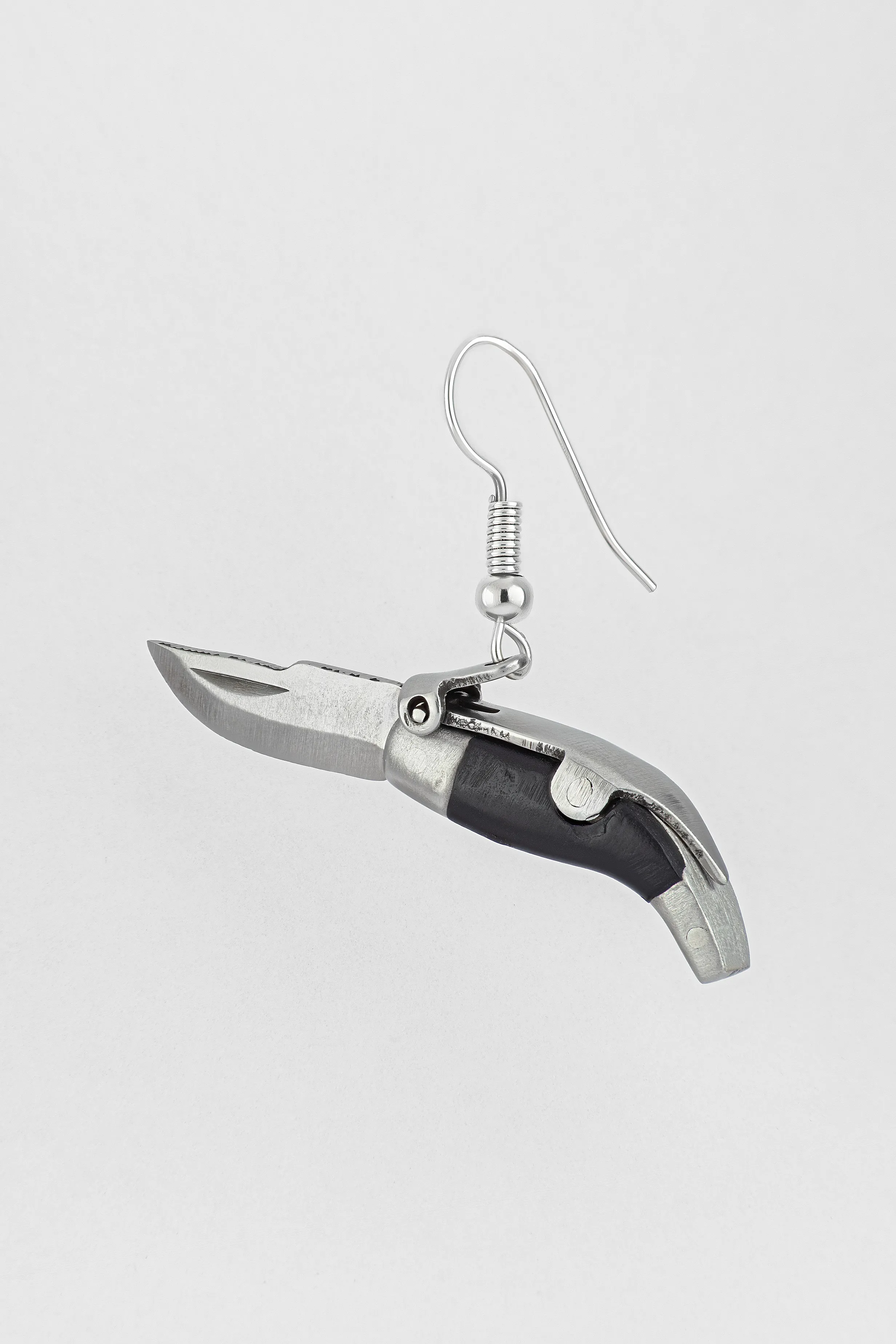
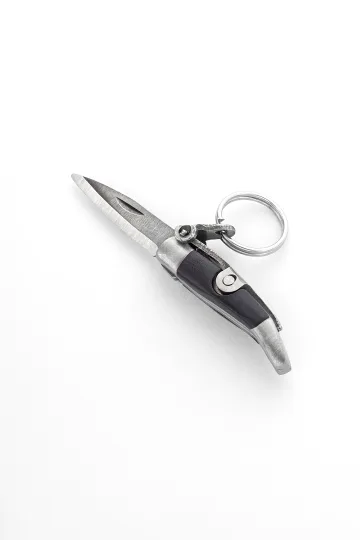
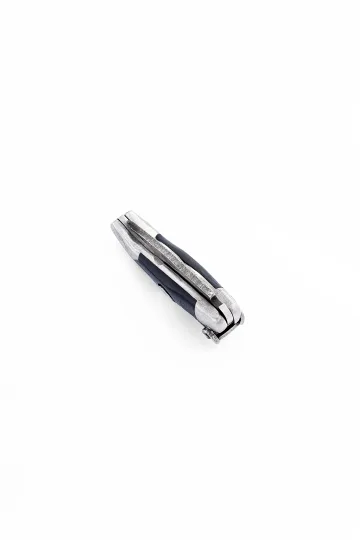
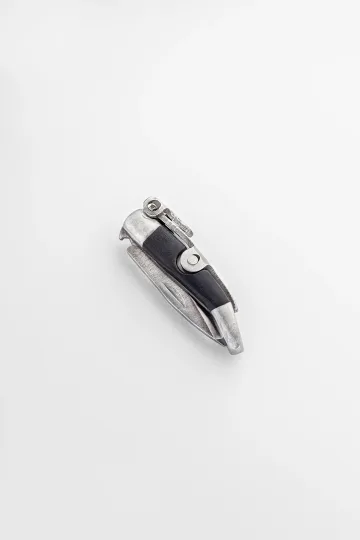
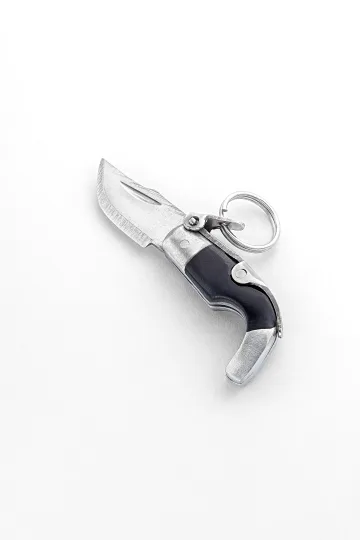
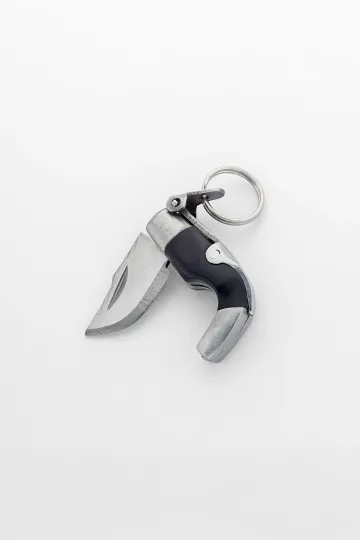
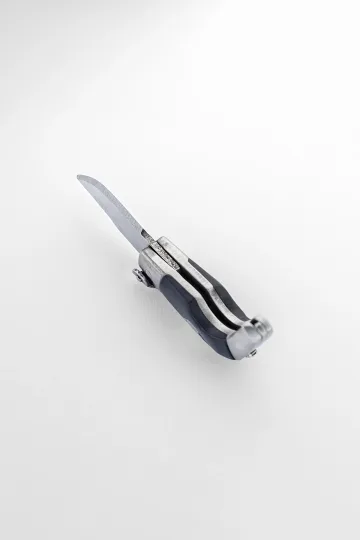
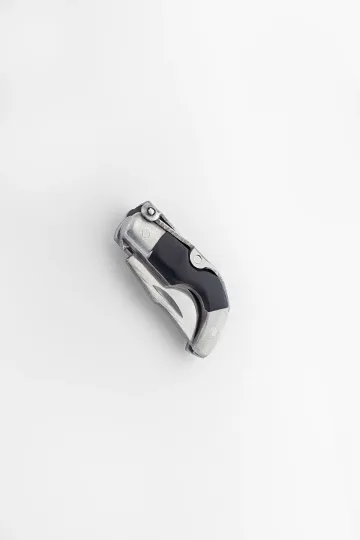
CAPAORA mini knife pendant
The 18th-century Spanish navaja in miniature: 40 mm of stainless steel, a real folding mechanism and a Palanquilla lock that clicks. An affordable gift to remember.
Authentic · Ships from Spain · 14-day returns
Dzi in Buddhism and how they are worn
The place of dzi in Tibetan culture
In Tibet and the Himalaya dzi have long been woven into religious and everyday life. They are worn as a personal charm, sewn into a gau (the chest amulet box where relics and mantras are kept), strung with coral, turquoise and silver into necklaces, and used in prayer beads. Dzi are passed down as a family treasure; they are used to "charge" a home and to protect children. A lama may bless a bead, and then ritual consecration is added to its "natural" power.
A dzi is no icon and no object of worship in itself; it is a carrier of blessing and protection, a companion in practice and on the road. The attitude toward it is respectful but alive: the bead is worn, held in the hands, taken along, not hidden behind glass.
How dzi are worn: cord, silver, the palm of the Buddha
The classic way to wear a dzi is on a simple cord at the neck, so the bead lies at the heart or the throat. It is often paired with silver: silver caps on the ends, a silver wrap, silver dividers between the dzi and other beads. Silver in Himalayan tradition is itself considered a pure, protective metal, and beside a dzi it strengthens the image of a charm.
A popular composition sets a dzi alongside red coral and sky-blue turquoise: three Himalayan materials together. There is also a figurative rule of placement called "the palm of the Buddha": the dzi is worn turned toward the body, as if resting in a protecting palm, under care. Bracelets of several dzi interspersed with silver or sandalwood beads are common too: they are turned over between the fingers like prayer beads.
Dzi and other charms: how to combine them
A dzi sits comfortably with other protective symbols, and many wear it in one set with familiar charms. The logic here is not "pile up as many as possible" but to assemble a meaningful set: the dzi as a personal guardian, beside, say, an infinity knot or a sign of one of the elements. If the very idea of wearable protection appeals to you, look into the general overview of amulets and talismans: there you can see how different cultures solve one task, to turn away harm and pull in luck, and the dzi takes its Himalayan place in that line.
Who a dzi suits and how to choose by eye count
Choosing "your" dzi: by eye count and by pattern
Tradition suggests choosing a dzi not by beauty but by purpose. If you need clarity of mind and confidence, you take a one-eyed. If harmony in a couple and a family matters, you choose a two-eyed. If you want luck in your affairs and prosperity, you reach for a three-eyed. If you need to "clear the road" and remove obstacles, you look at the four-eyed and six-eyed. If you seek protection from all sides, you consider the five-eyed and eight-eyed. If you dream of success and recognition, you choose the seven-eyed. If you want "everything at once," you turn to the patronage of the nine-eyed.
Among the patterns the tiger tooth suits someone who needs boldness and endurance; the lotus, someone seeking purity of intent and inner growth; the vajra, someone who wants firmness and an unbreakable spirit. This is not a strict science but the language of a tradition, and there is a beauty in it: you choose a bead for what you lack right now.
Dzi as a gift and as a personal thing
As a gift a dzi is traditionally prized especially highly: recall the belief that a true bead cannot be bought for oneself, only received. A gifted dzi carries the blessing of the giver, and so it is a strong, meaningful present: for the birth of a child (protection), for a new stage in life (support), for someone close setting out on a journey (a guardian on the way). A nine-eyed is given as a wish for completeness and luck, a two-eyed as a wish for harmony to a couple.
As a personal thing a dzi is good because it does not shout. A dark agate bead on a cord looks restrained and noble, and its meaning is read only by those who know. It is jewellery for the person who cares not about the shop window but about the inner story of the object.
When it is better to choose a "new" dzi honestly
If the budget is limited and it is a dzi you want, the sensible move is to buy a modern etched agate bead, knowing honestly that it is new. You get the same pattern, the same symbolism of the eye count, the same look and wearability, but without overpaying for a myth and without the risk of running into an "antiqued" fake. A genuine old dzi is a purchase for the collector and the connoisseur, ready for appraisal. For most people a dzi is first of all a beautiful charm with meaning, and here a new bead solves the task completely.
Dzi in a bracelet and on the wrist
A bracelet is perhaps the most practical everyday way to wear a dzi. A single bead is set between silver or sandalwood dividers on an elastic or braided cord, and it lies on the inner side of the wrist, near the pulse. Many turn such a bracelet over between their fingers on the road or while waiting, like a pocket set of prayer beads: the motion soothes, and the smooth, warm agate sits pleasantly in the hand. For a bracelet people more often take one strong bead (three-eyed or nine-eyed) rather than several, so it becomes the meaningful centre rather than getting lost in a busy row. A dzi bracelet is worn by men and women alike: a dark bead in silver looks equally fitting on any wrist.
How dzi reached the West
Beyond the Himalaya, dzi long stayed almost unknown. Interest in them in East Asia, especially in Taiwan and on the mainland of China, rose sharply in the second half of the twentieth century, when dzi came to be seen as a prestige amulet of luck and a collecting object. From there the fashion for "heavenly beads" gradually spread further. Today dzi are known to lovers of ethnic jewellery the world over, but this has not made genuine old beads any more numerous: their quantity is finite, and each new wave of demand only lifts the price of the originals and breeds more imitations. So the level-headed collector values not the loud "antiquity" of a market stall but the transparent history of a particular bead.
Caring for a dzi and respecting the culture
How to care for an agate dzi
Agate is tough and undemanding, yet a dzi still deserves gentleness. Wash it in warm water with mild soap, without harsh chemicals, abrasives or ultrasound: old beads may have hidden hairline cracks, and sudden shifts harm them. Take a dzi off before a shower with strong cosmetics, a chlorinated pool, and the sea with its abrasive sand. Store it apart from hard stones so the agate neither scratches nor is scratched. The cord wears through at the channel over time, and it is better to replace it ahead of time than to lose the bead to a snapped thread.
Guard an old dzi like the heirloom it is: fewer "strength tests," more care. Patina and traces of wear are its value, not a flaw; there is no need to rub or "polish to a shine" an old bead.
Respect for the tradition that gave birth to the dzi
A dzi is a living part of Tibetan and Himalayan culture, not a fashionable stone for a season. You can wear a dzi without any Buddhist practice, as a beautiful, meaningful charm, and there is no disrespect in that. But it is worth knowing that for millions of people this is a sacred thing with its own symbolism, legends and rituals. The respectful approach is simple: take an interest in the meaning of the pattern, do not invent "magic" out of thin air, do not cheapen the tradition for the sake of a pretty caption. Then the bead on your cord will be not a trophy but a tribute to an ancient culture that thought to look at the world through eyes painted on stone.
Send a friend a discount code, they save on their first order.
Facts that surprise
A dzi cannot be bought, only received. By the old Tibetan belief a true bead cannot be acquired for money: it is found, inherited or accepted as a gift. This idea has survived to our day and partly explains why dzi are surrounded by such mystique even on the market.
You must not shout "dzi!" or you will startle it. By the legend of petrified creatures, on seeing a bead in the ground you must cover it silently with your palm: name it aloud and it "dies." It sounds like a fairy tale, but that is exactly how children in the mountains were taught to pick up finds.
The gods dropped "defective" dzi. The chips and cracks on old beads were explained by popular fancy as the celestials throwing flawed beads down below. So a defect became proof of heavenly origin.
The pattern is not painted but "fused" into the stone. The white eyes of a dzi are not paint but the structure of agate altered by alkali and heat, down to a fraction of a millimetre. That is why across thousands of years the pattern has neither worn off nor faded.
The technology was lost, and that bred the myths. It is precisely because the exact ancient recipe for etching a Tibetan dzi was lost and "no one can do it anymore" that the legends of sky, insects and serpent naga grew up around the beads. The loss of the craft became fuel for the magic.
A nine-eyed is valued like a car, not a souvenir. A genuine old nine-eyed dzi costs as much as a serious purchase, and each such bead is one of very few. A cheap "ancient nine-eyed" is always a modern imitation.
The bored hole gives away the age. In a real old dzi the through-hole has been polished by the cord over centuries and is slightly asymmetrical from hand-drilling. A perfectly even machine channel in an "ancient" bead is the first sign of new work.
A dzi keeps company with coral and turquoise. The classic Himalayan necklace gathers three materials together: the dark dzi, red coral and sky-blue turquoise, each of which the tradition counts as protective.
Frequently asked questions
Is a dzi a natural stone?
Yes, a genuine dzi is a bead of natural agate or chalcedony (varieties of quartz) with an artificially applied etched pattern. The stone itself is natural, while the white eye design is created by a person through the ancient process of etching with alkali and heat. Modern imitations may be of dyed agate, glass or plastic, so when buying it is worth establishing clearly what exactly is being offered to you.
How many eyes should the "best" dzi have?
There is no universal "best" number; the choice depends on the purpose. In the hierarchy of tradition the nine-eyed stands highest as a symbol of completeness and luck, gathering up the meanings of all the rest. But the three-eyed (wealth, health) and the two-eyed (harmony in a couple) are chosen just as often, for a specific aim. Take the one whose meaning resonates with you.
How do I tell an old dzi from a modern one?
Look at four signs: the patina and natural traces of wear (polished facets, random micro-scratches), the shape of the channel (in old ones it is slightly conical and worn by the cord, in new ones machine-even), the depth of the white pattern (in genuine ones it has soaked into the stone and shows at chips), and the price (a genuine old dzi is dear by definition). Cheaply sold "antiquity" is almost always an imitation.
Why are real dzi so expensive?
Because of rarity and lost technology. Genuine old dzi are physically few, no new ones are made by the same ancient recipe, and demand in the Himalayan and East Asian world is high. Together this yields prices on the order of serious gemstones, especially for many-eyed and well-preserved beads with a history of ownership.
Can I wear a dzi if I am not a Buddhist?
Yes. A dzi can be worn as a beautiful, meaningful charm without any religious practice, and that is not considered disrespectful. It is enough to treat the bead with interest and respect for the culture it was born in: to know the meaning of the pattern, not to cheapen the tradition. Many wear a dzi exactly as a restrained piece of jewellery with meaning.
Is a modern etched dzi a fake?
No, not if it is sold as modern. A new agate dzi, honestly called new, is a fine piece of jewellery with meaning, affordable and beautiful. A fake is the situation where a new bead is passed off as an old one and an heirloom price is charged for it. Buying a new dzi is sensible: you get the symbolism and the look without overpaying for a myth.
What goes with a dzi in jewellery?
The classics are silver (caps on the ends, wrapping, dividers), red coral and blue turquoise, three Himalayan materials together. A dzi is worn on a cord at the neck near the heart or in a bracelet, alternating with silver or sandalwood beads. A dark bead looks well on a simple cord and does not clash with other restrained charms.
Can a dzi be given as a gift?
Yes, and in the tradition it is an especially valued gesture. By belief a true dzi cannot be bought for oneself, only received, so a gifted bead carries the giver's blessing. Dzi are given for the birth of a child, for a new stage in life, to someone close setting out on a journey. A nine-eyed is presented as a wish for completeness and luck, a two-eyed as a wish for harmony to a couple.
A Himalayan charm in your own style
A dark bead with a white eye on a simple cord or in silver. Assemble your own meaningful charm: dzi, silver, coral and turquoise in a restrained composition that only those who know will read.
See protective jewelleryBuying it as a gift? Each one arrives ready to give.
 A branded Zevira box and a little card come with every order.






About Zevira
Zevira gathers jewellery that carries a story and a meaning, not shine alone. The idea of the dzi is close to us: a charm that does not shout but quietly watches over its owner. We bet on restrained forms, noble silver, and symbols treated with respect for the cultures that created them. If it matters to you that a piece of jewellery should mean something while pleasing the eye, you are in the right place.