The peacock in jewellery: the eye on the feather that one culture wears as a charm and another fears to keep at home
In India the little "eye" on a peacock feather is hung over a cradle to guard against the evil glance, while in parts of England the very same feather is still kept off the threshold as a bringer of bad luck. One pattern, two opposite verdicts. The peacock is a bird of extremes all over: it has been made a symbol of immortality, of vanity, of royalty, of paradise and of the evil eye all at once, and every one of those meanings was somebody's firm belief.
This article follows the peacock through the cultures where it meant something in earnest: the India of its gods, the Greece of its goddess, early Christianity with its promise of resurrection, the Persian and Islamic image of the guardian of paradise, the dignity of China. We will untangle the central contradiction, charm against the evil eye, explain why the feather became an amulet and a mehndi motif in its own right, and arrive at Art Nouveau, where the peacock motif had its true flowering in metal and enamel. And above all, which stones and techniques carry that blue-green shimmer no photograph quite catches.
What the peacock means as a symbol and why jewellers love it
Where the peacock got its "eyes" and why they became the meaning
A peacock's tail is not a tail in the usual sense. What opens into a fan is the train, a set of elongated upper covert feathers, and at the end of each sits a bright spot that English calls an ocellus, a "little eye." That spot is a set of concentric rings of blue, bronze, gold and green, and they shimmer not from pigment but from the feather's microstructure: tiny layers reflect light at different angles. So the feather "burns" differently the moment you turn your head.
It was the "eye" that gave the peacock almost all its symbolism. The peoples who saw protection in it believed the eye on the feather turned a jealous stranger's gaze back like a mirror. Those who feared the peacock saw in the same eye an ominous all-seeing watcher, or an evil eye that draws misfortune in. One pattern, two readings, and both built on the idea of the gaze.
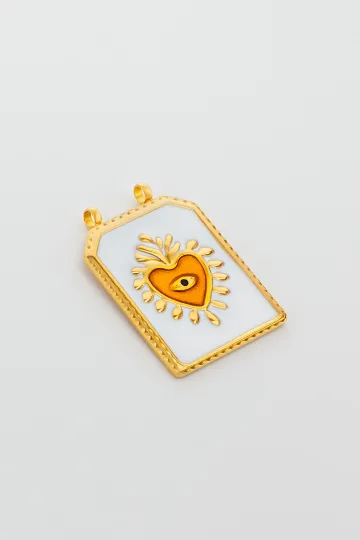
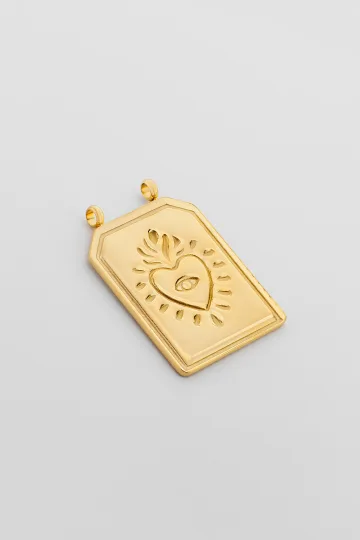
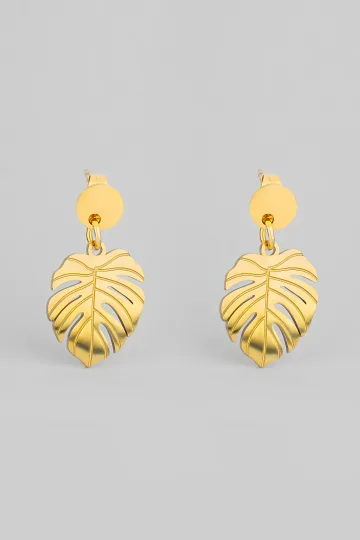
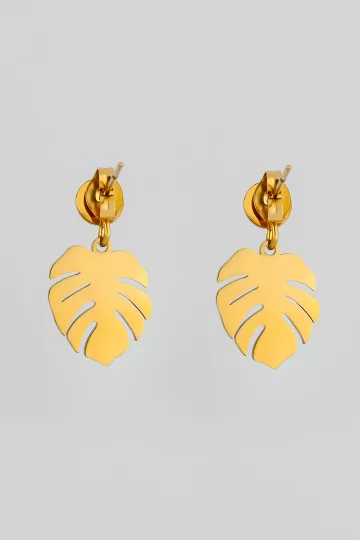
Wear the symbol, don't just read about it. These are in stock:


Why jewellers love the peacock more than most other birds
The peacock gives a maker what almost no other figure does: a ready palette and a ready shape. The fan of the tail is a natural composition for a brooch, a pendant or an earring, and the "eye" on the feather all but asks for a stone to sit in it. The blue-green play of the plumage matches what opal, labradorite and cloisonne enamel can do, so the peacock became the favourite subject of eras that fell in love with colour and the flowing line. Add its rich symbolism and it is clear why the motif keeps returning, wave after wave.
Where the peacock actually lives
The blue peacock we picture is the Indian (common) peafowl, native to the Indian subcontinent and Sri Lanka. There is also the green peafowl of Southeast Asia and the rare Congo peafowl of Africa. For the jewellery tradition almost all the meaning came from the Indian bird: its feather travelled the trade routes, passed into Greek, Roman, Persian and European hands, and dragged a whole train of stories along with it.
India: bird of the gods and a national symbol
The peacock and Saraswati: knowledge above beauty
In the Indian tradition the peacock is a mount and companion to several deities, and each gives it a different accent. Saraswati, goddess of wisdom, music and the arts, is often shown beside a peacock. Here the bird is not about vanity but about discernment: the ability to tell true knowledge from empty glitter. The paradox is that the most decorative creature serves a goddess who prizes focus above adornment. To wear the peacock in this logic is to choose clarity of mind, with the beautiful object coming along for the ride.
Kartikeya on the peacock: a warrior riding beauty
Kartikeya (also Skanda, Murugan), god of war and leader of the heavenly armies, rides a peacock named Paravani. The myth explains this elegantly: the peacock can kill snakes, so it became a symbol of victory over evil and over one's own baser passions. A war god on the most beautiful of birds is a reminder that strength and grace are not at odds. In the South Indian tradition the image of Murugan on his peacock is one of the most beloved.
Krishna and the feather in his hair
The most recognisable Indian image of the peacock is the feather in Krishna's crown. The mor pankh, the peacock feather, Krishna wears in his hair, and the motif repeats endlessly in painting, sculpture and jewellery. The feather here is a sign of love, joy and play, the qualities for which Krishna is most adored. A feather in the hair or on a pendant reads at once, in Indian culture, as a reference to him.
National bird of India
In 1963 the peacock was officially made the national bird of India: for its beauty, for its deep roots in mythology and for being found across the whole country. This is not a museum fact but a living part of identity: the peacock on fabrics, on dishes, in architecture, in wedding jewellery. In the Indian jewellery traditions, especially the kundan and meenakari styles, the peacock is one of the central motifs, and it is worn not as an exotic touch but as one's own.
Kundan, meenakari and Mughal work
India gave the peacock two techniques that have held for centuries. Kundan is the setting of stones in a thin strip of pure gold with no claws: the stone seems to float in a golden frame, and whole peacock tails were laid out this way in necklaces and forehead ornaments. Meenakari is multicoloured enamel, most often on the reverse of the same piece, and it gave the blue-green shimmer of the feather long before European Art Nouveau. Mughal craftsmen joined kundan on the front and meenakari on the back in a single piece, so the peacock shone with stones from the face and enamel from behind. That double-sidedness is one reason the Indian peacock looks richer than a flat brooch.
Mesopotamian and Zoroastrian roots
The paired peacock at the tree of life is older than both Greece and Christianity. A similar motif, symmetrical birds on either side of a sacred tree or spring, appears as far back as the art of Mesopotamia and ancient Iran, where it meant fertility, guardianship and a link to the otherworldly garden. When Christians and Muslims later took up the image, they did not invent it from nothing but inherited a ready scheme. The peacock at the tree is one of the longest-lived ornaments in human history.
A peacock struts best on a quiet background. Pile colour next to it and the bird just looks cheap, so don't.
How to wear a peacock
A peacock is a loud piece, and building a look around it is trickier than it seems. Here is what actually holds up, on a shoot and for a night out, sorted by occasion.
What background does a peacock read best against? I recommend a plain outfit in cool or neutral tones: navy, emerald, black, charcoal, cream. Against that the blue-green shimmer reads cleanly and the peacock takes the solo. A busy multicoloured outfit I suggest dropping: two bright things on one person fight and dull each other.
Which metal should you choose for a peacock? I choose by the job. Warm gold lifts the regal note and the bronze glints in the feather, and it suits warm and neutral skin. Silver and white gold sharpen the cold blue and the fine enamel work, and they sit well on a cool undertone. For companion stones I suggest the same ones set in the piece itself: opal, labradorite, pearl, so nothing argues with the motif.
Brooch, pendant or earrings? For a big gesture and an evening I recommend a brooch: it opens the fan of the tail and gives the enamel the most room. For every day I suggest a single-feather pendant, more wearable and quieter. Feather earrings I choose when I want movement: they shimmer as the head turns, working with the bird's main trait.
How do you keep a peacock from overloading a look? I keep one rule: the larger and brighter the peacock, the quieter everything else. With a big brooch or a tiara I do not add a competing necklace and earrings, I leave a single accent. A small feather pendant, by contrast, sits happily in a set with fine chains. One strong piece reads better than three middling ones.
Who does a peacock actually suit? Anyone who is not afraid of colour and a bold detail, who warms to ideas of renewal, dignity and beauty as strength. For a sceptic about charms I suggest a feather pendant: it is more neutral than the whole bird and never reads as a costume. And for someone who likes to arrive loud, I recommend the full fan of the tail and the nerve to wear it on a calm background.

Turn on your camera, pick earrings, a pendant or a ring, and see the piece on yourself in real time.
Switch items in one tap.
Everything runs in your browser: no photo or video is ever uploaded.
Ancient Greece and Rome: the bird of Hera and the eyes of Argus
The myth of Argus: where the eyes on the feather came from
The Greeks explained the "eyes" on the tail through a myth, and it is darker than it looks. Hera, the jealous wife of Zeus, set the hundred-eyed giant Argus Panoptes, "the all-seeing," to guard Io after she had been turned into a cow. Argus had eyes all over his body, and they slept in turns, so he never closed them all at once. Zeus sent Hermes, who lulled the giant to sleep and killed him. Grieving for her faithful watchman, Hera moved his eyes onto the tail of her favourite bird, the peacock. That is how the "eyes" ended up on the feather.
The peacock as the bird of Hera (Juno)
The peacock was the sacred bird of Hera, queen of the gods, and of Juno among the Romans. Juno's chariot, in the poets' descriptions, was drawn by peacocks. The bird stood for sovereignty, for marriage and for the goddess herself as patron of wedlock and of the state. So in antiquity the peacock was associated first of all with power and dignity, not with empty vanity: that meaning would come later, in Christian moralising.
The peacock and the deification of Roman empresses
In imperial Rome the peacock had a quite specific political role. On coins struck in honour of dead and deified empresses, the peacock was shown as the bird that carries the soul up to heaven, to Juno. The eagle bore the emperor's soul, the peacock the empress's. So Hera's bird became a sign of apotheosis, of deification, and took the next step toward its future Christian meaning of immortality.
Customer reviews
Zevira is a real jewellery shop. Genuine payments, deliveries and customer thank-yous.
🥰🥰🥰 gracias
Ok, ¡gracias! 🙂
Early Christianity: immortality and resurrection
Why the peacock was thought a symbol of incorruption
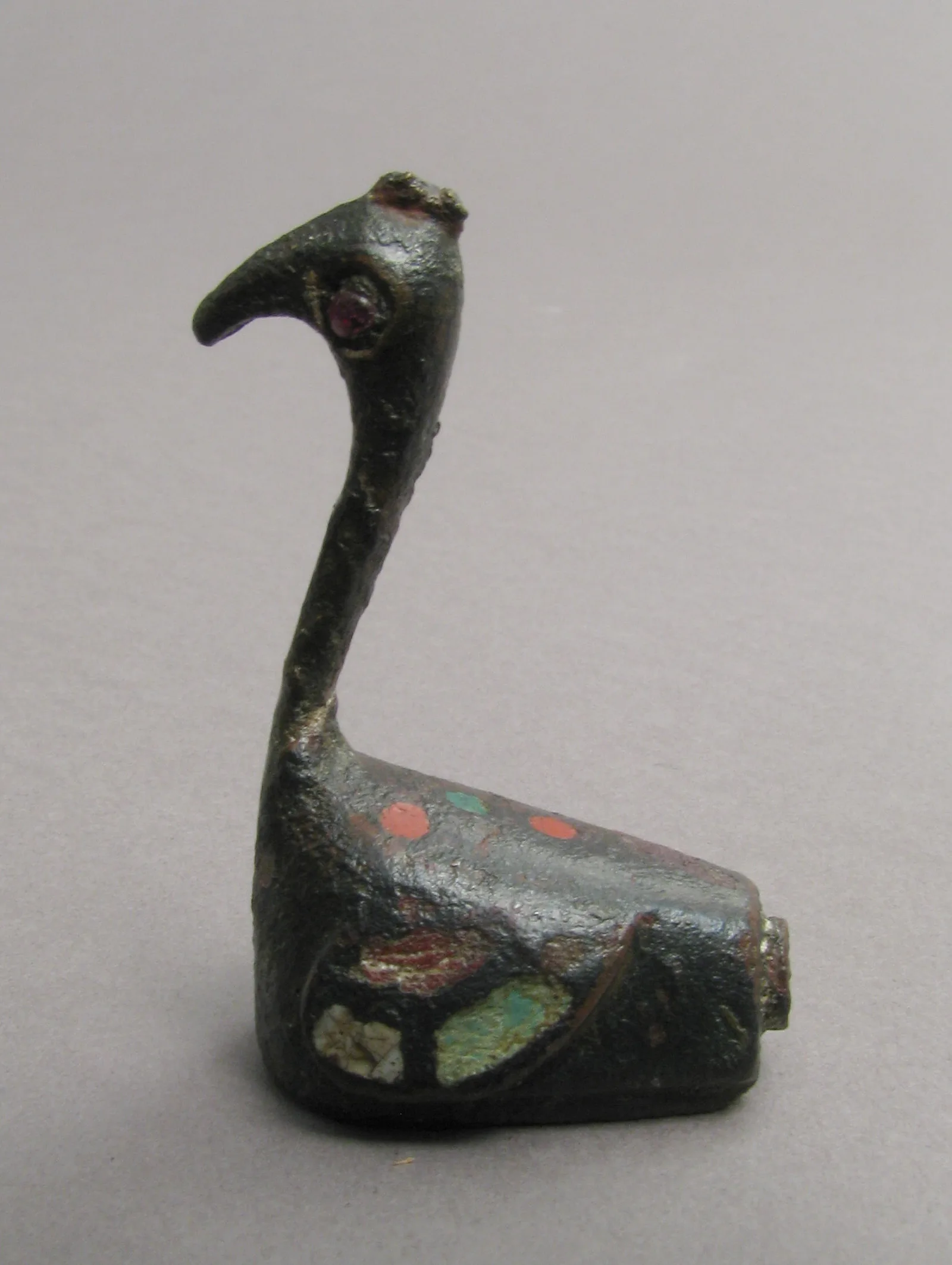
Early Christian art took up the peacock and gave it a new explanation, leaning on the ancient belief that the bird's flesh does not decay. Saint Augustine wrote that he tested this on cooked peacock meat and that it kept longer than usual. Whether or not that is true matters little for a symbol: a bird whose flesh "does not spoil" became a natural sign of incorruption, of the soul's immortality and of resurrection. In the catacombs, on sarcophagi and in early mosaics the peacock appears again and again.
Moulting and renewal: an annual resurrection
There was a second argument too. Every year the peacock sheds its magnificent tail and grows it back, brighter than before. For Christians this became a vivid metaphor of resurrection and renewal: the old dies, the new is born more beautiful than the last. Two peacocks drinking from one cup, or bending toward the tree of life, were shown on early Christian reliefs as an image of the eternal life the soul finds at the source.
The peacock in Byzantine and medieval art
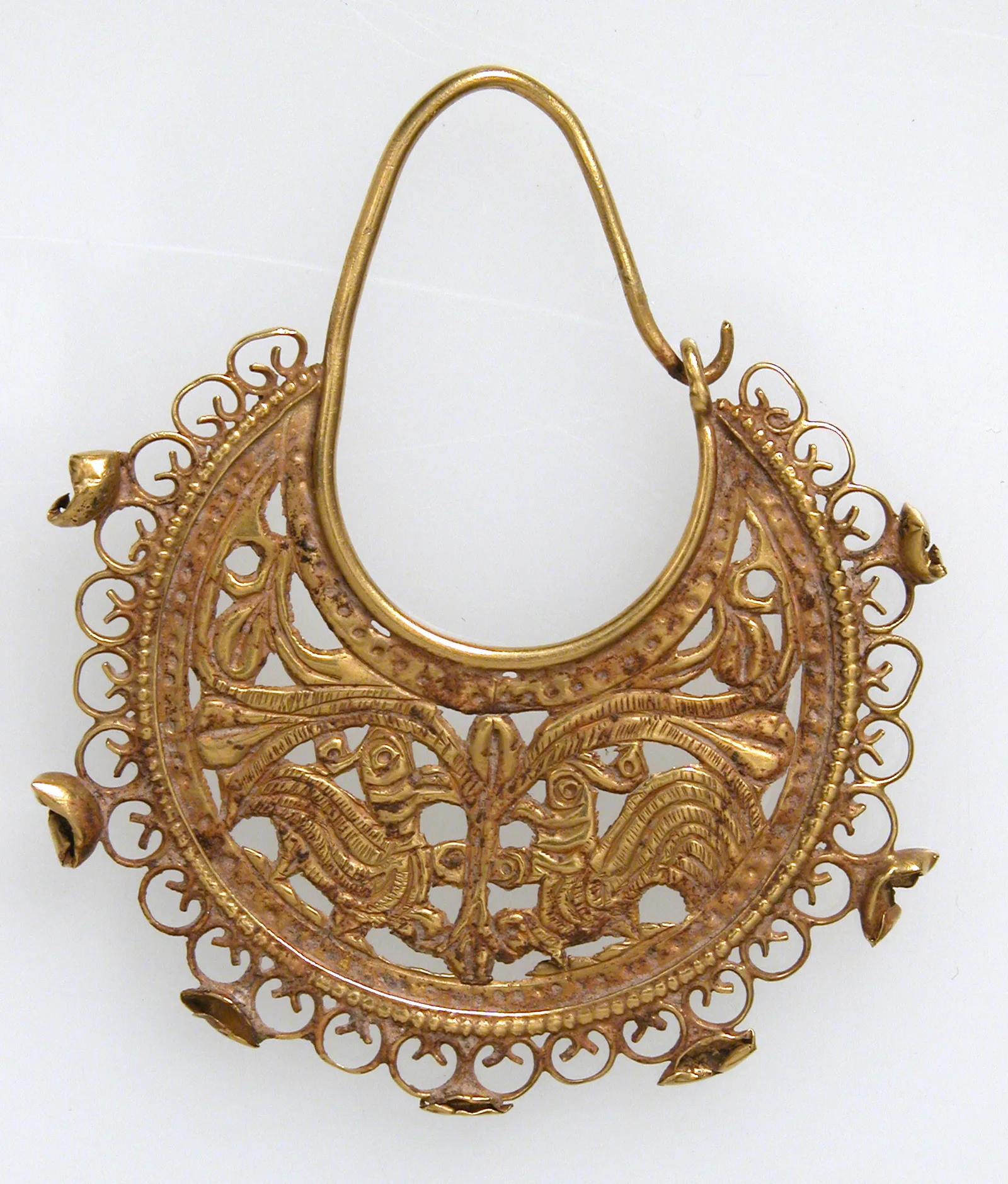
In Byzantium and the early Middle Ages the peacock settled firmly into ornament: mosaics, textiles, carving, illuminated manuscripts. A pair of peacocks on either side of a cup or a tree became a fixed decorative sign of paradise and immortality. From there the motif passed into jewellery: pendants and brooches with a peacock long carried, in Christian culture, not "pride" but the hope of eternal life.
Upload a photo of your pet, someone you love, or an object. We'll build a 3D model and hand-cast it in pewter.

Persia and Islam: guardian of paradise and the throne with two peacocks
Two peacocks at the tree: an image of paradise
In the Persian and wider Middle Eastern tradition the peacock is guardian and inhabitant of paradise. A common motif is two peacocks on either side of the tree of life or a fountain: a symmetrical pair guarding the spring of eternity. The image is older than Islam, with roots in Zoroastrian and Mesopotamian antiquity, and it outlived every change of religion because it is too good as both a decorative and a meaningful scheme. A blue-green bird beside a tree is an almost universal sign of the garden of bliss.
The peacock in Islamic ornament and the "Peacock Throne"
In Islamic art, where images of living creatures are limited, the peacock still remained one of the favourite figures in secular court art: on textiles, ceramics and book miniatures. Its most famous echo is the "Peacock Throne" of the Mughals, the legendary seat whose back, by the descriptions, was crowned with two golden peacocks with spread tails of precious stones. The bird here is a sign of supreme power and the splendour of paradise.
The feather in Persian poetry
In Persian culture the peacock feather appears both as a bookmark in sacred books and as a poetic image. The Sufi tradition knows a parable in which the peacock is the first bird placed in paradise, and its feather a trace of heavenly beauty that fell into the earthly world. This line makes the peacock not vain but a creature longing for a lost paradise, which differs sharply from the European moral about pride.
China and East Asia: dignity, rank and beauty
The peacock as a sign of rank and nobility
In imperial China the peacock feather was not an ornament but a reward. Officials of high rank were granted peacock feathers for their headdress, and the number of "eyes" on the feather marked the degree of distinction. So the bird became a sign of status, of dignity and of a position earned. In painting the peacock often stands for beauty, prosperity and dignity, and a pair of peacocks for the wish of a happy marriage.
The link to the goddess of mercy and the Buddhist line
In the Buddhist tradition the peacock is linked with compassion and with the ability to turn poison into beauty: the bird was thought to eat venomous creatures, and its plumage only grew brighter for it. Hence the image of a creature that transforms evil and suffering into something beautiful. In this context the peacock is a sign of purification and of overcoming, not of empty glitter.
Japan and the shared Eastern meaning
In Japan the peacock (kujaku) also entered art as a symbol of beauty, dignity and protection from evil, partly through Buddhist imagery. The line shared across East Asia reads like this: the peacock is a nobility that needs no proof, and a beauty that serves rather than shines for nothing.



The central contradiction: charm or evil eye
Where the belief that a peacock at home brings misfortune came from
The most stubborn superstition about the peacock is European: that a feather in the house brings bad luck. The roots go back to the myth of Argus, where the "eye" on the feather is the eye of a murdered giant, that is, a sign of betrayal and an evil fate. Later the theatre fed the belief: actors held a peacock feather on stage to be a bad omen, and the notion spread wider. It has nothing to do with the real qualities of the bird, just a chain of associations in which the "eye" was read as unkind.
Why the same "eyes" are a charm in other cultures
Where a stranger's gaze was seen as a threat of the evil eye, the peacock "eye" was read the other way, as protection. The logic is the same as that of the nazar, the blue eye against the evil eye: a mirroring eye reflects a jealous gaze back. In India the peacock feather is hung over children and in the home precisely as a charm that wards off another's envy. The same motif appears in protective traditions across the world, and the peacock falls naturally into line with the classic amulets and talismans.
How to think about it today
The "bad luck" belief is a local European superstition, not a universal human truth, and the opposite traditions, where the peacock is a blessing, are far more numerous. Whether to wear a peacock or keep a feather at home is a matter of your own culture and taste, not of any objective "harm." If you want to choose a side knowingly: for the charm speak India, Persia and the protective tradition of the "eye"; against it only a narrow European theatrical superstition. The balance is obvious.
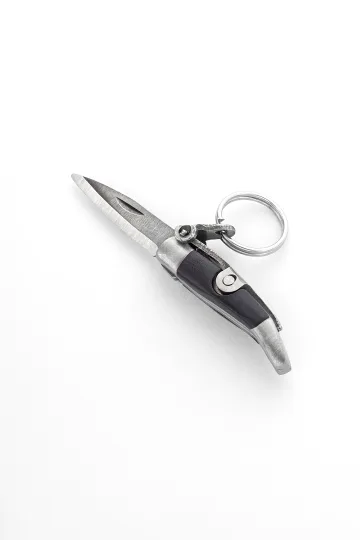
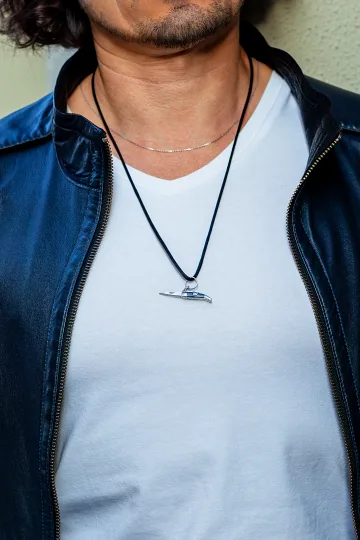
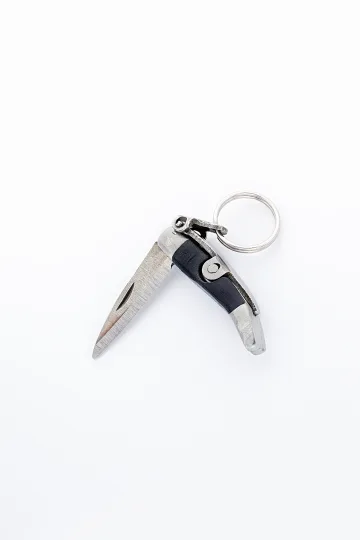
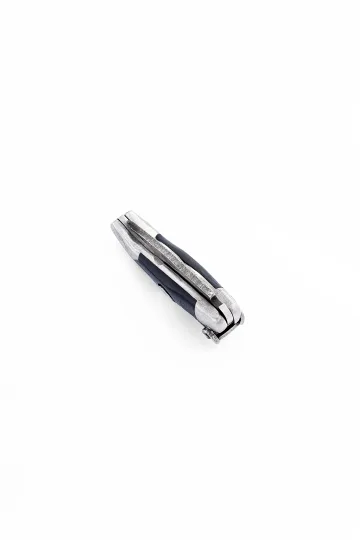
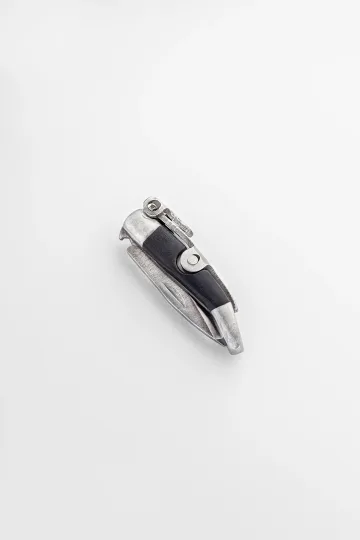
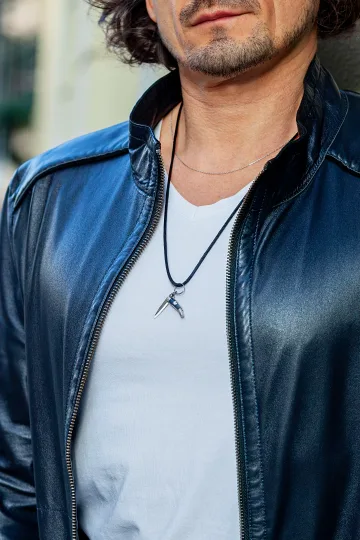
CAPAORA mini knife pendant
The 18th-century Spanish navaja in miniature: 40 mm of stainless steel, a real folding mechanism and a Palanquilla lock that clicks. An affordable gift to remember.
Authentic · Ships from Spain · 14-day returns
The peacock feather as an amulet, a pattern and a detail in its own right
The feather as a standalone charm
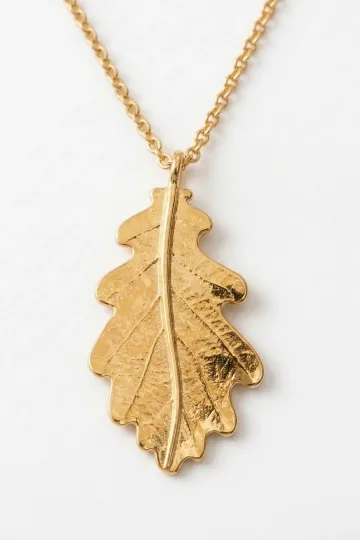
The feather lives its own symbolic life apart from the bird. In the Indian tradition the mor pankh is at once an attribute of Krishna, a household charm and an object used, by belief, to bless. In jewellery the feather is handier than a whole bird: it is easier to stylise into an elongated pendant or earring, and the "eye" at the tip is a natural place for a stone. So the feather became more popular than the figure of the peacock itself in everyday jewellery.
The peacock feather in mehndi and painting
In the art of mehndi (henna painting) the peacock and its feather are among the most frequent motifs, especially in bridal work. The curving feather lies beautifully along the line of the hand and forearm, and the "eye" allows play with the filling. Here the peacock is a sign of love, fertility and the beauty of the bride. The same pattern crosses over into engraving and enamel jewellery, keeping its bridal, festive note.
The feather in fashion and accessories
The peacock feather was a fashionable material for centuries: fans, hats, Venetian masks, brooches set with a real feather. Today, more often than the natural feather, makers use its jewellery interpretation in metal and enamel, which is both more durable and more ethical. The theme of the feather as a sign of lightness and freedom is a large one in jewellery, and there is a separate discussion of the symbolism of the feather, but the peacock feather stands apart precisely because of the "eye" and the shimmer.
Leave your email, we'll send your discount code. No spam, unsubscribe anytime.
The code arrives by email, valid on your first order.
The colour of the peacock: a blue-green that changes before your eyes
Why the plumage shimmers and what physics has to do with it
The colour of a peacock feather is not paint but structure. The blue-green and bronze tones are born from microscopic layers in the barbs of the feather, which reflect light at certain angles, so-called structural colour, like a soap film or a butterfly's wing. So one and the same feather looks now emerald, now blue, now copper-gold, the moment you change the angle. For a jeweller this is the challenge: to convey not one colour but the transition between them.
What the blue-green range means
The "peacock" blue-green, a turquoise-emerald with a golden gleam, reads as a blend of the calm of blue and the life force of green. It is the colour of water and foliage at once, so it suggests renewal, prosperity and a beauty without shouting. The shade is so recognisable that "peacock blue" and "peacock green" have long been names of colours in the designer's palette.
Why the shimmer matters more than the exact shade
The main task of a peacock piece is to convey the movement of colour, not a single tone. A piece that is simply "blue" or simply "green" loses the point. So jewellers choose materials with a play of their own: opal with its inner flashes, labradorite with its cold sheen, enamel with transitions and a metallic underlayer. It is the changeability, not the saturation, that makes a peacock a peacock.
The peacock across jewellery eras: the flowering of Art Nouveau
Why it was Art Nouveau that fell for the peacock
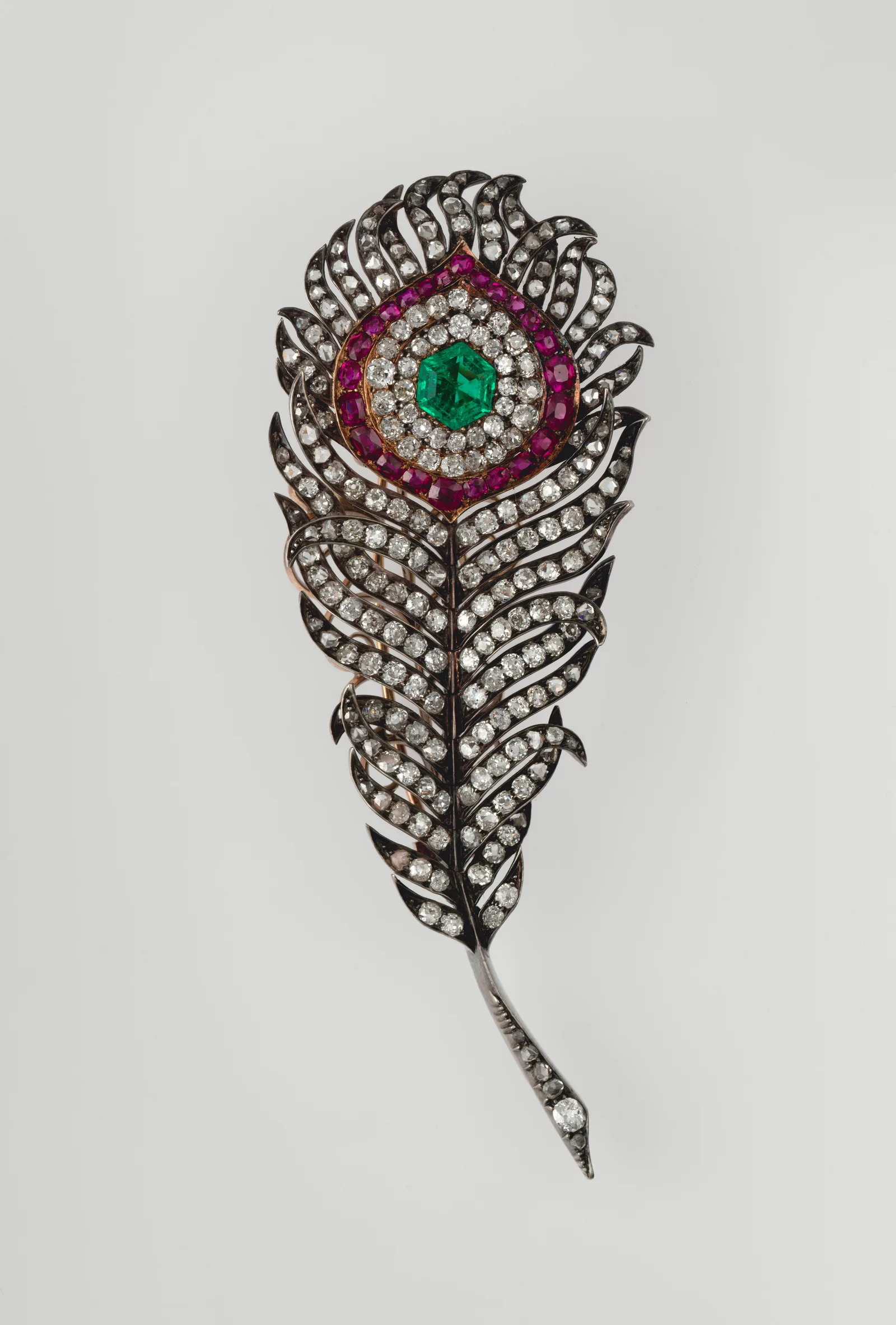
At the turn of the 19th and 20th centuries the Art Nouveau style sought flowing, curving lines in nature, and the peacock fit perfectly: the fan of the tail, the smooth neck, the "eyes" as a ready rhythmic pattern. The masters of the movement made the peacock one of their chief subjects: brooches, tiaras, pendants, combs. The bird answered everything the style prized: asymmetry, the natural motif, the cult of beauty and the play of colour. This was the true summit of the peacock theme in jewellery.
Enamel as the heart of a peacock piece
To convey the shimmer, Art Nouveau turned to enamel, and above all to its complex varieties. Cloisonne enamel, where coloured glass is poured into cells between thin metal partitions, lies ideally over the scaly pattern of the feather: each cell is like a single barb. Plique-a-jour enamel, translucent like stained glass, gave that very effect of a tail glowing from within. It is worth knowing separately how enamel jewellery is built and how it lives: it is a capricious technique, but the most expressive one for a peacock.
What came before and after Art Nouveau
The peacock neither began nor ended with Art Nouveau. Before it the motif lived in Indian kundan and meenakari, in Persian and Mughal work, in Byzantine ornament. After it the peacock stayed on in Art Deco (where its lines grew stricter and more geometric) and keeps returning to this day. But it was Art Nouveau that bound the peacock, enamel and the shimmering stone into a single, recognisable language that jewellers still use today.
Stones and techniques that carry the peacock's shimmer
Opal: inner fire to match the feather
The precious opal is the chief "peacock" stone: inside it flash patches of blue, green and gold, and this play (opalescence) repeats the logic of the feather, where colour is born from structure, not pigment. Opal is delicate (soft, sensitive to knocks and to drying out), but no other stone conveys the "living" shimmer so exactly. There is more on the character of the stone in the piece on fire opal and its play of colour.
Labradorite: a cold sheen, like the underside of the feather
Labradorite gives a different effect, a bluish-green glow that surfaces from a dark stone when it turns (labradorescence). It is stricter and more graphic than opal, and it conveys well that side of the peacock feather which drifts into dark bronze and blue-steel. The stone is harder than opal and calmer in wear. If opal is the "eye" of the feather, then labradorite is its dark, shimmering base. There is a separate look at the properties and choice of the stone in labradorite in jewellery.
Cloisonne and plique-a-jour enamel
Where a stone gives a point of light, enamel gives a continuous field of colour with transitions. Cloisonne enamel builds the "eye" of the feather in rings of different shade; plique-a-jour enamel makes the tail glow when held to the light. Enamel lets you control the colour completely, whereas a stone dictates its own play. The best peacock pieces often join enamel (the body, the feather) and a stone (the pupil of the "eye").
Peacock jasper, turquoise, malachite and pearl
There are more down-to-earth materials too. "Peacock jasper" (also called kambaba jasper), with its green concentric "eyes," directly recalls the pattern of the feather, though its relation to true jasper is loose. Turquoise and malachite give a dense blue-green without shimmer, but a steady and recognisable one. Pearl with a greenish-blue overtone ("peacock" pearl) adds a soft glimmer. These stones are chosen when you want the colour of the peacock but not the fragility of opal.
The peacock in the history of power and fashion
The Peacock Throne of the Mughals
The loudest peacock image in the history of jewellery is the Peacock Throne, commissioned by the Mughal ruler Shah Jahan, the same who built the Taj Mahal. The back of the throne was crowned with two golden peacocks with spread tails inlaid with sapphires, rubies, emeralds and pearls, and between them a tree of gemstones. The throne was held to be the richest in the world and became a byword for royal luxury. It was later carried off as a spoil of war, and the object itself is lost, but the name remained a symbol of supreme power, and the peacock was fixed in the Eastern tradition as the bird of sovereigns.
The peacock in heraldry and on coats of arms
In European heraldry the peacock appears as a sign of pride, beauty and immortality, most often shown with its tail spread, in a pose the heralds named with a proud word. It adorned the arms of noble families and served as a crest, the figure above the helm. A peacock feather crowned knights' helmets at tournaments as a mark of valour and vanity at once. The duality of the bird, beauty on the edge of pride, showed here too: one and the same image read both as dignity and as a warning against vainglory.
The peacock in Art Deco fashion
After its flowering in Art Nouveau the peacock did not leave jewellery; it changed its language. In Art Deco the smooth, flowing line of the feather gave way to strict geometry and stylisation: the tail turned into a fan of clear rays, the eyes into rows of calibrated stones, and the blue-green range moved into the contrast of onyx, emerald and diamond. The fan, one of the favourite motifs of the era, rhymed directly with the spread peacock tail. So the peacock survived the change of styles, each time adjusting to the taste of the time without losing itself.
Send a friend a discount code, they save on their first order.
Caring for the enamel and stones of a peacock piece
Enamel: gently and without knocks
Enamel is glass fused to metal, and it fears the same things glass does: knocks, sharp changes of temperature and abrasives. Take an enamel piece off before sport, cleaning and sleep, and store it separately so other jewellery does not scratch it. Clean it with a soft cloth, slightly damp if needed, without hard brushes or aggressive chemicals. Protect plique-a-jour enamel (the see-through kind) especially: it is thin and vulnerable.
Opal: moisture, softness and caution
Opal contains water and dislikes extremes: it must not be dried out (radiators, direct sun, ultrasound) and must not be dropped, since it is softer than quartz and scratches easily. Take an opal piece off when in contact with water, cosmetics and perfume, and wipe it with a soft damp cloth. It is better stored in a place that is not completely dry. Handled properly, opal lasts a long time; handled carelessly, it clouds and cracks.
Labradorite, pearl and metal
Labradorite is harder than opal, but it too dislikes knocks on its cleavage planes: a soft cloth and an occasional cleaning are enough. Pearl fears acids, perfume and sweat; wipe it after wear and store it separately. Keep the metal base (silver especially) dry, and remove tarnish with a special cloth, carefully going around the stones and enamel. The general principle: a peacock piece is not a workhorse but a thing for gentle wear.
Buying it as a gift? Each one arrives ready to give.
 A branded Zevira box and a little card come with every order.







Facts that surprise
A tail that is not a tail
What we call the peacock's tail is technically the train, elongated upper covert feathers, while the real tail feathers are short and hide beneath that fan. The spread "tail" of an adult Indian peacock can reach a metre and a half to two metres across, and yet it weighs little thanks to the hollow structure of the feathers.
A colour that is not in the feathers
There is almost no green or blue pigment in a peacock feather. The base pigment is brown, and the blue-green glow is created by a microstructure that reflects light. Grind the feather up and the colour vanishes, leaving a brownish dust. The same trick with structural colour lies behind the "fire" of opal, which is why the stone and the feather are so alike: both are coloured by light, not by pigment.
It cries before the rain
The peacock has a loud, alarming cry, and in India it was long held to herald the monsoon: the birds grow lively and call before the rain. So the peacock entered seasonal, rain symbolism and the poetry of the longing of separation, when the heroine waits for her beloved "by the first cry of the peacock."
The females are modest, and it is the male that dances
All the splendour goes to the male: the peahen is a brownish-grey, without the long tail. The male opens the fan in a courtship dance, and recent studies have shown that during the "dance" the feathers also vibrate at a particular frequency, creating a barely audible hum that the female senses. So the peacock's tail works on the eye and on the "ear" at once.
Albinos and white peacocks
There are snow-white peacocks whose "eyes" on the tail show only as a faint relief without colour. These are not albinos in the strict sense but a special form of colouring (leucism). The white peacock became a separate decorative image, a symbol of purity, and is sometimes stylised in jewellery too, playing now not with colour but with texture and the gleam of the metal.
The feather as a theatrical taboo
The belief that a peacock feather on stage brings misfortune is still alive in the theatre world: it is held that the "eye" of Argus draws trouble to the production. There is no rational basis, but the superstition has held for centuries, exactly as the opposite Indian belief in the protective feather has held. One object, two worlds.
Frequently asked questions
Is a peacock in jewellery lucky or unlucky?
It depends on the culture. In India, Persia and the protective tradition of the "eye," the peacock and its feather mean protection, love and renewal. The "unlucky" belief is a narrow European theatrical superstition, grown from the myth of the murdered hundred-eyed Argus. The traditions in which the peacock is a blessing are markedly more numerous, so you can wear it with an easy mind: you set the meaning, not the omen.
Is it true that you must not keep a peacock feather at home?
This is a local superstition, not a rule. In much of the world, India above all, the peacock feather is on the contrary brought into the home as a charm against the evil glance and hung over children. The "must not" comes from European theatre and the myth of Argus. If you feel close to the protective or Indian tradition, a feather at home is a sign of protection, not of misfortune.
What does the peacock symbolise in jewellery overall?
In sum: immortality and resurrection (early Christianity), sovereignty and marriage (Greece, Rome, the goddess Hera), wisdom and victory over evil (India), paradise (Persia, Islam), dignity and rank (China), and also beauty, renewal and protection from the evil eye. The specific meaning depends on which tradition you choose to read into the piece.
Which stones best convey the shimmer of a peacock feather?
Opal (an inner play of blue, green and gold), labradorite (a cold bluish-green sheen out of a dark stone) and cloisonne or plique-a-jour enamel (a controlled shimmer with transitions). For a steady but less "living" colour, turquoise, malachite, "peacock" jasper and pearl with a blue-green overtone will do.
Why does the peacock appear so often in the Art Nouveau style?
Art Nouveau sought flowing lines in nature and cultivated colour, and the peacock gives both: the curve of the neck, the fan of the tail, the rhythm of the "eyes." Together with cloisonne and plique-a-jour enamel, which conveys the shimmer, the peacock became one of the chief subjects of the style and had its flowering within it.
For whom does the peacock make a good gift?
For someone who loves colour and a striking detail and does not hide behind neutrality. By meaning the peacock suits a wedding and an engagement (the Indian symbol of love), a promotion (dignity and rank), and a sign of a new stage (renewal). For a person sensitive to omens, choose a feather pendant: it reads more softly than a whole bird.
How do I care for an enamel peacock piece?
Treat it like glass: no knocks, no sharp changes of temperature, no abrasives or ultrasound. Take it off before sport, water and sleep, store it apart from other jewellery, and clean it with a soft, slightly damp cloth. Protect the see-through plique-a-jour enamel especially, as it is thin.
Opal in a peacock piece, is it not too fragile to wear?
Opal is softer than many stones and fears drying out and knocks, so it is chosen for pieces of gentle wear: pendants, earrings, festive jewellery, rather than an everyday ring on a working hand. If you want a "peacock" stone for every day, take labradorite: it is harder and calmer, and it gives a shimmer beautiful in its own way.
The peacock is a story about how one and the same image can be a charm and a warning, royalty and renewal, the physics of light and pure mythology. If you feel close to its blue-green play, choose not a single tone but the shimmer: opal, labradorite, enamel. And wear it the way you read it yourself.
Wear the symbol, don't just read about it. These are in stock:
About Zevira
Zevira makes jewellery in which the symbol is not a pretext for esoterica but a reason for a beautiful and meaningful object. We love motifs with a double bottom, like the peacock: behind the shimmer stand several cultures and several meanings, and everyone chooses their own. In working with colour we lean on materials with a play of their own, opal, labradorite, enamel, so that a piece lives as it turns rather than staying a flat picture. If you are looking for a thing with character and a history, start with the catalogue.