Puzzle ring: the Turkish puzzle of interlocking bands that falls apart the moment you take it off
An old story says a jealous husband gave his wife a puzzle ring before riding off on a long journey. The moment she slipped it off, it scattered into four, six, sometimes eight thin bands. Putting them back without the trick is close to impossible. He came home, glanced at her finger, and the ring told him whether it had been removed. That, the legend claims, was a test of faithfulness.
It is a beautiful story, and it feels a shame to argue with it. Yet behind the legend hides a genuine little marvel: several separate rings, woven so cleverly that assembled they look like one solid band, and in your hand they collapse into a tangle of loops. It is a puzzle, a wedding token, and a workout for your fingers all at once. Let us look at how it is built, where it came from, how many bands it has, how to learn to assemble it, and who actually gets given one.
What a puzzle ring actually is
Several rings that fold into one
A puzzle ring is not a single band with a pattern on it. It is several independent bands, joined to each other but free to move. Each band is a separate thin ring with bends and twists. On its own it looks like a piece of wire bent into some baffling shape. But fold them in the right order and the right orientation, and the bends catch on one another, the bands line up in a row, and your finger ends up wearing one smooth, snug band. Look at it and you would never guess there are really four or six rings.
The whole trick is that the bands are not soldered. They hold together purely through geometry: each band passes through its neighbours in a set sequence, and the whole structure closes back on itself. Remove one and the stack loses its support, the bands slide free, and the ring opens out like a fan. That is why the other common name is the puzzle ring proper: taking it apart is easy, putting it back together takes skill.
Wear the symbol, don't just read about it. These are in stock:





What is curious is that the outer look of the assembled ring depends on how the maker bent each band. Some weaves give you a neat braid, others resemble interlaced waves, still others fold into something like a knot. It is, in a sense, mathematics frozen in metal: the bands are calculated so their loops slot into one another in exactly one order and no other. That is why two rings that look alike can assemble by completely different schemes, and the knack for one does not always carry over to another without a little getting used to it.
Where all the names come from
This piece has a whole scatter of names, all for the same object. Turkish puzzle ring, Turkish puzzle, faithfulness ring, composite ring, ring of rings, puzzle band. In the English tradition it is called the puzzle ring and the Turkish wedding ring. The names get muddled because the piece wandered for centuries across the Middle East, the Mediterranean, and Europe, and every culture pinned its own label on it. Turkish stuck because it flourished in the Ottoman Empire, faithfulness ring because of the jealous-husband legend, and puzzle for the obvious reason: scattering it is far simpler than rebuilding it.
How it differs from an ordinary wide ring
Assembled, a puzzle ring is easy to mistake for an ordinary wide band with a raised weave. The difference only shows when you take it off. An ordinary ring is one solid piece of metal; nothing happens to it. The puzzle is mobile, it springs a little, there are visible gaps between the bands, and if you try to yank it off it wants to fall apart. That is not a flaw, it is the whole point. The ring is deliberately made to come apart, so that it can be a riddle and an ornament at the same time.
How it assembles and why it scatters
The principle of interlocking bands
Each band in a puzzle ring has a wavelike profile: it rises, then dips, forming loops and crossovers. These bends are calculated so that neighbouring bands slide under one another and lock each other in place. Picture several wires threaded crosswise: while they all sit in place and hold tension, the structure stands. Take even one out and the rest lose their footing. It is this mutual interlocking, not solder and not a clasp, that holds the ring together when assembled.
Why it scatters when you take it off
The ring does not scatter from breaking, it scatters because you lift it off your finger. While the band sits on the finger, its walls are gently squeezed and the bands hold their shape. But pull the ring off carelessly, especially over the knuckle, and the bands shift against one another, the loops uncouple, and the whole stack splays apart. The more bands there are, the more readily it scatters from a clumsy move. That is exactly where the legend lives: returning a fan of bands to an assembled ring without knowing the sequence is nearly impossible, so an opened ring gives away whoever took it off.
What to do if the ring has opened
First rule: do not panic and do not bend anything. The bands already have the correct shape, you do not need to adjust them with your fingers, that only makes reassembly harder. Lay the bands on a flat, light surface so you can see all the bends. Then you need to recall or look up the assembly scheme for your particular number of bands. Assembly is always a fixed order: which band goes down first, which threads under it, which way the loops face. Learn the order once and you will assemble the ring in a minute without looking. At first a simple trick saves the day, one we will come back to in the section on learning.
There is a second rule that saves time: build the ring on your finger, not on the table. Many people find it easier to line the bands up right on a finger or on a thin pencil, because the cylindrical support hints at the right curve and keeps the bands from sliding apart. The bands settle naturally along the round, the loops meet more willingly, and the assembled ring sits in shape straight away. The table is good for working out the order and studying the bends, but the final assembly is often easier to finish on a support of the right diameter.
A puzzle wants a bare finger, on its own. Bury it under a stack of thin bands and the whole trick drowns in clutter. Don't.
How and with what to wear a puzzle ring
Over years of working with rings, this puzzle has passed through dozens of my looks. Here is what actually holds up, sorted by occasion.
Which finger should it go on? Most often I recommend the ring or middle finger. The ring finger underlines the wedding-and-love meaning, especially with a gimmel version or a gift from someone close. I choose the middle finger when you want the ring as a standalone accent, with no nod to a betrothal. A large many-band puzzle I suggest for the index, and a narrow four-band one for the little finger, closer to a signet. What matters here is not symbolism but fit: the ring must sit snugly, since it scatters from the very finger it is removed from most.
What style should I pair it with? A silver twisted puzzle I recommend with a free, bohemian look: linen, suede, rough knitwear, leather. An even, geometric weave in silver or steel I suggest for a businesslike, minimalist wardrobe, where it reads stricter. A gold puzzle I choose for an evening or dressy outing, where it earns the right to take the lead. Since the ring is already rich in texture, I never overload the hand beside it: let it be the centre, and let the rest sound quieter.
Can I stack it with other rings? You can, but carefully. Next to a wide many-band puzzle I add at most one or two thin, smooth rings on other fingers, so the textures do not argue. A narrow four-band one is easier to build into a stack beside slim bands. I watch one thing: neighbouring rings must not catch in the gaps between the bands, or they will help the puzzle open. For the same reason I never set it flush against a ring with a high stone or a sharp setting.
When should I wear it, and when take it off? A narrow silver four-band puzzle I wear calmly every day: it is quiet and reliable. Six- and eight-band versions, especially in gold, I save for weekends and special days, when you can show the ring and tell its story. For sport, hand work, or an active day I suggest taking it off entirely: there it snags and risks coming apart. Its ideal scene is a calm day or evening, with time to let someone scatter it and put it back together in a minute.
Who does it actually suit? The puzzle is unisex by nature. Women more often choose the dainty four- and six-band versions in silver and gold; the massive wide ones in silver, steel, or dark patina sit closer to a rugged look. What decides is not gender but width, metal, and the character of the weave. For a couple I recommend it especially gladly: both know the secret of assembly, and the ring becomes their private language.

Turn on your camera, pick earrings, a pendant or a ring, and see the piece on yourself in real time.
Switch items in one tap.
Everything runs in your browser: no photo or video is ever uploaded.
How many bands there are and how that affects difficulty
Four bands: the classic for beginners
A four-band ring is considered the basic and most approachable kind. Four loops fold into a neat band of medium width, the weave pattern reads clearly without splintering into fussy detail. Such a ring assembles without much trouble; you memorise the scheme in a few repeats. It is the ideal choice for a first encounter with the puzzle, for a gift to someone who has never held one before, and for everyday wear: four bands snag less often and are less eager to scatter.
Six bands: the happy medium
Six bands is a step up in both difficulty and beauty. The weave grows denser and more three-dimensional, the band gets wider, the pattern richer. Assembling one is more interesting already: the order is longer, mistakes come easier, and the first few times you have to peek at the scheme. But the result looks substantial, and the act of assembly turns into a small meditation. Six bands are often chosen as a wedding or gift option, when you want both beauty and a worthy riddle.
Eight bands and more: for the stubborn
Eight, ten, twelve bands: this is now the territory of the devoted. The more bands, the wider and weightier the ring, the more intricate the weave, the longer the assembly sequence. Building a many-band puzzle from scratch, with no knowledge of the scheme and no preparation, is nearly impossible, and the whole mystique of the piece rests on that. Wearing such a ring is harder too: it is large, heavier, more sensitive to being removed. But for sheer impact and prestige among puzzles it has no rival. It is a thing for someone who loves a challenge and is not afraid of spending an evening over a scattered fan of bands.
The general rule: more bands, more risk
The pattern is simple. Each extra band makes the ring prettier and more impressive, but at the same time raises the odds that it will scatter at the wrong moment, and lengthens the reassembly. So the number of bands is chosen by two measures at once: by taste and by way of life. If the ring will live on the hand of an active person, four or six bands are safer. If it is to become a household heirloom and a point of pride, you can reach for eight and beyond.
Customer reviews
Zevira is a real jewellery shop. Genuine payments, deliveries and customer thank-yous.
🥰🥰🥰 gracias

Ok, ¡gracias! 🙂

History and legends
The Ottoman Empire and the faithfulness ring
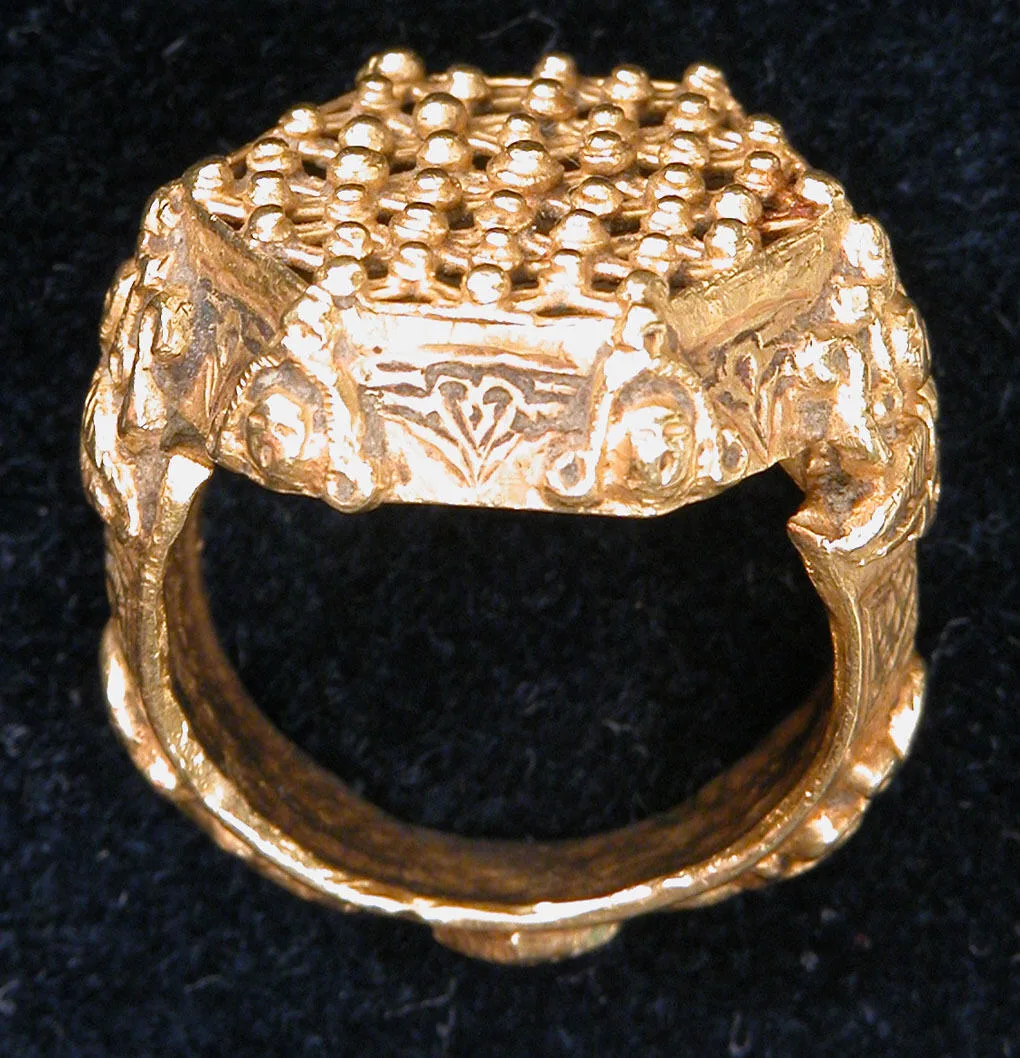
The flowering of the puzzle ring is linked to the Ottoman Empire, hence the nickname Turkish. The version that became almost folklore goes like this: a man of rank put such a ring on his wife before leaving on a long trip for trade or war. Taking it off without destroying it was impossible, and reassembling it without instruction was impossible too. Returning, the husband looked first at her hand: a whole band meant faithfulness, a scattered fan of bands betrayed that the ring had been removed. Historians treat this version with caution; documentary proof of such a practice is scarce, and much of it belongs to a lovely legend. But that legend stuck to the piece for good and still feeds its romance today.
It is not hard to see why the legend seemed plausible at all. In societies where metal was worked by hand and where nobody wrote down assembly schemes for the masses, the secret of a particular weave really could remain family knowledge. A wife not let in on the order of the bands genuinely would not have been able to return a scattered ring to its original form. So a household trick turned into an instrument of control, at least in the imagination of the storytellers. Ethnographers add an important caveat: similar tales about objects that expose infidelity travel through the folklore of many peoples, so the Turkish ring here is more a pretty individual case of a universal motif than a unique custom.
The Arab and Persian trail
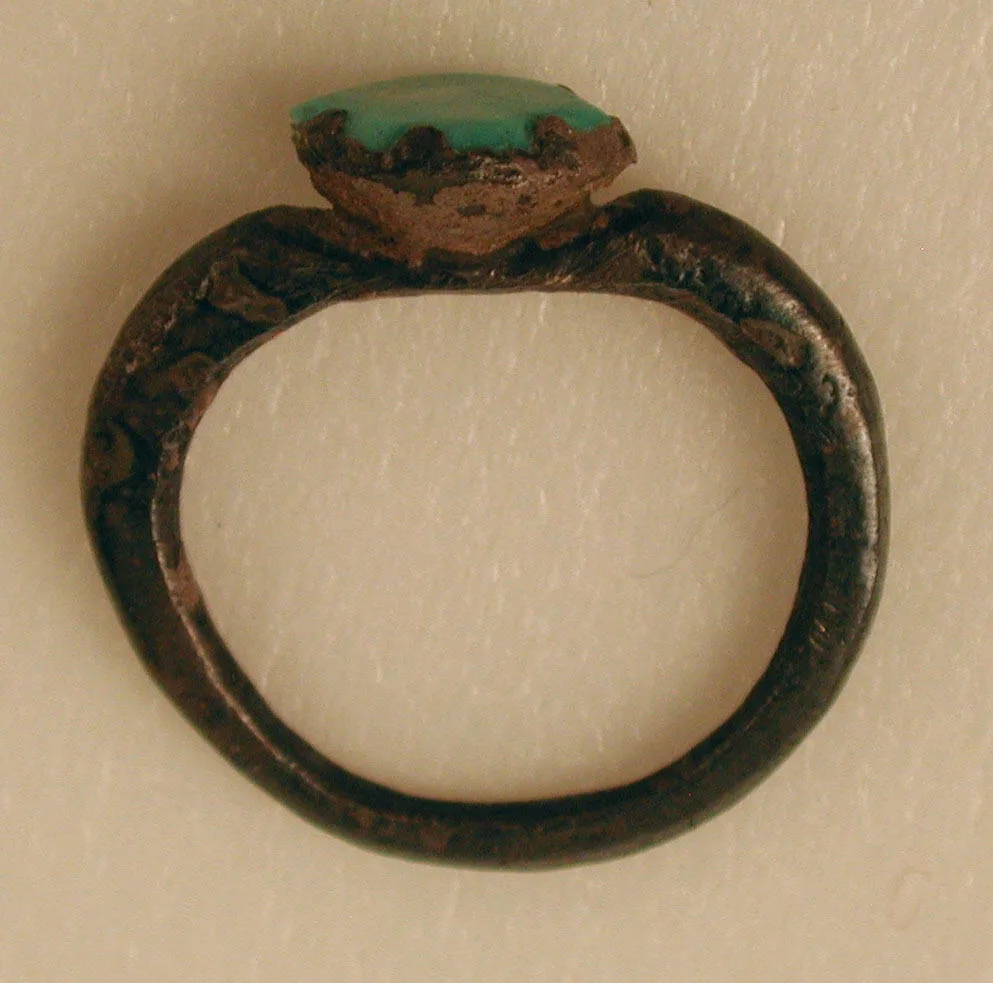
Similar puzzles of interlaced rings turned up across the Muslim East, from Arab lands to Persia. In cultures where metal, geometry, and ornament were prized especially highly, the idea of a ring that assembles by a hidden rule fitted perfectly. Eastern craftsmen adored objects with a secret: boxes with hidden locks, ornaments with encoded meaning, knots and weaves. The puzzle ring joined that line naturally, as one more riddle worn on the finger.
The English gimmel ring as a close relative
In Europe the puzzle found a close relative, the gimmel ring. The name comes from the Latin gemellus, meaning twin. It is a ring of two, sometimes three, hoops that close into one when assembled. In the Renaissance and later, in the sixteenth and seventeenth centuries, such rings were popular as engagement and wedding rings in England and the German lands. At the betrothal the groom and bride each wore a half, and at the wedding the hoops were joined into a single ring for the bride. The logic is the same as the puzzle's: several parts folding into one whole, as a symbol of union.
Fede rings and the motif of clasped hands
Beside the gimmel stands the fede ring, from the Italian mani in fede, hands in faith. Such a ring shows two hands clasped in a handshake, a symbol of union and a given word. Sometimes gimmel and fede were combined: two halves closed together, and the hands folded into one another like a clasp. From this same circle of ideas grew, by the way, the Irish Claddagh ring with its hands holding a heart beneath a crown. They are all about one thing: joining, faithfulness, two who become one.
How the puzzle survived to our day
From engagement and love symbolism the puzzle ring gradually moved into the category of ornaments with character. Today people wear it less to test faithfulness than for the beauty of the weave, the pleasure of assembly, and the story you can tell. It remained a favourite riddle of a gift, a souvenir from travels around the Mediterranean and the Middle East, and at the same time a symbol of unity for those who value meaning behind form. The legend of jealous husbands survived along with it and works without fail as a reason to start a conversation.
A special share of the ring's long life belongs to mathematicians and puzzle lovers. Interlinked rings became, long ago, an object of interest for those who study topology and knot theory: the question of exactly how several rings link and unlink turned out to be less simple than it looks on a finger. Thanks to this, the puzzle ring keeps surfacing in books and articles on recreational mathematics, puzzles, and clever mechanisms. So the ornament earned a second life, no longer as a love token but as an elegant, hands-on example of how beautiful geometry and an everyday object can be the very same thing.
Upload a photo of your pet, someone you love, or an object. We'll build a 3D model and hand-cast it in pewter.




Gimmel and fede as kin of the puzzle
Gimmel: twins that close together
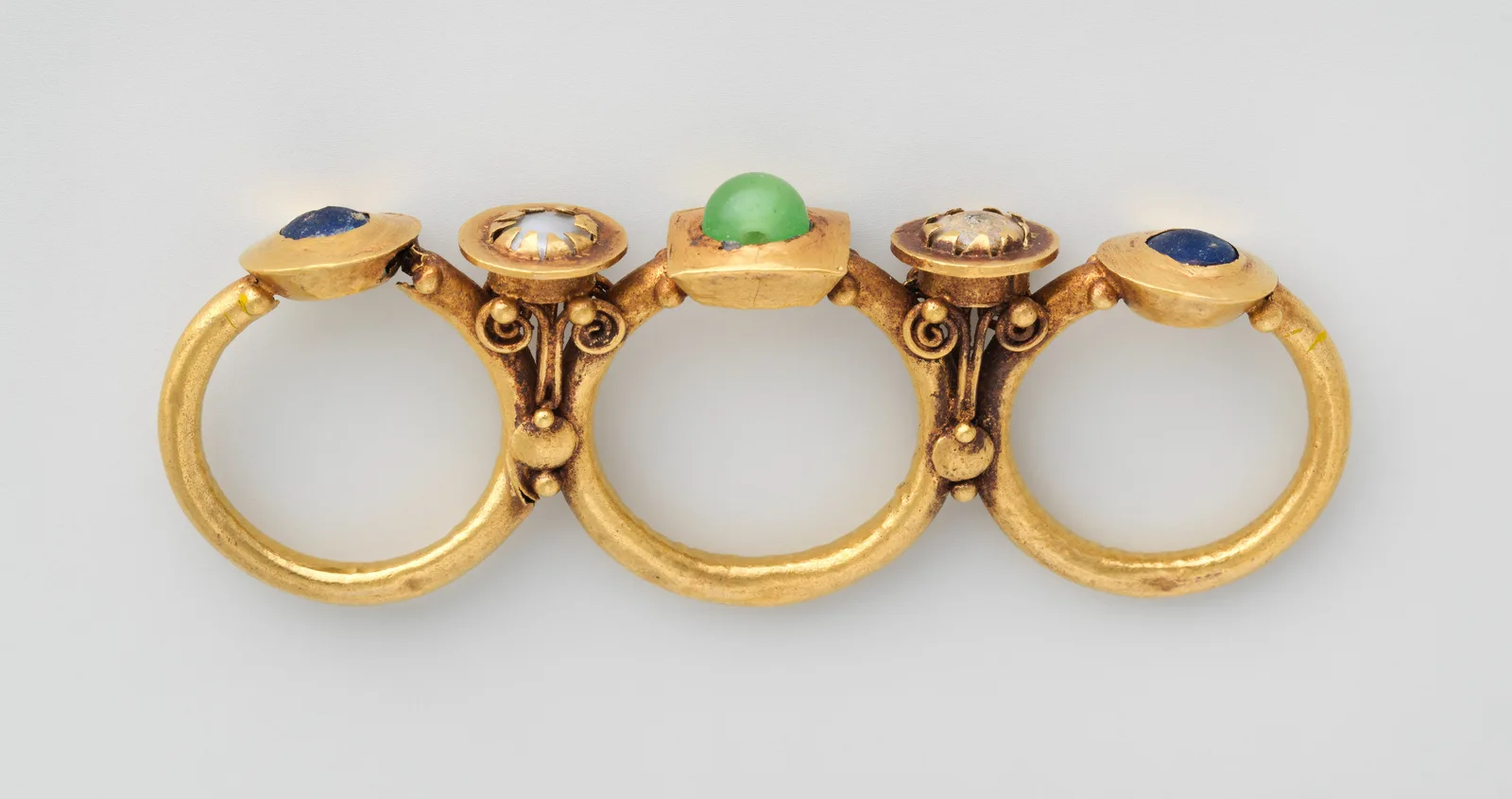
If the puzzle ring is four, six, or more bands, then the gimmel is its simpler and more intimate relative, usually of two or three hoops. Each hoop stands on its own, each may have its own pattern or setting, and assembled they close exactly together to form a single band. In the past such rings were split at the betrothal: one part worn by the groom, another by the bride, a third, if there were three hoops, by a witness. At the wedding they were joined. The idea of a separable ring that becomes whole at the right moment links the gimmel to the Turkish puzzle directly.
Fede: hands as a sign of faith
Fede added to this family a recognisable image, two hands in a handshake. The motif reaches back to ancient Rome, where joined hands meant a pact and faith to a given word. In medieval and Renaissance Europe fede became a love and engagement ring, and then fused with the gimmel: the halves closed and the hands folded into one another. The result was an ornament that was both a puzzle and a vow. For the modern buyer, fede and gimmel are a way to feel where the puzzle ring's wedding symbolism grows from.
How the puzzle differs from its kin
The difference is one of emphasis. Gimmel and fede are above all a symbol of union; their separability is ceremonial, the hoops simply fold together without any particular cunning. The Turkish puzzle puts the riddle itself front and centre: its bands are interwoven so that assembly demands skill, and opening it is nearly irreversible without knowing how. You could say gimmel is about joining two people, while the puzzle is about a test and a secret. But their root is shared, and whoever finds one interesting usually falls for the others too.
How to learn to assemble a puzzle ring
Photograph the ring before you take it apart
The most reliable advice for a beginner sounds banal but saves your nerves: before you take the ring apart, photograph it assembled from several angles, and better still film a short video, slowly removing it band by band. Then you will have an exact scheme of your own ring, with all its bends and order. Most people give up not because assembly is impossible, but because they took the ring apart blind and did not remember the original picture.
Master the order for your number of bands
Each number of bands assembles by its own algorithm. For four bands it is short, for six it is longer, for eight and more longer still. The point is to understand which band goes down first as the base, in what order the rest are added to it, and which way the loops face. For the common four- and six-band rings the schemes have long been described and are easy to find. Run through the algorithm step by step once, repeat three or four times, and your hands will remember the motion. After that assembly goes almost on autopilot, like tying shoelaces.
Practice and do not rush
The beginner's main mistake is haste and trying to assemble everything in one yank. The puzzle ring does not like force, it likes precision. Lay the bands out calmly, thread them one at a time, check each step. If you get tangled, do not bend the metal, go back to the photo and start over. Each time will be faster. Many admit that the first assembly takes half an hour with peeking, and after a week of practice the ring comes together in a minute, blind, and it turns into a small trick that is fun to surprise people with.





Materials: what puzzle rings are made of
Silver: the classic and the happy medium
Puzzle rings are most often made of silver, and that is a sensible choice. Silver is soft enough for the bands to have the right springiness and hold their shape well, yet strong and durable. The standard is 925 sterling silver, an alloy with a small share of other metals for hardness. A silver puzzle looks refined, in time it takes on a light patina that underlines the weave, and it costs a reasonable amount. For most buyers this is the optimal material.
Gold: for the formal version
Gold puzzle rings are made when the piece is meant as a wedding, gift, or status item. Gold is softer than silver, so the bands come out especially supple, and the assembled band glows with warm light. Yellow, white, or rose gold give different moods, and the weave on gold looks dearer and more festive. The downside is obvious: a gold puzzle costs noticeably more, and scattering it at the wrong moment stings all the more. So gold versions are more often chosen for an occasion than for daily wear.
Steel and other metals: for strength and character
Puzzles in stainless steel exist too, and they win on hard-wearing: steel is hard, does not tarnish, and takes knocks. The downside is that steel is stiffer than silver, the bands spring more, and a steel ring is a little harder to assemble. There are puzzles in brass and bronze with a warm golden cast, and in titanium for lightness. Each metal sets its own character: silver soft and classic, gold festive, steel bold and undemanding. The choice of material also affects how the ring behaves during assembly.
The stiffness of the metal is worth keeping in mind right at the buying stage. The softer the alloy, the more obedient the bands and the easier it is for a beginner to see the assembly through: silver and gold forgive clumsy moves, the bands settle smoothly into place. Hard metals like steel and titanium hold their shape better and barely bend in wear, but during assembly they demand more confidence, because they spring and like to slip away. So for a first puzzle ring it is wiser to take silver: it gives the right balance of softness for learning and strength for everyday life.
Leave your email, we'll send your discount code. No spam, unsubscribe anytime.
The code arrives by email, valid on your first order.
How to choose size and difficulty
Weave pattern: what to pick
Beyond the number of bands, puzzle rings differ in the character of the weave. Some makers create a strict, even pattern, where the bands line up in parallel waves and the assembled band looks calm and geometric. Others twist the bands into something like a rope or a braid, and the ring comes out textured, alive, playing in the light. Still others add asymmetry or a stone setting on one of the bands. Before buying it helps to picture the setting the ring will live in: a calm weave is closer to a tailored look, a twisted, three-dimensional one to a free, bohemian one.
Size: a touch more precise than for an ordinary ring
With the size of a puzzle you need to be more careful than with an ordinary ring. Because of the weave and the mobility of the bands it sits a little differently, and too loose a size is dangerous: on a wide finger the ring rattles, slips off more easily, and scatters. Too tight is bad too, because you will have to take it off over the knuckle, and that is the key moment when the bands uncouple. Better to choose the size exactly to the finger, so the ring sits snugly but comes off calmly, without a yank. If you waver between sizes, for a puzzle it is wiser to take the smaller of the suitable ones.
Difficulty to suit your life
The number of bands is chosen for two reasons at once: for beauty and for how you will wear the ring. For everyday wear by an active person, four or six bands suit best: they hold more reliably and scatter less often. If the ring is meant as a rarely removed heirloom, a collector's piece, or a riddle of a gift for a puzzle lover, you can take eight and more. Here it is worth answering yourself honestly whether you are ready to reassemble the ring each time it opens.
Width and comfort
The more bands, the wider the band. A wide ring is beautiful, but not comfortable for everyone: it crowds the neighboring fingers, snags on gloves and pockets, and feels massive. A narrow four-band ring is worn almost unnoticed. Before buying it is worth picturing which finger the ring will live on and in what setting. By the way, the meaning of rings on different fingers is worth considering too, since a puzzle is often worn with intent, and the beauty here comes as a second layer.
CAPAORA mini knife pendant
The 18th-century Spanish navaja in miniature: 40 mm of stainless steel, a real folding mechanism and a Palanquilla lock that clicks. An affordable gift to remember.
Authentic · Ships from Spain · 14-day returns
Who gets a puzzle ring and why
A symbol of unity and union
The chief meaning of a puzzle ring is that many separate parts fold into one whole. It is a direct metaphor for union: two different people become one, and that unity holds not on a clasp but on mutual interweaving. So the puzzle is given as a symbol of faithfulness and a firm bond, sometimes instead of or alongside a wedding band. Each time you assemble the ring, you seem to fold your own story back into one, and there is a quiet beauty in that.
Engagement and a promise
Because of its kinship with gimmel and fede, the puzzle ring is often chosen for an engagement or as a promise ring. It speaks of intent, of a word kept, of two who have decided to be together. Anyone thinking in that direction would do well to compare it with other options and read about couple rings, to work out which format of union feels closer. The puzzle adds to the promise a playful, personal shade that a plain band does not have.
A paired story for two
A puzzle ring is beautifully played out as a pair. One partner wears the assembled ring, and both know the story of assembly, and it becomes their shared secret: a stranger who picks up the ring will scatter it and fail to rebuild it, while the owners put it together in a minute. Sometimes the pair is completed with a second puzzle or a solid companion ring, so each has one of their own. The ritual itself, when you teach each other to assemble the ring, turns into a small tradition that holds not on words but on a shared skill.
A riddle of a gift and an object with character
Not every puzzle ring is given to lovers. Often it is simply an excellent gift for someone who loves puzzles, values things with a story, collects unusual objects, or collects rings. For such a person it matters both to wear the ornament and to solve it, to master the assembly, to surprise friends with the trick of the scattering band. People readily bring a puzzle ring home as a souvenir from Turkey, Greece, and the countries of the Middle East, because it is compact, affordable in silver, and carries a whole legend.
The downsides of a puzzle ring
It can be scattered and not put back
The chief and honest downside follows straight from the nature of the piece. The ring is deliberately made to come apart, which means it scatters, and not always at a convenient time. Pull it off sharply, catch it on clothing, take it off at night without looking, and in the morning a fan of bands faces you. If you have not mastered assembly, this becomes a problem: the ring lies in pieces, you cannot wear it, and you cannot put it back on your own. So the first thing to do after buying is to learn to assemble it confidently while the ring is still in its original assembled form and there is something to photograph.
It snags and is fussy in wear
Because of the weave and the gaps between the bands, a puzzle catches on fabric, hair, and gloves more readily than an ordinary ring. Many-band versions are massive on top of that and crowd the neighbouring fingers. With active hand work such a ring leads an anxious life: now it snags, now it starts to come apart. This is no reason to give it up, but it is a reason to choose a sensible number of bands and to take the ring off wherever there is a risk of tearing it loose, for instance at the gym or at rough work.
Repair and resizing are harder
Changing the size of a puzzle ring is far harder than for an ordinary one. The size has to be changed on every band in step, or the weave stops meeting up, and that is a job for a jeweller familiar with exactly these rings. Not every workshop will take it on. So it is better to choose the right size at once when buying, rather than count on resizing the ring later. The same goes for repair: a bent band has to be straightened precisely, or the assembly goes out of true.
Care and storage, so the ring does not open
Take it off gently and without yanks
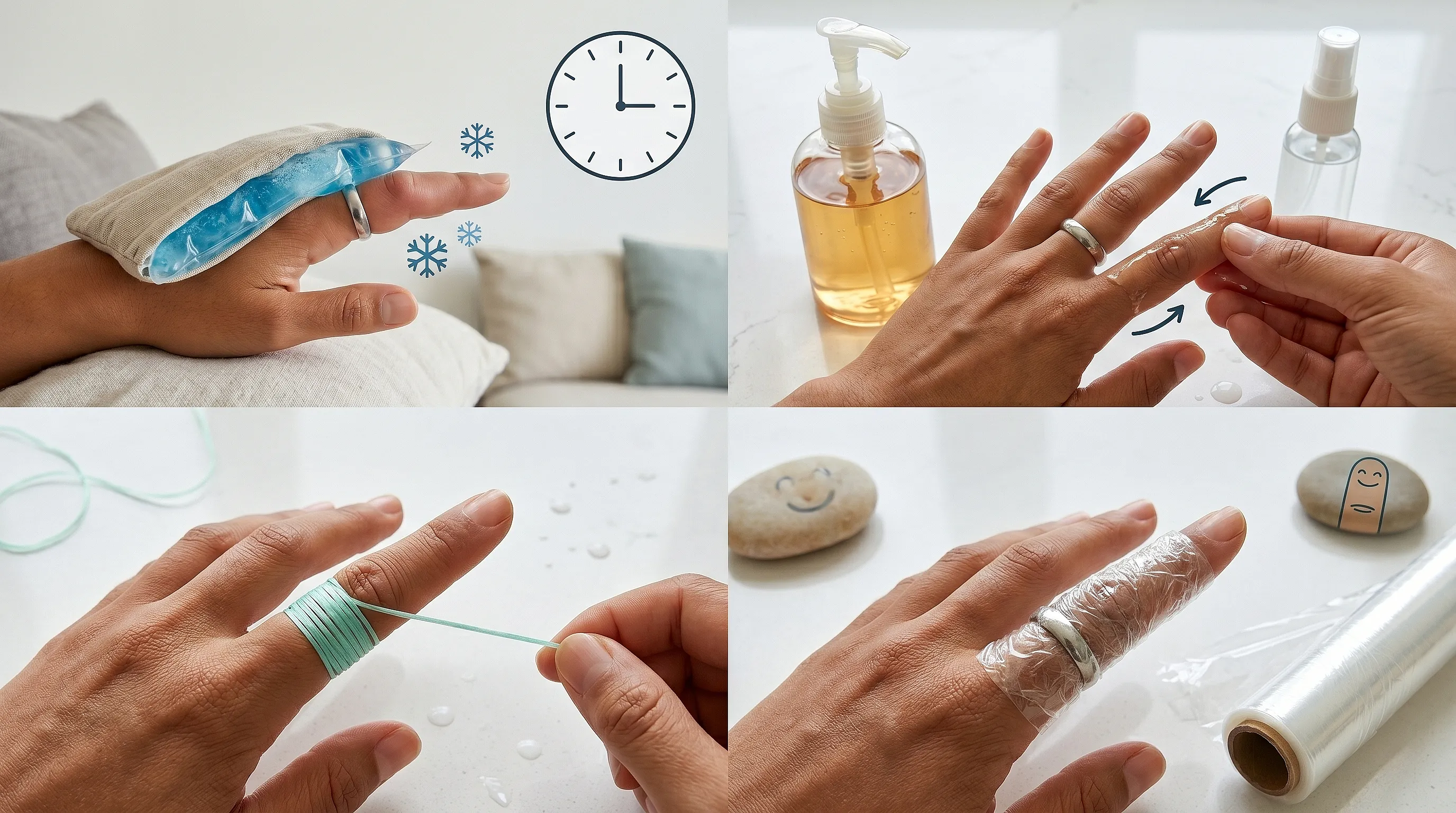
The most common reason a puzzle scatters is careless removal. Do not pull the ring off with a yank over the knuckle. Take it off smoothly, holding the band from both sides so the bands do not slide apart. If the ring sits a touch tight, wet the finger or soap it, but do not tug. The habit of taking the ring off carefully solves most of the trouble with it opening on its own.
Store it assembled and apart
A puzzle is best stored assembled, in a separate compartment of a box or in a soft pouch, so it does not rub against other jewellery or catch on it with its bands. If the ring lies in a common heap, stray chains and pendants easily snag it and open it. A silver puzzle is worth keeping with an anti-tarnish cloth or in a closed box, so it darkens less. The more peacefully the ring rests, the longer it stays assembled and beautiful.
Cleaning without taking it apart
A puzzle ring can be cleaned without taking it apart. Warm water, a drop of mild soap, a soft brush along the weave, then rinse and wipe dry with a cloth. An ordinary toothbrush with soft bristles works: it reaches into the bends where fingers or a cloth cannot get. Dirt collects in the gaps between the bands, so a brush is more useful here than with an ordinary ring. Silver, when it darkens, is brought back to life with a special cloth or a mild silver product. The main thing is not to use harsh chemicals and not to scrub hard, so as not to shift the bands. Taking the ring apart for cleaning is usually unnecessary, and it is best not to do it more than you have to.
Send a friend a discount code, they save on their first order.
Facts that surprise
The puzzle ring was sometimes called a test of wits for suitors: by legend a craftsman handed a candidate a disassembled ring, and if he could not put it together in the allotted time, the match fell through. Proof is thin, but the story lives on.
The English gimmel ring was sometimes made of three hoops: two for the groom and bride, a third for the witness to the betrothal, who kept his part until the wedding as living evidence of the word given. At the wedding all three parts were joined into one ring for the bride.
The motif of hands clasped in a handshake on fede rings is older than Christianity: joined right hands, the dextrarum iunctio, appeared on Roman coins and sarcophagi as a sign of accord and faith to a pact two thousand years ago.
There are puzzles where the number of bands climbs past a dozen, and almost no one will take on assembling them without a scheme. Such rings are made more as a demonstration of mastery than for everyday wear.
The idea of an object with a secret assembly is not unique to rings. The same cultural tradition gave us puzzle boxes with hidden panels and riddle purses. The ring simply turned out to be the most wearable of them, since you can keep its secret right on your finger.
In the twentieth century puzzle rings became a popular souvenir from Mediterranean resorts, and a whole genre of street-seller conjurers grew up around them, assembling a scattered ring in a flash before amazed tourists, turning the sale into a miniature performance.
Frequently asked questions
Is a puzzle ring necessarily a wedding ring?
No. Historically it is closely tied to wedding and love symbolism through the Turkish legend of faithfulness and through the related gimmel and fede rings. But today a puzzle is worn simply as a beautiful ornament with character, as a gift for a riddle lover, as a souvenir. The sense of union is in it, but there is no need to insist on it.
Is it true they tested wives' faithfulness with it?
It is a lovely legend, not a documented custom. The idea is that a removed ring scattered, and putting it back together without the knack was impossible, so an opened ring gave away whoever took it off. The logic works, but direct historical proof of such a practice is scarce. The legend survived along with the ornament and became part of its charm.
How many bands should a beginner choose?
For a first ring take four bands. It is the most approachable kind: the pattern reads clearly, the assembly is simple, the ring scatters less often. Six bands are a little harder but prettier; people choose them when they want a more serious riddle. Eight and more are better taken when you are ready to spend time on assembly and to wear a massive ring.
What do I do if the ring has scattered and I cannot put it back?
Do not bend the bands and do not panic. Lay the bands on a flat surface and find an assembly scheme for your number of bands, best of all from a photo or video that you ideally made in advance. Run through the algorithm step by step, repeat a few times. If it really will not come, a jeweller can assemble the puzzle. But usually after two or three tries by the scheme your hands remember the order on their own.
Can it be worn every day?
It can, if you choose a sensible number of bands, four or six, and pick an exact size. Then the ring holds reliably. For active hand work or sport it is better taken off, because it snags more readily than an ordinary ring and may come apart. Careful removal without yanks solves most of the trouble with everyday wear.
Which metal is best to get?
For most people 925 silver is optimal: refined, springy in the right measure, at a reasonable price. Gold is chosen for a formal or wedding version, it is softer and dressier but costs more. Steel and titanium are taken for strength and low fuss, though a stiff steel ring is a little harder to assemble. The material affects both the look and the behaviour of the bands during assembly.
Can a puzzle ring be resized?
It is harder than with an ordinary ring, because every band has to be adjusted in step, or the weave stops meeting up. Not every craftsman will take it on. So it is wiser to choose the right size at once when buying. If you waver between two sizes, for a puzzle people more often choose the smaller, so the ring sits snugly and does not slip off.
How does it differ from a Claddagh ring?
The Claddagh is a solid ring with a figure of two hands holding a heart beneath a crown; it is not taken apart, it carries the Irish symbolism of love, faithfulness, and friendship. The puzzle ring, by contrast, consists of several separate bands that fold into one, and its main feature is the assembly and disassembly. They share a root in the idea of union and clasped hands, but they are built and read differently.
Conclusion
A puzzle ring lives in several roles at once. It is a jeweller's riddle, where several thin bands fold by a hidden rule into a snug band. It is a wedding and love symbol with roots in the Turkish legend, in the English gimmel and the Italian fede rings, where parts close into one as an image of union. And it is simply a beautiful thing with character, pleasant to own, interesting to assemble, and always with something to tell about. The main thing is to master the assembly straight away and to wear the ring gently, and then it will delight you for years while keeping its own little secret.
Rings with meaning from Zevira
We love jewellery that has a story and a character: from classic 925 silver to rings with the symbolism of union and faithfulness. In the Zevira catalogue it is easy to find a ring that speaks of you and of those dear to you, and that wears for years.
Browse the catalogueBuying it as a gift? Each one arrives ready to give.
 A branded Zevira box and a little card come with every order.













About Zevira
Zevira is a jewellery brand for those who choose ornaments for their meaning and value the shine second. We work with 925 silver and quality materials, tell honest stories behind every symbol, and make things you want to wear every day and pass on. If the idea of a ring that folds into one whole from many parts feels close to you, we will have something that resonates.