Angels in jewellery: what the winged symbol really means
Six wings, four faces, and not a single halo
The seraph of the biblical vision is not a chubby baby with a harp. It has six wings, and it covers its own face with two of them. The little cherub stamped on greeting cards today was born a millennium and a half later and has almost nothing to do with the original. The angel carried exactly this confusion into jewellery: one silhouette, a dozen different meanings.
A wing, a halo, folded palms, raised arms. Each detail comes from its own era and drags its own meaning behind it. Some people wear an angel as a quiet talisman, some as a sign of faith, some for the sheer beauty of the silhouette. Every reason is valid, and none cancels the others. Below we trace where the image came from, what it actually means, and how to choose an angel piece while understanding what you are wearing.
Wear the symbol, don't just read about it. These are in stock:
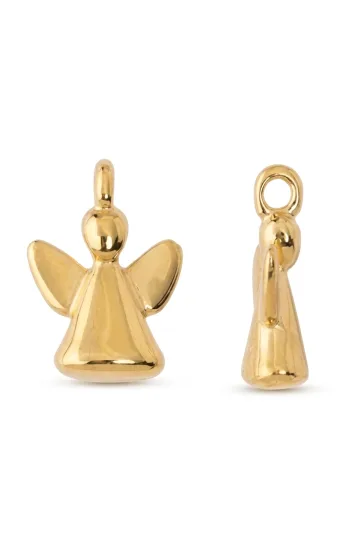




A messenger, not a cute creature: where the word comes from
The word "angel" comes from the Greek angelos, "messenger". It is not the name of a being but the name of a job: the one who delivers a message. The same word sits inside the very name of the Gospel, euangelion, "good news", and in the title of a courier in the service of an ancient state. Hence the first key idea. An angel was originally a function, not a pretty creature with wings. When Greek translators of the Hebrew Bible in the third century BC searched for a word for heavenly messengers, they took the ordinary term for a runner, and the image stuck as "the one who was sent". The wings were invented later, to show one simple property: it moves between heaven and earth and carries the message from there to here.
It is striking that the earliest Christian angels had no wings at all. Until the end of the fourth century they were drawn as ordinary young men in white robes, with no feathers behind their backs, and you could recognise them as heavenly messengers only from the scene. The first securely dated image of a winged angel is placed around the 380s, on the so-called Sarigüzel sarcophagus from Istanbul. The wing came into Christian art from a ready-made pagan formula.
A similar logic worked long before Christianity. The Greeks depicted a winged Nike, the goddess of victory, the Romans her double Victoria, and it was her pose, a soaring figure with wings spread, that later became the basis of the angelic silhouette. A human figure plus bird wings meant a link to the higher and the swiftness of the message. Early Christianity inherited the ready-made visual formula and filled it with its own content. So an angel in jewellery is an ancient image with a very long lineage, not a church invention of the last few centuries.
An angel belongs over a leather jacket, not over lace. The halo suits the brazen.
How and what to wear an angel with
An angel rarely calls for drama. It is usually a quiet symbol, so I dress around it to let it breathe rather than turn the look into a manifesto. Here is how I recommend approaching it, sorted by the questions that come up most.
What do I wear an angel with every day? For daily wear I recommend a small wing or figurine on a thin chain, silver or gold at medium length, over a plain turtleneck, shirt, or simple dress. An angel reads best on a calm background, so I suggest avoiding a busy pattern that argues with the fine feather engraving. A high collar or a shallow neckline gives the pendant something to rest against.
What should I choose for a gift or a special occasion? For a gift I choose a larger format: a big wing, a gold figurine, or a locket. I recommend adding a white accent here, mother-of-pearl or a light stone, to lift the heavenly note. Paired wings work as a piece for two, a wing each, so I suggest them when the gift is meant to mark a bond.
Which other symbols do I combine an angel with? I combine an angel most easily with motifs kindred in spirit: stars, the moon, a feather, or the dove as a sign of peace. They are all about lightness and upward movement. Heavy chains and aggressive symbolism tend to smother a quiet angel, so I recommend wearing those separately.
Which metal suits my colouring? For a warm colouring, golden skin and dark hair, I suggest yellow or rose gold, which supports the natural tone. For a cool colouring, fair skin with a pink undertone, I recommend silver and white stones. This is a starting point, not a rule: an angel is a light theme, and silver suits almost everyone.
What chain length do I recommend? For length the logic is simple: a small wing wins on a short chain at the collarbones, while a large figure or locket wants a medium length where the image unfolds to full height. I recommend keeping several angel pieces in one metal, otherwise the look falls apart into scattered details.

Turn on your camera, pick earrings, a pendant or a ring, and see the piece on yourself in real time.
Switch items in one tap.
Everything runs in your browser: no photo or video is ever uploaded.
The heavenly hierarchy: nine ranks, not one type
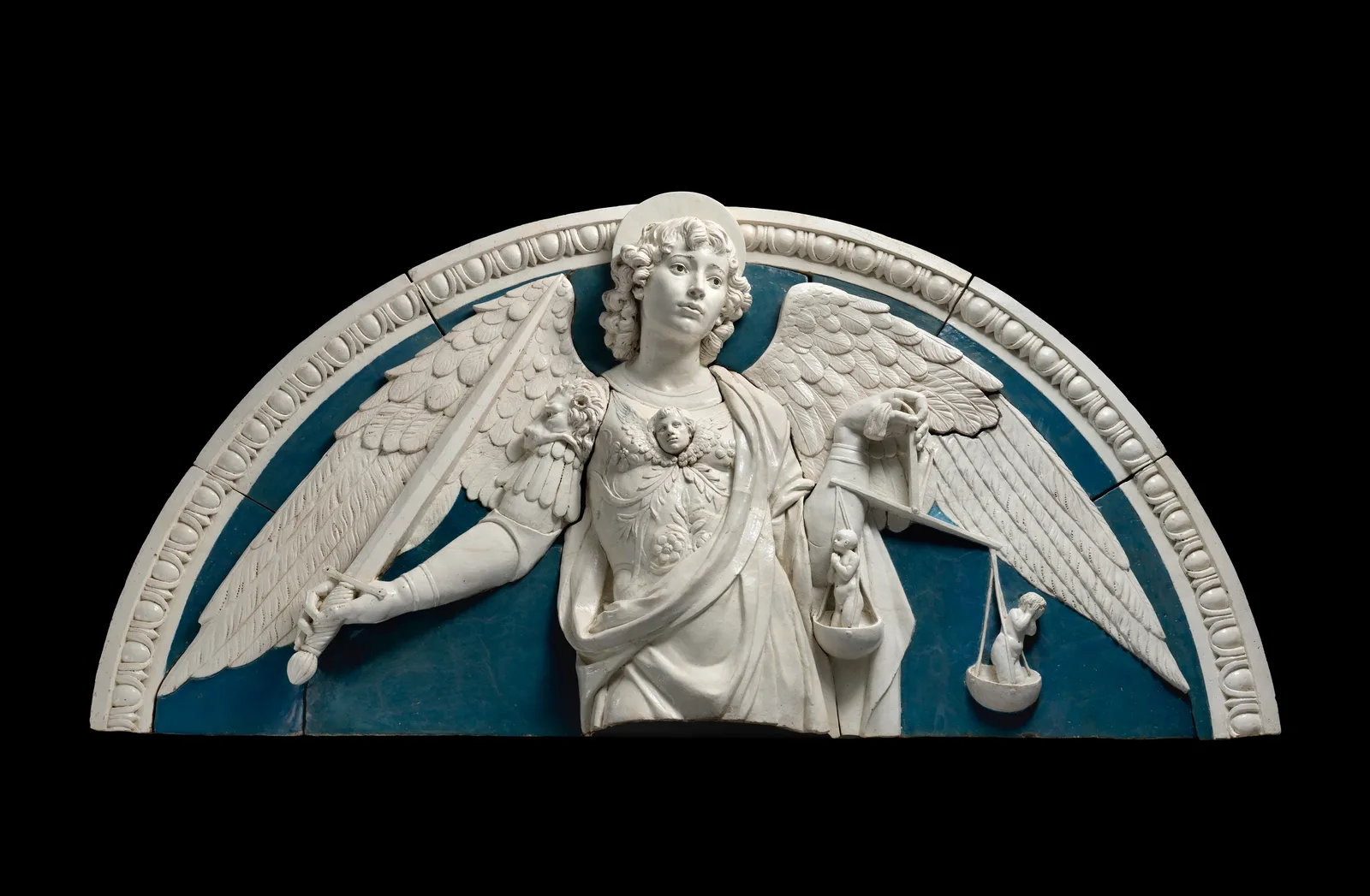
In the Christian tradition a detailed hierarchy of angels took shape, nine ranks split across three triads. It was systematised in the treatise "On the Celestial Hierarchy" by an author known as Pseudo-Dionysius the Areopagite, around the fifth or sixth century. He borrowed someone else's name: he signed as Dionysius the Areopagite, a first-century disciple of the apostle Paul, and for almost a thousand years he was taken at his word. Only in the Renaissance did scholars notice traces of fifth-century Neoplatonism in the text and quotations from authors who lived long after the apostles, and the author was politely renamed "Pseudo". The scheme itself survived the exposure without a scratch: the nine ranks were cited by Thomas Aquinas, retold by Dante in the "Paradiso", and it is to this scheme that our familiar order of heavenly powers goes back. The highest triad is seraphim, cherubim, and thrones. The middle one is dominions, virtues, and powers. The lowest is principalities, archangels, and angels proper. The higher the rank, the further the being is from a human and the less it looks like one.
This knowledge is useful not for theological pedantry but for understanding jewellery. When a maker creates an angel, they almost always take the image from the lowest triad, human-like and recognisable. The higher ranks are too alien to wear around the neck.
Seraph and cherub: nothing like the greeting cards
The seraph in the book of the prophet Isaiah is six-winged: two wings cover the face, two the feet, two for flight. The vision is recorded in the sixth chapter, and the very root of the word, the Hebrew saraph, is linked to the verb "to burn". Elsewhere in the Bible the same word names the burning serpents in the desert, so a seraph is literally "the burning one". No chubbiness, no infant meekness, this is a being of light and heat beside the source, and in the hymn "Holy, holy, holy" it sings at the very throne.
The cherub in Ezekiel's vision is four-faced: the face of a human, a lion, an ox, and an eagle, the body covered with eyes, and it moves on fiery wheels with rims studded with eyes. The image is so alien to a human that it is hard to describe in words. It was cherubim who were set to guard the entrance to Eden with a flaming sword, and their golden figures, by tradition, spread their wings over the ark of the covenant. Their four faces, human, lion, ox, and eagle, were later fixed in Christianity as symbols of the four evangelists. The fact that Baroque art began calling a winged child's head a cherub is a late simplification and a direct mix-up with the ancient putti, the cupids. The real cherub from the text has nothing to do with that sweet picture. Worth knowing: the "little cherub" on a locket and the biblical cherub are two completely different beings under one word.
Archangels: the only ones with names
Archangels are the only angels who in the tradition have personal names, and that is exactly why they appear in jewellery as specific characters. A curious detail: in the biblical texts themselves only two are named, Michael and Gabriel. Raphael came from the book of Tobit, which not every denomination treats as canon, and Uriel comes from the non-canonical book of Enoch. So the Catholic Church officially honours three archangels, Michael, Gabriel, and Raphael, and in 745 a Roman council even forbade praying to angels with other names, to stop the flood of homemade "archangels" such as Uriel, Raguel, and Sariel. Michael, whose name means "who is like God", is a warrior, depicted with a sword or scales, joining protection and strength. Gabriel is the messenger, the one who brings important news, his attribute a trumpet or a lily. Raphael is the healer and patron of travellers, shown with a staff and a fish, often chosen by those much on the road. Uriel, "light of God", is linked to wisdom and the fire of knowledge.
In jewellery the most common is Michael with a sword, because his image reads instantly and is clear even outside a church context: a defender standing guard. Michael is honoured surprisingly widely: among Christians he is the leader of the heavenly host, in Islam the cognate Mikail is in charge of rain and provision, and in Judaism he is considered the protector of the people. Such pieces are chosen deliberately, with an understanding of exactly who is being worn.
The four archangels: how to tell them apart
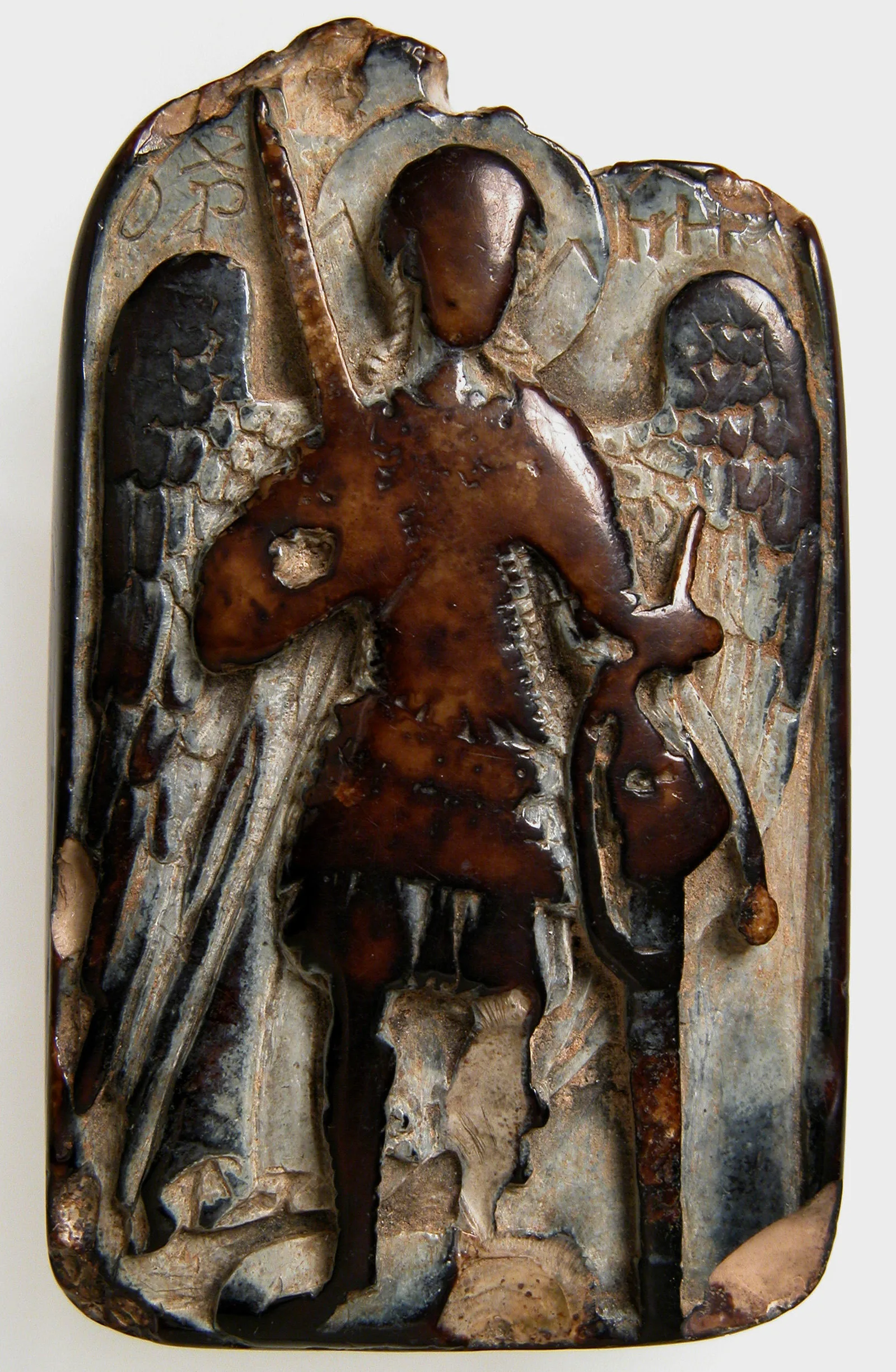
If an angel in a piece is nameless, it carries the general sense of watching and light. But give it a name and an attribute, and the image becomes precise. Each of the main archangels has its own role, its own object in hand, and a colour association built up over centuries by which it is recognised on icons and on jewellery medallions.
Michael. The name means "who is like God". A warrior and defender, leader of the heavenly host. His attribute is a sword or scales, sometimes a shield, a vanquished dragon underfoot. The traditional colour is red and gold, and among stones garnet and ruby are linked to him, stones of fire and strength. In jewellery Michael is the most common of the named angels, because his image reads instantly: a guardian standing in defence.
Gabriel. The messenger, the one who brings the main news. His attribute is a trumpet or a white lily. The colour is white and silver, the stone often moonstone or pearl, anything tied to purity and good news. Gabriel is chosen when the idea of a beginning, of news, of a change for the better matters.
Raphael. The name means "God heals". Patron of travellers, doctors, and those on the road. He is shown with a staff and a fish, often with a companion at his side. The colour is green, the stone emerald or another green mineral. Raphael is taken on a journey and given to those who travel a lot or work in medicine.
Uriel. The name means "light of God". Linked to wisdom and the fire of knowledge, his attribute a flame or a scroll. The colour is warm, amber, golden-fiery. Uriel appears less often than the first three, and he is chosen knowingly, for the meaning of light and knowledge.
Knowing these differences turns a purchase from a random one into a considered one. An archangel with an attribute is not "a prettier angel" but a specific image with a precise meaning, and the wearer usually understands exactly who they chose.
Customer reviews
Zevira is a real jewellery shop. Genuine payments, deliveries and customer thank-yous.
🥰🥰🥰 gracias

Ok, ¡gracias! 🙂

The angel beyond Christianity: winged messengers across traditions
The idea of a heavenly intermediary is older than any single religion and appears in very different cultures. This makes the angel a surprisingly universal symbol, not rigidly tied to one faith.
In Islam the angels, mala'ika, are created from light and have no freedom to disobey. The chief ones have names and duties: Jibril, the cognate of Gabriel, delivers revelation, Mikail is in charge of rain and provision, Israfil, by tradition, will blow the horn at the end of time, and Azrail takes souls. Depicting angels is not customary in the Islamic tradition, so there is almost no jewellery image there, but the idea of the winged messenger is the same.
In Judaism the malakhim are messengers, executors of will, and the higher ranks, the same seraphim and cherubim, entered the Christian system precisely from here. A special place belongs to Metatron, in later texts called "prince of the countenance" and scribe of the heavens, a figure almost beyond the limit. In Zoroastrianism there are the fravashi, winged ancestor-spirits who guard a person and to whom the Persian new year Nowruz is dedicated.
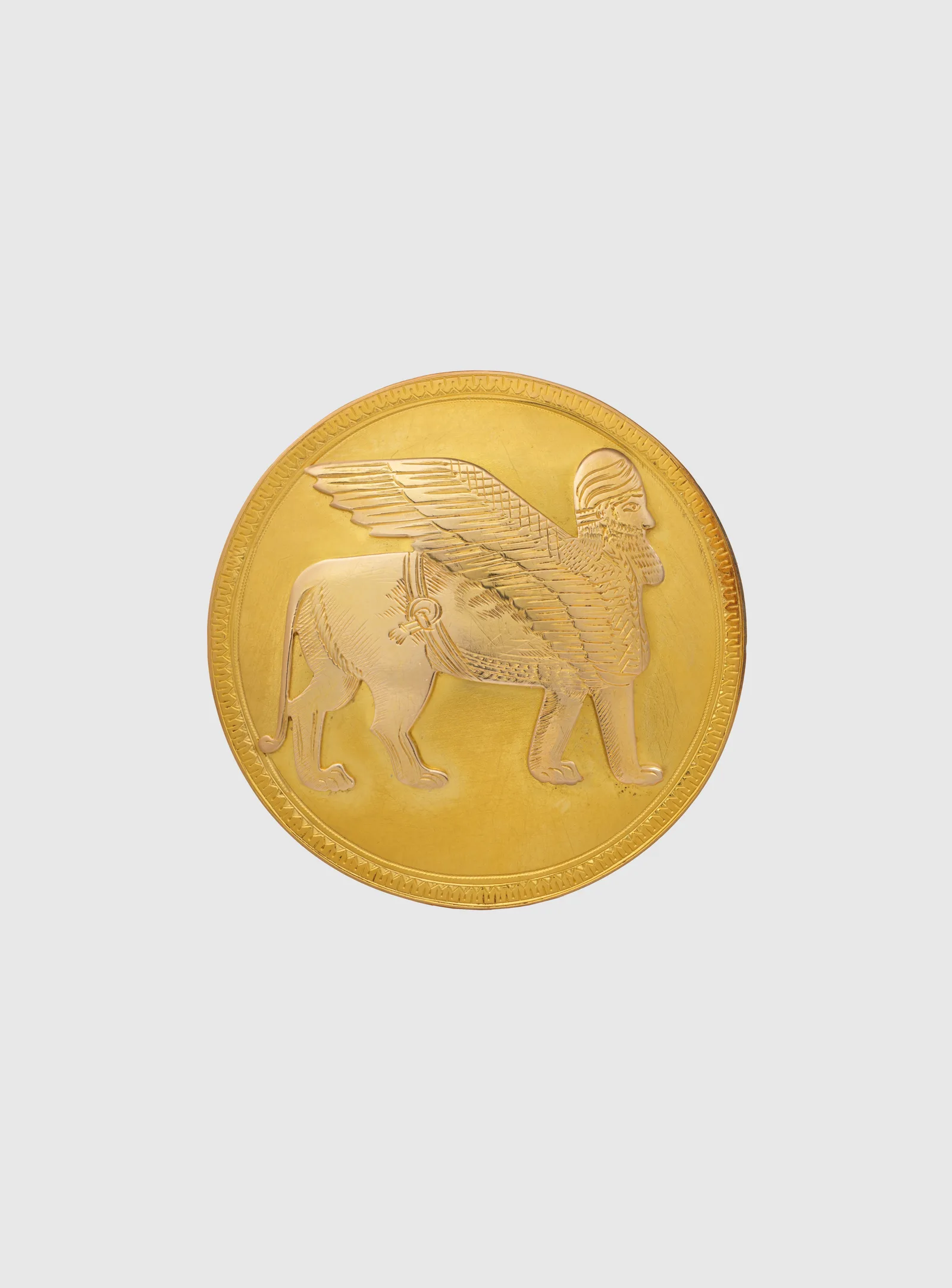
Earlier still, winged guardians appeared in the Ancient Near East. The palaces of Assyrian kings at Nineveh and Nimrud were guarded by the lamassu, giant winged bulls with a human bearded face and five legs, set on either side of the gates to ward off evil, and a pair of such guardians has survived into our day in museum halls. In Egypt the goddess Isis and her sister Nephthys spread their arm-wings over the sarcophagus of the one they protect, and this gesture of protection, a wing over a person, literally migrated into Christian painting. The Zoroastrian winged disc with a human figure, the faravahar, remains today one of the most recognisable symbols on the ruins of Persepolis, and modern Iranians and Zoroastrians readily wear it as a pendant. Among the Sumerians and Akkadians the good spirits, the apkallu, who sprinkled water over the place they protected, were also depicted with wings. This ancient visual idea, a wing stretched over a person as protection, survived into the Christian guardian angel almost unchanged. Even outside religion, a wing behind a figure almost everywhere means one thing: a link to the high, lightness, a message. So the angelic motif is calmly worn by people of very different views, and each invests it with the meaning closest to them.
The angel in art: how the image changed
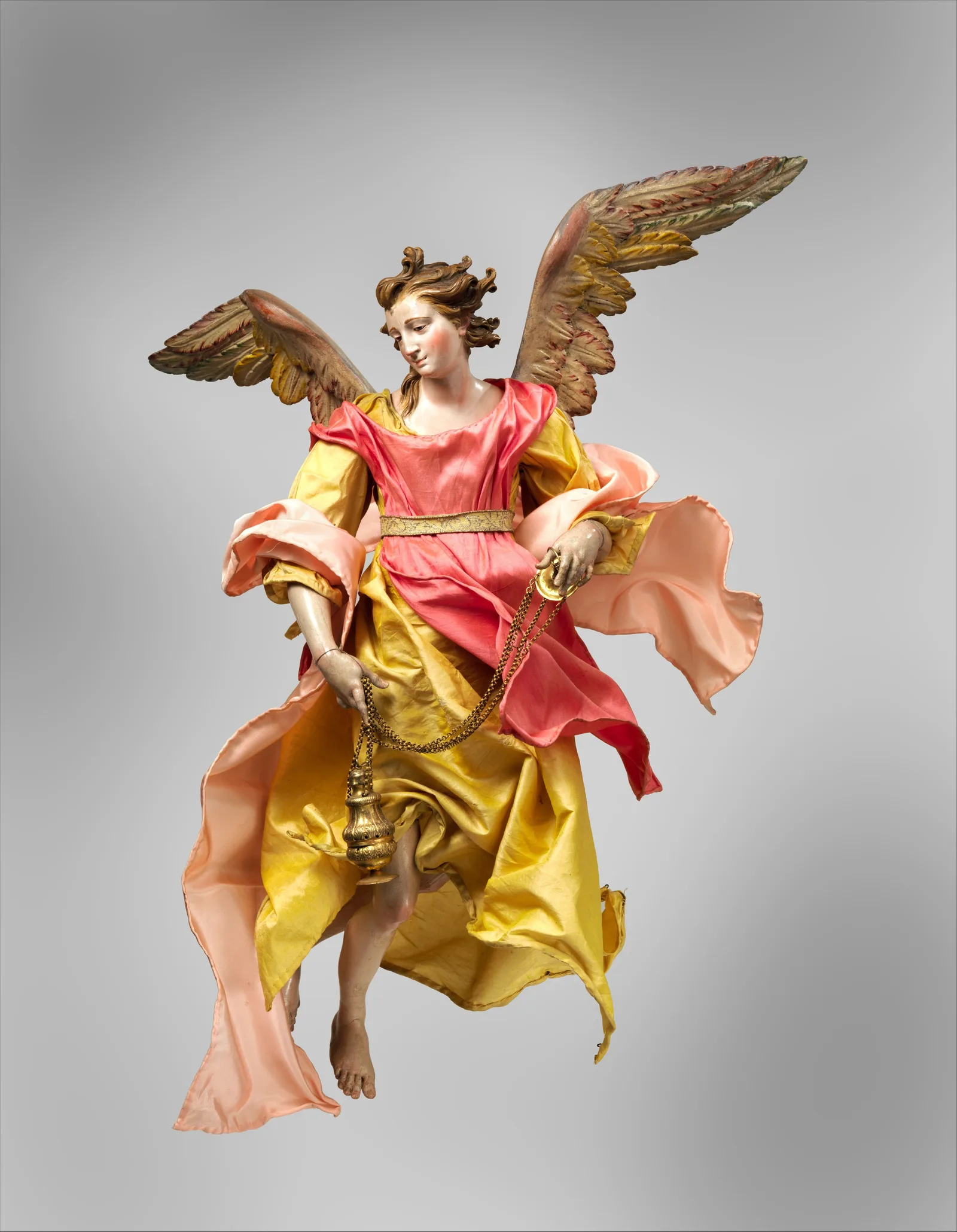
The history of the angel in art is the history of how a stern messenger gradually became warm and homely. Understanding this path helps you choose the version of the image closest to you.
In the Middle Ages the angel lived mainly on church objects: reliquaries, book covers, body icons. Metal here is not decoration in the modern sense but a carrier of meaning. An icon-pendant with a guardian angel was hung around a child's neck or taken on a journey. The figures were stern, elongated, solemn.
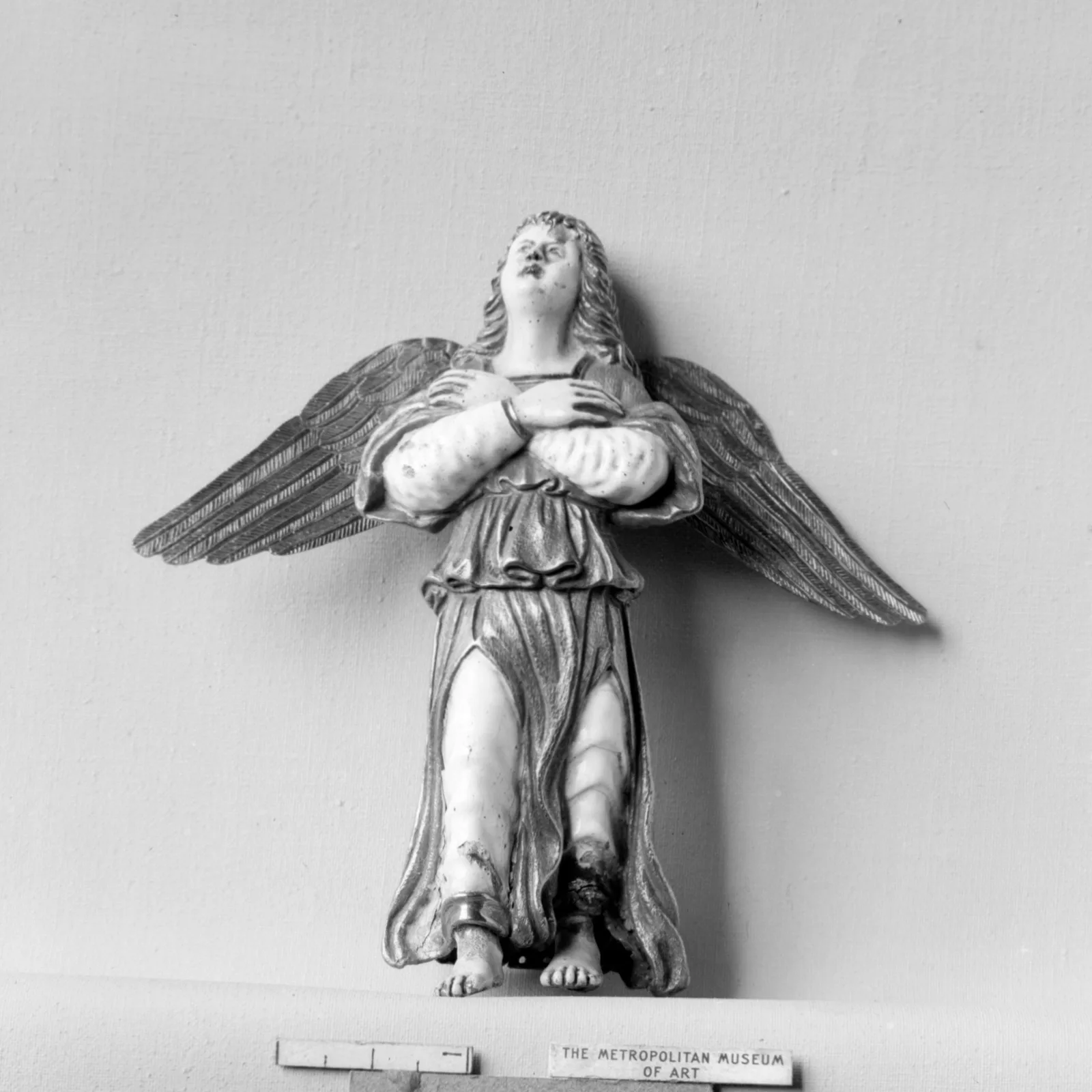
The Renaissance gave the angel a human body and face, made it alive and supple. And the Baroque brought that very chubby winged baby that today seems the "real" angel. Putti flooded church ceilings, mirror frames, bed headboards. The image became secular, decorative, almost domestic, and it was this version that most often migrated onto souvenirs and greeting cards.
The turn of the nineteenth and twentieth centuries, Art Nouveau, changed the drawing again: flowing lines appeared, large spread wings, the interweaving of figure and ornament. This language still lives in jewellery wings with fine feather detail. A few images became recognisable milestones on this path. The sixth-century mosaics of Ravenna, in the basilicas of San Vitale and Sant'Apollinare Nuovo, show angels already winged, in gold and purple, and set the solemn canon of the early messenger. Andrei Rublev in the "Trinity" around 1411 or 1425 showed three angels as the embodiment of quiet accord, without any pathos, and that icon is still considered the peak of Russian painting. Fra Angelico in the fifteenth century peopled his frescoes in the Florentine monastery of San Marco with gentle music-making angels. And the pair of leaning winged babies at the very bottom of Raphael's "Sistine Madonna", painted around 1512, took on a life of their own: these two were printed on so many cards, mugs, and wrapping paper that many take them for the "real" angel, although in the painting itself it is just a tiny detail at the lower edge. Behind the familiar picture stands a long line of very different images.
So when you choose an angel, you are in fact also choosing an era: a stern medieval icon-pendant, a warm Renaissance angel, a decorative Baroque putto, or a flowing Art Nouveau wing.
Upload a photo of your pet, someone you love, or an object. We'll build a 3D model and hand-cast it in pewter.




What the angel symbolises
When a person chooses a piece with an angel, they almost never choose "an angel in general". They reach for a specific meaning, and it is more honest to name these meanings separately, without piling them into one vague heap.
Protection and watching over. The main and oldest layer. The guardian angel is the idea that there is someone nearby who watches and protects. In a piece it works as a quiet reminder: the pendant cools the skin, and in an anxious moment the hand reaches for it by itself. There is no magic here, there is psychological support, and it is quite real.
Light and kindness. A light, soft layer of meaning. An angel is given as a wish of good, as a sign of warmth. With no religious subtext it simply reads as "a bright person nearby", and in that quality it fits almost any situation.
Freedom and flight. A wing on its own, separated from the figure, reads more broadly than religion: lightness, movement, the ability to rise above circumstances. So a wing pendant is often chosen by people for whom precisely that idea matters, not the church meaning. Here the angel meets another winged motif, the feather in jewellery, whose symbolism of freedom is expressed even more directly.
Faith. For a believer the angel is a specific theological image, an intermediary between heaven and earth. Here a piece stops being an accessory and becomes a quiet confession. This layer should be respected and not confused with the decorative: for one person it is ornament, for another an object of faith.
Beauty of the silhouette. Sometimes a wing is chosen simply because it is beautiful. A spread feather, a soft arc, the play of light on engraving. This is a valid reason, and there is no need to pretend that a deep meaning necessarily stands behind every angel.
Sometimes an angel is worn in memory of a loved one, and that is an old, clear tradition. If the conversation is precisely about that, we speak of it carefully and separately, in the piece on jewellery after the loss of a loved one, and here we leave the angel as a bright symbol.
To be honest about what the angel does not do. It does not bring money, does not heal illness instead of a doctor, does not pull love to order, and does not cancel the consequences of bad decisions. All of that is the promise of esoteric shops, and it has nothing to do with the true meaning of the image. The real meanings of the angel are strong enough on their own.
CAPAORA mini knife pendant
The 18th-century Spanish navaja in miniature: 40 mm of stainless steel, a real folding mechanism and a Palanquilla lock that clicks. An affordable gift to remember.
Authentic · Ships from Spain · 14-day returns
Types of angel jewellery
When a maker takes on an angel, the first decision is which angel exactly they are making, because there are several subjects and they should not be mixed. A person familiar with the topic instantly reads the difference between a wing, a figurine, and an archangel.
Wing pendant. The most popular and most universal format. A single wing or a pair, sometimes folded, sometimes spread. A wing reads easily as an angelic motif but does not impose a religious meaning, so it suits both believers and those who simply value the symbol of freedom. In execution it ranges from tiny, almost unnoticeable, to large and dramatic.
Little angel, a figurine. A full figure with wings and a halo, sometimes with folded palms. This image is closest to the warm, greeting-card angel. It is often given as a wish of good, placed as a gift for a child's birth or to a loved one on a joyful occasion.
Archangel with an attribute. Michael with a sword, Gabriel with a trumpet, Raphael with a staff. Here the angel stops being abstract and becomes a specific character with its own story. Such pieces are chosen knowingly, with an understanding of exactly who is being worn and why.
Locket with a wing. A closed format that can be opened. A wing or figure is engraved outside, and a small photo or note can be placed inside. This is the most personal of the angel formats, and it is usually chosen not on impulse but for a specific person.
Paired wings. A modern subject: two wings, sometimes joined by a heart or a stone in the middle. They are often taken as paired pieces, a wing each, as a sign of the bond between close people.
Abstract wing. Reduced to a few lines, minimalist. An arc, a couple of feathers, a hint. A quiet modern option for those who care about the idea, not the literalness of the image.
How to read a wing: the form hints at the meaning
A wing carries more than a recognisable silhouette, its form has its own quiet language, and a well-made piece uses that language.
A single wing reads as a personal sign, a fragment, a hint. It is chosen when you want quiet and understatement. A pair of wings is already fullness, protection, an embrace, the image sounds warmer and more complete. Folded wings speak of calm and concentration, spread ones of movement, impulse, flight. So a minimalist folded arc and a wide spread feather carry a different mood, even if made from the same metal.
The feather detail also matters. Large sparse feathers give a powerful, almost archangelic character. Frequent fine hatching makes the wing soft and lyrical. A smooth wing without texture looks modern and graphic but demands a flawless form, because it has nothing to hide flaws behind. When you choose an angel piece, look precisely at the feather: it shows the maker's hand and the character of the thing at once.
Leave your email, we'll send your discount code. No spam, unsubscribe anytime.
The code arrives by email, valid on your first order.
Materials, colours, and techniques
Metal and finish for an angel are chosen with the wing in mind, because the feather is the main textural task. A smooth empty surface rarely works: a wing needs rhythm, repetition, the play of light on individual feathers.
Silver. The most common choice, and not by chance. The cool white colour of the metal sits well on the light, heavenly theme. The feather on silver can be worked with fine engraving, given a matte sandblasted surface, or polished to a shine. Silver is affordable, and a silver angel pendant stays in the segment of a warm everyday gift that needs no serious outlay.
Oxidised silver. When you want to emphasise the relief of each feather, dark pigment is driven into the recesses. The feathers stand out sharply, the pendant looks more graphic and put together. Well suited to large wings and the image of an archangel with a sword.
Yellow and rose gold. The warm light of gold softens the image, makes it less stern and more homely. A golden little angel is a traditional gift for an important event in a child's life. Rose gold adds tenderness and works especially well in paired wings.
Mother-of-pearl and white stones. To strengthen the theme of light and purity, white accents are introduced into angel pieces: mother-of-pearl, white opal, moonstone, small rock crystal. They give a soft glow without a loud shine and read as "heavenly" in character, echoing a whole category of celestial jewellery with motifs of the sun, moon, and stars.
Blue and sky stones. A separate layer for those who want to tie the angel to the sky by both form and colour. Calm blue minerals such as celestine, whose very name comes from the Latin word for "heavenly", fit this theme naturally. And greenish seraphinite with its silvery pattern is even named after the seraphim, and its drawing literally recalls the plumage of a wing.
Feather engraving. The maker's main technical task. A feather can be cut with a graver, large and in relief, or applied in fine frequent strokes, almost like real plumage. The character depends on the engraving school: coarse carving gives a powerful archangel's wing, fine carving a soft and lyrical one. The feather detail is the easiest way to tell a stamped trinket from careful work.
Caring for angel jewellery
An angel has one feature a plain smooth pendant lacks: the feather. It consists of recesses and ridges, and that is exactly where care needs a head, not strength. Rough cleaning can turn a neat wing faceless in five minutes, so the approach changes depending on the metal and stone.
Silver. A light silver wing darkens over time, this is natural oxidation, not damage. A light tarnish comes off with a special silver cloth or a soft fabric with a drop of dish soap and warm water. After washing, the piece must be wiped dry: moisture left in the recesses of the feather is exactly what speeds up the darkening. What you must not do: rub with toothpaste and baking soda. These are abrasives, they scratch the polish and smooth out the fine engraving, after which the feather loses its drawing.
Oxidised silver. Here the blackness is not a flaw but the intent: the dark layer is driven into the recesses of the feather on purpose so the relief reads more sharply. Such a wing must be cleaned most gently of all. Only a soft cloth and warm water will do, with no polish and no silver cloths, because they remove that very blackness from the recesses. If you wipe an oxidised feather with an abrasive, the drawing fades, and you will not bring the blackness back at home. The light raised parts can be slightly refreshed, but the dark hollows are best left untouched.
Gilding and gold plating. A thin layer of gold over silver looks warm but lives by its own rules: the layer is microns, and any abrasive wears it off. No pastes, brushes, or silver cloths, the last of which dull the plating. Only a soft cloth and, if needed, warm water with a drop of soap, then dry. The places where the piece constantly rubs against skin or clothing, the chain by the clasp, the ridges of the figure, wear through first over time, this is normal wear, not a defect.
Mother-of-pearl, moonstone, opal. The most delicate inserts in angel jewellery. Mother-of-pearl is organic, moonstone and opal are soft and afraid of sharp changes. They must not be soaked, cleaned with ultrasound, or kept near perfume, hairspray, and creams: the chemistry eats in and dulls the surface. Care is simple: wipe with a slightly damp soft cloth and dry at once. Opal in addition dislikes dry heat and prolonged direct sun, which can make it crack. Such pieces are removed before a shower, the sea, and cleaning.
Engraved feather. The main value of a good angel and at the same time its most vulnerable spot. Dirt and darkening collect precisely in the strokes of the engraving, and the urge is to clean them with something hard, which is exactly the mistake. A soft toothbrush with baby bristles and warm soapy water work: light strokes along the grooves, not across and without pressure. Then dry with a soft cloth or let it air-dry, blotting the recesses with the corner of a tissue. Once every couple of weeks of such care is enough to keep the feather crisp for years.
And a general rule for all angels: take the piece off before sleep, sport, and water, store it separately in a pouch so the fine feather does not scratch against other things or catch on stray links.
To suit the look and colouring: which format to choose
An angel is rarely bought at random, and matching it to the person makes the piece precise. Three things work: format, chain length, and colouring.
For the warmth of the metal the guide is simple. A warm type, golden skin, dark hair, brown and green eyes, is closer to yellow or rose gold: it supports the natural tone. A cool type, fair skin with a pinkish undertone, ashy hair, grey and blue eyes, suits silver and white stones. This is a starting point, not a law: the angel is a light theme, and silver fits almost everyone.
Chain length decides how the image sits on the figure.
Wing. A light motif drawn out vertically. A small single wing sits well short, at the collarbones, on a chain above the neckline. A large spread feather asks for more length, at chest level, where it has room to unfold. On a short neck a vertical wing visually lengthens it, and that is a plus.
Little angel figurine. A compact, rounded image, suited by a medium length so the figure reads in full and does not hide under the collar. A very short chain eats the detail, and the little angel turns into an indistinct speck.
Locket. The weightiest and largest format. It needs a lower length, at chest level or a little higher, and support in the form of a high collar or plain fabric. On a very short chain a heavy locket looks squeezed.
Archangel with an attribute. A figure with a sword, trumpet, or staff carries a vertical and detail, so it needs both length and space. A medium or longer chain, a calm background without a busy pattern, otherwise the sword and wings merge into a jumble of lines.
For face shape the guide is soft but workable. A round and wide face is slimmed by elongated vertical motifs, a single wing or an archangel on a long chain. A narrow and elongated face is closer to a rounded, compact image at the neck, a little angel figurine or a locket. And above all: the quiet angel has the role of the soloist, it should not compete with large earrings and a busy neckline.
The guardian angel: where the idea of a personal angel came from
The warmest and most enduring layer of the theme is the belief in a personal guardian angel assigned to a person and protecting them. The idea is older than it seems and exists far beyond a single tradition.
In Christianity the notion of a personal guardian took shape from separate lines of Scripture and a popular piety that developed them into a detailed image: an angel beside you from birth, accompanying you through life, helping unseen. The idea was supported by the words of Christ about children whose angels "always see the face of the Father", and by the scene in the book of Acts where those gathered do not believe that Peter, freed from prison, is standing at the door and say, "it is his angel". A separate feast of the guardian angels in the Catholic Church was established quite late, at the start of the seventeenth century, and Pope Clement the Tenth entered it into the universal calendar in 1670.
Across the wider Western tradition the guardian angel kept its grip as a household idea: an icon-pendant of a guardian angel was for centuries hung around a child's neck, sewn into clothing, taken on a journey, a small object meant to keep a watching presence close. The feast of the Guardian Angels, marked on the second of October, gathered all of this into a single day: not a celebration of a person, but of the unseen protector believed to walk beside them.
The idea of a protecting angel is so enduring that it spawned legends even in the twentieth century. In August 1914, after the hard British retreat from the Belgian town of Mons, tales of the "Angels of Mons" crept along the trenches: that luminous figures supposedly appeared in the sky and covered the soldiers' withdrawal. Historians long ago established that at the root stood a short fantastical story by the writer Arthur Machen, published in a newspaper and taken by some readers for truth, but belief in heavenly defenders proved stronger than the rebuttals, and the legend lives to this day.
For a piece of jewellery what matters is this. A guardian angel pendant works as a meaningful reminder regardless of the depth of faith. A believer sees in it a specific image, a secular person a warm sign that they are thought of and cared for. Both meanings are honest. The only thing that matters is not to turn the symbol into a guarantee: a piece does not cancel caution and does not insure against trouble, it gives a point of inner support, and that is enough.
Who it suits and for which occasions to give it
An angel piece does not suit everyone across the board, and it is more honest to name those for whom it really works than to claim it is universal.
First, those who wear a symbol as quiet support. People in stressful work, before a flight, in a period of change, the guardian angel gives that very psychological foothold. This is not about belief in magic but about the habit of keeping a meaningful object close, one you can return to in your mind.
Second, believers. For them the angel is not a decorative motif but a specific image from the tradition. Archangel Michael with a sword, the guardian angel, the seraph: each carries a precise meaning, and the wearer usually understands exactly what is on their neck.
Third, as a warm gift without religious pressure. A little angel or a bright wing is given with a wish of good: for a child's birth, a christening, an important milestone, simply to a loved one. Here the image reads as "bright" and does not oblige anyone to faith. If it is specifically a christening, there are separate traditions of choosing for it, which we cover in more detail in our own piece.
Whom such a piece suits less: those looking for a maximally neutral, meaningless accessory. An angel always says something, and if that meaning is unwanted, it is simpler to choose a more abstract symbol.
Send a friend a discount code, they save on their first order.
The angel and other winged symbols: how they differ
The wing in jewellery is worn by more than the angel, and it is easy to confuse the motifs. The difference is in the accent, and understanding it helps when choosing.
An angel wing always carries a shade of protection and a link to the high, even when reduced to a minimalist arc. The feather is a pure symbol of freedom and lightness, with no religious layer, so it is chosen when you want the idea of flight without a reference to faith. The dove is peace and a message, a more concrete and social sign. The wing as a symbol in its own right is covered in a separate guide. The wings of Nike and Victoria from antiquity are victory and swiftness. The butterfly with its wings is about transformation and fragility, a completely different story.
The conclusion is simple. If you want protection and watching over, take an angel or its wing. If only the idea of freedom, the feather is closer. If peace and reconciliation, the dove. The same gesture, a wing behind the back, in each case says something slightly different.
Common mistakes when choosing an angel
A few slips repeat more often than others, and they are easy to avoid.
First, mixing subjects. An archangel with a sword and a gentle putto are different images, and worn together they argue. Pick one register.
Second, chasing size. A large wing is expressive, but on a thin neck or under a closed collar it gets lost and weighs down. Size is matched to the person and the neckline, not by the principle "the bigger, the more noticeable".
Third, confusing metal with mood. Oxidised silver gives a stern graphic image, warm gold a soft and homely one. If you want a bright wish but hold a stern oxidised wing, the image will sound different from what you intended.
Fourth, not looking at the feather. A cheap stamping gives itself away with a blurred flat feather without detail. A minute of attention to the wing's texture saves disappointment.
The angel: facts that surprise
The longer you dig into the history of the image, the less remains in it of the greeting-card baby with a harp. A few facts overturn the familiar picture.
The first angels had no wings. Almost four centuries of Christian art got by without feathers behind the back. In the earliest frescoes and sarcophagi an angel is just a young man in a toga, and you can identify him only from the scene. The wing arrived only by the end of the fourth century, borrowed from the pagan goddess of victory.
The word "angel" is a job title. The Greek angelos means "messenger", "runner", and in ordinary life it named a courier with a letter. The being here is secondary, the work primary: to deliver a message from above to below. The same root is hidden in the word "Gospel", good news.
The hierarchy of heaven was invented by a man who hid his name. The nine ranks of angels were laid out by a fifth- or sixth-century author who signed with the name of the apostolic disciple Dionysius the Areopagite. The forgery was uncovered only in the Renaissance, but by then the scheme had already become a classic and survived the exposure intact.
The real cherub is more frightening than sweet. In Ezekiel's vision the cherub has four faces, of a human, a lion, an ox, and an eagle, and a body studded with eyes. The chubby winged toddler on cards is a Baroque mix-up with the ancient cupid-putti, with no connection to the biblical image.
The Church once banned extra archangels. Only Michael and Gabriel are named in the Bible. In 745 a Roman council forbade honouring angels under any other names, because popular piety had begun breeding "archangels" by the dozen, with their own invented names.
Angels appeared even in war. The legend of the "Angels of Mons" of 1914, luminous figures that covered the British retreat, grew out of a newspaper story that readers took for truth. The fiction proved more enduring than the rebuttals.
Poets saw a storm in the angel, not tenderness. Rainer Maria Rilke opened his "Duino Elegies" with the line that "every angel is terrible". For him it was not a sweet figurine but a blinding force, beside which a human feels uneasy. The ancient texts agree: angels there almost always begin the conversation with "fear not", and not for a happy reason.
Winged guardians with a human face were invented long before the Bible. The Assyrian lamassu, bulls with wings and a bearded human face, guarded palace gates as far back as the ninth century BC, and the sculptors had their own trick: a fifth leg, so the beast seemed to stand when seen head-on and to stride when walked past. The idea of a winged defender at the entrance is older than the guardian angel by many centuries.
The most famous "angel" on a card is in fact two bored children. The pair of winged babies leaning on the parapet at the bottom of Raphael's "Sistine Madonna" is only a tiny detail in the painting itself. In the nineteenth century they were cut out of the whole scene and started being printed separately, and today these two are recognised more often than the entire painting.
Inside each archangel's name the word "God" is hidden. The ending "-el" in the names Michael, Gabriel, Raphael, Uriel is the ancient Hebrew "El", God. So the names read as short phrases: "who is like God", "strength of God", "God heals", "light of God". An archangel carries not a name but a motto.
Silver and gold, symbolism, wing pendants, lockets, paired sets.
Buying it as a gift? Each one arrives ready to give.
 A branded Zevira box and a little card come with every order.















Frequently asked questions
What does an angel symbolise in jewellery? There is no single answer, and that is the honesty of the theme. Most often the angel reads as protection and watching over: the idea of the guardian angel who is nearby and protects. The second large layer is light and kindness, the angel given as a wish of good without a religious subtext. The third is freedom and flight, especially for a separate wing. For a believer the angel is in addition a specific theological image, an intermediary between heaven and earth. When a person chooses an angel pendant, they usually reach intuitively for one of these meanings, and the only thing that matters is not to attribute to the symbol what is not in it.
How does a seraph differ from a cherub and an ordinary angel? These are different ranks of the heavenly hierarchy, and in appearance they look nothing like the familiar picture. The seraph in the book of Isaiah is six-winged, and its very name is linked to fire and burning. The cherub in Ezekiel's vision is four-faced and covered with eyes, an image so alien to a human that it is hard to put into words. Both stand in the highest triad, closest to the source of light. An ordinary angel and an archangel, by contrast, are in the lowest triad, closer to a human, and that is exactly why in art they are depicted human-like. The chubby winged baby of the cards is not the cherub of the text at all but a late Baroque simplification, a mix-up with the ancient putti.
Can a non-believer wear a piece with an angel? Yes, and it is completely normal. The image of the angel long ago went beyond a strictly religious meaning. A wing pendant reads as a symbol of freedom and flight, a little angel as a warm wish of good, an abstract wing simply as a beautiful form. None of these meanings requires faith. If you want the most secular reading, it is simpler to choose a separate wing or a motif reduced to lines: it carries the idea of lightness and upward movement without referring directly to the church tradition.
Which metal and stones suit an angel best? Most often silver is taken: its cool white colour sits well on the light theme, and the feather on it is easy to work with engraving. Oxidised silver emphasises the relief of each feather and suits large wings and the image of an archangel. Yellow and rose gold soften the image, make it warmer, which is why a golden little angel is often given for an important family event. Among stones the white and luminous ones fit the theme: mother-of-pearl, moonstone, white opal, small rock crystal. If you want to tie the angel to the sky by colour as well, take calm blue minerals or greenish seraphinite, whose pattern echoes the plumage of a wing.
For which occasions is it fitting to give a piece with an angel? Above all the joyful ones. A child's birth, a christening, an important life milestone, a warm sign of attention to a loved one. A bright figurine or wing reads as a wish of good and watching over. Paired wings work well as a gift for two, a wing each. If you want to emphasise the light, not stern note, choose warm gold and an open figure rather than a large oxidised wing.
Which symbol pairs well with an angel? An angel sits well beside motifs kindred in spirit, also about light and upward movement: stars, moon, feather, the dove as a sign of peace. Heavy chains and aggressive symbolism next to a quiet angel usually smother it, so they are better worn separately. If you are assembling a set, keep the pieces in one metal, otherwise the look falls apart into scattered details.
Is it true that every person has a guardian angel? This is a question of faith, not fact, and it is honest to say so. In the Christian tradition the notion of a personal guardian angel really does exist and is widespread, although in the text of Scripture itself it is expressed more mildly than in later popular piety. From the point of view of a piece it does not much matter: a guardian angel pendant works as a meaningful reminder regardless of whether a person takes it literally or as a metaphor. It is important not to confuse the symbol with a guarantee: a piece does not insure against trouble and does not replace caution, it only gives the wearer a point of inner support.
About Zevira
Zevira is a Spanish jewellery brand from Albacete. Angel motifs, wing pendants, and lockets are one of the catalogue categories. We are drawn to symbols with a long history and a clear meaning, not empty decoration. For current pieces and details, see the catalogue.