Bib Necklace: The Bold Multi-Strand Statement That Fans Across Your Chest
The heaviest pectoral ornament of Ancient Egypt weighed more than a kilogram and was held in place by a counterweight on the back, otherwise it pulled its wearer forward. Three and a half thousand years later the principle has not changed: a bib necklace is still about weight and balance first, beauty second. This is jewellery that does not complete a look. It becomes the look.
The bib, named for the fan shape that sits on the chest the way a child's bib does, is a wide, multi-strand statement necklace that drops from the neck toward the décolletage and covers the upper chest in a solid or near-solid sheet. Not a thin chain with a pendant, not a string of beads, but a broad structure that holds its shape and reads across an entire room. You do not wear one every day, and that is part of the point.
This article covers how the bib differs from a collar, a choker, and multi-strand beads, where it came from (from the Egyptian usekh broad collar to Art Deco and the ethnic revival), how to wear it so it leads rather than overwhelms, and who it suits by neck and figure. And separately, the things almost nobody writes about: weight, comfort, and how to store it without tangling the strands.
What a Bib Necklace Is
Where the word "bib" comes from and what it really describes
In everyday English a bib is what a baby wears at mealtime. The word stuck in the jewellery world because of the shape: the ornament fans out across the chest exactly where a baby's bib sits, covering roughly the same area. The term reads instantly, which is why it has outlasted fussier alternatives. You will also see "fan necklace" when the strands flare out toward the bottom, or simply "statement necklace" used loosely.
The idea is one thing: the piece occupies the zone from the base of the neck to the top of the décolletage and works as a single plate or a dense cascade, not as a line. An ordinary necklace you simply wear. A bib you put on, deliberately. The difference is not length but coverage, and the fact that this piece dictates the rest of the outfit rather than the other way around.
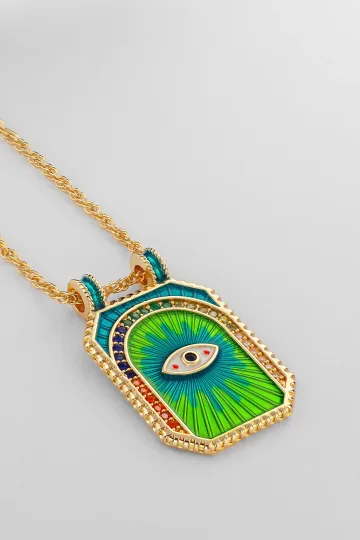
Wear the symbol, don't just read about it. These are in stock:




What a bib looks like: the fan, the area, the centre of gravity
The classic silhouette widens toward the bottom. Near the neck the strands or elements gather narrowly, close to the clasp, and toward the centre of the chest they spread into a fan, forming a triangle or a semicircle with its point facing up. The widest and often most ornate section falls over the centre of the décolletage, and that is where the large stones, pendants, fringe, or dense weave go.
The main feature you do not notice at first: a bib has a pronounced centre of gravity at the front. It rests on the chest rather than swinging from the neck like a pendulum. A well-made bib is therefore engineered for balance, so it neither rides up toward the throat nor slides off to one side. Ethnic and historical examples used a back counterweight for this; modern ones distribute the mass along an arc and lighten the underside.
How a bib differs from an ordinary necklace and a pendant
A pendant is an accent on a single point: a stone or symbol on a chain, with the rest of the chest and neck left bare. A mid-length necklace draws a line along the décolletage. A bib fills an area. You cannot see the fabric of the dress through it in the zone it covers, and that is the whole effect.
Because of that coverage, a bib is almost always the lead piece of an outfit. A pendant can sit in a layered set with other chains; a bib tolerates none of that. Next to it, any other necklace on the neck becomes redundant. This is a soloist, and you build the look around it, not the other way around.
Bib, Collar, Choker, and Beads: How Not to Confuse Them
The collar necklace: it hugs the neck, not the chest
A collar sits high and wraps the base of the neck in a ring, like the stand-up collar of a shirt. It is rigid or semi-rigid, holds a round shape, and barely drops onto the chest at all. A bib does the opposite: near the neck it can be very narrow, while the whole mass travels downward, onto the chest. Put bluntly, a collar draws a horizontal at the throat; a bib fills the vertical zone of the décolletage.
Sometimes a bib grows out of a collar: the top holds the neck while the bottom blooms into a fan across the chest. That is a hybrid, and harder to wear, because it sets both the line of the neck and the area of the chest at once.
You can check yourself with a single question: where is the mass. If the main weight and area sit in a ring around the neck, it is a collar. If they drop down and cover the chest, it is a bib, even if it begins at the throat as a narrow strip.
The choker: length at the throat, no mass on the chest
A choker is a short necklace worn snug against the neck, roughly 35 to 40 cm long. It can be a narrow ribbon or fairly wide, but either way it stays on the neck and does not cover the chest. A bib may begin like a choker at the throat, but its meaning lies in what comes below. If all the mass sits on the neck and nothing drops to the décolletage, it is a choker, not a bib. For where the boundaries between necklace lengths fall, it helps to check the chain length guide.
Multi-strand beads: flexible strands versus a single fan
This is the most common mix-up. Multi-strand beads are several flexible strands of different lengths that hang freely in a cascade. They are soft, they flow over the figure, and each strand lives on its own. A bib holds its shape as a single sheet: the strands are joined by bridges, a base, or a weave, so the fan does not scatter or tangle between strands.
Put simply: beads you can twist, knot, or lengthen, while a bib always sits the way it was designed to, because it is a structure rather than a bundle of strands. If a soft cascade of strands appeals to you more, there is a separate breakdown of the natural gemstone bead necklace. A bib is about something else: a single shape you read at once.
Riviera and bar necklaces: a line versus an area
It is worth separating the bib from two neighboring formats so they do not blur together. A riviera is a single row of stones of equal brilliance along the whole length, a thin shining line across the décolletage; it covers no area. A bar is a horizontal or vertical bar on a chain, a minimalist accent. The bib is the opposite of both: not a line and not a point, but mass. If you want a shining line rather than a sheet, look at the breakdown of the riviera necklace.
A bib wants a bare collarbone and black silk. Wear one over a turtleneck and we've never met.
What to Wear a Bib With
Dozens of bibs have passed through my hands on shoots, from rigid metal fans to light ethnic beadwork. Here is what actually holds a look together, sorted by occasion and by texture. One rule above all the rest: the bib leads, and everything around it goes quiet.
What do I put a bib with for the evening? For a celebration I choose a metal or stone fan and a smooth dress in a saturated colour: black, wine, emerald. I recommend baring the shoulders and décolletage, sweeping the hair up, and leaving only studs in the ears. Against bare skin a sparkling fan reads across the whole room, and that is its finest role.
I want a bib but the size intimidates me. Where do I start? I recommend a moving cascade instead of a rigid plate: the rows shift, settle along the figure, and forgive almost any neckline. Under it I suggest cool silver or matte metal over a solid dress of medium brightness. This bib lives as you walk rather than pressing down, and it is not frightening to put on for the first time.
Which bib fits a daytime bohemian look? With linen, silk, and a loose cut I advise a beaded or ethnic fan with pendants. Warm natural tones, handwork, living colour: here the bib is a daytime, meaningful piece rather than an evening one. It sets the character itself, so I keep the clothing around it calm and single-coloured.
Which neckline carries a bib best? I choose a V-neck, a bandeau, or bare shoulders. The V repeats the triangle of the fan, and a bandeau gives a clean field of skin where the piece leads without interference. I steer clear of high turtlenecks, ruffles, and large collars: they fight the bib for the very same space.
What do I pair with a bib from everything else? Almost nothing. I recommend hair up, studs left in, and rings and a bracelet kept in the metal tone and in full silence. The bib has already taken the lead, and anything added beyond the minimum works against it. The rule is simple: once you choose the fan, take off half of what you meant to add.

Turn on your camera, pick earrings, a pendant or a ring, and see the piece on yourself in real time.
Switch items in one tap.
Everything runs in your browser: no photo or video is ever uploaded.
Customer reviews
Zevira is a real jewellery shop. Genuine payments, deliveries and customer thank-yous.
🥰🥰🥰 gracias

Ok, ¡gracias! 🙂

History of the Bib: From the Egyptian Usekh to Today
Ancient Egypt: the usekh broad collar as the first bib
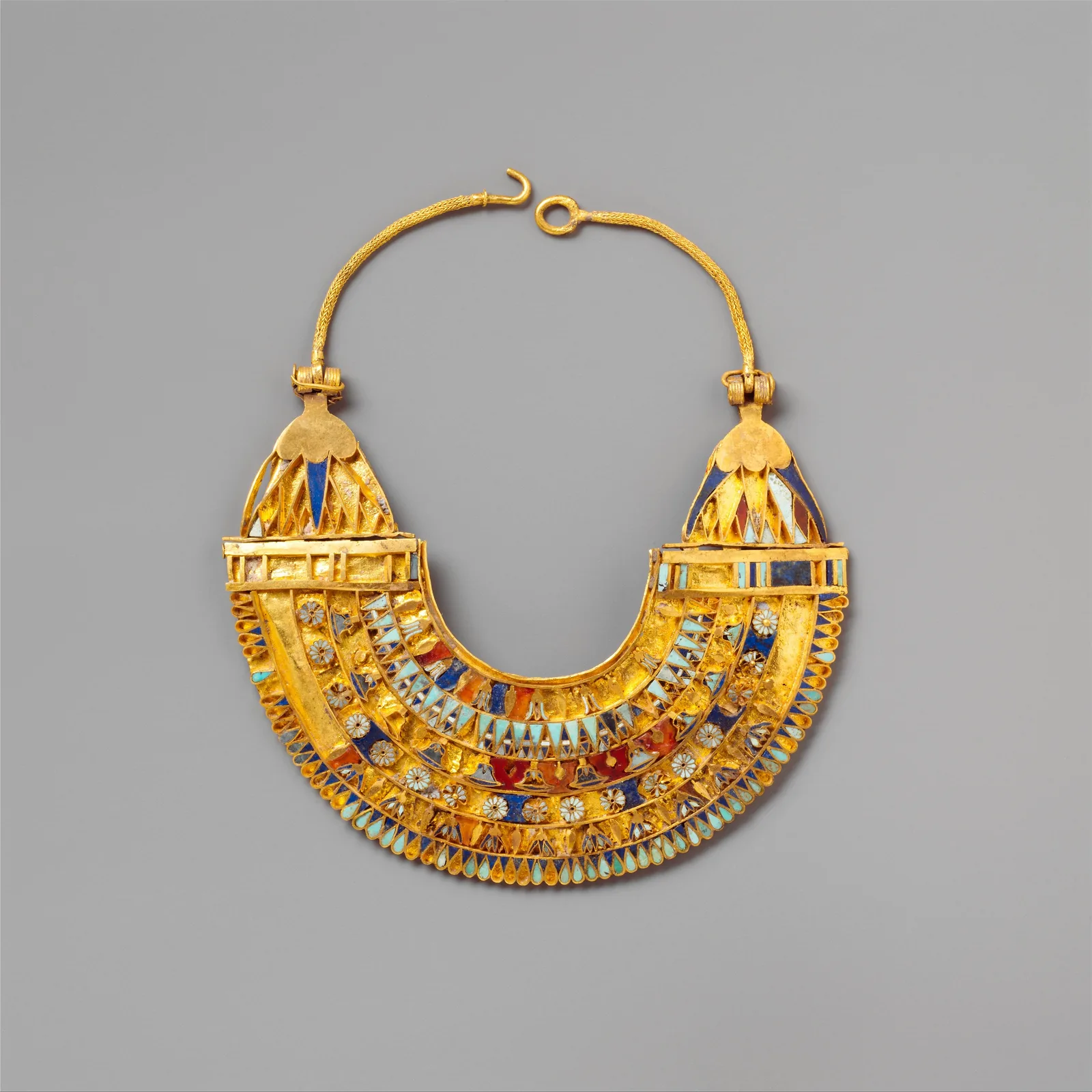
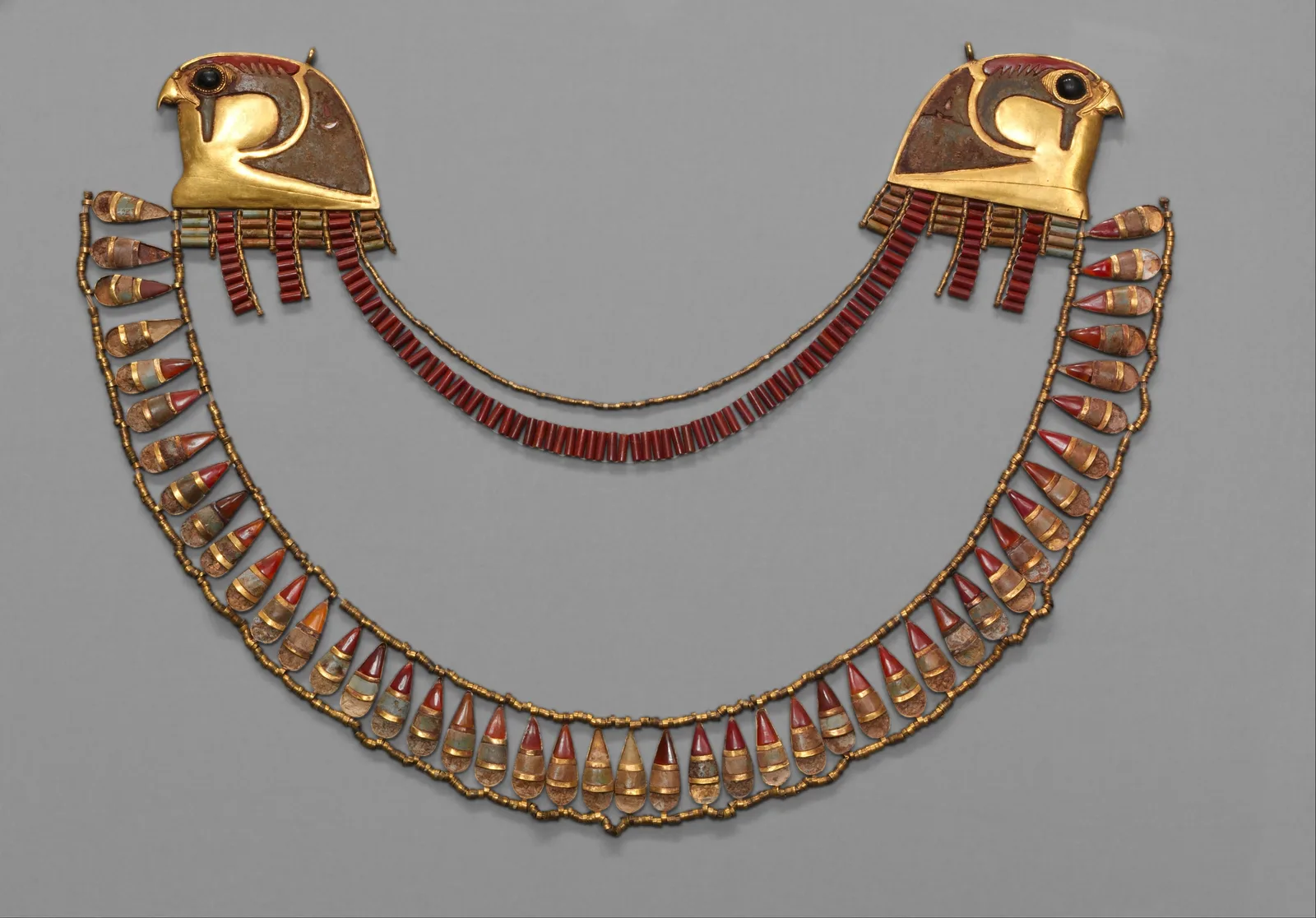
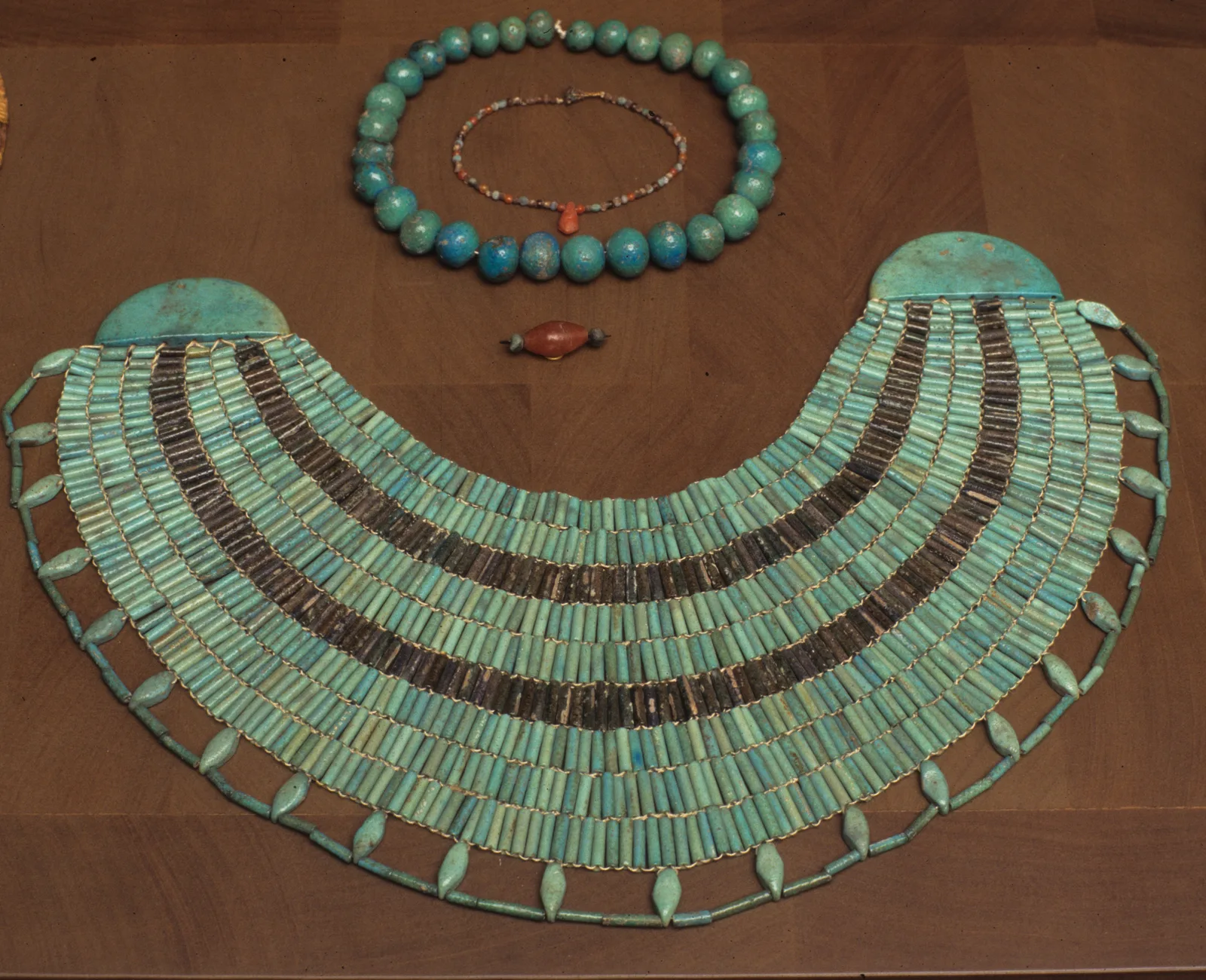
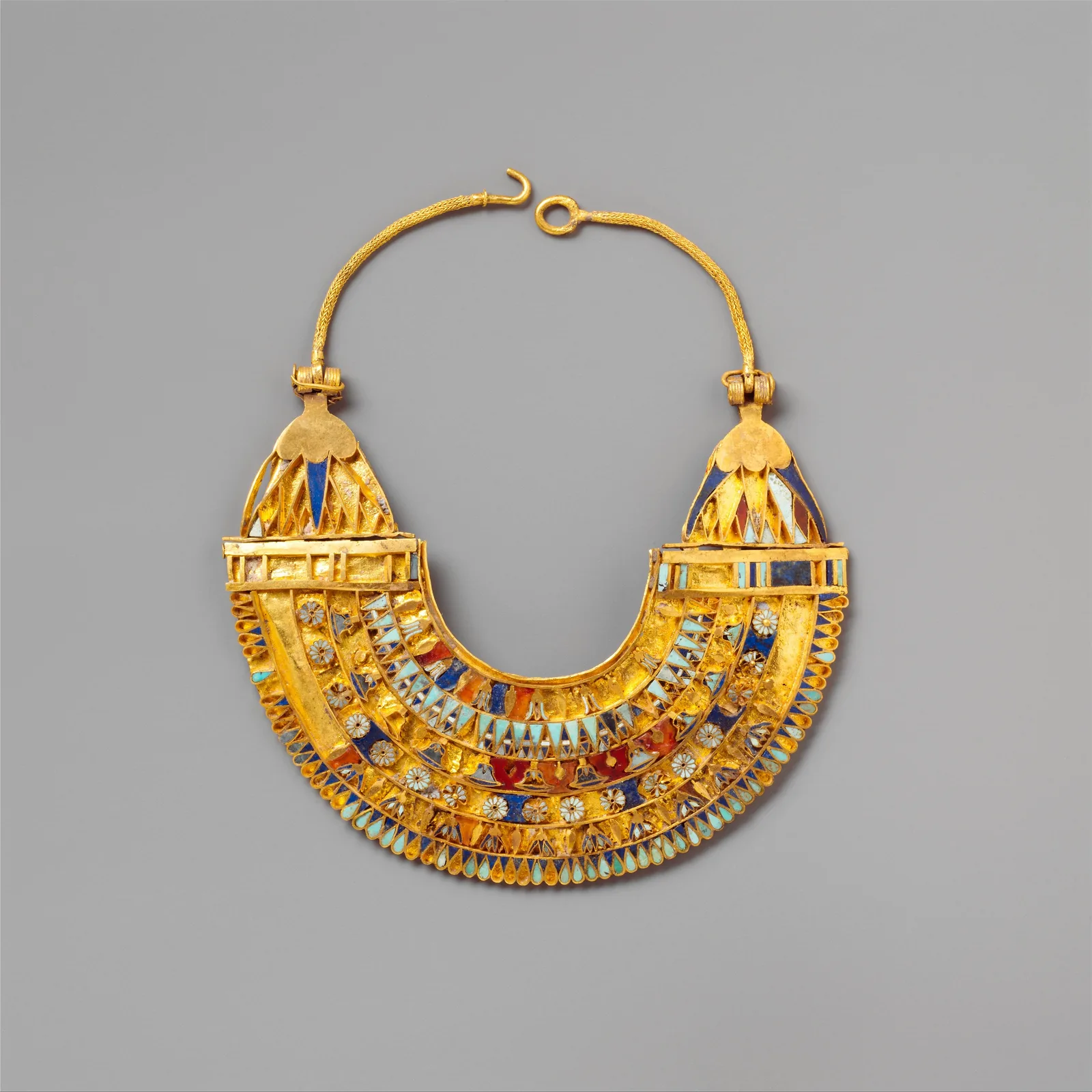
The bib's direct ancestor was born on the banks of the Nile. The Egyptian broad collar was called the usekh (also spelled wesekh, meaning "broad" or "wide"). It was a wide, semicircular collar-bib laid over the shoulders and chest as a continuous sheet of beaded rows: faience, carnelian, turquoise, lapis lazuli, gold. The rows ran in concentric arcs from the neck to the chest and often ended in a border of teardrop pendants or lotus flowers.
The usekh was worn by the living and the dead alike. On pharaohs it signaled status and a link to the gods; on mummies it protected the chest on the journey through the afterlife. The grandest were so heavy that a single clasp at the neck was not enough. A decorative counterweight called a menat hung down the back, without which the collar pulled the wearer forward and tipped out of place. That is the first engineering answer to a problem the bib has lived with ever since: mass at the front demands balance at the back.
The colours of the usekh carried meaning, each shade standing for something. Blue lapis lazuli meant sky and water; green turquoise and faience meant rebirth and life; red carnelian meant blood, energy, and protection. The semicircular fan of these stones turned the chest into a kind of map of the Egyptian world, where every colour held its place. Gold broad collars were found in the tombs of the nobility, and from the survival of the beads archaeologists still reconstruct exactly how they were strung, row by row, from the neck to the widest lower edge. Some of these collars have come down almost intact, and they show how demanding the work was: thousands of tiny beads in strict order of colour and size.
Ethnic bibs: Africa, India, Central Asia, the peoples of the Americas
The bib arose independently across dozens of cultures, because the idea is simple and strong: covering the chest with an ornament shows the wealth of a family and protects a vulnerable place. Across Africa, bibs were woven from beads in complex coloured patterns, and the design read like a language: age, status, tribe. Among the Maasai, flat beaded discs are still part of wedding and festival dress.
In India, heavy gold bibs set with gems were part of the bridal set and the dowry, a measure of a family's wealth. In Central Asia and among nomads, bibs were forged from silver with carnelian and coin pendants, and the ring of metal as a woman walked was considered a charm. Among the peoples of the Great Plains, hair-pipe breastplates were made from long bone tubes laid in rows into a dense lattice across the chest, and this was a man's warrior regalia. Everywhere the principle is one: the chest is the place you adorn and protect with the most massive thing you have.
It is worth noting that in many cultures the bib was not a personal whim but a family treasure, passed down through generations and worn only on special occasions. Silver nomad bibs strung with coins were both ornament and savings: in a hard year the coins could be removed and put to use. An Indian bridal bib passed from mother-in-law to daughter-in-law. Almost nowhere was this an everyday piece, and the habit of saving the bib for an occasion was formed long before us.
The Art Deco 1920s: geometry and cascades
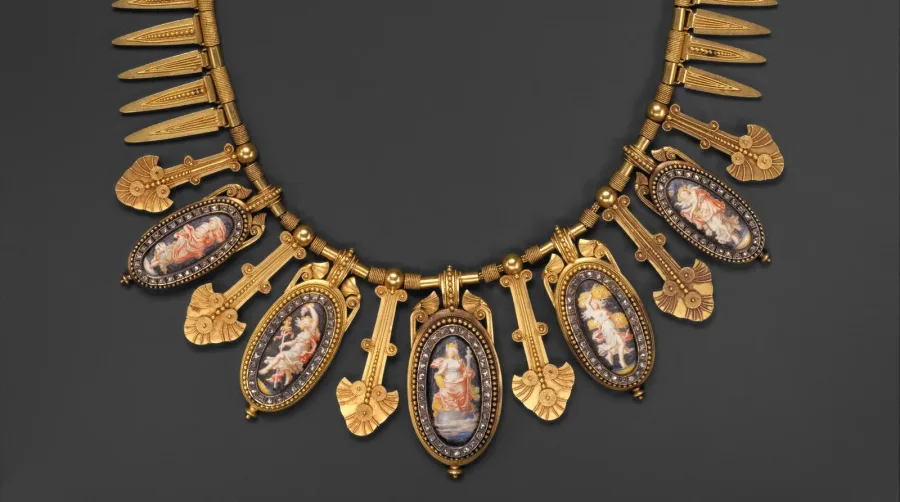
In the twenties of the last century the bib flourished again in a new language. Art Deco loved geometry, symmetry, and contrast, and a wide necklace on a bare chest fit that aesthetic perfectly. Dresses with deep backs and bare shoulders called for a large ornament at the front. Makers built bibs from strict geometric links, cascades of fringe, the contrast of black and white, diamonds with onyx and coral. It was the era when a bold necklace on a bare neck became a sign of the modern, emancipated woman.
Statement necklaces of the mid-twentieth century
In the forties and fifties the bold pectoral necklace settled in as a symbol of evening glamour. Dress silhouettes with bare shoulders and an open décolletage needed the chest filled, and the bib of large rhinestones, coloured glass, and gilt metal became the calling card of the dressed-up look. This was the era when fine costume jewellery rivaled real stones in prestige: form and sparkle mattered, while the material took second place. In these years the bib became, for good, what it remains now: jewellery for an occasion, for an entrance, for the photograph.
The ethnic revival and the present day
From the late twentieth century, renewed interest in ethnic jewellery brought the bib back into fashion as a conscious choice. Designers drew on African beadwork, Indian gold, nomadic silver, and the bib became a way to say something about yourself loudly and without words. Today the bib lives in two worlds at once: as an evening statement necklace and as an ethnic accent in a loose, bohemian look. In both, its role is the same. It leads.
Upload a photo of your pet, someone you love, or an object. We'll build a 3D model and hand-cast it in pewter.




Types of Bib Necklace
The rigid fan: a single form that holds its line
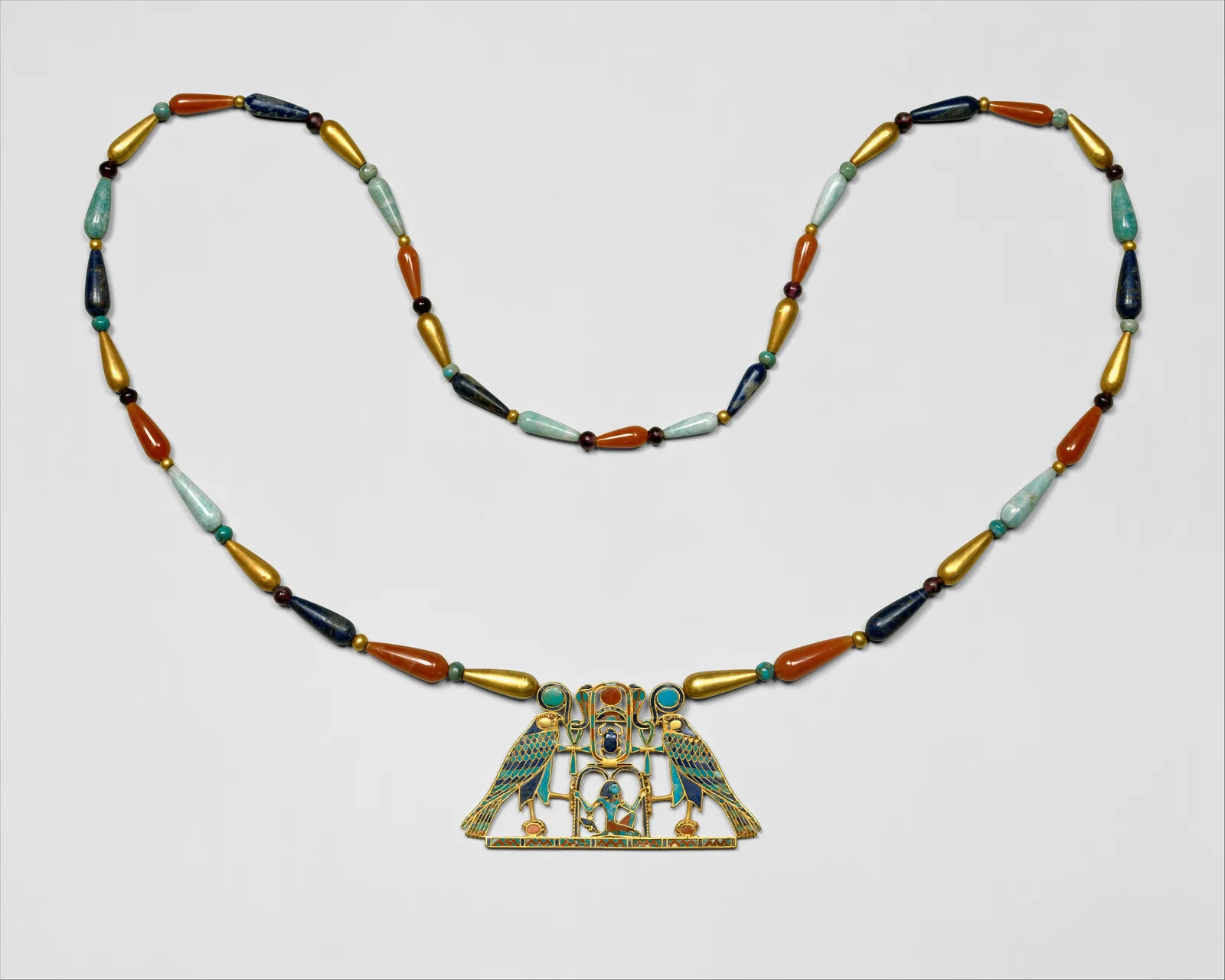
The most sculptural type. The base is rigid or semi-rigid, and the fan holds its set shape on its own, without conforming to the body. This kind of bib lies like a piece of armour, reads cleanly and graphically, and is ideal under smooth, single-colour dresses. There is one drawback: it is less forgiving, and if the shape does not suit your neck, you cannot adjust it. In return, it looks the most expensive and the most severe.
Chain cascade: moving strands and motion
Here the fan is built from many chains or rows of links of different lengths, joined at the top. Each row moves, and as you walk the bib comes alive, catches the light, and chimes softly. It lies more softly over the body, forgives different chests and necks, looks a touch less formal and a touch more wearable. This is the most versatile type for anyone trying a bib for the first time.
Textile with stones: a base of fabric or lace
A bib on a fabric, lace, or mesh base, onto which stones, beads, sequins, and cabochons are sewn. Light in weight, flexible, it settles onto the body like a part of the clothing. This type sits closer to haute couture and theatrical costume; it is striking on camera and on stage, but it needs careful handling, since fabric is vulnerable to snags and water.
Beadwork: an ethnic and bohemian character
The direct heir of African and nomadic bibs. A dense weave of seed beads, bugle beads, and small beads draws a pattern or a colour gradient. Warm, handmade, full of character. The weight is moderate, the wearability high, but the weave dislikes snags and sharp tugs: one pulled bead drags the row. In return, no other ornament gives such living colour.
A good beaded bib is always strung on strong thread or fishing line with a finished edge, so the outer rows do not fray. In dense African examples the base holds itself through the technique of the weave; lighter ones have a flexible base that follows the figure. When choosing, it is worth checking the edges and the clasp in particular: these are the weak points where a beaded bib wears out first.





Materials of the Bib
Metal: weight, shine, and durability
A metal bib is the strongest and the most "expensive" in appearance. Silver gives a noble, cool shine and a pleasant heft; gilt metal gives a warm glow for the evening. The main question with metal is weight: a solid metal fan can turn out heavy, which is why good models are made hollow or openwork to cut the extra grams. There is a detailed breakdown of silver as a material and its hallmark in the piece on silver 925.
Stones and crystals: where there is sparkle, there is weight
Stones and rhinestones give the bib the very thing you put it on for in the evening: sparkle and play of light across the whole area of the chest. The larger and denser the stones, the stronger the effect and the greater the weight. A simple rule applies here: if you want maximum sparkle, accept in advance that the piece will be substantial, and choose a lightened setting or a moving cascade rather than a solid plate.
It is worth understanding the setting as well. A bib holds dozens of stones, and they rest on many small fixings, each under load. A reliable setting with a bezel or prong holds up for years, while a cheap glued one loses stones row by row over time. So in a bib, what matters is not the size of an individual stone but how firmly the whole spread is held, otherwise within a year the fan will show bald patches.
Seed beads and bugle beads: lightness and colour
Beads make the bib the lightest and the most "colourful." From them come ethnic patterns, smooth gradients, and almost painterly sheets. The weight is minimal, and it is comfortable to wear. The price of that lightness lies in the fragility of the weave and in the fact that a beaded bib looks more at home in a bohemian or ethnic look than in a formal evening one.
Enamel: colour that does not fade
Enamel on metal gives a rich, deep colour that does not fade or dull over time, unlike painted metal. An enamel bib looks expensive and graphic, especially in Art Deco geometry. You need to protect it from knocks: a chip in enamel cannot be repaired as easily as a metal polish.
How to Wear a Bib: The Neckline Decides Everything
The main rule: a plain background and a bare neck
A bib is busy in itself, so everything else must stay quiet. The best background for it is a smooth, single-colour fabric with no pattern, no collar, no ruffles in the chest zone. A pattern under a bib turns into visual noise, and the ornament drowns. Black, white, a saturated solid colour: that is the ideal backdrop that lets the fan read cleanly.
And second: the neck and the décolletage must be bare. A bib needs naked skin above and around it, otherwise it merges with the clothing. A bare neck is half the effect.
Which neckline: V-neck, boat neck, bandeau, bare shoulders
A V-neck repeats the triangle of the bib and works with almost all its forms; the fan settles into the opening of the neckline as if poured in. A boat neck gives a level horizontal at the collarbones, and under it a bib that widens toward the bottom works well, creating a pleasing contrast of lines. A bandeau and bare shoulders are the most flattering background of all: an unbroken field of skin on which the bib leads without interference.
What to avoid: a high turtleneck, ruffles and draping on the chest, a large collar. They compete with the bib for the same space, and both lose.
A word on background colour. A black dress gives the bib the cleanest contrast, especially if the fan is light or sparkling. White and pastel work more softly and prettily, and under them a bib of coloured stones or enamel works well. A saturated solid colour (emerald, wine, blue) turns a colour-neutral bib into something that reads like a gemstone. What you should not do is set a bright, colourful bib against a bright, colourful dress: two strong colours cancel each other out.
What to avoid: collars, pattern, and layering
A bib is incompatible with layering at the neck. No extra chains, pendants, or beads over or under it; it is the entire top layer by itself. This is the opposite of layering, and if multi-piece looks appeal to you more, save the bib for a separate occasion. The logic of combining several pieces is covered in detail in the jewelry layering guide, but with a bib the rule is simple: it goes alone.
Leave your email, we'll send your discount code. No spam, unsubscribe anytime.
The code arrives by email, valid on your first order.
Where a Bib Belongs
Evening and celebration
The bib's natural element is the evening entrance, the celebration, the reception, the ceremony. Where the dress bares the shoulders and chest, where sparkle belongs, the bib comes fully into its own. It instantly lifts a plain black dress to the level of an event and removes the need for any other jewellery.
The photo shoot and the stage
On camera the bib works without fail: it is large, reads even in a wide shot, and holds the composition near the face. Photographers and stylists love it for exactly that. On stage and in a shoot, weight matters less than effect, so the most massive and theatrical models belong here, the ones that are a touch too heavy in ordinary life.
The ethnic and bohemian look
A beaded or silver bib with pendants is the heart of an ethnic and bohemian look. Here it pairs with loose fabrics, linen, silk, natural shades, and sets the character itself. In this context the bib is not an evening piece but a daytime, meaningful one, a sign of a taste for the handmade and the ethnic.
The wedding and the guest's role
The wedding is a special case. A bib suits a bride if the dress bares the shoulders and chest and is not overloaded with lace on top: then it replaces both a necklace and part of the bodice decor. A bib suits a guest too, but tact applies here: the ornament must not compete with the bride's outfit or pull attention onto itself at someone else's celebration. A light beaded or colour-restrained bib is more fitting in this role than a massive, sparkling fan.
When a bib is out of place
It is fair to say the reverse as well. Under a business suit, in a cramped office space, on the run, a bib is out of place; it is too loud and too demanding. This is jewellery for an occasion, not for the background. An attempt to wear it "just because" usually ends with it sitting in the box: too conspicuous for every day. And one more common mistake: wearing a bib under outerwear or a jacket that covers the chest. The fan must lie on open fabric in full, otherwise only the top edge shows and all the work of the ornament is hidden.
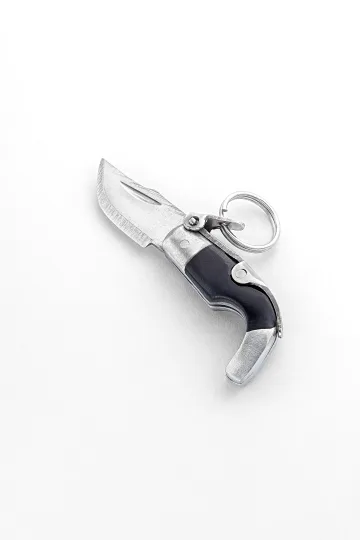
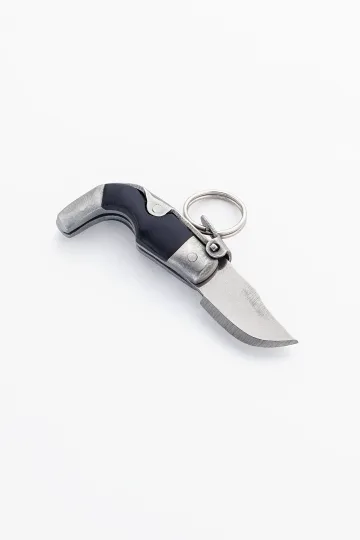
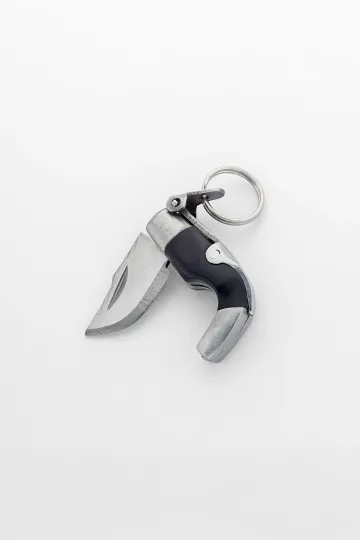
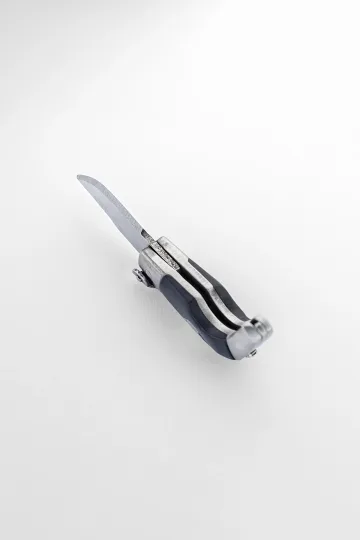
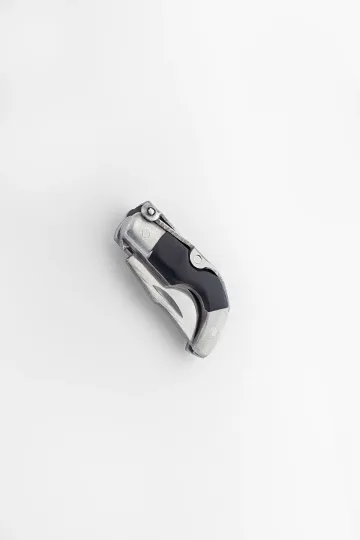
CAPAORA mini knife pendant
The 18th-century Spanish navaja in miniature: 40 mm of stainless steel, a real folding mechanism and a Palanquilla lock that clicks. An affordable gift to remember.
Authentic · Ships from Spain · 14-day returns
Who a Bib Suits: Neck, Figure, Height
Neck length: a long neck loves it, a short neck calls for caution
A high, long neck is the best setting for a bib: open space remains above the fan, and the ornament reads at full strength. A short neck is trickier: a bib that begins high at the throat shortens it visually even more. There is a solution: for a short neck, choose a bib that begins lower, leaving an open patch of skin at the throat, and fans out on the chest rather than at the chin. Then it does not press on the neck but lengthens the silhouette.
Face shape and the line of the shoulders
A bib works in tandem with the face: a wide fan balances a narrow face, while a sharp triangular bib softens a round one. The line of the shoulders matters too: wide shoulders carry a massive bib easily, while narrow ones get along better with a fan that tapers toward the bottom and adds no horizontal. How the shape of an ornament near the face works with face type is covered in detail in the jewelry by face shape guide.
Figure and height: the scale must match
A simple rule of scale: a tall, statuesque person suits a large bib, while a petite one is better with a smaller, lighter fan, otherwise the ornament "wears" the person rather than the other way around. A full chest carries a bib strikingly, but it requires that the fan not end right at its middle: better above or noticeably below. This is a matter of proportion: a bib must be in scale with the body, and then it adorns rather than outweighs.
You can test the proportion with a simple mirror check. Put the bib on with the dress you plan to wear out and step back a pace or two. If the ornament is the first thing to catch your eye while the face gets lost, the fan is too big; go smaller or lighter. If the bib reads but your gaze still rises to the face, the scale is right. The ideal bib leads the eye to the face rather than away from it.
How not to overload the look
The main mistake with a bib is to add more to it. More earrings, another chain, bold eye and lip makeup at the same time, a pattern on the dress. The bib is already the maximum, and everything added beyond the minimum works against it. The rule is simple: once you have chosen the bib, take away half of what you were going to put on as well.
Weight, Comfort, and Care
How much a bib weighs and why it matters
Weight is the last thing people think about with a bib, and that is a mistake. A massive metal or stone bib is genuinely heavy, and the weight makes itself felt within an hour: it pulls at the neck, presses at the base of the throat, leaves a mark on the skin. So when buying, it matters to keep the bib on for several minutes rather than holding it to the neck for a second. What feels light in the shop can become a trial by the end of the evening.
How to distribute the weight and ease the load
A well-made bib distributes the weight along a wide arc of the shoulders rather than hanging it on a single point at the throat. A soft or wide clasp at the back, one that does not cut into the neck, helps. If the bib is heavy, choose a moving cascade over a solid plate: moving rows settle along the body and spread the mass more gently. And remember the ancient solution: visually and physically, the bib is balanced by an open back and an upright posture; you cannot slouch under one.
Care: how to clean different materials
Care depends on the material. A metal bib is cleaned with a soft cloth, silver with a separate anti-tarnish cloth. Stones and enamel are wiped with a dry or slightly damp cloth, without soaking, so water does not get under the settings and into the base. Beads and textile are never wetted, only carefully cleaned with a soft dry brush. The main enemy of any bib is perfume and cream: apply them before the jewellery and let them absorb, otherwise they settle on the metal and stones.
A separate subtlety with a multi-strand bib: clean it row by row, not all in a clump. If you wipe everything at once, the cloth catches on the elements and drags the neighbouring rows, loosening the settings. Better to go over each visible row separately, holding the rest, and not pressing on the fixing points where the rows meet the base. Once a season, inspect the clasp and the joining points of the fan: on a bib these are exactly what bears the whole load and tires first.
Storage: above all, do not tangle the rows
The most common trouble with a bib in storage is tangled rows and snagged pendants. A multi-strand necklace must not be tossed into a heap with other jewellery: thin chains and strands interlace, and untangling a fan of a dozen rows is nearly impossible without losses. Store the bib separately, flat, on a level surface or hung on a wide hook, so the rows lie parallel and do not ride over one another. A soft pouch or a separate compartment in the box protects the stones from scratches and the rows from knots.
Send a friend a discount code, they save on their first order.
Facts That Surprise
The Egyptian usekh weighed like a dumbbell and was held by a back counterweight
The grandest usekh broad collars were so massive that a single clasp at the neck was not enough. A decorative counterweight called a menat was attached at the back, hanging down the spine, without which the collar pulled the wearer forward and tipped over. The engineering problem of "mass at the front demands balance at the back" was solved more than three thousand years ago, and modern heavy bibs essentially repeat the same physics, only hiding the balance inside the construction.
Among the Maasai, the bead colour on a bib is a passport
For the Maasai people, a beaded bib works as a readable sign. The colours carry meaning: red is strength and protection, white is purity, blue is sky and water, green is health and earth. From the pattern and colour of the disc you can read a woman's age, whether she is married, and which group she belongs to. There the bib works as a document worn on the chest.
The warrior breastplate of the Plains peoples was made from bone tubes
Among the peoples of the Great Plains, the man's hair-pipe breastplate was strung from long narrow bone tubes laid in horizontal rows into a dense lattice across the whole chest. Originally such tubes were carved from shell and bone, and the breastplate was warrior regalia and a mark of status, while also partly shielding the chest. Beauty and protection in one object, exactly like the Egyptian usekh on the other side of the world.
Art Deco made the bib a symbol of a new freedom
In the twenties, a bold necklace on a bare neck became a visual sign of emancipation. A woman who bared her shoulders, back, and chest, and put on a large geometric necklace, declared a new era without words. The bib turned for a short time from a purely status piece into a manifesto, and that is exactly when its modern evening image took shape.
Frequently Asked Questions
How does a bib necklace differ from an ordinary statement necklace?
Any statement necklace is large, but a bib is set apart by covering the area of the chest in a fan rather than hanging as a line or a point. A bib always fills the décolletage zone with a solid or near-solid sheet, with a pronounced centre of gravity at the front. If a piece is large but the chest beneath it stays bare, it is simply a statement necklace, not a bib.
Can you wear a bib during the day and to the office?
Technically yes, in practice almost never. A bib is too loud and too demanding for a business and everyday context; it pulls all the attention and competes with work clothing. Its element is the evening, the celebration, the photo shoot, the ethnic look. A daytime option is possible only with a beaded or light ethnic bib in a loose bohemian look, but not in a formal office.
What earrings should you wear with a bib?
Minimal or none. Studs, small posts, neat earrings matching the bib's metal. Long drops and chandeliers do not go with a bib; they fight it for attention near the face and overload the look. The rule is simple: maximum on the chest means minimum in the ears.
Which neckline suits a bib best?
A bare neck and chest: V-neck, boat neck, bandeau, bare shoulders. A V-neck repeats the triangle of the fan; a bandeau and bare shoulders give a clean field of skin on which the bib leads. Avoid a high turtleneck, ruffles and draping on the chest, and large collars; they occupy the same space as the bib and compete with it.
Is a bib hard to wear?
A massive metal or stone bib is genuinely substantial and within an hour begins to pull at the neck. So when buying, keep it on for several minutes rather than trying it for a second. What eases the wear is a moving cascade instead of a solid plate, an openwork or hollow base, a wide soft clasp at the back, and upright posture. Beaded and textile bibs are noticeably lighter than metal ones.
Does a bib suit a short neck?
It does, if you choose the right form. A bib that begins high at the throat shortens a short neck even more. You want one that leaves an open patch of skin at the base of the neck and fans out on the chest. Such a bib lengthens the silhouette rather than pressing on the neck. Hair swept up and an open shoulder line help as well.
How do you store a bib without tangling the rows?
Separately from other jewellery, flat on a level surface or hung on a wide hook, so the rows lie parallel. A multi-strand necklace must not be tossed into a common heap: thin chains and strands interlace with each other and with other jewellery, and untangling a fan of a dozen rows is nearly impossible. A soft pouch or a separate compartment protects the stones from scratches.
What should you wear if a bib feels too bold?
Start with a light version: a beaded or textile bib in a bohemian look, or a moving cascade instead of a rigid metal fan. Set it against a smooth, single-colour dress, put your hair up, leave studs in your ears. In that company even a large bib reads as natural rather than brash. And remember that a bib is for an occasion, not for every day, so boldness belongs here.
Ready for jewellery that speaks for you
A bib is the choice of those who are not afraid of being noticed. If layering and cascade appeal to you more, the Zevira catalogue has necklaces for any length and any neckline, from a thin line to a massive fan. Find yours.
Browse necklaces and pendantsBuying it as a gift? Each one arrives ready to give.
 A branded Zevira box and a little card come with every order.








About Zevira
Zevira is jewellery for those who choose with intention. We work with silver 925 and quality materials, and we approach each necklace format as its own problem: length, weight, balance, fit at the neck. A bib, a riviera, a bar, a choker, beads are different things with different logic, and we write about that honestly, so you choose what suits you rather than what simply looks good in a display case.