Braille Jewelry: a Secret Message of Six Dots Worn on the Skin
Louis Braille reworked an army "night code" into a reading system when he was fifteen. The original code let soldiers pass orders by touch in the dark, with no lamp to give away their position. Two centuries later the same six dots ride on a wrist or sit by a collarbone as a coded confession, a child's name, or the single word that keeps a person afloat. Fingers will read it in the dark. Eyes, most likely, will not.
Braille jewellery is built on a clever trick. Tiny half-spheres rise from the metal, set on a strict grid. To a passerby it reads as texture, abstract dots. To anyone who knows the system, or to a blind reader running a fingertip across it, those are specific letters and specific words. The result is a piece with a double bottom: decorative on the surface, meaningful underneath. This article covers how the six-dot script works, where it came from, what people write in it, how to make a line that actually reads, and who this kind of piece becomes a real anchor for rather than a novelty.
What Braille Is and How the Six Dots Work
The cell: a whole alphabet in one frame
The system is built on a unit called the braille cell, or six-dot cell. It is a rectangle of six positions arranged in two columns of three. The positions are numbered: down the left side are dots 1, 2, 3, and down the right side are dots 4, 5, 6. Every letter, number, and punctuation mark is formed by raising some of those dots and leaving the rest flat.
Six positions give sixty-four possible combinations, counting the empty cell. That is enough for the whole alphabet, the digits, punctuation, and a set of control symbols. The letter "A" is a single raised dot, number 1. The letter "B" adds dot 2. The logic is deliberate: the first ten letters use the upper four positions, the next ten repeat the same shapes plus the lower-left dot, and so on. The script is assembled like a building set, which is exactly why people learn it so fast by touch.
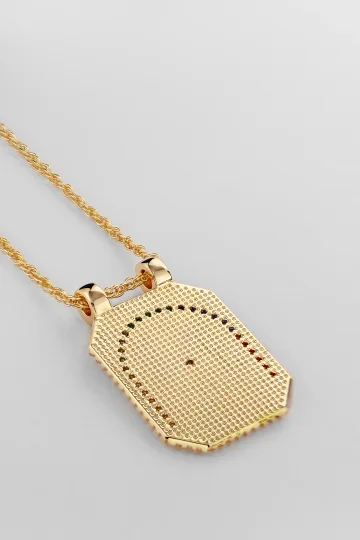
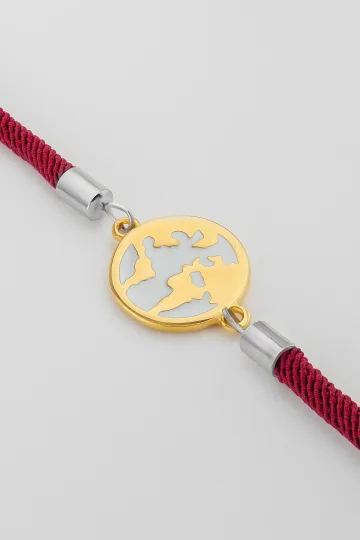
Wear the symbol, don't just read about it. These are in stock:


How a braille dot differs from ordinary print
The key difference is that a braille dot cannot be seen and understood, it has to be felt. The size is not arbitrary: the diameter of each dot and the spacing between them are tuned to an adult fingertip. Make the dots smaller or pack them tighter and the finger stops telling them apart, and the text turns to mush. Make them larger and a whole letter no longer fits under the pad of a finger, so reading slows to a crawl.
Books and signage follow standards that fix the exact relief height and grid spacing. Jewellery is not a textbook, and that perfect bookish geometry is hard to reproduce on a ring. But a maker who understands the point of the exercise stays close to those proportions. Then the line stays text you can genuinely read with your fingers, not a pretty nod toward Braille.
Why the dots are raised, not sunk
Braille is read by running a fingertip along the line from left to right. The finger senses bumps, the raised points, not hollows. So on jewellery the dots have to be convex, standing proud of the metal surface. Sunken pits are almost invisible to the finger, and a "line" like that works only as decoration, you cannot read it by touch.
This is an important fork when you choose a piece. Some jewellery is made honestly: real half-spheres are soldered on or drawn up out of the metal, and the text can be read blind. Some is made as imitation: the dots are cut or engraved inward, for the look, with no thought of reading. Both have a right to exist, but they are different objects, and it pays to know in advance which one you actually want.
History: How a Blind Teenager Built a Reading System
Louis Braille and the accident in the workshop
Louis Braille was born in 1809 in the French village of Coupvray near Paris, the son of a saddler. In his father's workshop, among leather and sharp tools, the three-year-old boy hurt his eye on an awl. The wound became infected, the infection spread to the other eye, and by the age of five Louis was completely blind. By the standards of the time this was close to a sentence: blind children were rarely taught, and many ended their lives in poverty.
Braille was lucky in his persistence and in his school. At ten he entered the Royal Institute for Blind Children in Paris, one of the first institutions of its kind in the world. They already tried to teach the blind to read there, but the method was punishing: ordinary letters were embossed on paper in large relief, and the finger could barely make out the bulky shapes. The books were huge, expensive, and almost useless for writing.
The night writing of Charles Barbier
The turn came thanks to an outsider. A French army officer, Charles Barbier, devised a system known as "night writing." The idea was military: soldiers needed to pass messages in the dark, by touch, without lighting lamps that would betray them to the enemy. Barbier encoded sounds as combinations of raised dots, twelve dots to a group, meant to be read with the fingers.
The army never adopted it; it proved too complex for soldiers in the field. But Barbier brought it to the institute for the blind, and there it reached the teenage Braille. Louis saw both the power of the idea and its flaw at once: twelve dots are too large, the finger cannot take in the whole group at once and cannot read it quickly. On top of that, Barbier's system encoded sounds rather than letters, and could not spell words precisely.
How a fifteen-year-old rebuilt a military code
Braille set about reworking the system and brought it to the form we still use today. He cut the group from twelve dots down to six, so the whole cell fit under a single fingertip and read instantly. He moved from coding sounds to coding letters, numbers, and punctuation, so words could be written precisely, spelled out. He finished the core of the work around 1824, when he was just fifteen.
He published the first version of his alphabet in 1829 and refined it later. Recognition came slowly and not in his lifetime: his own institute only officially adopted the system in 1854, two years after the author's death. Today Braille is adapted to dozens of languages and remains the principal means of written reading for blind people across the world. The teenager who rebuilt an army code gave millions of people access to books.
How Braille reached other languages
The Latin braille alphabet did not map directly onto every language: some scripts carry more letters, and some of those letters simply do not exist in the Latin set. So the system had to be adapted, fitting dot combinations to each letter. National braille tables took shape over the second half of the nineteenth century and settled into the first books printed for the blind in each country.
For jewellery this is a practical detail that matters. A name or word has to be written in the table for its own language, not borrowed from another. The same six dots can mean different letters in different tables, so a name set in the wrong table will read as nonsense under the fingers of someone using a different one. When you order a line in a particular language, say so to the maker plainly. That removes half the possible mistakes before anything is made.
Braille wants a bare collarbone or an open wrist. Buried under a sweater it goes mute, and don't argue.
How to wear Braille jewellery
Over years of styling I have fitted braille pieces to very different people, and the takeaway is one: the dots only live when a finger can reach them. Here is what actually works, sorted by occasion.
What do I pair a braille pendant with every day? For daily wear I recommend a short line of dots on a thin chain over plain clothing. The pendant rests at the collarbone, easy to take in hand and trace with a finger at any moment. A light top lifts the metal, a dark one turns the line into a quiet accent. For casual I suggest silver or steel over gold: calmer and closer to the graphic of the dots.
Which format suits my life? Here I look at the hands and the habits. For someone who works a lot with their hands I suggest a pendant or a tag that does not catch and slips under a shirt. For someone who likes to feel a piece on the wrist I recommend a bar bracelet or a rigid bangle: the line stays under the hand, easy to feel for discreetly. I choose the format for the body and the rhythm of the day, not for the display case.
How do I avoid hiding the message for nothing? The mistake I see most: the line gets tucked deep under a collar and the tactile point is lost. So I keep the dots on show or at least within easy reach. And I watch which way the bumps face: they should meet the finger, not press against the skin, or you read the smooth back. This gets settled at the stage of chain and clasp.
What do I combine it with? A braille line is graphic and gets lost beside busy pieces. I recommend the principle of a single accent: the piece is the accent, and I keep everything around it quiet. A slim chain, simple earrings, a minimum of jangling bracelets. Smooth metal in the same tone strengthens the dots, while a scatter of stones breaks the focus when you reach to feel for the word.
How do I wear it as a gift or a paired code? When the piece is a gift, I choose the format for the recipient's habits, not my own taste. Paired codes, where two people carry halves of a phrase, I suggest splitting across matching formats: two bracelets or two pendants, so they read as a pair. I keep the setting calm: the quieter the frame around the dots, the louder the meaning.

Turn on your camera, pick earrings, a pendant or a ring, and see the piece on yourself in real time.
Switch items in one tap.
Everything runs in your browser: no photo or video is ever uploaded.
Why Braille Jewellery Is Both a Secret Message and an Inclusive Gesture
A double bottom: visible to all, legible to a few
The strength of a piece like this is that it works on two levels at once. On the decorative level it is a neat row of raised dots, a textured detail that intrigues but says nothing outright. On the level of meaning it is specific words, open to those who know the script or anyone who runs a finger across it. A person wears a confession or a motto literally in plain sight, and it still stays hidden.
This is where Braille parts ways with ordinary engraving on jewelry, where the text usually reads to the eye, or hides on the reverse. Here the text is on the outside, on show, and still encrypted. It is a quiet way to carry something very personal without spelling it out for the first stranger to read.
Inclusion without grandstanding
The second layer of meaning runs deeper than the decorative one. Braille is the written language of blind people, and jewellery that uses it turns the usual situation around. The jewellery world is built for sight: shine, colour, the cut of a stone, all for the eye. A braille piece makes a piece of jewellery equally available to touch. A blind person can read it themselves, with no intermediary and no one else's description.
The trick is not to tip into grandstanding. A braille piece is not a "heroic act of solidarity" or a way to show off your own sensitivity. It is simply an object that works for more people than the usual one. To a sighted wearer it is a handsome cipher. To a blind reader it is plain text under the fingers. One object, two honest uses, and neither one ranks above the other.
Customer reviews
Zevira is a real jewellery shop. Genuine payments, deliveries and customer thank-yous.
🥰🥰🥰 gracias
Ok, ¡gracias! 🙂
What People Write in Braille on Jewellery
A name: your own, a loved one's, a child's
The most common subject is a name. Your own name on a pendant works as a quiet signature, like a first initial only hidden in dots. The name of someone you love on a bracelet turns the piece into a constant presence on the skin. A child's name holds a special place: many parents order a bracelet or pendant with a son's or daughter's name in Braille and wear it as a personal charm.
A child's name in dots is a close cousin of initial and monogram jewelry, only encrypted more tightly. A letter on a chain is recognized at once; dots are not. So a name in Braille reads more intimately: it is always with you, but never on display.
A one-word motto: a single word that holds
The second popular format is a single word. Not a phrase, not a quote, but a short anchor: "breathe," "strength," "faith," "hope," "free," "home." A person picks such a word as a reminder, a mental handhold for a hard moment. When anxiety rises, you can run a finger over the dots on your wrist and literally feel your word.
Braille suits this task better than open text precisely because it is tactile. A word that holds you up does not need to be read by anyone else. It is for the wearer. The dots make it a personal password, felt by the skin rather than displayed to the room.
A date, coordinates, and an encrypted "I love you"
People write important dates in Braille: a wedding day, a child's birthday, the date a new life began. They write confessions too: a short "I love you" in dots is a gift only the two of you can read. Sometimes they encode the coordinates of a meaningful place, as in coordinate couple pendants, only in braille digits instead of ordinary numbers.
One important caveat about numbers. In Braille, digits are not written on their own; they follow a special number sign placed before them that announces: what follows is numbers, not letters. Without that sign the grid of dots reads as letters, and the date turns into nonsense. So dates and coordinates should be trusted only to someone who knows the rules of notation, otherwise the piece ends up with a pretty but wrong line.
Upload a photo of your pet, someone you love, or an object. We'll build a 3D model and hand-cast it in pewter.



Touch and Aesthetics: Dots Read by the Fingers
How a tactile piece differs from engraving
Ordinary engraving works for the eye. You read the inscription, admire the lettering, but a finger makes little of it: the grooves are shallow, the relief barely there. Braille is the opposite. Its power is in touch. The raised dots are made to be handled, and that gives this kind of jewellery a particular, almost meditative quality.
Many owners admit the real pleasure is not in showing the piece off but in touching it. The finger learns the pattern and finds familiar dots automatically. It is like the way people nervously twist a ring or work a string of beads. A braille piece gives the hand something to hold onto, something meaningful, with a word inside.
The aesthetics of raised dots
As design, a row of neat half-spheres looks clean and graphic. The dots fall in a rhythmic line, and the metal catches a small highlight on every curve. It reads as modern and restrained, free of clutter. A braille line sits well in a minimalist style: a slim plate, a plain chain, no stones.
Designers play with the dots in different ways. Sometimes they stay smooth metal half-spheres. Sometimes they are swapped for tiny stones or pearls, and the line becomes a jewelled row where each "dot" glints. And sometimes the dots are buried in texture so the pattern reads as pure abstraction, and only the initiated know there is text in front of them.



How Braille Differs From Other Ways to Carry Something Personal
Braille and an engraved inscription
Engraving and Braille solve the same problem, carrying a personal text, but they address different senses. An engraved word is made for the eyes: it is read, admired, the lettering can be serifed or cursive. Hiding it is hard, though: either it is on show and legible to everyone, or it is moved to the reverse where it cannot be seen at all. Braille takes a third position: the text is outside, on show, and still encrypted, because a passerby sees dots, not letters.
There is a difference in the feeling of wearing them, too. Engraving is rarely touched; it is admired now and then. Braille is made to be traced with a finger, and that changes the habit: the piece becomes an act rather than a picture. So Braille and ordinary engraving are often ordered for the same person, but for different jobs: a formal line for the eyes and a secret word for the touch.
Braille and a name in plain letters
A name written in ordinary letters on a plate or pendant reads instantly, to everyone. It is an open, direct sign: here is my name, I wear it. That format has its own beauty of line and font, but there is no secret in it; anyone reads it in a second. Braille with the same name does exactly the reverse: the name is there, but only those who know the system, or who touch it, can read it.
Choosing between them is choosing a tone of voice. A name in plain letters declares openly. A name in Braille whispers. One person wants the name to be seen; another wants it with them, but not on parade. Both formats are honest, just at different volumes.
Braille and a foreign script
Inscriptions in Arabic script, Hebrew, or a Chinese character also look mysterious to the uninitiated, like a beautiful ornament with hidden meaning. But the mystery there is visual: the text reads to the eyes of those who know the writing and stays a picture for the rest. Braille encrypts differently, not through an unfamiliar alphabet but by turning text into tangible dots.
The fundamental difference is that Braille is the only one of these that reads by touch and in the dark. A foreign script has to be seen; Braille can be read with the fingers, eyes closed. That is why it works both as an aesthetic cipher for the sighted and as a full text for the blind. This is its unique niche among all the ways to hide a word in jewellery.
Braille for Blind and Low-Vision Wearers: Function, Not Souvenir
When the dots are real help
For a blind or low-vision person a braille piece stops being a cipher and becomes simply a readable object. They run a finger over it and recognise their own name, a date, a word, with no one's help and no description from the side. It is a rare situation in the jewellery world: a thing that addresses a person directly, in their own language.
So a gift like this to a blind friend or relative works differently than it does for a sighted person. A sighted person receives a handsome puzzle. A blind person receives a piece they can read themselves, feel the meaning with their own fingers, rather than take it on faith that "something is written" there. For someone used to a world built only for sight, that is a tangible mark of attention.
Tact: a gift, not an occasion for pity
This calls for care in the very attitude toward the gift. A braille piece for a blind person is not a "touching gesture of support" or a way to remind them of their difference. It is a piece that suits them, the way any beautiful thing chosen to taste suits anyone. Hand it over as calmly as any gift: with attention to the person, not to their sight.
It is best to avoid phrasing along the lines of "no matter what" and "you are special." The best gift is the one chosen because it fits this particular person, their name, their word, their story. Braille is simply the natural way to write the text so the recipient can read it themselves. Respect shows not in loud words but in the piece being thought through and made correctly.
What to check if you are giving it to a blind person
If the piece is meant for someone who genuinely reads Braille, the small things become critical. The dots must be raised and large enough, the spacing correct, the text written by the rules, including the number sign before dates. An imitation with sunken pits is useless to such a person and may even disappoint: they will reach to read it and find unreadable mush under the finger.
So for a blind recipient honesty of execution matters more than decoration. A plain plate with correct, readable dots is better than an ornate piece with dots "for show." Check with the maker in advance whether the line is meant for real finger reading, and in what language the text is written, so the table matches the one the recipient uses.
Leave your email, we'll send your discount code. No spam, unsubscribe anytime.
The code arrives by email, valid on your first order.
Should You Make the Line Readable by the Rules of Braille
Why "just dots" is not Braille
The temptation is strong: set out pretty half-spheres and call it Braille. But Braille is a system with strict rules, and random dots do not add up to any letters in it. A maker who does not know the table can easily place dots so that someone who reads Braille sees gibberish or another word entirely. As decoration it passes, but it is no longer "writing."
The distinction is fundamental. One thing is jewellery inspired by the aesthetics of Braille, where the dots are just a motif. Another is jewellery with a real inscription you can read. Both are legitimate, but calling the first kind "a name in Braille" is dishonest. If you are promised a specific word, it should genuinely read.
Common mistakes in the notation
There are several mistakes, and nearly all come from not knowing. First: a mixed-up dot numbering, where the maker mirrors the cell or swaps the columns, and every letter comes out wrong. Second: a missing number sign before dates, so the digits read as letters. Third: the wrong language table, where a name is set in the wrong alphabet's table.
A fourth common mistake concerns size and spacing. Even correctly assembled letters will not read if the dots are too small or set too close. The finger simply cannot tell the separate bumps apart. So the right table needs the right geometry as well. And fifth: a mirrored layout, where the piece is made from a sketch without allowing for the fact that on the finished object the line must read left to right on the side that faces the finger.
How to check the result is right
The most reliable way is to compare the finished line against a reference braille table for the language, dot by dot. A serious maker will do this themselves and show you the layout: this cell is such-and-such a letter, here is the number sign, here is the next digit. If the seller cannot explain exactly how the word is written, that is reason to be wary.
The ideal check is a live one: let someone who reads Braille handle the finished piece. They run a finger over it and say what is written. If it matches the intent, it is done right. This step matters most when the piece is meant for a blind recipient, since they are the one who will read it every day.
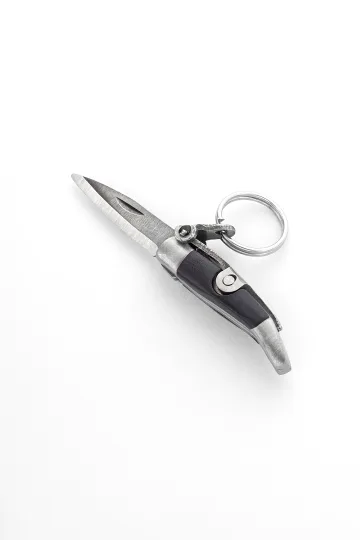
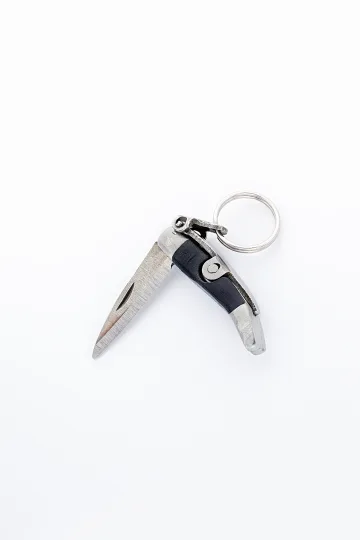
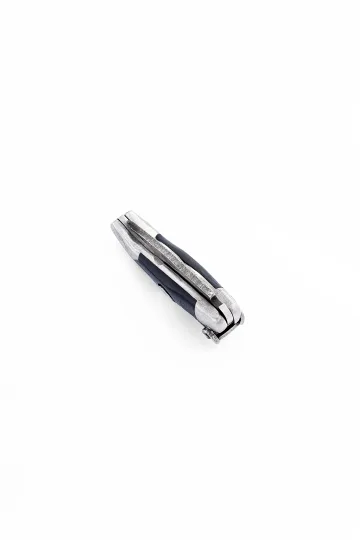
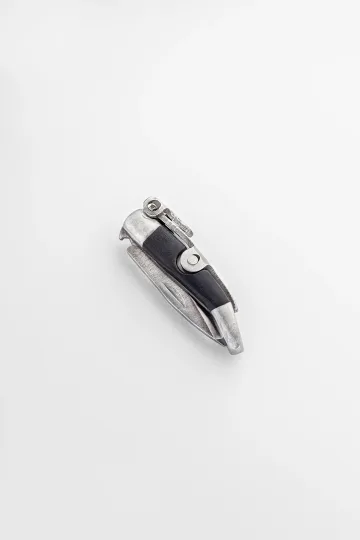
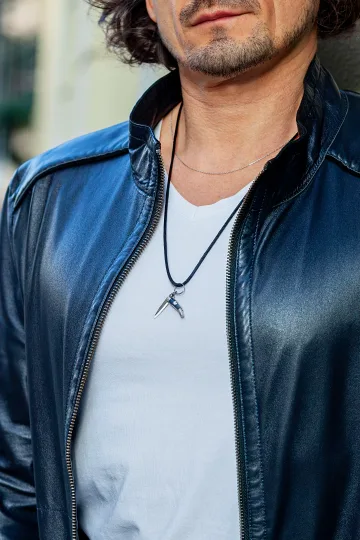
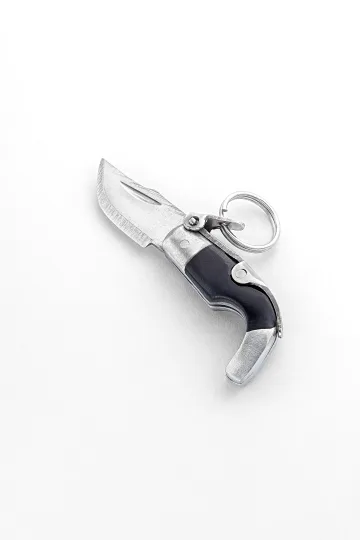
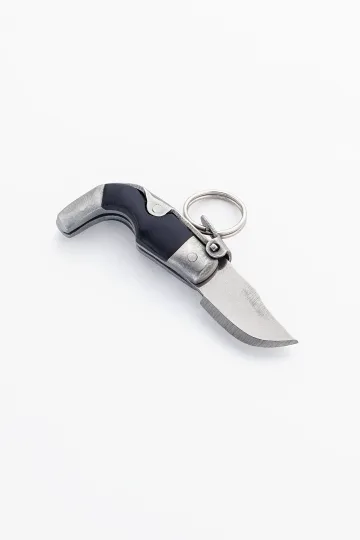
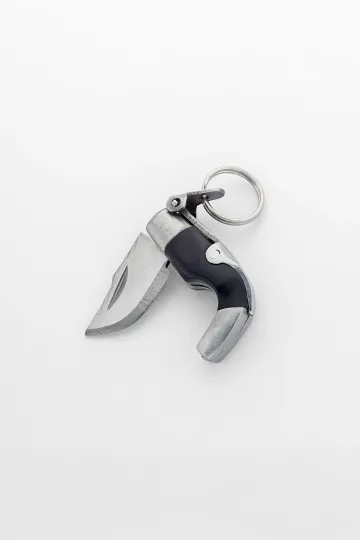
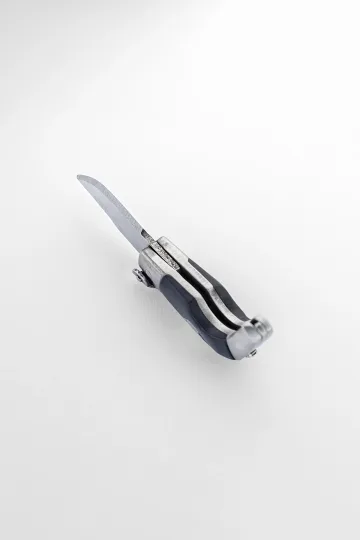
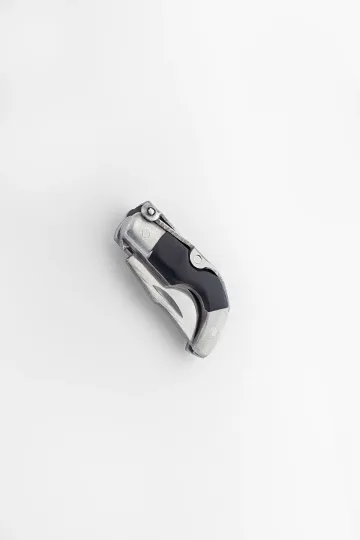
CAPAORA mini knife pendant
The 18th-century Spanish navaja in miniature: 40 mm of stainless steel, a real folding mechanism and a Palanquilla lock that clicks. An affordable gift to remember.
Authentic · Ships from Spain · 14-day returns
Materials and Formats of Braille Jewellery
Silver, gold, steel
Most often braille jewelry is made of silver. Sterling 925 silver is malleable and holds fine relief well, so the dots come out clean and crisp. It is affordable and sits pleasantly on the skin, and over time it tarnishes nobly, throwing the texture into relief. For most people it is the optimal choice: the dots are visible, they read, and they do not cost a fortune.
Gold is chosen when the piece is meant as an heirloom or an especially valuable gift. It is dearer, softer to work, and gives a warm, rich highlight on each half-sphere. Steel, on the other hand, is picked for strength and wear resistance: steel dots barely abrade, and such a piece survives daily wear and constant handling without losing relief. Each metal has its own logic, and the choice depends on what matters most: softness, value, or durability.
How the raised dots are made
There are several methods. The dots can be soldered: tiny metal beads are fixed to the plate strictly on the grid. They can be pushed up out of the metal from the back, in which case they are part of the plate, seamless. On costlier pieces the dots are sometimes cast together with the base from a single model. There is also a set version, with small stones or pearls in place of metal half-spheres.
The method affects the look, the durability, and the readability. Soldered beads give the cleanest, most correct half-spherical relief, close to the bookish standard, and read best of all. Pushed-up dots are a touch softer in shape but form a monolith with no risk of a bead falling off. Stones are prettier but work worse as tactile text: their uneven facets throw the finger off. If reading is the priority, choose clean metal half-spheres.
Pendant, ring, bracelet, tag
The most common format is the pendant: a vertical or horizontal plate with a line of dots on a chain. A pendant holds a fairly long word or even a short phrase and sits comfortably in the hand when you want to touch it. A bracelet, especially a narrow bar on the wrist or a rigid bangle, keeps the dots right under the hand, easy to find at any moment without taking it off.
A ring is harder: a narrow band fits few dots, so it carries a single letter, a short word, or an initial. A military-style tag, a flat metal plate on a chain, suits a name or a motto and is worn close to the body. The format depends on the length of the text and on how you want to touch it: a pendant and a bracelet are handier for frequent handling, while a ring and a tag are more compact and worn more constantly.
How and to Whom Braille Jewellery Is Given
To someone close, as a personal code
A braille piece is a gift for those who prize meaning over shine. To a partner you can give an encrypted confession that only the two of you read. To a friend, a word tied to your shared history, a joke or a motto only the two of you get. To yourself, an anchor word that holds you through a hard stretch. In every case it is a thing with a secret, and the secret is half its value.
Such a gift works where an ordinary inscription would be too direct. Saying "you are my anchor" out loud is not always easy. Encrypting it in dots and slipping it onto another person's wrist is easier and finer. The words are with them, but not on parade. In this Braille echoes matching jewelry for couples, where the meaning is also hidden from outsiders and clear only to two.
To a blind friend or relative
A separate, especially meaningful scenario is a gift to a blind or low-vision person. Here the piece turns from a riddle into a text the recipient reads themselves. The main thing, as already said, is to hand it over without grandstanding or pity, like any thought-through gift. Choose a word or a name that matters to this particular person, and make sure the line is made correctly and reads by the finger.
A good move is to check in advance what language and which table the recipient uses, so the text matches the system familiar to them. And do not turn the handover into a lesson on Braille: someone who reads it every day knows more about it than the giver. It is enough that the piece is beautiful, correct, and about them.
How to explain the gift
Because the inscription is encrypted, the gift has a pleasant drama in the giving. You can hand the piece over in silence and invite them to work out what it says. You can tuck a small card with a braille table into the box so the person decodes the word dot by dot themselves. You can reveal the meaning at once if the moment calls for it.
This element of mystery and solution makes a braille piece a memorable gift. The recipient lives through a small discovery instead of an ordinary handing-over of a box: first they see mysterious dots, then they realise a word is hidden in them, then they learn which word and why. A gift like that stays in the memory longer than an object with no story.
Send a friend a discount code, they save on their first order.
Caring for Braille Jewellery
The main problem: dirt between the dots
Braille jewellery has a weakness that flows straight from how it is built. Dirt gathers between and around the raised dots: skin oil, bits of cream, dust, soap film. On a smooth surface this is barely noticeable, but a relief line of dots collects grime more actively and dulls faster in the hollows between the bumps.
Over time clogged gaps spoil both the look and the touch. The dots start to merge under the finger, the relief "silts up," and reading gets harder. For a piece that is handled regularly this is doubly a shame: the point of the thing is the reading, and dirt gets in the way of that reading. So the relief needs a little more attention than a smooth piece.
How to clean the relief properly
The best tool is a soft toothbrush with soft bristles. Warm water, a little mild soap, gentle circular strokes of the brush between the dots, and the dirt comes out of the gaps. After washing, the piece needs thorough drying with a soft cloth, especially in the hollows, so no moisture or streaks are left. Hard brushes, abrasive pastes, and harsh chemistry are not needed: they scratch the metal and smooth the relief.
For silver, if it has darkened, a special silver cloth over the dots themselves and a gentle treatment along the lines of the piece on what 925 sterling means will do. The main rule is simple: clean the relief gently and regularly, without waiting for the gaps to clog up completely. A few minutes once every couple of weeks will preserve both the shine and the readability of the dots for years.
Facts That Surprise
A military past for a peaceful alphabet. The system that today helps millions of blind people read books grew out of an espionage invention: "night writing" for passing orders in the dark, without light, so the enemy would not notice.
The author was fifteen. Louis Braille finished the core work on his system at about fifteen. A teenager did what grown specialists before him could not: he created a script genuinely comfortable for reading by finger.
Recognition came after death. Braille was officially adopted in his own institute only in 1854, two years after the author's death. In his lifetime Louis never saw his system win.
Six dots, sixty-four combinations. From just six positions come sixty-four variants, counting the empty cell. That is enough for the alphabet, the digits, punctuation, and the control symbols of a whole language.
The size is not arbitrary. The diameter of a dot and the grid spacing are tuned to an adult fingertip. Make them smaller and the finger stops telling letters apart. It is ergonomics worked out two centuries ago.
Numbers need a sign of their own. To write a date you set a special number sign before the digits. Without it the dots read as letters, and "birthday" turns into a random run of symbols.
Braille is on banknotes and packaging. Raised braille marks are printed on the banknotes of many countries and on medicine boxes, so blind people can tell denominations and drugs apart by touch. The script left the bounds of books long ago.
Braille works in any language. The system has been adapted to dozens of writing systems, including Cyrillic, Arabic, Chinese, and mathematical notation. The same six-dot principle covers nearly everything people can write down.
Frequently Asked Questions
Can the inscription on the jewellery really be read by touch?
It depends on the execution. If the dots are raised, large enough, and set by the rules, the inscription reads by touch just like book Braille. If the dots are sunken or made too small and tight "for the look," you will not be able to read them by finger, it is only decoration. Before buying, ask whether the piece is meant for real reading.
What language is written in Braille?
Any one the system has been adapted to. The important thing is that the table matches the language of the text: a name is written in that language's braille table. Mix up the tables and someone who reads Braille will see nonsense. So the language of the inscription is worth settling with the maker in advance.
How do you write a date or numbers?
Through a special number sign placed before the digits. It tells the reader: what follows is numbers, not letters. Without that sign the same grid of dots reads as letters of the alphabet, and the date comes out wrong. Writing numbers should be trusted to someone who knows the rules, or the piece ends up with a pretty but mistaken line.
Does this kind of piece suit a blind person as a gift?
Yes, and for them it is especially meaningful: they read it themselves, with no intermediary. The main thing is to approach the gift without grandstanding or pity, like any thought-through piece. Make sure the dots are readable, the text is written by the rules, and the language matches the one the recipient uses. Then the gift is not a toy but a real piece that works.
Which metal is best to choose?
Sterling 925 silver is a handy all-rounder: malleable, affordable, holds the dots well. Gold for an heirloom or an especially valuable gift. Steel for durability, if the piece will be worn and handled every day, since steel relief barely wears down. For tactile reading clean metal half-spheres work best, not stones, whose facets throw the finger off.
How does Braille differ from ordinary engraving on jewellery?
Engraving is built for the eye: you read it but barely feel it with a finger. Braille is built for touch: its raised dots are made to be handled and read by feel. Engraving is usually hidden on the reverse, while a braille line lives on the outside, staying encrypted for anyone who does not know the system. They are two different ways to hide a personal meaning.
Will the dots wear off over time?
With normal wear metal dots last a long time, steel and gold especially. Silver is softer and with daily intensive handling may round off a little at the edges over the years, but this barely affects readability. The main enemy is not wear but dirt in the gaps between the dots, so the relief should be cleaned gently and regularly to keep it crisp.
Can you wear this kind of piece every day?
Yes, and many do exactly that: the meaning of the thing opens up in constant contact, when the finger habitually finds the familiar dots. For daily wear choose a sturdy metal and a handy format: a bar bracelet or a pendant easy to feel without taking it off. Once every couple of weeks clean the gaps between the dots with a soft brush, and the piece will keep both its look and its readability for a long time.
A personal word hidden in six dots
A name, a date, or the one word that holds, turned into a line of raised dots on silver, gold, or steel. A neat cipher on the surface, plain text under the fingers. Choose your format and metal in the Zevira catalogue.
Go to catalogueBuying it as a gift? Each one arrives ready to give.
 A branded Zevira box and a little card come with every order.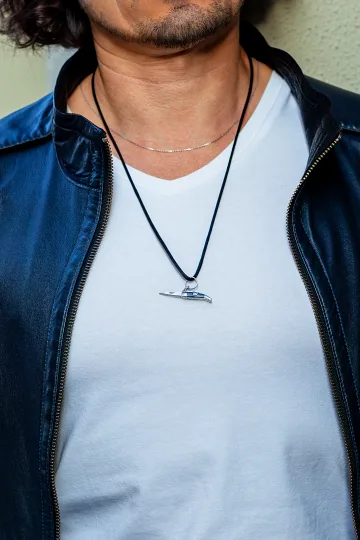




About Zevira
Zevira makes jewellery where meaning matters more than shine. We believe a thing on the skin can be a quiet personal sign: a name, a date, a word a person has chosen for themselves. Braille is for us a natural extension of that idea, a way to write the most personal thing so that fingers read it rather than curious eyes. We work with sterling 925 silver, gold, and steel, watching the cleanness of the relief and the accuracy of every line.