The Hercules Knot and Heracles in Jewellery: the Ancient Knot of Marriage and Its Meaning
"Tie the knot" as a phrase for getting married was not coined by the British or by sailors. The idiom traces back to the Hercules knot, the double interlace that fastened the bride's wedding belt in ancient Greece and Rome. Only the husband was allowed to untie it, on the wedding night. The knot held the marriage together, warded off evil, and stood as a seal of fidelity.
What the Hercules knot is
The Hercules knot is two simple knots tied facing each other so that the loops grip one another and hold by friction. English tradition calls it the Hercules knot, the square knot, or the reef knot, and the Latin nomenclature names it nodus Herculaneus. This is a working join rather than a decorative flourish: the harder you pull on the ends, the tighter it cinches.
The shape is unmistakable. Two strands, gold wires or cords, meet at the centre, wrap around each other crosswise, and run off to the sides. The result is a symmetrical figure, like a figure eight pressed flat, or like two interlocking loops. Ancient jewellers loved it for exactly this symmetry: the knot reads the same from either side, with no top and no bottom.
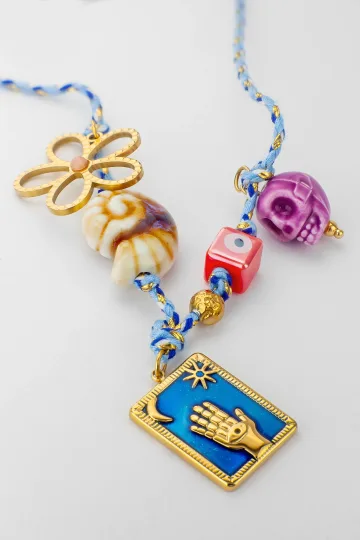
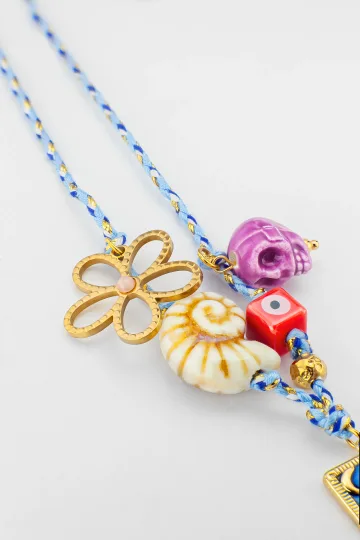
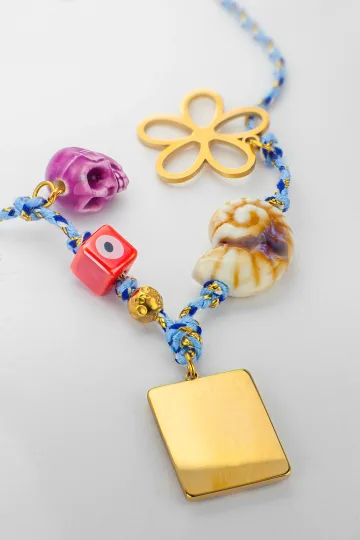
Wear the symbol, don't just read about it. These are in stock:



Why it was named after Heracles
The name comes from the hero of Greek myth. Heracles (Hercules to the Romans) was famed for strength no one could match, and a knot that cannot be undone by a rough yank was naturally linked to his hands. By one account the motif comes from the way Heracles tied the forepaws of the slain Nemean lion across his chest, fastening the lion skin with a knot and no clasp. The skin held on a double interlace, and the image stuck: the knot of Heracles means a grip that cannot be torn apart.
How it differs from an ordinary knot
The chief quality of the Hercules knot is reliability. An ordinary single knot slips and works loose under load. The double facing interlace does the opposite: tension locks it. The ancients knew this from practice. Surgeons of antiquity used the same knot to bind dressings and close wounds, because it did not come undone on its own. Galen, a physician of the Roman era, recommended the nodus Herculaneus for bandaging outright. So the knot picked up a second meaning, healing, which we will come to below.
How the Hercules knot is built inside
The easiest way to understand the knot is with your hands. Take two cords and tie them together twice. If both times you carry the ends to the same side, you get a granny knot, which creeps and works loose. If the second crossing runs against the first, the ends lie parallel to their own standing parts, and the knot sets fast. The whole difference is in the direction of the second turn, and that small thing separates the strong knot of Heracles from its unreliable double. Ancient craftsmen and physicians told them apart clearly, even if they used their own names.
The geometry of the knot follows a simple logic. Each strand first wraps around the other's end, then comes back and clamps its own. Two facing loops form, each holding the other by the throat: pull harder and the loops bite harder. You can release such a knot only with a facing motion, slackening it from the sides rather than yanking the ends. This trait made the knot of Heracles a favourite of anyone who needed reliability: the sailor, the surgeon, the jeweller, the priest. For all of them the knot held something important, and all of them valued that it would not shift.
In jewellery the same mechanics are translated into metal. Gold or silver wire is bent into two facing loops, the points of contact are soldered, and the curves are tuned so the figure reads symmetrically from both sides. A modern jeweller usually does not tie the knot from a living thread but assembles it as a rigid form, yet the pattern repeats the same facing interlace as two thousand years ago. That is why a proper Hercules knot in a pendant always looks as if it could still be drawn tight, even though it froze in metal long ago.
The history of the Hercules knot
Ancient Egypt: the first woven charms
The idea of the knot as a charm is older than Greece. In ancient Egypt interwoven cords and knot amulets were worn against evil long before the figure had a Greek name. The "knot of Isis", the red tyet amulet, was placed on the chest of the dead as a sign of protection and of the goddess's blood. A knot in Egyptian culture tied power inside an object, held it in, kept it from leaking away. This logic, the knot as a lock for benign energy, travelled on north to the Greeks.
The myth of the knot: Heracles and the lion skin
The most famous hero of the pantheon gave the knot its Greek name, and the legend behind it is plain and vivid. The first labour of Heracles was the fight with the Nemean lion, whose hide no weapon could pierce. The hero strangled the beast with his bare hands, then stripped off its impenetrable skin and wore it as armour: the lion's head served as a helmet, the forepaws crossed on his chest. To hold the skin without buckles or straps, the paws were tied in a knot, and by tradition this interlace became the knot of Heracles. The image stuck: what fastened the hide of the greatest of heroes could not be weak.
The myth has a second layer too. Heracles passed through twelve labours, each of which tested him to the breaking point, and each time he came out whole. The knot of his name inherited this reputation for not breaking. To name a knot after Heracles was to say that it holds the way the hero held: under any load, to the end, without giving in. The hero and his place among the Olympians are covered in detail in the article on the Olympian gods and the Greek pantheon; here one thing matters: the name gave the knot a ready idea of endurance, well beyond a mere label, which people began to wear on the body.
Ancient Greece: the bride's belt
The Greeks turned the knot into a wedding symbol. The bride put on a belt tied with a Hercules knot, and that knot became the seal of her chastity and of her fidelity to come. Only the husband had the right to untie it, on the wedding night, with his own hands. The gesture was ritual: by loosening the knot, the man took on the protection and care that the knot itself had carried before. The Greek expression for this survives in the texts, and from here runs the European idiom about the "tied knot" as a metaphor for marriage.
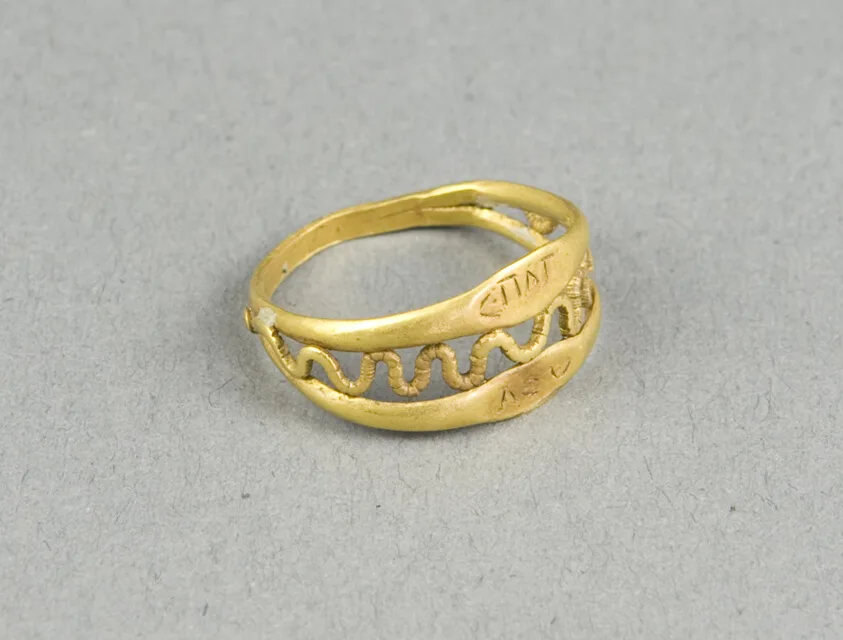
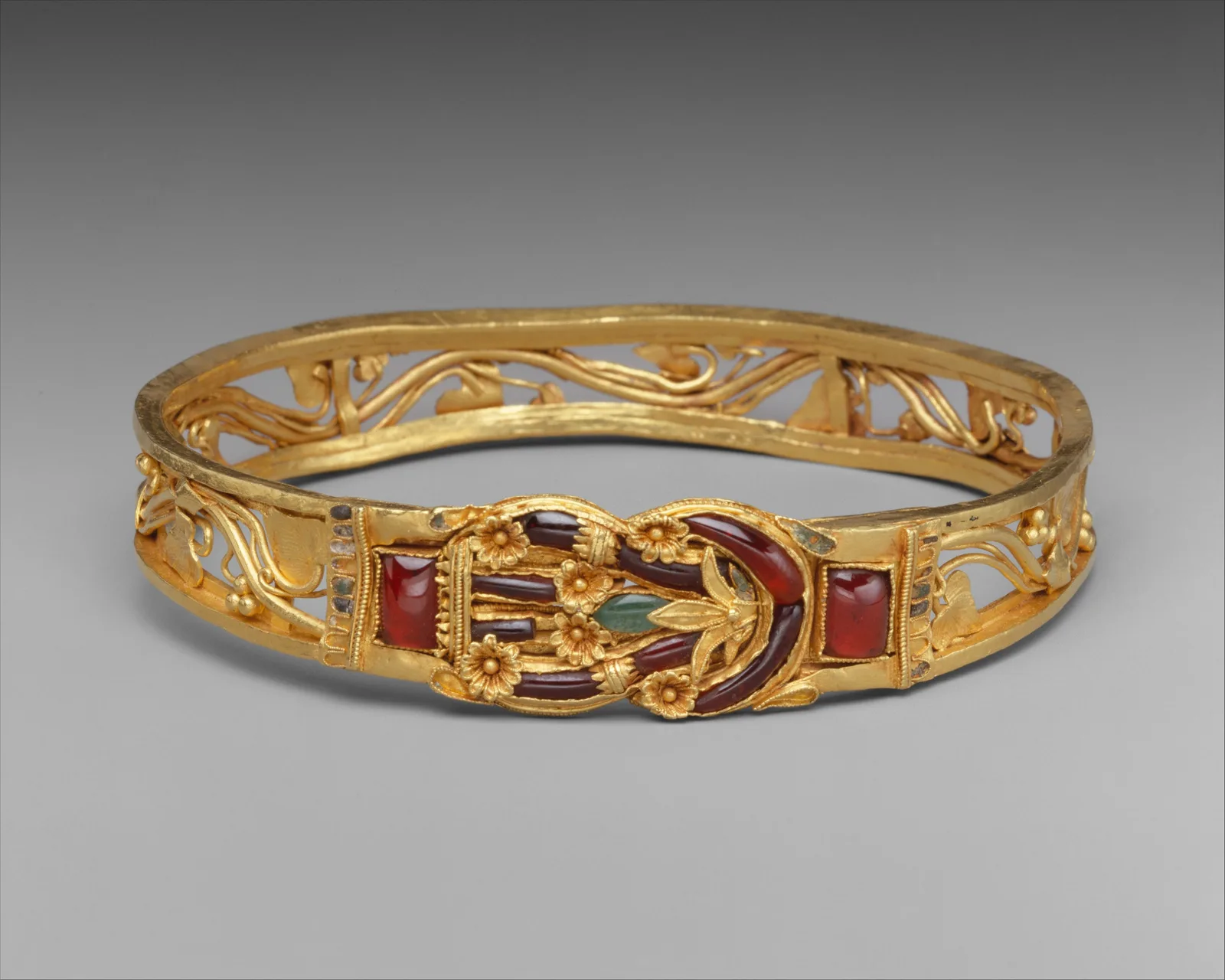
In parallel the knot entered the jeweller's craft. Hellenistic masters of the fourth to second centuries BCE made gold diadems, bracelets and earrings with a central Hercules knot. They often inlaid it with garnets: a red stone in a gold knot read as blood, life, passion and protection all at once. Such pieces turn up in burials across the Hellenistic world, from Macedonia to the Black Sea coast.
Ancient Rome: the knot of marriage and the amulet
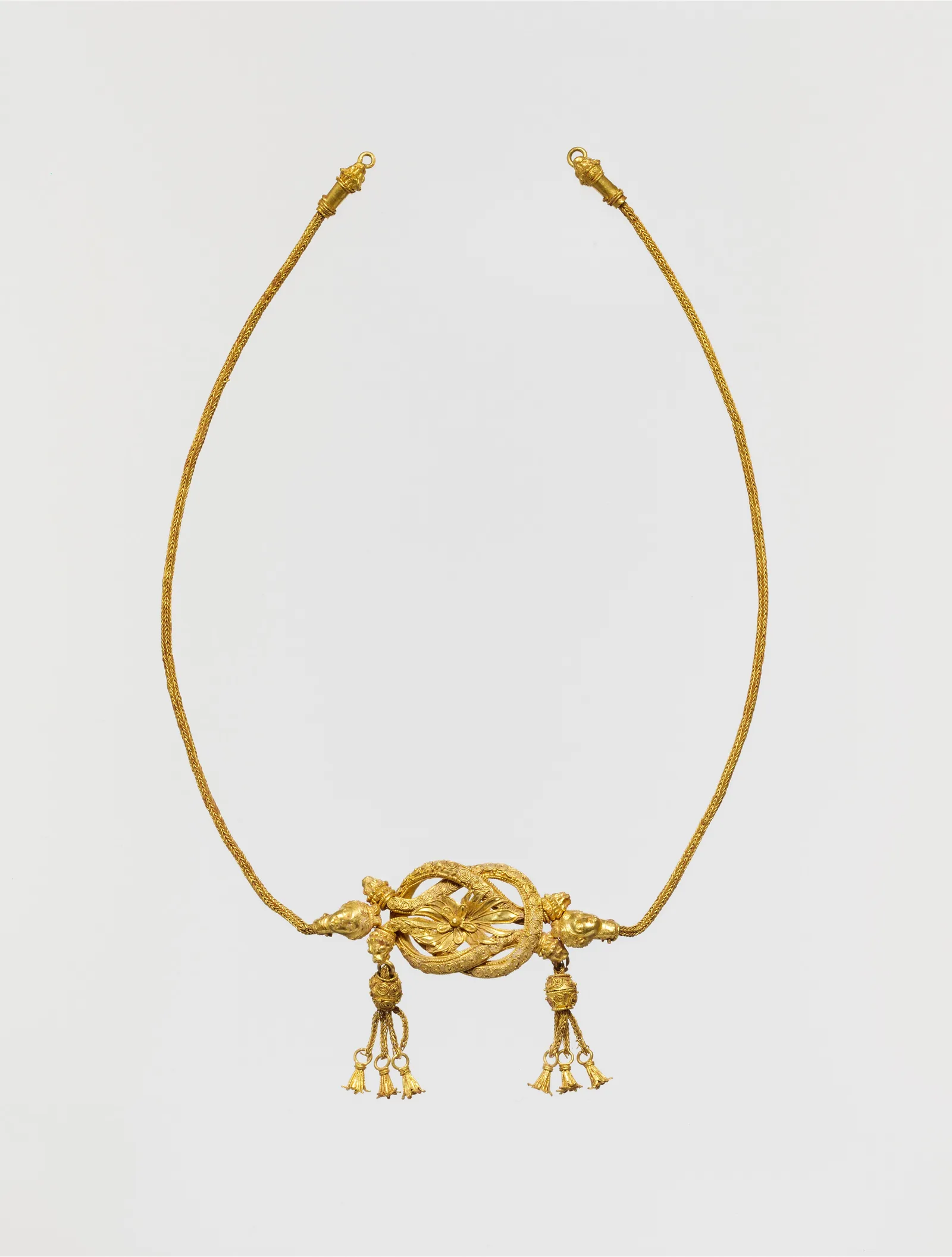
Rome took over the Greek tradition and fixed it in place. The Latin name nodus Herculaneus came into common use, and the knot itself became a stable feature of the wedding. The Roman bride girded herself with a woollen belt tied in this knot, and the groom undid it on the marriage bed. The knot of Heracles was thought to bring the couple fertility and many children, since Heracles, by tradition, left behind plenty of offspring of his own.
The knot was worn outside the wedding too. Romans hung small knot pendants on children as charms and set the motif on rings and brooches. The protective function worked by the same Egyptian and Greek logic: the interlace tangles evil, throws off the evil eye, denies misfortune a straight path to a person. Pliny the Elder noted that wounds bound with a Hercules knot healed faster, and that belief kept the knot's reputation as a healer.
The knot also fit the Roman idea of good fortune at the start of a new venture. It was set on seals and on the rings that closed important agreements: the interlace read as a pledge that the deal would not come undone. So a third, businesslike sense joined the wedding and protective meanings: a sign of a firm, unbreakable obligation. This line survived into medieval coats of arms, where the knot meant loyalty to family and to one's word.
The bride's belt and the rite of untying
The heart of the Roman wedding was the bride's belt. Before the rite the girl was girded with a belt of sheep's wool tied in a Hercules knot, and that knot became the seal of her untouched state and her fidelity to come. The wool was no accident: the sheep stood for domesticity and labour, and the knot over it closed the girl like a lock. Only the husband had the right to untie the belt, only on the marriage bed, with his own hands. The gesture was staged as a passage: while the knot held, the girl belonged to her father's house, and the loosened knot meant her husband now protected her.
From this rite grew an idiom that outlived Rome by two thousand years. "To untie the knot" meant to enter marriage, and later European languages flipped the image and began to say "tie the knot" in the same sense. The English phrase for the tied knot, its French, Italian and German relatives, all of them descend from the Roman wedding belt. Language remembers that marriage is connectedness, and the Hercules knot was the most vivid form of that connectedness antiquity ever devised.
Untying the knot carried a magical sense as well. The husband who loosened the belt was thought to take the knot's power onto himself: its protection, its promise of fertility, its strength. So the gesture had to be done with care, neither torn nor cut, or it boded ill for the young family. A Hercules knot carefully loosened was a good omen, one roughly torn a bad one. In this small detail you can see the whole logic of the symbol: a bond cannot be ripped apart, it can only be gently re-formed into a new one.
Hellenistic gold: the height of the motif
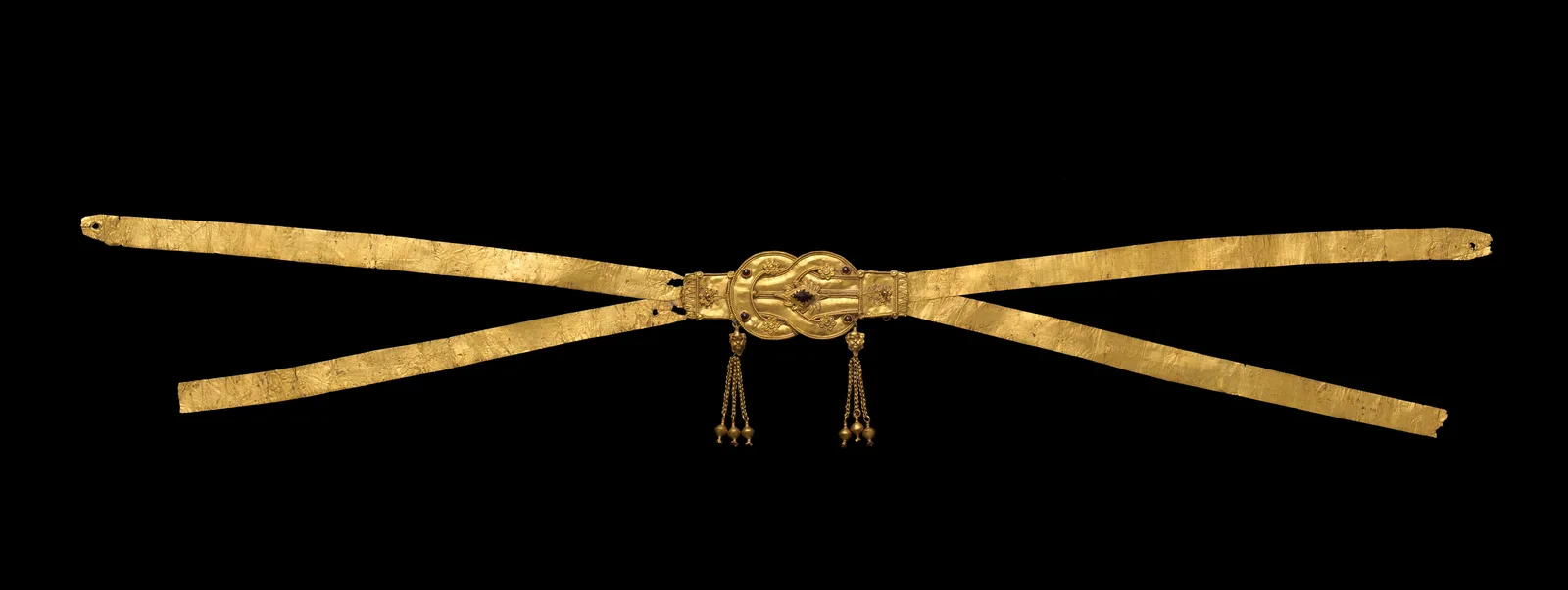
The knot reached its peak in the jeweller's craft during the Hellenistic age. After the campaigns of Alexander of Macedon, plenty of gold flowed through the Mediterranean workshops, and jewellers competed in intricacy. The Hercules knot became a favourite central element: they tied it from twisted gold wire, filled it with enamel, framed it with granulation. A diadem with the knot at the centre of the brow, a bracelet with a knot clasp, a necklace where the knot holds the pendants, all of these were status pieces of their day.
The knot was both beautiful and functional. In bracelets and necklaces it worked as a clasp: the two ends of the chain met in the knot, which held the fastening shut. The form joined the piece into a ring, and the symbolism of joining matched the mechanics of joining. A rare case where a charm literally does what it promises.
The quality of such pieces still astonishes. Hellenistic masters drew gold into thread finer than a hair, twisted it into cords, gathered granulation from microscopic spheres and laid them along the edges of the knot. Garnets were not set just anywhere: the cut was tuned to the curve of the loops so the stone sat flush. On the finest examples you can see the knot was meant as the meaning's centre for the whole piece: the lines converge on it, the eye rests on it. The jeweller showed mastery exactly where the symbol demanded strength, and the technique matched the idea.
Art nouveau and the return of the knot
After antiquity the motif slipped into shadow for a long time, surviving mostly in coats of arms and ornament. It came back at the turn of the nineteenth and twentieth centuries, in the age of art nouveau and the Greek revival. Jewellers of that time were taken with antiquity, pored over the excavations of Hellenistic tombs and copied the finds. The knot of Heracles appeared again in diadems, brooches and bracelets, now as a deliberate nod to the ancient world, a sign of the wearer's taste and learning. Since then it has stayed in the jeweller's repertoire as the "love knot", often with no memory of Heracles, but with the same idea of an unbreakable bond.
The knot in jewellery by era and type
The knot played different roles in different pieces, and its fate is easy to trace by those roles. The diadem was the summit. A Hellenistic diadem was a gold band converging at the brow in a Hercules knot, often with a garnet at the centre. Noble married women wore it, and the knot at the brow read as a sign of protected standing. The diadem placed the knot in the most visible spot, at the edge of the face, where it worked as ornament and charm at once, like an ancient counterpart of a crown. This line of ancient ceremonial work echoes the theme of antique sculpture in jewellery: the same cult of measured form, only in miniature.
The bracelet was the knot-as-clasp. In Hellenistic bracelets the two ends of the hoop met in a Hercules knot that held the fastening. Here symbol and mechanics coincided literally: the knot joined the piece into a ring and promised union to whoever wore it. Such bracelets are found in pairs, one for each wrist, and many of them are over two thousand years old, with the knot on them still working. Earrings and necklaces picked up the same device: the knot held the pendants, gathered the threads, was the piece's centre in both meaning and structure.
The ring became the chief carrier of the knot later. In antiquity the knot was more often carved on signets and set on contract rings as a sign of an unbreakable obligation. With the motif's return in art nouveau and down to our own day, the knot moved inside the wedding ring: it is engraved on the inner side as a secret message, visible only to the wearer. So the knot travelled from the ceremonial diadem in plain sight to a hidden sign against the skin, but in every type of piece it said the same thing: a bond that cannot be torn apart.
A Hercules knot wants a bare throat and a single chain. Bury that ancient symmetry under a heap of pendants and it is a jumble sale, not antiquity.
How to wear the Hercules knot
Over years on shoots and styling sessions the knot has passed through dozens of looks with me. Here is what actually works, sorted by occasion.
What do I wear the knot with every day? For daily wear I recommend a silver or steel knot on a thin chain over a plain tee, a linen shirt or a knit. A light top lifts the metal, a dark one turns the knot into the accent. The symmetrical shape likes a clean background, so I suggest you do not pin it between other pendants.
Is it right for the office? Yes. I recommend a restrained knot, silver or matte gold, 45 to 50 cm, so it slips under the top button of a shirt. Under a jacket the knot reads as a quiet detail, not a loud statement. A strict dress code is no obstacle for it.
How do I build an evening look? For evening I choose an open neckline and a smooth fabric in a deep colour: wine, emerald, black. A gold knot, or one with a red garnet at the centre, catches warm light and reads best at the collarbone. I suggest a shorter length, 40 to 45 cm.
What do I pair the knot with if I want layers? Give the knot its own line of length and do not crowd it in with other pendants: the symmetry gets lost in a cluster. I recommend smooth chains of any weave, a leather cord for a casual look, thin rings on neighbouring fingers. One knot on a clean chain always beats five pendants at once.
Who does it actually suit? Anyone who likes spare pieces with a story. The knot's geometry is neutral, so it sits equally on a men's look and a women's one. For a man I suggest silver or steel on a solid chain, for a woman thin gold, with a stone at the centre if you like. Two rules that never fail: choose the length for the neckline, and let the knot stay the accent, never the background.

Turn on your camera, pick earrings, a pendant or a ring, and see the piece on yourself in real time.
Switch items in one tap.
Everything runs in your browser: no photo or video is ever uploaded.
The meaning of the Hercules knot
An unbreakable bond and marriage
The main meaning of the knot is a join that cannot be torn apart. Two strands interweave so they become one whole, and the more you press on that union, the tighter it holds. For a wedding there is no better metaphor. So the Hercules knot is given for engagements and weddings, set on matching pieces, engraved inside rings. It says without words: we are bound, and this bond cannot be undone with a yank.
Protection and the charm
The second function is protective. The interlace tangles evil. The evil eye, by the ancient belief, looks for a straight line to its victim, and the knot throws it off the path, leads it into loops, disarms it. The same idea of a "labyrinth for misfortune" works in many cultures: an evil spirit was thought to have to untangle the knot or walk its whole winding course before it reached a person, and while it is busy with that, the threat loses force. So the knot was hung on children, set on door rings, worn on the road, where a person was thought especially vulnerable. If protective symbols interest you, see the guide to protection amulets, charms and talismans: the Hercules knot takes its place there among the protective motifs of the Mediterranean.
Protection and healing in the ancient mind
For ancient people the knot was not an ornament but a tool for influencing fate. In ancient magic, to tie a knot meant to catch and hold something invisible: illness, luck, another's will, love. To untie meant to let it out. So knots were tied and loosened at carefully chosen moments: a woman in labour sometimes had every knot in the house untied so the birth would go easier, while a charm was tied tight to lock the power inside it. The Hercules knot in this system was a locking knot: it held the good close and kept evil from the body.
The healing reputation grew from the same logic and from plain practice. The knot physically drew a wound shut and did not come undone, so it could draw the illness itself together and keep it from spreading. Physicians of antiquity bound wounds and fractures with the knot of Heracles, and faith in its curative power held for centuries: a dressing with the right knot was thought to heal faster than usual. Here magic and medicine did not argue but propped each other up. The knot worked in the surgeon's hands and in the patient's head at once: one drew the flesh together, the other drew the worry together. A modern person would call the second half an effect of expectation, but for antiquity it was a single, undivided power of the knot.
The motif of blood stood apart. A red garnet at the heart of a gold knot read as a drop of life locked into an unbreakable form. Blood, the knot and the name of the strongest of heroes folded into one dense charm: to wear such a knot was to keep health, protection and a promise of endurance all at once. In this sense the ancient knot was closer to a medicine and a spell than to a jewellery trinket, and it is exactly this density of meaning that carried its reputation down to us.
Healing and the strength of Heracles
The third layer of meaning is health. The Hercules knot was a medical instrument: it bound dressings, and faith in its curative power held for centuries. It was easy to tie this together with the strength of Heracles. The hero who cleansed the world of monsters passed his power to overcome on to the knot of his name. To wear the knot was to wear a piece of Heracles' endurance: to hold on, not to break, to make it to the end.
Fertility and the continuation of the line
The Romans added to the knot a meaning of fertility. Heracles left behind plenty of offspring, and his knot on the wedding belt promised the couple children and a strong line. The red garnet in Hellenistic knots reinforced this: the colour of blood and life in the form of an unbreakable join read as a wish for a full, fertile family life.
Heracles as a hero: a separate motif in jewellery
Heracles lives in jewellery in his own right, not only through the knot of his name. He is a self-standing image with his own attributes, easy to recognise on cameos, coins and pendants.
The twelve labours
The story of Heracles is twelve tasks he carried out in atonement. He strangled the Nemean lion, whose skin he then wore. He killed the Lernaean hydra, which grew two heads for every one cut off. He caught the Cerynean hind and the Erymanthian boar, cleaned the Augean stables, drove off the Stymphalian birds. He tamed the Cretan bull and the mares of Diomedes, won the belt of Hippolyta, rustled the cattle of Geryon, plucked the golden apples of the Hesperides and led the hound Cerberus out of the land of the dead. Each labour is a story, and any of them could become the subject of an ancient gem or carved stone. The twelve labours remain a rich source of imagery for original jewellery to this day.
The club and the lion skin
Heracles is easy to know by two things. The first is the club, a rough cudgel from the trunk of a wild olive, his main weapon. The second is the skin of the Nemean lion, slung over his shoulders, with the lion's head as a hood. On coins and cameos Heracles was often shown just so: a bearded strongman, the lion's jaws above his brow, the club in hand. These attributes passed into jewellery. A pendant with a lion's head, a signet ring with a club, a cameo with the hero's profile, all of them are references to Heracles, clear to anyone who knows the myth.
Heracles as a symbol of strength and endurance
For an ancient person Heracles was the model of manly virtue: strength, stamina, a readiness to take on the impossible. The Stoics made him an example of spiritual endurance, a man who passes through trials and does not break. So the image of Heracles on a piece of jewellery reads as a declared position rather than an illustration of the myth: I will endure. If you are curious how Heracles fits into the wider system of Greek gods and heroes, it is covered in detail in the article on the Olympian gods and the Greek pantheon.
Heracles between man and god
Heracles holds a special place in mythology. He was born mortal, the son of Zeus and the earthly woman Alcmene, passed through suffering and hard labour, and in the end was received on Olympus and became a god. This biography makes him easier to grasp than the other heroes: he was not born all-powerful, he earned his immortality through sweat and pain. For a piece of jewellery this is a strong subtext. The image of Heracles speaks not of finished perfection but of the path toward it, of strength that can be earned. Whoever chooses Heracles as a personal symbol most often invests exactly this thought: I am working on myself, I am passing through my own trials.
Heracles in coats of arms and emblems
After antiquity Heracles became a favourite figure of European heraldry and emblem. The club and lion skin landed on the arms of cities and families that wanted to declare strength and invincibility. The Pillars of Heracles, the two cliffs on either side of the Strait of Gibraltar that the hero himself was said to have set, entered the emblem of Spain with a motto about moving beyond the known world. The infinity sign, by one hypothesis, also goes back to the ribbon winding around the Pillars of Heracles. So the figure of the hero turned into a pure sign of strength and of a limit that can be surpassed, and that sense transfers easily onto a signet or a token.
Customer reviews
Zevira is a real jewellery shop. Genuine payments, deliveries and customer thank-yous.
🥰🥰🥰 gracias

Ok, ¡gracias! 🙂

Materials
Gold
The historical material of the knot. Hellenistic masters tied the Hercules knot from gold wire, and gold remains the truest choice: it draws into a fine thread, holds the shape of the loops, and does not darken over time. Yellow gold gives a warm, ancient look, white and rose a modern one. A twisted gold knot looks the same as it did two thousand years ago, and that is a rare quality for a jewellery motif.
Silver
An accessible and noble alternative. Sterling silver suits the knot well: it is malleable, holds detailed weaving, and is easy to polish to a mirror or leave matte. A silver Hercules knot looks more restrained than a gold one and fits the everyday wardrobe better. For matching pieces silver is convenient because it suits a man and a woman equally.
Garnet and coloured stones
The ancient classic is a knot with a red garnet at the centre. The stone reads as blood, life and passion, reinforcing the marriage meaning. Modern makers set the knot with garnet, ruby, sapphire, turquoise and pearl alike. A stone at the heart of the knot turns the abstract interlace into a focal point the eye is drawn to.
Steel and modern alloys
For anyone who wears a piece every day and wants no upkeep, stainless steel suits well. It holds the crisp geometry of the knot, does not scratch under everyday wear, and leaves no marks on the skin. The symbolism does not change: the knot keeps its meaning in the form, not in the metal.
Caring for the knot
The woven form of the knot gathers dust and skin oils in its loops, so it asks for a little more care than a smooth pendant. A silver knot is cleaned now and then with a soft cloth or a special wipe, reaching into the hollows of the weave with a toothpick or a soft brush. Gold is washed in warm water with a drop of soap and dried. Steel only needs a wipe. A knot with a stone calls for caution: garnet and most settings dislike harsh chemistry and sharp knocks against the loops of the mount. Take the knot off before sport, the shower and sleep, and the weave will last for decades, the way ancient bracelets lasted two thousand years.
Upload a photo of your pet, someone you love, or an object. We'll build a 3D model and hand-cast it in pewter.




Who it suits and who receives it as a gift
The Hercules knot is not tied to one religion or culture, and it has no "correct" wearers. Men and women wear it equally naturally: the geometry of the knot is neutral, with neither "feminine" curls nor forced toughness. For a woman a slim gold knot on a chain is the more common choice, for a man a silver or steel one on a heavy chain or a leather cord.
The knot is given for clear reasons. For a wedding or an engagement as a sign of an unbreakable union. For an anniversary as a reminder that the bond has stood the test of time. To someone close, for a journey or a new chapter, as a charm and a wish for endurance. The knot also makes a fine gift for two at once, when the same motif repeats on two pieces. If you are choosing a meaningful gift, the knot is convenient because its symbolism reads without explanation: the recipient understands the message the moment they see the form.
The knot suits those who buy a piece for themselves too. Ancient tradition held a gifted charm to be stronger than a bought one, but that is no ban: buying a knot for yourself as a personal sign of endurance is perfectly normal, and many do exactly that.
How to choose a Hercules knot
Symmetry and clean weaving
The chief mark of a good knot is even symmetry. The two strands should meet at the centre cleanly, the loops should be equal, the ends should run off as mirror images. A crooked knot toppled to one side gives away poor work. Look at the piece from both sides: a proper knot has no "wrong side", it reads the same from front and back.
Size for the task
For an everyday pendant 1.5 to 3 cm is comfortable: smaller gets lost on the chest, larger starts to look bulky. For a ring the knot is made small so it does not catch on clothing. For a ceremonial piece, a brooch or a large pendant, the size can be bigger, where the knot works as the focal point of the look. Match the size to the build: a larger person suits the upper limit, a slight one the lower.
Metal and stone
Gold gives the most historically true look and needs no upkeep against darkening. Silver is more accessible and more versatile in style, but asks for cleaning now and then. Steel is the most practical for everyday wear. A stone at the centre of the knot, a red garnet above all, points to the ancient canon and reinforces the marriage meaning, but a plain knot with no setting is full of meaning too. Decide by what matters more: historical accuracy, budget, or trouble-free everyday wear.




The love knot in wedding traditions
The wedding meaning of the knot outlived antiquity and spread across cultures, sometimes under other names. The idea of "binding two with a knot" turned out so handy that it was rediscovered again and again.
In Britain and Ireland there is the rite of handfasting: the hands of the groom and bride are bound with a ribbon or cord, a knot is tied, and the couple stands like that for part of the ceremony. From here, by the common account, comes the English phrase about the "tied knot". The rite itself is ancient, pre-Christian, but its link to the idiom of marriage is the same as that of the ancient Hercules knot: the hands are joined, the knot holds.
In other folk traditions the bride and groom were bound with a cloth, their hands wrapped with a length of woven linen, and this too read as the sealing of a union. The logic is shared: while the knot holds, the bond holds. Among many peoples the wedding features a tying, an interweaving, a winding, and the Hercules knot is the Mediterranean ancestor of this large family of rites.
Modern jewellers draw on exactly this layer. The love knot, often already with no memory of Heracles, became a stable motif of wedding and engagement pieces: it is engraved inside rings, set on pendants, made the heart of matching sets. A buyer may know nothing of the ancient bride's belt, yet reads the message of the form intuitively: we are bound.
The Hercules knot in modern jewellery
Today the knot lives in several registers at once. There is the strict historical replica: a gold knot with a garnet, repeating the Hellenistic canon, for those who value an exact nod to antiquity. There is the minimalist version: a slim plain knot with no stone, a spare sign that fits the everyday wardrobe and draws no extra attention. And there are original readings, where the knot is reimagined: stretched out, simplified to a graphic line, joined with other symbols.
The knot is popular in matching and engagement lines, because its form is literally about the union of two. It is also convenient in engraving: the outline of the knot reads well on the small surface inside a ring. In men's jewellery the knot comes through a rugged presentation, silver or steel, a heavy chain, no stones, as a sign of endurance. In women's jewellery it comes through delicacy, fine gold, a small stone at the heart.
The strength of the knot is that it keeps its meaning under any styling. You can make it ancient, you can make it modern, you can make it masculine, you can make it tender, and in every case the original idea of an unbreakable bond remains. A rare motif that does not run out of breath from being reimagined.
Leave your email, we'll send your discount code. No spam, unsubscribe anytime.
The code arrives by email, valid on your first order.
Protective knots in the cultures of the world
The Hercules knot is not the only sacred knot in history. The idea of the interlace as a symbol of bond and protection arose among different peoples independently, and it is worth getting to know the "relatives" of the Hercules knot.
The Celts gave the world the endless knot, a plait with no beginning and no end, standing for eternity and the continuity of life. The Norse tied the valknut and knotwork ornament on weapons and stones. In the East the Chinese knot of fortune is plaited from a single cord as a wish for long life and luck, and the Buddhist endless knot is one of the eight auspicious symbols, standing for the interweaving of wisdom and compassion. In Islamic culture intricate knotwork ornament decorates everything from carpets to domes.
A shared logic unites them. The knot holds. The knot joins. The knot tangles evil. From Egypt to China people arrived at one thought by independent paths: a woven thread is stronger than a straight one, and that strength serves both protection and an oath. The Hercules knot is the Mediterranean version of this universal idea, with the name of the strongest of heroes added.
How the Hercules knot differs from other knots
The knot of Heracles is easy to confuse with three neighbours, and it is worth telling them apart by essence. The sailor's knot comes from a wholly different world: it was born in the hands of sailors as a set of working fastenings, and it carries as many meanings as it has kinds, from reliability and discipline to a tie with the sea. The Hercules knot is always the same single figure with the same single meaning of union and protection, while sailors' knots run into dozens, each tied its own way. It is technically amusing that the simplest knot of Heracles is itself one of the basic sailors' knots, the reef knot, but in jewellery they are kept apart by symbolism rather than by form.
The Celtic knot differs in its principle of construction. The Hercules knot is built from two separate strands that have a beginning and an end, running off to the sides. The Celtic plait is tied from a single thread with no beginning and no end, and means infinity, the continuity of life and the cycle. That is, the knot of Heracles is about two who have intertwined into one, while the Celtic one is about one that flows without a break. Different numbers at the root, different ideas: the union of two against the eternity of one.
The love knot is the closest of all, and often it is simply another name for the same motif. The modern "love knot" is frequently the Hercules knot itself, renamed with no memory of Heracles, or its simplified relative of two interwoven loops. The meaning coincides, and they part only in the details of the pedigree: behind the words "love knot" there is usually neither the ancient bride's belt, nor the name of the hero, nor the healing reputation, while behind the Hercules knot stands all of this dense history. In choosing, it is worth deciding what matters more: a pure romantic sign, or the same sign with a two-thousand-year biography behind it.
CAPAORA mini knife pendant
The 18th-century Spanish navaja in miniature: 40 mm of stainless steel, a real folding mechanism and a Palanquilla lock that clicks. An affordable gift to remember.
Authentic · Ships from Spain · 14-day returns
Heracles in art
The image of Heracles passed through the whole of Western art, and jewellery is only part of that journey. In antiquity he was modelled in clay, struck on coins, carved on gems. The famous "Farnese Hercules", a marble statue of the weary hero leaning on his club, set the canon of tired strength: even the strongest grows tired, and in that tiredness lies grandeur.
In the Renaissance Heracles was rediscovered as a symbol of virtue and of the power of the state. Rulers had themselves portrayed in the guise of Heracles, artists painted his labours on the walls of palaces. The subject of "Heracles at the crossroads", where the hero chooses between the easy road of vice and the hard road of virtue, became a favourite theme of moralists. In the Baroque his labours turned into striking multi-figure scenes, full of motion and muscle.
Carved gems and cameos with Heracles were prized in every age. A small profile of the hero on carnelian or agate was worn as a ring, and behind the beautiful object stood a declared link to the idea of strength and endurance. This tradition, wearing Heracles on the finger or at the throat, has lasted into the jeweller's art of our own day.
Famous ancient knots and finds
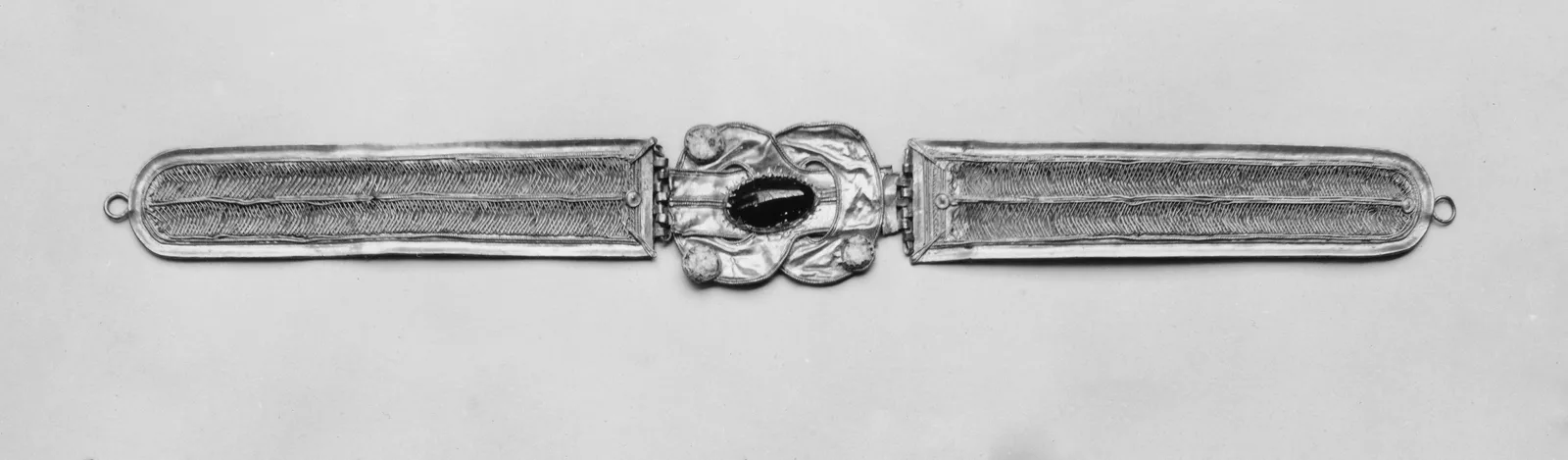
The Hercules knot is known from texts, but it lives in metal too. Archaeologists find it in real pieces, and these finds make the knot's history tangible.
In Hellenistic burials across the Mediterranean, gold diadems with a knot at the centre keep turning up. The most famous date to the third and second centuries BCE: a fine gold band converging at the brow in a knot, often with a garnet or green enamel at the heart. Such diadems were worn by noble women, and the knot at the brow read as a sign of a married, protected status.
Bracelets with the knot are found in pairs. They were worn one on each wrist, and the knot worked as clasp and charm at once. Twisted gold wire forms the loops, and the ends run off into smooth hoops. Many of these bracelets are over two thousand years old, and the mechanics of the knot on them still works: clean it and reassemble it, and the knot draws tight just as it did in its owner's lifetime.
Gems with Heracles are found in whole collections. Carvers left the hero's profile in the lion skin on carnelian, agate, amethyst. Many of these stones were later reset into medieval and Renaissance mounts: an ancient gem was prized as a treasure and worn on, sometimes credited with the properties of an amulet. So one small carved stone could pass through two thousand years and several owners, remaining a piece of jewellery throughout.
The psychology of the knot: why it works on us
The knot acts on a person even before they learn its history. A few simple mechanisms of the mind are at work here.
First, the vividness of the metaphor. A bond between people is abstract, you cannot touch it. The knot makes it visible and tangible: two threads are intertwined, they cannot be parted. The mind likes it when a complex feeling takes on a simple material form. So a knot as a gift reads more clearly than a plain ring: it shows the idea of union directly.
Second, the anchor of memory. When a knot is given by someone close on an important day, the object becomes a physical bookmark for that relationship. Every glance at the knot returns you to the moment, the person, the promise. In cognitive therapy this device is called anchoring: a material object draws out a whole chain of warm memories and gently regulates the mood.
Third, the sense of safety. Faith in a charm lowers anxiety, and that works apart from any mysticism. A person who has "something covered" turns over fewer possible misfortunes in their head. The Hercules knot, with its double symbolism of union and protection, gives two reasons at once to feel calmer: someone close is near, and an ancient protective sign stands over the bond.
Fourth, a statement about oneself. The knot of Heracles speaks of the wearer's values: fidelity, endurance, a readiness to keep one's word under pressure. To wear such a sign is to remind yourself every day of who you want to be. Psychologists note that objects that anchor identity raise resilience to stress, and the ancient knot works in exactly that way.
Why a symbol of a strong bond grips us so
The idea of an unbreakable bond has a deep psychological footing. People need to feel that a relationship will not fall apart at the first jolt, and the knot answers that need with a literal picture: the harder you pull, the tighter it holds. It is a rare symbol that promises not fragile perfection but strength under load. A weak bond is torn by any crisis, a strong one only cinches tighter in a crisis, and the knot shows exactly the second scenario. So it reassures: it says not "everything is smooth with us", but "we cannot be torn apart, even when it is hard".
The doubleness of the image works too. Two separate strands do not vanish in the knot, they remain themselves while holding to each other. For people this is a precise metaphor for healthy closeness: not a merging where two lose themselves, but a joining where each keeps their own line and is still bound to the other. Psychologically that is far more appealing than symbols of total dissolution. The Hercules knot offers a mature model of a bond, and many read it intuitively, before they know either the history or the name of Heracles.
Finally, the knot gives a sense of a finished choice. A tied knot is a decision already made and fixed. In a world where almost everything is reversible and fluid, an object that says "here it is bound for good" acts as an anchor. It takes away part of the anxiety of choice: the decision is settled, and now one can live inside it. This is what holds us to the knot after millennia. It is not about a pretty trinket but about the basic human longing for a bond that will endure.
Send a friend a discount code, they save on their first order.
The Hercules knot against the sailor's knot and the Claddagh
The Hercules knot is easy to mix up with other "knot" and "binding" symbols. Let us sort out the differences so you can choose with eyes open.
The Hercules knot against the sailor's knot
These are different knots with different histories. The Hercules knot is an ancient wedding charm: a double facing interlace, the knot of marriage, protection, healing, the name of Heracles. The sailor's knot is a tradition of a wholly different origin, coming from seafaring culture, and it means rather reliability, discipline and a tie with the sea. The forms do not match either: the Hercules knot is a symmetrical flat figure eight, while sailors' knots run into dozens of kinds, each with its own pattern and purpose. If the maritime theme is closer to you, there is a separate article on the sailor's knot in jewellery. In short: both are about a bond, but the Hercules knot is about the union of two and ancient magic, the sailor's knot about the sea and a seaman's loyalty.
The Hercules knot against the Claddagh
The Claddagh is not a knot at all. It is an Irish ring with a motif of two hands holding a heart beneath a crown: the hands mean friendship, the heart love, the crown loyalty. The only thing it shares with the Hercules knot is the theme of love and union. But the language is quite different: the Claddagh tells its story through figures, the Hercules knot through interlace. The Claddagh is Irish and medieval, the Hercules knot Mediterranean and ancient. The Claddagh is covered in detail in the article on the Claddagh ring, its meaning and history. Choose the Claddagh if the Irish tradition and a figurative language are close to you, and the Hercules knot if pure geometry and ancient roots are nearer.
When to choose which
The Hercules knot is worth taking for those who love spare symmetry and a history reaching back to ancient Greece, who want a charm and a sign of an unbreakable union in one piece. The sailor's knot suits people tied to the sea or those who value the idea of a reliable fastening. The Claddagh is your choice if you like open, readable symbolism and Irish colour. All three are about a bond, but each speaks its own language.
Facts that surprise
The idiom "tie the knot" was born from a wedding belt. The English "tie the knot" and its European counterparts trace straight back to the Hercules knot on the belt of the ancient bride, which the husband untied on the wedding night.
The knot was a surgical instrument. Galen and other physicians of antiquity bound dressings and closed wounds with the Hercules knot, because it does not come undone under load. The same knot is still familiar to surgeons as the "square knot".
Heracles wore the lion skin on a Hercules knot. By one account the knot is named so because the hero fastened the paws of the slain Nemean lion across his chest with it, doing without a clasp.
Hellenistic knots were filled with garnets. A gold knot with a red stone at the centre was a status piece of the age: the red garnet read as blood, life and passion, reinforcing the marriage and protective meaning.
In jewellery the knot worked as a clasp. In ancient bracelets and necklaces the Hercules knot held the fastening: the symbol of joining literally joined the piece into a ring.
Pliny believed in the knot's healing power. Pliny the Elder wrote that wounds bound with a Hercules knot healed faster, and that belief kept the knot's reputation as a healer for centuries.
Art nouveau brought the knot back from oblivion. After centuries of neglect, jewellers at the turn of the nineteenth and twentieth centuries reread the excavations of Hellenistic tombs and brought the Hercules knot back into fashion as the "love knot".
Similar knots were invented independently by different peoples. The Celtic endless knot, the Chinese knot of fortune, the Buddhist endless knot: the idea of the interlace as a symbol of a bond arose all over the world on its own.
Many languages tie marriage to binding. Words for a union, a bond and a tie share roots across languages, and the idea is the same: marriage is connectedness. The Hercules knot was the most vivid form of that idea in antiquity.
One wrong turn turns the knot of Heracles into an unreliable one. If the second crossing goes the same way as the first, you get a granny knot, which creeps under load. The whole strength of the Hercules knot rests on the facing direction of the turns.
Ancient bracelets with the knot still work. On many Hellenistic bracelets the knot clasp works after two thousand years: clean it and reassemble it, and the loops draw tight just as they did in the owner's lifetime.
The bride's knot was loosened with care, not torn. A wedding belt roughly torn was thought a bad omen for the family. The knot was meant to be loosened gently, to pass its power to the new union rather than to destroy it.
Frequently asked questions
What does the Hercules knot mean?
An unbreakable bond, above all a marital one. Two interwoven cords hold by the force of tension, and the harder you pull, the tighter the knot, so it became a symbol of a union that cannot be torn apart. In addition the knot means protection from evil, healing, and the strength of Heracles.
Why is the knot named after Heracles?
Because it is strong, like the hero's grip. By one account the name comes from the way Heracles tied the paws of the slain Nemean lion across his chest, fastening the lion skin without a clasp by exactly this double interlace.
How does the Hercules knot differ from the sailor's knot?
In origin and meaning. The Hercules knot is an ancient wedding charm from Greece and Rome, about the union of two, protection and healing. The sailor's knot comes from seafaring culture and means reliability, discipline and a tie with the sea. They are different knots with different forms and histories.
Are the Hercules knot and the Claddagh the same thing?
No. The Claddagh is an Irish ring with hands, a heart and a crown, a figurative symbol of friendship, love and loyalty. The Hercules knot is an interlace from the ancient Mediterranean. The only thing they share is the theme of union; the language and origin are different.
Can the Hercules knot be worn for something other than a wedding?
Of course. The wedding is the historical occasion, but the knot works as an everyday charm, as a sign of personal endurance, and as simply a beautiful piece with a deep history. A small knot pendant is fitting on any day.
What material should I choose the knot in?
Gold is the historical and truest choice, silver an accessible noble alternative, stainless steel for everyday wear with no upkeep. A knot with a garnet or another red stone at the centre points to the ancient canon and reinforces the marriage meaning.
Is the knot a charm or a piece of jewellery?
Both. Ancient tradition held that the interlace tangles evil and throws off the evil eye, so the knot was hung on children and worn on the road. At the same time it was always a beautiful jewellery piece. Protection and aesthetics do not argue in it.
Does the Hercules knot suit men?
Yes. The knot is tied to Heracles, the model of manly strength and endurance, and its geometry is spare, with no "feminine" details. A silver or steel knot on a leather cord or a heavy chain looks natural on a man.
How does the Hercules knot differ from the Celtic knot?
In the principle of weaving and in meaning. The Hercules knot is built from two separate strands that intertwine into one, and means the union of two. The Celtic knot is tied from a single thread with no beginning and no end and means infinity and continuity. One is about the bond of two, the other about the eternity of one.
Where does the phrase "tie the knot" for marriage come from?
From the Roman wedding rite. The bride was girded with a woollen belt in a Hercules knot, and the husband untied it on the wedding night. At first people said "untie the knot" for entering marriage, later European languages flipped the image into "tie the knot", and the idiom has lasted to our own day.
Can the Hercules knot be given for an anniversary?
Yes, it is one of the most fitting occasions. For an anniversary the knot reads as a sign that the bond has stood the test of time and only cinched tighter. The matching format works well, when the same knot repeats on two pieces.
Buying it as a gift? Each one arrives ready to give.
 A branded Zevira box and a little card come with every order.














Conclusion
The Hercules knot is a rare symbol in which form and meaning coincide literally. Two cords interweave so they hold by the force of their own tension, and that mechanics is its message: a true bond grows stronger under pressure rather than tearing. The Greeks fastened their wedding belt with it, the Romans hung it on children as a charm, physicians bound wounds with it, and the jewellers of the Hellenistic age turned it into the golden summit of their craft. Heracles added his name to the knot and an idea of endurance. Two and a half thousand years on, the knot still says exactly what it said then: we are bound, and this bond cannot be undone with a yank.
Silver, gold, symbolism, matching sets, charms with a history.
About Zevira
Zevira gathers jewellery that has something to tell. We love symbols with a long memory: charms, knots, ancient motifs, pieces worn for meaning rather than for shine alone. The Hercules knot is one such symbol: spare, ancient and honest in its promise of an unbreakable bond.
The catalogue has silver and gold, matching sets for two, symbolism and charms. If you are looking for a meaningful gift for a wedding, an engagement, or simply for someone close, start with the catalogue.