The Hierophant in Tarot: Meaning of Major Arcana 5, Symbols, and Jewellery
At twenty, the Hierophant feels like a fence. By forty, it feels like an anchor. It is one of the rare tarot cards that grows clearer with age: it speaks of the things you do not value right away, yet which stay with you once everything else has changed. A person who walked away from church will still have their child christened at the same font where they themselves were christened. Tradition turns out to be stronger than personal conviction.
Arcanum 5 sits between the Emperor and the Lovers. It belongs to the space where personal experience meets the accumulated knowledge of generations. It is about the ritual that gets passed down, not because anyone forces it, but because everyone who came before you walked through it too. It is about the mentor who stands between a question and its answer, not to block the path, but to show how others have walked it.
Arcanum 5 travelled a long road, from the Italian decks of the fifteenth century to the Waite deck of 1909. Every symbol on the card carries its own meaning, its own history, its own roots in the spiritual traditions of the world. The Hierophant corresponds to Taurus and the element of Earth, and it shows up in everyday life through study, profession, and family. For a jewellery context, though, one thing matters most of all: which of the card's symbols became wearable pieces, why they work, and how to choose a piece that matches the meaning that speaks to you.
The Hierophant in the Major Arcana: a place between the Emperor and the Lovers
The Major Arcana are twenty-two cards, each describing a large archetype of human experience. Not an event, not a specific situation, but a type of force or a type of state. Arcanum 5 holds a precise spot in that sequence.
Arcanum 4, the Emperor, is worldly power. Structure, law, order, all of it set up by people for people. He governs the outer world: the state, the army, the land. His authority rests on force and on agreement.
Arcanum 6, the Lovers, is choice. The moment a person stands before a decision that will define their path. Heart against mind, the individual against what has been accepted.
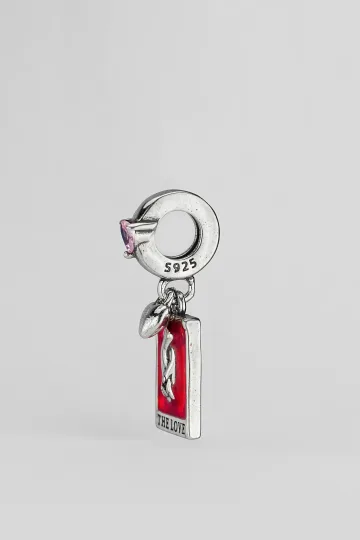
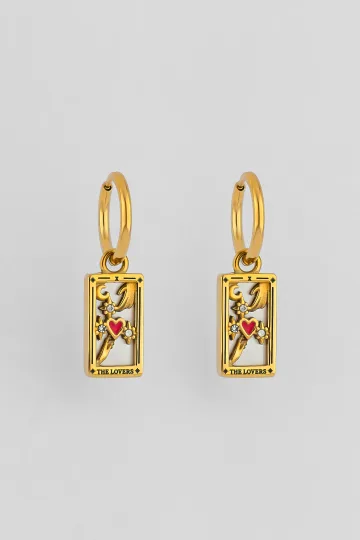
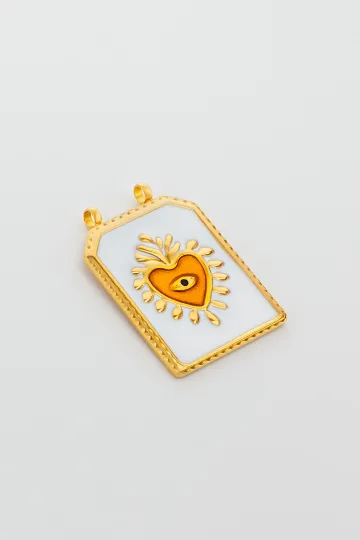
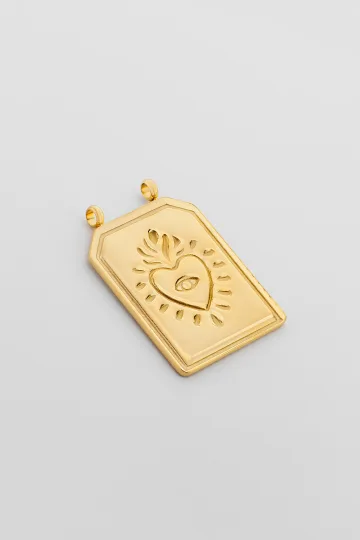
Wear the symbol, don't just read about it. These are in stock:


Between them stands the Hierophant. He does not rule territories, and he does not live through a choice of the heart. His space is different: he mediates between the earthly and the heavenly. His task is to translate what lies beyond ordinary understanding into a form that can be passed on. He is the keeper of the system that transmits knowledge, whether religious, philosophical, or professional.
If the Magician (Arcanum 1) is individual will acting alone, and the High Priestess (Arcanum 2) is intuition and secret knowledge held within, then the Hierophant is collective wisdom organised into an institution and handed from teacher to student. He does not discover the new; he passes on the proven.
In the tradition of the Fool's journey through all the arcana, the Hierophant is the point where the Fool meets the system and has to decide: accept its teaching, walk through it as through a gate, or find a path of his own beyond it.
The card's history: the Pope in Visconti, Le Pape in the Marseille decks, the Hierophant in Waite
Visconti-Sforza: a real pope on the card
The first tarot cards appeared in Northern Italy in the first half of the fifteenth century. They were playing cards for courtiers, not tools of divination. One of the earliest surviving decks, the Visconti-Sforza, was made around 1450 at the court of the Duke of Milan.
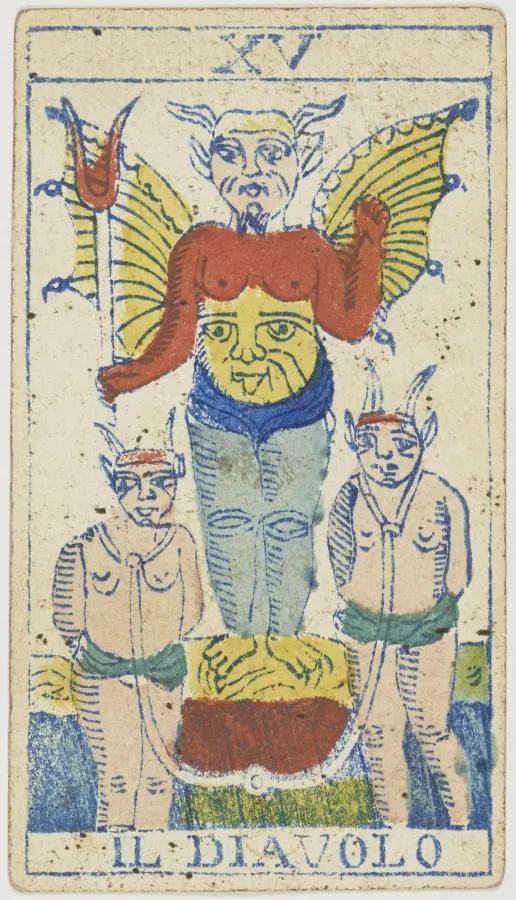
The fifth card of the Major Arcana in that deck was called Il Papa, the Pope. It shows a figure in papal robes, wearing the triple tiara, with two kneeling monks at his feet. Historians believe the model was Felix V, the last antipope of the Western Schism, elected by the Council of Basel in 1439 and abdicating in 1449. His figure was a real political power at the very moment the deck was being made.
During the Renaissance, the papacy controlled the Papal States in central Italy. The Pope was a religious leader, yes, but he was also a sovereign, a diplomat, a military commander. The image of the Pope on the card was the image of a real centre of power, spiritual and worldly at once.
The Marseille tradition: Le Pape
By the eighteenth century, France had developed the Marseille deck, a standardised version of tarot for mass production. The fifth card here is still called Le Pape. The image is less individualised than in the Visconti: a typified religious figure with attributes. The tiara, the staff, the double cross, two attendants standing or kneeling.
The Marseille Pope kept this image for roughly three centuries. Over that time the card became firmly tied to religious structures, to the authority of the church, to priesthood as an institution.
Waite renames and rethinks: 1909
Everything changed in 1909. Arthur Edward Waite, a British occultist and member of the Order of the Golden Dawn, commissioned a new deck from the artist Pamela Colman Smith. Waite replaced the name "Pope" with "Hierophant".
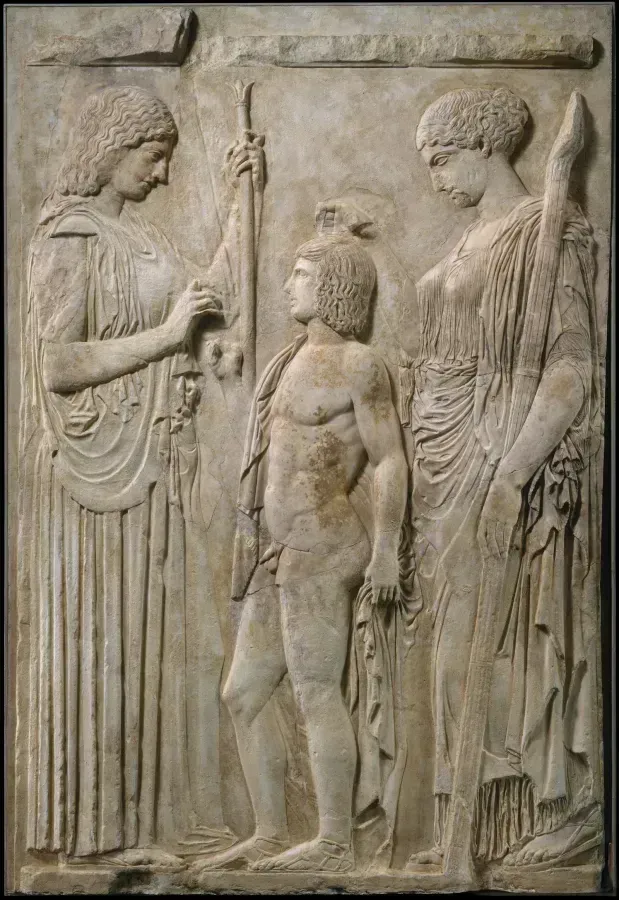
The word hierophant comes from the Greek hierophantes: hieros (sacred) plus phainein (to show, to reveal). Literally, the one who reveals the sacred. In ancient Greece this was the title of the chief priest of the Eleusinian Mysteries, the secret cult of Demeter and Persephone. We will return to that story in its own chapter below.
The renaming was deliberate. Waite wanted to strip away the specifically Catholic context and make the archetype more universal: not a particular pope, but the principle of spiritual mediation. The priest of the mysteries who stands between the profane world and the sacred, who carries you across the threshold, who knows the ritual. A priest whose knowledge is not personal property but an inheritance he is bound to pass on.
The renaming was part of Waite's wider design: to give all the Major Arcana names that point to universal archetypes rather than to specific religious or social roles. So the Pope became the Hierophant, the High Priestess replaced the Papess, Justice replaced the old name. The whole system was reimagined as a description of archetypal principles of human experience.
Along with the new name, Smith created a visual image that became canonical for most modern decks.
Wear the double cross in aged silver, never buffed gold. Shine cheapens it, and no arguments.
How and with what to wear the Hierophant's symbolism
I have been building these symbols into looks for years now. They have their own manner of presence: not under the collar, not on show. Here is what actually works, occasion by occasion.
How do I wear a double cross or a key every day? For everyday, I recommend oxidised silver on a medium chain over a fine jumper, a shirt with the collar open, or a roll-neck in a deep tone: graphite, wine, dark green, sand. A patina gets along with muted colours and textured fabrics, wool, linen, dense cotton. Under a V-neckline a symmetrical pendant settles right along the symbol's vertical.
Does it work for the office? It does, if you keep the Hierophant's restraint pure. I suggest a single pendant on a medium chain over a blouse or shirt, with no pile-up. For a strict look I choose silver without oxidation, cleaner than a dark patina; 14K gold lends a business suit a quiet standing. One rule: one accent of meaning, the rest stays silent.
How do I put together an evening look? In the evening I amplify the symbolism with several pieces at once. A double cross and a key on chains of the same length echo each other: the Hierophant is about symmetry, so I build not on a contrast of lengths, as with the Fool, but on the rhythm of repeating forms. Under a dark dress with bare shoulders or a closed neck, velvet, silk, I recommend a combined piece in two metals; it comes fully into its own.
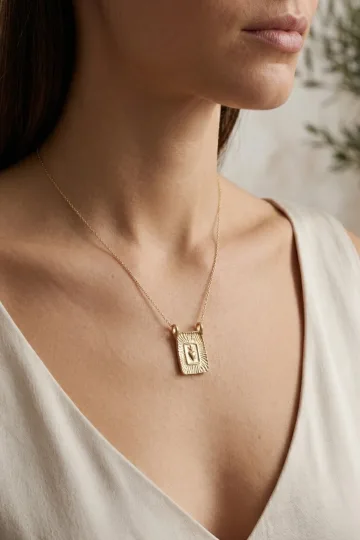
What length and size should I pick? I keep the chain at a medium length, around forty-five centimetres: the symbol should fall into the zone you yourself see in the mirror. I choose a medium size, the Hierophant does not shout; visible enough for you to remember the symbol, restrained enough that it does not fight your clothes.
Who does this aesthetic suit? I suggest it to those drawn to depth without pose: the calm, thoughtful type, people with a pull toward history and ritual, those who value things with a biography. And do not mix more than two metals in one look, or you lose the very composure for which the Hierophant exists.

Turn on your camera, pick earrings, a pendant or a ring, and see the piece on yourself in real time.
Switch items in one tap.
Everything runs in your browser: no photo or video is ever uploaded.
The iconography of the Waite-Smith card: every symbol in detail
The Hierophant card in the Waite-Smith deck is dense with detail. Each detail carries a concrete layer of meaning.
The triple tiara
On the Hierophant's head sits the triple tiara, or triregnum. The three tiers of the crown stand for three worlds: heavenly, earthly, and underworld. In the Catholic tradition the triple tiara is an attribute of papal power, symbolising three kinds of authority: priest, prophet, and king. Waite widens this meaning to something more general: three planes of being that the hierophant takes in with his knowledge.
The three levels of the tiara translate into jewellery through a threefold structure: three links, three pendants of different lengths on a single chain, three rows in a bracelet. This is not a literal copy of the tiara, but a nod to the principle of threeness that the Hierophant carries.
The double cross
In his right hand the Hierophant holds a staff topped with a triple cross, the papale or ferula papalis. This is a specifically papal attribute: two or three crossbars on a single shaft. In the Waite tradition the double cross symbolises the union of the earthly and the heavenly, the joining of two worlds along one vertical axis.
The double cross, also known as the patriarchal cross or the Cross of Lorraine, was historically worn by cardinals and patriarchs. In heraldry it appears on the arms of several European cities. In jewellery terms it is the distinctive symbol of the Hierophant, less common than an ordinary cross, which is exactly why it reads as more particular. For more on the meaning of crosses in jewellery, see our guide to cross necklaces.
The crossed keys at his feet
At the Hierophant's feet, on the stone slabs of the floor, lie two crossed keys, one gold and one silver. This is a direct reference to the keys of Saint Peter and to papal heraldry. In the Catholic tradition the gold key opens the heavenly kingdom, the silver key releases from earthly bonds.
In Waite, the crossed keys symbolise the balance between the conscious and the unconscious, between revealed knowledge and hidden. They lie at the Hierophant's feet, not in his hands: this is knowledge he keeps but is ready to pass to a worthy student. The key as a symbol of access to what is concealed is one of the strongest motifs in jewellery. For a full reading of key symbolism in jewellery, see our guide to the key symbol.
Two students at his feet
Before the Hierophant stand two figures in robes, one bearing lilies, the other roses. They embody the transmission of knowledge: the teacher above, the students below, the space between them ritual. This is a symbol of hierarchy. It is the structure of learning itself: knowledge passed personally, from one person to another, across a shared space.
The lilies on one robe symbolise purity and intellectual knowledge. The roses on the other, practical experience and earthly wisdom. Together they show two types of student that a mentor guides at the same time.
The marble temple
The Hierophant sits between two grey marble columns, just as the High Priestess (Arcanum 2) sits between columns of her own. But the Priestess's columns, one black and one white, are the duality of mystery. The Hierophant's columns are identical, grey: not mystery, but stability. An institution that exists independently of any one person within it.
The marble temple is not a natural space, not a forest or a field. It is a man-made sacred place, built for the passing on of knowledge. Civilisation, not nature. In jewellery, the marble texture is sometimes echoed through grey-and-white agate, or through silver with matte and polished surfaces set side by side.
The gesture of blessing
The Hierophant's right hand is raised in a gesture of blessing: two fingers up, two down. It is a mudra that appears in the iconography of Christian saints and Buddhist teachers alike. Two fingers up are the heavenly, two down the earthly: a bridge between the levels, formed by the hand itself.
The archetypal meaning: tradition, ritual, mediation
The Hierophant is the archetype of the mentor who keeps a tradition. Let us unpack what actually lies behind that.
Tradition, in the context of Arcanum 5, is not rigidity and not a ban on change. It is the accumulated experience of generations, packed into a reproducible form. The ritual people repeat because it works. The system of teaching that passes on not information but understanding.
The Hierophant embodies several linked principles.
Mediation. Between a person and something larger stands the one who knows the language of both. The priest between the worshipper and god. The teacher between the student and knowledge. The master between the apprentice and the craft. The notary between two parties to an agreement that needs to be sealed. The interpreter between two language worlds. The therapist between a client and his own unconscious. The Hierophant is the one who translates. Not the one who decides for you, but the one without whom two worlds cannot speak to each other directly.
Ritual as container. Ritual is not superstition. It is a way of giving meaning to moments of passage. A wedding, a funeral, an initiation, a graduation, the first day at a new job. The Hierophant is present wherever a life transition is given a form that marks it as important. Without ritual the transition still happens, but it stays unlived.
Institution as storehouse. The church, the university, the guild, the family with settled traditions are all mechanisms of storage and transmission. The Hierophant is the principle that keeps what one person learned from dying with them.
Learning through obedience. There is a stage in any apprenticeship when you simply have to do as the teacher says, without understanding why. Not because the teacher is infallible, but because you first have to master the form, and only then look for your own path within it. The Hierophant is exactly that stage.
This is not a romantic archetype. It is not about inspiration or individual revelation. It is about patience, repetition, continuity. About being part of something that was there before you and will be there after.
Upright and reversed
Upright
The Hierophant upright speaks of the following.
In matters of study and career: a time to work with a mentor, to take a formal course, to earn a certificate, to join a professional community. Do not reinvent the wheel; learn from those who already know how.
In matters of relationships: the traditional routes make sense. Formalising things, the blessing of family, meeting the expectations of those close to you. Not because you must obey, but because those structures hold real support.
In spiritual matters: find a spiritual mentor, a tradition, a community. Solitary spiritual exploration has value too, but the Hierophant suggests testing what the collective practices have to offer.
Keywords for the upright Hierophant: tradition, mentorship, institution, ritual, learning, blessing, convention, spiritual guidance.
Reversed
Reversed, the Hierophant changes sign without falling apart; it points to a different kind of problem.
First reading: rigidity and dogmatism. A system that has stopped serving people and begun serving itself. Rules for the sake of rules. Form without content. A ritual people keep performing without knowing why, and which therefore no longer works.
Second reading: rebellion against external authority in favour of the inner one. "I know what I need myself." This is not always a mistake; sometimes that is exactly right. The reversed Hierophant suggests a check: might it be worth breaking free of a system that holds you back?
Third reading: nonconformity and the search for unconventional paths. A refusal of settled forms in favour of personal experience. This may well be the right answer to a particular situation.
The difference between a constructive reversed Hierophant and a destructive one: in the first case, the refusal of tradition comes with a search for something truer. In the second, it is simply negation for its own sake.
Customer reviews
Zevira is a real jewellery shop. Genuine payments, deliveries and customer thank-yous.
🥰🥰🥰 gracias

Ok, ¡gracias! 🙂

Taurus and the element of Earth
In the astrological system of the Golden Dawn, which Waite followed, every Major Arcana card is tied to a zodiac sign or a planet. The Hierophant corresponds to Taurus, the element of Earth, ruled by Venus.
The match is precise and, at first glance, not obvious. Taurus is the sign credited with conservatism and an attachment to comfort. But behind that lies something deeper: the ability to guard what has value, patiently and without drama. That is exactly the quality needed by the one who carries a tradition across generations.
Taurus is the sign of patience, steadiness, loyalty to the proven. Taurus does not rush into the new. It builds, slowly and carefully, what will stand for a long time. Value, for Taurus, lies not in a bright flash but in what accumulates over time. The tradition the Hierophant keeps is precisely the thing Taurus knows how to guard.
The element of Earth is materiality, embodiment, practicality. The sacred knowledge the Hierophant carries does not stay abstract. It is embodied in rituals, in objects, in buildings, in texts, in jewellery. The Hierophant grounds the spiritual.
Venus as ruler adds beauty and harmony. The Hierophant's rituals are not harsh or ascetic. They call for beautiful vestments, music, architecture, ornament. Form should match content; that is a Venusian principle.
The Hierophant's link with Taurus also explains its connection to the body and to sensory experience as a path toward the spiritual. Not asceticism, but the fullness of embodiment.
Parallels: the Pope, the Tibetan lama, the chief rabbi, the patriarch
The Hierophant as an archetype is present in every tradition of the world. It is not a Christian or a Western image, but a universal function.
The Pope. The most direct parallel. Pontifex literally means "bridge-builder" (from the Latin). His task is to connect people with god through the structure of the church, the sacraments, the dogmas, the rituals. The triple tiara, the keys of Peter, the double cross: every attribute passed directly into the card's iconography.
The Tibetan lama. In Vajrayana Buddhism the lama keeps the line of transmission: from the Buddha, through a chain of teachers, to a particular student. The Dalai Lama is considered an incarnation of Avalokiteshvara, the bodhisattva of compassion. The function is the same as the Hierophant's: a mediator between ordinary experience and liberation.
The chief rabbi. In the Jewish tradition the rabbi is not a priest in the Christian sense. He is a scholar, a master of texts, the one who can interpret the law as it applies to a particular case. The chief rabbi of a community is the authority on matters of halakha and tradition. This is the Hierophant in a tradition that has no sacraments but has constant interpretation.
The Orthodox patriarch. In the Eastern Christian tradition the patriarch keeps the apostolic succession. His authority rests on an unbroken chain of ordinations reaching back to the apostles. This is the principle of transmission embodied in an institution.
The Grand Imam. In Sunni Islam the ulama, the scholars, keep and interpret sharia. The Grand Imam of Al-Azhar in Cairo is one of the highest authorities of the Sunni world. His role is to keep the tradition and to answer new questions through the lens of accumulated knowledge.
The high priest of the Eleusinian Mysteries. The very case that gave the card its name. He was the only one who knew the full ritual and could conduct it in the Telesterion, the hall of initiation. His knowledge could not be conveyed in words, only through participation. More on that cult in a chapter of its own below.
In all these parallels the same structure runs through: there is knowledge too important to be lost, and there is a person or institution that takes on the responsibility for keeping it and passing it on.
Upload a photo of your pet, someone you love, or an object. We'll build a 3D model and hand-cast it in pewter.




The Hierophant in literature and film
"The Name of the Rose" (Umberto Eco, 1980)
Eco's novel is a detective story set in a medieval monastery. At heart, though, it is a book about what happens when the keeper of a tradition begins to defend it at any cost, murder included. The blind monk Jorge of Burgos guards the only copy of the second book of Aristotle's "Poetics", convinced that laughter would destroy the fear of God, and that the fear of God is the only thing holding people back from sin.
The Hierophant in its shadow form: when the defence of tradition matters more than the people it is meant to serve.
"Faust" (Johann Wolfgang von Goethe, 1808 / 1832)
Mephistopheles, in his dialogue with Faust, mocks the university professor who teaches the form without grasping the content. "Words make a fine substitute when concepts are in short supply." This is a critique of the Hierophant who has lost the essence: passing on the form of the ritual, but not the living knowledge.
Yet Faust himself is looking for a Hierophant of another kind, one who could pass on the knowledge of "what holds the world together at its core". The trouble is that no such hierophant exists: the knowledge he is after is not transmitted through ritual.
"The Doctrine of the Faith" and church trials
In real history, the Congregation for the Doctrine of the Faith (formerly the Holy Inquisition) is a hierophantic institution in its purest form: its task is to keep the purity of the knowledge being transmitted. The cases of Galileo, Giordano Bruno, and later Pierre Teilhard de Chardin are instances of conflict between the keeper of a tradition and those whose discoveries do not fit the accepted form.
The reversed Hierophant in full.
"Babylon 5" (television series, 1993-1998)
A less expected example. The series has a character, Delenn, leader of the Grey Council, a religious order among the Minbari. Her role is to mediate between the warrior and religious castes. She keeps a tradition a thousand years old and at the same time has to make decisions in real time. This is the Hierophant in a science-fiction setting: the function the same, the form different.
Jewellery from the Hierophant's symbols: keys, cross, shield, sacred heart
The symbolism of Arcanum 5 is rich for jewellery. The card offers concrete images, each carrying a meaning of its own.
Keys: access to hidden knowledge
The crossed keys at the Hierophant's feet, gold and silver, are a symbol of the secret knowledge he keeps. In jewellery the key works as a symbol of access: to knowledge, to the heart, to possibility.
In the Hierophant's context the key carries an extra layer: it is a beautiful symbol of opening. A reminder that some things must be earned, through study or initiation, before you gain access. A key pendant given at a graduation, or after an induction into some tradition, carries exactly that meaning.
A skeleton key, especially in silver with a patina, works particularly well in this aesthetic. It is at once Victorian (a link to the tradition of the past) and a little mysterious (what does it open?). For the full symbolism of keys in jewellery, read our guide to the key symbol.
The Hierophant's double cross: a singular motif
The ordinary cross is well known. But the double cross, the cross with two crossbars, is a specifically hierophantic symbol. It is called the patriarchal cross, the Cross of Lorraine, the double archiepiscopal cross.
Historically it was worn by cardinals and patriarchs as a sign of a particular mediating service: a sign that the wearer is responsible for passing the faith on, not only for professing it. That makes the double cross a rarer and more meaningful piece than the standard Latin cross.
A double-cross pendant in 925 silver is a direct reference to the Hierophant's iconography. To those who know the card, it reads at once. To those who do not, it simply looks like a beautiful old cross with a long history. Which is also true.
For more on the meaning of crosses of every shape, see our guide to cross necklaces.
The shield: protection through tradition
A shield in jewellery symbolises protection. But in the Hierophant's context the shield carries a particular shade: it is not the lone individual's personal armour. It is protection through belonging to a system. Family, tradition, order, profession; each of these institutions acts as a shield for its members.
In heraldry the shield is the foundation of a coat of arms. It carries the symbols of a lineage, the marks of belonging. This is precisely the hierophantic idea: you are protected by being part of something larger.
A shield pendant, especially with a heraldic motif or a space for personal engraving, works as a piece for those who feel a tie to the tradition of a family or a profession. For more on shield symbolism, see our guide to the shield symbol.
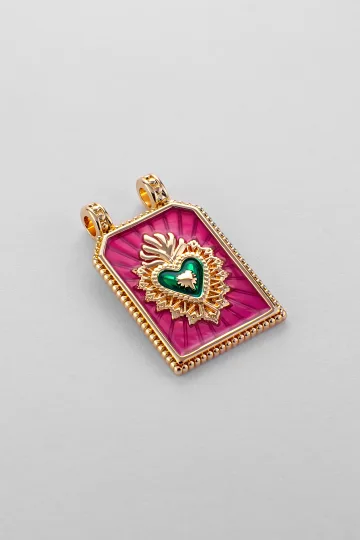
The sacred heart: spiritual mediation through love
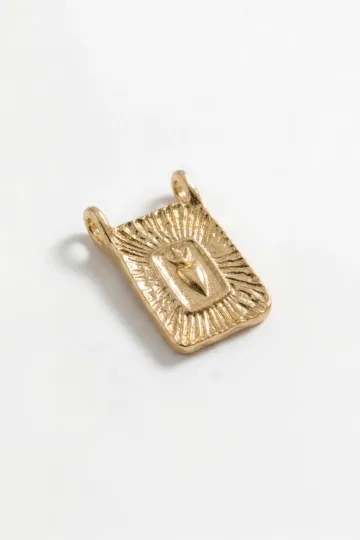
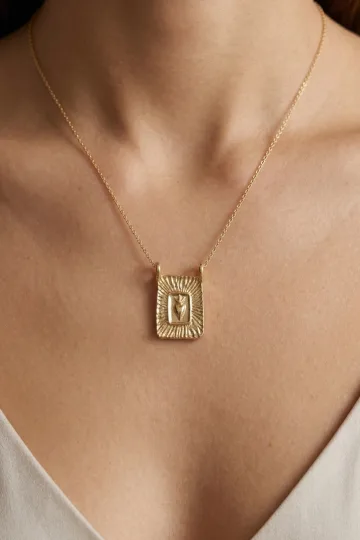
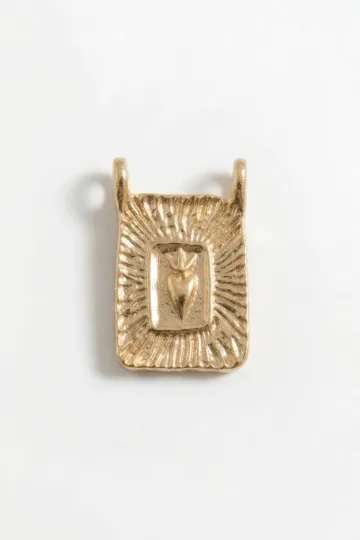
The sacred heart, a flaming heart with a cross, is one of the central symbols of the Catholic tradition. Its iconography took shape in the seventeenth century around the visions of Margaret Mary Alacoque, but its roots reach into medieval mysticism.
In the Hierophant's context the sacred heart symbolises what stands behind the ritual: love as the foundation of spiritual transmission. Not a rule, not a law, not the fear of punishment, but a bond of the heart between teacher and student, between a person and what they hold sacred.
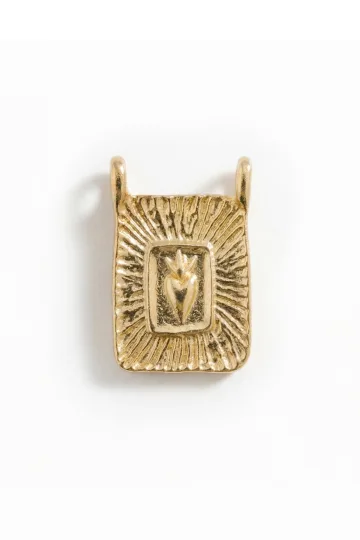
A sacred-heart pendant is a piece with layered meaning. For some it is a literal religious symbol. For others it is an image of passion and devotion. For others still it is the aesthetic of Spanish and Latin American baroque, rich and intense. For more on the symbolism of the sacred heart, see our guide to the sacred heart.





The Hierophant and the theme of learning: how to read the card in different contexts
The Hierophant rarely appears without a concrete context. When it lands in a spread, the first thing to look at is which kind of knowledge and transmission it is speaking of at this particular moment in the querent's life.
The Hierophant and the career path
In a professional context the Hierophant most often says one of two things.
First: now is the time to learn from those who know. Do not try to invent the approach from scratch; find a mentor in the field and pick up the proven methods. Earn the certification. Take the formal course. This is not a limitation but an acceleration: the accumulated experience of others saves years of trial and error.
Second: it is time to pass things on. If there is significant experience behind you, the Hierophant can mean that the moment has come to become a mentor to others. The student has become the master. Now the cycle asks that the master take on students of his own.
Both readings matter, and neither is better than the other. It all depends on where the person stands at the moment.
The Hierophant in questions of meaning and the spiritual path
When a person asks about meaning, about the spiritual path, about what to believe, the Hierophant in a spread suggests testing the existing traditions before striking out entirely on your own.
This does not mean "submit to the system". It means: human history holds thousands of years of reflection on the same questions that occupy you. Before inventing a new spirituality, it is worth seeing what has already been found.
The Hierophant may also point to a particular tradition worth studying. Not necessarily a religious one: a school of philosophy, a psychological approach, a meditative practice with a settled methodology.
The Hierophant in the family context
In family matters the Hierophant often speaks of the role of elders. Of the worth of listening to the experience of earlier generations, even when it seems out of date. Or of accumulated wisdom in the family that can be drawn on.
Sometimes the card points to a ritual worth restoring or creating. Families with no traditions and rituals of their own are more vulnerable in moments of crisis, because they have no accumulated form for living through the difficult.
The Hierophant in questions of health
In the context of health the Hierophant most often speaks of the importance of turning to professionals with accumulated knowledge. Not self-medication, not advice off the internet, but recourse to a body of knowledge that has stood the test of time.
The history of the Eleusinian Mysteries: where the word itself comes from
The Eleusinian Mysteries were held at Eleusis, some twenty-three kilometres from Athens. By various estimates the cult lasted more than a thousand years and was banned in 392 CE by the emperor Theodosius I as a pagan practice.
The mysteries were dedicated to the story of Demeter and Persephone. Demeter, goddess of fertility, loses her daughter Persephone, carried off by Hades into the underworld. In her grief she stops caring for the earth, and winter comes. Zeus secures Persephone's return, but she has already eaten pomegranate seeds in the underworld and must now spend part of the year there. Her return each spring is rebirth.
The Eleusinian Mysteries were divided into the Lesser and the Greater. The Lesser were held in spring at Agrae near Athens, the Greater in autumn at Eleusis. Participants in the Greater Mysteries numbered in the thousands: ordinary citizens, aristocrats, rulers. Among those who passed through them were Plato, Pindar, Epictetus, probably Aristotle, and later several Roman emperors.
What took place in the Telesterion, the hall of initiation into the Greater Mysteries, was unknown to the uninitiated. This was a strictly kept silence: revealing the secrets was punishable by death. Across the whole history of the cult and its hundreds of thousands of participants, not a single complete account of the ritual has survived.
The hierophant stood at the centre. Only he knew the full text and the order of the rite; only he could pronounce the sacred formulas. His office was passed down within the family of the Eumolpidae by inheritance: from father to son, through initiation rather than ordinary teaching.
After the ban of 392, this knowledge vanished literally: the last initiates died, and the chain broke. One of the clearest cases of hierophantic transmission breaking off and knowledge being lost forever. That is the very image Waite chose when he gave Arcanum 5 the name of a Greek priest.
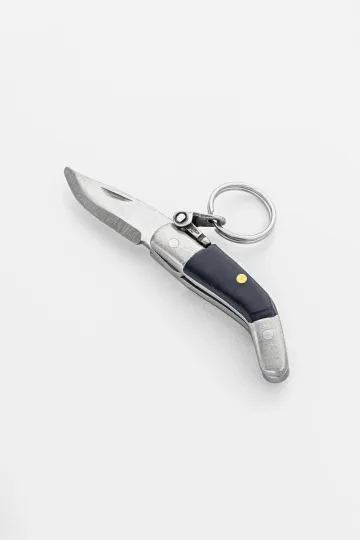
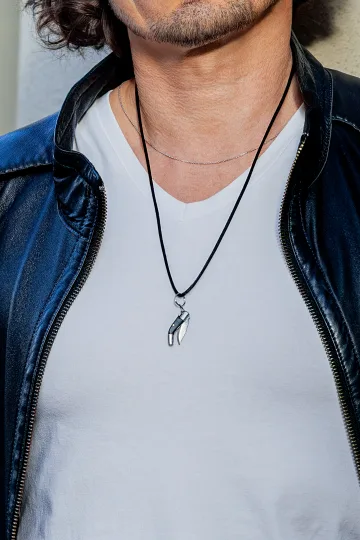
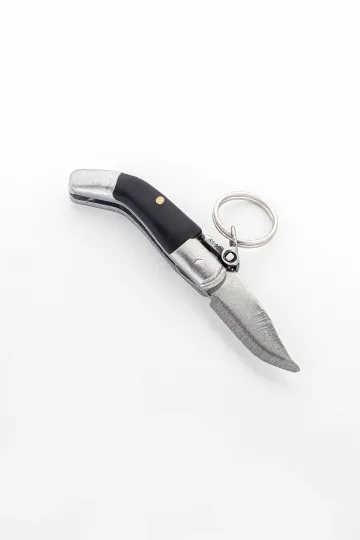
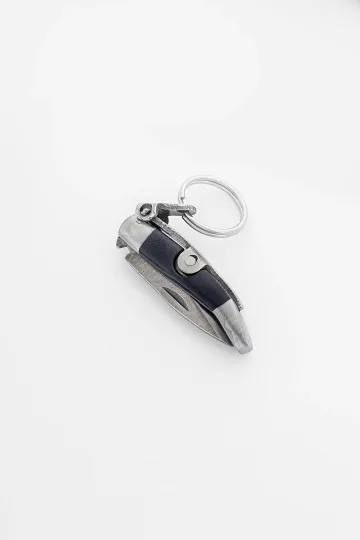
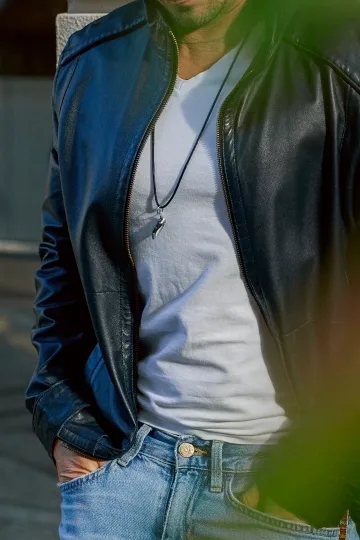
CAPAORA mini knife pendant
The 18th-century Spanish navaja in miniature: 40 mm of stainless steel, a real folding mechanism and a Palanquilla lock that clicks. An affordable gift to remember.
Authentic · Ships from Spain · 14-day returns
Choosing a piece by the Hierophant's symbolism: a practical guide
If you want a piece with the symbolism of Arcanum 5, here are a few practical pointers.
By the layer of meaning that matters to you now.
If you are in the middle of study or apprenticeship: the key. A symbol of access to knowledge you do not yet hold but are moving toward. Wearing a key during a period of study is a reminder of why you are doing it.
If you are passing knowledge on to others, having become a mentor or teacher: the double cross. A symbol of mediation, of the vertical axis between levels. A reminder that you carry responsibility both for yourself and for those you teach.
If you feel a tie to a tradition or a lineage and want to mark it: the shield with a heraldic or personal symbol. Protection through belonging.
If you are in the middle of a spiritual search, looking for a tradition you can trust: the sacred heart. A reminder that at the root of any real transmission stands not power and not fear, but love.
By aesthetics and style.
Oxidised silver with a dark patina, for the most meaning and the least decoration. A piece that carries history.
14K gold, for the solemn moments of initiation. Stepping into a post, defending a thesis, being admitted into a professional community.
A combination of metals, for the card's full symbolism: gold and silver keys, which carry an extra layer of meaning.
By size and visibility.
The Hierophant is not aggressive. Its strength does not lie in being noticed by everyone. The ideal size is a medium pendant or a slim ring. Visible enough that you yourself remember the symbol. Restrained enough not to catch everyone's eye.
Size here works toward the same restraint as the symbol itself: a piece should not demand attention in order to carry meaning.
Leave your email, we'll send your discount code. No spam, unsubscribe anytime.
The code arrives by email, valid on your first order.
The Hierophant in spreads: what its position means
In the "current situation" position
The Hierophant at the centre of a spread says you are inside the space of a system: an educational institution, a religious tradition, a professional hierarchy, a family order. This is not necessarily bad. It may well be that right now it makes sense to use the resources of that system rather than fight against it.
In the "advice" position
The card advises turning to a mentor, walking the formal path, getting guidance from someone who already knows how. Do not try to discover everything on your own; draw on what has been accumulated.
In the "obstacle" position
If the Hierophant stands as an obstacle, it may mean: too rigid an adherence to the rules is blocking movement. Or: someone in your life is using authority not to pass on knowledge, but to control.
In the "outcome" position
The Hierophant as outcome: the path will complete itself through study, through recognition within a system, through passing knowledge on to others.
Paired with other arcana
The Hierophant and the Fool (0): tradition meets the newcomer. A good time to begin a formal course of study.
The Hierophant and the Tower (16): the crisis of an institution. A system that held together on form without content comes down.
The Hierophant and Judgement (20): the close of a cycle of learning, initiation, recognition.
The Hierophant and the High Priestess (2): two kinds of knowledge, the institutional and the intuitive. When they sit side by side, the question is: which path to knowledge are you on right now?
Combining the Hierophant with other symbols in jewellery
Hierophant-themed pieces work well in combination with other symbols, as long as there is an inner logic between them.
Key and cross. The classic pairing of hierophantic aesthetics. The key as access to knowledge, the cross as the vertical axis between earthly and heavenly. A bracelet with two charms, or earrings where one symbol completes the other.
Double cross and shield. Protection through belonging to a tradition. It works well for those who feel themselves part of some system: family, professional, spiritual.
Key and sacred heart. The heart and access. Spiritual transmission as an act of love, and also as an act of teaching.
A threefold form. Any piece with a threefold structure, three links, three pendants, three layers, echoes the Hierophant's triple tiara.
Silver with a patina. Oxidised 925 silver, the base metal for this theme; why exactly this metal, we discuss below in the chapter on materials.
Chains of equal length. Unlike the symbolism of the Fool, where chains of different lengths work well as a symbol of movement, the Hierophant is balance and symmetry. Chains of equal length, matching earrings, symmetrical bracelets.
The Hierophant and the other Major Arcana: how they interact
Understanding the Hierophant deepens when you look at it in the context of neighbouring cards and thematic groups.
The Hierophant and the High Priestess: two kinds of mediation
The High Priestess (Arcanum 2) and the Hierophant (Arcanum 5) are both tied to spiritual knowledge, but from opposite sides.
The Priestess keeps the personal, intuitive, untransmittable knowledge. She sits before a veil of pomegranates, behind which lies what cannot be passed on through words. She is silent. Her knowledge calls for inner experience, not instruction.
The Hierophant keeps collective, systematised knowledge, passed on through ritual and teaching. He speaks. His task is to make accessible what would otherwise stay closed.
If your question calls for an inner answer, the Priestess. If it is a question with a proven path and a teacher, the Hierophant.
In jewellery this pair shows up through contrast: moonstone and silver for the Priestess (mystery, reflection, night), oxidised silver with a double cross for the Hierophant (tradition, structure, transmission).
The Hierophant and the Fool: the newcomer meets the system
If you read the arcana as the Fool's journey (Arcanum 0) through all the stages of experience, the meeting with the Hierophant is the moment the traveller first runs into an organised system of knowledge.
The Fool steps into the world with no plan and no system. The Hierophant offers a system. It is always a difficult moment: the system gives support, resources, the accumulated experience of thousands of people. But it also demands submission to a form, at least at the start.
The most important questions when the Fool meets the Hierophant: does this system really keep living knowledge, or only form without content? Does the teacher I have met truly pass things on, or only control?
The Fool's journey through all the arcana and the jewellery symbolism around it is covered in detail in our article on Arcanum 0 and the symbols of the path. The Fool and the Hierophant together describe the full cycle: stepping into the world without a map, and then finding the tradition that keeps the accumulated maps of everyone who walked the path before.
The Hierophant and the Tower: what happens when an institution falls
The Tower (Arcanum 16) stands paired with the Hierophant as its antagonist. If the Hierophant is the principle of steady transmission through a system, the Tower is the moment the system comes down. Lightning strikes the tower, the crown falls, figures fly from the windows.
This is not necessarily bad. The Tower tears down what held together on form without content. If a hierophantic structure has lost its living knowledge and become only power for power's sake, the Tower is the necessary crisis.
After the Tower, systems of transmission arise again, in a new form. The hierophantic principle cannot be destroyed: as long as there are people, knowledge will be passed on. Only the form of transmission changes.
What people feel when the Hierophant turns up in a spread
Reactions to this card are very different, and that in itself is telling.
Some feel relief. The Hierophant confirms it: the path you are walking is a proven one. You are not alone. A tradition stands behind you. You can lean on what came before you.
Others feel irritation. "The system again, the rules again, someone again telling me how things should be done." This is the reaction of a person who needs not the support of a structure right now, but a way past its limits. That is information too: perhaps a particular Hierophant in your life (a teacher, an organisation, a tradition) no longer serves your growth.
Others feel weight. "Responsibility again for keeping something large." This is the reaction of a person who has become, or is becoming, a Hierophant to someone, and is not sure whether they are ready to carry that responsibility.
Others feel longing. "I want a tradition like that, a system, a mentor, and I cannot find one." This is a request for a hierophantic structure that is not yet in their life.
All these reactions are normal and all are informative. The card shows not what should be, but what is.
The Hierophant in astrology: deeper into Taurus
The Hierophant's correspondence to Taurus is no accident and deserves a look of its own.
Taurus, the second sign of the zodiac, the element of Earth, a fixed sign. The fixed signs (Taurus, Leo, Scorpio, Aquarius) neither begin nor end things. They sustain and stabilise what has already started. Taurus takes what Aries began and turns it into a durable reality.
In the Hierophant's context this means: he is no revolutionary and no reformer. He is the one who takes living knowledge and makes it into a durable system, able to last across generations. That calls for patience, method, the giving up of the shallow for the sake of the deep.
Venus, ruler of Taurus, adds a sensory dimension. The Hierophant's rituals always work through sensory experience: the smell of incense, the touch of the temple's cold stone, the sound of the organ, the weight of the vestments. Taurus knows that bodily experience fixes knowledge more reliably than words.
This explains why jewellery fits so naturally into the hierophantic theme. A piece is a bodily, tangible way to wear a symbol. Not an abstract idea, but an object with weight and texture.
People born under Taurus often find a particular resonance with the Hierophant card. Not because they are bound to follow traditions, but because the quality of patient keeping and passing on comes naturally close to them.
The Hierophant as mentor: when this card is about a person in your life
The Hierophant in a spread often points not to an abstract principle, but to a particular person in the querent's life.
It may be a teacher who changed the way you think. A lecturer who did not pass on information but opened a door into a whole world of thinking. Such teachers are rare, but those who have met them remember them for life.
It may be a religious mentor: a priest, a rabbi, an imam, a monk, a Zen teacher. A person who knows the path and is ready to lead another along it. Not because they are after power, but because passing things on is their calling.
It may be an elder in a profession. A master who took on an apprentice. A colleague with twenty years of experience who does not begrudge the time to explain. A mentor who sees the potential before the person sees it themselves.
It may be a parent or an elder in the family. The one who passes on not household skills but a way of looking at the world, a system of values, an attitude toward tradition.
When the Hierophant points to a person, it is worth asking yourself a few questions. Does this figure really pass on knowledge, or only imitate transmission while holding on to power? What have I already learned from them? What do I still need to take from this teacher? Has the moment come to step beyond what they can give?
The last question matters most. A hierophantic mentor who keeps the student dependent is not passing on, but absorbing. A good hierophant knows when the student should leave, and points to that moment himself.
Send a friend a discount code, they save on their first order.
The digital age: new Hierophants
In the twenty-first century the hierophantic function has not disappeared; it has shifted into new formats.
YouTube channels devoted to a particular craft. Podcasts where an experienced practitioner shares accumulated knowledge. Online schools with a system of levels and certifications. Masterclasses from well-known practitioners.
All of these are new hierophantic structures. They work on the same principle: the one who knows passes things on to the one who is learning, through an organised form. The only difference is that the space of transmission has gone digital.
This has changed the scale, but not the principle. A Hierophant in the digital world can pass knowledge to millions of students at once. But the question of the quality of transmission remains: living knowledge, or only its form? A real mentor, or an imitation of one, trading on the illusion of authority?
A piece with the Hierophant's symbolism, in this context, is a reminder that behind the digital noise stands a principle that has lasted for millennia. That the knowledge worth seeking has always been passed on through a particular person, and not through text or video alone.
Materials and finishes for Hierophant jewellery
The choice of metal and finish for Arcanum 5 pieces matters, because the Hierophant is the element of Earth, and the material embodiment here is part of the meaning.
925 silver with an oxidised patina
The best choice for the hierophantic theme. A dark patina reads visually as accumulated time, as history, as something that has passed through many hands. It brings out every detail: the relief of the double cross, the contours of the key, the shape of the shield.
Oxidised silver is also more matte than polished, which gives a sense of dignity without pretension. The Hierophant does not shout. He stands in a dark robe between two grey columns and speaks quietly.
925 silver without oxidation
A more versatile option. Pure silver shine works in a lighter register of the same symbolism. For those who prefer a classic jewellery aesthetic without the gothic depth.
14K gold
Gold lends the hierophantic symbolism a formality and solemnity. It is the choice for a piece that marks a particular moment of initiation: defending a thesis, a professional induction, an important family ritual.
Gold also echoes the Hierophant's golden key, the one that opens the heavenly.
Combined pieces
A double cross or crossed keys in two metals, gold and silver at once, are a direct reference to the card's iconography. The gold and silver keys at the Hierophant's feet. Such a piece carries the fullest possible layer of meaning.
Stones in Hierophant jewellery
The Hierophant is the element of Earth. Stones of earthly origin work naturally within its symbolism.
Lapis lazuli. Deep blue with golden veins of pyrite. In the medieval tradition this is a stone of wisdom and heavenly knowledge. It was used to make the pigment ultramarine, with which the robes of the Madonna were painted. Lapis lazuli in a Hierophant piece adds a layer of heavenly knowledge.
Onyx. Black, impenetrable. A stone associated with protection and strength. It pairs well with dark silver and the double cross. Serious, steady.
Garnet. Deep red. A stone historically tied to the blood of a covenant and to loyalty. In the Hierophant's context it is the colour of commitment to a tradition.
Agate. Various shades, from grey-blue to brown. Earthy, steady. In some traditions agate was used for seals and signet rings, and that is a direct hierophantic link.
Amber. Golden, ancient, literally fossilised. It carries the meaning of the very old, the preserved. For pieces about transmission across generations, amber is ideal.
Buying it as a gift? Each one arrives ready to give.
 A branded Zevira box and a little card come with every order.













Who the Hierophant's symbolism suits
Students and postgraduates
A piece with the Hierophant's symbolism is fitting at any moment of study: at the start, when you are only entering the system, and at the end, when you pass through the ritual of completing it.
A key pendant lands especially well at a thesis defence. It is a symbol that you have walked through the gate and earned the access that had to be earned.
Teachers and mentors
For those who have become a hierophantic figure to their own students. A piece with a double cross or with a symbol of transmission is an acknowledgement of the role you carry. Not the crown of power, but the key of responsibility.
Those going through a professional initiation
Stepping into a post, a first independent project after a long apprenticeship, earning a licence, being admitted into a professional community. Any of these moments is hierophantic in structure. A piece that marks it becomes a material memory of the passage.
Those seeking, or just having found, a mentor
The start of a real apprenticeship is a special state. A person who has found a teacher with something genuinely worth passing on is living through something important. A piece with hierophantic symbolism at that moment is an acknowledgement of the worth of what is happening.
Those who keep family traditions
If there is a tradition in your family that you uphold, recipes, rituals, stories, objects, then you already perform a hierophantic function. A piece with a family crest or with a symbol of transmission is an acknowledgement of that role.
Those going through a crisis of faith in a system
The reversed Hierophant gives a reason for a piece too. If you are stepping out of a tradition that held you back, or seeking a new one, or rethinking your relationship with authority, the symbolism of an open or reversed key works here.
As a gift
The same occasions work for a gift to another. A key pendant at a graduation says: you have earned the access. A piece for a mentor acknowledges their role. A double cross on a professional anniversary marks the one who long kept and passed things on. A gift here is a way of naming aloud a passage that would otherwise go unnoticed.
FAQ
Is the Hierophant always about religion?
No. Religion is the most obvious context, but far from the only one. The Hierophant appears wherever there is a system for passing on knowledge: a university, a guild, a family with strong traditions, a professional order, a therapeutic method. Any mentor who passes on not information but understanding is a hierophantic figure.
What does the Hierophant mean in questions of love?
In a love spread the upright Hierophant most often speaks of traditional relationships: formalising things, marriage, family as an institution. Sometimes of a partner who is a mentor or an authority. The reversed Hierophant in matters of love is about unconventional formats of relationship, a refusal to formalise, a mismatch of values.
How does the Hierophant differ from the Priestess?
The High Priestess (Arcanum 2) keeps secret, intuitive knowledge, the kind that is not passed on in words and is not expressed in institutions. She is silent. Her knowledge is personal and inner. The Hierophant passes on knowledge publicly, through ritual and structure. His knowledge is collective and outer. One keeps the secret, the other opens the way to it through initiation.
Do you have to be religious to wear Hierophant symbols?
No. The symbols of keys, crosses, shields carry layers of meaning that work beyond the religious context too. The double cross is a history of mediation, not necessarily Christian. The key is access and knowledge, not necessarily the Keys of Peter. The shield is protection through belonging. You can wear them from any position that finds meaning in them.
How do you tell a Hierophant piece from an ordinary religious one?
The wearer's intention. A cross as a religious symbol is about faith in a particular tradition. A double cross as a Hierophant symbol is about the principle of mediation, teaching, transmission. One and the same object can carry both meanings at once; that is not a contradiction.
The Hierophant and shamanism: is there a link?
The shaman in traditional cultures performs the same function: mediation between the world of people and the world of spirits. Ritual, a special status, transmission through initiation. The shaman passes through a particular experience, illness, vision, death and rebirth, which makes him a competent mediator. The structure is the same as the Hierophant's. This confirms the universality of the archetype: wherever there is the sacred and the profane, a figure appears who stands between them and knows how to translate.
Can you wear the Hierophant's symbolism as a reminder of a mentor?
You can, and it is one of the most precise ways. A piece with a key chosen in honour of a teacher who changed your thinking. A double cross as a symbol of the person who showed you a path within a tradition. A pendant with the shield of a family crest as a memory of an elder in the line who carried the history. All of this works as a material tie to a figure who played a hierophantic role in your life. The piece in that case works as a point of memory.
What does it mean if the Hierophant turns up more often than other cards in spreads?
Frequent appearance says this principle is active in your life right now. There are several readings. You are going through study or initiation, and the system you are mastering demands your full attention. You have become, or are becoming, a mentor yourself, and that role is not yet fully realised. The systems you are part of are in a phase of transformation and call for a conscious attitude toward tradition. Or, finally, you need a mentor, and the card points to that request.
How should you combine the Hierophant's symbolism with other tarot cards in jewellery?
The Hierophant combines well with symbols that continue or complement its theme. The Fool (0) as a pair, the start of the path and the system you enter. The Sun (19) as a pair, tradition and its light, knowledge and its joy. The World (21) as a pair, the close of study, the reaching of full knowledge. The Tower (16) as a contrast, the system that comes down once it has become form without content. These combinations work both in a spread and in jewellery: a bracelet with several charms or a set of pendants on different chains.
Can you wear the Hierophant's symbolism if you are far from religion?
Yes. The secular Hierophant exists everywhere: in academia, in professional communities, in family traditions, in schools of art. The double cross is a historically interesting object with seven centuries of iconographic history. The key is a symbol of access that exists in cultures the world over. The shield is a heraldic form with a long history of its own. You can wear them in any context that resonates for you.
Wear the symbol, don't just read about it. These are in stock:
Conclusion
The Hierophant is not the brightest card of the Major Arcana. None of the romance of the Lovers, the mystery of the Priestess, the drama of the Tower. It is serious and a little solemn. It sits between two identical grey columns and passes a blessing to two figures who have come to learn.
But that is exactly what makes it so steady. It is about what does not need to be explained anew each time. About what holds together on its own, because thousands of people have passed through it before you and thousands will after.
The symbols it carries, the keys, the cross, the shield, the tiara, the gesture of blessing, are not decoration. They are tools of transmission. A piece with one of these symbols is a tie to a principle that has lasted longer than any one religion or tradition.
A person who understands the Hierophant also understands that solitary knowledge is fragile. That the most important things are passed on personally, from teacher to student, in the space of ritual or learning. That tradition is not a prison, but the accumulated experience of humanity, packed into a form you can work with.
To wear a piece with its symbolism is to wear a reminder that you are part of an unbroken chain. Someone taught you. You teach someone. The chain does not break.
The priest of the Eleusinian Mysteries who received new initiates two thousand years ago, and the university lecturer passing a difficult idea to students today, are one and the same archetype. Different eras, different formats, one and the same function. The keys lie at the Hierophant's feet to this day. The only question is whether you are ready to take one of them.
A silver double cross on a chain. A skeleton key with a patina. An engraved shield. A sacred heart in a baroque setting. Any of these pieces says the same thing: I am part of something larger. I remember who taught me. I carry it on.
Silver, gold, wedding rings, symbolism, matching sets.
About Zevira
Zevira makes jewellery in the artisan tradition of Albacete, Spain. Tarot symbolism is one of the constant motifs in our collections: from the Fool to the World. Hierophant-themed pieces are especially fitting for those who value tradition, are going through study, or are looking for a symbol of belonging to something that matters.
What you can find with us for the Hierophant's symbolism:
- Double-cross pendants in 925 silver with a patina, a direct reference to the card's iconography
- Key pendants in skeleton and antique forms, a symbol of access to knowledge
- Shield pendants in heraldic forms, with the option of personal engraving
- Sacred-heart pendants in the Spanish baroque tradition, spiritual transmission through love
- Matching key and cross pendants for two people tied by a shared tradition
- Rings with the symbolism of transmission, for those who wear a reminder of their path on the hand
Every piece can be personalised with engraving. 925 silver, 14-18K gold. Personal engraving of a date, a name, or a word that matters to you is possible.