Jewellery and Headphones: What Presses, What Snags, What to Wear
The ear became a workplace
In 1910 the United States Navy bought its headphones from a man assembling them ten pairs at a time on a kitchen table in Utah. A century on, one ear holds an earbud, a glasses arm, a mask loop and an earring at once. Something gives, and it is usually the jewellery.
The fight between headphones and earrings happens every day, and it plays out in one of three ways. A person takes an earring out before a call, drops it in a pocket, forgets it, loses it. Or leaves it in and finds a red dent from the clutch on the lobe by evening. Or hears a faint click on a recording, blames the microphone, and never thinks to look at the chain around the neck.
The subject looks trivial, and it is settled at the point of purchase. Jewellery chosen with the gear in mind never has to come off. Jewellery chosen without that thought lives in a pocket and one day fails to come back out of it. What follows is what actually happens between the technology and the metal on the ear, and which shapes take it calmly.
Three ways to interfere: pressure, snag, sound
There are exactly three conflicts, and they are worth keeping apart, because each is fixed differently. Pressure builds when a cup or a pad presses an earring against the ear and turns it into a hard point between two surfaces. The worst offender here is not the front of the earring but its back: the clutch, the post, the butterfly.
Snagging is mechanics. A hoop, a hook or a swinging drop catches the edge of a pad or a temple arm, and when the gear comes off the jewellery follows it. The lobe stretches, and in a bad case it tears.
Sound is a matter of the recording, not the ear. Metal lying near a microphone taps against other metal, rubs against fabric, and produces clicks that no amount of editing removes cleanly. You feel the first two conflicts. You discover the third only once the take is already made.
Why the ear loses to the gear
The outer ear is cartilage under thin skin, with almost no fat beneath it. The only soft part is the lobe, which is exactly why piercings went there for centuries. Everything else presses straight onto the perichondrium, the sensitive lining of the cartilage, which recovers slowly.
The gear, for its part, is built for an average ear with nothing on it. The clamp of a headband is set so the pad holds a seal, not so an earring fits under it. No headset adapts to a piece of jewellery, so the jewellery is the thing that has to adapt.
From that follows a plain rule: given the choice between changing the gear and changing the earring, changing the earring is always cheaper. The good news is that the shapes which live happily under a headset read as grown-up rather than modest, not as poorer than the big ones.
What is normal, and what is a signal
An even mark from the pad that fades soon after the gear comes off means nothing. A single point under the lobe that you still feel once the headset is off is a different thing: the clutch has pressed into the tissue. If a mark like that is still there in the morning, the ear is worth showing to the piercer who did the hole.
Some signs call for no guesswork at all. Pain that the same gear never caused before. Redness around the piercing itself rather than along the line of the pad. Discharge, swelling, the feeling that the post sits deeper than it did in the morning. Take those to a piercer, and if there is swelling and heat, to a doctor: telling mechanical irritation from infection by eye is not something an article can do for you.
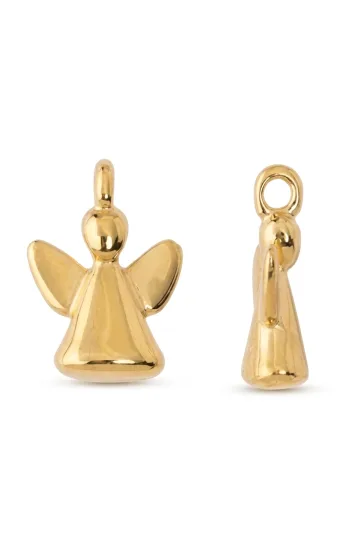
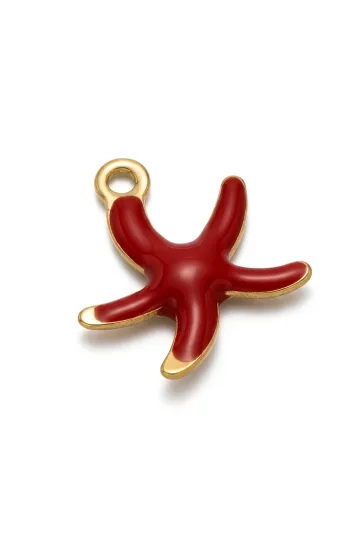
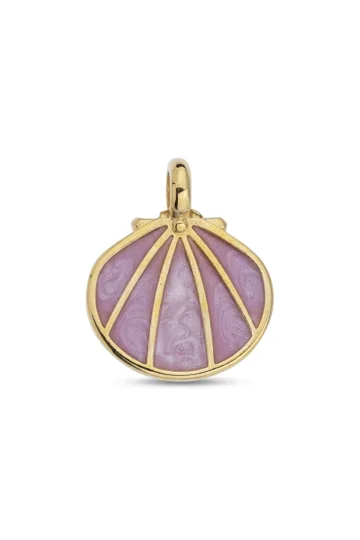
Wear the symbol, don't just read about it. These are in stock:
A hundred years of technology on the ear
The clash between an earring and a headset looks like a complaint of the last decade. In fact the technology moved onto the ear more than a century ago, and both sides of the fight have changed several times over.
Theatre down the wires, and headphones on a rod
You could listen to a play through a pair of capsules as far back as the nineteenth century. In the 1890s the British firm Electrophone ran wires to the stages of London theatres and opera houses and sold a subscription to the live feed: a subscriber picked up a receiver at home or in a club and heard what was happening on the stage that minute.
People listened through heavy capsules joined below the chin and mounted on a long rod. A rig like that did not sit on the head. The listener held it, and the rod existed so the weight of the capsules did not have to be carried on the fingers up beside the ears.
For our purposes this is the useful starting point. While the technology stayed in the hand, sound and jewellery did not physically argue: the listener decided how hard to press a capsule and could ease off at any second. An earring under a held capsule was there for the length of a broadcast, not a working shift, and took exactly the load the listener chose to give it.
A kitchen table in Utah and a naval order
In 1910 Nathaniel Baldwin of Utah assembled, on his kitchen table, capsules markedly more sensitive than what radio operators of the day were using, and sent samples to the military with a letter written in purple ink on pink and blue paper. The Navy tested them, judged them the best it had tried, and ordered a batch, even though the inventor could make around ten pairs at a time.
The build was simple: a pair of capsules on a band that arched over the head and held them to the ears with a constant force. A band differs from a held capsule in one respect, which is that the band sets the force, not the fingers. A hand presses as hard as a person likes and lets go the moment it tires. The spring of a headband holds what it was built to hold, and holds it for as long as the gear is on the head. Anything caught between the pad and the ear gets that same force in full.
For jewellery the difference between those two ways of listening is the whole story. A held capsule is eased the second a clutch starts to bite, at no cost. A headband gives no such option: to relieve the pressure you take the whole thing off, and you put it on for the sound and keep it on to the end of the task, that is, to the end of the call, the workout or the shift. So the question of what can stay in the ear applies precisely to whatever holds on the head by itself.
Screw back and clip: holding an earring on an unpierced ear
The second party to the fight changed no less. Victorian Europe treated a pierced ear as not quite respectable, and the fashion for earrings returned before the tolerance for a hole in the lobe did. The answer was the screw fitting, which appeared in the 1890s: the earring held by a thread and pinched the lobe from both sides, needing no hole at all.
In the 1930s the hinged clip reached the market, a sprung grip that opened and closed in one movement. It proved faster than the screw and took its place in daily use.
Both fittings had the same job: to hold a piece on an ear with no hole in it. It had nothing to do with technology. The solution had a consequence, though, that anyone wearing a clip under a headset now feels. A grip holds by squeezing, so by definition it stands on both sides of the lobe and rises above it on both. A piercing wins over a grip in that respect: a post passes through the tissue rather than clasping it, and in a flat form it barely rises above the skin.
What the history means for a buyer
The conclusion is short and firm: everything that holds on the head by itself works on the ear the same way. The band of a headset, a glasses arm, a mask loop, the lining of a helmet differ in force, area and direction, not in nature. Each presses whatever ended up between it and the skin against the ear, and does so for as long as it stays on the head. The capsule on a rod, held in the hand, is not on that list: there the force came from a person who could drop it at any second.
So the demands on the jewellery are set by mechanics, not by fashion. Under constant pressure the survivor is whatever does not gather force into a point: wide beats tall, smooth beats spiky, fixed through the tissue beats clamped from both sides. The screw fitting of the late nineteenth century and the flat labret handle it in their own ways, and both are judged the same way: by what is left on the back.
Under over-ear headphones I pick a flat back and a profile with no single high point. Save the hoops for an evening without a headset. A post with a butterfly clutch presses with the tail behind the lobe, not with the front, and the headphones are not to blame.
A stylist on an eight-hour shift in a headset
A working day in a headset often ends with the earrings simply staying at home: it is easier to give them up than to take them off every time. Below is a conversation with a Zevira stylist about building a set that survives a shift and still reads.
Where do you start when someone tells you they are in a headset all day?
I ask which headphones, and how many hours in a row. After that the choice is almost mechanical. Under over-ear models I recommend a flat back and a profile with no separate high point; under in-ear buds you can keep drops, because the ear is free. Shape and metal come after that question, not before it.
What about people who need the earrings to read on camera?
Work with width, not height. A wide flat disc reads on a screen better than a small ball, and nothing stands out forward or back. I suggest moving the accent to a second lobe hole or to a cuff higher up, if the upper ear is free of an arm. What actually survives on a webcam is covered in detail in the piece on jewellery for video calls.
And the chain? Does that come off too?
I keep the chain, but I pick a length that stays clear of the collar and the cable. A short one sits on the collarbone and lives quietly. A long one drops into the neckline, and that is where everything you hear on a recording begins. Under a headset I recommend one pendant with no moving parts: two pendants on two chains will find each other and knock.

Turn on your camera, pick earrings, a pendant or a ring, and see the piece on yourself in real time.
Switch items in one tap.
Everything runs in your browser: no photo or video is ever uploaded.
How headphones sit on the ear
Before choosing an earring it helps to understand the geometry: different kinds of gear touch different parts of the ear, and their forbidden shapes do not overlap.
Over-ear headphones: the cup circles the ear
An over-ear model encloses the whole outer ear, and the pad rests in a ring around it: in front at the temple, above the ear, behind it, and below the lobe. Above, in front and behind, the bone of the skull lies close under the skin, and below there is no bone at all, only the soft tissue of cheek and neck, and the pad sinks deeper into it. The ear inside the cup is technically free, but only for an empty ear.
Add an earring and the picture changes. With the gear on, the lobe is pressed to the head by the lower edge of the pad, and the cartilage rim touches the wall of the cup at the top. So over-ear headphones bear on the upper cartilage and the base of the lobe, and leave the middle of the shell alone.
The practical conclusion is unexpected: under over-ear headphones the calmest place for a piercing is the centre of the shell and the tragus, while the outer points suffer, the helix at the top and an ordinary earring in the lobe.
On-ear headphones: the pad lands on the shell
An on-ear model is smaller and sits on the ear rather than around it. All the clamping force lands on the shell, and any earring under the pad is caught between the gear and the cartilage.
This is the least jewellery-friendly format there is. Here even a flat earring gets in the way if it has anything to push back with: a raised clutch, a rib, an edge, a stub of post standing proud. A hoop is simply pressed into the ear along its whole arc. The lobe suffers first, because the edge of the pad often lands right on it.
If on-ear headphones are your main working tool, the set is built around them and nothing else. Everything else comes after.
In-ear buds: the tip holds in the canal
In-ear models go into the ear canal and hold against its walls. The outer ear stays open, so with large earrings in the lobe there is no conflict at all.
They bring their own narrow spots, though. Anything close to the mouth of the canal, which means the tragus, the antitragus and the lower shell, starts competing with the tip for the same room. Another problem is the fingers: a bud is taken out blind, and the hand catches a drop hanging next to it. Models with a silicone tip hold in the canal more firmly and need a more definite pull to remove, so the risk of clipping a piece of jewellery on the way out is higher.
Open and bone-conduction models: the ear stays free
Open earphones do not cover the ear; they lie beside it and send sound into the shell from outside. Bone-conduction headphones go further and use no canal at all: the driver presses against the cheekbone in front of the ear, and sound reaches the inner ear through bone. The Italian physician Gerolamo Cardano described that path in the sixteenth century, noting that a person with hearing loss could hear an instrument by gripping a rod set against it between the teeth.
For jewellery this is the best of all worlds. The shell, the lobe and the cartilage are free, and you can wear whatever you like. In exchange a different zone asks for attention: the arm that runs over and behind the ear, exactly where cuffs and upper piercings sit. The freedom is not total, it has simply moved. The lower ear is free, the top is busy.
What happens to an earring under a cup
The mechanics are worth going through carefully, because intuition misleads here. The size of the jewellery gets the blame; the back and the height decide the outcome.
The back presses harder than the front
A classic stud holds with a post and a butterfly clutch. The butterfly sits on the reverse of the lobe, has two loops threaded onto the post, and a tail of post that runs through it and stands further out still. That reverse is the side that meets the head when a pad lands on top.
The result is unpleasant arithmetic: from the front you judge a neat face, and what goes under the pad is the whole assembly with its clutch, which is noticeably taller. Metal presses into the soft tissue on the inner side, where the skin is thinner and where you see nothing. The mark from a butterfly outlasts the mark from any decorative part.
So the first rule of a set for headphones is to look not at the face but at what stands on the back.
Snagging the pad and a torn lobe
The pad of a headphone has an edge and a seam. A hoop, the hook of a fish-hook fitting and any swinging drop catch that edge on the way on, and above all on the way off, when the movement is quick and blind.
Two outcomes follow. In the mild case the earring stays in the pad and drops to the floor, and it is found or it is not. In the bad case it stays in the ear while the lobe takes a jerk. A torn lobe from a jerk like that is a routine repair that plastic surgeons close with a small separate procedure. Hoops and drops on hooks come off before over-ear headphones go on, not after something has already happened.
Metal on metal: scratches, ring and worn plating
There is damage in the other direction too, thought about less often. The outer face of the cup on many models is plastic or painted metal, and a hard earring works across it like a cutter. The jewellery suffers the same way: the polish clouds and thin plating rubs through at a single point.
Plating has its own tale. Gold over silver lasts a long time if it is not rubbed, and it goes exactly where the edge of a pad passes over it every day: not as a patch and not evenly, but as a narrow band along the line of contact. The same mechanism kills coloured coating on steel. How different finishes behave is set out in a separate guide to minimalist jewellery, where the shape is chosen for daily wear in the first place. Ring is the third effect: a metal earring touching the shell passes its own taps into the cup, and the sound goes straight into the ear, skipping the air.
Customer reviews
Zevira is a real jewellery shop. Genuine payments, deliveries and customer thank-yous.
🥰🥰🥰 gracias
Ok, ¡gracias! 🙂
Earrings under on-ear and over-ear headphones
The hardest scenario of the lot, and it is worth taking apart by the three things that decide it.
Height matters more than diameter
Intuition says the big pieces are the problem. In fact the tall ones are. A wide flat disc goes under a pad without consequence, because the force spreads across its whole area. A small ball makes a point and presses into the skin, though it takes up far less room on the ear.
Thickness works the same way. A thin hoop lying flat against the lobe is easier to bear than a bulky bead. The physics is plain: one and the same clamping force, divided over a larger area, gives a lower pressure. So under on-ear headphones take a shape with no separate high point, front or back, and do not hold yourself back on width. Studs and their kin are covered in the guide to stud earrings, where you can also see which bases come flat.
A flat back instead of a butterfly and post
The second parameter settles half the matter. A fitting with a flat base, which piercers call a labret, puts a thin smooth disc on the reverse instead of a jutting butterfly. The ear gets an even surface rather than two loops. The reason is purely mechanical, and it shows on the fingers: under pressure a flat disc spreads the load across its area, while a clutch with loops gathers the same force into two points. The next best option is a screw fitting with a rounded back. It stands taller than a flat disc, but has no sharp loops and does not snag the fabric of a pad.
Hoops, drops and what can stay
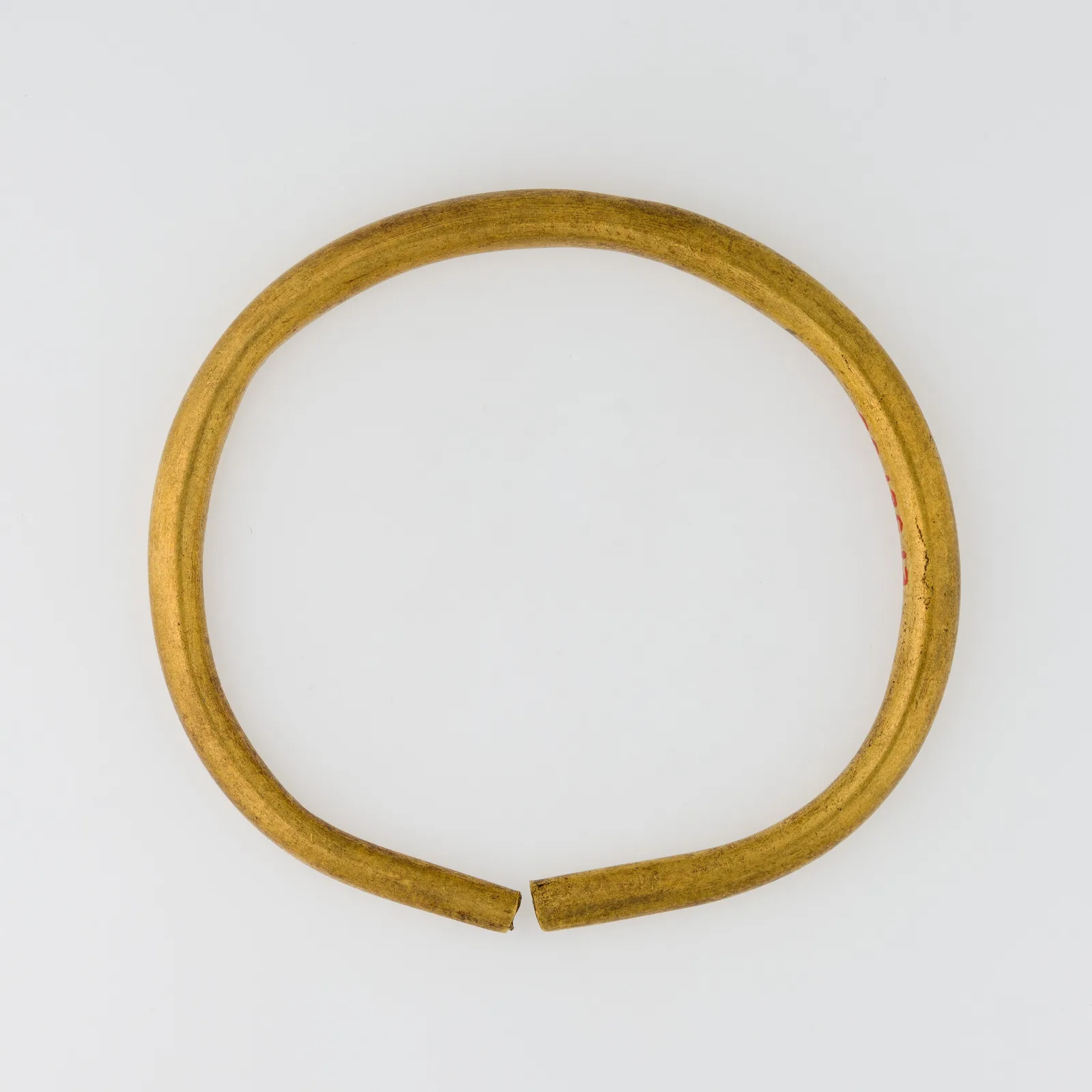
Hoops lose under over-ear headphones whatever their size. Diameter does not save them: a small hoop catches the edge of the pad just as a large one does, and a large one also pushes against the neck when the head turns.
Drops behave two ways. A long drop on a rigid base hangs below the lobe and below the edge of the pad, so under over-ear headphones it sometimes does better than a short one. The key question is not length but the fitting: a fish hook catches fabric, a stud with a drop does not.
Cuffs and clips suit neither on-ear nor over-ear headphones, and the reason for both bans is the same. The grip stands on the outside and rises above the ear on both sides. An on-ear pad comes down on it from above, and an over-ear cup takes the upper cartilage and the base of the lobe, exactly the two lines a cuff and a clip hold by. Under in-ear buds, though, they are perfectly at home, worth remembering while reading the guide to ear cuffs and clip-ons.
Earrings under in-ear buds
Here the rules turn over. The shell is free, and the conflict moves down and inward, to the mouth of the ear canal.
Tragus, antitragus and room for the tip
The tragus is the small flap of cartilage in front of the canal; the antitragus lies opposite it below. Both English and the older Greek terms are in use, tragus and antitragus, and piercing guides lean on the Greek. A bud holds against the walls of the canal, and its body settles into the hollow of the shell between those two ridges. A piece of jewellery standing in the tragus or antitragus ends up right in the body's path.
The piercing itself does not get in the way; the height of the top does. If a bud stopped holding after you changed the post, the cause is the new top, not the headphones: the fit is sensitive to any extra bulk near the mouth of the canal. The full map of ear piercings, their names and their healing is gathered in our guide to types of ear piercing, and it is handy for checking which point of yours is taken.
The ear hook on sport models
Sport buds often hold with a hook that wraps over and behind the ear. That hook runs along the helix, the outer rim, and across the zone behind the ear. For an owner of upper piercings this is the worst case of all: the hook presses on the jewellery for the whole workout and moves with the head, so drag is added to pressure. What a given piercing will take is a question for the person who made it: name the sport hook to your piercer, because the post they choose for it may be a different one. The fix is simple and unwelcome. For the workout the upper post is either swapped for a flat, short one or taken out. The lobe is free and can carry whatever it likes.
Cuffs and ear chains
A cuff grips the cartilage rim from the outside, and ear chains link two piercings or a piercing and a cuff. With buds they are compatible, because a bud never touches the rim. One caveat is about removal. A bud is pulled out with two fingers and blind, and the hand runs right along the outer edge of the ear. A chain between two points catches a finger easily. The habit of pulling the bud downwards rather than outwards removes the question entirely: the fingers move away from the edge instead of riding along it. A second point is weight. A cuff with a long chain pulls the cartilage rim down, and paired with hours of headphones that gives a feeling of heaviness by evening. A light chain does not.
Upload a photo of your pet, someone you love, or an object. We'll build a 3D model and hand-cast it in pewter.



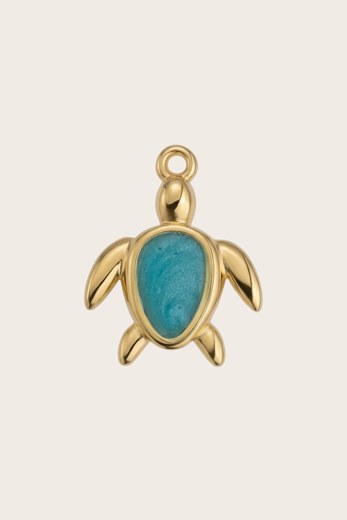
Piercings and headphones: a separate conversation
If the ear was pierced recently, the gear turns from an ally into a source of trouble. Here it pays to be precise, because the cost of a mistake is months of healing.
Fresh cartilage and over-ear headphones do not mix
Cartilage heals slowly, and the timeline is counted not in weeks but in half-years. A helix piercing heals fully in six to nine months, and some people need up to twelve; a conch, the piercing in the bowl of the shell, also called a concha, falls in the same six to twelve months. Our own map of ear piercings gives the same window for both, and it is worth holding in full rather than by its lower edge: a channel that looks calm from the outside at three months is still rebuilding inside.
All that time the jewellery sits in an unhealed channel, and pressure from above brings two problems at once. The first is mechanical: a pad shifts the post, and keeping it straight for a whole shift is not possible. The second is that the owner watches the reaction to that pressure blind, seeing nothing from inside the channel. So the decision is not the reader's to make: the timeline, the jewellery and the load allowed during healing are set by the piercer, and with swelling, heat and discharge the question goes to a doctor. The practical takeaway: for the healing time of a cartilage piercing, over-ear and on-ear headphones come off entirely, and you listen through buds, which never touch the outer rim.
The lobe heals faster, but not instantly
The lobe is gentler: soft tissue and a good blood supply, so healing runs in weeks rather than months. Even so, a fresh lobe piercing does badly under a pad. The danger is elsewhere: there is almost no pain, so a person puts the gear on too early and finds the problem later through discharge and redness. A fresh earring also usually sits on a long post with room for swelling, and a long post is exactly what stands out and snags. A sensible order: for the first weeks wear buds, then move to a short post with a flat back, and only then bring back the usual gear.
The flat labret as a working fix
The labret with a flat disc on the reverse was not devised for headphones, or even for the ear: the name comes from the Latin labrum, lip, and it meant an ornament set in the lip. Under a headset the shape works for the same reason it worked there: the disc lies flat on the skin, nothing stands proud, and the pad passes over it with no point of pressure. It has a second virtue, useful for sleep and for a hat: it does not snag fabric. For anyone in headphones daily there is a case for moving every piercing onto posts like these and swapping the decorative tops by mood. Watch the metal separately. If the ear reddens to any post, the cause may be the alloy rather than the pressure, and it is worth reading the piece on nickel allergy before changing the headphones.
The chain and the lavalier mic
From here the conflict leaves the ear and drops to the neck, and it changes nature: it stops being about pain and becomes about sound.
Where the click on the recording comes from
A lavalier mic is a capsule the size of a pea, clipped to clothing on the chest, usually fifteen to twenty centimetres from the mouth. It is sensitive to what happens a few centimetres from it and does not tell a voice from a stray noise. A chain gives two kinds of interference. The first is a metallic click: a link strikes a link, or a pendant strikes the capsule, when the head turns. The second is a rustle, when metal rubs the fabric of a shirt next to the mic. Both sounds are short and broadband, and clearing them from the track is close to impossible, because they land on top of speech. The sound engineer's rule is blunt: keep the capsule away from jewellery, fasteners and zips. Metal near a mic is a reliable source of random noise.
Where to put the chain with a lav
There are three working options, and they are not equal. The simplest is to move the mic aside so a clear gap stays between it and the chain. The second is to tuck the chain fully under clothing, at which point it stops touching the capsule but may start to rustle against the fabric. The third is more dependable than either: change the length. A short chain sits on the collarbone, above the line where a lav clips, and simply never meets it. How to size a length for your own neck and neckline is worked out in the guide to chain lengths.
A pendant that stays quiet
It is not the pendant itself, but the number of moving joints. A pendant on a chain has at least one hinged point, and that is where the knock is born. The more parts, the more sources. A quiet build looks like this: one pendant, a solid fixing, a flat shape with no cavity. A hollow pendant works as a resonator and sounds louder than a solid one of the same size. Layered pendants on several chains sound worst of all, because they knock against each other on nothing more than calm breathing.
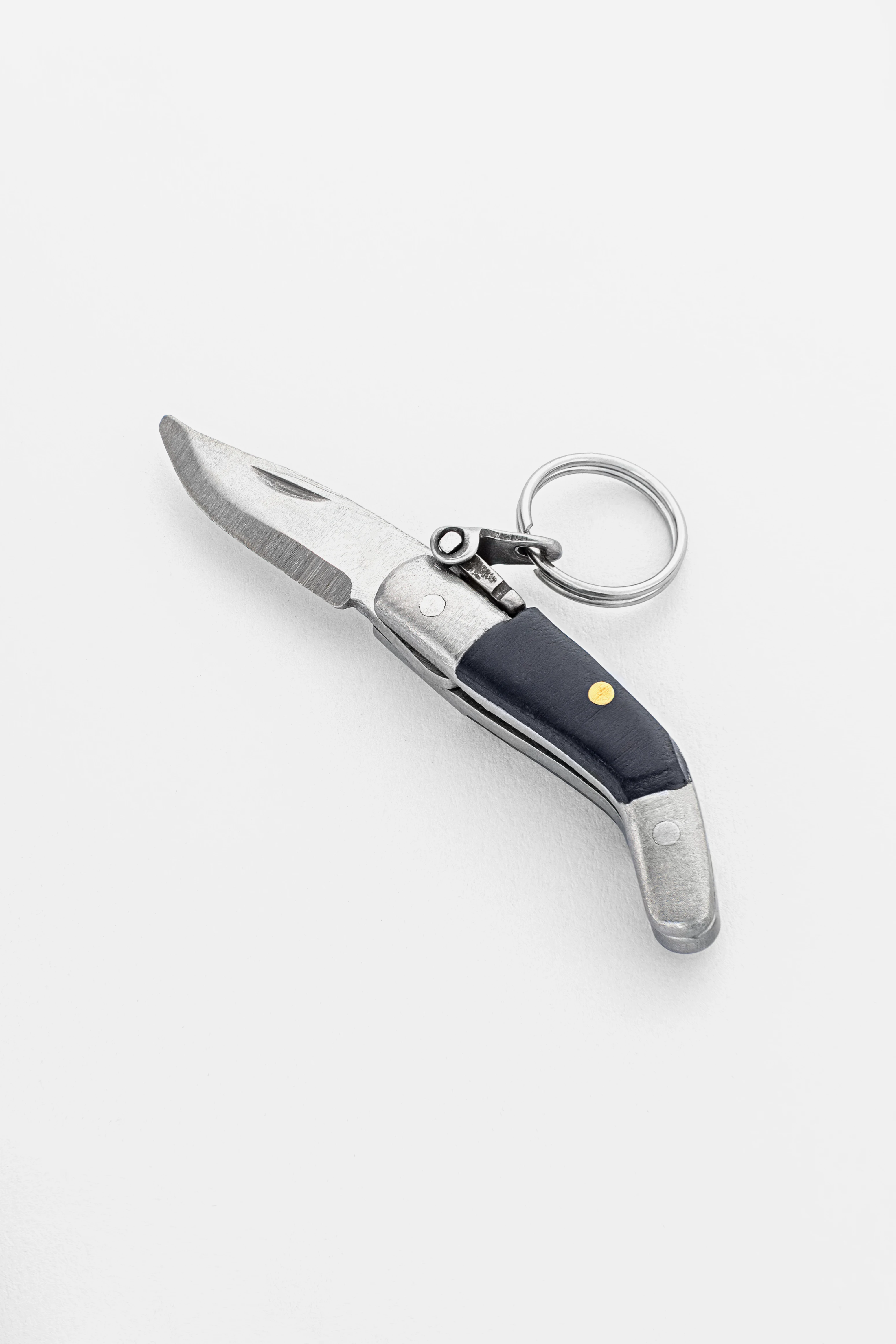
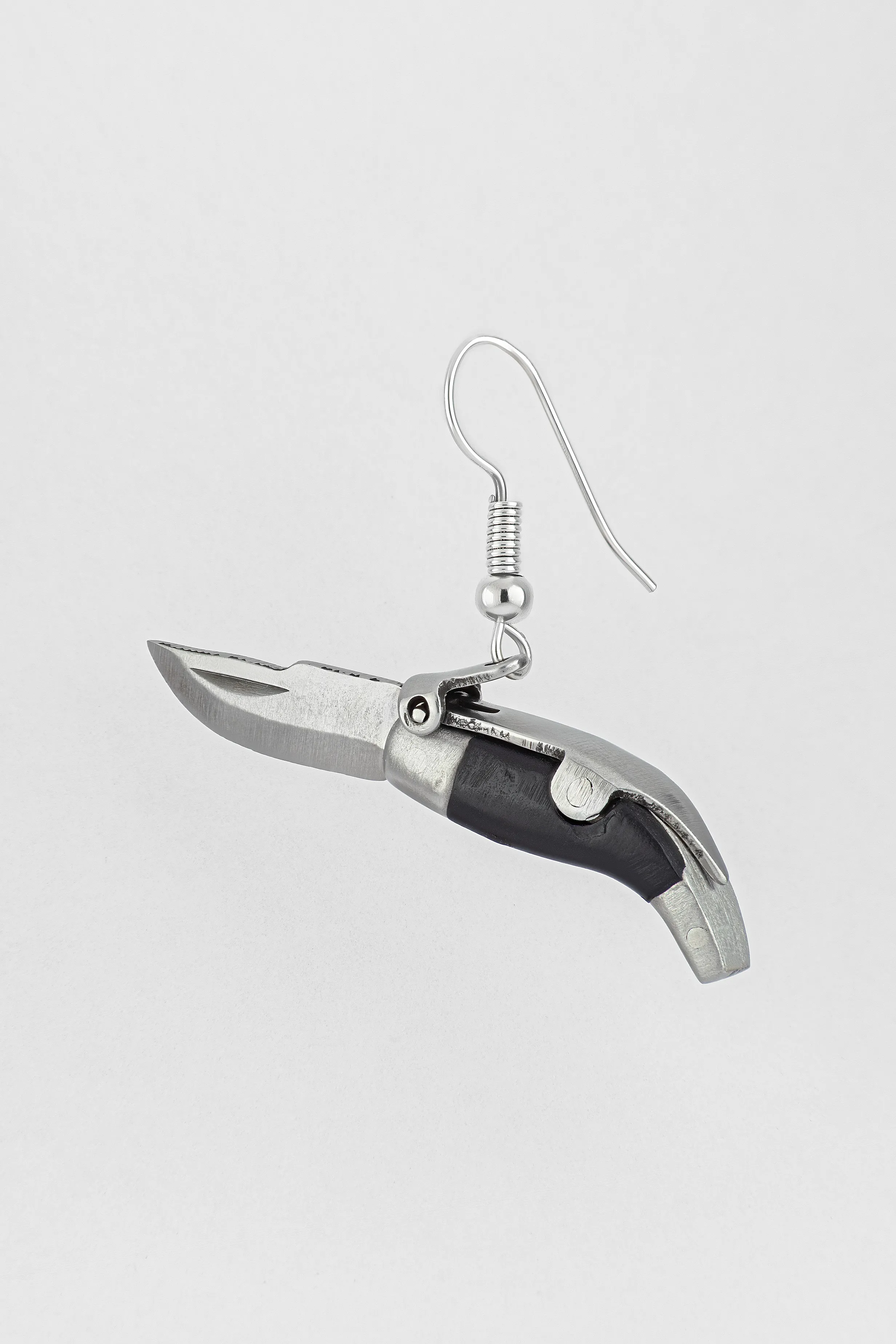
CAPAORA mini knife pendant
The 18th-century Spanish navaja in miniature: 40 mm of stainless steel, a real folding mechanism and a Palanquilla lock that clicks. An affordable gift to remember.
Authentic · Ships from Spain · 14-day returns
Jewellery on a podcast recording
A studio mic on a stand behaves differently from a lav, and its bans are different too.
A stand mic hears the hands, not the neck
A large mic stands on a stand in front of the speaker and points at the face. A chain on the neck is noticeably further from the capsule than with a lav, but everything the hands do falls into the pickup: bracelets, rings, a watch. So the priorities swap. With a lav you take off the chain; on a studio mic you take off the bracelets. A person who gestures while talking sounds on the recording like a rattle, and the culprit is a fistful of bracelets on one wrist, not the equipment.
Desk, keyboard and everything that sounds with them
The second source is contact between jewellery and a surface. A ring on the desktop, a bracelet on the edge of the table, a watch on an armrest. The sound travels through the desk straight into the stand, if the stand rests on the same surface, and every movement gets a knocking overtone. The fix asks for no sacrifice of jewellery. Rings can stay if there is something soft under the hands, and the stand can go on a separate support or a shock mount. Bracelets are better pushed up the arm or taken off for the recording: that is the one category with no compromise.
A quiet layout for recording
The rule for spacing things out is simple: anything that can strike a surface or a neighbouring part comes off the hands, and what stays on the ears is what is silent by its position. An earring makes no sound, because the mic is far away and there is nothing for it to hit. A ring on a hand that lies still is silent too. So the quiet layout for a recording is one pair of earrings, one ring on a still hand, nothing on the wrists. Keep the chain if the mic is on a stand, take it off if it is clipped to clothing. Check the layout with the ears, not the eyes: start a recording, turn your head, move your hands, and listen to the track before you go live. How the same pieces behave in the frame rather than the track is covered in the piece on jewellery for video calls.
The chain under a headset collar
A headset with a headband and a boom mic lives on the head differently from music headphones, and its zone of influence runs well below the ears.
The headband, the arm and the neckline
A professional operator's headset often has a rear band or a second hoop resting on the nape. Wired models add a cable running down the neck to the belt or the desk. A chain that hangs below the collarbone falls into the path of that cable. From there the familiar sequence starts: the cable lies over the chain, a turn of the head drags it sideways, the clasp slides forward, and the links twist. By the end of a shift the chain is either twisted or undone.
Length and clasp decide it
There are two working lengths. A short one that sits snugly at the base of the neck and physically never meets the cable. And a distinctly long one that goes under clothing and lies on the chest beneath the fabric, out of the collar zone. Worst of all is the middle length, sitting right on the line of the collar. It comes out and tucks in by turns through the day. Check the clasp itself as well: a lobster clasp with a large ring catches on knitwear far more readily than a flat spring ring. Why a chain twists in the first place, and how to avoid it, is set out in the guide to storing and untangling chains.
Why the clasp travels to the front
The clasp slides forward for a plain reason, not because of poor quality. It is heavier than a link, so at any movement it seeks the lowest point of the circle, and the low point on the neck is the hollow at the front. The cable of a headset speeds the process, nudging the chain in one direction hundreds of times a shift. Fighting the physics is pointless, so either the clasp is made light and flat, or the chain carries a pendant whose weight holds it at the front while the clasp sits at the back. The second way is the more reliable: the pendant is heavier than the clasp, and the role of the low point falls to it.
Leave your email, we'll send your discount code. No spam, unsubscribe anytime.
The code arrives by email, valid on your first order.
Jewellery and glasses
Glasses add a fifth item to the ear, and it runs right over the place the upper piercings love.
The temple arm and the top of the ear
The arm of a pair of glasses rests on the helix and bears on the bone behind the ear. That is exactly where a helix, a forward helix and upper cuffs sit. Glasses press on them constantly rather than now and then, because they are worn all day. The lobe, meanwhile, is untouched by glasses. So an owner of glasses does well to keep the accent low on the ear and leave the top free. Thin titanium arms press less than plastic ones simply because they are narrower and lighter. There is a second reason to keep the top free, not about comfort: a frame is a large feature on the face, and jewellery placed flush with it competes for attention. Spreading them apart by height is easier than matching them by shape.
Glasses plus headphones: two loads on one point
The worst combination of all looks like this: glasses, over-ear headphones and a helix piercing. The pad presses the temple arm, the arm presses the jewellery, and the jewellery bears on the cartilage. Three layers, all bearing on one spot the size of a fingernail. You relieve it in order. First take the jewellery out of the upper zone, then change the arm for a thinner one where possible, then loosen the headband. If none of the three is available, the option left is open headphones, which do not cover the ear at all.
Jewellery and a helmet
A helmet differs from headphones in that it goes on and off with a jerk, and inside it has a snug lining.
A motorcycle helmet: take off anything that stands out
The lining of a motorcycle helmet hugs the head tightly, and the helmet goes on with effort: the edges are pulled apart by hand and the head passes inside. Any earring at that moment ends up between the fabric and the skull. The mechanics are the same as under a pad, only harsher. The back of a stud bears on the head through the dense lining, and on the way off the jewellery can go with it. A smooth shape passes more kindly than a spiky one, simply because it has nothing to catch the fabric with.
The difference between piercings here is not depth but the order in which the lining reaches them. The helmet goes on from above, so the first thing the lining runs across is the outer rim: the helix sits there, and it takes both pressure and drag from the fabric. The rook lies deeper. It is a piercing through the upper ridge of the antihelix, the ridge that piercing guides call the antihelix and that the fold of the rim covers from above. The lining reaches it later and no longer drags it along, but presses on it through the dense layer at full force. Jewellery deep in the shell, in the tragus or the conch, the edge of the lining also leaves alone rather than sweeping off, yet it takes the pressure with everyone else. So the rule for a helmet is stricter than for headphones: take off anything that stands out, not only what sits on the rim. There is a trick that lowers the risk when a piece cannot be removed. Put the helmet on with the straps drawn apart by hand: the lining opens, and the head passes in with less rubbing against the cheeks and ears. Take it off the same way, not with an upward yank.
Bike helmet, hard hat and ear defenders
A bicycle helmet is looser and does not hug the head, but it has a strap that runs under and around the ear. The adjustment buckle often sits right under the lobe, and a long earring gets caught beneath it. A hard hat adds its own twist: ear defenders clip to it on brackets and work like on-ear pads, only with more clamp, because protection depends on it. Under a rig like that the strictest rule in this article applies: flat only, and only in the lobe.
Jewellery and a face mask
A medical mask on ear loops adds a load once thought about rarely and now well known to anyone who wears a mask for shifts.
The ear loop and the earring
The loop of a mask runs over the same place as a glasses arm: over the cartilage at the top and behind the ear. The difference is the character of the load: the elastic pulls the ear forward, while a glasses arm presses down. For jewellery that means two things. A cuff on the upper rim shifts and chafes under the loop, because the elastic slides over it at every movement of the jaw. An earring in the lobe is untouched: the loop runs higher.
A strap holder instead of the ears
Worn for a long time, the elastic chafes the skin behind the ear even with no jewellery in play. That is why simple holders appeared in 2020: a bar across the nape that the loops hook onto instead of the ears. A bar like that solves the jewellery question too: with it the upper rim is free, and a cuff or a helix can stay. A second trick is to cross the loops behind the head, which gives a similar effect with no extra object.
A shift in a mask: an order that spares the ear
For anyone in a mask for hours on end, the help comes not from the choice of jewellery but from the order of operations. Put the mask on before the headphones and take it off after them, or the elastic runs over the pad and drags along whatever it caught at every removal. The second rule is about breaks: relieve the pressure at least briefly when the setting allows. Smear a thin layer of cream on the skin behind the ear before a long shift, and simply leave the upper-zone jewellery off for a day like that. If the skin behind the ear inflames anyway, the question is no longer for the jewellery or the mask, but for a doctor.
Materials: what survives friction
Constant contact with gear is an abrasive load, and different metals answer it differently.
Silver is softer than it looks
Silver sits at about 2.5 to 3 on the Mohs scale, below steel and well below titanium. So a plastic or metal cup can leave a mark on it, and the polish clouds with steady rubbing. That is no reason to give up silver; it is a reason to choose the shape. A silver stud with a matte surface takes a daily headset calmly, because a scratch does not read on a matte finish. A mirror polish on a piece rubbed against a pad every day clouds sooner than a matte surface of the same alloy: on a mirror every stroke shows, on matte not one.
Titanium and steel under a daily headset
Titanium sits at about 6 on Mohs, surgical steel at about 5.5. Both take contact with plastic and fabric in their stride, and both scratch the cup of a headphone sooner than they scratch. Titanium has a second advantage: it is lighter than steel at the same size, and weight matters for piercings in cartilage, which stretches down under a load. For a piece that lives under headphones all day, lighter is better.
Plating wears in one spot
Gold, rhodium and coloured coatings behave unlike solid metal. They are thin, and their wear is not even but pointed: where the edge of a pad passes, the coating strips in a band, and around it stays untouched. It looks worse than an honest scratch, because a contrast appears between the worn strip and the new surface. The plain rule that follows: for a daily headset take a piece of solid metal, and keep the plated ones for occasions without gear.
Send a friend a discount code, they save on their first order.
How to build a set for your gear
It remains to gather everything into an order of operations that takes one evening and saves you the daily removals.
Look at the profile, not the size
Take an earring, set it on the table face up, and look from the side at eye level. That shows what decides the matter. An even dome and a wide base go under a pad whole, because the clamping force flows across their area. A separate ball on a stem, a rib, an edge, a sharp corner give a projection, and all that same force gathers on it alone. Look separately at the back, because the main culprit hides there: a butterfly on a long post rises above the skin more than any front feature and bears on the side of the lobe you cannot see. The rule it all reduces to is simple: under a pad the problem is not the size of the jewellery but the projection that gathers pressure into a point. Wide and flat gets through, narrow and tall does not. This holds for over-ear and on-ear headphones, for a helmet and for a hard hat with defenders. Under buds it does not apply at all, because nothing lands on the lobe there, and you choose the size freely.
The palm-and-pad test
The practical test needs neither gear nor a mirror. Put the earring in, press the ear with your palm at the force a headphone usually presses, and hold it until a clear sensation appears. If that is a point rather than an even pressure across the whole shell, this earring will not do under a headset. The second test is for snagging: run a finger over the jewellery from top to bottom with light pressure, imitating the edge of a pad. If the finger catches on anything, the fabric will catch too.
What you can change on the gear itself
Changing the headphones for the sake of an earring costs more than changing the earring, but if you are choosing the gear anyway, three of its properties decide the fate of the jewellery. The first is the depth of the cup on an over-ear model: the deeper it is, the better the chance the ear stays free inside and the pad lands in a ring around it rather than on the shell. The second is the shape of the pad. An oval one follows the contour of the ear and passes around it on the bone; a round one of the same size often lands its lower edge straight on the lobe, that is, on the earring. The third is the thickness and softness of the pad itself: a thick one spreads the clamp over a large area, a thin one passes it on almost undiminished. A velour cover is softer than leatherette and slides less on metal, but it collects lint and anything a hook can catch. Check the headband adjustment too. Many wear a headset at the factory setting without realising the band widens a click: the cups move apart, the clamp drops, isolation loses a trifle, and the ear gains room. It is the one setting on this list that costs nothing and takes a second.
Two sets instead of one universal pair
The most dependable answer looks dull: split the jewellery into work pieces and the rest. The work set is flat posts with a smooth back and one short chain; they live in the ear permanently and never come off. Everything else goes on when the gear is off the head. That order removes the main cause of loss: a piece is not lost under the headphones but in the pocket it was dropped into before a call.
Jewellery you do not take off before a call
Flat shapes, a smooth back, solid metal. Pieces that stay in place while a headset is on the head.
Facts that surprise
- Baldwin refused to patent his design, judging it a trivial improvement, and when the Navy offered to move production to the east coast he refused that too: he lived in a polygamous marriage and would not leave Utah.
Embouchureis a French word for the set of the lips on a wind-instrument mouthpiece, and the same word was carried over to name the soft cushion of a headphone, a short leap from the mouth to the ear.- Stereo reached the public half a century before stereo recording: at the International Electricity Exhibition in Paris in 1881 visitors took a telephone receiver to each ear and heard opera from the stage, and reviewers noted that the singers' movements across the stage were audible.
- Bone conduction was described long before headphones: in the sixteenth century the physician Gerolamo Cardano noted that a person with hearing loss could hear an instrument by biting a rod set against its soundboard.
- A patent for ear protectors against the cold went to Chester Greenwood of Maine in 1877: he built the frame at fifteen so his ears would not freeze while skating, and by 1883 his factory turned out fifty thousand pairs a year. He was not the first and made no such claim: the patent lists the thing as an improved earmuff, meaning muffs like it were already worn.
- Jewellery on the head was once ruled a public danger: in 1910 the Chicago city council debated banning hatpins longer than nine inches, and similar limits were discussed in Baltimore, New Orleans and Pittsburgh.
- The name of the tragus, the little flap in front of the ear canal, comes from the Greek for goat, given for the tuft of hair that grows on it.
Frequently asked questions
Can you wear earrings with on-ear headphones?
You can, if it is a flat shape with a smooth back and no separate projecting parts. An on-ear model presses straight on the shell, so any projection becomes a point of pressure. Hoops and bulky beads do not suit headphones like these.
Which earrings do not bother in-ear buds?
Almost any, including large drops and hoops: a bud holds in the canal and never touches the outer rim of the ear. Care is needed only with piercings in the tragus and antitragus, and on removal, when the hand passes close to a drop.
How long after a cartilage piercing can you wear over-ear headphones?
A helix heals fully in six to nine months, and some people need up to twelve; a conch falls in the same six to twelve months. All that time a pad from above keeps shifting the post, so for the whole period you switch to buds, which do not touch the rim. The exact date for your own piercing is named by the piercer, not the calendar, and swelling or discharge is a question for a doctor.
Why does an earring scratch the headphone, and does it get damaged itself?
Because a steel or titanium earring is harder than the plastic of the cup. The jewellery loses its polish in the process, and thin plating rubs through at the single point where the edge of the pad passes. Matte surfaces and solid metal take it better.
Does a chain interfere with a lavalier mic?
Yes, and more than you would think. Links give short clicks, and metal rubbing on fabric gives a rustle, and both land on top of speech. What helps is either a short length that sits above the clip line, or moving the capsule aside.
What do I do if glasses and headphones press on the same spot?
Relieve the point in order: take the jewellery out of the upper ear, move to a thin temple arm, loosen the headband. If that is not enough, open or bone-conduction headphones stay, since they do not cover the ear.
Do I need to take earrings off under a helmet?
Anything that stands out comes off. A motorcycle helmet goes on with force, and the back of a stud bears on the head, and on the way off the jewellery is dragged out with the lining. The helix on the outer rim suffers first, because the lining runs across it soonest. The rook on the antihelix ridge and pieces deep in the shell it reaches later and no longer sweeps off, yet it still presses on them through the dense layer.
Which metal takes friction against headphones best?
Titanium and surgical steel: their Mohs hardness is about 6 and 5.5. Silver is softer and picks up micro-scratches faster, so in a work set it is taken in a matte finish. Plated pieces do not suit a daily headset.
Buying it as a gift? Each one arrives ready to give.
 A branded Zevira box and a little card come with every order.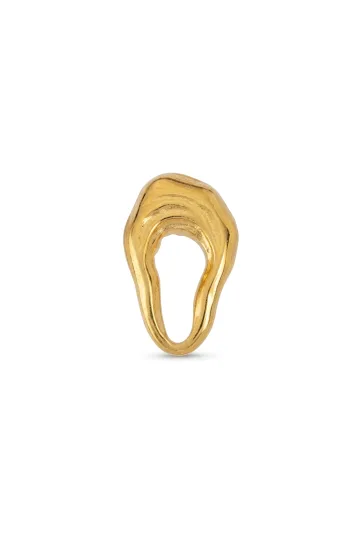
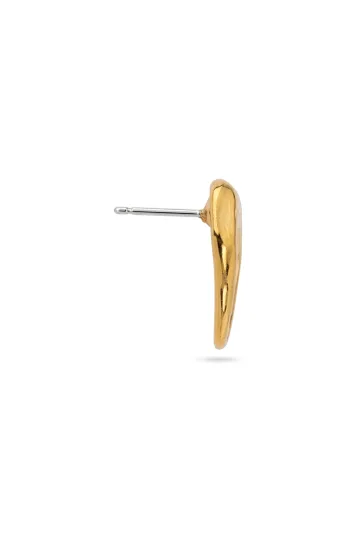

What stays when the headphones come off
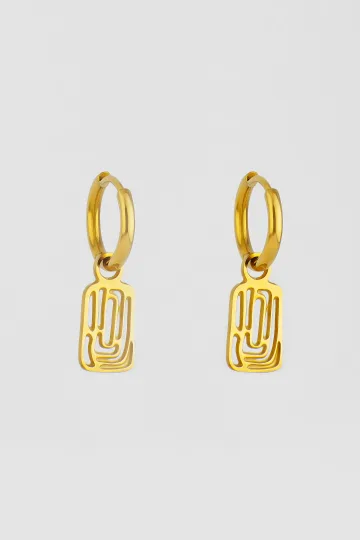
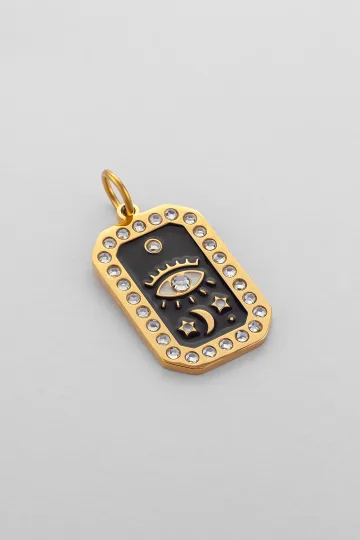
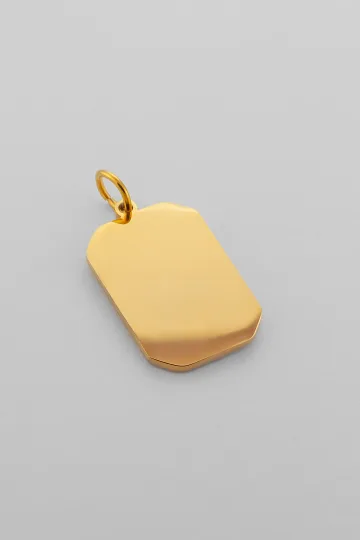
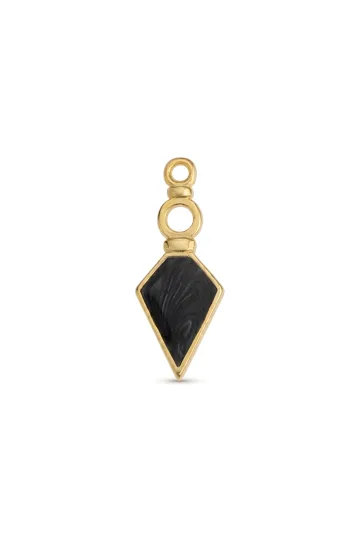
The clash between jewellery and technology is settled not by giving up jewellery but by changing the geometry. Flat instead of tall, smooth instead of loops, solid instead of plated, short instead of middling. Four swaps, after which nothing needs taking off before a call or a workout.
We have one ear for all the gear, and it grows no tougher for our putting up with things. It does calmly carry a piece chosen with an eye to what will land on it from above. A piece like that is in place in the evening, when the headset already hangs on its hook, and that is exactly why it is seen more often than the fancy one that lives in a box.
About Zevira
Zevira gathers jewellery that carries meaning: symbols, history, and a shape with the metalworking heritage of the Spanish interior behind it. We think about how a piece lives through a real day, including the day a person spends in a headset.