Sarasvati in Jewelry: Goddess of Knowledge, Wisdom, Music and the Arts
The Goddess Worth More Than Gold
There is an old Indian belief that Lakshmi and Sarasvati rarely visit the same house at once, because great wealth and great learning seldom live easily side by side. And if you had to choose, the sages advised calling Sarasvati first. Money without knowledge slips away, while knowledge wins back everything else.
Sarasvati is the Hindu goddess of knowledge, wisdom, speech, music and every art, the consort of Brahma the creator. You know her by her white robes, the vina (a long stringed instrument), the white hamsa swan at her feet, the lotus, the book of the Vedas in one hand, and the prayer beads. Her image has lived in jewellery for a long time: pendants shaped like the vina, small figures of the goddess on a white thread, motifs of the swan and the white lotus.
Here is the path ahead: who Sarasvati is and where her name comes from, how her cult lives on from the waters of an ancient river to the festival of Vasant Panchami, what each of her attributes means, why her knowledge is also clarity of speech, creativity and purity, how she differs from Lakshmi, what materials such jewellery is made from, and how to wear it respectfully. Sarasvati is no charm and no ornament but a living goddess worshipped by hundreds of millions of people right now, and that is worth remembering.
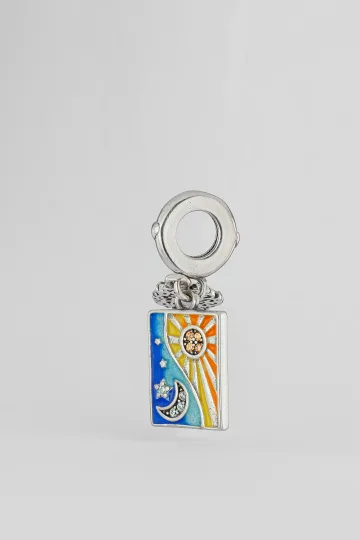
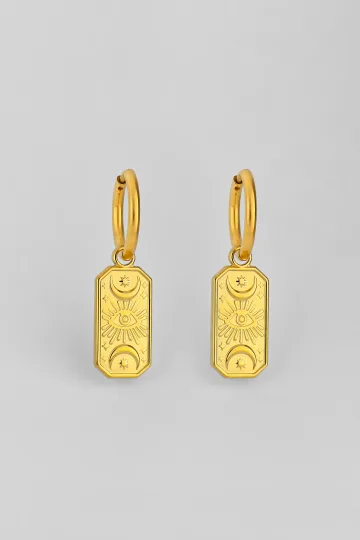
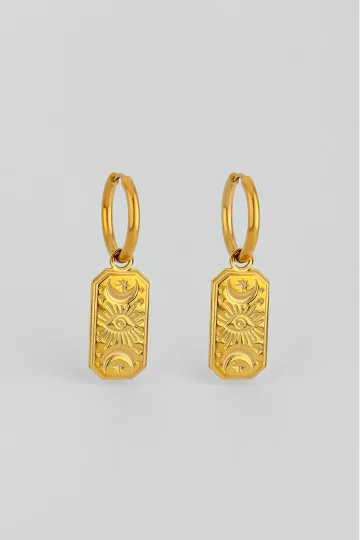
Wear the symbol, don't just read about it. These are in stock:








Who Sarasvati Is
The Name and Its Meaning
Sarasvati (in Sanskrit सरस्वती) literally means "the flowing one," "the one who has currents," "the abundant one." The root "saras" means water, lake, stream. The name first belonged to a sacred river, and only later became the name of a goddess. The link to water is no accident: speech flows like a river, thought streams, music pours. The goddess of knowledge carries the name of a current because everything she presides over moves and never stands still.
She has many other names. Vani and Bharati are tied to speech and the word. Sharada means "of the autumn," and under this name she is honoured especially in Kashmir. Vagdevi means "goddess of speech." Each name lights up a different facet: a river here, a word there, music elsewhere.
What She Looks Like
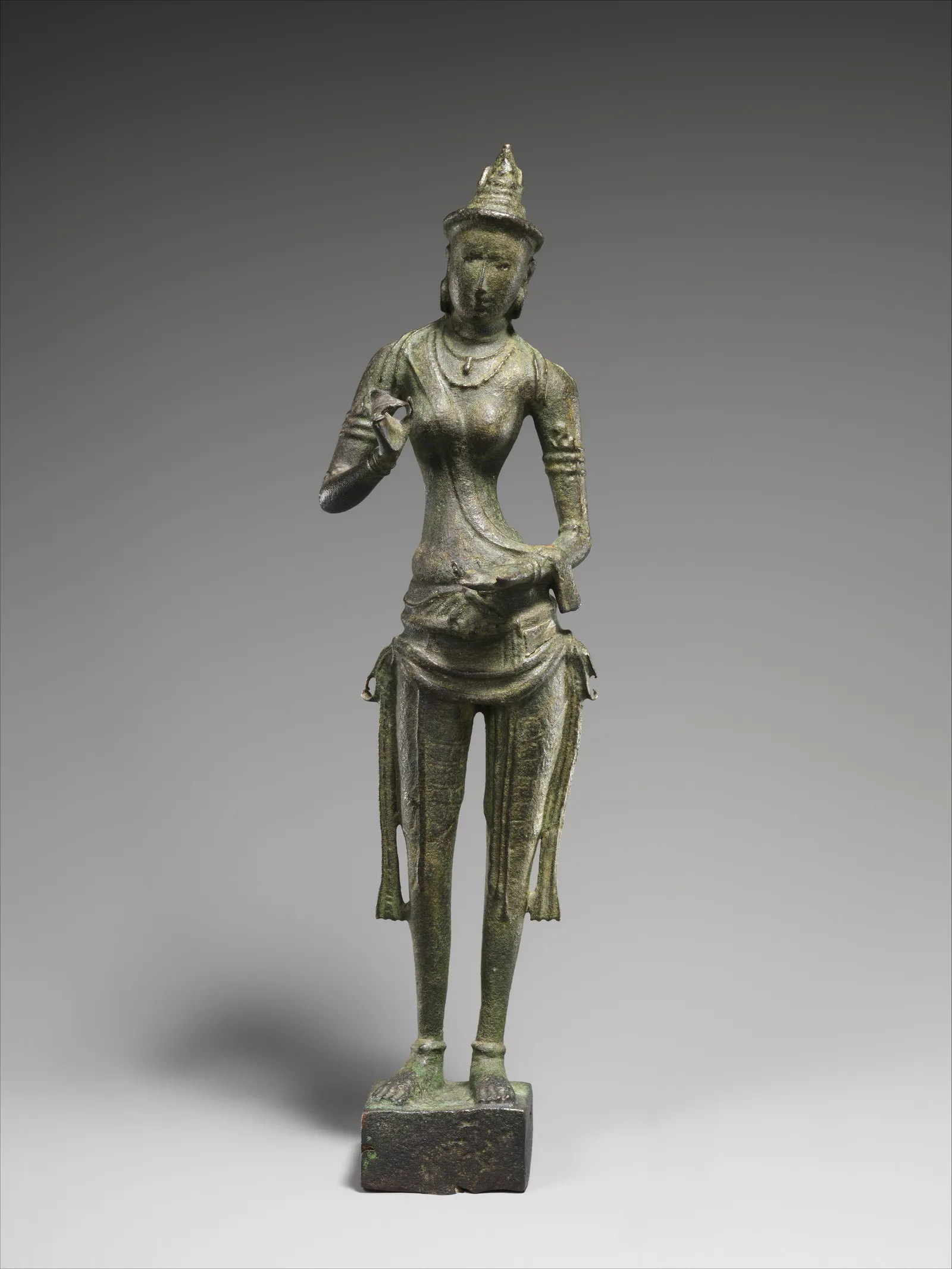
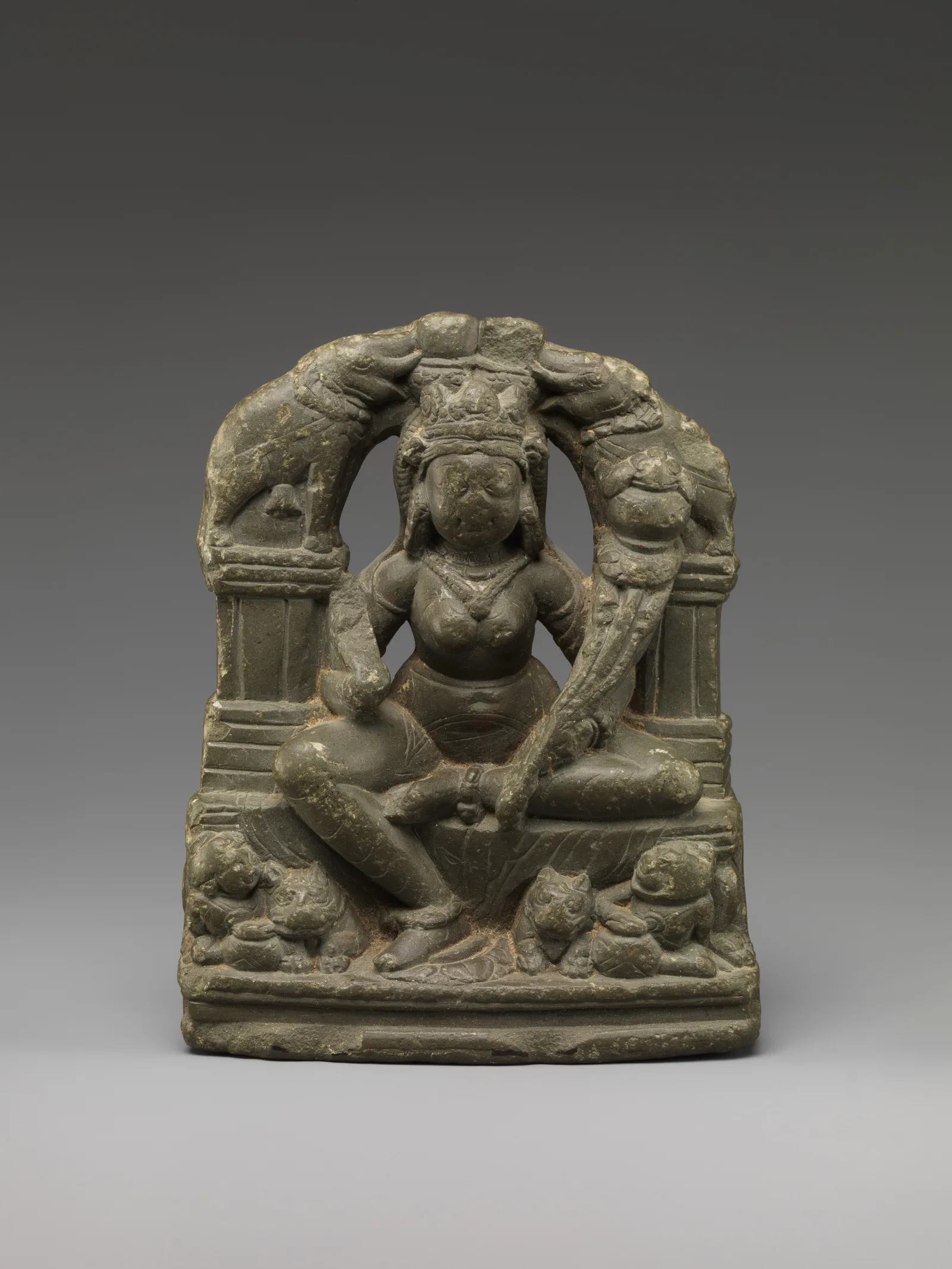
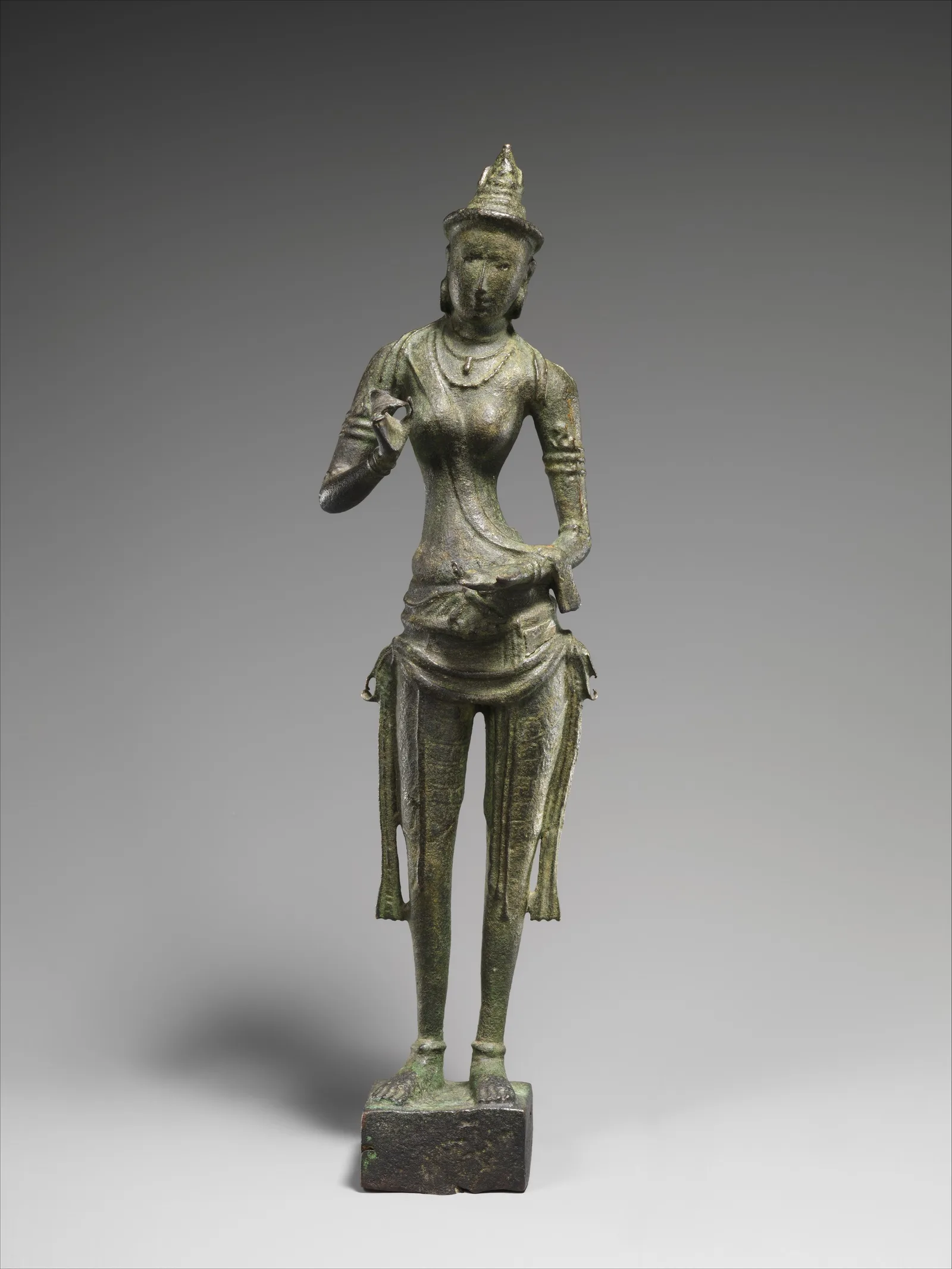
The canonical image is recognised at once and stands in sharp contrast to the lavish Lakshmi. A beautiful woman in a plain white sari sits on a white lotus or on an open lotus by the water. She most often has four arms. With two she holds the vina, a long stringed instrument, and plays it. In the third hand is the book of the Vedas or a scroll, in the fourth the prayer beads. Beside her is a white swan, sometimes a peacock. She wears little jewellery, her skin is fair, her face calm and concentrated. No gold, no stream of coins: all of Sarasvati's splendour is whiteness, purity and music.
Every detail carries meaning, which is why the image moved so easily into jewellery. You can take the whole figure, or a single attribute: the vina, the white lotus, the swan, the book. Anyone who knows will read the reference to the goddess even when the pendant shows no face.
What She Presides Over
Sarasvati answers for everything tied to mind and creativity. Knowledge and study, wisdom and memory, speech and eloquence, writing and poetry, music and dance, any art or craft that calls for mastery. Students turn to her before an exam, musicians before a concert, writers before a blank page, speakers before a speech. She gives not things but abilities: a clear mind, the right word, a steady hand, inspiration.
Her Place in the Hindu Pantheon
Sarasvati is among the chief goddesses of Hinduism and forms one of the sacred triads of female deities, the Tridevi, together with Lakshmi and Parvati or Durga. She is the consort of Brahma the creator, first of the Trimurti, the god who makes the world. The logic is elegant: to create, you need knowledge, the word and a design, and that is Sarasvati. Without her even the creator is mute.
Tridevi: Knowledge, Wealth, Power
The three great goddesses share among them the foundation of a full life. Sarasvati answers for knowledge, speech and art, Lakshmi for wealth and abundance, Durga or Parvati for strength and protection. They are often honoured together, especially during the autumn festivals, because one without the others is incomplete: knowledge without means goes hungry, means without strength stands defenseless, strength without knowledge is blind. In jewellery the three goddesses are sometimes joined in a single set, but Sarasvati is the "quietest" and most austere of them, closest of all to the idea of inner work rather than outer shine.
How Sarasvati Differs From Lakshmi
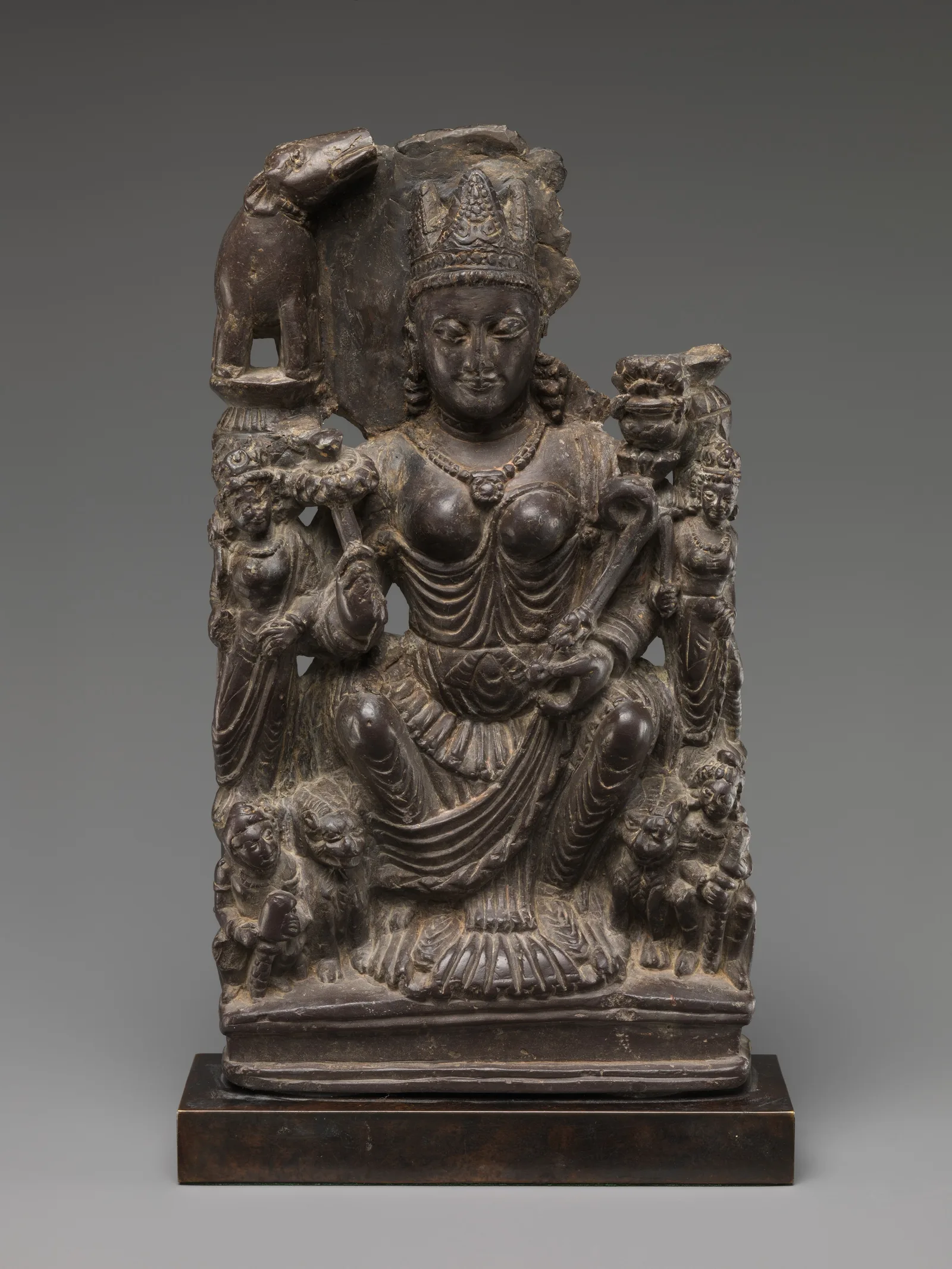
This is the most important pairing of opposites in all of Hinduism. Lakshmi gives wealth, Sarasvati gives knowledge. Lakshmi is in red and gold, among coins and elephants; Sarasvati is in white, with the vina and the book. Lakshmi answers for the fruits, Sarasvati for the roots, for the skill that wins those fruits. The two are rarely shown side by side without a third figure, and folk belief even sends them to separate houses. To wear a symbol of Sarasvati is to make a different choice than to wear a symbol of Lakshmi: to bet on mind and mastery rather than on luck and means.
The goddess of knowledge hangs on silver and pearl, never on gold. Leave the red and gold to Lakshmi, and don't you dare mix the two.
How to Wear Sarasvati Jewellery
A lot of white has passed through my hands: pearl, moonstone, silver against cool skin. I value the Sarasvati sign because it stays quiet and never argues with the clothes. Here are the five questions I get asked most.
Chain or white thread? I recommend a thin silver chain of 45-50 cm for a figure or a vina, so the sign sits on the sternum and reads. A white or yellow thread I suggest for anyone who wants a modest, ritual look: it echoes the Vasant Panchami festival and never pulls attention. I choose a cool metal, silver or white gold; warm yellow I save for a festive, larger piece.
Which stone suits this symbol? I stay with the goddess's white palette: pearl, moonstone, rock crystal, mother-of-pearl. Pearl I recommend first, since it is born in water, just as Sarasvati is. I avoid coloured stones, and I leave red and gold to Lakshmi: side by side the two worlds quarrel. If you want warmth, I suggest citrine or amber for a yellow, festive note.
One sign or a full set? A single pendant I suggest keeping as the main accent on a clean chain, with no neighbours. If you build a set, I keep one palette: a lotus pendant and swan earrings read as one story. I allow layers, but thin ones: Sarasvati dislikes clutter, her strength is restraint.
Lotus, swan, vina or the figure? The white lotus I recommend for anyone who wants a quiet, everyday sign; it reads simply as a flower. The swan I choose for its note of a clear mind, and the vina I suggest for a musician or artist as a direct mark of the craft. The full figure of the goddess with the vina I keep for an occasion: the start of studies, an exam, a concert. The larger the figure, the calmer I build the look around it.
Which neckline and occasion? For a high, closed neckline I suggest a short pendant, so the sign sits on the fabric. For an open V-neck I choose a larger form that holds the bare zone at the collarbones. A large gold figure I keep for a celebration and for Vasant Panchami, a thin lotus or swan I recommend for every day. And remember: the goddess on the neck, on a ring, on earrings is fitting, on footwear or underwear it is not, this is a living faith.

Turn on your camera, pick earrings, a pendant or a ring, and see the piece on yourself in real time.
Switch items in one tap.
Everything runs in your browser: no photo or video is ever uploaded.
Customer reviews
Zevira is a real jewellery shop. Genuine payments, deliveries and customer thank-yous.
🥰🥰🥰 gracias

Ok, ¡gracias! 🙂

History and Cult
From Sacred River to Goddess
The earliest mention of Sarasvati in the Rigveda is in hymns not to a goddess of knowledge but to a river. Sarasvati there is a mighty, brimming river, "best of rivers, best of goddesses," flowing from the mountains to the sea. People settled on her banks, brought offerings to her, held her waters to be cleansing. Then the river ran dry and, by one account, went underground or changed its course. But the name remained, and behind it a goddess gradually rose. Water turned into a metaphor: that which flows and cleanses became knowledge and speech.
Consort of Brahma the Creator
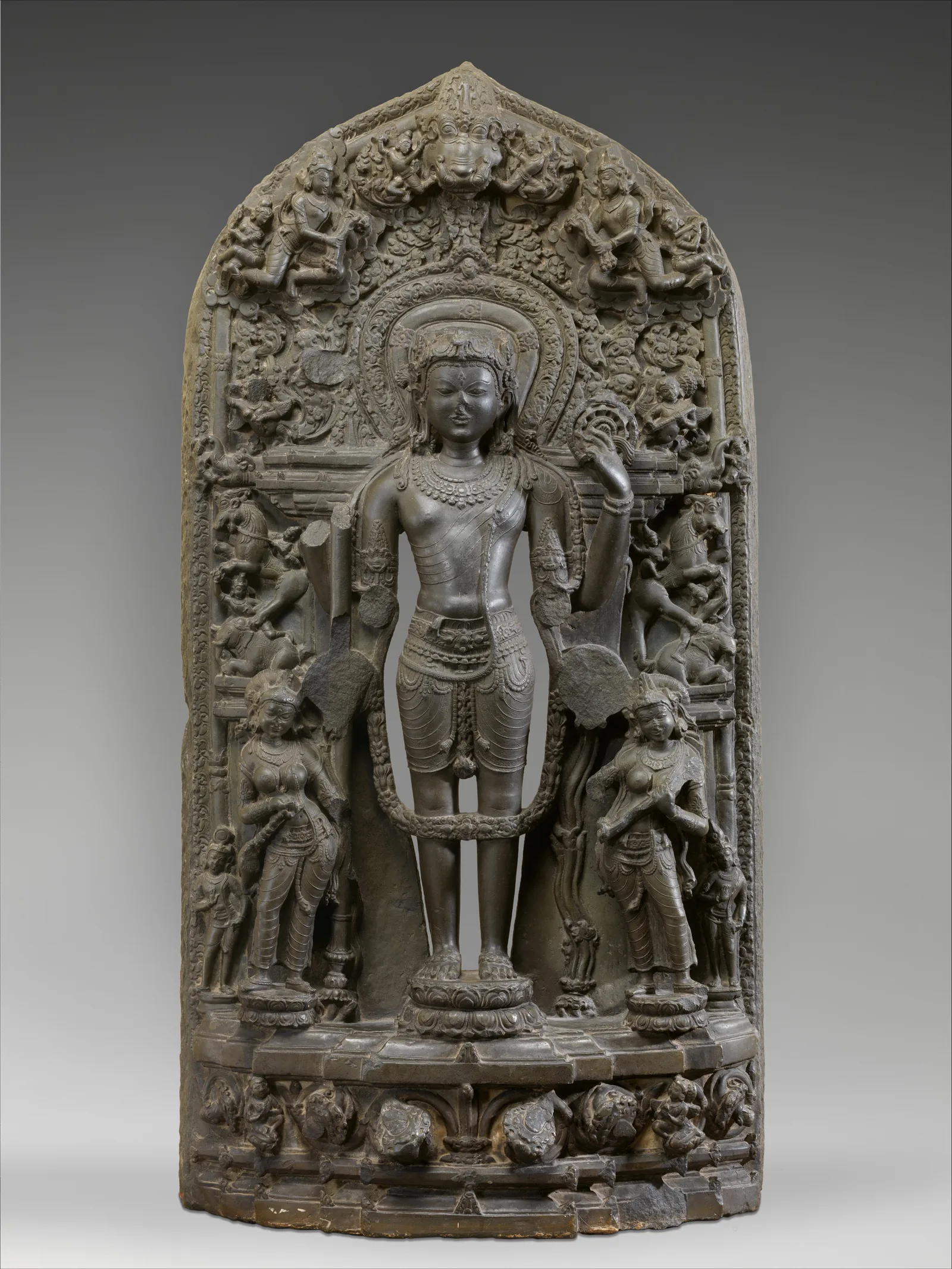
In classical Hinduism Sarasvati is the consort of Brahma, the creator god. Their union speaks for itself: creation is impossible without knowledge and the word. The myths say that when Brahma fashioned the universe, it was Sarasvati who gave him the wisdom and speech to order the chaos. There is also a poetic tale that Brahma made her from his own mouth as the embodiment of the word, and was then so captivated by her beauty that he could not look away. The heart of this pair is not passion but the partnership of mind and creative power.
Patron of the Vedas and Language
Sarasvati is closely tied to the Vedas themselves, the sacred texts, and to Sanskrit, the language in which they are written. She is held to be the mother of the Vedas, the source of all hymns and mantras. By tradition, it was she who gave people writing and grammar. For this reason Indian culture honours her as the goddess of all learning whatever its form, from memorizing sacred verses to counting, writing and any craft that has to be learned.
Vasant Panchami: Festival of Spring and Knowledge
Sarasvati's main festival is Vasant Panchami, celebrated at the end of winter, on the fifth day of the bright half of the month of Magha, usually in late January or early February. It is a festival of the arrival of spring and at the same time a day of the goddess of knowledge. On this day people wear yellow, the colour of blossoming mustard fields and the spring sun, prepare yellow sweets, and fly kites. In schools and homes they set out an image of Sarasvati, offer her books, pens and musical instruments, and ask her to bless the year of study ahead.
The Day Children Learn Their Letters
Linked to Vasant Panchami is a touching rite called akshar-abhyasam, or vidya-arambham, a child's first touch of learning. On this day small children are set to write their letters for the first time, their hands guided over rice or a board, as if being brought under the protection of the goddess of knowledge. For many Indians it is Sarasvati who opens the road into the world of literacy, and the child traces a first word on her festival.
Patron of Students and Musicians
Worship of Sarasvati does not come down to a single day. Before exams, students across India pray to her, lay their textbooks before her image, and wear her likeness as a talisman of success in study. Musicians honour the goddess in particular, for she herself holds the vina: it is considered bad form to step carelessly over a musical instrument, since Sarasvati lives within it. Dancers, singers, painters, scholars, all whose work is mastery and mind, see her as their patron.
Sarasvati Beyond India
The goddess of knowledge travelled with Buddhism and Indian culture far beyond India. In Japan she is known as Benzaiten, goddess of water, music, eloquence and fortune, one of the Seven Lucky Gods. In Tibet and other Buddhist lands she is honoured under the name Yangchen or similar. The image changed and took on local features, but the recognisable core remained: water, music, the word and knowledge moved together. This long journey shows how universal the idea of a deity of wisdom and art turned out to be.
Upload a photo of your pet, someone you love, or an object. We'll build a 3D model and hand-cast it in pewter.




The Symbols of Sarasvati
The Vina, Her Instrument
The vina is Sarasvati's chief and most personal attribute, the thing that sets her apart from all others. It is a long stringed instrument, kin to the lute, which the goddess plays holding it in two hands. The music of the vina is an image of harmony, of order built out of sound, which is to say knowledge turned into beauty. Playing demands mastery, an ear, discipline, everything the goddess bestows. A pendant or brooch shaped like the vina is the most telling sign of Sarasvati, a direct reference to her and to the idea of art as the highest skill. The vina appears in jewellery less often than the lotus, and so it is especially prized by those who know.
The Hamsa Swan
Sarasvati's vahana, her mount, is the white swan, in Sanskrit hamsa. The swan beside the goddess of knowledge carries a deep meaning. By an ancient Indian belief, the swan can separate milk from water when the two are mixed and drink only the milk. This is an image of discernment, the chief faculty of the wise: to part truth from falsehood, the valuable from the empty, the lasting from the passing. Sarasvati seated on the swan is knowledge that knows how to choose. The swan on its own is a rich symbol of purity and faithfulness, but as Sarasvati's vahana it reads in a special way, as a sign of a clear mind.
The White Lotus
Sarasvati sits on a white lotus or holds one in her hand, and the color matters here. Where Lakshmi's lotus is more often pink or red, the lotus of the goddess of knowledge is white, the color of purity, truth and an unmixed mind. The lotus grows from murky mud, rises above the water and opens unstained, and so too knowledge rises above ignorance while staying pure. Sarasvati's white lotus is an image of an enlightened mind untouched by the dirt of the passions. There is a detailed guide to the lotus in jewelry about the flower itself and its meanings across cultures.
The Book and the Vedas
In one of her hands Sarasvati holds a book or scroll, most often the Vedas, the sacred texts. The book is a direct sign of knowledge, learning, the written word, everything that keeps and passes on wisdom. Unlike music, which lives in the moment, the book is knowledge fixed for good. The pairing of the vina and the book in the goddess's hands speaks of the two sides of learning: living art and firm knowledge. A pendant with an open book beside a vina reads as a wish for success in study and writing.
The Prayer Beads
In yet another hand Sarasvati often holds prayer beads, in Sanskrit akshamala. The beads are a sign of concentration, meditation, spiritual discipline and counting. They remind us that knowledge is not bare intellect: true wisdom calls for inner work, repetition, patience. The beads tie Sarasvati to the idea of learning as a spiritual path rather than a hoard of facts. In jewellery a motif of beads beside her other attributes adds a note of focus and the spiritual.
The Peacock
Sometimes Sarasvati is shown not with a swan but with a peacock, or a peacock stands beside the goddess as a second companion. The peacock is a sign of beauty, art, pride and the many colors of creativity. But paired with the swan it carries a lesson too: the swan teaches discernment and restraint, while the peacock with its dazzle warns of the danger of vanity. The wise choose the white swan of simplicity over the bright peacock of showy beauty. The peacock is a deep symbol in its own right, covered in a separate article on the peacock in jewelry, but beside Sarasvati it reads as one of her attributes.
The Colour White
Whiteness is Sarasvati's palette, as red and gold are Lakshmi's. The white sari, the white lotus, the white swan, the fair skin: all of it speaks of purity, truth, clarity, unmixed knowledge. White is the colour in which there is no deceit and nothing superfluous. That is why jewellery with the goddess of knowledge is often made on a white thread, with white stones, pearl, mother-of-pearl, in silver or white gold. The white palette sets Sarasvati apart from the lavish goddess of wealth and conveys her austere, luminous spirit exactly.
The Four Arms
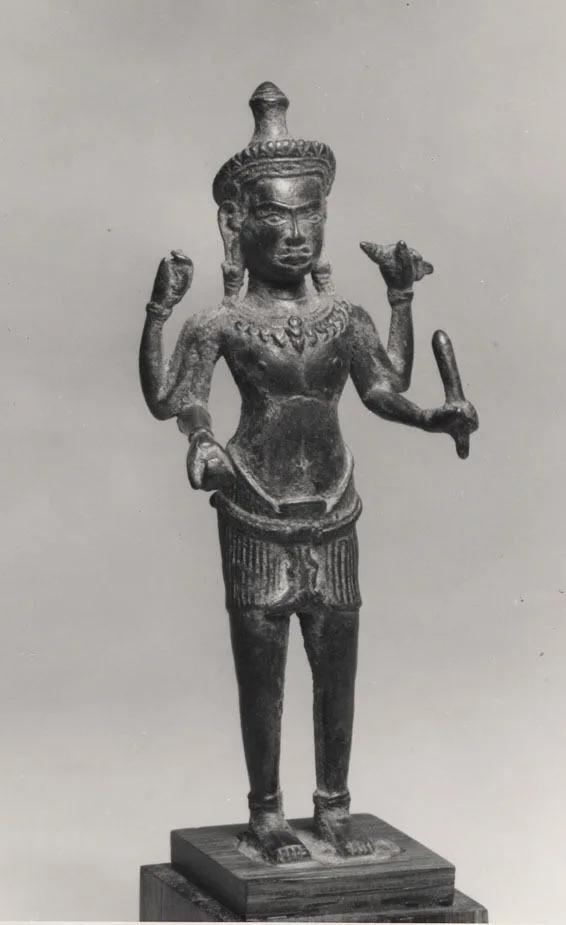
The goddess's four arms are not decoration but a code of meaning. In Hindu iconography the number of arms shows power and the breadth of a deity's gifts. Each of Sarasvati's four arms is busy with its own: the vina in the two middle ones, the book and the beads in the outer two. They are also read another way, linked to the four sides of learning. The mind that thinks, the reason that judges, the alertness that notices, and the self that is aware. The goddess holds all four at once, showing that real knowledge is wholeness, not one dry stretch of memory. In jewellery the four-armed figure is the most canonical and recognisable, pointing straight to the temple image.
The Yellow of the Festival
Though Sarasvati's native palette is white, the colour yellow is firmly tied to her festival of Vasant Panchami. Yellow is the colour of blossoming mustard fields, the spring sun, renewal and the joy of learning. On the goddess's day people wear yellow, prepare yellow sweets, and tie yellow threads. So a piece of jewellery with Sarasvati on a yellow thread, or with a warm yellow stone, citrine or amber, reads as a festive, springtime take on the theme, while white underlines the austere, everyday side.






What Sarasvati Means in Jewellery
Knowledge and Study
The most direct meaning. Jewellery with Sarasvati is worn as a wish for and support in study: for students, exam candidates, anyone sitting tests, taking up a new field, defending a thesis. It is no magical "amulet for a top grade" but a reminder of intention and effort. The goddess answers for the fruits of learning, and her image keeps the focus on the goal, helps you gather yourself and not abandon what you started.
Wisdom and Discernment
Sarasvati gives not a sum of facts but wisdom, the ability to tell the important from the empty, truth from falsehood. This is the lesson of her swan, which drinks milk out of a mixture with water. To wear her symbol is to value clear judgment, a sober mind, the ability to see the heart of things. It is close to those who make decisions, teach others, seek the truth rather than the convenient gain.
Clarity of Speech and Eloquence
As goddess of speech, Vagdevi, Sarasvati is patron of the word. Speakers, teachers, presenters turn to her, all to whom it matters to speak clearly and convincingly. Her image is worn as support before a public talk, a defence, a negotiation, an important conversation. The gift of speech is held sacred in Hinduism, for the world is made through the word, and Sarasvati is the keeper of that gift.
Creativity and Art
The vina in the goddess's hands speaks of creativity as the highest expression of knowledge. Sarasvati is patron of musicians, singers, dancers, painters, poets, all whose work is to make something beautiful. Her symbol is worn as a talisman of inspiration and mastery, as a plea that the hand be steady, the voice true, the design clear. For her, creativity is not chaos but a harmony built from knowledge.
Purity and Clarity of Mind
Sarasvati's whiteness is a sign of purity, both moral and mental. A clear mind, free of fuss, envy and pettiness, is the goddess's ideal. Her image is worn as a reminder of inner tidiness: keep your thoughts in order as you keep your words in order. This is the quiet, meditative side of the symbol, close to those who value focus and calm.
Memory and Concentration
The prayer beads in the goddess's hands tie her to memory, discipline, the ability to concentrate. Study is impossible without memory and patient repetition, and Sarasvati is patron of that unseen work. Her symbol sustains you through long tasks that call for staying power: preparing for an exam, mastering an instrument, learning a language. It is a sign that wisdom grows not in a single leap but through steady labour.
Sarasvati and Lakshmi: Knowledge Against Wealth
Two Goddesses, Two Paths
The contest of Sarasvati and Lakshmi is a favorite theme of Indian folk wisdom. Lakshmi gives wealth, Sarasvati gives knowledge, and the old belief says that the two rarely visit the same person at once. The rich are not always learned, and the great scholar is not always rich. Behind this lies an honest observation: each one takes a whole life, and few have the strength for both paths together. The goddess of wealth, her lotus, her coins and elephants are covered in detail elsewhere, in a large article about Lakshmi.
Roots and Fruits
There is a reconciling view as well. Knowledge is the roots, wealth is the fruits. First Sarasvati, then Lakshmi. Whoever first gains skill and wisdom will sooner or later gain means too, for skill feeds you. Wealth without knowledge, on the other hand, runs through your fingers. That is why the sages advised calling Sarasvati first: give a person a fishing rod and the fish will follow. In this sense the symbol of the goddess of knowledge is an investment in yourself rather than a bet on luck.
Which to Choose for Jewellery
The choice between a symbol of Sarasvati and a symbol of Lakshmi is a choice of intention. If the idea of mind, study, creativity and mastery is closer to you, your goddess is Sarasvati, and your palette is white, with the vina, the swan, the white lotus. If means, abundance and good fortune in business are closer, your goddess is Lakshmi, and the palette is red and gold. Many give jewellery with Sarasvati to those who study or create, and jewellery with Lakshmi to those starting a venture. Sometimes both are worn together, an acknowledgment that knowledge and means are both needed for a full life.
Leave your email, we'll send your discount code. No spam, unsubscribe anytime.
The code arrives by email, valid on your first order.
Materials for Sarasvati Jewellery
Silver
Silver is the metal best suited to Sarasvati by her very nature. The cool white sheen of silver answers the goddess's whiteness, her purity and clarity, her lunar, calm side. A silver pendant with the vina, the swan or the figure of the goddess conveys her austere, luminous spirit exactly, and is practical for everyday wear. If you want a dependable, wearable metal, choose real silver; there is an article on the hallmark and the signs of authenticity, silver 925, what it means.
White Gold and Platinum
For those who want the nobility of gold but not its warm yellow sheen, white gold or platinum will do. The cool white metal keeps the link to Sarasvati's palette while staying precious and lasting. White gold with pearl or a clear stone conveys the pure, luminous theme of the goddess of knowledge well, and suits a formal but restrained look.
Pearl
Pearl is an almost perfect stone for Sarasvati. It is white, born in water as the goddess is tied to the river, and it carries a note of purity and calm. A pearl set in a lotus pendant or a pearl bead beside the figure of the goddess reads as a drop of pure knowledge. Mother-of-pearl, with its soft shimmer, also suits the watery, luminous theme well. There is a detailed guide to pearl on its types, choosing and care.
White and Clear Stones
Sarasvati's palette is white and clear, so rock crystal, moonstone, white agate, clear quartz and colourless zircon fit her theme naturally. Moonstone, with its soft glow, is especially close to the goddess's spirit: cool, pure, lit from within like a clear thought. Clear rock crystal reads as absolute clarity of mind. These stones strengthen the link to the white, pure side of the image.
Gold in the Temple Tradition
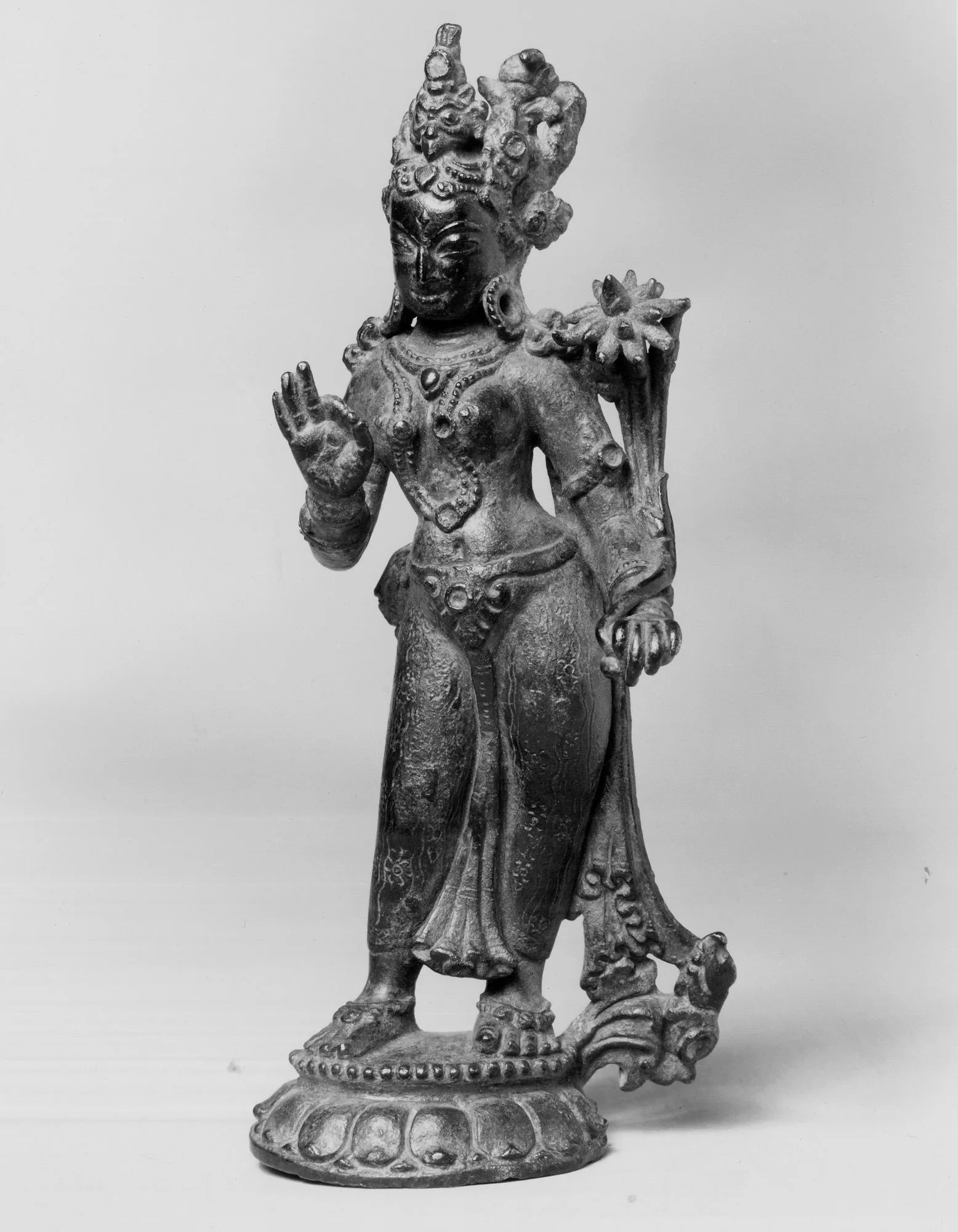
Although white is the goddess's native palette, the Indian tradition of temple jewellery cast Sarasvati, like the other gods, in gold as well, with rich relief work. A golden figure of the goddess with the vina is a canonical temple image, especially for festive and altar pieces. Warm gold leads the image away from austere whiteness toward ceremony, and that version is chosen when a piece should sound festive rather than restrained.
The White Thread as a Base
Many wear a figure or sign of Sarasvati not on a chain but on a white or yellow thread. White is the goddess's colour, and yellow is tied to her festival of Vasant Panchami. The thread in Indian tradition carries the meaning of a blessing, tied on in temples and at festivals. A pendant on a thread looks modest yet carries a double meaning, knowledge and blessing. It is an accessible option for those to whom the symbol matters more than a costly metal.
CAPAORA mini knife pendant
The 18th-century Spanish navaja in miniature: 40 mm of stainless steel, a real folding mechanism and a Palanquilla lock that clicks. An affordable gift to remember.
Authentic · Ships from Spain · 14-day returns
Goddesses of Wisdom Across Cultures
Athena Among the Greeks
Sarasvati is not the only goddess of wisdom in the world, and a comparison helps to grasp what is distinct about her. Among the Greeks wisdom belonged to Athena, born from the head of Zeus, goddess of reason, strategy and crafts, with the owl as her companion. But Athena is also a warlike goddess, wisdom as calculation and victory. Sarasvati is gentler: her knowledge is not a weapon but music, speech and purity. Where Athena is helmeted and bears a spear, there Sarasvati is with the vina and in white.
Thoth and Seshat Among the Egyptians
In ancient Egypt writing, counting and knowledge were embodied by the god Thoth with the head of an ibis, while his companion Seshat presided over writing and measurement. Like Sarasvati, they are tied to the word and the record, to what keeps knowledge. But the Egyptian tradition stressed counting, measure and the magic of writing, whereas the Indian one added music and art. Sarasvati unites writing and music in a single image, which the Egyptians did not.
Benzaiten in Japan
The most direct relative of Sarasvati is the Japanese Benzaiten, into whom the goddess turned on arriving with Buddhism. Benzaiten presides over water, music, eloquence and fortune, holds the biwa, a musical instrument, and her shrines are set by water, by ponds and rivers. Here you can see how far the Indian goddess travelled and how exactly she kept her core: water, music and the word stayed with her even thousands of kilometres from home. This is a rare example of a single image passing through several cultures without losing its centre.
Vasant Panchami as a Festival of Knowledge
It is worth recalling the festival of Sarasvati on its own, for it lights up her essence. Vasant Panchami is not a lavish celebration of wealth like Lakshmi's Diwali, but a luminous day of study and spring. Yellow clothes, books and instruments before an image of the goddess, children tracing their first letters, kites in the sky. The festival is quiet and joyful, like the goddess herself: it is not about money and luxury but about a beginning, a blank page, an entry into the world of knowledge.
Facts That Surprise
Sarasvati did not begin as a goddess but as a river. In the Rigveda she is a mighty, brimming stream, "best of rivers," and only with time did the name of the river become the name of the goddess of knowledge.
By an ancient belief, Sarasvati's swan can separate milk from water when the two are mixed and drink only the milk. That is how it became a symbol of wise discernment, the ability to part truth from falsehood.
On the day of her festival, Vasant Panchami, small children in India are set to write their letters for the first time, their hands guided over rice. Many Indians trace the first word of their lives under the protection of the goddess of knowledge.
A musical instrument in Indian tradition is held to be the dwelling of Sarasvati, so to step carelessly over a vina or a sitar is considered disrespect to the goddess herself.
Sarasvati is the consort of Brahma the creator, and by one tale he made her from his own mouth as the embodiment of speech, since without the word and knowledge the world could not be ordered.
The goddess of knowledge travelled with Buddhism all the way to Japan, where she became Benzaiten, one of the Seven Lucky Gods, keeping her link to water, music and eloquence.
Folk wisdom holds that Lakshmi and Sarasvati, wealth and knowledge, rarely visit the same house at once, which is why their images are sometimes kept apart.
The goddess's white colour is not poverty but a different kind of luxury. In a world where gods blaze in gold and purple, Sarasvati chooses pure white, and that is her chief mark of distinction.
Send a friend a discount code, they save on their first order.
Frequently Asked Questions
Who is Sarasvati in simple terms?
She is the Hindu goddess of knowledge, wisdom, speech, music and every art, the consort of the creator god Brahma. She is pictured as a beautiful woman in white, with four arms, playing the stringed instrument called the vina, with a book and prayer beads, on a white lotus, beside a white swan. She gives mind, clear speech and creative mastery.
How does Sarasvati differ from Lakshmi?
Sarasvati gives knowledge, Lakshmi gives wealth. Sarasvati is in white, with the vina and the book; Lakshmi is in red and gold, with coins and elephants. By folk belief the two rarely visit the same person at once. The sages advised calling Sarasvati first: knowledge is the roots, wealth the fruits. The goddess of means is covered in detail in an article about Lakshmi.
What does the vina in Sarasvati's hands mean?
The vina is a stringed instrument and the goddess's chief personal sign. The music of the vina is an image of harmony built from sound, that is, of knowledge turned into beauty. Playing demands mastery and an ear, everything Sarasvati bestows. A pendant shaped like the vina is her most telling symbol and a telling gift for a musician.
Why is there a white swan beside Sarasvati?
The swan, in Sanskrit hamsa, is her vahana, her mount. By an ancient belief the swan can separate milk from water and drink only the milk, and so it became a sign of discernment, the wise person's chief faculty of parting truth from falsehood. Sarasvati on the swan is knowledge that knows how to choose.
Can a non-Hindu wear Sarasvati jewellery?
Yes, if it is worn with respect and an understanding of the meaning, not as exotic decor. Sarasvati is a living goddess for hundreds of millions of people. It is fitting to wear her image as a pendant, a ring or earrings. It is disrespectful to place an image of a deity on footwear or underwear. Knowing what you wear is the chief condition of respect.
What metal and stone are best for Sarasvati jewellery?
White is the goddess's palette, so silver, white gold and platinum suit her, and among stones pearl, moonstone, rock crystal, white and clear stones. Silver with pearl conveys her pure, luminous theme best of all. Warm gold is fitting for a festive, ceremonial version.
When is the best time to give Sarasvati jewellery?
The main occasion is her festival of Vasant Panchami at the end of winter, a day of knowledge and spring. Occasions tied to study and creativity are good too: the start of the school year, admission, an exam, a thesis defence, a musical debut. It is a telling gift for a student, a teacher, a musician, anyone who studies or creates.
Does Sarasvati help only with study?
No. Her sphere is wider: wisdom and discernment, clarity and eloquence of speech, music and dance, any art or craft, memory and concentration, purity of mind. Study is only the most common request made to her. In essence she is patron of everything that calls for mind, mastery and the word.
Conclusion
Sarasvati is the most luminous and austere image in the whole Hindu pantheon, because her gift cannot be bought and cannot be lost. Wealth comes and goes, but knowledge stays with a person forever. A white sari instead of gold, the vina instead of a stream of coins, the swan that separates milk from water, the white lotus of a clear mind, the book and beads in her hands. To wear her symbol is to choose mind, mastery and purity of thought, to bet on the roots rather than the fruits. The goddess comes to the one who studies and labors; silver or white gold, a quiet lotus or a telling vina, the result is one and the same: this is jewelry about knowledge, and it has dignity.
Jewellery with the symbolism of knowledge and purity
White lotus, swan, pearl, cool silver. Choose your piece in the spirit of Sarasvati, as a gift for a student, a musician, or yourself.
Browse the catalogueBuying it as a gift? Each one arrives ready to give.
 A branded Zevira box and a little card come with every order.














About Zevira
Zevira is jewellery with meaning. We gather symbols that carry a story: charms, signs of love and luck, mythological and religious images from different cultures. Every piece comes with a clear account of what it means and where it came from, so you wear something with character rather than an impersonal metal and stone. Gold, silver, natural stones, pearl, all chosen so that a piece serves long and pleases every day.