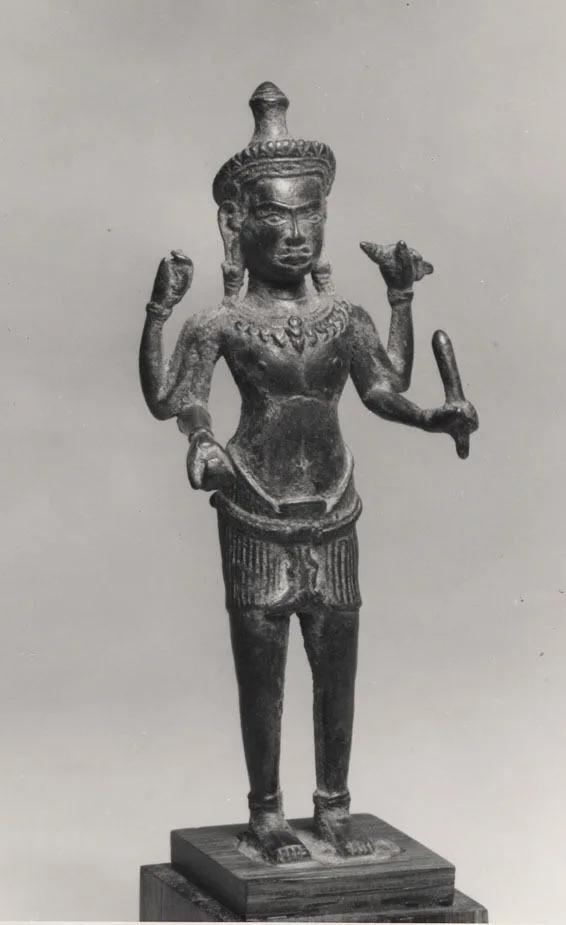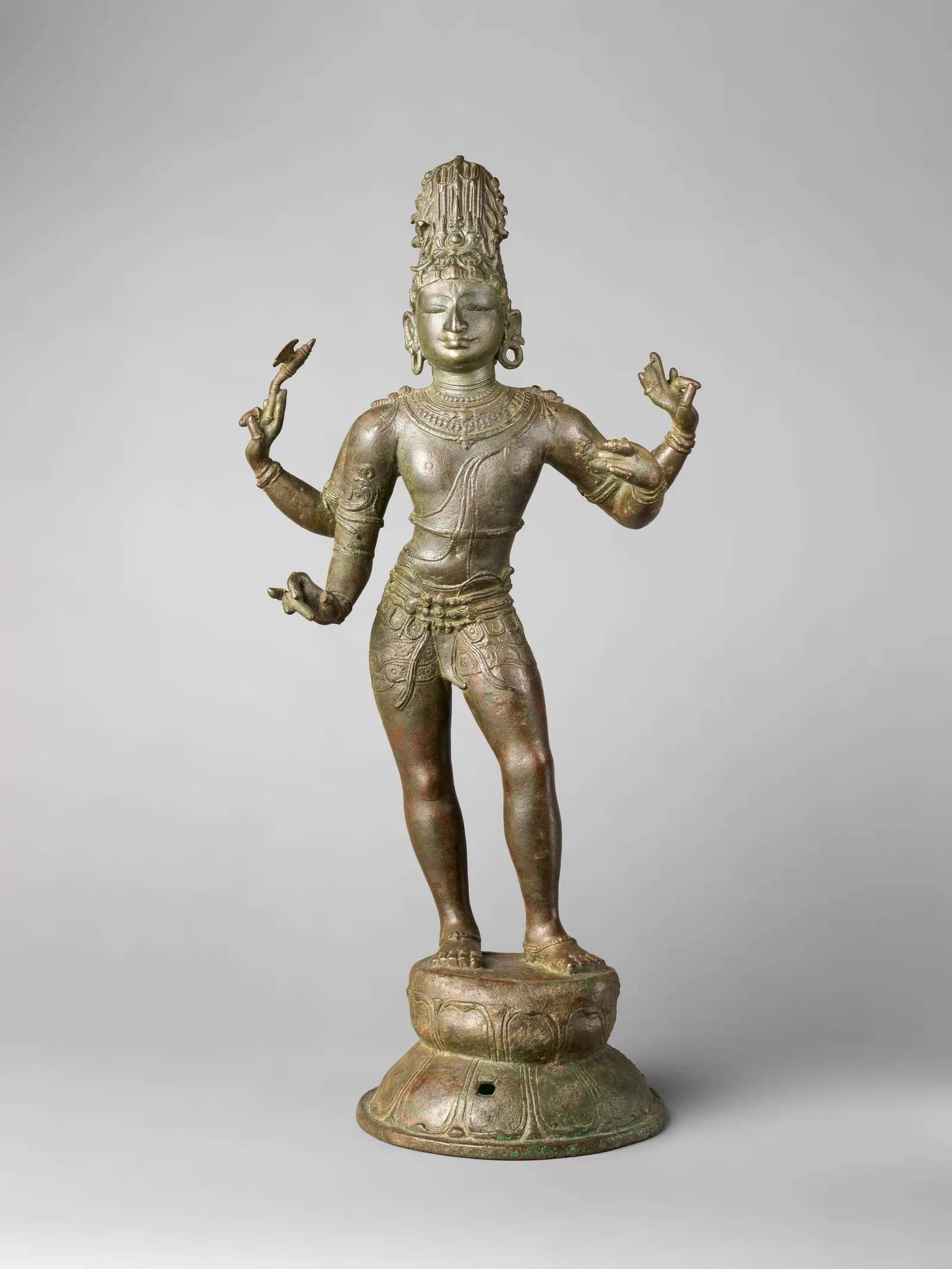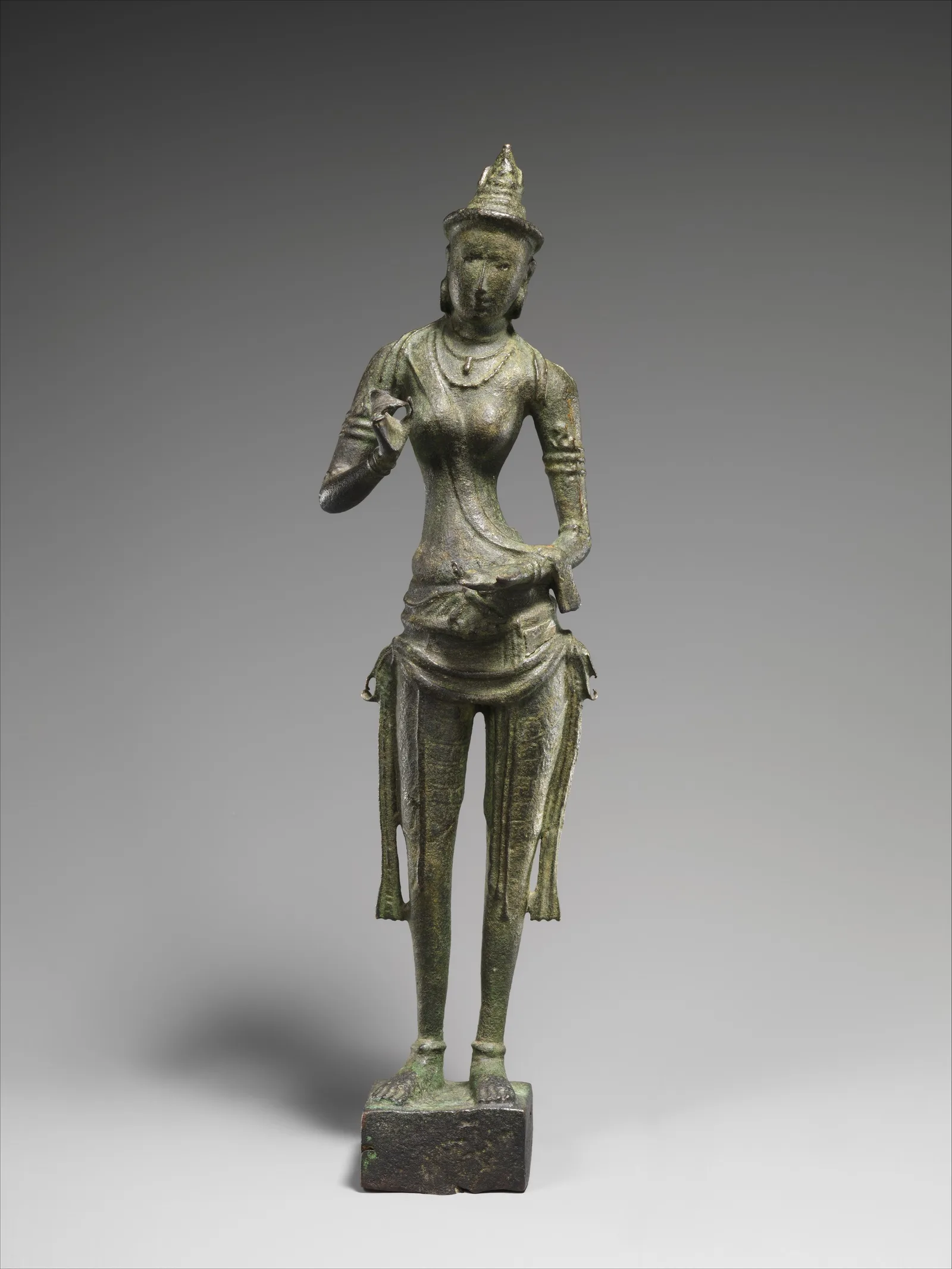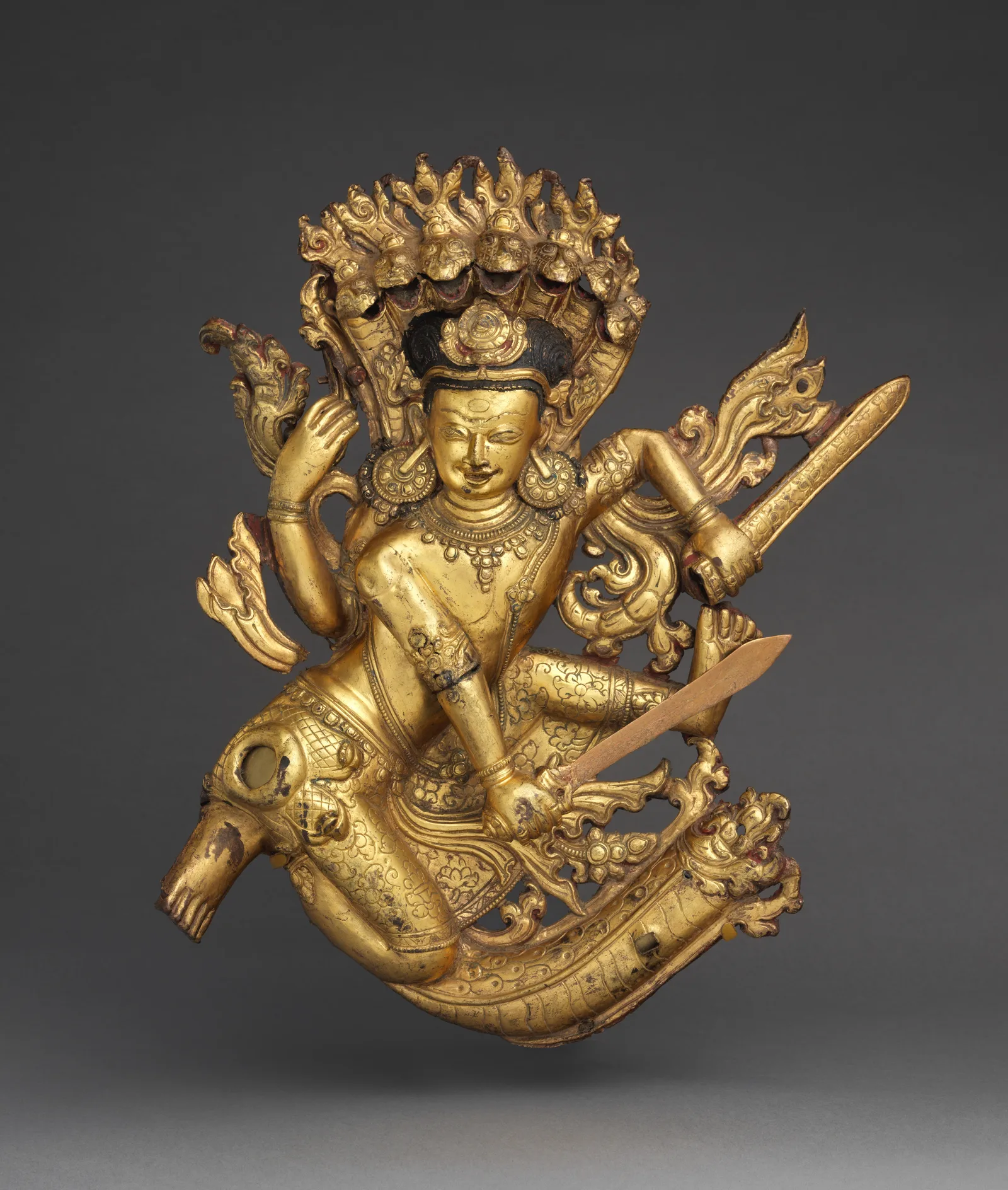
Krishna in jewelry: the blue-skinned god of love with a flute, a peacock feather and a tale of stolen butter
A blue cowherd who steals butter from the neighbours, enchants a whole herd of cattle with his flute, and falls in love with the cowgirl Radha. This is no children's bedtime story but one of the most beloved gods on the planet. Krishna wears a peacock feather in his hair, holds a bamboo flute, and smiles in a way that millions of people read as the very face of joy.
Who Krishna is
Krishna is one of the most revered gods of Hinduism, the eighth earthly form of the great god Vishnu. Where many gods are painted as fearsome or majestic, Krishna is different. He smiles, plays, loves, and gets into mischief. He carries the role of the embodiment of divine love and joy, and that is why his image is welcomed so warmly both in India and far beyond it.
The name Krishna in Sanskrit means dark, blue, attracting. Hence his recognisable blue or blue-black skin, the chief visual marker of the god. The colour is read in different ways: as the colour of the endless sky and ocean, as a sign of the boundless, as a hint at something that does not fit into ordinary earthly tints. Krishna has many names: Govinda and Gopala (cowherd, keeper of cattle), Madhava, Murali (the flute player), Giridhari (the lifter of the mountain). Each name opens a separate facet of his rich biography.
Wear the symbol, don't just read about it. These are in stock:


In jewellery Krishna appears both as a full figure playing the flute and through his recognisable signs. The bamboo bansuri flute, the peacock feather in his hair, the blue colour, the cow and the herdsman's staff, the lotus, the paired image of Radha and Krishna. These signs are read instantly by anyone familiar with Indian culture, and to everyone else they give an elegant form with a deep meaning. A pendant with a flute or with the figure of a dancing cowherd works as a sign of love, joy, and a lightness that does not deny depth.
Krishna holds a special place among the figures of the Hindu pantheon. He is not one of the three supreme gods, like Brahma, Vishnu and Shiva, but an earthly manifestation of Vishnu the preserver, who descended into the world in human form. At the same time, for millions of people, followers of Vaishnavism and especially of the Krishna tradition, Krishna himself is the highest, all-encompassing deity, the source of everything that exists, rather than one avatar among many. This duality, a god who is also a close, accessible, loving friend, is what makes his image so alive.
How Krishna differs from other gods
Set beside fearsome or majestic gods, Krishna stands out for his humanity. His life is not abstract cosmology but a detailed biography: birth in prison, a secret rescue, a childhood among cowherds, youthful games with the cowgirls, friendship, war, philosophical conversation. People turn to him not out of fear but out of love and tenderness. Many devotees build personal, almost family relationships with Krishna: they see in him a child, a friend, a beloved, a teacher. In this he is closer to human beings than almost any other great god, and that closeness explains why his image is so readily worn near the heart.
Names and forms of Krishna
Krishna has many names, and each opens its own facet. Govinda and Gopala are linked with the care of cattle and herding, Murali and Murlidhar with playing the flute, Madhava with spring and sweetness, Giridhari with the lifted mountain, Madhusudana with the defeat of a demon. He is depicted in many ways too: a chubby toddler with butter in his palm, a young cowherd with flute and feather, a wise charioteer, the loving partner of Radha. This many-sidedness gives jewellery a rich choice: one person wears the mischievous child, another the tender flautist, a third the paired image of love. Behind each form stands its own story, and so the symbol of Krishna is rarely faceless. It almost always points to a specific scene.
What follows, in order: where the image of Krishna came from and which stories stand behind it, what each of his symbols means, why people wear such jewellery, what the love of Radha and Krishna means, what these pieces are made from, how to wear them and with what, respectfully, and which surprising facts have gathered around this god.
The history and cult of Krishna
The image of Krishna is one of the most fully developed in any living religion on the planet. Behind it stands a detailed biography told in sacred texts, and a cult that grew into one of the largest spiritual traditions in the world. At almost every stage of this story Krishna left a mark in art, in painting, in sculpture, and in the small forms of jewellery.
An avatar of Vishnu
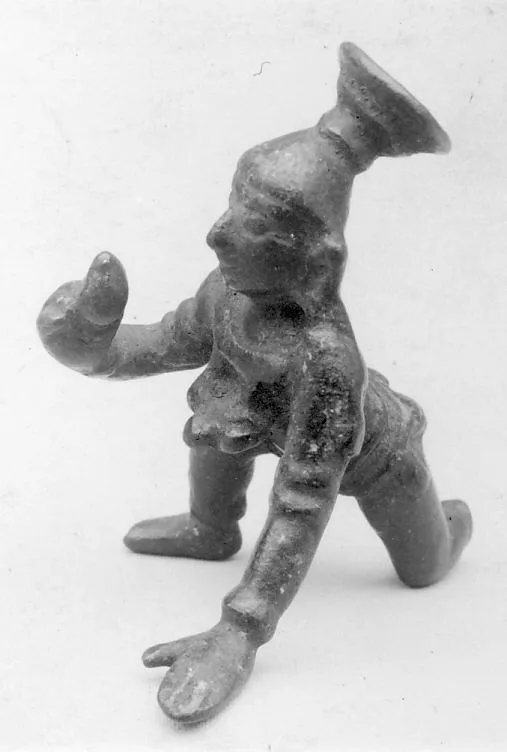
Hinduism holds the idea of the avatar: the supreme god Vishnu, keeper of the world's order, descends to earth from time to time in different forms to restore justice whenever evil gains the upper hand. The tradition counts several such earthly manifestations, and Krishna is the eighth of them, one of the fullest and most beloved. He comes into the world in a difficult hour, to free the earth from tyranny and bring back balance. This is worth grasping clearly: Krishna is not a separate, independent god who appeared from nowhere, but the face of Vishnu himself, turned toward people with a special warmth. That is why his symbolism so often sits alongside the signs of Vishnu: the lotus, the disc, the conch.
Birth in prison and a secret rescue
History begins dramatically for Krishna. The wicked king Kamsa, having heard a prophecy that the eighth son of his sister would destroy him, locks his sister and her husband in a dungeon and kills their children one after another. When Krishna is born, a miracle happens: the guards fall asleep, the chains drop away, the gates open by themselves. The father carries the infant out of the prison, wades across a flooded river, and gives the child to be raised by a family of cowherds, exchanging him for a newborn girl. So Krishna grows up not in a palace but among simple cowherds, in the village of Vrindavan, and this decides the whole character of his image: a god who is not a distant overlord but one of your own, raised among cows, meadows and ordinary people.
A mischievous childhood and the stealing of butter
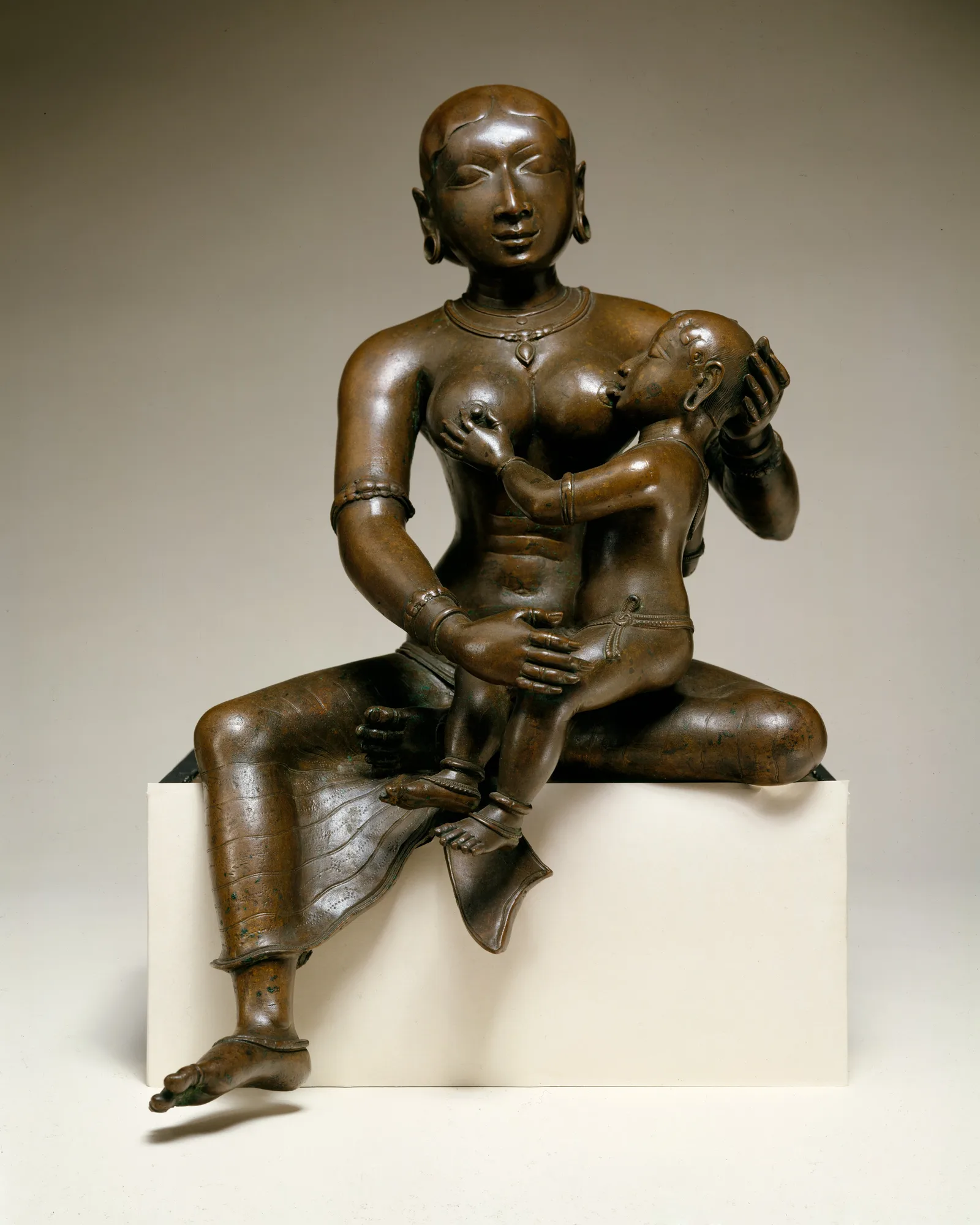
Krishna's childhood is an endless string of charming pranks, lovingly retold for centuries. Little Krishna adored fresh butter and cream, and together with his friends he would pinch them from the pots that the housewives hung up high, out of the children's reach. The little ones would climb onto one another's shoulders in a living pyramid to reach the treat. This scene, the butter thief, became one of the most cherished: Krishna is often shown as a chubby toddler with a lump of butter in his palm and a sly smile. Behind the mischief stands a deep idea: a god who is accessible in the simplest, most domestic, most human things, who loves the world and people without any sternness. To this day, festivals in his honour stage a game where teams build human towers to break a pot hung high overhead.
Youth in Vrindavan and the dance with the cowgirls
The young Krishna in Vrindavan is surrounded by gopis, cowgirls captivated by his flute playing. The most famous scene of this time is the rasa lila, the circular night dance of Krishna with the cowgirls beneath the moon. By tradition each gopi felt that Krishna was dancing with her in particular, because he miraculously multiplied his image so that no one would be left out. This dance is read not as a simple love story but as an image of the soul reaching toward the divine, and the divine answering each soul with love. Among all the cowgirls, Radha holds a special place, and there is a separate, larger discussion of her further on.
The Bhagavad Gita
The mature Krishna is no longer a playful cowherd but a wise teacher and a participant in the great war described in the epic. On the battlefield the warrior Arjuna loses his will: he is about to fight against his own kin and teachers, and he lowers his weapon. Then his charioteer, who turns out to be Krishna himself, leads him through a long conversation about duty, about action without attachment to its fruits, about the immortality of the soul, about the different paths to the highest. This conversation became the sacred text known as the Bhagavad Gita, one of the most widely read and revered philosophical works of Hinduism. From the cheerful boy with butter, Krishna here reveals himself as the deepest of teachers, and both sides, play and wisdom, live within a single image.
Janmashtami
The birth of Krishna is celebrated as one of the most joyful festivals of Hinduism, Janmashtami. On this day people fast until midnight, the supposed hour of the god's birth, then sing, decorate cradles holding a figure of the infant, and act out scenes from his life. In various regions people stage noisy games of breaking a hanging pot of butter, recalling his childhood pranks. The festival is filled not with solemn sternness but with family warmth and merriment, fitting for Krishna himself. For millions of people this is a favourite day of the year, and the mood of the festival says a great deal about the character of a god whom people approach with joy rather than fear.
Vaishnavism and the worship of Krishna
The worship of Krishna is part of a large current within Hinduism, Vaishnavism, which unites those for whom the highest god is Vishnu and his earthly forms. Within this tradition stands the Krishna tradition, in which Krishna is venerated as the fullness of the divine. A special place belongs to the path of bhakti, devoted loving service to god: not dry ritual but heartfelt love, expressed in singing, dance, and the repetition of names. This path made the image of Krishna so emotional and warm. Devotion to Krishna is also expressed through jewellery bearing his signs, worn as a visible acknowledgment of that love.
Krishna's flute plays solo or not at all. Bury it under five chains and the god goes silent, and I won't have that.
What to wear with your Krishna symbol
Plenty of flutes, figures and paired pendants have passed through my hands. Here is what genuinely works, sorted by occasion.
How do I wear the bansuri flute every day? For daily wear I recommend the spare silver flute on a thin chain of medium length, over a plain t-shirt or a linen shirt. A light top lights up the graphic line, a dark one turns it into the accent. I suggest letting a single flute take the solo, with no neighbours fighting for attention.
And where does the figure of the playing god go? The figure is more complex in silhouette, so it needs room. Under it I choose a plain top with no pattern and a slightly longer chain, so the figure lies on the chest and reads as a whole. Gold and enamel suit it better than silver here, and I keep the background of the outfit calm.
How do I carry coloured enamel with the blue and the peacock feather? I recommend wearing bright enamel against a solid background: black, white, deep wine. A busy print next to it drowns the blue and the feather, and the whole point of the colour is lost. One coloured pendant on a clean neckline speaks louder than enamel crowded among other pieces.
How is the paired Radha and Krishna worn? I suggest keeping the paired pendants right at the heart, on a chain under the clothes or over them. It is a meaningful sign for two, fitting for an anniversary or an engagement. You do not need a second large pendant beside it; let the pair speak for itself.
Which symbols do I combine it with? I recommend letting one strong Krishna sign take the solo rather than drowning it in a handful of charms. Thematically it sits well with other signs of the Hindu tradition: the sacred syllable Om, the lotus and the peacock feather, the figure of Ganesha. Coloured enamel I choose against a calm background of clothing, so the blue and the feather read clearly.

Turn on your camera, pick earrings, a pendant or a ring, and see the piece on yourself in real time.
Switch items in one tap.
Everything runs in your browser: no photo or video is ever uploaded.
Customer reviews
Zevira is a real jewellery shop. Genuine payments, deliveries and customer thank-yous.
🥰🥰🥰 gracias
Ok, ¡gracias! 🙂
The symbols of Krishna
Krishna has a whole set of recognisable signs, and almost every one has become an independent motif in jewellery. Let us go through them one by one, pointing to separate articles wherever a symbol deserves its own discussion.
The bansuri flute
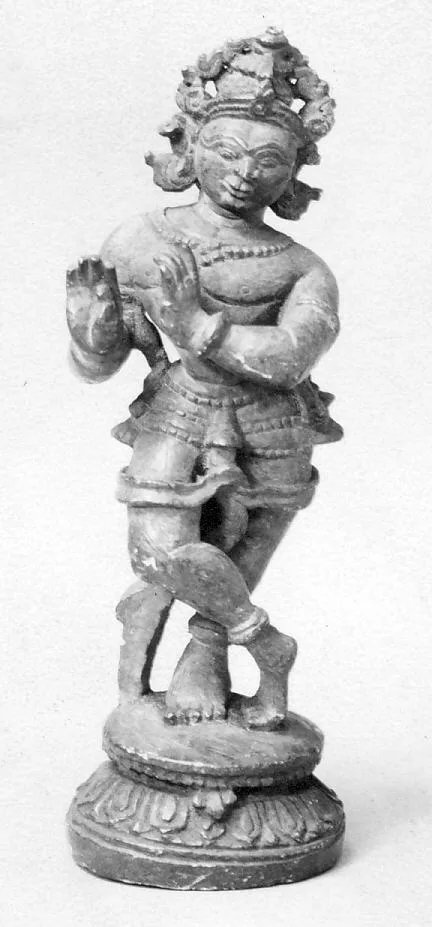
The flute is the chief and most recognisable sign of Krishna. The bansuri is a simple bamboo transverse flute, and in the hands of the god it becomes an instrument whose music captivates everything alive: people, animals, even rivers grow still to listen. The sound of the flute is read as the call of the divine, addressed to the human soul, as love that draws others to itself without force, by its beauty alone. The emptiness inside the flute carries its own meaning: only by emptying oneself of pride and ego does a person become an instrument in the hands of the highest, through which the divine melody flows. In jewellery the bansuri reads elegantly and graphically, and of all Krishna's signs it is the slender flute that most often finds its way into spare pendants and charms.
The peacock feather
A peacock feather always shines in Krishna's hair, and this is one of his gentlest signs. By tradition the peacocks so rejoiced in the god's music that they danced for him, and in gratitude Krishna adorned himself with their feather. The eye on the peacock feather is linked with all-seeing vision and with beauty, and its bright colours with joy and the play of life. The peacock as a symbol in its own right has a long history, and there is a separate account of it in the piece on the meaning of the peacock in jewelry. For Krishna the peacock feather adds lightness, festivity, and a connection with the nature among which he grew up.
Blue skin
Blue or blue-black skin is Krishna's visual signature. Artists read this colour as a sign of infinity: the god's skin is the colour of the boundless sky and the deep ocean, the elements that have no visible limits. The blue hints that Krishna, for all his human closeness, remains measureless, unable to fit into ordinary earthly tints. There is a more poetic reading too: just as pure water and clear air, at great depth, appear blue, so the infinitely pure divine reveals itself through blue. In jewellery the blue skin is conveyed through blue stones and enamel, and it is often the colour that becomes the accent setting the image of Krishna apart.
The cow and the cowherd
Krishna grew up among cowherds and herded cattle himself, hence his names Govinda and Gopala, linked with the care of the herd. The cow in Hinduism is a sacred animal, a symbol of gentleness, abundance, and the motherly generosity of the earth. The image of Krishna the cowherd, surrounded by cattle, playing the flute to them, carries the idea of a god who tenderly keeps everything alive, as a herdsman keeps his flock. The herdsman's staff and figures of cows sometimes accompany images of the god. In jewellery this facet appears less often than the flute, yet it is exactly what explains why Krishna is felt as a close, domestic, earthly god rather than a distant heavenly ruler.
The lotus
The lotus accompanies Krishna as it does many gods of Hinduism. This flower grows out of muddy water yet remains pure and beautiful, and so it became a symbol of spiritual purity born in the midst of an imperfect world. With Krishna the lotus is often used to describe his eyes, his feet, his palms, underlining the beauty and purity of the god. The lotus as a symbol in its own right is treated in a separate article on the meaning of the lotus in jewelry. For Krishna the lotus strengthens the theme of purity that the world cannot stain, and of a spiritual beauty open to everyone.
Radha and Krishna as a symbol of love
The paired image of Radha and Krishna is a sign all its own, a separate motif in jewellery and a whole philosophy of love. Radha is Krishna's beloved cowgirl, and their union became, in Indian culture, the highest image of love, earthly and divine at once. Paired pendants, two profiles turned toward each other, figures of the lovers together with the flute and feather carry the idea of perfect, devoted, tender love. A separate, larger section is given to this image below, because the love of Radha and Krishna is the heart of the whole cult and one of the chief reasons people wear his symbols as a sign of feeling.
Upload a photo of your pet, someone you love, or an object. We'll build a 3D model and hand-cast it in pewter.

What Krishna means in jewellery
Why wear a symbol of Krishna? This god carries several layers of meaning, and each answers a different human need. What unites them is the idea of love and joy open to everyone, rather than stern protection.
Divine love
The chief meaning of Krishna is love. Not strict and demanding, but tender, drawing near, answering a person's feeling. People choose the symbol of Krishna when the idea of love as the highest power and as a path to the highest is close to them. The flute that calls by its beauty alone, the paired image of Radha and Krishna, the very smile of the god all speak of this. To wear such a sign is to keep with you a reminder of love as the main thing in life.
Joy and lightness
Krishna is a god of joy. His childhood pranks, dances, music and smile carry the idea that the spiritual need not be stern and heavy. One can move toward the highest with a light heart, through beauty, play, love. For a person tired of heaviness and seriousness, the symbol of Krishna is a quiet permission to rejoice without treating joy as something shallow. In this the image of Krishna stands clearly apart from fearsome or ascetic gods.
Lila, the divine play
In the philosophy of Krishna the idea of lila, divine play, matters greatly. According to it, the whole world is the free, joyful play of the highest, created not out of need but out of fullness and love. Krishna plays, dances, gets into mischief precisely because divine action is free and light. The symbol of Krishna is a reminder: one can treat life as a game, without clinging to the result, living it with interest and lightness. This is a deep idea, offered through the brightest of images.
Devotion
The path to Krishna is the path of bhakti, devoted loving attachment to god. What is valued here is not the number of rituals but the sincerity of feeling, the giving of the heart. People choose the symbol of Krishna as a sign of this devotion, the direction of the heart toward something high and beloved. For a believer, a piece with a flute or with the figure of the god is a visible acknowledgment of love. For a secular person the same idea reads as faithfulness to what is dear, as the ability to give oneself wholly to feeling.
Harmony and inner peace
The music of Krishna, under which the world falls silent, carries the idea of harmony. Where the god's flute sounds, accord arrives: the herd grows calm, nature stills in beauty. People choose the symbol of Krishna as a sign of inner concord, of agreement with oneself and with the world. This is not passive peace but living harmony, in which there is room for movement, for dance, and for joy.
Protection and trust in the world
Krishna has the facet of a protector too. In the legends he saves the cowherds from a flood by holding a whole mountain on one finger, defeats monsters and tyrants, and shields the people who love him. This protection rests not on thunder and fear but on trust: whoever has given their heart to Krishna feels themselves under a reliable wing. People choose the god's symbol as a quiet sign of that support, the belief that love is stronger than misfortune. For someone passing through a hard period, such a sign works as encouragement, a reminder that care arrives in a simple, human form too, not only in a fearsome one.



Radha and Krishna: a symbol of love
Among all the facets of Krishna, the love of Radha and Krishna stands apart, and it deserves a separate discussion. It is this paired image that most often becomes the heart of a piece of jewellery, and it best explains why Krishna is called the god of love.
Who Radha is
Radha is Krishna's beloved cowgirl, his chief love among the gopis of Vrindavan. In the legends she is older than Krishna and loves him selflessly, with her whole being. Their love is full of both tenderness and the longing of separation, for Krishna is destined to leave Vrindavan for his great calling. In the Indian tradition Radha came to embody the perfect loving soul, and she is often venerated together with Krishna as an inseparable pair. In many temples their images stand side by side, and people address them as a single image of love.
Earthly love and love for the highest
The love of Radha and Krishna is read on two levels at once. On the first it is the story of earthly, human love in all its fullness: attraction, tenderness, jealousy, separation, faithfulness. On the second it is an image of the soul striving toward god, and god answering it with love. Radha here embodies the human soul, and Krishna the highest, toward which it reaches. Radha's longing in separation is read as the longing of a soul torn from the divine. This double meaning makes the image deep: speaking of earthly love, it speaks also of love as a path to the highest.
Paired jewellery
The image of Radha and Krishna has long served as the basis for paired jewelry. Two pendants that together form a single scene, paired charms with figures of the lovers, rings with their names or signs are worn as a symbol of love and faithfulness. Such a gift carries the idea of the perfect couple, of devotion to one another, of a love in which the earthly and the exalted come together. For lovers it is a meaningful sign with a thousand years of feeling behind it, rather than a chance pretty souvenir. There is more about the language of such signs in the piece on love symbols in jewelry.
Leave your email, we'll send your discount code. No spam, unsubscribe anytime.
The code arrives by email, valid on your first order.
Materials
The image of Krishna is historically tied to certain materials, and each has its own logic. Part of this comes straight from temple tradition, part from the jeweller's craft.
Gold
Gold gives the image of Krishna a stately, warm depth. A gold figure of the god playing the flute recalls temple images decorated with gold and gems, for in temples Krishna is dressed richly and festively. A gold pendant with a flute or with a peacock feather reads as a ceremonial, more formal option, fitting for a significant gift or a special occasion. The warm gleam of the metal echoes the joyful, festive character of the god himself.
Silver
Sterling silver with its cool gleam conveys beautifully the elegant, graphic line of the flute and the slender feather. The bansuri, the silhouette of the dancing cowherd, the paired profile of Radha and Krishna in silver look noble and restrained, while silver is easily darkened in the hollows of the relief to bring out detail. Silver is durable, wearable every day, and does not cause allergies in most people. For a spare flute or a small pendant it is perhaps the most versatile choice.
Peacock enamel and colour
A special line of Krishna jewellery is the work with colour. The blue skin of the god and the bright peacock feather are conveyed through enamel, laying in deep blue, turquoise, green, gold. Hot enamel over metal gives a rich, almost jewel-like colour, and it catches best the blue-green shimmer of the peacock feather and the blue of Krishna himself. Such pieces look festive and ornate, in the spirit of the Indian tradition, where the image of the god is always richly coloured. Enamel calls for careful handling: it is protected from knocks and scratches, and taken off before any vigorous activity.
Stones
A separate line is the use of stones that echo Krishna in colour and meaning. Blue stones answer the blue skin of the god and the infinity of the sky, blue-green ones pick up the play of the peacock feather, clear ones add light to the image. The stone here works as an accent rather than the main character, because in Krishna jewellery the symbol itself comes first: the flute, the feather, the figure of the god, the paired image of love.
How to tell a good piece from a stamped one
The image of Krishna lives in detail, and the quality of the work shows at once. In a good figure you can read the elegant pose with crossed legs, recognise the flute at the lips, the feather in the hair, the soft smile. In a weak casting the details run together, the face is blurred, the flute turns into a shapeless little stick. Enamel is judged by the cleanness and evenness of the fill: the colour should lie smoothly, without bubbles or chips, and the borders between shades should be sharp. Genuine silver carries a hallmark of its fineness, most often 925, while a suspiciously light "silver" piece with no hallmark, one that quickly darkens to a green tinge, gives away a cheap alloy under a coating. Paired jewellery is checked by how the two parts come together: in a good piece the lines meet exactly, forming a single scene.
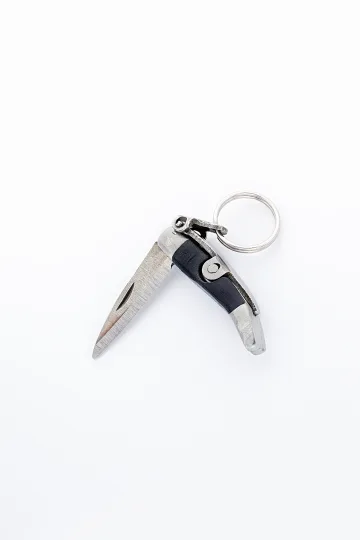
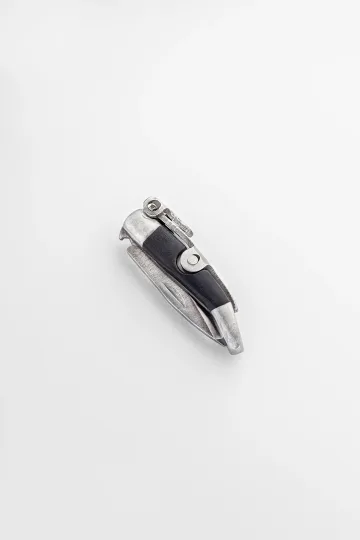
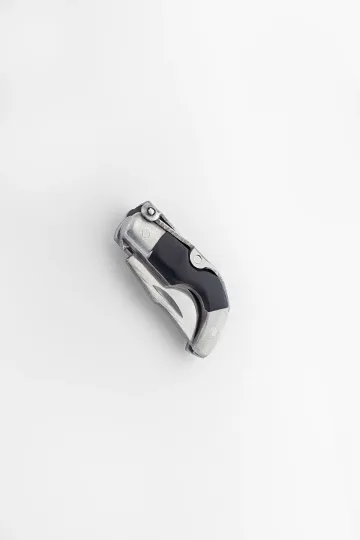
CAPAORA mini knife pendant
The 18th-century Spanish navaja in miniature: 40 mm of stainless steel, a real folding mechanism and a Palanquilla lock that clicks. An affordable gift to remember.
Authentic · Ships from Spain · 14-day returns
Krishna in art, dance and song
Krishna has a vast cultural life beyond the temple, and it feeds the modern symbolism of jewellery. Its main fields are the visual arts, classical dance, and the tradition of singing the god's names.
Krishna in art
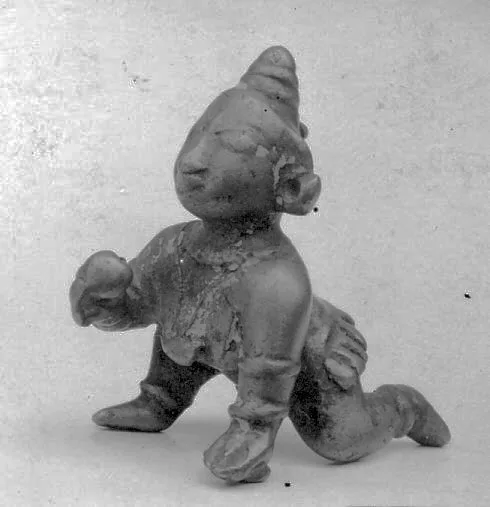
Artists have returned to Krishna for thousands of years. Stone reliefs in ancient temples show the god playing the flute surrounded by cowgirls and cattle. Later Indian miniature painting created whole series about his life: blue Krishna among the green groves of Vrindavan, the night dance beneath the moon, tender scenes with Radha, the separation and reunion of the lovers. These miniatures, with their rich colours and fine feeling, became a peak of Indian painting. From this rich tradition all the recognisable details passed into jewellery: the pose with the flute, the crossed legs, the feather in the hair, the blue colour, the paired image of love. Every pendant with a flute player is a distant descendant of the temple relief and the courtly miniature.
Krishna in dance
The life of Krishna is a favourite subject of classical Indian dance. Scenes of his childhood, of the dance with the cowgirls, of the love of Radha and Krishna have been embodied for centuries in movement, gesture, and expression. With the language of the body a dancer tells how Krishna steals butter, how he calls the cowgirls with his flute, how Radha longs and loves. This dance language is full of tenderness and play, fitting for the god himself. The image of Krishna playing the flute, carried into a piece of jewellery, holds the same dancerly grace: the lightness of the pose, the curve of the body, movement frozen in metal.
Singing the names and the Hare Krishna movement
The path of bhakti shows itself most vividly in the singing of the god's names. The repetition and chanting of Krishna's names, including the famous mantra with the words "Hare Krishna," is an ancient spiritual practice meant to fill the heart with love for god. In the twentieth century, devotion to Krishna through song and dance spread far beyond India along with an international movement that many know by the words "Hare Krishna." This is a living religious practice of millions of people, and it deserves the same respect as any faith. For jewellery this means that the signs of Krishna long ago travelled beyond India and became recognisable around the world, and with that recognition came a responsibility to wear them with meaning.
Facts that surprise
So many stories have gathered around Krishna over the millennia that some of them sound almost unbelievable.
Krishna lifted a whole mountain on one finger. By the famous legend, to shelter the cowherds and their cattle from a seven-day downpour sent by the angered god of rain, the young Krishna raised the great hill of Govardhana and held it on his little finger, like an umbrella, until the storm died down. Hence his name Giridhari, the lifter of the mountain. The scene is read as the victory of direct love and care over fear of fearsome forces.
The name Krishna means blue, or dark, quite literally. The god's recognisable colour is built into his very name. In Sanskrit "krishna" means dark, blue-black, attracting. His blue-dark skin, in other words, is not an invention of artists but the literal meaning of the name turned into a visual image.
Each cowgirl in the dance believed Krishna was dancing only with her. By the legend of the rasa lila, the circular night dance, Krishna miraculously multiplied his image so as to stand beside every gopi at once. In this way none felt left out, and people read in it an image of divine love that belongs wholly to each soul, without dividing itself.
The Bhagavad Gita is called one of the most widely read philosophical books in the world. The conversation of Krishna with the warrior Arjuna on the battlefield became a sacred text in its own right, translated, commented on, and studied for centuries far beyond India. Great thinkers in many countries read it and drew inspiration from it.
In honour of Krishna's childhood pranks, people still build living towers out of human bodies. At a festival in his honour, teams build a high human pyramid to reach a pot of butter or curds hung high overhead and break it. The game reenacts the god's childhood mischief, when he stole butter by climbing onto his friends' shoulders.
Krishna and Radha have no "wedding" in the ordinary sense. Their love is venerated as the highest image of feeling precisely because it is free and selfless, not fixed by a marriage contract. Many traditions place this pure, devoted love above any formal tie, seeing in it an image of the soul's love for god.
Krishna's blueness is explained through the physics of water and sky. One poetic interpretation holds that pure water and clear air, at great depth and breadth, appear blue, though in themselves they are colourless. So the infinitely pure divine, having no "colour" of its own, reveals itself to the eye as blue, the colour of the boundless.
The peacocks, by legend, gave Krishna their feather themselves. Enchanted by the god dancing to his music, the peacocks broke into a dance of joy, and then, in gratitude for the delight, laid their feathers at his feet. One of them Krishna placed in his hair, where it has remained his eternal sign.
Send a friend a discount code, they save on their first order.
Frequently asked questions
Who is Krishna in Hinduism?
Krishna is one of the most revered gods of Hinduism, the eighth earthly form of the great god Vishnu, the keeper of the world's order. He is venerated as the embodiment of divine love and joy. He has a detailed biography: birth in prison, a childhood among cowherds, youthful games, a part in the great war, and the philosophical conversation that became the Bhagavad Gita. For followers of Vaishnavism, Krishna is the fullness of the divine, approached with love.
What does Krishna's flute symbolise?
The bansuri flute is the chief sign of Krishna. Its music captivates everything alive and is read as the call of the divine addressed to the soul, as love that draws others by its beauty alone. The emptiness inside the flute carries its own meaning: only by freeing oneself of pride does a person become an instrument of the highest. In jewellery the flute reads elegantly and graphically, and more often than the other signs it finds its way into spare pendants.
Why does Krishna have blue skin?
The blue colour is built into the god's very name: "krishna" means dark, blue-black. The colour is read as a sign of infinity, since Krishna's skin is the colour of the boundless sky and the deep ocean, elements with no visible limits. There is a poetic reading too: the pure and infinite reveals itself as blue, just as clear water appears blue at depth. The blue underlines that Krishna, for all his closeness, remains measureless.
What does Krishna's peacock feather mean?
The peacock feather in Krishna's hair is linked with beauty, joy, and the nature among which the god grew up. By legend the peacocks danced with delight to his music and gave him their feathers. The eye on the feather is read as a sign of all-seeing vision. The feather adds lightness and festivity to the image of Krishna. There is more about the meaning of the peacock in a separate article.
Who is Radha and what does the image of Radha and Krishna mean?
Radha is Krishna's beloved cowgirl, his chief love. Their love became, in Indian culture, the highest image of feeling, earthly and divine at once. On one level it is the story of human love, on another an image of the soul reaching toward god. Paired jewellery with Radha and Krishna is worn as a sign of perfect, devoted love and faithfulness.
Can a person of another faith wear a symbol of Krishna?
Yes, as long as it is done with respect. Krishna is a deity of a living religion, but his symbols long ago entered world culture through art, dance, and the devotees' movement. Wearing a flute, a figure of the god, or the paired image of Radha and Krishna is fine, as long as you know the basic meaning and avoid vulgar takes on a sacred image. Respect for the culture makes a piece of jewellery deeper.
How does Krishna differ from Vishnu?
Krishna is the earthly manifestation of Vishnu, his eighth avatar. Vishnu is the supreme preserver god, upholding the order of the world, while Krishna is his form, descended to earth in human shape to restore justice and reveal love to people. That is why their symbols often sit together: the lotus, the disc, the conch. For many believers, the fullness of Vishnu himself is revealed in Krishna.
What is the Bhagavad Gita?
The Bhagavad Gita is a sacred text of Hinduism, the conversation of Krishna with the warrior Arjuna before the great battle. Arjuna does not want to fight against his kin, and Krishna explains to him the meaning of duty, of action without attachment to its fruits, the immortality of the soul, and the different paths to the highest. This text became one of the most widely read philosophical works in the world and reveals Krishna as the deepest of teachers.
Conclusion
Krishna has outlasted millennia and remained one of the warmest and most beloved images in world culture: from the blue baby with a lump of butter to the wise teacher on the battlefield. His strength lies in an idea clear to a person of any age: one can move toward the highest through love and joy, not only through sternness and fear. The flute, the peacock feather, the blue, and the paired image of Radha and Krishna answer simple human needs: to love, to rejoice, to live lightly and yet deeply, to be faithful to what is dear. In choosing a sign of Krishna, a person keeps with them a quiet reminder that love and joy are not shallow things but the most important of all.
Silver, gold, the symbolism of world cultures, talismans and meaningful signs.
Buying it as a gift? Each one arrives ready to give.
 A branded Zevira box and a little card come with every order.









About Zevira
Zevira makes jewellery with meaning: symbols, talismans, signs of strength and inner support in clean forms of silver and gold. We love things with a history thousands of years long, and we carry that history into modern design without needless pathos and without mysticism. The signs of ancient cultures in the catalogue sit beside minimalist pendants and paired sets, so that everyone finds their own symbol.