The Hindu Pantheon: Gods of India in Jewelry
Hindu tradition counts thirty-three million gods, and that is not a typo but an image: the divine runs through everything alive. Out of this ocean of forms a person chooses one for themselves, the ishta-devata, a personal deity, and keeps its sign close. Elephant-headed Ganesha on a chain, Shiva's trident on a ring, a Lakshmi coin tucked in a wallet all work as a living link to a chosen god rather than as a souvenir.
How the Hindu pantheon is built
Hinduism does not arrange its gods in one strict hierarchy the way the Greek Olympus does. It is a living, layered system where a single god has dozens of names and forms, and a single idea has dozens of embodiments. The easiest way in is through a few pillars: the Trimurti, the devas and devis, and the avatars.
The Trimurti: three faces of one force
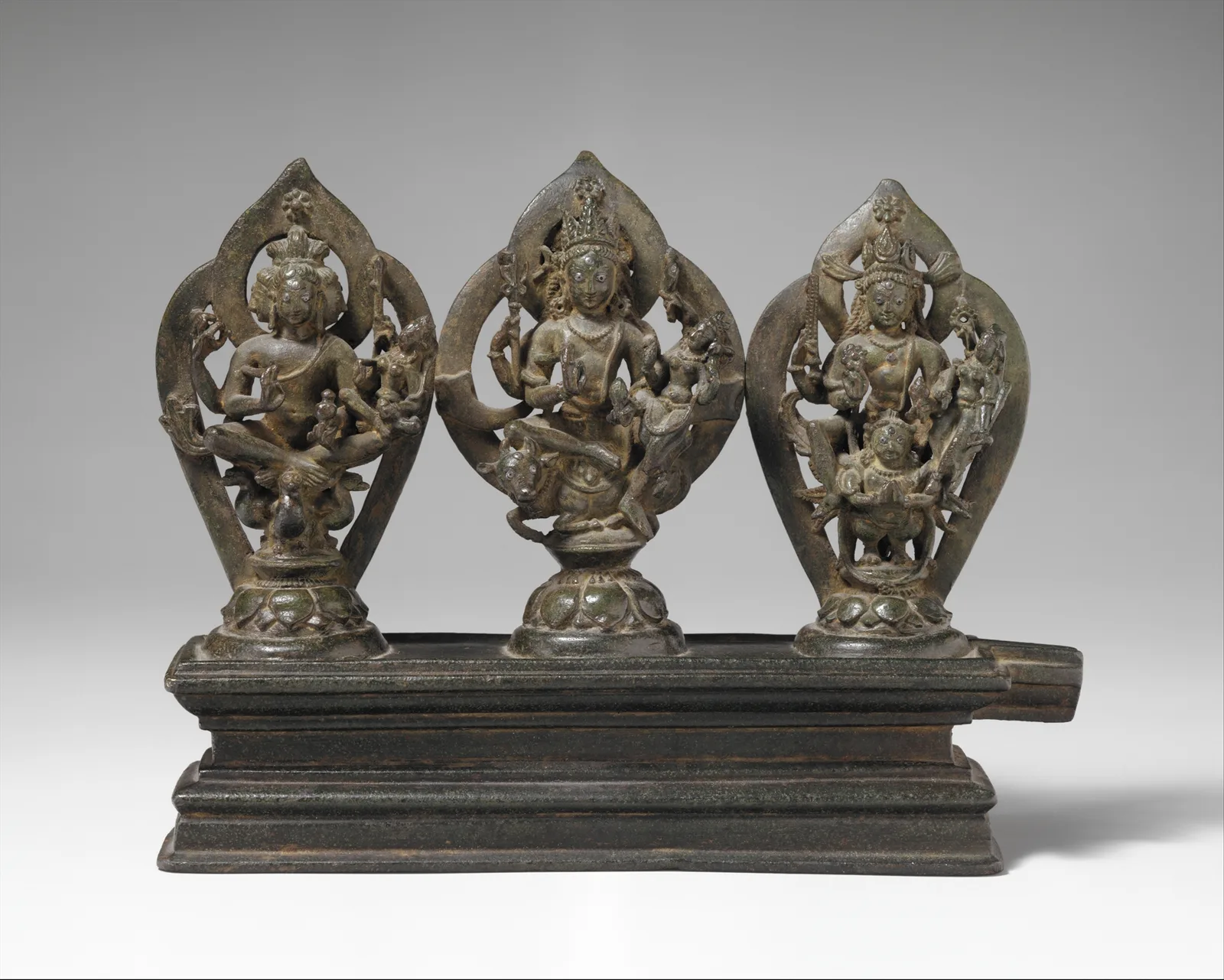
At the centre stands the Trimurti, three supreme gods who govern the cycle of the world. Brahma creates the universe, Vishnu preserves and sustains it, and Shiva destroys it to clear space for new creation. This is not enmity but the rhythm of the world breathing: birth, life, dissolution, birth again. Brahma himself is almost never shown in jewelry and rarely worshipped on his own, with very few temples dedicated to him. Vishnu and Shiva, by contrast, gave rise to two vast branches of Hinduism, each with millions of followers.
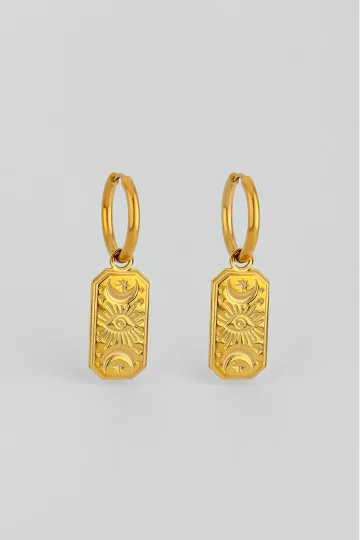
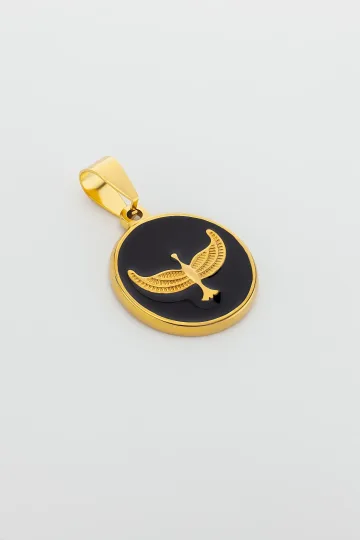
Wear the symbol, don't just read about it. These are in stock:



Devas and devis: gods and goddesses
Devas are gods, devis are goddesses. Each supreme god has a consort, and she is no shadow but a force in her own right, a shakti, the active energy of the deity. Lakshmi, Vishnu's consort, presides over wealth and good fortune. Parvati, Shiva's consort, governs love and motherly care, and in her fierce form becomes Durga and Kali. Sarasvati, linked to Brahma, watches over knowledge and the arts. In many streams it is the Goddess herself, Devi or Shakti, who is held to be the highest force from which everything else is born.
Avatars: a god descended to earth
An avatar is the descent of a god into an earthly body when the world is threatened with ruin. Avatars are most often spoken of in connection with Vishnu: he came as a fish, a turtle, a boar, a man-lion, and in human form as Rama and Krishna. So Rama and Krishna are not separate gods but forms of Vishnu, and yet they are loved and honoured as heroes in their own right, with their own stories, festivals and temples.
Why there are so many gods
The multitude of gods in Hinduism does not contradict the idea of a single origin. Brahman is the impersonal absolute, the ground of all that exists, while the individual gods are its faces turned toward the human being. Praying to Ganesha or Lakshmi does not deny that unity: it means turning to the facet of the divine that is closest to your need. Hence the calm acceptance of a personal deity: each person walks their own path to the absolute.
Gods of India in jewellery: a history
The bond between Indian gold and the gods is older than most jewellery traditions we know. Jewellery in India was almost never only jewellery.
Temple gold and the cult of the image
For centuries South Indian temples accumulated gold: offerings from the faithful, gifts from rulers, settings for statues of the gods. A whole genre of temple jewellery took shape, heavy, with raised faces of deities, lotuses and peacocks. It was placed on temple dancers and on the statues of the gods themselves during festivals. A god's image in gold was not decoration but part of the ritual: by adorning the god, a person expressed devotion, bhakti.
Kundan and meenakari: technique and image
Northern India produced two summits of the jeweller's craft. Kundan is an ancient technique in which stones are set into a frame of the thinnest strips of pure gold, with no claws or prongs. Meenakari is coloured enamel painted onto the reverse of a piece, so the object is beautiful from both the front and the back. Such pieces often carried Krishna with his flute, Radha, peacocks and lotuses. A ceremonial ornament became a wearable miniature with a scene from the life of the gods.
The god as a personal charm
Beyond ceremonial gold there was an everyday layer too. A simple Lakshmi coin, a Ganesha pendant, a thread with an Om charm, a ring bearing the face of Shiva. This is a homely, warm religiosity: you wear the god so he is near you on the road, in trade, in study. The small image worked as a seal of devotion and as protection at once, and it is this layer that lies closest to how the symbolism of the gods is worn today.
Diaspora and the wider world
Indians settled across the globe, and the symbolism of the gods spread with them. Ganesha became, arguably, the most recognisable Indian deity outside India; his elephant head is known even to people who could not name a single other god. The sign of Om and the image of the dancing Shiva entered world culture through yoga and art. So the personal gods of India became part of a shared language of symbols, understood far beyond its borders.
Ganesha: remover of obstacles
Ganesha, the god with an elephant head and a human body, is the best-loved and most recognisable god of India. The son of Shiva and Parvati, he removes obstacles and watches over beginnings: a new venture, a move, study, a wedding. That is why he is addressed first, before any other god. His attributes are a broken tusk, the sweet modak, and a mouse as his mount. In jewelry Ganesha is about a lucky start and the clearing of barriers. For the full story of his history, broken tusk and mouse, see the separate piece on Ganesha in jewelry.
Lakshmi: goddess of wealth and fortune
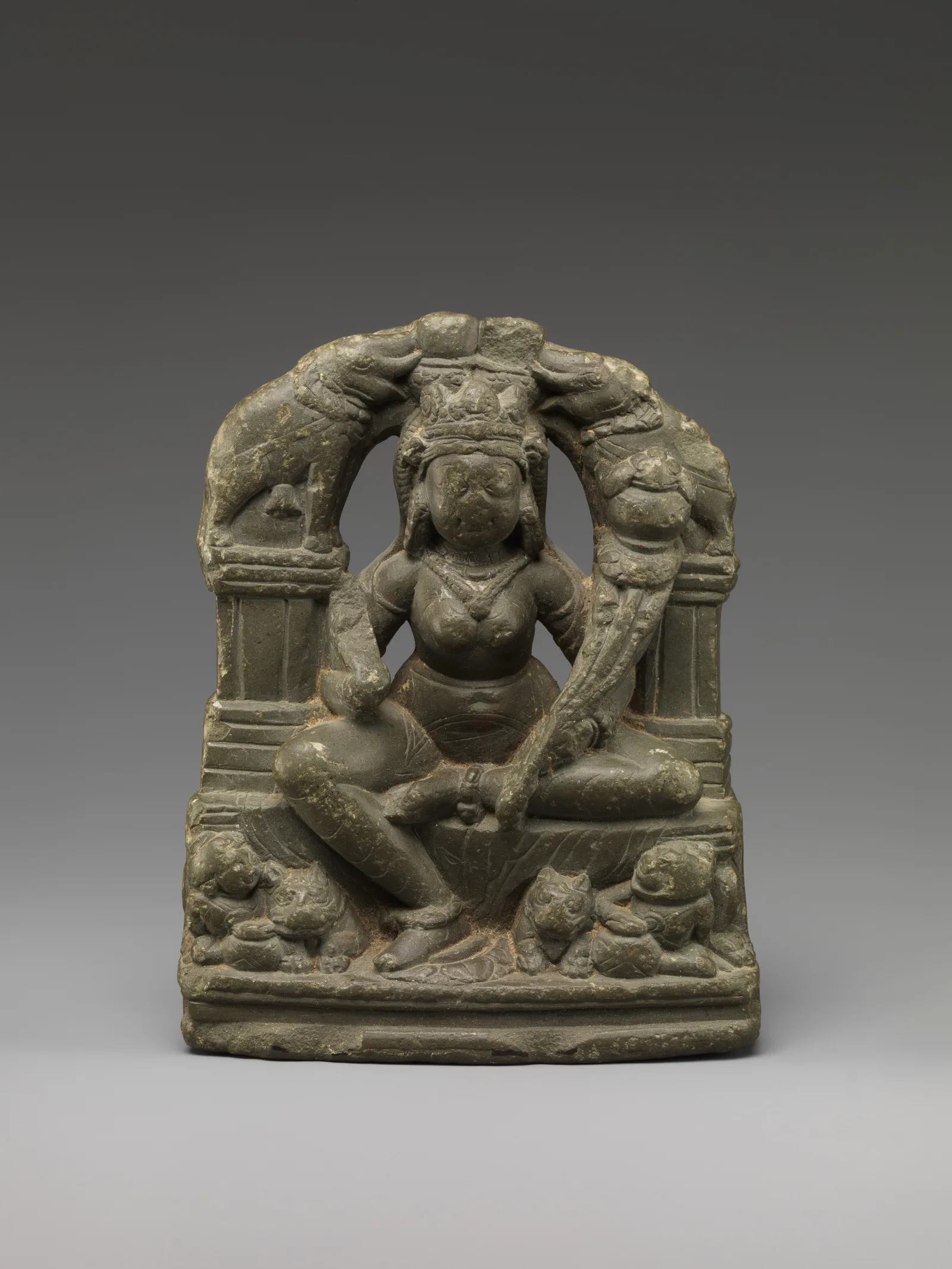
Lakshmi, Vishnu's consort, is the goddess of abundance, fortune and prosperity, both material and spiritual at once. She is shown sitting or standing on a lotus, with gold coins pouring from her palm, surrounded by elephants. People turn to her during Diwali, when fortune is invited into the home for the new year. In jewelry Lakshmi is about plenty, well-being and a gentle pull toward the good. A coin or pendant with her image is often kept in a wallet and worn by those who want to hold on to and grow what they have earned.
Shiva: trident, third eye and dance
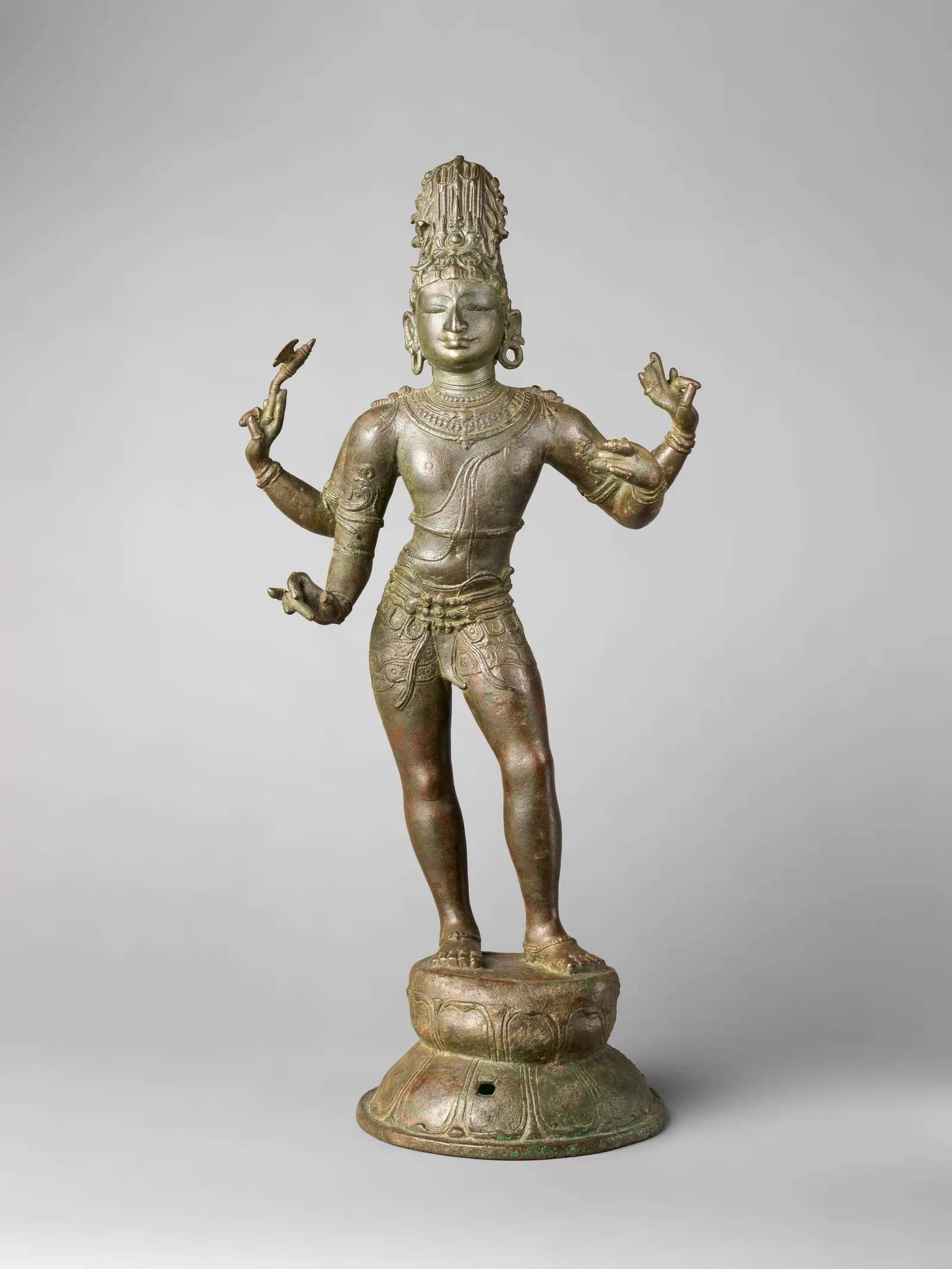
Shiva, the destroyer and transformer of the Trimurti, is a god of paradoxes: a fierce ascetic hermit and at the same time a loving husband, lord of the dance and patron of yogis. His attributes are the trishula, a three-pronged spear standing for the three forces of the world, a third eye in his forehead able to burn away illusion, a crescent moon in his hair, a serpent at his neck and a damaru drum. The image of Shiva Nataraja dancing inside a ring of fire conveys the eternal rhythm of birth and decay. In jewelry Shiva is about inner strength, perseverance and spiritual discipline. The trident as a pendant is spare and powerful.
Vishnu: keeper of the world
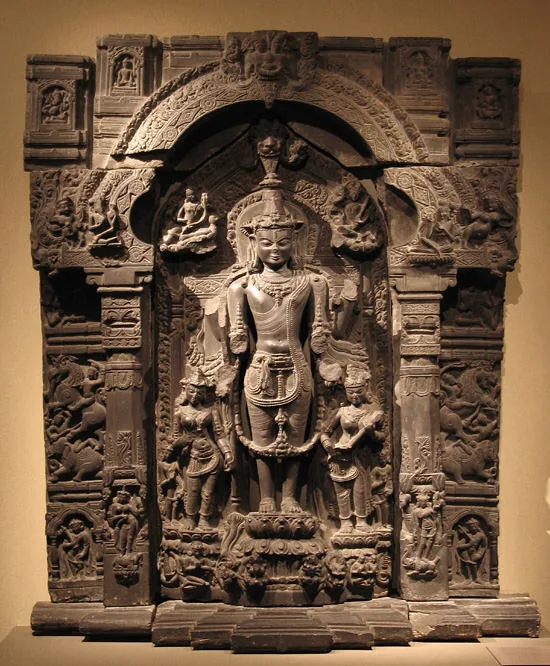
Vishnu, the second god of the Trimurti, upholds the order of the cosmos and descends to earth as avatars whenever evil must be answered. He is shown with four arms holding a conch (shankha), a discus (chakra), a mace (gada) and a lotus, with blue or dark skin and yellow robes. Often he rests on the thousand-headed serpent Shesha in the midst of the ocean of milk, while from his navel grows a lotus bearing a seated Brahma, an image of unbroken creation. His consort Lakshmi gently massages his feet, and this pair stands for the union of the preserving force with the principle that brings plenty. In jewellery Vishnu is about balance, the defence of order and faithfulness to duty. His direct image is worn less often than those of his avatars Rama and Krishna, but the conch and the discus appear as signs in their own right.
Krishna: the flute and the peacock feather
Krishna, the eighth avatar of Vishnu, is one of the most beloved gods: a cowherd, a prankster, a wise counsellor and a lover. He is known by his flute, the peacock feather in his hair, and his blue skin. The flute calls souls toward the divine, the peacock feather is a mark of beauty and play, and the love between Krishna and the cowherd-girl Radha became an image of the soul's devoted love for god. In jewellery Krishna is about joy, love and a lightness of heart. The flute and the peacock feather are frequent motifs in kundan and meenakari, and the blue is rendered in sapphire or enamel.
Sarasvati: the vina, the swan and knowledge
Sarasvati, goddess of knowledge, music, speech and the arts, is the patron of students and creators. She is shown in white robes, with a vina, a stringed instrument, with a book and a rosary, riding a white swan or beside a peacock. White stands for pure knowledge free of passions, the swan for the ability to separate what matters from what is empty, as the bird in legend separates milk from water. The rosary in her hand is concentration, the book is eternal wisdom, and the vina is the harmony and beauty of spoken sound. People turn to her before examinations and important creative work, and at her festival of Vasant Panchami children first trace their letters under her care. In jewelry Sarasvati is about a clear mind, study and inspiration.
Durga and Kali: the fierce forms of the Goddess
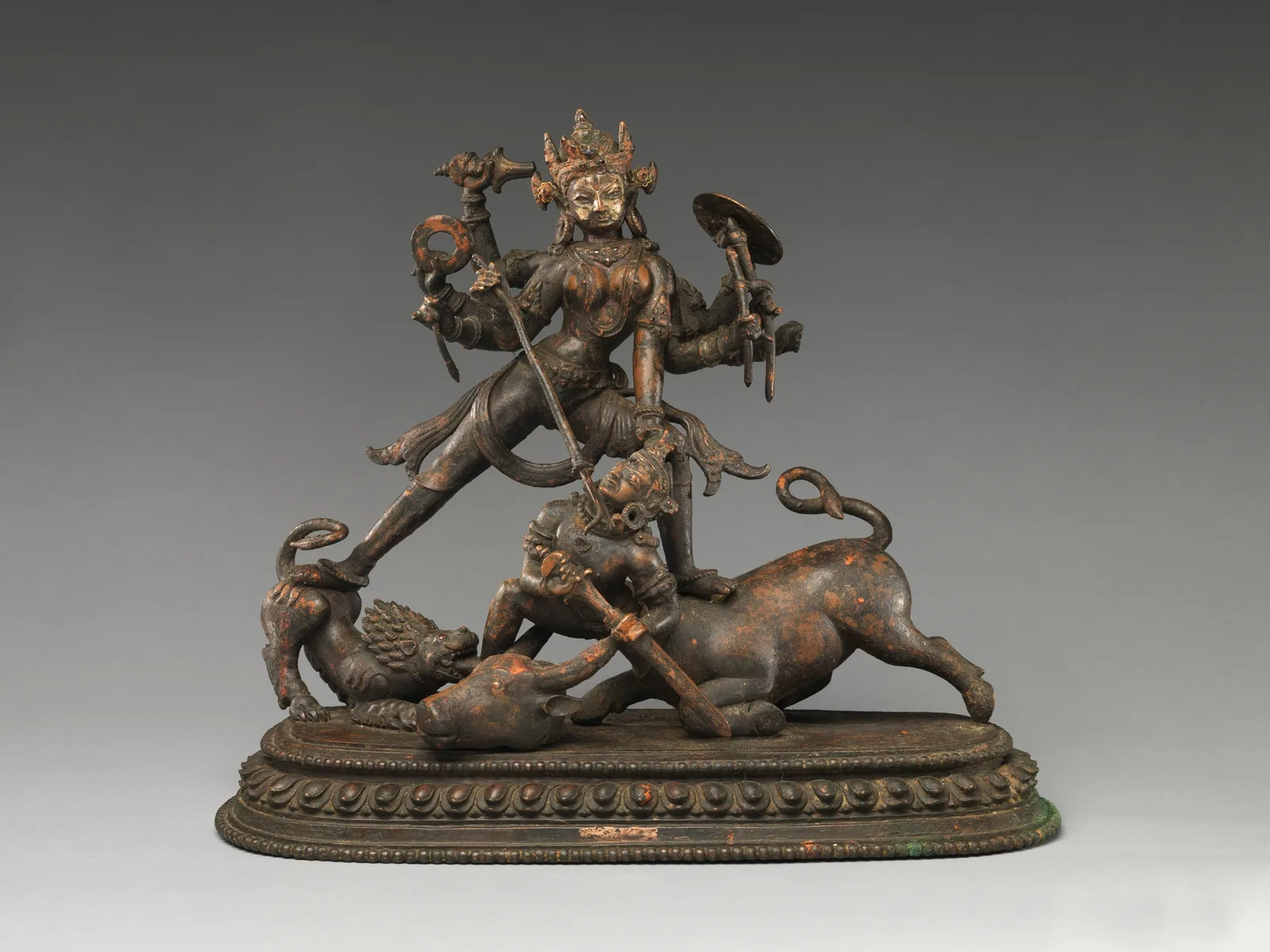
Durga and Kali are the fierce aspects of the great Goddess, and they deserve to be spoken of with respect and precision. Durga, a many-armed warrior riding a lion or tiger, defeats the buffalo demon Mahishasura: she is the protector of the world, the force of good risen against evil. Kali, the dark goddess with her tongue out and her garland, embodies relentless time and the destruction of illusions, yet for her devotees she is above all a loving mother who frees them from the fear of death. Their images run deep and cannot be reduced to "scary pictures". In jewellery the signs of Durga, especially the trishula and the lion, read as protection and inner steadfastness. This is strong symbolism, chosen with awareness.
Hanuman: devotion and strength
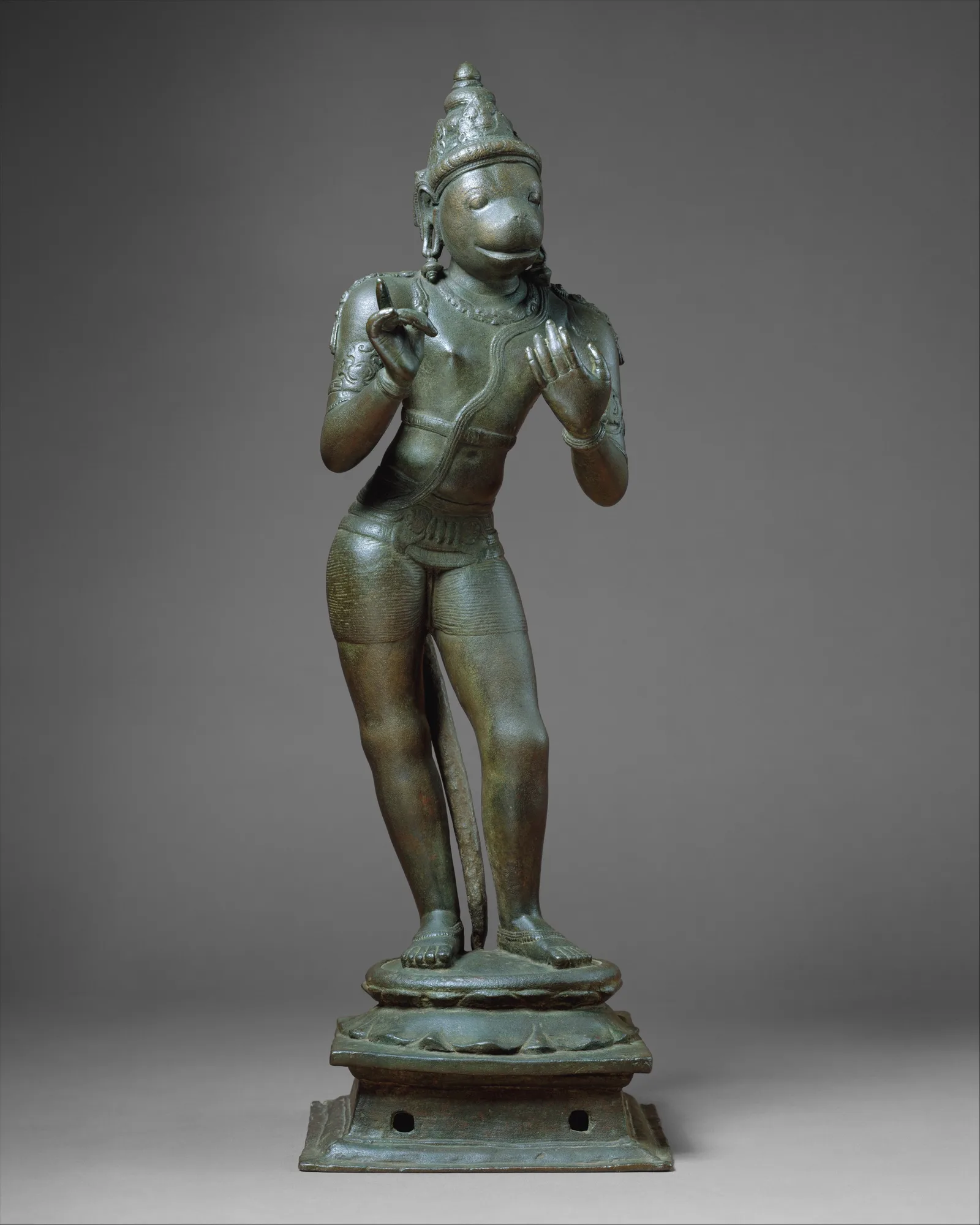
Hanuman, the monkey god and faithful companion of Rama, is a model of devotion, courage and selfless service. By legend he leapt across the ocean in a single bound, lifted an entire mountain of healing herbs when he could not identify the right plant, and passed through fire unharmed. People turn to him for protection, strength of spirit and courage, especially on Tuesdays and Saturdays. In jewellery Hanuman is about loyalty, endurance and the overcoming of fear. His image and his gada mace are popular as a charm and a sign of resilience. A curious trait: by legend Hanuman does not remember his own strength until he is reminded of it, and this motif of dormant power makes him close to anyone learning to believe in themselves.
Om: the sound from which everything was born
Om, or Aum, is not a god but the primal sound from whose vibration, by belief, the universe was born. This syllable opens prayers and mantras, and its written form in Devanagari has become one of the most recognisable spiritual signs in the world. In jewelry Om is about a link to all that exists, inner peace and a spiritual path not tied to any single god. For what each curve of the symbol means and how to wear it respectfully, there is a separate full guide on Om in jewelry.
Ganesha lives above the waist, nowhere else. Do not you dare hang that elephant head off an ankle, it is not a keyring.
What to wear a god's image with, and where
Indian symbolism has passed through dozens of my shoots, from heavy temple gold to thin silver with an Om sign. Here is what actually works on a look, and what respect for a living faith asks of you.
What do I wear a god's sign with every day? For daily wear I recommend a silver pendant with a trident, an Om sign or the face of Ganesha on a thin chain over a plain tee or a linen shirt. A light top lifts the metal, a dark one turns the sign into the accent. Silver is calmer than gold and does not argue with clothes, so for everyday wear I usually reach for it.
Gold or silver for a deity image? For a warm skin undertone and a ceremonial look I suggest yellow gold, especially the temple style with a raised face of Lakshmi or Ganesha: it echoes the tradition itself, where gold belongs to the goddess of abundance. A cool undertone and a restrained style are closer to silver with the crisp graphics of Om, a trident or a mandala. One rule: I never mix gold and silver on the same chain, the metal should sound in a single tone.
Where on the body is a god's image right? Here style gives way to tact. In the Indian tradition the head is the clean part of the body and the feet the unclean one, so I always place a sacred image above the waist: at the neck, on the chest, on the wrist, on the finger. Below the waist, on the ankle or on a belt at the hips, I would not wear a god's sign. This simple rule removes most awkwardness and reads as respectful.
Can I gather several gods into one look? You can, but with sense. One face on a clean chain is always stronger than five different gods jumbled together. If you want a set, I recommend complementary powers: Lakshmi and Ganesha together for luck and the clearing of obstacles, a pair traditionally honoured at Diwali. A large face of Ganesha or Lakshmi I take on a short or medium length so the design is visible, while a small Om or trident I drop lower, on its own line.
How do I build a look for an evening or the camera? For a special entrance I choose the most traditional option: gold and colourful meenakari with a blue Krishna or a red Goddess. An open neckline and a smooth fabric in a deep colour put the face at the centre of attention. Against bare skin at the collarbone the enamel and relief read best, and I suggest a shorter length. And wear the image knowing whom you wear: that awareness is the best styling of all.

Turn on your camera, pick earrings, a pendant or a ring, and see the piece on yourself in real time.
Switch items in one tap.
Everything runs in your browser: no photo or video is ever uploaded.
The avatars of Vishnu: ten descents
A distinct layer of Indian symbolism is the avatars of Vishnu, his earthly embodiments. Tradition counts ten of them, the Dashavatara, and each came when the world faced destruction. These images appear both in temple carving and in jewellery, especially in the south of India.
The first animal forms
The earliest avatars are animal. Matsya, the fish, saved a sage and the seeds of life from the great flood. Kurma, the turtle, set his back beneath a mountain during the churning of the ocean. Varaha, the boar, raised the sunken earth from the depths on his tusks. These images are ancient, reaching back to creation myths, and in jewellery they are rare, though they appear as family charms in particular communities.
The man-lion and the dwarf
Narasimha, the man-lion, tore apart a demon who could be killed neither by man nor beast, neither by day nor by night: the god appeared on the threshold at dusk in a form that was neither one thing nor the other. Vamana, the dwarf, measured out the whole universe in three steps and humbled a proud king. These are avatars about the cunning of cosmic law and the triumph of order over self-assured strength.
Rama: the model of duty
Rama, the seventh avatar, is the hero of the epic about the abduction of his wife Sita and the campaign to win her back with an army of monkeys led by Hanuman. Rama embodies dharma, faithfulness to duty, honour and his given word even at the cost of personal happiness. His bow is a frequent sign, and his name on its own is considered a mantra. In jewellery the image of Rama and Sita is worn as a sign of faithful love and steadfastness.
Krishna and the Kalki to come
Krishna, the eighth avatar, is the most beloved, and he is covered in detail above. The ninth is named, in different traditions, as either the Buddha or Balarama. And the tenth, Kalki, has not yet come: by prophecy he will appear on a white horse at the end of the present dark age, to close the cycle and begin a new one. Kalki is a rare but powerful motif of hope for the world's renewal.
Customer reviews
Zevira is a real jewellery shop. Genuine payments, deliveries and customer thank-yous.
🥰🥰🥰 gracias

Ok, ¡gracias! 🙂
Gods of India in art
Before becoming a pendant, a god passed through temple sculpture, miniature painting and dance. The image we wear today was struck by centuries of art, and it helps to understand that chain.
Temple sculpture set the canon
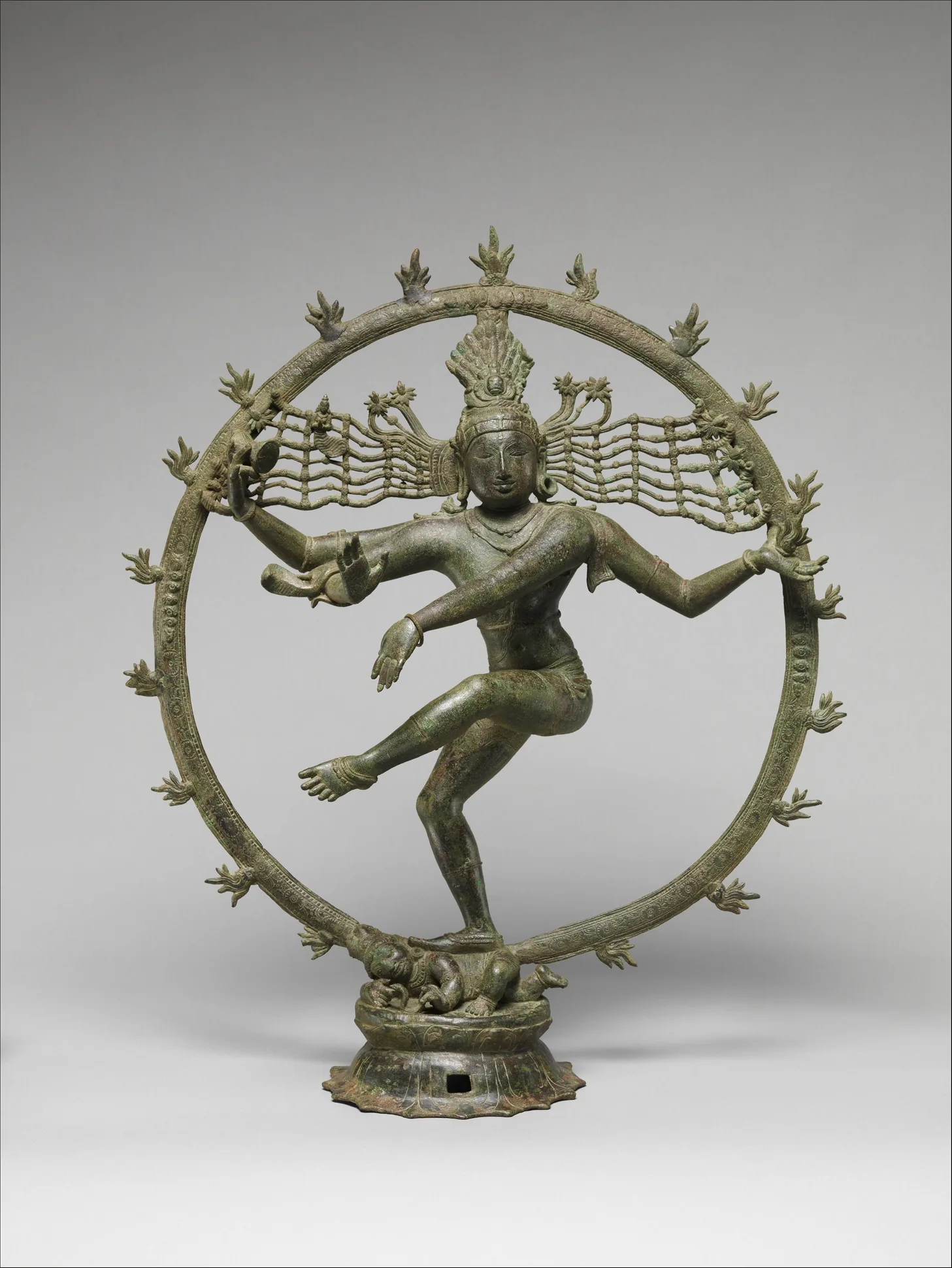
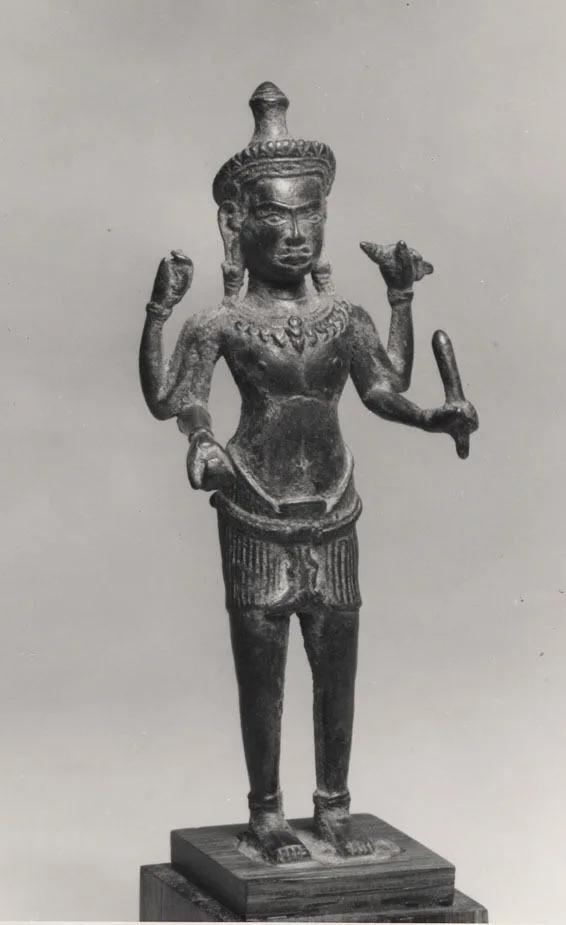
The stone and bronze gods of the southern temples fixed how each deity looks: how many arms, what is held in each hand, which animal it rides. Many arms are not a deformity but a language: the arms show how many forces a god commands at once. The bronze Nataraja, the dancing Shiva inside a ring of fire, became perhaps the most perfect image in Indian sculpture, and it is from this canon that jewellers take poses and attributes.
Miniature and enamel
Indian miniature painting, especially scenes from the life of Krishna, gave jewellery colour and story. Krishna's blue skin, the green gardens, the gold saris passed from paper onto meenakari enamel. A small enamel scene on a pendant is, in effect, a miniature worn on the body. So painting and the jeweller's craft went hand in hand.
Dance and gesture
Classical Indian dance tells the stories of the gods through hand gestures, the mudras. Each gesture is a word: lotus, conch, blessing. These same gestures are frozen in sculpture and in jewellery: a god's palm raised in the abhaya mudra means "do not fear". Knowing the language of gesture, you read the image more deeply than just a handsome figure.
What art gave to jewellery
The chief legacy of temple sculpture and miniature painting is recognisability and a ready vocabulary of signs. The trident, the lotus, the flute, the peacock feather recurred so often in stone, bronze and paint that they came to read instantly. The jeweller took this language, polished over centuries, and carried it onto metal and enamel at a small scale.
Upload a photo of your pet, someone you love, or an object. We'll build a 3D model and hand-cast it in pewter.

How to choose your deity
Hinduism has the notion of the ishta-devata, a chosen deity, the face of the divine a person picks as their personal patron. The choice is made not by the beauty of the image but by need, character and area of life.
By task and need
Starting a new venture, a move, study, opening a business, that is Ganesha, remover of obstacles. Wanting to hold and grow your prosperity, that is Lakshmi. Sitting examinations, writing, working in the arts, that is Sarasvati. Needing inner strength and spiritual discipline, that is Shiva. Looking for protection and steadfastness in a hard stretch, that is Durga or Hanuman. A god in Hinduism is often tied to a specific task, and that is normal.
By character
A leader and keeper of order is close to Vishnu. Someone who values joy, love and lightness is closer to Krishna. The ascetic, the person of discipline and perseverance, to Shiva. A caring and generous nature, to Lakshmi. A person of mind and creativity, to Sarasvati. The image of the god becomes a quiet reminder of the trait you want to keep alive in yourself.
By day of the week
In Hindu tradition the days of the week are linked to gods and planets. Monday is dedicated to Shiva, Tuesday to Hanuman and Durga, Thursday to Vishnu and to teacher-gurus, Friday to Lakshmi and the goddesses. Many people choose a day to pray to their deity and sometimes tie the wearing of its sign to that day. This is not a strict rule but a convenient rhythm.
Can you wear several
You can. Hinduism is at ease with the veneration of different gods, since all of them are facets of the one. A common approach is to combine complementary forces: Lakshmi and Ganesha are invited together for fortune and the clearing of obstacles, and this pair is often honoured at Diwali. The point is not to turn the set into a random heap, but to understand what each sign is saying.
The psychology of choosing a deity
The choice of a deity is rarely accidental. More often a person reaches for what they want to strengthen in themselves or be reminded of every day.
The sign as a daily anchor
A small image at the neck or on the wrist works as a quiet anchor for attention. Someone who chose Ganesha keeps near them the thought that any barrier can be passed. The sign of Lakshmi recalls a careful attitude to prosperity, the trident of Shiva an inner discipline. This is not magic but the mechanics of attention: an object you see and touch many times a day quietly keeps a chosen value in focus.
An ideal, not a mirror
People often choose a god not by who they are but by who they want to become. A restless person reaches for the calm of Shiva the ascetic, a withdrawn person for the joy of Krishna. There is no contradiction in this: a symbol sets a direction rather than describing a fact. The Indian tradition too calls not on the god a person has already become, but on the one whose force is needed for a particular task.
Devotion as a support
In Hinduism the bond with a personal deity is called bhakti, devotion. It is a warm, personal feeling, closer to love than to fear. To wear the image of your god is to keep that bond near you, a small reminder that you do not face hardship alone. For many it is exactly this, and not a belief in miracles, that gives such jewellery its meaning.




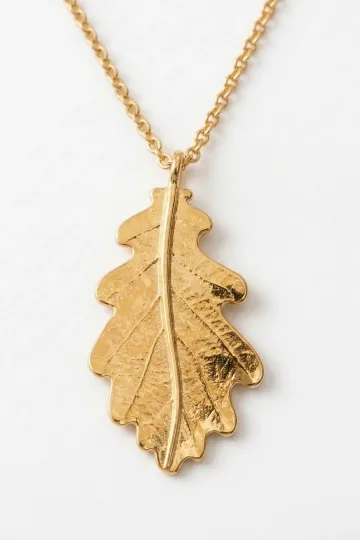
Attribute symbols of Hinduism
A god can be worn not as a figure but as a sign, and this is an old Indian habit. The sign is more restrained than a portrait and reads as pure geometry.
Om
Om is the chief sound and written symbol of Hinduism, the sign of the world's first ground. It is worn as a universal spiritual sign not tied to any one god. The curves of Devanagari fold into a shape that is now recognised the world over.
Lotus
The lotus rises from muddy water clean and untouched by the dirt, and so it became a symbol of spiritual awakening, purity and creation. Lakshmi, Sarasvati and Brahma all sit upon the lotus. The lotus flower as a motif in its own right carries the idea of growth through hardship. More on the lotus in jewelry.
Mandala and yantra
A mandala is a geometric diagram of the universe, a circle with patterns set inside it, used for concentration. A yantra is a related diagrammatic symbol of a specific deity. In jewellery a mandala reads as a sign of harmony, wholeness and centring, which is why it is loved well beyond a religious context.
The swastika as an ancient Indian sign
In India the swastika has been honoured for thousands of years as a sign of well-being, good fortune and the solar motion. The word itself in Sanskrit means "that which brings good". It is drawn on the thresholds of homes, on account books at Diwali, on wedding invitations, and it appears in the temples of Buddhism, Hinduism and Jainism across Asia. This peaceful, ancient swastika must be clearly distinguished from its distorted version, seized by a criminal regime in twentieth-century Europe: there the sign was turned, tilted and filled with a hateful meaning that has nothing to do with the Indian tradition. In the Indian context the swastika remains a good sign, but outside Asia wearing it calls for understanding and tact, out of respect for the memory of the victims.
Trishula, shankha and others
The trishula, Shiva's trident, stands for the three forces of the world and mastery over them. The shankha, Vishnu's sea conch, when sounded gives a tone close to Om and means the sacred call. The chakra, Vishnu's discus, is the sign of the turning of time and of law. The damaru, Shiva's drum, is the rhythm of creation. Each of these signs works on its own, without the figure of the god itself.
Leave your email, we'll send your discount code. No spam, unsubscribe anytime.
The code arrives by email, valid on your first order.
Materials: temple gold, silver, meenakari
Indian symbolism loves the materials it has been seen in for centuries, and each has its own character.
Gold
Gold in India is an almost sacred substance rather than an ordinary metal, the colour of Lakshmi and of the sun, a sign of purity and well-being. Yellow gold gives the most traditional, warm note, especially in the temple style with raised faces of the gods. A god's image in gold reads like a small household relic, and it is gold that has historically been bound up with offerings to the gods.
Silver
Sterling silver 925 is more practical and restrained, closer to the lunar, ascetic register of Shiva with his crescent moon. Silver holds the sharp graphics of a trident, an Om sign or a mandala well and suits everyday wear. It is a sensible choice for anyone who wants a spiritual symbol without ceremonial shine.
Meenakari: coloured enamel
Meenakari, painted enamel native to Rajasthan, gives jewellery colour: Krishna's blue skin, the green of a peacock feather, a goddess's red sari. The enamel covers both the front and the back, so the piece lives on both sides. It is the most painterly way to wear a scene with a god, a small miniature in metal.
Kundan and stones
In the kundan technique stones are set into pure gold, and each stone is chosen for its meaning. Sapphire and blue enamel for Krishna, ruby and red tones for the fierce Goddess, pearl and moonstone for the gentle Lakshmi, white stones for Sarasvati. The stone strengthens the character of the image without arguing with it.
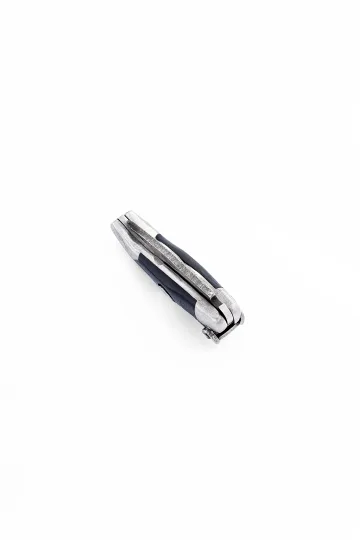
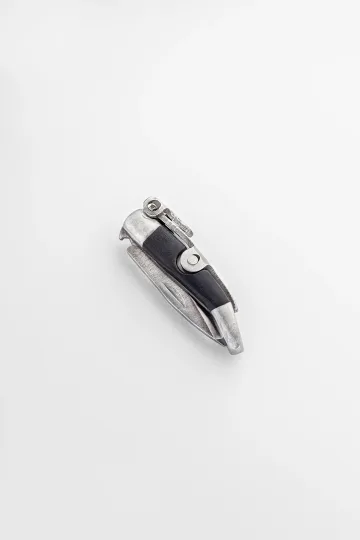
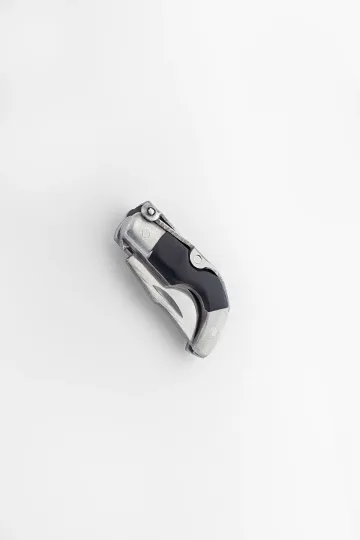
CAPAORA mini knife pendant
The 18th-century Spanish navaja in miniature: 40 mm of stainless steel, a real folding mechanism and a Palanquilla lock that clicks. An affordable gift to remember.
Authentic · Ships from Spain · 14-day returns
How to choose a good image of a deity
A god's image is easily spoiled by crude work, so when choosing you look not at the subject but at fidelity to the canon, the clarity of the face and the quality of the metal.
By fidelity to the canon
The chief mark of a good image is correct attributes. Ganesha should have an elephant head with one broken tusk, Shiva a trident and a crescent moon, Lakshmi a lotus and coins, Sarasvati a vina and a swan. Muddled attributes or a random set of details give away a maker who copied a picture without understanding it. A good image reads correctly even to an expert.
By the clarity of the face
In quality work the god's face is worked out: features, pose and the gesture of the hands are visible even when the pendant is the size of a fingernail. In a cheap stamping the relief is blurred, the details run together, and the god turns into a featureless blot. Turn the piece under the light: the facets should give a clear play of shadow, not a murky smudge. In enamel pieces you look at the purity of colour and the evenness of the fill.
By metal and setting
Real gold and silver carry a hallmark, feel cool against the skin and have weight. A cheap imitation is light, warm to the touch and flakes over time. In temple gold the depth of the relief is prized, in kundan the even seating of stones in the gold strip, in meenakari the neatness of the enamel without chips. A crude setting, traces of glue, a crooked rim all speak of haste.
Handwork against the machine
Today images are cut both by hand and by machine. The machine gives an even, repeatable form, handwork gives living, slightly imperfect lines and character. Neither is worse in itself: the question is the cleanliness of the execution and whether the attributes are correct. A costly handmade piece is valued for the maker's hand, a tidy machine-made one for being affordable while still sharp.
Gods of India in world culture
The gods of India long ago stepped beyond India and became part of a shared language of symbols. That is why their signs are read even by people who never opened a sacred text.
Through yoga and meditation
Yoga carried both the postures and the symbolism around the world: the Om sign in studios, the image of Shiva the yogi as patron of practice, mantras at the start and end of a class. For many people the acquaintance with the Hindu pantheon begins on the mat rather than in a book. So Om and the lotus became almost universal signs of inner peace.
Ganesha as a kindly sign of luck
Ganesha went out into the world about as far as any of them. His elephant head is recognised as a kindly sign of luck and a good start far beyond Hinduism. Small Ganesha figures are set on desks, he is worn before an important task, and in this role he is close to how other peoples wear their own charms for luck.
In art and design
The images of Indian gods inspired carvers, painters and jewellers for centuries beyond India too. Many-armed figures, the dancing Shiva, the lotus and the mandala entered the world's visual vocabulary. Yet the line between respectful interest and empty decoration is thin, and that is exactly why sacred images deserve to be approached with knowledge, not as a pretty pattern without meaning.
Why the symbol works without knowing the myth
Even without remembering all the legends, a person reads the basic meaning: the elephant clears barriers, the lotus is purity and growth, the trident is strength, the coins are plenty. The attributes became a legible alphabet across cultures. Therein lies the strength of the Indian pantheon for jewellery: the sign speaks for itself, as long as you wear it with understanding.
The Hindu pantheon against the Greek and the Egyptian
Three great traditions gave jewellery three different languages of symbols. Understanding the difference helps when you choose whose sign to wear.
Hindu: a living faith and a personal god
The chief difference of the Indian pantheon is that it is the living religion of a billion people, not the legacy of a vanished culture. The gods here are not twelve and not a strict list but an almost endless multitude of faces of a single origin. The symbolism is about devotion and a personal bond with a chosen god, about concrete help in a task and about a spiritual path. The style is figurative and warm, with faces, many-armed figures, lotuses and bright enamel.
Greek: character and ideal
The Greek gods are like people, with passions, weaknesses and a biography, and their pantheon long ago became cultural heritage rather than a matter of faith. The symbolism is about character and ideal, about who a person wants to be, and the signs are elegant and recognisable. If the Indian image speaks of devotion and a path, the Greek speaks more of traits of character. There is a detailed piece on the Olympian gods.
Egyptian: eternity and protection
The Egyptian pantheon is stricter and more geometric; it is about the afterlife, eternity and magical protection. The goddess Isis and the Egyptian gods give protective signs such as the ankh, the eye of Horus and the scarab, which work as amulet-seals. This too is a tradition no longer practised but powerful in its imagery. Against it the Indian symbolism is warmer and more alive, closer to a daily household prayer.
What unites them
All three do the same thing: they turn faith and character into a small wearable sign. But Indian images deserve special tact precisely because a living faith stands behind them. Close by stands the Buddha in jewelry: Buddhism grew on Indian soil and shares part of its symbolism with Hinduism, including the lotus and Om, while going its own way.
Send a friend a discount code, they save on their first order.
Facts that surprise
The Indian pantheon is full of details that never make it into a short retelling.
Ganesha is called on first, before any other god and before any undertaking. That is why Indian books, documents and even schoolchildren's notebooks often began with the sign or name of Ganesha, so the venture would pass without obstacles.
Ganesha's broken tusk, by one legend, he broke off himself so he would have something to write the great poem with when his pen snapped. The god who removes obstacles did not stop at an obstacle of his own.
Shiva is shown with a blue throat, and there is a story behind it: during the churning of the cosmic ocean a terrible poison surfaced that threatened to destroy all life, and Shiva drank it to save the world, the poison leaving a blue mark on his throat.
The dancing Shiva Nataraja, enclosed in a ring of fire, became one of the best-known Indian images in the world. A large bronze statue of the Nataraja was placed outside one of the major centres of physics, as a metaphor for the cosmic dance of energy.
Lakshmi and the owl are sometimes shown together, and in India the owl in this context is not a sinister bird but a vahana, the mount of the goddess of wealth, a companion of abundance.
The name Sarasvati once belonged to a sacred river, mentioned in the oldest hymns and dried up over time. The goddess of knowledge kept the name of the vanished river, and the flow of water turned into a flow of wisdom.
Krishna as a child so loved clarified butter that he stole it from pots hung up under the ceiling, and the scene of the little butter thief became a favourite subject of miniatures and enamel jewellery.
The swastika is still drawn in India on account books on the day of Diwali, opening the new financial year under the sign of well-being. For a billion people it is a sign of luck, not what it was made into in twentieth-century Europe.
In her hands Durga holds the weapons of all the gods: Shiva's trident, Vishnu's discus, Indra's thunderbolt, the gods gave them to her so she could defeat the demon they could not handle themselves. The goddess gathered the force of the whole pantheon into one pair of hands.
Hanuman, by legend, does not know his own strength until he is reminded of it. This motif, of a power asleep in a person that must be realised, made him a beloved image for those learning to believe in themselves.
Frequently asked questions
How many gods are there in Hinduism?
Tradition speaks of thirty-three million, but this is an image of boundlessness, not an exact count. In practice there are a few supreme gods (the Trimurti of Brahma, Vishnu and Shiva, and the great goddesses), their avatars and forms, and a multitude of local and household deities. All of them are held to be faces of a single origin, Brahman.
Can I wear Hindu symbols if I am not a Hindu?
Yes, many Hindus welcome sincere and respectful interest. It is considered good form to know whom and what you wear, not to use a sacred image as an empty trinket, and to keep a few simple points of tact, for example wearing a god's face above the waist. Intention and respect matter more here than a formal prohibition.
Which of the gods brings luck and money?
Wealth, fortune and prosperity are the domain of Lakshmi, the consort of Vishnu. Her coin or pendant is often kept in a wallet and worn by those who want to hold and grow what they have. Alongside her, Ganesha is called to clear the obstacles on the path to fortune, and this pair is especially honoured at the festival of Diwali.
How do Krishna and Rama differ from Vishnu?
Krishna and Rama are avatars of Vishnu, his descents to earth in a human body. That is, they are not separate gods but forms of one god, come to restore order. At the same time they are loved and honoured as heroes in their own right, with their own stories, festivals and temples.
Why is Ganesha so popular outside India?
The image of the elephant-headed god is bright, kindly and easily recognised, and his role as remover of obstacles and patron of beginnings is clear without knowing the whole mythology. That is why Ganesha became the best-known Indian deity in the world, worn for a lucky start to a new venture even by people outside Hinduism.
What does the swastika mean in Hinduism, and can it be worn?
In Hinduism the swastika is an ancient sign of well-being, good fortune and the sun; it is thousands of years old and has nothing to do with the crimes of twentieth-century Europe, where the sign was distorted and seized. In the Indian context it is a good symbol. But outside Asia wearing it calls for understanding and tact, out of respect for the memory of the victims, so it is approached with particular awareness.
Which material is the most traditional for a god's image?
Gold, especially in the South Indian temple style with raised faces. Gold in India is bound up with the goddess Lakshmi and is held to be a pure, almost sacred substance. For coloured scenes with the gods the traditional choice is meenakari enamel, and for stones the kundan technique. Silver is closer to the ascetic register of Shiva and is convenient for everyday wear.
Can you wear several gods at once?
You can. Hinduism is at ease with the veneration of different gods, since all of them are facets of a single origin. It is convenient to combine complementary forces, for example Lakshmi and Ganesha for fortune and the clearing of obstacles. The point is not to pile images into a random heap, but to understand the meaning of each sign.
Conclusion
The Hindu pantheon is not a strict list of gods but a living ocean of images, from which each person chooses their own face of the divine. Ganesha clears barriers, Lakshmi brings plenty, Shiva gives the strength to persevere, Sarasvati clarity of mind, Krishna joy of heart. The ancient Indian tradition long ago showed how to wear this faith on the body, through temple gold, kundan, meenakari and a simple god-coin in the wallet. Today the same language works in pendants, rings and earrings: you choose not a picture but a force that is close to you and a path of your own. A single sign, a face, a trident or an Om, is enough for the symbol to sound, and it matters to wear it with respect for the living faith that stands behind it.
Silver, gold, symbolism, charms, spiritual signs and matching sets.
Buying it as a gift? Each one arrives ready to give.
 A branded Zevira box and a little card come with every order.










About Zevira
Zevira makes jewellery with meaning: symbols, charms and motifs with a history, in silver and gold. We love things that mean something to their owner, from spiritual signs to protective amulets of different traditions, and we treat the living culture behind them with respect. If you are looking for your symbol, start with the catalogue and find the one that is about you.