Mokosh and Slavic Women's Amulets in Jewelry: Goddess of Fate, Thread, Spindle and the Rozhanitsy
The Only Goddess Who Stood Beside the Thunderer
In the year 980, Prince Vladimir of Kiev set six idols of the chief gods on a hill. Five of them were male, from the thunderer to the god of cattle. Only one was female: Mokosh. She spun the thread of human fate, watched over women's lot, fertility and handcraft, and was the single female power to reach the state pantheon of early Rus. Her sign still lives on in pendants and breast amulets.
Mokosh is the Slavic spinner of fate, patron of women, mothers and every kind of thread work: spinning, weaving, embroidery. In her hands lie the spindle, a person's lot that she spins from flax tow, and the fertility of the earth, often drawn as a sown rhombus. Beside her stand the rozhanitsy, female amulets of birth, and the lunula, a women's lunar sign, which has its own guide to the lunula as a Slavic amulet.
What follows, in order: who Mokosh was and where her name came from, how she was honoured from pagan Rus through to the Christian Paraskeva of Friday, what each of her signs means from the spindle to the sown-field rhombus, which women's amulets gather around her, what they are made from and how to wear them. And a separate look at the spinner goddesses of fate among other peoples, from the Greek Moirai to the Norse Norns, since Mokosh stands in their company.
Wear the symbol, don't just read about it. These are in stock:





Who Mokosh Is
The Name and Its Roots
Mokosh (also recorded as Makosh) is a female deity of the eastern Slavs, patron of fate, fertility, women's work and household plenty. Her name is read in different ways. Some tie it to the root for "to get wet," to moisture, water, damp, and then Mokosh is the goddess of the wet, birthing earth. Others see in the name the word "kosh," meaning a lot, a woven basket, fate, and then "Ma-kosh" reads as "mother of the lot," the one who allots a person's share. Both readings meet on one point: Mokosh is bound both to the earth and to fate.
What She Governed
Mokosh's power lay in the women's world. She watched over spinning, weaving, embroidery, all work with thread, and through thread over a person's very fate, for life was imagined as a spun length of tow. Under her rule fell the fertility of the earth and of women, easy births, the health of children, plenty in the home. This is the goddess of everything tied to the continuation of the family and to the women's hands that feed and clothe it.
The Spinner Goddess of Fate
The central trait of Mokosh is the spinning of fate. As late as the nineteenth century, peasant women in the north still believed that at night an unseen spinner walked through the cottages and spun any tow left unattended, and that a spindle must never be left out overnight. Behind this belief stands the ancient image of a goddess spinning the thread of human life. To spin a thread was to set a fate; to break the thread was to end a life. Mokosh held that spindle in her own hands, which makes her not a mistress of craft but a dispenser of lot.
Mistress of Women's Lot
For the Slavs, "lot" was not an abstract word but an almost living being, a good or ill share that fell to a person at birth. As a spinner, Mokosh was tied to this lot directly. By later belief she had helpers or aspects, Dolya and Nedolya, who spun the happy or the unhappy thread. A woman turned to Mokosh not for vague luck but for a concrete good share: a kind husband, healthy children, steady work and plenty.
Her Place Among Vladimir's Gods
When Prince Vladimir gathered a sanctuary of the chief gods on the Kiev hill in 980, the chronicle list of idols held the thunderer Perun, Khors, Dazhbog, Stribog, Semargl and Mokosh. Of all those names, only one is female. This is a rare case: into a state pantheon, usually ruled by male warrior deities, a goddess of women's work and fate broke through. It means her cult was so strong and so rooted in the life of the people that Mokosh could not be passed over. Beside warrior gods such as Perun's axe she held her own, the women's half of the world.
A lunnitsa belongs on a bare throat and in silver, nothing else. Keep a gold amulet well away; the moon has no patience for show-offs.
How and What to Wear a Women's Amulet With
After years of working with Slavic symbolism I have settled on one plain rule: a women's sign has to match the age, the occasion and the neckline. Here is what I actually recommend, occasion by occasion.
What should I wear every day? For everyday I recommend a lunula or a smooth rhombus pendant on a fine silver chain. Silver gets along with cool tones of clothing, bronze with warm ones. The lunula reads best on a bare neckline, the rhombus on a long chain over plain, solid-colour fabric where the pattern does not get lost. One expressive sign works harder than a scatter of pendants.
What should I give a little girl? For a girl I suggest a light, understated sign: a tiny lunula or a smooth pendant with no sharp edges. Such an amulet suits a birth, a christening or a first birthday. I choose silver, which is calm and hypoallergenic, and always a secure cord or chain with no small parts that can come loose.
What should I choose for a bride? For a bride or a young woman of marrying age I recommend signs of love and fertility: a dressy lunula, a rozhanitsa, the field rhombus. Fine work belongs here, filigree and granulation, a piece larger and richer than an everyday one. In the bridal set this amulet holds the centre, so I advise letting no other large pendant argue with it.
What suits an expectant mother? For an expectant mother I choose a rozhanitsa or a lunula, amulets of birth and a good lot. I go for smooth pieces with no sharp corners at a comfortable length, so the jewellery does not press or get in the way. A soft cord or a light silver chain is calmer and more fitting here than any heavy metal.
How do I layer several signs together? If you want a layered necklace, I recommend keeping one sign as the main one, say a large lunula, and the rest finer and simpler so they do not pull attention onto themselves. Filigree and granulation get along with smooth chains. I keep silver to silver and choose natural textures: linen, wool, leather, wood. A handful of Slavic signs at once turns the look into a festival costume rather than everyday jewellery.

Turn on your camera, pick earrings, a pendant or a ring, and see the piece on yourself in real time.
Switch items in one tap.
Everything runs in your browser: no photo or video is ever uploaded.
Customer reviews
Zevira is a real jewellery shop. Genuine payments, deliveries and customer thank-yous.
🥰🥰🥰 gracias

Ok, ¡gracias! 🙂

History and Cult
The Oldest Layer: the Great Mother
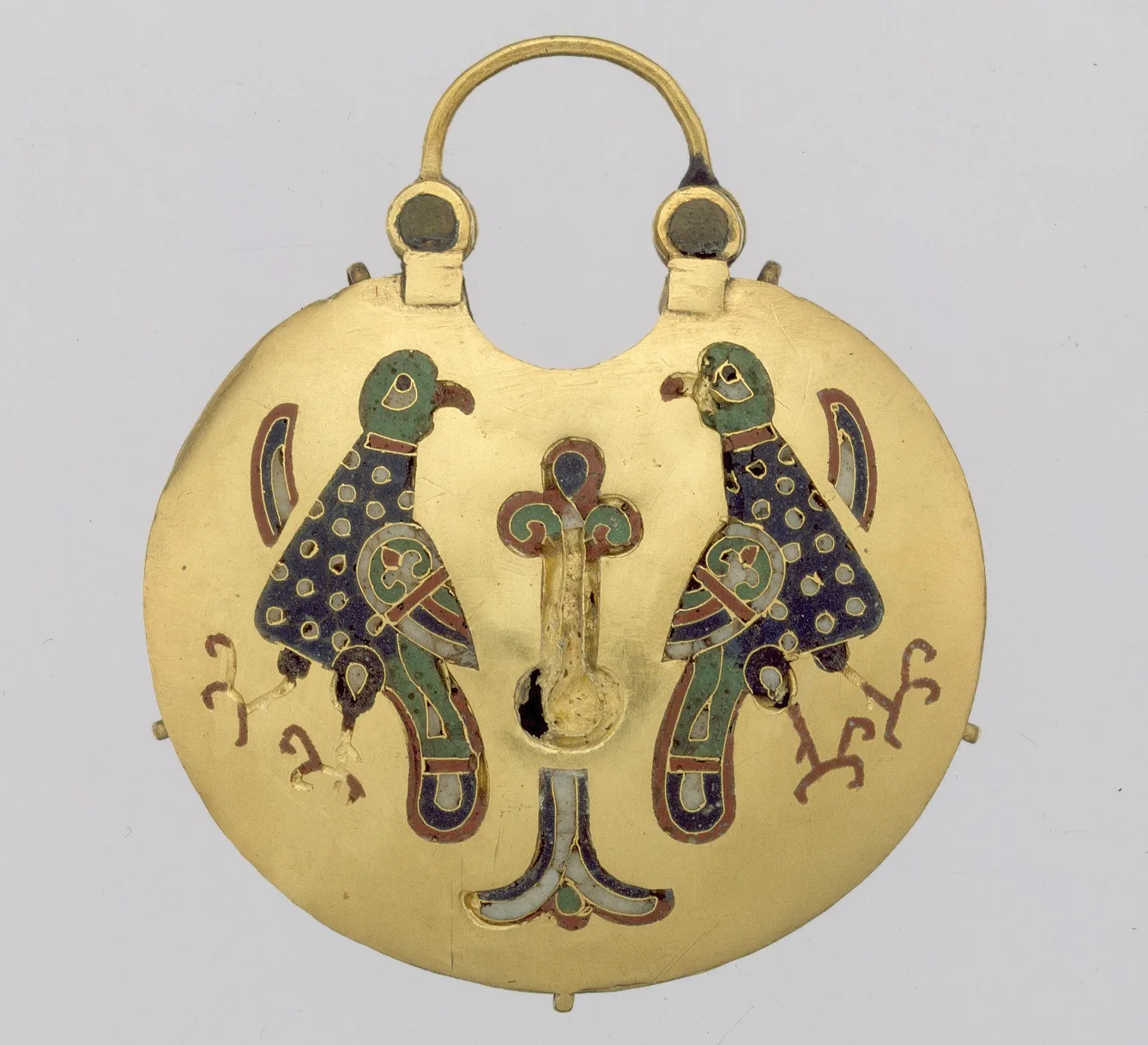
The image of Mokosh reaches back further than Slavic antiquity, into the cult of the Great Mother, goddess of earth and fertility, shared by many peoples. Scholars see in her the heir of the ancient "goddess with raised arms" found in embroidery and on distaffs: a female figure with arms thrown up or down, surrounded by birds, horses or plants. This is not a portrait of a goddess in our sense but a sign of the birthing force of the earth. From this ancient layer grew the Mokosh of the eastern Slavs.
The Only Goddess of the Pantheon
It is worth repeating how unusual Mokosh's position was. The pantheons of ancient peoples are often rich in female deities: the Greeks had dozens, the Norse a whole kindred of goddesses. Among the eastern Slavs, as the chronicle recorded them at the time of baptism, the female principle in the high pantheon was held by Mokosh alone. This suggests she was assembled from many local women's cults into a single image, patron of all things female, from the spun thread to childbirth. She took into herself what among other peoples would have spread across several goddesses.
Friday, the Day of Mokosh
A particular day of the week was tied to Mokosh: Friday. On that day one could not spin, weave or wash, so as not to offend the goddess and not to tangle the threads of fate. The ban on spinning on Fridays held in the villages for a very long time and outlived paganism itself. Friday became a women's day, a day when the mistress of the house rested from thread work, and breaking the ban promised trouble: tangled yarn, illness, a quarrel in the family. So through everyday omens the ancient honouring of the spinner goddess shows through.
Dual Faith: Paraskeva of Friday
When Rus accepted Christianity, the cult of Mokosh did not vanish but merged with the veneration of the Christian saint Paraskeva, whose name in Greek means "Friday." In popular belief, Paraskeva of Friday was made the patron of the same round of matters: women's work, spinning, weaving, trade, a good marriage, childbirth. People prayed to her for health, for a good suitor, for thread work, and in her honour they did not spin on Fridays. The saint took on the functions of the pagan goddess almost without remainder, and for centuries the memory of Mokosh lived behind the figure of Paraskeva of Friday. This phenomenon is called dual faith, when Christianity and the old belief coexist in the same rites.
The Northern Spinner in Folk Belief
The memory of the spinner goddess held longest in the Russian North, in remote villages where old customs lived into the twentieth century. There people told of Mokusha or Mokosha as an unseen woman who roamed the yards, looked into the cottages and spun. If tow was left on the distaff without a prayer, Mokusha herself would spin it in the night, and the yarn would come out spoiled. Sheep were shorn, flax was soaked, spinning was begun with an eye to her will. These late peasant beliefs are the last living trace of the great goddess who once stood on the Kiev hill.
The Sign on the Distaff and in Embroidery
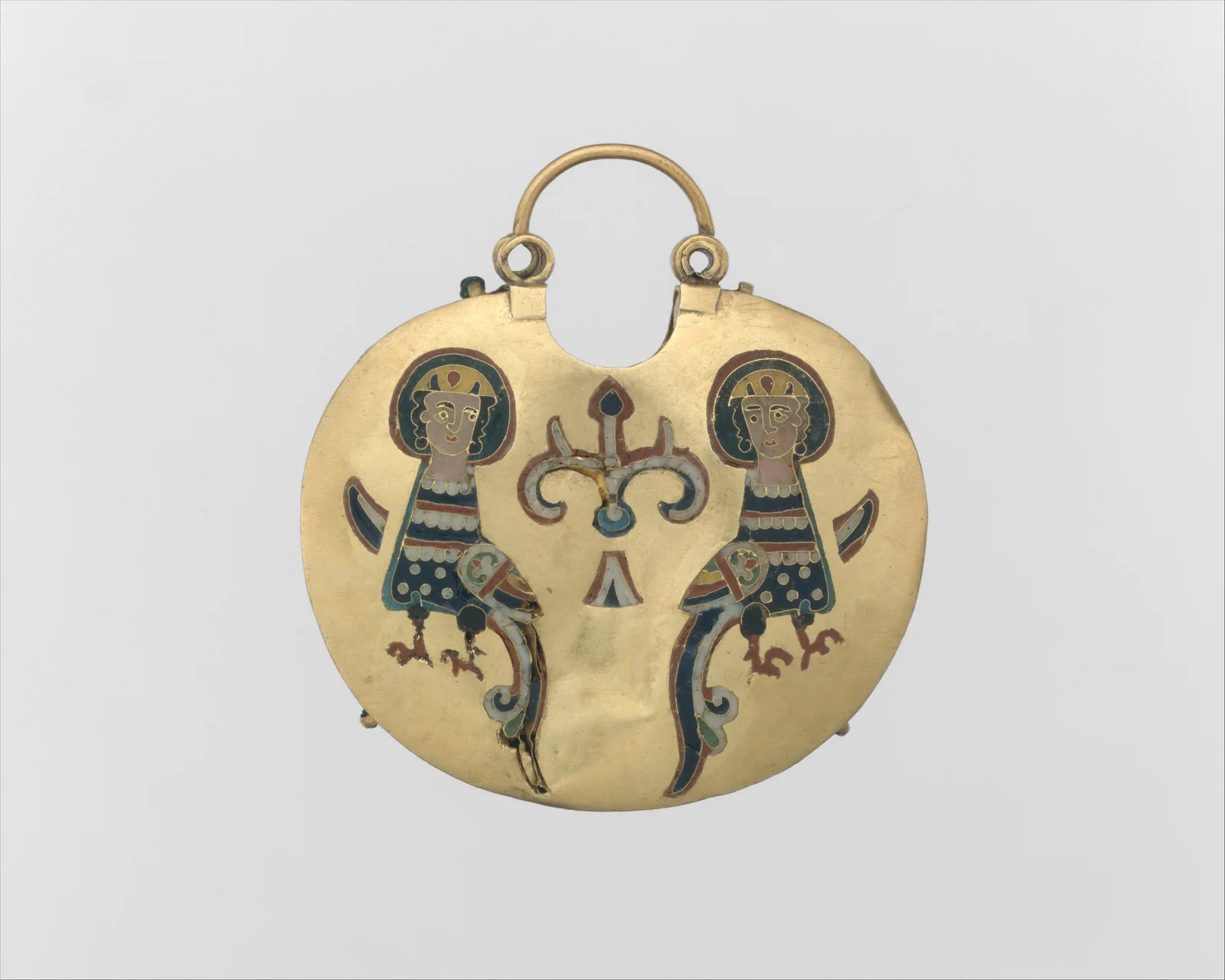
For a peasant woman the distaff was no ordinary tool but an almost sacred object, and it was decorated with carving and painting of deep meaning. On distaffs and in the embroidery of towels, generations repeated the image of the goddess with raised arms, the rhombi of the sown field, the figures of the rozhanitsy, horses and birds. A bride often received her distaff from her betrothed, and a painted distaff passed down from family to family. In these patterns, which craftswomen repeated long after forgetting their original meaning, the visual image of Mokosh and the women's signs tied to her has reached us.
Upload a photo of your pet, someone you love, or an object. We'll build a 3D model and hand-cast it in pewter.




The Symbols of Mokosh
The Thread of Fate
The thread is the heart of everything in the image of Mokosh. A person's life was imagined as a thread the goddess spun from tow: an even, strong thread meant a good, long fate; a thin, broken one promised trouble and a short span. To spin a thread was to give life and lot; to break it was to end a life. For this reason any work with thread was, for the Slavs, not an everyday matter but an almost sacred one, bound up with fate. In jewellery the thread reads as a fine chain, a braided cord, a motif of interweaving, and carries the idea of bond, family, an unbroken fate.
The Spindle
The spindle is the working tool of Mokosh and her chief object-sign. A wooden rod on which thread is twisted and wound, turning, it turns loose tow into firm yarn, the shapeless into the shaped, chaos into order. In that turning people saw an image of fate itself, winding off a person's days. The spindle was a women's object from birth: a newborn girl's umbilical cord was cut on a spindle or distaff so that she would grow into a skilled craftswoman. In jewellery a stylised spindle, or a spindle whorl, the small flywheel weight, points straight to the goddess's craft.
The Whorl
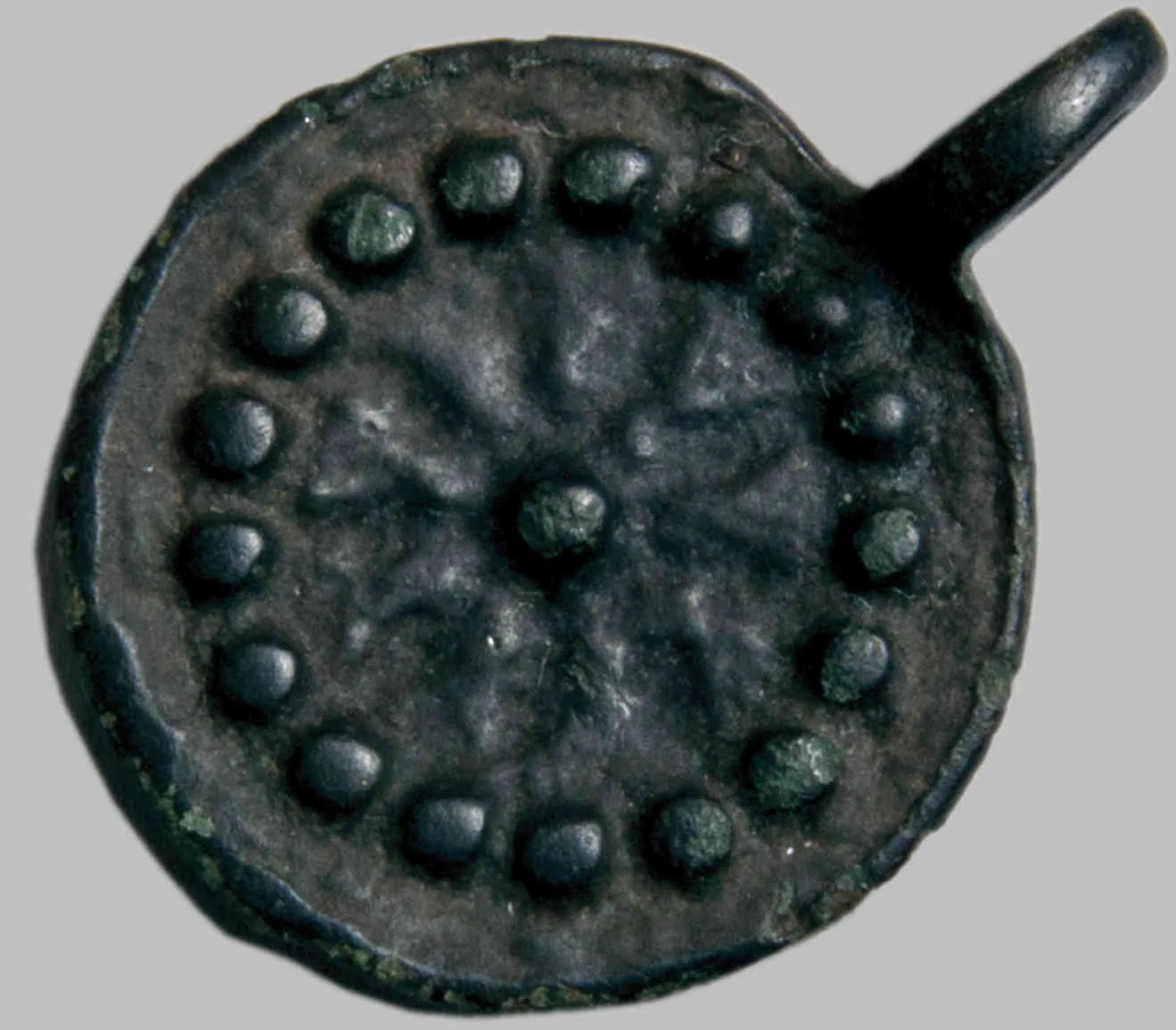
The whorl is a small weight slipped onto the spindle to make it turn better. Archaeologists find them by the thousand, in clay, stone and bone, and signs, crosses, owners' names and protective symbols are often scratched into them. A pink slate whorl of Ovruch stone was a prized thing, kept and handed down. Since the whorl is part of the spindle, it carried a protective meaning tied to Mokosh and women's lot. In modern jewellery a round whorl weight is sometimes echoed as a pendant, a reference to the ancient women's craft.
The Sown-Field Rhombus
The rhombus, divided into four parts with a dot in each, is one of the chief women's signs of Slavic embroidery, an image of the sown field. The rhombus is ploughed earth, the dots within are scattered seeds, and the whole sign means fertility, harvest, fruitfulness, motherhood. This symbol was repeated for thousands of years on women's shirts, on wedding towels, on hems, in the places tied to birth and the continuation of the family. The sown-field rhombus connects directly to Mokosh as goddess of the birthing earth. In jewellery it reads as a rhombus-shaped pendant or ornament, a sign of fertility and plenty.
The Rozhanitsy
The rozhanitsy are female deities of birth and fate who come at a child's arrival and decide its lot. There are usually two of them, sometimes together with Rod, the male principle of the family line. In embroidery the rozhanitsy are drawn as two women or two does flanking a central figure or tree. The rozhanitsy are closely bound to Mokosh: both spin and assign fate, both govern birth and lot. In a women's amulet the sign of the rozhanitsy is a wish for a safe birth and a good fate for the child, which is why expectant and young mothers prized it above all.
The Lunula and Its Link to Mokosh
The lunula is a women's lunar amulet shaped like a horned crescent, horns pointing down, one of the most common women's ornaments of Slavic antiquity. The moon ruled women's cycles, the monthly count, fertility, and so the lunula was a purely female sign tied to the same sphere as Mokosh: fruitfulness, lunar time, women's fate. The lunula and the signs of Mokosh often sat side by side in one set of finery. They are different amulets, but from one women's circle. The horned crescent is covered in detail in the guide to the lunula as a Slavic amulet; what matters here is that in the whole of women's protection the lunula and the symbolism of Mokosh work together.
The Comb
The comb is another women's object with a protective meaning, tied to the theme of Mokosh through hair and thread. Hair was held by the Slavs to be a vessel of strength, and combing and braiding a task that called for protection. The comb guarded against tangled hair, as the goddess guarded against a tangled thread of fate. Comb pendants, often with paired horse or bird heads, were worn as amulets. This object stands in the same row as the spindle and the whorl, a sign of the women's daily round under the goddess's care.








Slavic Women's Amulets
The Lunula as the Chief Women's Sign
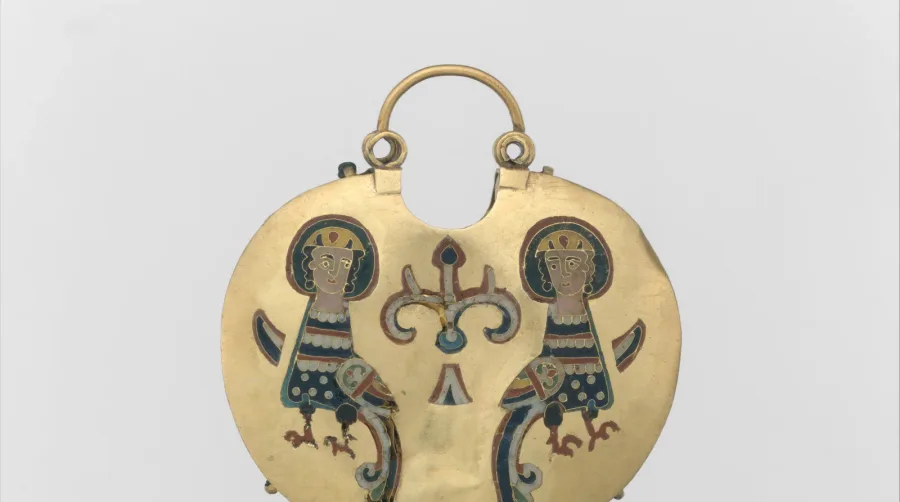
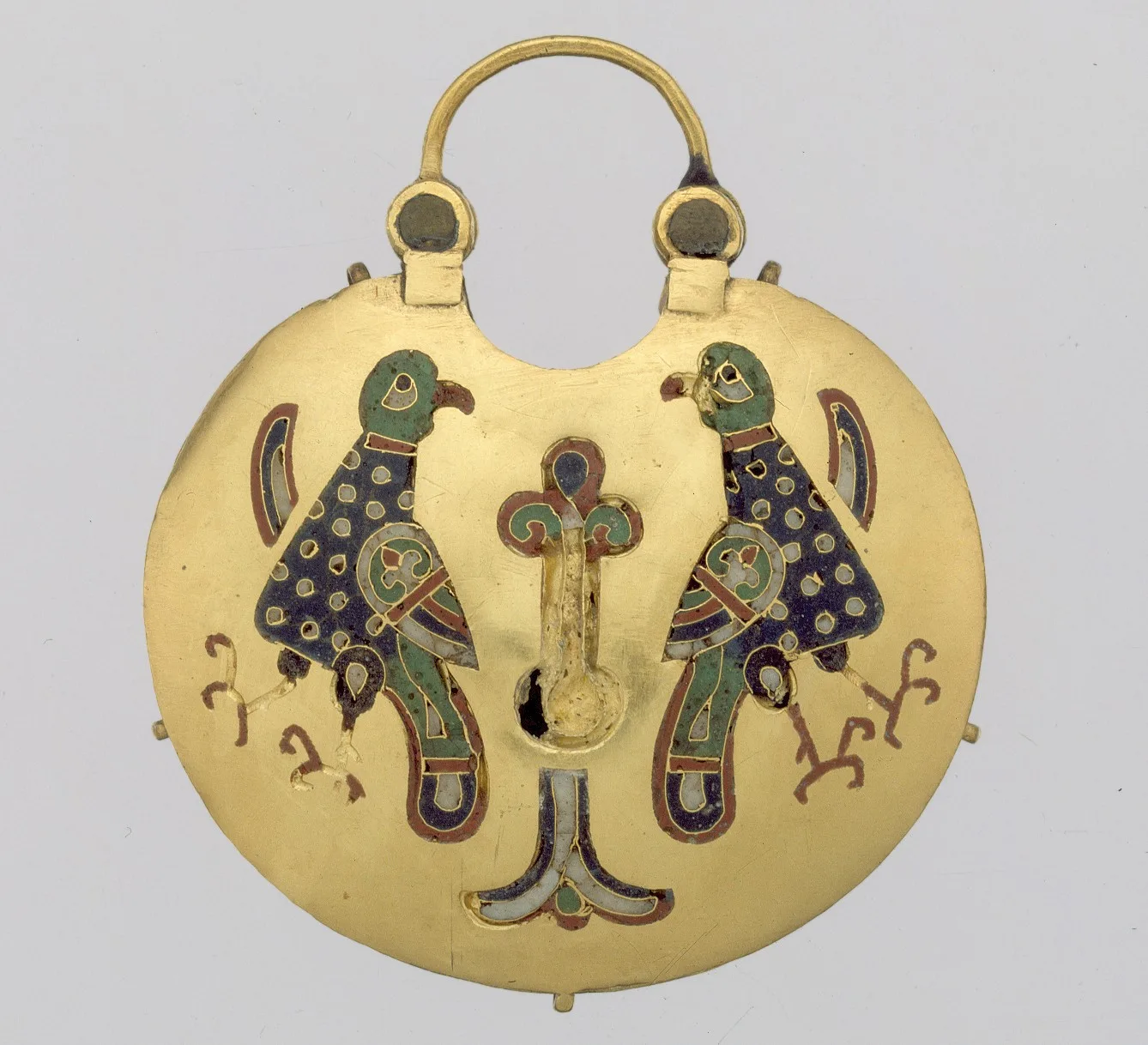
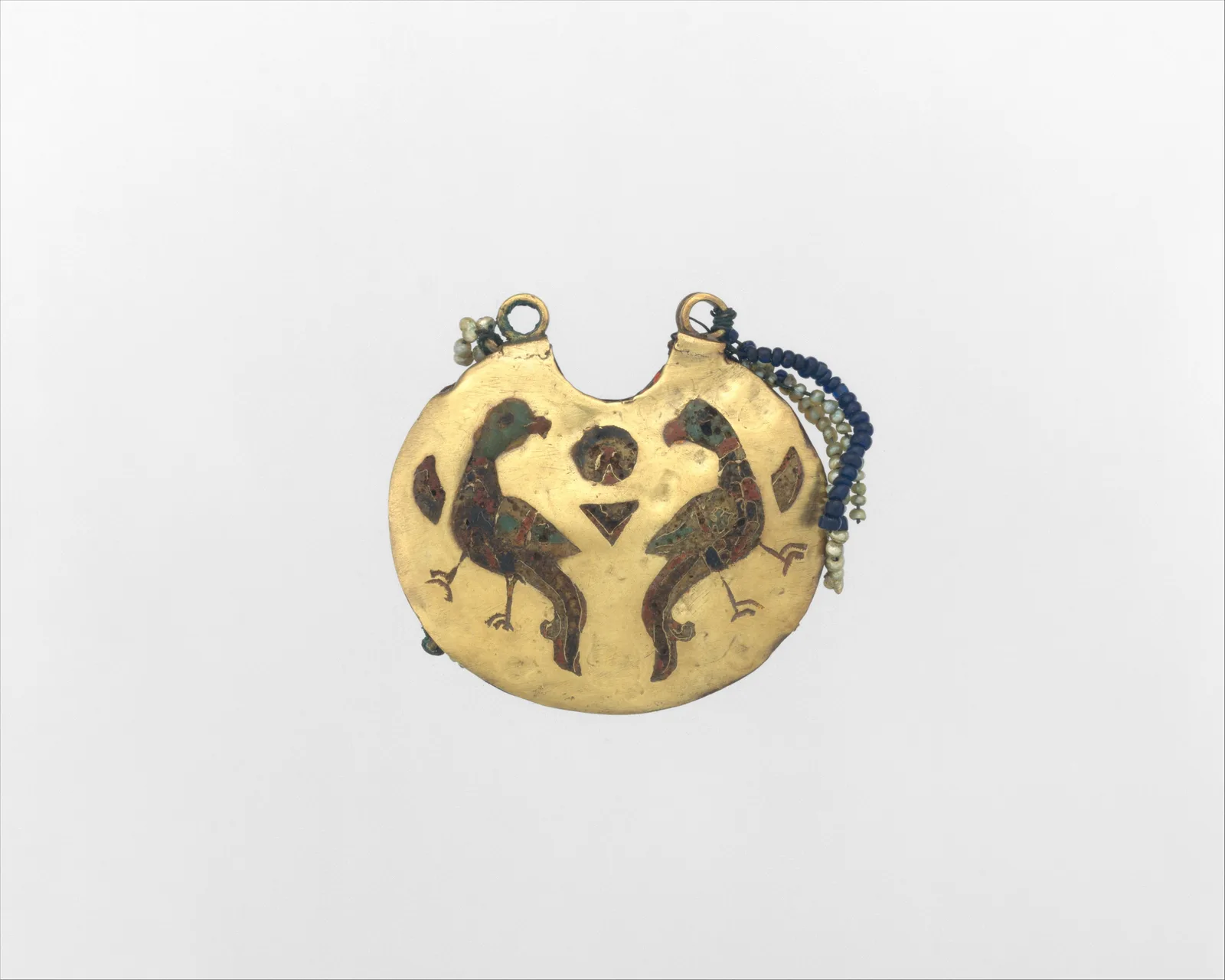
Of all the women's amulets, the lunula appears most often. The horned crescent, horns down, was worn by girls, young women and married women; it was woven into temple ornaments, hung on the breast, sewn onto clothing. The lunula protected women's health and fertility, helped in love and marriage. There were plain, narrow-horned lunulas and wide ones richly worked with granulation and filigree. This is the most recognisable women's amulet of Slavic antiquity, and in modern jewellery it remains a direct sign of femininity and fertility.
The Rozhanitsa, Amulet of Birth
The sign of the rozhanitsy is a women's amulet turned toward birth and the good lot of a child. It was worn by young women, expectant and recent mothers, and embroidered on birth and wedding towels. The figure of a woman with raised arms, or two does flanking a tree of life, is the rozhanitsy. Such an amulet asks for an easy birth, healthy offspring, a happy fate for the child. In jewellery the rozhanitsa appears less often than the lunula, but it carries the most maternal meaning of all the women's signs.
The Rhombus of Fertility
The sown-field rhombus, as a sewn-on or cast sign, is a women's amulet of plenty and fruitfulness. Its place was on women's clothing in the zones tied to birth, and in jewellery as a rhombus-shaped pendant. It was worn so that there would be bread in the house, harvest in the field, children in the family. The rhombus with dots inside is the most "agrarian" of the women's signs, a direct wish for fertility and a well-fed life, and it points straight to Mokosh as goddess of the birthing earth.
The Comb Amulet
The comb pendant is a women's amulet that protected the hair, and through it the strength and health of its owner. Small cast combs, sometimes with paired horse heads, were worn on the neck or at the belt. The horse was a solar, kindly sign for the Slavs, and a pair of horses on a comb strengthened its protection. The comb amulet is closer to the everyday women's world than the lunula, and it was chosen as a quiet, domestic sign of care for oneself and the home.
The Mokosh Sign as a Modern Amulet
In the modern Slavic amulet circle there is a separate "Mokosh sign" or "star of Makosh," sold as a women's amulet of fate and fertility. It is worth saying plainly: this graphic sign has no reliable confirmation in ancient finds; it was assembled and interpreted in modern times from the rhombi of the sown field and women's embroidery. That does not make it "fake" as a piece of jewellery, but the historical truth is that the genuine ancient women's amulets are the lunula, the rozhanitsy, the field rhombus, the spindle and whorl, and the comb, while a single "Mokosh sign" is a modern reconstruction. An honest seller will say so, and a buyer is free to choose what feels closer in meaning.
Amulets for a Girl, a Young Woman and a Mother
The Slavs distinguished women's amulets by age and standing. A small girl was given light protective signs, a tiny lunula, so she would grow up healthy. A young woman of marrying age was due amulets of love and marriage, the lunula and signs of fertility, so she would find a kind husband and become a mother. A married woman and mother was closer to the rozhanitsy, the field rhombus, the comb, all that concerns home, children and plenty. So the same circle of symbols accompanied a woman through her whole life, shifting its shade of meaning along with her age.
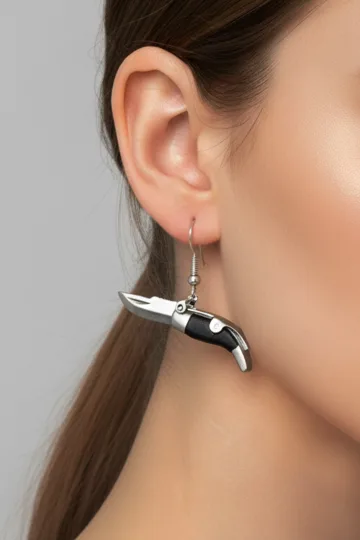
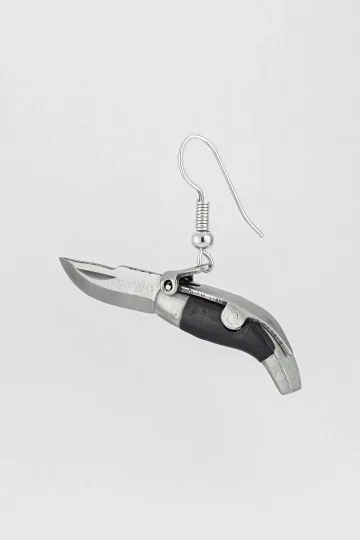
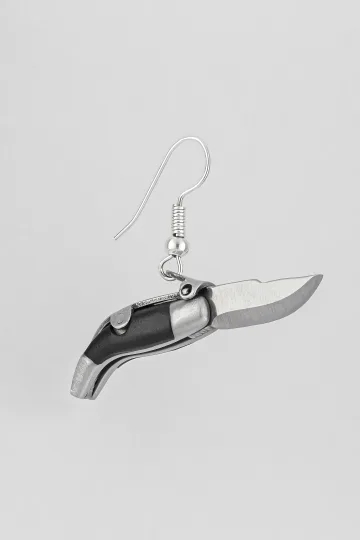
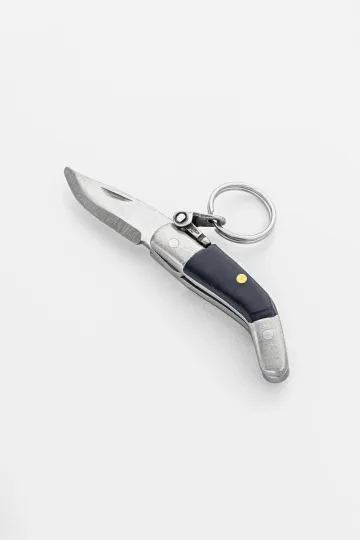
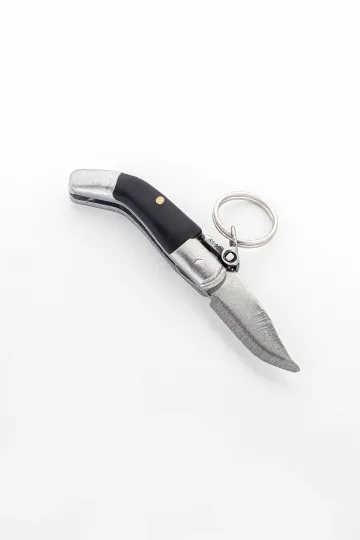
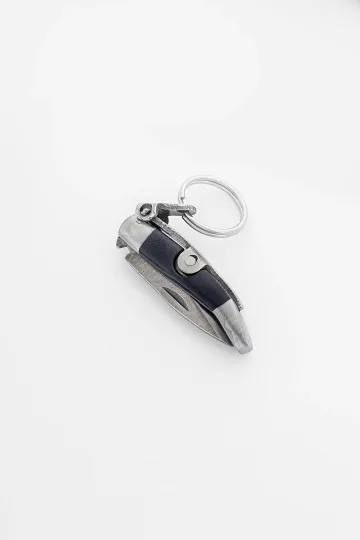
CAPAORA mini knife pendant
The 18th-century Spanish navaja in miniature: 40 mm of stainless steel, a real folding mechanism and a Palanquilla lock that clicks. An affordable gift to remember.
Authentic · Ships from Spain · 14-day returns
Meaning
Women's Lot
The chief meaning of the symbolism of Mokosh is women's lot, the share the goddess spins for each person at birth. To wear her sign is to ask for a good lot: steady work, peace in the family, health, success in women's matters. This is not a passive hope but a calm certainty that you have your own thread and your own place in the great cloth of life. An amulet with the theme of Mokosh reads as a quiet wish for a good lot for yourself and those close to you.
Fate and the Thread of Life
Behind the lot stands the deeper theme of fate as a thread. Mokosh reminds us that life is a connected thread, with a beginning and a continuation, that a person is woven into the cloth of the family line. This meaning is close to those who value the link between generations, the memory of ancestors, the sense that you are a link in a long chain. A thread piece, a braided cord, an interwoven pattern carry exactly this idea: you are not alone, you are part of the shared cloth.
Fertility and the Continuation of the Family
The oldest layer of Mokosh is fertility, of the earth and of women. Her sign is worn as a wish for abundance, harvest, children, a full life. For a woman expecting a child or hoping for one, the symbolism of Mokosh, the rozhanitsy, the field rhombus is an appeal to the goddess's maternal force. This is the most bodily, earthly meaning of the amulet: not abstract luck but a concrete continuation of the family and plenty in the home.
Handcraft and Women's Skill
Mokosh is patron of all work with thread, and her sign settles naturally on those who spin, weave, knit, embroider, sew. For a needleworker an amulet of Mokosh is a sign of her craft and a plea for ease in the work, that things go smoothly, like good yarn. In a modern sense this also takes in every kind of women's labour that calls for patience and steady hands. A spindle or whorl as a pendant reads exactly this way: a sign of skill and diligence.
Protection of the Mother and the Home
Mokosh guards both the woman and the whole home, the hearth, the plenty, the harmony of the family. Her amulets were hung in the house, worn by housewives, so that there would be order in the cottage, bread that never ran out, healthy children. This is the domestic, hearth-side side of the goddess, close to the image of the keeper. An amulet with her symbolism suits as a sign of care for home and family, a quiet token of the mistress who holds the household together.
A Bond with Water and Earth
If the name of Mokosh is read through "to get wet," then the goddess is tied to moisture, rain, springs, the damp birthing earth. Water and earth are the two principles of fertility, without which there is no harvest. This meaning adds a natural, elemental depth to the image of the goddess: she both spins fate in the cottage and stands behind the very damp earth that bears bread. For those drawn to a natural, earthly spirituality, the symbolism of Mokosh reads as a bond with living earth and water.
Patronage and Intercession
Behind every facet of the image stands a simple, everyday role of Mokosh: she is the woman's protectress. People turned to the thunderer for rain and victory, and to Mokosh for what was closer and more pressing, for harmony in the cottage, the health of a child, that the thread work go smoothly. This was no distant heavenly power but a domestic patron, to whom a woman turned plainly, in her own words, at the distaff or the well. An amulet with her symbolism still carries that warm sense of intercession: a sign that you have your own protectress within the most female, domestic circle of cares.
Leave your email, we'll send your discount code. No spam, unsubscribe anytime.
The code arrives by email, valid on your first order.
Materials
Silver
Silver is the chief metal of Slavic women's amulets. Lunulas, rozhanitsy, pendants and amulet whorls were most often made of silver, a white, lunar, cool metal that is by its very nature female and tied to the moon. Silver does not argue with the skin, suits any outfit, and is worn every day. For an amulet with the theme of Mokosh, the lunula or the rozhanitsa, silver is the truest choice in spirit. On how to tell real silver, there is an article on silver 925, what it means.
Bronze and Brass
Far from every family could afford silver, and a great many ancient amulets were cast in bronze and similar alloys. The warm golden shine of bronze looks good in reconstructions of historical jewellery and costs far less than silver. Over time bronze takes on a noble patina that gives a piece the look of true age, as if dug from the ground. For those who want an "archaeological" look in a women's amulet without a premium price, bronze and brass are a good choice.
Filigree and Granulation
Filigree is a pattern of fine twisted wire, and granulation a pattern of the tiniest soldered metal beads. With these techniques the masters of early Rus adorned the finest women's amulets: wide lunulas were covered in granulation, pendants framed in filigree. Filigree and granulation give a silver amulet that fine, lace-like beauty for which they were prized. A piece with the theme of Mokosh worked in filigree points straight to the skill of the jewellers of early Rus.
Wood and Bone
Not all women's handcraft and amulet work was metal. Spindles, distaffs and combs were made of wood and bone, and these materials carry the warmest, most domestic meaning. A wooden spindle pendant, a bone comb, is closer to the everyday women's world than a silver lunula, and suits those for whom the naturalness of the material matters. Wood is alive, warm to the touch, and in an amulet of Mokosh, goddess of handcraft and home, it is especially fitting.
Clay and the Stone Whorl
Whorls, the weights for the spindle, were made of fired clay, soft stone, and more rarely coloured slate. A clay or stone whorl with a scratched-in sign is the most "earthen," simple and ancient of women's amulets. In modern jewellery a round whorl bead or a ceramic pendant is sometimes introduced as a reference to this ancient women's object. It is a modest but honest material in spirit, closest of all to the real peasant household.
Pairings with Stones
Ancient women's amulets rarely carried set stones, but in rich finery silver was set off with coloured glass, carnelian, sometimes freshwater pearl. Warm red carnelian was linked to women's health and the blood of the family line, pearl to purity and water. For a modern amulet with the theme of Mokosh, carnelian or pearl in a silver setting adds colour and meaning while staying within the circle of women's, natural stones, never arguing with the austerity of the sign.
Spinner Goddesses of Fate Across Cultures
Why Compare
Mokosh is not alone. Almost every people has female deities who spin or weave a person's fate. This is one of humanity's oldest images: life as a thread, fate as spinning. Placing Mokosh in this row makes it easier to see how deep and universal her image is, and how far from accidental. The spinner goddess is no local Slavic invention but a shared human way of speaking about fate.
The Greek Moirai
Among the Greeks, fate was spun by the three Moirai, three sisters. Clotho spun the thread of life, Lachesis measured out its length, Atropos cut it with shears, ending a life. Three goddesses divided among themselves what Mokosh held alone: to spin, to measure, to cut. The image of the thread of life and the spinning sisters is one of the clearest in the world among the Greeks, and it echoes the Slavic spinner of fate directly.
The Roman Parcae
The Romans took over the Greek image and called the three spinners of fate the Parcae: Nona, Decima and Morta. They likewise spun, measured and cut the thread of life. The word "fatum," fate, destiny, is bound to these goddesses. The Roman tradition carried the image of the fate-spinners onward into European culture, where it lived in art and literature for centuries. Mokosh and the Parcae are kindred images, grown from one ancient root.
The Norse Norns
Among the Norse, fate was decided by the Norns, three maidens at the roots of the world tree Yggdrasil: Urd (the past), Verdandi (the present) and Skuld (the future). They wove the threads of the fates of people and gods, and even the gods were subject to them. The Norns are closest to Mokosh in spirit: in both, a female principle that spins and weaves a person's share stands at the very foundation of the world. Norse women's power is covered in detail in the study of the goddess Freyja, who also commanded the magic of fate, seidr.
Baltic Laima and Others
Among the Balts, fate and fortune were governed by the goddess Laima, closely tied to birth and lot, in many ways a sister of Mokosh in meaning. Among the Germanic peoples there was Holda, or Perchta, a spinning mistress who watched over order in women's work and punished lazy spinners, a direct relative of the Slavic spinner. Across Europe runs one image: a great female power that spins fate and guards women's labour. Mokosh is the eastern Slavic face of this ancient goddess.
How the Slavic Spinner Differs
For all the kinship, Mokosh has her own trait. The Greek, Roman and Norse spinners are first of all powers of destiny, who assign a person's share and stand above people and even gods, an image that is rather forbidding. Mokosh, by contrast, is closer to the earth and the home: she spins fate, watches over the harvest, fusses over births, guards handcraft, and she is easy to turn to plainly, at the distaff. This makes her warmer and more down-to-earth than the distant goddesses of doom. The eastern Slavic spinner is not an aloof ruler of fates but a domestic protectress who spins your lot and helps about the house in the same breath.
Why the Image Is Universal
Spinning was women's work in every farming culture, and the sight of a thread born from shapeless tow suggested, all on its own, an image of fate spun out of nothingness. For this reason the spinner goddess arose among different peoples independently, as a natural metaphor of life. Mokosh, the Moirai, the Norns, the Parcae, Laima are not borrowings from one another but different branches of one ancient human image: fate as a thread in women's hands.
Facts That Surprise
Mokosh was the only female deity in Prince Vladimir's pantheon of 980: of the six idols on the Kiev hill, five were male and she alone female.
By one reading, the name "Mokosh" parses as "mother of the lot," from the word "kosh," meaning a lot, a share, a woven basket for drawing lots. The goddess carries the idea of fate in her very name.
The ban on spinning and weaving on Fridays, the day of Mokosh, held in Russian villages so long that it outlived paganism by many centuries and lingered in places almost to our own time.
After the baptism of Rus, the cult of Mokosh passed to the Christian saint Paraskeva, whose name in Greek means "Friday." The saint took on the affairs of the pagan goddess almost without remainder.
In the Russian North, as late as the nineteenth century, people believed that tow must not be left on the distaff overnight, or the unseen Mokusha would spin it herself and the yarn would come out spoiled.
The rhombus with a dot inside, a common sign of women's embroidery, is an image of the sown field: the rhombus is ploughed earth, the dot a scattered seed. It is one of the oldest symbols of fertility.
Whorls, the weights for the spindle, are found by archaeologists in their thousands, and many bear scratched-in signs, crosses and even owners' names, which makes them among the most personal women's objects of antiquity.
The image of the spinner goddess of fate arose among many peoples independently: the Greek Moirai, the Roman Parcae, the Norse Norns and the Slavic Mokosh are different faces of one ancient idea about fate as a thread.
Send a friend a discount code, they save on their first order.
Frequently Asked Questions
Who is Mokosh in Slavic mythology?
Mokosh is a female deity of the eastern Slavs, patron of fate, fertility, women's work and household plenty. She spun the thread of human lot and governed spinning, weaving and embroidery, the fertility of earth and of women, easy births and the health of children. Mokosh was the only goddess in Prince Vladimir's pantheon of 980.
Why is Mokosh tied to spinning and fate?
For the Slavs a person's life was imagined as a thread spun from tow: an even thread a good fate, a torn one trouble. To spin a thread was to set a lot, to break it to end a life. As a spinner goddess, Mokosh held that spindle, so all work with thread was held to be bound up with fate, and the goddess herself was the dispenser of women's lot.
What is the lunula, and is it linked to Mokosh?
The lunula is a women's lunar amulet shaped like a horned crescent, horns pointing down, one of the most common women's ornaments of Slavic antiquity. The moon ruled women's cycles and fertility, so the lunula belongs to the same circle as Mokosh: women's lot, fruitfulness, lunar time. They are different amulets but kindred. There is more in the guide to the lunula.
Who are the rozhanitsy?
The rozhanitsy are female deities of birth and fate who come at a child's arrival and assign its lot. There are usually two, sometimes together with Rod. In embroidery the rozhanitsy are drawn as two women or two does flanking a tree. Their sign was worn as an amulet of birth, asking for an easy birth, health and a good fate for the child, and expectant mothers prized it most.
What does the rhombus with a dot mean in women's amulets?
The rhombus, divided into parts with dots inside, is an image of the sown field: the rhombus is ploughed earth, the dots scattered seeds. The sign means fertility, harvest, motherhood and plenty. It was repeated for thousands of years on women's clothing in places tied to birth. The sown-field rhombus connects directly to Mokosh as goddess of the birthing earth.
Is there a separate "Mokosh sign"?
The genuine ancient women's amulets are the lunula, the rozhanitsy, the field rhombus, the spindle and whorl, and the comb. A single graphic "Mokosh sign" or "star of Makosh," sold today as an amulet, is a modern reconstruction based on the rhombi of the sown field and women's embroidery, without reliable confirmation in ancient finds. As a piece of jewellery with meaning it has every right to exist, but calling it ancient would not be honest.
Which metal should I choose for a Slavic women's amulet?
Silver is the truest choice: lunulas, rozhanitsy and pendants were most often made of it, and it is by nature lunar and female. Bronze and brass give a warm "archaeological" look at an accessible price. The finest ancient amulets were adorned with filigree and granulation. For a natural, domestic meaning, wood and bone suit, as in real spindles and combs.
Who is an amulet with the symbolism of Mokosh for?
For women and girls of all ages, since this is the goddess of all things female. A girl, a light lunula for health; a young woman and bride, signs of love and marriage; a mother and expectant mother, the rozhanitsy and the rhombus of fertility; the mistress of a house, the comb and the sign of plenty. It also suits needleworkers as a sign of skill, and those drawn to the theme of family, fate and the link between generations.
Buying it as a gift? Each one arrives ready to give.
 A branded Zevira box and a little card come with every order.














Conclusion
Mokosh is the only goddess who stood beside the warrior gods on the Kiev hill, and she held not lightning and not a sword but a spindle. Behind the fine thread in her hands stands an enormous meaning: women's lot, fate, fertility, birth, handcraft, harmony in the home. Around her gathers a whole circle of women's amulets, the lunula and the rozhanitsy, the sown-field rhombus, the spindle and whorl, the comb, and each sign speaks of its own facet of women's strength. Mokosh did not vanish with baptism but passed into the figure of Paraskeva of Friday, into the ban on spinning on Fridays, into the northern beliefs about an unseen spinner. To wear her symbolism is to choose a sign with a thousand years of memory instead of nameless decor, to acknowledge the worth of women's labour, family and a good lot. Silver or bronze, lunula or rozhanitsa, a gift for a daughter or an amulet for yourself, the upshot is one: this is jewellery about women's fate and about the thread that binds the generations.
Women's Amulets With Slavic Meaning
Lunulas, silver with filigree, natural stones and signs of women's lot. Choose your amulet with the character of Mokosh, as a gift for a daughter, a mother or yourself.
Browse the catalogueWear the symbol, don't just read about it. These are in stock:


About Zevira
Zevira is jewelry with meaning. We gather symbols that have a history: amulets, signs of love, mythological images. Every piece comes with a clear account of what it means and where it came from, so you wear a thing with character rather than impersonal metal and a stone. Silver, bronze, gilded settings, natural stones, all chosen so the jewelry lasts long and pleases every day. If you want to go deeper into protective signs, there is a full guide to amulets, talismans and charms and a selection of protection rings.