Protection Rings: Symbols, Traditions and Why People Still Wear Them
The short answer
A protection ring is any ring bearing a symbol traditionally associated with warding off harm, evil, or misfortune. The most common symbols are the nazar (evil eye), the hamsa (Hand of Fatima), the cross, the ouroboros, and various runic or Celtic designs. People wear them for belief, for psychology, for aesthetics, or for all three at once.
No, a ring will not stop a bullet. But a ring that makes you feel 5% calmer during a stressful meeting? That is not nothing. The placebo effect is a documented scientific phenomenon, and protection rings exploit it beautifully.
Now the full story.
Wear the symbol, don't just read about it. These are in stock:




Protection symbols on rings: the complete catalogue
The nazar (evil eye)
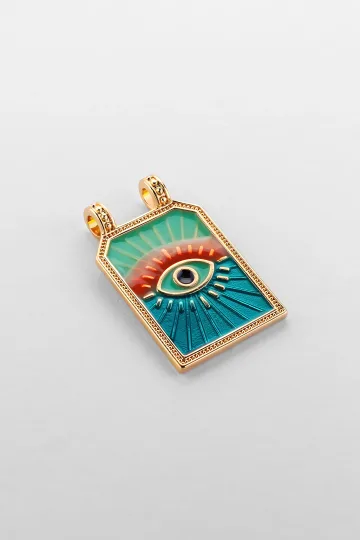
The blue concentric eye is the most widespread protective symbol in the world. Across Turkey, Greece, the Middle East, North Africa, and Central Asia, anywhere people believe in the evil eye (roughly 40% of the world's population), you will find the nazar.
On a ring, the nazar typically sits on a flat signet-style face or appears as a central stone with the characteristic white-blue-black concentric pattern. Some designs use enamel to recreate the traditional glass bead. Others use a blue stone (lapis lazuli, blue topaz, blue CZ) as a stylised interpretation.
Who wears it. Everyone. In Turkey, wearing a nazar is as unremarkable as wearing a cross in Italy. Believers wear it for genuine protection. Sceptics wear it because "well, it cannot hurt." Tourists buy it as a souvenir and then never take it off. The nazar crosses the line between faith and fashion so thoroughly that the line no longer exists.
The psychology. The evil eye belief centres on the idea that envious looks can cause harm. The nazar "watches back," deflecting negative attention. Whether you believe in envious energy or not, the feeling of being "watched over" has real psychological effects. It is a portable sense of security. More in our complete nazar guide.
The hamsa (Hand of Fatima / Hand of Miriam)
An open palm, often with an eye in the centre. Protection against evil, envy, and negative energy. The hamsa is shared across Islam, Judaism, and Christianity in the Mediterranean, a rare case where three religions agree on something.
On rings, the hamsa is usually small (8-12 mm) on the ring face. The combination of hamsa plus nazar (eye in the palm) doubles the protective symbolism. It is a belt-and-braces approach to warding off evil: the hand blocks it, the eye sees it coming.
Cultural reach. From Marrakech to Tel Aviv, from Naples to Istanbul. The hamsa appears in homes, cars, offices, and on jewellery. Its cross-cultural appeal is part of its power: it belongs to everyone and excludes no one. More in our hamsa guide.
The cross
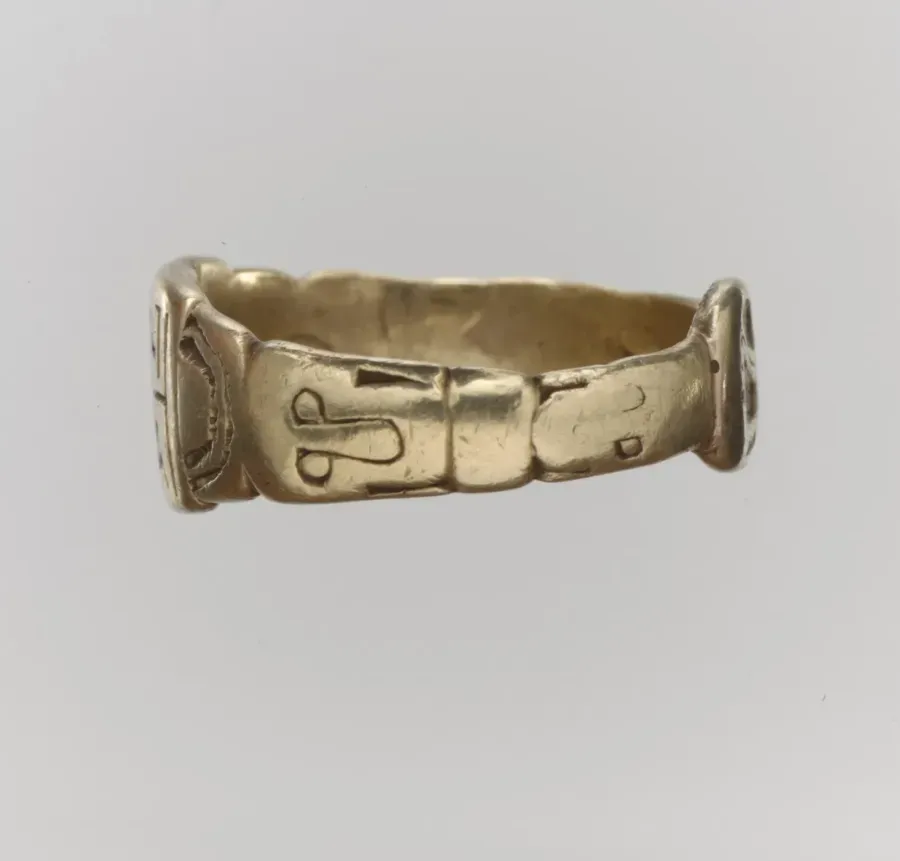
The most recognisable religious symbol in the world. On a ring, the cross can be engraved, cut out, set with stones, or form the shape of the ring itself. The protective aspect comes from faith in divine providence: God watches over those who bear His symbol.
But crosses on rings are not exclusively religious. In contemporary fashion, crosses are worn by non-religious people as cultural or aesthetic symbols. The meaning has broadened from "I believe in Christ" to "I value tradition, strength, and heritage." Both uses are valid.
Ring styles. Signet rings with engraved crosses. Bands with cut-out cross patterns. Gothic crosses with dark stones. Minimalist crosses as simple lines on a plain band. The style communicates as much as the symbol. More in our cross jewellery meaning guide.
The ouroboros
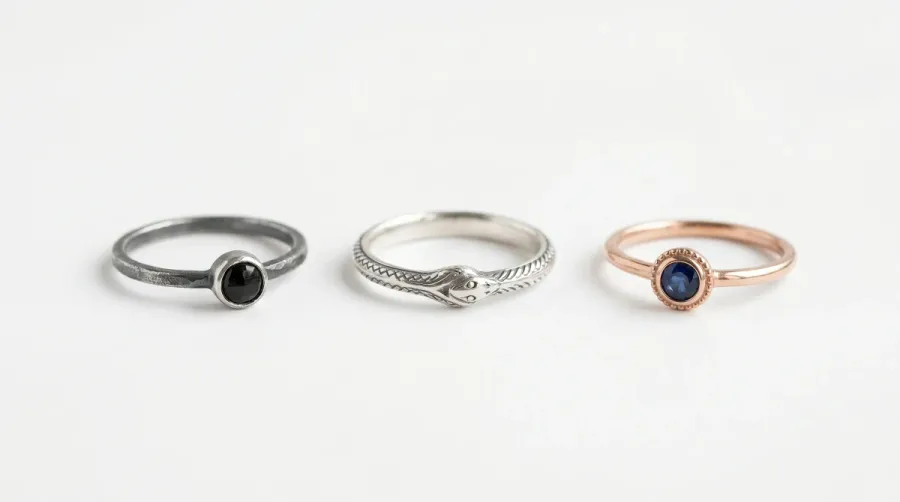
A serpent eating its own tail. On a ring, this is literal: a metal snake coiled around the finger, its head biting its tail. Protection through the idea of cyclicality: everything returns, nothing is lost forever, destruction feeds creation.
Ouroboros rings are among the most visually striking protective rings. Sculptural, three-dimensional, unmistakable. They sit at the intersection of protection, philosophy, and art. The snake does not just sit on the finger. It wraps around it. Possessively. Protectively. More in our ouroboros guide.
Runes
Norse runes on rings are not mere letters. In the Scandinavian tradition, each rune carries a distinct meaning and power:
- Algiz (ᛉ): Protection, shield. The most directly "protective" rune. On a ring, it is like wearing a shield on your finger.
- Eihwaz (ᛇ): Endurance, resilience. Protection through toughness rather than deflection.
- Thurisaz (ᚦ): Thorn, defensive force. Protection through counterattack. Not a shield but a weapon.
- Tiwaz (ᛏ): Justice, victory. The rune of Tyr, the god who sacrificed his hand to bind the wolf Fenrir. Protection through sacrifice and courage.
Runic rings are particularly popular among men who find other protective symbols too ornamental or too explicitly religious. Runes have a raw, martial quality that sits comfortably with masculine aesthetics. More about Norse symbols in our Aegishjalmur guide and Vegvisir guide.
The scarab
The Egyptian dung beetle, rolling a ball of dung as the sun rolls across the sky. A symbol of rebirth, renewal, and protection in the afterlife. On rings, the scarab is usually executed as a signet: a three-dimensional beetle figure on the ring face, sometimes with movable wings.
Egyptian protective symbols have been worn continuously for 5,000 years. The scarab is one of the oldest ring designs in existence, and modern versions maintain the essential form with remarkable fidelity. More in our scarab meaning guide.
The Eye of Horus (Udjat)
The restored eye of the falcon god Horus, destroyed in battle and reassembled by the god Thoth. A symbol of healing, wholeness, and victory over chaos. On rings, the Eye of Horus appears as a detailed engraving or relief on a signet face.
The Eye of Horus is protection with a story: "I was broken and made whole again." It resonates particularly with people who have survived difficult periods and want a tangible reminder of their resilience. More in our Eye of Horus guide.
The Claddagh ring
An Irish ring featuring two hands holding a heart, topped with a crown. Hands represent friendship. Heart represents love. Crown represents loyalty. Not a classical "protective" symbol in the sense of warding off evil, but a protector of relationships: a symbol of fidelity and promise.
How to wear it: heart pointing outward means single. Heart pointing inward means taken. Right hand for friendship or courtship. Left hand for engagement or marriage. This is one of the few rings where orientation carries specific, codified meaning. More in our Claddagh ring guide.
The signet with a personal symbol
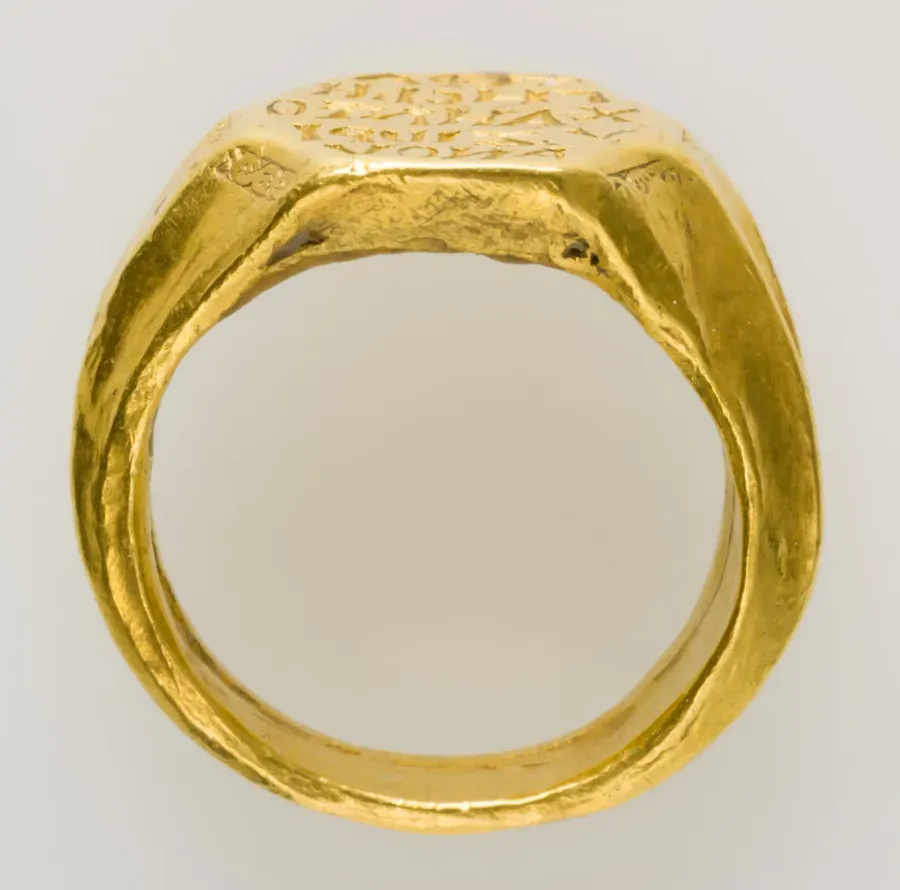
Historically, signet rings sealed letters: a personal mark, a signature, an identity. But many chose protective symbols for their signets: family crests, religious images, guild marks, astrological signs.
The modern interpretation: a signet bearing a symbol that is personally meaningful to you. Not necessarily from the classical "protective" canon. A compass for direction. An anchor for stability. A star for aspiration. Initials for identity. Whatever you associate with confidence and grounding.
One ring with a spine beats five that just sit there. A fistful of rings is a market stall, not a hand.
How to wear a protection ring
An amulet lives on your hand every day, so I build the look around a ring that settles into your wardrobe instead of fighting it. Here is what I recommend, by occasion.
Which protection ring should I wear every day? For daily wear I recommend a narrow band with a modestly engraved symbol in steel or silver. It sits happily with jeans, a plain tee and knitwear, does not snag and does not get in the way. Cool metal holds a calm palette: grey, blue, denim, white. One symbol on the hand, not five neighbours crowding it.
Is a signet ring right for the office? Perfectly, if you keep it restrained. I suggest a smooth signet or a ring with a minimal mark, a neutral metal and no loud stone. Under a long sleeve a wider signet reads well when it is the only ring and free of shine. Warm gold I pair with beige, brown and soft neutral tones.
How do I wear an amulet ring for the evening? In the evening the ring becomes the accent. I choose a fuller shape: a relief hamsa, a sculptural ouroboros, a ring with enamel or a dark stone. On a bare hand they read best, especially against deep colours: black, emerald, burgundy.
How do I combine it with other rings? The rule that never fails: one strong symbol at a time. If the amulet is large, keep the other rings as plain bands with no pattern. A stack of two or three narrow rings around one symbolic ring looks composed. I keep the metals in one family, and remember a ring on the hand and a pendant at the neck never compete since they live in different zones. More on that in our jewellery layering guide.
Who do protection rings actually suit? For a minimalist I recommend a thin band with a barely-there engraving: it asks for no attention and stays on the finger for years. For someone who likes character I suggest a heavy signet or a sculptural shape. Two rules that hold: the symbol should face outward, not hide in the palm, and size it to your warm, end-of-day finger or the ring will spin.

Turn on your camera, pick earrings, a pendant or a ring, and see the piece on yourself in real time.
Switch items in one tap.
Everything runs in your browser: no photo or video is ever uploaded.
Protective symbols from other eras
The catalogue above covers what you will actually find in a shop window. The symbols below turn up less often, but each has a documented protective role and a long life on rings.
The ankh
The Egyptian sign of life, a loop set on a cross, is one of the oldest protective symbols still in circulation. On rings it appears from the New Kingdom onward, held by gods in tomb painting as the thing they extend toward the living. Worn today it reads as protection of life itself rather than protection from any particular threat, which makes it a quiet choice for people who dislike the confrontational look of an eye.
Thor's hammer
Mjolnir is a hallowing symbol before it is a weapon. Norse practice used the hammer sign over births, marriages and burials, and the small silver hammers found across Scandinavia and northern England were worn on cords rather than fingers. Ring versions are modern, and they sit best as a broad band with the hammer carved in relief rather than as a dangling charm. Note that the symbol has been adopted by groups nobody wants to be confused with, so context and setting matter.
The valknut
Three interlocked triangles, found on Gotland picture stones and on the Oseberg ship burial, associated with Odin and with the passage between worlds. Its protective reading is about courage in the face of what cannot be avoided rather than about deflecting harm. Graphically it is one of the strongest symbols on a signet face, because the interlace reads clearly even when cut small.
The triskelion
Three legs or three spirals turning from a common centre. The version at Newgrange in Ireland predates the pyramids; the three-legged variant is the emblem of the Isle of Man and of Sicily. As a protective device the meaning is motion and continuity, the idea that nothing that keeps turning can be caught. It suits a narrow band, where the spiral wraps rather than sits.
The phoenix
A bird that burns and returns. Classical authors describe it, medieval bestiaries keep it, and by the Renaissance it is a standard emblem of resurrection and of survival through disaster. On rings it belongs to the same family as the toadstone and the garnet: symbols people choose after something has already gone wrong, rather than in advance of it.
The dragon
In European heraldry the dragon guards, in Chinese tradition it brings rain and fortune, and in both it is a boundary creature that stands between the wearer and whatever is outside. Dragon rings are usually wraparound designs where the body forms the shank and the head meets the tail. Practically, they catch on clothing, so a low-relief version is the wearable one.
Protective stones in rings
The metal carries the symbol, but the stone often carries the older belief. These six turn up again and again in protective ring traditions across Europe and the Middle East.
Turquoise, the stone that warns
The most widely held belief about turquoise in Europe and Persia alike is that it changes colour when its owner is in danger or in poor health. The belief has a real basis: turquoise is porous, and it genuinely shifts from sky blue toward green as it absorbs oils, soap and moisture from the skin. A stone that visibly responds to the person wearing it was bound to be read as a stone that watches over them. Turquoise rings were standard riding jewellery in Europe for centuries, on the theory that they protected against falls.
Agate and carnelian, the stones of the Islamic signet
The carnelian signet is one of the most persistent ring traditions anywhere, worn across Persia, the Ottoman lands and Central Asia for well over a thousand years, usually engraved with a name or a short inscription. Agate carries a separate and much older protective reputation, going back to Mesopotamian eye beads: a banded agate cut so the rings of colour form a circle is, quite literally, an eye you can wear.
Garnet, the stone of return
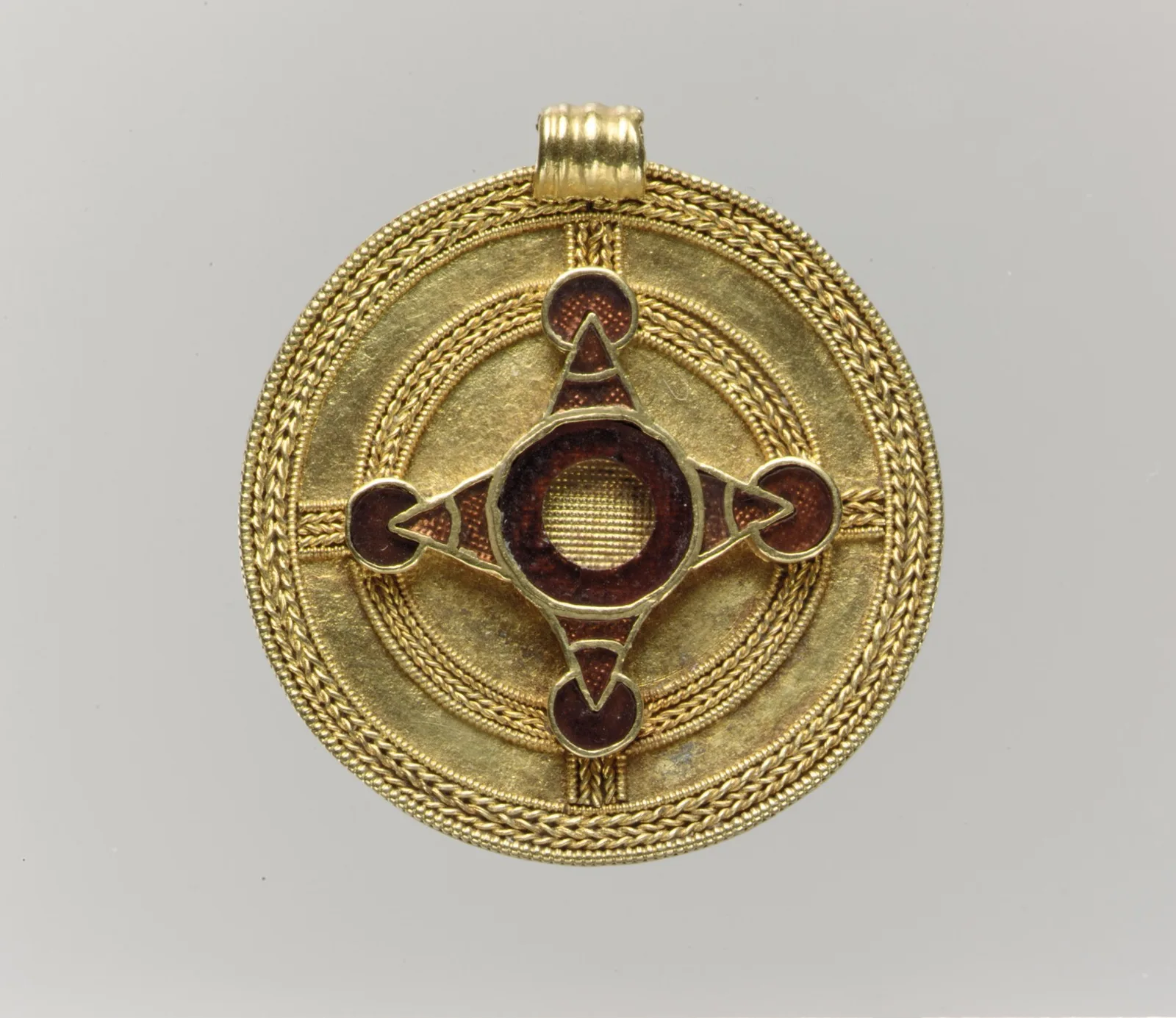
Dark red garnet travelled with soldiers and sailors, and the belief attached to it is specific: it brings the wearer back. Anglo-Saxon and Merovingian goldwork is full of thin garnet slices set over gold foil, and the stone stayed in that role through the Crusades. It is a good choice for a farewell ring, which is where the tradition mostly used it.
Moonstone and rock crystal, the quiet ones
Both are defensive rather than assertive. Rock crystal was set into medieval reliquary rings because it let you see what was inside while sealing it off, and it kept the associations of clarity and truth. Moonstone belongs to a softer strand of the tradition entirely, connected with intuition, sleep and safe travel by night. Both are soft enough that a bezel setting is not optional.
Amber, the warm guard against the eye
Baltic amber is the folk amulet of the whole northern and eastern Baltic coast, given to children against the evil eye and to adults against joint pain. Galician and Asturian practice uses black jet for the same purpose, which is why azabache and amber often appear in the same sentence in Spanish sources. Amber is fossil resin, so it is very light and very soft, and a ring set with it needs a protective rim.
The toadstone and the legend of poison
English medieval belief held that a stone grew in the head of an old toad, that it sweated or changed colour in the presence of poison, and that a ring set with one would protect the wearer at table. The stones sold as toadstones are in fact the fossilised palate teeth of a Jurassic fish, and they turn up in surviving English rings from the thirteenth century onward. The belief is nonsense; the rings are real, and they are a neat reminder that protective jewellery has always been a mixture of hard craft and hopeful thinking.
Customer reviews
Zevira is a real jewellery shop. Genuine payments, deliveries and customer thank-yous.
🥰🥰🥰 gracias
Ok, ¡gracias! 🙂
History of protection rings
Ancient Rome: the ring as passport and shield
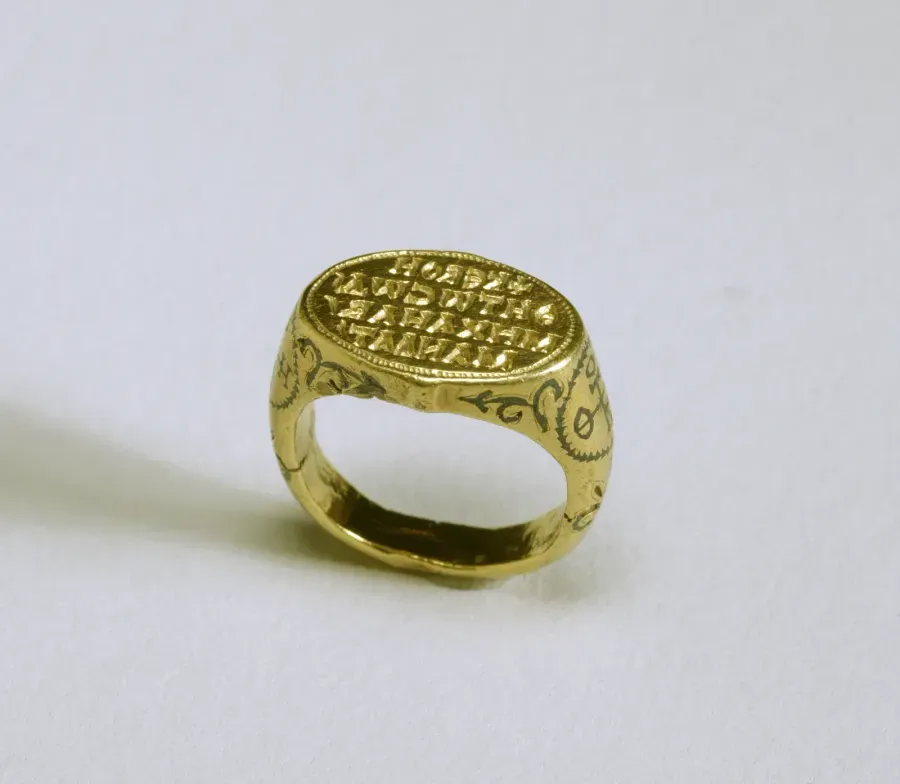
Roman signet rings (sigillum) combined practical and protective functions. A Roman citizen wore his signet to seal letters and documents. It was his signature, his verification. But the choice of image on the signet was often dictated by belief in protection.
Legionnaires engraved Mars (god of war) or the eagle (symbol of the legion and Rome). Sailors chose Neptune or dolphins. Merchants chose Mercury. Each selected a patron and wore them on the finger. Losing the signet was considered an ill omen for two reasons: it could be used fraudulently, and the patron had "departed."
Medieval bishop's rings
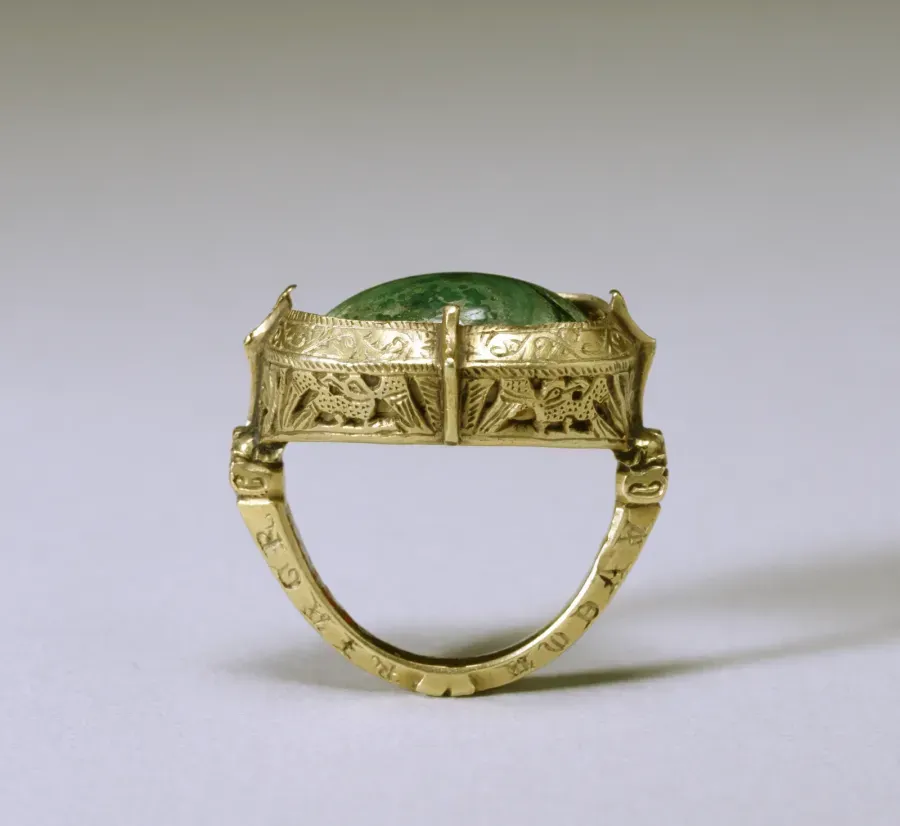
The episcopal ring was not merely a symbol of office. In the medieval period, it was considered a literal protective artefact. Prayers, names of saints, and crosses were engraved on the band. The faithful kissed the bishop's ring to receive blessing. The ring was the conduit of that blessing.
Knights departing for the Crusades received rings with consecrated metal. The ring was believed to protect in battle. A historian might say "superstition." A knight who survived the battle would say "it works."
Military traditions
The connection between rings and military service is ancient and deep.
Pilots' rings. During the Second World War, pilots wore rings with compasses, wings, and stars. Partly identification. Partly talisman. The tradition migrated to modern aviation: many pilots wear talismanic rings, even if they do not admit it publicly. More about compass symbolism in our compass meaning guide.
Marine Corps rings. The USMC ring (United States Marine Corps) is more than an accessory. It is a symbol of brotherhood, service, and protection. Marines wear it for life, never removing it. The ring becomes part of the body and part of the identity. In this sense, it is a talisman not mystical but social: "I am from these people, and these people stand behind me."
The farewell ring. In many cultures, a wife or mother gives a ring to a man departing for war or a dangerous journey. "While you wear this, I am with you." This custom is documented from antiquity through the twentieth century. The ring as a physical connection to home, to those who wait.
The modern version: giving a protection ring before a difficult period such as a new job, a move, or exams. The meaning is the same: "I am thinking of you, and may this protect you."
Rings with words: posy rings and prayer rings
Posy rings: a line of verse inside the band
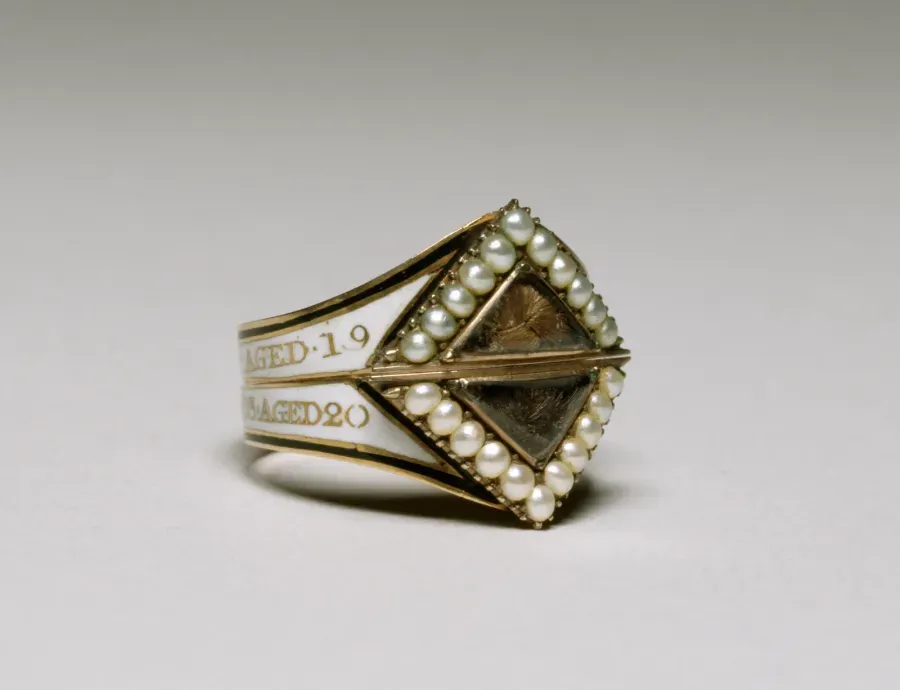
For roughly four centuries, from the late medieval period to the Georgian era, English and Welsh lovers exchanged gold bands engraved on the inside with a single line of rhyme. The word comes from "poesy". The outside was usually plain; the message was private, worn against the skin, readable only by the owner and by whoever gave it. Surviving examples in British collections carry lines like "not two but one till life be done" and "in thee my choice I do rejoice".
Posy rings are not amulets in the strict sense, but they work by the same mechanism as one. A sentence carried permanently against the finger is a fixed intention, and their protective use is explicit in some inscriptions, which ask for God's keeping rather than for love. Modern engraved bands are the direct descendants, and the practical advice from four hundred years of them is unchanged: keep it short, and put it inside.
The Claudius ring and the origin story of the wedding band
The legend that a Roman emperor forbade marriage to keep his soldiers unattached, and that a priest married them in secret and was executed for it, is the folk origin of both the wedding ring and the mid-February feast attached to it. Historians treat the story as later invention layered onto an older Roman betrothal custom, in which an iron ring was given to the bride's family as a pledge and a gold one worn afterwards. Whatever its history, the story explains why the wedding band is so often described in protective terms rather than romantic ones: it was framed from the start as a thing worn against danger.
The wedding band as a protective sign
Across most of Europe the wedding ring doubles as an amulet, and the folklore is remarkably consistent. A ring that will not come off is read as a good sign, a lost ring as a warning, and a cracked one as something to be repaired at once rather than replaced. In several English counties the wedding ring was rubbed on a sty or a wart as a cure, which is a purely magical use of a piece of jewellery worn by almost everyone. If you want a protection ring but dislike overt symbolism, this is the tradition to lean on: a plain band, engraved inside.
Upload a photo of your pet, someone you love, or an object. We'll build a 3D model and hand-cast it in pewter.



Protection ring traditions around the world
Turkey and Greece: a nazar on every threshold
The blue eye is not a niche belief in either country, it is ambient. It hangs in taxis, over shop doors and above cots, and the ring version is simply the portable form. Greek practice adds the verbal element: a compliment is often followed by a small sound to break the eye that the compliment might have attracted. Turkish silverwork sets the glass eye flush into a wide band, which is the most practical version, since a raised glass cabochon on a ring will eventually meet a door frame.
Ireland: the Claddagh as an heirloom
Hands, heart and crown: friendship, love and loyalty. The design comes from the fishing village outside Galway and belongs to the wider European fede tradition of clasped-hand rings. What makes it a protective object rather than a romantic one is how it is used: Claddagh rings are handed down the female line, and a grandmother's ring worn by a granddaughter is understood to carry the family with it. The direction the crown points still signals whether the wearer is attached, which is a live custom rather than a tourist explanation.
Spain and Galicia: azabache against the eye
Jet from the Asturian coast has been carved into protective amulets since the medieval pilgrimage routes made Santiago a workshop town. The classic form is the figa, a small closed fist, given to infants against the evil eye and still sold across Galicia and Asturias. Jet is warm to the touch, extremely light, and soft enough to carve in detail, which is precisely why it became the material of choice for amulets that children would wear.
Scandinavia: the runic band as a personal shield
Rune-inscribed rings survive from the Viking age onward, and a handful of them carry sequences that appear to be charm formulas rather than language. The Kingmoor ring, found in Cumbria and now in the British Museum, is the best known: twenty-nine runes that spell nothing in any language and were almost certainly a healing or protective charm. Modern runic bands follow the same logic, and the practical advice is to know what your inscription says before it is cut into metal that you intend to keep.
England: cramp rings and the royal touch
From the fourteenth century, English monarchs blessed rings on Good Friday which were then distributed as cures for cramp and falling sickness. The rings were ordinary gold and silver bands; the belief was that the blessing, and the monarch's touch, made them medicinal. The practice ran for two centuries and only died out under Elizabeth I. It is worth knowing because it is the clearest documented case in British history of protective jewellery issued as a matter of state, rather than made by a village silversmith.
Protection rings and religious traditions
The Christian tradition
The church has never been comfortable with amulets and has always been full of them. Ring rosaries, worn on a finger with ten beads or bumps around the band, are a devotional object used exactly as a protective one, turned during prayer. Episcopal rings mark office. Pilgrim rings brought back from Santiago, Canterbury or Rome carry the mark of a shrine, and the wearer's confidence in them was never really separate from the confidence in the shrine.
The Islamic tradition
The carnelian or agate signet is the standard form, worn on the right hand and often engraved with the wearer's name, a phrase, or a short line of scripture. There is a well-established preference for silver over gold in men's jewellery, which is why so much traditional Islamic ring work is silver with a single large stone. The inscription is what carries the meaning, and rings of this kind are frequently handed down.
Buddhist mantra rings
A band engraved with a mantra in Tibetan script, most often the six syllables of the mantra of compassion, is worn as a practice object rather than as a charm. The distinction matters to practitioners: the ring does not act on the world, it reminds the wearer of something. Rings of this kind are usually broad, silver, and rotate on a second inner band so they can be turned like a small prayer wheel.



Which finger for a protection ring?
Traditions vary by culture, but common patterns emerge:
Ring finger (left hand). Traditionally connected to the heart (vena amoris). Protection rings for relationships (Claddagh, eternal love symbols) often live here.
Index finger. The finger of authority and direction. Signet rings historically went on the index. A protection ring on the index says: "I direct my own life."
Middle finger. Balance, responsibility. The neutral position. If you do not know where to put it: the middle finger is safe.
Little finger (pinky). In some traditions, the pinky is connected to intuition and communication. Small signets on the pinky are classic, especially in British and Italian traditions.
Thumb. Uncommon but gaining popularity. A thick band or signet on the thumb is a bold statement. In some martial traditions, the thumb ring was a practical tool (archery thumb rings in Eastern cultures). On modern rings, it signals confidence and willingness to stand out.
More about ring placement meanings in our ring finger meaning guide.
Materials for protection rings
Stainless steel 316L. The practical choice for an everyday talisman. Does not tarnish, does not cause allergic reactions for most people, survives daily wear without showing it. A protection ring should be on the finger always: 316L allows that without maintenance.
Sterling silver 925. Silver has a long folklore association with protection. Silver bullets against werewolves. Silver crosses against vampires. Whether you believe in monsters or not, silver as a "protective metal" is deeply embedded in Western culture. If you choose silver for a protection ring, tradition is on your side. More in our silver 925 guide.
Black steel / Black PVD. Black rings with protective symbols are visually powerful. Black associates with strength, mystery, and defence. PVD coating is durable and does not wear off: important for a ring meant to be worn permanently.
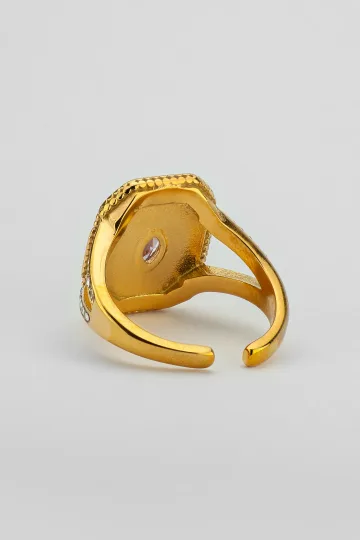
Gold. In many traditions, gold represents divine light and incorruptibility. A gold protection ring carries the weight of precious metal and the symbolism of permanence. But gold scratches, and a scratched protection ring can feel like it has been "damaged" symbolically. Stainless steel may be psychologically better for a daily talisman: it does not show wear.
More about metals in our brass, steel, and silver comparison.
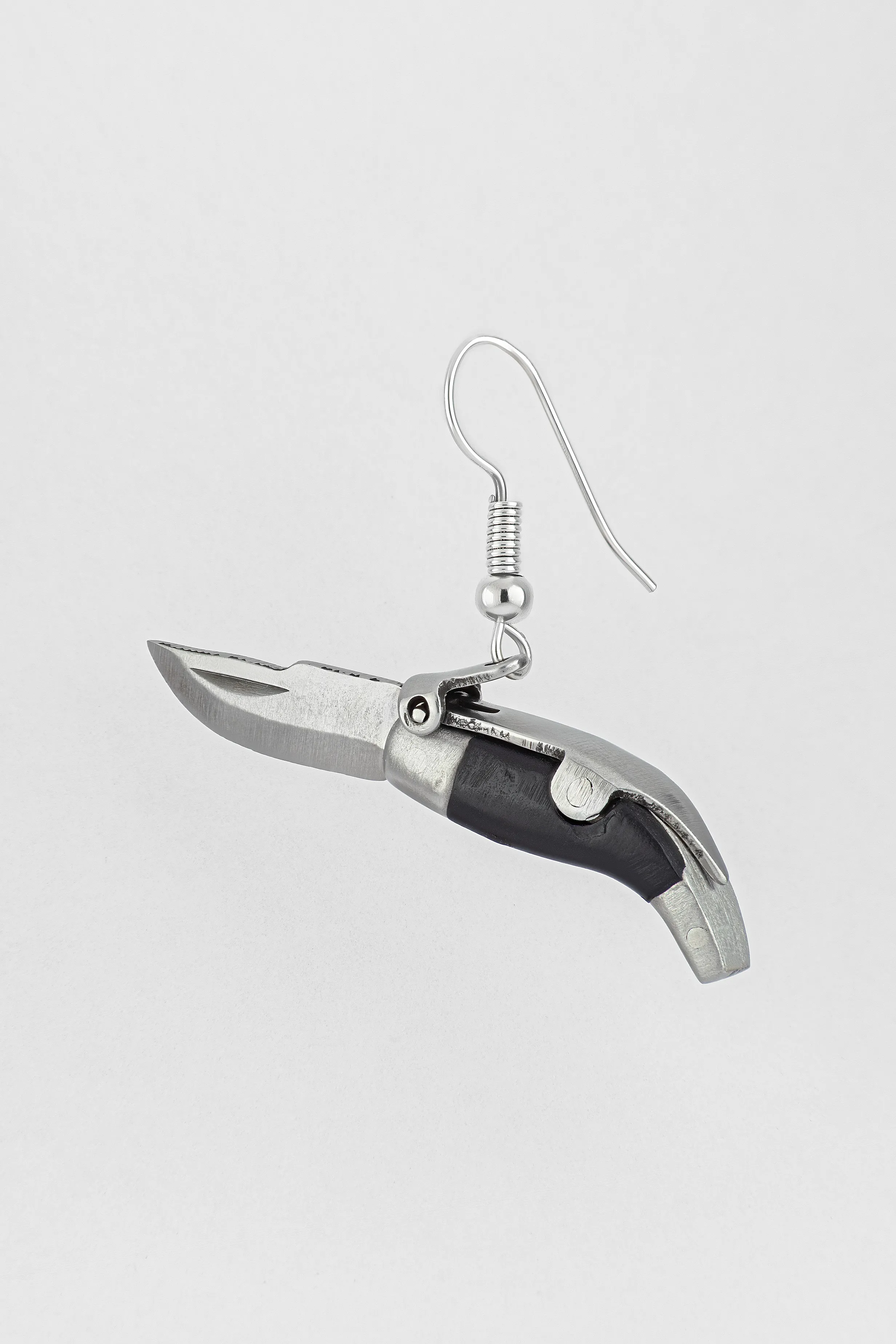
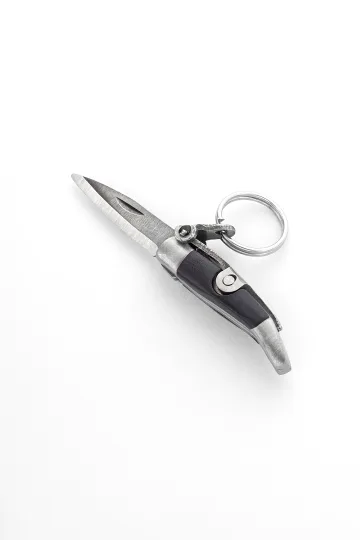
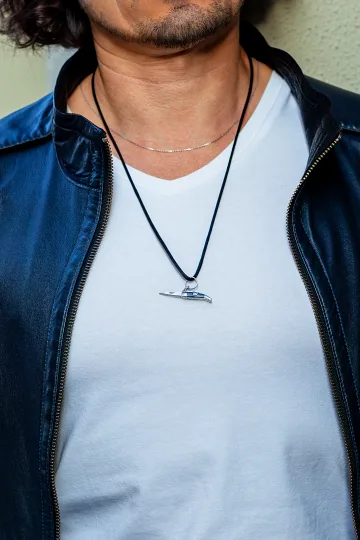
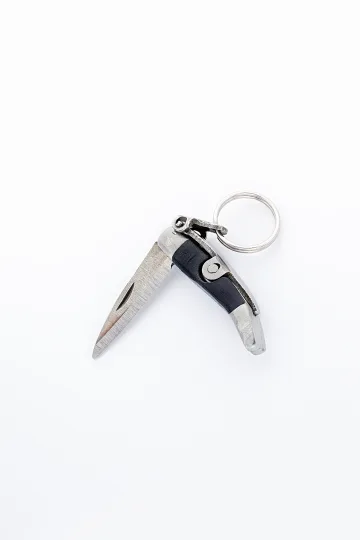
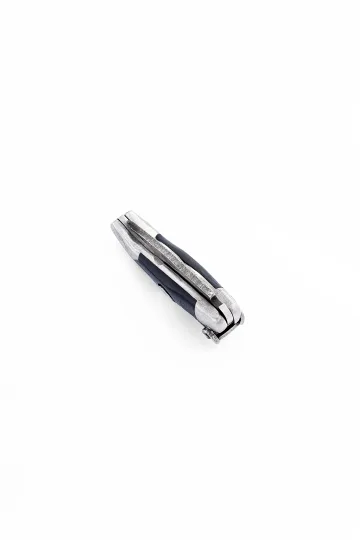
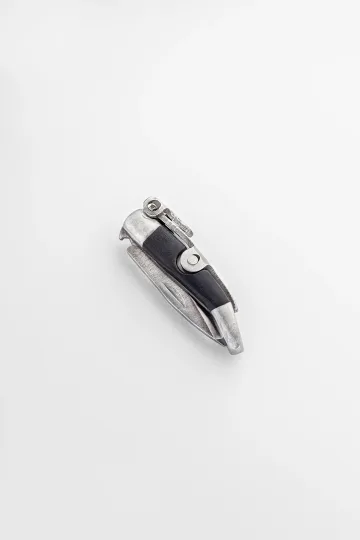
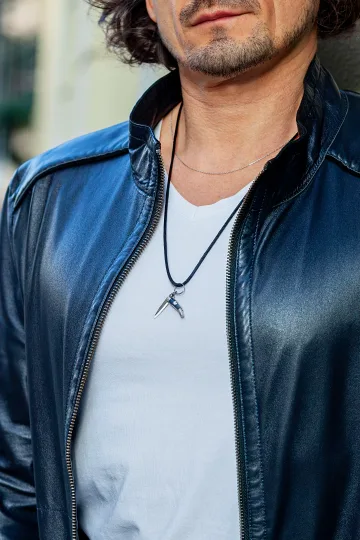
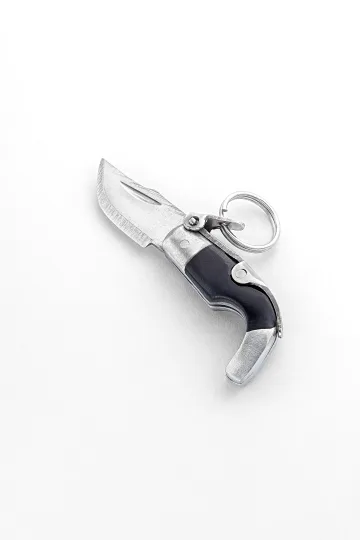
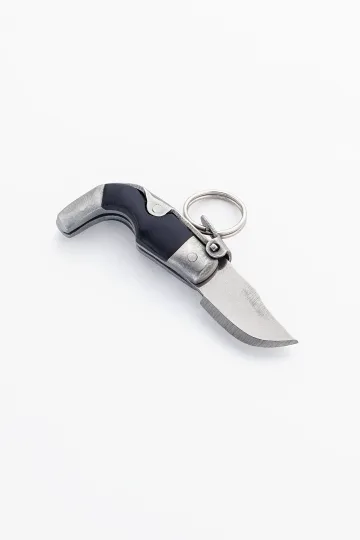
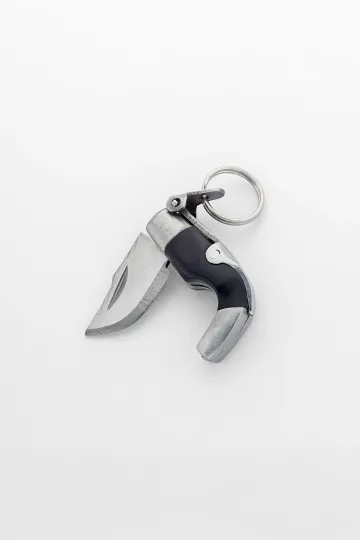
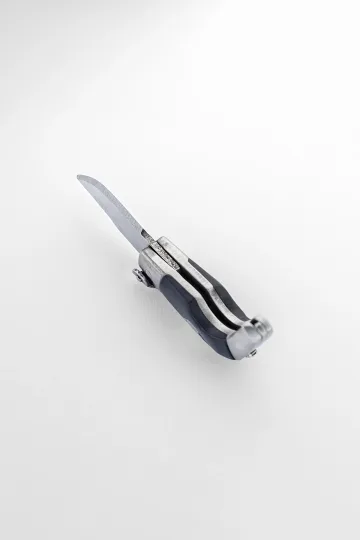
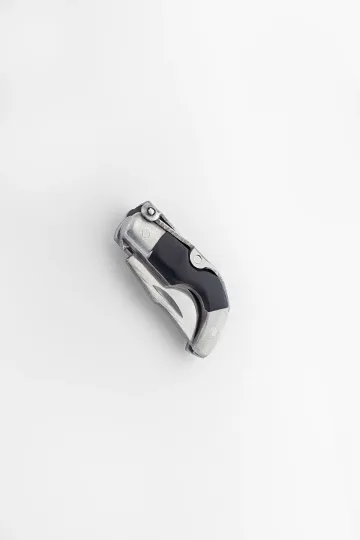
CAPAORA mini knife pendant
The 18th-century Spanish navaja in miniature: 40 mm of stainless steel, a real folding mechanism and a Palanquilla lock that clicks. An affordable gift to remember.
Authentic · Ships from Spain · 14-day returns
Engraving a symbol: what lasts and what wears away
A protection ring is usually a ring you never take off, which puts the engraving in a fight with your own hands. Some of it survives decades; some of it is gone in two years.
Depth beats detail. Hand engraving with a graver cuts a V-shaped channel that keeps a crisp edge as the surface wears. Laser marking is shallow and superb for fine text, but on the outside of a band it fades under the same friction that polishes the metal. If the design must sit on the outside, ask for it cut, not marked.
Inside survives, outside does not. The inner surface of a band touches only the finger and wears at a fraction of the rate. This is why four-hundred-year-old posy rings still read clearly inside and are worn smooth outside. Anything you want your grandchildren to read goes inside.
Relief outlasts line. A symbol carved so that it stands proud of a recessed background survives far better than a symbol scratched into a flat face, because the wear happens on the high points and the shape stays legible. Signet faces work on this principle.
Metal decides the timeline. Fine gold and fine silver are soft and take detail beautifully, then lose it. Sterling silver, 14K gold, palladium and steel all hold an engraving longer. If the piece is symbolic rather than precious, steel keeps a mark almost indefinitely.
Oxidation is maintenance, not permanence. The blackening that makes an engraved pattern readable is a surface treatment. It will lift out of the high points within months of daily wear and eventually out of the grooves as well. Any jeweller can re-blacken it; expect to ask every few years.
Check the text twice, then again. Runes, Hebrew, Arabic and Tibetan all have letter forms that are easy to reverse or mis-sequence, and an engraving is not an edit. Have the exact string written out, confirm it with someone who reads the script, and approve a proof before the tool touches the ring.
Leave your email, we'll send your discount code. No spam, unsubscribe anytime.
The code arrives by email, valid on your first order.
The psychology of protection rings: why they work even if you do not believe
Placebo is not an insult. The placebo effect is a proven scientific phenomenon. If a person believes a pill will help, it helps in 30% of cases, even if the pill is sugar. The brain initiates real physiological processes in response to belief.
A protection ring works on the same principle. You associate it with safety. You put it on. You feel more confident. You act more confidently. You get better results. The ring did not protect you. Your confidence did. But the ring activated that confidence.
In psychology, this is called "anchoring": a physical object linked to an emotional state. Athletes wear "lucky" socks. Actors hold talismans before going on stage. Students spin their "lucky" ring during exams. The mechanism is identical in all cases: the object triggers the state.
We do not promise that a nazar ring will stop an envious person. But if it gives you a 5% boost in calm on a stressful day, that is already working. And 5% more calm is priceless. Ask anyone who has ever had a panic attack whether they would trade it for 5% more calm.
The anxiety ring phenomenon
A recent development: rings specifically designed to be fidgeted with. Spinner rings with a rotating band. Textured bands for tactile stimulation. Beaded rings that can be rolled between fingers. These are not "protection" in the traditional sense, but they serve the same function: something on the finger that provides comfort through physical interaction.
The crossover between protection rings and anxiety rings is natural. A person who spins their ouroboros ring during a stressful meeting is doing exactly what a spinner ring is designed for. They just happen to be spinning a 3,000-year-old protective symbol instead of a purpose-built fidget device.
Protection rings as gifts
Protection rings are one of the best symbolic gifts because they carry a specific and positive message.
When to give:
- Before a journey or move ("may this protect you on the road")
- After recovery from illness ("you survived, like the Eye of Horus")
- Before exams or a new job ("carry this for strength")
- After a difficult period ("order after chaos")
- Birthday or graduation ("your potential is limitless, and this watches over you")
Who to give to:
- People who appreciate symbolism with depth
- People who have survived a tough time
- People interested in history and mythology
- Anyone who could use a tangible reminder that someone cares
How to explain (if needed): Keep it to three sentences. "This is a [symbol name]. It has been used for [number] years as a symbol of protection. I want you to have it because [personal reason]."
The explanation should be brief. The ring should speak for itself.
More gift ideas in our gift for girlfriend guide and gift for boyfriend guide.
Protection rings for men vs women
Men's protection rings
Men gravitate toward larger, heavier, darker protection rings. Thick bands with deep engravings. Signet-style rings with runic or Norse symbols. Black PVD-coated rings with skulls (memento mori), wolves (wolf symbolism), or serpents.
The aesthetic is martial, raw, and unapologetic. Men's protection rings do not whisper. They declare.
Women's protection rings
Women's protection rings tend toward smaller, more detailed designs. Delicate nazar eyes with enamel. Thin bands with engraved crosses. Small hamsa on a dainty signet. Rose gold or silver tones.
But these are tendencies, not rules. A woman wearing a thick ouroboros ring is not "wearing a men's ring." She is wearing a powerful symbol on her own terms.
Unisex designs
The nazar, the hamsa, the Eye of Horus, and the infinity symbol work across all genders without modification. Their symbolism is universal, and their ring designs range from delicate to bold in every line.
Care for protection rings
Protection rings are everyday jewellery by definition. They are not worn occasionally. They live on the finger. This means they need materials that survive daily wear.
316L stainless steel: wipe with a soft cloth occasionally. That is all. No polishing, no special storage, no worry about water or sweat.
Sterling silver: polish every 1-2 weeks if worn daily. Tarnish is inevitable but easily managed. More in our tarnish restoration guide.
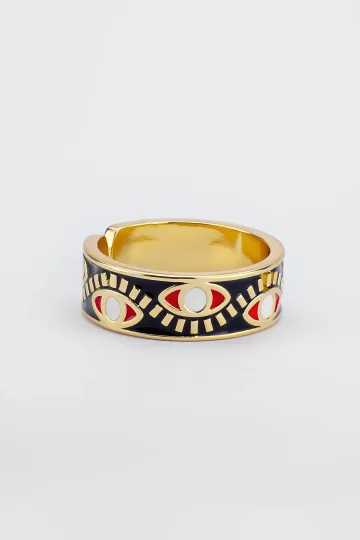
With enamel: if the protective symbol includes coloured enamel (common with nazar and hamsa designs), treat the enamel gently. No impacts, no abrasives, no extreme temperature changes. More in our enamel care guide.
Sizing matters. A protection ring should fit securely. Too loose and it falls off (losing your talisman is symbolically terrible). Too tight and it restricts blood flow. One finger width of movement when the hand is flat. More in our ring size guide.
FAQ
Are protection rings superstition? Depends on perspective. For believers, they are a tradition with millennia of history. For sceptics, they are beautiful jewellery with a psychological bonus. Both positions are valid.
Which hand should I wear it on? No universal rule. Traditions vary. Wear it on whichever hand and finger feels right and does not interfere with daily tasks.
Can I wear multiple protection symbols? Yes, but from a style perspective, one strong symbol is more memorable than five different ones. Five creates noise. One creates identity.
What metal should a protection ring be? Whatever suits you. Folklore ascribes protective properties to silver. Practically, wear whatever does not cause allergies and survives daily use.
Can I give a protection ring as a gift? Yes, and it is one of the best gift ideas. "I want you to be protected" is a powerful message. Especially before a journey, a new job, or a difficult period.
What if a protection ring breaks? In superstitious tradition: "it took the hit for you, it protected you." In practical terms: the metal fatigued or took mechanical damage. Replace it and do not worry.
Which protection symbol is "strongest"? The one you believe in most. A nazar for someone from Turkey, a cross for a Christian, a rune for a Scandinavian enthusiast. The psychological effect depends on personal connection, not objective power.
Do protection rings work? Define "work." Will they stop a car accident? No. Will they make you feel 5% calmer and more grounded? Possibly. And sometimes 5% is the difference between a good decision and a bad one.
Protection rings in sport and performance
Athletes are among the most superstitious people alive. And rings play a role.
Tennis players who touch their ring between serves. Boxers who wear a specific ring to every pre-fight ritual. Runners who spin their band before a race. The connection between a physical object and peak performance is well-documented in sports psychology. It is called a "pre-performance routine," and the object (ring, bracelet, sock, whatever) anchors the athlete in a state of readiness.
Protection rings fit naturally into this context. A ring with a symbol that means "strength" or "invincibility" works as more than decoration for an athlete. It is a trigger for the mental state they need. Whether the protection is "real" is irrelevant. The performance boost is measurable.
The watch-and-ring combination. Many professional athletes and performers wear a ring on the opposite hand from their watch. The ring on the non-dominant hand, the watch on the dominant. Or vice versa. The ring grounds them. The watch times them. Both are essential.
Send a friend a discount code, they save on their first order.
Protection rings in modern anxiety culture
We live in an age of ambient anxiety. Social media comparison, economic uncertainty, political instability, climate worry. Background noise that never stops. Protection rings are experiencing a renaissance precisely because of this.
The modern wearer of a protection ring is not necessarily superstitious. They might be a graphic designer in Bristol who spins their ouroboros ring during client calls. Or a student in Edinburgh who touches their nazar ring before presentations. Or a nurse in Manchester who wears a hamsa ring through twelve-hour shifts.
These people do not believe the ring has magical properties. They believe in the ritual. Put the ring on: work mode. Touch the ring: calm mode. The ring is a switch, not a shield. But the effect is the same.
Anxiety rings vs protection rings. The market for "anxiety jewellery" (spinner rings, fidget rings, textured bands) has exploded. These are rings designed specifically to be played with during moments of stress. Protection rings were doing this for centuries before anyone invented the category. The ouroboros you spin during a meeting is an anxiety ring that predates the concept by 3,000 years.
The tactile element. What makes rings particularly effective as anxiety tools (versus pendants or bracelets) is the finger. Fingers are the most touch-sensitive part of the body. The density of nerve endings in the fingertips is extraordinary. A ring that you rotate, press, or feel against the adjacent finger provides constant, subtle sensory feedback. That feedback anchors you in the present moment, which is the foundation of every mindfulness technique ever invented.
Buying it as a gift? Each one arrives ready to give.
 A branded Zevira box and a little card come with every order.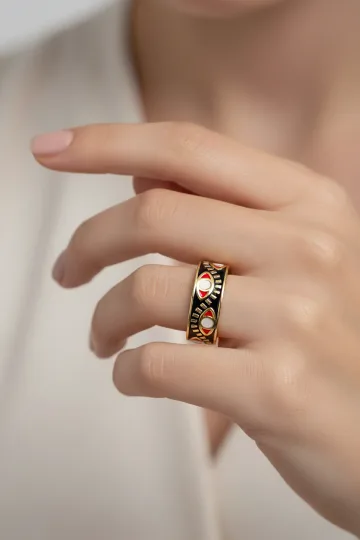





Protection rings in art and literature
The ring in portrait painting
Renaissance and Baroque portraiture treats rings as information. A sitter holding one between finger and thumb is usually signalling a betrothal or a completed contract; a ring hung on a cord at the neck indicates that the giver is absent or dead. Northern European portraits often show several rings worn above the knuckle, which was fashion rather than accident and made the stones visible at the angle the painter needed. Once you notice this, half the hands in any old master gallery start reading as sentences.
The ring in folklore and fairy tale
The wishing ring, the ring that grants invisibility, the ring that must not be given away: these are among the oldest portable plot devices in European storytelling. Plato describes a shepherd who finds a ring that makes him invisible and asks what an honest person would do with it, which is still the sharpest version of the question. Norse tradition has Andvaranaut, a cursed ring that returns misery to every owner, and that thread runs directly into the medieval Nibelung material and out again into nineteenth-century opera.
The ring as the knot of the plot
Stories reach for rings because a ring is small, portable, identifiable and impossible to divide. It can be lost, stolen, swallowed by a fish and recovered, which is the shape of the Polycrates story in Herodotus and of a dozen folk tales after it. Solomon's seal ring, in the versions told across Jewish, Christian and Islamic tradition, commands spirits and is lost the moment it leaves his hand. The moral is consistent across all of them: the object holds power only while the owner keeps hold of it, which is a fairly practical thing to remember about a ring you intend to wear every day.
Choosing your protection symbol: a practical guide
If you are new to protection rings and want to choose your first, here is a decision framework:
If you want universal protection: nazar or hamsa. These are the broadest, most culturally widespread protective symbols. They do not require commitment to any specific religion or tradition. They simply say: "I am protected."
If you want cultural connection: choose a symbol from your own heritage. A Celtic knot if you have Irish or Scottish roots. A Norse rune if you identify with Scandinavian culture. A scarab if you are drawn to Egyptian history. A Claddagh if you are Irish. The connection to your own tradition deepens the psychological effect.
If you want philosophical depth: ouroboros. It is not just "protection." It is a worldview: everything is cyclical, nothing truly dies, destruction and creation are the same process. Wearing an ouroboros is wearing a philosophy.
If you want minimal commitment: a plain band with a tiny engraved symbol on the inside. Only you know it is there. The protection is private. No one asks questions. No one needs an explanation.
If you want to make a statement: a large signet ring with a bold symbol on the face. A nazar eye in vivid blue enamel. An ouroboros in high relief. A runic inscription in blackened steel. This ring will be noticed, commented on, and remembered.
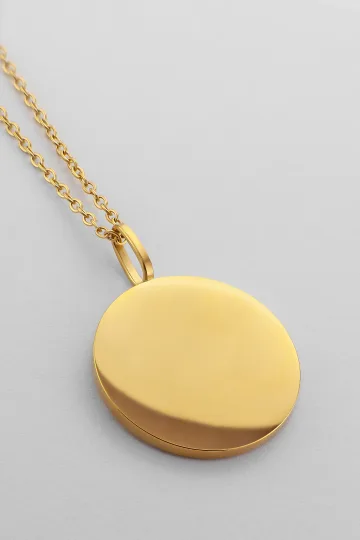
Silver and gold jewellery, wedding bands, symbolic pendants, paired sets.
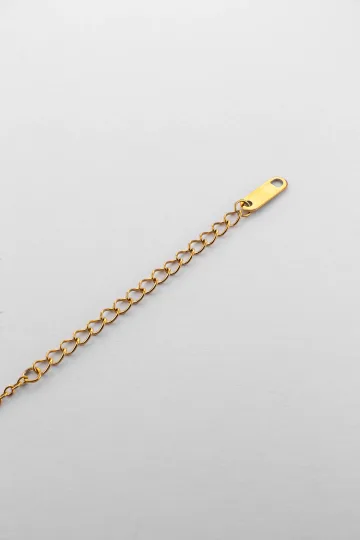
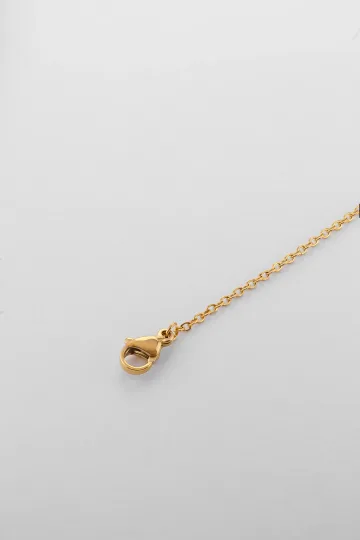
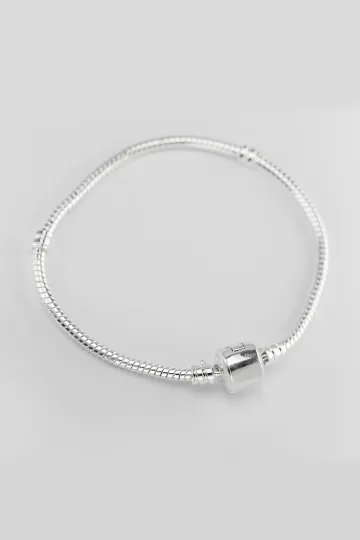
Wear the symbol, don't just read about it. These are in stock:


The bottom line
A protection ring is not magic and it is not nonsense. It is a millennia-old tradition adapted to a modern context. You wear a symbol that means "I am safe" or "I am strong" or "someone watches over me." And every time you look at it or spin it on your finger, that symbol reminds you.
Is there magic in this? Maybe. Is there psychology in this? Definitely. Is there beauty in this? Always.
Here is what we know for certain: humans have been wearing protective symbols on their fingers for at least 5,000 years. Across every culture, every continent, every religion. If it did not work on some level (psychological, emotional, spiritual, or simply aesthetic), it would have disappeared centuries ago. It did not. It grew.
A ring on your finger that makes your day slightly calmer, slightly more grounded, slightly more intentional? That ring is working. Whether it is the ancient gods, the placebo effect, or simply the comfort of a ritual does not matter. The calm is real. The grounding is real. The feeling that someone (even if that someone is you, past-you, the version of you that chose this ring) is looking out for you? That is real too.
And if that is not protection, nothing is.
About Zevira
Zevira makes jewellery in the artisan tradition of Albacete, Spain. In the Spanish tradition, protection rings are a chapter of their own: from azabache in Galicia to charms against the evil eye in Andalusia. We carry that line forward in our collections.
What you can find with us:
- Rings with protective symbols (nazar, hamsa, the Eye of Horus)
- Signet rings with an engraved cross or an anchor cross
- Sacred Heart rings in the Spanish tradition
- Men's protection rings in a chunky signet style
- Slim symbol rings that can be worn several to a hand
Every piece is made by a craftsman by hand, with the option of personal engraving. We work in sterling silver 925 and 14-18K gold.